Category Archives: Extra

TMBP Extra: Christmas time is here again

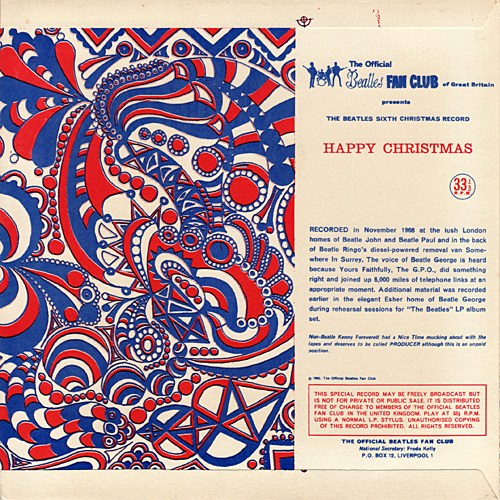
1968_sleeve_back

Quick quiz: When the Beatles convened Jan. 2, 1969, at Twickenham for the Get Back/Let it Be sessions, what was their most recent record release?

It wasn’t the “Hey Jude” single, which was still on the charts , but came out the end of August 1968. It’s not the White Album either — that came out at the end of November.  The soundtrack to the Yellow Submarine film was released nearly two weeks into the January 1969 sessions, with songs that had long been recorded.

Check the solo discographies, even, and you come close —  but not close enough. Two Virgins — cut in May — came out a week after the White Album. John also participated in the Rock & Roll Circus on Dec. 11, 1968, but that recording wasn’t released until 1996. George’s Wonderwall Music was close, too, released Nov.1, 1968 in the U.K. and Dec. 1 in the U.S.

The answer, a giveaway by now thanks to the post title and above image, is the Beatles’ Sixth Christmas Record, recorded post-White Album sessions in November 1968 and released Dec. 20, 1968, less than two weeks before the band assembled at Twickenham in Jan. 1969, and while the band was in active discussions planning out the film and potential shows.

There’s no need for a play-by-play breakdown of the recording, since if you’re at this blog, you either already have heard it or, if not, you really should just click and listen — it’s less than eight minutes long.

Does it portend anything musically for the band? Well, no, not at all.

It’s odd and experimental in (most) places. But perhaps more relevant, this is the first of the fan-club-only Christmas releases, which date back to 1963, in which the group wasn’t actually a  group, with each of the four members submitted their own message for inclusion. How separate were they? It was an international affair with George literally phoning it in from L.A., while the rest of the band put their respective pieces together from their homes.

Alas, they were forced back together again days later at Twickenham, but by the time their following (and last) Christmas album came out in Dec. 1969, they’d be done recording as The Beatles, separately or together, altogether (one exception aside).
1 Comment

Filed under Extra

TMBP Extra: Lindsay-Hogg catalog

Lindsay-Hogg and Lennon

With the first significant discussion of the potential live show complete, I thought it was as good a time as any to briefly go off timeline to present what the project’s director, Michael Lindsay-Hogg, had already worked on in his career to this point. More than 30 posts in, it’s clear he’s a central character to the Let it Be/Get Back story, even if he doesn’t pick up a guitar or sing a note during the sessions.

After some stage work, the 25-year-old entered the world of music in 1965 as a director on “Ready Steady Go!

And it was his exposure working on the show that caught the eye of Brian Epstein, who drafted Lindsay-Hogg to direct promo films for “Paperback Writer” and “Rain” in 1966.

Certainly foreshadowing the relationship we’ve heard thus far on these Jan. 1969 tapes, the director describes his first meeting with the band to sketch out ideas for the two films in his 2011 autobiography, “Luck and Circumstance“:

But with The Beatles that evening, I found an idea was something to be mauled, like a piece of meat thrown into an animal cage. They’d paw at it, chuck parts of it from one to the other, chew on it a bit, spit it out, and then toss the remnant to me, on the other side of the bars.

Ultimately, the director “was told Mr. Epstein did not want anything ‘unusual, just a video of the boys performing,'” he wrote in his autobiography.

The creative relationship with The Beatles seems much different than the one he developed with the Rolling Stones, a band for which he ultimately directed dozens of videos for into the 1980s, beginning with both sides of the “Jumping Jack Flash” single in 1968.

Not much after the Stones shoots, Lindsay-Hogg was back with The Beatles, this time filming both halves of the uber-single “Hey Jude/Revolution” in September.

Here’s Lindsay-Hogg with a few words on the “Revolution” clip, in an interview published as part of the promotion of the 1+ set.

Iconic Beatles visuals, I dare say, and it showed the potential of a shoot at Twickenham. And it’s partly from the “Hey Jude” experience, in which the band is said to have enjoyed playing live before an audience — not just the songs before the camera, but impromptu performances between takes — that led Paul to hatch the Get Back idea, which began filming nearly four months to the day later.

But first, Lindsay-Hogg got the call from Mick Jagger to direct what was to become the Rock and Roll Circus, with one John Lennon contributing “Yer Blues” to the production, filmed about three weeks before The Beatles commenced rehearsals at Twickenham.

The show was famously shelved until 1996, in part because The Who blew the Stones off the stage. The same Who, incidentally, that Lindsay-Hogg shot the “Happy Jack” promo film for two years earlier after also shooting them for “Ready Steady Go!”

This is the oeuvre the then-29-year-old son of Orson Welles (something he only recently found out was true) brings into his latest gig for The Beatles in January 1969.

4 Comments

Filed under Extra

TMBP Extra: They say it’s his birthday

I originally put this post together in 2012, to mark Paul McCartney’s 70th birthday. Since then, I’ve added similar, more extensive birthday posts for John Lennon, George Harrison and Ringo Starr.

Like the many millions of Beatles-focused blogs, of course I need to recognize Paul McCartney’s milestone birthday.

I’ve wrestled with just how. This blog is a niche, focused on January 1969’s Get Back/Let It Be sessions and its reasonable relations (the Let It Be album and movie). June 18 is half a year away from January, so there’s no direct tie to the timeline.

The easy way out is to post a relevant video of Paul from the sessions, pluck out some classic tune, and I just leave it there.

But I got to thinking about June 1969, a few months after the sessions, and just what the band was doing. And the answer was… nothing.

“Get Back” — the single — was already a hit. The Get Back album was alive and being worked on by Glyn Johns.  A couple of songs for Abbey Road were worked on, but not extensively. “The Ballad of John and Yoko” was quickly written and recorded in April and released the end of May.

But June? No studio time.

Come July 1, the full recording sessions for Abbey Road would formally begin. Before September was out, it was in stores. Think about that. It took less than three months for the vast majority of Abbey Road to be recorded. It took me about three months to bang out 10 posts for this blog.

So with nothing going on June 18, 1969, I backed up a year to the same date in 1968. There was no recording session that day, either,  but the band was about three weeks into the White Album sessions, with “Revolution” “Don’t Pass Me By” and “Blackbird” having been worked on to that point.

And yet again, like I always am by the Beatles and keep finding myself as I work on this blog, I’m left marveling at things I already knew but didn’t think much about. Between Paul’s birthday in 1968 and 1969, the band recorded the vast majority of the White Album, the entirety of what would become Let It Be and had gotten Abbey Road under way (with most of the songs already written) — not to mention recording and releasing things like “Hey Jude,” too. Tack on three more months, and over 15 months we had all three albums in the can. Remarkable. (And that’s just what they did on vinyl — they also built Apple, had personal lives, side projects, etc.).

So where does that leave this post? Well, back to the start I think:  Pluck something from the sessions and leave it at that.

So for Paul’s 70th, here’s one of the greatest of them all, and the song from which this blog’s name came from, “Let It Be.”

Happy birthday, Paul!

4 Comments

Filed under Extra

TMBP Extra: Twickenham saved?

And a break for news.

Back in February we learned Twickenham Film Studios, many times a character in Beatle films and promos and one of the famed villains in “Let it Be,” was slated to close in its 99th year.

Today we learn a “mystery buyer” has put down a 10 percent deposit to keep the studios alive, just a few weeks after a pair of different buyers withdrew their offers —  the first one after local residents opposed the developer’s plans to build a housing complex on the site.

Via Sky News:

Gerald Krasner, from joint administrators Begbies Traynor, told Sky News a mystery buyer exchanged contracts with them on Friday and they have received a 10% deposit.

He said the building would continue as studio facilities with all staff jobs secured.

Colin Firth, Sir Paul McCartney and Steven Spielberg all backed the campaign to save the studios

A statement released by Begbies Traynor added: “It is envisaged that completion will take place later this year.

“At this stage, the purchaser wishes to remain anonymous and further details will be released after completion.”

Staff at studios say they are “delighted” at the news but Maria Walker, who started the petition to save the studios, is wary.

She told Sky News: “I am cautiously optimistic because we don’t know who the buyer is. If it is genuine then it is great news but we do have our concerns.”

2 Comments

Filed under Extra

TMBP Extra: Red-carpet anniversary

NOTE: I originally posted this on May 20, 2012, when this was a mere blog bébé. I gave it a scrub and a revision May 13, 2020, with better information on the May 13 premiere of the film at various venues across the United States. 

***

pavilion

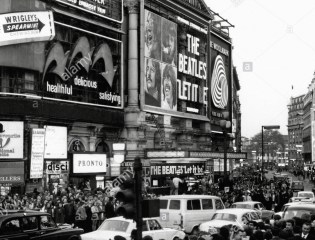
Outside the London premiere on May 20, 1970.

There was no glitz, no red carpet.

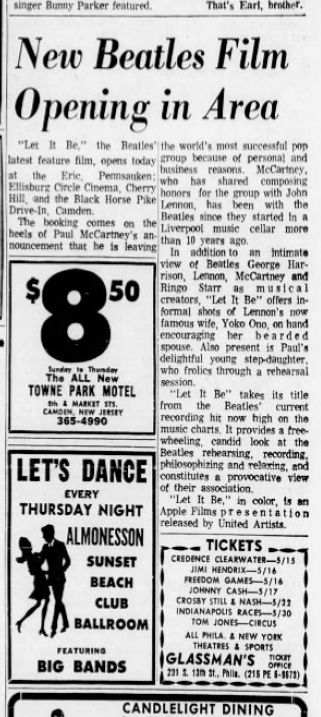
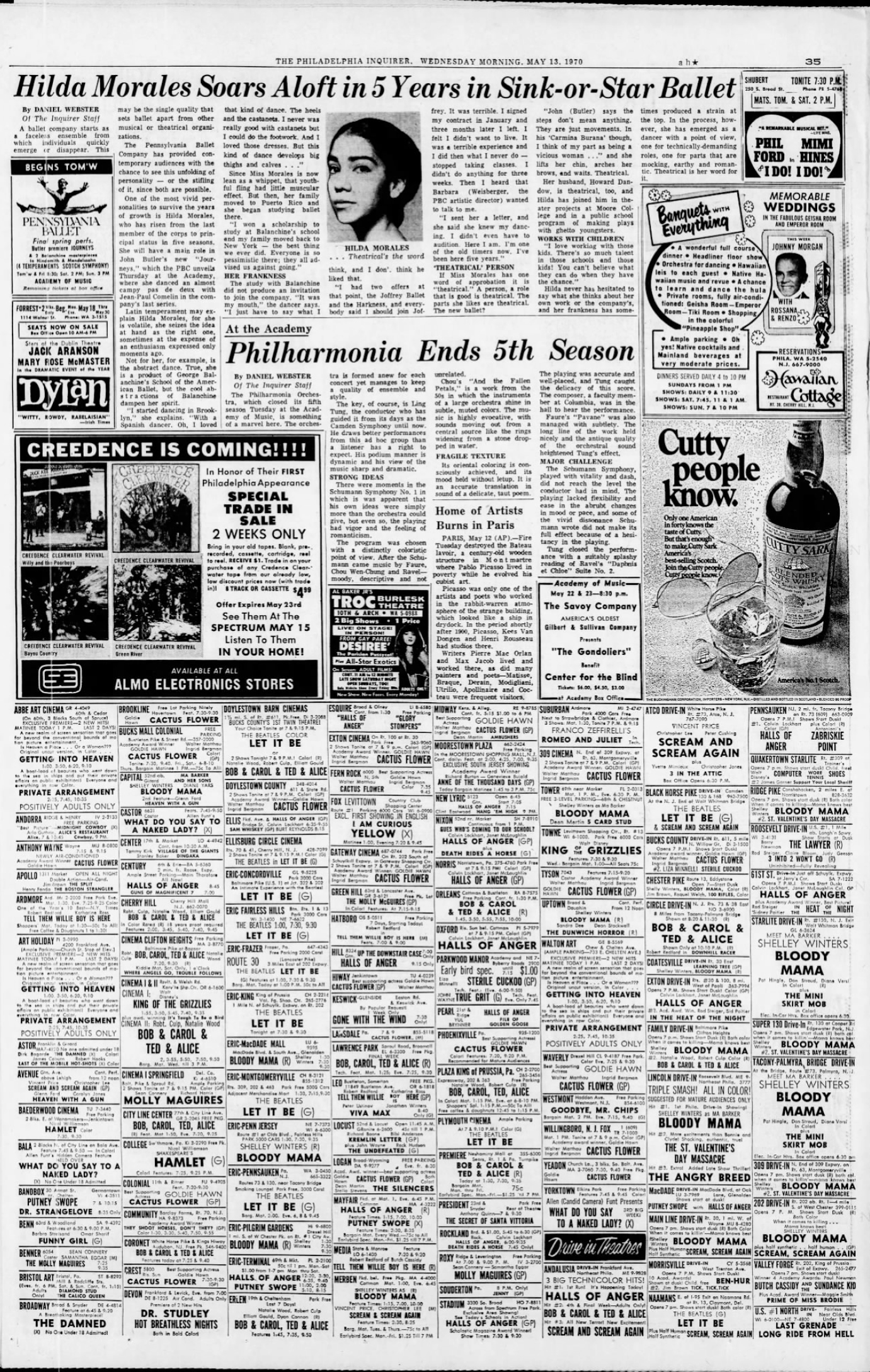
When the Let It Be film was shown to the public for the first time on the big screen, it was in ordinary theaters dotting the United States, not at a promoted premiere in New York, an event that’s still cited across the internet because of a 50-year-old press release.

From Keith Badman’s The Beatles: After the Break-Up 1970-2000:

The film Let It Be will, in Britain, be simultaneously premiered in both London and Liverpool on May 20, and, under the distribution agreement with United Artists, the film will open in New York on May 13 and will be shown in 100 cities all over the world! Let It Be is described by United Artists as a ‘Bioscopic Experience’.

The New York premiere, he writes, never happened, and the film was to open May 28.

californian-051320

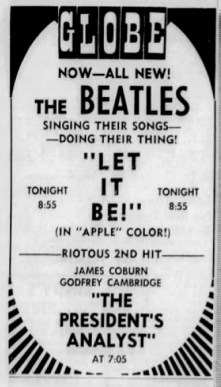
The Beatles: “Singing their songs, doing their thing. “Pretty accurate. (From the Salinas Californian, May 13, 1970)

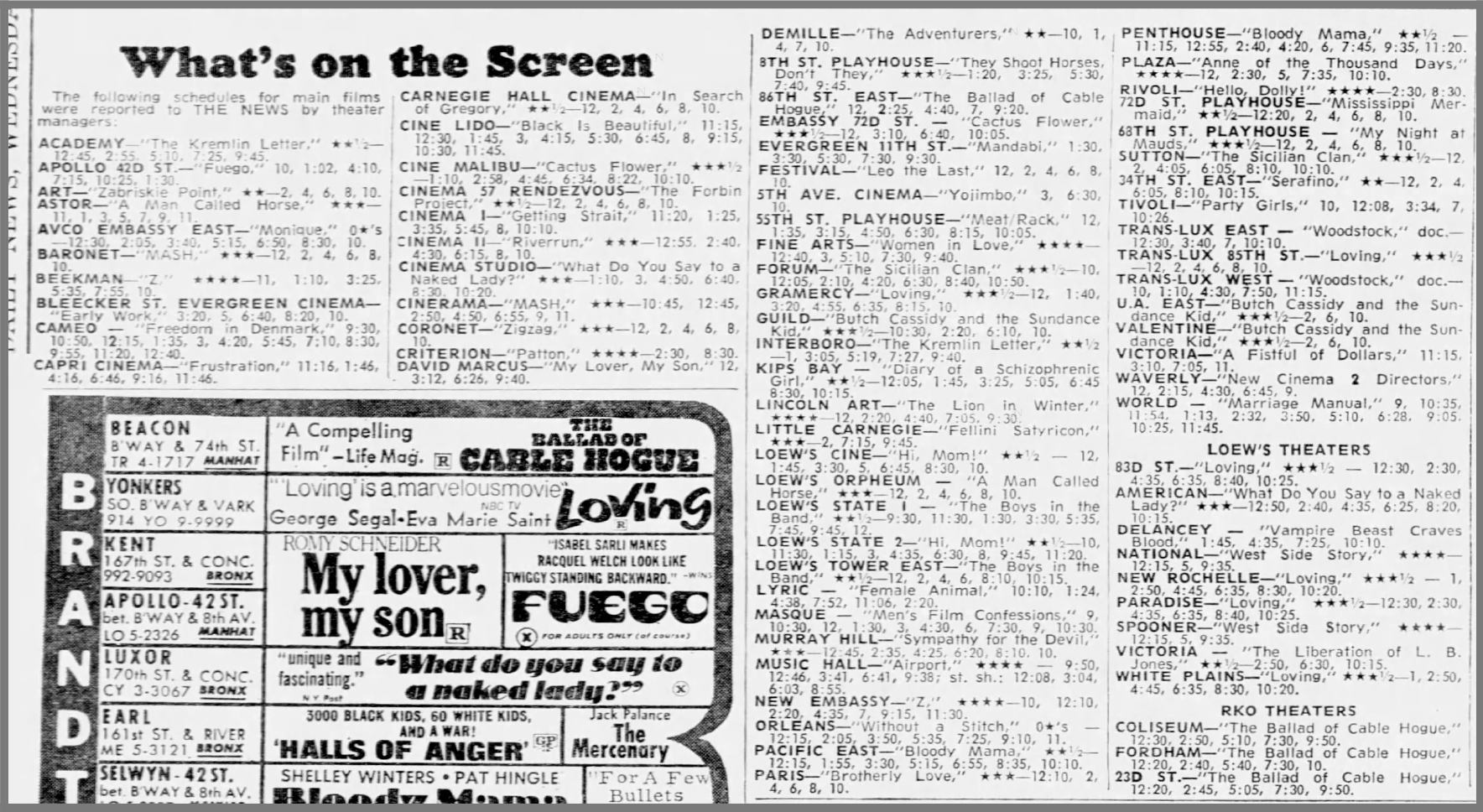
But that’s not completely accurate either. There indeed was not a New York premiere. There wasn’t even a New York showing, when searching the day’s movie listings.  (You could still catch six showings of Jean-Luc Godard’s Sympathy for the Devil in Murray Hill, though.)

While the Big Apple was shut out for another week, Let It Be was showing on screens across California, Ohio, Georgia, Pennsylvania and other states, in theaters and drive-ins. A week later, it received wider distribution across the U.S.

May 20 was even more important in England, where the film finally received its proper sendoff, premiering in London and Liverpool with the pomp missing stateside.

Back to Badman:

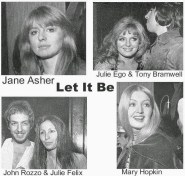
The Let It Be film opens today in Britain with special simultaneous Gala North-South premiere events. In the South, crowds surge upon the London Pavilion where guests include Spike Milligan, Mary Hopkin, Julie Felix, Sir Joseph Lockwood, Richard Lester, Simon Dee, Julie Edge and Lulu. Not to mention fifty dancing members of the Hare Krishna group and various members of The Rolling Stones and Fleetwood Mac pop groups. Most noticeable in the crowd are women no longer involved with The Beatles, John’s ex-wife Cynthia Lennon and, two years after her split from Paul, the actress Jane Asher. Before entering the cinema, Spike is playfully pictured by the press, alongside the police, trying to hold back the large excited crowds.

At the conclusion of its first week at the 1,004-seat cinema, where Let It Be was screened a total of 41 times, the film nets approximately £ 6,229. Brian Millwood, on behalf of UA, announces: “We’re happy with the start made by the film. It’s by no means the biggest take for the house, but it’s nevertheless good.”

Let It Be will run at the London Pavilion for five weeks until Tuesday June 23, when it is replaced by the Mick Jagger film Ned Kelly. Meanwhile in Liverpool, the northern premiere takes place with a comparatively quiet, invitation only, event at the Gaumont in Camden Street, London Road. (The screenings at both cinemas commence at 8:45pm.) Let It Be will eventually go on to be released in 100 major cities around the world.

6a416-1970-05-132b-2blet2bit2bbe2bfilm2bpremiere2b3

At the London premiere

The film received mixed reviews and has endured a love-hate relationship with fans as well as the group. But the importance of the film and these sessions in the band’s — and music history (see: Rooftop)  — can’t be diminished.

September 4, 2020, we get to do it all over again, when Peter Jackson’s The Beatles: Get Back retells the story of the January 1969 sessions.

2 Comments

Filed under Extra