23 days until the start of the Get Back sessions
While a Beatles group performance remained aspirational, John Lennon’s Dirty Mac prepared to do the real thing after spending this Tuesday rehearsing. Formed explicitly for the Rolling Stones’ Rock and Roll Circus on just a few days’ notice, John fronted this two-day supergroup that included Eric Clapton (guitar), Keith Richards (bass) and Mitch Mitchell (drums). Yoko Ono would perform with the Dirty Mac, but credited separately. The January 1969 issue of the Beatles Book Monthly assured us George was hoping to join the group but couldn’t because of “urgent remixing sessions” for the Jackie Lomax LP.
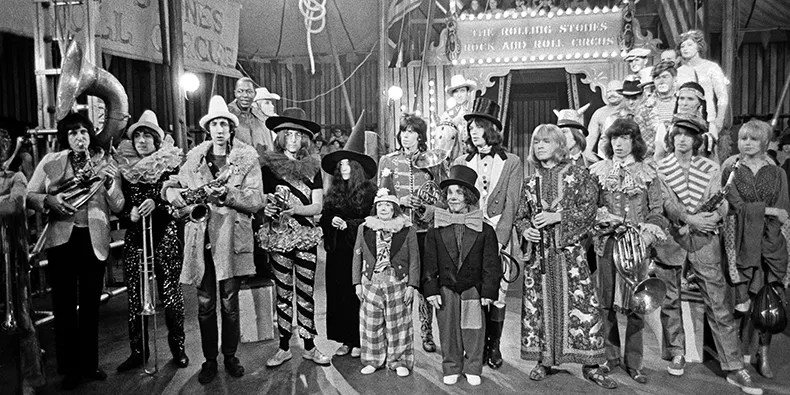
Having been some days in preparation: The cast of the Rock and Roll Circus pose for promotional photos on Dec. 10, 1968
The Rock and Roll Circus deserves a deep study of its own for how it relates to the Beatles – this post isn’t it – but it’s important to mark the personnel present. Michael Lindsay-Hogg, who had an established working relationship with both the Beatles and the Stones, directed the program and tapped Tony Richmond as cinematographer. Glyn Johns, another Stones veteran, engineered the Circus’ sound, while photographer Ethan Russell – himself an increasing part of the Stones’ circle – documented the show. These figures would be at the core of the small group chronicling the Beatles starting just a few weeks later.
Michael related how the band was formed in a 2019 story in NME:
So Mick called John and he said, ‘Yeah, I’ve been playing with Eric Clapton just for fun, he could play, who could play bass?’ And Mick said, ‘Maybe Keith could play bass’. We all liked Mitch Mitchell from the Hendrix Experience so in that one phone call we had John Lennon, Eric Clapton, Keith Richard[s] and Mitch Mitchell to fill that supergroup spot. So that’s not too shabby. That’s the way it was at the time. It was partly to do with the friendship and the mutual admiration that the key players had for each other that made the show possible in the first place.”
Intertel’s Wycombe Road studios at Stonebridge Park in Wembley served as the venue. Michael said during Get Back sessions that he tried to book the Houses of Parliament for the Circus, but “they didn’t go for it.”
Among the songs rehearsed by the Dirty Mac – named as a play on Fleetwood Mac, per John – were the Beatles’ “Revolution” and a warmup jam, neither of which were recorded for the show itself. The songs would eventually surface on a 2019 reissue of the Rock and Roll Circus.
A report from the Dec. 21 Melody Maker conceded rehearsals progressed … slowly.
During the first day rehearsal which began at midday there were seventeen items to run through. By five o’clock only three of four acts had been dealt with.
John’s son, Julian, was on hand, and the day included a promotional photo shoot for the event. It also included a variety of auditioning circus acts. Michael wrote in his 2012 memoir, Luck and Circumstance, that Yoko told him if he chose to employ the boxing kangaroos on site in the Circus, John wouldn’t perform the next day.
“I’m not sure if she’d talked to John about this,” Michael wrote. “But needless to say, the kangaroos hopped back into their holding pen and were not seen again.”

Yoko, Julian and John at the Rock and Roll Circus rehearsals on Dec. 10, 1968
According to a 2019 interview with Michael in Beatlefan, John wasn’t the first choice to front a supergroup on the show (it was Steve Winwood). He wasn’t even the first Beatle considered.
We first thought, would Paul McCartney want to form a group for this show? Paul would leap into anything if he thought it was right, but given all the other stuff that was going on, we didn’t think that Paul would want to appear without The Beatles. Mick and I didn’t think it was gonna happen. Then, we thought John might have the temperament to jump into the water without his flip-flops on.
Turns out Paul was the one packing his flip-flops on Dec. 10.
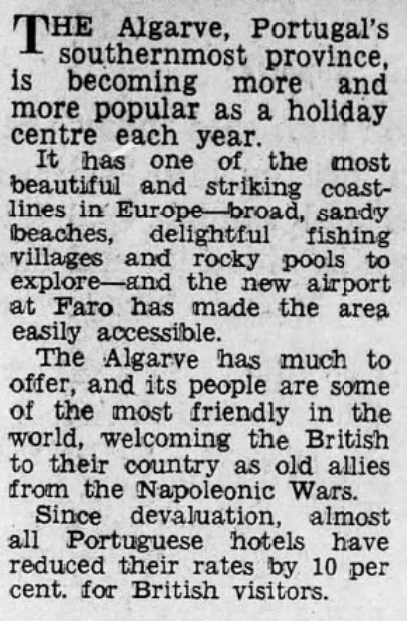
Come for the sandy beaches; stay because they’re an old Napoleonic War ally. A travel story on the Algarve, from the Dec. 12, 1968, issue of the Birmingham Evening Mail.
The Algarve was already trendy. Indeed, Paul experienced Portugal’s expanding resort region a few years earlier in early summer 1965, vacationing in Albufiera with then-girlfriend Jane Asher. He thrived there too: It’s where he started writing the lyrics to “Yesterday,” while batting away wedding rumors.
In 1968, Beatles biographer Hunter Davies informally invited everyone in the band to his Praia da Luz rental home, a former sardine factory. He wasn’t expecting Paul to spontaneously take him up on the offer this Tuesday night.
Many Years From Now, Paul’s 1997 authorized biography by friend Barry Miles, lays out the story: With Neil Aspinall’s help, Paul chartered a night flight and was joined by girlfriend Linda Eastman and her daughter, Heather. After landing at Faro Airport and cabbing it 50 miles, Paul woke up Davies with “shouts and pebbles on his window,” before he stuck his host with the taxi bill (Paul didn’t have any local currency).
“I thought at first it might be some drunken fishermen, on their way home,” Davies wrote in his own 2006 memoir “The Beatles, Football and Me.” Then I realised someone was shouting out my name – in a Liverpool accent. ‘Wake up Hunter Davies, you lazy bugger.’”
The account in Many Years From Now establishes that Dec. 11, 1968, is the date Paul departed to and arrived in Portugal.
I think that date is wrong, and instead, Paul and Co. arrived a day earlier, on Dec. 10.
The reason is simple: A local, contemporary account said so, and it said so while he was in Portugal, not almost 30 years later in a memoir.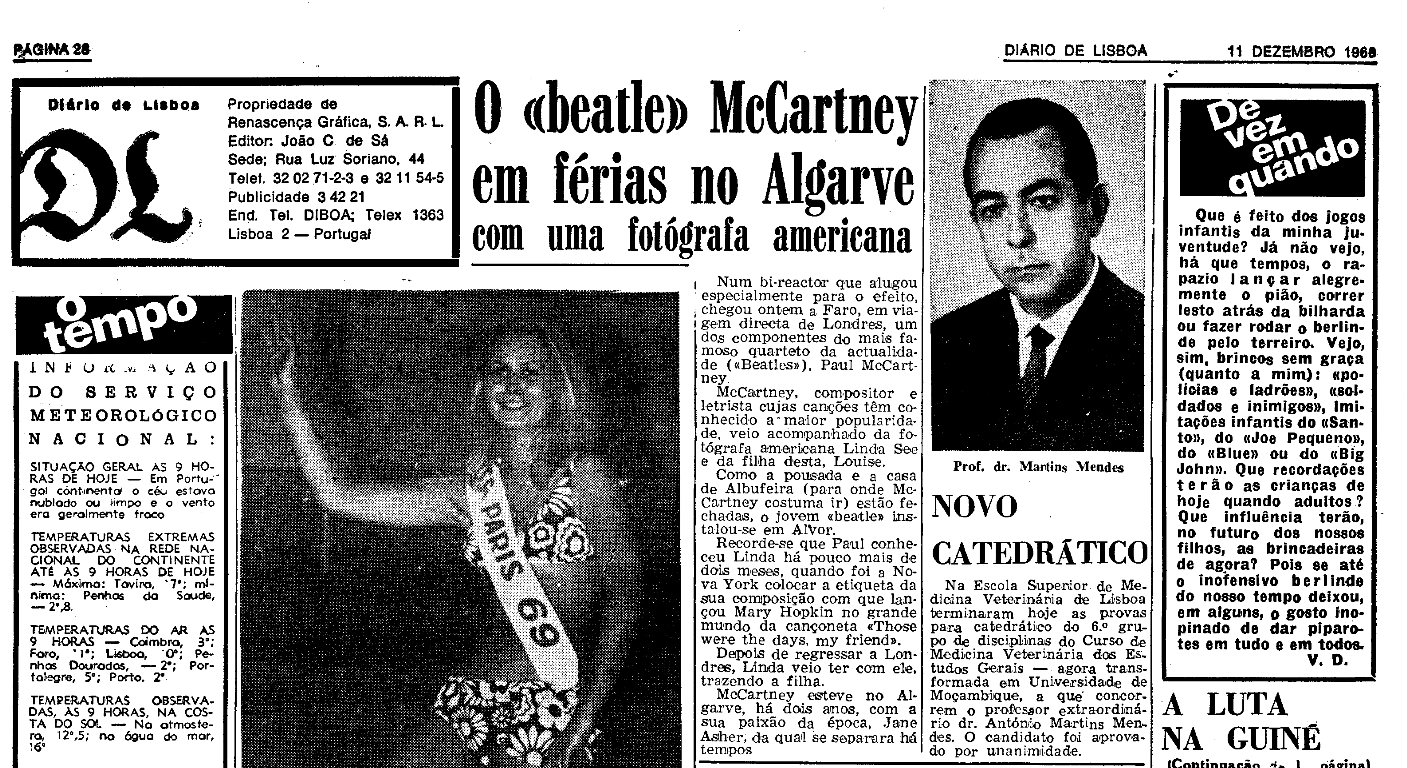
As published in the daily newspaper Diário de Lisboa on Dec. 11, 1968 (the 3rd, 4th and 5th editions), and translated by Google in 2023 (the emphasis in the first paragraph is mine):
The Beatle McCartney on vacation in the Algarve with an American photographer
In a bi-reactor that he rented especially for this purpose, one of the members of the most famous quartet today (<<Beatles>>) arrived in Faro yesterday, on a direct trip from London, Paul McCartney.
McCartney, composer and lyricist whose songs have enjoyed the greatest popularity, was accompanied by American photographer Linda See and her daughter, Louise.
As the inn and the house in Albufeira (where McCartney usually goes) are closed, the young <<Beatle>> settled in Alvor.
Remember that Paul met Linda just over two months ago, when he went to New York to label his composition with which he launched Mary Hopkin into the great world of the song <<Those were the days, my friend.>>
After returning to London, Linda came to see him, bringing his daughter.
McCartney was in the Algarve two years ago with his love at the time, Jane Asher, from whom he had separated some time ago.
To clarify some things: A bi-reactor is an airplane. The article used Heather’s middle name as her first, and late in the story said it was his daughter. They also used Linda’s married name “See,” which she stopped using in 1965.
BUT. I feel a newspaper wouldn’t get the day wrong, when it was happening within the last 24 hours. Saying Paul came “yesterday” is a lot more easily verifiable on a deadline than a foreign celebrity’s girlfriend’s last name or daughter’s first name. Think of the timeline involved, too: If Paul arrived late on the 10th, it would make sense news wouldn’t get out until early on the 11th, and indeed the news wasn’t in the first two earlier editions of Diário de Lisboa, but was in the final three.
With the timeline corrected, we’ll catch up more on the McCartney-Eastman vacation in the coming days as they settle in.
Just as Paul eyed a quiet escape on the Continent, he won a popularity contest back home. In a Daily Express poll of 5,000 readers unveiled on Dec. 10, Paul, the “driving force behind the Beatles” who “looks like a naughty choirboy,” more than doubled up the votes of runner-up Ringo Starr. George, liked for – among other reasons – his “hairy legs,” and John brought up the rear.

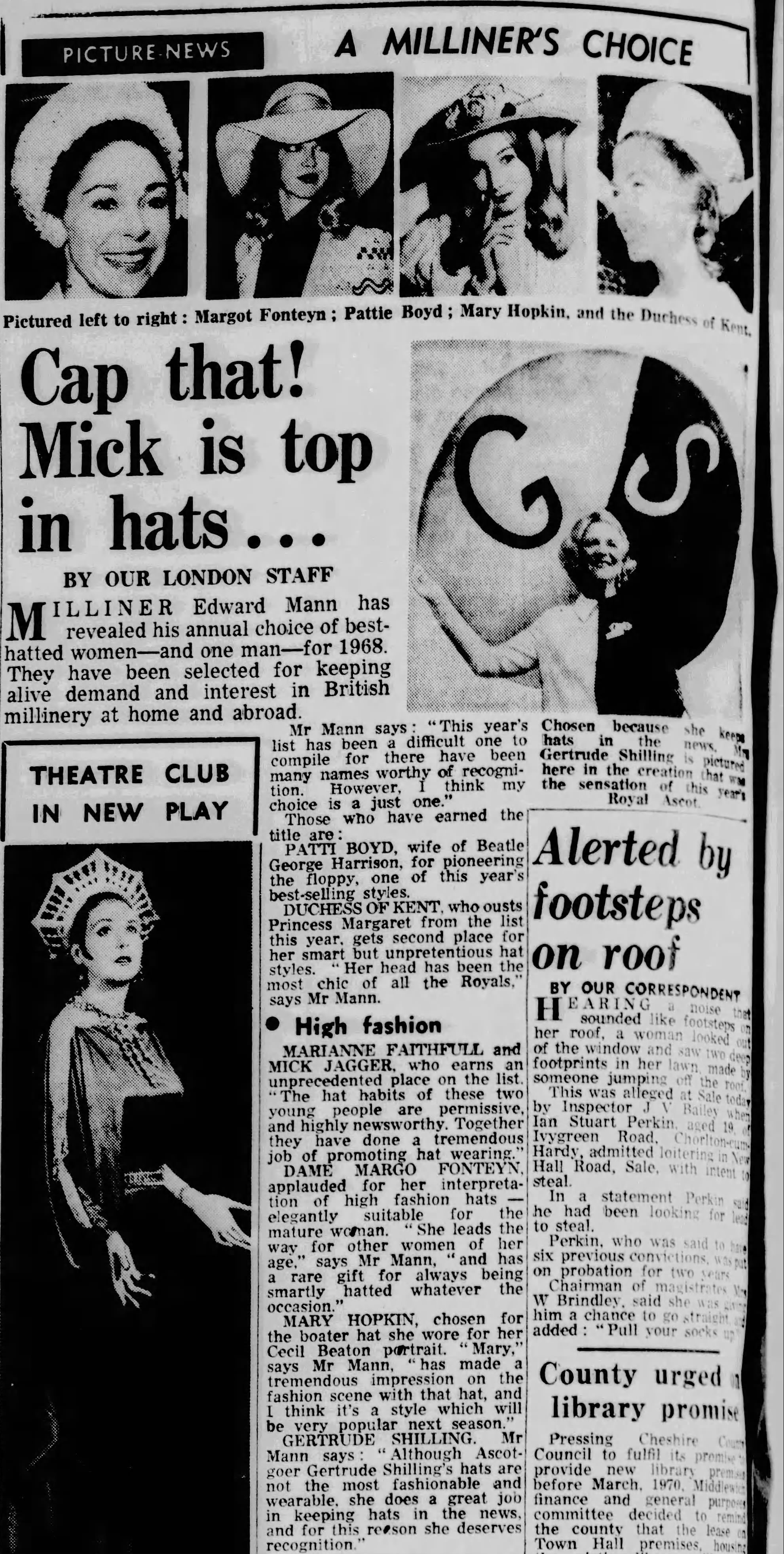
Rough as it was for George, at least wife Pattie Boyd could recoup some family pride, capping off this Tuesday as one of Britain’s “best-hatted women.” Specifically, Pattie earned milliner Edward Mann’s honor “for pioneering the floppy, one of this year’s best-selling styles.” Mary Hopkin was likewise recognized, for a boater hat.
 They May Be Parted