22 days until the start of the Get Back sessions
“The Rolling Stones needed a family show, and Mick [Jagger] wanted a family show. Mick said he wanted Ed Sullivan without Ed Sullivan.”
That’s how director Michael Lindsay-Hogg described the Rock and Roll Circus to Paul McCartney a few weeks later, in the midst of the Beatles’ Get Back sessions.
Fronted by John Lennon – introduced as Winston Leg-Thigh – the Dirty Mac’s evening show at Intertel’s studios in Wembley marked his first performance away from the Beatles since their formation. This circus act had a safety net, with John backed by Eric Clapton (guitar), Keith Richards (bass) and Mitch Mitchell (drums), as seasoned as ad-hoc band you could build.
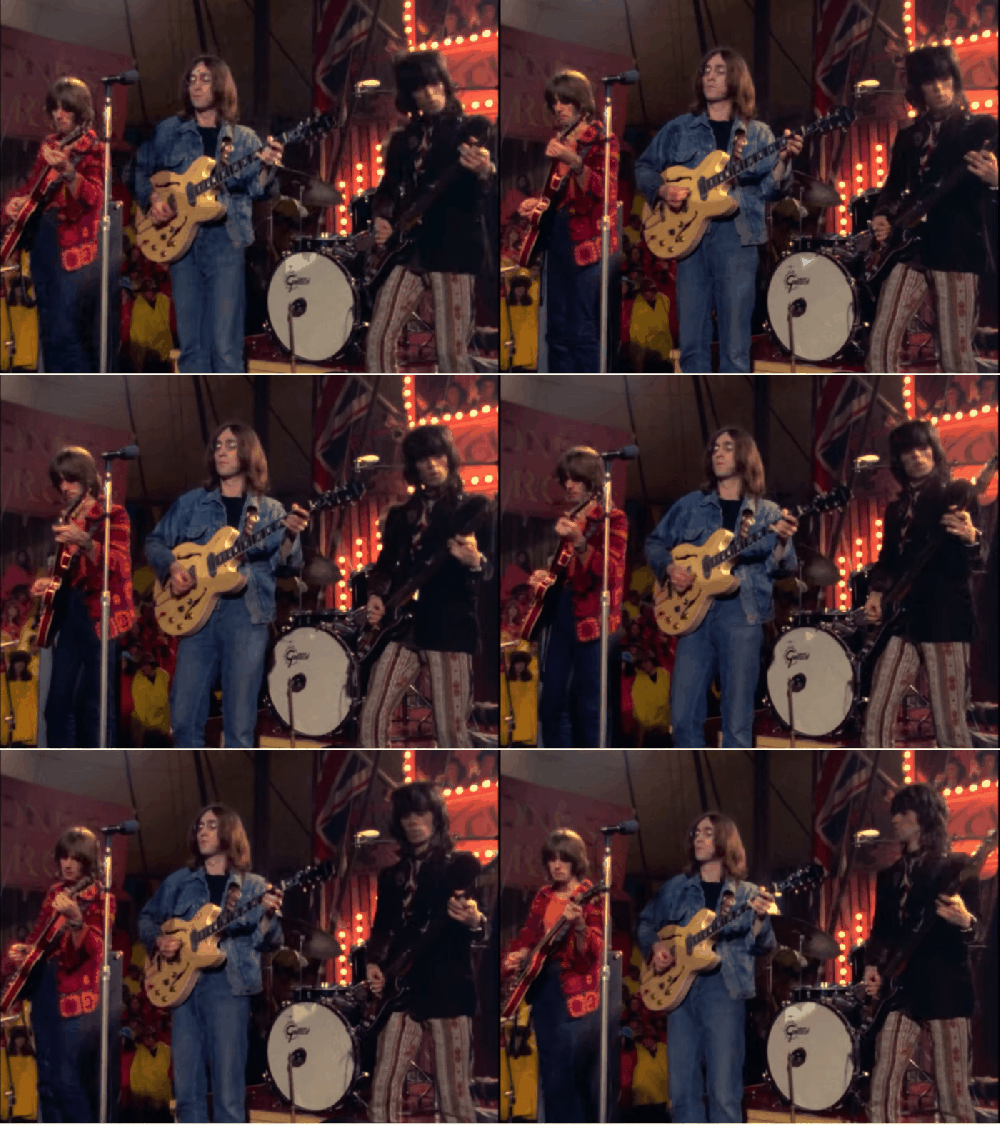
Their fiery performance of “Yer Blues,” a fresh Beatles cut from the new White Album, speaks for itself and lent itself perfectly to the band. They sound absolutely terrific.
Yoko spent “Yer Blues” on stage in a black bag. She emerged as the band, joined by renowned Israeli violinist Ivry Gitlis, performed a song initially called “Her Blues” that was ultimately released as “Whole Lotta Yoko.” Let’s call it a basic rock-blues improv jam with a dueling lead provided by violin and Yoko’s imitable vocals.
The director didn’t expect Yoko’s performance. Here’s how he recalled it in 2019 for NME:
All I’d noticed vaguely was at the beginning of ‘Yer Blues’, someone was getting into a black bag at the edge of the stage, but I didn’t really take much notice of that because I was trying to figure out the best way to shoot the song. Then Yoko comes near the mike and you see John and Yoko looking at each other and John going ‘go ahead, go ahead’. Then Yoko starts to sing. I’d never heard her sing before and of course it’s very riveting and it didn’t stop. … She had been a quite well-regarded abstract artist in New York in the ‘50s, so she had a reputation in the avant garde art world. She wasn’t just a girl who turned up, she came with a reputation, although not many people in England knew who she’d been in New York.
The Dirty Mac wrapped their set early enough in the proceedings to allow John and Yoko to venture to BBC’s Broadcasting House and appear live during the first hour of John Peel’s “Night Shift” program, which ran from 12:05-2 a.m. (Here’s the BBC Broadcasting House, as I photographed it in June 2024)
Really, this should be the first item for December 12, but we’ll keep this at December 11, since John shared his immediate reaction to the Circus.
“It’s very exhilarating,” John told Peel. “The Who were who-ing, the Stones were stoning, the clowns were clowning.”
Asked what other projects he was working on, John clarified, “[The Circus] wasn’t a project. That was Mick saying, ‘Do us a favor, Stevie Winwood’s pulled out.’”
Elsewhere in the same interview, John read “Jock and Yono” as well as “Once Upon a Pool Table,” two poems that would imminently appear on the Beatles’ 1968 fan club Christmas record. He introduced the poems as “a piece of paper called ‘Charles.’”
John and Yoko also promoted their December 18 Alchemical Wedding event scheduled for the Royal Albert Hall (“go naked” was Yoko’s suggestion) and, relatedly, discussed Two Virgins.
“I can’t see it being a pop hit,” John said. Still, he was chuffed it sold 700 copies the previous day in some “hidden underground-type open-air shops.” Referring to the couple’s growing inventory of recorded material, John said, “When we’re old and gray, we’ll put out all the backlog we got.”
Listeners were treated to a brief live song: John briefly crooned — and whistled — “It’s Now or Never” to fill time.
After the interview, John and Yoko made the 10-mile return trek back to the Circus, which continued to around 5 a.m., when the Stones finally finished recording their set.

John and Yoko whoop it up following the Stones’ performance of “Sympathy For the Devil.”
Ostensibly staged to promote Beggars Banquet, released just days earlier on December 6, the Rolling Stones mothballed Rock and Roll Circus, which wouldn’t see a formal release until 1996. Conventional wisdom holds the show was shelved because the Stones were upstaged by the Who.
Members of the Beatles were likely among the very first people to have seen initial edits of the show, while the band was working with the same director in subsequent weeks during the Get Back sessions. Indeed, the Rock and Roll Circus often served as a tangible point of comparison as the Beatles searched for their own live show concept in January 1969.
Paul McCartney very badly wanted to enjoy the Who’s terrific performance of “A Quick One, While He’s Away,” but blamed Michael for poorly capturing his subjects.
Paul, from the January 13 Nagra tapes:
It didn’t look right. I know it was a bad print. But like, I didn’t ever get into any one of the Who. Ever. It was the event all the time. And no one digs that. That’s over, that sort of event, I think. It really is now, if you’re trying to show him, I just really say just stick [the camera] on him.
…
Pete Townshend, I never saw him. I’d really like to look at him for a long time cause he fascinates me. … I’d like to really just see what he looks like after he’s done that thing (presumably his windmill guitar move).
You know, [I’d like to see] Keith Moon just sort of jabbering away on the drums, just for a whole number almost.
Naturally, John’s reflection on the evening was experiential, not observational, and it stuck with him to the end of his life, a dozen years later. John opened up to the BBC in his penultimate interview, on December 6, 1980, sharing these thoughts, in the context of the Toronto Rock and Roll Revival as well as the Rock and Roll Circus:
It was instantly creative, and there was no big palaver, it wasn’t like this set format show that I’ve been doing with the Beatles, where you go on and do these same numbers, “I Want to Hold Your Head,” you know (laughing). And the show lasts 20 minutes and nobody’s listening, they’re just screaming, and the amps are as big as a peanut. And it was more of a spectacular rather than rock and roll.
The first time I performed without the Beatles for years was the Rock and Roll Circus, and it was great to be on stage with Eric and Keith Richard and on a different noise coming out behind me even though I was still singing and playing the same style. It was just great experience. I thought, wow, it’s fun with other people you know?
And speaking of other people, let’s introduce one more key character at this circus – call him a firebreather, a strongman or a clown, maybe all three. Allen Klein was a footnote to John on December 11, 1968, but emerged as one of the most critical figures in Beatles history.
From Fred Goodman’s 2015 biography on Klein:
He came to the all-night recording session for only one reason: to meet John Lennon. He achieved his goal, but just. The set was hot and cramped, no place for a conversation let alone a full-blown seduction. Allen had to settle for a handshake and hope that he’d finally registered with Lennon as more than just another outstretched palm.
“I didn’t know what to make of him,” John recalled in the 1970 Lennon Remembers interview. “We just shook hands.”
At the precise moment John acted as the ultimate multimedia showman, appearing on stage before an audience and TV cameras before shuttling over to a live radio appearance, Paul sought to escape the spotlight and work on some things in private.

Breakfast at Hunter’s. Portugal, December 1968.
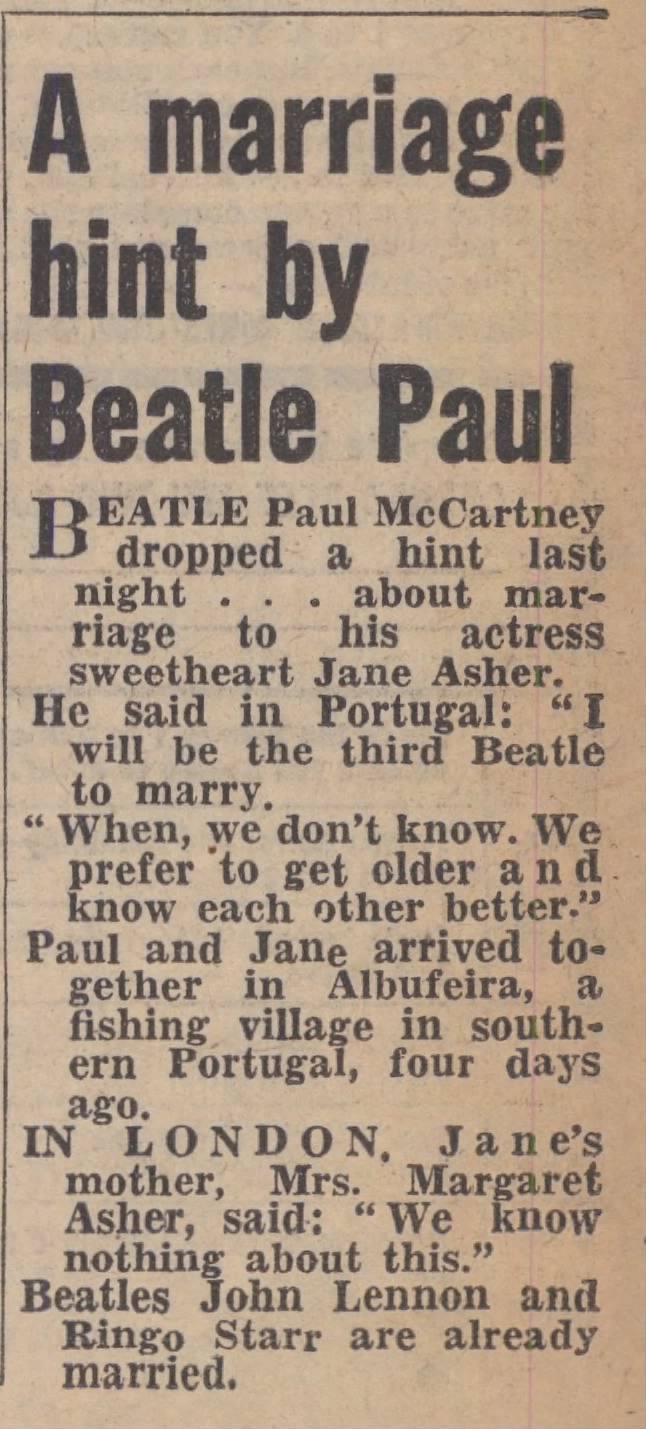
The last time he went to Portugal, in 1965 with then-girlfriend Jane Asher, the headline in the Daily Mirror screamed “A marriage hint by Beatle Paul.” But it was merely a hint, Paul conceding, “When, we don’t know. We prefer to get older and know each other better.” The couple was engaged, but never married, and Paul eventually began dating Linda Eastman.
Paul tied the knot with Linda Eastman in March 1969, but before that he popped the question in Portugal in December 1968. He felt – on the heels of extended time together that fall in New York and Scotland – they did know each other better.
Here’s Paul, as quoted in 1997’s Many Years From Now:
As our relationship solidified and we really started to feel very confident with each other, it was a question of ‘Well, shall I get off the pill then?’ And we talked about that, and I said, ‘Yeah!’ I don’t know why. It wasn’t like planning a family, it was more ‘If you like. We could see what happened. If anything happened. That would be all right.’ Then Mary was on the way, it was definitely not planned. And we decided, round about that point, to get married.
This trip to Portugal with Linda and her daughter, Heather– December 11 was their first full day there — was precisely that point.
 They May Be Parted