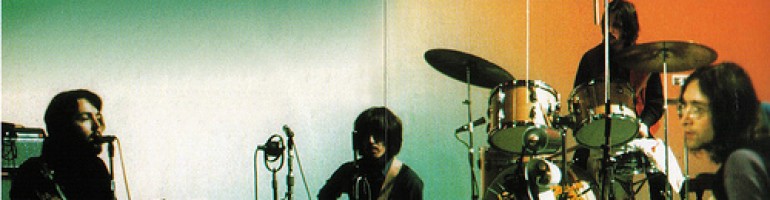
19 days until the start of the Get Back sessions
John Riley is the star of the biggest Beatles-related dentist story, which happened in 1965. Riley covertly dosed coffee with LSD sending dental patients George Harrison and Pattie Boyd as well as John and Cynthia Lennon on their first trip. Riley went down in history as that “wicked dentist,” in George’s words.
Then there was the “Gordon the Irish dentist,” who was anything but wicked when a Beatle and friends spontaneously visited a small town in Bedfordshire. The genial bearded dentist welcomed Paul McCartney, plus Apple execs Derek Taylor, Peter Asher, Tony Bramwell and reporter Alan Smith into his home in Harrold one June day in 1968, serving his surprise guests “hams and pies and multi- jewelled salads, new bread and cakes, chicken and fruit and wine” (by Taylor’s account in “As Time Goes By”).
None of this is to say Dr. Anthony Halperin wasn’t an interesting figure. It’s just his brush with Beatles history was less about him and more about his space.
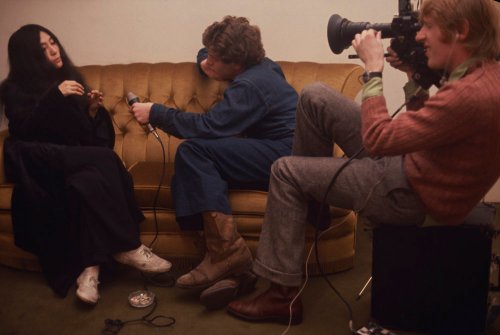
Yoko Ono is interviewed by Dutch television in a dentist’s waiting room on December 14, 1969. Photo by Susan Wood.
And that brings us to December 14, 1968, when John Lennon had a bridge replaced in Dr. Halperin’s dental chair in Knightsbridge. The real action was in the waiting room, though, where Yoko Ono hosted a true multimedia event: a longform conversation filmed for television which largely doubled as a magazine interview for a separate publication and a photo session for a third media outlet.
As I mentioned earlier in a separate entry, this dentist office interview has often been misattributed to December 12. John could be a little crazy, but he probably wasn’t “stay at the Rock and Roll Circus until 5 a.m. and then have non-emergency dental work a few hours later” crazy.
We’re lucky to have like the entirety of the interview for the Dutch VARA-TV program “Rood Wit Blauw” (Red White Blue), as conducted by sociologist Abram de Swaan online.
(This YouTube clip is shorter than the audio, and mostly overlaps with the final segment)
While John was undergoing the procedure, Yoko owned the stage by herself and early in the interview defined herself.
I’ve always been a freak, in a sense that even now in newspapers, they don’t know what to call, what to say about me. So they sometimes say, well, a Japanese actress, Yoko Ono, or a film producer, or a composer, or a painter, anything they say. But it’s very difficult to label a person, and nowadays, art is so complex that you can’t label somebody really …
Have you ever tried your hand at describing yourself, somehow labeling yourself, like a bottle sticking a label on itself?
I never bothered to. So I always say, whatever people think, whatever you think, is me. And that’s true.
But you see, in my field, my own field, which is art, I was always considered somebody who is a little bit out of the group, out of everything. So that they didn’t know how to label me, you know.
…
The painter said, well, she’s not really a painter. And the composer said, no, she’s not really a composer.
So I was always out of the circle by trying to, sort of deal with the future and all that. And John was always doing that too, you see.
The segment touched on Two Virgins, recapped the couple’s origin story, the butterfly effect, nudity and the nature of her art.
It’s not the age of professionalism. And the reason why I’m doing these things in my work, all my paintings and all my sculptures are unfinished. And the Two Virgins record is called Unfinished Music, you see. And that is because I want people to finish it or go on adding something to it, so the piece will always go on growing, you know.
John joined a little more than halfway through the interview, “out of [my] skull, out of [my] mind” from the dentist’s anesthesia — at least he knew he was being drugged this time. As described in the March 1969 Nova:
A small ripple passed over us when a third assistant came out of the surgery to announce that “John’s bridge fits perfectly,” but it seemed to be more professional excitement than anything else. “What a miracle that bridge fits” one white-coated girl said to me. “He’s always cancelling his appointments and teeth shift with time, you know.”
Nova further described the shift at John’s arrival:
The microphone approached like an ice-lolly, the Look photographer, having stood in every possible corner of the room, now climbed on a table; and suddenly the door opened and all eyes, all machinery, all attention flew to John Lennon.
…
As soon as John entered the room, Yoko’s lacy self-confidence was replaced by a shy, maternal attitude, she seemed to defer to John who was talking rapidly, to beam upon him; and I realised, heaven help me, that this was going to be a love story.
There seems to be a pact between John and Yoko, probably instinctive and unspoken, that when the conversation is about art and the arts Yoko is set loose like a pretty moth; anything else, taxes, politics, police raids, is John’s province.”
The topic shortly went to their recent drug bust at some length (“we were lying in bed feeling very clean and drugless”) before an involved discussion of taxes and materialism and prejudice. That last topic led to a some provocative quotes from John and Yoko, especially read today. It also was the first public mention of a phrase that would later serve as the title of a controversial 1972 single.
John: I believe in reincarnation, right? So that’s one thing that helps me in an overall view of things. I believe that I’ve probably been black, I’ve probably been Jewish, I’ve probably been female, I’ve probably been a tree or anything. And that helps a lot. So a lot of sort of intellectual reincarnation.
But even so, you can make it, you know, it might be tougher physically and materialistically to make it being black and that. But you can make it, you know. And I sympathize, and I think it’s terrible. I believe it should be smashed one way or another, people’s prejudice, but they won’t change it really by violence. Okay, so the black power scene, you know, good luck to it, because at least it’s frightening them. It might frighten them enough to kill them and have a real war.
OK, so then if the blacks took over, all well and good, but all the blacks aren’t saints. You know, it’s going to be the same scene, just a different version.
Yoko: For instance, I believe that the situation of the women in the world is today, it’s like a woman is like the nigger of the world. And so that’s why we understand about the nigger problem very much.
For a bit of context, the interview aired on Dutch TV on January 15, 1969 – right as the Get Back sessions were reaching a standstill. The Nova interview was in the March 1969 issue, and the photos from Look appeared in its March 18, 1969 edition. Either the Austrian television crew from the other day was still lingering or they managed to get their hands on the Dutch footage, but some of the dentist waiting room film made it into their documentary, too.
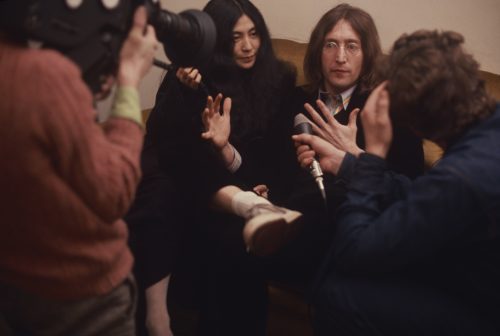
John and Yoko hold court in the waiting room of his dentist. Photo by Susan Wood.
One easter egg from the footage and Look’s photos: John wears the same shirt to the dentist as he does to rehearse and record during Get Back (and record “Hey Jude”).
But on December 14, 1968, as far as the public was concerned, the next Beatles project was an imminent concert.
By this point, it was no longer will the Beatles stage a live concert, just when and where. We learn in the Let It Be/Get Back experience that these questions weren’t so easily answered and went down to the last moment. By mid-December we knew the show would end up in the new year, and as far as venue, it wouldn’t be London’s Roundhouse.
The December 14 DISC and Music Echo reported another possibility that the Beatles touched on and mooted during the Get Back sessions, perhaps the venue they knew best of all: Liverpool’s Cavern Club. This grew out of what was probably a late October visit by Paul to the Beatles’ old haunt.
When Paul McCartney made a nostalgic visit to his hometown recently he expressed a strong desire to appear there again with John, George and Ringo.
…
Said club’s owner, Alf Geoghan, to whom Paul spoke: “He didn’t definitely state that they would come. But he did express a desire to play again.
“He seemed quite delighted to find the place comparatively unchanged. He says he expected padded walls and Japanese waitresses!”
Paul spent two hours at the Club, according to the story, which closed with a characteristic give-every-answer-at-once reply from Apple publicist Derek Taylor:
“The idea of the Beatles playing the ‘Cavern’ again isn’t as bizarre as it seems. We won’t say POSSIBLY or PROBABLY. But it’s very attractive.”
Meanwhile, Melody Maker speculated on another rumor that never came close to coming true, writing in its December 14 edition that Andy Williams could be a guest on an upcoming Beatles special, which they pinned down with a January 18, 1969, date. This came on the heels of the American crooner meeting with both Paul and George during the course of 1968.
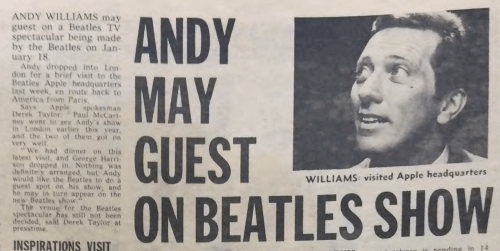
“Nothing was definitely arranged,” Taylor told Melody Maker. “But Andy would like the Beatles to do a guest spot on his show, and he may in turn appear on the Beatles show.”
Both the Cavern and Andy Williams speculation were laid to rest at by the end of the month, when the January Beatles Book magazine hit mailboxes, saying “Rumours that the programme might be made in Liverpool instead of London have been denied. So has the idea that Andy Williams, who lunched with Apple executives a few weeks ago, might make a guest appearance in the show.
While talk of a live Beatles show ran rampant, a new theory emerged that they had another studio release besides the White Album already in stores. From the appropriately labeled “RUMORS” column in DISC and Music Echo:
That unknown group, the Moles – whose “We Are the Moles” getting a lot of airplay – is really Beatles in disguise. Anonymous caller summoned by DJ Stuart Henry to London’s Hyde Park offering exclusive interview. Says Stuart: “I was met in a taxi by a person dressed from head-to-toe in black. He even had a hood on. I’m not convinced – but it could have been John Lennon. The record certainly sounds like the Beatles.”
The Moles never actually charted with “We Are The Moles,” which was released in mid-November 1968. Of course, they also weren’t the Beatles, but instead were British psychedelic pop band Simon Dupree and the Big Sound in disguise. Shortly after this entry in DISC, the cat was let out of the bag by none other than Syd Barrett.
Here’s how it all went down, according to a recent interview with Derek Shulman, who was the lead singer of (and would later help form) Gentle Giant:
We didn’t know that in the studio at that time, Syd Barrett, Pink Floyd were recording as well. And when the buzz started to happen and people were saying, ‘Wow, it’s a Beatles song, they want to call themselves the Moles, we got to buy this.’ Syd did a big interview saying, ‘No, it’s not the Beatles, it’s the shitty band Simon Dupree, so he blew the whistle on us.
As the Moles stalled on the charts in emulating the Beatles, it was really enough to simply cover them, and one song in particular. No fewer than The Bedrocks, Joyce Bond, Chris Shakespeare Globe Show, Arthur Conley, Marmalade and Spectrum all had covers of “Ob-La-Di, Ob-La-Da” on the market (and of course, the Beatles’ own version LP-only in the UK and US). Paul later revealed the Bedrocks’ version was his favorite during a January 13, 1969, conversation at Twickenham.
The early winner in the “Ob-La-Di” sweeps was Marmalade, who entered the charts at No. 22. A lengthy feature in New Musical Express spotlighted the band as they began a journey that would lead to an eventual UK No. 1.
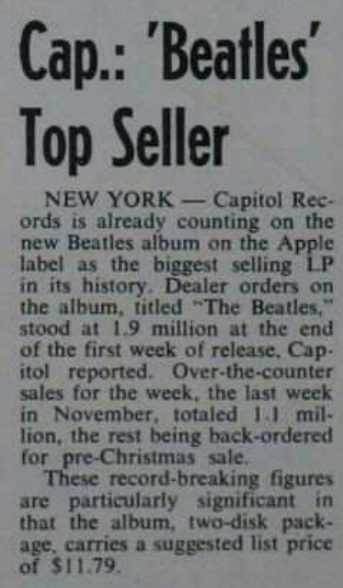
Whether it was an imposter like the Moles, or imitators covering Beatles tracks, nothing beat the real thing. In the December 14, 1968, issue of Billboard, Capital Records said the White Album was in line to become their biggest record in the label’s history. After just one week, dealer orders already stood at 1.9 million while over-the-counter sales totaled 1.1 million.
This kind of success would help subsidize a new experimental label publishing budget-priced LPs featuring “talk, poetry and music especially designed for the college market,” as Billboard described a what would become Zapple, a few pages later in the same issue.
And that takes us back to John Lennon. If you thought bridge work was a pain, try selling a record with a naked photo of you and your girlfriend on the cover in 1968. Another Billboard article laid out the situation with Two Virgins and American music store chains. While distributor Tetragrammaton planned packaging that would obscure the cover’s nudity, five stores flat-out refused to sell the LP: Sears, White Front, May Co., Broadway and Wallichs Music City.
“We don’t carry any product that might harm our reputation as a family store,” Sears said in a statement, and Billboard added the company probably wouldn’t change its policy even with new, more modest packaging.
In denying sales of the LP, a May Co. representative said: “While it’s not our job to act as a public censor, I feel sensationalism and liberalism can go too far.”
One chain, though saying they wouldn’t sell the record with the nude cover in its “raw state,” committed to selling the LP, and gave the right reason.
“An artist of John Lennon’s stature is too important not to be heard,” said a merchandise manager from Korvette’s. “Appropriate arrangements are being made to handle the LP and still not offend our family trade.”
 They May Be Parted

