Tag Archives: George Harrison

Jan. 3, 1969: Traveling on that line

When we last left you on the Nagra Tapes timeline, George wondered aloud whether it was practical for the Beatles to perform a concert consisting only of new songs, without throwing the audiences — especially the American one — a bone with an “oldie but goldie.”

They had, in fact, rehearsed such a song a few hours earlier. Well, it may not have been a goldie, but it was an original Beatles oldie dating all the way back to the days of the Quarrymen.

And while they did in fact record “One After 909” in 1963 — in fact, it was 49 years ago today, on March 5, 1963 (the same day they cut “From Me To You”) — that original recording didn’t see an official release until Anthology in 1995.

The band attacked their first take of the song (in presumably five-plus years) with much of the same gusto they gave covers of the same era during the sessions. How do we know they enjoyed playing it? They actually finished the song.

Following that first run-through, which was replete with stumbles but seemed to have John and Paul remembering all the words, the band — especially Paul — collectively marveled at the simplicity of the lyrics.

“I always meant to just change the words a bit,” John said. Paul chimed in that “it’s great,” before giving a spoken-word run-through of first verse, to George’s laughter. Then George, ever eager still to actually have a focus here, asks if the band should rehearse the song more.

A bit of that dialogue appeared in the Let It Be film, and decades later, on a podcast promoting the Let It Be … Naked release on iTunes.

“Or maybe we should do it without practicing. You know, practicing will fuck it up,” George said.

The band in fact, did return to the song — after first running through a take of the presumed John oldie “Wake Up in the Morning/Because You Love Me So.” And like the prior run-through, this take of “One After 909” was closer in spirit and pacing to the Quarrymen version than the 1963 recording.

Also like the prior take, the band continues to poke fun at the lyrics once the song is over. John bemoans, “We always thought it wasn’t finished.”  And George goes further, suggesting “Most people don’t give a shit what the words are
about, as long as it’s popping along.”

It’s rock and roll, and it’s a song, written in 1957, that is indeed seminal rock. It was a Beatles song, not a John song/Paul song/George song as the bandmates had been bringing to the sessions otherwise — and you can hear the harmony (literally and figuratively) while they play.  Really, it’s the perfect song for what they were trying to achieve during these sessions: developing a loose, off-the-cuff presentation of their songs.

13 Comments

Filed under Day by day

TMBP Extra: Oscar night

Not initially intended as a feature film, Let It Be was indeed eventually released in theaters in May 1970, more than a year and three months since the end of the Get Back sessions. Paul became the final member to quit the band a month earlier, and famously, none of the Beatles attended the premiere.

By the time the subsequent Oscars rolled around, on April 15, 1971, the Beatles were, well, really broken up. George and Paul each had No. 1 hits in either the US the UK or both (All Things Must Pass LP and “My Sweet Lord” single for the former, McCartney LP for the latter), John would have his first later in the year (Imagine LP and single) and Ringo had just released his biggest hit to date, “It Don’t Come Easy.”

Also, everyone was suing each other.

But ancient history was relevant to the Academy,  who gave The Beatles — whatever that was anymore — the award for Best Music, Original Song Score over the soundtracks to The Baby Maker, A Boy Named Charlie Brown (one of this author’s chidhood favorites), Darling Lili and Scrooge.

Of course, the Beatles wouldn’t be at the ceremony to pick up what would be their lone Academy Award (A Hard Day’s Night had two nominations in 1964, lost both). That honor would go to Quincy Jones, who had already produced a track on Ringo’s Sentimental Journey and would more than 10 years later work with Paul. (Decades later still, the two would be in the news together again).

Paul’s absence, apparently, wasn’t for lack of trying by Jones, who said he visited Macca —  while he was recording RAM in New York — and tried to convince him to come out for the ceremony.

Paul would later get two nominations as a solo artist for best song (“Live and Let Die” in 1973 and “Vanilla Sky” in 2002), but he went 0-for-2.

And with that, John, Paul, George and Ringo’s trophy cases only had the lone Oscar for Let It Be — provided Quincy Jones gave it to them.

4 Comments

Filed under Extra

Jan. 3, 1969: No little thing

Just as the band was trying to find an agreeable venue for the concert that would cap the sessions, they likewise were searching for a setlist.

The new songs they were rehearsing were a given — at this early point, it was obvious “I’ve Got a Feeling” and “Don’t Let Me Down” were being worked on to reach that payable point and passed the generally accepted bar of “fast” ones good for a live show.

In a curious admission, George expresses his worry about putting on a TV show of all new songs. Of course, by that point,  the critical failure Magical Mystery Tour (the film) was a little over a year old, and it wouldn’t be seen in the United States until 1974, supposedly because of the negative criticism surrounding it.

But they’re still the Beatles! The White Album was in the middle of a nine-week run atop the charts in the U.S., en route to becoming their best-selling record (each sale counted as two). “Hey Jude” was the No. 1 song in the U.S. as recently as six weeks earlier after spending nine atop the Billboard charts, and it was still sitting at No. 15.

Also, they’re the Beatles.

Yet George was still concerned about how new songs would be received.

So of all the songs, George suggests an album track from 1964’s Beatles For Sale.

“We’re not going to do any oldies but goldies for the show?” George asks.

“Dunno, could be” says Paul.

“Cuz I’d like to do it,” George continues, agreeing with someone who says “it would be nice.”

“And also from the selling point of view, in America … maybe it’s all new, or maybe… If they had the album and then saw it, [the concert]  a week after. But just to hit… the first initial thing of us singing all completely new … they need something to identify with apart from us. It would be nice to start the show or end the show with a couple of… (then he either cuts himself off of the sound cuts out.)

I’ll tell you which is a good one..

Then George starts playing the beginning to “Every Little Thing.” Paul, the song’s author, joins in with little gusto. We get to see some of this sequence in the 2021 Get Back docuseries.

So of all songs George suggests would be a good kick-start — or capper — to the big concert, it’s not “Hey Jude,” not “Back in the USSR” — which George had been riffing on leading into this suggestion — not his own recent classic “While My Guitar Gently Weeps”  or slightly older “Taxman.”  He could have suggested “All My Loving,” which opened up the first Ed Sullivan appearance and won over the United States instantly. Or for the idea of going full circle, the first song off their first album in “I Saw Her Standing There.”

But instead it was “Every Little Thing.” A great song! But probably just a tick more familiar as the other new songs they’d debut.

I don’t question the choice from a standpoint of quality. It’s just surprising. And I wonder if it would have done anything to “ease” American audiences.

As it happened, the Beatles would, in fact, find an oldie of theirs to play at the concert that ended the sessions, and they dusted it off earlier in the day on Jan. 3. But while it was an old Beatles song, it wasn’t something that would be at all familiar to fans…

7 Comments

Filed under Day by day

TMBP Extra: Rooftopaversary

I need to make one more interruption before returning to the day-by-day tapes breakdown to recognize the 43nd anniversary of the rooftop concert atop 3 Savile Row that just about concluded the Get Back sessions and wrapped the Beatles’ career as a live act. More on this iconic event as I eventually reach it in the Nagra tapes timeline down the road.

9 Comments

Filed under Extra

Jan. 2, 1969: Tell me why

Something I never completely got my head around is why the Get Back sessions had to happen when they did, in the beginning of the new year, 1969. And in such a disorganized state, to boot.

The timeline is stunning, really, when you look back on it, even in the context of the music industry not being what it is today, when you can go years and years between records.

Consider: On Jan. 2, 1969, the Twickenham sessions got under way. “Hey Jude” was recorded five months earlier (July 31, 1968), released four months earlier (Aug. 26, 1968) and had just finished runs at No. 1 around the world. The White Album was released SIX WEEKS earlier. Six weeks!

The members of the band couldn’t have been bored — John and Yoko were doing the concept art thing, George  and Bob Dylan were writing together only weeks earlier in late November (he’d show off “Let it Down” on this day). Paul and Linda were a little less than two months from marrying. Ringo had just appeared in “Candy” and was soon to be in “Magic Christian.” They had stuff going on!

And again, I know, the industry is different today than it was then. But even considering that, there really wasn’t that much reason for the Beatles to rush into the studio in January 1969. It’s just what they did.

Famously, the goal here was to rehearse fresh material for a film or TV special, culminating in a concert before a live audience. New material. Six weeks after they put out a double album.

But there they were, at the Twickenham sound stage on Jan. 2. Six weeks after they released the White Album (did I mention that?). And despite the rush to be there, sessions beginning in the morning like it was an office job, they still didn’t really have the the session’s raison d’être lined up. There was no agreement on a venue to actually perform the concert.

A little more than halfway through the day’s recordings, Glyn Johns and Michael Lindsay-Hogg discuss with Paul — in addition to the state of his beard — the potential venues for the culmilation concert. Legend has local clubs, African amphitheaters and the like in the mix, but from discussions on the first day of the sessions, it’s clear that it’s most likely going to be a soundstage. Twickenham itself is an option, and seemingly Paul’s preferred one (“Just as well stay here”). Another option pitched is Intertel Studio in Wembley, where the Stones’ Rock and Roll Circus was recorded a mere three weeks earlier.   The venue received raves — “It sounds like a good live studio.”

Amazingly, at that moment elsewhere at Twickenham– and sure, who knows if he was in the room at the time, out having a smoke, grabbing a bite or in the bathroom — was John Lennon. But he was never consulted (on tape, at least) about what he thought of Intertel. And he only performed “Yer Blues” there a mere three weeks earlier.

But even though it was a potential concert venue following the rehearsals there, everyone hated Twickenham.  PAs hadn’t even been set up (they were arriving later that day). John was suggesting they move into a corner of the room — Ringo was too far away. “This place sounds terrible,” Paul said.

Said Lindsay-Hogg to laughter, “I think the thing to do is just be very flexible about every aspect of the enterprise.”

As a director, Lindsay-Hogg was naturally eyeing a dramatic scene. A Tunisian open-air amphitheater was famously pitched, the Beatles to play at dawn. “Snake charmers, holy men … torchlit, 2,000 Arabs and friends around,” Lindsay-Hogg visualized.

It was never going to happen, no matter what. Paul put it straight right there on Day 1. “I think you’ll find we’re not going abroad, because Ringo just said he doesn’t want to go abroad. And he put his foot down.”

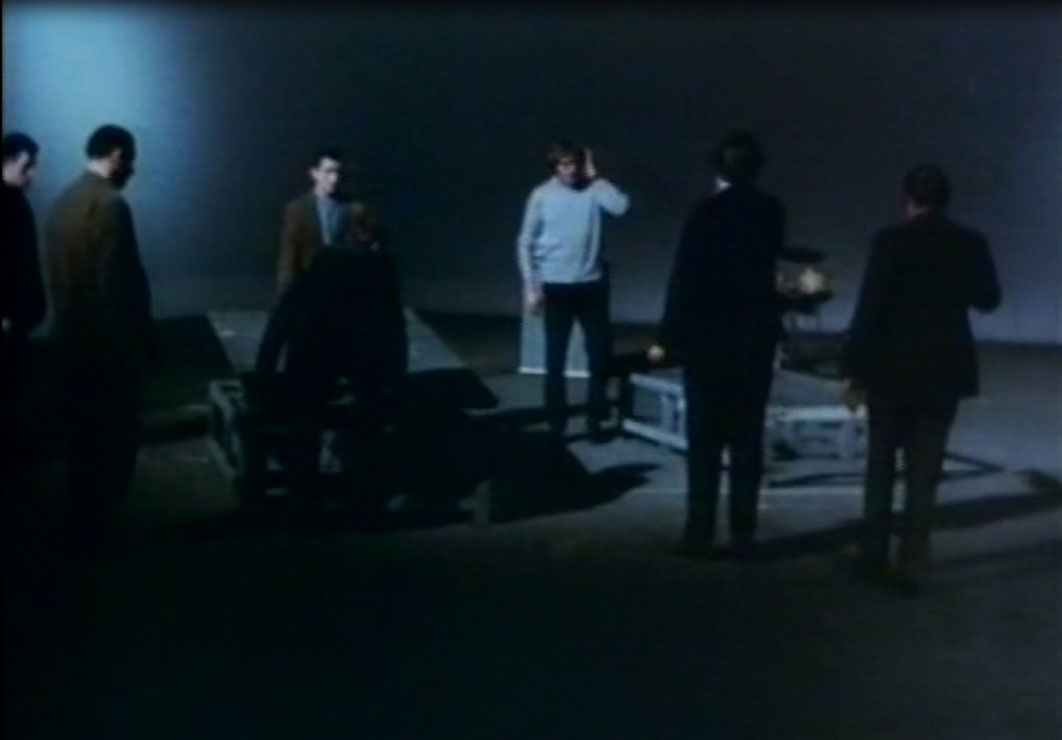
The stage is set at Twickenham as the opening credits roll in “Let it Be.”

Lindsay-Hogg hoped to change minds. “Let’s see what we all feel in a day or two… instead of making anything hard and fast.”

There would be no budging. “Ringo definitely doesn’t want to go abroad,” Paul said, “so that means we don’t go abroad. Maybe we go abroad next time… [but] it would be nice to find some way to do it out of doors.”

Like John wasn’t even considered when discussing a venue he played just weeks earlier, Ringo didn’t state his case in person, only via proxy. It did really sound like it was the first time the topic of concert venue was seriously discussed immediately between the director and the film’s principals, and it was after they had already began the sessions.

Thus, there they were on Jan. 2, starting 20 days of rehearsals culminating in a concert that had absolutely no parameters decided outside of the band scheduled to perform.

9 Comments

Filed under Day by day