Tag Archives: Hey Jude

Jan. 7: On their own at the holiday camp

Some time passed on the morning of Jan. 7 between when “Get Back” made its debut and when Paul McCartney, George Harrison and Ringo Starr — plus director Michael Lindsay-Hogg and John Lennon, who had just arrived for the day’s sessions — returned to the much-needed discussion of what exactly they were doing at Twickenham Film Studios.

The arguments of the day before that culminated in George’s “just want to please you” line may be the moment etched in cultural history of these sessions, but the next 45 or so minutes did far more to define the vibe at Twickenham.

The tapes pick up the discussion already in progress, but the message and motive is clear: There’s a serious movement to abandon the documentary and live show, and, by extension, these sessions, which are only just beginning its fourth day.

From the Get Back book.

From the Get Back Book.

“If we cancel the show now, we’d still be throwing it away,” Paul said. “That’s the way we tend to do (it)… that’s where all the money goes.”

Lindsay-Hogg tries to rally the troops, suggesting the worst-case scenario is the group is left with a documentary, which is something the group could still sell, since money is being made something of an issue here by George.  John agrees, saying a documentary of the group making an LP isn’t the worst if they can’t find a gimmick for a show.

With big dreams of an African adventure still flickering, Lindsay-Hogg continues to insist there should be a show anyway. He’s not crazy about the term “gimmick,” either.

Very quietly, George shares something every Beatles fan knows in retrospect when we look back and put the pieces together.

George: Ever since Mr. Epstein passed away, it hasn’t been the same.

Paul: We’ve been very negative since Mr. Epstein passed away. That’s why all of us,  in turn, have been sick of the group, you know? There’s nothing positive in it.  It is a bit of a drag. But the only way for it to not be really a drag, is for the four of us to say, “Should we make it positive? Or should we fuck it?”  There’s only two alternatives, innit?

It’s a fascinating exchange for several reasons, starting with how they refer to their former manager. Both Paul and George still call him Mr. Epstein, not Brian, nearly a year and a half after his death. The formality of the business relationship never broke.

More of note is not only the ease at which they’re willing to discuss their current state and lack of motivation, but how severely Paul views the band’s state. There’s “nothing” positive in it. And so we’re at the group’s climacteric moment.  These four men seem ready to walk away from at least their present phase as a four-piece. Now’s the time to find a new way of continuing as a band, return to the old way they would record and perform together or just walk away. It’s a distillation of the same conversation they had the day before, but spoken with more urgency.

It bears repeating — this strife and breakup talk isn’t at the end of a grueling, unhappy month, or after a several weeks of early mornings on the cold Twickenham soundstage, as the fable of the Get Back sessions relates. This is after the group has been back together in January for a period that can be measured in hours.

John — lacking sleep, sobriety or both — simply suggests the group just needs a little incentive.

“All the things that we do, the whole point of it is communication. And to be on TV is communication. We have a chance … to smile at people, like (in the broadcast for) “All You Need is Love.”  So that’s my incentive for doing it.”

With John referencing another Beatles television production, the director’s wheels begin to turn.

MLH: Both “All You Need is Love” and  (his own production) “Hey Jude” did communicate.

Paul: Of course, they did, course they did.

John: We need to think of an incentive, the inventive is to communicate.

Paul: You know, there really is no one there now to say: Do it.

And thus we return to Mr. Epstein’s ghost. No one is there to make them get up at 8 a.m. now, Paul says. They have to get themselves up at 8.  And this is part of growing up.

These men range in age from 25 to 28 at the time of these sessions and have been professional musicians since their teens.

“Your daddy goes away at  certain point of your life, and you stand on your own feet,” Paul continues. “And that’s all we’ve been faced with. Daddy’s gone away now, and we’re on our own at the holiday camp. And I think we’d rather go home.

“Or,  we do it.”

So it’s crystal clear to Paul here, he’s fighting uphill. The fresh lyrics of “The Long and Winding Road” are playing out moments after he introduces the song. This here is one of the many times he’s been alone.  And he’s still waiting by his bandmates’ door.

Paul continues.

It’s discipline we like. We all agree — for everything you do, if you want to do it well, you got to have discipline, we all think that. But for this, we’ve never had discipline. A slight, symbolic discipline by Mr. Epstein. And he sort of said, ‘Get suits on,’ and we did … And so we were sort of always fighting that discipline a bit.

But now it’s silly to fight the discipline because its our own self-imposed, these days. So we put in as little as possible. But I think we need  bit more if we are going to get on with it.

Lindsay-Hogg acknowledges the decision to work at all is the group’s, not his own, but that they have indeed started work and should maximize it.  Paul, meanwhile, equates what Lindsay-Hogg is dealing with to his own work on the Jackie Lomax LP.

“Any other director in the world would say, ‘Fuck off. Get off my set, you cunt.’ I mean, wouldn’t you?” Paul asks. “I couldn’t operate. … if Jackie in the middle of the album said he won’t do it, (we) wouldn’t have the album.”

Paul suggests to George that the group used to “do it,” be “fully switched on.”  And he hearkens back to their feature film career.

“Those films, look at it, that was us doing it.”

“Well, if that’s what doing it is, that’s why I don’t want to do it,” George retorts. “I never liked that.”

Like the day before, George’s matter-of-fact, deflating response draws a pause followed by nervous laughter and a stammered response.

Paul (talking over George):  See nowadays, you’ve grown up and you don’t have to do that anymore. You don’t have to put the pancake on and go out in front and sweat and shake our heads because we’re not that anymore. We’ve grown up a bit.

George: And we’ve done that anyway.

Paul:What I mean is, we did it, the but it doesn’t mean to do it again means to do all that. For him (John) to do it, he has to do a thing in a black bag with Yoko. And you’re doing it.

Several voices correct Paul.

“White bag,” he says.

“You know you’re doing it then, on this level.”

Paul’s argument, that doing something is tantamount to doing “it” isn’t flying. Lindsay-Hogg changes course and questions just what the Beatles are, circa January 1969 and what is it, since we’re talking about “doing it,” that  they really want to do?

“But do you still want to perform to an audience?” he asks. “Or  do you just see yourselves as a recording group.”

That’s a simple enough question that really does cut into their motivation, not only for these sessions but for their own reason for existing at this late stage in their career.

And its a question we hope to answer next time here at They May Be Parted!
15 Comments

Filed under Day by day

Jan. 6: Please, please you (Pt. 2)

Rehearsals on January 6 — just the third day of the Get Back/Let it Be sessions — deteriorated to the point where The Beatles were arguing about the very nature of rehearsals and the extent to which a song need be complete in order to have a member bring it to the full band to actually bother with run-throughs.

paul-gb-bookWith takes of “Two of Us” under way, Paul’s already defensive, George is already passive-aggressive. And John? Seems like he just wants to run out the clock and get the hell out of there. But at least he’s not showing any desire to have confrontation at this very specific moment in time.

When we last left things, the song — while sounding great to these ears more than 40 years later — was hung up in the intro, outro and bridge (I guess that doesn’t leave a lot, does it?). Paul had just accused George of being annoyed by him and he bemoaned the presence of the cameras. After some silence and noodling by the group, and another remark by John about the opening riff that continues to torture him, Paul repeats his preferred rehearsal style.

Paul: Doesn’t everyone agree that it’s confused at the moment? So all I’m trying to say is, let’s get the confusion, unconfuse it, then confuse it.

It’s what we’ve been doing all afternoon — this is why we’re not getting anything done. We’ve just got [to get] rolling on with it. We’ve only got 12 more days, so we’ve really got to do this methodically, this one. Unconfused, then a bit more confused, then a bit more. “Now try this drumming here, try this drumming there. Now, OK, let’s stop and look into this bit.”

Well, there’s another nice, little revelation. As of Jan. 6, it seems it’s locked in that the sessions will end Jan. 18 — or, if we’re adding in weekends, make it the 21st or 22nd (depending on whether the 6th counts against that 12 days). Presumably this is how long they’ve booked Twickenham. Talk about ambitious. As history would eventually prove, The Beatles would be out of Twickenham much earlier than that, on Jan. 14 – but that would be a direct result of George leaving the band before rejoining on a condition they abandoned the soundstage for Savile Row.

After Paul’s repeated plea to simplify first, John jumps in, almost as comic relief, continuing his complete fixation on getting out of playing the opening galloping part on guitar.

“I’ve got an idea,” John graciously offers. “I should vamp, because I’ve got to sing, and it’s hard going. But it’s annoying” (and he plays the opening riff).

George fools around on guitar over a bit, making dialogue hard to pick up, until things get clearer in this next exchange.

Paul: I’m trying to stop us all playing until we know what we are playing.

George: But you got to play in order to find out which fits and what doesn’t.

Paul: I’m thinking … we’re improvising the solos, but we play strict chords and strict rhythms around the vocals… I don’t want to say, ‘cause I really just hear myself the only one saying it. All this time…I don’t, don’t get any support or anything…you know its right, and you know its right. (He’s presumably talking to George and John).

John: OK, so I just don’t know what to do about it.

George: I’ll wait until you get your bits and then work my part out if you like. It’s like a matter of working it out with you while you’re working your bit out. You know if you got your bass bit, you know… it will take even longer.

Paul: I’m not trying to say to you, you’re doing it again as though I’m trying to say, and what we said the other day, I’m not trying to get you. What I really am trying to just say is, “Look lads” — the band, you know — “should we try it like this,” you know?

George: It’s funny now how I don’t even care.

It’s amazing honesty from George. He, for one, doesn’t seem to care at all about the cameras capturing the proceedings.  But alas, the tone he spoke in was somewhat mild (and who knows what the visual was) so I can see how this didn’t end up becoming the killer line chosen for the film, like “whatever it is that will please you” became.

Meanwhile, Paul’s showing no hesitation in calling out George and John, both, in saying he’s alone in keeping things afloat. Really, for all of Paul’s flaws, he’s kind of right here about the situation. There does seem to be a bit of cart-before-the-horse when it comes to running through the songs.

And as Paul continues, not skipping a beat after George’s dismissive comment, he goes back at George, reminding him of a recent exchange the two had over a song.

Paul: This one, it’s like, “Should we play guitar through ‘Hey Jude’? No, I don’t think we should.”

(loveallthis.tumblr.com)

(loveallthis.tumblr.com)

More than 40 years later as I write this, it almost seems like “Hey Jude” was from a different generation of Beatles than the ones arguing their way through the Get Back/Let it Be sessions. But on Jan. 6, 1969, where we are today in this blog’s current timeline, it was a song recorded less than six months prior, released a little over four months earlier and had just dropped out of the UK Top 40 three weeks prior.

It’s a funny thing how prevalent the ghost of “Hey Jude” was at the time of the Twickenham sessions. The song’s sessions were easy, with rehearsals beginning July 29, ending Aug, 1. The experience of the song’s video shoot – done at the same Twickenham — helped encourage the band that the time was right to perform in front of live audiences. And like these sessions, “Hey Jude” was ultimately recorded away from the safe and familiar confines of EMI Studios at Abbey Road (where they recorded what turned out to be more rehearsals than real takes), and instead at Trident.  And if outtakes are any indication, it was a pretty upbeat affair.

Thus, the experience recording the song — which happened smack in the middle of the White Album sessions — was fresh at the time of the Get Back/Let it Be sessions. Paul and George had just been discussing how much they liked Wilson Pickett’s cover version just three days prior.

So what was Paul’s beef with George on “Hey Jude”? Here’s what he has to say sometime in the 1990s, as captured to print in the Anthology book:

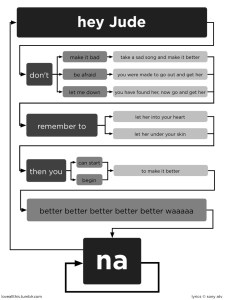
On “Hey Jude”, when we first sat down and I sang ‘Hey Jude…’, George went ‘nanu nanu’ on his guitar. I continued, ‘Don’t make it bad…’ and he replied ‘nanu nanu’. He was answering every line – and I said, ‘Whoa! Wait a minute now. I don’t think we want that. Maybe you’d come in with answering lines later. For now I think I should start it simply first.” He was going, ‘Oh yeah, OK, fine, fine.’ But it was getting a bit like that. He wasn’t into what I was saying.

In a group it’s democratic and he didn’t have to listen to me, so I think he got pissed off with me coming on with ideas all the time. I think to his mind it was probably me trying to dominate. It wasn’t what I was trying to do – but that was how it seemed.

This, for me, was eventually what was going to break The Beatles up. I started to feel it wasn’t a good idea to have ideas, whereas in the past I’d always done that in total innocence, even though I was maybe riding roughshod.

I did want to insist that there shouldn’t be an answering guitar phrase in ‘Hey Jude’ – and that was important to me – but of course if you tell a guitarist that, and he’s not as keen on the idea as you are, it looks as if you’re knocking him out of the picture. I think that it was like, ‘Since when are you going to tell me what to play? I’m in The Beatles too.’ So I can see his point of view.

But it burned me, and I then couldn’t come up with ideas freely, so I started to have to think twice about anything I’d say – ‘Wait a minute, is this going to be seen to be pushy?’ – whereas in the past it had just been a case of, ‘Well, the hell, this would be a good idea. Let’s do this song called “Yesterday”. It’ll be all right.’

What we see here is pretty obvious: The Get Back/Let it Be sessions have been tarnished — demonized even — in part, because we actually can hear everything that happens thanks to voluminous bootlegs. Good luck finding a recording George and Paul arguing over the “Hey Jude” extra guitar part.

So in the Anthology excerpt (among other places, like in Barry Miles’ “Many Years From Now”), Paul does a pretty good job here giving what seems like an honest presentation of what was happening in 1968-69. And nearly 30 years after the fact , he was still able to run through the specifics.

And it was Paul’s reflection — This one, it’s like, ‘Should we play guitar through ‘Hey Jude’? No, I don’t think we should.'” — is what directly prompted George to spew “I’ll play, you know, whatever you want me to play.”

More from the “Two of Us” rehearsals, including George finally uttering that line I keep on going on about, coming up in the next post!

22 Comments

Filed under Day by day

TMBP Extra: Christmas time is here again

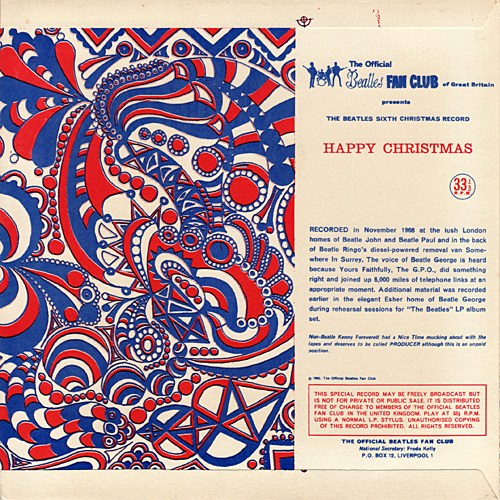
1968_sleeve_back

Quick quiz: When the Beatles convened Jan. 2, 1969, at Twickenham for the Get Back/Let it Be sessions, what was their most recent record release?

It wasn’t the “Hey Jude” single, which was still on the charts , but came out the end of August 1968. It’s not the White Album either — that came out at the end of November.  The soundtrack to the Yellow Submarine film was released nearly two weeks into the January 1969 sessions, with songs that had long been recorded.

Check the solo discographies, even, and you come close —  but not close enough. Two Virgins — cut in May — came out a week after the White Album. John also participated in the Rock & Roll Circus on Dec. 11, 1968, but that recording wasn’t released until 1996. George’s Wonderwall Music was close, too, released Nov.1, 1968 in the U.K. and Dec. 1 in the U.S.

The answer, a giveaway by now thanks to the post title and above image, is the Beatles’ Sixth Christmas Record, recorded post-White Album sessions in November 1968 and released Dec. 20, 1968, less than two weeks before the band assembled at Twickenham in Jan. 1969, and while the band was in active discussions planning out the film and potential shows.

There’s no need for a play-by-play breakdown of the recording, since if you’re at this blog, you either already have heard it or, if not, you really should just click and listen — it’s less than eight minutes long.

Does it portend anything musically for the band? Well, no, not at all.

It’s odd and experimental in (most) places. But perhaps more relevant, this is the first of the fan-club-only Christmas releases, which date back to 1963, in which the group wasn’t actually a  group, with each of the four members submitted their own message for inclusion. How separate were they? It was an international affair with George literally phoning it in from L.A., while the rest of the band put their respective pieces together from their homes.

Alas, they were forced back together again days later at Twickenham, but by the time their following (and last) Christmas album came out in Dec. 1969, they’d be done recording as The Beatles, separately or together, altogether (one exception aside).

1 Comment

Filed under Extra

TMBP Extra: Lindsay-Hogg catalog

Lindsay-Hogg and Lennon

With the first significant discussion of the potential live show complete, I thought it was as good a time as any to briefly go off timeline to present what the project’s director, Michael Lindsay-Hogg, had already worked on in his career to this point. More than 30 posts in, it’s clear he’s a central character to the Let it Be/Get Back story, even if he doesn’t pick up a guitar or sing a note during the sessions.

After some stage work, the 25-year-old entered the world of music in 1965 as a director on “Ready Steady Go!

And it was his exposure working on the show that caught the eye of Brian Epstein, who drafted Lindsay-Hogg to direct promo films for “Paperback Writer” and “Rain” in 1966.

Certainly foreshadowing the relationship we’ve heard thus far on these Jan. 1969 tapes, the director describes his first meeting with the band to sketch out ideas for the two films in his 2011 autobiography, “Luck and Circumstance“:

But with The Beatles that evening, I found an idea was something to be mauled, like a piece of meat thrown into an animal cage. They’d paw at it, chuck parts of it from one to the other, chew on it a bit, spit it out, and then toss the remnant to me, on the other side of the bars.

Ultimately, the director “was told Mr. Epstein did not want anything ‘unusual, just a video of the boys performing,'” he wrote in his autobiography.

The creative relationship with The Beatles seems much different than the one he developed with the Rolling Stones, a band for which he ultimately directed dozens of videos for into the 1980s, beginning with both sides of the “Jumping Jack Flash” single in 1968.

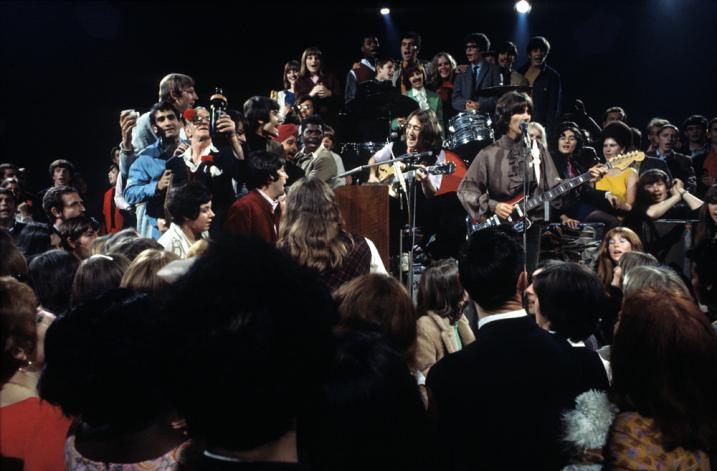
Not much after the Stones shoots, Lindsay-Hogg was back with The Beatles, this time filming both halves of the uber-single “Hey Jude/Revolution” in September.

Here’s Lindsay-Hogg with a few words on the “Revolution” clip, in an interview published as part of the promotion of the 1+ set.

Iconic Beatles visuals, I dare say, and it showed the potential of a shoot at Twickenham. And it’s partly from the “Hey Jude” experience, in which the band is said to have enjoyed playing live before an audience — not just the songs before the camera, but impromptu performances between takes — that led Paul to hatch the Get Back idea, which began filming nearly four months to the day later.

But first, Lindsay-Hogg got the call from Mick Jagger to direct what was to become the Rock and Roll Circus, with one John Lennon contributing “Yer Blues” to the production, filmed about three weeks before The Beatles commenced rehearsals at Twickenham.

The show was famously shelved until 1996, in part because The Who blew the Stones off the stage. The same Who, incidentally, that Lindsay-Hogg shot the “Happy Jack” promo film for two years earlier after also shooting them for “Ready Steady Go!”

This is the oeuvre the then-29-year-old son of Orson Welles (something he only recently found out was true) brings into his latest gig for The Beatles in January 1969.

4 Comments

Filed under Extra

Jan. 6: Adore your ballroom dancing (If there’s a rock show, Pt. 3)

Back-garden Beatles (Tittenhurst, 1969)

After a proposed overseas concert in a Roman amphitheater in Libya is scuttled by Paul, citing Ringo’s insistence on staying in England, a suggestion is made to perhaps go small and shoot a Beatles concert in a back garden, presumably somewhere in London.

Director Michael Lindsay-Hogg quickly dismisses the idea, suggesting it would end up like a “little promo film … instead of a Beatles television show.”

Sitting in on the discussion, George Martin cuts to the chase and thinks even smaller, proposing “we just do it in the other studio.”

Paul shifts the focus off the venue and back to the composition of the crowd.

Paul: We’re all prepared to do it with an audience. But what Yoko said is right — we can’t just have the same old scene. If it was the same old audience and we were … all naked when they came in, then that’d be a different scene, you know?

MLH: I think she’s totally right about that, that’s one of my big points.

As the discussion goes in circles, someone in the group asks the simple — but very difficult — question: “What can you do that’s new with them?”

Paul: We shouldn’t really try to do anything with the audience because the audience is the audience, and it’s them, and they’ve come in. It’s us that’s doing the show.

Yoko: Because If I were in New York and I watched the “Hey Jude” [promo on TV] … my interpretation would be that those people around them who are sort of climbing up and starting to sing with were just hired people. If I think that, then it’s OK. But if I thought it was a true audience, then I think, ‘Oh, so now people don’t think of The Beatles as too much’ because all the image that everybody in the world has about The Beatles is that once there’s an audience, they’re going to be frantic and pulling their clothes and tearing it away and all that.

“Hey Jude” promo video

OK, then.  Not so sure I’m on board with Yoko’s assessment of the state of The Beatles’ popularity at this point, but hey, she’s soon to be married to a member of the band and was actually there in the ’60s, whereas this blogger was yet to be born.

But still. It seems a bit out of reach to me to suggest that just because a Beatles audience wouldn’t be in full-tilt 1964-era Beatlemania, pulling out their hair and screaming over the songs, means the band isn’t as “big” anymore.  It’s 1969, not 1964 anymore. The music scene has changed.

But to avoid what Yoko thinks would be an issue, George Harrison says the solution is something The Beatles had done before.

The good thing is that we could completely create another image, reserve the image of your choice. If we could just think of an image we’d like to be and then we make it that one, which could be anything. We could just be a nightclub act, or anything, just the smoochy, low lights and 10 people.

Wheels turning, Lindsay-Hogg says, “Then you’re a little cabaret act,” before he and George Martin agree again that there should be a large audience that’s not necessarily any kind of focal point, just to be used as a sounding board.

But then Paul picks up on George’s idea and gives it a twist.

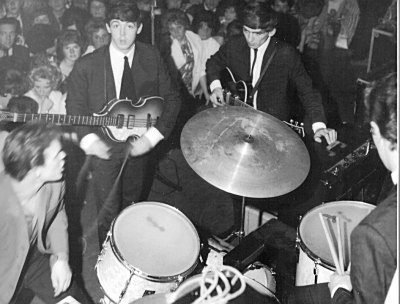
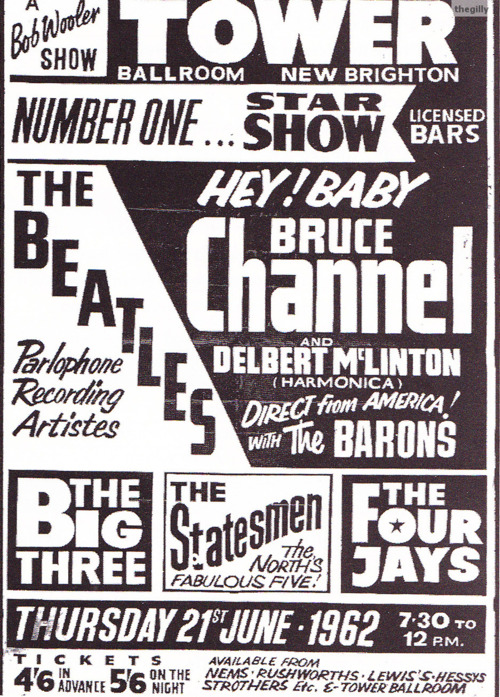
I thought, like, a ballroom. If we did go right back … and did it purely like a dance. “Come to the Tower Ballroom, there’s a dance on. Oh, incidentally, we’ll be the band there.” And we’d go on, play all the numbers and we’d play it like we’d play a dance, without trying to sort of announce anything. There’s a fast one, there’s a slow one, and everyone, like, dances. And there might be a fight or there might be the kinds of things that happened at dances. Or it might be a very sedate, quiet dance.

The Beatles, performing at the Tower Ballroom, ca. 1961-62

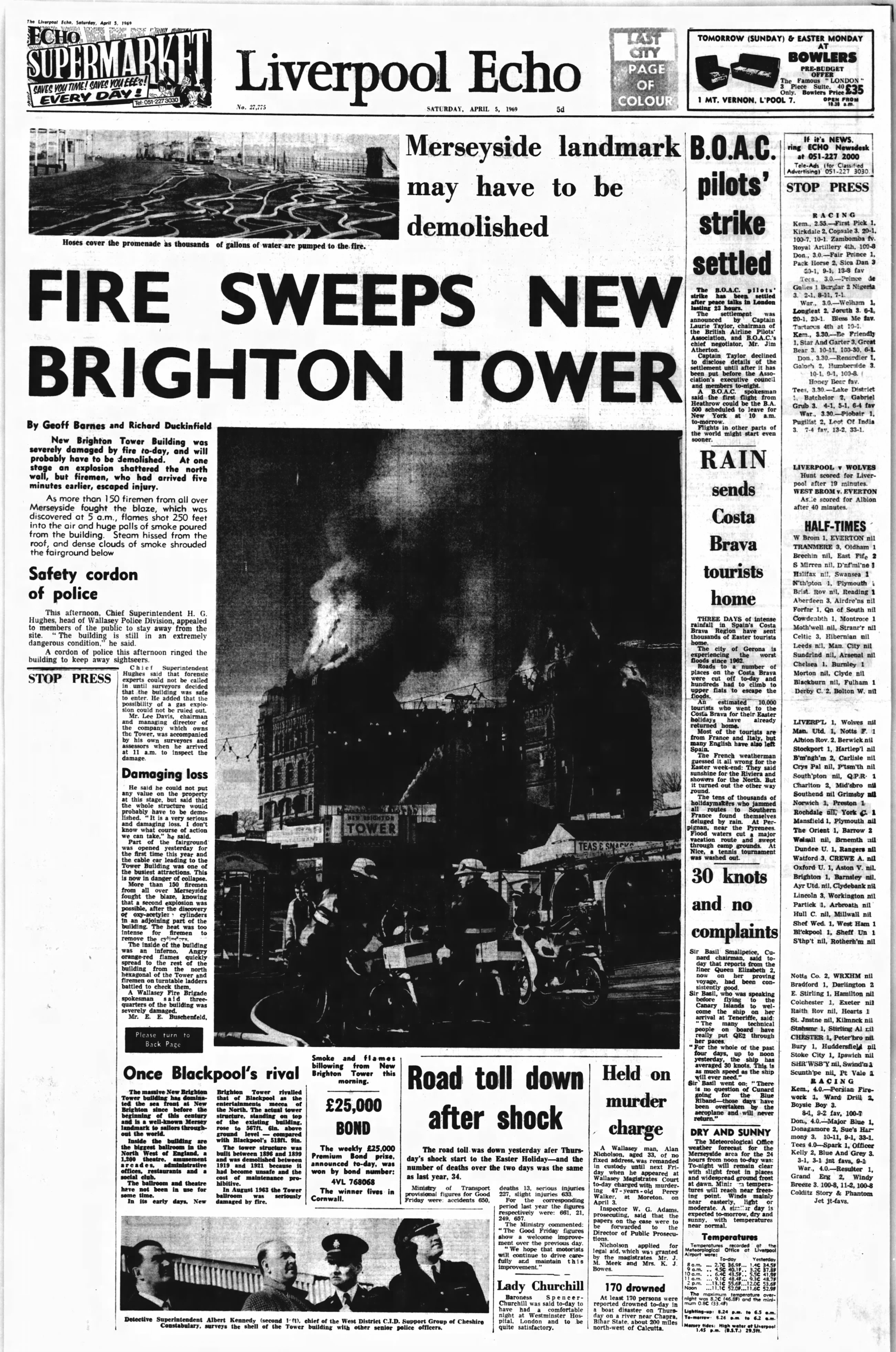
Presumably, Paul’s referring to the Tower Ballroom of New Brighton — just a ferry ride ‘cross the Mersey from Liverpool — a venue they played numerous times in 1961 and 1962.

I actually sort of love this idea, with the full understanding that it may just take hired hands to get an audience to ignore the fact they’re at a Beatles concert and just go ahead and actually dance.

And to do that, as my wife said to me, they’re really just making a long music video. What’s the point?

Lindsay-Hogg is on board — in essence, he says —  because he likes its simplicity. But that’s where his agreement ends. “What you’re asking for is a really, really simple approach, which I think is right,” the director says. “But I’m not sure just to have an audience dance around you is good that way. I don’t think you are just a local band.”

Paul, and the rest of the group in the conversation, agree. But after digging deeper into the idea, Lindsay-Hogg ultimately thinks it’s a non-starter.

MLH: The only time on TV it didn’t work for you was when you went on … Top of the Pops, and they did dance, do you remember that? And they didn’t really do very much. And that would look so crazy. It looked crazy for four minutes, but it would look lunatic for longer. It would have been in the bad way, it was so sedate, and you all were so sedate back then.

The essence of this idea is the simplest approach possible. The essence is correct —  totally, totally what I believe — but you’re just not the local dance band. Would that you were, but you’re not. So that’s going to be very hard to achieve.

Paul sticks with his newest idea, saying that if they’re going to be artificial and build a set at Twickenham to mirror the Tower Ballroom anyway, why not just go to the Tower itself?

We learn a little bit more about the Let it Be film’s early timeline in Lindsay-Hogg’s response.

MLH: That was one of the reasons we started veering off on these ideas was when we were looking at locations that Friday afternoon after Christmas, and all the locations looked like four steps up from a boutique, you know what I mean? Four years ago everyone was shooting in a boutique, and now it’s a disused sawmill or whatever it is. It just looked like plastic locations.

Everyone agreed it was a phony look, certainly something the group was seeking to avoid.

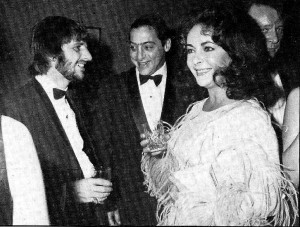
“Candy” co-stars Ringo Starr with Richard Burton — and Liz Taylor in 1968.

Also notable here is that the director was scouting locations on Dec. 27, 1968 — a mere 10 days earlier. Good on Lindsay-Hogg, too, for working hard; he directed “Rock & Roll Circus” just 16 days prior.

Yoko won’t give up on the band staging a show before anything remotely like a conventional audience, comparing the scenario to actor Richard Burton, and saying that people don’t want to see him performing on stage before a “fixed” audience.

No matter what kind of audience, it s going to look crummy. What he is is a legend.  Seeing him on his own private boat or just seeing him shaving is just more dignified than seeing him perform before a fixed audience. Do you see that point? That’s why it’s better to show you in your private home, or George’s home or something. “Oh, this is much better than a fixed audience.”

George and Pattie at home at Kinfauns, their home from 1964-1970

Someone, perhaps Mal or Neil, out-Yokos Yoko by suggesting a performance at The Royal Academy or Tate Gallery — “with nobody there but the pictures.” Naturally, she agrees.

Lindsay-Hogg still wants none of that, saying, “Once you get up to perform as The Beatles, you have to perform to someone, even if it’s going to be this different kind of audience.”

The debate churns on.

MLH: Certainly yes, you play straight at home. But I have a feeling that’s not big enough.

Yoko: But that’s big. See the private home of Paul McCartney or George Harrison.

MLH: We could fit that into the documentary.

George Harrison reflects on a “Bridget” documentary (presumably Bardot),  describing her taking the audience to St. Tropez as she “sings a tune over her front gate and walking around the pool.”

Insisting that kind of minutia can be incorporated in the documentary, Lindsay-Hogg then offers what turns out to be his concluding argument for the day.

If you just get up to perform, you either have to be performing directly to the people at home or to an audience. It’s only two ways. Maybe it would work for the people at home, I just don’t think there’s quite enough scope. And I think the idea’s good, because we have to think about the audience — because you are so riddled with audience. The audience is so much part of the first half of you musically — [under his breath as an aside] says the critic from the Guardian — the audience is so much part of the mystique.

After a mention of mystique, we’re left with a mystery — the tape cuts off abruptly, and the next track is merely a nondescript improvised instrumental, and there’s no return to the discussion this day again.

And what of the Tower Ballroom? Had The Beatles performed there, it would have been the last hurrah for the venue. It was destroyed by fire just three months after this discussion.

14 Comments

Filed under Day by day