Having completed a spirited four-song run-through to jump-start the full band’s session at Twickenham on January 8, 1969, with the ancient “One After 909,” the Beatles managed to dig to the very bottom of the vault and the genesis of the Lennon/McCartney songwriting partnership.
It’s a stretch to say the Beatles played “Too Bad About Sorrows” in the moments after they finished “One After 909,” itself a primeval composition, one John had said was his own, but Paul claimed to have shared credit writing. The spark of “909” propelled the group further down Memory Lane and over to 20 Forthlin Road. Dating back more than a decade to 1957, “Too Bad About Sorrows” has the distinction of being the very first Lennon/McCartney collaboration, per Paul.
We would sit down with a school notebook which I have to this day, an old tattered copybook, blue lines on white paper, and I would write down anything we came up with, starting at the top of the first page with ‘A Lennon-McCartney Original’. On the next page, ‘Another Lennon-McCartney Original’; all pages have got that. We saw ourselves as very much the next great songwriting team. Which funnily enough is what we became! We started off, I think, with a song called ‘Too Bad About Sorrows’. They all had very simple chord structures but we learned our craft that way.
Paul said much of the same here, on the South Bank Show in 1978.
Lasting about 15 seconds long, all we really hear on the January 8, 1969, performance is John singing the first line of the song — the title — over incoherent guitar and bass accompaniment, and two more garbled lines: “Too bad about love/There’ll be no tomorrow.” The performance itself is obviously forgettable as are so many of the brief stabs at songs these sessions, but this is particularly notable as it enabled the public — via decades of bootlegs and now YouTube clips like the one below sourced from those same bootlegs — to hear the very first Lennon/McCartney song.
The group would similarly perform a taste of “Too Bad About Sorrows” nearly two weeks later after the sessions shifted to Savile Row.
Straight out of the stab at “Too Bad About Sorrows,” John playfully delivered the line, “There’s no blue moon in history,” before letting out a giggle. Seconds later, he and Paul shared vocals on an impromptu version of “Just Fun,” the song John had just referenced and what is considered the second collaboration from the Lennon/McCartney team. In between, John delivered the line about “pot-smoking FBI members” that would eventually appear on the Let It Be album, and referenced in the last post.
Two days earlier, “Just Fun” had come up in conversation with director Michael Lindsay-Hogg and producer Glyn Johns in a sequence that ended up in the Let It Be film as they discussed the revival of “One After 909.” Paul weakly sang the opening lines from “Just Fun” as part of a greater recounting of the early days of writing with John.
The Jan. 6 discussion of “Just Fun,” from the “Get Back” book.
This attempt wasn’t as comprehensive as the abbreviated January 6 version, lasting just a single line: “They said that our love was just fun.” Things broke down as George interrupted to go over new songs to be rehearsed. “Just Fun” wasn’t performed — at least at these sessions, and that we know of — by the Beatles again. Like “Too Bad About Sorrows,” this wasn’t any kind of groundbreaking performance, but it’s a slice of history that’s thankfully preserved.
Beyond the South Bank Show clip above, Paul has dusted off “Just Fun” elsewhere, including two verses’ worth of the song at a 2004 soundcheck in Zurich, of all dates and places. Quite oddly, John’s singing of the line “There’s no blue moon in history” shows up in the once indispensable 1982 documentary “The Compleat Beatles” (this author’s first real exposure to the band’s history) as background during an interview with George Martin about Beatles For Sale, for some reason. So in that strict sense, it’s actually been officially released, albeit a few seconds’ worth.
Unfortunately, “Just Fun” is a terrible, terrible, awful lyric. Even Paul agrees.
There was one called ‘Just Fun’ we couldn’t take any further: ‘They said that our love was just fun / The day that our friendship begun / There’s no blue moon / That I can see / There’s never been / In history …’ Ooops! It’s horrible, this is horrible. When we heard heard that rhyme we just went off that song in a big way. We were never really able to fix it either. But they’d get written down and we’d play ‘em. We’d say, ‘Wow, we’ve written some songs, you know, d’you wanna hear them? “Said our love was just fun …”’
There’s never been a blue moon in history? For heaven’s sake, Paul, there was a blue moon over Liverpool in August 1956, 11 months before you met John and wrote this song!
It turned out OK for these guys, though, and Lennon/McCartney — together and alone — figured it out. For instance, we all can agree that “She Said She Said” — the next song the group played on January 8, after a mention from George — is a quite terrific lyric.
Considering the band never performed the song live, and presumably hadn’t played it at all together in two-and-a-half years, the group holds together the first verse decently enough.
As we recount events two days before George left the Beatles on January 10, it’s worth marking that the original 1966 recording session of “She Said She Said” was missing Paul. He walked out after he “had a blarney” with the others, the first Beatle to tentatively leave the group.
Our world lost — and the stars and heavens regained — David Bowie last week. I didn’t feel much like blogging about the Beatles for a little bit, even though this post had already been mostly written. But as the man once sang, time is waiting in the wings, and we should be on by now. So please enjoy the continuation of the Beatles’ Nagra tapes timeline, picking up with the morning of January 8, 1969, as David Bowie was celebrating his 22nd birthday across town and working on writing Space Oddity.
It’s tough to say “this is when they got serious” when there were laughs and smiles throughout, but after more than a half hour on the January 8, 1969, Nagra reels, the Beatles at least found a bit of motivation and a short-term goal to complete, getting serious in deed if not demeanor. With a concert to be staged, John, Paul, George and Ringo gathered their focus for a chirpy, energetic run-through of four songs deemed early contenders for a live show.
Paul led the proceedings, tabbing his original duet as the opener: “Johnny, ‘On Our Way Back Home.’”
If you’ve seen Let It Be — and I really hope you have and will one day again on some sort of modern entertainment replay device – you’ve been struck by how loose John and Paul are, hamming it up as they sing into the same microphone.
Paul, who Ringo in an interview the previous year referred to as“Elvis” in reference to his performance of “Lady Madonna,” was closer to the toxically impaired King, comically slurring and sneering throughout a take that both he and John sang without benefit of a lyric sheet. That’s how we end up with John, laughingly repeating his mistake “two of us wearing postcards” once the take was complete. They laughed the as they sang it during the take, too.
While Paul and John can’t often get through more than a few words without butchering a lyric, there was no turning back once they started, with this a sincere attempt at a run-through.
The sequence appears slightly edited in the film, cutting the performance in half from its actual three minutes to a minute-and-a-half. Had the group secretly abandoned the film and this leaked, conventional wisdom would have been that the group had a blast at Twickenham. Maybe they were just hamming it up for the cameras — or John was, at least — but it’s hard to deny a somewhat different spirit in the room with a watch and listen. When things were languid at Twickenham, it was painfully clear.
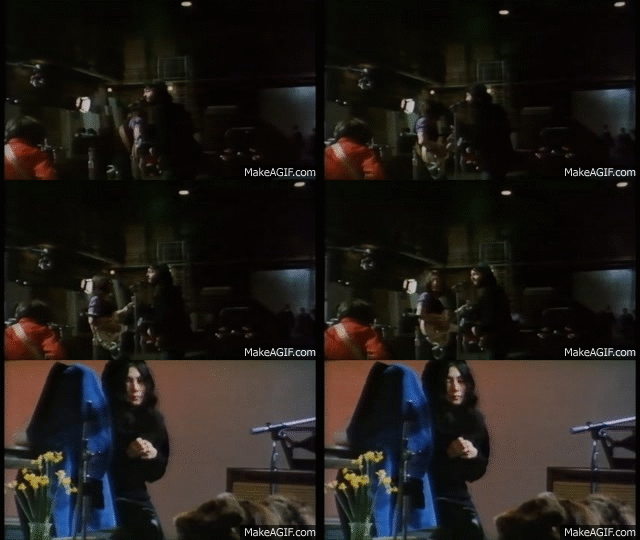
A visually telling edit by movie director Michael Lindsay-Hogg comes around 30 seconds into the clip, as we catch John glancing over at Yoko, who blankly stares back, as he stands oh, so close to Paul, showing some of the genuine affection that they certainly used to have and somewhere deep in there still did.
Two of us, and also Yoko
If you can use the word “tragedy” when referring to the fact a song was omitted from a compilation –- you shouldn’t, but I will, deplorably -– it’s a tragedy this take didn’t make it onto Anthology 3. It’s in the film, thus is a recognizable, published “official” release, so despite the issues with the lyrics, it’s “out there.” Consumers would have understood having an(other) imperfect take on the compilation, if not welcomed it.
In the film, the song comes out of the “shocktric shocks” sequence from a few days earlier, and then dumps into “I’ve Got a Feeling,” but in reality the group – after the improvised “You Got Me Going” and a few unserious seconds of “Twist and Shout” – delivers “Don’t Let Me Down.” Note the time between the end of “Two of Us” and “Don’t Let Me Down” is less than a minute. Dallying was at a minimum. While “Don’t Let Me Down” appears several times in Let It Be, this version is not in the film.
George didn’t quite nail the introduction, but again there was no concern when the lyrics were muffed. John simply shouted “Snotgobbler!” and moves on. That’s rock and roll. So was the pre-primal scream from John as the song began. So were the lyrics “nobody ever rubbed me like she do me,” which John subs in at one point. The band played on, and musically it was relatively tight, really an achievement at this point in the song’s lifespan.
Paul beard porn from the January 8 sessions, as seen in Let it Be. Thank me later.
John came out of the high-energy take with thanks from the “band.” “God bless you, ladies and gentlemen, I’d just like to say a sincere farewell from Rocky and the Rubbers, this is Dirty Mac himself saying …”
Paul cut in, all business: “I’ve Got a Feeling.”
“Good morning!”
The performance was a tick slower at the outset, and with continued lyrical miscues (especially Paul and John mismatching “oh no” and “oh yeah” early on), but it retained the same vigor as the two previous songs. Paul shouts a celebratory “good morning!” after wailing “somebody who looks like you!” as George hits the middle-eight guitar part.
This sequence made the film, notably appended to a particularly torturous rehearsal from a day later.
Three songs into the run-through, John revealed some fatigue, perhaps reflecting the weight of the previous week more than the prior 10 minutes: “Only another two days to go, then we’ll have another two off.” But Paul then offers a pick-me-up, suggesting, “Do ‘One After 909’.” So they did.
This number marked the one point in the four-song run-through the group stopped after they started, rebooting the take after George’s solo. Once again, there’s a disconnect with the film. Based on clothes alone, this performance of “One After 909” is featured visually early in the movie — after Paul’s discussion of the song with Lindsay-Hogg from a couple days earlier (as seen in the film) — but paired with the audio of a take from January 9.
The movie and even a moment of the Let It Be LP was further fleshed out with a bit of memorable dialogue coming out of “One After 909.” You’ll hear it on the Let It Be LP prior to “For You Blue,” George’s eventual lone contribution to album that was just days old, as John reads from the newspaper.
Queen says no to pot-smoking FBI members.
What, you thought she’d be OK with it?
Again, we have a disconnect between the movie and the tapes, as the film moves to a previous day’s take of “Oh! Darling” while in real time, the band had completed their first commitment to a run-through for a show yet to materialize. It was rough, but it was spirited, and if anything, the set must have given them the idea there would be a light at the end of the tunnel if they chose to shine it. With at least four fully formed songs, they were on their way, and the apparent positivity could easily be read to bode good fortune ahead.
Probably inspired by “One After 909,” they continued a quick dip into their back catalog.
Three years ago in this space, we celebrated Paul McCartney’s 70th birthday with a brief look back at the period between June 18, 1968 and 1969, a stretch that straddled the Get Back/Let It Be sessions that we explore here. On the occasion of the diamond jubilee of John Lennon’s birth, we’ll do the same thing people have done for more than 50 years: compare John and Paul, and as usual, with much different results.
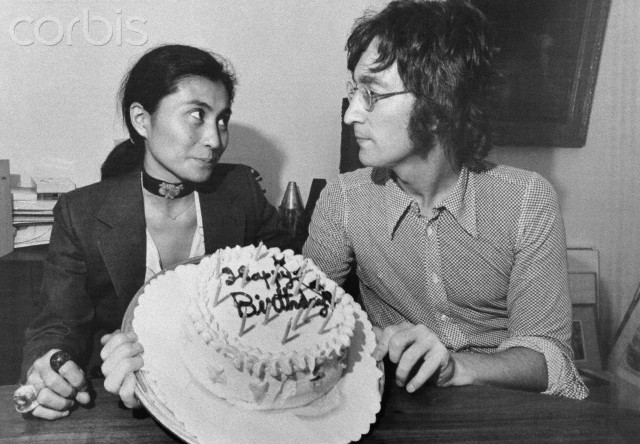
Smile, John, it’s your birthday!
Forty-seven years ago today — October 9, 1968 — was John Lennon’s 28th birthday. The Beatles were primarily in the mixing stage of the White Album. John was in the midst of a divorce with Cynthia. Nine days later — there’s that number that follows John around — he and Yoko were victims of a drug bust at their home as they were handling the difficult release of Two Virgins.
In the coming months, the White Album was completed and released, the Beatles assembled in January 1969 for a monthlong writing and recording session and they subsequently recorded and completed Abbey Road (along with other songs, like John’s “The Ballad of John and Yoko,” a No. 1 hit). Those achievements fell in the same period as between Paul’s 1968 and 1969 birthdays. So what’s different for John and in the time frame that’s shifted by four months?
Yoko, obviously, and her dramatically increased role in John’s life, replacing Paul as his primary collaborator. It wasn’t just her, but what she enabled John to be willing to do. John, with Yoko, created their own art and performance outside of the Beatles — bed-ins, experimental music, films, publications — all things that grew from being an outlet away from the band to becoming a full replacement for the band that Paul was expending his energy to keep together and internally manage. Like John and Yoko, Paul got married, too (less than 10 days earlier), and started his own life with Linda, increasingly spending time at his farm in Scotland. The Beatles had become his band, if it was anyone’s.
Three weeks before the Get Back sessions, John formed the Dirty Mac for the Rolling Stones’ Rock and Roll Circus in December 1968. His bed-in recording of “Give Peace a Chance” was released within weeks of “The Ballad of John and Yoko” in July 1969. Two weeks before the release of Abbey Road in September 1969, his first iteration of the Plastic Ono Band took the stage in Toronto. Upon his return on Sept. 20, he told the rest of the Beatles he quit the group. He wouldn’t perform together with the other three Beatles again. Ten days later he recorded “Cold Turkey.”
All of the Beatles by this point had their own lives, marriages and projects outside the band. For John, the Beatles had become the outside project in a wildly tumultuous period coinciding with his divorce, his immersion into Yoko, the use of harder drugs and his disengagement from Paul. All the factors are related. This may not have been John’s greatest period as a pop music songwriter, at least in volume, but given the variety of artistic pursuits and chances he was willing to take — including the biggest one of all, replacing Paul with Yoko — it was a remarkable period in John Lennon’s career and life.
On August 28, 1969, Linda gave birth to Mary, Paul’s first child. On October 9, John’s 29th birthday and the end of the period we’re recalling here, Yoko miscarried. They would have their first child together, Sean, exactly six years later, on October 9, 1975.
It all came together thanks to television, LSD, a dance and a dare.
George Harrison started the fifth day of the Beatles’ sessions at Twickenham, January 8, 1969, with the dare, challenging director Michael Lindsay-Hogg with a new song in hand.
“‘I Me Mine’ it’s called,” George says to the crinkling of paper being unfolded. “Should I sing it to you? I don’t care if you don’t want it, I don’t give a shit about it. I don’t give a fuck. Can go in my musical. [laughter]
“It’s a heavy waltz.”
An edited version of this moment — the origin story of what would become one of George’s two contributions to the Let It Be LP — along with a performance of the song, appears in the film of the same name in a three-minute sequence that closed out the Twickenham portion of the movie. On the Nagra tapes, the band is introduced to the song and would later work through and rehearse it roughly five separate times in the five hours of the day’s tapes, covering about an hour total.
The first 45 seconds of the song are familiar: It’s George accompanying himself on guitar to the first two verses of the song, and those lyrics are the same as would eventually be released. But to this point, there is no chorus, instead a brief flamenco-inspired guitar part bridges the verses.
After this initial debut, George interrupted himself to again gush about John’s 1969 diary — “Got up. Went to work. Came home. Watched telly. Went to bed.” — providing himself a segue to his prior night’s entertainment. Once more, it was the Beatles talking about and drawing inspiration from television.
“It was the TV, you see.” George said, recounting he was watching “that science fiction thing, but then it suddenly turned into that crap about medals and things.” That crap was an episode of the weekly program Europa, “The Titled and the Unentitled.” Per the original TV listing, the show “looks at the aspects of pomp and circumstance through European eyes-with a special report from French Television on the investiture this summer of the Prince of Wales.”
George Harrison, MBE, may have found the subject matter “crap,” but in his role as musical prospector, he found value amidst the precious medals being discussed. Specifically some incidental music during the program — Johann Strauss’ “Kaiser Walzer” — sparked George at some point between 9:55 and 10:25 p.m. GMT the night of January 7.
(George would have seen a different performance. This one is from 1969 but from West German or Austrian television.)
“That’s what gave me the idea. Suddenly, it was the bit where they were all coming in from the ball. I think it was Austria, and they all had their medals. And there was some music that was just playing … like a 3/4 thing. Some things like that happen where you just hear something, and it registers in your head as something else. And so I just had that in there, the waltz thing.
“It’s like one of those things where they’re all swaying.”
Years later, in his pseudo autobiography that took the name of this very song, George addresses the origins of the lyrics.
I Me Mine is the ‘ego’ problem. …
I suppose having LSD was like somebody catapulting me out into space. The LSD experience was the biggest experience that I’d had up until that time. … [A]fter one dose of acid I felt I was stuck in this thing, which later I realised is called ‘relativity’. So, the big ‘I’ I’m talking about is the absolute, whereas we’re in the relative where everything is good-bad, yes-no, up-down, black-white. That’s why they called it the heaven and hell drug! But life is heaven and hell, we see it as, or make it into hell or heaven: there’s no heaven and hell beyond relativity.
So suddenly, I looked around and everything I could see was relative to my ego — you know, like ‘that’s my piece of paper’ and ‘that’s my flannel, or ‘give it to me or I am’. It drove me crackers; I hated everything about my ego — it was a flash of everything false and impermanent which I disliked. But later, I learned from it: to realise that there is somebody else in here apart from old blabbermouth …
Anyway that’s what came out of it: I Me Mine. The truth within us has to be realised: when you realise that everything else that you see and do and touch and smell isn’t real, then you may know what reality is and can answer the question ‘who am I’?.
After an extensive return to discussion of the “science fiction” — the series “Out of the Unknown” and the episode “Immortality Inc.” as excitedly shared in rich detail by George and Ringo — George presents the new song to Paul, who had just arrived at Twickenham.
“Is that grammatical? Flowing more freely than wine? Flowing much freer?” George asks. “If there were such a word as ‘freer’ is it ‘f-r-e-e-e-r?” George asks. “It’s ‘f-r-e-r’” Michael concludes before Paul chips in, “It’s like ‘queer.’”
It would be more than two hours until the group returned to “I Me Mine” — what they did in the interim will, of course, be the subject of subsequent posts. Once they did return to the song, George addressed John, who wasn’t yet at the studio when the song was first introduced. “Would you like to learn a new one?” George asks. “Very simple,” George assures him.
After John clowns around through a couple abbreviated spins through the song and making sure George knows “we’re a rock and roll band, you know,” he mockingly suggests he play the barrel organ. George had more seriously considered adding an acoustic bass. “Want the accordion?” Paul asks George, who’s open to that sincere suggestion. “If it’s not here, then just fuck it.” Alas, Paul’s accordion — he did have one, you know — wasn’t at Twickenham. What John would really like is an electric piano setup, but that too isn’t yet available. One thing they do have is some working effects, and an upbeat John has plenty of fun with the echo.
Some of the above highlights are edited down and rearranged in the 2021 Get Back docuseries:
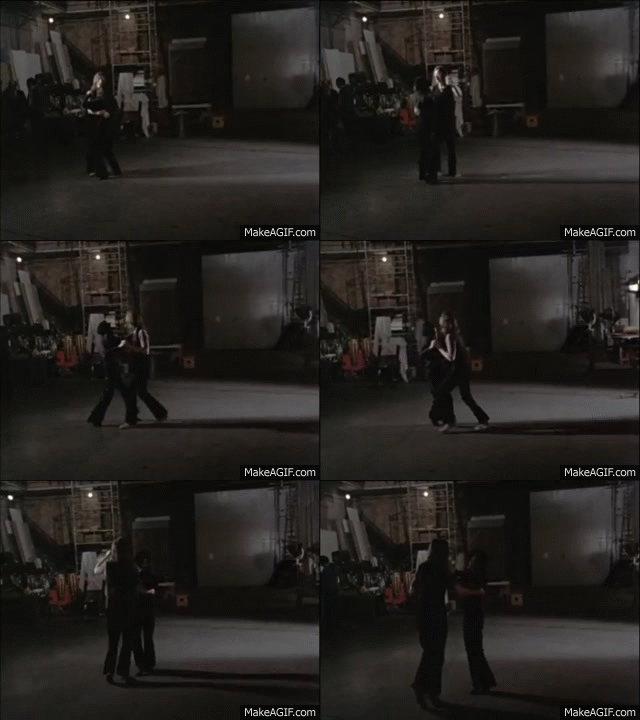
“Are you going to teach us this?” John asks, and George supplies the band, at last, with chords to “I Me Mine.” Soon enough, however, John doesn’t play at all. Instead, as Strauss intended, he and Yoko waltz on the soundstage as George, Paul and Ringo provide the soundtrack.
George loves the antics, and doesn’t need the extra musical accompaniment John would offer anyway.
“Do you want to do that on the show?” George asks John. “That’d be great, ‘cause it’s so simple to do, the tune. But to do that waltz, or something, if you want to bag it up a bit.” Laughing, Paul offers a mock show introduction to the song: “John and Yoko would like to waltz in their white bag, And there’s a white bag waltzing around. They were doing things inside it.
“We should do it like an escapoligists thing. You can see they’re not tied at all. There’s nothing up their sleeves. And we put the bag over them.”
Excitedly, George thinks about playing up the character of the song itself, too. “Castanets on that bit,” he suggests for the flamenco part. Through the entirety of the song’s development and rehearsal, the Beatles are animated, embracing the fun of a song outside their normal sound, and thinking visually for the show. Excepting some of Paul’s offbeat ideas for “Maxwell’s Silver Hammer,” it’s one of the rare times on the tapes the band actively discusses a performance of a song and explicitly how it could be staged.
“Are you sure that’s grammatic?” George asks once more. “Flowing more freely?” Michael assures him it’s fine.
As rehearsals continue and the group works out the transition from the verses into the flamenco bit, Paul finds a bit of inspiration, recalling “Domino,” a hit for Tony Martin nearly two decades earlier, and covered by the likes of Doris Day, Bing Crosby and Andy Williams (whose cover Paul seems to evoke most) in the years since.
While the group worked out the newest Harrisong, the conversation twisted to George’s very first composition, “Don’t Bother Me,” which surfaced on With The Beatles in 1963.
You know I was in bed, at Bourenmouth, we were on a summer season. And the doctor gave me some tonic, which must have had amphetamine or something in it. And the rest of you all just drank it to get high. And that’s when I wrote that one.
John and Yoko apparently continued to dance with enough frequency that Paul called them out on it. “You’ll spoil the spontaneity of the dance when you actually have to do it,” he said. Paul, along with George, offered dance instructions to the pair as the song sharpened quickly. Soon enough the production gained Lindsay-Hogg’s attention, as he must have missed several of the rehearsals as the day progressed.
“That’s great,” MLH says, apparently seeing the dance for the first time and being told it was for the show. “Its beautiful. The whole thing should be very Brechtian. … [The show] should be called ‘January 20, 1969,’ and that every song has a character. Like that’s the character of that one.” The conversation continues about the “very theatrical” live show. But that’s a story for another blog post.
The Threetles rehearse “I Me Mine.” From the Let It Be film.
Returning to the song, Paul plays the role of fixer again, like he did with “Don’t LetMe Down” days before, as George troubleshoots the transition from the verses into the flamenco break. “That sounds like it would be a good rock bit, it gets out of the idea of the waltz.” The next take on tape (there’s a cut but it doesn’t sounds as if much time had passed) has Paul and George hashing out a chorus that starts as “my my my” to a 12-bar blues progression.
“Just do it like a beep-beep harmony,” Paul says before singing “my my my” in a high register, as he sang “beep beep, beep beep, yeah!” in “Drive My Car” less than four years earlier. This chorus then fell into the flamenco break.
We’re left with another tape cut, but here it is clear a little bit of time has elapsed. The 12-bar progression remains, but now “my my, me me, mine” is sung over it. In a few minutes that would evolve into the “I I, me me, mine” that was later immortalized on wax, but not first without a little bit of push and pull between Paul and George.
Paul: “My my” is good to sing. It’s like “mm-mah, mm-mah.”
“I, I” is not … as easy to do. … It’s like “nn-night” is easy to sing. “Rr-right.” The “mm-mah” is easy … It’s like “my, my, my” is easy to shout.”
While he says Paul can sing what he wants, George’s mind is made up and he continues to sing “I I, me me, mine.” It stuck, and Paul subsequently sang George’s suggestion for the day’s final few attempts (and, of course, on the eventual release).
The final stab at the song for the day, a complete take, is what appeared in the film. For the final hour on the tapes, the band moved onto “The Long and Winding Road” and “Let It Be” before wrapping the day with a lengthy discussion about the live show.
By way of comparison of other songs the group had been working on these first few days, the writing/rehearsal sessions for “I Me Mine” were painless. The development and improvement of the song was linear, resulting in a final run through that may not have been release-ready — nothing at Twickenham was nor was intended to be — but was a sharp, concise (clocking in at under two minutes), complete song that was a reasonable contender for the live show. At that point, with the performance looming in 11 days, that’s all they needed. “Bits” were generally worked out, and there was even a visual to add to the live production.
You can play “I Me Mine” on the Savile Row rooftop in Rock Band: Beatles, but George himself never played the song live on either his 1974 or 1991 tours.
And about that visual: John and Yoko’s dance. It’s entirely feasible and reasonable to say their waltz, however cheeky and contrived it was, is the reason “I Me Mine” exists at all, at least in the Beatles’ catalog. To explain, we must look beyond January 8, 1969. Well past.
The Beatles didn’t attempt “I Me Mine” during the balance of the January 1969 sessions. This was it; the song’s introduction and development on January 8 marked the entirety of the Beatles’ work on the song during the Get Back sessions. George demoed three songs seven weeks later on his birthday, but “I Me Mine” wasn’t among them (instead, he recorded “Something,” “All Things Must Pass” and “Old Brown Shoe,” versions of which appeared on Anthology 3). If the Beatles ever considered “I Me Mine” for Abbey Road, evidence is lacking.
The song’s sound and words were born of TV and LSD. But the reason “I Me Mine” exists at all as a song by the Beatles is because of the dance.
When John and Yoko waltzed to “I Me Mine,” the underdeveloped show idea finally had a specific visual Michael Lindsay-Hogg could attach to a song. Yet, in less than two days’ time, George quit the group, and upon his return, he made clear he didn’t want to perform any of his songs live (although he did bring several more new songs to the studio to work on). But for the purposes of the Let It Be film, the job was done. The waltz ensured a place for “I Me Mine” in the movie, and thus, required the song a place on the soundtrack. Thing is, there was never a proper recording done of the song at Twickenham, and there wasn’t suitable recording equipment there anyway. In every prior iteration of a potential Get Back/Let It Be album, as compiled by Glyn Johns, “I Me Mine” was left off, since it hadn’t otherwise been a consideration for the LP. The movie changed that.
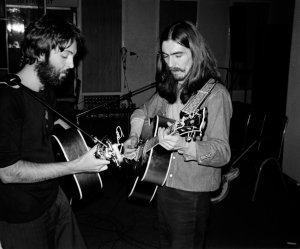
Paul and George work on “I Me Mine” in January 1970. From George Harrison’s Twitter, 2000.
Once the song was earmarked for the film and thus the album, the Threetles made their debut. On January 3, 1970 — almost a year to the day after George wrote the song and brought it to Twickenham — George, Paul and Ringo spent one last session together at Abbey Road, recording “I Me Mine.” John was on holiday in Denmark, but that almost didn’t matter: He had already privately quit the band more than two months earlier. As George remarked, “Dave Dee is no longer with us” as they went ahead, for one last time, to “carry on the good work that’s always gone down in [Studio] No. 2.”
Phil Spector took the recording, embellished it, doubled its length and tacked it onto Let It Be as the Beatles formally expired as a group. Like John’s “Across the Universe,” the song it follows on Let It Be and precedes on Let It Be … Naked, “I Me Mine” in its final form is not a product of 1969. It’s worth noting, too, that George turned around “I Me Mine” in a relatively complete form in less than 24 hours. John dragged out a nearly year-old “Across The Universe” and still couldn’t make it workable for the show.
The same three men who laid down “I Me Mine” — George, Paul and Ringo — returned to the studio together 24 years later to record John’s “Free as a Bird.” Paul convinced himself it was OK to record a new Beatles song without John.
“I invented a little scenario,” Paul said of recording the group’s first song since “I Me Mine.”
“I think it’s a waste just banishing it,” John says. “I’d sooner stick it in here.”
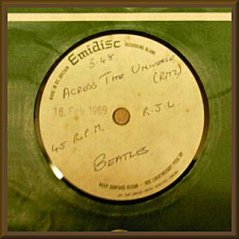
It is “Across the Universe” and here is the live show the Beatles were rehearsing for at Twickenham in January 1969. Decades later an established favorite in the Beatles canon, “Across the Universe” was merely an unsatisfactory recording in author John Lennon’s opinion, one that remained in the can for 11 months as of this date. But the song had definite resonance with John.
It’s one of the best lyrics I’ve written. In fact, it could be the best. It’s good poetry, or whatever you call it, without chewin’ it. See, the ones I like are the ones that stand as words, without melody. They don’t have to have any melody, like a poem, you can read them.
The song’s origin dated to 1967, when he was still married to Cynthia. From his interview with Playboy in 1980:
I was lying next to my first wife in bed, you know, and I was irritated. She must have been going on and on about something and she’d gone to sleep and I’d kept hearing these words over and over, flowing like an endless stream. I went downstairs and it turned into sort of a cosmic song rather than an irritated song; rather than a ‘Why are you always mouthing off at me?’ or whatever, right? …
Recorded in the same February 1968 sessions that yielded “Lady Madonna,” “The Inner Light” and “Hey Bulldog,” “Across the Universe” was initially John’s pick for a single release while the Beatles were in India the subsequent month. But unhappy with the recording, John withdrew the song for single consideration. “[N]obody was interested in doing it originally, everyone was sickened,” John said in 1980. “The tune was good, but subliminally, people don’t want to work with it sometimes.” John called the bad recording an example of “subconscious sabotage” by Paul.
Meanwhile, Paul’s “Lady Madonna” won the honor for the single, and John “banished” the song by offering “Across the Universe” to Goons alum Spike Milligan for a charity album he was compiling to benefit the World Wildlife Fund. That part of the story comes later.
An early take of the song eventually surfaced on Anthology 2 in 1996 while another take from that same session was ultimately used as the basis for the Let ItBe version before being reworked again for Let it Be … Naked.
That part of the story comes later, too.
Between February 1968 and January 1969, the Beatles had issued a 30-song LP (the White Album), two singles (“Lady Madonna” and “Hey Jude“) and their Christmas album, and 10 days after this January 7, 1969, session the Yellow Submarine soundtrack would come out. But none of those releases featured “Across the Universe,” a fully recorded and mixed track. The Beatles weren’t attempting to lay down tracks for an album at Twickenham, and this early they conceded any eventual yield from these sessions that ended up on vinyl would be a bonus.
It’s under these circumstances John thinks the time is right for a reintroduction of “Across the Universe,” on the heels of a hefty dose of “Maxwell’s Silver Hammer.” It’s also a window into the relatively exhausted state of John’s songwriting at this point after his explosive contributions to the White Album. Paul is writing on the spot at the sound stage and George is bringing in songs he developed the night before. John is left offering a year-old song that was already recorded as a contribution to the show, a “Cynthia” song — presumably his last — brought forward in time to Generation Yoko. And on top of that …
It’s “another slow one,” too. “I know that we’ll knock off a couple of fast ones,” John bemoans. “If I just wasn’t so tired when I got in …”
George expresses that it’s OK to have another slow song, and we hear a snippet of the tune to be later known as “Gimme Some Truth” for the second time these sessions. “That’s another one,” John says. “It’s a pity they’re all so similar because it would have been nice, that ‘Hypocrites’ one.
“What’s the first line?” John asks as the group begins work on “Across the Universe.”
He gave the song a pair of run-throughs just the day before, and did in fact get the opening right but not much else. On January 7, the words were not at all flowing, like a paper cup or much of anything else, as he limps through a lackluster initial take. Once a set of lyrics finally arrived from the office, John baffled even himself with his poetry.
“Tumble blindly?” he asks with incredulity.
With lyrics in hand, work begins anew on the arrangement.
John: When we were doing it last time, we did it all right in the end. The thing I don’t lke about the version we did, is we didn’t dig it the time we did it. All that tamboura was great.
George: I liked those girls singing as well, which you didn’t like. The whole record is great, really. It’s just another idea, another way of doing it.
John: I haven’t heard it in along time.
After John responds to Paul’s question on the status of the World Wildlife Fund LP for the second time in as many days (“they haven’t gotten it together yet”), the tape cuts before dumping us mid-rehearsal as the group continues work on the song. Pacing is an early issue, and John asks Ringo if he can remember his part from the recording. To George, the slower pace, compared to the recording, fits the song’s mood. “It couldn’t be any other way,” John replies. “I couldn’t get the words out. There’s no breath.”
The drone — played on the tamboura for the 1968 recording — was something John liked very much, and how to include that here was debated with an organ making an appearance. John briefly accompanied himself on the instrument before abandoning it, saying that playing along was “too hard.”
In the near 40 minutes on and off focused on “Across the Universe” rehearsals on the tapes, there were brief moments where the band sounded tight and the group’s harmonies clicked, but takes usually crumbled. John gave George, who was employing heavy wah-wah, carte blanche with the song’s introduction. “Whatever you’d like, you’re on your own there.”
The rare song brought to the Get Back sessions complete and — like “One After 909” (which would be be played between “Across the Universe” takes) — recorded previously as well, “Across The Universe” was a venue for the group to play out a bit of their frustrations and feeling of being trapped in their own group dynamic and in these sessions. It’s not just in the clip below, but throughout the day’s takes, the song is performed lethargically, but it’s plausible to think Paul and John believe it when they sing “nothing’s gonna change my world” so strongly together. Just a few hours earlier they backed off the brink of breakup, perhaps they were resigning themselves that the world they were in really wasn’t going to change. One take (below), in response to his own chorus conceding nothing was gonna change his world, John says as an aside, “I wish it fucking would.”
Nothing was gonna change that song, either — John made no attempt to solicit or attempt any significant tweaks to the song, keeping the original lyrics, structure and melodies intact. Paul applied a few spontaneous harmonies, although it was unclear if it was something that would have remained if the song advanced further in the sessions.
There are several excursions from “Across the Universe” including a second abbreviated attempt at what John seemed to consider an unfinished companion song in “Gimme Some Truth.” While John suggested writing more, the group merely played the minute or so of the song it knew and moved on.
“That’s just as exciting as the other one,” John says sarcastically as the band finishes playing a bit of the song. This would mark the end of “Gimme Some Truth” as a Beatles song as John left it in an aborted state. It would not be rehearsed again these sessions on the tapes, or presumably in any other Beatles session in 1969. George would ultimately play guitar for John when the song surfaced on Imagine in 1971 in a version as dynamic as the Beatles version was listless.
About 45 minutes after the final attempt at “Across the Universe” and several attempts of “Don’t Let Me Down” came one of the more surreal moments of the Beatles’ time at Twickenham captured on the Nagra reels. With the work day nearly complete, the group finally got to hear a copy of the original recording of “Across the Universe,” as requested by John as the song’s rehearsals began. For about 3 1/2 minutes, we listen to the band listen to themselves on record, the entirety of the World Wildlife Fund version of the song that would be released more than 11 months later, in December 1969.
Of note, is that the sound effects were already in place on what was a freshly cut acetate. According to the liner notes accompanying the 2009 The Beatles in Mono box set, the sounds were added in January 1969, which means it was completed within the previous 144 hours. So its feasible this was the first time the group was hearing that addition, and George was vocal about his displeasure. “I don’t like that flapping,” the Beatle says of the bird. “It takes too long before it does it” (presumably meaning the song starts). It’s difficult to hear much other discussion — although there clearly is some, along with mild attempts by the group to play along.
A sequence in the Let it Be film lasting less than a minute and 45 seconds, spliced in immediately following the “I’ll play, you know, whateveryou want me to play” line captures a taste of the January 7 “Across the Universe” session. The song would be rehearsed, briefly, once more two days later before being shelved completely, falling out of consideration for the live show.
The song’s association with Let It Be — the album and the film — is really a complete anachronism, but certainly not without reason. The group spent about an hour (on the tapes) working on “Across the Universe” during the Get Back sessions, half of that on January 7 with the balance January 6 and 9. None of those takes have been formally released on record, with the only official glimpse the brief segment in the film. The song made its way onto at least one of Glyn Johns’ compilations for the aborted Get Back LP and ultimately found its way onto Phil Spector’s final Let It Be, in a production beloved by John. The anachronism carried even further onto Let It Be … Naked, which intended to reissue the original record and thus sessions in an unvarnished fashion, yet it still included a mix of the 1968 version of “Across the Universe.”
Because it was in the film and as of early 1970 was a finished Beatles product but not yet surfaced on a Beatles release, there was a perfect excuse for “Across the Universe” to make the soundtrack. To repeat John from January 7, 1969: “I think it’s a waste just banishing it. I’d sooner stick it in here.”
The group spent considerably more time on songs like “All Things Must Pass” and “Maxwell’s Silver Hammer” during the Get Back sessions. But with the former not in the film and earmarked as a George solo song, and the latter already released on Abbey Road by the time the film was released, “Across the Universe” by comparison didn’t not make sense as an option for the Let It Be LP. This, even though it was a song that featured a master track from 1968 and strings and production from 1970. In 1969, a bird made music on “Across the Universe,” but not a Beatle.
The record as produced by Spector featured 12 songs, 11 originating from or recorded during the January 1969 sessions. The 12th — “Across the Universe” — fell under the Let It Be banner to save it from eternal banishment.
 They May Be Parted