Tag Archives: Michael Lindsay-Hogg

Jan. 6: Adore your ballroom dancing (If there’s a rock show, Pt. 3)

Back-garden Beatles (Tittenhurst, 1969)

After a proposed overseas concert in a Roman amphitheater in Libya is scuttled by Paul, citing Ringo’s insistence on staying in England, a suggestion is made to perhaps go small and shoot a Beatles concert in a back garden, presumably somewhere in London.

Director Michael Lindsay-Hogg quickly dismisses the idea, suggesting it would end up like a “little promo film … instead of a Beatles television show.”

Sitting in on the discussion, George Martin cuts to the chase and thinks even smaller, proposing “we just do it in the other studio.”

Paul shifts the focus off the venue and back to the composition of the crowd.

Paul: We’re all prepared to do it with an audience. But what Yoko said is right — we can’t just have the same old scene. If it was the same old audience and we were … all naked when they came in, then that’d be a different scene, you know?

MLH: I think she’s totally right about that, that’s one of my big points.

As the discussion goes in circles, someone in the group asks the simple — but very difficult — question: “What can you do that’s new with them?”

Paul: We shouldn’t really try to do anything with the audience because the audience is the audience, and it’s them, and they’ve come in. It’s us that’s doing the show.

Yoko: Because If I were in New York and I watched the “Hey Jude” [promo on TV] … my interpretation would be that those people around them who are sort of climbing up and starting to sing with were just hired people. If I think that, then it’s OK. But if I thought it was a true audience, then I think, ‘Oh, so now people don’t think of The Beatles as too much’ because all the image that everybody in the world has about The Beatles is that once there’s an audience, they’re going to be frantic and pulling their clothes and tearing it away and all that.
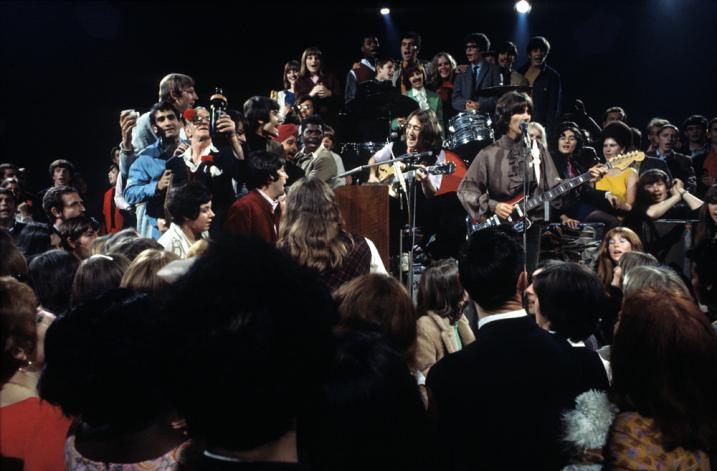
“Hey Jude” promo video

OK, then.  Not so sure I’m on board with Yoko’s assessment of the state of The Beatles’ popularity at this point, but hey, she’s soon to be married to a member of the band and was actually there in the ’60s, whereas this blogger was yet to be born.

But still. It seems a bit out of reach to me to suggest that just because a Beatles audience wouldn’t be in full-tilt 1964-era Beatlemania, pulling out their hair and screaming over the songs, means the band isn’t as “big” anymore.  It’s 1969, not 1964 anymore. The music scene has changed.

But to avoid what Yoko thinks would be an issue, George Harrison says the solution is something The Beatles had done before.

The good thing is that we could completely create another image, reserve the image of your choice. If we could just think of an image we’d like to be and then we make it that one, which could be anything. We could just be a nightclub act, or anything, just the smoochy, low lights and 10 people.

Wheels turning, Lindsay-Hogg says, “Then you’re a little cabaret act,” before he and George Martin agree again that there should be a large audience that’s not necessarily any kind of focal point, just to be used as a sounding board.

But then Paul picks up on George’s idea and gives it a twist.

I thought, like, a ballroom. If we did go right back … and did it purely like a dance. “Come to the Tower Ballroom, there’s a dance on. Oh, incidentally, we’ll be the band there.” And we’d go on, play all the numbers and we’d play it like we’d play a dance, without trying to sort of announce anything. There’s a fast one, there’s a slow one, and everyone, like, dances. And there might be a fight or there might be the kinds of things that happened at dances. Or it might be a very sedate, quiet dance.
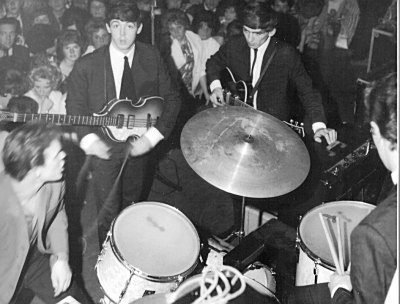
The Beatles, performing at the Tower Ballroom, ca. 1961-62

Presumably, Paul’s referring to the Tower Ballroom of New Brighton — just a ferry ride ‘cross the Mersey from Liverpool — a venue they played numerous times in 1961 and 1962.
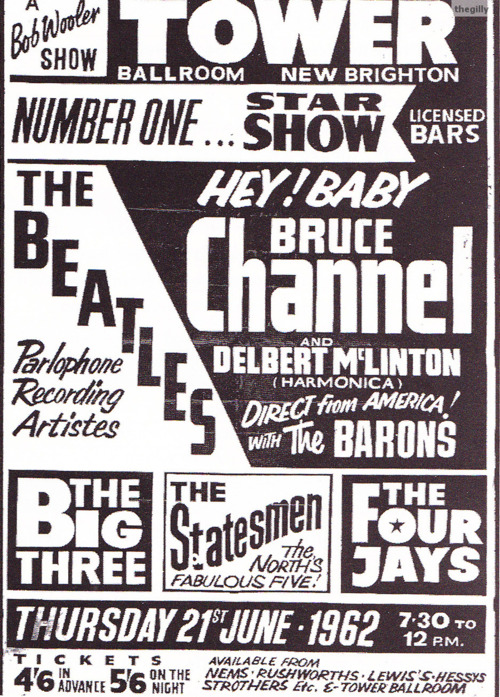
I actually sort of love this idea, with the full understanding that it may just take hired hands to get an audience to ignore the fact they’re at a Beatles concert and just go ahead and actually dance.

And to do that, as my wife said to me, they’re really just making a long music video. What’s the point?

Lindsay-Hogg is on board — in essence, he says —  because he likes its simplicity. But that’s where his agreement ends. “What you’re asking for is a really, really simple approach, which I think is right,” the director says. “But I’m not sure just to have an audience dance around you is good that way. I don’t think you are just a local band.”

Paul, and the rest of the group in the conversation, agree. But after digging deeper into the idea, Lindsay-Hogg ultimately thinks it’s a non-starter.

MLH: The only time on TV it didn’t work for you was when you went on … Top of the Pops, and they did dance, do you remember that? And they didn’t really do very much. And that would look so crazy. It looked crazy for four minutes, but it would look lunatic for longer. It would have been in the bad way, it was so sedate, and you all were so sedate back then.

The essence of this idea is the simplest approach possible. The essence is correct —  totally, totally what I believe — but you’re just not the local dance band. Would that you were, but you’re not. So that’s going to be very hard to achieve.

Paul sticks with his newest idea, saying that if they’re going to be artificial and build a set at Twickenham to mirror the Tower Ballroom anyway, why not just go to the Tower itself?

We learn a little bit more about the Let it Be film’s early timeline in Lindsay-Hogg’s response.

MLH: That was one of the reasons we started veering off on these ideas was when we were looking at locations that Friday afternoon after Christmas, and all the locations looked like four steps up from a boutique, you know what I mean? Four years ago everyone was shooting in a boutique, and now it’s a disused sawmill or whatever it is. It just looked like plastic locations.

Everyone agreed it was a phony look, certainly something the group was seeking to avoid.
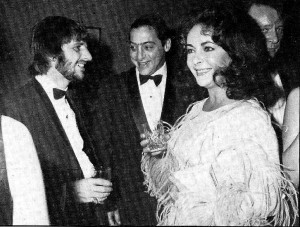
“Candy” co-stars Ringo Starr with Richard Burton — and Liz Taylor in 1968.

Also notable here is that the director was scouting locations on Dec. 27, 1968 — a mere 10 days earlier. Good on Lindsay-Hogg, too, for working hard; he directed “Rock & Roll Circus” just 16 days prior.

Yoko won’t give up on the band staging a show before anything remotely like a conventional audience, comparing the scenario to actor Richard Burton, and saying that people don’t want to see him performing on stage before a “fixed” audience.

No matter what kind of audience, it s going to look crummy. What he is is a legend.  Seeing him on his own private boat or just seeing him shaving is just more dignified than seeing him perform before a fixed audience. Do you see that point? That’s why it’s better to show you in your private home, or George’s home or something. “Oh, this is much better than a fixed audience.”
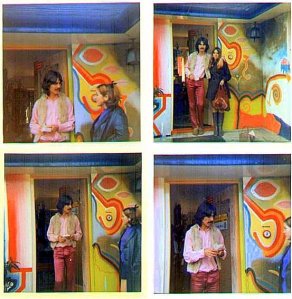
George and Pattie at home at Kinfauns, their home from 1964-1970

Someone, perhaps Mal or Neil, out-Yokos Yoko by suggesting a performance at The Royal Academy or Tate Gallery — “with nobody there but the pictures.” Naturally, she agrees.

Lindsay-Hogg still wants none of that, saying, “Once you get up to perform as The Beatles, you have to perform to someone, even if it’s going to be this different kind of audience.”

The debate churns on.

MLH: Certainly yes, you play straight at home. But I have a feeling that’s not big enough.

Yoko: But that’s big. See the private home of Paul McCartney or George Harrison.

MLH: We could fit that into the documentary.

George Harrison reflects on a “Bridget” documentary (presumably Bardot),  describing her taking the audience to St. Tropez as she “sings a tune over her front gate and walking around the pool.”

Insisting that kind of minutia can be incorporated in the documentary, Lindsay-Hogg then offers what turns out to be his concluding argument for the day.

If you just get up to perform, you either have to be performing directly to the people at home or to an audience. It’s only two ways. Maybe it would work for the people at home, I just don’t think there’s quite enough scope. And I think the idea’s good, because we have to think about the audience — because you are so riddled with audience. The audience is so much part of the first half of you musically — [under his breath as an aside] says the critic from the Guardian — the audience is so much part of the mystique.

After a mention of mystique, we’re left with a mystery — the tape cuts off abruptly, and the next track is merely a nondescript improvised instrumental, and there’s no return to the discussion this day again.

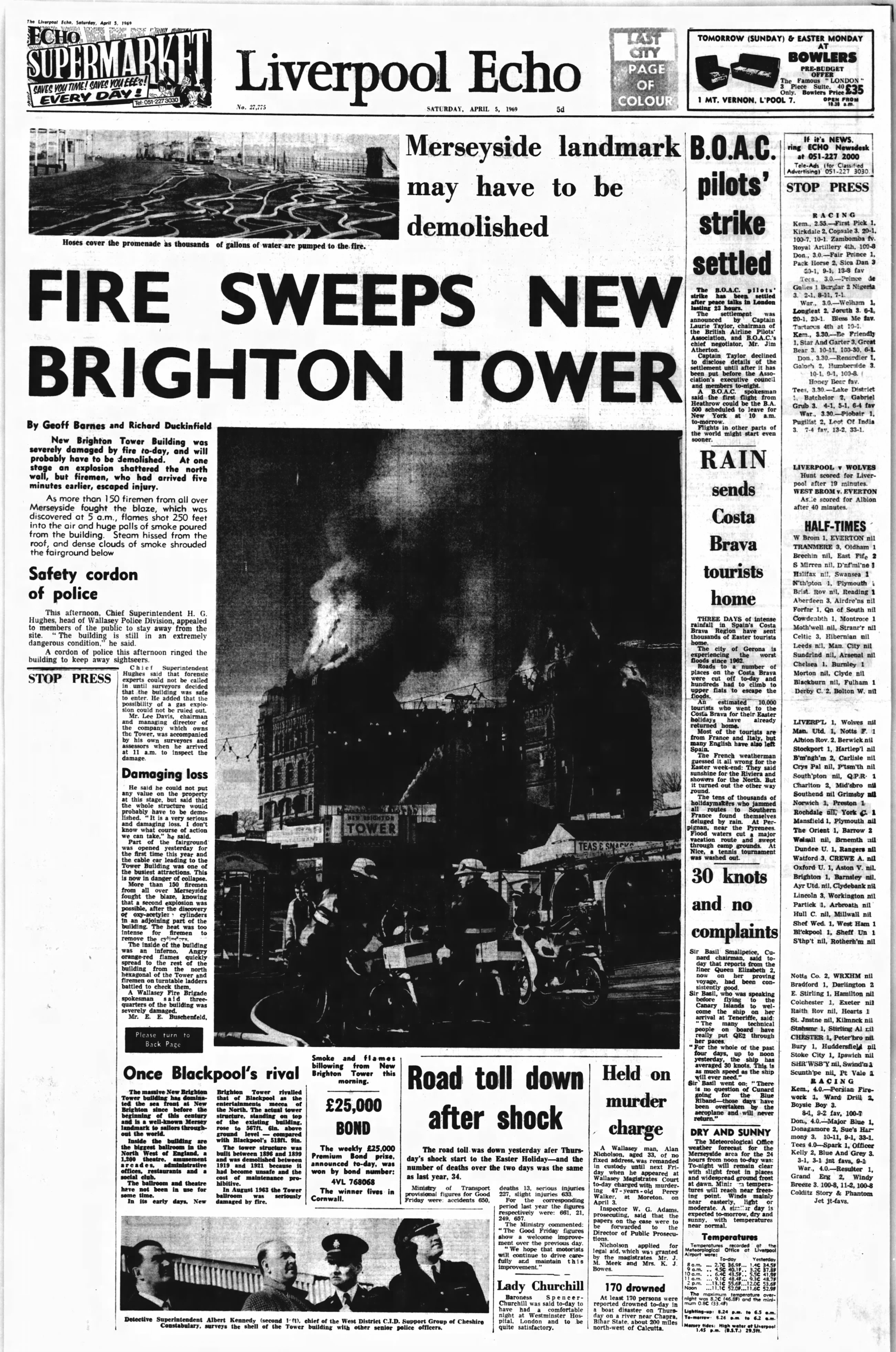
And what of the Tower Ballroom? Had The Beatles performed there, it would have been the last hurrah for the venue. It was destroyed by fire just three months after this discussion.
14 Comments

Filed under Day by day

Jan. 6: Such a lovely audience? (If there’s a rock show, Pt. 2)

Having established earlier in the conversation that there will be two live shows to cap the documentary of which filming is already in progress, the band — primarily Paul — plus Yoko Ono, George Martin, Michael Lindsay Hogg and a few other insiders (probably the likes of Mal Evans, Neil Aspinall and Derek Taylor? I don’t know them as well by voice) — continue their lengthy discussion about the show, potential venues and the composition of an audience.

For a show plan first hatched more than a month earlier, things remain in total flux.

Paul latches onto Yoko’s idea of playing to an empty house, at least for one of the two proposed shows, with the second night’s performance before a conventional audience.

Hey, maybe there will be some traction here! Paul’s on board with Yoko’s ideas up front and early on (and John doesn’t seem to care, not chiming in at all during this chat), so a huge part of the battle here is over, George’s independent streak — which is about to erupt — notwithstanding. And it’s not much of a surprise, really, given Paul’s avant garde leanings.

Alas, Lindsay-Hogg punctures that idea, saying there’s no need to eschew a crowd “partly [because] the documentary is playing in silence. I know it’s not for an audience, but it’s the same thing.”

Paul replies to say that the band has ignored the camera from the moment they started filming at Twickenham a few days earlier, repeating the  “performance might be — should be — two cameras or two audiences …  two something.”

But Yoko pressed on — with Paul again agreeing —  saying the audience isn’t the draw for people watching the film at home, unless it’s something different, like “kings or queens coming to see it.”

The director keeps pressing back.

MLH: What I think is if you got in front of an empty house and played, it makes you look too … rich, in the bad sense. In other words, whats the point? This is the negative aspect of that. What’s the point in you getting up and playing for an empty house when you could be giving people happiness with whatever kind of full house we decided?

Yoko: Nobody’s going to think that. They’re going to think it’s a very poetic situation. And they know the Beatles are rich …

Voice of reason George Martin, as he did earlier in the conversation, again sides with Lindsay-Hogg on just what a waste a live performance to an empty room would be, putting it succinctly:

There’s no point in doing a live performance, it’s like going into a recording studio and doing one take.

He then repeats the point that an audience would give an extra something to the band they wouldn’t get otherwise.

Someone chimes to suggest one of the more exotic venues that had been in the mix, presumably since December,as the band hatched the live-show idea.

You’re going right back to Sabratha, [then].

Sabrathra was alluded to on the first day of filming by the director, promising a scene replete with “snake charmers, holy men … torchlit, 2,000 Arabs and friends around.”

And a beautiful, unique venue the former Roman amphitheater outside Tripoli, Libya, would have been and with such an unusual audience. It’s certainly something that would one-up recent rock films like Cream at the Albert Hall and the recently completed Rolling Stones Rock & Roll Circus.

Paul agrees with a remark that a bit of a focus on the audience (wherever it may be)  isn’t a bad thing — seeing the reaction of people who have seen the band before in the Beatlemania era and how they’d react to the band now, post-1966 and the end of their live era.

Yoko: Then it should be a real scene. You have to announce in the newspaper say that it’s going to be a real alive show. It’ll be a crazy scene, like everybody queuing for it and everything.

Neil? Mal? Derek? Then it should be an Albert Hall scene.

Lindsay-Hogg,  who joked earlier in the day about a Beatles show at “the Albert Hall with those quick cuts,” said a few hours later that he’s not opposed to a show at the nearly 100-year-old stage. But…

MLH: I just think it slightly smells of a few years ago. The Shea Stadiums, wherever it has been.

Yoko: Say anything, and it will slightly smell of a few years ago or slightly less than a few years ago because they topped it.

MLH: I’m not particularly supporting this idea, but it is an idea we can then say no to and go away from if we can top it. But [Sabratha] is a location which is marvelous in itself, by the sea.

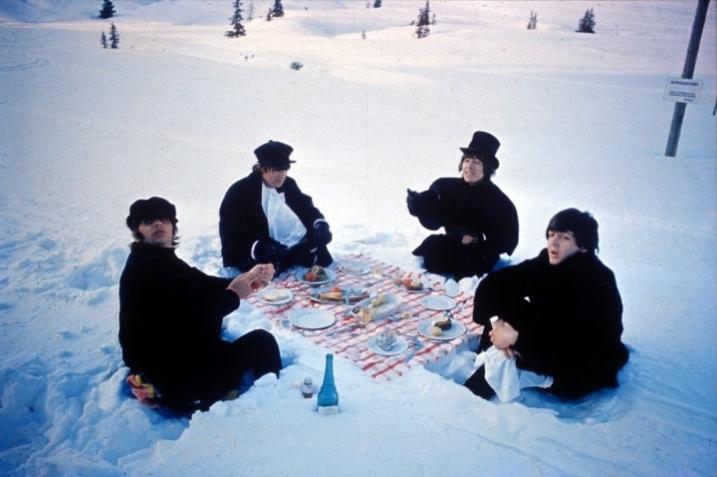
The Beatles faced winter elements before

Perhaps this is just calling Ringo’s bluff.  As Paul said on Jan. 2, “I think you’ll find we’re not going abroad, because Ringo just said he doesn’t want to go abroad. And he put his foot down.”

And calling the drummer’s bluff is something the Get Back book and Let it Be Naked’s “Fly on a Wall” disc proves was done repeatedly. But for the second time this day, Paul shoots down an overseas trip, saying, “Look, it has to be in England. An outdoor scene has to be in England, because we’ve decided we’re not going  abroad.”

To someone responding that a performance under the skies couldn’t be done in wintertime England, which is “too bloody cold,” Paul doubles down, after agreeing to the sentiment.

We have decided, it’s a definite decision, that we’re not going abroad, so we should sort of rule that out. It’s not even to the two-way, should we go abroad, we like, we definitely said no to that.

So as usual these days, they’re back to Square One, crossing the seas and back in just a few minutes, only to end up again home in England — and potential venues therein as the discussion continues.

An odd postscript to the Sabratha flirtation: More than 40 after the Beatles toyed with the idea of playing at Sabratha just eight months before Khadafi led a coup to take over Libya, former Apple exec and Beatles assistant Peter Brown had his PR firm hired to improve the dictator’s image.

Tune in next post, where we resume this Jan. 6, 1969, conversation about the forthcoming show.

24 Comments

Filed under Day by day

Jan. 6: Playing to the gods (If there’s a rock show, Pt. 1)

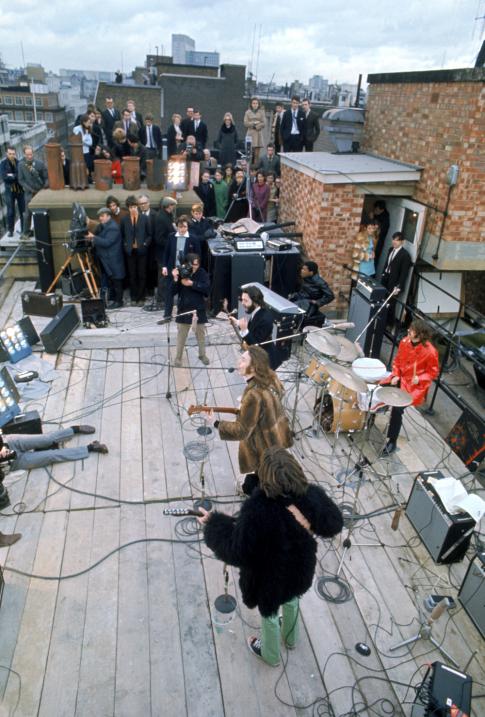
Even the most casual rock music fan knows how the Let it Be film ends, even if they’ve never seen it or even if they’re not really Beatles fans. The sight of John, Paul, George and Ringo trying to pass their audition on the roof at 3 Savile Row isn’t merely an iconic Beatles moment, it’s an iconic moment in popular music history and pop culture itself.

Watch the movie, and there’s never an inkling that wasn’t the plan all along. Less than three years removed from their last tour, the group rehearses some new songs, then when they’re ready simply climb the stairs and rock from the roof. It’s just like they planned it all along, right?

Source: Beatles.com

Of course not. And right here’s another reason why I’m loving listening to these tapes and find them so valuable — it’s not just to hear the songs in progress and rehearsed in context or to hear songs they threw away or just shelved until they could revisit as solo acts. It’s to hear a conversation like one we hear a few hours into Jan. 6, the kind of thing that never made compilations of the sessions.

I keep getting back to my need to operate within context throughout this blog. So we know the end of he story: the rooftop show. But how did they get there? We get an incredible glimpse here.

After exploring George’s “Hear Me Lord” and knocking out a few covers, conversation shifts to the planned live show, a topic promised earlier by director Michael Lindsay-Hogg and just touched upon in the prior days on the tapes.

And there’s an awful lot going on here in what’s marked “Dialogue,” 14-plus music-free minutes, the 53rd track on the Jan. 6 collection of Purple Chick’s A/B Road.

Two figures that loomed so large in Beatles history — George Martin and Yoko Ono – make their first significant appearances on these tapes. Ono would remain key to the story of Get Back/Let it Be. Martin would not. Well, he would be, ultimately, quite conspicuous by his absence.

But it’s not necessarily the people involved but what they’d discuss that makes it a memorable sequence.

The endgame here, after all, is a live show, even if they have no set plans for one in place.  Yoko begins the conversation – on the tapes, at least, where after a quick cover of Chuck Berry’s “I’m Talking About You” (a song they used to play in Hamburg), we join the chat in medias res.

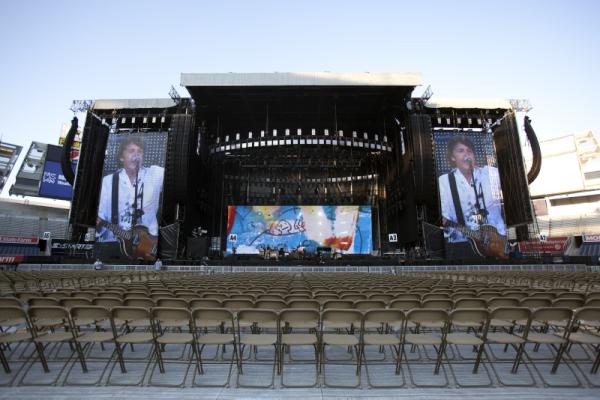
Yoko’s first suggestion is for the Beatles, who four years prior played before more than 55,000 in their iconic Shea Stadium show on Aug. 15, 1965, to have something of a more modest audience.

Yoko: “…[have a] stage, you know, and it’s like an open-air something, and you’re playing to the gods! You know, and to the stars.

Yoko’s plan: Paul’s soundcheck at Yankee Stadium, ’01

While Paul’s agreeable to the suggestion — or at least something avant garde — Michael Lindsay-Hogg tries to push another angle for the live show involving all those seats being filled by actual people, even if they’re not necessarily fans of the Beatles.

MLH: “Or, even playing to people that have never seen you before. See, I think you’re right. Any stage performance of an ordinary sort, visually, will never be topped, because we all remember – and you better than I — the past.”

But Paul — quite the veteran of the stage even at this young age — sides with Yoko.

Paul: “What’s the use of an audience? The use of an audience is like… for you, it’s out of sheer charity to play to them because you love them. Or for you to collect ticket money, or to get a reaction between you, for the sake of your shows. But look the thing is then, that’s presuming that we’re not enough for a show. That presupposes there’s really not enough in the four of us, that you really have to pan off on to a postman.”

Enter George Martin, who joins Team MLH after some indistinguishable crosstalk.

Martin: “The whole point about the audience is to give you something when you’re performing.”

MLH: “Like an actor on stage”

George Harrison is there too, and at this point, I think he says that “It’ll be just our luck to get a lot of cunts in there [at the show].” Perfectly reasonable thought.

Lindsay-Hogg gets things back on point, reminding the band that once they’re on a stage, they’re performers.

MLH: “And you got to have something to do it to. Of some sort, either a camera or real people, I think.”

Yoko: “Empty chairs would be much more dramatic. I mean 20,000 empty chairs!”

MLH: “Looks like they haven’t bought any tickets!”

Paul: “Look, nobody’s going to think that way.  Nobody’s going to think that haven’t bought any tickets.”

After agreeing with Paul, Yoko says people are wondering what makes up the audience in this post-Beatlemania world before continuing to pitch the actual lack of an audience.

Yoko: “It should be like the invisible, nameless everybody in the world, instead of some teenager or something, and they say, ‘Oh, so they still have that teenage audience.’ Or if you have costumed people they say, ‘Oh, that’s the audience now.’ It’s very dangerous.

“[With empty chairs], now you have audience in every heart in the world, you see? It’s very bad to limit it.”

The diplomatic Lindsay-Hogg says he does like the idea. But…

MLH: “That sounds to me more, though, like five minutes rather than 15 minutes. Because you’re right — what we do want to attack is all over the world. It oughtn’t be anymore the kids that queue up outside the gate, it ought to be the whole world. And that was one of the things we tried to get on Jude [the Hey Jude promo clip, directed by Lindsay-Hogg nearly to the day four months prior at these very same Twickenham Studios].”

Oh, that’s OK, says Paul, since “we’re doing two shows, aren’t we? We’re taping the shows on the Sunday and the Monday, aren’t we?”

Sunday and Monday shows. Of course.

And here we have the sessions in a nutshell:  The band is doing a show with songs they can’t agree on and haven’t finished writing and at a location — possibly international — that hasn’t been determined. BUT. They do know they’re taping two shows, to the point where they know it’s a Sunday and a Monday.  The devil’s in the details, not only in her heart, it appears.

Tune in next post, where we continue this Jan. 6, 1969, conversation about the forthcoming show.

25 Comments

Filed under Day by day

Jan. 6: Icing Cream

When the Beatles reconvened at Twickenham Film Studios the morning of Jan. 6, 1969, it was the prior evening’s television that dominated early conversation between the band and director Michael Lindsay-Hogg.

And, hey, why not? Twickenham is their office, and the piano is the water cooler, so what else would the grunts talk about as another work day begins?

Just seconds into the day’s tapes  the discussion goes right into the Cream farewell concert that aired on BBC the evening before. And with it, it’s one of the Beatles’ reference points for their eventual film. Or, at least, a great example of what they didn’t want to do.

The documentary is, in fact, really lousy — I watched the whole damn thing in prepping this post. Cream, as a band, is great. But what a terrible program, from the seizure-inducing cuts to the wildly melodramatic narration and ridiculous band interviews. The camera’s always on the wrong thing, the songs aren’t complete, there’s continuity errors and it’s just an effort to get through.  Try it yourself here!

“Ginger Baker’s was the only interesting interview,” Lindsay-Hogg said to Paul, explaining that he himself is “really uncoordinated” and learned a bit of drum technique from Baker.

“I just thought they were interviewed badly,” Paul said.

Paul likened the interviewer to “a 3-year-old kid” in suggesting Eric Clapton play his parts again on guitar.

The talk shifts to a tangent when Lindsay-Hogg compares the Cream production to the grandiose “Eloise” by Barry Ryan (the song itself, not the promo clip below), a chart-topper from a few weeks earlier.

“All form and no substance,” the director said of the song after using the same term to describe the Cream doc.

“It’s great, I thought,” Paul replied. “I loved it.”

“All form, no substance, I hated it,” Lindsay-Hogg said before again repeating “All form and no substance.”

“That’s too big a put-down,” Paul said. “All form, and not much substance.”

“It was my least favorite record from the last five years,” Lindsay-Hogg insisted before adding under his breath,”I really hate it.”

Paul then sings a bit of “Eloise,” and Lindsay-Hogg is incredulous, although he would admit he liked the musical break.

The conversation wandered a bit, and included a quick take of “Oh Darling!” by Paul solo on the piano. But after Ringo, and then John and Yoko arrived, discussion of the Cream documentary resumed.

“We ought to think this week sometime about the show,” Lindsay-Hogg said to the group. “We could do it at the Albert Hall with those quick cuts.” Paul again expresses his disappointment, especially focusing on those edits.

Paul asked Ringo if he saw the show.

“Bits,” said the drummer.

“That’s all there were! Just bits, terrible quick-cutting,” replied Lindsay-Hogg.

Hard to tell what John or Yoko said as they were well off-mic.

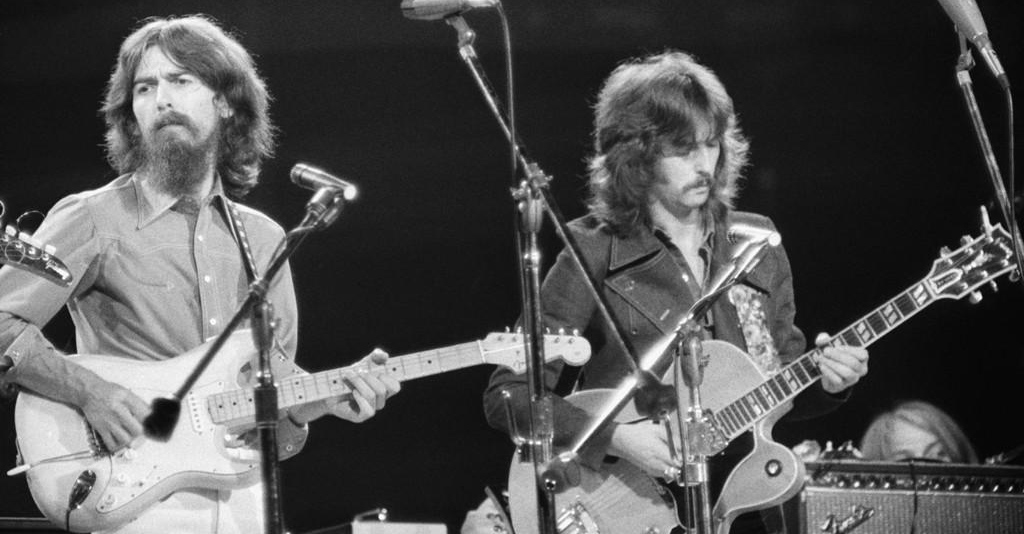
George is the last to arrive. He was already good friends with Clapton — who contributed his part on “While My Guitar Gently Weeps” four months earlier and had played in Lennon’s Plastic Dirty Mac just weeks earlier on the Rock & Roll Circus. Despite the friendship, George doesn’t shy from criticizing his friend’s production.

“There were some nice bits, but … what was … with the photography? You don’t see anything,” George said.

George calls Baker “great,” and Paul asks Ringo if he’s met him “as star drummers.”

George & Eric

Conversation shifted again, George talks about a new song he wrote (“Hear Me Lord”) and then his equipment arrives at the studio (“like an ambulance for ailing documentaries” according to Lindsay-Hogg).

But they can’t shake talking about Cream’s own doc, again mocking the interviewer.

Then, finally after 40 minutes of the tapes, the band’s finally ready to start the business of making music, and a documentary of their own.

I found it interesting, in retrospect, is they’re discussing a farewell concert, which is what Let it Be ended up being — not planned that way, of course (of course?) —  and that’s what they would spend so much of the sessions attempting to organize. Not that Lindsay-Hogg would end up producing anything that looked like the Cream special — nothing he’d done I’ve seen had given that indication — but Let it Be was certainly not anything like the Cream farewell.

But having that reference point so early in the sessions could only have helped light even the smallest of sparks in encouraging the band to do what they always have done, and that’s do something better than every other band.

21 Comments

Filed under Day by day

Jan. 3, 1969: Setting the tone

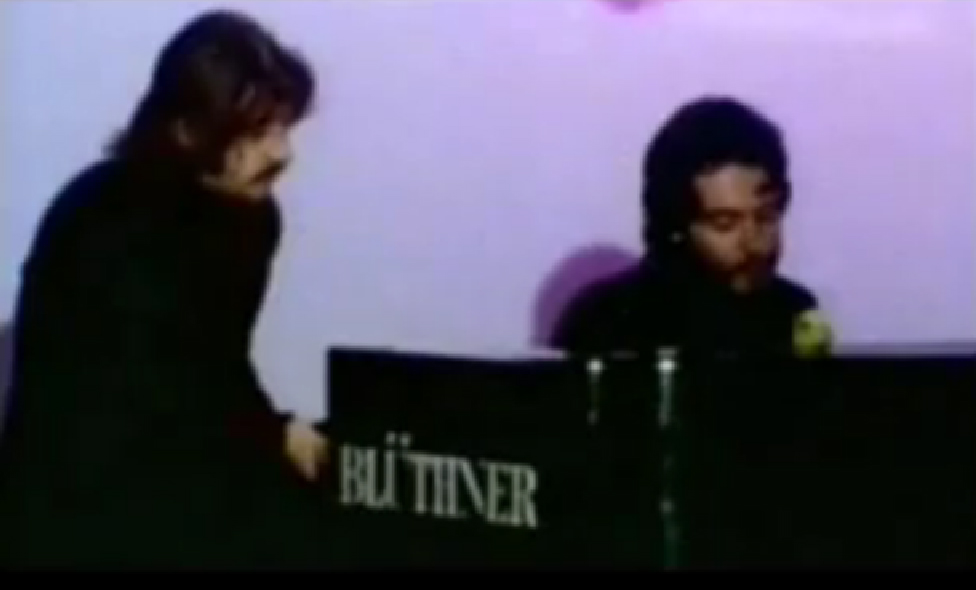
The second day of the sessions at Twickenham, Jan. 3, begins with Paul alone at the piano, and in the span of the first five minutes we hear the first fleeting tastes of “Long and Winding Road” and “Oh! Darling,” plus an extended preview of “Maxwell’s Silver Hammer,” which would see an extensive full band rehearsal later in the day.

While it’s among the dozens of covers sampled that day alone, a few minutes of Paul riffing Samuel Barber’s “Adagio for Strings” jumped out at me as someone who’s seen the film “Let it Be” countless times.

And as the Twickenham stage is set on Jan. 2, the actual first day of the sessions, “Adiago” plays as the opening credits roll, cutting to Paul (with Ringo) at the piano. This truncated version of the song gives way to “Don’t Let Me Down,” and the rest of the film.

Sayeth Wikipedia:

The Adagio was broadcast over the radio at the announcement of Franklin D. Roosevelt’s death. It was also played at the funeral of Albert Einstein and at the funeral of Princess Grace of Monaco. It was performed in 2001 at Last Night of the Proms in the Royal Albert Hall to commemorate the victims of the September 11 attacks, replacing the traditional upbeat patriotic songs.

In 2004, listeners of the BBC’s Today program voted Adagio for Strings the “saddest classical” work ever..

Thus, of all songs to use to begin the film that ostensibly chronicles the band’s breakup, we get this over the credits.

Well played, Michael Lindsay-Hogg.

8 Comments

Filed under Day by day