Tag Archives: Sgt. Pepper

TMBP Extra: Stay till it’s time to go

“The world is still spinning and so are we and so are you. When the spinning stops – that’ll be the time to worry. Not before. Until then, The Beatles are alive and well and the Beat goes on, the Beat goes on.”

These were the instructions Apple publicist Derek Taylor articulated April 10, 1970, the marker for the end of the greatest pop music group there ever will be, the day the papers blared “PAUL QUITS THE BEATLES.”

That was more than 53 years ago, and it’s still not time to worry.
I felt compelled to write about “Now and Then,” the Beatles’ new single, and “last song,” even though I generally keep my focus to the Get Back sessions of a half-century earlier. One of the reasons I started researching and writing They May Be Parted in 2012 is because I thought I was investigating the endgame of the Beatles, and I wanted to understand that ending. Listening to the Nagra tapes of the sessions themselves, the January 1969 sessions weren’t what we were led to believe, a revision to history that now is mainstream opinion since the release of the Get Back docuseries.

I’ve posted some takes on “Now and Then” on social media and voiced a few others as a podcast guest, but since I have this permanent platform, I wanted to post here for posterity, too.  Maybe this is more for me than anyone else. I tried to keep my thoughts in some kind of order, but this is certainly a brain-dump of high order. 

“Now and Then” was released just over a week before I published this post, and today hit No. 1 on the U.K. charts. My feelings on the song and the accompanying video evolved in that short time, and may continue to, I’m sure. 

There simply won’t be and can’t be consensus on any aspect of “Now and Then.” Contemporary critics routinely called Beatlemania a fad. One writer famously said Sgt. Pepper was “ultimately fraudulent.” Abbey Road was described by another as “an unmitigated disaster.” So from the jump, we can abandon any thought of a common opinion and there doesn’t need to be. It only matters what it means to you, if anything. It’s like attending a funeral — you go because you feel compelled to mourn for your own personal reasons. 

Assuming we all know the original backstory – John Lennon committed the idea to cassette in the late 1970s and widow Yoko Ono handed the tapes of this and three other songs to Paul McCartney in 1994 for use as potential new Beatles songs – let’s pick things up in 2023 with the song’s rollout.

One basic truth to have any “Now and Then” discussion: We simply have to accept the fact this song and video exist in order for us to have a reasonable conversation about it. Whether the song should or shouldn’t exist never was our call. It was up to the two living Beatles and the two estates.  In the 1990s, the decision was made to break the seal and reopen the Beatles as an active unit. This is just a continuation of that act in the 1990s. 
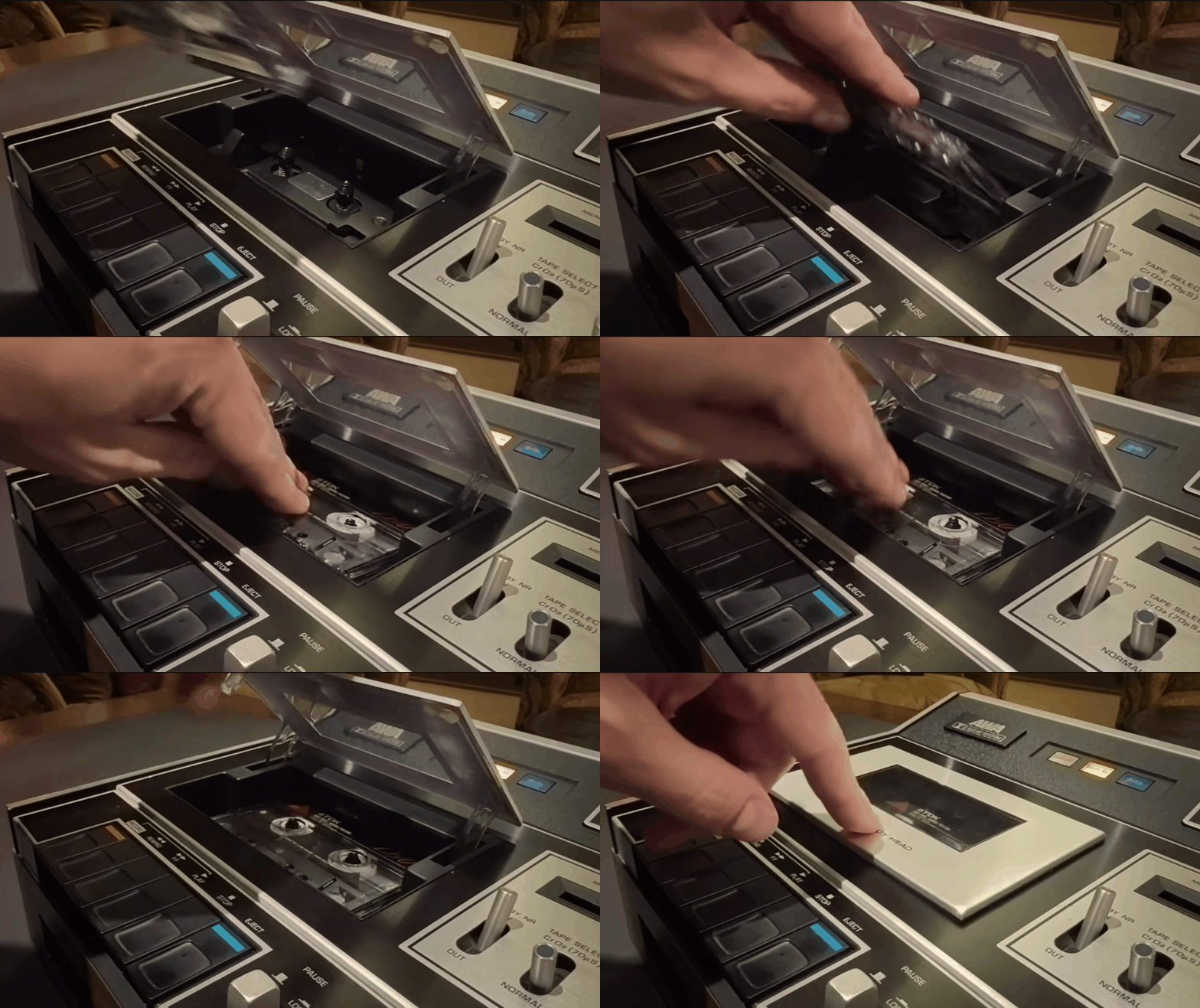
Is it real, or is it TDK?

George Harrison left explicit instructions to his son, Dhani, and Jeff Lynne outlining how he wanted Brainwashed, his posthumous 2002 LP, to be finished after his death. John didn’t leave behind anything except for the music itself.  If the tape of “Now and Then” actually said “For Paul” in John’s writing, we just don’t know if that meant it was dedicated to him, meant to give to him to listen to or something else altogether.  It could imply there were tapes that said “For May” or “For Sean.” Maybe there were and no one else has seen them.

Since I’m picking up the story in 2023 via 1995, I’m not really going to get into John’s original intent or inspiration in writing the song, the deeper Lennon-McCartney relationship, the Carl Perkins “My Old Friend” stuff or anything along those lines. There are some terrific voices in the Beatles-sphere who can offer their opinions on that. But ultimately, the most important interpreter is Paul. If we all (myself included) can hyper analyze every word and every note the Beatles play and find deeper meaning, certainly Paul McCartney has the right to decode and determine how a song by his longtime songwriting partner and dear friend spoke to him.

The 2023 rollout window for “Now and Then” was highly compact, and it allowed for knee-jerk takes and then knee-jerk reactions to those initial takes.

Straight away, Paul stumbled into the first step of the rollout in June, saying AI was key to completion of the song. Really, the blame goes to the person who wrote the BBC headline: “Sir Paul McCartney says artificial intelligence has enabled a ‘final’ Beatles song.”

The clumsy description spoiled the promotion of project from the outset, even if the actual use of the the technology wasn’t anything wrong. If he just said “we’re using same gadgets Peter Jackson used to clean up the Get Back tapes” it wouldn’t have put the rollout on the back foot from the start.

Jackson put together the magnificent making-of documentary, unveiled the day before the song’s actual release, on November 1, pulling together unseen home movies of John and Anthology-era footage of George. How remarkable it was to be able to enjoy them both so alive again. Watching Paul singing along to “Now and Then” in the 1990s was extremely moving. 
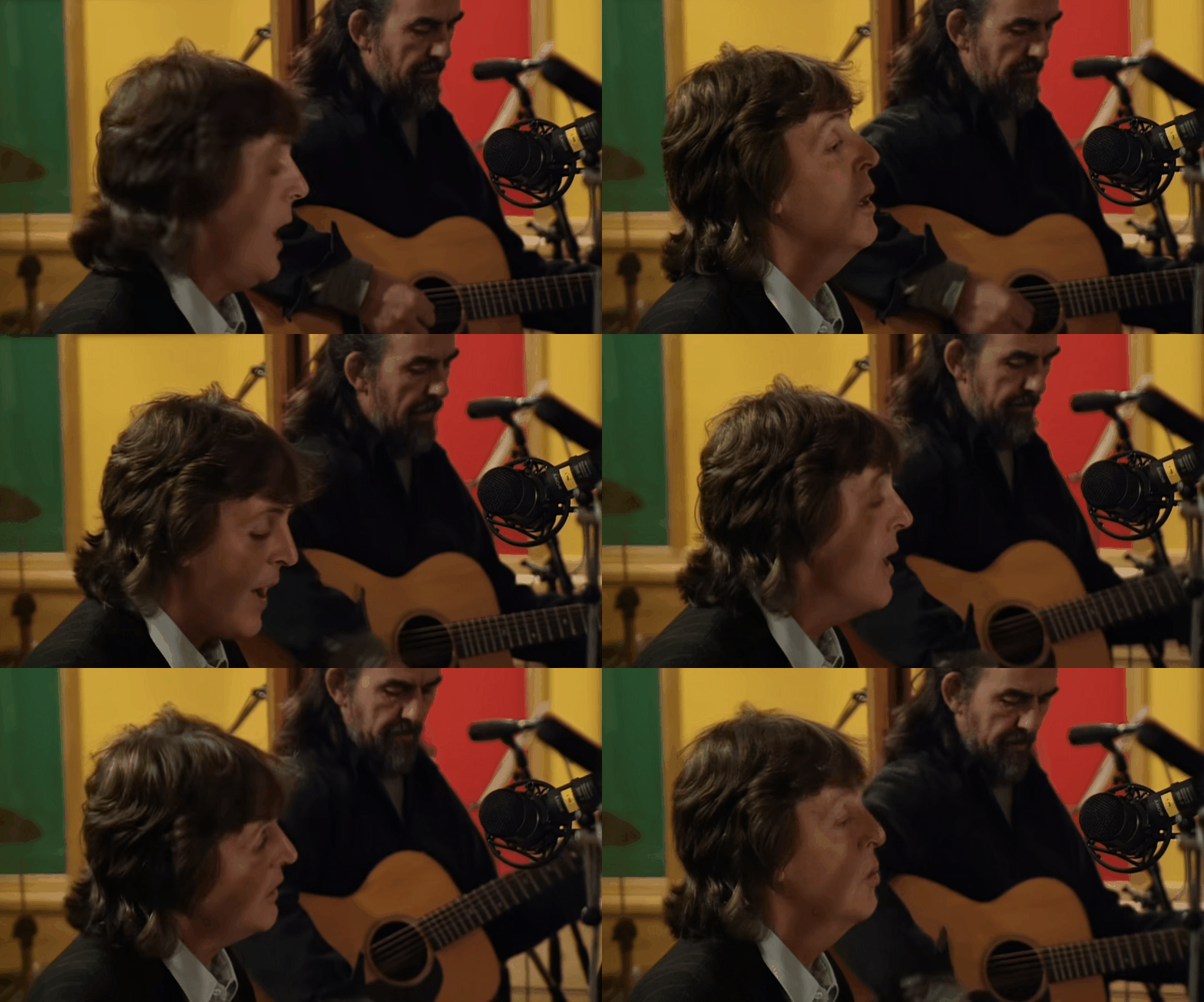
Regardless of whether the musical performances of “Now and Then” in the documentary were a solid sync job or authentic, the sequence made a straight-line link between the ’90s and now, pulling “Now and Then” into the Anthology era as second-act Beatles song and doing everything it could to ensure George was part of this story. Utilizing the Yellow Submarine time travel and timeline was deft, and little easter eggs like using Magic Alex’s sound “technology” was clever and really gave a deep nod and wink to let even the most diehards know, “We’re with you, and this new song can speak to you too.”

It’s entirely anecdotal, from social media, but people started to weep once they heard John Lennon’s voice in isolation. It took me until a few seconds later, when Paul joined him in harmony.

To me, that’s one of the most important and enjoyable features of “Now and Then,” which was officially released on November 2  — Paul owns his “old-man voice,” which he really hasn’t done during his solo career as it’s become more prominent. He’s treating his Beatles work separate from his solo work, which often takes him out of his realistic vocal range.  But for this final Beatles track, he leans into that feature of his singing voice as a complement to John, who in his mid-to-late 30s when he recorded “Now and Then” was about 40 years Paul’s junior at his current age. It would have been like John singing with an 81-year-old George Burns in 1977.

I think the strings do a great deal of heavy lifting. Superficially, this is the biggest difference with whatever they would have worked on in the ’90s, when they didn’t employ strings at all on “Free as a Bird” and “Real Love.” I found the arrangement lovely and not overwhelming, evocative enough of “I Am the Walrus” and “Eleanor Rigby” without overwhelming the listener.  

I’ll say the same for the harmonies that were sampled from “Because,” “Eleanor Rigby” and “Here, There and Everywhere.” Giles Martin applied them tastefully and subtly enough into the fabric of the song it sounded completely natural. 

Ringo was typically fab on the kit, and his added color on vocals were welcome. But it’s too bad surviving guitar parts were mixed low as they were. Much has been said about Paul’s slide solo in tribute to George — it did make you miss George, and it probably would have had a little more flavor and guts to it had he been around.

I do really feel like they were playing together, instead of this cross-generational, cross-dimensional, analog-digital hybrid. It’s all very tidy, under four minutes, not at all ponderous and conscious of overstaying its welcome. 

I thought John’s original recording was a little slight — I didn’t love any of the original piano sketches as they were taped, to be completely honest.  Certainly they were never meant to be release-ready or anything close to it. 

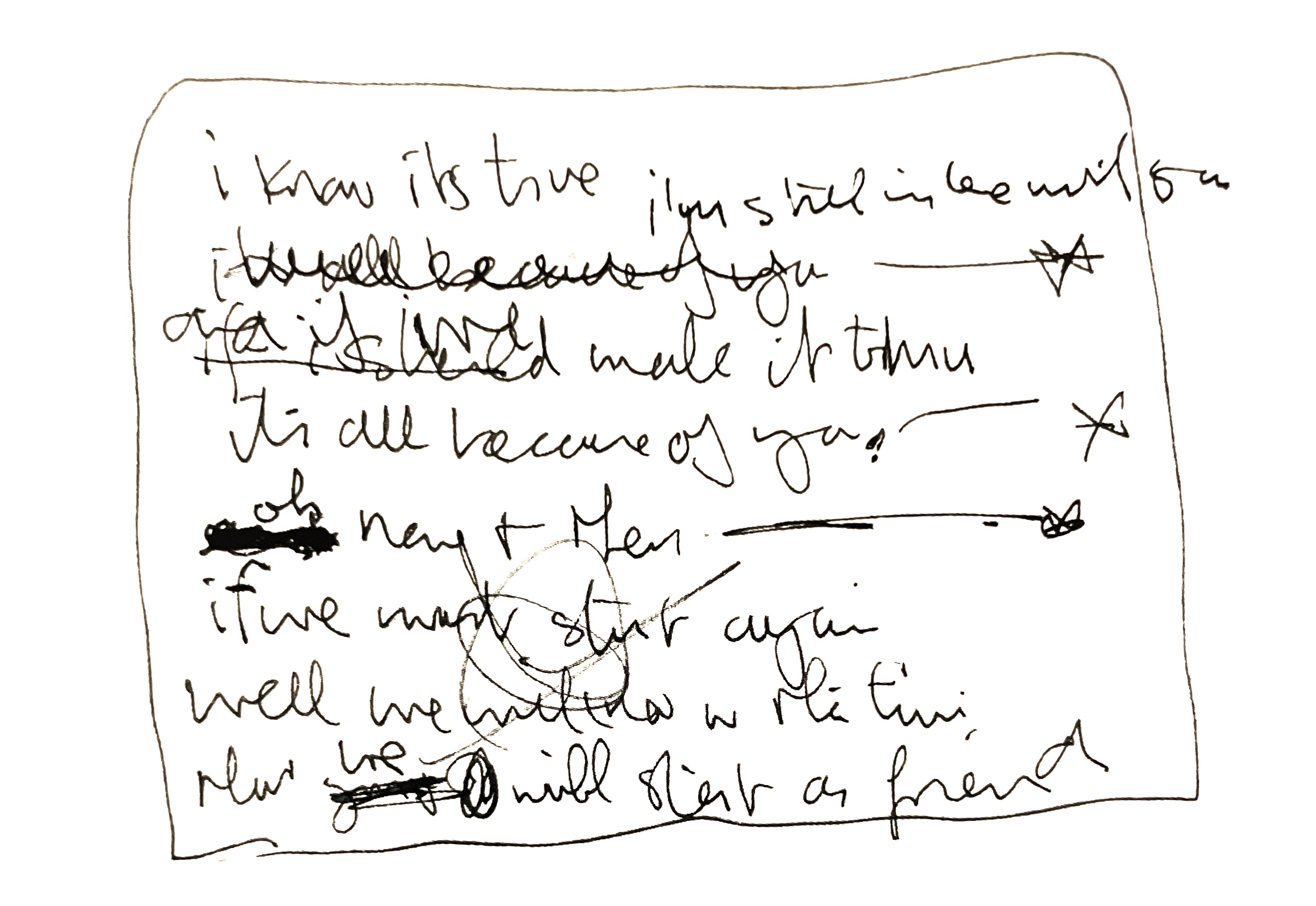
In contemporary interviews from the Anthology era, Paul himself didn’t pull any punches when it came to the quality of the content itself. On what was clearly “Now and Then,” from the November-December issue of Beatlefan:

Yeah, what’s it called – I don’t know, it didn’t really have a title [Sings: “You know/it’s true; it’s up to you…] That beginning bit’s great and then it just goes a bit crummy. We all decided that it’s not one of John’s greatest songs. So that we’d have to manipulate all of that, which is just a little bit more difficult.

I think it’s worth considering how different a 1995 version of the song would have been. We can be assured the overall sound would be different with Jeff Lynne at the helm as originally planned. Would the song have been adjusted, arranged and edited the same way? At the minimum, George would have had a say in the song’s writing and arrangement, probably in a 50-50 manner with Paul (minus some percentage offered to Ringo Starr, to be fair).  This is in no way meant to come off crass, but without George’s presence, it freed Paul to fully arrange “Now and Then” with complete freedom. 

Even if every now and then he’d feel so insecure, Paul had the confidence to open up the door to collaborate with John as an equal partner, as he felt he had every right to do and had done so many times. If Paul thought the song’s original bridge was clunky, extraneous and “crummy,” he was justified in killing it. I know it seems insane to say “No, we don’t want to hear any more unreleased John Lennon,” but the Beatles were always great editors. Paul McCartney is a magnificent song fixer, and this is the ultimate, final fix.  

And this returns me to Get Back. I long heard on the Nagras and everyone has since seen in the series that the others explicitly trusted Paul with their songs. He led the way, whether it was John letting him arrange “Don’t Let Me Down” or George welcoming input to “I Me Mine.” That’s just two small examples in a career of such collaboration.

Does “Now and Then” sound like it belongs on a Beatles LP? Of course not, and why should it?  Not quite a mashup, but think of it like the single version of a compilation album. It’s pieces from four of the last six decades woven in under four minutes, I think quite seamlessly. At times “Now and Then” sounds natural in any of those decades, though without fitting comfortably in any of them, either.

What is the essence of a Beatles song? Is it the personnel or the sound? The Beatles didn’t always record as a quartet, certainly not as the years went on. You only needed one Beatle to make Beatles song sometimes. “I Me Mine” was written and rehearsed with no input from John in 1969, and then recorded with him out of the country and having quit the band in 1970. Yet it’s undeniably a Beatles song.

Paul and Ringo got together recently for lunch, but had to send each other files of “Now and Then” — they couldn’t even bother to record the last song in the same room. Maybe there’s something calculated to that: If they couldn’t be in the same room as John and George, then they wouldn’t record without them as a unit. They’d all be apart, together.

The Beatles’ wild variety of styles defines the group’s music. So if it’s not the personnel or sound that makes a Beatles song a “Beatles song,” maybe the essence of a Beatles song rests in its original time — the 1960s. But, as George and John sang in response to “you say stop” in “Hello Goodbye,” they can stay till it’s time to go. And they decided it wasn’t time to go.

In the last 30 years, since the Threetles first attempted “Now and Then,” we lost George Harrison, Linda McCartney, George Martin, Neil Aspinall, Geoff Emerick and so many others, people close to the Beatles, their story and their music. John wasn’t the only one missing anymore, and each of these people to some degree must have been on Paul’s mind as he worked on “Now and Then,” this song of memories and loss. 

And to that end, it’s also quite clearly a song of closure. The promotion — so actively screaming that it’s the “last” Beatles song — leans completely into that. But the music does too. I’m not any kind music theorist, but I have two operational ears, and this is what I hear:

“Now and Then” is the only one with a conclusive ending. 

I love the concept of the butterfly effect, so let’s apply it here. There’s no answer, but what if “Free as a Bird” had the poor demo tape recording and “Now and Then” ended up salvageable in 1995? Maybe the quote I shared earlier, where Paul said it was “not one of John’s greatest songs” would have meant “Real Love” would have been the lone reunion song? We’re left to guess.

And that brings us to the video. It’s divisive and a little insane. 

There’s a lot to unpack. My initial reaction was that it was too contrived, too scattered. The 1990s Anthology outtakes were outstanding, as it was in the making-of film — images of George we hadn’t seen before and the Threetles at work. But my overall first impression was that this video was the kitchen sink, trying to stuff so much in four minutes: present-day performances, ’90s video, archival footage and photos. 

I would imagine that if they didn’t do the “Free as a Bird” video already, that would have been an apt solution. 

That’s one way to go, when there’s a member of the band who’s not around anymore, a creative film that had few images of the Beatles as they had been and none of the surviving members pictured in the ’90s. “Real Love” took a more straightforward approach, compiling moments from throughout their career with 1990s footage. But there’s no narrative.

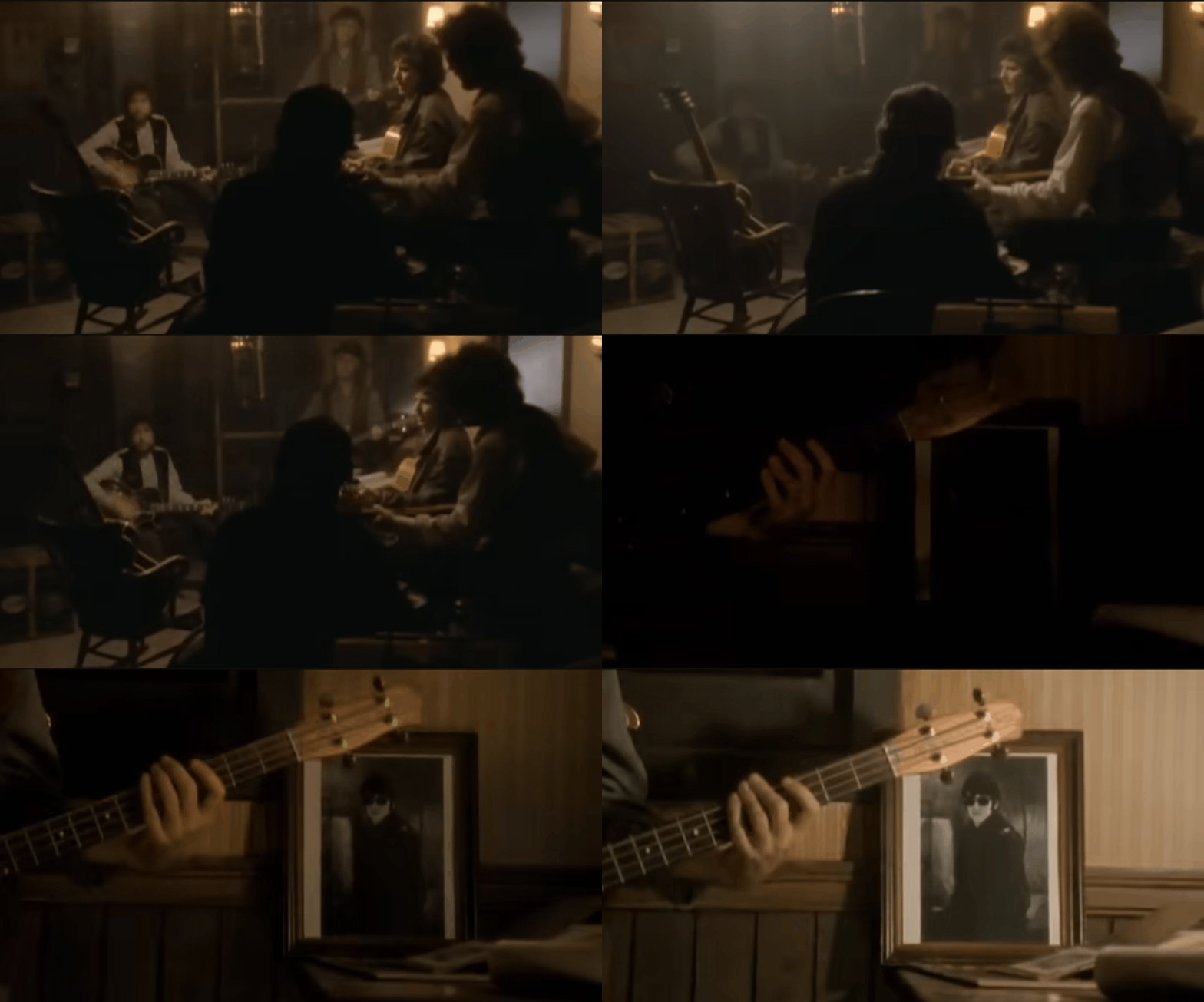
Roy Orbison died shortly after the first Traveling Wilburys album came out in 1988, and in the “End of the Line” video, released a few months later, he was represented by a rocking chair with a guitar and a photograph shown during his vocal lines. It was moving and sad, but I don’t think it was an approach that would have worked for the Beatles, with half the band gone. It would have come off maudlin, and completely against the idea that “Now and Then” was a full-group effort. (Mind you, I don’t think “End of the Line” was maudlin — it was still in the early phases of mourning Orbison.)
I was completely skeptical when I first saw 1967-era “Hello, Goodbye” John and George intermingling with 2023 Paul and Ringo. The word “cringe” was thrown around a lot on social media, and I get that. My thinking on the video quickly evolved from the first to second viewing — your milage may vary. 

We’re faced with two issues: Would the departed Beatles want to be represented this way? And if so, should it be as silly as presented? 
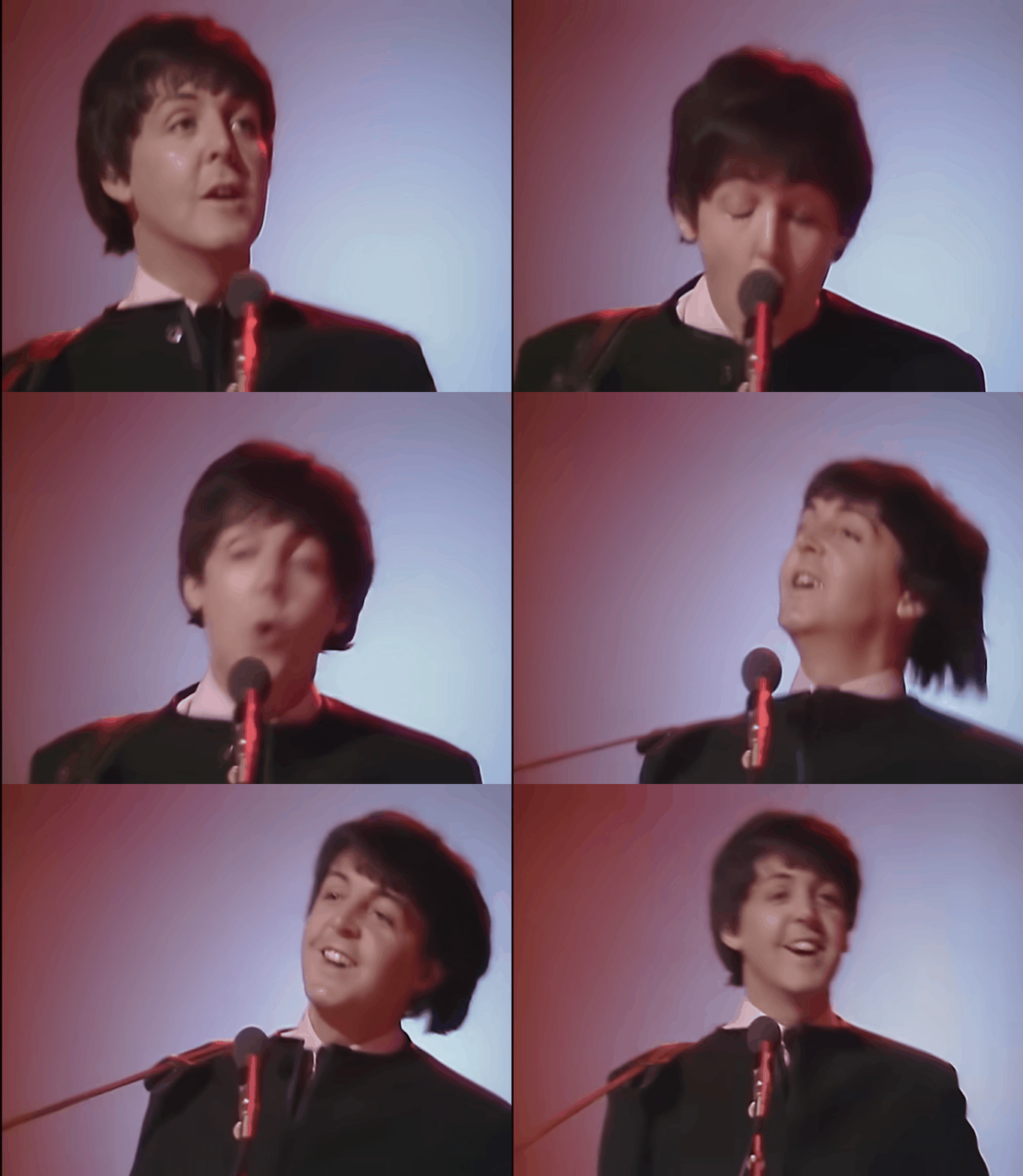
Paul as Beatle Paul (above) in 1980 and George as Beatle George (below) in 1974.
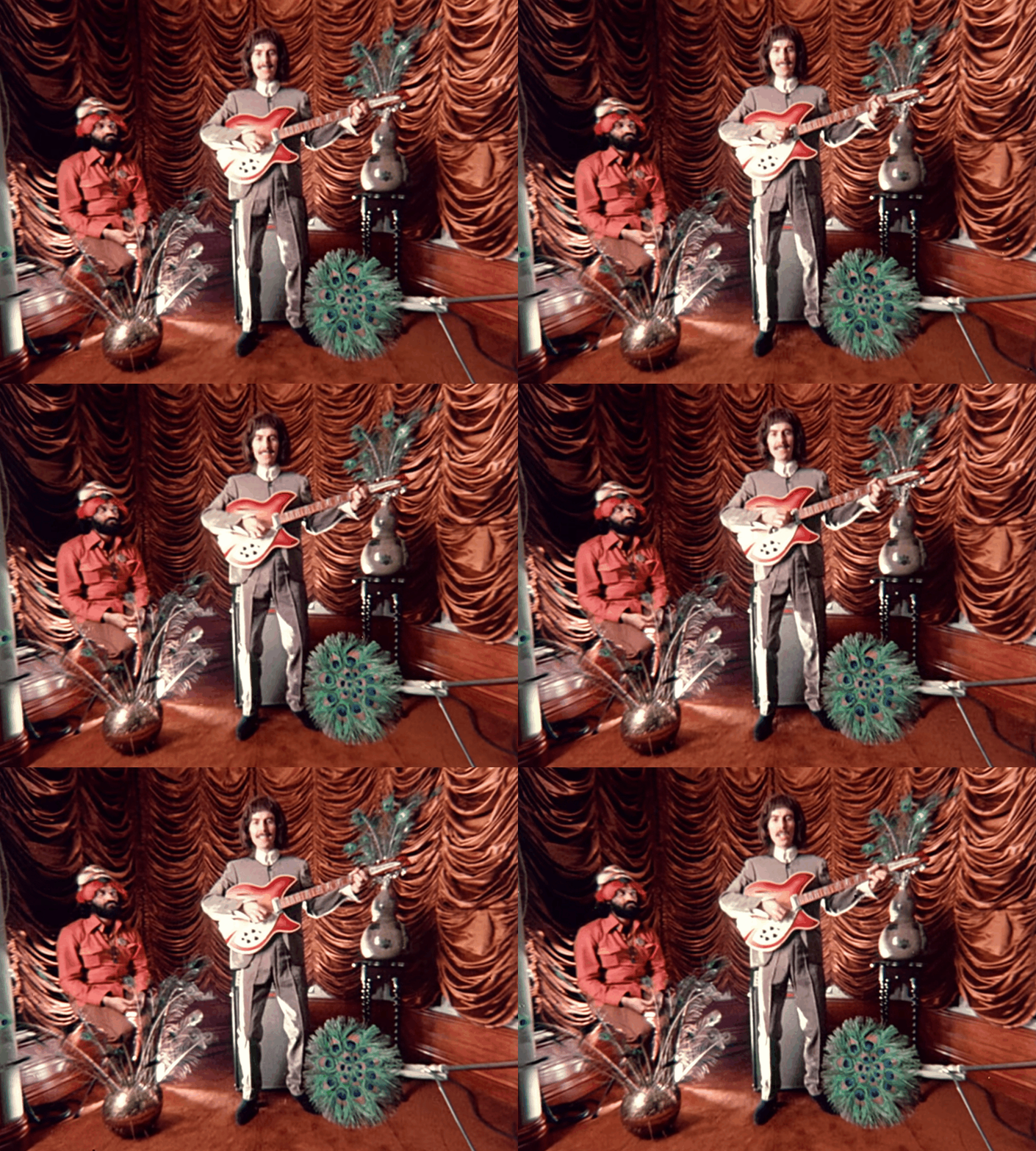
Let’s not pretend George and John didn’t revisit their Fab Four period in their solo years. Putting aside the many callouts in songs, either cryptic or overt, George did things like dress in the same Sgt. Pepper costume he wore in “Now and Then” and elsewhere, and John literally had the Beatles on the cover of a solo record. Complicated feelings they may have been, they never wrote off that time.
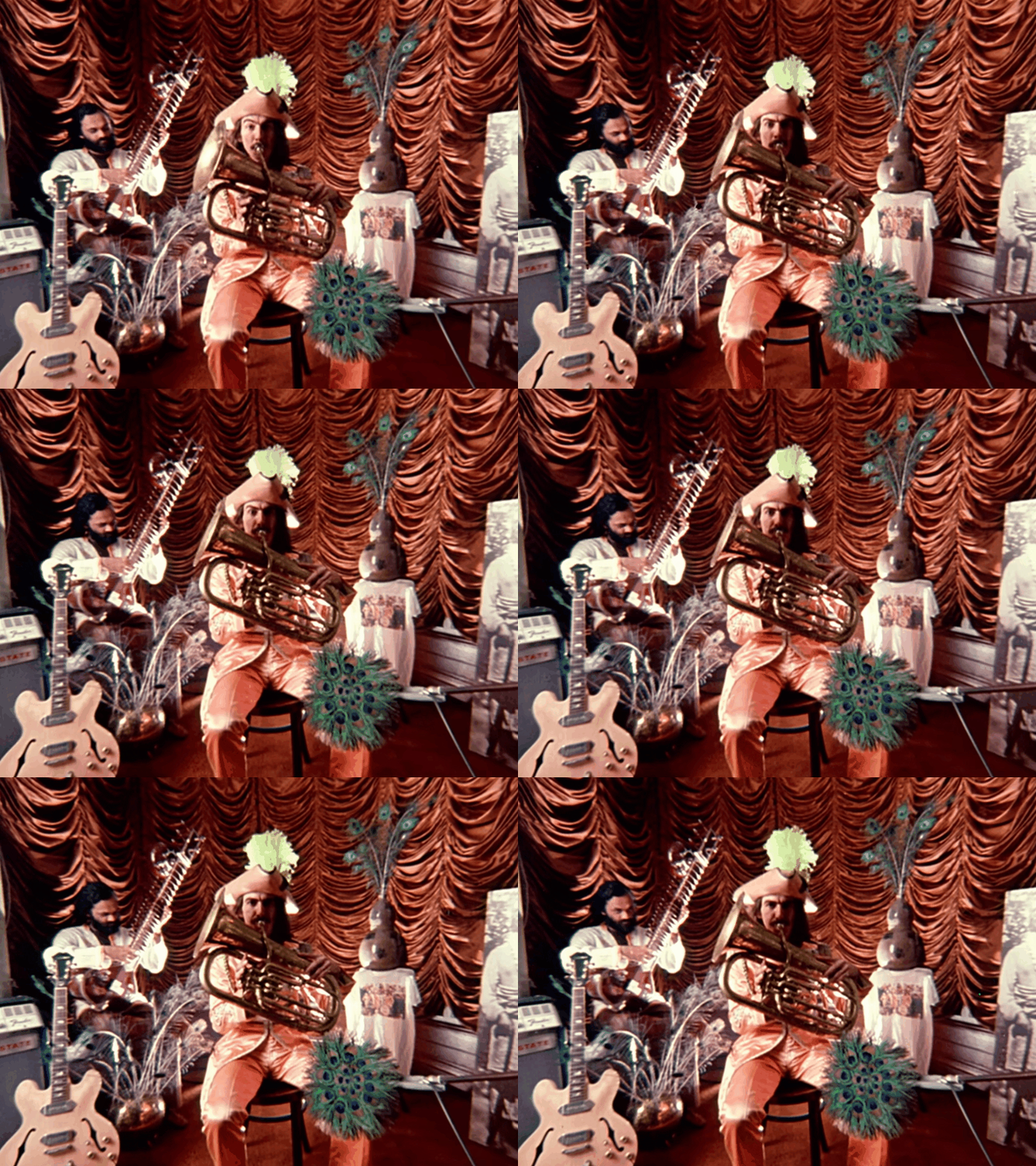
St. Pepper George in the 1974 “Ding Dong” video, one of many Beatle guises he employed as he tried to “ring out the old.”

In their day, the Beatles embraced comedy in their films and promos, and beyond into the solo years (George was the funniest of all, with his estate keeping that flame alive). Even with a wistful lyric at play, it wouldn’t be the Beatles’ way to match it with a bleak visual. 

One way they could have gone would have been to make multiple videos, something the Beatles did themselves over their career and when they went solo. Build out a full video of the ’90s sessions co-mingled with appropriate ’70s Lennon home or studio footage. The Beatles at work on their last song.

Another direction would be a more direct clip/highlight reel, something they added to the video for “Real Love,” but now with another 30 years of memories added, and earlier footage cleaned up.

Finally in the last video, they could have really owned the time-travel element and gone completely bananas. Stick Paul into the “How Do You Sleep” sessions. Put 60 years of Ringos into one room. Get the 1980 Paul pretending to be the 1960s Paul and put him on stage with the Plastic Ono Band in Toronto. You get the idea. Really play into the fact these four guys were always together, even when we can document they weren’t.

Those were my knee-jerk impressions of the video, kind of a mixed bag. Then I watched the video again, this time with my wife, who helped me open my eyes to a better interpretation.

A lot of people really don’t like the video, and I get it. It’s jarring, uncomfortable and the technology — as impressive as it is — still isn’t perfect. 
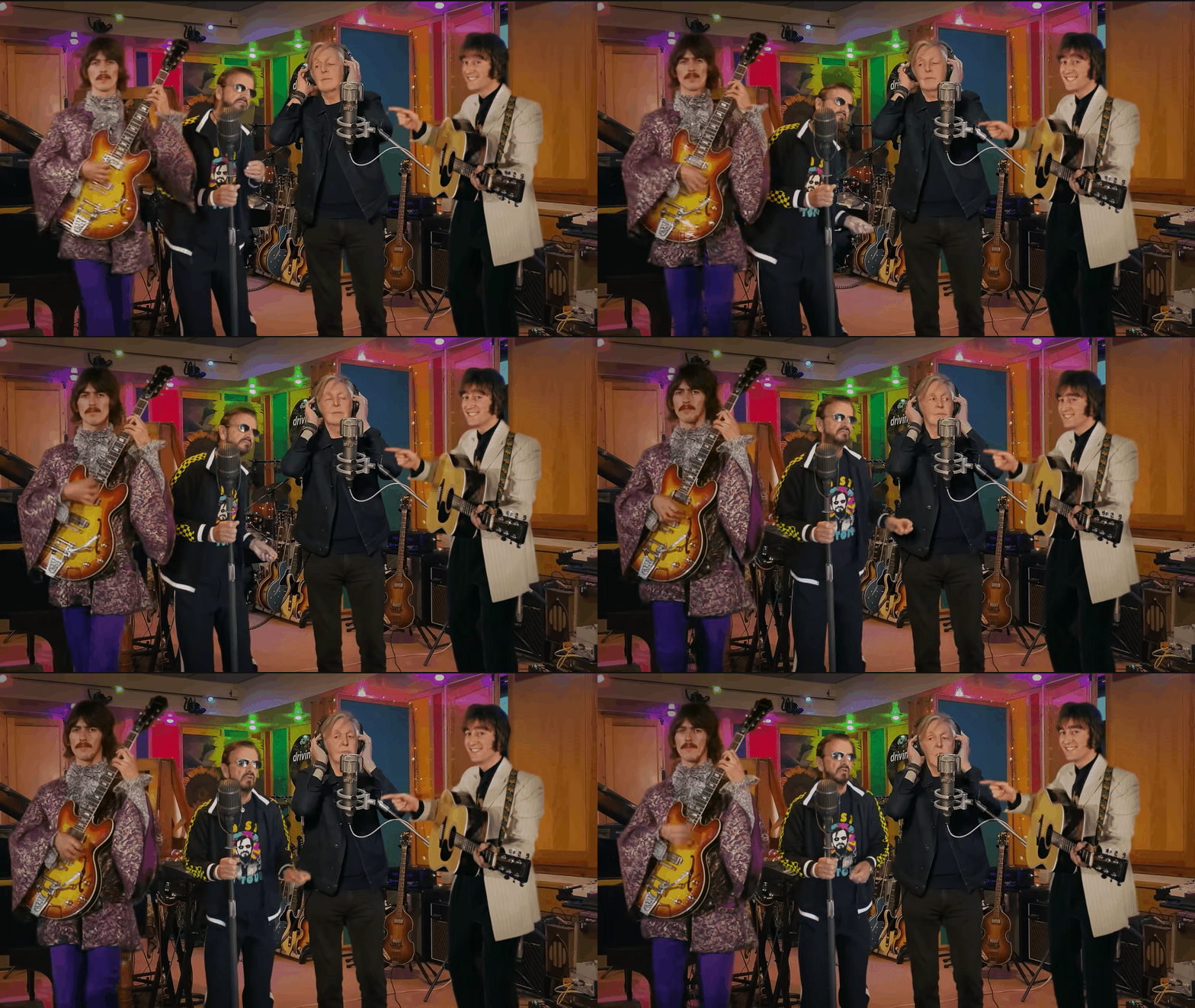
Peter Jackson described the concept as “Ringo and Paul in 2023 trying to work on a song and they get invaded by the 1967 Beatles,” but I think there’s much more to it than that. 

It’s Ringo and Paul deliberately surrounding themselves with the John and George they knew so well. At a funeral, wake, shiva – this is when we remember and talk of the vibrant life of the person we’re remembering, sharp and in color, not memories of their weakness or death. These days are filled with silly memories and pictures from all across their lives, laughter among the tears. I don’t think there’s any doubt Paul and Ringo vividly remembered a vitalized John and George — and even their own former vigorous selves — when they were in the studio last year working on “Now and Then.”  It’s just the Beatles and their closest associates:  George Martin was embodied through his son, and Mal Evans through the MAL technology used to extract John’s voice. 

This part of the video isn’t meant for us, it’s for them. We just get to be voyeurs. 

As the video nears the end, their life literally flashes before their eyes. Again, the animation is awkward in spots, but I’ll argue in favor of the concept. When I look at a photo of people I’ve lost in my life, their memory isn’t stuck in that 4×6 print. They live, they move. Every time I see their face, it reminds me of the places we used to go, a concept Ringo and George certainly understood.  
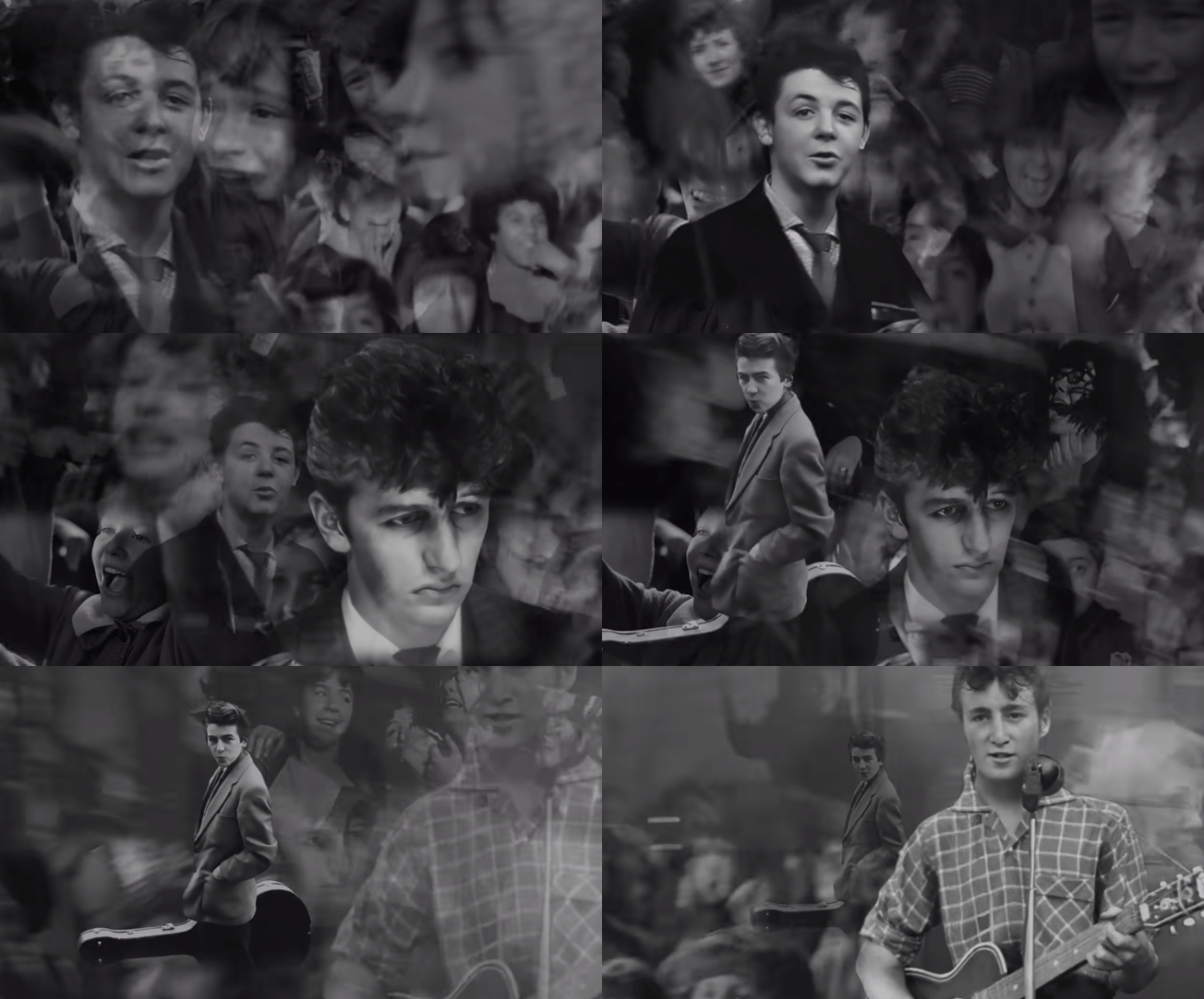
And then we were snapped back into reality, the reality of 1964, and the Beatles all together in a single time and place. With their concluding bow, taken from their performance of “She Loves You” in the “A Hard Day’s Night” film, the Beatles vanish before our eyes, and the lights spelling out their name burn out. That was the point in the video I lost it. 

If the rest of the video was for the surviving Beatles, this ending was for us, the Beatles fan, the rest of the world. They were singing to us now, not each other. 
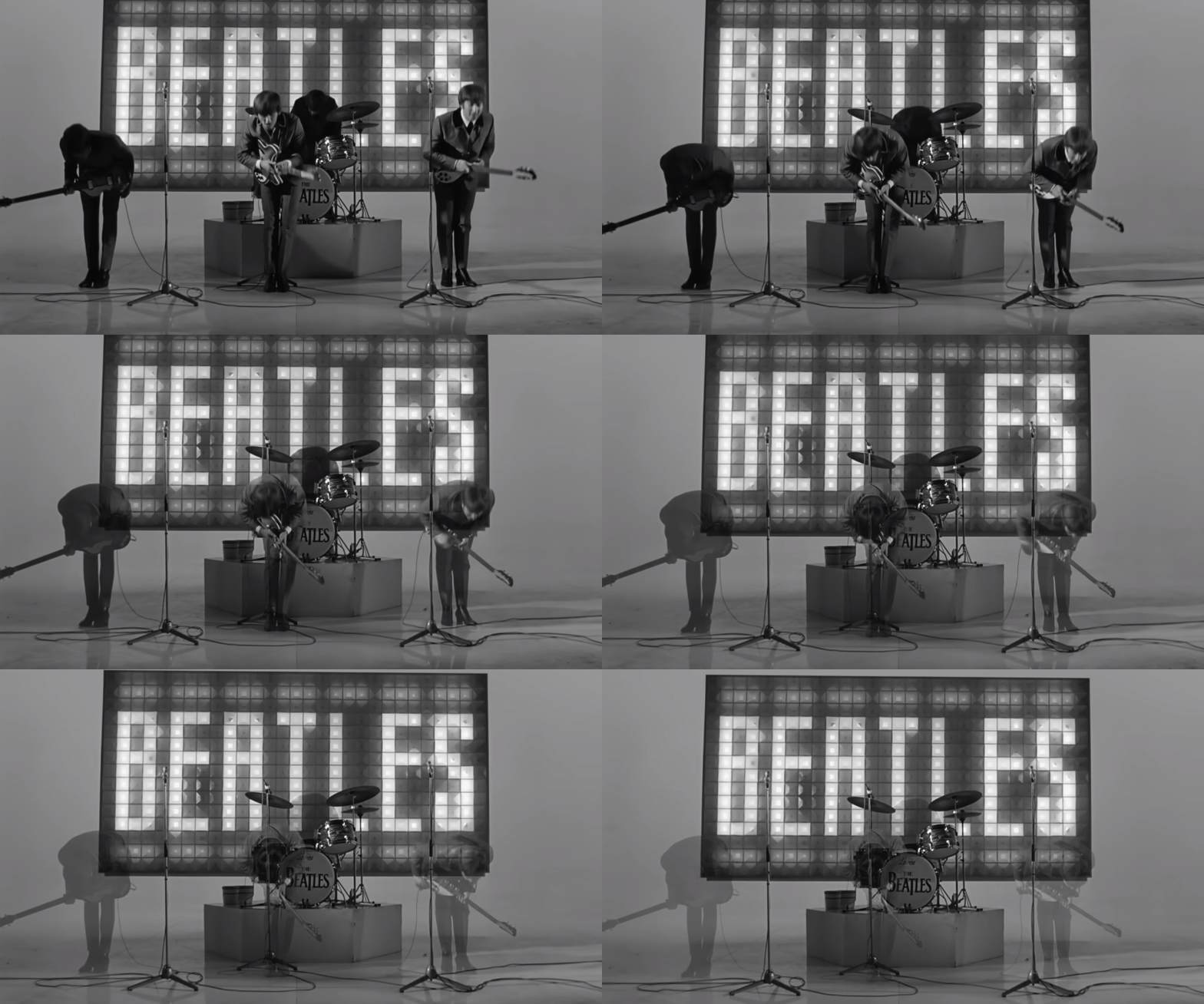
Deliberate or not, this ending evokes a dramatic sequence in The Compleat Beatles, an unauthorized but highly valuable biography of the band from 1982. In the sequence on the breakup of the band, we see the iconic black-and-white photos of the band from April 1969, with George, Ringo, John and Paul vanishing, in sequence, as “I’m So Tired” plays in the background, the aggressive lyric, “I’d give you everything I’ve got for a little peace of mind.” 

In the “Now and Then” video, that tone has changed. Go to the source in “A Hard Day’s Night,” and you can hear the valedictory statement they give prior to their bow: “With a love like that, you know you should be glad.” See, it does work both ways: If Paul McCartney and Peter Jackson can search for deep meaning in these kinds of things, so can I.

The Beatles have said “Hello, Goodbye” many times. Breakup rumors started in 1964, and continued until they actually broke up. Until their partial reunions. The only endings that ultimately matter are John Lennon’s death in 1980 and George Harrison’s in 2001.

I’ll bring things back one more time to Get Back, Let It Be and original breakup, with these points: No living Beatles (out of four) approved the Get Back edit by Glyn Johns in 1969 (it later came out packaged with the Let It Be reissue in 2021). That’s two fewer Beatles that approved “Now and Then.”

I don’t think they could have sold “Now and Then” as a genuine cosmic reunion of friends, not merely co-workers, without the Get Back docuseries coming first. That set the stage to a mainstream audience that the the Winter of Discontent was much milder than forecast. 

And thus ends the Beatles’ final act. Or does it?  Paul offered this relevant remark to his fan club magazine, Club Sandwich, in the Winter 1995 issue, when asked if Anthology was the “last word” on the group:

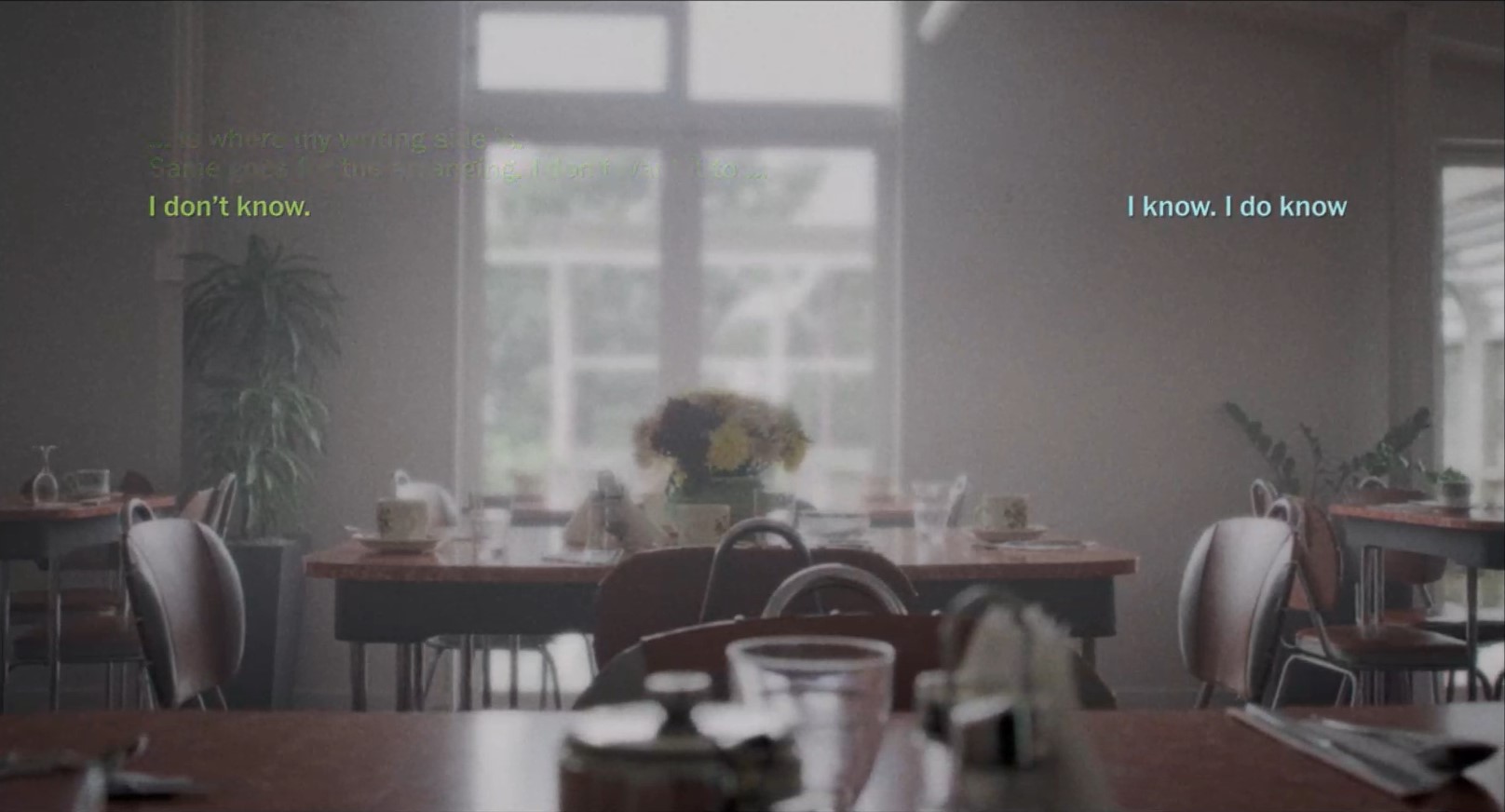
I don’t know. That’s the difficult thing. In the electronic press kit we all enigmatically said, “Where does the circle end and where does it begin? An end is a beginning, of sorts.” But to me, for now, it’s an end.

An entire new generation of fans had the experience of hearing the “last” new Beatles song as their first new Beatles song, something some of us got to experience in the 1990s, in the 1980s, in the 1970s and all the time in the 1960s. Where does the circle end and where does it begin?

There is no end to the Beatles, as long as they occupy our lives, our ears, our eyes. Don’t take it from me. Just ask Derek Taylor, who said this on April 10, 1970: 

“The Beatles have changed so many lives, that the need for them still exists. The hope that they represent still exists. And as long as that exists, then they have to exist. They’ve got to be there to fulfill that need, and who are they to take themselves away, to say ‘OK kids, that’s it’? …

“If the Beatles don’t exist, you don’t exist.”

4 Comments

Filed under Extra

Jan. 13: The Lunchroom Tape (Pt. 3)

To write about the Beatles’ lunchroom discussion on January 13, 1969, is to write about a conversation that has no particular aim and a sudden ending. As I wrote last time — I cut-and-pasted this part — it’s sincerely impossible to give a linear rundown of this 30-minute discussion, as it isn’t a linear discussion. My disclaimer remains: You may have already read some of the below in previous posts. Now three parts in, this isn’t a straight recap — instead I’m trying to follow themes as they moved across different points in the conversation.

If you haven’t already,  please read Part 1 first and then Part 2. It’ll get you right where you need to be to start off here. 

***

There’s no snark, no playing for the cameras, no sarcasm. Otherwise absent, John Lennon revealed his instinctual charm in his vulnerability.

“I played a weaker game now than ever,” John was recorded saying at one point during the Beatles’ lunchroom discussion on January 13, 1969, as captured by the Nagra Tapes.

He did know, however, that whomever he was speaking to, Paul McCartney, Ringo Starr, Yoko Ono and Linda Eastman could listen in and follow up. This wasn’t complete privacy.

This conversation, like so much on the lunchroom Nagra tape and so much of the serious discussion around the band these days, is framed around the group’s approach to George Harrison’s role in the group.  John and Paul certainly admitted to treating him “like a mongrel.” But much of the conversation is really centered on John and Paul themselves, the conjoined Nerk Twins and compositional heart and soul of the Beatles, the two biggest heads of the mighty four-headed monster that embodied the Beatles.

Much drama lay in store for the John and Paul relationship in years to come, but a lot had developed already. The threat of a further fracture — of the greater four, of these specific two — hung over Twickenham on January 13, 1969. The four were really three at this point anyway, with George gone.

And then there were those two. It was clear the relationship between John and Paul was, at best, impaired. The Lennon-McCartney partnership was discussed at some length before John and Yoko arrived for the day. In the presence of Ringo, Linda and others, Paul admitted his relationship with John — certainly when it came to songwriting, their job — wasn’t the same.

As the tapes secretly rolled in the Twickenham canteen, John came off as sincere in airing his grievances, which he must have held close prior, given how fresh his admissions sound.

“It’s like George said,” John conceded 12 minutes in, a line captured in the 2021 Get Back docuseries. “It just doesn’t give me the same sort of satisfaction anymore, because of the compromise we’d have to make to be together.”

The end result of the records now aren’t enough. … When something came out, like Revolver or [Sgt.] Pepper or whatever, there was still that element of surprise that we didn’t know where it came from. But now we know exactly where it comes from, and how it arrived at that particular noise, and how it could have been much better. Or it needn’t have been at all. The only way to do it satisfactorily, for yourself, is to do it on your own. And then that’s fucking hard.

So what’s the way out? It should have been these very sessions — the Beatles were in the midst of conducting exactly what it seems like John sought. The Get Back sessions weren’t delicately curated, and even if the actual noises weren’t necessarily unique, the process of creating new songs for a show demanded spontaneity unseen in their history.

John didn’t say the above to Paul, who was engaged in conversation with Yoko. Instead, John was speaking to Linda, who challenged her partner’s partner.

Linda: But you were saying yesterday … you write good songs and it can’t be any better way. You don’t want just studio musicians. I mean, that’s how I look at it. You make good music together, whether you like it or not.

John: I like it.

Linda: And making good music is also … it’s really hard working at a relationship.

Issues clearly emerged in 1968, and whether it sprouted from the death of Brian Epstein or the trip to India or during the White Album sessions itself isn’t necessarily relevant to this discussion. While the 1967 noises still surprised, the White Album left John “dissatisfied” (Ringo disagreed), even though “the end result was as good as it could’ve been.”

At once, John yearned for time on his own, while also lamenting that the Beatles had turned more in that very direction – more actively working separately — during the recording of their last album. To this end, The Beatles LP should have been called “John, Paul, George and Ringo.”

“I dig it, individually, far more than Sgt. Pepper,” John said. “But as a whole — as a Beatles thing, I think it didn’t work as a Beatles thing.”

There’s another contradiction. To get The Beatles Thing, they had to be themselves. But that behavior alienated George.

I wrote about some of what’s written below when I recounted Paul’s concept of a “breakup show” earlier on the 13th, but it’s worth not only repeating but going into further detail in the context of the rest of the lunchroom tape. We’re now in the post-Get Back docuseries world, which requires more commentary than before to amplify or clarify what a broader audience has now seen.

“You try and make George play competently, because you’re afraid that how he’ll play won’t be like you want him to play,” John told Paul. “And that’s what we did.

“And that’s what you did to me.”

The accusation came as no surprise to Paul, who simply mustered a “yeah,” like he did so many times during this conversation in response to John.

We can’t pretend this is a surprising point of contention. Paul Was Bossy largely defined the iconic Winter of Discontent. It was why the Let It Be Sessions, as we often called it once upon a time, was a “failure,” and why we believed the Beatles entered the summer of 1969 to produce Abbey Road as a way to go out on a high. This is 50 years of how Beatles history was recounted, whether you like it or not, to quote Linda.

We know better today, but even if it wasn’t the ultimate casus belli, of course Paul was bossy, even if that’s just in the lowercase. The other Beatles struggled with it: George quit at least in part because of it, and at the canteen, John protested. Paul may have placed himself as merely “secondary boss” earlier in the conversation when discussing an expanded lineup, but now, with around seven minutes left on the lunchroom recording, John conceded he felt powerless working with Paul, and had for some time.

“I’d got to a bit where I thought it’s no good, me telling you how to do it, you know? All I tried to do on [the White A]lbum was just sing it to you like I was drunk, you know? Just did me best to say, ‘Now look, this, this stands up on its own.’

“And I’m not doing this quite well this time, ‘cause I — like, even with ‘Don’t Let Me Down’, the first time I sang it. Because I hadn’t allowed meself to say it was a whole song. I couldn’t — it was only after we’d done it that I’d realized it was done.  You know, and on The Beatles album, I just sort of said, ‘Here it is, ignore here, this is me singing it drunk, but I’m pretending as if I’m not. What would you do with it? George, you play whatever you like.’”

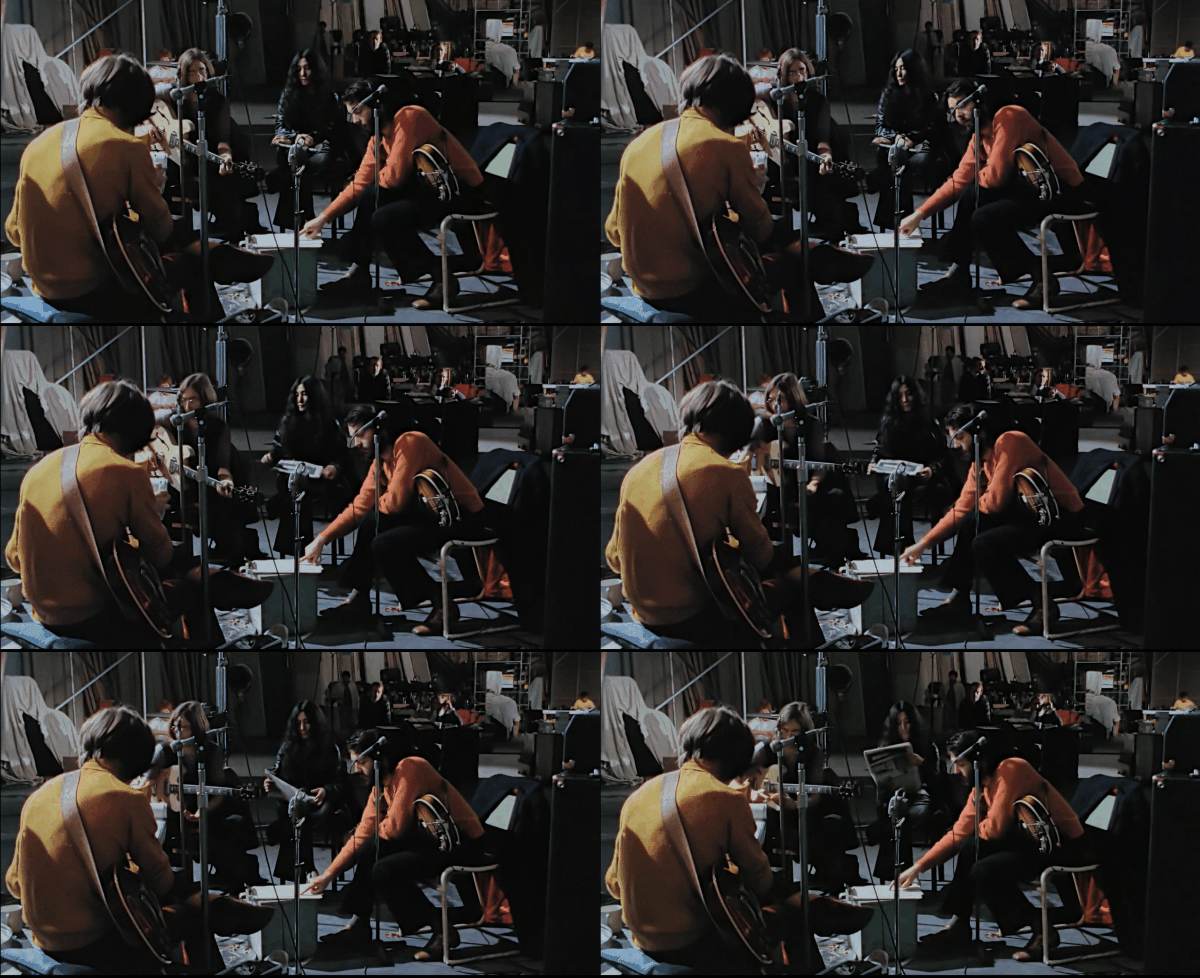
Paul arranges “Don’t Let Me Down,” from the January 6 sequence of Get Back.

Paul laughed at John’s second mention of singing drunk, but it goes to John feeling he had to be stripped of inhibitions to present and arrange a song to Paul as finished in his ears and in his eyes. John entered these sessions feeling unsure again, though. As he said regarding “Don’t Let Me Down,” it took Paul and George to help arrange it earlier in the sessions after John himself said he wasn’t sure in which order the song’s three sections should be presented.

You know, and that’s what it was. It wasn’t -– it wasn’t the arrogance of, “Listen, this is it, baby.”  It was that I can’t tell you what to do because you won’t play, here, like what I think you should play. And I’m not going to tell you what to play.

Paul and John continued to speak to and over each other. It wasn’t angrily, they just were doing everything to make their respective points.

Paul: OK, and that’s great, you know. And then – it’s just being able to say that, on the occasion, just being – say, “Look, I’m not going to say anything about the song, because it’ll be difficult … to sing it to you.”

John: Yeah, I know, but you wouldn’t say – listen to me – you probably arranged it you know?

Paul: I know, I know.

John: Well, I’m saying that “Dear Prudence” is arranged. Can’t you hear [John vocalizes part of the song]. That is the arrangement, you know?  But I’m too frightened to say “This is it.” I just sit there and say, “Look, if you don’t come along and play your bit, I won’t do the song,” you know? I can’t do any better than that. Don’t ask me for what movie* you’re gonna play on it.

Because apart from not knowing, I can’t tell you better than you have, what grooves you can play on it.  You know, I just can’t work.  I can’t do it like that.  I never could, you know.  But when you think of the other half of it, just think, how much more have I done towards helping you write?  I’ve never told you what to sing or what to play. You know, I’ve always done the numbers like that.  Now, the only regret, just the past numbers, is when because I’ve been so frightened, that I’ve allowed you to take it somewhere where I didn’t want.

[* Author’s note: I swear “movie” is what John said there, even if it doesn’t sound like it makes sense in context.]

What made the last bit a dialogue instead of a monologue was only the occasional “yeah” delivered by Paul.

John was pouring it out.  He admitted fear, regret and submission.

“And then, my only chance was to let George take over, or interest George in it, because I knew he’d …”

“’She Said, She Said,’” Paul interrupted, and John confirmed.

Interestingly, you can hear Linda replying, “yes, yes,” which means this was a big enough deal to Paul that he shared the story of that song’s recording with her (the couple didn’t meet for nearly a year after that session, so she wasn’t around at the time). It’s easy to reason why he did, and why he likely brought it up within the last 100 hours. With George having just quit, Paul probably told Linda about the time he himself walked out on the band – during the recording of the final song cut for Revolver, on June 21-22, 1966.

An anecdote absent from Beatles history until 1997 — the post-Anthology era — Paul recalled the walkout for Barry Miles’ authorized biography Many Years From Now.

I’m not sure but I think it was one of the only Beatle records I never played on. I think we all had a blarney or something and I said, “Oh, fuck you!” and they said, “Well, we’ll do it.” I think George played bass.

Paul’s account had been the single source of this incident. It’s now part of the Beatles’ official history with this passage appearing in the book that accompanied the 2022 Revolver deluxe reissue (along with Paul’s quote):

The disagreement that happened in the dead of night seems to have been about how to resolve differing ideas for the arrangement. A recording sheet in the Abbey Road archive indicates a piano was added to the song at one stage, but no trace of the instrument remains on the tapes.

Back in the Twickenham canteen, John was clear about what mattered to him that night in 1966: “He’d take it as it is,” John said of George before continuing.

“So on [the White Album] it’s probably George, you know, if there’s anything wrong with it.  Because I don’t want your arrangement on it … I only want your …  If you give me your suggestions, let me reject them, or if there’s one I like, it’s when we’re writing songs. The same goes for the arrangement.”

Exasperated and resigned, John continued, “I don’t want it to … I don’t know.”

Both Paul and Yoko said they knew what he meant, even if John couldn’t pin it down.

Opposite sides of the same coin. Not captured in Get Back: Yoko chiming in.

In the tape’s final moments, John returned the focus to his in-studio working relationship to Paul and continued to show what, at best, can be called inconsistencies.

And that’s all I did on the last album was say, “OK, Paul, you’re out to decide [how] my songs [are] concerned, arrangement-wise.” … I’d sooner just sing them, than have them turn into, into ‘[Being For the Benefit of] Mr. Kite,’ or anything else, where I’ve accepted the problem from you that it needs arrangement. …  I don’t see any further than the guitar, and the drums, and, and George Martin doing the … I don’t hear any of the flutes playing, you know?  I suppose I could hear ‘em if I [spoken as if straining] sat down and worked very hard! You know, I could turn out a mathematical drawing, if you like …

Indeed, John was more likely to tell George Martin he wanted “to smell the sawdust” in “Mr. Kite’s”  circus atmosphere, or that he wanted to sound like the Dalai Lama chanting from a mountaintop in “Tomorrow Never Knows.” It’s all consistent with John’s outspoken, retrospective dissatisfaction with arrangements on his own songs, like “Across the Universe” and “Strawberry Fields Forever.”

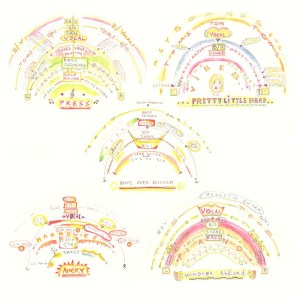
And I really am relying on your touch: Paul’s hand-drawn instrument charts from the gatefold of 1986’s Press to Play LP.

Isn’t John lucky to have run into a guy like Paul McCartney (and a producer like George Martin) to help him take the song beyond guitar and drums and happily chart out those mathematical drawings?

It’s the archetypal refrain when bands splinter: There were musical differences. The Beatles didn’t really have musical differences. Just listen to the music they kept making and their general output as solo artists. These guys just had differences in how to make music. Despite the protestations, John and Paul weren’t incompatible but perfectly complementary, they knew it and we all know it.

How to fit in George (Harrison) was an entirely different issue. This was all part of the “compromise we’d have to make to be together,” as John said earlier at the canteen.

Paul:  I’m onto the same thing, you know.  …  It is only, like, if you can just remember that we’re, you know, the four of us are trying to do that.  ‘Cause I mean, all of those things you say, you know, in some way, apply to me. Not always —

John: Yes, yes, because everything applies a little bit to each other.

Paul: It is just you saying it.  They’re all, you know, in some way, to some degree, will apply to me.

John: But there was a period where none of us could actually say anything, about your criticisms.

Paul: Yeah.  Yeah.

John: ‘Cause you would reject it all.

Paul: Yeah, sure.

John: And so George and I would just go, you know, “I’ll give you a line here,” “OK,” you know, “We’ll do four in a bar, and I’ll do…” [resigned, sincere] And a lot of the times you were right.

Paul: Yeah.

John: But a lot of the times you were the same as they always are.  But I can’t see the answer to that.

The “we’ll do four in a bar” bit is what the Get Back docuseries claimed was “I’m Paul McCartney” — my complete forensic analysis of this sequence is here at CSI: Twickenham.  Regardless if the show’s transcription decision was human (or AI) error or a deliberate editorial misrepresentation, even if John wasn’t actually mocking Paul we can understand why Peter Jackson and Co. either thought he was or just wanted that quote to have some traction.

Paul’s ego at this moment was justifiably boundless, and it extended to his thoughts on the band itself. The Beatles’ reputation earned them wiggle room. It ties indirectly to an imaginary scenario he laid out earlier in the conversation: drunkenly playing the piano just because he felt like it and “everyone in that room will dig it, because it’s me really doing it.”

Here Paul insists the Beatles don’t have to play perfectly to sound that way to listeners and critics.

The thing is, like, within each other, within ourselves, we’ve reached something that’s nearly perfect. And everyone else who’s listening to it — “That’s it! We’ve done it!” … OK, so we know we nearly made it, but we’ve really made it for everyone else. ‘Cause, OK, we’re into the fine, finest, finest technicalities, you know, I mean, that’s where it’s at, you know? If one day, we can even keep all the people who are listening to this, nearly, nearly made it, they think we’ve made it. They think that’s it.

The next bit is familiar from the opening moments of the lunchroom scene of the Get Back series, although on the tapes it actually was said very close to the end.

“Like last week,” Paul said, “I say I was doing all right for me, I was really trying to just say to George, ‘Take it there,’ you know? Whereas I wouldn’t have gone, previously — I would have said, “Take it there – with [vocalizing] ‘diddle-derddl-diddle-der.’  But I was trying last week, to say, ‘Now, take it there, and it needs to be like…”

“You see, the point now is we both did that to George this time,” John replied.

The policy that kept us together. The compromise we’d have to make to be together. John had asserted in the canteen several times there was a system, and in not so many words, he believed that system had collapsed and they broke George. This was, like so many issues these four had, a communication problem.

John put it succinctly: “It’s like if I say, ‘All right, take it,” he’ll say, “Well, look, I can’t take it.”

Before the tape ran out in the lunchroom, as John and Paul continued to discuss their inability to get through to George, musically, we get to hear part of an exchange that was introduced in an edited fashion very early in the Get Back version of the sequence.

Paul: So he knows that when we say, “Take it,” we expect [Paul vocalizing]. If I said that, then he’d … [vocalizing George playing a simplified version of that same part]

John: But it’s just that bit. The bit where we’ve — “I’ve Got a Feeling.” There’s no way we could have translated it to him to say …

Paul: He’d have said, “I’ll do it at home.”

John: He’s gonna go home. But so have I, you know. I’m gonna go home in a studio, rather than go through this with anybody.

Paul: I’ve never said to George, “Look, George, I think, when I want a guitar bit, I want it exactly like I want it.”  And he’s never said to me, “Well, you can’t have it.”  … But that’s it, while he’d never said that to me, and I’ll never say that to him, and we’ll go on.  But, really, I mean it is gonna be much better if we can actually say, “Look George, ‘I Got A Feeling,’ I want … exactly [like this].”  And he’ll say, “Yeah, but I’m not you and I can’t do it exactly how you do it.”

And that ended the near-30-minute reel. It’s unclear how much longer they spoke, and what direction the conversation took.

So where are we left after extensively eavesdropping on the Beatles?

Ultimately we only know what a 1960s-era miniature spy microphone shoved into a flowerpot in an active lunchroom was able to pick up over a single half-hour period. At several points, the conversation is completely indistinguishable. At others we have a conversation being picked up in the foreground when one in the background is completely obscured. Even with Get Back’s AI, we’ve learned it’s not all perfectly heard.

Thanks to the lunchroom tape we know the Beatles better than before if only because there are more data points to draw upon, but that doesn’t mean we understand things proportionally better. These Beatles were never ones to keep a story consistently straight when it was for public consumption, and it doesn’t seem much different in private.

All at once during this same conversation, John wanted to:

  • Assign song arrangements to Paul because he didn’t want to bother with the job himself
  • Ask for suggestions on arrangements with the right of refusal
  • Not have any additional arrangements to his songs

As relaxedly outspoken he was on the lunchroom tape as well as earlier in talking to the others prior to John’s arrival,  Paul was likewise levelheaded, perhaps thinking all along, “John, you’re all over the place, as usual” while never coming close to saying as much.

The tape and these sessions overall allow us to witness a maturation in Paul’s temperament and what sounds anecdotally like a softening in his micromanagement style in the 30 months since his 1966 walkout. He could still be very stubborn, but if we assume the “She Said, She Said” situation was comparable to other tense moments in January ’69, he handled these recent situations with greater poise. Paul recognized it himself saying just above, “Like last week, I say I was doing all right for me.”  There are several similar snapshots throughout the sessions at Twickenham where Paul can be heard stopping himself.

Get Back was misleading in its presentation of the “I’ll go home to do it” quote. It’s not that George wanted to quit the band — or for that matter that John wanted to also. Home was the space George was more comfortable working on certain things. Witness the “last-night” songs George composed alone at home. When John says George will go home, he didn’t mean he was quitting the band, as Get Back implies. The context is clear it was to be in a different space to work out his parts.

Still, George had quit the band, and attempts to get him back the day before failed. Perhaps John was so vocal at the canteen as a reaction to the complaints others had that Yoko was speaking for him over the weekend. John wasn’t relying on her, or code words or telepathy to communicate with Paul.

The Get Back edit of the lunchroom tape is a very frustrating viewing once you know the contents of the entire original half-hour audio tape. Deceptive at its worst and unreliable at other points, the TV edit simply blurs an already schizophrenic conversation. Even if the two central participants were John and Paul, the active presence of Ringo, Yoko and Linda needed to be acknowledged, period.

An alternate televised account of the lunchroom — perhaps openly presented as a supercut or trailer of sorts of the full conversation — would have come off cleaner. A movie trailer never presents the action in the final order, but that’s OK and assumed by a viewer. Openly presenting the lunchroom sequence as a sampler of the conversation — one that jumps in, out and all around — would have been a more fair portrayal to satisfy the critics (like me) while keeping with the show’s clear time limitations.

Paul was most outspoken when discussing the group’s future, both before and during the lunchroom tape. But to be clear, the Beatles always discussed their future, even publicly, going back to the dawn of Beatlemania. You’ve heard John’s quote from November 1963 before:

You can be big-headed and say, ‘”Yeah, we’re gonna last 10 years.” But as soon as you’ve said that you think, ‘We’re lucky if we last three months,’ you know.

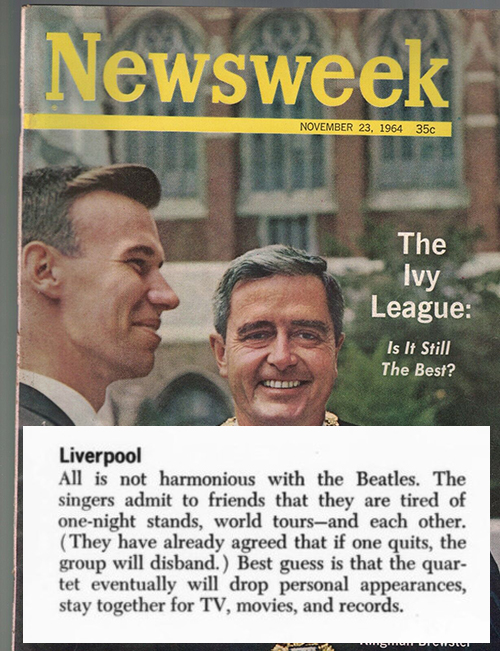
That they were conscious of their future more than six years after that interview should be no surprise. Breakup rumors appeared in the mainstream press as early as 1964 and reignited periodically. They were always expected to break up until they unexpectedly broke up.

The issue date of this Beatles breakup rumor — November 23, 1964 — was the same day “I Feel Fine” was released in the U.S.

How often did the Beatles privately have conversations like this one at the Twickenham canteen? How often over their career during a bumpy period? How often in January 1969? This 30-minute sequence was a one of a kind capture, but it doesn’t make it a one-of-a-kind conversation.

The individual Beatles of January 13, 1969, were closer to 30 years old than 20. Closer to the release of the McCartney LP than Sgt. Pepper. Their egos were developed, and John said he needed to smother his in Paul’s shadow. George’s could hardly develop in the space of John and Paul.

Did John even want George back? That’s not my question, that’s John’s question.

At this point, there are conflicting goals: self-preservation and singing how you really sing it vs. the Beatles Thing. With the luxury of retrospection, we know it shook out OK. Abbey Road was terrific, Let It Be was great and the intermittent singles were fab. It was more in question on January 13, 1969.

Meanwhile, if John was looking for sounds that would surprise, in 10 days time, the embodiment of a new sound and new attitude would walk through the door, giving life to John’s search for an element of surprise.

***

Like “Her Majesty” — the conclusion to Abbey Road that had its origins in the Get Back sessions — the lunchroom tape cuts off unresolved. We only know what comes next some short time later: John, Paul and Ringo head back to Twickenham’s sound stage. George isn’t there.  They don’t replace him either. They simply go back to the studio.

But George’s on their mind.

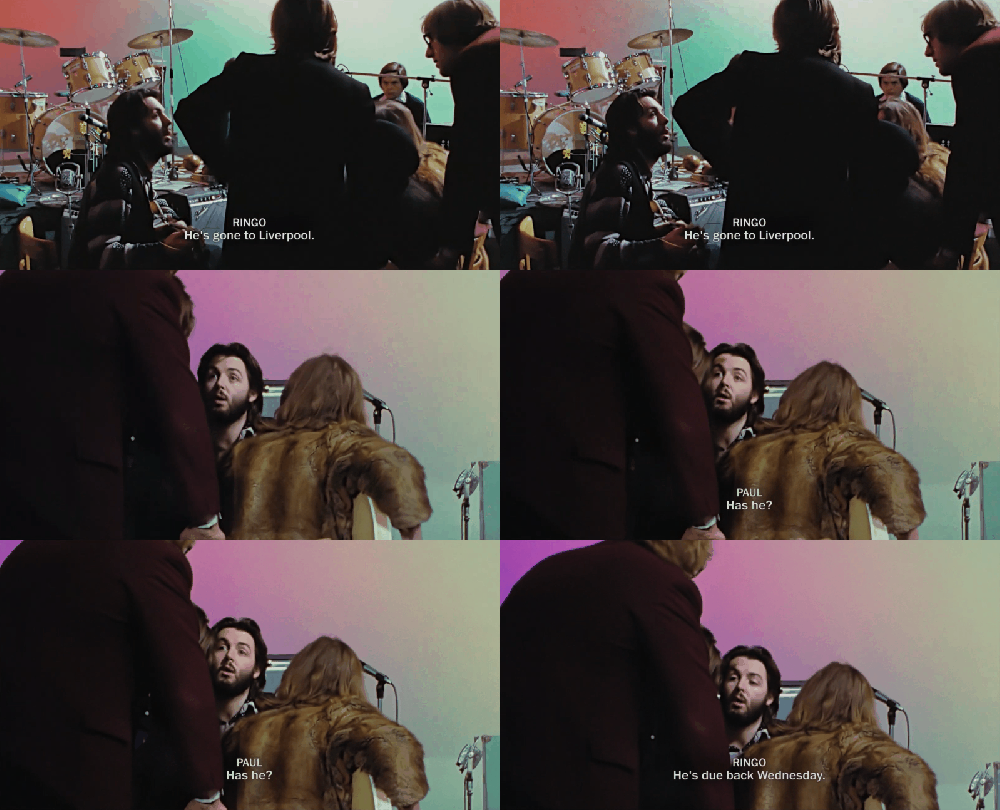
“Let’s go and see George,” Paul said about 10 minutes into the post-lunch Nagras, which were initially filled with idle talk — a little bit about camera work,  some about television. There was one problem with that excellent plan, and Ringo delivered the news: George, in fact, had — quite literally — gone back home.

“He’s gone to Liverpool” and would be back Wednesday.

“Oh, then Wednesday’s the day we see him, right?” Yoko replied, cheerfully.

“Yeah, and I think til then … ” Paul said before being cut off by Ringo.

“Should we rehearse the numbers?”

And so the remaining Beatles got back to work.

5 Comments

Filed under Day by day