Tag Archives: Yoko Ono

TMBP Extra: That road before

As a film, Let It Be has more backstory than story.

In Beatle-time, the 15-plus-month turnaround from the end of their January 1969 sessions until the film’s release in May 1970 was simply a glacial pace. Then from the moment it reached theaters, Let It Be has been treated as a snuff film.

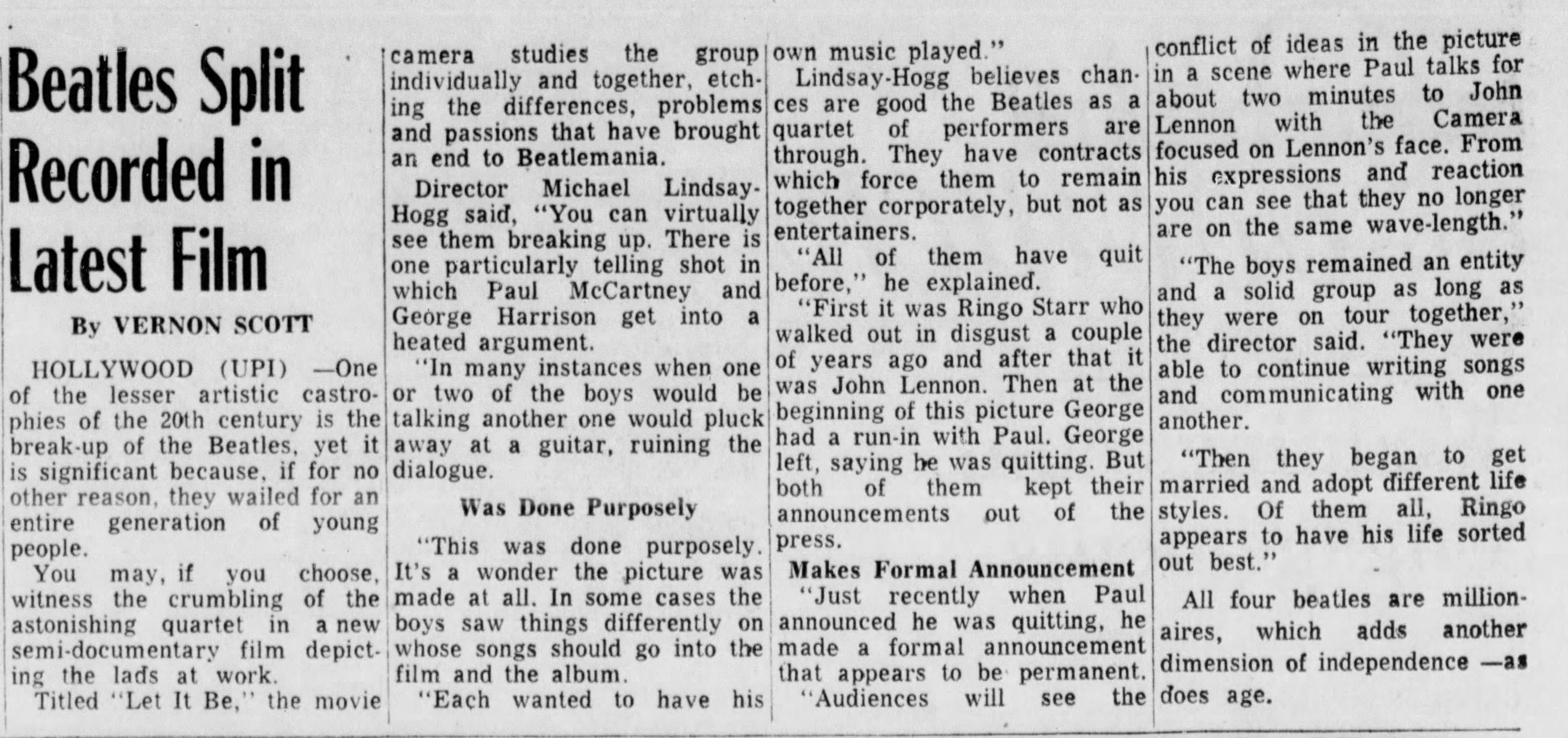
You can virtually see them breaking up … it’s a wonder the picture was made at all.

That’s director Michael Lindsay-Hogg, quoted in a syndicated wire story the week of the film’s release, ostensibly to promote the film. We’ll never know if he’d have said the same thing if the film come out in sometime in 1969 as originally planned, when it was provisionally titled Get Back.

It only took 51 years, but Get Back is about to be on television after all — a movie-turned-television-show, the reverse of Let It Be’s trajectory from TV show to feature film.

To put 51 years into context, it’s 11 more years than John Lennon spent in the material world. It’s about as far away from today as the release of Let It Be was from the Treaty of Versailles. It’s a relative eternity.

Let’s pick up this story after January 1969. The Beatles completed busy and fruitful winter sessions split between Twickenham Film Studios and their own basement recording studios at 3 Savile Row with dozens of hours of audio and video that would emerge as a TV show and springtime LP, their follow-up to the White Album.

The February 1969 issue of the Beatles Book, their fan club magazine, said that while there was “still no fresh progress” on the Beatles’ next film, it was a “priority job” for the new year. They hadn’t yet realized the film was already in the can.

For the next several months, a clear pattern emerged: The release of the album was delayed because the movie was hung up.

April 29, 1969: Melody Maker reported 68 hours of footage was about to be edited down, “from which two films will be produced.”

May 3, 1969: “This film … somebody’s editing that at the moment. It’s sixty-eight hours, and they’re trying to get it down to five for several TV specials. Or then, it might be a movie. I don’t know” — John, to Melody Maker

Early July 1969: The Beatles Book reported the release of the album and a companion book would be delayed because “the fellows would like the film to go on television in August so that everything comes together at the same time.”

July 12, 1969: “[The LP] is tentatively set for September release … to coincide with the screening of the group’s TV special. … If the TV show is delayed until later in the autumn, it is possible that an alternative album … will be released first. From all the many reels of film shot during their recording sessions, the Beatles are hoping to produce a three-hour cinema film, from which the two-hour TV special would then be extracted.” — NME

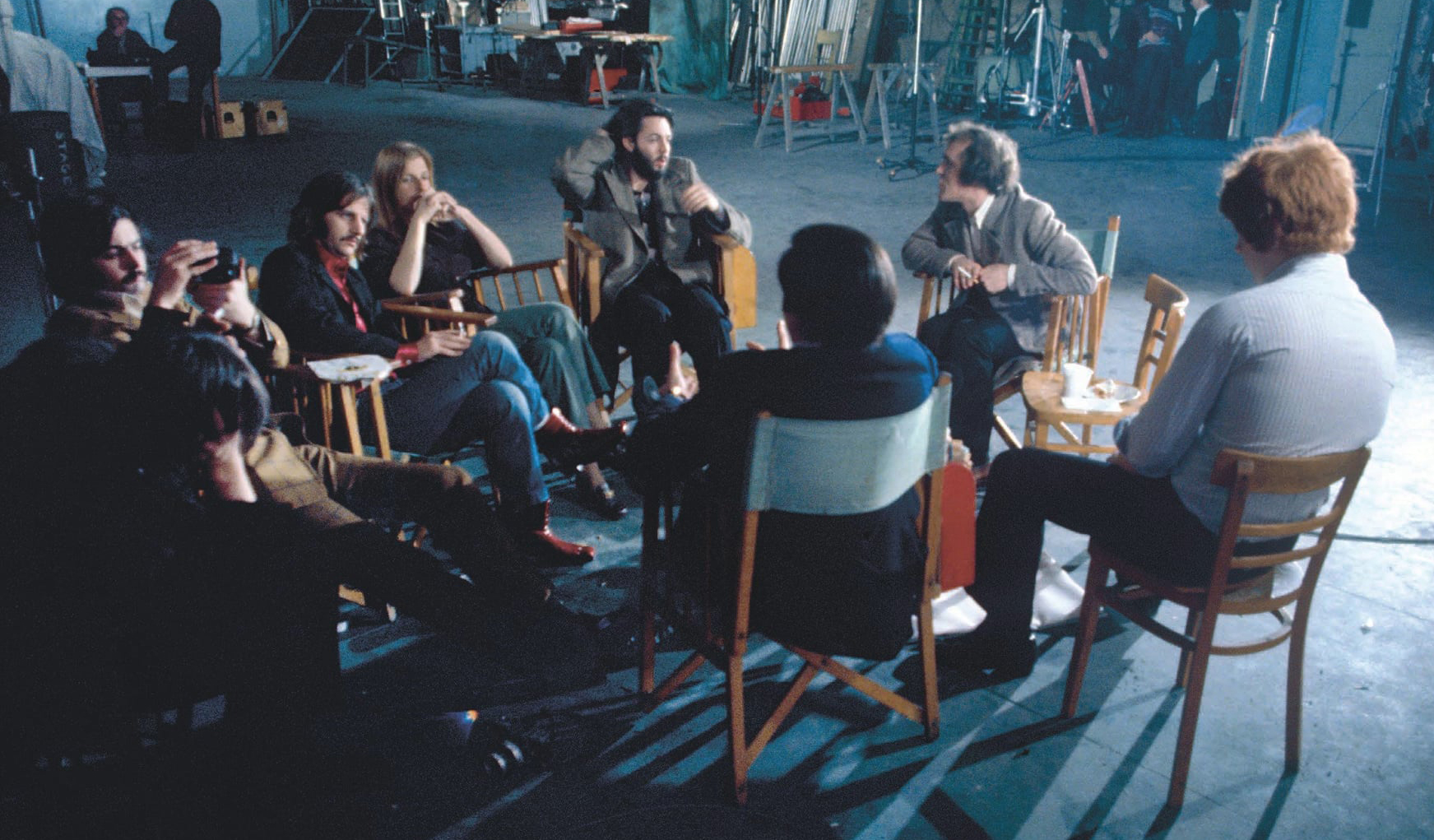
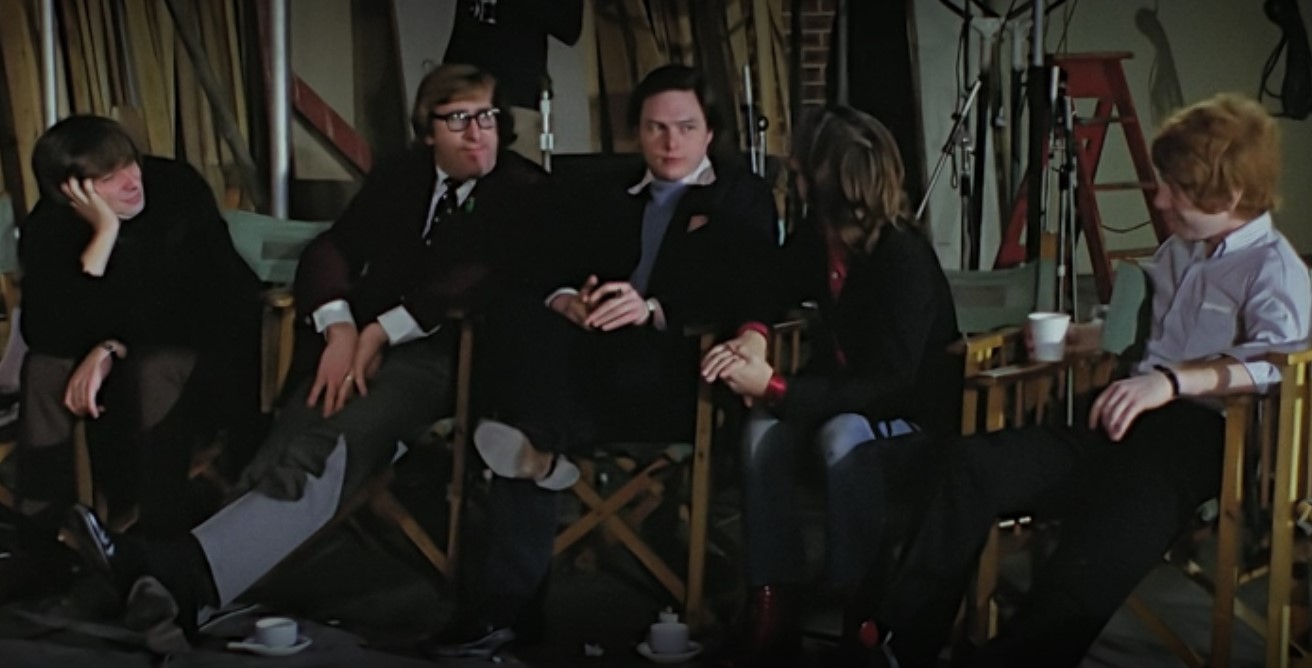
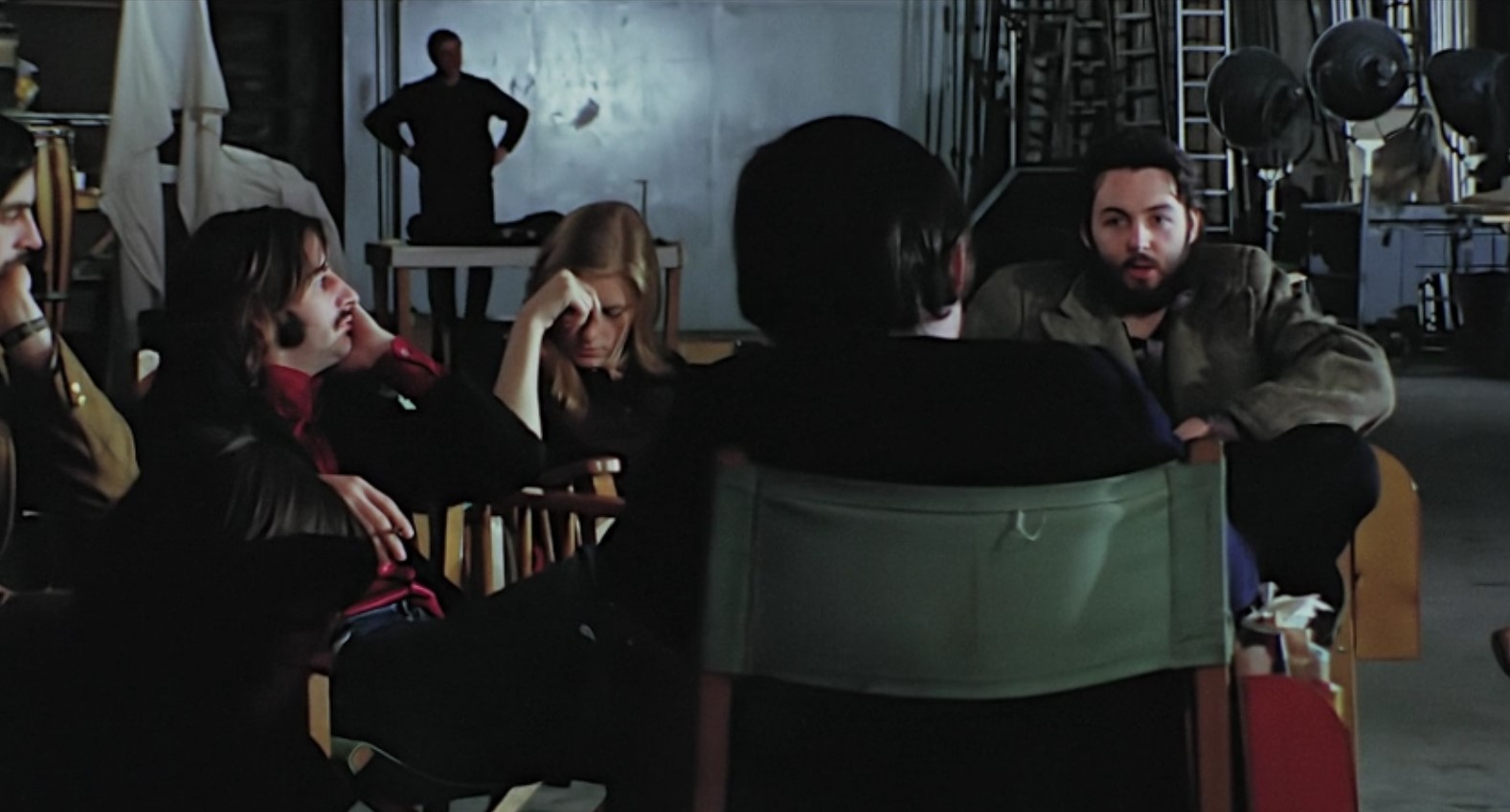
The Beatles and family, at the July 20, 1969, rough cut screening.

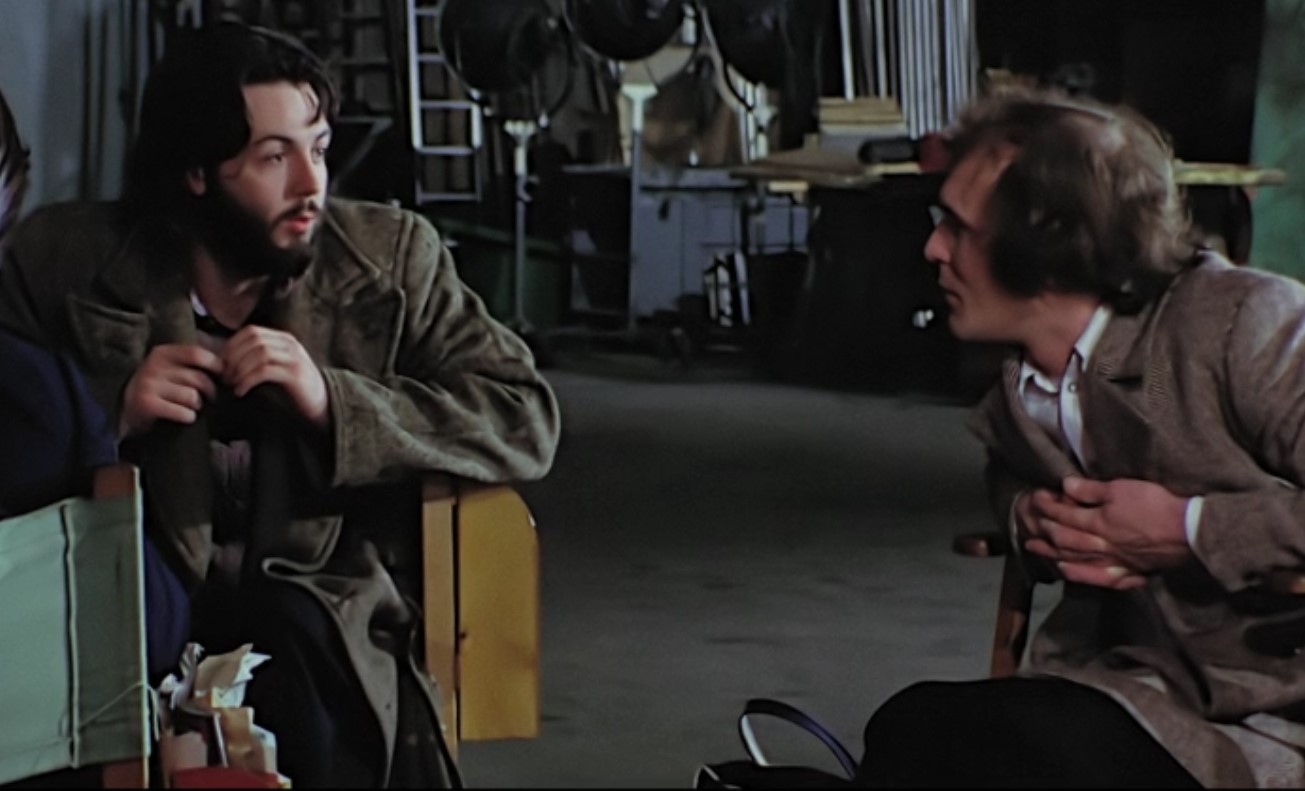
July 20, 1969: The same day mankind made a giant leap on the moon, the stars of the film sat in place for a while to view Michael’s working cut of the film, which at the time clocked in at about 2 1/2 hours. This was about three months after editing was reported to be getting under way.

July 21, 1969: The day after the screening, Beatles assistant Peter Brown phoned Michael, asking on behalf of the group just one required edit: Whack a half-hour of John and Yoko footage. In his 2011 memoir Luck and Circumstance, Michael wrote he was told, “Let me put it this way. I’ve had three calls this morning to say it should come out.”

July 29, 1969: Variety reported plans to screen a TV special to coincide with the release of the Get Back LP. “The TV show and a three-hour cinema version are still at the editing stage,” the magazine said.

Early August 1969: The Beatles Book said the Get Back LP will be pushed back again to coincide with the film, “probably towards the end of November.”

August 30, 1969: “There is still no news of release of the … ‘Get Back’ album. … It is understood that this will still be issued as a soundtrack album for the film, however, and that Christmas is a possibility.” — NME

September 1969: After screening a new cut at some point this month, the group signed off on the film to business manager Allen Klein, according to Michael. In what could simply be a coincidence, the same month also saw John announce to the others that he was quitting the Beatles. They released Abbey Road in September, too.

September 20, 1969: Six days before that very release, NME reported the 85-minute “Get Back” film would premiere early in 1970. The paper said the documentary had been edited from “five hours of film taken at the time,” quite the error of scale. The paper does say, however, that the movie is expected to be picked up by United Artists in order to fulfill their three-film commitment. The Beatles’ priority for the year, as mentioned in February, was now complete. This is definitely a scoop, with Variety reporting the same UA deal the following April.

October 1969: Counter to the NME story, the Beatles Book maintained the LP and film would come out in December. Elsewhere in this issue, in Steve Turner’s article on the Beatles’ effect on modern culture, the rumor that the Beatles may film a version of Lord of the Rings was revived.

November 1969: The Beatles Book was back to reporting a 1970 release with UA distributing.

On the very eve of the Let It Be’s ultimate release in May, we can catch a glimpse of contemporary opinions of the film.

Based on interviews conducted prior to the release of the McCartney LP, the traditional marker for the breakup of the Beatles, BBC Radio 1 broadcast a promotional special on May 23, 1970, in conjunction with the film’s wide release in the UK.

Paul compared the film to watching a painter fill his canvas, calling it a “good film” and “interesting.”

George, however, said he “can’t stand” seeing the “pure documentary of us slogging.

“But for other people who don’t know what we’re really about, who like to go in and see our warts, it’s very good. … It’s the complete opposite to the clinical approach that we’ve normally had.”

Of the album, he says “you can actually get to know us. It’s more human.”

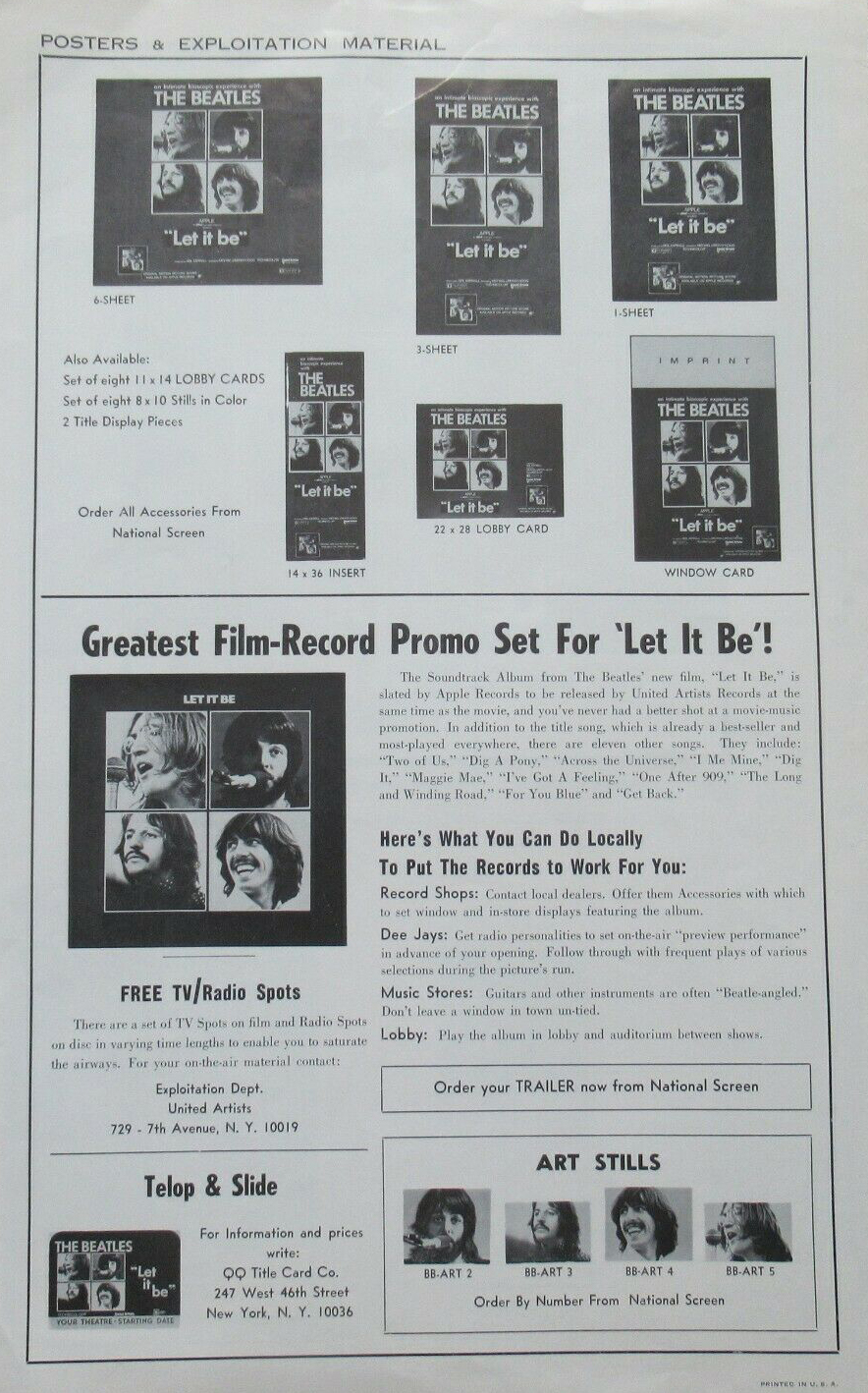
“Exploitation materials and posters” intended for theaters to use for promotion of Let It Be.

Speaking to Rolling Stone for a cover story on the eve of the release of his solo debut — the magazine is dated April 30, but the interview was clearly conducted prior to April 10 — Paul continued to point to the film, which he still referred to as Get Back, in positive terms.

“The Get Back film is a good film. And it is a real film. The troubles are in it as well as the happy moments.”

Paul went on to complain about the delays of the record’s release in interestingly prescient terms while blaming Klein for the holdup.

“The LP is looking to be a joke, for it is a bit of a cliff hanger. I would have liked to have seen it out there three months ago and now I don’t even remember making it.”

It’s tough to keep pace in Beatle-time. Paul’s point is clear, though, even with the tremendous exaggeration.

While the Beatles may have been in a difficult spot in early April 1970, it wasn’t the same spot — difficult or not — they were in January 1969.

When Let It Be was first shown to the public, on May 13, 1970, there was no glitz or red carpet. Instead the film was screened in ordinary theaters dotting the United States, not at a promoted premiere in New York as Apple had initially promoted.

A week later, May 20, the film received a more proper launch, premiering in London and Liverpool with the pomp missing stateside. In London, Beatle exes Jane Asher and Cynthia Lennon were among the guests, which also included Mary Hopkin, Lulu, Spike Milligan and other notables as thousands of fans showed up at the scene. Kevin Harrington, equipment manager at the time, wrote in his memoir that he took an Apple Scruff to the premiere. No Beatles were present, however.

At this moment, two key figures were across the globe, in Los Angeles. John Lennon was in Bel Air undergoing Primal Scream therapy while Michael Lindsay-Hogg was at work about a half-hour away in Hollywood (traffic pending).

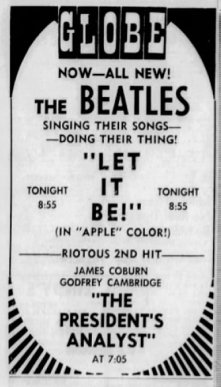
The most accurate review yet: “Singing their songs, doing their thing!” (From the May 13, 1970, Californian)

John and Yoko joined Rolling Stone chief Jann Wenner and his wife, Jane, for a showing Let It Be at a sparsely attended theater in San Francisco in the early part of June 1970.

“After the show — moved at whatever level, either as participants or deep fans — we somehow cried,” recalled Wenner.

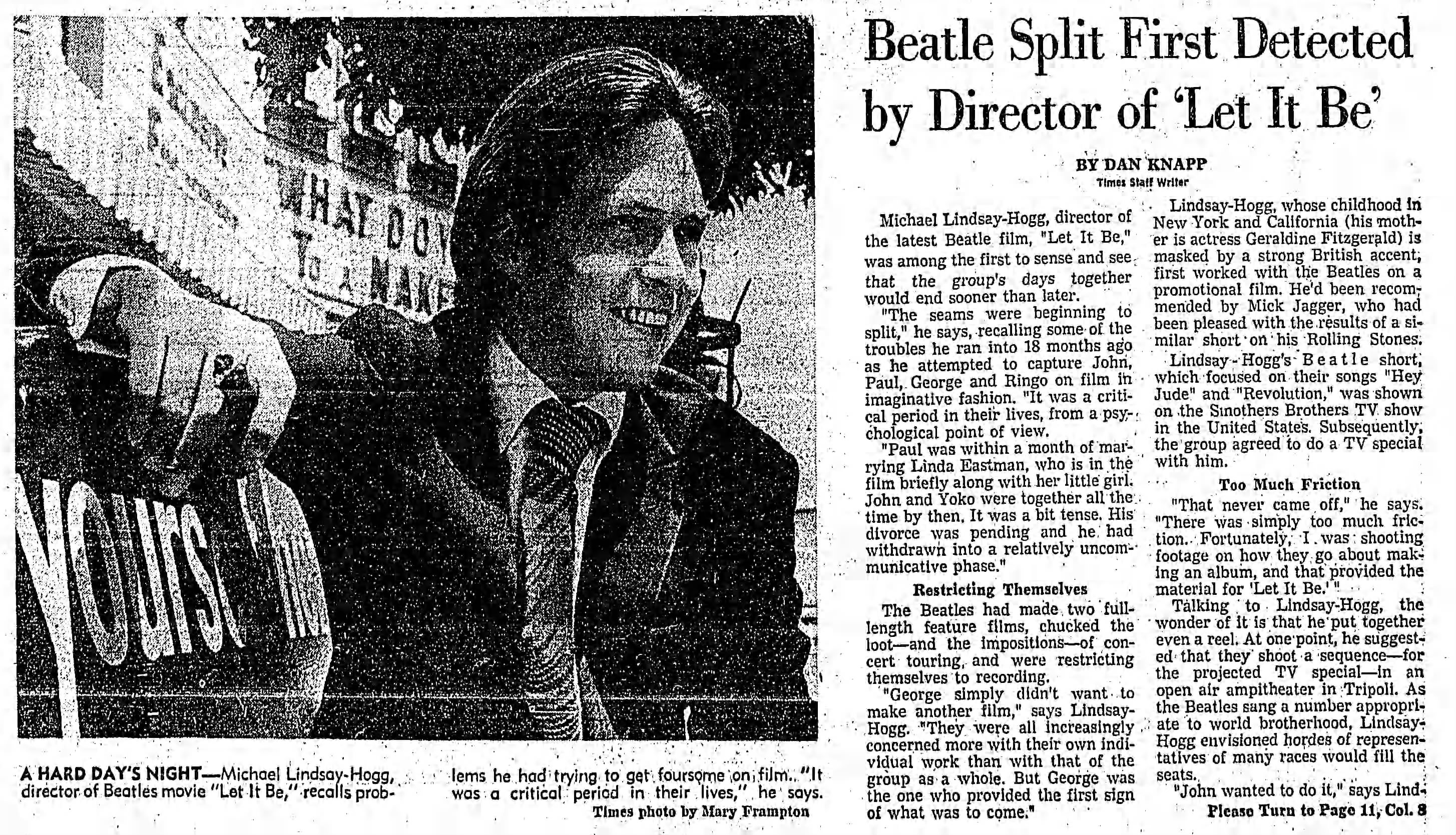
In a Los Angeles Times interview published just a few days after Lennon saw the movie, Michael again reflected on the difficulty of filming the sessions in terms dramatic enough the reporter remarked “the wonder of it is that he put together even a reel.”

In the June 10, 1970, article, Michael complained the group would disrupt “a lot of good, funny and antagonistic conversation” by playing music and moving microphones away. “I don’t think I got them when they were their most charming,” he said, essentially acknowledging they were never charming given the amount of footage he actually did get.

The article was memorable enough for Michael that he remembered his reaction to it decades later in his book.

… [I] was surprised, or concerned, that what had seemed clear to me when I’d said it had been reported without insight, with no recognition of irony or jokes. The Beatles were portrayed only as argumentative people, without extenuation, without subtlety.

The article prompted a further response, a phone call from fellow director — and father, as he later learned — Orson Welles, who asked Michael if he was happy with Let It Be.

“Some of it,” Michael replied. “It’s hard when your stars are your producers. And there were four of them. … A lot I liked got cut out. … But the footage was good.”

Let It Be arrived at theaters at various points in May 1970, but it was absolutely impossible to separate it and its impact from the April release of McCartney. Ringo’s late-March release of his solo debut, Sentimental Journey, wasn’t necessarily seen to have been as critical to the story as McCartney, but it simply piled on the narrative. Let It Be was the breakup film paired with a breakup soundtrack LP. Reviews of one usually paired with reviews of the other.

Variety’s review, published in their May 20 issue, called the movie “relatively innocuous, unimaginative piece of film. But the musicians are the Beatles, and coming hard on the group’s breakup, … [it’s] charged with it own timely mystique.

The fascination of “Let It Be” is that it is, in a sense, probably the last public appearance of Paul McCartney, John Lennon, George Harrison and Ringo Starr as a group, with all the gossip and speculation attending the split, reading between the spoken lines of the film becomes a game in itself.

Variety did wisely predict “McCartney … will probably emerge strongest as a major individual talent of the Seventies as a composer and singer.”

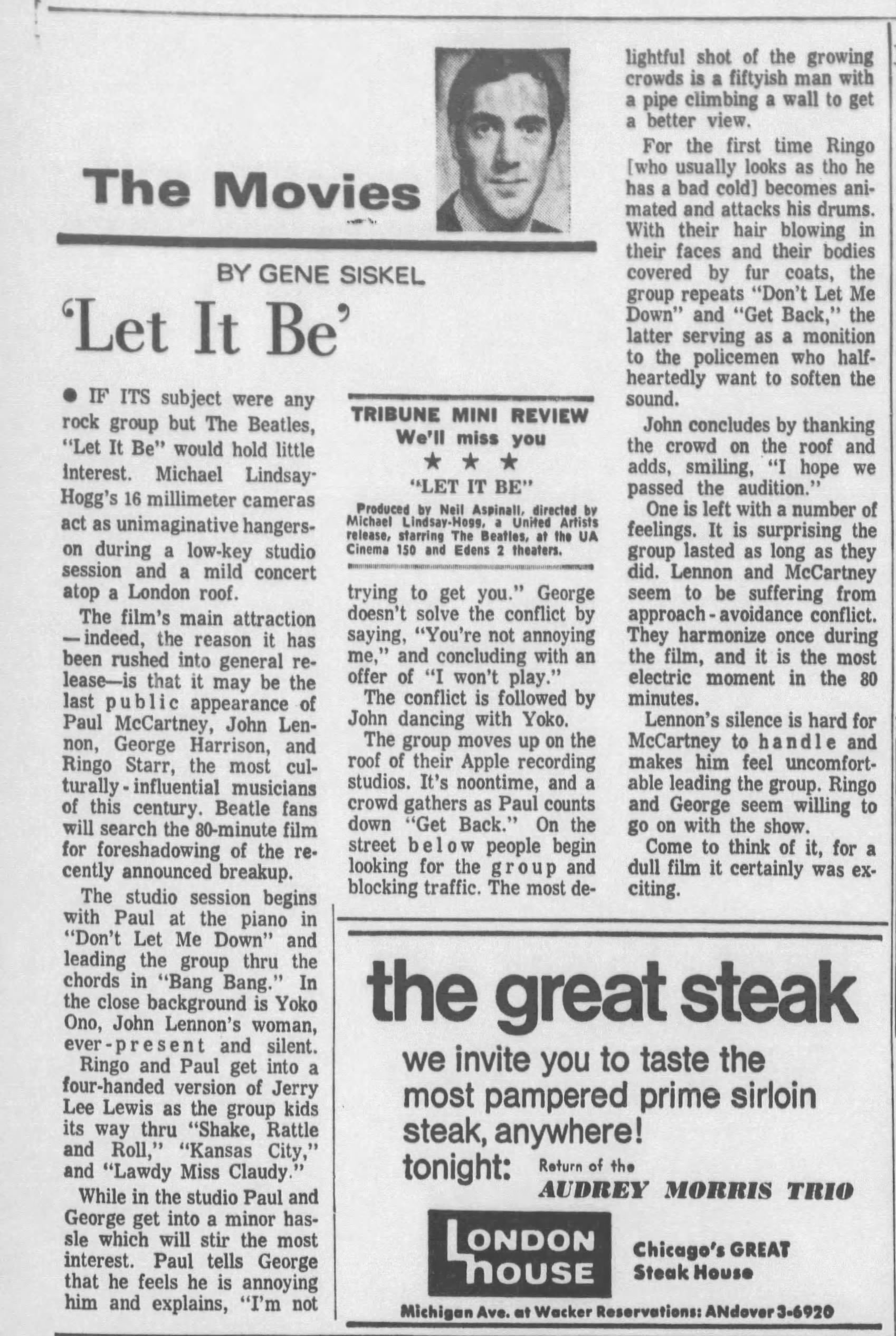
Chicago Tribune legend Gene Siskel gave Let It Be three stars, writing “Beatle fans will search the 80-miunte film for foreshadowing of the recently announced breakup.”

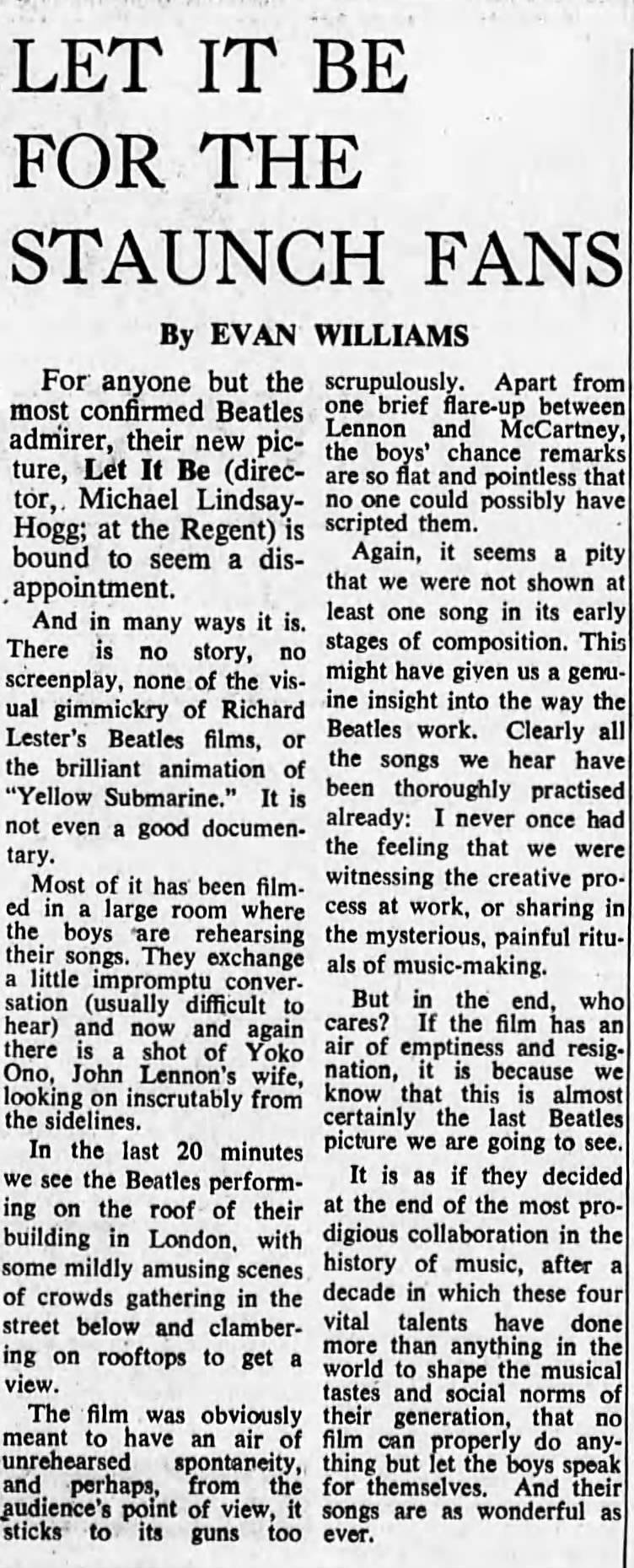
In the the Sydney Morning Herald’s review headlined “Let It Be For the Staunch Fans,” writer Evan Williams smartly noted:

It seems a pity that we are not shown at least one song in its early stages of composition. This might have given us a genuine insight into the way the Beatles work. … I never once had the feeling that we were witnessing the creative process at work, or sharing in the mysterious, painful rituals of music-making.

(This key point is something the 2021 Get Back film is set to get right).

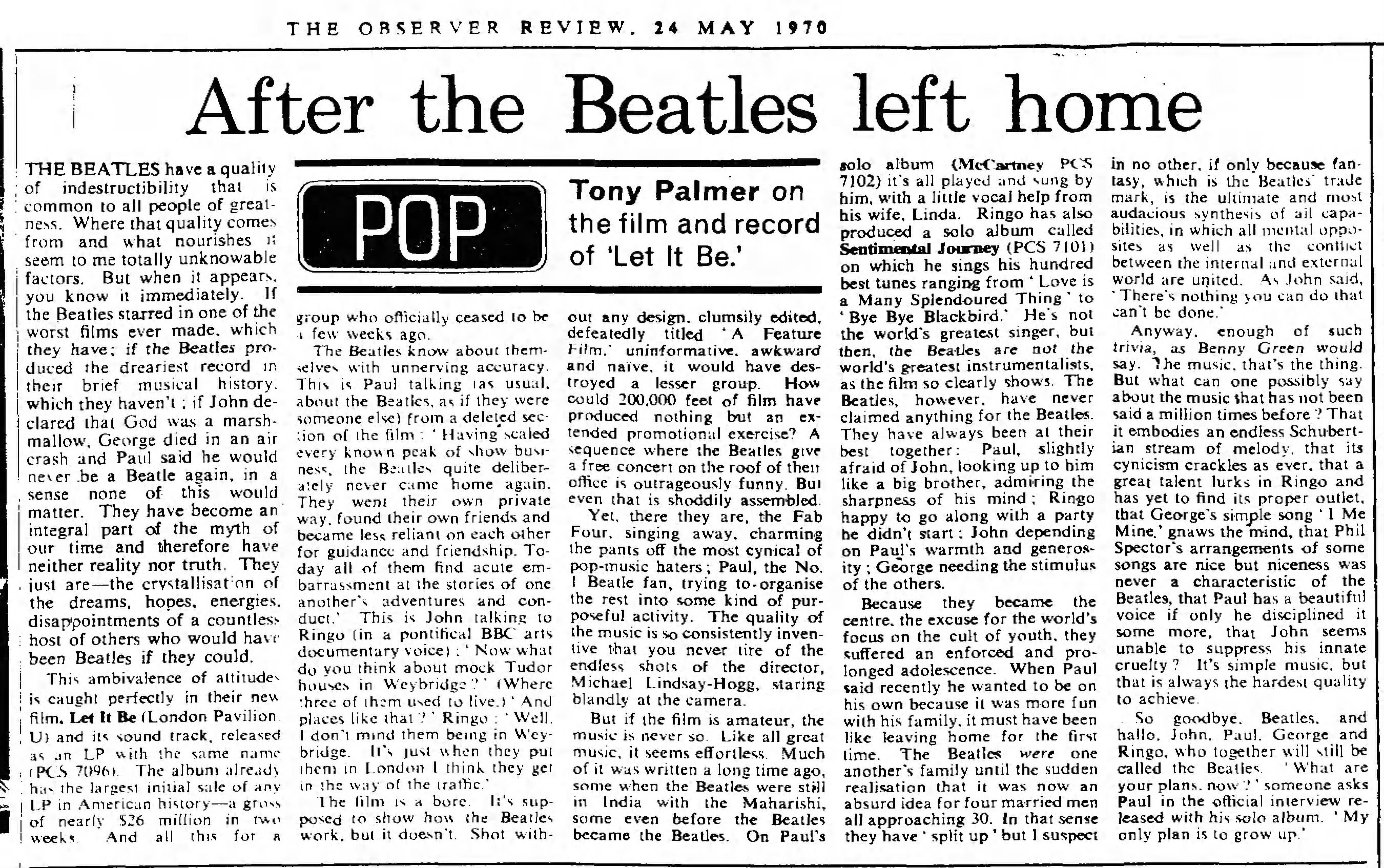
Tony Palmer gave a brutal takedown of the film in the Observer’s May 23, 1970, issue.

The film is a bore. … Shot without any design, clumsily edited, defeatedly titled ‘A Feature Film,’ uninformative, awkward and naive. It would have destroyed a lesser group. How could 200,000 feet of film have produced nothing but an extended promotional exercise?

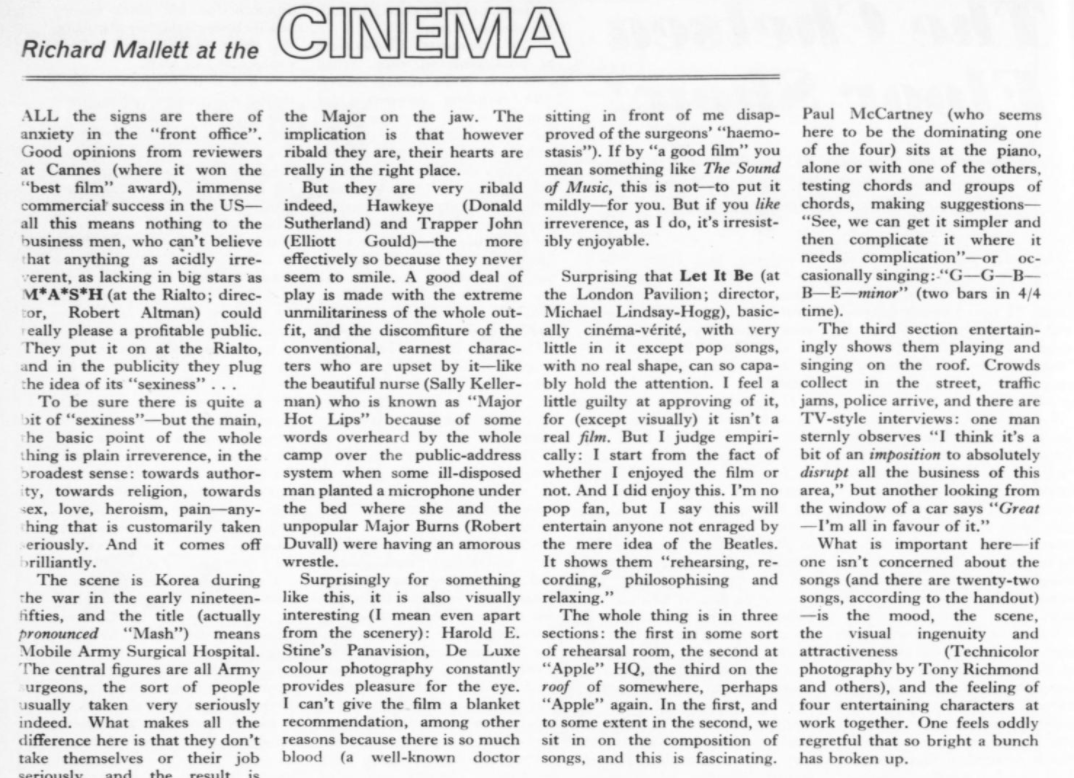
Writing for Punch magazine, Richard Mallett, who described himself “as no pop fan” called the film shapeless but wrote it “will entertain anyone not enraged by the mere idea of the Beatles.” He enjoyed the film’s mood, visuals and interplay of the four Beatles, concluding, “One feels oddly regretful that so bright a bunch has broken up.”

“The Beatles and Friend” – from Punch magazine

These are just a small sampling of reviews. I could have posted hundreds, but you get the idea.

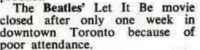
The film performed OK at the box office, seeming to peak in Variety’s weekly rankings at No. 5 in its third week. Per those same rankings, it dropped from No. 8 to 41 on June 17 and then slowly vanished from theaters overall. The film ultimately won an Oscar for its score, but no there weren’t any Beatles around to pick up the trophy. 

From Billboard, June 11, 1970

It’s an understatement to say the Beatles, especially John and George, piled on subsequent years, advancing and ensuring the film’s terrible standing.

Even Capitol Records eventually called out the film’s dim reputation. Remember Reel Music? (Don’t answer that). The 1982 compilation of Beatles movie songs promoted Let It Be like this:

Let It Be poignantly documents the group’s disintegration while capturing their inimitable songwriting technique.

For his part, Paul continued a working relationship with Michael, tapping him for a few promotional videos in the 1970s.

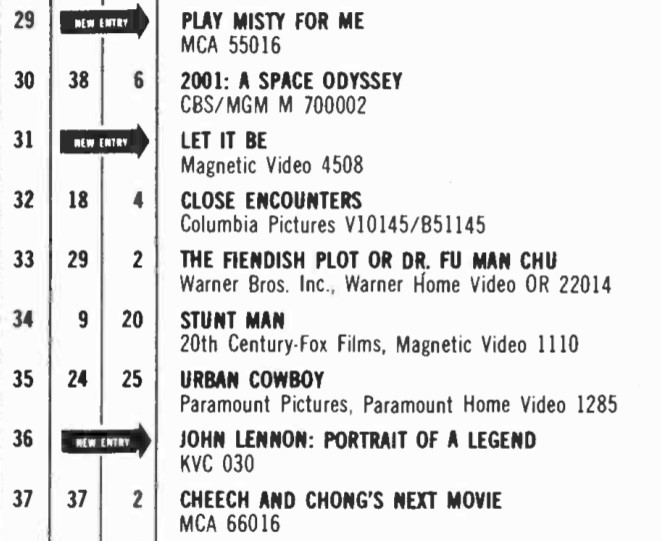
In July 1981, a decade after it was in theaters, Let It Be saw its first home release on VHS (it was later issued on Laserdisc). Again using Variety’s rankings, the tape debuted at No. 31 and kind of bubbled around the 20s, peaking at No. 19 before eventually falling out of the Top 40.

VHS charts, August 1, 1981, Variety.

That makes it 40 years since the movie was last issued for a home audience. In January 2022, “A Hard Day’s Night” is slated for a 4K Criterion Collection reissue. You could have bought that fab film on VHS, Laserdisc, DVD, Blu-Ray and streamed it online in that same period of time. It’s a big game of telephone, but Michael says that Paul told him George blocked the DVD release in the 1990s, while a planned DVD to be released in tandem with Let It Be … Naked in 2003 never materialized.

Footage from Let It Be trickled out officially on occasion, like in Anthology in 1995, when a whole new audience was exposed to George playing if Paul wanted him to play during the “winter of discontent.” On the flip side, part of the rooftop show ran during the credits of the 2014 documentary “Eight Days a Week,” a lovely — if strictly anachronistic — conclusion to a movie about the Beatles’ touring years.

But for all intents and purposes, the original Let It Be film had its reputation established by its release, with the breakup taking on a disproportionate stake. Decades of unavailability for mainstream viewers cemented the movie as a straw man for late-era Beatles. The only two views of it were “watch the Beatles break up” or “watch for the symptoms of the Beatles breaking up.” There was little middle ground. Maybe Michael Lindsay-Hogg offered up too much subtlety.

Or maybe we also lost some context along the way.

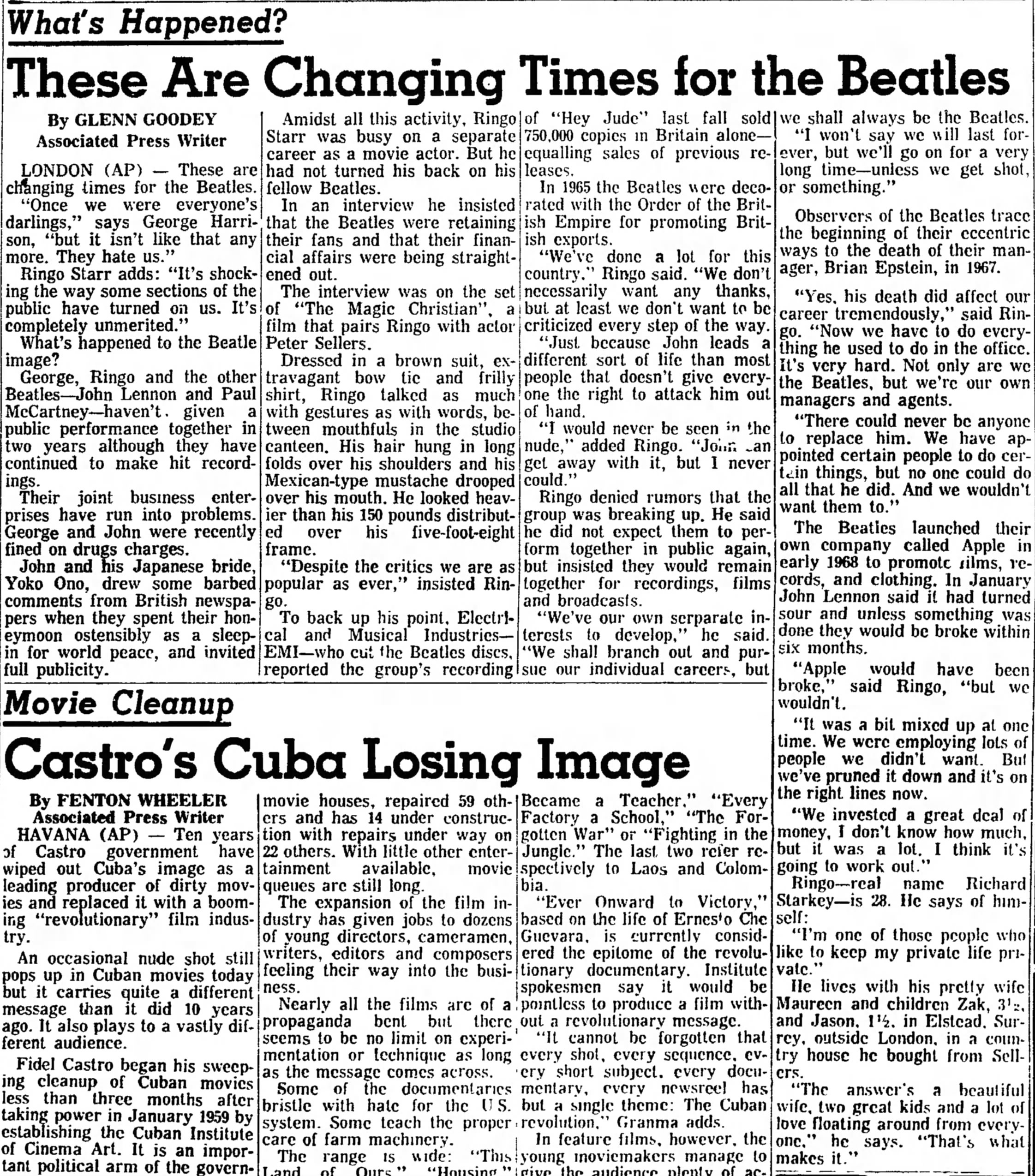
“Once we were everyone’s darlings,” George said in an interview published by AP. “But it isn’t like that anymore. They hate us.”

Ringo agreed in the same article. “It’s shocking the way some sections of the public have turned on us. It’s completely unmerited.”

Those quotes are from April 1969, a year before the band broke up.

It only took 51 years, but Let It Be is Get Back again. It’s out in conjunction with the release of the LP and a book (and within months of competing solo Beatles products). Yet with all this history behind it, it instead arrives with excitement from the band and fans alike, and it’ll draw upon its own blank slate.

6 Comments

Filed under Day by day, Extra

Jan. 12: A family outing (Pt. 2)

FYI at the outset: I’m applying the same disclaimer from last time, when I started recounting the Beatles’ January 12, 1969, meeting at Ringo Starr’s house.  For this series of posts, I’m going to jump between various parts of the January 13 Nagra tapes that directly address January 12, for the sake of the overall narrative.  Specific quotes and certain discussion topics conspicuously absent here will soon be tied back into the story. I promise!

****

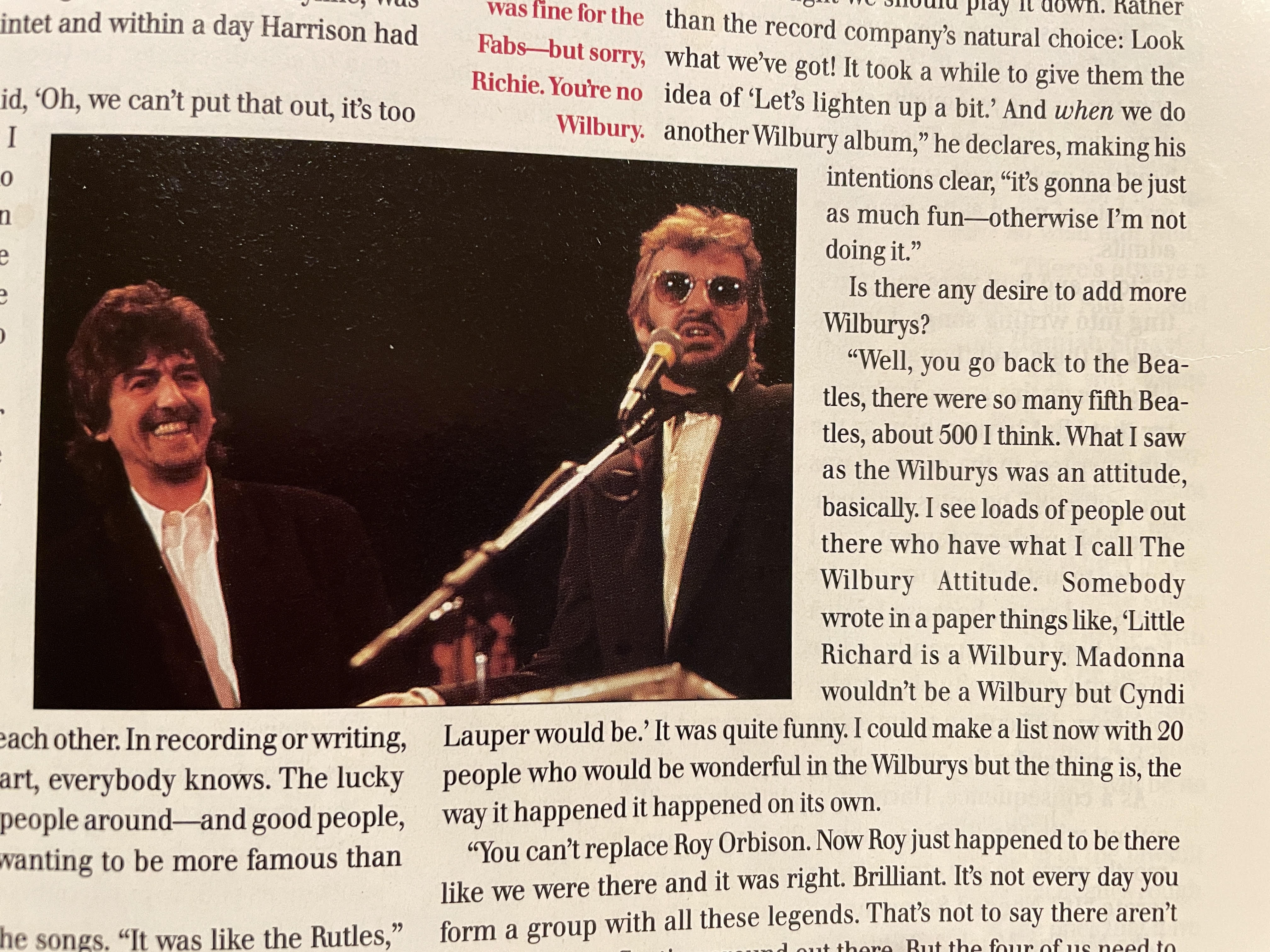
Twenty years after the breakup of the Beatles and in the midst of leading his own supergroup, George Harrison characterized the “Wilbury Attitude.”

From the March 1990 issue of Musician:

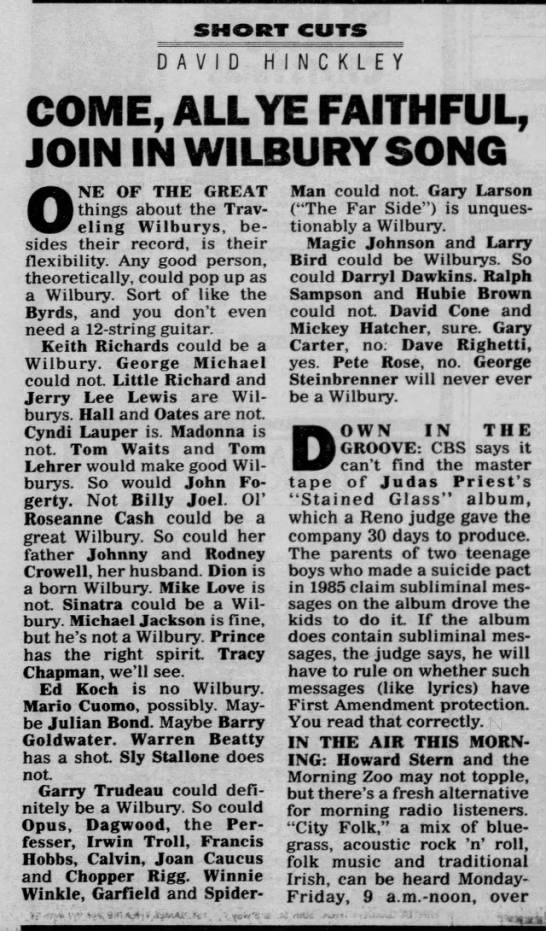
Somebody wrote in a paper things like, ‘Little Richard is a Wilbury. Madonna wouldn’t be a Wilbury but Cyndi Lauper would be.’ It was quite funny.

While there may have been “about 500” fifth Beatles, as George estimated in that same Musician profile, the four proper members of the Beatles were set in stone (Pete Best and Stu Sutcliffe screw up this accounting, so let’s just stick with the figure of four), and the lineup had been stable for more than six and a half years by the time we reached January 1969.

John Lennon proposed expanding the group more than once over the course of that month. The Beatles’ board meeting on January 12 was one such occasion.

Most of what we know about that meeting we learned from recordings of John, Ringo and Paul McCartney — among several other key figures — captured a day later. And while some of those January 13 conversations were filmed openly at Twickenham Studios on the set, so to speak, of Let It Be, a clandestinely recorded lunchroom discussion fleshed out the story.  Remember Michael Lindsay-Hogg’s spy microphone? Documenting this lunch became the device’s greatest legacy.

It must be repeated to make it clear: This meeting was not merely between Paul and John, as suggested by the 2021 Get Back docuseries. There were at least half a dozen people present.

“The Beatles, to me, isn’t just limited to the four of us,” John said on the 13th, candidly recounting what became a contentious point discussed during the previous day’s meeting and in response to Ringo relaying that George wanted a meeting limited to the four Beatles. It’s worth noting there were multiple occasions during lunch that Ringo and Paul explicitly referred to the “four” Beatles.

“I think that I alone could be a Beatle. I think [Paul] could. I’m not sure whether [Ringo] could. … I’m just telling you what I think. I don’t think the Beatles revolve around the four people.”

Maybe it’s hindsight speaking, but of course the Beatles revolved around four people, and it had since Stu stepped out in 1961, even if their nominal leader suggested otherwise by calling a critical upgrade at drums merely a reorientation.

“It’s like [Ringo] joining instead of Pete,” John continued. “To me, it is like that.”

We don’t hear Yoko Ono’s name explicitly mentioned in the context of being a part of an expanded Beatles, a proto-Plastic Ono Band, but it’s the clear suggestion amid her omnipresence and in the wake of her taste of the fab experience 48 hours earlier.

For her part, Yoko didn’t see George’s departure as anything but temporary. His return was, in her eyes, completely in the hands of the others.

“You could get back George so easily, you know that,” Yoko said during the lunch.

****

Reputation’s changeable, situation intolerable: George stuck on the third rung

“The third boss.”

That’s how Paul plainly described George’s place in the Beatles hierarchy on the lunchroom tape. (Paul conceded John was at the front and himself secondary.)

It was only a few days prior when George openly bemoaned his status within the group and the dead-end destiny of so many of his contributions: “I’ve got about 20 songs from 1948, because I knew very well at the moment I’d bring them into the studio that [splat sound], there its gone.”

This complaint on January 7 came immediately before he called for “a divorce,” which he pursued when he walked out January 10. At the January 12 board meeting, it only got worse, according to John.

“It’s a festering wound … yesterday we allowed to go even deeper,” John said early in the recording of the lunchroom discussion. “But we didn’t give him any bandages.”

Not only a reluctant medic, John wasn’t sure he wanted George to even be a Beatle anymore. Maybe the Beatles could be a four-piece after all, just with Yoko and without George.

“Do I want him back, Paul?” John said. “I’m just asking, do I want it back, whatever it is — the myth?”

That remark echoed George himself from the divorce conversation, in his response to Paul, saying the band used to be “switched on,” George had replied, “If that’s what doing it is, that’s why I don’t want to do it.”

Like George, John was searching for motivation to maintain the group’s status quo, even when the Beatles’ status quo was really a constant state of invention and reinvention, at least to the point of view of us on the outside.

During lunch on January 13, Paul and John agreed the duo would “connive,” when it came to their marginalization of George within the band and their maintenance of creative control. This, while George “could afford to be more insensitive” himself, as “some other part,” an other acting separately from the other members of the band, perhaps musically, perhaps socially.

“I do think that as grim as it all is,” Paul said, “that [George] is right. And I do think that our sole approach is exactly what he’s been saying.”

John simply said that he knows he’s treated people this way since primary school and offered the customary breakup excuse, “It’s not him, it’s just me.”

Yet while the duo acknowledged the problem of their treatment of George as a tertiary Beatle — later Paul would admit they treated him “a bit like a mongrel” — they didn’t set forth a path to solve it directly. The board meeting on the 12th, which was supposed to be a general business meeting, went so far beyond just an attempt to reconcile George’s walkout. The band’s very existence was in question. Again.

“It’s like George said. It doesn’t give me much satisfaction anymore,” John said on the 13th. “Because of the compromise we’d have to make to be together. The end result of the records now aren’t enough. …  When something came out like Revolver or Pepper or whatever, there was still that element of surprise that we didn’t know where it came from. But now we know exactly where it comes from, and how we arrived at that particular noise and how it could have been much better.

“The only way to get it satisfactorily for yourself is to do it on your own. And then that’s fucking hard.”

Here John again mirrors another of George’s points from January 7, when the latter said he wanted no part of performing any of his own songs at the presumptive forthcoming concert “because they just turn out shitty. They come out like a compromise.”

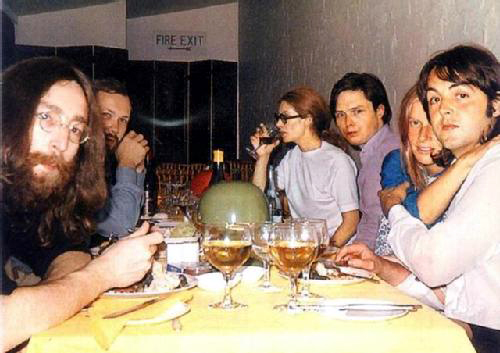
A fab feast, July 1969

Linda Eastman, who like Yoko was at the lunch on the 13th, responded by throwing some of John’s words back in his face. “But you were saying yesterday … you write good songs and it can’t be any better way. You don’t want just studio musicians. I mean, that’s how I look at it. You make good music together, whether you like it or not.

John admitted that he liked it. Still, he was dissatisfied with the White Album. Not his own contributions, which he remained happy with, but the sum of the parts. While Ringo said he dug it “far more than Sgt. Pepper,” John struggled to reconcile how good the White Album was and what he felt it should have been.

As difficult as the situation was, Paul was the optimist. He didn’t even see George’s absence as a problem — yet.

“See, I’m just assuming he’s coming back, you know? I’ll tell you, I’m just assuming he’s coming back.

“What if he isn’t?” John asked.

“If he isn’t, then it’s a new problem.”

****

A “new” problem implies previously existing problems, and on January 12, 1969, the Beatles definitely had other problems.

With the benefit of hindsight,  we know Yoko was right and Paul’s optimism was justified. It was easy to get George to return to the group. It took a couple painless concessions from the others, and he was back with the Beatles just a few days later — this wasn’t any protracted estrangement, just one with good retrospective drama and publicity. For context, Ringo’s resignation during the White Album sessions lasted almost twice as long.

While acknowledging the issue, why didn’t John and Paul go a step further and apply the bandages to salve George’s festering wounds? It’s unclear, as they had recognized, at least in the wake of the meeting — if not during it — their “conniving” problem.

“Our brains sort of … con him,” Paul said at lunch, calling those moments “so innocent” and “so simple.”

That kind of treatment came completely natural to John. “It might have been my game. It might have been masochistic,” he said describing his approach. “But the goal was still the same: self-preservation.”

Yet, John said he “had to fight it the last three years,” saying he overcompensated by feeling he was actually giving in to George for several years, going out of his way to work with and relinquish a territory on their records, while George was creatively on “a good ride.”

He didn’t use the word “connived,” but in later interviews George did consider the others’ actions selfish. None of this should surprise anyone who has followed the Beatles for the last half-century.

From George’s terrific 1977 interview with Crawdaddy:

There were too many limitations based upon our being together for so long. Everybody was sort of pigeonholed. It was frustrating. The problem was that John and Paul had written songs for so long it was difficult. First of all because they had such a lot of tunes and they automatically thought that theirs should be the priority, so for me I’d always have to wait through ten of their songs before they’d even listen to one of mine. … I had a little encouragement from time to time, but it was a very little. It was like they were doing me a favor. …

Paul would always help along when you’d done his ten songs, then when he got ‘round to doing one of my songs, he would help. It was silly. It was very selfish, actually.

Then there’s Yoko, who George didn’t want around the studio as a non-participant, much less as an artistic partner. He may have been insensitive to her when she entered John’s life (invoking her “bad vibes”), but he clearly felt that behavior was justified. This emerged as the red line for John. We know how the story ended, and Yoko didn’t leave John’s side while the Beatles were together. John won that part of the battle, even if she wasn’t elevated to a member of the group.  (Through tragedy she ultimately became a member of the Apple board.)

There was no punch-up on January 10, 1969, that pushed George to take a break from the Beatles, it was just, largely, the simple, sweeping con he endured for years. You could almost say George had been fobbed off and he’d been fooled, he’d been robbed and ridiculed. John and Paul recognized and acknowledged as much on the lunchroom tape.

Like it or not, in the words of Linda, the Beatles made good music together. After the meeting on January 12, 1969, it was an open question if the four of them had any mutual desire and consensus to resume doing so.

15 Comments

Filed under Day by day

Jan. 12: A family outing (Pt. 1)

For all the company’s subsidiaries, history could have used Apple Stenography.

The Nagra tapes so ubiquitous around the Beatles during January 1969 weren’t rolling at Ringo Starr’s Brookfield House estate in Elstead on Sunday the 12th. George Harrison ditched the band midway through the January 10 sessions, and after a brief encounter with John Lennon and Yoko Ono on the 11th, he was back in the company of the entire band as they met to discuss their immediate and long-term future.

Even without minutes of the meeting, we have an excellent idea how it transpired thanks to those very recordings and the candor of others recapping and analyzing the meeting’s fallout the next day back at Twickenham.

For this and the next several posts, I’m going to be jumping between various parts of those January 13 Nagra tapes for the sake of the overall narrative. Specific quotes and certain discussion topics absent here will soon be tied back into the story. There will be redundancies and I may not get to specific points until later. But please trust the process!

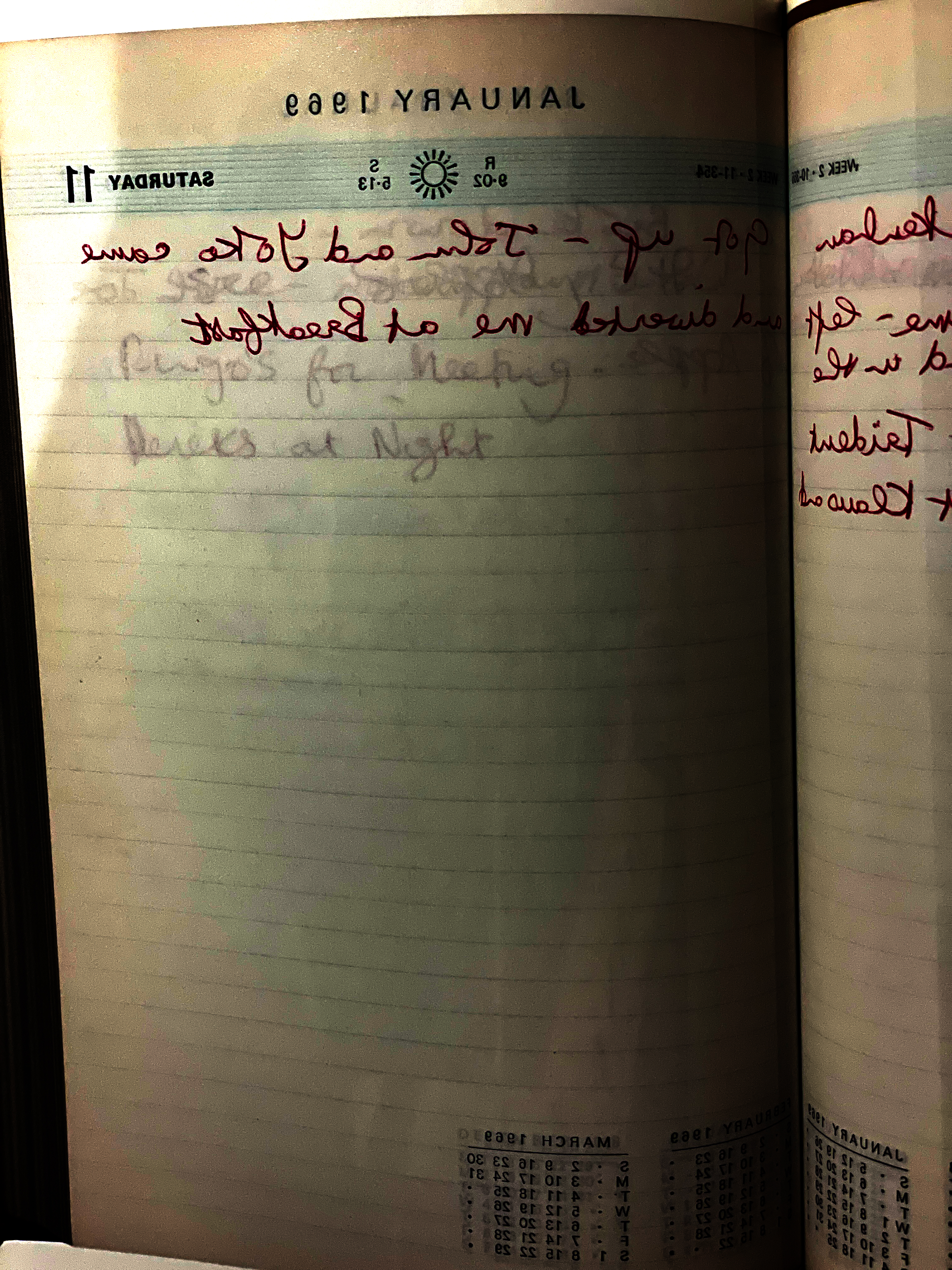
We know nothing about the meeting from George’s perspective except an acknowledgment of its very existence. And we only know that much thanks to 21st century Photoshop trickery, taking his diary entry for the day before (as published in the Living In the Material World book), flipping the image and manipulating the colors to reveal what was on the opposite page.

Clearly and without further detail, George wrote: “Ringo’s for Meeting.”

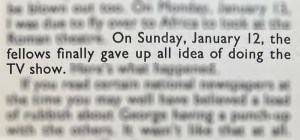
Do-it-all assistant Mal Evans provided another rare written reference to the meeting, merely saying January 12 was the day “the fellows finally gave up all idea of doing the TV show.”

This tidbit was for public consumption, published in the March 1969 Beatle Books fan club magazine, months after the event, with the storm of George’s departure long passed and the group seemingly — at least in public — a unit again, the earliest Abbey Road sessions under way and more to come.

While we have reason to question if this January 12 meeting is exactly when the premise of a Beatles TV documentary was called off, at the very least because cameras were back at Twickenham the next day, remember Mal did keep a diary, so it stands to reason he checked the date.

(From the March 1969 Beatles Book)

Early January 13, the day the Get Back sessions resumed, Ringo summarized the proceedings in a dry voice: “The meeting was fine, a lot of good things. But then, you know, they all sort of fell apart at the end.”

While the meeting was held in the wake of George’s departure, it quickly became clear the missing guitarist wasn’t the group’s greatest concern.

“I love you laconic Liverpudlians,” film director Michael Lindsay-Hogg said on the 13th. “Because I said to [Apple chief] Neil [Aspinall], ‘And then the businessmen left and then there was just the five of you there, right?’ He said, ‘No, that’s the trouble. Six,’ he said with his flat voice.”

***

Sunday’s gathering featured two distinct components:

  • A business meeting, which included John Eastman, Paul McCartney’s soon-to-be brother-in-law, and other accountants
  • A personnel meeting, so to speak, to discuss the Beatles’ near-term future as a viable unit and to hash out issues better left to a modern HR department

There was only passing mention of the business element, with Ringo referring to “John from America” and the “new accountants we just moved with.” (On January 10, George explicitly mentioned John Eastman in the context of an imminent business meeting, a meeting that had Neil very excited and promised to have news that was “so good.”)

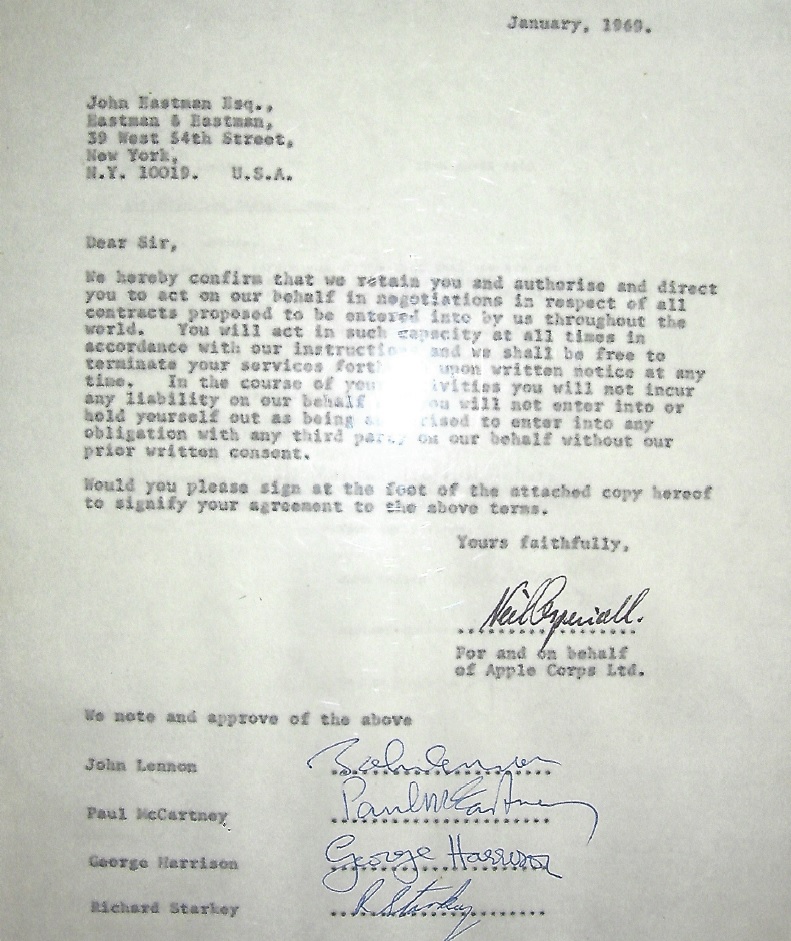
It’s feasible the Sunday meeting is when this document — which is only dated “January 1969” — was signed, giving the Eastman & Eastman law firm rights to negotiate contracts on the Beatles’ behalf.  The timing works out — John Eastman was working on a deal for the successor company to NEMS less than a week later.

The Eastman & Eastman management contract, January 1969.

If only to justify what Ringo described as “a lot of good things” coming of the meeting, the business aspect must have pointed to a positive development.

Most of the subsequent recollections of the Sunday meeting were about the greatest strain on group.

“[John] looked great yesterday” Linda Eastman said in the open discussion early on the 13th between Paul, Ringo, Neil, Michael and Mal.

“Who was he wearing, the usual?” Michael asked, to laughter, including Paul, who repeated the joke.

To be clear, Yoko wasn’t the only non-Beatle or Beatle employee at Ringo’s on Sunday. Linda was there, and even if she regretted her own presence, Paul’s girlfriend (and the lawyer’s sister) was critical that she — and others — were even welcome to attend.

Linda: It’s harder being at a meeting and everybody putting their two cents in, and none of you all saying anything.
Paul: But that’s the other thing, having the meeting. You came with me, and [Linda’s daughter] Heather came.
Linda: Yeah, I was going to say I shouldn’t go.
Paul: It’s such a temptation going out to Ringo’s for the afternoon. It feels like a family outing. (said to laughter)

Paul: It should have been the four of us.
Ringo: Well you (Linda) were out of the way. It nearly was.
Paul: It’s still that thing.
Linda: When there’s something serious, a few other people talking about it, and you get off the tracks.

Paul would also describe the scene as being like “board meetings of ICI (Imperial Chemical Industries) and all the governors and all the wives, and mates and kids and animals.”

Neil explicitly said that Yoko’s participation undermined any chance for a serious discussion. “Everybody else is like, ‘Fuck it. You know it’s not going to be a board meeting, so let’s make it a party.'”

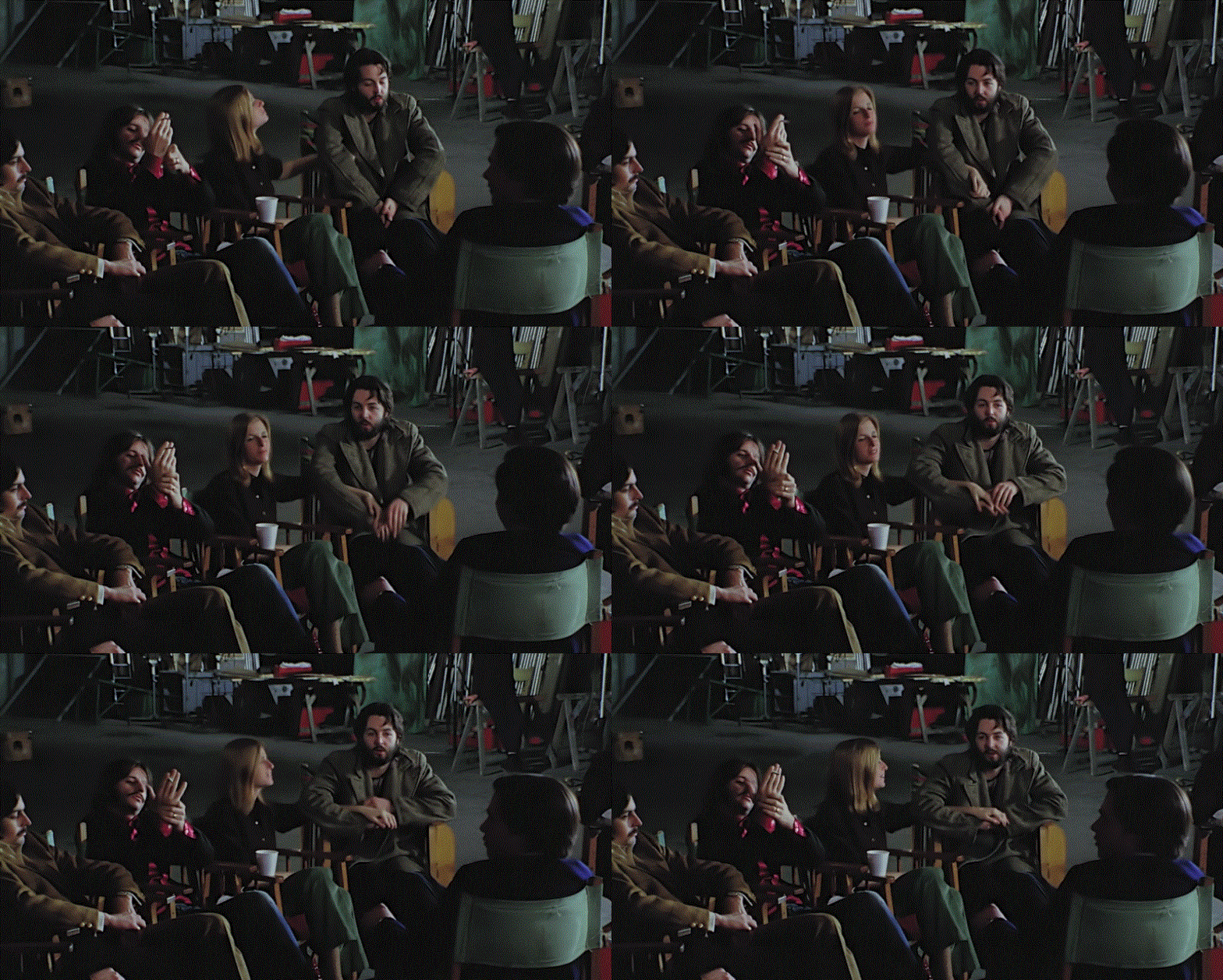
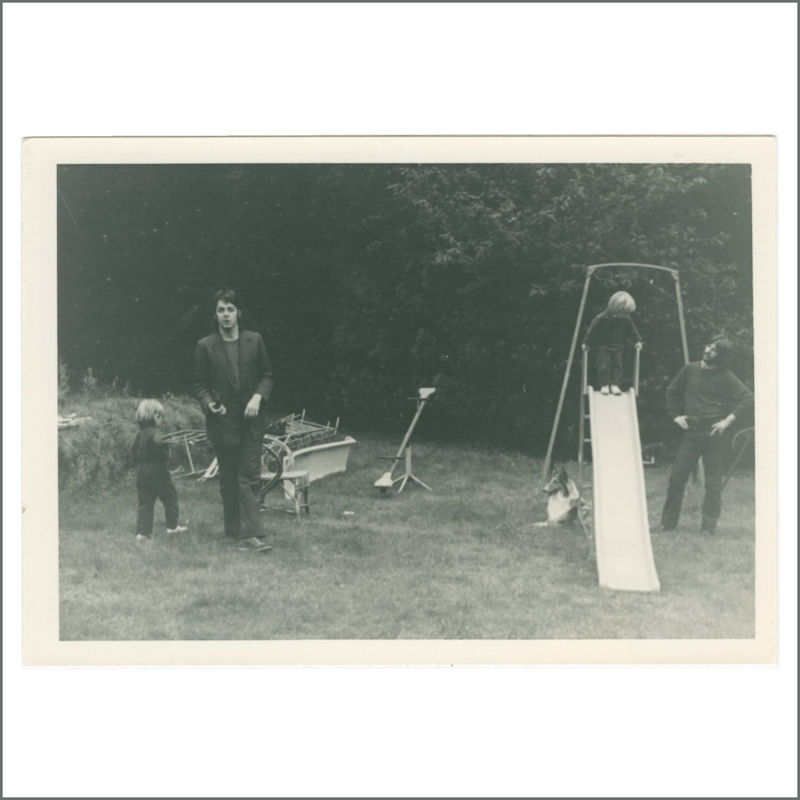
When I get to the bottom I go back to the top of the slide, etc. Beatles and family at Ringo’s in Summer 1969.

Yoko did “so much talking,” Linda bemoaned.

A “key moment,” according to Paul, came when John said he didn’t understand George’s desire for a meeting consisting exclusively of the four Beatles, explicitly excluding Yoko. Twice George told John, ” I don’t believe you,” in reaction to John’s stated confusion.

“I think John knew what he was talking about, too,” Neil said. “It’s like the bullshitting bit where that can go on. It’s silly.”

Paul agreed, but absolved John to a degree.

“John does bullshit. I bullshit. Ringo bullshits. George bullshits. You know, we bullshit.

“With John, you think you can influence it, you think he’s past it. So you start giving him more credit than he’s due for. With Yoko, they mean it.”

Paul consistently placed legitimacy on John’s dedication to Yoko (we’ll see more of this in the coming posts). John alone could be a slippery figure, but here Paul was insisting John really needed Yoko at his side, completely and sincerely.

Paul’s last remark was met with derision from Linda and Neil, especially. Paul’s tone implied maybe he didn’t really believe what he was saying out loud, either.

***

This meeting was scheduled to be about Apple. It would have helped to have been about George. But it became a meeting that revolved around Yoko.

John accused the others of pushing out anyone who threatened the sanctity of the four members of the group, a balance he and Yoko disrupted months earlier. Paul freely admitted as much the next day, describing the Beatles’ conscious decision to maintain a well-defined inner circle.

“The trouble with us, like John said [during Sunday’s meeting], is anything that comes in … with the egos, we try and push out,” Paul said Monday. “It’s always been that. Anybody who’s come in, Like with Michael Braun, with that book, [he] came in for a while, within the circle for a while, and then he gets pushed out cause we don’t want him in the inner circle. And he’s got to stay on the edges.”

Braun’s book — Love Me Do! The Beatles’ Progress —  was published in 1964, and chronicles the group over the course of several months that year and the year prior. John later told Rolling Stone it “was a true book. He wrote how we were, which was bastards. ” Really, the book reads like a draft manuscript of the “A Hard Day’s Night” film, the group enveloped by Beatlemania with supplementary anecdotes of those dismissing the movement. It’s candid, and in the context of its original publication, it had to be a revelation by comparison to other portrayals of the group.

But to Paul’s point in January 1969, the proximity given to Braun, an American journalist who had his own colorful biography, was too much for the group in time. Yoko came in for a while, had been within the circle for a while, but she wasn’t getting pushed out. She was inner circle, with no reason to think she would be forced to the edges.

This wasn’t the only issue. John’s silence, in tandem with Yoko’s new role as his spokesperson, made for the untenable situation. After all, Linda was there too, but she didn’t attempt to speak for Paul.

Still why wouldn’t John talk? One of the greatest wits of his generation, the outspoken and leader of the Beatles — self-proclaimed by this point — silenced himself. John had already forced Yoko into the inner circle. He didn’t need to hand her his voice too. Unless, he didn’t think he needed his voice in the first place.

John openly discussed the Beatles’ ability to communicate non-verbally in Hunter Davies’ 1968 authorized biography.

I think communication all the time like mad, but putting it into words is a waste of time. We talk in code to each other as Beatles. … We understand each other. It doesn’t matter about the rest.

(Listen to the terrific One Sweet Dream podcast for the deepest of dives into this corner – and many others — of the Lennon-McCartney relationship).

If John was silent because he thought he didn’t have to speak at all, Paul cried foul the next day, ultimately mocking John’s telepathic approach.

“Who was he wearing?” (From the Get Back book)

“With our heightened awareness, the answer is not to say anything,” Paul said. “But it isn’t! Cause, I mean, we screw each other up totally when we don’t do that. Cause we’re not ready for heightened vows of silence.”

Paul started to laugh before conceding, “We don’t know what the fuck each other’s talking about.”

Paul then shattered the telepathy myth, explaining why he thought Yoko spoke for John.

“There was something the other day, I said, ‘What do you think?’ And he just didn’t say anything. And I know exactly why. … If one of us is talking about it, it’s a drag if the other three aren’t.”

John’s silence only made Yoko’s outspokenness more conspicuous by contrast.

“Yoko was saying yesterday, ‘This is my opinion. This is my opinion how the Beatles should be.’”

There was no indication of what John’s opinion was.

“John didn’t talk,” Paul later said. “Yoko talked for John.”

John, too, was a laconic Liverpudlian.

***

Despite having spent several years working with the band, Michael Lindsay-Hogg was, by simple logic of not being an insider, a Beatles outsider.

He also had a film to make — a film the Beatles hired him to make — and it wasn’t for quite some time into the January 13 session he finally asked about one of his missing stars, who had hardly been mentioned at all that morning.

“Did George stay?”

“Well, in the middle of all that, actually,” Paul answered, “George went. He said, ‘I’ll see you.’”

15 Comments

Filed under Day by day

Jan. 11: How he was diverted

Daylight is good at arriving at the right time, but January 11, 1969, was always going to be that gray.

London was rainy that Saturday morning, a desperately needed day off for the Beatles, who finished spending five consecutive packed and charged days at Twickenham Film Studios, the final one witnessing George Harrison quitting the band after lunch.

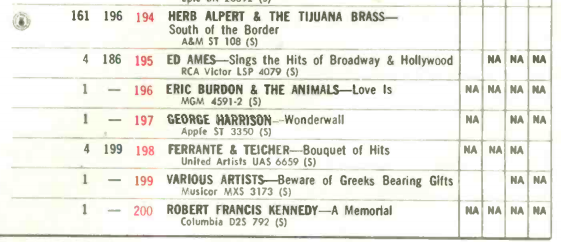
At least George woke up to a little good news: The soundtrack to the film Wonderwall, his excellent first solo effort, cracked the Billboard 200 LP charts in the United States, where the January 11 issue of the magazine placed the LP at a very modest No. 197. (It would eventually peak at No. 49, on March 1, 1969). His presently erstwhile band’s eponymous double album remained the best-selling LP in the country, while Sgt. Pepper’s Lonely Hearts Club Band (No. 56) and Magical Mystery Tour (75) remained on the top half of the charts. Bearing a sound retrospectively of so long ago, these two 1967 releases remained relevant to record-buyers.

(Still, George had one up on Paul McCartney, whose own 1967 release — the soundtrack to The Family Way, ostensibly the first “solo” release by a Beatle, albeit with little participation from Paul himself — did not chart at all.)

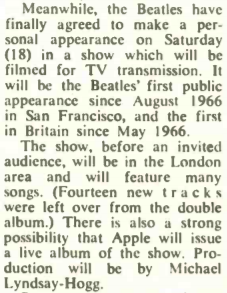
The same January 11, 1969, issue of Billboard shared the news of an impending Beatles “personal appearance” filmed for TV one week hence.

Meanwhile, the Beatles have finally agreed to make a personal appearance on Saturday (18) in a show which will be filmed for TV transmission. It will be the Beatles’ first public appearance since August 1966 in San Francisco, and the first in Britain since May 1966. The show, before an invited audience, will be in the London area and will feature many songs. (Fourteen new tracks were left over from the double album.) There is also a strong possibility that Apple will issue a live album of the show. Production will be by Michael Lyndsay-Hogg. [sic]

As we’ve heard on the Nagra tapes throughout the sessions so far, the show’s date and location had remained completely fluid and in constant state of negotiation to that point, beyond the fact the Beatles were now short a guitarist. We could charitably say 14 White Album leftovers wasn’t far off, although that was probably guesswork on Billboard’s part.

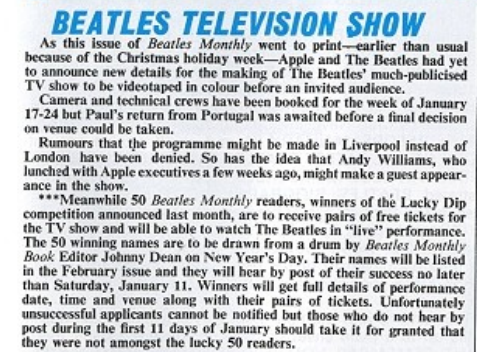
Left unspoken on the tapes was the Beatles Book’s competition (as described in the January 1969 issue), in which 50 winners would earn invitations to the group’s live show on January 18. The magazine said winners would receive details “no later than Saturday, January 11.” But it was the 11th, and no one had been alerted.

George was ready for his own victory, a weekend away from the band with the chance to rest and reset his private and professional problems. Then an unplanned and very personal appearance ended any search for serenity.

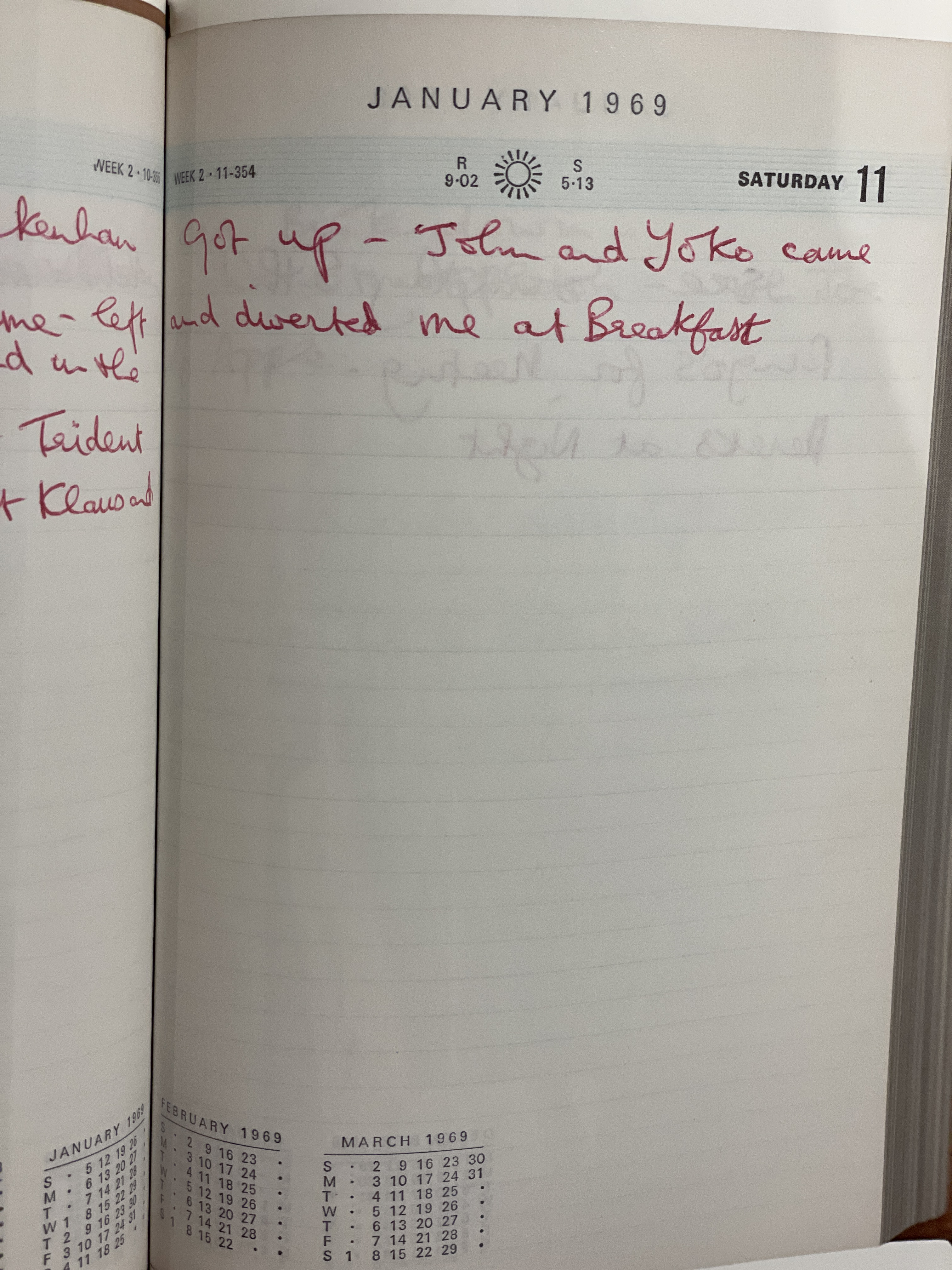
From George’s diary:
“Got up – John and Yoko came and diverted me at Breakfast”

George’s diary entry for January 11, 1969. From the Living in the Material World book.

To paraphrase George himself from the Beatles’ chart-topping album, we don’t know how he was diverted. We can only guess what John Lennon and Yoko Ono spoke about with George.

It’s notable, however, that the couple made the effort to intercept George as one of their very first activities that day — George probably wasn’t up at dawn, but it was still what he considered breakfast time. John didn’t offer George any cooling-off period in what could have been an attempt to make amends as much as it may have been a power play on John’s part, a multifaceted attempt to rein in George.

“I’m phoning Eric [Clapton], and he’ll be in Monday to replace you,” one could imagine John saying, with Yoko looking on. “And the others are happy to go along with the change! You should have heard them jamming with Yoko yesterday.”

That’s only a guess at what John could have told George. He could have simply said, “I’m really sorry, please come back,” but we don’t know that either.

We do know the result of the visit: Any apology on John’s part for their presumed midday argument wasn’t good enough, or George, no matter what, was never going to be receptive the day after the walkout. Instead, he would continue his holdout.

Separately, any attempt by Paul McCartney or Ringo Starr to contact George is conspicuous by its absence, a contrast notable in its own right.

The single line about John and Yoko’s visit is the lone January 11 entry in George’s diary.

It’s possible this is the day George threw out Charlotte Martin and reconciled with wife Pattie Boyd. It may have been the day he wrote “Wah-Wah.” But we don’t have any evidence either way, we just know those events happened in this narrow period while George was away from the band.

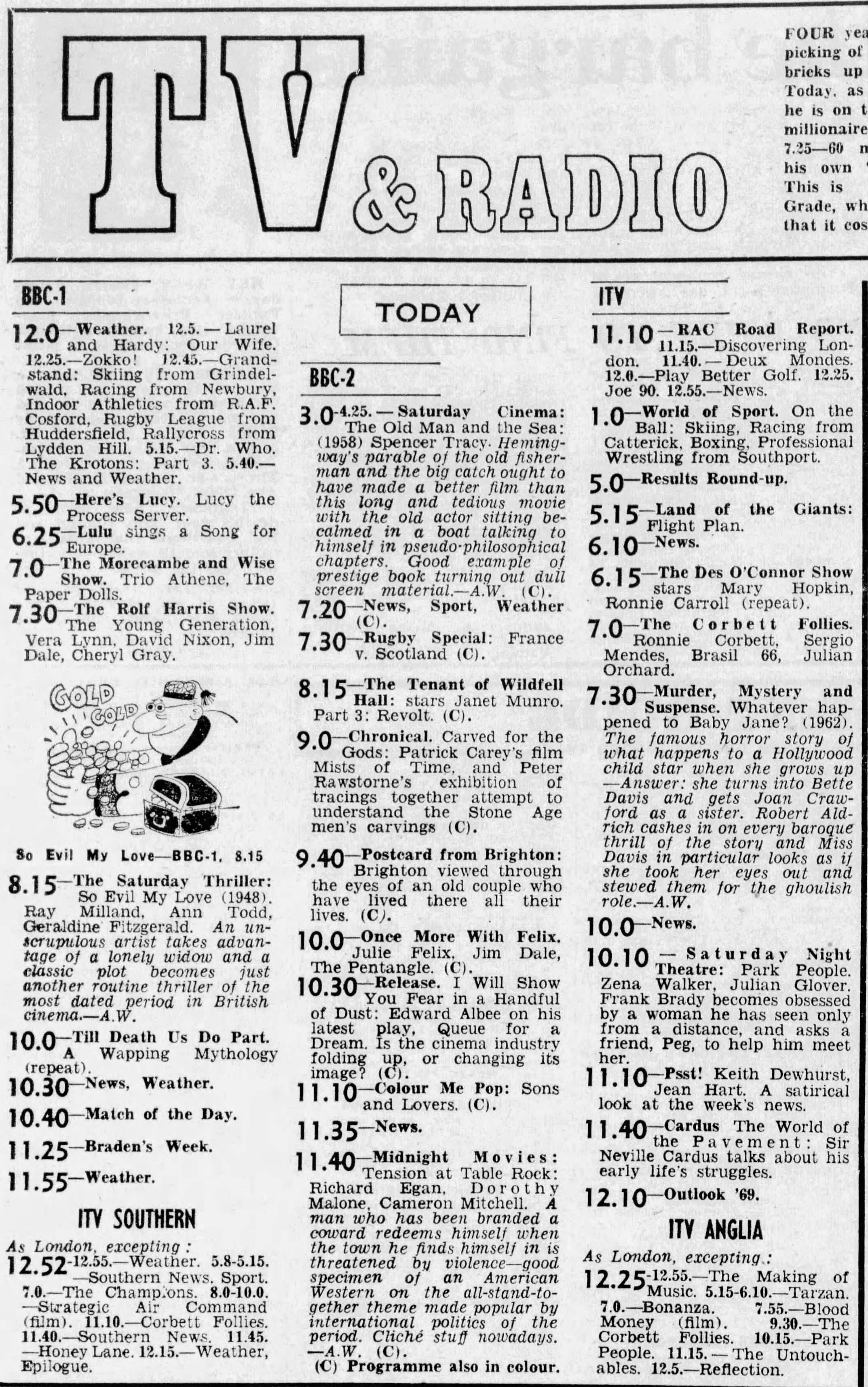
It’s unclear what Paul was doing Saturday. It’s possible that if he stayed in, he watched the Rolf Harris show at 7:30 p.m., when Vera Lynn performed “Good Night” on BBC-1, as promoted by Dick James the day before.

Ringo didn’t bother listening to a cover of the track he sang to close the White Album. Instead, he was tuned to the ITV murder mystery, which was on at the same time.

Saturday night’s TV listings

“Did you see ‘[Whatever Happened To] Baby Jane?’ on Saturday?” Ringo asked Michael Lindsay-Hogg on Monday, January 13, as captured by that day’s Nagra tapes. “Great film.”

The 1962 film starring Bette Davis and Joan Crawford is a dark thriller revolving around a tortured celebrity sibling rivalry. The mixed-up state of the Lennon-McCartney-Harrison dynamic and its internal rivalries had devolved into its own tortured state by this point.

When the calendar turned to January 12, three of them — John, Paul and George — were Sunday driving, separately arriving, on their way to Ringo’s home.

Previewed on Friday before George’s departure, this meeting didn’t occur Saturday, as it was initially discussed. And when they gathered Sunday, it wasn’t exclusively an Apple business meeting as originally scheduled, but it also turned into a rescue mission to get George back to the Get Back sessions and make the Beatles whole again.

3 Comments

Filed under Day by day

Jan. 10: Et cetera

January 10, 1969, saw the Beatles at the precipicesomething we’ve heard before, and will again. Listening to the day’s tapes to the end, it’s clear this wasn’t a band prepared to call any kind of hiatus, even when they had every reasonable excuse to do so. 

Before we move into the weekend away from the studio and their return the following Monday, here are a few loose ends, some other conversations and events from this Friday.

***

While Paul McCartney, John Lennon and Ringo Starr gleefully jammed away in George Harrison’s absence, Michael Lindsay-Hogg was the face of pessimism. 

“Once you leave, it’s really hard to come back,” he conceded. But the director was alone in his premise.

“Not really,” replied Apple chief Neil Aspinall, who’d seen this kind of thing before. “We’re all having a meeting on Sunday. So he could be back then.”

“The box that George is in,” Neil continued, “it’s him versus John and Paul when it comes to what he’s got to do and what he has to play.”

Nevertheless, make the most of it.

George Martin clarified the deeper issue.

“And there’s the songwriting. Because they’re a songwriting team, and he’s his own team.”

Michael — who had been immersed in the Lennon-McCartney experience for more than a week — doubted the extent of their partnership at this point in their career. 

“Nevertheless,” George countered, “they’re still a team.”  

***

In a storyline hard to contain, George’s box wasn’t nearly as notorious as John and Yoko’s bag.

Paul continued to poke fun at the couple for their nascent bagism movement, quizzing his musical partner on logistics and therein shattering any attempt by future scholars to find deeper meaning in the shade of their sack.

“Can you see each other in the bag?” Paul asked the couple — seemingly apropos of nothing, at least on the tapes — during one of the day’s early takes of “I’ve Got a Feeling.”

“Yes,” John said, laughing. “We’re together in the bag.”

“I know, but can you see each other inside, when you’re in the bag.”

“It’s just like being under the sheets. … She generally used to use black bags where you could see out, but we couldn’t see a thing.”

Later in the day, after the couple briefly left the set, Paul speculated, to laughter, that they were “probably in a bag in his dressing room … they brought their own bag with them today.”

“Hence the expression,” Michael replied, “Papa’s got a brand-new bag.”

***

When Dick James referred to sheet music as part of an “expanding market,” Michael questioned just who was part of that market, opening up an illuminating conversation on the state of that industry in 1969. The NME stopped publishing sheet music charts in 1965, and in retrospect, it’s laughable to consider the market’s state as Dick describes. Even in January 1969, it was an open question just who was that market.

“Who buys sheet music?,” Michael asked. “Do I buy at home ‘I Want to Hold Your Hand’ to play on my piano on Saturday night with my family?”

It wasn’t just piano players in the market for sheet music, Dick claimed, but “guitar people, little groups.”

When Michael countered that it would be cheaper for enterprising bands to just buy the records, Paul said not everyone had the ear for that. “They try to find the chords on the piano, and they’re blind.”

George Martin, proofreader

The real issue arose when the the sheet music’s chords were wrong, something Glyn Johns said happened with “extraordinary” frequency.

On the defensive, and speaking on behalf of the publishing industry, Dick laid out the process of how the song went from record to printed paper.

“Where the boys are concerned, they don’t write the song (down), they create the song. I get an acetate or a tape when the record’s finished, and I give it to my music scribe, and he has to take it down. He’s a very good man, he’s very experienced. He can make mistakes, but in an effort to eliminate this now, we check the lyrics — John and Paul, they OK the lyric to be correct.

“That we print, and that is proofed as well. When my scribe is finished transcribing what the boys have done into a song copy, we then send it down to George Martin, and George vetoes it (i.e., he approves). Now if there’s still is a mistake after that, it truly is one of these genuine oversights.”

***

While the Beatles were in the midst of creating their own raw documentary, George promoted the computerized film “Permutations” by pioneering animator John Whitney, who hosted the film at Apple’s HQ the the night before. Featuring an Indian music soundtrack, George was first introduced to the film by Ravi Shankar.

“You’ve seen the three-screen thing before,” George told Michael, describing the film’s unique presentation. “It wasn’t like the psychedelic ones that just freak out and all that. It was just really great and nice to look at.

“So if you hear somebody say, ‘There’s a John Whitney looking for Mr. Harrison,’ let him in.”

***

Hugh Curry, January 1969

No one was looking for Hugh Curry, a Canadian DJ who found himself at Twickenham in the waning moments of the day’s session and would later interview John and Yoko on the same soundstage a few days later.

At the outset, Curry sought a solo interview with Yoko, but if John could somehow maybe make an appearance, well …

“If there’s a moment while she’s doing it, I’ll wander into it,” John generously replied to the suggestion. “You just set a time to do her, and if I’m not doing anything I’ll come in on it.”

“Goddamn sinister”

Pivoting to the subject of the box-office success of the Yellow Submarine film, Curry invoked the missing Beatle, clearly unaware of his recent departure. 

“They make George look so goddamn sinister.”

After a nervous giggle from Yoko, John changed the subject, pinning down the interview for the following Tuesday, anytime after 10 a.m. 

Even with a plan in place, Curry stayed put, pre-interviewing the couple. 

“I heard some stuff over the phone, it sounds good,” Curry said of Yoko’s earlier vocal disruption. “Oh wow, she’s laying some new sounds on it!” 

John and Yoko’s delight was short-lived.

Curry: I heard the Two Virgins thing.

Yoko: Oh, you like it?

Curry: No, I don’t.

The interviewer’s matter-of-fact response brought John to mock tears.

“I dig Cage, Stockhausen, people like that,” he said. “I thought it was too much on one level. It didn’t have enough peaks and valleys.” 

Incredulous, Yoko could only repeat “are you kidding?” before John interjected, “It’s got millions of ’em.”

Curry backed off, suggesting that maybe his “head wasn’t in the right place” on that first listen.

A brief discussion of Cage’s “Indeterminacy” — John hadn’t heard it, but Yoko had, and she was sick of it — led into a discussion of Two Virgins and the difficulty of its distribution in Canada. 

And speaking of record labels … 

“How’s Apple doing,” Curry asked. 

“Going around in circles,” John replied. “Like everything else.” 

1 Comment

Filed under Day by day