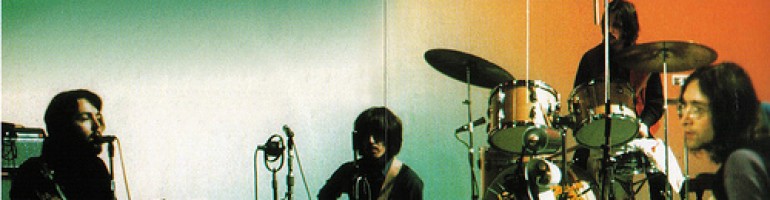
I’ve previously dipped in and out of the lunchroom tapes in recounting the events of the weekend of January 11-12, 1969. Now that our timeline here has finally reached the afternoon of January 13, you’ll see some facts and points repeated from earlier, but now in its original canteen context.
It comes a little less than three hours into the Get Back docuseries (counting credits), about a third of the way into the entire series, and it’s a shocking and quite unnerving moment — as it should be. This could be the most unique sequence of the Beatles recorded on tape and one that most fans, even the self-proclaimed die-hards, probably didn’t know existed before November 2021.
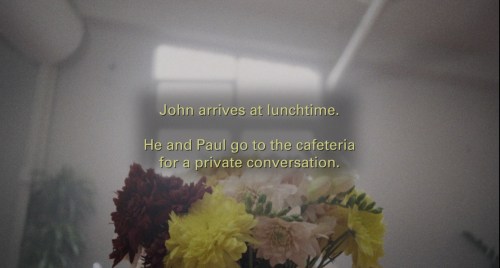
Director Peter Jackson used the Beatles’ January 13, 1969, lunchroom tape to great effect. The chyron says it all, in clear, yellow type:
John arrives at lunchtime.
He and Paul go to the cafeteria for a private conversation.
They are unaware that the film-makers have planted a hidden microphone in a flowerpot.
Behold true flower power: A planter with a bug designed to capture a colony of Beatles. This is also where a real problem begins for viewers and, importantly, the historic record.
First, there’s the “who,” and this is the most important misrepresentation of all.
Paul McCartney and John Lennon did have a “private conversation,” insomuch as it wasn’t at a public venue but at the Twickenham Film Studios cafeteria. But Ringo Starr, Yoko Ono, Linda Eastman and Mal Evans were there, too, and probably Neil Aspinall as well, all equal parties to the discussion.
At least one of that group knew a hidden microphone was in Michael Lindsay-Hogg’s arsenal. Ringo and George Harrison found that out the previous week; they just didn’t know where or when their hired documentarian would deploy it.
“This is the bugging device, so we can surreptitiously bug your showbiz conversations,” Michael openly boasted on January 9, the day before George quit.
On separate occasions, both George and Ringo asked if “that” was the tape on which they were being secretly recorded. A day later, on January 10, Michael suggested to the same pair that he could color the microphone to make it look like one of the director’s signature vices.
“Do you think if I paint this brown and put red on top it’ll look like a cigar?”
“You wouldn’t see the red, just the ash,” George replied.
At this moment on January 13, George was most certainly seeing red, dining away from the office that Monday. Ringo, among the quieter figures on the full lunchroom tape, never indicated any suspicion this showbiz conversation was being surreptitiously bugged.
—
For something so esoteric, we’re left with two distinct experiences: The Get Back version of the lunchroom, and the Nagra tape reality, which cut off suddenly after nearly 29 minutes but was recorded in a true, linear sequence — an actual conversation.
The Get Back docuseries’ timeline of events leading up to lunch was accurate: The group gathered upon John’s arrival on January 13. Paul wondered aloud where George was.
This wasn’t the first spoken moment on the lunchroom Nagra tapes – instead, that’s John, in medias res defending his relationship to Yoko in the context of his recently dissolved marriage to Cynthia.
(When John said “I would sacrifice you all for her” as the lunchroom Nagra recordings begin, a segment also transcribed in the 2021 Get Back book, any kneejerk reaction that it was about the Beatles’ current situation vis-à-vis Yoko should be tempered; on the tapes he already mentioned it was as “a husband.”)
Paul essentially began the lunchroom discussion – “So where’s George?” — with a bit of cheek. In the TV edit, John replied, “Well, he doesn’t want to be here,” per the subtitles, although it’s not entirely clear that’s what he’s really saying if you listen closely, and it’s difficult to even find that line on the Nagras.
Without going line-by-line – and I can, would you like me to? — that is the main takeaway on the televised representation of this lunch: It’s different.
On the tapes – omitted from the discussion in Get Back – Ringo quickly replied with a punchline: “It smells like George is here.”
So the evidence is clear from the absolute beginning: The Get Back lunchroom sequence and the full Nagra lunchroom tape are completely different representations of a specific, important moment in time. I don’t think the TV series was at all edited maliciously, but to dramatically distill a 29-minute sequence to six and deliver a specific narrative. I’d watch 29 minutes of this stuff, but maybe that’s why my filmmaking career never got off the ground.
Intent aside, however, it’s still an inauthentic experience. Only with this understanding can we even try to parse anything.
How scattered is the Get Back edit? Here’s a look at me and my notes.
It should go without saying, but I’ll say it anyway at the outset (and yes, more than 800 words into this post, this is only the outset): The work Peter Jackson’s crew performed to clean up the audio of the lunchroom tape is nothing short of remarkable. Listen to 10 seconds of the bootleg tapes and then 10 seconds of the audio in Get Back; the technological advances are staggering.
Michael — who later misremembered the recording as capturing George’s departure of the Beatles days earlier — considered the tape unusable, writing in his 2011 autobiography Luck & Circumstance:
My bug had only picked up the sounds of cutlery banging on china plates, obscuring what the muffled voices had said.
At times, the Get Back AI is a little too good, and the voices can sound almost processed and nearly garbled. Listen to the televised sequence on headphones, you’ll hear what I mean.
The chyron subtitles aren’t completely accurate, either. This could be a case of my ears vs. their ears, and my eyes vs. their claims. But, I think my eyes and ears are pretty OK.
A great example comes more than 2 1/2 minutes into the Get Back scene. In a complaint about Paul’s unwillingness accept criticism, so to speak, John — per the subtitles — sort of mockingly says “I’m Paul McCartney” in a soundbite that took me completely by surprise when I first saw it. That’s because it’s not in the tapes.
Instead, I think John clearly says “four in a bar,” as in the rhythm. That absolutely fits the context that line was originally in, with John saying he and George would just surrender to Paul’s musical decisions to finish a song. (We’ll get to that plotline later.)
Here’s that line on the Nagra tapes in its original context:
And the “four in the bar” line, slowed down a tick:
It seems clear he does not say “I’m Paul McCartney.”
In other words: We have to proceed with genuine caution consuming this sequence.
—
Paul was drinking Dos Equis, and John enjoyed a glass of wine. While this has long been called the lunchroom tape, we don’t actually hear anyone dining; the clatter of cutlery is from the staff working in the cafeteria. They may not have been recorded having a feast, but plenty was eating away at the Beatles.
We don’t know what John and Yoko were doing at home besides leaving their phone off the hook, but Paul — especially — and Ringo had already spent hours speaking relatively candidly about the group’s inner relationships, not only in the context of George’s departure, but quite deeply regarding the Lennon-McCartney partnership. The day must have completely exhausted and gutted Paul even beyond the depictions we now can see in Get Back.
This is a dramatic oversimplification, but the 29-minute conversation covers several overarching and highly overlapping points, including:
- John and Paul’s relationship with and treatment of George, and the latter’s future as a Beatle
- The concept of being a Beatle – and also an independent individual (and tangentially, a solo musician)
- Leadership – and bossiness
- The Beatles’ working relationship – as in, how they made music
The conversation is scattered – like any other normal discussion between actual humans under stress and a little bit of influence. They weave in and out of each of these broad points. This isn’t a meeting with a printed agenda and action items.
John and Paul are at the center of this dialogue, but across the discussion, Linda, Yoko and Ringo participate. Mal’s engagement comes across as a servant only. If Neil is there, he’s quiet. Only the impenetrability of the tapes makes his presence a question, but he was at Twickenham prior to the lunch and part of the day’s earlier discussions, so it would make sense the ultimate insider would join any important conversation.
It can’t be repeated enough, though: Paul and John are just two of the people in this conversation. To not mention Ringo most specifically as a party to this discussion is to sideline and discount one-quarter of the Beatles, a self-proclaimed democracy of four. Much as this conversation presented John and Paul at their most unfiltered, the presence of Linda and Yoko doubtless clouds a bit of their candor. Still, they speak in a fashion that we hardly hear through the duration of the month otherwise — especially John, who displays little in the way of wit and humor but plenty of self-refection and doubt.
But it has to be repeated: The portrayal of this discussion as a one-on-one conversation between only John and Paul is a very unfortunate failing of the excellent Get Back.
—
We’ve established John, Paul and Ringo are all there …
So where’s George?
His absence isn’t the only thing that makes this conversation interesting, but it jump-starts the discussion, and like an odor, it permeates the meeting. The Beatles’ problems ran deeper than George’s resignation, but without it, would this lunch have even been recorded?
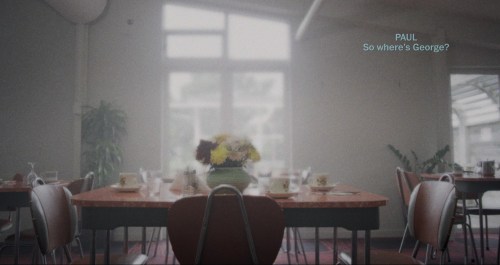
Given how the tapes begin, we can establish this is close to the start of the conversation.
“It’s a festering wound,” John said of what he thought George must have been feeling, early in the discussion—as documented on the Nagras and edited into Get Back. “And yesterday (at the meeting at Ringo’s house), we allowed it to go even deeper. But we didn’t give him any bandages.”
John blamed the indifference on Beatle egos. He said he tried to “smother” his ego at the two meetings he had with George over the previous weekend – the first meeting really more an ambush. John used the same phrase – smothering his ego — to describe how he made it possible to “carry on” working with Paul. We’ll get back to that dynamic later.
On multiple occasions on the tapes — not in Get Back, since it’s not acknowledged that she’s even there — Yoko not only steers the conversation to ask about George but also remarks the ease of which they can bring George back. But …
“Do I want him back, Paul? I’m just asking, do I want it back, whatever it is, enough?”
John’s indecision of how he wanted to approach his and the band’s near-term future overlapped an admission that George had “been on such a good ride.” But at the same time, he said – agreeing with something Paul had previously remarked – that George was “some other part.”
I mentioned this in a previous post: George was viewed as an other. Though never explicitly described as such, it was clear George was both musically and socially separate from John and Paul. (And this was said without an apparent realization he was temporarily estranged from his wife.) Further, the rough-edged John blamed his own management style on his upbringing, saying he knew he’s treated people “this way” since primary school.
Get Back doesn’t pull in this part of the conversation. Instead, it implies George’s absence was a direct result of Paul’s – and to a lesser extent, John’s – in-studio musical enforcement. Not necessarily “musical differences,” but exhaustion from day-to-day life as the implied Beatles session guitarist.
That may have been the case, but there’s a lot more to it.
Get Back follows up less than a minute into the sequence with this exchange, which actually happens in Minute 27 of the original tapes:
Paul: The thing is, that’s what I was trying to say to George, you know. Whereas, previously I would have said, “Take it there, with diddle-derddl-diddler-der.” But I was trying, last week, to say, “Now take it there, anything you like. Put whatever you …”
John: You see, the point is now, we both do that to George this time, and because of the buildup to it.
Paul may not have given instructions to play a guitar part verbatim, but there were several moments where he was very specific with how he wanted something to sound. It was enough that it drove George to tell Paul whatever it was that would please him, he’d do it, after all.
Was that enough to drive George out of the band, though? The Get Back portrayal of the lunchroom tapes implies his absence is the final statement of this intimate discussion, and not only is it John and Paul’s decision if George should even be a part of the band, but that this could well be the end of the Beatles as we know it, for now.
John: If we want him, if we do want him, I can go along with that because the policy has kept us together.
Paul: Well, I don’t know, you know. See I’m just assuming he’s coming back.
John: Well do you want …
Paul: If he isn’t, then he isn’t, then it’s a new problem. And probably when we’re all very old, we’ll all agree with each other and we’ll all sing together.
The last bit of conversation on the Get Back portrayal is a … complicated edit job, pulling in lines from various moments in the first half of the Nagras.
There’s more to the above quotes — in their original context — and I’ll get to that. This post is only “Pt. 1” after all.
 They May Be Parted
I think I must’ve seen this post a couple years ago. Now I’m actually (finally) watching Get Back. Had to pause the whole doc after seeing the devastating lunchroom flowerpot scene, came online, and found this post. Started reading, and it seemed very familiar.
Thanks for the reminder that it wasn’t JUST John and Paul. The movie totally makes you think otherwise. It’s sleight-of-hand that definitely colors the content and its impact, but I understand the directorial choice even if I don’t agree with it.
I also understand editing different pieces of what someone is saying for time and clarity with the goal of preserving the intent of the speaker. That’s tricky work at the best of times, and what Paul (and especially John) are giving us here is not the best of times, in terms of clarity of thought. This is an iffy edit.
But worse than those two choices, I think, is Over-enhancing AI audio and misinterpreting it.
5 or 6 years out from the production of this film, similar AI audio tools to the ones they used are available to most of us. I work in radio and do a lot of news, documentary, and storytelling work. I’ve been using AI scrubbers on a regular basis the last couple years to enhance wonky audio – from podcasts, iffy phone calls, noisy field recordings with too much background noise, etc. The trick is to use it sparingly. And the less sparingly you use it, the more cautious you must be.
If you use photoshop too much, you wind up with an oversaturated or over-contrasted fake-looking photo. There may be aesthetic reasons to do that purposefully, but not usually when you’re doing documentary work, reporting, photorealistic representations, etc.
If you use AI audio enhancers too much, you wind up with digital mush, and even fake dialogue. I’ve seen it eat words, I’ve seen it change words. I even stripped a voiceover off of a music bed once, purposefully did the most enhancement it could do, and the snippet of guitar intro on that audio was made to sound like a human voice. It was unintelligible, of course, but the former music def sounded like a person trying to talk.
This tech can’t just be applied and its results accepted. You have to work with it like an archaeologist works with a brush and toothpick, or a historian works with multiple sources. It requires diligent human monitoring and control at every step.
The more enhancement something needs, the more I must use my ears and my brain and closely compare the enhanced audio with the original to make sure it hasn’t gone awry. There are times I even spliced in poor-quality original word or two into an enhanced piece of audio because the AI just couldn’t get it right.
And one thing I NEVER have in front of me when I do this work is a TRANSCRIPT telling me what the source is SUPPOSED to be saying. That would distract my ears from the work they need to do.
So, I went back out to the living room and replayed half of that scene after reading this post. This time, I listened instead of read, using the “ears” I use at work. Sure enough, I immediately heard Digital Mush in spots. I definitely did NOT hear “I’m Paul McCartney.”
I re-watched a youtube video where Peter Jackson talked about making the film, and there’s one point where he explains there are other people in his team doing the work of repairing the old audio and video, in ways he doesn’t fully understand. So it seems to me, between the tech approach on the front end, and the artistic directorial approach on the back end, they dropped the ball on some of the “scholarly” work in the middle. I think on top of PJ working more freely with this scene than perhaps he should have edit-wise, he was working with content that was less reliable than he knew.
So, this is a kind of misleading scene overall. Still devastatingly impactful, but definitely manipulative. I don’t want to take sides in this, but even with the scene reinforcing what I think I know about The Beatles and further leading me to take John’s “side,” I have nonetheless never felt worse for Paul McCartney.
I think he was the guy who wanted to do the work more, he wanted to perform more, he was best equipped to handle the Beatles’ enormous success, and he was the most blinded by that success (‘since everything we do works, let’s rent a bus and make a movie with no director or script!). Get Back finds them in a sad situation all around, but its almost tragic on Paul’s end.
Thanks so much for writing this post, I’ll continue on with Part 2 now!
LikeLike
Jason Dole, I love this comment!
I’m a court transcriber, and while we’re not currently using speech-to-text tools, I’ve worked for companies that are. It’s the inevitable direction the industry is headed: transcribers becoming editors of machine transcription (much like translators are becoming editors of machine translation). It’s such a frustrating business, however, because having output in front of you massively influences your comprehension.
When I did police transcription, we also encountered issues with ‘scrubbing’ bad audio: the process of cleaning it up can actually distort the sound further, adding what sound like extra syllables, messing with intonation and so on and so forth. I couldn’t believe how poor the Get Back lunch room transcription was… how many rounds of people did that pass through without anyone picking up those woeful mishearings? Not only that, but mishearings that hugely affect meaning!
LikeLike
Pingback: TMBP Extra: Jan. 13, 1969 recap | They May Be Parted
Pingback: Jan. 13: Et cetera | They May Be Parted
Pingback: TMBP Extra: A conversation with Steve Matteo | They May Be Parted
Pingback: January 13: Looking for the greener grass | They May Be Parted
Do you have a transcript of the lunchroom conversation? I used to have one. Someone sent it to me on Dsulpys forums but I’ve lost it. I’d really like to re-read it to the recordings again. Anyway, nice synopsis and story telling in the blog. Capturing key moments like the ‘She-said She-said.’
LikeLike
Pingback: Jan. 13: The Lunchroom Tape (Pt. 3) | They May Be Parted
This is a great read, thank you! I’m in the process of transcribing the audio, and I’d like to draw your attention to one little mishearing in your (excellent) excerpts:
JOHN: But I’m just trying to ask meself, do I want it [him?] back, Paul? I’m just asking, do I want it back, whatever it is, enough?
The ‘enough’ does sound quite like ‘myth’ due to the poor audio, but ‘enough’ is confirmed when John immediately asks a follow-up question of Paul that uses the same key word:
Then if it is enough, I’ve had to smother me ego for you, I’ve had to smother me jealousy for you – – –
LikeLike
I appreciate the kind words. And yes, you’re absolutely right. I’ve been giving the entire lunchroom a fresh re-listen and transcription, too, and I definitely didn’t catch it right the first time. We can’t get the MAL-ified cleaned up version soon enough!
(Thanks again, Katie!)
LikeLike
Hey Dan – has anyone done a new pass at this using AI tools of 2025? Thanks – Chris.
LikeLike
Katie, could I look at your transcript? This was a personal project of mine a while back, and someone sent me a transcript they had made but I seem to have lost it.
LikeLike
If you’re out there, hit me up and I’ll send you a copy of my transcript that I put together. I want to see if I can try using some AI tools in 2025 to create a better version, because the Peter Jackson version is a threat to history. – Chris
crubeo66@gmail.com
LikeLike
Pingback: Jan. 13: The Lunchroom Tape (Pt. 2) | They May Be Parted
Pingback: How Peter Jackson Used AI on The Beatles’ ‘Revolver’ Release – WORLD NEWSPOT
I think you are spot on with “four in a bar”. The “I’m Paul McCartney” transcription made no sense.
LikeLike