Category Archives: Day by day

Jan. 8: Let it be hers

Mid-afternoon on January 8, 1969, at Twickenham Film Studios, Paul McCartney sat at a piano and microphone and ran though “Let It Be.” Nine months later, and 3,500 miles to the west of London, the Queen of Soul was doing the very same thing.

By that point — October 1969 — Abbey Road was in stores while “Let It Be,” along with the rest of the songs slated for the Get Back LP that would ultimately evolve into the Let It Be LP, remained on the shelf. Aretha Franklin had a copy of the unreleased track, though, and we know she had been promised that song for a long time, going back at least as far as the start of the new year. But she wasn’t getting an exclusive.

Let’s go back to Twickenham, January 8, 1969:

George:  You going to give it to Aretha Franklin?
Paul:  I’m going to do it, and give it to her.

Specifically, Paul planned to have the Beatles cut a “rough demo from the first rehearsal” once the song was complete and would “try to get her to do it as a single.” But “Let It Be” was not quite complete yet on this, the fifth day of the sessions. The melody is locked down, but Paul only presented the first verse and chorus to this point.
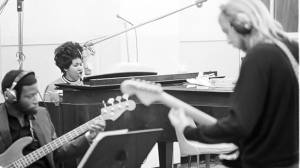
Weight and see: Aretha Franklin does her thing, while Duane Allman (right) does his on a cover of The Band’s “The Weight” on January 9, 1969.

Still, he knew what he had, and its potential as a cover. “It would be great for Aretha Franklin, that number,” Paul said before singing a line in an absolutely terrible imitation of her. (For the record, that same January 8, 1969, Aretha was recording her version of “The Weight” by The Band, whose influence weighed heavily on the Beatles these sessions.)

Ringo provided upbeat drum accompaniment —  exactly as laid out by Paul, with a faster tempo than would ultimately surface on the record, and with several awkwardly inserted fills.

Tongue firmly in cheek, John soon offered a lyrical tweak and a poke at Paul’s pseudo-religious lyric, suggesting “Brother Malcolm” as a nod to the group’s do-it-all assistant. (Paul will deliver that line in a few future takes.)

The group would return to the day’s on-again, off-again writing-cum-rehearsal session for “I Me Mine” followed by “The Long and Winding Road,” which like “Let It Be” was similarly unfinished lyrically and being given its first introduction on the tapes to the full band this afternoon.

These repeated truncated takes of “The Long and Winding Road” — which lasted nearly a half hour, split into two separate stagings late in the day — mainly served, as far as the Nagra reels were concerned, as background music for an increasingly captivating conversation about the eventual live show. More about that in the next post.

“The Long and Winding Road” caught George’s fancy, and he called the song “lovely.” Before the end of the day, Paul taught George the song’s chords. Likewise, Paul sketched out how to play “Let It Be,” which was played for about 10 minutes at the very end of the day’s musical portion, and George and Ringo were full participants.  The song was never to be played live in front of an audience by the Beatles, but at this point it was clearly in line for the upcoming concert, and Paul sought out additional accompaniment come showtime.

“It’s sort of gonna do like a hymn. That’s why I was thinking we could get audience participation on that,” he told George.
af-lib

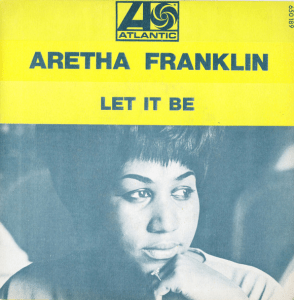
The sleeve for the French release of Aretha’s version of “Let It Be.”

The January 8 session was really the formal coming-out party for “Let It Be,” marking first time Paul played it to the rest of the band these sessions (on tape, at least, but it seems clear if it had been played prior, it wasn’t as extensive).

Like “Yesterday,” the song was famously sourced from a dream, but this time around it was the lyrics that were nocturnally inspired.

Here’s Paul, as quoted in Barry Miles’ Many Years From Now:

In the dream she said, “It’ll be all right.” I’m not sure if she used the words “Let it be” but that was the gist of her advice, it was “Don’t worry too much, it will turn out okay.”  It was such a sweet dream I woke up thinking, Oh, it was really great to visit with her again. I felt very blessed to have that dream. So that got me writing the song “Let It Be.” I literally started off “Mother Mary,” which was her name, “When I find myself in times of trouble,” which I certainly found myself in.

But to be clear, the trouble wasn’t dated to January 1969. Rather, like “The Long and Winding Road,” “Let It Be” materialized in 1968 amid the lengthy and tumultuous White Album sessions. The two gospel-flavored songs had another link, and that was they were written with other people in mind from the start, too: “The Long and Winding Road” was influenced by Ray Charles.

As for Ray’s future Blues Brother co-star, Aretha never did end up releasing “Let It Be” as a single in the U.S. or U.K., but it was among the standout tracks (her covers of “Elanor Rigby” and “The Weight” were among others) on her This Girl is in Love With You LP, which was released January 15, 1970 — two months before the Beatles’own version came out as a single, and 11 days after the last Beatles recording session.
6 Comments

Filed under Day by day

Jan. 8: Look Around

It was 12 days until their scheduled concert, and on January 8, 1969, the Beatles were loose, relatively upbeat and open-minded, uncommon characterizations associated with Get Back/Let It Be sessions. Still, there wasn’t even consensus on what continent to stage the concert, much less what venue or what kind of audience would have tickets to the show.

What they lacked in plans and new material — Paul would insist the group would produce a few “rockers” soon — the Beatles at least had no shortage of live productions against which they could reflect and project.

Two classes of potential inspirations highlighted discussions to this point: recent live broadcasts by their peers (eg., Cream’s Farewell Concert, the Rolling Stones’ Rock and Roll Circus) and the Beatles’ own history on stage and on the small screen. The audience was as much a consideration as the venue.

In the final hours of the day’s sessions, as the group continued to work on George’s new song “I Me Mine,” John and Yoko waltzed the room right into a continued deliberation of the staging of the imminent show.

“I think the thing to do is just put you all in a framework, which will be just, like, the audience and a stage,” pitched Michael Lindsay-Hogg, who was tentatively willing to settle for a simple approach if his preferred idea — an overseas trip — was denied. “And by the time we get to the stage, we’d have a routine of numbers. We can find each number how they fit theatrically, like your dance for that one, like the song that you cry in and the song you do that brings tears to everybody’s eyes.”  Off mic, it was joked there’ll be the one song that’s done in the wrong key.

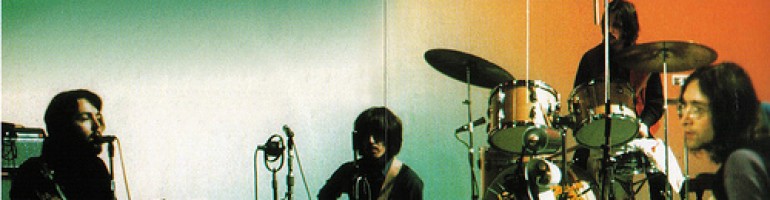
Twickenham's Stage 1. What a pretty palette!

Twickenham’s Stage 1. Simply gorgeous!

“Seriously,” the director continued. “Almost, we should end with ‘Good Night’ or whatever song is going to be like ‘Good Night’ this time. … The end of the show should be a tearjerker like ‘Hey Jude’ or like ‘Good Night’ or like something else.”

Two large signs promoting the show’s working title — “January 20, 1969” — would hang as a backdrop. “And it’s the 19th of February, 1982,” John injected for a laugh and commentary on the decision process’ plodding pace.

When Paul asked about the composition of the audience, Michael answered forcibly, “Human beings, and the first thousand who queue up.” John was more specific, positing “pastry cooks from Walton-on-Thames” would be in attendance.  (John’s joke was told nine weeks before the London suburb actually became a footnote in Beatles history: George and Pattie were fined for drug possession in Walton-on-Thames on March 12, 1969 — the same day Paul and Linda married.)

To snickers, Michael proposed voice overs for each song. E.g.: “Now Paul sings a song of true love.” 

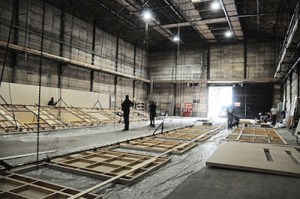
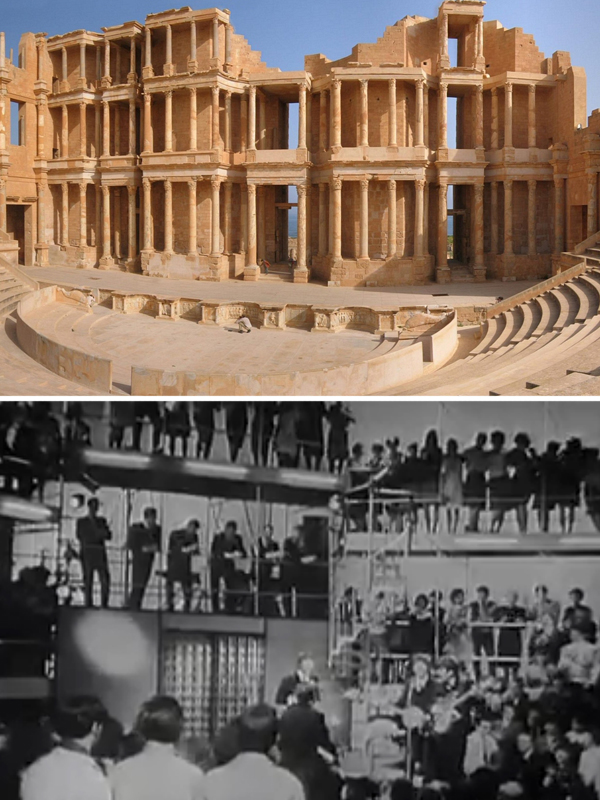
The audience seated at Twickenham’s Stage 1 would sit in the round, either at three-quarters or fully encircling the group. “You could build this place great like that, all of it like a coliseum,” Paul said. “Four sides, then on the top of it all, your cameras, or a camera.”

“I still don’t think that’s our best idea, for the record and on tape,” Michael replied, resigned. “But I think if that’s what we’re going to do, it’ll be fine. Because I’ll make it fine, and you’ll make it fine.”

Coliseums real (Sabratha, top) and fabricated (Rediffusion's Wembley Park studio)

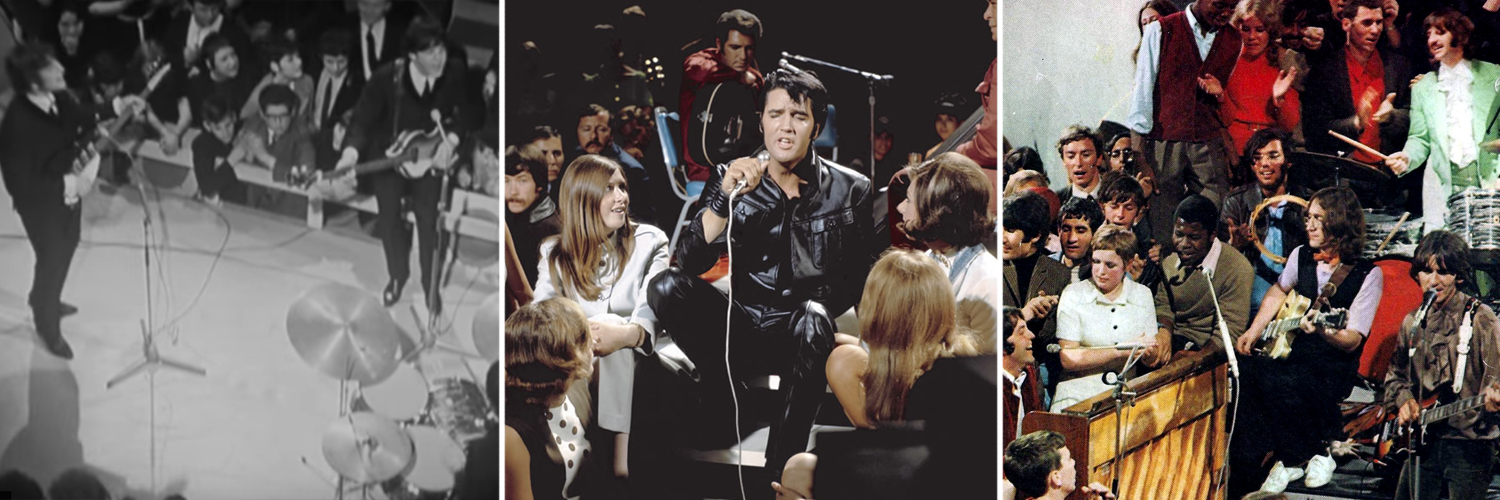
Coliseums real (Sabratha, top) and fabricated (“Around the Beatles” at Rediffusion’s Wembley Park studio)

The bar for the Beatles’ triumphant return to the stage re-established at “fine,” Michael conceded “torch-lit is for next time.”

While the coliseum-style arrangement recalled to Michael the currently shelved Sabratha, Paul was reminded of a moment in the group’s history from four and a half years earlier, when Beatlemania was at its peak.

“It’s a bit like ‘Around the Beatles.'”

“Ah, I was thinking about that,” Michael said. “That was a very good show. That’s why I think it should be kind of theatrical. … Also the Presley show they’ve just done, apparently, which has more of an ‘Around the Beatles’ audience.”

In reality, the live sequences in the ’68 Comeback Special — broadcast on NBC as “Singer presents … Elvis” — had more of a “Hey Jude” vibe than an “Around The Beatles” one; there was always a distance between fans and the band in “Around the Beatles,” while “Hey Jude” and the Comeback Special put the musicians within reach of the crowd, and the King several times interacted directly with the commoners. What “Around the Beatles” and the Comeback Special did share in their audiences was its enthusiasm-cum-mania.

The Comeback Special was being cited in discussions of the Beatles ’69 show, but it had no influence on the “Hey Jude” taping, or vice versa. Elvis filmed the concert portion in late June 1968 but those tapes weren’t broadcast until December. “Hey Jude” was filmed in early September 1968 and broadcast days later. The two paths never crossed.

compare

Way beyond compare: Around the Beatles (left), Elvis’ Comeback Special (center) and the “Hey Jude” promo film.

Elvis triumphantly rehabilitated his rock and roll credentials with his special; the Beatles didn’t need to do that. Yet …

“One of the things we’re up against,” Michael continued, “is all the past things you’ve done.”

Here we are with a reference to the past again. The Beatles did a lot. But surprisingly, although they were commonly featured across all facets of the media, they had very few their own television programs.

“There’s only about three of them,” Paul said, and John rattled off the list: “‘Magical Mystery Tour,’ ‘Around the Beatles’ and ‘Shea'” — the latter the landmark 1965 concert at the former New York Mets ballpark that was broadcast a year later on BBC and in 1967 in the U.S. on ABC. (It recently had a run in theaters in 2016, remastered and looking downright fab as the capper to the enjoyable “Eight Days a Week” documentary).

But “Magical Mystery Tour” was a scripted musical, and “Shea” was a concert film. So that means …

“‘Around the Beatles’ is our only ever TV show, isn’t it?” said Paul.

“And it was good,” Michael said, as Glyn Johns — who had long, but falsely  claimed second-engineer duties on the show (see the postscript of this post for more on that)  — called the program “fantastic.”

After John broke into a few seconds of “Shout” — the finale of that show  — Paul complained to Michael about a theater-in-the-round setup, arguing it’s a step backward, replicating the set of “Around the Beatles.”

“I think with every idea we will have is bound to be …  any of us can pick out a negative side to it,” Michael countered.

“Yeah,” Paul replied. “But it should’t be too heavy negative a side.”

Michael asked the others for input, but John replied by playing Chuck Berry‘s “Sweet Little Sixteen” — a song Michael said, without explanation, “always frightens me” — and swapping in a variety of British locales for the original American cities. (John delivered a more serious reworking of the song six years later on his Rock ‘N’ Roll album).

Returning to “I Me Mine,” Michael remarked John and Yoko’s waltz is “kind of theatrical. And it’s also romantic, and it also fits the song.” Michael was also concerned about the complete bill and “what’s going to be our mind-blasting topper at the end, which I think ought to be a weep-weep, myself. A bang or a cry.”

Paul leaned toward the bang, saying, “we intend to write a couple of rockers.” That worked for Michael — at the beginning, at least. “I think you should open exciting and end with the audience in tears.”

John launches into another Chuck Berry number, this time “Almost Grown,” and is soon joined by Paul. Pleased, Michael said, “That’s what January 20, 1969″ is all about.”

The documentary portion of the production returns to Michael’s forefront when he asks his crew if this performance is being filmed — don’t forget, while the Nagra tapes recorded sound throughout the sessions, the group wasn’t consistently filmed.

Despite the illusion, it was time to get back to work, and Paul returned to setting the agenda.

“Are we all right on George’s number (‘I Me Mine’)? I’m not. Are you? Should we keep doing it a bit more?”

And so, for the time being, the Beatles ended negotiations regarding the live show. The metaphors don’t come much easier: The Beatles’ recounting and considering a return to a theater in the round left them talking in circles.

10 Comments

Filed under Day by day

Jan. 8: Two for the Road

Formal recording for Abbey Road wouldn’t come until months after the Beatles’ January 1969 sessions and not until the project was shelved along with its stable of new songs. It’s with the luxury of retrospection we can establish that the sessions served as a demo venue for Abbey Road, not a bad byproduct of the weeks in the studio.

To this point — the pre-lunch portion of the January 8 session — the Beatles had in one form or another performed six future Abbey Road tracks (”Maxwell’s Silver Hammer,” “Oh! Darling,” “Sun King,””She Came In Through the Bathroom Window,” “Golden Slumbers” and “Carry That Weight”) that were either contenders for the live show or simply unfinished bits for another day, if any.

“All Things Must Pass,” deplorably, didn’t make the cut on either Abbey Road or Let It Be. On this day, the final stabs at that Harrisong (which were the best ones to that point in these sessions, too) found John at piano, and it was there he re-introduced a future piece of the Abbey Road medley, “Mean Mr. Mustard.”

New to the Get Back sessions, “Mean Mr. Mustard” wasn’t at all new to the other Beatles, who had heard John’s demo for the song the previous May at Kinfauns. You, too, can hear it for yourself if you crack open your copy of Anthology 3 and pop in the first disc, or on the 2018 reissue of the White Album. Or just listen below!

Pretty earthy, but that’s the Esher Demos for you. Like “All Things Must Pass” and others, the influence of the group’s February 1968 India trip stretched far past the subsequent White Album. Back in Twickenham, Mr. Mustard’s sister was still Shirley, and he’s yet to rediscover his roots with Polythene Pam. Her sordid story will come later. First, we can enjoy John performing “Mean Mr. Mustard” at the Get Back sessions.

A bit more fleshed out with full instrumentation, the first 1969 take of “Mean Mr. Mustard” is roughly what it was nearly a year earlier, and not awfully far off from what it would become later on Abbey Road. It also stands as an alternate version of his work-in-progress “Madman,” which was a few days away from debut at these sessions. But the Madman’s story will come later, too.

Ultimately, John trashed the song, calling it, along with “Sun King” and “Polythene Pam,” merely “bits of crap that I wrote in India.”

But is one man’s trash another’s treasure?

All right, fine. Paul probably wasn’t inspired by this take of “Mean Mr. Mustard,” despite sharing bouncy piano chords, but it wouldn’t have been the first time a song drawn from these sessions would bizarrely resurface many years later.

Before breaking for a bite, the Beatles returned to another song that would later be separated only by one track on the Abbey Road Side 2 medley. The number had already had a few rehearsals over the last few days, but it finally was given its formal name on January 8.

Paul: I think it’s called “Bathroom Window” … But it’s funny. It doesn’t sound like a title. “She Came in Through the Bathroom Window.”

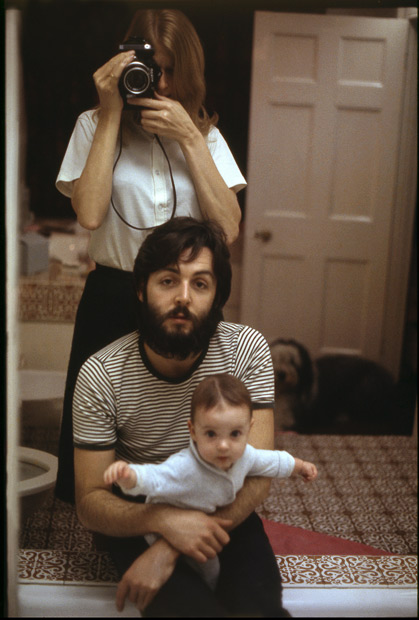
Paul, Linda and Mary McCartney in the bathroom, 1969. The window is out of the frame.

Paul, Linda, Mary and Martha in the bathroom, 1969. The window is out of frame.

An earlier stab at a rehearsal never materialized, but after the Beatles spent about a half hour focusing on “All Things Must Pass” and John’s quick “Mean Mister Mustard” detour, the “Window” was reopened.  “Do you want to stay on that for ‘Bathroom Window?'” Paul asked John, who was still at the piano. He did, and it marked the third consecutive day the group spent time on the song.

Mentioned previously in this space, one delight of the Twickenham takes of “She Came In Through The Bathroom Window” is the chance to hear Paul harmonizing with John on the song. Remember the Abbey Road version features Paul double-tracked.

Still, it’s hard to call these takes ultimately pleasurable. After some brief instruction, we hear three total takes of the song, with the first two dragging to the finish. The final take is a bit livelier. Unlike other McCartney compositions in the first week of the sessions, the song is indeed complete, though, with the same lyrics, melody and general instrumentation as we’d hear on Abbey Road, once that blessed day would come.

Now with “Mustard” on the table and the “Window” closed, the Beatles adjourned, quite appropriately, for lunch.

4 Comments

Filed under Day by day

Jan. 8: An hors d’oeuvre

“All Things Must Pass” should have been a Beatles song, another gripping, iconic anthem dating to the group’s long goodbye.

gh-rs

By the time the Beatles were rehearsing and recording in January 1969, George Harrison’s emergence into a songwriter that rivaled John Lennon and Paul McCartney was essentially complete, with “All Things Must Pass” part of that transformation. Taste matters, but a fair argument could be made that the song could have been the band’s greatest.

“All Things Must Pass” — which had the potential to emerge during the Get Back sessions, be performed live and later land on the Let It Be LP — thus could have gone a long way to giving George his ‘moment’ prior to the group’s send-off of Abbey Road. It never happened. But on January 8, John and Paul gave George the option of taking his song, creating that moment and enjoying his own spotlight at the live show to come. They never said it, but based on the prior week’s tapes, the two senior members of the band were probably just disinterested in playing the song.

“Do you fancy just doing it on your own on an acoustic?” Paul asked. “That would work. But it’s a bit of a thing for you.” The “thing” in question was effort.

Paul would know about playing alone on stage with an acoustic guitar while the rest of the Beatles waited in the wings.

Would opportunity knock, but for George this time?

John was on board, too, condescendingly positing George could serve “an hors d’oeuvre” to the presumptive hungry crowd.

George didn’t directly knock the idea, but didn’t follow up on the suggestions, instead trying work Paul and John on the chorus’ harmonies. After scuttling Paul’s suggestion to begin the song with George’s instrumental opening straight into the chorus, instead of the first verse — hey, it worked for “Don’t Let Me Down” a few days earlier — the pair haggled over the bassist’s harmony line, with Paul complaining it moved too much.

The group spent about a half hour on the tapes working on and around “All Things Must Pass” on January 8 — returning to the song after skipping it the day before — and while there was no significant or specific alterations to the song from the previous days’ rehearsals, they capped the day’s work on the song with a legitimate, listenable and, dare I say, enjoyable take of “All Things Must Pass.” It’s a version that should have shown up, at least, on Anthology 3, in addition to George’s one-man demo from a month later.

While the day’s final take is not too dissimilar in overall form than the one ended up on the final recording on George’s solo debut the following year (excepting the orchestration and dozens of additional flourishes, of course), John’s piano part here — he had moved over from organ in the final phases of the day’s takes — added little, usually amounting to pounding out chords. Still, it’s not wholly detrimental, and Paul’s bass line is on point.  Ringo, as usual, hits the spot.

The Beatles’ greatness has been amplified by the what ifs and what could have beens, and the possibility of a “Beatles’ 1969 classic ‘All Things Must Pass’” is a genuine opportunity lost.

It sounds as good as it could at this point in what amounts to a few hours of overall rehearsal and arrangement with half to three-quarters of the band giving a fraction of effort. It’s the Beatles playing a coherent, complete version of “All Things Must Pass,” and that counts for something in a world where such a release never existed, yet we all paid money (several times, in fact, thanks to new formats, remastering, etc.) to buy “Wild Honey Pie” and “Dig It.”

There is a “rest of the story.” But the vast majority of history of “All Things Must Pass” by the Beatles is now mostly told. This pre-lunch performance marked the final time they played the song at Twickenham. They returned to it very briefly near the end of the month at Savile Row with the support of Billy Preston, who released the song a few months before George would in 1970. By January 8, 1969, the rehearsal stage was essentially over, however, and this was really the final fumes of “All Things Must Pass” as a Beatles song.

Notably, the song never appeared in the Let It Be film. “I Me Mine,” revealed earlier on January 8, did, joining “For You Blue” (which was properly introduced to the band a day later) as George’s contribution to the Get Back sessions. Despite all the hours of rehearsals, the song he carried over into January 1969 as a product of his days with Dylan and The Band, would be passed over by his own band. And it was good enough to serve as the title track of what could be argued to be the greatest Beatles solo album.

6 Comments

Filed under Day by day

Jan. 8: No blue moon in history

Having completed a spirited four-song run-through to jump-start the full band’s session at Twickenham on January 8, 1969, with the ancient “One After 909,” the Beatles managed to dig to the very bottom of the vault and the genesis of the Lennon/McCartney songwriting partnership.

It’s a stretch to say the Beatles played “Too Bad About Sorrows” in the moments after they finished “One After 909,” itself a primeval composition, one John had said was his own, but Paul claimed to have shared credit writing. The spark of “909” propelled the group further down Memory Lane and over to 20 Forthlin Road. Dating back more than a decade to 1957, “Too Bad About Sorrows” has the distinction of being the very first Lennon/McCartney collaboration, per Paul.

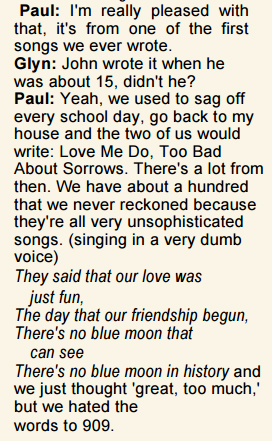
We would sit down with a school notebook which I have to this day, an old tattered copybook, blue lines on white paper, and I would write down anything we came up with, starting at the top of the first page with ‘A Lennon-McCartney Original’. On the next page, ‘Another Lennon-McCartney Original’; all pages have got that. We saw ourselves as very much the next great songwriting team. Which funnily enough is what we became! We started off, I think, with a song called ‘Too Bad About Sorrows’. They all had very simple chord structures but we learned our craft that way.

Paul said much of the same here, on the South Bank Show in 1978.

Lasting about 15 seconds long, all we really hear on the January 8, 1969, performance is John singing the first line of the song — the title — over incoherent guitar and bass accompaniment, and two more garbled lines: “Too bad about love/There’ll be no tomorrow.” The performance itself is obviously forgettable as are so many of the brief stabs at songs these sessions, but this is particularly notable as it enabled the public — via decades of bootlegs and now YouTube clips like the one below sourced from those same bootlegs — to hear the very first Lennon/McCartney song.

The group would similarly perform a taste of “Too Bad About Sorrows” nearly two weeks later after the sessions shifted to Savile Row.

Straight out of the stab at “Too Bad About Sorrows,” John playfully delivered the line, “There’s no blue moon in history,” before letting out a giggle. Seconds later, he and Paul shared vocals on an impromptu version of “Just Fun,” the song John had just referenced and what is considered the second collaboration from the Lennon/McCartney team. In between, John delivered the line about “pot-smoking FBI members” that would eventually appear on the Let It Be album, and referenced in the last post.

Two days earlier, “Just Fun” had come up in conversation with director Michael Lindsay-Hogg and producer Glyn Johns in a sequence that ended up in the Let It Be film as they discussed the revival of “One After 909.” Paul weakly sang the opening lines from “Just Fun” as part of a greater recounting of the early days of writing with John.

The Jan. 6 discussion of “Just Fun,” from the “Get Back” book.

This attempt wasn’t as comprehensive as the abbreviated January 6 version, lasting just a single line: “They said that our love was just fun.” Things broke down as George interrupted to go over new songs to be rehearsed. “Just Fun” wasn’t performed — at least at these sessions, and that we know of — by the Beatles again. Like “Too Bad About Sorrows,” this wasn’t any kind of groundbreaking performance, but it’s a slice of history that’s thankfully preserved.

Beyond the South Bank Show clip above, Paul has dusted off “Just Fun” elsewhere, including two verses’ worth of the song at a 2004 soundcheck in Zurich, of all dates and places. Quite oddly, John’s singing of the line “There’s no blue moon in history” shows up in the once indispensable 1982 documentary “The Compleat Beatles” (this author’s first real exposure to the band’s history) as background during an interview with George Martin about Beatles For Sale, for some reason. So in that strict sense, it’s actually been officially released, albeit a few seconds’ worth.

Unfortunately, “Just Fun” is a terrible, terrible, awful lyric. Even Paul agrees.

There was one called ‘Just Fun’ we couldn’t take any further: ‘They said that our love was just fun / The day that our friendship begun / There’s no blue moon / That I can see / There’s never been / In history …’ Ooops! It’s horrible, this is horrible. When we heard heard that rhyme we just went off that song in a big way. We were never really able to fix it either. But they’d get written down and we’d play ‘em. We’d say, ‘Wow, we’ve written some songs, you know, d’you wanna hear them? “Said our love was just fun …”’

There’s never been a blue moon in history? For heaven’s sake, Paul, there was a blue moon over Liverpool in August 1956, 11 months before you met John and wrote this song!

It turned out OK for these guys, though, and Lennon/McCartney — together and alone — figured it out. For instance, we all can agree that “She Said She Said” — the next song the group played on January 8, after a mention from George — is a quite terrific lyric.

Considering the band never performed the song live, and presumably hadn’t played it at all together in two-and-a-half years, the group holds together the first verse decently enough.

As we recount events two days before George left the Beatles on January 10, it’s worth marking that the original 1966 recording session of “She Said She Said” was missing Paul. He walked out after he “had a blarney” with the others, the first Beatle to tentatively leave the group.

1 Comment

Filed under Day by day