Jan. 8: An hors d’oeuvre

“All Things Must Pass” should have been a Beatles song, another gripping, iconic anthem dating to the group’s long goodbye.
gh-rs

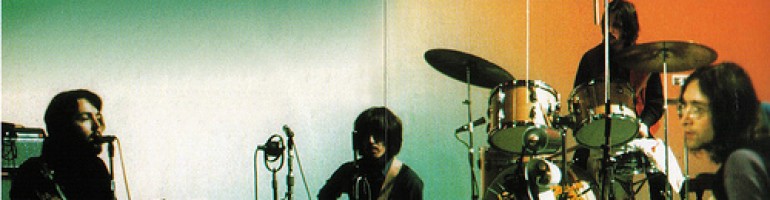
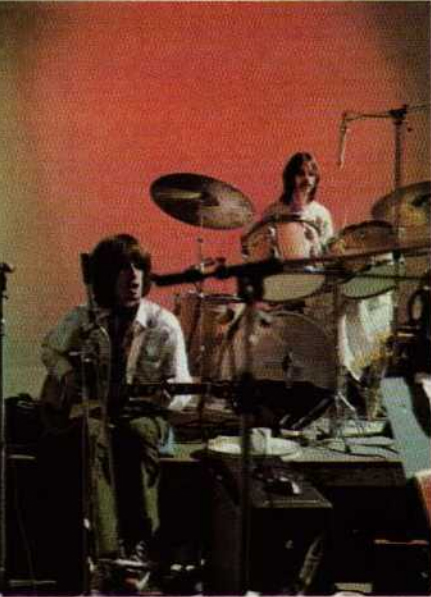
By the time the Beatles were rehearsing and recording in January 1969, George Harrison’s emergence into a songwriter that rivaled John Lennon and Paul McCartney was essentially complete, with “All Things Must Pass” part of that transformation. Taste matters, but a fair argument could be made that the song could have been the band’s greatest.

“All Things Must Pass” — which had the potential to emerge during the Get Back sessions, be performed live and later land on the Let It Be LP — thus could have gone a long way to giving George his ‘moment’ prior to the group’s send-off of Abbey Road. It never happened. But on January 8, John and Paul gave George the option of taking his song, creating that moment and enjoying his own spotlight at the live show to come. They never said it, but based on the prior week’s tapes, the two senior members of the band were probably just disinterested in playing the song.

“Do you fancy just doing it on your own on an acoustic?” Paul asked. “That would work. But it’s a bit of a thing for you.” The “thing” in question was effort.

Paul would know about playing alone on stage with an acoustic guitar while the rest of the Beatles waited in the wings.

Would opportunity knock, but for George this time?

John was on board, too, condescendingly positing George could serve “an hors d’oeuvre” to the presumptive hungry crowd.

George didn’t directly knock the idea, but didn’t follow up on the suggestions, instead trying work Paul and John on the chorus’ harmonies. After scuttling Paul’s suggestion to begin the song with George’s instrumental opening straight into the chorus, instead of the first verse — hey, it worked for “Don’t Let Me Down” a few days earlier — the pair haggled over the bassist’s harmony line, with Paul complaining it moved too much.

The group spent about a half hour on the tapes working on and around “All Things Must Pass” on January 8 — returning to the song after skipping it the day before — and while there was no significant or specific alterations to the song from the previous days’ rehearsals, they capped the day’s work on the song with a legitimate, listenable and, dare I say, enjoyable take of “All Things Must Pass.” It’s a version that should have shown up, at least, on Anthology 3, in addition to George’s one-man demo from a month later.

While the day’s final take is not too dissimilar in overall form than the one ended up on the final recording on George’s solo debut the following year (excepting the orchestration and dozens of additional flourishes, of course), John’s piano part here — he had moved over from organ in the final phases of the day’s takes — added little, usually amounting to pounding out chords. Still, it’s not wholly detrimental, and Paul’s bass line is on point.  Ringo, as usual, hits the spot.

The Beatles’ greatness has been amplified by the what ifs and what could have beens, and the possibility of a “Beatles’ 1969 classic ‘All Things Must Pass’” is a genuine opportunity lost.

It sounds as good as it could at this point in what amounts to a few hours of overall rehearsal and arrangement with half to three-quarters of the band giving a fraction of effort. It’s the Beatles playing a coherent, complete version of “All Things Must Pass,” and that counts for something in a world where such a release never existed, yet we all paid money (several times, in fact, thanks to new formats, remastering, etc.) to buy “Wild Honey Pie” and “Dig It.”

There is a “rest of the story.” But the vast majority of history of “All Things Must Pass” by the Beatles is now mostly told. This pre-lunch performance marked the final time they played the song at Twickenham. They returned to it very briefly near the end of the month at Savile Row with the support of Billy Preston, who released the song a few months before George would in 1970. By January 8, 1969, the rehearsal stage was essentially over, however, and this was really the final fumes of “All Things Must Pass” as a Beatles song.

Notably, the song never appeared in the Let It Be film. “I Me Mine,” revealed earlier on January 8, did, joining “For You Blue” (which was properly introduced to the band a day later) as George’s contribution to the Get Back sessions. Despite all the hours of rehearsals, the song he carried over into January 1969 as a product of his days with Dylan and The Band, would be passed over by his own band. And it was good enough to serve as the title track of what could be argued to be the greatest Beatles solo album.

6 Comments

Filed under Day by day

TMBP Extra: RIP George Martin

It’s so obvious a statement, it sounds dumb to write: Without George Martin, who died Tuesday at 90, the Beatles would have been a completely different entity from the one he signed, nurtured and produced.

martin

January 1969

The Beatles existed before Martin agreed to sign them to Parlophone in 1962, and had he not, the group would have continued to do so.  If George Martin didn’t manage and help develop the Beatles sound, someone else ultimately would have. But we can only imagine what the output would have been, and if we would still be talking about it more than 50 years later. Because of Martin, there’s no question: Here we are still talking about it.

George Martin produced, arranged, mixed, composed and was otherwise involved with hundreds of records over half a century. The Beatles’ output adds up to a fraction of it (and he notably wasn’t involved in one record). But his creativity and willingness to interpret the sounds inside the heads of Lennon/McCartney/Harrison/Starr and pull together the resources to apply it tangibly to wax earned Martin all the praise he has received as a forefather, godfather, innovator and icon. If he didn’t make the Beatles into The Beatles, maybe we’d be writing here about how innovative his work with another band was — if he crossed over from jazz and comedy records to pop music at all.

McCartney & Martin in the ’80s

This blog deals with January 1969, the precise moment when George Martin mattered least to the Beatles. He ended up something of an adviser at the Get Back sessions, and it was ultimately left to Phil Spector to, as Martin would describe it, “overproduce” Let It Be for release. As someone who brought the most out of the Beatles (I was going to list song titles as examples, then the list got too long), Martin’s view of the Spector production reveals what Martin himself thought he did best for the Beatles.  From Anthology:

[Spector’s Let It Be] was bringing The Beatles’ records down a peg — that’s what I thought. Making them sound like other people’s records.

The Beatles may have pinched ideas from other bands, but when George Martin produced, they never, ever sounded like another band.

Paul McCartney — the only Beatle to work again with Martin after the breakup — asked him to produce Abbey Road as a swan song, and that record is damn near perfect — like so many other wildly varied Beatles efforts Martin was tasked with producing.

George Martin put up with a lot of nonsense working with the Beatles, often enabling implausible sonic ideas while increasingly dealing with, to use sports parlance, an out-of-control clubhouse. The Beatles may have wanted to make an “honest” album with Abbey Road, but that didn’t mean they got along much better than they did while working on Let It Be (or the White Album, for that matter).  But recording that final album gave Martin closure, too.  Again, from Anthology:

Nobody knew for sure that it was going to be the last album — but everybody felt it was. The Beatles had gone through so much and for such a long time. They’d been incarcerated with each other for nearly a decade, and I was surprised that they had lasted as long as they did. I wasn’t at all surprised that they split up because they all wanted to lead their own lives — and I did, too. It was a release for me as well.

It’s 2016, and the world has been without two of the Beatles for a long time now. There have been a lot of contenders for “fifth Beatle” — George Martin, Mal Evans, Billy Preston — and we’ve lost them all, too. (A silly case could be made that Ringo is the fifth Beatle, since Pete Best is arguably part of the first four, but that’s for another rainy day). But whether it’s vinyl, cassette, CDs or MP3s, thank God we’ll always have the music.

Rest in peace, George Martin.

2 Comments

Filed under Extra

TMBP Extra: Since he fell out of the womb

Over the years, we’ve celebrated the birthdays of Paul McCartneyJohn Lennon and Ringo Starr, looking back at the periods straddling the big days in 1968-1969. Today it’s George Harrison’s turn. It may be the anniversary of George Harrison’s birth today, or it may be the day after the anniversary of his birth. With Liverpool under bombardment during World War II, keeping the records became confused that day in 1943. But February 25 is the day George celebrated, so it’ll be the day we mark, too.

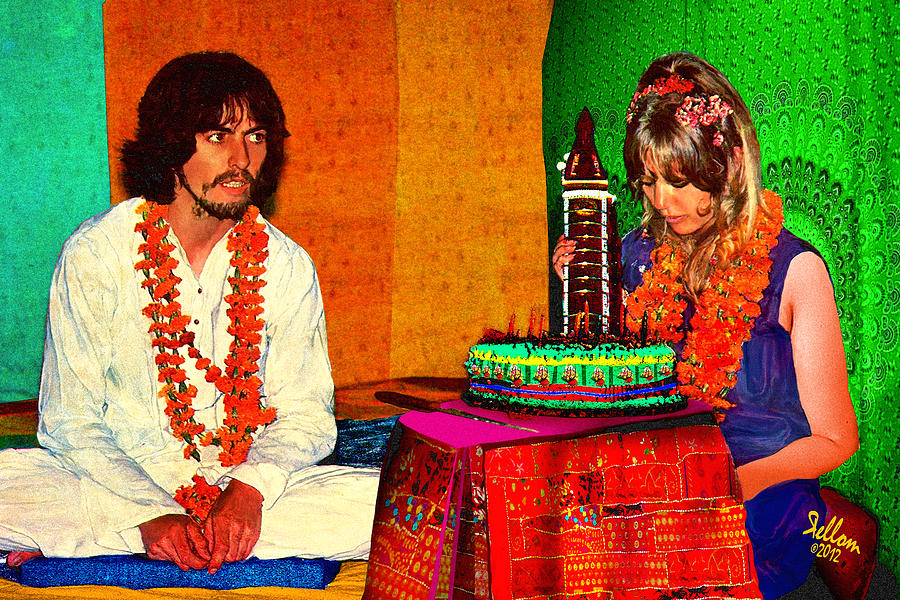
1968, in India. That's actually a cake for Pattie Boyd, whose birthday was a three weeks after George's.

India, 1968. That’s actually a cake for Pattie Boyd, whose birthday was three weeks after George’s.

George’s 26th birthday came just a few weeks after the Beatles wrapped up the Get Back sessions at Twickenham and Savile Row. It capped a remarkable year in his life and career, one that could fill a book, much less a blog post.

George’s 25th birthday was celebrated in India less than 10 days after the Beatles arrived to study Transcendental Meditation under Maharishi Mahesh Yogi. Their retreat lasted nearly two months (for George, who outlasted the rest of the Beatles), transforming the four men, their music and Western culture along the way.

Starting in May and lasting throughout the summer, the Beatles recorded The Beatles. The double White Album, featuring a career-high four compositions, would be released before the winter. In between, George produced Jackie Lomax and saw the release of his solo LP Wonderwall, which was recorded late 1967 and early 1968. (It’s really great, and worth infinite listens).

With Winter 1968 came another transformative overseas trip, this time on the other side of the earth from India, a journey that included a stop in upstate New York, where George spent an intimate holiday with Bob Dylan and the Band, playing and writing songs. They were not laying the groundwork for the formation of the Traveling Wilburys about 20 years later, but it’s worth the dream.

That brings us to January 1969, and you can read all about it here and in posts to come. It’s worth noting, George brought Billy Preston into the Beatles’ circle, and then later would produce him for Apple.

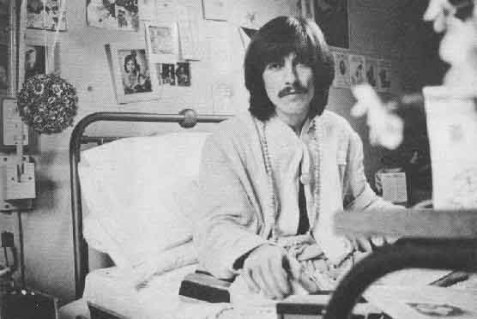
What happened next? George had his tonsils out a week after the rooftop concert, and was laid up for about another week.

George breaks up with his tonsils, February 1969. Photo appears in his autobiography, I Me Mine.

George breaks up with his tonsils, February 1969. Photo appears in his autobiography, I Me Mine.

He joined the rest of the Beatles on February 22, 1969, to record the first 35 takes of “I Want You,” essentially beginning the Abbey Road sessions, and that about brings things up to his 26th birthday, on February 25, 1969.

Of course, that’s not it. What about the music? Check out this list of Harrisongs composed or at least worked on seriously between his 25th and 26th birthdays (listed alphabetically, with one obvious omission I’ll explain below): “All Things Must Pass,” “Badge” (with Eric Clapton), “Circles” (eventually released in 1982), “Dehradun,” “For You Blue,” “Hear Me Lord,” “I Me Mine,” “I’d Have You Anytime,” “Isn’t it a Pity,” “Long, Long, Long,” “Not Guilty” (left off the White Album, it was released in 1979), “Nowhere to Go” (All Things Must Pass LP outtake written with Dylan), “Old Brown Shoe,” “Piggies,” “Savoy Truffle,” “Sour Milk Sea” (written for Jackie Lomax), “Wah-Wah,” “While My Guitar Gently Weeps,” “Window, Window” (another All Things Must pass outtake). And there’s probably others we don’t know the origins of that would fall in this timeframe too.

Enjoy it all on this YouTube playlist (it’s not just “Badge” as the image implies — click around!):

Not too shabby. As a bonus, he finally had his first song to appear on a Beatles single — the mighty “The Inner Light” was on the flip side of the “Lady Madonna” single, released while they were in India.

Oh, he bought a Moog, too. More about that later in 1969.

George had a really good year, artistically. It was an important one spiritually, too, and he was expanding his professional horizons and stockpiling compositions. In many ways, he shaped the Get Back sessions by walking out and resetting the parameters under which the group would perform live, plus he brought Billy into the fold. His relationship with Dylan, developed when he was in New York, was a critical moment in his career and his own window into how other artists could interact, and reflecting everything that was wrong with the Beatles. While he was still not quite yet afforded the same global respect given to Paul and John, the Beatles’ junior member’s time would come in 1969, thanks in large part to something.

Sorry, I missed the punctuation and capitalization. That’s thanks in part to “Something.” 

There are lots of dumb ways to spend a birthday in your 20s, but recording a few demos at EMI Studios on Abbey Road isn’t one of them.  February 25, 1969, saw George cut solo acoustic versions of “Old Brown Shoe” (first debuted during the Get Back sessions) and “All Things Must Pass” (from 1968, and rehearsed extensively in January 1969). The final song he worked on that day was “Something”, the seeds of which were planted in 1968, but he hadn’t completed as late as the final days leading to the rooftop concert on January 30, 1969.

You can find takes of all three songs on Anthology 3, with a fleshier version also on the 2019 Abbey Road anniversary deluxe edition.

The commercial and critical success of the Abbey Road release of “Something” (finally, his first A-side) — earning high praise from Lennon and McCartney — plus the LP’s “Here Comes the Sun,” changed how George Harrison, Songwriter, was viewed. The time and efforts he spent between his birthdays in 1968 and 1969 propelled him to that point.

6 Comments

Filed under Extra

Jan. 8: No blue moon in history

Having completed a spirited four-song run-through to jump-start the full band’s session at Twickenham on January 8, 1969, with the ancient “One After 909,” the Beatles managed to dig to the very bottom of the vault and the genesis of the Lennon/McCartney songwriting partnership.

It’s a stretch to say the Beatles played “Too Bad About Sorrows” in the moments after they finished “One After 909,” itself a primeval composition, one John had said was his own, but Paul claimed to have shared credit writing. The spark of “909” propelled the group further down Memory Lane and over to 20 Forthlin Road. Dating back more than a decade to 1957, “Too Bad About Sorrows” has the distinction of being the very first Lennon/McCartney collaboration, per Paul.

We would sit down with a school notebook which I have to this day, an old tattered copybook, blue lines on white paper, and I would write down anything we came up with, starting at the top of the first page with ‘A Lennon-McCartney Original’. On the next page, ‘Another Lennon-McCartney Original’; all pages have got that. We saw ourselves as very much the next great songwriting team. Which funnily enough is what we became! We started off, I think, with a song called ‘Too Bad About Sorrows’. They all had very simple chord structures but we learned our craft that way.

Paul said much of the same here, on the South Bank Show in 1978.

Lasting about 15 seconds long, all we really hear on the January 8, 1969, performance is John singing the first line of the song — the title — over incoherent guitar and bass accompaniment, and two more garbled lines: “Too bad about love/There’ll be no tomorrow.” The performance itself is obviously forgettable as are so many of the brief stabs at songs these sessions, but this is particularly notable as it enabled the public — via decades of bootlegs and now YouTube clips like the one below sourced from those same bootlegs — to hear the very first Lennon/McCartney song.

The group would similarly perform a taste of “Too Bad About Sorrows” nearly two weeks later after the sessions shifted to Savile Row.

Straight out of the stab at “Too Bad About Sorrows,” John playfully delivered the line, “There’s no blue moon in history,” before letting out a giggle. Seconds later, he and Paul shared vocals on an impromptu version of “Just Fun,” the song John had just referenced and what is considered the second collaboration from the Lennon/McCartney team. In between, John delivered the line about “pot-smoking FBI members” that would eventually appear on the Let It Be album, and referenced in the last post.

Two days earlier, “Just Fun” had come up in conversation with director Michael Lindsay-Hogg and producer Glyn Johns in a sequence that ended up in the Let It Be film as they discussed the revival of “One After 909.” Paul weakly sang the opening lines from “Just Fun” as part of a greater recounting of the early days of writing with John.

The Jan. 6 discussion of “Just Fun,” from the “Get Back” book.

This attempt wasn’t as comprehensive as the abbreviated January 6 version, lasting just a single line: “They said that our love was just fun.” Things broke down as George interrupted to go over new songs to be rehearsed. “Just Fun” wasn’t performed — at least at these sessions, and that we know of — by the Beatles again. Like “Too Bad About Sorrows,” this wasn’t any kind of groundbreaking performance, but it’s a slice of history that’s thankfully preserved.

Beyond the South Bank Show clip above, Paul has dusted off “Just Fun” elsewhere, including two verses’ worth of the song at a 2004 soundcheck in Zurich, of all dates and places. Quite oddly, John’s singing of the line “There’s no blue moon in history” shows up in the once indispensable 1982 documentary “The Compleat Beatles” (this author’s first real exposure to the band’s history) as background during an interview with George Martin about Beatles For Sale, for some reason. So in that strict sense, it’s actually been officially released, albeit a few seconds’ worth.

Unfortunately, “Just Fun” is a terrible, terrible, awful lyric. Even Paul agrees.

There was one called ‘Just Fun’ we couldn’t take any further: ‘They said that our love was just fun / The day that our friendship begun / There’s no blue moon / That I can see / There’s never been / In history …’ Ooops! It’s horrible, this is horrible. When we heard heard that rhyme we just went off that song in a big way. We were never really able to fix it either. But they’d get written down and we’d play ‘em. We’d say, ‘Wow, we’ve written some songs, you know, d’you wanna hear them? “Said our love was just fun …”’

There’s never been a blue moon in history? For heaven’s sake, Paul, there was a blue moon over Liverpool in August 1956, 11 months before you met John and wrote this song!

It turned out OK for these guys, though, and Lennon/McCartney — together and alone — figured it out. For instance, we all can agree that “She Said She Said” — the next song the group played on January 8, after a mention from George — is a quite terrific lyric.

Considering the band never performed the song live, and presumably hadn’t played it at all together in two-and-a-half years, the group holds together the first verse decently enough.

As we recount events two days before George left the Beatles on January 10, it’s worth marking that the original 1966 recording session of “She Said She Said” was missing Paul. He walked out after he “had a blarney” with the others, the first Beatle to tentatively leave the group.

1 Comment

Filed under Day by day

Jan. 8: Rocky and the Rubbers

Our world lost — and the stars and heavens regained — David Bowie last week. I didn’t feel much like blogging about the Beatles for a little bit, even though this post had already been mostly written. But as the man once sang, time is waiting in the wings, and we should be on by now. So please enjoy the continuation of the Beatles’ Nagra tapes timeline, picking up with the morning of January 8, 1969, as David Bowie was celebrating his 22nd birthday across town and working on writing Space Oddity.

It’s tough to say “this is when they got serious” when there were laughs and smiles throughout, but after more than a half hour on the January 8, 1969, Nagra reels, the Beatles at least found a bit of motivation and a short-term goal to complete, getting serious in deed if not demeanor. With a concert to be staged, John, Paul, George and Ringo gathered their focus for a chirpy, energetic run-through of four songs deemed early contenders for a live show.

Paul led the proceedings, tabbing his original duet as the opener: “Johnny, ‘On Our Way Back Home.’”

If you’ve seen Let It Be — and I really hope you have and will one day again on some sort of modern entertainment replay device – you’ve been struck by how loose John and Paul are, hamming it up as they sing into the same microphone.

Two of Us

Paul, who Ringo in an interview the previous year referred to as“Elvis” in reference to his performance of “Lady Madonna,” was closer to the toxically impaired King, comically slurring and sneering throughout a take that both he and John sang without benefit of a lyric sheet. That’s how we end up with John, laughingly repeating his mistake “two of us wearing postcards” once the take was complete. They laughed the as they sang it during the take, too.

While Paul and John can’t often get through more than a few words without butchering a lyric, there was no turning back once they started, with this a sincere attempt at a run-through.

The sequence appears slightly edited in the film, cutting the performance in half from its actual three minutes to a minute-and-a-half. Had the group secretly abandoned the film and this leaked, conventional wisdom would have been that the group had a blast at Twickenham. Maybe they were just hamming it up for the cameras — or John was, at least — but it’s hard to deny a somewhat different spirit in the room with a watch and listen. When things were languid at Twickenham, it was painfully clear.

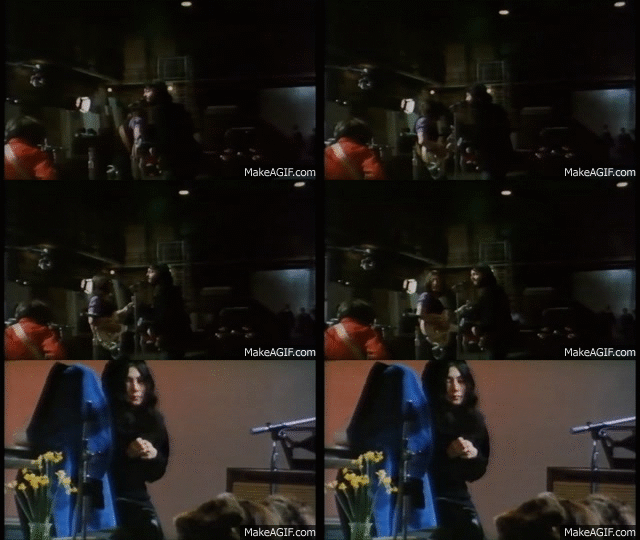
A visually telling edit by movie director Michael Lindsay-Hogg comes around 30 seconds into the clip, as we catch John glancing over at Yoko, who blankly stares back, as he stands oh, so close to Paul, showing some of the genuine affection that they certainly used to have and somewhere deep in there still did.

Yoko and Us

Two of us, and also Yoko

If you can use the word “tragedy” when referring to the fact a song was omitted from a compilation –- you shouldn’t, but I will, deplorably -– it’s a tragedy this take didn’t make it onto Anthology 3. It’s in the film, thus is a recognizable, published “official” release, so despite the issues with the lyrics, it’s “out there.” Consumers would have understood having an(other) imperfect take on the compilation, if not welcomed it.

In the film, the song comes out of the “shocktric shocks” sequence from a few days earlier, and then dumps into “I’ve Got a Feeling,” but in reality the group – after the improvised “You Got Me Going” and a few unserious seconds of “Twist and Shout” – delivers “Don’t Let Me Down.” Note the time between the end of “Two of Us” and “Don’t Let Me Down” is less than a minute. Dallying was at a minimum. While “Don’t Let Me Down” appears several times in Let It Be, this version is not in the film.

George didn’t quite nail the introduction, but again there was no concern when the lyrics were muffed. John simply shouted “Snotgobbler!” and moves on. That’s rock and roll. So was the pre-primal scream from John as the song began.  So were the lyrics “nobody ever rubbed me like she do me,” which John subs in at one point. The band played on, and musically it was relatively tight, really an achievement at this point in the song’s lifespan.

beardclose up

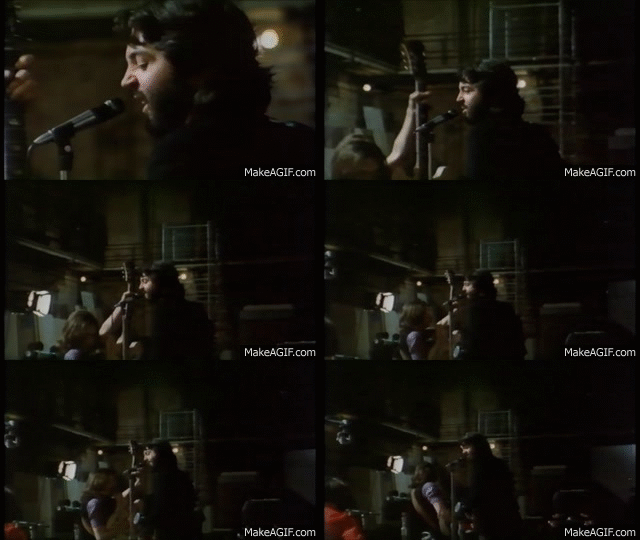
Paul beard porn from the January 8 sessions, as seen in Let it Be. Thank me later.

John came out of the high-energy take with thanks from the “band.” “God bless you, ladies and gentlemen, I’d just like to say a sincere farewell from Rocky and the Rubbers, this is Dirty Mac himself saying …”

Paul cut in, all business: “I’ve Got a Feeling.”

goodmorning

“Good morning!”

The performance was a tick slower at the outset, and with continued lyrical miscues (especially Paul and John mismatching “oh no” and “oh yeah” early on), but it retained the same vigor as the two previous songs. Paul shouts a celebratory “good morning!” after wailing “somebody who looks like you!” as George hits the middle-eight guitar part.

This sequence made the film, notably appended to a particularly torturous rehearsal from a day later.

Three songs into the run-through, John revealed some fatigue, perhaps reflecting the weight of the previous week more than the prior 10 minutes: “Only another two days to go, then we’ll have another two off.” But Paul then offers a pick-me-up, suggesting, “Do ‘One After 909’.” So they did.

This number marked the one point in the four-song run-through the group stopped after they started, rebooting the take after George’s solo. Once again, there’s a disconnect with the film. Based on clothes alone, this performance of “One After 909” is featured visually early in the movie — after Paul’s discussion of the song with Lindsay-Hogg from a couple days earlier (as seen in the film) — but paired with the audio of a take from January 9.

The movie and even a moment of the Let It Be LP was further fleshed out with a bit of memorable dialogue coming out of “One After 909.” You’ll hear it on the Let It Be LP prior to “For You Blue,” George’s eventual lone contribution to album that was just days old, as John reads from the newspaper.

Queen says no to pot-smoking FBI members.

What, you thought she’d be OK with it?

Again, we have a disconnect between the movie and the tapes, as the film moves to a previous day’s take of “Oh! Darling” while in real time, the band had completed their first commitment to a run-through for a show yet to materialize. It was rough, but it was spirited, and if anything, the set must have given them the idea there would be a light at the end of the tunnel if they chose to shine it. With at least four fully formed songs, they were on their way, and the apparent positivity could easily be read to bode good fortune ahead.

Probably inspired by “One After 909,” they continued a quick dip into their back catalog.

10 Comments

Filed under Day by day