Jan. 3, 1969: No little thing

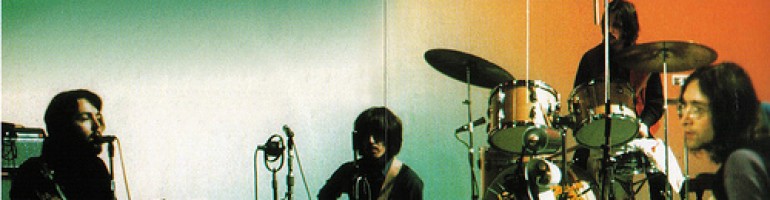
Just as the band was trying to find an agreeable venue for the concert that would cap the sessions, they likewise were searching for a setlist.

The new songs they were rehearsing were a given — at this early point, it was obvious “I’ve Got a Feeling” and “Don’t Let Me Down” were being worked on to reach that payable point and passed the generally accepted bar of “fast” ones good for a live show.

In a curious admission, George expresses his worry about putting on a TV show of all new songs. Of course, by that point,  the critical failure Magical Mystery Tour (the film) was a little over a year old, and it wouldn’t be seen in the United States until 1974, supposedly because of the negative criticism surrounding it.

But they’re still the Beatles! The White Album was in the middle of a nine-week run atop the charts in the U.S., en route to becoming their best-selling record (each sale counted as two). “Hey Jude” was the No. 1 song in the U.S. as recently as six weeks earlier after spending nine atop the Billboard charts, and it was still sitting at No. 15.

Also, they’re the Beatles.

Yet George was still concerned about how new songs would be received.

So of all the songs, George suggests an album track from 1964’s Beatles For Sale.

“We’re not going to do any oldies but goldies for the show?” George asks.

“Dunno, could be” says Paul.

“Cuz I’d like to do it,” George continues, agreeing with someone who says “it would be nice.”

“And also from the selling point of view, in America … maybe it’s all new, or maybe… If they had the album and then saw it, [the concert]  a week after. But just to hit… the first initial thing of us singing all completely new … they need something to identify with apart from us. It would be nice to start the show or end the show with a couple of… (then he either cuts himself off of the sound cuts out.)

I’ll tell you which is a good one..

Then George starts playing the beginning to “Every Little Thing.” Paul, the song’s author, joins in with little gusto. We get to see some of this sequence in the 2021 Get Back docuseries.

So of all songs George suggests would be a good kick-start — or capper — to the big concert, it’s not “Hey Jude,” not “Back in the USSR” — which George had been riffing on leading into this suggestion — not his own recent classic “While My Guitar Gently Weeps”  or slightly older “Taxman.”  He could have suggested “All My Loving,” which opened up the first Ed Sullivan appearance and won over the United States instantly. Or for the idea of going full circle, the first song off their first album in “I Saw Her Standing There.”

But instead it was “Every Little Thing.” A great song! But probably just a tick more familiar as the other new songs they’d debut.

I don’t question the choice from a standpoint of quality. It’s just surprising. And I wonder if it would have done anything to “ease” American audiences.

As it happened, the Beatles would, in fact, find an oldie of theirs to play at the concert that ended the sessions, and they dusted it off earlier in the day on Jan. 3. But while it was an old Beatles song, it wasn’t something that would be at all familiar to fans…

7 Comments

Filed under Day by day

TMBP Extra: Not Fade Away

Three years before the Beatles breathed life into music was the day the music died: Feb. 3, 1959, when Buddy Holly, Ritchie Valens and the Big Bopper were killed in a plane crash, along with pilot Roger Peterson.

The influence of Buddy Holly & the Crickets on the Beatles can’t be understated; from their sound to their name and even their look in some ways (John felt OK to wear glasses), they were true inspirations.

The Quarrymen recorded “That’ll Be the Day” as their first acetate, and later the Beatles would tackle “Words of Love” for Beatles for Sale. “Crying, Waiting, Hoping,” was also done for the BBC. Paul, famously, went on to buy the rights to Buddy Holly’s songs in 1975, and both he and John Lennon — likewise, a major admirer — covered his songs during their solo careers.

And of course, Holly would be covered during the Get Back sessions.  So as we remember Buddy Holly, enjoy the Beatles remembering him, through his music. Worth noting, perhaps, that unlike so many of the other covers they’d touch on during the sessions, they often completed the Holly covers, or at least offer more than a few-seconds snippet.


Leave a comment

Filed under Extra

Jan. 3, 1969: Starrwriter 69

Quite literally, the freshest sound in music right now is by Ringo Starr, whose 17th solo release — Ringo 2012 — hit shelves and servers today (Jan. 31, 2012).  Most of the songs are at least co-written by him, meaning perhaps Richard Starkey is is finally hitting his stride as a songwriter as he has little more than 100 songs to his credit over the course of 50-plus years since the Beatles began recording. And many of those — while I don’t doubt his contributions — are things like “Dig It” and “Flying,” songs that received the four-Beatle credit and other songs in which he presumably didn’t have much heavy lifting.

Of course, that list doesn’t count songs written and not registered. It certainly doesn’t have songs he partially crafted. And that’s just what we have out of Ringo as early on the second day as rehearsals continue at Twickenham.

Source: thebeatles.com

George was discussing The Band with Paul and Ringo (John wasn’t there yet) and how their favorite track (presumably off the White Album — he didn’t specify) was “Don’t Pass Me By” because of its country western vibe.  “That’s their scene, completely,” George said of the very first composition credited solely to Starkey.

Paul chimes in to ask Ringo, “Are you going to write another?”

“Yes I am,” he replied, almost incredulously before some cross-talk obscures what was said next, although Paul already knew what was in the works. In fact, he already was able to name one — “Picasso” (also bootlegged as “I Bought A Picasso”) — before Ringo started pounding out the chords (a struggle).

“Let’s hear it,” Paul asked, remarking it was “a fast one” — something they were looking to add to the set list of the live show. “Too fast for me,” Ringo replied. Paul, as well as George, had absolutely heard it before based on their reactions and subsequent suggestions.

Sounding very similar — and, really, quite like a sped-up “Don’t Pass Me By” — Ringo then launched into “Taking a Trip to Carolina” — a song he’d first touched upon for 45 seconds or so a few minutes prior to “Picasso.” As he says midway through, “the words are not very good.”

Note that this clip, from the bonus disc that came with “Let it Be … Naked,” begins with the exchange that preceded “Picasso” edited in as the lead-in to “Taking a Trip to Carolina.” But in reality, that’s not the exact order of how it really happened.

“Carolina” was also featured in the 2021 Get Back docuseries.

Ringo wouldn’t showcase a song again until later in the month, with “Octopus’s Garden,” which of course would later appear on Abbey Road (I’ll cover the song’s introduction to the sessions when I reach that date). We wouldn’t hear either “Picasso” or “Taking a Trip to Carolina” for the remainder of the tapes.

He would not have a vocal on Let it Be — either of the iterations (Glyn Johns mix of the Get Back LP or the final Phil Spector production) — marking the first time that happened since the A Hard Day’s Night LP in 1964 (*He didn’t have a lead on ’67’s Magical Mystery Tour, either, but it was technically an EP with old singles padding the US full-album release).

17 Comments

Filed under Day by day

TMBP Extra: Rooftopaversary

I need to make one more interruption before returning to the day-by-day tapes breakdown to recognize the 43nd anniversary of the rooftop concert atop 3 Savile Row that just about concluded the Get Back sessions and wrapped the Beatles’ career as a live act. More on this iconic event as I eventually reach it in the Nagra tapes timeline down the road.

9 Comments

Filed under Extra

TMBP Extra: We all shine on

Phil Spector, John Lennon

A key date in the history of the Get Back sessions came a full year later, five months since the end of the Abbey Road sessions and a few weeks removed from the final time the Beatles — three of them, at least (no John) — recorded as a unit.

It was on this day in 1970 Phil Spector entered the Beatles’ orbit.

Spector, for better or worse, soon became the producer for the Let It Be album. And it was for his work on that incredible day — Jan. 27, 1970, the day “Instant Karma!” was born.

As Lennon famously put it:

I wrote it for breakfast, recorded it for lunch and we’re putting it out for dinner.

And it was released 10 days later. The song may have been written the day before, but that’s splitting hairs.

The key takeaways:

  • Finally we have a commercial solo record by a Beatle. And it’s really a classic.
  • The work of Spector —  who had said he always wanted to produce the Beatles and was in London to talk to George Harrison about his own solo work (according to the terrific “You Never Give Me Your Money” by Peter Doggett; I’d seen other explanations for how they hooked up) — so impressed John and George that he was tasked with putting together what would be called the Let it Be album two months later. And in doing so, the original intent of the Get Back sessions — capturing the band’s live essence — was in large part shattered with the (over)production.

Regardless of the impact on the Beatles as a whole, Spector became massively important in the solo work of John (Plastic Ono Band, Imagine, Some Time in NYC, Rock & Roll, other singles) and George (All Things Must Pass, Concert for Bangladesh, Living in the Material World).

And it started here:

Leave a comment

Filed under Extra