Jan. 9: It’s dead easy

It took only a few minutes on January 9, 1969, for Paul McCartney to invoke jazz guitar, classical compositions and swing percussion for a hymnal ballad being written for an R&B singer that would become a classic rock and easy listening staple.

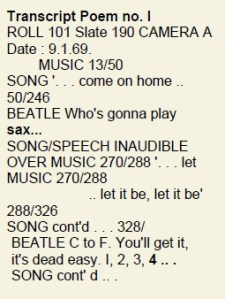
Transcript Poem No. 1, from the Get Back Book

“Let It Be,” lovingly and deliberately crafted during much of this day, spoke clearly to Paul’s boundless musical vocabulary, and on the day’s Nagra tapes we clearly hear the well-defined, rich genetic code buried within the song. No wonder it’s so special.

Dubbed “Mother Mary” by Paul at this point, “Let it Be” received solo piano treatment early in the day’s session per Paul’s daily ritual and a brief engagement, mainly with George Harrison, midday. The full ensemble’s rehearsal treatment later in the working day crafted the song into something both concrete and familiar. But importantly and quite visibly, Paul didn’t arrange it all by himself.

To recap the chronology of “Let It Be” to this point:

September 6, 1968: The earliest-known recording of the song — released in 2018 on the White Album Deluxe — consisted of a snippet of the first verse and chorus. Paul is on piano (the group was in the midst of recording “While My Guitar Gently Weeps”). If there was anything to “Let It Be” beyond this, it’s either buried inside the vaults at Abbey Road, secured in Paul’s private archives or lost amid the echoes of Cavendish Avenue. But there’s no reason to believe there was really much more, because …

January 3, 1969: While the song gained an introduction as the Beatles rehearsed in their first full day at Twickenham, Paul hadn’t advanced “Let It Be” beyond the first verse and chorus, exactly what he had in 1968.

January 8, 1969: After the weekend and a couple extra days, the song appeared on the tapes again, as Paul disclosed he wrote the song for Aretha Franklin — but he wanted the Beatles to record it, too. Paul instructed a faster pace on the drum pattern and shared the chord structure with George. The musical tag was borrowed from the introduction and applied to the song’s conclusion, as the day’s session wrapped.

On January 9, the song was a significant focal point, with rehearsals of “Let It Be” alone taking up a good 20 percent of the day’s recorded sessions on the tapes. An initial midday discussion of the tag — “just at the end of ‘Mother Mary,’ there’s, like, a riff,” as described by Paul — was nestled between rehearsals of “Get Back” and “Across The Universe,” just prior to the “Penina” origin story.

At once, Paul had an unfinished song — musically, it was sharp, but the lyrics were quite incomplete — and he solicited advice and allowed the song to evolve, while at the same time explicitly mapping out musical parts for the others.

(Ignore the subtitles in the below clip, for everyone’s sake. But enjoy the audio from this part of the session)

The first phase of the hour-plus sequence that concludes the day’s tapes has Paul walking the others through the song in a deliberate fashion.

To Ringo Starr: Play the drums “like swing.”

To John Lennon, who was on bass: “C … G … A … F,” Paul instructed, vocalizing the bass part with piano accompaniment and working his way through the verse and chorus. “You’ll get it, it’s dead easy.”

Paul continued to work the group through the song, repeating the verse-chorus sequence, methodically taking stock of every element. After the primer, the song’s iconic harmonies were casually introduced to the chorus. “It’s like ‘aahs,'” instructed Paul, who suggested harmonies that were to be delivered “very simply.”

Moments later, the former rejected choir boy evoked both church as well as a man who wrote music for it — Johann Sebastian Bach — as a further inspiration (it wasn’t the first time Paul drew from the Baroque-era composer).

There’s a lot of things with these chords. See that harmony there – it’s like church harmony. There’s all that bit of sustained. … it’s like Bach, just holding the notes. Can you hear it?

With the harmony in strong development, Paul shifted to broader aspects of the song, like “how should we start it?” (Days earlier, John asked the same thing of “Don’t Let Me Down,” unsure how to arrange the various elements of the song).

There was a go at opening “Let It Be” with the chorus, but that idea was scrapped quickly, with the song’s soon-to-be established format taking hold early on.

“OK, the first two choruses, just the piano,” Paul said. “Then the second thing to come in is your two voices on the ‘let it be.’ And then [it] builds. So maybe bass isn’t in till, like, halfway.”

While the harmonies were framed around a centuries-old inspiration, Paul invoked a contemporary to George for his guitar part.

“If you could just somehow hold the one note on guitar without making it sort of corny,” Paul said. “Like Wes Montgomery, the octaves.”

Too bad we don’t get to hear a complete picture of what happens next, because … cats.

Michael-Lindsay Hogg: “I don’t like dogs, I like cats.”

Ringo: “We’ve got a poodle, as well.”

With the tapes’ camera and microphone shifting to a conversation between the film’s director and drummer, we’re deprived of a clear listen to the continued development of the song for a few moments. But the instructional continued in the background, as John added a grating, deep baritone harmony that was thankfully abandoned ultimately, but was retained throughout most of the day.

As Ringo continued his conversations away from the rest of the band, including a chat with Denis O’Dell about the Magic Christian, Paul and John alone casually delivered a rendition of Buddy Holly’s “That’ll Be The Day” — which was the first song recorded by the Quarrymen (to an acetate) more than 10 years earlier.

Following John’s cheeky order — “Come on you gits, get on your fucking instruments!” — the rest of the group indeed followed their leader, enthusiastically launching into an full-band Little Richard medley, “Slippin’ and Slidin'” (as later covered by John) into “Jenny Jenny,” before Paul applied the breaks in a return to “Let It Be.”

As a nod to his muse, Paul swapped in “Oh, Aretha Franklin” where he would normally sing “speaking words of wisdom” at one point.

Resuming the song-crafting process, Paul sought to integrate the musical tag he mentioned earlier to George.

Paul:  I was thinking
John: You’ve been thinking again.
Paul: After we’ve done the “let it be, let it be,” done the whole thing through, we might make something of [played the riff]. … Like, without rhythm, but with you [John] and me doing it.

Upon Ringo questioning when the various instruments come in throughout the song, Paul begins make suggestions before stopping himself.

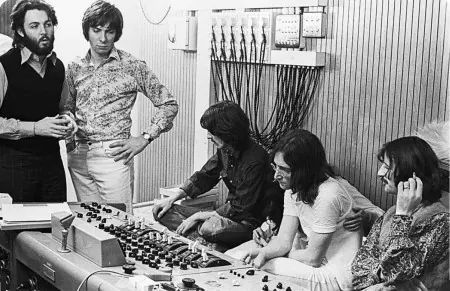
Enter Glyn Johns. Well, not really “enter” — he’d been with the group the entirety of the sessions in a somewhat nebulous production role.

“He seems to be arranging this, come on,” Paul said to laughter. “That’s good, come on.”

From his 2014 memoir, Sound Man, Glyn recalled his first days working for the Beatles:

After they had finally run through the first song a couple of times, Paul turned to me and asked what I thought they should do for an intro. I nearly fell over in shock. I thought I had been employed to just engineer and here I am in the first hour of rehearsals being asked for my input into the arrangement. I responded as quickly and confidently as I could and suggested a way of playing the intro, which they liked, and we were off. I was amazed at how quickly and easily I was accepted, each guy individually making an attempt to put me at ease and make me feel part of the team.  …

On the second day, things came to a head among the band. …

I have a very clear memory of sitting outside in the bleak surroundings of the soundstage at Twickenham at on that cold gray afternoon with Denis, the line producer for the film, both of us praying that the elation of being employed for a project with the most successful artist in the world was not about to come to a grinding halt after two days.

It is not my place to discuss any detail of what happened, but it is common knowledge that George left the band and was persuaded to return a couple days later.

Glyn’s timeline isn’t precise; he wrote that the arrangement request was on the session’s first day (which was January 2) and George would quit the band the next day, but Paul was a late arrival on the first day at Twickenham and George’s departure happened on January 10, the day after the events of this post. Still, the recollection is valuable to get an idea of Glyn’s mindset early in the sessions regarding his role.

Glyn with the Beatles, from Glyn’s autobiography, Sound Man.

With Paul handing him the reins, Glyn was confident and direct in dictating his plan — based on Paul’s original idea — to a very receptive band.

“Absolutely nothing except the piano and voice the first time around,” said Glyn. “And then the voices, right? … Then you [George] come in where you come in. And you [John] come in the next time round.

“So it goes: Piano and voice.  Backing added [to the chorus], then it goes back to the top [the sound of high-hat is played]. George is in then. John comes in when John comes in. Then the the next chorus, you’re [Ringo] back in on your thing, and back on your [swinging drum pattern]”

Paul gave very simple approval — “that’s it” — before leading the group into a demonstration and subsequent instructions, like building up the percussion without any snares — “It’s like jazz,” George remarked —  and adding “big drums” on Ringo’s fill before the second round of the chorus.

The writer and arranger disagreed on when John and George should come in — Paul proposed they should join together, while Glyn thinks otherwise. “It’s all happening a little bit too quickly with the bass coming in at the same time, that’s all,” Glyn said. Paul deferred, and instructed George to come in for a solo after the “big” chorus, and to base it after the verse’s chords.

“Do it to your own discretions and sort of come in so it builds up, just so you’re not all in at the one time,” Paul said. “Let those two [Ringo and John] get in before you [George] come in.”

The group returned to a run-through as it was drawn up with George entering into the riff, after the second chorus. But it didn’t click and the placement of the riff becomes the next segment receiving attention.

“It’s very corny, really — the down, down, down, down [sang by Paul].” George quickly compares the riff to the end of the chorus in Janis Joplin’s “Piece of My Heart.”

Glyn suggested back-to-back plays of the riff after the second chorus, an idea Paul jumped on.

Paul: See, then that can lead into the solo, ’cause I think it’ll be time by then.

John: Just use that riff into the solo and the end [of it] for the end.

Paul: It’s going to be a short one, anyway.

Paul ordered up “two lengths of solo,” while he and John added harmonies over the second one. The conclusion of “Let It Be” was then sketched: the guitar solo, another chorus and two plays of the riff, with the second one coming in slow.

A first full run of the complete song structure clocked in at barely more than two minutes, with no additional verses after the solo. That is, what we know now as the “And when the night is cloudy…” verse — that section didn’t exist yet.

“Want to do it again? George asked. “It’s quite short, isn’t it?”

“Yes, it is a little bit,” Paul conceded. “It does need something else. It may be sort of ‘oohs’ though the second verse or something else when the cymbals come in. It sounds a bit sort of bare with just piano there.”

“Organ. I could play organ for that and drop it for the bass,” John suggested, forecasting Billy Preston’s eventual arrival without calling for additional personnel, for now, anyway.

Now in the final phases of the day’s rehearsals, the group put further attention on getting into and out of the riff. And in its final moments, George purposely hacked his way through the solo, building the framework of what would later appear on record. Paul gave further bass instruction to John, while George went over the drum pattern with Ringo.

Having logged more than an hour on the song at the end of the day’s session, exhaustion finally set in after a few more competent attempts of the song.  A suggested short break became a request from George to quit for the day entirely, which they all did following a final take.

As they gathered to leave, a debriefing showed the band still found room for improvement in “Let It Be”:

Paul: It should have more bits, should be more complicated.

George: I just feel [the ending] needs something really sustaining.

John: Or even some words … a big all-together.

Any further collaborative work on the “Let It Be” was going to have to wait. Paul touched on the song in a brief solo version the next morning, but later that day, George left the group.

Still, the Beatles — led by Paul but with significant help from others in the room — got through much of the musical dirty work in “Let It Be” in relatively effortless fashion on January 9.

3 Comments

Filed under Day by day

Jan. 9: Subconscious sabotage

“Subconscious sabotage.”

To his death, that remained John Lennon’s reflection on the recording of “Across the Universe,” what he regarded as one of his finest sets of lyrics.

Here’s John quoted in All We Are Saying, David Sheff’s full transcription of his September 1980 Playboy interview:

But the Beatles didn’t make a good record of Across the Universe. I think subconsciously sometimes we — I say “we,” though I think Paul did it more than the rest of us; Paul would … sort of subconsciously try and destroy a great song.

He subconsciously tried to destroy songs, meaning that we’d play experimental games with my great pieces, like “Strawberry Fields” — which I always felt was badly recorded. That song got away with it and it worked. But usually we’d spend hours doing little detailed cleaning-ups of Paul’s songs; when it came to mine, especially if it was a great song like “Strawberry Fields” or “Across the Universe,” somehow this atmosphere of looseness and casualness and experimentation would creep in. Subconscious sabotage. He’ll deny it, ‘cause he’s got a bland face and he’ll say the sabotage doesn’t exist. But this is the kind of thing I’m talking about, where I was always seeing what was going on … I begin to think, Well, maybe I’m paranoid. But it’s not paranoid; it’s absolute truth.

The same thing happened to “Across the Universe” It was a lousy track of a great song and I was so disappointed by it. It never went out as the Beatles; I gave it to the Wildlife Fund of Great Britain, and then when Phil Spector was brought in to produce Let It Be, he dug it out of the Beatles files and overdubbed it. The guitars are out of tune and I’m singing out of tune ‘cause I’m psychologically destroyed and nobody’s supporting me or helping me with it and the song was never done properly.

By January 1969, “Across the Universe” was completely in the can — even down to the sound effects, which the group heard for the first time on the January 7 (George Harrison wasn’t crazy about the birds). With a dearth of fresh material, John could have made “Across the Universe” a focal point during the Get Back sessions. This was John’s chance to properly record the year-old song to his ears.

But like previous occasions at Twickenham, he wouldn’t show much passion to rehearse and rejuvenate the song. Still, “Across the Universe” remained and returned to the table January 9 as the group continued to develop new and manage more established songs for an eventual live show as the sessions began its second week.

“Across the Unicorn,” as John introduced it that day, was performed at such a glacial pace in an initial take that it broke down seconds in with laughter from John. “It shouldn’t be that slow, should it?” As a reaction, the group — as they’d often do — zipped through the song double-time after another standard attempt.

While the song was fully formed, “Across the Universe” wasn’t stage-ready. George didn’t like the birds on wax, and he didn’t like the harmony with Paul as performed at Twickenham. The interplay between George and the others on this fact should sound familiar. Really, nothing was going to change his world.

John: What didn’t you like about his har-MO-ney?
George: Just in some places.
John: Ah, some places. Well that’s details, George.
Paul: Please specify then, please specify.
George: (after singing singing the first verse), It sounds a bit forced .. It wasn’t natural.
Paul: Especially in the “Nothing’s going to change my world.”
John: Just sing that in unison.
Paul: I was planning on working on those bits anyway.

Ah yes, the bland-faced saboteur was prepared to do his worst.

Continuing to work on the song, George and Paul attempted painfully high top harmonies on “jai guru deva,” prompting John to respond, “Is that a bit much?”

With additional takes, the harmonies developed into a characteristically lovely John-Paul-George blend — it’s hard for those three voices together to sound anything but — even if the rest of the song’s redevelopment remained stagnant, at best.

“The ‘nothing’s gonna change my world’ — we got to do something to it,” John said, giving Ringo some rare (for these sessions) drumming instruction — asking for “something heavier. Just play an on-beat there. Try doing the on-beat on the snare, to push it along.”

Not significantly improved and with just a single complete take over nearly 15 minutes of work on “Across the Universe,” John was clearly uninspired by his own song, asking, “Should we do something else then?”

Paul rejected the thought, suggesting they again speed things up. A subsequent attempt indeed had a little more pep — the rhythm section didn’t drag quite as much as it had, additional lead guitar licks peppered the chorus and Paul added more extensive harmonies throughout the song. Again, the song wasn’t completed to its finish, but George wasn’t displeased overall, admitting it was a “little better that time.”

John didn’t bother to offer his own review, instead breathlessly launching into a brief improvisation that has since gone by the name “Shakin’ in the Sixties.” The group followed with an upbeat cover of Cliff Richards’ 1958 hit “Move It” that in turn spilled into a sloppy but jubilant abbreviated version of “Good Rockin’ Tonight.”

An animated discussion of “Rowan & Martin’s Laugh-In” — the group were all clearly fans, trading lines from the show (”Very interesting …” “Say goodnight, Dick”) — led to something of a comic take of Carl Perkins’ “Tennessee,” with everyone enjoying playing.

(It’s nice to know: They may have been the greatest band on the face of the earth, but they still talked about TV at work, just like we do).

Ready to shift gears back to business, John asked, “Have we learned any new ones lately?” After a deliberately flippant butchering of the first verse of “Across the Universe,” John said, “I don’t want to do that one anymore.”

As George began to play “I Me Mine” — a new one from just the day before — John instead sang the words to “House of the Rising Sun.” They never do play “I Me Mine,” instead launching into a series of racially charged songs addressed at length in the last post.

“Across the Universe” and “I Me Mine,” ultimately back-to-back tracks on Side 1 of Let It Be, share another piece of history: By this moment on the afternoon of January 9, 1969, both songs were completely abandoned, weeks before the end of the January 1969 sessions.

“I Me Mine” was recorded from scratch in 1970 by the Threetles, while “Across the Universe” saw its original 1968 recording … embellished and warped by Phil Spector, John’s choice to produce the final soundtrack album. That’s two songs on the Let It Be LP taken not from its associated sessions, but appearing on the record purely because of the songs’ appearance in the Let It Be film.

But while George eventually took his opportunity to properly record “I Me Mine” in the final recording session before the Beatles broke up, what of John’s “Across the Universe”? While unplayed after January 9, 1969 , the song was listed among the the possible numbers for a live show on January 21, the group’s first day of sessions at Savile Row after George left on January 10 and the rest of the Beatles took a hiatus after January 14. But when George asked if they should consider and rehearse “Across the Universe” on January 23, John passed.

“No, no, ’cause it’s going out on an EP,”  John said.

Ode to a panda bear: “Across the Universe” debuted on the “No One’s Gonna Change Our World” charity LP in December 1969.

This opens up some questions. Circa some point in 1968, “Across the Universe” was tabbed for the World Wildlife Fund’s charity LP — that’s why the birds were recently overdubbed, for use on that record. But we also know — or think we know — there was a potential Yellow Submarine EP at one point considered, and that would have included the original version of “Across the Universe.” But if that was the case, it would have been profoundly strange that the other Beatles wouldn’t have been aware of it. An odd unicorn, indeed.

But the song’s eventual release wasn’t necessarily of consequence. If John wanted a new version of his song for posterity, this was the time to craft it on his terms. The Beatles resurrected “One After 909,” after all, and breathed life into a song that had a truly bland recording gathering dust in the vault.

While it wasn’t confirmed in any way, there were certainly some occasional discussions by this early point that these sessions could easily yield a new album, in addition to serving as rehearsals for a live show. Stuck for a month, John could have rehearsed and re-calibrated the absolute daylights out of “Across the Universe.” Lord knows Paul played the hell out of “Get Back” and his songs during the sessions. But here we are on January 9, 1969, and “Across the Universe” was completely discarded, both as an option for the live show but also as a song to be revisited and rerecorded. Who sabotaged whom? Or even what?

Maybe our sources aren’t really reliable after all. Here’s John in January 1971, from his iconic “Lennon Remembers” interview in Rolling Stone:

You know, we all say a lot of things when we don’t know what we’re talking about. I’m probably doing it now, I don’t know what I say. You see, everybody takes you up on the words you said, and I’m just a guy that people ask all about things, and I blab off and some of it makes sense and some of it is bullshit and some of it’s lies and some of it is – God knows what I’m saying.

Needless to say, this issue hangs over pretty much every corner of Beatles scholarship. At least John had the self-awareness to admit this, as problematic a fact  it is.

So was the original recording of “Across the Universe” a victim of “subconscious sabotage”? Regardless of the answer, John — who we can certainly believe was never satisfied with any of the recordings of the song, even the one he helped record with David Bowie in 1975 — had the blank palate of  the January 1969 sessions to craft it in any direction he pleased. But he was bored with the song, whether he would admit it or not, and took it no further after just a week into the sessions, despite a paucity of new material.

The song as recorded would be released, as planned, in December 1969 on the World Wildlife Fund’s “No One’s Gonna Change Our World” LP with John’s voice sped up, and again in May 1970 on Let It Be, further adorned and with his voice slowed down.

Subsequent official releases of “Across the Universe” came in 1996 (Anthology 2), 2003 (Let It Be … Naked) and 2018 (White Album deluxe release). Each of those stripped down versions came after John’s death and with Paul’s presumptive partial oversight.

And every recorded version of the Beatles’ “Across The Universe”  was sourced from the original recordings from early February 1968.

15 Comments

Filed under Day by day

Jan. 9: Power politics

Pablo Fanque, Mao Zedong and Edgar Allen Poe are among the historical figures with a cameo in a Beatles lyric. During the Get Back sessions, former Prime Ministers — and famed taxmen — Harold Wilson and Edward Heath joined a more exclusive club, making an encore appearance in song.

A reasonable argument can be made that the improvisations littering these sessions aren’t really songs at all, but instead casually jammed interludes capturing the moment, intended to be forgotten if not for the tapes that recorded it all. But ultimately we do have the tapes, and those for January 9, 1969, contain a suite of performances inspired by a subject even more ponderous than taxation: the Commonwealth Prime Minister’s Conference, which was in its third day as the Beatles continued their sixth at Twickenham, about 10 miles away.

Paul McCartney had already drawn upon the contemporary issue of the East Asian community’s flight from Kenya to Britain, conceiving the “No Pakistanis” iteration of “Get Back” that would be a part of the song for a few more days. After a thirty-minute detour that included a revisiting of “Across the Universe” and the bassist’s recounting of the “Penina” origin story, the news of the day recaptured Paul’s imagination.

Paul’s performance began seemingly unprompted, launched from a flippant attempt of the “House of The Rising Sun” that itself began as a bit of a mockery of George Harrison’s “I Me Mine” — a song that was proposed to be rehearsed. Instead John launched into the song popularized by The Animals in 1964.

That brings the story to “Commonwealth.”

Paul channels Elvis vocally — and picks up on John’s ability to script a “newspaper song.” George doesn’t even participate at the outset; instead he discusses equipment issues with Glyn Johns.

The tabloids served as a literal jump-off point. From the front page of the January 9, 1969, Daily Mirror, under the three-deck headline “WARNING TO THE PREMIERS: NO EXTRA IMMIGRANTS”:

Britain has no intention of easing her immigration restrictions to take in extra Asians forced out of East Africa.

Home Secretary James Callaghan is making this clear in private talks with Commonwealth leaders now meeting in London.

He is telling them that many Britons share the views of Tory M P Mr. Enoch Powell, who wants to stop further immigration and encourage migrants to go home.

While Mr. Callaghan was taking this action, Premier Harold Wilson was rejecting accusations of discrimination at the Premiers’ conference inside London’s Marlborough House.

Accusations of discrimination by Pakistani Foreign Minister Mr. Arshad Husain brought an immediate riposte from Premier Wilson.

He reminded Mr Husain that Britain had brought in penal laws to ban discrimination.

Mr. Wilson told him: “Do not hold me responsible for the phenomenon known as Enoch Powell.”

While Wilson and Heath reappear in Beatles song, it’s fellow Member of Parliament Enoch Powell at the center of Paul’s muddled tale.

Here’s a taste of the first set of lyrics, transcribed as lovingly as possible for something at times so unintelligible:

Tonight Enoch Powell said get our immigrants, immigrants, you better go home, ha ha ha ha ha
Tonight Premier Wilson said to the immigrants, you better get back to your Commonwealth homes
Yeah, yeah, yeah, he said you better get back, home
Now Enoch Powell said to the folks, he said … the color of your skin
… So Ted Heath said to Enoch Powell, he said you better get out or heads are gonna fall (?)
He said, Enoch Powell, Enoch you better go home

A deeply inflammatory political figure, Powell’s biography is defined by his April 20, 1968, “Rivers of Blood” speech, in which he dramatically stoked racial fears, viciously attacking mass immigration from Commonwealth countries. Powell would lose his position in the Shadow Cabinet (“Ted Heath said to Enoch Powell, he said you better get out”) while deeply accelerating a serious divide in British public opinion. (In the 1970s, Eric Clapton would publicly embrace Powell, a terrible idea the Beatles pal would ultimately say he regretted.)

The “Rivers of Blood” speech had indescribable impact, and as an American writing more than 50 years later, I’m certainly dealing in deep understatement.

On the Beatles’ timeline, Powell’s 1968 speech coincided with the immediate aftermath of their trip to India (George alone remained overseas at the time). A month after the speech, Paul was put on the record regarding Powell as John and Paul were interviewed on their promotional tour to launch Apple.

Asked about “this racial business over in England,” Paul offered a simple answer: “That thing’s just the same question everywhere, you know? It’s no different in England. It’s a bit less harmful in England, but it’s the same thing. Some people don’t like other people ‘cause they’re not the same as them.”

Yes? Welcome!

Plain-speaking regarding Powell in 1968, Paul was in standard form singing about him eight months later, on January 9, 1969, prioritizing the sound of the song over lyrics and meaning, even moreso in subsequent verses. Presaging the Kinks’ brilliant “Victoria” by several months, Paul offers a tour of mostly Commonwealth locales (Australia, New Zealand, Pakistan, India, West Indies, “Old Calcutta”) as well as Europe and South Africa.

(“Old Calcutta” could also be heard as “Oh! Calcutta!” a wink to John’s involvement in the forthcoming stage show, while the reference to Tucson was both an acknowledgement of the location’s growing importance the to “Get Back” lyric as well as an indicator of Paul’s monumental disinterest in improvising any sort of serious lyric to this song.)

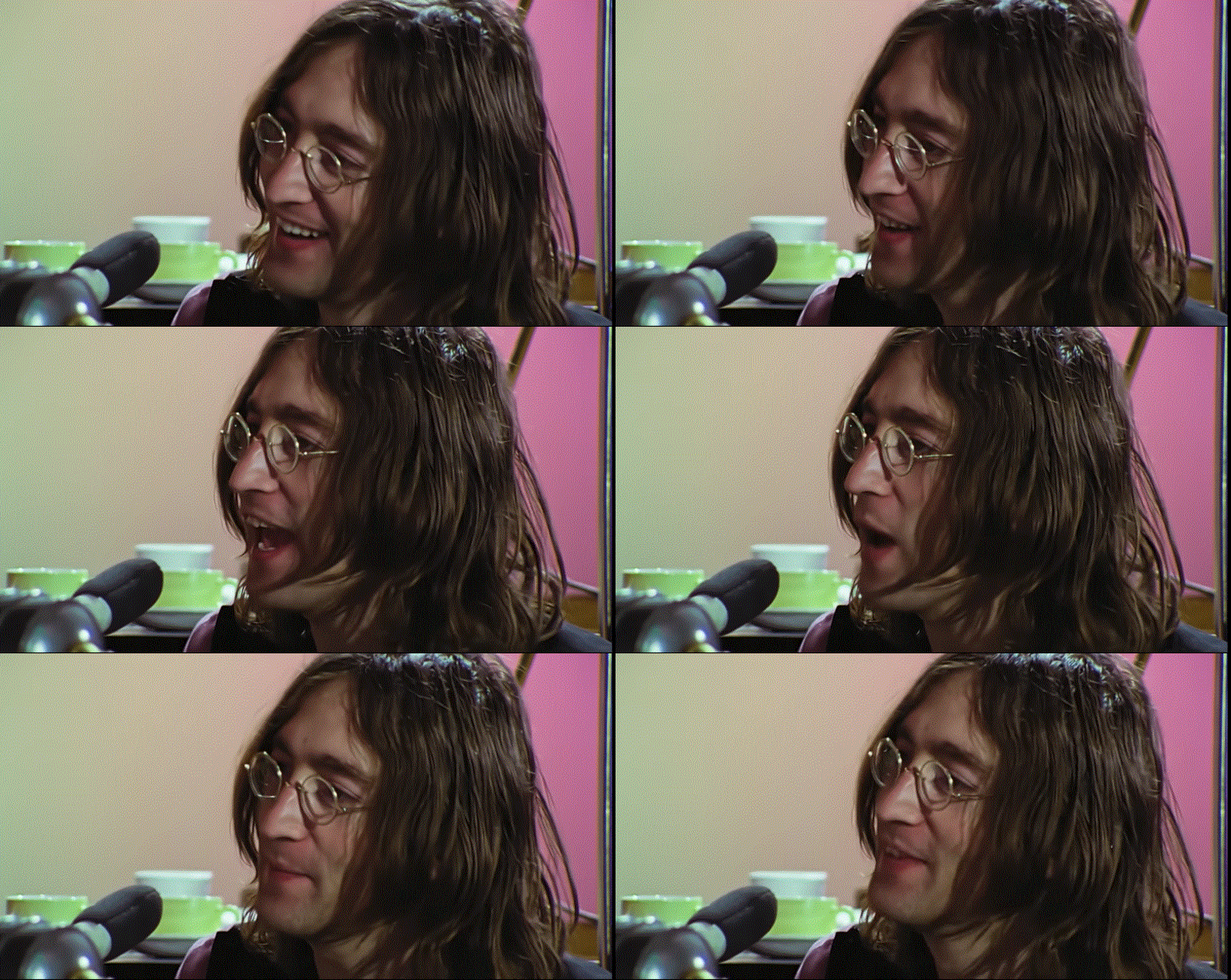
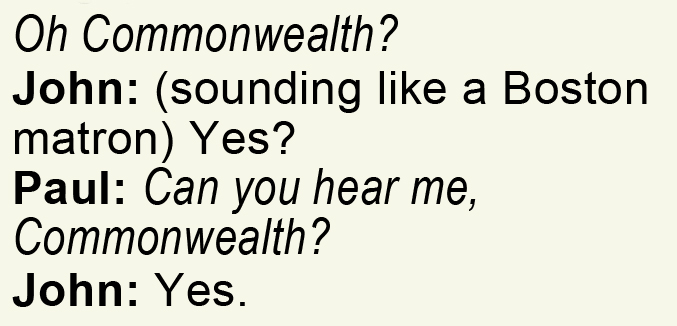
But the clear focal point of the track is the chorus, featuring an animated John interjecting a responsive “Yes?” to each of Paul’s calls of “Commonwealth,” in a shrill, deliberately cartoonish accent, described in the book that accompanied the Let It Be LP as that of a “Boston matron.”

(Yet another aside: In a remarkable coincidence in this song’s story, Boston, Lincolnshire — site of a huge influx of immigrants in the 21st century — tallied the highest percentage of “leave” supporters in the Brexit vote.)

The first time John chimed with his “Yes?” response, Paul sounded sincerely taken by surprise, unable to suppress a laugh. This interplay, enjoyed throughout half of the song, is what makes “Commonwealth” memorable and somewhat remarkable (Paul would use a similar vocal inflection himself elsewhere in the song). Partial film of the performance of the song — focused on John alone — makes clear he is enjoying this one-off.

The collaboration of sorts was sustained throughout, as John quickly improved Paul’s original verse-closing words:

Paul: Commonwealth, but it’s much too wealthy for me
John: Much too common for me.

Paul was strong on the fly, but John was even more clever, unsurprisingly.

As “Commonwealth” petered out, Paul delivered a brief coda consisting merely of the words, “Oh, Enoch Powell … powerless” (sounding very close to “Powell-less”)

This brief interlude spilled into another lengthy improvisation and an additional moment John and Paul used to minimize the junior songwriter in the band. Originally intended by George to be an electrified take of “For You Blue,” Paul hijacked the song and veered into another direction, interjecting several mentions of “white power” — again, as inspired by headlines satirically and obviously not a celebration of such a thing — and was met with an off-timed “Get Off!” response from John. The song quickly evolved into Paul and John — both continued in high spirits — trading real and fictional names in a roll call over an enjoyable, loose blues rocker. Paul occasionally throws in a “Can you dig it?” or “Let me hear it” after a name.

More than 40 names are called out — usually by Paul — including multiple Quarrymen (Eric Griffiths, Ivan Vaughn and John Lennon himself), other Beatles insiders (Mal Evans, Peter Brown), many others in entertainment (James Brown, Judy Garland, Dusty Springfield, David Frost) or in politics (Winston Churchill, Richard Nixon), with the likes of Superman alter ego Clark Kent and stain-killer Super Ajax also receiving call-outs. Paul and John are clearly enjoying every moment of it.

At one early point, the song breaks down, with John asking what the group should properly rehearse next.

George: I’ll do one, but it has acoustic guitar and no backing.
John: Get off!

And with that, “Get Off” picked right back up. It was a funny moment, with delicious comic timing on John’s part, but another occasion in which they’d offend and unnerve George.

Soon after, George begins to sing and play “For You Blue” only to have John and Paul continue to play “Get Off” over him.

During the final moments before the group did ultimately work on “For You Blue” (covered at length here), John seemingly pokes at George, who two days earlier suggested a divorce from the group and one day later would in fact temporarily leave the Beatles.

Paul (following some feedback): Noise is a little too loud for me.
John: Leave the group then, if you don’t like it (giggles).

Sure, the Beatles played “God Save the Queen” on the rooftop, but they wouldn’t be quite as overtly political in such a burst for the balance of the sessions. And while “Get Off” (and “Commonwealth,” like the similarly jubilant “Suzy Parker” ) vanished from the group’s memory, never to appear on an official release, a little bit of “Get Off” lived on, both as a stream-of-consciousness performance and through the very use of one of the song’s key phrases in “Dig It.”

With “For You Blue” begging to be rehearsed, Paul and John spent 15 minutes comically spanning and panning global issues. But all politics are ultimately local, and there were clearly internal band politics at play.

7 Comments

Filed under Day by day

TMBP Extra: Here, there and everywhere

I’ve been sharing my insights on the Beatles’ Get Back sessions on this blog for the last seven years, and it’s been with great joy that recently I’ve been able to share my voice as well at some other fine locations online.

Deep thanks to Robert Rodriguez for engaging me in a terrific, lengthy discussion on the Something About the Beatles podcast on the occasion of the 50th anniversary of the January 1969 sessions. Log onto your favorite podcast app (here it is on iTunes) or just click below. Perhaps do both!

Additionally, a huge thank you to the FabFourArchivist for having me on for a couple of cameos on his YouTube series about the road to the rooftop.

Greetings to all the new readers and followers who have found this site thanks to the above! We’re now more than 50 years removed from the Get Back sessions — and with this one, 100 posts on this blog — and we can’t stop talking about it. And why would we?

2 Comments

Filed under Extra

TMBP: Let It Be anew

The Beatles wanted to make a Lord of the Rings movie, going back more than 50 years. A half century later, they’ve got director Peter Jackson aboard, but for an entirely different film. Will this end up a fantasy, too?

Having maintained a monthlong silence on the 50th anniversary of the Get Back/Let It Be sessions, the Beatles raised the Dead Men of Dunharrow (that’s the Army of the Dead if you only saw the film) on the anniversary of the rooftop concert.

Quick takeaways here:
• The selection of Jackson was no accident. He obviously has a masterful storytelling ability while working within the constraints of very detailed and very iconic source material, as well as film restoration. While I don’t anticipate him to introduce Tauriel to, say, sit in on saxophone, I’m expecting something we’re not expecting.

Jackson’s a superfan, too, which can only be a good thing.

• I don’t believe having an “upbeat” Let It Be film is necessarily revisionist history — or fantasy, for that matter. I’ve long maintained there was plenty of sugar to along with the medicine when considering January 1969. It would be disingenuous not to include the tension, the arguing, the passive-aggressive relationships between the band members, and I think Jackson’s quote saying there was “none of the discord this project has long been associated with” is an overstatement. To whitewash that aspect of the sessions would be problematic (though not surprising, given the promotional work recasting of the White Album sessions 50 years later). But it would be likewise false to resissue the film as merely their “winter of discontent,” not that we should expect that.

Paul McCartney and Michael Lindsay-Hogg (right) “on the set” of Let It Be. (Via IMDB)

• Make no mistake: Let It Be is Michael Lindsay-Hogg‘s film. He wasn’t just behind the scenes, he was an active participant in the sessions. Listen to the tapes (or leave it to me and read this fine blog instead), and you can hear MLH’s voice more than anyone else who’s not in the band. I’m very curious to see how Jackson works with MLH’s ubiquity — he’s central to every discussion about the live show, and perhaps he’ll retroactively get his first acting credit, that’s how much screen time he could get, in theory.

• And about that live show. I’ve written it before, but clearly the film’s arc should be (and have been) the sort of near-comedy of the greatest group in the world wondering what to do next and how — and that includes debating their own future —  throwing out every idea they can think of, only to have someone argue against it. Finally, after ups and downs (George quitting), the villian (Twickenham Film Studios) is vanquished, a bit player from their past (Billy Preston) emerges out of nowhere to help return order, and everyone realizes the simplest solution (rooftop show) is what they were looking for all along. The farther one travels, the less one knows, so find the answer at home.

• I won’t call this a buried lede, but not even mentioned in the social media blitz — only the Beatles’ press release — is this news:

Following the release of this new film, a restored version of the original Let It Be movie directed by Michael Lindsay-Hogg will also be made available.

Quite the “oh, by the way …”

This is, of course, good news. Let It Be is a critical document, too, despite it’s obvious flaws, and we haven’t seen an official release since it the days of LaserDisc and VHS.

• The 140 hours of audio cited by Jackson is quite a bit more — in excess of  50 hours or so — than we’ve already have heard leaked and bootlegged over the years. It could be 24 more hours of discussions about a live show (I’m hoping) or 24 more hours of Maxwell’s Silver Hammer outtakes (I’m expecting). Reality, as usual, will likely be somewhere in between. I can’t see anything that changes the direction of history, but maybe we do get a few more specifics on locations. And I’m sure we get some improvisations or clipped covers we never heard.

“It’s funny, uplifting and surprisingly intimate.” – Peter Jackson

• I’ll admit I was wrong about something — but I’ll bury it at the bottom of this post. I never thought the Beatles would release Let It Be while Paul, Ringo and Yoko were still with us. And I thought, once Paul announced several months ago that some new version of the film was to be released, we’d probably just get Let It Be content lumped in as part of an Abbey Road deluxe set — “Beatles ’69.”  But I was wrong there, too. Mea culpa.

• That said, we didn’t hear a thing about getting some of the audio outtakes — Nagra or otherwise — finally released. I’m still not expecting any sort of sweeping set — do you really think they’re going to put out tapes of Paul calling a newspaper “cunts” or, more relevantly, acknowledging how negative they are and doubting their future? — but maybe we will get a disc or two of some January 1969 upbeat highlights — “Suzy Parker,” “Oh Julie, Julia,” “Commonwealth,” etc. And there’s certainly enough terrific material to fill several Abbey Road “demo” discs, too.

The most disappointing part of the announcement is the timeline: It hasn’t been announced yet. But simply to get news of a new (and old) Let It Be is reason enough to celebrate with an unexpected party.

5 Comments

Filed under Extra