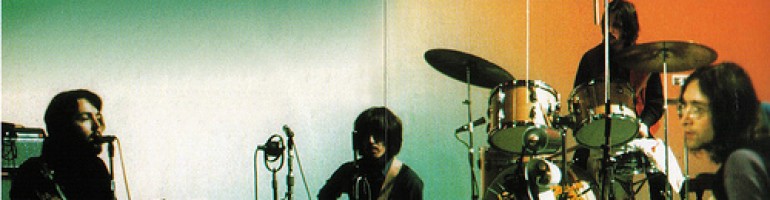
Following a lengthy but productive workshop of “Get Back” early on January 10, 1969, Paul McCartney conceded the Beatles were “going to hate these [new songs by the time] we do them [live].” And they were already starting to feel it.
“My favorite” was John Lennon’s glib reply after Paul introduced “Two of Us” as the next song to be rehearsed.
The song’s author himself was salty, too, with Paul criticizing the song at the start of this 30-minute sequence as “faceless” after the day’s first run-through.
(This throwaway joke is worthy of a brief sidebar. It’s treated as fact that the band Grapefruit, who were signed to Apple Publishing and named by John after Yoko Ono’s book of the same name, were offered — but refused — to record “Two of Us.” That fact appears sourced entirely from the above quote by John, which also appeared in the book packaged with the Let It Be LP. Not discernible in print, John said this with a laugh, seemingly underwhelmed by Grapefruit at this point in their career and jokingly ready to hand off this faceless effort to a juice-less Grapefruit.)
A slightly defensive Paul backed off his critique. “No, it’s all right, the song. It’s just not very interesting to me yet.”
With the same treatment we can still see today in the Let It Be film, electric and energetic, John proposed a solution that would come once the group convened at Savile Row: Unplug.
“The question’s always the same, and the answer’s always the same. Maybe in the studio, it’s acoustic.”
When he wasn’t micromanaging (see below), Paul had no problem opening the floor to an organic solution, and he sounded especially — and uncharacteristically — happy to see the working week nearly over. “OK, just run through it. … See, George, you can just [plays galloping guitar part], and then try to tart it up. I know that’s what I said not to do last time, but it’s Friday. Let’s try it.”
After another attempt petered out, Paul refocused on the song’s bridge, sounding an air of desperation. “We’ve just got to do something about this middle eight before it’s too late. … It’s time for riffs. That’s the only thing that’s going to help all of this.” Still, his own detailed suggestions crossed into the comical.
“Do something slow, four in the bar, with a little bit of kick to it,” Paul said before laughing at the absurdity of his requested word salad. Still, the group added minor flourishes here and there, with Ringo working a bossa-nova tempo in the bridge at one point, while later trying a “Peggy Sue”-inspired pattern.
Frustrated, Paul conceded that he’d “never been stuck with the middle eight, but it’s all right.” John countered that it was a typical middle eight, while George — who was largely quiet during the “Two of Us” session — suggested the group mix in a Mellotron part.
And while Paul said the middle eight remained lacking — John proposed, to laughs, some choreography –“Two of Us” rehearsals wrapped up on the tapes, with the final takes featuring a variety of experimental parts, including a guitar part from George that had a echo of the Byrds’ “The Bells of Rhymney” (or maybe it’s just by way of his own “If I Needed Someone”).
In those same final moments — and ultimately the song didn’t advance much further from where they began that day — Paul sang “four of us” at one point. That was quite poignant, because just minutes later on the tapes, the Beatles would, in fact, consist of just three of them.
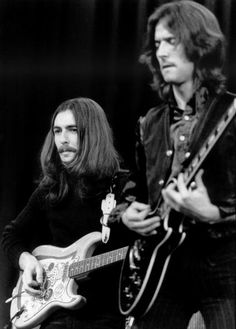
If I needed someone, George Harrison vs. Eric Clapton edition. (Insert Pattie Boyd joke here)
“You need Eric Clapton.”
“No, you need George Harrison.”
As the Beatles worked on the days-old “Get Back,” it was Harrison himself who suggested they call on his friend, the erstwhile Cream sharpshooter, to add an extra line or a solo to the quickly developing song. John Lennon and Paul McCartney disagreed, trying to prop up George’s confidence and desire — and offer a specific instruction, too, as the band continued work after Dick James departed Twickenham on January 10, 1969.
With George the next to leave the venue and indeed the group, the exchange reads as a tidy — albeit exaggerated and deceptive — emblematic microcosm of the present situation. George was itching to leave, but maybe the rest of the band didn’t know it. Maybe George wasn’t certain just yet either.
The full group worked on “Get Back” and “Two of Us” that Friday, and both songs received a bit of tough love, mainly from its songwriter. But Paul pushed the others, too.
A deep, ongoing concern for Paul was George’s power chord that immediately followed the phrase “Get Back,” a chord he called “passé” in an earlier exchange with session arranger Glyn Johns.
“That suggests something to be, this chord,” Paul said. “We should try to get away from that,” as Paul subsequently refers to the chord as “passé” again, this time directly to George.
Paul: It was a couple of years ago.
George: No it wasn’t, it’s just a chord. … Some chords fit things.
Paul: Chords, like fashions and stuff. But it’s like drainies (drainpipe trousers).
George: Some drainies suit different occasions.
He eventually shrugged off the cross-talk, and the group continued to attack “Get Back,” with George searching for a power chord more in line with the latest trouser fashion.
“For the three of us, that’s good enough for the rock-and-roll thing,” Paul said just prior to George bringing up Clapton as a supplement to the song.
“Just doing simple things until it’s your go,” Paul told George. “Because otherwise you get the guitar conflicting with what you’re singing and all that. And then I’m trying to sing louder to get over the guitar. If you (George) vamp, then it takes away from his (John’s) vamping. It’s like the big, soft, lead guitarist, who just stands there and …”
“Little, soft, lead guitarist” interrupted George — who at 5-foot-10 stood the same height as Clapton (who would famously be called on again soon, but that’s for another post).
“No, the big one in our head, who just sort of goes [Paul played straight, staccato power chords]. You can either do that soft or good. I really think it’ll happen better if we’re just keeping it going. A clipped offbeat. ‘She’s a Woman.’ That was just a better rhythm than we have. And ‘Sgt. Pepper’ on the organ.”
Facing this tall order, the group moved into other facets of “Get Back,” including Ringo’s drum pattern, the vocal combinations, guitar solos — including a proposal for both John and George to each have one — and the lyrical content. While “Pakistanis” and “Puerto Ricans” tracked well enough to remain useful to Paul (“Meanwhile back at home there’s 20 Pakistanis living in a council flat”), he didn’t try to further deepen the political discourse. Instead characters like Sweet Loretta Martin and Jo Jo Jackson were introduced, and while the latter eventually lost the surname, both survived to the rooftop and into posterity.
“It fits — it’s a drag queen. ‘Get back to where you once belonged,’ Paul said.
John chipped in another line that mostly stuck: “But he knew it wouldn’t last.” Paul added the companion rhyme “California grass” although he conceded, “It’s daft, but we’ll straighten it out later.” (He didn’t).
While John and Paul actively hashed out the lyrics as a team, George was uninvolved and clearly disinterested in collaborating beyond defending his guitar parts (and later, making suggestions on a drum pattern to Ringo). Still, there was serious momentum toward building “Get Back,” and John was clearly into the song throughout, delivering a ripping vocal on several takes, at times singing the verses and chorus in unison with Paul or even solo.
Repeated stabs offered positive results, including funky takes featuring a groovy wah-wah solo by George. The song was fast and electric, and a strong example of the Twickenham sessions at their best, genuinely spirited.
And while John was eager to deepen the arrangement, Paul again tempered the organic enthusiasm. “We still haven’t gotten one straight through yet.” If it wasn’t the guitar part in the chorus, it was the guitar in the verses that nagged him.
Paul also worked to manage a since-discarded introduction that featured the three guitarists playing a “big, long, clear chord” while Ringo was asked to work out an extended arrangement on tom toms, squeezing in as long an introduction as feasible.
Despite the work, the mood at the moment was light. The melody line of “Get Back” reminded John of the old Perry Como hit “Catch a Falling Star,” prompting some giggles followed by a verse of that song. An even more unlikely reference came moments earlier, when — in referencing “Long Tall Sally” — Paul broke into the closing theme to the Beatles cartoon, with Ringo joining in.
As the Beatles wrapped this early-day stab at “Get Back,” the song settled into a defined structure, really starting to resemble the song Paul still trots out in concert a half-century later.
With the group ready to shift to “Two of Us,” John took note of the overall pace of the sessions at Twickenham.
“We’ve never learned this many numbers at once, have we?”
The pace of new material strained John’s attention span. That’s not a surprise. But in the hours before George left the band on January 10, 1969, the message from Paul to the lead guitarist was clear: You need to keep up, too. It wasn’t about handling the quantity of songs, which was John’s problem. It was about keeping up with the quality.
George’s chord selection was “passé.” It was of “a couple years ago.” George may have been matching Paul in productivity, consistently delivering newsongstothesessions, lapping John’s contributions. But he sill was very much the junior partner in this first month of the band’s final full year.
When George suggested the group bring in Clapton, it wasn’t a genuine dismissal of his own talents. It came from a clear weariness, an exhaustion. How could George not feel completely weary for the position he was put in by Paul, who was quick to call his own lyrics “daft” yet also describe George’s playing as “passé”?
And that only described the most recent hour. Only 72 hours before he called for a divorce. Since that moment, things were no more improved in the studio than they were at home.
The Beatles needed George Harrison, but did George Harrison need the Beatles?
Like so many of the outtakes on the “sessions” discs unearthed and unleashed on the most deluxe version of the Beatles eponymous double-album, this newest version of “Let It Be” — the oldest recording of the song — is acutely alive and profoundly captivating.
As performed on September 5, 1968 — the day after recording their iconic performance of “Hey Jude” for Frost on Sunday — here’s the world’s greatest tea-room orchestra:
Fifty years in the books, and Beatles history still has room for an edit.
In some ways, this one-minute, 18-second cosmic jam capturing the band in medias res — between takes of “While My Guitar Gently Weeps” — is just what should be expected, even if its very existence is still something of a minor surprise. A White Album-era version of “Let It Be” felt apocryphal, despite established knowledge rooting it in fact. And so it is that the disjointed, driving performance sounds like it’s out of time — it was.
Let’s dig in on some finer points:
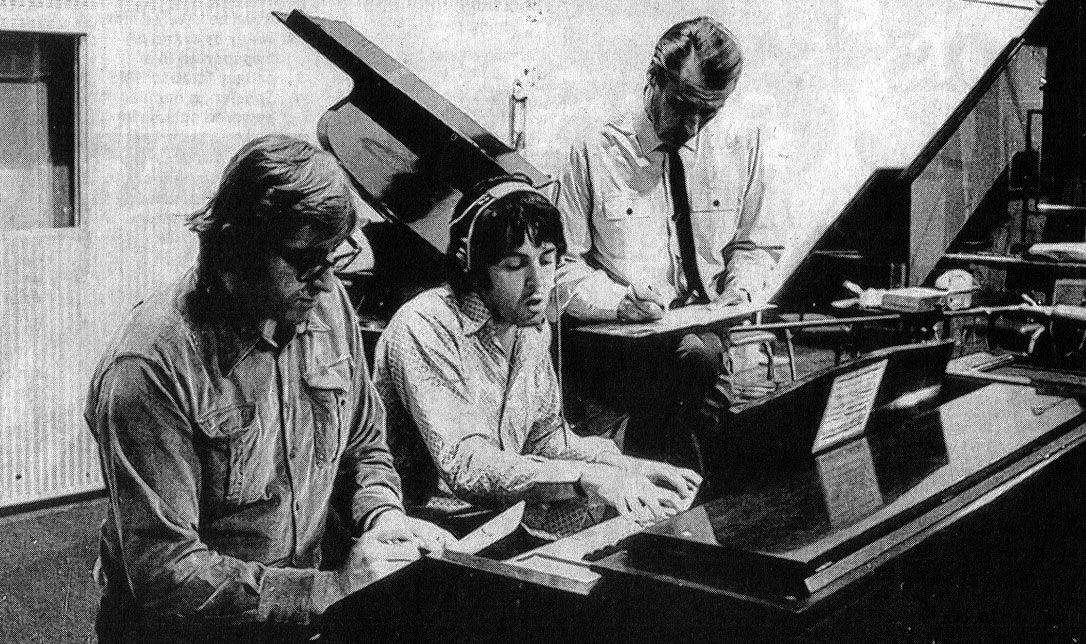
Brother Malcolm, Paul and George Martin during the White Album sessions in 1968
Brother Malcolm, Mother Mary and the lyrics of “Let It Be”
Notably, the lyrics of the song hardly advanced in the three months between September 5, 1968 and January 3, 1969, the first recorded performance of “Let It Be” at the sessions that would ultimately bear its name.
Here’s Paul grooving alone at the piano for the song’s debut on the Nagra tapes:
The lone addition, lyrically: “In my darkest hour, she is standing right in front of me.”
“She,” of course, is Mother Mary, who presumably was in the very original lyric sourced from Paul’s dream about his mother but was absent in the 1968 early attempt. That featured “Brother Malcolm,” a nod to do-it-all assistant Mal Evans. The reference to Mal was inconsistent over January 1969 but endured to the very end of the sessions. Here are the Beatles on the final day of the sessions, January 31, 1969:
It wasn’t until a few days into the sessions at Savile Row, on January 25, 1969, that most of the verses had been added. But Paul started teaching “Let It Be” to others in the band on January 8, when we hear Paul naming chords to the others to learn. That’s also when Paul disclosed that, even at this early stage, he planned to have Aretha Franklin cover the song.
Interludes
Students of the Beatles’ January 1969 sessions have heard this sort of thing several times before, someone in the group veering into an original, a cover, an improvisation between songs, during a transition during a rehearsal or purely as an aside.
Some of these drop-in songs were even the same for the White Album and Get Back/Let It Be sessions:
And just as future songs were sampled and explored during jams in 1968, they were in ‘69 too. And probably long before that as well. A few examples:
Divine intervention
This initial iteration of “Let It Be” may not have had “Mother Mary” but it did feature the hand of “God.”
The September 5 session of “While My Guitar Gently Weeps” was the one that featured Eric Clapton as the Beatles’ guest on lead guitar. That places Eric at the origin of “Let It Be,” and he can be heard adding a few guitar licks to the improvisation. (Listen to the very end and you can hear George close the track imploring his friend to don his headphones: “Cans on, Eric.”)
A full 31 years later Eric would get to play the song again, joining Paul on stage at the 1999 Rock & Roll Hall of Fame inductions. Paul was inducted for his solo career, but the show closed with, naturally, “Let It Be.”
This same induction ceremony honored producer George Martin, who happened to miss the September 5, 1968, session whilst on vacation.
Times of trouble?
Even Paul called the White Album “the tension album.” John said worse in the early ’70s. Ringo literally left the band for a few weeks in the summer of ’68. Four Beatles, each recording in a separate studio — we all know the stories.
But while history is static, perceptions are variable.
The 2018 reissue’s promotional campaign works to dispense with some of the darker sides of the session, from Giles Martin’s interviews to the numerous dismissals of dysfunction in the lovely hardbound book packaged with the deluxe edition. Indeed, there’s plenty of laughter and carefree spirit throughout the White Album outtakes. The outtake set even begins with laughter among John, Paul and Yoko, as if to hammer the point home.
The Get Back/Let It Be sessions inherit the same sour reputation, yet it would be very easy to compile 50 tracks from January 1969 filled with laughter, chatter and the indication that nothing could ever tear these guys apart. And I bet if and when we do see a formal reissue campaign of Let It Be (which I suspect will be attached to a larger Abbey Road/”Beatles in ‘69” re-release), we’ll see that very recalibration of Beatles history. More “Suzy Parker,” and not quite so many calls for a divorce.
And that’s OK. I’ve long posited that things weren’t necessarily so bad — or at least that much worse — for the Get Back/Let It Be sessions than in the period immediately before and after. Naturally, the reality lies somewhere in between. Neither the White Album nor Let It Be are outliers — that’s just how the group was post-1967.
Together at the beginning of that trip, the individual Beatles returned to England separately. For the final stage of their career, they produced enduring music, though they may be parted.
Let’s run through the ones we know and then learn the [new] one.
This is our format.
Paul McCartney was right. There was a format. At least there was a framework developing as the Beatles rehearsed in their second week at Twickenham.
As covered in the last post, George Harrison would have to wait a few hours for attention to return to his new “For You Blue.” Instead, with the full band ready to go nearly 90 minutes into the January 9, 1969, Nagra tapes, the Beatles tackled “Two of Us” for the fifth time in six days, initiating a sequence in which the group returned to some of the finished, core songs they’d have for their live show. Why, it was their format!
This stretch also clearly exposed the side of the Beatles that everyone (else) usually cites when describing the Get Back sessions. While I’m quick to argue January 1969 at Twickenham was not of itself the downfall of the band as it was filled with harmonious, joyous and highly fruitful moments to match the uglier, fractious component of the sessions, these guys could get pretty petulant and didn’t hide it with the tapes rolling.
A quick, carefree one-off into the song the day before, this day’s “Two of Us” rehearsal stretched about a half-hour, and quite unlike the Rocky and the Rubbers’ version, Paul insisted on serious refinement.
As loose as their run-through was early on the 8th was exactly how tense things emerged on the 9th, with consistent, stuttered efforts to get through a full song.
From the top, the group can’t find the proper pacing of “Two of Us,” with Paul pushing the others to pick it up. “Keep them all quiet, keep your instruments down so we can sort of hear what’s going on.”
They had another go at the song, and “it’s still pathetic,” in Paul’s words. He suggested the issues went beyond just the song’s speed.
As Paul nitpicked what arrangement the song needed entering the bridge, John argued, “We never got into this [part] yet,” defending himself and the others as Paul criticized the group for not knowing what’s in his head.
A fiery example of the strain came during a “Two of Us” take in which Paul barked at John, who wasn’t in perfect rehearsal position, to “get on the mic.” John, certainly responding to the tone more than the instruction itself snapped back.
“You don’t have to bitch about it, we’ll never get through it.”
The band immediately went into another take, and you can hear John loud and clear — but he came in early. You can hear Paul’s displeasure when he comes in himself at the right time. Still, they championed on.
A dark moment, for sure, but as usual for these guys, they were able to compartmentalize and still harmonize figuratively and literally. Picking apart “Two of Us” to improve the various “bits” and now focusing on the middle eight, Paul started thinking out loud.
“The two things I think of are both corny, but something better are oohs … or [a staccato “dit-dit-dit”]”
Never mind that the “oohs” are actually “aahs” when Paul, John and George instantly launch into a demonstration of the vocals, which are proposed to appear supporting the “you and I have memories” lead. This is the Beatles magic, immediate and spontaneous and completely normal, even when it comes a few minutes after one member complains about the other one’s bitchiness. The subsequent stab at the staccato vocalization came off a bit sloppier but still likable.
Concerned the backup line would sound “too thin,” George proposed, “Maybe we get a few Raelettes,” marking yet another time the group evoked Ray Charles’ backup singers. “Get three girls” with some phasing on the mics.
John’s cheeky reply was to bring in three boys instead, and George named the Dallas Boys, Britian’s first boy band (by ’69 they were into their 30s).
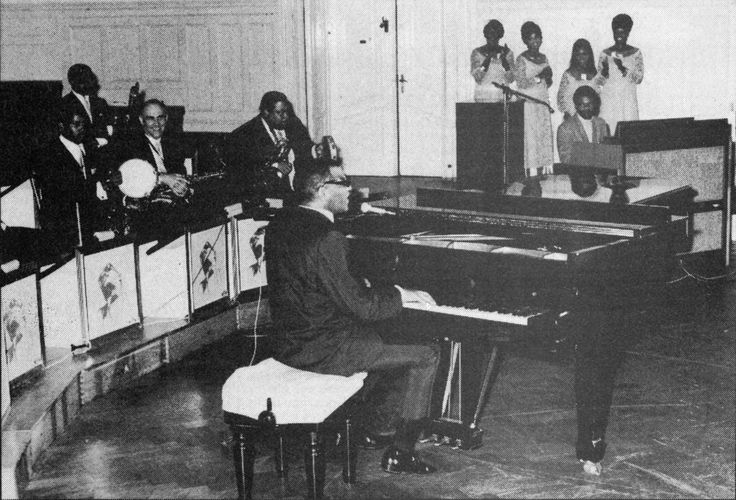
While they never landed the Raelettes, the Beatles would soon enlist the man seated before them, Billy Preston. (Photo from late 1968).
Ultimately, Paul asked the others to “just think of something, then” for the middle eight, and off they went into another take, this one featuring the lovely “aahs.” The song may not have dramatically improved, but the mood had over the last 25 or so minutes on the tapes.
But Paul still had something to complain about, turning his attention to a frequent (and legitimate) punching bag for the band, the equipment setup at Twickenham. If we think the tapes sound diluted, just imagine how substandard the quality must have been for the musicians on the sound stage. With the proposed show nearing — and despite some pretty ambitious ideas, uh, floated less than 24 hours earlier — improved sound needed to be addressed along with other facets of a finalized live performance.
“Just so that we can all hear, so it sounds really great here,” Paul said. “So that our voices are just as loud as they need to be. ‘Cause then we’ll be able to hear what’s wrong.”
What’s more …
“Everything we’re going to actually do like that, we could get into now. Just where the amps are going to be, and where we stand. It is a bit silly to be rehearsing sitting, facing this way, when we’re actually to be playing standing, facing that way.”
And here’s where we return to a disagreement among the principals, but with a far different result than earlier.
John: I thought we’d get into that when we do a few more.
George: We still have dance steps to learn.
Paul: And the jokes in between.
The esprit de corps resumed as the group advanced to a singular take of “Don’t Let Me Down.” There was no nibbling, no exhausting search for a missing “bit,” and even when there was a screw-up on the lyric, they powered on and completed the song in a tidy 3:10.
Far less concise, and clocking in at nearly 25 minutes of torturous micromanagement, was a brutal run of “I’ve Got a Feeling.” After a perfectly adequate (for this point in the sessions) initial run-through, Paul immediately identified just one specific spot for improvement — the same part of the song that had bedeviled the group on multiple occasions, and the same point that the struggled with in several songs — “The only bit is the break. Still not sort of dramatic enough.”
This tense sequence was up there among the least listenable parts of the entire month’s worth of tapes. Paul offered several variants on how he wants the guitar part to sound, right after his line, “All that I’ve been looking for is somebody who looks like you!”
Issues:
“All the notes are clipped.”
“There shouldn’t be any recognizable jumps.”
“The notes shouldn’t ring on.”
“At the moment, it’s like a riff.”
Solutions:
“[The notes should be] just like falling, falling.”
“Try to sort of sing it.”
“It’s got to be like pain.”
“Certainly do anything like it’s crying.”
It’s got to be like pain. What an instruction!
Paul desperately and relentlessly attempted to communicate how he wanted the part to sound — gesticulating, vocalizing, playing it on the bass — but George simply couldn’t or wouldn’t accurately nail the brief solo.
In another editing trick that showed up in the Let it Be film, it was nailed. That’s because the film shows the January 8 “Rocky and the Rubbers” take of the song (where Paul shouts a celebratory “good morning!” after the part is played), and spliced it on both ends of a brief portion of this sequence from January 9.
Ultimately, the part was hit satisfactorily enough for the Paul to continue the group through their core set. The mood rose again for another jubilant effort of “One After 909,” although we don’t get a complete grasp of the rehearsal due to the tape cutting in and out. We can pretty safely assume, though, that like “Don’t Let Me Down,” the band tore through a single take.
As John moved over to the piano, the Beatles practiced their stage patter, in hilariously fake sincere voices.
Paul: “Certainly, it’s a great occasion for us.”
John: “First chance we’ve had to play for you dummies for a long time.”
The playful attitude continued as Paul dabbled in a bit of “Norwegian Wood” on bass, soon to be joined briefly by Ringo on drums and George on guitar and vocals before they immediately launched into, as George called it, “the one about the window.”
It was a straightforward, strong take of “She Came In Through the Bathroom Window,” although we don’t hear the whole thing on the tapes. Far less straightforward, but wholly enjoyable was a string of takes broken up by tape cuts, including one with John taking the lead vocal with a heavy Cockney accent.
By this point, the mood was entirely loose. The song was given a slow ballad treatment, featuring a lyric referencing the famed celebrity female impersonator Danny La Rue. Paul completed one take by answering the phone: “Hello, this is Tuesday speaking. Is that Paul? I’d like to have a word with you.”
Now, five minutes past 1 p.m., the group broke for lunch. Paul offered a brief impression of Elvis — who someone mentioned turned 34 the day earlier.
Only a few hours into a temperamental roller-coaster of a day, John replied to the rest of the 20-somethings in the group, “We all seem to be catching up to him.”
Today, Jan. 8, marks David Bowie’s birthday. We’ve noted Bowie’s birthday here before, purely as an afterthought in conjunction with the fact it’s also Elvis Presley’s birthday. But we focused on Elvis last time, and today’s it’s Bowie’s turn.
According to Tony Visconti, David’s friendship with John developed to such a degree that the three of them often spent a night on the town together. “We stayed up with John Lennon until 10:30 a.m. We did mountains of cocaine, it looked like the Matterhorn, obscenely big, and four open bottles of cognac,” Tony recalled. … John and David bonded over drugs, music, and a shared quirky British sense of humor.
In addition to having crossed paths to varying degrees with each of the members of the band, Bowie was deeply influenced and inspired by the Beatles, and when you try hard enough, you can hearit throughouthisextensivecatalog. Additionally, Ken Scott was a shared link in the studio, engineering Magical Mystery Tour and the White Album while engineering and/or producing Bowie from 1969-1973. (Visconti worked with Paul, too, after he first worked with Bowie).
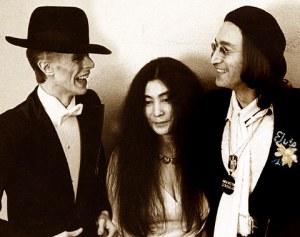
New York, 1975: Bowie, Ono, Lennon
But one thing Bowie did not do was have anything to do with the Beatles as a unit. His star only rose as the Beatles’ was burning out. The Beatles closed the 1960s after defining its sound just as Bowie prepared to do the same for the ’70s. As Bowie eventually put it, when referring to his friendship with Lennon: “Although there were only a few years between us, in rock and roll that’s a generation, you know? Oh boy, is it ever.”
After a lifetime of enjoying rock music, it somehow took until my 40th year to fully immerse myself into Bowie’s music. This is not to say I wasn’t a fan, or didn’t enjoy various releases over the years. But in 2014 I really became a superfan, getting completely absorbed into his music. Part of that immersion was to visit the truly incredible David Bowie Is exhibition that recently closed at Chicago’s Museum of Contemporary Art. Comprehensive and engrossing, I was blissfully overwhelmed.
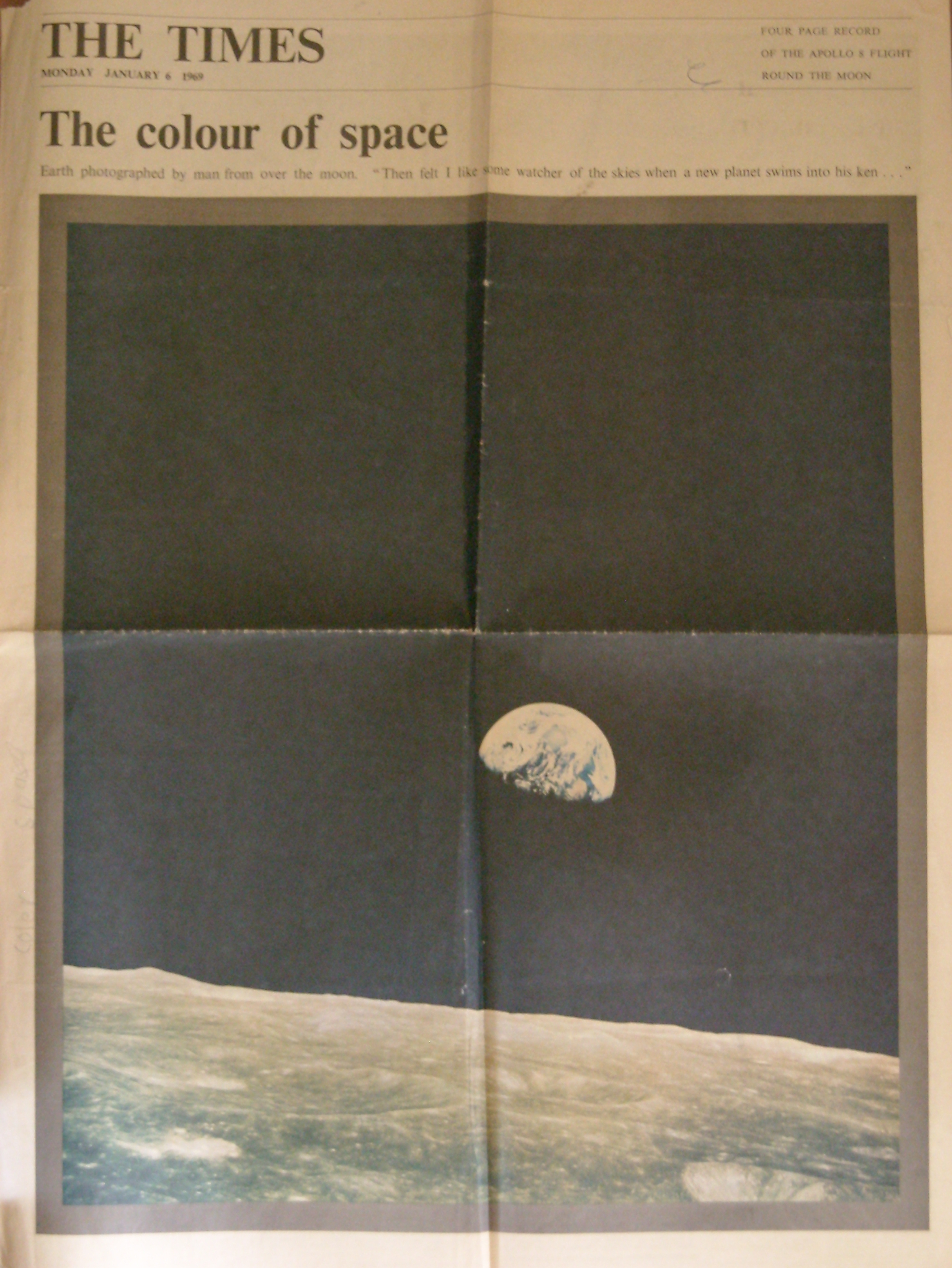
The Times, Jan. 6, 1969 (click for larger image)
Among the artifacts near the beginning of the exhibit was a newspaper: the Times of London showing the Earthrise, the iconic image from Apollo 8 that shows, well, the earth rising as viewed from the moon. The photo was taken Dec. 24, 1968, but was published in a special insert in the Times on Jan. 6, 1969. According to the exhibit, after seeing the paper, Bowie had “Space Oddity” written within a week.
Especially when you place yourself into that era, it’s a moving image, the blue earth rising above the moon, but that’s not what jumped out at me. And if you happened to be at the MCA that morning in mid-November and heard someone muttering, “I’ll play, you know, whatever you want me to play,” and wondered who it was, that would be me.
The Nagra tapes didn’t roll 24/7 in the lives of John, Paul, George and Ringo from Jan. 2-31, so we certainly can’t say the Apollo mission — or any other particular news event — did or didn’t inspire or influence the band. The group touched on politics, immigration in particular, in outtakes like the “No Pakistanis” version of “Get Back” and “Commonwealth” at various points during the Get Back sessions, and it’s not as if the Beatles didn’t have a history of being social commentators.
But I found it illustrative with regards to where these different acts were at this very specific moment in time — Jan. 6, 1969 — that David Bowie was able to find a muse that would launch him into stardom for the first time just as the Beatles found themselves trapped –Planet Earth is blue, and there’s nothing the Beatles could do. Between the time Bowie started writing “Space Oddity” on Jan. 6 and finished it on the 13th, George would suggest the band “have a divorce” after an open discussion recounting how bad things have been for a year (Jan. 7), and then he’d end up quitting (Jan. 10). The Twickenham sessions ended after Jan. 14.
George on David Bowie, 1974
I certainly won’t argue the Beatles were out of ideas in January 1969; this entire blog is predicated on the idea the group remained vibrant and vital during the Get Back sessions. But it’s obvious any success they had was despite themselves. The songs they wrote or worked on this month were works of art, to varying degrees, but it was often tantamount to climbing up the hill backwards, as Bowie would put it, to get anything done. We’d have lost Abbey Road and Let It Be (although you’d assume many of the songs would later resurface on solo records) but an argument can be made John and George, at least, may have been happier people had the Beatles ceased to exist in their present form sometime in 1968. Is the difference tangible between a band being pulled apart and an artist ready to burst? Oh boy, is it ever.
Used in conjunction with the BBC’s Apollo 11 moon landing coverage in July 1969, “Space Oddity” made a name of Bowie just as the Beatles were in the thick of recording Abbey Road. (About 12 hours after man first walked on the moon, the Beatles began recording “Come Together”). By the time Bowie’s eponymous LP featuring “Space Oddity” was released that November, the Beatles were effectively finished. Five years (what a surprise) later, after meeting John at a party, the Starman ultimately entered the orbit of the Beatles.

 They May Be Parted