Tag Archives: argument

Jan. 7: On their own at the holiday camp

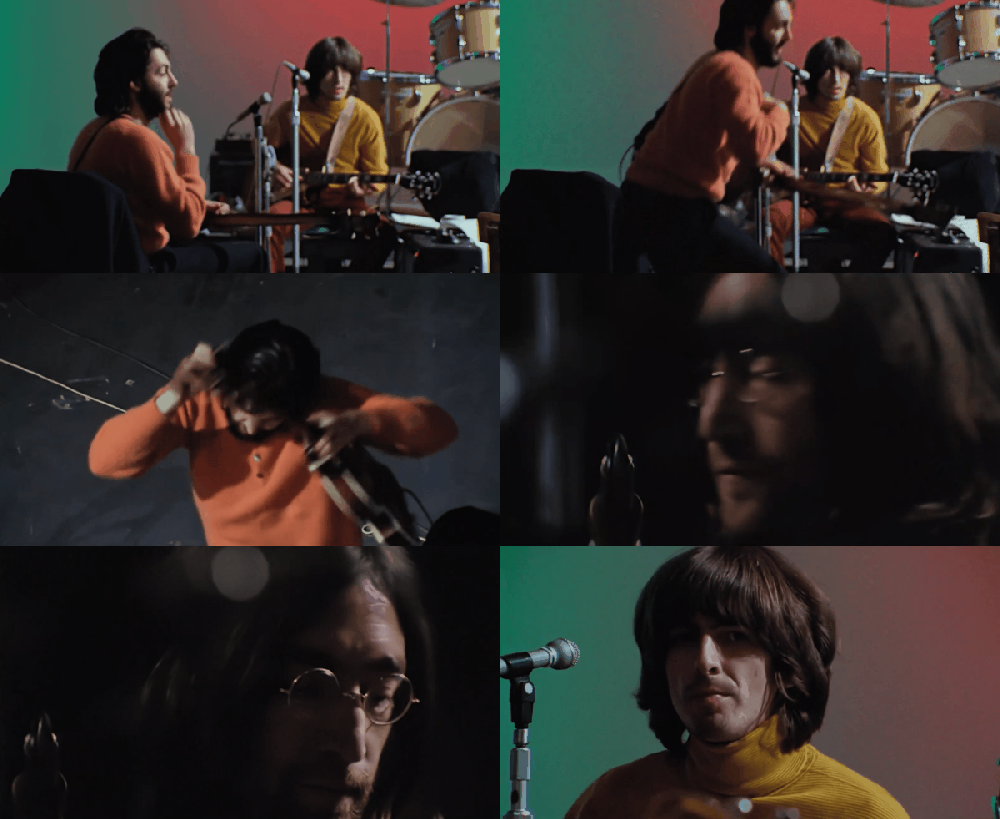
Some time passed on the morning of Jan. 7 between when “Get Back” made its debut and when Paul McCartney, George Harrison and Ringo Starr — plus director Michael Lindsay-Hogg and John Lennon, who had just arrived for the day’s sessions — returned to the much-needed discussion of what exactly they were doing at Twickenham Film Studios.

The arguments of the day before that culminated in George’s “just want to please you” line may be the moment etched in cultural history of these sessions, but the next 45 or so minutes did far more to define the vibe at Twickenham.

The tapes pick up the discussion already in progress, but the message and motive is clear: There’s a serious movement to abandon the documentary and live show, and, by extension, these sessions, which are only just beginning its fourth day.

From the Get Back book.

From the Get Back Book.

“If we cancel the show now, we’d still be throwing it away,” Paul said. “That’s the way we tend to do (it)… that’s where all the money goes.”

Lindsay-Hogg tries to rally the troops, suggesting the worst-case scenario is the group is left with a documentary, which is something the group could still sell, since money is being made something of an issue here by George.  John agrees, saying a documentary of the group making an LP isn’t the worst if they can’t find a gimmick for a show.

With big dreams of an African adventure still flickering, Lindsay-Hogg continues to insist there should be a show anyway. He’s not crazy about the term “gimmick,” either.

Very quietly, George shares something every Beatles fan knows in retrospect when we look back and put the pieces together.

George: Ever since Mr. Epstein passed away, it hasn’t been the same.

Paul: We’ve been very negative since Mr. Epstein passed away. That’s why all of us,  in turn, have been sick of the group, you know? There’s nothing positive in it.  It is a bit of a drag. But the only way for it to not be really a drag, is for the four of us to say, “Should we make it positive? Or should we fuck it?”  There’s only two alternatives, innit?

It’s a fascinating exchange for several reasons, starting with how they refer to their former manager. Both Paul and George still call him Mr. Epstein, not Brian, nearly a year and a half after his death. The formality of the business relationship never broke.

More of note is not only the ease at which they’re willing to discuss their current state and lack of motivation, but how severely Paul views the band’s state. There’s “nothing” positive in it. And so we’re at the group’s climacteric moment.  These four men seem ready to walk away from at least their present phase as a four-piece. Now’s the time to find a new way of continuing as a band, return to the old way they would record and perform together or just walk away. It’s a distillation of the same conversation they had the day before, but spoken with more urgency.

It bears repeating — this strife and breakup talk isn’t at the end of a grueling, unhappy month, or after a several weeks of early mornings on the cold Twickenham soundstage, as the fable of the Get Back sessions relates. This is after the group has been back together in January for a period that can be measured in hours.

John — lacking sleep, sobriety or both — simply suggests the group just needs a little incentive.

“All the things that we do, the whole point of it is communication. And to be on TV is communication. We have a chance … to smile at people, like (in the broadcast for) “All You Need is Love.”  So that’s my incentive for doing it.”

With John referencing another Beatles television production, the director’s wheels begin to turn.

MLH: Both “All You Need is Love” and  (his own production) “Hey Jude” did communicate.

Paul: Of course, they did, course they did.

John: We need to think of an incentive, the inventive is to communicate.

Paul: You know, there really is no one there now to say: Do it.

And thus we return to Mr. Epstein’s ghost. No one is there to make them get up at 8 a.m. now, Paul says. They have to get themselves up at 8.  And this is part of growing up.

These men range in age from 25 to 28 at the time of these sessions and have been professional musicians since their teens.

“Your daddy goes away at  certain point of your life, and you stand on your own feet,” Paul continues. “And that’s all we’ve been faced with. Daddy’s gone away now, and we’re on our own at the holiday camp. And I think we’d rather go home.

“Or,  we do it.”

So it’s crystal clear to Paul here, he’s fighting uphill. The fresh lyrics of “The Long and Winding Road” are playing out moments after he introduces the song. This here is one of the many times he’s been alone.  And he’s still waiting by his bandmates’ door.

Paul continues.

It’s discipline we like. We all agree — for everything you do, if you want to do it well, you got to have discipline, we all think that. But for this, we’ve never had discipline. A slight, symbolic discipline by Mr. Epstein. And he sort of said, ‘Get suits on,’ and we did … And so we were sort of always fighting that discipline a bit.

But now it’s silly to fight the discipline because its our own self-imposed, these days. So we put in as little as possible. But I think we need  bit more if we are going to get on with it.

Lindsay-Hogg acknowledges the decision to work at all is the group’s, not his own, but that they have indeed started work and should maximize it.  Paul, meanwhile, equates what Lindsay-Hogg is dealing with to his own work on the Jackie Lomax LP.

“Any other director in the world would say, ‘Fuck off. Get off my set, you cunt.’ I mean, wouldn’t you?” Paul asks. “I couldn’t operate. … if Jackie in the middle of the album said he won’t do it, (we) wouldn’t have the album.”

Paul suggests to George that the group used to “do it,” be “fully switched on.”  And he hearkens back to their feature film career.

“Those films, look at it, that was us doing it.”

“Well, if that’s what doing it is, that’s why I don’t want to do it,” George retorts. “I never liked that.”

Like the day before, George’s matter-of-fact, deflating response draws a pause followed by nervous laughter and a stammered response.

Paul (talking over George):  See nowadays, you’ve grown up and you don’t have to do that anymore. You don’t have to put the pancake on and go out in front and sweat and shake our heads because we’re not that anymore. We’ve grown up a bit.

George: And we’ve done that anyway.

Paul:What I mean is, we did it, the but it doesn’t mean to do it again means to do all that. For him (John) to do it, he has to do a thing in a black bag with Yoko. And you’re doing it.

Several voices correct Paul.

“White bag,” he says.

“You know you’re doing it then, on this level.”

Paul’s argument, that doing something is tantamount to doing “it” isn’t flying. Lindsay-Hogg changes course and questions just what the Beatles are, circa January 1969 and what is it, since we’re talking about “doing it,” that  they really want to do?

“But do you still want to perform to an audience?” he asks. “Or  do you just see yourselves as a recording group.”

That’s a simple enough question that really does cut into their motivation, not only for these sessions but for their own reason for existing at this late stage in their career.

And its a question we hope to answer next time here at They May Be Parted!
15 Comments

Filed under Day by day

Jan. 6: Please, please you (Pt. 3)

This is the conclusion of a three-part series on the Jan. 6, 1969, sessions for “Two of Us.” If you haven’t already, please enjoy Part I and Part II!

George: OK, I don’t mind. I’ll play, you know, whatever you want me to play. Or I won’t play at all, if you don’t want me to play. Whatever it is that will please you, I’ll do it.

The line came a little more than 16 minutes into the Let it Be film. In a movie less about words and more about music — the trailer’s promise of “rapping” not withstanding — it would stand out regardless. As it is, George’s statement to Paul during the day’s rehearsal of “Two of Us” essentially became the catchphrase for the entire sessions. It’s George’s frustrations and Paul’s bossiness — and John’s disinterest, as he’s conspicuous by his absence —  all in one. And because it was in the film, and the highlight of an extensive set of dialogue in it, it’s the moment we point to. At least, it’s the moment I point to.

“Whatever it is that will please you, I’ll do it” caps a sequence that lasted much longer than two or so minutes depicted in the film.

And when all was said and done, it was Paul needling George over a six-month old suggested guitar part that prompted him to say it (and was the subject of much of the last post).

Paul: This one, it’s like, “Should we play guitar through ‘Hey Jude’? No, I don’t think we should.”

georgeI get what Paul wants to do here, prove his point that a more spartan approach is ideal — especially here while they’re in the rehearsal stage. And he’s made that clear. But instead he finds a way to pick at a scab.

George, remember how you were wrong about “Hey Jude”? You’re wrong, just like that, today.

And because of George’s state during the sessions — his originals were blandly tolerated at best or outright dismissed at worst — the scab tears right open.

George: OK, I don’t mind. I’ll play, you know, whatever you want me to play. Or I won’t play at all, if you don’t want me to play. Whatever it is that will please you, I’ll do it. But I don’t think you really know what that one is.

Missing from the film is that last line, which really gives it an extra bite. Passive-aggressive right into aggressive.

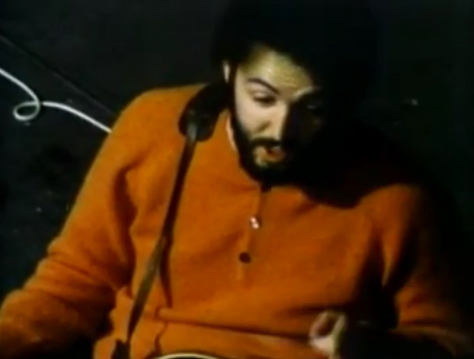
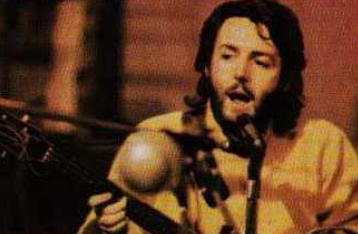
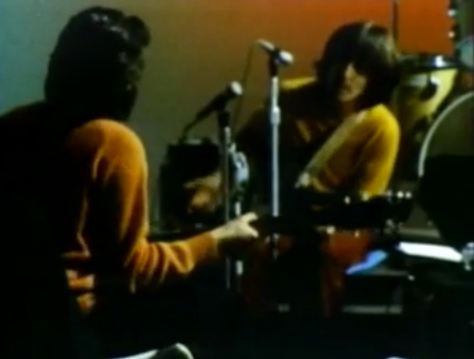
In the film, the discussion pivots from George to John wanting to listen back to tapes before he begins into “Across the Universe.” Paul’s sweater goes from orange to yellow, so not much sleuthing is needed to know that’s cut in from a different day.

After George relays his willingness to please, Paul’s actually speechless for a few seconds, before saying, audibly perturbed and in a way only Paul can say it, “OK, now come on.” He pays no mind to John, who here is actually trying to defuse the situation with a resolution that would move the session forward in the immediate.

Do you want to take the galloping bit, and I’ll just vamp?” John cuts in to ask George. Paul continues.

Paul (to George): Look, you know, it’s not like that. … We’ve gone through this, we’ve really got to sort out this, because this is the one, you know? Now we’re rehearsing,  and we’re trying to get it together for a TV show. So we really, like you said, we’ve only been through four numbers.

(George replies with an “uh-huh”)

So we’ve probably got to get some system to get through like 20 or 30 and no more. … And it’s probably going to be like sculpture. So that we get all the chords, so we can all vamp them all. Then we can all play every solo we need.

Wow! That’s a lot of songs. What a TV show that could have been, right?  (This isn’t the post for it – but it will be sooner than not: What would those 30 songs be?)  Anyway!

Paul: But… you know what I mean. It’s got to sound as though it’s improving.

George: It actually, it sounded to me, that for me, it was a waste of me time playing when we started it today. I just started remembering then what it was getting into the other day after playing it for an hour and a half. And suddenly I start finding that what I’m doing is starting to have something, Have some sculpture to it.

Paul: I know what you mean, it’s just that that way of doing it puts me off the way I’m trying to do it.

George: But that’s all. I can only do me that one way, however I do it, you know?

Silence. And then Paul decides to wave the white flag before being spurned. Just picking his fights, I guess.

Paul:  Let’s do another song, then.

George: No, we can’t.  We still have to learn this.  Do you want to do … Maxwell’s Silver Hammer?

The sarcasm drips like water from a faucet. Maybe he was looking for an excuse to quit the band a few days earlier than he ultimately did.

John: Let’s do this, because, I mean, we’re going to come to this,or whatever it is. And the thing is just to try to and think whatever …  it’s going to be.

Paul: This afternoon, I think we’ve wasted a long time. I think we do waste, physically, waste a lot of time, the four of us together.

It’s Paul as boss again, this time lecturing on employee efficiency. And I don’t blame him, because he’s pretty much on target here.

The slate cuts in, and there’s some cross talk and Paul’s bass muffling some dialogue.

Paul: I’m scared of that, ‘You be the boss.’ I have been for a couple years. We all have, you know? Not pretending about that. … And that’s what we decided, you know?

This line passed right by me the first time I heard it, and it wasn’t until I was sprucing up the post that it jumped out. What’s Paul saying here? Should we give him the benefit of the doubt and guess he’s saying he’s scared of the whole “be the boss” thing for a couple years? Or is he coming out and saying that he has been the boss for a couple years?  I’m not sure he doesn’t think of George as a subordinate, but I don’t think he believes that of John. But I’ll give Paul a pass here, in part because the lack of reaction.

Paul: And this is why it’s chaos. That’s why we take so long.  Because, really … we could play it shitty. We play it shitty 10 times, and so it’s sort of in there.   And then I think we could play it quite good then. But it’s just like different approaches, you know? I think we’d be better just doing it all like the Red Norvo Five. Just really like…

John:  Vamping away.

Paul: Vamping … then get the imaginative thing. … I know it’s impossible … because we don’t do it that way. … There’s no point in me trying to get you to do it how I do it.

paul-pointsA little reminder here — they’re not even done with their third day of the sessions, and things are already being described as a “waste of time” and “chaos.” Reading between the lines and maybe I’m off-base, but I think Yoko’s omnipresence is implied as part and parcel of the chaos. And maybe Paul has a bit of an idea that they’re moving too fast here, even though he’s part of that problem — nobody has any idea what songs they’re going to play at a live show, where the show will be or even how it will be staged.

Meanwhile, who the heck is Red Norvo? He led his quintet (there was a trio, octet and other combinations, too), playing modern jazz on a vibraphone and, it seems, famously vamping.

Paul: It’s terrible, though, seeing yourself really go down a path you’ve been down too many times, you don’t want to go down. Like us going on about this. I really don’t want to go down that path. It’s just silly. I just don’t see any solution.

The problem is that we should all arrange our own tunes. And if you want improvisation, then should just say it.

George: That’s the best way.

Paul: It’s like a point of theory, this, isn’t it? It’s not just to do with playing music. Far further reaching, this thing.

Far further reaching, indeed. So the path is set for Beatles 2.0, although  we’ve already seen them act, essentially, as each others’ backup band in many instances on the White Album (and certainly before that, too). Now, they discuss codifying it, taking “I’ll play if you want me to play” to its logical conclusion.

It wasn’t an angry exchange, this one, rather very matter of fact (and difficult to hear with the band playing over the conversation). But we do see how it manifested on Abbey Road, where the band often recorded parts in separate studios simultaneously.

Isn’t this moment here, very specifically, The Beatles agreeing to ultimately break up? They’re happy to relegate the other members as their respective session players, making George no different to Paul than Hamish Stewart, or Paul no different to John than Tony Levin.

Perhaps coincidentally, the group launches into a slow, almost mournful abbreviated version with John leading on vocals. Shortly thereafter, Paul gets back to business.

Paul: What I really meant to say was, let’s do the same bit on that. That’s what I really meant to say.  (“We’re on our way home”)

The band returned to the back end of the chorus, focusing on timing and cues. Mal is asked to fetch John a tea and George a beer. This can only be a good thing as the occasional brew helps fuel the odd blog post as well.

George and Ringo fool around, playing “Frère Jacques”  into Dylan’s “It Ain’t Me Babe” for less than a minute. Maybe the beer helped mellow the mood, as George, with a much friendlier vibe, asks Paul how he envisions the style of “Two of Us.”

George: It was going heavier. Do you want it more countryish?

Paul: I don’t mind, I’ll just go where it goes.

The group runs through the song a few times, sometimes able to get all the way through. Tape cuts make it hard to tell just how many times they did work on it.

In addition to giving a passing, light-hearted nod to “When the Saints Go Marching In” and “Loop De Loop” — they spent a bit of time on the very end of “Two of Us.” I’d most certainly say Paul was trying to “confuse it” before “unconfusing it” here, but what the hell do I know? I’ve only written about 5,000 words on just 50 minutes of “Two of Us” rehearsals.

And with that, we wrap the day’s historic and fascinating rehearsals of the song.

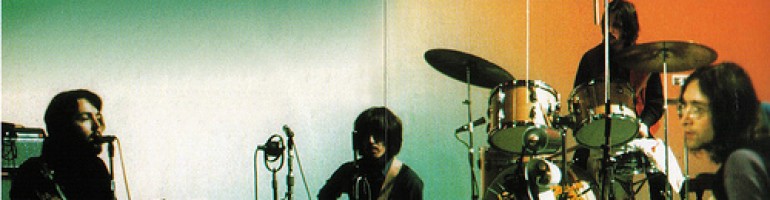
Having fun, the Ringo way

Having fun, the Ringo way

So given the full context of the day’s sessions (and the prior days’, too), and emotions which were especially ramped up during the torturous “Don’t Let Me Down” rehearsal that immediately preceded “Two of Us,” of course  George’s famed “please you” wasn’t anything remotely out of the blue. It wasn’t even the most potent or viscous thing he said that hour.

But the delivery of “please you” was perfect, and watching it on film more than 40 years later, it’s still a great, dramatic moment. Like I wrote in the first post about “Two of Us,” it’s a  passive-aggressive greatest hit.  I’ve said it to bosses (they had no idea what I was referencing).  I’ve said it to my wife (she did).

I think it’s remembered, even in a way that “I don’t even care” — spoken seconds earlier — isn’t. Of course, that could just be terrible VCR copies and rips over the years responsible for the muddy sound. The moment, the editing — it was just perfect for “I’ll play, you know, whatever you want me to play. Or I won’t play at all, if you don’t want me to play. Whatever it is that will please you, I’ll do it.”

The pity in all of this? I think the song sounds great. It’s fun, upbeat — I liken it to a driving song during a buddy movie vs. the eventual acoustic cut, which sounds like something to hold hands to in a romantic comedy. Oh well. I’ll enjoy the pacing of the song while it lasts for a few more days of the sessions.

The “Two of Us” rehearsals over, John searches for the words to “Across the Universe,” while George sneaks in a little bit of Hear Me Lord. They go back into “Universe” for one take before attention shifts to “All Things Must Pass” and “She Came in Through the Bathroom Window” to end the day.

28 Comments

Filed under Day by day

Jan. 6: Please, please you (Pt. 2)

Rehearsals on January 6 — just the third day of the Get Back/Let it Be sessions — deteriorated to the point where The Beatles were arguing about the very nature of rehearsals and the extent to which a song need be complete in order to have a member bring it to the full band to actually bother with run-throughs.

paul-gb-bookWith takes of “Two of Us” under way, Paul’s already defensive, George is already passive-aggressive. And John? Seems like he just wants to run out the clock and get the hell out of there. But at least he’s not showing any desire to have confrontation at this very specific moment in time.

When we last left things, the song — while sounding great to these ears more than 40 years later — was hung up in the intro, outro and bridge (I guess that doesn’t leave a lot, does it?). Paul had just accused George of being annoyed by him and he bemoaned the presence of the cameras. After some silence and noodling by the group, and another remark by John about the opening riff that continues to torture him, Paul repeats his preferred rehearsal style.

Paul: Doesn’t everyone agree that it’s confused at the moment? So all I’m trying to say is, let’s get the confusion, unconfuse it, then confuse it.

It’s what we’ve been doing all afternoon — this is why we’re not getting anything done. We’ve just got [to get] rolling on with it. We’ve only got 12 more days, so we’ve really got to do this methodically, this one. Unconfused, then a bit more confused, then a bit more. “Now try this drumming here, try this drumming there. Now, OK, let’s stop and look into this bit.”

Well, there’s another nice, little revelation. As of Jan. 6, it seems it’s locked in that the sessions will end Jan. 18 — or, if we’re adding in weekends, make it the 21st or 22nd (depending on whether the 6th counts against that 12 days). Presumably this is how long they’ve booked Twickenham. Talk about ambitious. As history would eventually prove, The Beatles would be out of Twickenham much earlier than that, on Jan. 14 – but that would be a direct result of George leaving the band before rejoining on a condition they abandoned the soundstage for Savile Row.

After Paul’s repeated plea to simplify first, John jumps in, almost as comic relief, continuing his complete fixation on getting out of playing the opening galloping part on guitar.

“I’ve got an idea,” John graciously offers. “I should vamp, because I’ve got to sing, and it’s hard going. But it’s annoying” (and he plays the opening riff).

George fools around on guitar over a bit, making dialogue hard to pick up, until things get clearer in this next exchange.

Paul: I’m trying to stop us all playing until we know what we are playing.

George: But you got to play in order to find out which fits and what doesn’t.

Paul: I’m thinking … we’re improvising the solos, but we play strict chords and strict rhythms around the vocals… I don’t want to say, ‘cause I really just hear myself the only one saying it. All this time…I don’t, don’t get any support or anything…you know its right, and you know its right. (He’s presumably talking to George and John).

John: OK, so I just don’t know what to do about it.

George: I’ll wait until you get your bits and then work my part out if you like. It’s like a matter of working it out with you while you’re working your bit out. You know if you got your bass bit, you know… it will take even longer.

Paul: I’m not trying to say to you, you’re doing it again as though I’m trying to say, and what we said the other day, I’m not trying to get you. What I really am trying to just say is, “Look lads” — the band, you know — “should we try it like this,” you know?

George: It’s funny now how I don’t even care.

It’s amazing honesty from George. He, for one, doesn’t seem to care at all about the cameras capturing the proceedings.  But alas, the tone he spoke in was somewhat mild (and who knows what the visual was) so I can see how this didn’t end up becoming the killer line chosen for the film, like “whatever it is that will please you” became.

Meanwhile, Paul’s showing no hesitation in calling out George and John, both, in saying he’s alone in keeping things afloat. Really, for all of Paul’s flaws, he’s kind of right here about the situation. There does seem to be a bit of cart-before-the-horse when it comes to running through the songs.

And as Paul continues, not skipping a beat after George’s dismissive comment, he goes back at George, reminding him of a recent exchange the two had over a song.

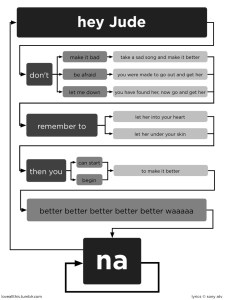
Paul: This one, it’s like, “Should we play guitar through ‘Hey Jude’? No, I don’t think we should.”

(loveallthis.tumblr.com)

(loveallthis.tumblr.com)

More than 40 years later as I write this, it almost seems like “Hey Jude” was from a different generation of Beatles than the ones arguing their way through the Get Back/Let it Be sessions. But on Jan. 6, 1969, where we are today in this blog’s current timeline, it was a song recorded less than six months prior, released a little over four months earlier and had just dropped out of the UK Top 40 three weeks prior.

It’s a funny thing how prevalent the ghost of “Hey Jude” was at the time of the Twickenham sessions. The song’s sessions were easy, with rehearsals beginning July 29, ending Aug, 1. The experience of the song’s video shoot – done at the same Twickenham — helped encourage the band that the time was right to perform in front of live audiences. And like these sessions, “Hey Jude” was ultimately recorded away from the safe and familiar confines of EMI Studios at Abbey Road (where they recorded what turned out to be more rehearsals than real takes), and instead at Trident.  And if outtakes are any indication, it was a pretty upbeat affair.

Thus, the experience recording the song — which happened smack in the middle of the White Album sessions — was fresh at the time of the Get Back/Let it Be sessions. Paul and George had just been discussing how much they liked Wilson Pickett’s cover version just three days prior.

So what was Paul’s beef with George on “Hey Jude”? Here’s what he has to say sometime in the 1990s, as captured to print in the Anthology book:

On “Hey Jude”, when we first sat down and I sang ‘Hey Jude…’, George went ‘nanu nanu’ on his guitar. I continued, ‘Don’t make it bad…’ and he replied ‘nanu nanu’. He was answering every line – and I said, ‘Whoa! Wait a minute now. I don’t think we want that. Maybe you’d come in with answering lines later. For now I think I should start it simply first.” He was going, ‘Oh yeah, OK, fine, fine.’ But it was getting a bit like that. He wasn’t into what I was saying.

In a group it’s democratic and he didn’t have to listen to me, so I think he got pissed off with me coming on with ideas all the time. I think to his mind it was probably me trying to dominate. It wasn’t what I was trying to do – but that was how it seemed.

This, for me, was eventually what was going to break The Beatles up. I started to feel it wasn’t a good idea to have ideas, whereas in the past I’d always done that in total innocence, even though I was maybe riding roughshod.

I did want to insist that there shouldn’t be an answering guitar phrase in ‘Hey Jude’ – and that was important to me – but of course if you tell a guitarist that, and he’s not as keen on the idea as you are, it looks as if you’re knocking him out of the picture. I think that it was like, ‘Since when are you going to tell me what to play? I’m in The Beatles too.’ So I can see his point of view.

But it burned me, and I then couldn’t come up with ideas freely, so I started to have to think twice about anything I’d say – ‘Wait a minute, is this going to be seen to be pushy?’ – whereas in the past it had just been a case of, ‘Well, the hell, this would be a good idea. Let’s do this song called “Yesterday”. It’ll be all right.’

What we see here is pretty obvious: The Get Back/Let it Be sessions have been tarnished — demonized even — in part, because we actually can hear everything that happens thanks to voluminous bootlegs. Good luck finding a recording George and Paul arguing over the “Hey Jude” extra guitar part.

So in the Anthology excerpt (among other places, like in Barry Miles’ “Many Years From Now”), Paul does a pretty good job here giving what seems like an honest presentation of what was happening in 1968-69. And nearly 30 years after the fact , he was still able to run through the specifics.

And it was Paul’s reflection — This one, it’s like, ‘Should we play guitar through ‘Hey Jude’? No, I don’t think we should.'” — is what directly prompted George to spew “I’ll play, you know, whatever you want me to play.”

More from the “Two of Us” rehearsals, including George finally uttering that line I keep on going on about, coming up in the next post!

22 Comments

Filed under Day by day

Jan. 6: Please, please you (Pt. 1)

It’s a passive-aggressive greatest hit.

And it’s the highlight of the series of posts — which gets under way here — I was most eager to write before I heard a minute of the complete tapes.

George to Paul: I’ll play, you know, whatever you want me to play, or I won’t play at all if you don’t want to me to play. Whatever it is that will please you… I’ll do it.

Having just heard the band make their way through a somewhat torturous rehearsal of “Don’t Let Me Down,” the context is finally here of just why George was ready to snap at Paul. But it’s a long and, well, somewhat direct road to get to “whatever it is that will please you,” and the tension isn’t one-sided as the group pivots to Paul’s “Two of Us,” an ode to his bride-to-be, Linda.

please youIn listening to the entirety of the “Two of Us” tapes, Paul’s ready to jump at anyone, feeling quite on the defensive. John, for one, doesn’t take the bait. And in fact, as the session for the song goes on, John actually attempts a bit of a peacemaker role once things begin to boil between Paul and George. But that comes later. George, on the other hand, is quite ready to share his feelings with Paul.

Musically, the song isn’t too much different than it had been before they broke for the weekend, on Jan. 3. It’s upbeat, and completely electric at this point. But like the final version, it’s a Paul-John duet. The first take of the day, straight from the top after they had moved on from “Don’t Let Me Down,” breaks down seconds in when John asks if he’s supposed to be singing.

Paul: Melody. You’re supposed to remember the words, too.

John: Yes, I’ve got them here.

Paul: But learn ’em.

John: I almost know ’em.

And we’re off and running! Just another 50 or so minutes of remaining rehearsals of “Two of Us” — and arguments — to go. Fasten your seat belts.

The tension never lets up — getting to “whatever it is that will please you” was inevitable.

Paul references past Beatles songs a number of times during the rehearsal, beginning with an early run-through, when he dictates to George that the guitar part during the verses should sound “like that bit in ‘Getting Better All the Time'” (meaning the staccato guitar part opening the song and that plays throughout).

After subsequent noodling around with the song, Paul tries to restore order and get down to actual business, in the orderly, McCartneyesque manner we’ve come to know and love/hate.

“OK, come on, come on,” Paul says to the group with a headmaster’s tone. “Let’s get it so we know it simply, and then we can add. We don’t know any one [song] yet straight. We keep trying to get to the bits.”

This is indeed true through the first few days of the sessions. “Don’t Let Me Down” is dragged down by the bridge. “I’ve Got a Feeling” isn’t quite right yet. “All Things Must Pass” is very much a work in progress. “Maxwell’s Silver Hammer” isn’t finished yet. You get the picture. Only “One After 909” – written more than a decade earlier, despite the slower arrangement, and born in these sessions out of an oldies jam – was in game shape.

Another pass at “Two of Us” and things break down as they enter the first bridge (“You and I have memories…”). So it’s time for a band meeting (Ringo, the passive drumming robot, says nothing throughout).

Paul: We’re going to have to sort of bring it together, because we’re all at odds. We’re doing that thing we did on The Beatles — we’re all playing, you know? Like in this verse, it’s two harmonies singing, trying to say some words, right? So it’s just… (he vocally apes a guitar vamp ). And in the bits when we need bits….

John: I’m just trying to sing it and do this thing (he plays the guitar part played during the “We’re on our way home” line).

Paul: We’ve got to get the riffs when the riffs bits come in.

George: The riffs… There’s no riffs. It’s nice just to get what you’re playing. (George then starts to sing “You and I are memories…”)

Paul: But it’s not together, so that it’s not sounding together.

George: So we keep playing until we…

Paul: Or, we can stop and say it’s not together.

George: Yes, then you’ve got to carry on until you get it together. It’s all right to keep playing until it sounds like it’s blending with the rest.

Paul: I never know what to say to that, you know? ‘Cause what I want to say is, “Now, come on,” and play, but I can’t, I know. You know, and we get into that one. OK.

They’re not talking about what sounds good, what words work or don’t or the like. This is a debate about the philosophy of how to rehearse. We’re in uncharted territory. These four men are writing a record on the spot, under strict time constraints to get these songs in working order for a show that’s going to happen at some unknown locale, and very soon.

You’d think this kind of thing would have been hashed out, but then again, why would it? When they last toured, in 1966, they played about a dozen songs — nothing brand new, and some songs they’d been playing for many years. They knew the songs inside and out, plus they weren’t writing anything special for the tour or struggled under the pressure of the clock. And when they last brought new songs to the table — a few months earlier for the White Album sessions — they didn’t have the pressure of the live show.

There’s a bit of nervous laughter from Paul before he continues to offer a logic he repeats numerous times over the “Two of Us” sessions this day.

Paul: … It’s complicated now. See, if we can get it simpler, and then complicate it where it needs complications, but it’s complicated in the bit.

George: It’s not complicated.

Paul: But, I mean, you know.

George: I’ll play just the chords if you like, and then…

While George is low-key throughout, speaking in completely passive-aggressive tones, Paul grows audibly exasperated.

Paul: No, no, come on. You always get annoyed when I say that. I’m trying to help, you know? But I always hear myself annoying you…

George: No, you’re not annoying. It’s not annoying anymore (or is it “anyone”? Hard to tell).

Paul: … And I get so where I can’t say it. But you know what I mean. Just do this then, and, I don’t know. I can’t do it on film either. I don’t know if we can do it on camera.

Funny, Paul had just said earlier in the day that he didn’t mind being filmed, that the band has ignored the camera from the moment they started filming at Twickenham a few days earlier.

As we see in the 2021 Get Back docuseries, at this point, Paul stands up, and paces around, showing emotion the Nagra tape audio alone doesn’t capture. It’s a clear dovetail between audio only and the audiovisual moment that was very new on first viewing in 2021.

As it would turn out, Paul returned to his seat and would end up having to continue this discussion on camera after all, and it would become one of the iconic moments of the Get Back/Let it Be sessions and the film — behind only the rooftop concert — and truly in the group’s history overall.

The in-depth look at the “Two of Us” sessions on Jan. 6, 1969, will resume in the next post. Coming very soon!

20 Comments

Filed under Day by day

Jan. 6: Cross that bridge (Pt. 2)

When we left the Fab Four in the previous post, the band was continuing the wrestle with the bridge in “Don’t Let Me Down.” To Paul, the section “needs things to happen.”

So he proceeds to ask Ringo for a little bit of stop-and-start drumming, some cymbal play and otherwise suggest ways to demolish the pacing of the song.

John seems to like it, or at least not dislike it. There’s a sparseness to it, and maybe I’m nuts, but I almost feel a little Plastic Ono Band thing happening here (“Hold On” maybe?).

excerpt

Excerpt from the Let it Be book

One thing that’s enjoyable to listen to as they work on this is hearing the isolations — Paul’s bass, George’s guitar. Meanwhile, Ringo’s a robot throughout the rehearsals. He literally doesn’t say a word (that you can hear on the tapes, at least), soaks up Paul’s instructions and basically steps in to lay down the same steady beat each of the 2,549 (approx.) times they try to tackle the bridge this day.

Meanwhile, the tapes cut in and out for an undetermined amount of takes, but it couldn’t have been too long, since they’re still wrestling with the same stuff. Now they’re paying a bit more attention to the instrumentation on the bridge over the vocals. Paul’s looking for more from George in the way of a lead guitar line — overall, not just in the bridge. Soon, John tells George, “We’ve got to keep fiddling around with this bit, so you want a guitar bit. … There’s a point where we’ll to have to concentrate on the guitar for each song.”

But maybe it won’t be now. John gives the band a chance to opt out of the “Don’t Let Me Down” after nearly an hour of not exactly getting very far. “Should we do something else ,then?”

Feel like letting go? Not Paul. “Stick with it,” he replies.

So they continue and struggle with the song’s pace, first going too fast, then overcompensating by going too slow. Things just aren’t getting anywhere. George complains they don’t even know what they’re singing during the bridge —  and they don’t. Tape glitches lose some time, but it doesn’t matter. When we’re back, the rehearsals are in the same state. John doesn’t bother singing the lead vocals straight every time — and there’s no point, it’s the same vocals he uses on the final take.

For a moment, they ditch the response vocals and go with simple “aahs” over the bridge, and it didn’t sound too bad. But still a bit superfluous.

So Paul shares what’s on his mind, which is what we all probably figured he’d say anyway.

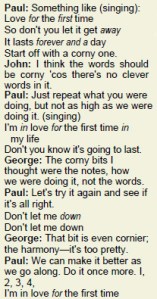
Let’s do what I said in the first place. Really, just repeat what you’re doing (the response vocals). I think that’s the best. … Not as high as we were doing it.

As we enter the final few minutes of the song’s rehearsals for the day, palpable tension finally arises. George’s general objection is to the weak response vocals and undefined instrumentation in the bridge. Paul replies that “I’m just trying to get a bit we’ll try and sort of go right through. We keep talking about it.”

The next take, they do a call-and-response in the bridge, this time repeating John’s lines: “I’m in love for the first time (I’m in love for the first time)/Don’t you know it’s going to last (Don’t you know it’s going to last)…etc.

George still objects, and makes no bones about it, saying,”I think it’s awful. …  it’s terrible.”

Paul and John both fire back, speaking over each other:

John: Well, have you got anything to supplant it?

Paul: OK, you’ve got to come up with something better, then.

George makes a suggestion to the guitar part/harmony (they’re being played together) that Paul calls “just too pretty,” which is interesting on so many levels — although among them that it’s true.

They can’t get through a take of the bridge before things break down. George keeps offering up little tweaks, but Paul doesn’t want to be slowed. Now, at least.

Paul: We make it better as it goes on.  … We’ve just gone around like for an hour with nothing.”

George: [We’ve been just trying different] permutations.

Paul: I know, but let’s sort of move on now.

John: I’d like to hear any of them right once.

More stumbling through takes and Paul and John reach agreement on how the bridge should now sound, at least the lyrical combination. It’s a mixed message to George, too, since literally moments after saying it wasn’t the time to tweak the bridge, he decides it, in fact, is.

Paul: When [John sings] “Don’t you know it’s going to last,” we sing, “It’s a love that has no past.” Then we repeat “It’s a love that lasts forever” exactly, and then when you sing “It’s a love that has no past,” we sing “It’s a love that’s going to last.”

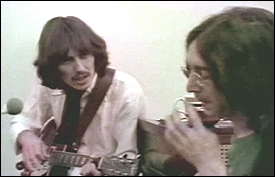
George JohnGot that?  Not sure John did or really cared — he’s let this aspect of the song be managed by Paul all day as it is — but he replied simply “Yes, I agree.”

A pair of broken takes did result, blessedly, in an epiphany and a solution that stuck.

“Forget the last line,” George said right after doing just that and playing the song’s opening riff over where they had been shoehorning in a response vocal.

They repeat this part a few more times. We still have the other extra vocals in the bridge, but the riff sticks.

While Paul’s assuaged for the moment — “So that’s near enough for the time being” — John isn’t.

John: We found out that’s the weak bit [the bridge] so we tried putting voices on it. But it’s still down to the rhythm.

Paul: But it was always weak on your guitar. That’s the weak bit of the song.   (It’s unclear here if he’s talking to John or George, or both).

Shortly after that exchange, we’re back after some kind of gap on the tapes, with a fresh attempt at the song from the top. And we clearly lost some discussion, because the bridge suddenly lacks any response vocals — but does retain George’s riff to end the section. This sounds like the “Don’t Let Me Down” we know and love, for the most part, even down to John not quite getting his own vocals straight.

The next (and final) take, we inch even closer, with Paul and George singing harmonies with John, not as a response to him in the bridge.

And with that, the band ends their 80-plus minutes (on the tapes, it was even more in reality) of “Don’t Let Me Down” rehearsals on a high note. May not have been the classic “eyeball-to-eyeball”  collaborations John and Paul would do — especially with George so deeply involved. But clearly, even though it wasn’t exactly cordial, it worked. “Don’t Let Me Down” was a better song 80 minutes after they started rehearsing.

Paul then announces the next song they’ll try to work on —  “Two of Us Going Nowhere On Our Way Home” — and we’ll find out soon enough just how much George wants to please him.

13 Comments

Filed under Day by day