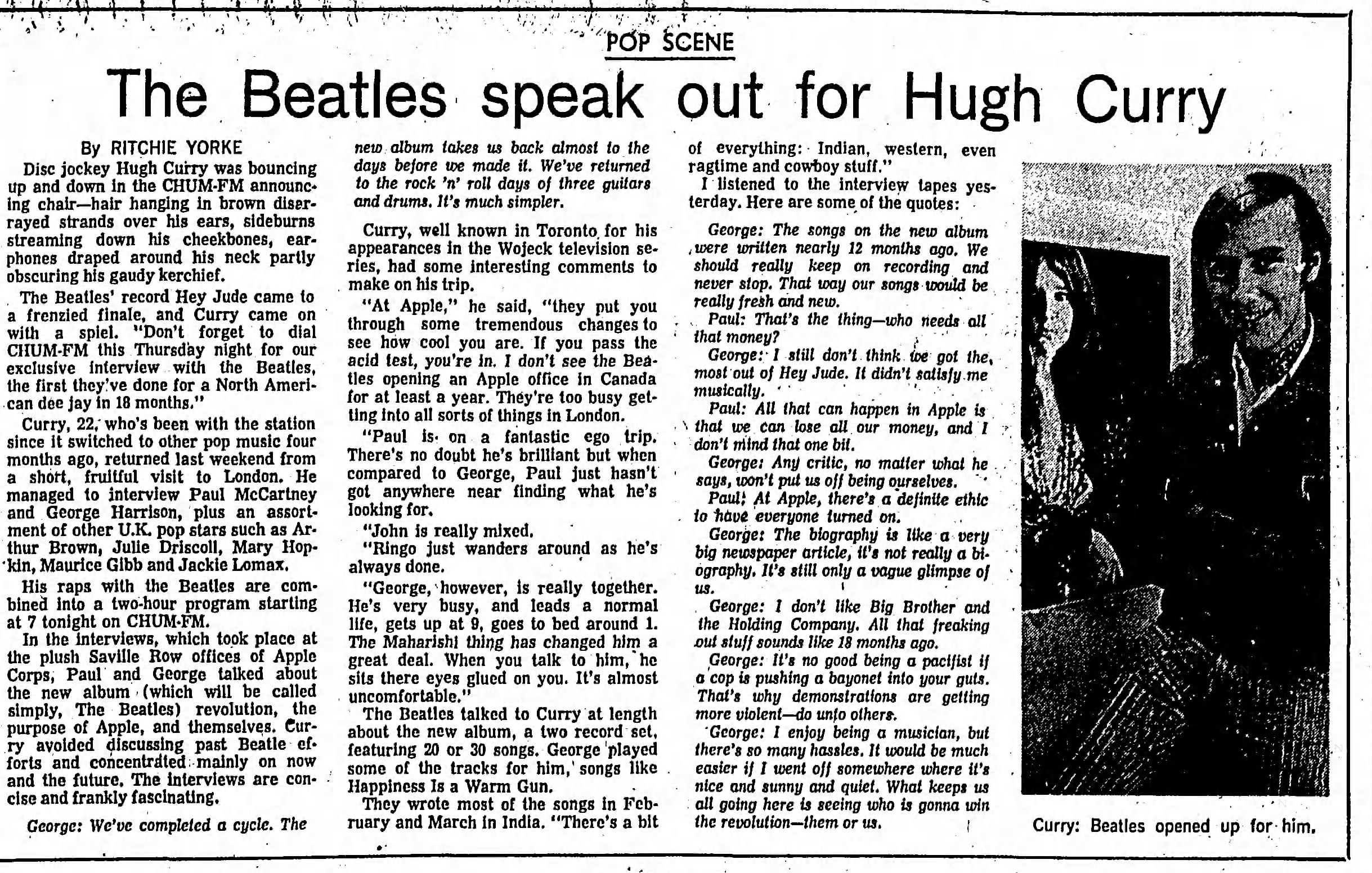
John Lennon and Yoko Ono gave a lot of interviews in 1969, the year of Bagism and Bed-Ins. The 30 minutes they spent with a Canadian TV network on January 14, 1969 — what has long been known as the “Two Junkies” interview — was otherwise completely unremarkable save three things.
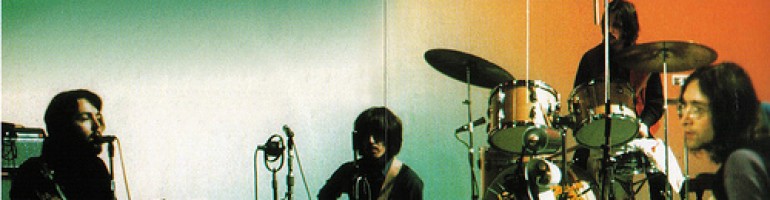
First, the interview was conducted in the midst of the Get Back sessions and on set at Twickenham Film Studios. Hugh Curry, who conducted the interview for a Canadian Broadcasting Corporation (CBC) television program, probably wasn’t aware George Harrison had quit the group and certainly couldn’t have anticipated it was the last real day of the sessions at Twickenham.
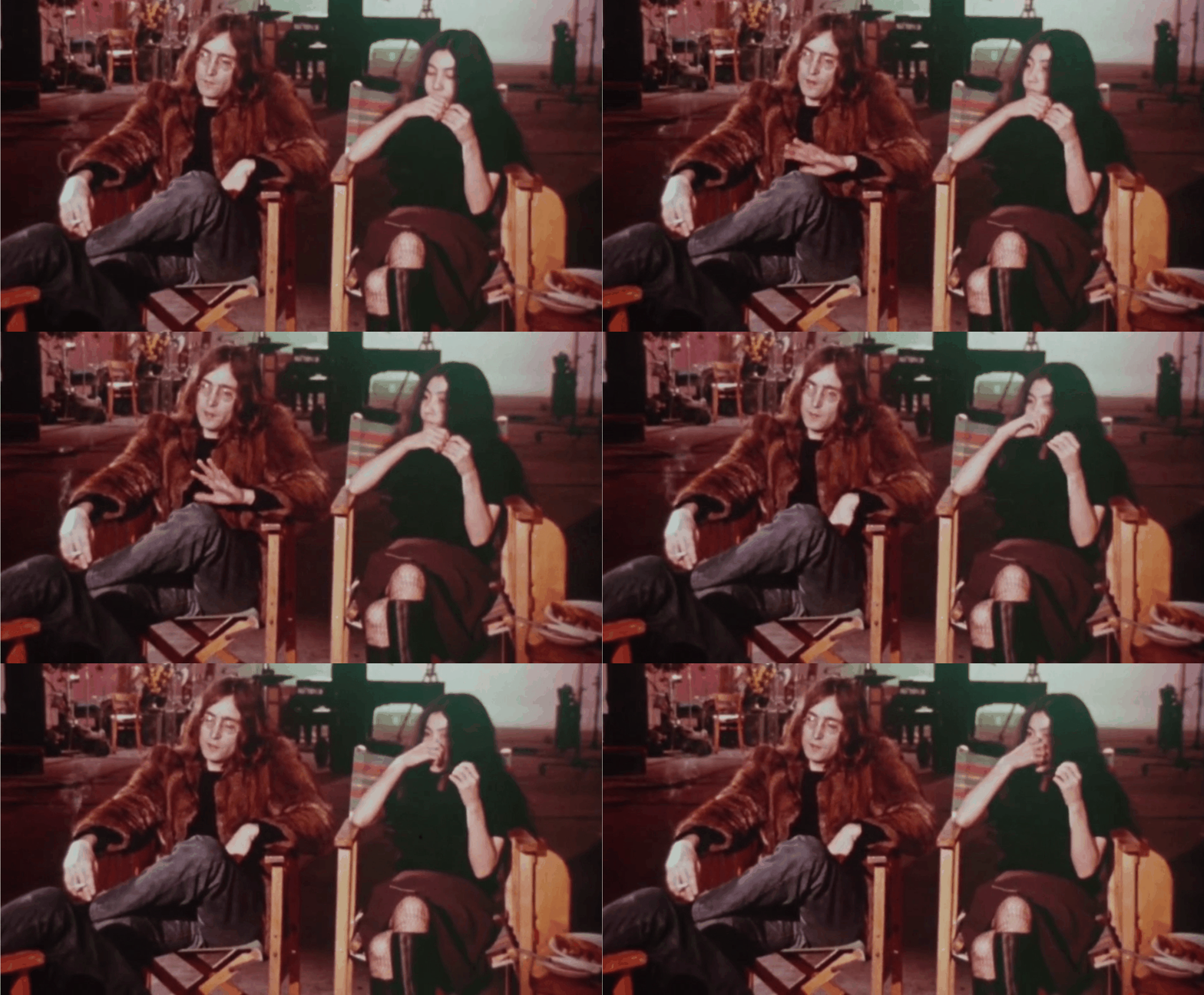
Second, and maybe less of a surprise, John was coming down from a heroin high. “I just was up late, you know,” he said later that day as recorded on the Nagra tapes. “I was sort of stoned and high and watching films.”
His condition alone may not have been remarkable, but halfway through the interview John fled to throw up.
Finally, and we’ll get to this at the end, the provenance of how the full interview survived is an incredible story unto itself, rich with Beatles-adjacent characters in a massive pile-on of coincidences.
In the context of the Nagra tapes and Get Back docuseries, the Two Junkies interview lives in negative space. It’s not on the dozens of hours of tapes, and the interview isn’t seen in Get Back (Peter Jackson told me during our 2021 appearance on Something About the Beatles that he decided not to pursue the rights to the clip to include in Get Back after some consideration). Like so many things Beatle-related do – or did for a long time – it survives as a bootleg.
Curry finalized the timing of the interview (after 10 a.m. this Tuesday) just a few days earlier, on January 10, after George walked out on the sessions. It was originally pitched as a discussion primarily with Yoko.
“If there’s a moment while she’s doing it, I’ll wander into it,” John generously replied to the suggestion he could participate in the interview. “You just set a time to do her, and if I’m not doing anything, I’ll come in on it.”
Speaking decades later in an interview that surfaced on YouTube in 2015 but could date earlier, Curry said he was able to hook up the interview because his cameraman, Phil Pendry, was friends with Yoko’s then-estranged husband Tony Cox. Curry considered any appearance by John to be a bonus.
“We got there, and John and Yoko showed up, and we all had a couple of cups of tea and woke up, because it was fairly early in the morning, and did the interview,” Curry said. “And it went quite well, and John was really good and very kind to do it … it worked out very well, and that was the end of the story.”
(It wasn’t even close to the end of the story.)
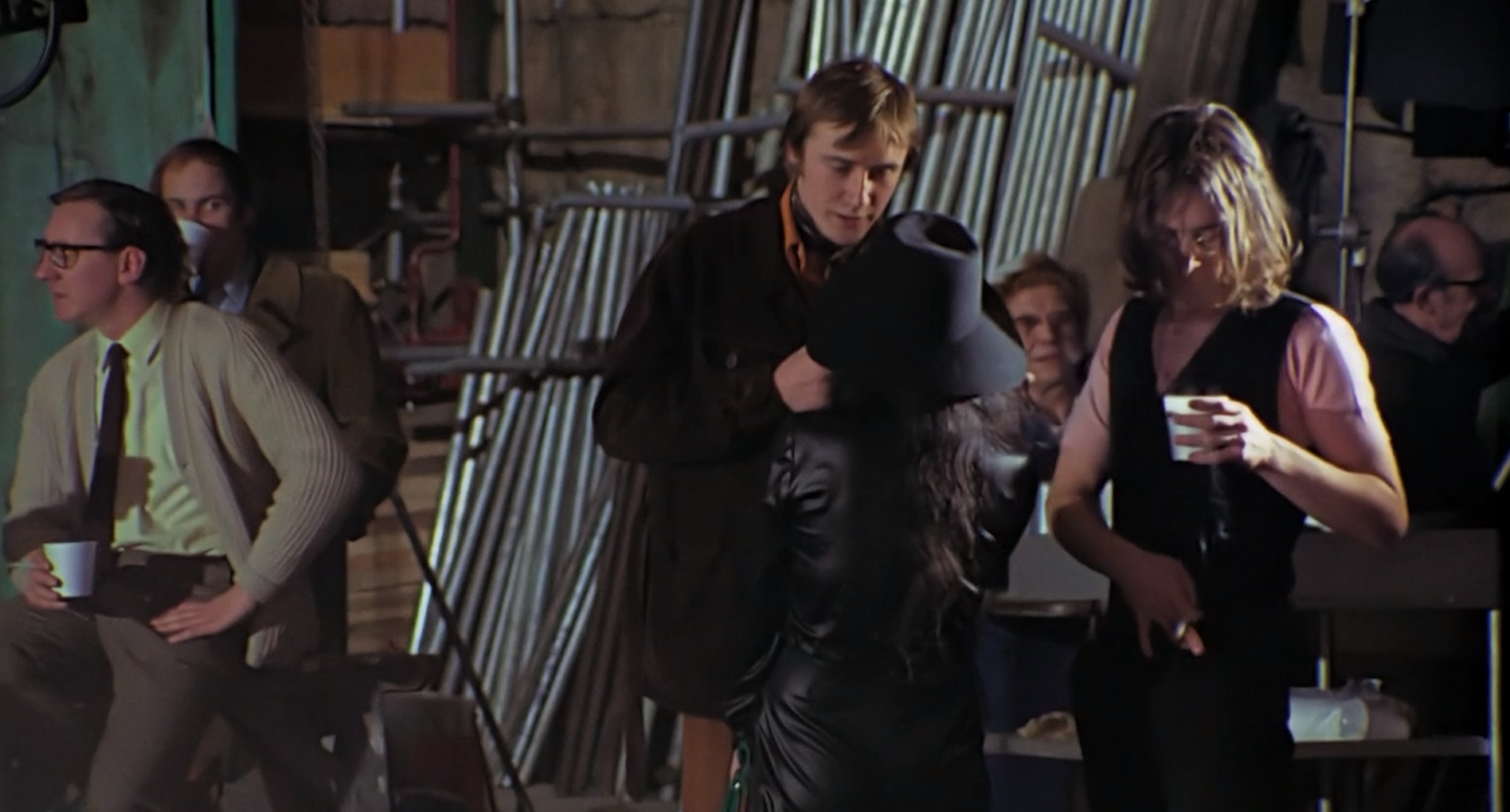
John, Yoko and CBC’s Hugh Curry as captured by Michael’s cameras and revealed in Get Back.
Curry already had a history with the group – he interviewed three Beatles for Canadian radio during promotion for the White Album. At the time of this interview at Twickenham, Curry was in London embarking on a six-week assignment collecting interviews for a forthcoming youth-focused TV show, “Through the Eyes of Tomorrow.”
Let’s dig into the interview itself and the scene around it. Remember the last post: Paul McCartney, Ringo Starr, Michael Lindsay-Hogg and others were playfully sketching out movie ideas aware John and Yoko were actively being filmed.
“There’s a camera crew here from CBC who John fixed [up], and they want to do Yoko and possibly John. They want to set up in the other part of the studio. They can easily go to another studio. Do you mind?” Michael asked.
It was OK with everyone, and Paul joked “We’ll just shoot the CBC crew shooting John shooting Yoko. But John and Yoko should be shooting Ringo and I.”
We could hear roadie Mal Evans as part of the conversation on the Nagras, but at the same time, he was keeping an eye on the nearby CBC interview. Photographer Richard Keith Wolff was there too, too, part of Curry’s traveling party. At one point Ringo sneaks by in the background, prompting some laughter.
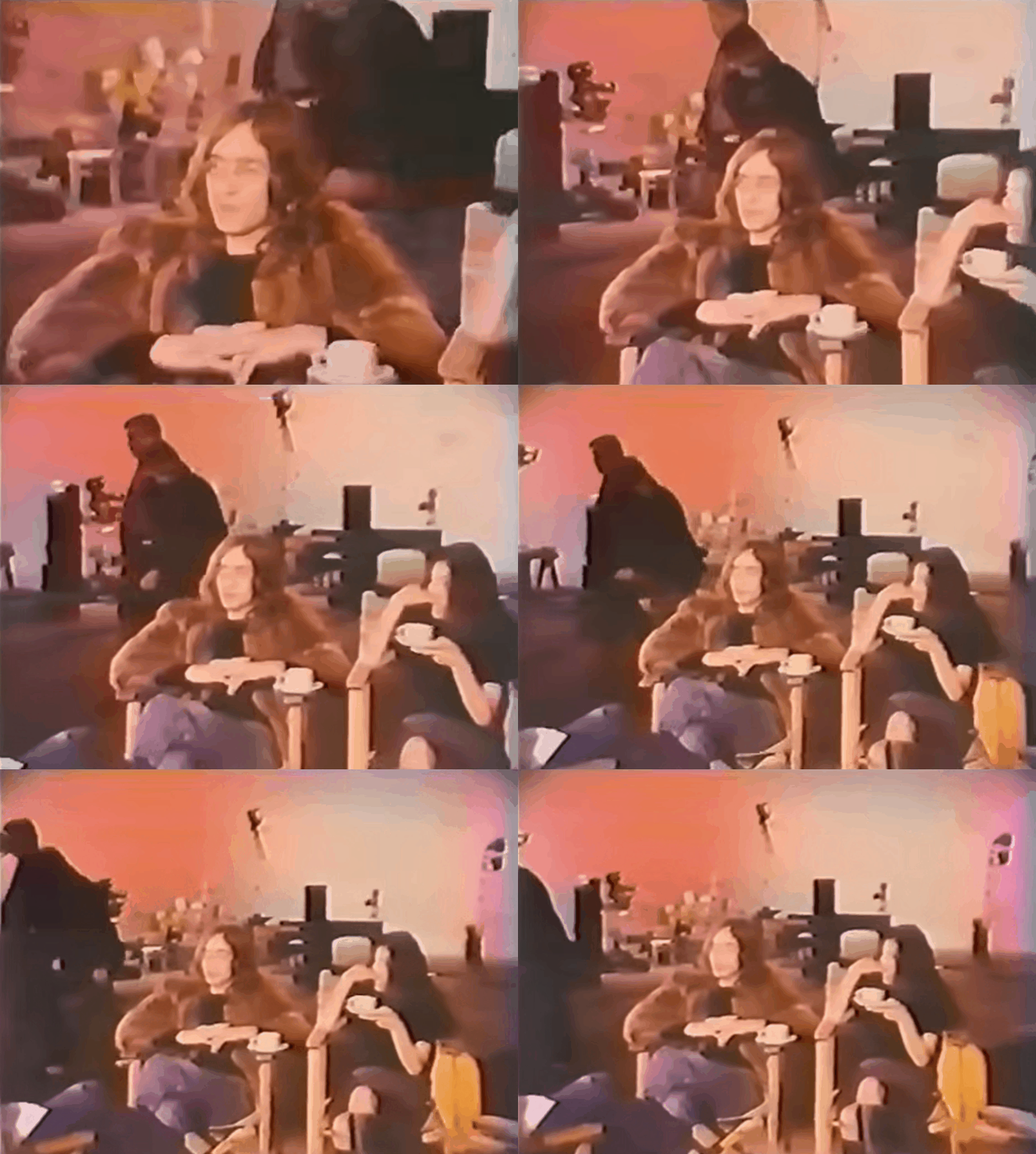
Located on the familiar Twickenham set (the Blüthner and the rest of the Beatles’ rehearsal stage serves as the backdrop), John sat to Yoko’s right — both were in director’s chairs, with Curry sitting at an angle, in front of the couple and to their right. Occasionally you can see Curry’s leg in the shot, and his questions are audible on the recording. John enjoyed the usual Get Back session combo meal: a cigarette with a side of tea. Yoko worked on a muffin or cake or toast of some kind and was often seen picking at her nails and fingers. Their legs were crossed throughout. John appeared pale, at least at the beginning, as seen in poor quality video and better quality photographs. His speech was uncharacteristically slow and only got slower.
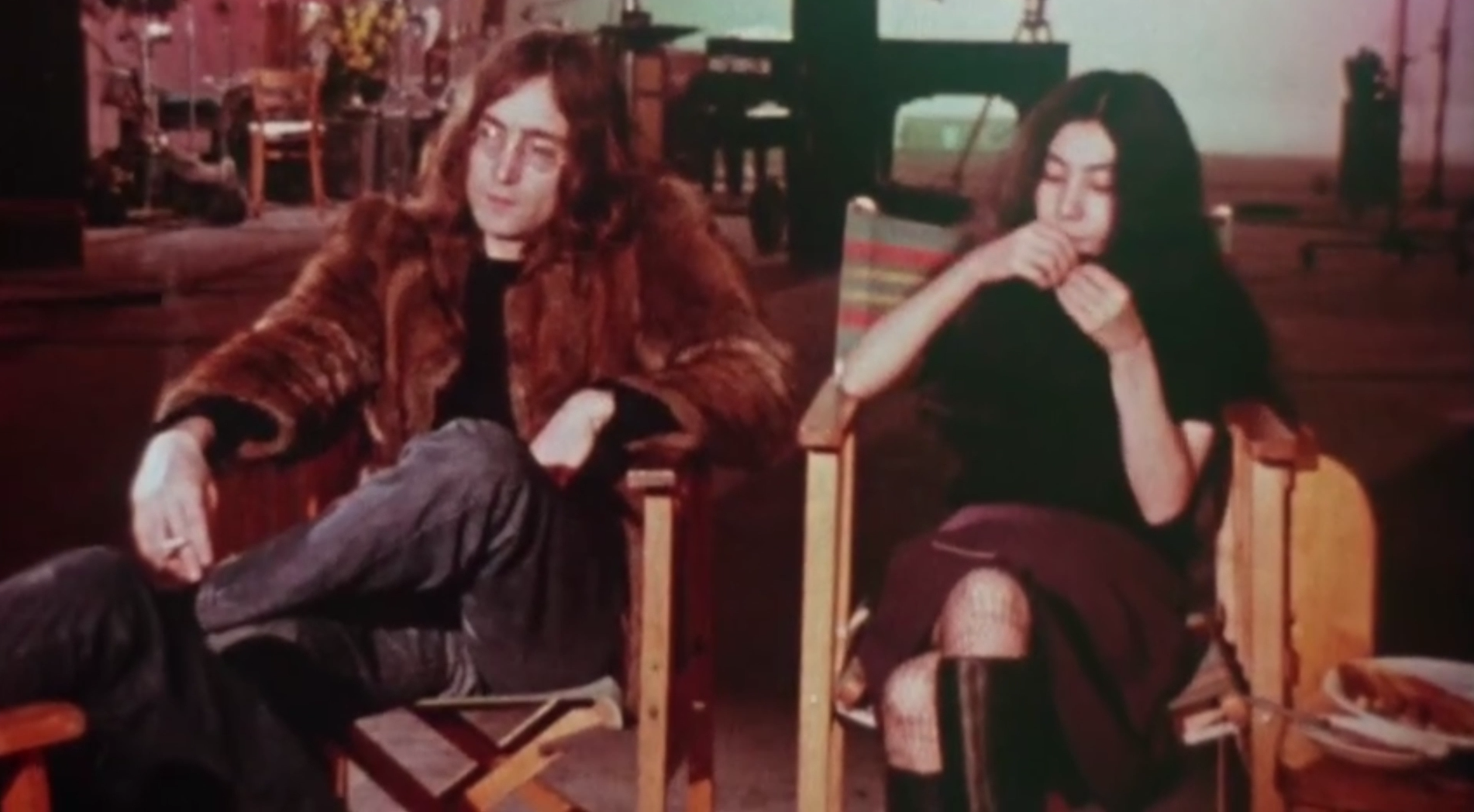
The interview began with Curry asking John for the couple’s origin story, which was familiar in the press by now, leading into how they have since been artistic influences on each other. Yoko was gracious and reflective in her reply.
(Both John and Yoko said “you know” a lot during the interview – for the sake of easy reading, I edited several – but not all — of those out when I quoted them below, like I would if someone said “um.” This sort of thing happens all the time. I went to journalism school, it’s all good!)
“John actually really changed the whole world in a way,” Yoko said. “You know, he influenced the whole world, I think. In that sense, I was sort of influenced.
“I think my work lacked a kind of relaxed type of sense of humor. I mean, there was sort of a cynicism in it, but there wasn’t a real sense of humor and also sort of constructive thinking. And that’s the thing that I sort of got from John, I think.”
Much of the interview centered around John and Yoko’s LP Unfinished Music No. 1: Two Virgins, recorded in May 1968 and released that November, only a few weeks before this interview. Curry called the duo’s nearly 30-minute platter of sounds “not a one-time listening experience.”
“If I did anything vaguely like that before, I’d just do it for sort of fun and maybe play it to Ringo,” John said.
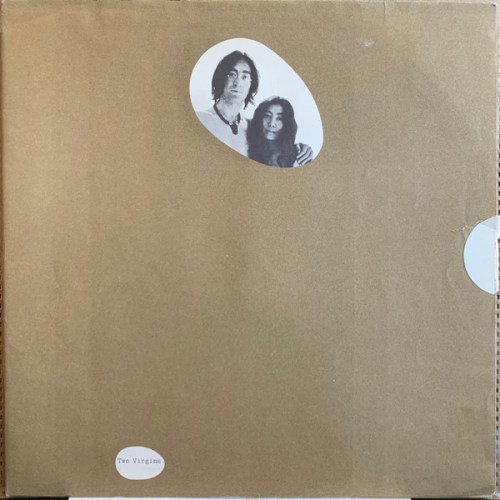
John didn’t coin the name “Two Junkies” but came close in the late ’70s, writing that he and Yoko on the cover of Two Virgins were “two slightly overweight ex-junkies.” That description appeared in an autobiographical section of his posthumously released book Skywriting by Word of Mouth, in 1986. Click on for the NSFW version of the cover, but make sure to ask mom and dad first!
When it came to the controversial cover of the LP, John said he originally envisioned it as Yoko alone posing naked. John first pitched the idea to her in a letter he sent from India in February 1968, which included a drawing of her naked sitting on a “huge glass ball.”
John: The natural thing that I got from her and her book Grapefruit … was the simplicity and childlike [nature] and innocence. …
And then I thought the best cover [would be] for her to be naked and sort of say, this is me, you know, no arty cover or no design to it, just a plain straight photo of her naked as her work is. …
Just naturally when we got together and made the LP together [I thought that] that we should both be naked on the cover. You know, I didn’t think anything until I started getting reaction from people. …
Even when I first got it back, I got the surprise of seeing myself actually naked. But I thought, well, why not, you know? We’re all naked. And so it was just when I started showing it to people and people reacted very strongly, I thought maybe there’s some trouble here.
Freshly established as a Beatles B-side and album track, “Revolution” was another justifiable talking point that Curry jumped on. John’s reaction time answering had noticeably slowed by this point, 10 minutes into the interview.
Curry: How do you think [the revolution is] going?
John: I’ve no idea really. … I just know there’s something in the air. That’s all I know. And I don’t know what form it takes. I don’t know whether, you know, five million people in Trafalgar Square or [the] Two Virgins cover is doing it, or are both of them doing it, and to what extent they’re having the effect. …
We’re for the revolution, whatever it is, you know, but as I sort of said in that song, I’m not pro-violence. … I’m not saying, well, get off the streets and start marching and waving and distracting people. But I can’t give a yes to “let’s destroy it all,” you know, I don’t think that’s the answer. …
I really think, if it gets to destruction, you can count me out. But I’m not sure, you know, I’m human and I’m liable to change or, depending on the situation, I prefer non-violence.
It was shortly after this part of the conversation John, in fact, counted himself out.
“Excuse me, I feel a bit sick,” he said a little after the 16-minute mark of the recording, following a short stretch in which John was hiccupping, audibly holding something down, and clearly sick to his stomach.
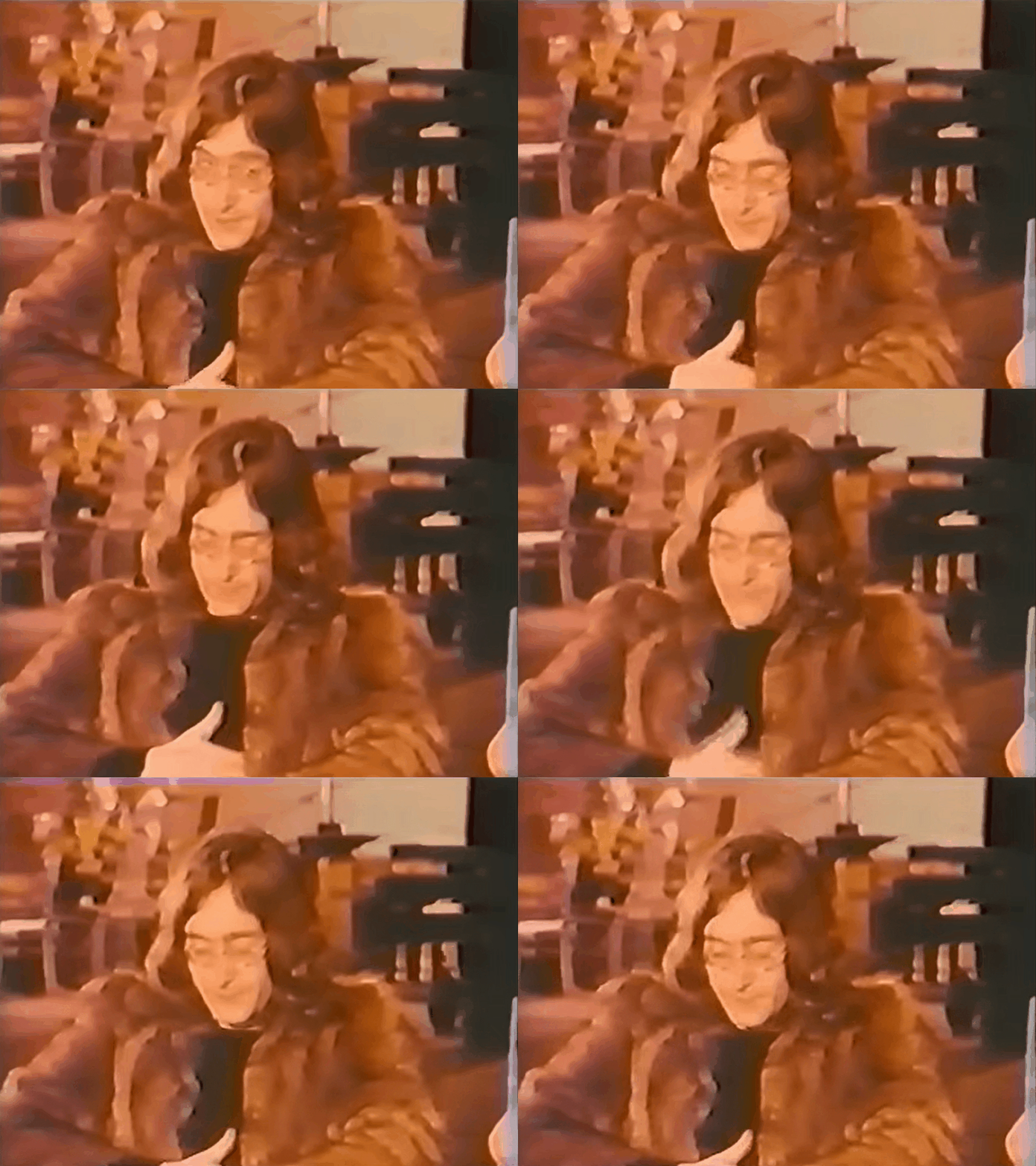
This is when the Two Virgins canonically became the Two Junkies.
According to Wolff, who shared this account in Ken Womack’s book Living the Beatles Legend, Mal quickly arrived on the scene to help John, who threw up off-camera.
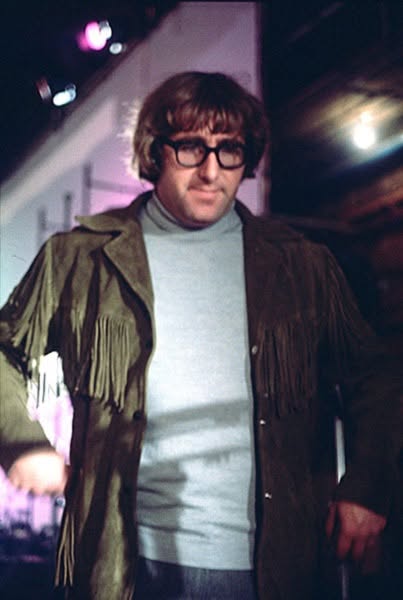
It’s Mal Evans to the rescue, as photographed by Richard Keith Wolff on January 14, 1969.
John recalled this moment later in the day, as heard on the Nagras and seen in Get Back — although for the docuseries, the reveal was edited for dramatic effect. The entirety of John’s admission came after actor Peter Sellers’ visit to the set, which was also in Get Back. It came on the heels of a mention of Ringo feeling sick (a hangover, probably).
“See, you missed me this morning. I did it for CBS [sic],” John said. “Just leapt off in the middle of the interview. No reason at all, except that I mistreated my body.”
A few minutes later, John returned to the subject:
John: I’m just recovering from the day.
Yoko: From the night.
John (feigning shock): Oh, don’t say that! You’re always revealing us. From the night indeed. Next thing you’ll be telling them about our black sheets.
Unlike other days recorded, here John and Yoko bluntly discussed drug use on tape. As Sellers left the stage, John joked the actor shouldn’t “leave the needles lying around. We’ve got a bad reputation now with John getting busted.”
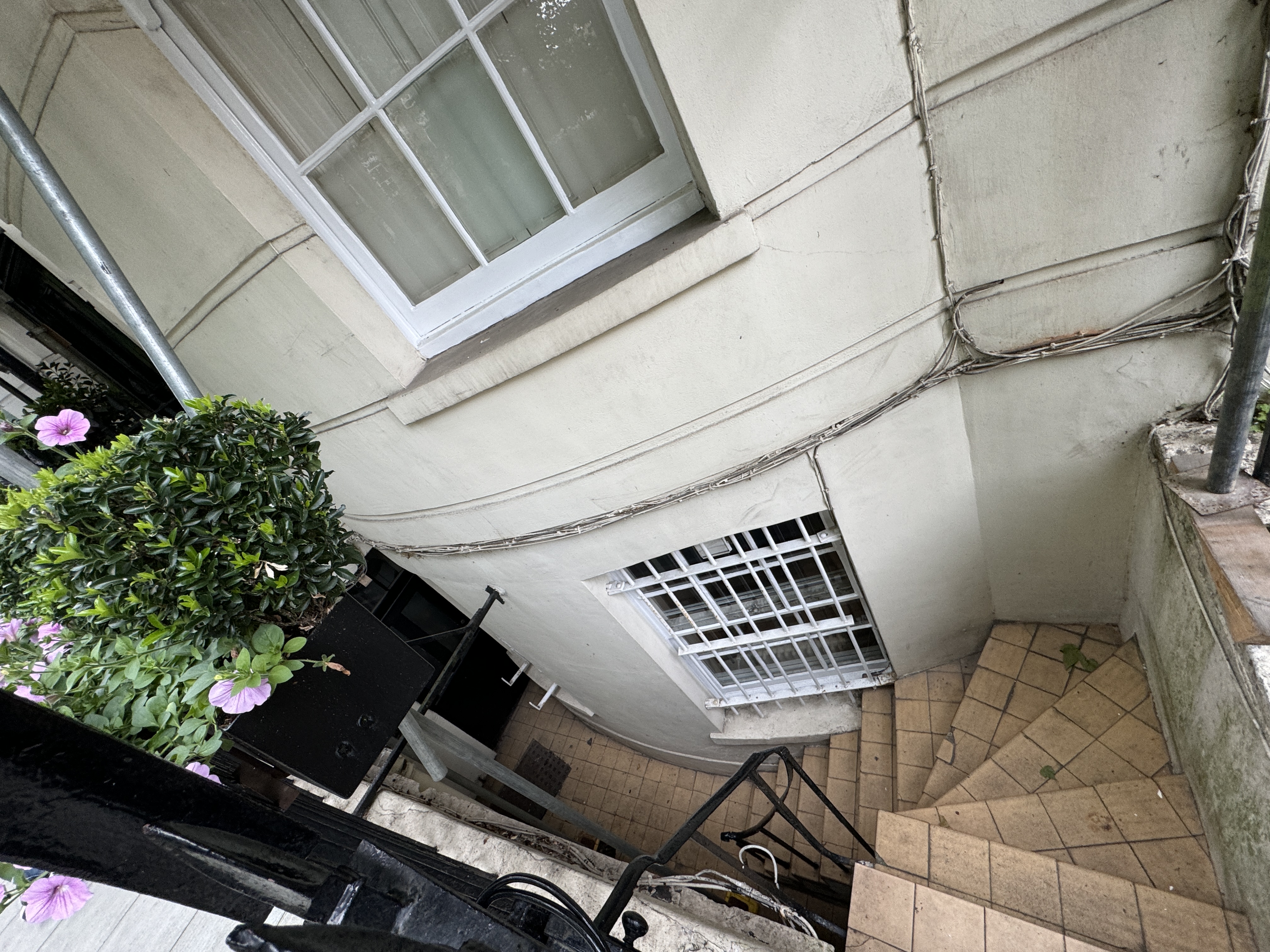
The basement of 34 Montagu Square, where John and Yoko were busted for drugs as well as posed for the Two Virgins LP cover.
“I know what it’s like for showbiz people,” John continued. “They’re under a great strain and they need a little relaxation. … It’s a choice between that and exercise, you know. And drugs win, hand [sic] down.”
“Well, shooting is exercise,” Yoko added.
(For the record, John maintained they only snorted heroin. “I never injected it or anything,” he said in the 1970 Lennon Remembers interview for Rolling Stone. “We sniffed a little when we were in real pain.”)
In Get Back, the edit shows a concerned Paul suggesting John should avoid discussing drug use in front of the cameras.
“Is there any need to do this in public, Mr. Lennon?” we hear Paul ask.
But this response from Paul was spliced in from a completely different part of the conversation more than 20 minutes later and explicitly in the context of the Two Virgins nude LP cover. It wasn’t even a criticism – it was Paul role-playing as an aggressive interviewer as they joked their way through the afternoon.
Let’s listen in to be sure. First, here’s the context around Paul’s line “Is there any need to do this in public, Mr. Lennon?” as heard on the Nagra tapes.
Now, here’s John’s description of getting sick.
OK, so John vomited halfway through his CBC interview. Now what?
Consummate professional and self-promotion addict he was, John got right back in front of the camera to complete the interview after the brief absence. John wasn’t running quite at 100 percent, but he enjoyed a little bit more pep in the second half of the interview.
Two Virgins resumed as the focus of Curry’s line of questioning at John’s return. The LP, in John’s opinion, should be analyzed no differently than a Beatles record.
John: All the versions that people have of it, all their interpretations are true for them. If you believe it, it’s true. And it you don’t believe it, it isn’t true for you. It doesn’t exist. If I don’t believe you, in you, you don’t exist.
Yoko: It [was actually titled] Unfinished Music, which means that we were very conscious of that, meaning that you can add anything to it. You own sounds, if you want to, or just in your mind.
John, who said in the interview “it’s a job, writing a song,” put some effort linking his work with the Beatles to what he was creating with Yoko. It’s a thoughtful response that sheds a little light on his thinking — or what he wanted to telegraph publicly — halfway through the Get Back sessions and while George was estranged from the group.
Although we’ve [the Beatles] been married 10 years, it’s still as new as it ever was in the relation. You can’t just sort of bulldoze through because we’ve been together so long. We’ve got to feel our way and try and communicate or reach a certain level together to put it across, otherwise it doesn’t work.
Asked about a potential return to the stage, John derided their final tours in 1966 as “a sort of freak show.”
“The Beatles were the show, and the music had nothing to do with it,” he said. “And as we were musicians, we felt there was no enjoyment. … The only reason to be a Beatle is to make music, and not just to sort of be in a circus.”
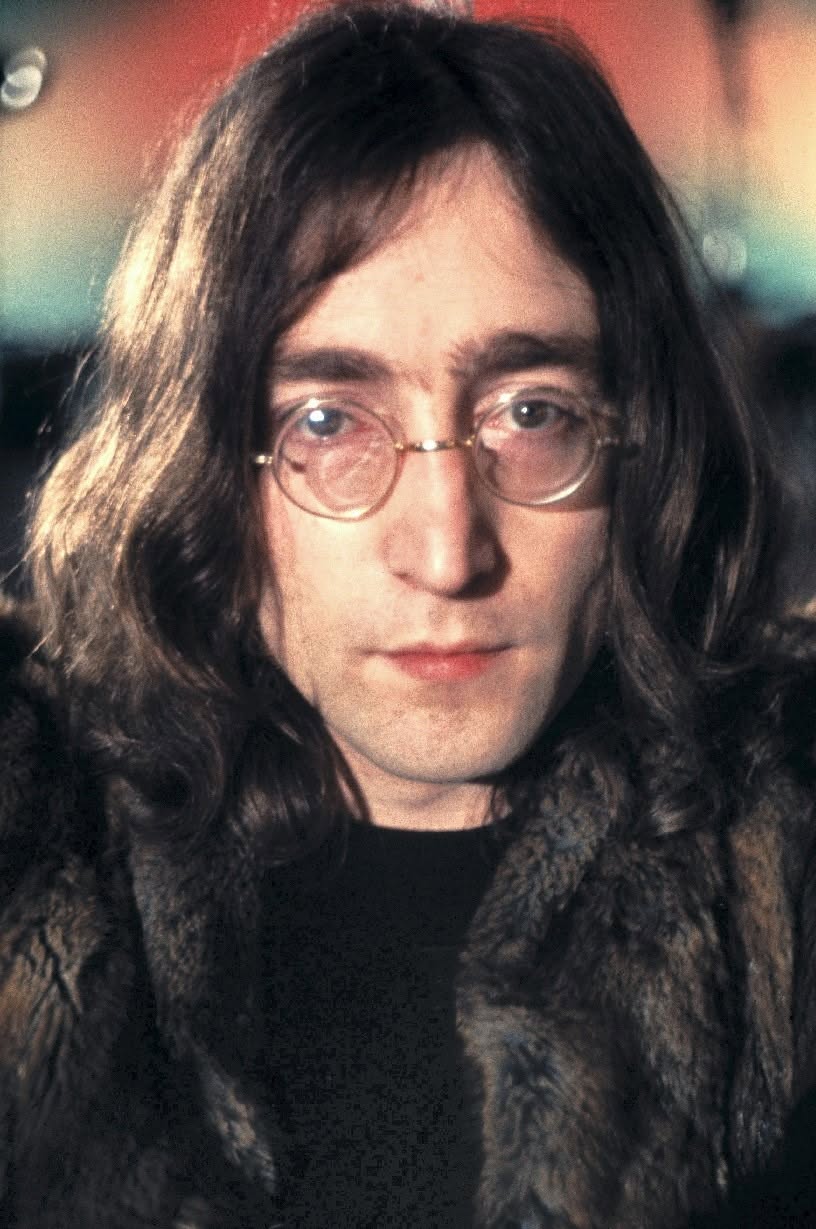
John on January 14, 1969, as photographed by Richard Keith Wolff.
Curry pushed back, suggesting the live scene in 1969 wasn’t what it was even a couple years earlier, saying progressive venues like the Fillmore East and West and the Avalon Ballroom were more controlled environments with attentive audiences.
John: But we’ve done that gig. … We haven’t got a strong enough compulsion. …
That’s partly the reason for doing this show, doing a live sort of album with an audience.
With a return to the stage to cap the TV show they were recording still the Beatles’ imminent plan in some form — though at the moment an increasingly quixotic concept given the situation at this low ebb of the Get Back sessions — John was still offering a public face that the plan was still on.
An examination of John’s work ethic concluded the interview.
“I’ve always never enjoyed not having anything to do … but now there’s something to do all the time [with projects with Yoko]”
If he wasn’t making a record but was “in the garden, making eight mil[limeter] films,” John didn’t view that as work until Yoko convinced him otherwise.
John: Just having vague ideas and things, which I didn’t consider work. But when I met Yoko, I realized that was work. You know, that’s another kind of work. And so one way or the other, I work all the time now. I think I always did, but I felt as though I wasn’t working before.
Curry: You’re having to work at not working type of thing.
John: Yeah, but I can’t stand not working, you know.
At the conclusion of the interview, we can hear on the Nagras John and Yoko returning to the others as they’re climbing the chains on set, just killing time.
The Two Junkies interview survived in its entirety, although only a small portion was originally broadcast on Canadian television in 1969. Taken in sum, this wasn’t a groundbreaking or revelatory interview. It was pretty boilerplate, but an accurate, adequate fit for the couple’s public statements at the time. Unlike the other celebrity interviews Curry conducted in this period and apropos of the importance of the subjects, this one was shot in color.
Watched side-by-side with the Get Back documentary — or Let It Be, or any point in his public life, really — the Two Junkies interview is wild contrast for the John Lennon we’re used to. One of the most charismatic cultural figures in modern history, John is a monotone bore for most (all?) of the interview.
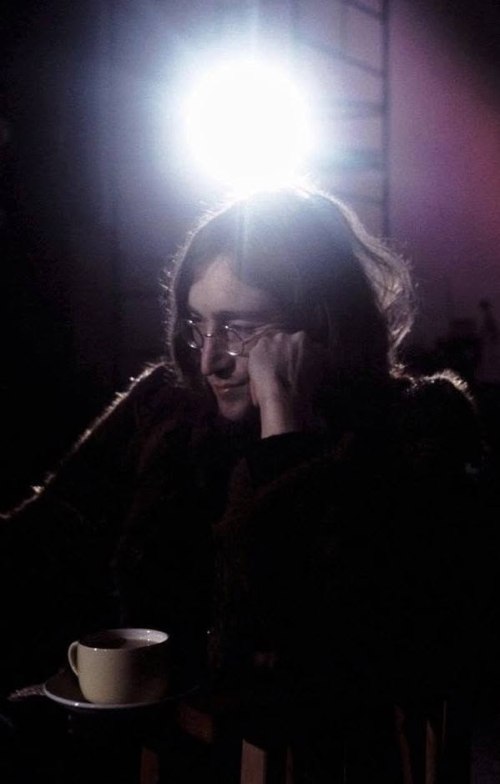
John on January 14, 1969, as photographed by Richard Keith Wolff.
Two Junkies is an outlier, existing apart from the Nagras, Get Back or Let it Be. If we want to know what it’s about and what happened, we need to pursue it as a separate entity, part of John’s solo career, in some part. So much of the Get Back sessions witness the Beatles revealing themselves organically. But here, in that same moment and space, there’s an outsider asking the questions in a deliberate manner.
With the interview in the can, Curry struck two prints of the film, one of which he kept, and the other handed off to the CBC. What happened next pushes this story into the late 1980s and in a wildly unexpected direction.
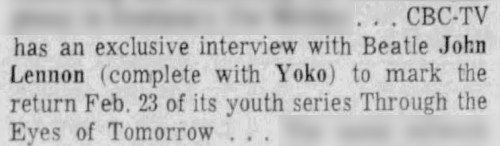
The Toronto Star, January 28, 1969.
The John-Yoko segment for “Through the Eyes of Tomorrow” was promoted as “coming soon” in TV listings only two weeks after the interview was conducted, in advance of the show’s debut the following month (which featured a January 7 chat with Jimi Hendrix).
A short clip from the John-Yoko interview ultimately premiered in May 1969, packaged in an episode that also included conversations with Eric Clapton, Spencer Davis and Fat Mattress. (Curry’s relationship with Lennon ultimately extended later into 1969, when he helped organize the Toronto Rock & Roll Festival.)
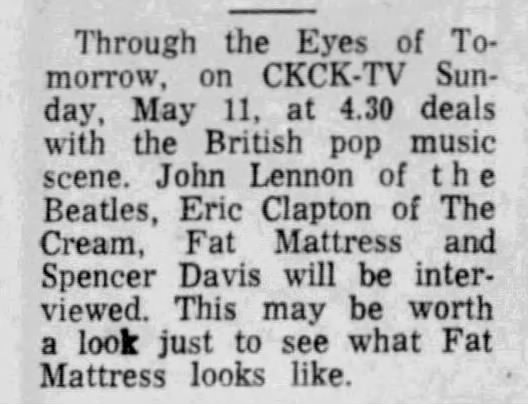
A newspaper listing (The Regina Leader Post) promotes “Through the Eyes of Tomorrow” on May 10, 1969. Fat Mattress was a band fronted by Jimi Hendrix Experience bassist Noel Redding, and he was quite slender!
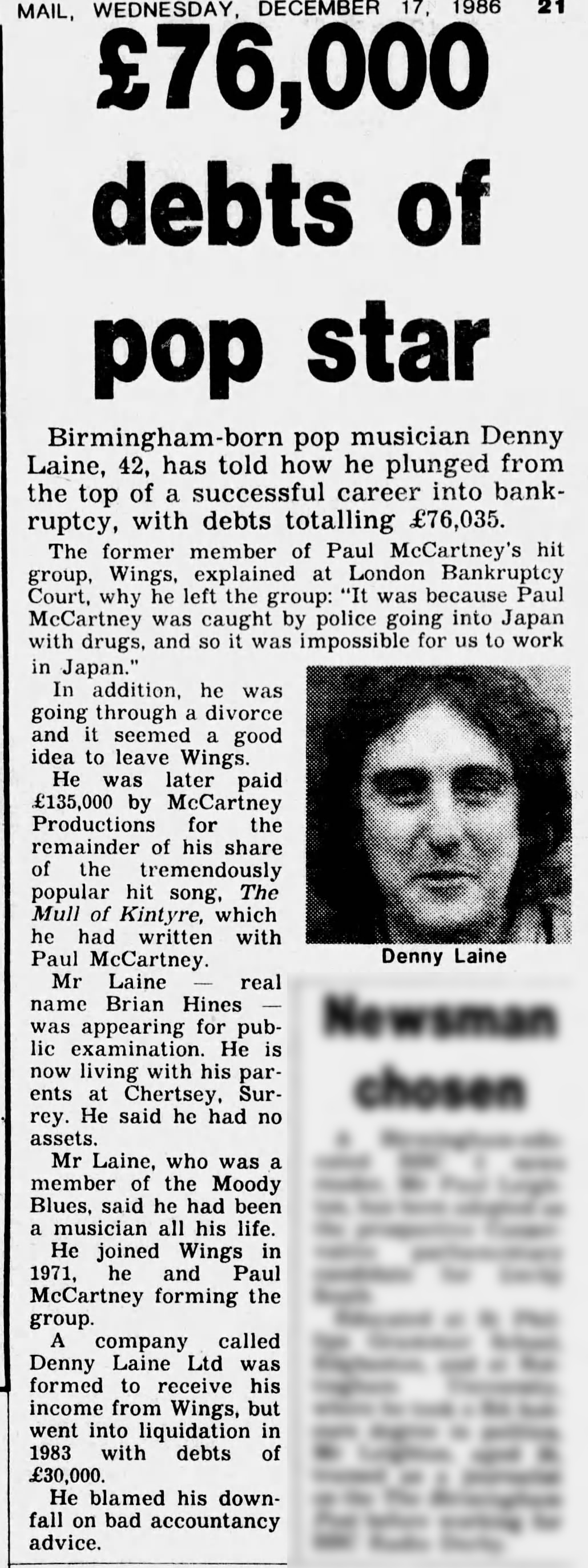
For the wider, global public, a 20-second clip included in the 1988 documentary Imagine: John Lennon – in which John discusses “Revolution,” as quoted above – marked the first broad exposure to the interview. But that clip wasn’t supplied by the CBC, it came from the print Curry made for himself. Thing is, Curry didn’t give it to the Imagine producers, either.
“I’d been hanging out [in the late 1960s] with a guy called Tony Secunda, who was a real character, a real legend in the British music scene at that time,” Curry recalled in the YouTube clip posted in 2015. In his career, Secunda managed the likes of the Procul Harum, the Move, T-Rex and the Moody Blues, among many others. He was a legend! In her 2007 memoir “Memories, Dreams and Reflections,” Marianne Faithful wrote, without elaborating, that Secunda was the inspiration for “Sailor Sam” in Paul’s 1973 hit “Helen Wheels.” (Yes, I know Sailor Sam was in “Band on the Run,” too, but Secunda produced bands from Birmingham, which was name-checked in “Helen Wheels.”)
Certainly, Paul would have known Secunda through Denny Laine, Wings guitarist and one-time Moody Blues guitarist. Curry knew Denny too, via Secunda. “We hung out a lot together and partied together, and probably too hard,” Curry remembered.
Stick with me, I’m about to tie all of this together to the Two Junkies. To do that, though, let’s reintroduce two marijuana junkies: Paul and Linda McCartney. Paul’s drug bust in advance of Wings’ 1980 tour of Japan set off a chain reaction that led us – like, literally you and me – to be able to watch the Two Junkies interview on YouTube today.
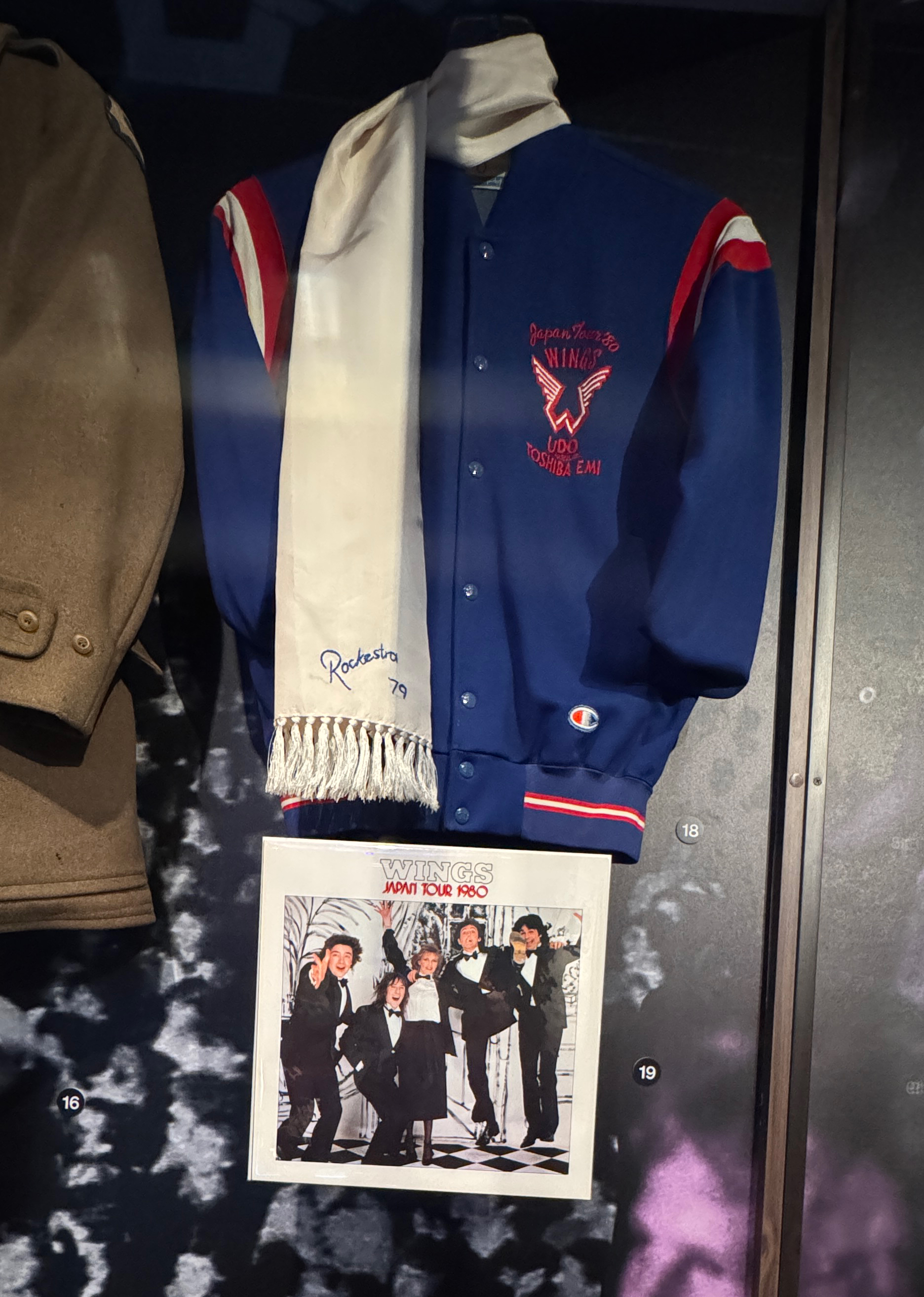
Artifacts of the aborted Wings 1980 Japan tour (plus a sweet Rockestra scarf) on display at the Rock & Roll Hall of Fame this past summer.
Here’s how it played out, and remember, there are no coincidences in Beatles history, only connections we’d never predict:
- The cancellation of the Wings tour in Japan ultimately led to the dissolution of the band – they split in 1981 without recording or touring again.
- Dealing with the perfect storm of the end of Wings, a divorce and poor accounting advice, Denny filed for bankruptcy in 1986.
- In searching though Denny’s assets as part of the bankruptcy proceedings, a film can was discovered at a flat he and Secunda had shared.
“I had totally forgotten [it] even existed,” Curry said of his own copy of the Two Junkies interview, which first found its way into Segunda’s during the pair’s hard-partying days, then via Secunda into Denny’s garage or basement or wherever it happened to be uncovered. Secunda suggested to Curry they “do something” with the reel, but the latter demurred, concerned with rights issues. At the same time, per Curry’s account, Secunda sent him a copy on VHS, which at some point Curry dubbed himself and shared with a friend who was a “very big Beatles fan.”
Meanwhile, in that same 1986 and across the ocean in New York, Yoko commissioned a documentary to be told in John’s words, what would become Imagine: John Lennon, released in 1988. A long lost interview clip — like, say, a joint interview with Yoko from 1969 — would be an attractive addition to the documentary. Secunda thought so too, sending his own copy of the interview to Yoko (he was ultimately credited as a researcher for the film). After the documentary hit theaters, that aforementioned very big Beatles fan suggested Curry give Imagine a watch because one scene was very familiar …
As Curry remembered:
The questions were being asked by this bloke with an English accent. And I said, gee, that voice sounds familiar. … I was thinking, well, maybe John did another interview that day or something. But then I looked down [at] the corner of the frame and I could see my boot that I’d been wearing that day to do the interview. So I knew it was in fact the interview that I’d done with John. I recognized the questions and the answers as well, but certainly I recognized the boot. …
[Secunda] clipped out my voice asking John the questions and put his own voice in. … Maybe he thought that would cover him legally where I was concerned or whatever. Or it would change the content of it and therefore change the copyright. But with Tony you never knew because he really was a lovable rogue, but a rogue nonetheless.
It doesn’t take much of a leap to assume some combination of Secunda, Curry’s friend and/or the production team for Imagine shared the full Two Junkies interview into the wild, where the bootleg market did its thing.
Recalling this from 2026, it’s incredible to consider Paul and Linda’s own drug-related indiscretions indirectly led to the widespread distribution and heightened status of what would otherwise be an obscure Canadian interview with John and Yoko, an interview that’s treated as a prime example of how drug use affected the Beatles.
And very much in the spirit of the Get Back sessions, it’s a bootleg that lets us know this moment exists at all.