Tag Archives: future solo

Jan. 9: Et cetera

January 9, 1969, marked the last full day all four Beatles worked together at Twickenham during the Get Back sessions. Here are a few loose ends worth tying up before the pivot point of January 10.
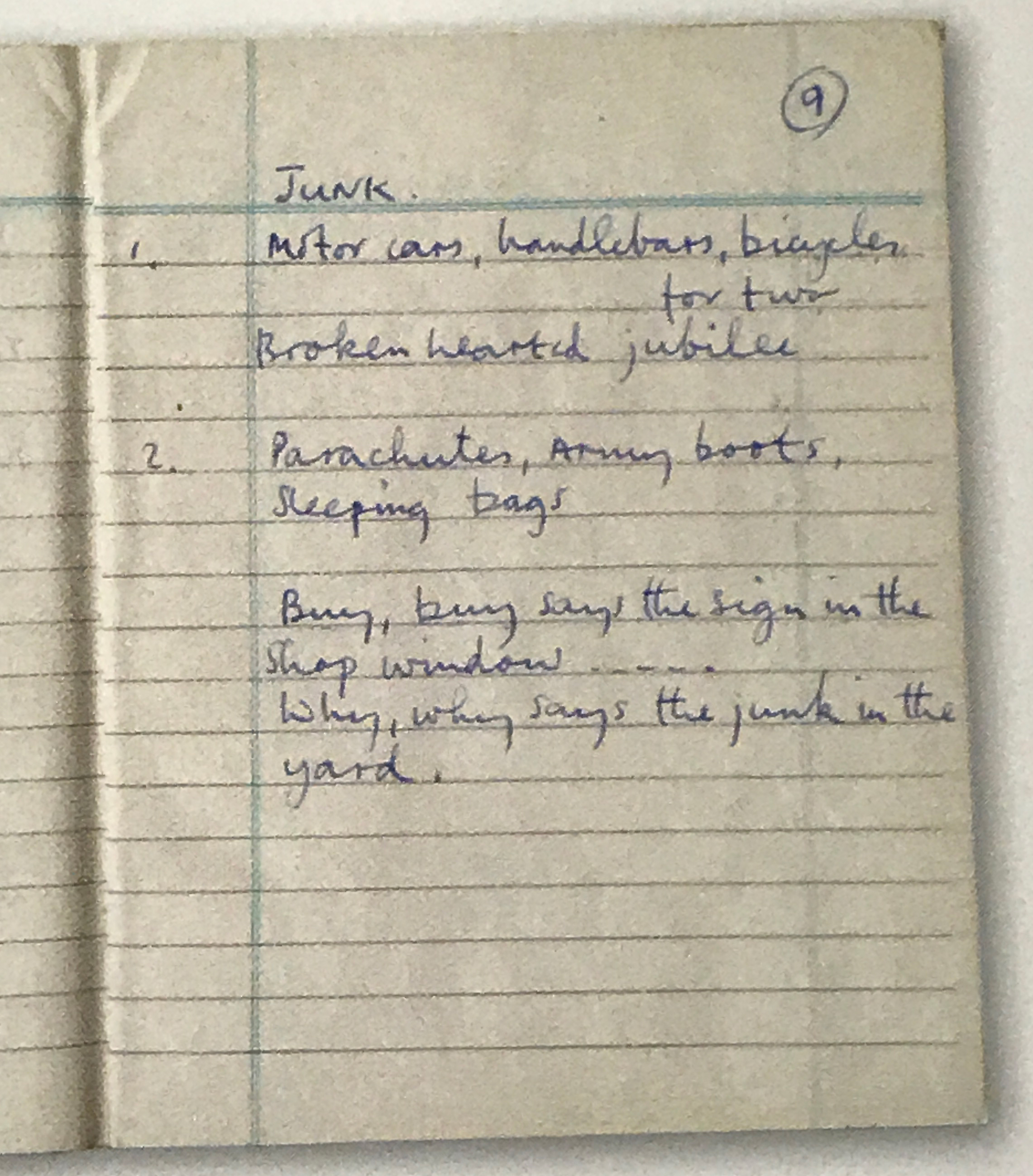
“Junk” (Paul’s hand-written lyrics, from the White Album deluxe companion book)

Conceived in India in 1968 and born at Paul McCartney’s home in 1970, “Junk” and “Teddy Boy” were under a period of gestation in the studio in January 1969. These brothers in song, destined to be released together on Paul’s eponymous solo record, were likewise introduced to the Get Back sessions in tandem on January 9, 1969.

This wasn’t any attempt at a rehearsal, just a light breather between takes of “Across The Universe.”

“Remember that one?” Paul asked the room after a spinning off a quick, shuffling verse of “Teddy Boy.” That song’s story will continue later, after the action shifts to Savile Row.

“And ‘Junk’?” Paul continued.

That song, while lyrically incomplete, was formed enough to be among the May 1968 Esher demos, but except for this momentary appearance, it wouldn’t surface again during the Get Back sessions and it never seemed to be a contender for Abbey Road, either.

It’s a stretch to even call this a performance.

After mentioning the song’s title, Paul rattled off a few words (“epsilon,” “elephant,” “parachute” were the most recognizable) in an exaggerated French accent — John Lennon chipped in, too — to the tune of the song before they quickly return to “Across the Universe.”

A key takeaway from this sequence is the nostalgia with which Paul asks “remember that one” to John, as if these were songs from their childhood, not merely less than a year old. Paul, especially, will refer to the trip to India as if it was another era. More on that as we get to those portions of the tapes.

*****

We’re living in the wrong timeline.

John: “I’d like to do a number just on electric”

In another universe, John’s “Quit Your Messing Around” is hailed as essential proto-punk, a harsh, noisy sound brought into the mainstream. In ours, however, the song is a sub-30 second blast of chords followed by John’s four-word request, obscured by so many other electric (and acoustic) numbers throughout the day’s songs on the tapes.

*****

Surrounded by a film crew for a week already, the Beatles were still learning the extent of personal coverage a week into the sessions.

“This is the bugging device,” Michael Lindsay-Hogg said. “So we can surreptitiously bug your showbiz conversations.”

In this sequence, both Ringo Starr and George Harrison on separate occasions asked if “that” was the tape.

This bugging device will be a part of the story the next day of the sessions.

*****

Ringo was consistent, at least. He resisted traveling abroad for a concert, and he lobbied against needless travel for his role in The Magic Christian, too.

Film producer Denis O’Dell was working on selling Ringo on filming a scene in New York, mostly to get a single distinctive shot.

“We thought of doing one day in Wall Street,” Denis said, though conceding he was “two-minded about it.”

“If we’re just going to America for one scene … I mean, I’ll do it. I don’t think it’s worth it.. .. And who knows Wall Street? I don’t know Wall Street. Unless you put up a sign that says “Wall Street,” I’d have no idea what it looks like.”

The scene was never filmed. But four months later, Ringo joined the rest of the cast and crew on the QE2 as it sailed for New York to celebrate the end of filming.

*****

As the day’s session came to a close, John and Yoko Ono apologized to Paul — and notably not the film’s director or producer — for consistently rolling into the studio well after the others. Paul’s reply was a study in passive-aggressive behavior.

Yoko: Are we getting later and later?
Paul: … It’s getting to be a habit.
John: OK, we’ll come in …
Yoko: … around 10,
Paul: I’m getting used to it! Don’t throw me now.

2 Comments

Filed under Day by day

Jan. 9: Crossroads he’s standing at

During a brief transition immediately preceding the extensive “Let It Be” session late on January 9, 1969, George Harrison opened himself up to significant, retrospective armchair psychoanalysis in just five minutes of music.

He also became a human bootleg.

Everybody’s got somebody to lean on: Lucky and Nelson, November 1968.

Bob Dylan’s Basement Tapes with the Band (a huge influence on the Beatles’ Get Back sessions) had been privately circulating since 1968, and the first true rock bootleg — Great White Wonder, which featured two LPs of his music that stretched back to as early as 1961 — surfaced in record shops starting in July 1969.

But this January 9, George — just a few weeks removed from his first collaboration with Dylan — seized a few moments of spotlight and shared a few of his friend’s songs, and ones that the others in the room hadn’t likely heard.

“I Threw It All Away” was so fresh a cut, Dylan wouldn’t record it for his forthcoming “Nashville Skyline” until Feb. 13, precisely two weeks after the Beatles’ rooftop performance and while George was in a London hospital recovering from a tonsillectomy.

Dylan first shared the song with George and wife Pattie Boyd around Thanksgiving 1968 at his home in upstate New York. George retained quite a bit of the song in performing at Twickenham, injecting intensity in his solo acoustic take.

George didn’t perfectly nail the lyrics, but he captured guts of the chorus and parts of the verses — “No matter what you think about it, you just can’t do without it. Take a tip from one who’s tried … And I threw it all away.”

The performance seamlessly went into “Mama, You Been On My Mind,” written in 1964, but to that point another unreleased Dylan track.

Perhaps it’s the color of the sun cut flat
An’ cov’rin’ the crossroads I’m standing at
Or maybe it’s the weather or something like that
But mama, you been on my mind

When you wake up in the mornin’, baby, look inside your mirror
You know I won’t be next to you

There could be no reason at all George plucked these songs out of thin air this Thursday afternoon, as meaningless as the group’s brief forays into “Tennessee” or “Slippin’ and Slidin‘” within the same hour. He’d been playing Dylan throughout the sessions, after all.

Or …

Maybe the songs reflected George’s mood as he was less than 24 hours from quitting the group. Paul transparently sang the blues about the Beatles in “The Long and Winding Road,” “Let It Be” and “Golden Slumbers,” so why wouldn’t George do likewise? It’s not a significant stretch to consider George was speculating about what he was throwing all away, at these crossroads he was standing at.

Without question, those two Dylan songs did hit home with George.

But …

Maybe it wasn’t necessarily only for the reasons we’ve always supposed.

The January 9 tapes begin with the Paul’s muse, Linda Eastman, visiting the studio. John’s girlfriend, Yoko Ono, had been a Beatles session fixture for months, and this day was no different.

George’s wife, Pattie, was very much not hanging around Twickenham. And when she looked inside her mirror, George wasn’t next to her, because she had walked out on him. But that didn’t mean he was alone at his Kinfauns home.

From Pattie’s autobiography Wonderful Tonight:

I was friendly with a French girl who was going out with Eric Clapton. She was always flirtatious with George, but so were a lot of girls and he, of course, loved it. Then she and Eric broke up — Eric told her to leave — and she came to stay with us at Kinfauns.

It was January 1, 1969, and George and I had seen in the new year at Cilla Black’s house. … We arrived home in good spirits but then everything went swiftly downhill. The French girl didn’t seem remotely upset about Eric and was uncomfortably close to George. Something was going on between them, and I questioned George. He told me my imagination was running away with me, I was paranoid.

Soon I couldn’t stand it so I went to London to stay with Belinda and Jean-Claude. Six days later George phoned me to say that the girl had gone and I went home.

The French girl was 20-year-old Charlotte Martin, and she had been dating Eric for more two years. Eric has since said he left Charlotte because of his growing feelings for Pattie. Why, you can almost say George tried to give her consolation when her old man let her down.

George’s fling was in its final day on January 9 — and after leaving the Beatles the next day, he asked Charlotte to leave Kinfauns, ending the affair.  He would  reconcile with Pattie, and separately, with the rest of the Beatles shortly thereafter.

The two Dylan songs George touched on wouldn’t drift far from his consciousness. Sixteen months after this date, George joined Bob in New York City, where they recorded both “I Threw It All Away” and “Mama, You Been On My Mind,” and the sessions have since surfaced on bootlegs.

George continued to show love for “Mama, You Been on My Mind,” laying down a solo studio version in the 1980s; this was still before Dylan’s first authorized release of the song in 1991. George’s recording would get a proper release in 2012 on Early Takes, Vol. 1.

From Giles Martin, who produced the compilation:

He recorded it at home in Friar Park at some point during the ‘80s, and it originally had programmed drums and loads of keyboards on it, and George had overdubbed himself for a three-part vocal harmony.

I asked [George’s widow] Olivia if it would be OK to break it down a bit, I thought it sounded a lot better stripped to its bones. You can still hear a bit of the drum sound in the background, because there was bleed on the tape — probably coming through from George’s headphones.

George did his own three-part harmonies in the ’80s, but his first vocal partners, John and Paul, were silent on the tapes during George’s brief Dylan set on January 9, 1969.  Walking out on the group, George silenced himself the next day, not only because of his increasingly tense relationship with John and Paul, but with trouble surrounding his marriage, as well.

***

Charlotte Martin remained in rock-and-roll’s inner circle. In a coincidence of the calendar, exactly one year after her last day involved with George, on January 9, 1970,  she met Jimmy Page after a Led Zeppelin concert. The couple would maintain a relationship into the 1980s. Their daughter, Scarlet Page, is a rock photographer of note; she’s shot Paul McCartney and contributed to the Visions of Dylan photo exhibition in 2007.

11 Comments

Filed under Day by day

Jan. 9: Just another day

It had been a week.

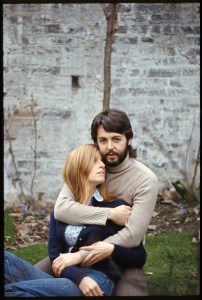
Linda & Paul, 1969

With the benefit of nearly a half century of hindsight and purely from the vantage point of surviving audio tapes, it was an absolutely remarkable one for the Beatles, starting January 2 and entering the sessions on January 9. Amid sniping that peaked with a threatened walkout in unpleasant, wholly uninspiring surroundings, the Beatles put together — between mostly recently written shells and completely new originals — a compact set of fresh songs they could reasonably stage for a TV show. Just the night before, after days of deliberation, it sounded like they had come to consensus on what and where the show would be.

January 9 began, as many of the days at Twickenham Film Studios had, with Paul McCartney the first Beatle in the room. Today, he took a guest with him to the office.

“Do you know Michael Lindsay-Hogg?” Paul asked his bride-to-be, Linda Eastman.

From the conversation, it’s clear that Paul didn’t take his work home with him. She knew very little about the group’s plans regarding the live show.

Linda: So if you do it, it would be in here?

Paul: Dunno. There’s many a story …

MLH: If we do it here, we’ll do it in here.

Paul: But if we don’t, it’s on a boat to Tripoli.

Linda, like George Harrison the day before, instantly questioned the practicality of a boat trip. “What do you do with the equipment?”

Well, that’s Apple’s problem, Michael and Paul agreed.

The conversation abruptly shifted to a book Michael was reading — the title is never mentioned, but he clearly described My Father and Myself by J. R. Ackerley — before an evidently disinterested Paul bailed out minutes later: “I better go and put in some piano practice.”

Paul’s demonstration piece was an unfinished original, perhaps inspired by Linda’s time as a receptionist in New York before they met and after her first marriage. Or it may have just been another McCartney original observing life through a woman’s eyes, one Wings drummer Denny Seiwell would later call “Eleanor Rigby in New York.”

In two years’ time, “Another Day” was Paul McCartney’s first single as a solo artist (the 1970 McCartney LP yielded no singles), reaching No. 2 in the U.K. and No. 5 in the U.S. It also received a Linda McCartney co-writing credit, a fact that eventually spawned yet another Beatles-related lawsuit.

The song was name-checked that same 1971 in John Lennon’s furiously anti-Paul diatribe “How Do You Sleep”: “The only thing you done was yesterday / And since you’re gone you’re just another day.” The “Another Day” reference was actually written by Allen Klein, not Lennon.

But on January 9, 1969, Klein was a few weeks away from smashing into the Beatles orbit, and John was Paul’s partner, still a few moments from joining the day’s sessions. “Another Day,” however, was recognizable in this early state, the song’s first two verses largely identical to what Paul would record in New York in October 1970.

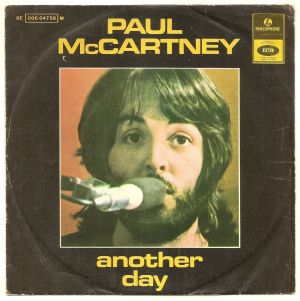
The sleeve of the Portuguese release of the “Another Day” single featuring Twickenham Paul.

Paul sang delicately and tentatively on the tapes, in contrast to his bolder performance on piano in his practice session. He’s searching, unsuccessfully, for a bridge to the song, and there’s no chorus. After about three minutes and two-plus repetitions of the two verses, Paul simply moved on to improvisations and several other previously debuted numbers (to be explored in subsequent posts).

The song could be heard just once more on the Nagra tapes, for less than a minute, in a fleeting rendition by Paul on acoustic guitar during an equipment change on January 25. “Another Day” was never a serious consideration for a Beatles record.

The next several songs Paul would play were.

9 Comments

Filed under Day by day

Jan. 8: An hors d’oeuvre

“All Things Must Pass” should have been a Beatles song, another gripping, iconic anthem dating to the group’s long goodbye.

gh-rs

By the time the Beatles were rehearsing and recording in January 1969, George Harrison’s emergence into a songwriter that rivaled John Lennon and Paul McCartney was essentially complete, with “All Things Must Pass” part of that transformation. Taste matters, but a fair argument could be made that the song could have been the band’s greatest.

“All Things Must Pass” — which had the potential to emerge during the Get Back sessions, be performed live and later land on the Let It Be LP — thus could have gone a long way to giving George his ‘moment’ prior to the group’s send-off of Abbey Road. It never happened. But on January 8, John and Paul gave George the option of taking his song, creating that moment and enjoying his own spotlight at the live show to come. They never said it, but based on the prior week’s tapes, the two senior members of the band were probably just disinterested in playing the song.

“Do you fancy just doing it on your own on an acoustic?” Paul asked. “That would work. But it’s a bit of a thing for you.” The “thing” in question was effort.

Paul would know about playing alone on stage with an acoustic guitar while the rest of the Beatles waited in the wings.

Would opportunity knock, but for George this time?

John was on board, too, condescendingly positing George could serve “an hors d’oeuvre” to the presumptive hungry crowd.

George didn’t directly knock the idea, but didn’t follow up on the suggestions, instead trying work Paul and John on the chorus’ harmonies. After scuttling Paul’s suggestion to begin the song with George’s instrumental opening straight into the chorus, instead of the first verse — hey, it worked for “Don’t Let Me Down” a few days earlier — the pair haggled over the bassist’s harmony line, with Paul complaining it moved too much.

The group spent about a half hour on the tapes working on and around “All Things Must Pass” on January 8 — returning to the song after skipping it the day before — and while there was no significant or specific alterations to the song from the previous days’ rehearsals, they capped the day’s work on the song with a legitimate, listenable and, dare I say, enjoyable take of “All Things Must Pass.” It’s a version that should have shown up, at least, on Anthology 3, in addition to George’s one-man demo from a month later.

While the day’s final take is not too dissimilar in overall form than the one ended up on the final recording on George’s solo debut the following year (excepting the orchestration and dozens of additional flourishes, of course), John’s piano part here — he had moved over from organ in the final phases of the day’s takes — added little, usually amounting to pounding out chords. Still, it’s not wholly detrimental, and Paul’s bass line is on point.  Ringo, as usual, hits the spot.

The Beatles’ greatness has been amplified by the what ifs and what could have beens, and the possibility of a “Beatles’ 1969 classic ‘All Things Must Pass’” is a genuine opportunity lost.

It sounds as good as it could at this point in what amounts to a few hours of overall rehearsal and arrangement with half to three-quarters of the band giving a fraction of effort. It’s the Beatles playing a coherent, complete version of “All Things Must Pass,” and that counts for something in a world where such a release never existed, yet we all paid money (several times, in fact, thanks to new formats, remastering, etc.) to buy “Wild Honey Pie” and “Dig It.”

There is a “rest of the story.” But the vast majority of history of “All Things Must Pass” by the Beatles is now mostly told. This pre-lunch performance marked the final time they played the song at Twickenham. They returned to it very briefly near the end of the month at Savile Row with the support of Billy Preston, who released the song a few months before George would in 1970. By January 8, 1969, the rehearsal stage was essentially over, however, and this was really the final fumes of “All Things Must Pass” as a Beatles song.

Notably, the song never appeared in the Let It Be film. “I Me Mine,” revealed earlier on January 8, did, joining “For You Blue” (which was properly introduced to the band a day later) as George’s contribution to the Get Back sessions. Despite all the hours of rehearsals, the song he carried over into January 1969 as a product of his days with Dylan and The Band, would be passed over by his own band. And it was good enough to serve as the title track of what could be argued to be the greatest Beatles solo album.

6 Comments

Filed under Day by day

TMBP Extra: Since he fell out of the womb

Over the years, we’ve celebrated the birthdays of Paul McCartneyJohn Lennon and Ringo Starr, looking back at the periods straddling the big days in 1968-1969. Today it’s George Harrison’s turn. It may be the anniversary of George Harrison’s birth today, or it may be the day after the anniversary of his birth. With Liverpool under bombardment during World War II, keeping the records became confused that day in 1943. But February 25 is the day George celebrated, so it’ll be the day we mark, too.

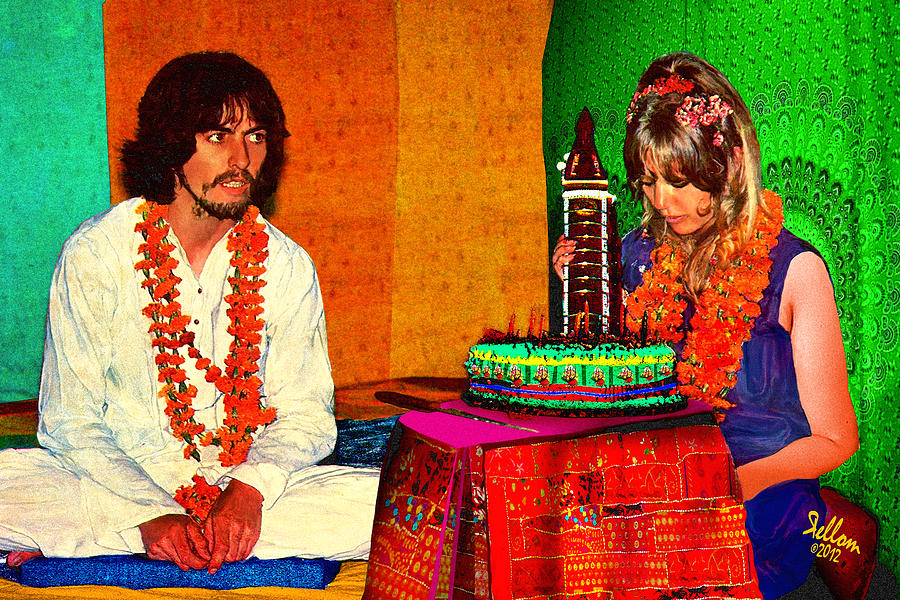
1968, in India. That's actually a cake for Pattie Boyd, whose birthday was a three weeks after George's.

India, 1968. That’s actually a cake for Pattie Boyd, whose birthday was three weeks after George’s.

George’s 26th birthday came just a few weeks after the Beatles wrapped up the Get Back sessions at Twickenham and Savile Row. It capped a remarkable year in his life and career, one that could fill a book, much less a blog post.

George’s 25th birthday was celebrated in India less than 10 days after the Beatles arrived to study Transcendental Meditation under Maharishi Mahesh Yogi. Their retreat lasted nearly two months (for George, who outlasted the rest of the Beatles), transforming the four men, their music and Western culture along the way.

Starting in May and lasting throughout the summer, the Beatles recorded The Beatles. The double White Album, featuring a career-high four compositions, would be released before the winter. In between, George produced Jackie Lomax and saw the release of his solo LP Wonderwall, which was recorded late 1967 and early 1968. (It’s really great, and worth infinite listens).

With Winter 1968 came another transformative overseas trip, this time on the other side of the earth from India, a journey that included a stop in upstate New York, where George spent an intimate holiday with Bob Dylan and the Band, playing and writing songs. They were not laying the groundwork for the formation of the Traveling Wilburys about 20 years later, but it’s worth the dream.

That brings us to January 1969, and you can read all about it here and in posts to come. It’s worth noting, George brought Billy Preston into the Beatles’ circle, and then later would produce him for Apple.

What happened next? George had his tonsils out a week after the rooftop concert, and was laid up for about another week.

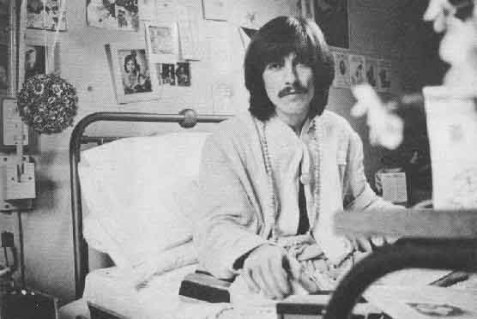
George breaks up with his tonsils, February 1969. Photo appears in his autobiography, I Me Mine.

George breaks up with his tonsils, February 1969. Photo appears in his autobiography, I Me Mine.

He joined the rest of the Beatles on February 22, 1969, to record the first 35 takes of “I Want You,” essentially beginning the Abbey Road sessions, and that about brings things up to his 26th birthday, on February 25, 1969.

Of course, that’s not it. What about the music? Check out this list of Harrisongs composed or at least worked on seriously between his 25th and 26th birthdays (listed alphabetically, with one obvious omission I’ll explain below): “All Things Must Pass,” “Badge” (with Eric Clapton), “Circles” (eventually released in 1982), “Dehradun,” “For You Blue,” “Hear Me Lord,” “I Me Mine,” “I’d Have You Anytime,” “Isn’t it a Pity,” “Long, Long, Long,” “Not Guilty” (left off the White Album, it was released in 1979), “Nowhere to Go” (All Things Must Pass LP outtake written with Dylan), “Old Brown Shoe,” “Piggies,” “Savoy Truffle,” “Sour Milk Sea” (written for Jackie Lomax), “Wah-Wah,” “While My Guitar Gently Weeps,” “Window, Window” (another All Things Must pass outtake). And there’s probably others we don’t know the origins of that would fall in this timeframe too.

Enjoy it all on this YouTube playlist (it’s not just “Badge” as the image implies — click around!):

Not too shabby. As a bonus, he finally had his first song to appear on a Beatles single — the mighty “The Inner Light” was on the flip side of the “Lady Madonna” single, released while they were in India.

Oh, he bought a Moog, too. More about that later in 1969.

George had a really good year, artistically. It was an important one spiritually, too, and he was expanding his professional horizons and stockpiling compositions. In many ways, he shaped the Get Back sessions by walking out and resetting the parameters under which the group would perform live, plus he brought Billy into the fold. His relationship with Dylan, developed when he was in New York, was a critical moment in his career and his own window into how other artists could interact, and reflecting everything that was wrong with the Beatles. While he was still not quite yet afforded the same global respect given to Paul and John, the Beatles’ junior member’s time would come in 1969, thanks in large part to something.

Sorry, I missed the punctuation and capitalization. That’s thanks in part to “Something.” 

There are lots of dumb ways to spend a birthday in your 20s, but recording a few demos at EMI Studios on Abbey Road isn’t one of them.  February 25, 1969, saw George cut solo acoustic versions of “Old Brown Shoe” (first debuted during the Get Back sessions) and “All Things Must Pass” (from 1968, and rehearsed extensively in January 1969). The final song he worked on that day was “Something”, the seeds of which were planted in 1968, but he hadn’t completed as late as the final days leading to the rooftop concert on January 30, 1969.

You can find takes of all three songs on Anthology 3, with a fleshier version also on the 2019 Abbey Road anniversary deluxe edition.

The commercial and critical success of the Abbey Road release of “Something” (finally, his first A-side) — earning high praise from Lennon and McCartney — plus the LP’s “Here Comes the Sun,” changed how George Harrison, Songwriter, was viewed. The time and efforts he spent between his birthdays in 1968 and 1969 propelled him to that point.

6 Comments

Filed under Extra