From Liverpool to Hamburg to points circling the globe, the Beatles electrified audiences, and, well, you can insert your own hyperbolic statement about the redefinition of a rock show here. Yet on January 8, 1969, 28 months since they last played proper a live concert (alternately: “only” 28 months since they last played a live concert), Beatlemania was a memory as the group searched, still, for the how and where of their upcoming live TV concert.
The Beatles’ performance of “Hey Jude” on “Frost on Saturday” that was aired nearly four months prior to the day was their new baseline. It was nothing compared to the ideal, the best in the business.
“The example of the perfect stage show is James Brown,” director Michael Lindsay-Hogg declared to Paul, George and Ringo. “He’s the greatest stage show of all time, I think.”
For all the R&B the Beatles performed, there’s no evidence they covered the Godfather of Soul, but there were fans among the group. From a press conference in 1965:
Question: “I have a question for all The Beatles here. If you were sitting at home listening to record albums of other recording artists, who are some of the American recording artists that you prefer?” John: “Otis Redding is one.” George: “Yeah.” Paul: “James Brown.”
Paul’s tune was unchanged several decades later, when he told Uncut in 2004 that Brown was “sodding fantastic,” while understandably saying he’s more of a Beatles fan, ultimately.
OK, stack us up against James Brown, record for record, he’s definitely hotter because he’s James Brown. But he didn’t do the stuff we did. He’s James Brown and he’s sodding fantastic. We can all agree on that. But there’s something else to The Beatles. Look, we did a lot of good music. You look at Revolver or Rubber Soul, they are decent efforts by any standards. If they’re not good, then has anyone ever been any good? Because, if they’re not good, then no-one has ever really been that good.
“I don’t know about that,” George said, dismissively, in response to Lindsay-Hogg’s declaration. “All that, with his cloak and his crown …”
When I hold you in my arms, I know that I can’t do no wrong. (ca. 2000.)
Paul and Ringo parodied Brown’s “cape routine,”Paul pleading, “Come back, Ringo, come back!” “I can’t do no more, man,” Ringo moans in response.
Lindsay-Hogg beamed in recounting a Brown performance. “He’s got comedy and everything, and he has all that bit before he comes on. And I love when he comes on with that little white suitcase that says ‘Out of Sight’ on it, with that white silk suit.”
There’s no delusion — nobody at Twickenham thought or suggested the Beatles try to stage a show like Brown’s. So instead, as they’ve done before, they returned to their own recent benchmark: “Hey Jude.”
With Paul having already mentioned earlier that morning the suggestion of “[opening] the doors [to the audience], and we’re in the middle of a number,” Lindsay-Hogg — the director of the “Hey Jude” segment — wondered if the band shouldn’t be awaiting the audience’s arrival. “It’s all collected and you’re all together, then you start, as opposed to you coming on as the Beatles, it’s like much more intimate and participated that you’re there.
“If we were to do it here, the way to do it is to make the big brotherhood again”
Paul’s on board with a rerun of audience participation, a la “Hey Jude.” But it seems he thinks his luck with the “na-nas” of 1968 wouldn’t be repeated in the new year. “If we could do it, I thought it would be great, really, if all the audience did it,” Paul says before he imitates the crowd clapping and singing responsively the “oh, yeah” in “I’ve Got a Feeling. ”
“But the British audience [would sing, mockingly, in drawn-out tones], ‘Oh, yeeees, oh yes. They’re bloody good, this mother,’”
Rehearsing “Hey Jude,” September 1968.
Lindsay-Hogg wanted nothing to do with Twickenham — or anywhere in England — as a concert locale, but this early in the sessions he’s at least showing signs of a vaguely open mind and understanding the final decision won’t be his anyway.
“I think if we do it here — and that’s an extremely long pause after that, ‘If we do it here’ — we ought to I think, which is what we’re talking about, is take a lesson from Jude. Which is another title for a song: ‘Take a Lesson From Jude.’ And make it that kind of thing where the audience is involved, but in a good way. When I say a party, I don’t mean paper hats and balloons.”
“Maybe we should have,” George chipped in.
The discussion shifted to the potential decriminalization of pot — sparked from a reading of the daily papers and the Wooton Report — and it’s around then John finally arrived and joined his mates as George said he was keeping his guitar warm for him.
With characteristic sarcasm, John replied, “I’ve been dreaming about get[ting] back to my guitar.”
The band’s all here, and a loose warmup began with some R&B — alas, not James Brown, but an improvisation led by Paul that name-dropped French fries and sausages that evolved into a song from one of Brown’s early contemporaries: Big Joe Turner’s “Honey Hush.” It was a song Paul later recorded for “Run Devil Run” and John rehearsed with Elephant’s Memory before his 1972 concert in New York, if the bootlegs are to believed.
“Honey Hush” wandered into “Stand By Me,” a song very definitely covered by John for “Rock ‘n’ Roll” in 1975 and his last single before his comeback in 1980. This time, Paul was on vocals, and he gave it the same grandiose treatment he delivered on “I Me Mine,” adding a little “The Barber of Seville” flavor for good measure.
More than 30 years later, Paul and James Brown shared the microphone on a version of “Stand By Me.”
As the Beatles continued getting loose, a mention of one Harry Pinsker led to a cheeky rendition of the “Hare Krishna Mantra” with the Apple Records accountant in the lead role. The Radha Krsna Temple (London)’s version of the chant, as produced by George Harrison months later amid the Abbey Road sessions in the summer of 1969, peaked at No. 12 on the U.K. charts.
As they wrapped their approximation of the chant, and with discussion of staging ongoing, the Beatles began their first sincere stab at a genuine run-through of their new songs. If you’ve seen the “Let It Be” film, you’ve seen much of that performance.
“Johnny,” Paul instructed laying out the set’s opener, “’On Our Way Back Home.’”
It all came together thanks to television, LSD, a dance and a dare.
George Harrison started the fifth day of the Beatles’ sessions at Twickenham, January 8, 1969, with the dare, challenging director Michael Lindsay-Hogg with a new song in hand.
“‘I Me Mine’ it’s called,” George says to the crinkling of paper being unfolded. “Should I sing it to you? I don’t care if you don’t want it, I don’t give a shit about it. I don’t give a fuck. Can go in my musical. [laughter]
“It’s a heavy waltz.”
An edited version of this moment — the origin story of what would become one of George’s two contributions to the Let It Be LP — along with a performance of the song, appears in the film of the same name in a three-minute sequence that closed out the Twickenham portion of the movie. On the Nagra tapes, the band is introduced to the song and would later work through and rehearse it roughly five separate times in the five hours of the day’s tapes, covering about an hour total.
The first 45 seconds of the song are familiar: It’s George accompanying himself on guitar to the first two verses of the song, and those lyrics are the same as would eventually be released. But to this point, there is no chorus, instead a brief flamenco-inspired guitar part bridges the verses.
After this initial debut, George interrupted himself to again gush about John’s 1969 diary — “Got up. Went to work. Came home. Watched telly. Went to bed.” — providing himself a segue to his prior night’s entertainment. Once more, it was the Beatles talking about and drawing inspiration from television.
“It was the TV, you see.” George said, recounting he was watching “that science fiction thing, but then it suddenly turned into that crap about medals and things.” That crap was an episode of the weekly program Europa, “The Titled and the Unentitled.” Per the original TV listing, the show “looks at the aspects of pomp and circumstance through European eyes-with a special report from French Television on the investiture this summer of the Prince of Wales.”
George Harrison, MBE, may have found the subject matter “crap,” but in his role as musical prospector, he found value amidst the precious medals being discussed. Specifically some incidental music during the program — Johann Strauss’ “Kaiser Walzer” — sparked George at some point between 9:55 and 10:25 p.m. GMT the night of January 7.
(George would have seen a different performance. This one is from 1969 but from West German or Austrian television.)
“That’s what gave me the idea. Suddenly, it was the bit where they were all coming in from the ball. I think it was Austria, and they all had their medals. And there was some music that was just playing … like a 3/4 thing. Some things like that happen where you just hear something, and it registers in your head as something else. And so I just had that in there, the waltz thing.
“It’s like one of those things where they’re all swaying.”
Years later, in his pseudo autobiography that took the name of this very song, George addresses the origins of the lyrics.
I Me Mine is the ‘ego’ problem. …
I suppose having LSD was like somebody catapulting me out into space. The LSD experience was the biggest experience that I’d had up until that time. … [A]fter one dose of acid I felt I was stuck in this thing, which later I realised is called ‘relativity’. So, the big ‘I’ I’m talking about is the absolute, whereas we’re in the relative where everything is good-bad, yes-no, up-down, black-white. That’s why they called it the heaven and hell drug! But life is heaven and hell, we see it as, or make it into hell or heaven: there’s no heaven and hell beyond relativity.
So suddenly, I looked around and everything I could see was relative to my ego — you know, like ‘that’s my piece of paper’ and ‘that’s my flannel, or ‘give it to me or I am’. It drove me crackers; I hated everything about my ego — it was a flash of everything false and impermanent which I disliked. But later, I learned from it: to realise that there is somebody else in here apart from old blabbermouth …
Anyway that’s what came out of it: I Me Mine. The truth within us has to be realised: when you realise that everything else that you see and do and touch and smell isn’t real, then you may know what reality is and can answer the question ‘who am I’?.
After an extensive return to discussion of the “science fiction” — the series “Out of the Unknown” and the episode “Immortality Inc.” as excitedly shared in rich detail by George and Ringo — George presents the new song to Paul, who had just arrived at Twickenham.
“Is that grammatical? Flowing more freely than wine? Flowing much freer?” George asks. “If there were such a word as ‘freer’ is it ‘f-r-e-e-e-r?” George asks. “It’s ‘f-r-e-r’” Michael concludes before Paul chips in, “It’s like ‘queer.’”
It would be more than two hours until the group returned to “I Me Mine” — what they did in the interim will, of course, be the subject of subsequent posts. Once they did return to the song, George addressed John, who wasn’t yet at the studio when the song was first introduced. “Would you like to learn a new one?” George asks. “Very simple,” George assures him.
After John clowns around through a couple abbreviated spins through the song and making sure George knows “we’re a rock and roll band, you know,” he mockingly suggests he play the barrel organ. George had more seriously considered adding an acoustic bass. “Want the accordion?” Paul asks George, who’s open to that sincere suggestion. “If it’s not here, then just fuck it.” Alas, Paul’s accordion — he did have one, you know — wasn’t at Twickenham. What John would really like is an electric piano setup, but that too isn’t yet available. One thing they do have is some working effects, and an upbeat John has plenty of fun with the echo.
Some of the above highlights are edited down and rearranged in the 2021 Get Back docuseries:
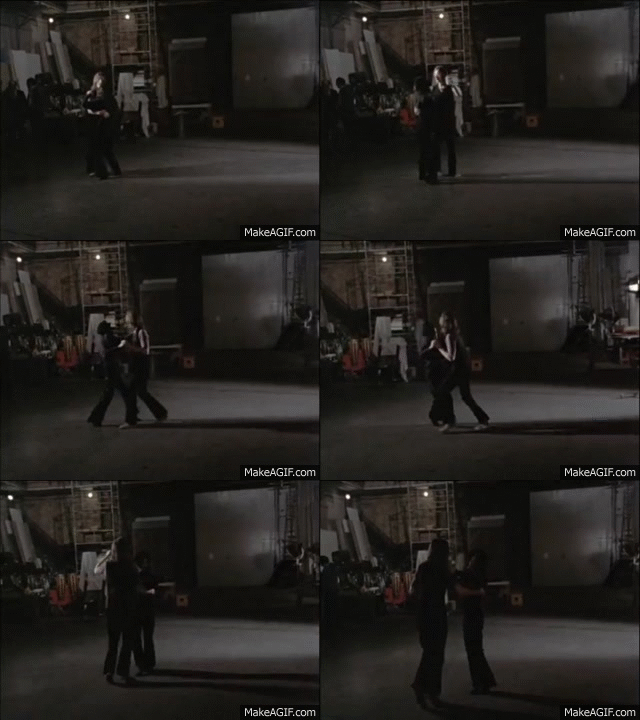
“Are you going to teach us this?” John asks, and George supplies the band, at last, with chords to “I Me Mine.” Soon enough, however, John doesn’t play at all. Instead, as Strauss intended, he and Yoko waltz on the soundstage as George, Paul and Ringo provide the soundtrack.
George loves the antics, and doesn’t need the extra musical accompaniment John would offer anyway.
“Do you want to do that on the show?” George asks John. “That’d be great, ‘cause it’s so simple to do, the tune. But to do that waltz, or something, if you want to bag it up a bit.” Laughing, Paul offers a mock show introduction to the song: “John and Yoko would like to waltz in their white bag, And there’s a white bag waltzing around. They were doing things inside it.
“We should do it like an escapoligists thing. You can see they’re not tied at all. There’s nothing up their sleeves. And we put the bag over them.”
Excitedly, George thinks about playing up the character of the song itself, too. “Castanets on that bit,” he suggests for the flamenco part. Through the entirety of the song’s development and rehearsal, the Beatles are animated, embracing the fun of a song outside their normal sound, and thinking visually for the show. Excepting some of Paul’s offbeat ideas for “Maxwell’s Silver Hammer,” it’s one of the rare times on the tapes the band actively discusses a performance of a song and explicitly how it could be staged.
“Are you sure that’s grammatic?” George asks once more. “Flowing more freely?” Michael assures him it’s fine.
As rehearsals continue and the group works out the transition from the verses into the flamenco bit, Paul finds a bit of inspiration, recalling “Domino,” a hit for Tony Martin nearly two decades earlier, and covered by the likes of Doris Day, Bing Crosby and Andy Williams (whose cover Paul seems to evoke most) in the years since.
While the group worked out the newest Harrisong, the conversation twisted to George’s very first composition, “Don’t Bother Me,” which surfaced on With The Beatles in 1963.
You know I was in bed, at Bourenmouth, we were on a summer season. And the doctor gave me some tonic, which must have had amphetamine or something in it. And the rest of you all just drank it to get high. And that’s when I wrote that one.
John and Yoko apparently continued to dance with enough frequency that Paul called them out on it. “You’ll spoil the spontaneity of the dance when you actually have to do it,” he said. Paul, along with George, offered dance instructions to the pair as the song sharpened quickly. Soon enough the production gained Lindsay-Hogg’s attention, as he must have missed several of the rehearsals as the day progressed.
“That’s great,” MLH says, apparently seeing the dance for the first time and being told it was for the show. “Its beautiful. The whole thing should be very Brechtian. … [The show] should be called ‘January 20, 1969,’ and that every song has a character. Like that’s the character of that one.” The conversation continues about the “very theatrical” live show. But that’s a story for another blog post.
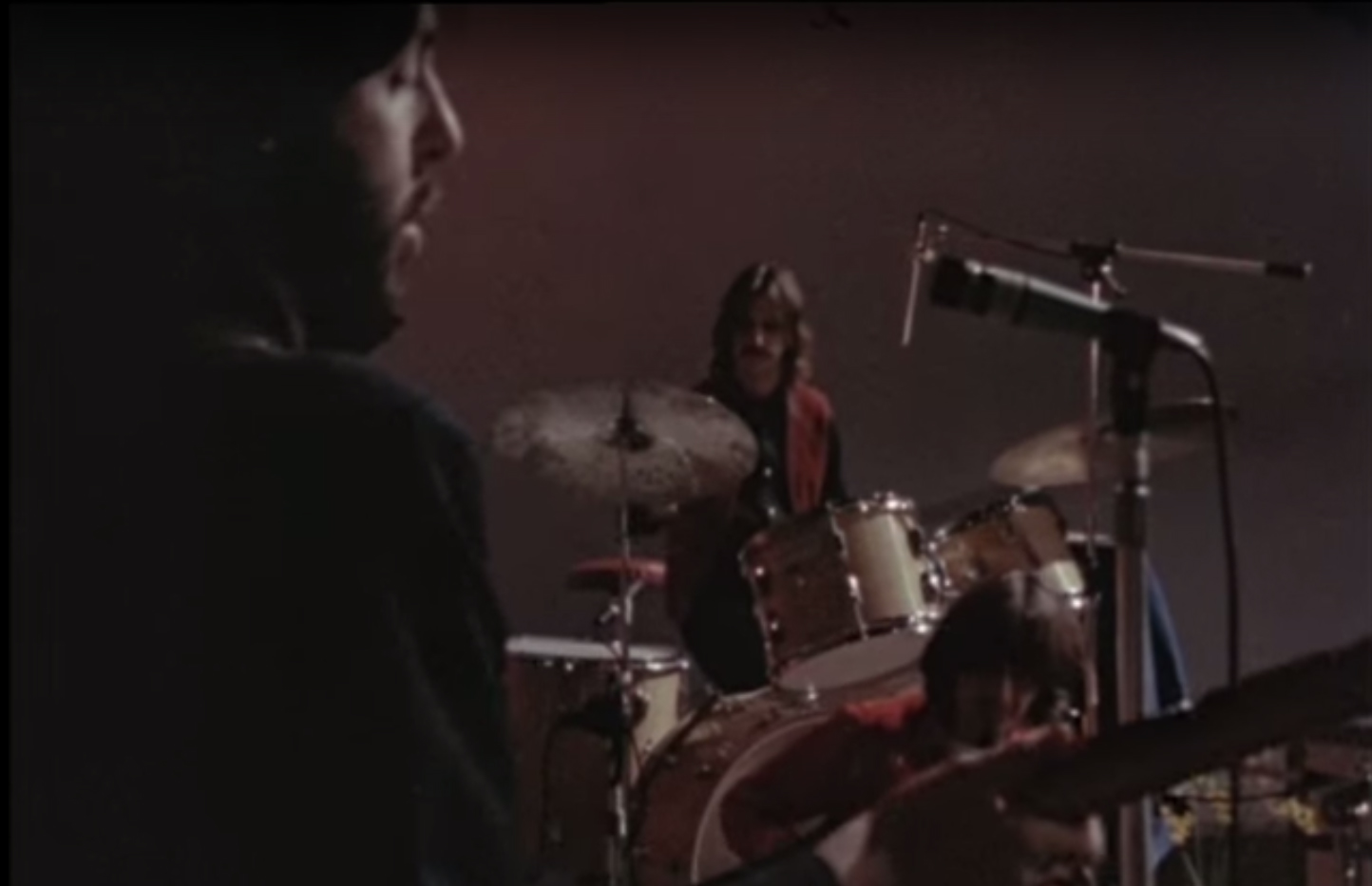
The Threetles rehearse “I Me Mine.” From the Let It Be film.
Returning to the song, Paul plays the role of fixer again, like he did with “Don’t LetMe Down” days before, as George troubleshoots the transition from the verses into the flamenco break. “That sounds like it would be a good rock bit, it gets out of the idea of the waltz.” The next take on tape (there’s a cut but it doesn’t sounds as if much time had passed) has Paul and George hashing out a chorus that starts as “my my my” to a 12-bar blues progression.
“Just do it like a beep-beep harmony,” Paul says before singing “my my my” in a high register, as he sang “beep beep, beep beep, yeah!” in “Drive My Car” less than four years earlier. This chorus then fell into the flamenco break.
We’re left with another tape cut, but here it is clear a little bit of time has elapsed. The 12-bar progression remains, but now “my my, me me, mine” is sung over it. In a few minutes that would evolve into the “I I, me me, mine” that was later immortalized on wax, but not first without a little bit of push and pull between Paul and George.
Paul: “My my” is good to sing. It’s like “mm-mah, mm-mah.”
“I, I” is not … as easy to do. … It’s like “nn-night” is easy to sing. “Rr-right.” The “mm-mah” is easy … It’s like “my, my, my” is easy to shout.”
While he says Paul can sing what he wants, George’s mind is made up and he continues to sing “I I, me me, mine.” It stuck, and Paul subsequently sang George’s suggestion for the day’s final few attempts (and, of course, on the eventual release).
The final stab at the song for the day, a complete take, is what appeared in the film. For the final hour on the tapes, the band moved onto “The Long and Winding Road” and “Let It Be” before wrapping the day with a lengthy discussion about the live show.
By way of comparison of other songs the group had been working on these first few days, the writing/rehearsal sessions for “I Me Mine” were painless. The development and improvement of the song was linear, resulting in a final run through that may not have been release-ready — nothing at Twickenham was nor was intended to be — but was a sharp, concise (clocking in at under two minutes), complete song that was a reasonable contender for the live show. At that point, with the performance looming in 11 days, that’s all they needed. “Bits” were generally worked out, and there was even a visual to add to the live production.
You can play “I Me Mine” on the Savile Row rooftop in Rock Band: Beatles, but George himself never played the song live on either his 1974 or 1991 tours.
And about that visual: John and Yoko’s dance. It’s entirely feasible and reasonable to say their waltz, however cheeky and contrived it was, is the reason “I Me Mine” exists at all, at least in the Beatles’ catalog. To explain, we must look beyond January 8, 1969. Well past.
The Beatles didn’t attempt “I Me Mine” during the balance of the January 1969 sessions. This was it; the song’s introduction and development on January 8 marked the entirety of the Beatles’ work on the song during the Get Back sessions. George demoed three songs seven weeks later on his birthday, but “I Me Mine” wasn’t among them (instead, he recorded “Something,” “All Things Must Pass” and “Old Brown Shoe,” versions of which appeared on Anthology 3). If the Beatles ever considered “I Me Mine” for Abbey Road, evidence is lacking.
The song’s sound and words were born of TV and LSD. But the reason “I Me Mine” exists at all as a song by the Beatles is because of the dance.
When John and Yoko waltzed to “I Me Mine,” the underdeveloped show idea finally had a specific visual Michael Lindsay-Hogg could attach to a song. Yet, in less than two days’ time, George quit the group, and upon his return, he made clear he didn’t want to perform any of his songs live (although he did bring several more new songs to the studio to work on). But for the purposes of the Let It Be film, the job was done. The waltz ensured a place for “I Me Mine” in the movie, and thus, required the song a place on the soundtrack. Thing is, there was never a proper recording done of the song at Twickenham, and there wasn’t suitable recording equipment there anyway. In every prior iteration of a potential Get Back/Let It Be album, as compiled by Glyn Johns, “I Me Mine” was left off, since it hadn’t otherwise been a consideration for the LP. The movie changed that.
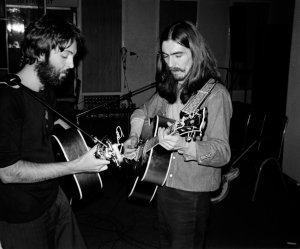
Paul and George work on “I Me Mine” in January 1970. From George Harrison’s Twitter, 2000.
Once the song was earmarked for the film and thus the album, the Threetles made their debut. On January 3, 1970 — almost a year to the day after George wrote the song and brought it to Twickenham — George, Paul and Ringo spent one last session together at Abbey Road, recording “I Me Mine.” John was on holiday in Denmark, but that almost didn’t matter: He had already privately quit the band more than two months earlier. As George remarked, “Dave Dee is no longer with us” as they went ahead, for one last time, to “carry on the good work that’s always gone down in [Studio] No. 2.”
Phil Spector took the recording, embellished it, doubled its length and tacked it onto Let It Be as the Beatles formally expired as a group. Like John’s “Across the Universe,” the song it follows on Let It Be and precedes on Let It Be … Naked, “I Me Mine” in its final form is not a product of 1969. It’s worth noting, too, that George turned around “I Me Mine” in a relatively complete form in less than 24 hours. John dragged out a nearly year-old “Across The Universe” and still couldn’t make it workable for the show.
The same three men who laid down “I Me Mine” — George, Paul and Ringo — returned to the studio together 24 years later to record John’s “Free as a Bird.” Paul convinced himself it was OK to record a new Beatles song without John.
“I invented a little scenario,” Paul said of recording the group’s first song since “I Me Mine.”
Nearly 46 years ago, somewhere between lunch and the resumption of the day’s writing session-cum-rehearsals for “Maxwell’s Silver Hammer,” it sure sounds like Paul McCartney may just have invented the mashup, or at least a rough approximation.
Really!
This is not a medley, sampling, sound collage or musique concrete a la “Revolution No. 9” and others before it. This is turn-of-the-21st century-style mashup: Think The Grey Album,GirlTalk or the Beatles’ own Love with elements of two or more songs layered on top of each other. The kind of stuff Paul got roped into a few years back before an audience, he and George performed live to tape decades earlier in a little bit of completely obscure history.
That would be 1967’s “When I’m 64” (written a decade earlier as one of Paul’s first songs and described here by Paul as the “beautiful geriatric Beatles song”) sung atop “Speak to Me,” which would ultimately lead off Jackie Lomax’s debut album, as produced by George and released two months later. We already heard George briefly play a more proper version of “Speak to Me” to John a few days earlier.
As Paul’s “When I’m 64” vocals eventually drop out – and his mouth clicks chime in – we go from a forgotten moment of debatable history to one that would have a lasting impact on wax: the debut of Maxwell’s actual Silver Hammer, the anvil, as ordered before lunch.
The band comfortably eases out of “Speak to Me” with a fun and increasingly polished run through of “Oh! Darling” – polished for this point in the sessions, for sure – the second time they played the song in a few hours, and with John having rejoined the group back on guitar. The song is essentially complete and by all accounts should have been by now part of the core considered for the live show at this early stage. It doesn’t get any further attention this afternoon as Paul immediately returns to “Maxwell’s” for the better part of another hour. This initial launch into the song is captured in the Let it Be film, spliced in from the point where Mal strikes the anvil. It’s a truncated slice of the song, and in the film we end up getting thrust into the Shoctric Shocks incident, which actually occurred four days earlier.
Paul doesn’t introduce any new wrinkles yet in this first go-round after lunch. He’s pleased, though. “It’s catchy enough, then,” he says after the first full take. He soon boasts of the dramatis personæ and vibe of the song, “It’s so cartoon … such caricatures.”
Paul remains a delightful caricature of himself, remaining fixated on the whistles that color the song throughout. “We want a mic for John and George on this ’cause the whistle on this,” is Paul’s first and primary direction to the crew. George’s initial concern in the early going of the post-lunch session is getting the song’s timing and cues down, especially for the sake of Mal, who wielded the hammer. Not that George didn’t try to give his drummer an additional bit of work.
“I’m sorry, George, the hammer’s too heavy for me,” Ringo says to laughter. As it turned out, Ringo would end up carrying that weight after all, striking the anvil in July, when the group properly recorded “Maxwell’s” for Abbey Road.
By Paul’s thinking, the roadie was the man for the job.
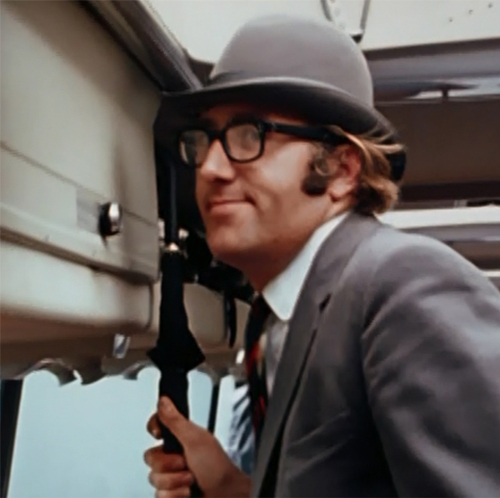
Mal’s more like Maxwell, anyway. … He should be very scholarly. Very straight, in a striped tie and a blazer, sort of. Big chrome hammer. That’s how I see him anyway. [He’s] Maxwell Edison, majoring in medicine, in fact.
Resplendent in a smart gray blazer and striped tie, Mal Evans is already dressed for the role of Maxwell Edison, medical student, as he rides the Magical Mystery Tour bus.
Sparked by a question from George about the repeated of “bang, bang” in the chorus, Paul runs through the song structure again with the usual caveat: “I haven’t written the last bit.”
That’s fine with George, who thinks he knows how the song goes. “I just know it in my head, rather than the words, because the words are not in the right order anyway.”
Loose as he can be, Paul repeats the song structure: “It’s like two verses (scatting and singing) Bang, bang. … Clang, clang. … Whistle. … That’s nice fellas.”
As work continues, George shows a bit of concern with his own instrumentation.
George: To the man that’s producing me, whenever I play bass, because I don’t know anything about it, I don’t know what the sound is. I just plug it in and play it. So if somebody knows how to get the sound or record it. I mean Glyn’ll have to do that if he’s around. So you can mention that to him.
That’s some pretty self-deprecating talk from George, but he really has few bass credits under his belt to this point.
Straight out of the Small Faces’ playbook, John ad libs a narrative introduction to the song, laying out Maxwell Edison’s origin story, with Paul picking up in the middle.
John: Let me tell you the story about Maxwell’s Silver Hammer. He got it from F.D. Cohen, the pawnbroker from Bayswater.
Paul: Maxwell was a young boy just like any other boy, and he might’ve lived a life like any other young boy’s life had it not been for some certain unforeseen circumstances.
And … whistle!
Given that the band spent more than an hour on the song of about five hours of recorded tapes this day, it’s no surprise it was a very early contender for the live act. So much so, George began offering up suggestions on how to stage it, beyond costuming for the band and Mal. There’s a practical side to his suggestions, too.
George: I think we can do it with lots of people singing the chorus, ‘Bang, bang, Maxwell’s Silver Hammer,’ but it’s very difficult for me to whistle and sing and keep in sync. … It should be like the end of [Hey] Jude.
John: ‘You all know it, join in, gang, because we don’t know it.’
George: We could just project it up, have the chorus projected up there.
We’re not sure what Paul thinks of that idea, since there’s whistling to be done, and no joke whistling, please. “Really, do it like it’s straight,” he says, telling George how the notes of the chorus solo goes. That’s a whistle solo, not a guitar solo, mind you. Paul does work on improving the song, spending a few minutes crafting a harmony based on a short, partial climb up a scale “with jumps on the hammer,” in his words. It’s pretty and adds to the carnival-like atmosphere the song has to this point.
For the final takes of the day of the song, the rest of the group still doesn’t have the song’s structure completely down, and Paul resorts to vocal cues to alert when the whistling solos come. John asks Paul to shout out “blow it, boys” at the appropriate time. Paul can’t help but repeat his helpful reminder: “It should be very straight, the whistling.” He really does keep saying this, to a near obsessive state, and at no point is he kidding about it.
The “Maxwell’s” rehearsals for the day end with a final, full run through. The song’s basic elements are there: new harmonies, whistle solos, the anvil and a full strong structure. What it lacks is a complete set of lyrics, but Paul isn’t sweating it, concluding with a simple, “OK, that’s Maxwell’s.”
While the song did progress with the work on Jan. 7, there was a noticeable missed opportunity shortly after lunch as a lead-in to the mashup sequence. For a few brief moments as the group warms up, a sloppy yet sincere take of “Maxwell’s” features Ringo on vocals, and it sounded like the perfect fit. Paul’s song eventually drove the other three Beatles to fury; giving Ringo an extended vocal role could have changed a little corner of Beatles history.
As the sessions continue, John takes the reins for the next song, one that not only has its lyrics set, but the instrumentation as well.
“Should we do ‘Across the Universe?’ We almost know that, don’t we?”
Everybody had a hard year? If we’re talking about the Beatles, that’s a fair appraisal just a week into 1969.
As rehearsals were set to get fully under way January, 7, 1969, the group openly discussed breaking up. Instead, moments later, they were trying to hammer out the details of “I’ve Got a Feeling” for more than 20 minutes before launching into an extended session dedicated to Paul’s pet “Maxwell’s Silver Hammer.”
The out was right there for them; the group was in agreement that a divorce was not unreasonable. But while we don’t know for certain, (unless this particular discussion was filmed and we can see for ourselves if the footage is ever released), it doesn’t even sound like anyone moved out of their chairs, much less high-tailed for the exits. Paul left the band during the recording of “She Said, She Said” in 1966 and Ringo split during “Back in the USSR” in ’68. But this cry for divorce, so much more severe than a walkout of a single member, didn’t immediately lead to much of anything. Nobody budged January 7, 1969, after the early takes of “Get Back,” and status quo reigned.
As tension melts and the group trades chatter for chords, it quickly becomes clear little that had led to the group to the brink had actually changed. Paul may not enjoy his role as band leader — “I’m scared of that, ‘You be the boss’” — but he’s not letting that job go, either, despite any prior protests from George or anyone else in the group.
Arranger/producer Paul made plain his preferences for “I’ve Got a Feeling,” and anything else they were to tackle going forward in preparation for the live show.
We should start off by doing everything we’re going to do on the thing. Like if you’re going to do the ‘oh yeahs’ innit, you’ve got to do ’em how you’re going to do it. No use singing ’em quiet now if you’re planning on doing them loud on the night.
Paul certainly sweats the details and is quick to dictate the construction of the song, asking John to keep the chord sequence before the chorus “kind of tight,” barking “riff” to George at the appropriate times and working on the balance of “oh yeahs” with “oh noes.” Even Ringo wasn’t spared; he received explicit directions, too: “Don’t go into the swing at the end,” Paul said as he vocalized the closing drum pattern.
Overall, special focus was paid to the transition to “Everybody’s had a hard year” and the subsequent section. Paul pushes George to add “something recognizable” just prior to the bridge (“All these years I’ve been wandering around”).
The vibe, meanwhile, is generally agreeable throughout, and there’s certainly no indication that moments earlier the band was basically trying to figure out the right way to break up. While no songs were particularly tight by this stage of the sessions, there’s a definite, steady progression here with “I’ve Got a Feeling, ” a song that had seen time each day thus far at Twickenham. The group works their way through at least one complete take (tape cuts, as usual, keep any claim here from being definite).
Content with the state of the song, and with a lengthy pivot to “Maxwell’s Silver Hammer” imminent, the band detours briefly into a pair of apparent improvisations that wouldn’t be heard from again (the bluesy “Woman Where You Been So Long” and the especially catchy, Little Richard-inspired “Oh! Julie, Julia”).
John cuts off the jam to ask Paul to launch into “Oh! Darling,” an admitted favorite of John’s up to his death 11 years later. Paul was again in instruction mode here — there was no solicitation for advice on working out kinks, rather the song was set and merely needed to be taught.
Paul had already played the song twice at Twickenham — both times solo at the piano for Lindsay-Hogg (“Sounds great, Fats Domino!” the film director said on the 6th), but it was without any further accompaniment and probably without the full band even in the building. This is the first full-band take of the song, which, despite the need for Paul to shout out chords and generally sounding in a rough state, seems to have had at least some off-tape rehearsal at some point. With John’s enthusiasm for the song only helping the cause, it’s not unlikely to think “Oh! Darling” could have been a viable option for an extended live show, were it to have actually been staged. Alas, with the rooftop featuring Paul only on bass, and the setlist short, it wasn’t meant to be, but the song certainly found a happy home on Abbey Road.
With just single take achieved, George (largely off-mic) thinks beyond “Oh! Darling.”
“‘Maxwell’s’ would be even better to go on.”
Even Paul’s skeptical as the band readies to lay down the silver hammer.
As I write this, it’s Friday, Jan. 31. About three-and-a-half weeks ago was Jan. 7. Check your own personal calendars, news headlines and the like. It’s not that long ago. That matters to me, and this blog, because this is where the Beatles come in.
Flip (or click) back several calendar pages – 45 in fact – and we’re at January 1969, dominated by the Get Back sessions. Jan. 31 marked its final day, a short day dedicated to nailing for film and for tape usable takes of Paul’s non-rooftop-suitable “Two of Us,” “Let It Be” and “The Long and Winding Road.” (The clips appeared in the movie prior to the rooftop show, but were in fact filmed the next day).
What of Jan. 7? That’s where we left off last in the session timeline, at a genuine pivot point. George suggested the group “have a divorce,” Paul said he’d thought about that, too. The Doldrums. It hung over the band.
So what happened between Jan. 7 and Jan. 31, 1969, to recast the sessions? Well, I’m not going to give it all away at once. What else would I blog about, the recording of Sentimental Journey? (That actually seems like an interesting, star-studded, intercontinental story, but I digress.) Three and a half weeks is such a short period of time, in relative terms, and we know that the group was on the brink Jan. 7. By Jan. 31 so much memorable musical output was in the bank and in the works. Factor in that there’s 10 ½ days without George after his walkout and more than a week without any rehearsals at all, and I’m left grasping at superlatives.
To wit: From Jan. 7-13 and Jan. 21-31, 1969 (18 days, and that includes weekends not spent in the studio):
Paul wrote the majority of “The Long and Winding Road,” “Let It Be” and “Get Back” and debuted future solo tracks “Another Day,” “Teddy Boy” and “Back Seat of My Car”
George wrote: “I Me Mine,” “Old Brown Shoe” and “Something,” as well as “Wah-Wah” at home during his break from the band.
Everything you hear on “Let It Be,” plus “Don’t Let Me Down” was recorded.
We saw the birth – and if not the birth, than at least the studio debut – of Abbey Road’s “I Want You,” “Oh! Darling” and “Octopus’s Garden.”
We have the rooftop show, too.
The Beatles even found time to meet with Allen Klein for the first time.
And I feel like I’m understating what happened.
So, there’s just a little bit of food for thought before I return to the timeline (soon!). Context is everything, and with January here and now gone, it provided the perfect chance to put into focus how much these guys got done throughout the madness they, for the most part, created themselves.

 They May Be Parted