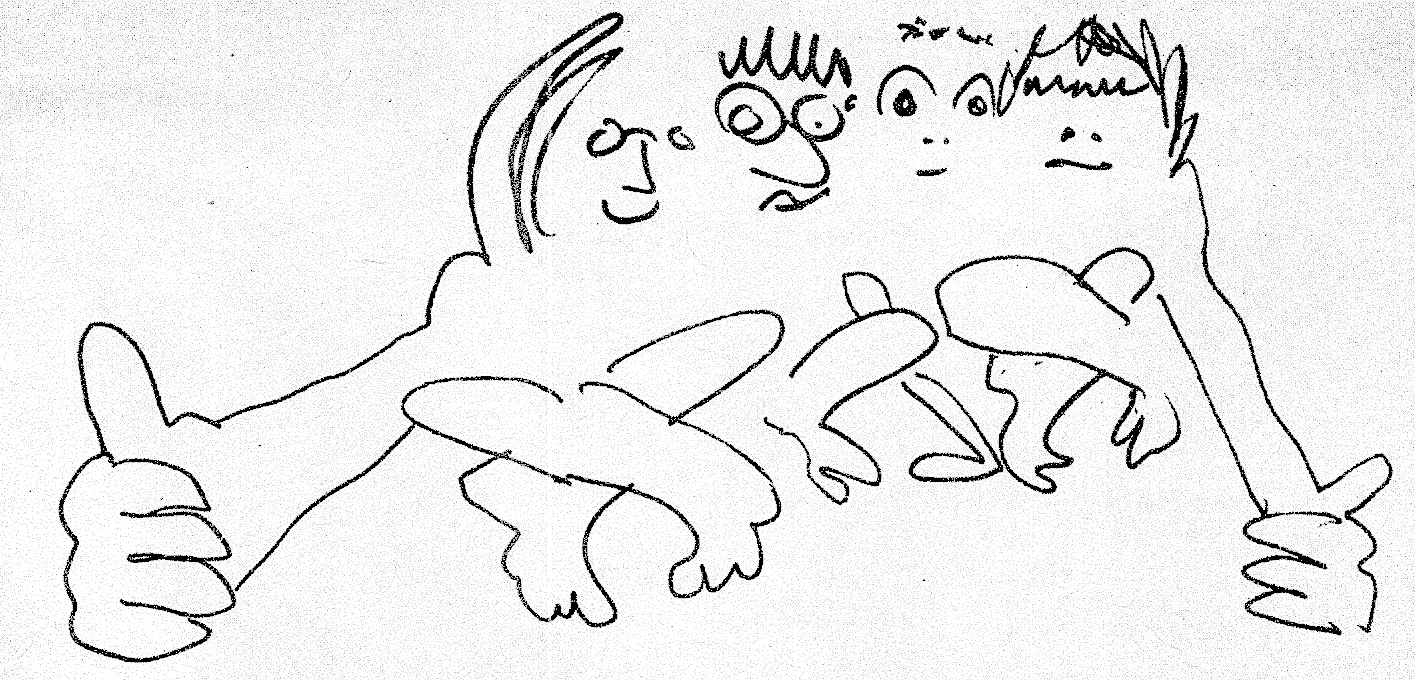
The Beatles, as depicted by John Lennon in November 1968, as published in the December 7, 1968, issue of New Music Express.
In my faith, we count down the 25 days to the start of the Get Back/Let It Be sessions. This is completely normal.
To operate this particular digital advent calendar, simply click the day below and read up on what our boys and their extended circle were doing in these days leading up to their Most Holy Assemblage at Twickenham Film Studios on January 2, 1969.
Today — Jan. 2, 2013 — marks the 44th anniversary of the beginning of what would ultimately be known as the Get Back (or Let it Be) sessions. And for me, it’s exactly one year since I began this labor of love.
So with another year over and a new one just begun, I wanted to quickly look back at a year of posts and share a little bit of what I’ve discovered through 40 posts that have covered 14 hours of music and conversation thus far.
Wait — Just 14 hours in?! That’s it? I’m amazed, too (maybe). When I started this blog, I didn’t think after a year’s worth of posts I’d still be on January 6, the third day of the sessions with another 83 hours of tapes (nearly three-and-half-days’ worth) remaining. Beyond the fact that life indeed is what happens when you’re busy making other plans, I found my interest in what I was listening to increase with every post. I started out planning on a couple of posts per session day, but I’ve eventually found myself writing multiple posts about a single song or even a conversation.
And about those conversations… So far, I’m finding them more interesting than the song rehearsals. Not that it should surprise anyone that two-plus hours of “Don’t Let Me Down” (in just these 14 hours) gets a bit old . But the decades-old bootlegs that first exposed me (and I’m sure many of you) to the sessions really only featured the band’s wacky covers and oddball originals (in addition to the more definitive and unique takes of the songs to eventually surface on the record and in the movie). Getting to hear George tell Paul he’ll play if he wants him to play is great. But being able to get the entirety of the context plus the rest of the conversation is gold (that specific example is subject of my next original post, in fact). The discussion they had about Cream plus the lengthy discussionabout the potentiallive show just fascinated me (and, hopefully, you!).
Run from, not for, cover: Maybe it’s just because they’re old news by now. But the covers they “play” (so far there haven’t been too many full run-throughs) aren’t all that compelling. Maybe it’s personal taste, but I just don’t care all that much. Although at times they clearly enjoyed performing those more than their originals when it’s the entire band actually playing together. But for something that has long defined these sessions, I’m eager to just get through them.
Clickbait
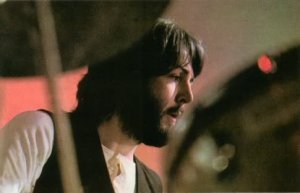
I’ve just seen a face. I don’t pay too much attention to site stats, since the blog is purely for fun, not profit. But in a very inexact study of search terms people use to find the blog, people just love searching for Paul’s beard. And I’m happy to oblige.
I have plenty of more observations, but I’ll leave them to this next year’s posts themselves. I do seem to have a tendency to ramble.
So with this blog entering its second year, I simply want to thank you all so much for reading. This is just so much fun to be able to have the chance to virtually talk about such a specific thing with so many knowledgeable people as enthusiastic as I am. Can’t wait for another year of Beatle posts/tweets/chatter.
—
As we enter the first few days of January, I’ll be unearthing links to my posts about those days in 1969 on the tapes, starting below with Jan. 2. After we’re caught up with my posts through Jan. 6, I’ll pick up where I left off on the timeline (that same Jan. 6) with a look at “Two of Us” and the iconic George-Paul argument that happened within.
Tell me why: In their rush to begin recording at Twickenham, nobody seems to have an exit strategy.
A little disclaimer. I’m in the process of a little bit of cleanup. Anywhere that I change content of any substance, or fix a fact, I’ll make that clear. But I won’t waste anyone’s time denoting when I found better video clip or replaced a dead link, etc.
Something I never completely got my head around is why the Get Back sessions had to happen when they did, in the beginning of the new year, 1969. And in such a disorganized state, to boot.
The timeline is stunning, really, when you look back on it, even in the context of the music industry not being what it is today, when you can go years and years between records.
Consider: On Jan. 2, 1969, the Twickenham sessions got under way. “Hey Jude” was recorded five months earlier (July 31, 1968), released four months earlier (Aug. 26, 1968) and had just finished runs at No. 1 around the world. The White Album was released SIX WEEKS earlier. Six weeks!
The members of the band couldn’t have been bored — John and Yoko were doing the concept art thing, George and Bob Dylan were writing together only weeks earlier in late November (he’d show off “Let it Down” on this day). Paul and Linda were a little less than two months from marrying. Ringo had just appeared in “Candy” and was soon to be in “Magic Christian.” They had stuff going on!
And again, I know, the industry is different today than it was then. But even considering that, there really wasn’t that much reason for the Beatles to rush into the studio in January 1969. It’s just what they did.
Famously, the goal here was to rehearse fresh material for a film or TV special, culminating in a concert before a live audience. New material. Six weeks after they put out a double album.
But there they were, at the Twickenham sound stage on Jan. 2. Six weeks after they released the White Album (did I mention that?). And despite the rush to be there, sessions beginning in the morning like it was an office job, they still didn’t really have the the session’s raison d’être lined up. There was no agreement on a venue to actually perform the concert.
A little more than halfway through the day’s recordings, Glyn Johns and Michael Lindsay-Hogg discuss with Paul — in addition to the state of his beard — the potential venues for the culmilation concert. Legend has local clubs, African amphitheaters and the like in the mix, but from discussions on the first day of the sessions, it’s clear that it’s most likely going to be a soundstage. Twickenham itself is an option, and seemingly Paul’s preferred one (“Just as well stay here”). Another option pitched is Intertel Studio in Wembley, where the Stones’ Rock and Roll Circus was recorded a mere three weeks earlier. The venue received raves — “It sounds like a good live studio.”
Amazingly, at that moment elsewhere at Twickenham– and sure, who knows if he was in the room at the time, out having a smoke, grabbing a bite or in the bathroom — was John Lennon. But he was never consulted (on tape, at least) about what he thought of Intertel. And he only performed “Yer Blues” there a mere three weeks earlier.
But even though it was a potential concert venue following the rehearsals there, everyone hated Twickenham. PAs hadn’t even been set up (they were arriving later that day). John was suggesting they move into a corner of the room — Ringo was too far away. “This place sounds terrible,” Paul said.
Said Lindsay-Hogg to laughter, “I think the thing to do is just be very flexible about every aspect of the enterprise.”
As a director, Lindsay-Hogg was naturally eyeing a dramatic scene. A Tunisian open-air amphitheater was famously pitched, the Beatles to play at dawn. “Snake charmers, holy men … torchlit, 2,000 Arabs and friends around,” Lindsay-Hogg visualized.
It was never going to happen, no matter what. Paul put it straight right there on Day 1. “I think you’ll find we’re not going abroad, because Ringo just said he doesn’t want to go abroad. And he put his foot down.”
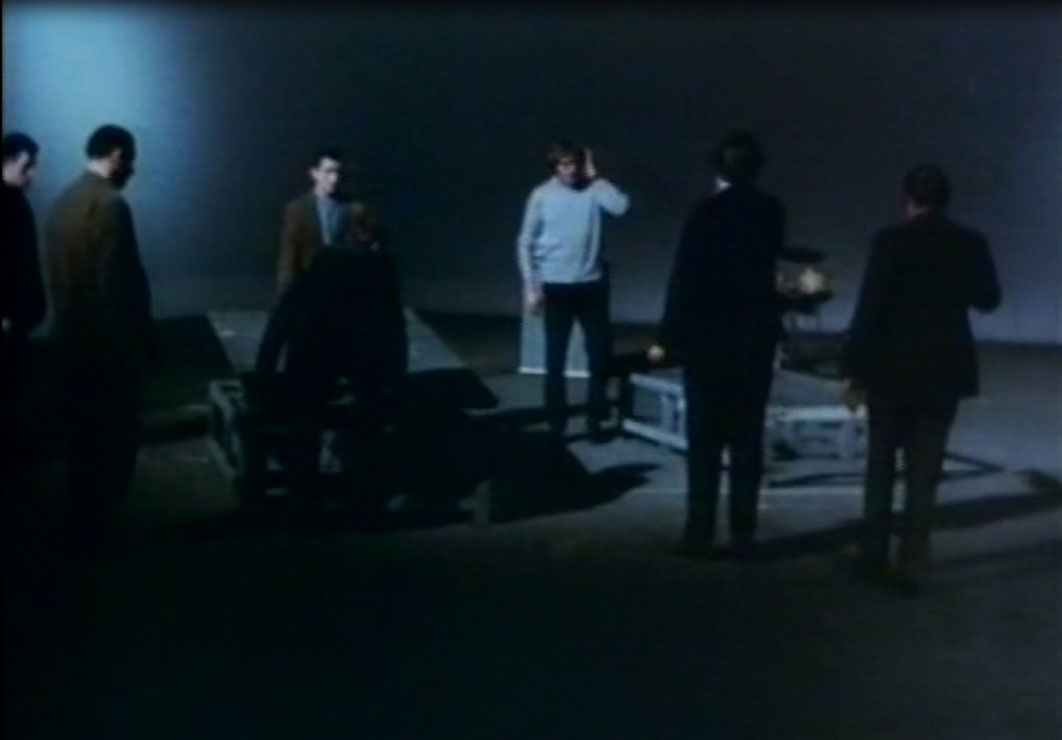
The stage is set at Twickenham as the opening credits roll in “Let it Be.”
Lindsay-Hogg hoped to change minds. “Let’s see what we all feel in a day or two… instead of making anything hard and fast.”
There would be no budging. “Ringo definitely doesn’t want to go abroad,” Paul said, “so that means we don’t go abroad. Maybe we go abroad next time… [but] it would be nice to find some way to do it out of doors.”
Like John wasn’t even considered when discussing a venue he played just weeks earlier, Ringo didn’t state his case in person, only via proxy. It did really sound like it was the first time the topic of concert venue was seriously discussed immediately between the director and the film’s principals, and it was after they had already began the sessions.
Thus, there they were on Jan. 2, starting 20 days of rehearsals culminating in a concert that had absolutely no parameters decided outside of the band scheduled to perform.
Line of the day, directed at Paul during a discussion with director Michael Lindsay-Hogg:
“You going to keep the beard? You look like a Talmudic student.”
As it happened, one of the few covers they ran through on that day was Chuck Berry’s “Brown-Eyed Handsome Man.”
Thirty years later, Paul McCartney would record his own version of the song on Run Devil Run, and perhaps with his subconscious working overtime, among the video’s line dancers (around 52 seconds in) would be none other than…
Much like I can never listen to Hey Jude the same way after knowing where JohnPaul drops the F-bomb, it’s hard to hear “Don’t Let Me Down” and “Sun King” the same way after hearing them debuted at Twickenham on the first day of rehearsals.
And that’s because, after hearing each of those songs quite literally countless times over my life, it never occurred to me that they’re one in the same. Insomuch that “Sun King,” ostensibly, is part of “Don’t Let Me Down.”
Maybe it had always been obvious to everyone else. But to me, it was revelatory.
How was this missing from my life all these years? Am I the last to know? This, easily, was the most interesting thing about the first day, for me. Something I’d never even approached thinking about.
 The Beatles, as depicted by John Lennon in November 1968, as published in the December 7, 1968, issue of New Music Express.

























 They May Be Parted