Tag Archives: Martha My Dear

Jan. 14: The day I went back to school

Dave Grohl told a funny story about Paul McCartney on “The Graham Norton Show” during the promotional tour for his 2021 memoir, The Storyteller, expanding on a brief passage from the book itself. The episode played out in 2014, when Paul and wife Nancy Shevell visited Grohl to meet his newborn baby and indulge in an evening of pizza and wine.

There’s a piano in the corner of the room and [Paul] just can’t help himself. … He starts playing “Lady Madonna” in my fucking house. And my mind is blown. I can’t believe this is happening. …

[Grohl’s 5-year-old daughter Harper] had never taken a lesson to play any instrument at that point. And she sat down and she watched his hands. They sat together, and he was showing her what to play. And they wrote a song together.  …

The next morning, I woke up and I went to the kitchen. I was making breakfast, and I heard her playing the song that they had written the night before. And I came around the corner, and she looked at me as she was playing the piano. She realized I was watching, and she never played the piano again.

And then she’s like, “I want to be a drummer.” I’m like, “Are you out of your mind?”

The anecdote is relevant not because – in an outstanding coincidence – Grohl was born on this January 14, 1969. Instead, the story underlines Macca’s actions to start his own day, thousands of miles away, on the same January 14, 1969.
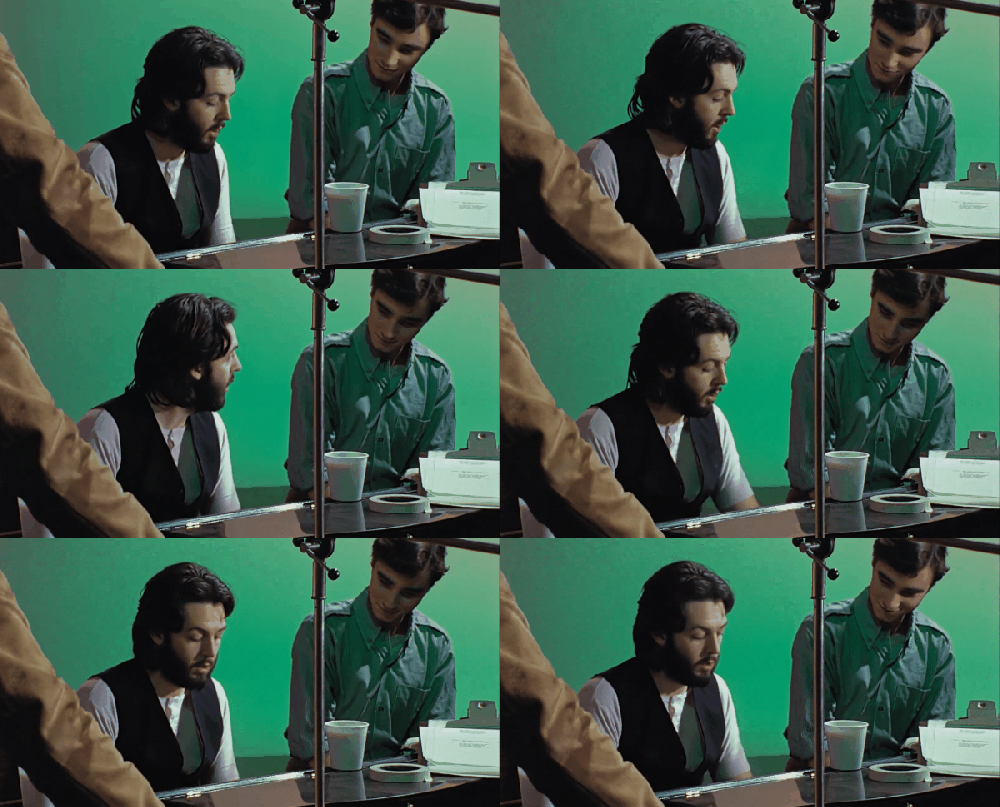
“The great thing about the piano is, like, there it all is, there’s all the music ever,” Paul told 22-year-old clapper loader Paul Bond. “That’s it. All the music that’s ever been written is all there, you know.”

(Going forward from this point, when I call someone just “Paul,” it’s McCartney.)

In the midst of a discussion of various music styles, Paul followed with chaotic cacophony on Twickenham’s Blüthner as a demonstration of “the latest things in music,” conceding “that’s music too.”

This sequence is short, but we can glean quite a bit from these five minutes of the two Pauls interacting in real time as recorded on the Nagra tapes (it’s only two minutes in Get Back).  An incident like this opens up the space to tell the Beatles’ life and career biography, something that happens often during these sessions.

To his credit, Bond questioned if there was any origin story to Macca and the instrument. “What did you do, you just started tinkering about on piano?” he asked.  McCartney blew him off with a “yeah, sure.” But there was more to it.

“To us kids, [my father] was a pretty good player, he could play a lot of tunes on the piano,” Macca recalled in Barry Miles’ 1997 biography Many Years From Now. “I used to ask him to teach me but he said, ‘No, you must take lessons,’ like all parents do. I ended up teaching myself like he did, by ear.”

Decades later, Paul told a similar story in his own book, 2021’s The Lyrics.

Dad wouldn’t teach me the piano, though; he wanted me to take lessons. He didn’t think he was good enough and, because my parents had aspirations for us, he wanted me to learn the ‘real stuff.’ I took a few lessons from time to time but ended up being pretty much self-taught, just like him. I found lessons to be too restricting and boring. It was much more interesting to make up songs than to practise scales.

Paul indeed received professional lessons, briefly. Here’s his old teacher, Leonard Milne, remembering Paul McCartney the piano student from a 2010 interview in Mark Lewishon’s Tune In:

I gave Paul one lesson a week, at a grand piano I had in the lounge at my parents’ house, 237 Mather Avenue. He started on The Adult Beginner’s Guide To Musical Notation but this didn’t last long because he said he wanted to learn by ‘chord symbols,’ letters printed under the notes — like ‘C7,’ say. It’s a musical shorthand he would have known as a guitar player. He didn’t want to learn the real technique, he wanted to rush ahead — he was clearly a boy with talent who didn’t want to be held back. I also didn’t set homework because Paul made it clear he wanted to press on, not fiddle around with paper.

Fiddle around he did, teaching himself on the piano at home in his teenage years. (Paul had another aborted attempt at formal piano training in the mid-1960s, when he was already established in the Beatles, a brief story he shared in his 2023 A Life In Lyrics podcast.)

Naturally, Paul pressed on in these early moments of the January 14 sessions, playing brief, catchy progressions on the piano. He was the only Beatle there anyway; he had the time to mess around.

“Unless you stop yourself, there’s no stopping yourself,” Macca told Bond – who was visibly beaming throughout the scene in Get Back, in awe and truly engaged at the piano lesson.  “Unless you feel like stopping. there’s really nothing to stop you, ‘cause that’s it then. There it all is.”

Paul then launched into “Martha My Dear” – just an 8-week-old album track at this point in time – and added the comment, “See, but then you get to sort of wonder how people do all those contrapuntal things.”

“A lot of old tunes have just a set sort of chord pattern. Because that’s the great thing, once you stop trying to find out chord patterns, you really suss what people are doing and what musicians are doing.”

The decision to play “Martha My Dear” was clearly deliberate on Paul’s part. It wasn’t merely a piano song near the front of his mind. Here’s Paul, decades later, as quoted in Many Years From Now, discussing how he considered the song’s piano part when he wrote it:

When I taught myself piano I liked to see how far I could go, and this started as a piece you’d learn as a piano lesson. It’s quite hard to play, it’s a two-handed thing, like a little set piece. In fact I remember one or two people being surprised that I’d played it because its slightly above my level of competence, really, but I wrote it as that, something a bit more complex for me to play.

In real time, on the Nagras, Paul plays what sounds like a few seconds of “San Francisco Bay Blues” – a song he covered throughout his solo career, including on his 1991 Unplugged appearance. John Lennon fooled around with it, too, during the Imagine sessions in 1971.

In Get Back (which edits it out of order, placing it prior to “Martha”), this 10-second piece is credited to them both as a Lennon/McCartney original retroactively titled “Bonding (Piano Piece).” I’m with the A/B Road bootlegs and others when it comes to credit – this doesn’t sound like Paul conjuring an original improvisation. Especially in the context of his follow-up statement.

“Old tunes, you know, they are just a certain way of going,” Paul told Bond. “And they hardly ever vary from it. I don’t really know it, you know, my dad knows that better than I do.”

The brief and highly unorthodox lesson was over, with Bond going back to work after admitting, “I must get myself a piano.”

We’re not going to pretend that Paul only started becoming adept at piano in 1968 – he was playing it on stage in the Hamburg days. Still, he considered himself a relative neophyte, whether we all believe that or not.

Only a few days earlier, prior to debuting “Another Day” on the Nagras, Paul said, “I better go and put in some piano practice.” True, he may have been trying to get out of a conversation with Michael Lindsay-Hogg, but he said it nonetheless.

For a man who didn’t know how to read music and thought of himself as a novice, teaching the instrument came comfortably. Perhaps it came from his own potential desire to be a teacher, if he wasn’t in a band.

Engaged with literature, a young Paul McCartney “didn’t know if I would actually get to university or get somewhere,” he said in Many Years From Now. “What was my next thing gonna be? Teachers’ training college?”
A brief edit of the conversation appeared in the original Get Back book published with the Let It Be LP in 1970.

Paul said as much to American audiences at the dawn of Beatlemania, too, in a February 11, 1964, interview with WWDC-AM’s Carroll James, one of the DJs credited with being the first to play a Beatles song on American radio.

“At that time, I thought of being a teacher, actually,” Paul said when he was asked what his plans were if he wasn’t a Beatle. “But luckily, I got into this business, because I would have been a very bad teacher.”

Only a few months before the Get Back sessions, Paul told Tonight Show guest host Joe Garagiola and American audiences, “I was nearly going to be a teacher, but that fell through, luckily.”

Still, here he is, January 14, 1969, embracing and excelling as musical instructor. School was on his mind, even if it was in the subconscious. He continued at the piano, this time playing a new song.

“I had one this morning,” Paul said about five minutes after Bond’s lesson ended. “But it was just like, ‘The Day I Went Back to School’ or something.” The estranged George Harrison presented his “last-night songs” earlier at Twickenham, and so did Paul.

There was only a single verse, repeated several times.

The day I went back to school, the day I went back to school, the day I went back to school
The teacher said, would you like to come back tonight?
I said, no thanks. I’m doing all right without you.

Paul was a long way from 1977’s “Girls School,” and resisting the kind of potentially illegal temptation mentioned in that song’s lyrics isn’t particularly rock and roll of him. But things were weird at this point in Beatles history, so I guess anything goes.

We’d never hear the song we all call “The Day I Went Back to School” again, not during the Get Back sessions nor anytime since.

But the point remains: Teaching and learning was something on the forefront and in the subliminal corners of Paul’s mind on January 14, 1969. Whether it was in private, like at the Grohls’ in 2014, or in the 2021 documentary series “McCartney 3,2,1,” when Paul was demonstrative to host Rick Rubin.

Like Grohl said, Paul can’t stop himself.

Paul Bond’s entire career was ahead of him when he worked on the Get Back sessions, and over the subsequent 40 years, his cinematographer and cameraman credits included “Downton Abbey,” “London’s Burning,” “Inspector Lewis” and all kinds of other things British audiences would know.

Bond also worked on “The South Bank Show,” and that’s where his path crossed with Macca again, in 1984, as part of the small crew working behind the camera.
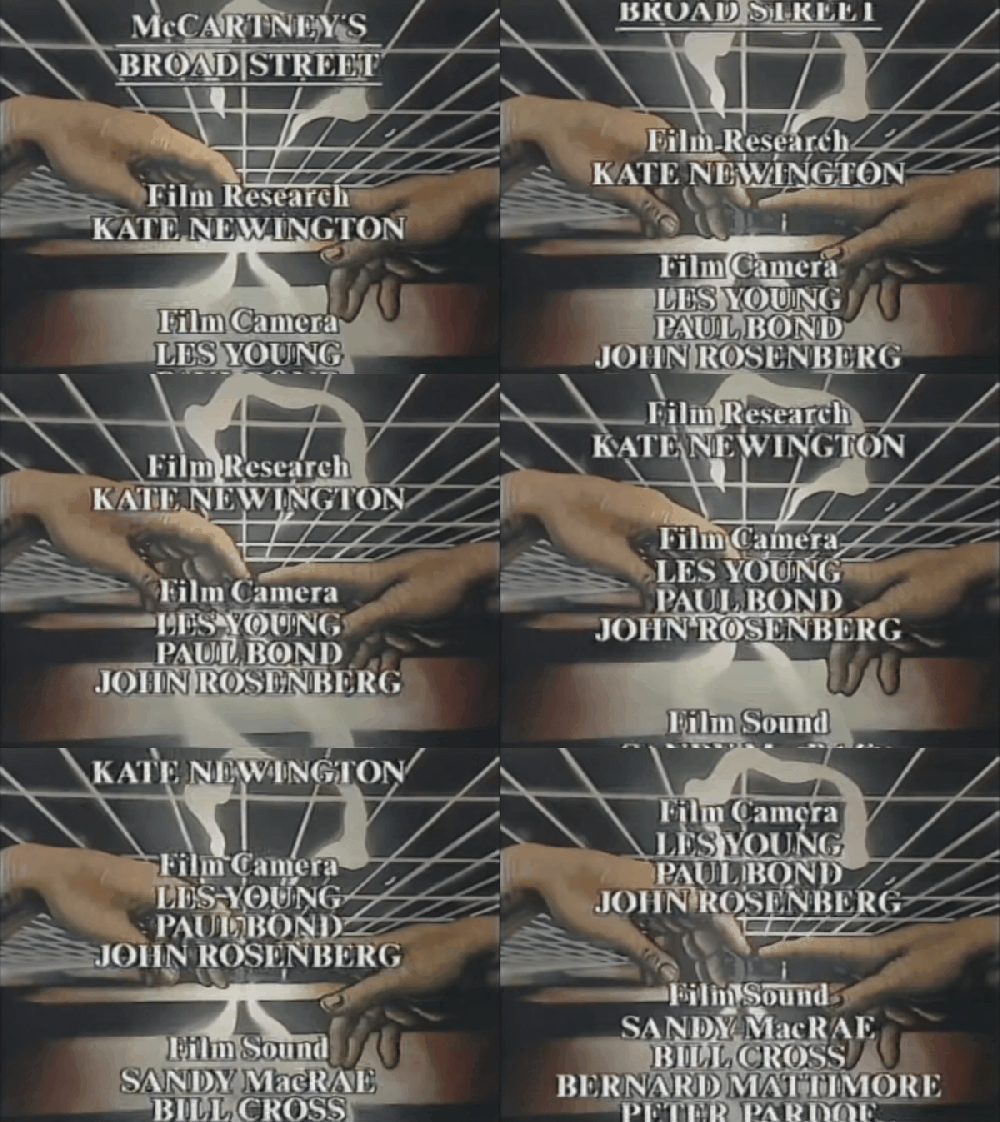
Bond has also enjoyed a separate act in an a completely unrelated field.

Since at least the mid-1970s, Bond has been a beekeeper. No mere apiarist, Bond is a world champion at the art, earning international recognition in 1979.
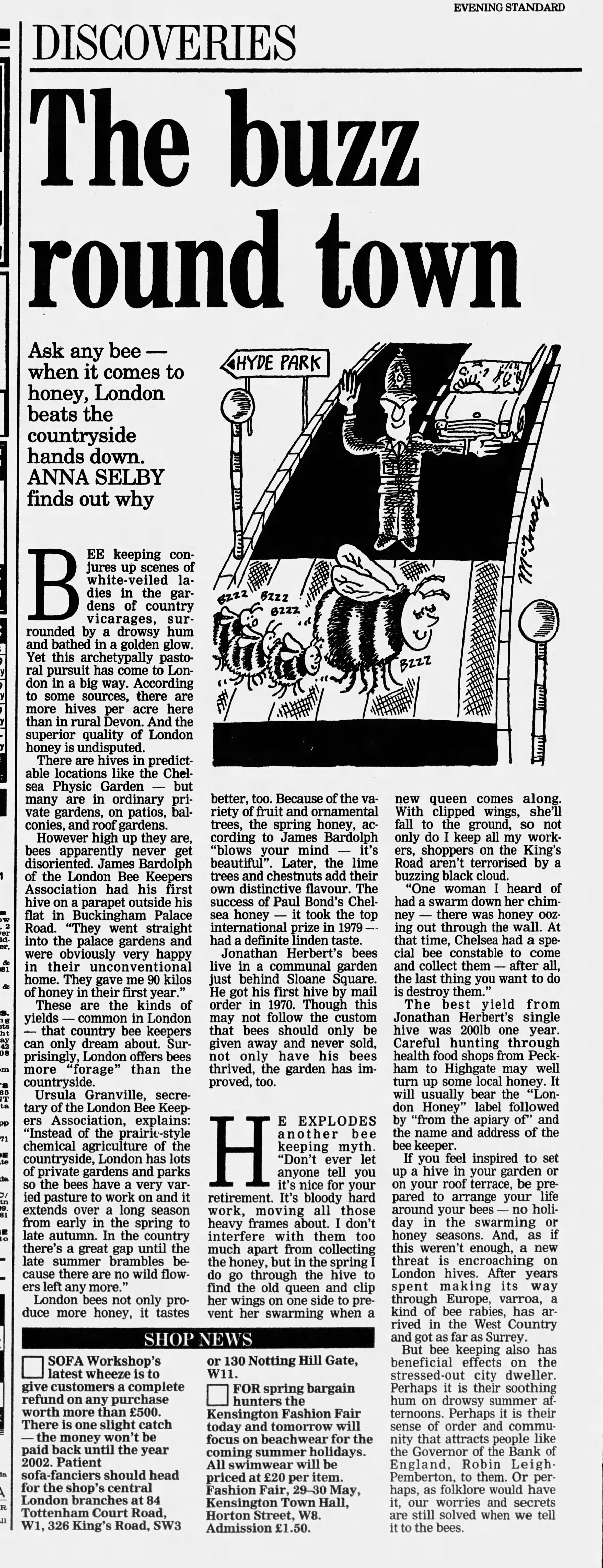
From the May 29, 1992, issue of the Evening Standard under the headline “The buzz round town”

Modest in his mastery, Bond credited the bees and the process for his sweet success. Maybe that’s something Paul McCartney taught him when he pointed to the piano for having all the music inside it instead of his own remarkable skill in unlocking that power.
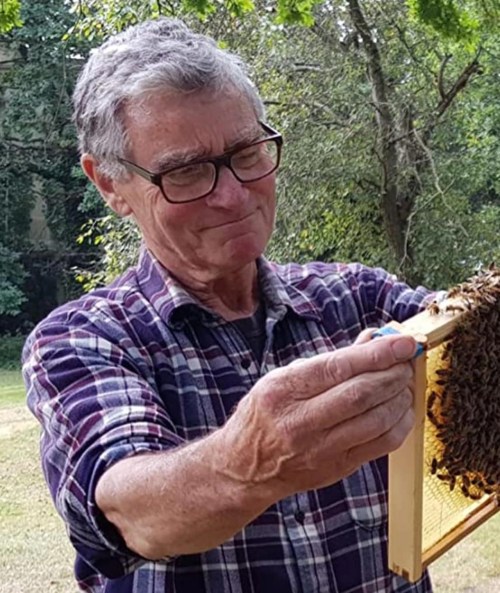
I’ve been waiting all post to write this: Let it Bee.

As Bond said in Idle Beekeeper: The Low-Effort, Natural Way to Raise Bees, published in 2019, when he was asked to share his secret of success: “Oh, I just rinsed out the jars.”

1 Comment

Filed under Day by day

Jan. 10: Go on, as if nothing’s happening

“It seems highly unlikely we’d be on,” the guitarist told the director.

With a member of the band unexpectedly AWOL, he was justifiably skeptical the Beatles could stage the big concert to end the film.

“I mean, the law of averages are against it,” he continued. “I think if you could get the juggler on with a couple more clubs, that’d fill in a bit of time.”

That guitarist speaking was George Harrison, and the production was A Hard Day’s Night, the Beatles’ first feature, filmed Spring 1964. On the afternoon of Friday, January 10, 1969, it wasn’t a self-deprecating Ringo Starr who was missing, it was a self-reliant George himself, having sprung Twickenham during his “Winter of Discontent.” This left the remaining Beatles and director Michael Lindsay-Hogg juggling ideas for how to close what would become “Let It Be,” their final film, and who else would be on stage playing lead guitar.  

Michael and Ringo, January 1969. From Peter Jackson’s Get Back.

More than a week into the Get Back sessions, Michael continued making similar iterations of the same pitch for the show.

“One of my ideas is if we go to, like, anywhere, that we mightn’t just announce any times for the concert at all,” he said to Paul McCartney later in the day on the 10th. “We’ll set them (the Beatles) up in whatever desert we do it in, and they start to play. And one by one, and ten by ten, people will come in.”

Inane, I’d call that,” Paul replied with a comedic aggression. “Straight off the top of my head. … Imbecilic. Salacious.”

(Like in his songwriting, at times, Paul sometimes spoke words that simply sounded good, even if they didn’t make sense in context.)

Michael deflected the response, saying “‘imbecilic’ sounded like a bad bug you get the flu from.”

Regaining focus, he invoked the show’s target date, 10 days hence: “I though that could make a very kind of groovy, trendy opening. Seriously, like: January 20, 1969.”

Moments later, the director and the others in the room — which extended beyond just the band — discussed the issue of visas and difficulties several of the Beatles’ peers (Donovan, Mick Jagger and Keith Richards) faced getting into the United States. They were open to several options, including Mexico, the Virgin Islands and other Caribbean destinations.

“And Catalina, which George said wasn’t very nice,” Michael said.

Not that it mattered what George thought then, he’d quit the group almost an hour earlier.

“So what’s our next move?” Michael asked the others. 

“We split George’s instruments,” John Lennon said to laughter.

It was clear in the immediate they were not considering splitting the band, though. If the Beatles were going to be on the move, it would just be in a different iteration. Abandoning the project wasn’t a consideration at present.

The conversation would shortly return to locations, with the Roman amphitheater at Sabratha in Tunisia remaining at the forefront, all other contenders just conversation pieces to keep the group engaged. Michael’s long-preferred destination, he enlisted a “reconnaissance team” that included Beatles assistant Mal Evans and producer Denis O’Dell slated to scout the venue the upcoming Monday.

“There has to be someone to say, ‘The weather’s fine, come on in,’” Michael said.

Paul repeated familiar, feasible suggestions (The Cavern Club, Tower Ballroom) along with new nearby options (the Underground) and  more distant, outlandish and outrageous ones (“the mouth of a volcano near Ecuador”). 

“I think we should do it for more than 500 people,” Michael added.

It was a tough time to think big. This was an afternoon and evening of distractions and interruptions.

In the wake of George’s departure, there were several coincidental arrivals at Twickenham: A package arrived for Paul (marked “‘handle tenderly”); several “EMI heavies” wandered around the soundstage; a CBC interviewer prepped John and Yoko for an infamous interview that would come a few days later.

Rather than return to a full rehearsal, the group joined Michael in telling several imbecilic (and salacious) knock-knock jokes. Of more interest was Michael discussing his career and relationship with Orson Welles, whom decades later he would discover was his father. One lengthy anecdote (which was also detailed in his 2011 autobiography, “Luck and Circumstance”) described Michael acting in Welles’ 1960 stage production of “Chimes of Midnight” when Welles briefly stormed out of the production in anger. 

“See you ’round the clubs!” Glyn Johns reacted, laughing — and confirming George’s earlier valedictory statement, which wasn’t caught on tape. 

An afternoon replete with nostalgia would soon continue after Paul returned to the piano (you can hear “The Long and Winding Road” and “Adagio for Strings” clearly on the tapes in the background). After quizzing the band on whether they had endured any scuffles with their fans (Ringo recalled being kicked in the head), Michael asked if they looked back fondly on their frenzied touring period.

John replied with an affected accent, the voice of a ragged bluesman looking back on a lifetime, not merely a few years earlier:

Why, I think of it every day. I think what fun we had when we was [sic] the Beatles, playing and rocking with the group around the world. I said, ‘Richard, you remember that?’ He says, ‘No, I hadn’t joined you then.’

One of the not-so-fond memories: “Having eggs thrown at us in Australia was one of my big moments,” John said.

Reminded by Ringo he had missed part of the 1964 Australian tour (although he was there for the egging in Brisbane), John evoked the name of the rare Beatle stand-in. 

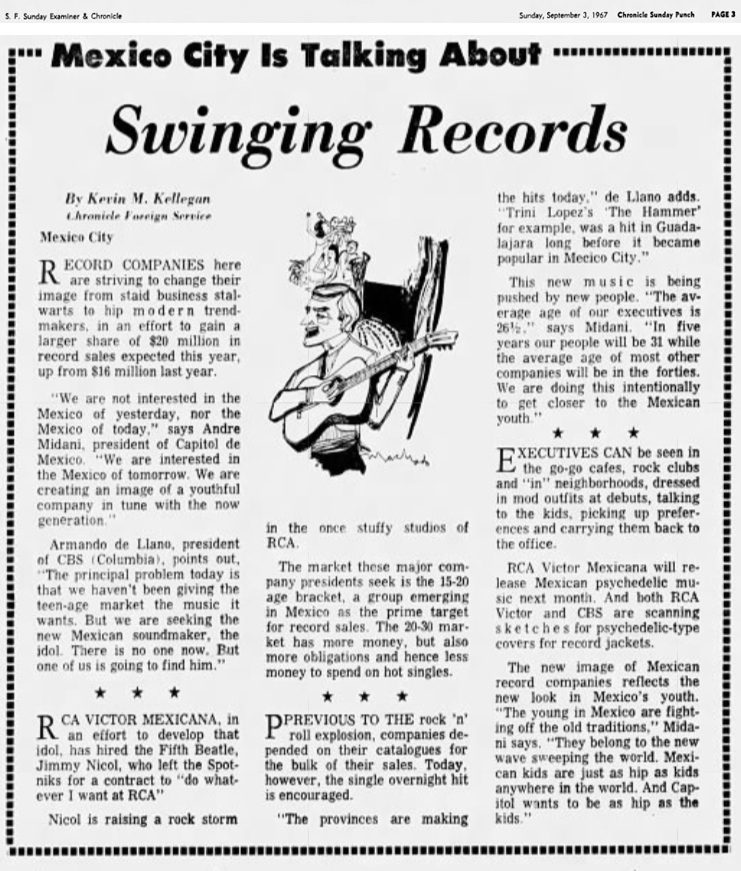
Jimmie Nicol: Now making a living as the 29th Beatle in New Mexico,” John said of the fill-in drummer, who was actually in old Mexico at the time.  

Now with the band facing a new vacancy, would they soon get to Beatle No. 30?

As if on cue, moments later, Michael barked an instruction for additional equipment: 

“Glyn, Yoko wants a mic.” 

She was back, but the music was hardly intense, with Paul having moved onto his White Album ode “Martha My Dear.”  Now, her vocals were largely calm and controlled, more comedic than anything.

While Yoko once again wailed, John — in conversation with Michael — laid out his plans to replace George. He didn’t suggest Yoko. 

A few hours earlier, George told the other Beatles, “You need Eric Clapton.” The time had come for John to heed the advice, sharing it with Michael. 

“I think if George doesn’t come back by Monday or Tuesday, we ask Eric Clapton to play, ” John said. “Eric would be pleased. He left Cream because they’re all soloists. … The point is, if George leaves, do we want to carry on as Beatles?”

Harsh feedback shortly overwhelmed the room, obscuring some of the conversation on the tapes. But the discussion continued, as Yoko again passionately called out John’s name.

MLH: Maybe for the show, you would just say George is sick.

John:  (Sincerely): No, I mean, if he leaves, he leaves.

MLH: But what’s the consensus, do you want to go on with the show and the work?

John: Yeah. If he doesn’t come back by Tuesday, we get Clapton.

Yoko: John!

John: Whaaaaat? (laughter) 

John and Yoko continued to repeat each other’s names, but this was the couple playing for laughs.  Meanwhile, John and Michael’s discussion continued through the call-and-response, bringing together the issue of show location with locking down a replacement guitarist.

MLH: And what about the venues? … If George comes back we go away, and if Clapton comes in we stay here.

John: We should just go on, as if nothing’s happening.

MLH: I think we should go away.

So eager to get the show on the road, Michael had the potential logistics lined up in his head, proposing the group spend the following week at Twickenham and the week after abroad, all conforming to the group’s timetable, which was in part defined by Ringo’s filming schedule for The Magic Christian. 

“What I’ve always thought is we leave here next weekend (January 18-19) and do the show the following weekend (January 25-26) there, if we decide to go there,” Michael said. “And then come back on Monday (January 27), which is just inside Ringo’s seven days.”  (The January 20, 1969, date floated previously must have only applied to a domestic show or an alternative, abbreviated schedule.)

Michael’s plans to this point were more extensive than expected, implying there really was no option, at least that he was eager to prepare, other than Sabratha. 

“We’ve arranged everything food-wise to come in from Germany,” Michael said, adding for the skeptics, “I do not joke. It’s the same food from the American [military] base.”

Eric Clapton and John Lennon, from the Rock & Roll Circus, December 1968.

And if it wasn’t enough John was trying to enlist Eric Clapton to join the Beatles, Michael casually suggested a near reunion of Cream, if it meant just getting Paul and John to Libya for rehearsals, and Ringo — who was least receptive to travelling — to be minimally overseas.

“We can get out a session man for a couple days,” Michael said. “Or Ginger Baker can come for a few days. Just to kind of routine it.”

The discussion between John and Michael petered out as John joined Paul and Yoko on another jam. Unlike earlier, when the Beatles played hard blues rock out of rage, this improvisation was more subdued, a more gentle and at times an arguably pleasant performance, containing elements of “Castle of the King of Birds.” Paul was on piano, John on guitar and Ringo on tambourine with Yoko providing another disruptive vocal — although not quite as consistently intense than earlier in the day.

Soon, Paul shifted to the drums — and it’s a noticeable drop in quality from Ringo to Paul, as strong as the latter is as a multi-instrumentalist. More importantly, it freed up Ringo, who returned to conversing with Michael. But first, he played up for the cameras (and tapes).

Yeah, rock it to me baby, that’s what I like. You may think this is a full orchestra, but if you look closely you can see there’s only two people playing and one person singing. I know it sounds like Benny Goodman, but don’t worry. It’s the big sound of 1969! You bet your life. Oh, sock it to me, sock it to me. (Laughter)

Interested in the filmmaking, Ringo asked Michael precisely what he was doing — “I thought what we should do is the first sessions when you came back, make it very hand-held looking,” Michael said, pulling the curtain behind the sausage-making. More importantly, Michael shared his first-hand view on what he saw after George walked out. 

“And the interesting thing is, Paul went to his amp. … I don’t know if you knew what you did, psychologically, after lunch. You (addressing Paul, who joined them) went at your amp like you shut the door into a closet. … And you (Ringo) were playing very hard. … And John was doing whatever he was doing.”

Ringo, Paul and Michael continued their conversation, as John provided background music — “Sun King” and “Dear Prudence.”

MLH: Have you ever had coverage when you were doing a whole album?

Ringo: No. 

MLH: Have you ever wanted it?

Ringo: No.

Like it or not, the Beatles — what presently remained of them — were getting blanket coverage, and the real drama was happening in the studio, not on location.

“Are we meeting again Monday?” Michael asked hopefully in the waning moments of the day’s session.

“Yeah, I’ll have Eric, Jimi (Hendrix, although it could feasibly be Jimmy Page) and Tommy (Evans of the Iveys, perhaps?) lined up,” John replied, with varying and low degrees of sincerity.

Paul’s set his bar much lower. 

“A7, D7, G7,” he instructed Maureen Starkey, who was visiting Twickenham that afternoon. “Get ’em off over the weekend and you’re in.”

(Ironically, armed with those chords, Maureen would have been able to fill in for George on his For You Blue.)

Paul with guitar protégée Maureen Starkey. From the Get Back trailer.

Before splitting for the day, Michael made sure to capture the scene. “We have this well-documented. And a lot of shots of the empty cushion.” We’ll see what Peter Jackson shows us in Get Back ’21, but this footage was left on the cutting-room floor of the final cut of Let It Be.

“And I guess that’s it,” wrapped up Michael, who wished the others luck in their planned weekend business meeting, which would include George. “And I hope everything really goes swell. I’d like to say, I’ve enjoyed our week together, hope one day we have another one like it.”

“Surely,” Paul replied. “Why not?”

And thus ended the first full work week of the Get Back sessions.  While George was kicking Eric Clapton’s ex-girlfriend out of his own house, John pushed the concept of welcoming Eric into the Beatles’ office. 

As you certainly know, Clapton never joined the Beatles, and John didn’t bring him in the following Tuesday, even though George wasn’t back. There clearly wasn’t an actual offer anyway.

Here’s Paul, from the Anthology book:

After George went we had a meeting out at John’s house, and I think John’s first comment was, ‘Let’s get Eric in.’ I said, “No!” I think John was half-joking. We thought, “No, wait a minute. George has left and we can’t have this — it isn’t good enough.’

For his part, Clapton repeatedly downplayed the idea he was an actual fallback option for the Beatles. In modern parlance, Clapton thought John used him as clickbait, and the friendship he had with George would have been a blocker anyway. 

Eric, from the April 1998 issue of Mojo

There may have been [a suggestion the Beatles would ask him to join]. The problem with that was, I had bonded or was developing a relationship with George — which was exclusive of them. I think it fitted a need of his and mine, that he could elevate himself by having this guy, that I could be like a gun-slinger to them. Lennon would use my name every now and then for clout, as if I was the fastest gun. So I don’t think I could have been brought into the whole thing, because I was too much a mate of George’s.

Several years later, after George’s death, Clapton literally laughed at the idea of joining the Beatles when he was interviewed for Martin Scorsese’s 2011 documentary “Living in the Material World”.

As he said in the clip, the Beatles could be the most close-knit quartet, but at the same time, “the cruelty and the viciousness was unparalleled.” 

The latter led the Beatles to this moment. After their first full day at Twickenham, on January 3, George described with envy The Band‘s ability to blur their domestic and working lives, something he witnessed first-hand when he visited the group and Bob Dylan six weeks prior.  “They’ve got all that gear there, but … they’re just living, and they happen to be a band as well.”

His relationships with his wife and his band in distress, George had neither element 10 days into January 1969 — he wasn’t living properly, and he didn’t feel like a useful member of the Beatles.  

While he’d join John Lennon as a member of the Dirty Mac before and the Plastic Ono Band later, Eric Clapton was neither asked, nor was he seemingly willing to accept an assignment with the Beatles.

The Beatles didn’t need Eric Clapton, a gunslinger for hire. They needed George Harrison. 


5 Comments

Filed under Day by day