Tag Archives: Michael Lindsay-Hogg

Jan. 8: The Four Powers

In a time of global crisis — isn’t it always, though? — it was the world’s greatest legislative body. OK, maybe the Beatles were the world’s greatest band that also tried to behave like a legislative body, and late in the day on January 8, 1969, it was nearing time for a decisive vote on a lingering issue: Where would the Beatles play their next — and presumably last — concert?
You know his name (look up the nation)

From the band’s outset to its imminent end, the Beatles prided themselves on what they called democracy, but it was really complete consensus. “We had a democratic thing going between us, particularly by 1962,” George Harrison told the high court in 1997 amid a lawsuit to stop the release of a Beatles recording from one of their residencies in Hamburg. “Everybody in the band had to agree with everything that was done.”

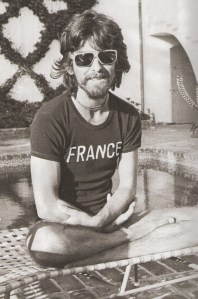
Unanimity isn’t necessary to the democratic model, but this model United Nations was extraordinary by nature of its four voting members: John Lennon, Paul McCartney, George Harrison and Ringo Starr. The two serious veto threats earned code names from director Michael Lindsay-Hogg — Russia (Ringo) and France (George, so named “because he smoked some garlic once,” per Paul).

Continuing his earlier conversation with Ringo, and desperate to sell a show overseas, Michael laid out the situation as he saw it in hopes of chipping through the Iron Curtain.

The way it stacks up is, John is happy to go. … Paul is, I gather, in the middle, tending toward either side … and George is swinging more your way. So there’s quite a tough battle. The problem was we couldn’t talk about it because of Russia. And it’s the four powers. And if Russia says no, then the conversation is obviously in the bag and we can’t do anything with it. And I think if we now can talk about it, we may still discard it … or we may come up with something better.

In retrospect, the drama of the group’s incapability of finding agreement on a concert location, despite the suggestion of several intriguing venues, would have made for a captivating documentary for Michael. It would have given a narrative the Let It Be film lacked. But after less than a week of sessions, the director saw things differently.

“My documentary is running out of gas,” Michael admitted to John. “If we were to vote tomorrow, it’s not running out of gas.”

Fine-tuning the group’s intentions would do more than make for better television. “It might make it better again, whatever the wound is,” Michael told John moments earlier.
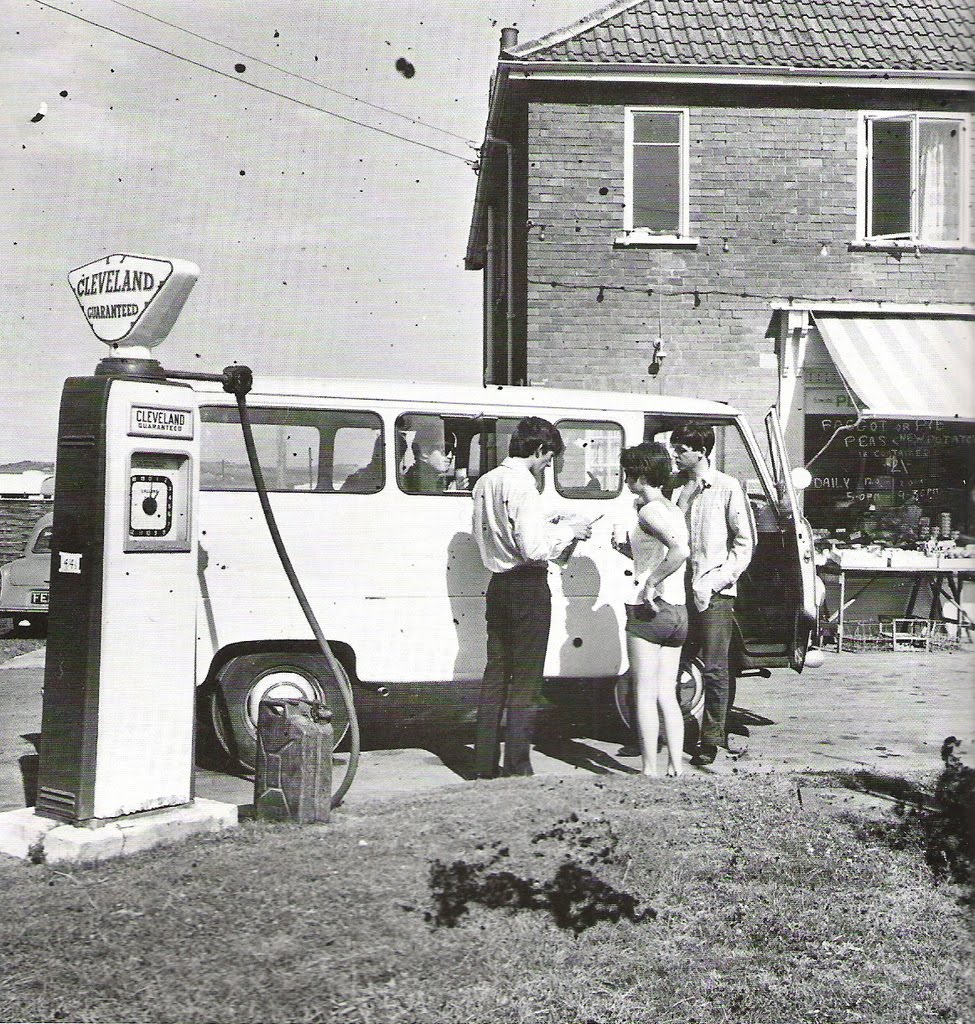
What octane do documentaries use? (Photo of the Beatles at Weston-super-Mare by Dezo Hoffman, 1963)

“Yeah, that’s what I was thinking,” John replied.

And here you thought John didn’t care about the band anymore. The Beatles were a wounded group before the Get Back sessions started, and salt would soon be added when George quit in two days’ time. But the Beatles were still worth saving in January 1969, even if John himself would call it quits well before the calendar year was out.

The day’s musical session was complete, Paul having walked the group through “The Long and Winding Road” and “Let It Be.” For these final 15 or so minutes on the tapes, all four Beatles are engaged, animated and opinionated concurrently to a degree yet unheard to this point on the Nagra reels.

All the principals immersed, Denis O’Dell makes the sell on Michael’s repeated preferred overseas adventure.

“I really think we could go and shoot a day sequence, a night sequence, a torch-light sequence, out there the sea, desert, in four days. Make it comfortable for everybody.”

Paul’s skepticism remained. But he was willing to keep options open and the live concert plans … uh, afloat.

My major objections to that: Traveling, one. Setting up and everything — I’m sure we can do that. Then, there’s that thing, which may not seem much, but we’re doing a live show, and we’re doing it in Arabia (laughter), and everyone’s waiting to see the lads rocking again. So, like, I’ll tell you what then, I’ll come in with it as long as you can get a couple of boats, the QE2. And then give away the tickets here, as you would have done, but the ticket includes a boat journey as well.

The composition of the audience was a sticking point, especially for Ringo, and there’s something virtuous to be said for the lads’ loyalty and desire to be rocking again before an audience that was with them from the start.

“We’ve got to get the right audience for Russia,” Michael said. “If we can get the right audience over there, which we can get over there.”

George wasn’t easily swayed. “What is the point of doing it abroad… apart from getting a great holiday? I’d much rather do it and then go away.”

Reminding the band of Twickenham’s relatively pedestrian features, Denis replied, presumably waving his hand at the scene around him, “To get away from that, that’s really the answer.”

“It’s ‘Around the Beatles ‘69′,” John acknowledged after a brief exchange about potential set possibilities on the Twickenham stage.

Paul, having had enough at the end of a long day, aggressively presented a compromise.

“I’ll tell you what I’ll offer you. If we’re going away, and we hire a boat to take the audience with you, we’ll do a bloody show on the boat, and then we’ll do a show when we get there, in the moonlight. … Final dress rehearsals on the boat.”

History never stopped chasing the Beatles, and sometimes it caught up to them. They didn’t want to repeat a past accomplishment, whether it was “Around The Beatles” or a stadium show. But Paul’s suggestion would have done just that: Bringing along a select audience to a performance at sea would combine a pair of episodes from the other side of their career.

Feb. 20, 1962, just a month after Brian Epstein formally signed on to manage them, the Beatles — that’s still John, Paul, George and Pete, at this point — performed an important show at Floral Hall in Southport. From Mark Lewisohn’s epic Tune-In:

[Epstein’s] principal involvement in the Floral Hall night was two-fold: to help sell the 1200 tickets and to book the talent that would provide continuous dancing for four hours — five groups headed by POLYDOR RECORDING STARS, THE BEATLES. He circulated typed leaflets among Beatles fans and on the record counters at all three Nems shops, announcing affordable coach trips: fans could pay 8s, 6d for return transportation, admission to the hall and, afterwards, the chance to mingle with the musicians and get their autographs. These special all-in tickets were sold only in the Whitechapel shop, outside which the chartered buses would leave. The Beatles were taking a Liverpool audience with them for a night out up the coast.

Emphasis mine.

Instead of towing British passengers across the Atlantic and Mediterranean, the Beatles brought their fans from their Cavern Club base in Liverpool about 20 miles up the A565.

That was by bus. Six months before the Floral Hall show, the Beatles made the first of four appearances on the Riverboat Shuffle, a concert series on the MV Royal Iris, a ferry cruising in the River Mersey.

For Paul — who would record parts of Wings’ London Town on a boat in the Virgin Islands in May 1977 — the Royal Iris performances made enough of a lasting impact that he referenced them decades later on his 2007 LP Memory Almost Full:

The journey wasn’t as important to Michael as the destination: the Roman amphitheater in Sabratha, Libya.

“I don’t think anything is going to beat a perfect acoustic place, by the water, out of doors, a perfect theater, with perfect acoustics,” he said.

John was on board. “Just singing a number, sunset and the dawn and all that. Gentle, and the moon, and all that for the songs, you know.”

“I think we’re going to do rock and roll at dawn or at night, and we can have the change of day over something like this,” Michael replied. “Because I’m sure we can do the rock and roll there if we get the right audience.”

All-important consensus was building between the two most powerful members of the band, and it was more than wanderlust and closer to finding a way to heal that wound — do something different, but still be together as The Beatles.

“Last year, when we were doing the album, like you said, we suddenly said we don’t need to do it here, in EMI in London,” Paul said. You can listen along to this particular sequence on the “Fly on the Wall” bonus CD packed with Let It Be … Naked.

John excitedly picked up the argument.

“Every time we’ve done an album, we’ve said, ‘Why are we stuck in EMI, we could be doing it in L.A.! We could be in France! And every time we do it, and here we are again, building another bloody castle around us, and this time we [should] do it there. And not only would we be doing it, physically making the album there, but it takes [off] all that weight of, ‘Where’s the gimmick, what is it?’ God’s the gimmick. And the only problem we’ve got now is an audience, you know.”

For a moment, at least, Paul’s skepticism vanished.

“It makes it kind of an adventure, doesn’t it?”
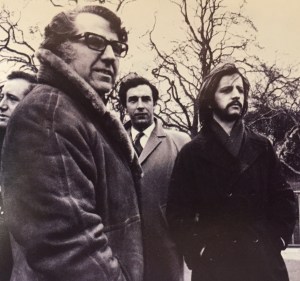
8 Comments

Filed under Day by day

Jan. 8: Nothing is real

Far from chaotic, the Get Back sessions, if anything, could be defined by its routines. Paul arrived early to play piano, and then pretty much ran the rehearsals. George’s songs — whether written overnight or brought back for another day — were a slog for everyone else. John didn’t have much new to offer, while Ringo did Ringo things like participate in conversations and keep the beat. Turn the page to the next day on the calendar, and do it all again.

Beyond music, the daily pattern underlying the scene centered around discussion of the live concert the Beatles were trying to put together. At once a footnote to the songs, the show was simultaneously the purpose of these January sessions and thus ostensibly what mattered most. The push and pull between director Michael Lindsay-Hogg’s wanderlust and the group’s default stance — to stay put — was a constant. And the more they couldn’t settle on a British venue, the closer they collectively moved toward simply staying in the very room where they were rehearsing and ruminating.

January 8, 1969, then, was no different than so many other days the Beatles spent at Twickenham the first half of the month. Discussion about the concert surfaced late in the work day, concurrent with Paul introducing the unfinished “The Long and Winding Road” and “Let It Be” to the rest of the band for the first time, and with their initial attempts at a full-band arrangement.

Yet now, to stage the “honest” sound they sought to achieve these sessions, the Beatles began to consider an ersatz solution. Rock and roll begets rocks, or something imitating it, at least.

Denis O’Dell (left) with Ringo at The Magic Christian shoot. Photo from O’Dell’s book, At The Apple’s Core.

“If we try to cover all this (Twickenham’s sound stage) and build caverns and caves, it’s nice, you see,” said Denis O’Dell, the head of Apple Films.

Why perform at the Cavern in Liverpool for the nearly 300th time, when you can simply craft your own cavern indoors? (Please don’t answer that.)

Denis had been in the film industry since before the Beatles were born, and his association with the group began in 1964, when he was associate producer on the A Hard Days Night film. It was the start of a mutually beneficial partnership to this point, which included How I Won the War (associate producer and John starred), Magical Mystery Tour (producer) and led to his appointment as an Apple executive.

Of course, you already know his name (but have to look up his number) from his time at Slaggers, and do note he is NOT related to Miss Chris O’Dell.

Denis had appeared sporadically on the tapes to this point, and here it dovetailed with one of the first times John seemed even marginally interested in what was going on with the live show.

“Then we could do what we’d like with a backing,” Denis told John. “Go black, or stark or something. Then we could control all our lights from a panel, and we could have all colors you’d like.”

“Yes. And they’ll be able to see us through everything.”

John invoked sets used by Stanley Kubrick, Denis’ boss on Dr. Strangelove (that film was the source of the footage used during the “Flying” sequence in Magical Mystery Tour), and the man floated to direct a version of Lord of the Rings starring the Beatles. An extensive recap of that aborted episode in Beatles history is discussed at length in Denis’ 2003 fine autobiography of his Beatles years, At The Apple’s Core.

The conversation would continue, with Denis asking someone to fetch George Djurkovic, art director of The Magic Christian, from the film’s set elsewhere at Twickenham to provide added insight. But while Paul continues to play “The Long and Winding Road” in the background the conversation on the tapes meandered to a new duo: Ringo — one of the stars of The Magic Christian — and Michael. While Denis and John spoke as if the live show was to be held at the studio, Michael continued negotiations on taking the show on the road with Ringo. They were the leaders of the rival factions: Stay-put Starr vs. the whole Hogg.

“If I do go, I think it’s better just to go for four or five days,” Ringo said, showing newfound flexibility. “We don’t need to go to rehearse.”

Ringo was willing to bend and travel, but there’s a catch: “I’d like to do it to a British audience.”

It’s a catch, but one Michael is willing to receive. “Can we all talk about it? Will you take the veto off if you can be convinced we can get an audience?” Michael asked.

A Roman amphitheater wasn’t artificial, but to Ringo, the whole reason to perform overseas was contrived. The only reason to travel was the “helicopter shot, you’ll see the sea, the theater. And that is, for one, two minutes, say, that shot isn’t worth me going down there when I really prefer to do it here.”

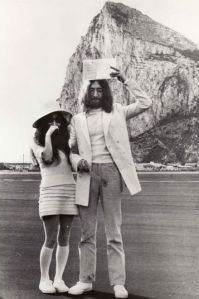
Two and a half months after Ringo suggested the Beatles perform before there for a “British audience,” John and Yoko would be married in Gibraltar (near Spain).

“I see us doing a good show here [at Twickenham], because it’s you [the Beatles],” Michael said, again conceding this could be the last TV program the band will ever do.

Speaking quickly, Michael continued:  “Everything you do has got to be good. All your albums are good. …. It’s not only you as the band, it’s not only them as songwriters, it’s the four of you.

“It’s got to be the best.”

Of course they’re the best. Like Ringo doesn’t know that?

“Every time we do anything it’s going to be the best,” Ringo replied. “Can’t we just do something straight?”

And back to Twickenham, and staying precisely put.

“At the moment, that scaffolding set and the tubular thing, it is kind of like four years ago,” Michael said. “And there’s nothing wrong with four years ago. … We’re all 28 now, or whatever we are. The audience isn’t the same, life isn’t the same.”

For the record, John, Ringo and Michael were all 28, Paul was 26 and George a wee 25. But his point remained legitimate. This wasn’t 1965 anymore.

“This place, it could be rock and roll, ” Michael began.

“It could be rock and roll in Tahiti or wherever you want to put us. What’s it called? (laughing)”

Michael’s not even sure himself. “It’s either Tunisia or Tripoli.”

Ringo asks about a British possession likewise on the Mediterranean — “What about Gibraltar?” — before turning his attention back to the room he was in and the music, ignored during the conversation.

How’s this for an idea of stripping a show down?

“See, Ringo said, “I’d watch an hour of just [Paul] playing the piano.”

7 Comments

Filed under Day by day

Jan. 8: Look Around

It was 12 days until their scheduled concert, and on January 8, 1969, the Beatles were loose, relatively upbeat and open-minded, uncommon characterizations associated with Get Back/Let It Be sessions. Still, there wasn’t even consensus on what continent to stage the concert, much less what venue or what kind of audience would have tickets to the show.

What they lacked in plans and new material — Paul would insist the group would produce a few “rockers” soon — the Beatles at least had no shortage of live productions against which they could reflect and project.

Two classes of potential inspirations highlighted discussions to this point: recent live broadcasts by their peers (eg., Cream’s Farewell Concert, the Rolling Stones’ Rock and Roll Circus) and the Beatles’ own history on stage and on the small screen. The audience was as much a consideration as the venue.

In the final hours of the day’s sessions, as the group continued to work on George’s new song “I Me Mine,” John and Yoko waltzed the room right into a continued deliberation of the staging of the imminent show.

“I think the thing to do is just put you all in a framework, which will be just, like, the audience and a stage,” pitched Michael Lindsay-Hogg, who was tentatively willing to settle for a simple approach if his preferred idea — an overseas trip — was denied. “And by the time we get to the stage, we’d have a routine of numbers. We can find each number how they fit theatrically, like your dance for that one, like the song that you cry in and the song you do that brings tears to everybody’s eyes.”  Off mic, it was joked there’ll be the one song that’s done in the wrong key.

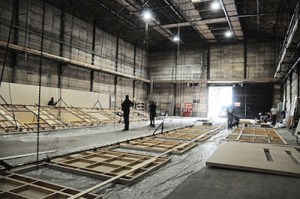
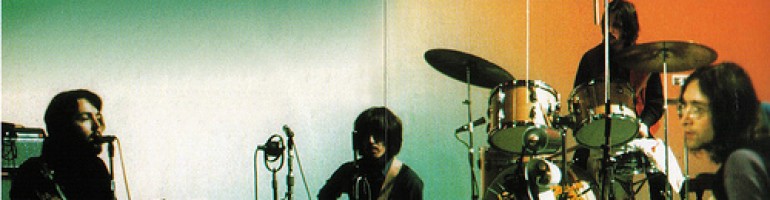
Twickenham's Stage 1. What a pretty palette!

Twickenham’s Stage 1. Simply gorgeous!

“Seriously,” the director continued. “Almost, we should end with ‘Good Night’ or whatever song is going to be like ‘Good Night’ this time. … The end of the show should be a tearjerker like ‘Hey Jude’ or like ‘Good Night’ or like something else.”

Two large signs promoting the show’s working title — “January 20, 1969” — would hang as a backdrop. “And it’s the 19th of February, 1982,” John injected for a laugh and commentary on the decision process’ plodding pace.

When Paul asked about the composition of the audience, Michael answered forcibly, “Human beings, and the first thousand who queue up.” John was more specific, positing “pastry cooks from Walton-on-Thames” would be in attendance.  (John’s joke was told nine weeks before the London suburb actually became a footnote in Beatles history: George and Pattie were fined for drug possession in Walton-on-Thames on March 12, 1969 — the same day Paul and Linda married.)

To snickers, Michael proposed voice overs for each song. E.g.: “Now Paul sings a song of true love.” 

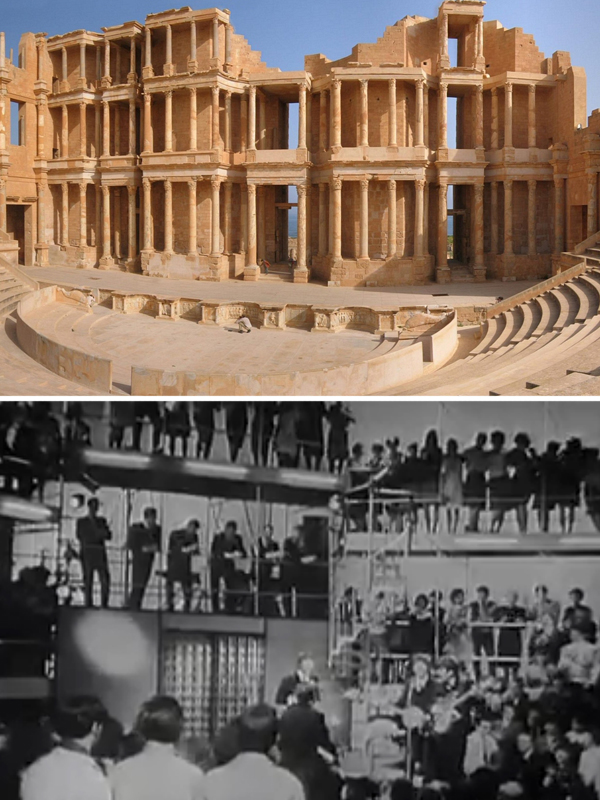
The audience seated at Twickenham’s Stage 1 would sit in the round, either at three-quarters or fully encircling the group. “You could build this place great like that, all of it like a coliseum,” Paul said. “Four sides, then on the top of it all, your cameras, or a camera.”

“I still don’t think that’s our best idea, for the record and on tape,” Michael replied, resigned. “But I think if that’s what we’re going to do, it’ll be fine. Because I’ll make it fine, and you’ll make it fine.”

Coliseums real (Sabratha, top) and fabricated (Rediffusion's Wembley Park studio)

Coliseums real (Sabratha, top) and fabricated (“Around the Beatles” at Rediffusion’s Wembley Park studio)

The bar for the Beatles’ triumphant return to the stage re-established at “fine,” Michael conceded “torch-lit is for next time.”

While the coliseum-style arrangement recalled to Michael the currently shelved Sabratha, Paul was reminded of a moment in the group’s history from four and a half years earlier, when Beatlemania was at its peak.

“It’s a bit like ‘Around the Beatles.'”

“Ah, I was thinking about that,” Michael said. “That was a very good show. That’s why I think it should be kind of theatrical. … Also the Presley show they’ve just done, apparently, which has more of an ‘Around the Beatles’ audience.”

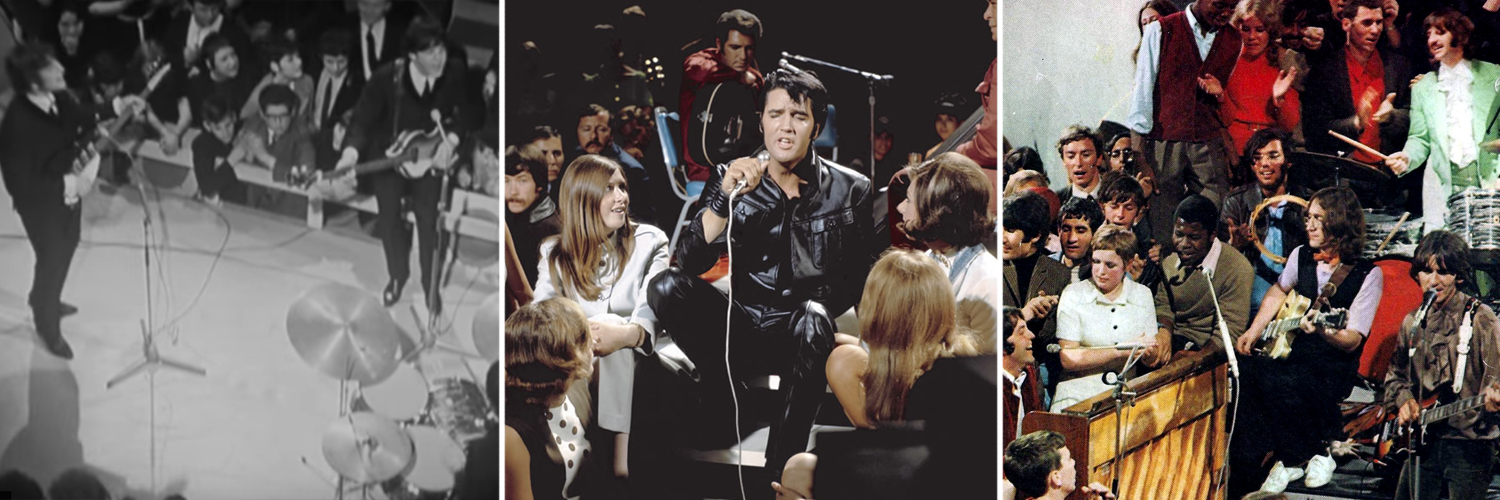
In reality, the live sequences in the ’68 Comeback Special — broadcast on NBC as “Singer presents … Elvis” — had more of a “Hey Jude” vibe than an “Around The Beatles” one; there was always a distance between fans and the band in “Around the Beatles,” while “Hey Jude” and the Comeback Special put the musicians within reach of the crowd, and the King several times interacted directly with the commoners. What “Around the Beatles” and the Comeback Special did share in their audiences was its enthusiasm-cum-mania.

The Comeback Special was being cited in discussions of the Beatles ’69 show, but it had no influence on the “Hey Jude” taping, or vice versa. Elvis filmed the concert portion in late June 1968 but those tapes weren’t broadcast until December. “Hey Jude” was filmed in early September 1968 and broadcast days later. The two paths never crossed.

compare

Way beyond compare: Around the Beatles (left), Elvis’ Comeback Special (center) and the “Hey Jude” promo film.

Elvis triumphantly rehabilitated his rock and roll credentials with his special; the Beatles didn’t need to do that. Yet …

“One of the things we’re up against,” Michael continued, “is all the past things you’ve done.”

Here we are with a reference to the past again. The Beatles did a lot. But surprisingly, although they were commonly featured across all facets of the media, they had very few their own television programs.

“There’s only about three of them,” Paul said, and John rattled off the list: “‘Magical Mystery Tour,’ ‘Around the Beatles’ and ‘Shea'” — the latter the landmark 1965 concert at the former New York Mets ballpark that was broadcast a year later on BBC and in 1967 in the U.S. on ABC. (It recently had a run in theaters in 2016, remastered and looking downright fab as the capper to the enjoyable “Eight Days a Week” documentary).

But “Magical Mystery Tour” was a scripted musical, and “Shea” was a concert film. So that means …

“‘Around the Beatles’ is our only ever TV show, isn’t it?” said Paul.

“And it was good,” Michael said, as Glyn Johns — who had long, but falsely  claimed second-engineer duties on the show (see the postscript of this post for more on that)  — called the program “fantastic.”

After John broke into a few seconds of “Shout” — the finale of that show  — Paul complained to Michael about a theater-in-the-round setup, arguing it’s a step backward, replicating the set of “Around the Beatles.”

“I think with every idea we will have is bound to be …  any of us can pick out a negative side to it,” Michael countered.

“Yeah,” Paul replied. “But it should’t be too heavy negative a side.”

Michael asked the others for input, but John replied by playing Chuck Berry‘s “Sweet Little Sixteen” — a song Michael said, without explanation, “always frightens me” — and swapping in a variety of British locales for the original American cities. (John delivered a more serious reworking of the song six years later on his Rock ‘N’ Roll album).

Returning to “I Me Mine,” Michael remarked John and Yoko’s waltz is “kind of theatrical. And it’s also romantic, and it also fits the song.” Michael was also concerned about the complete bill and “what’s going to be our mind-blasting topper at the end, which I think ought to be a weep-weep, myself. A bang or a cry.”

Paul leaned toward the bang, saying, “we intend to write a couple of rockers.” That worked for Michael — at the beginning, at least. “I think you should open exciting and end with the audience in tears.”

John launches into another Chuck Berry number, this time “Almost Grown,” and is soon joined by Paul. Pleased, Michael said, “That’s what January 20, 1969″ is all about.”

The documentary portion of the production returns to Michael’s forefront when he asks his crew if this performance is being filmed — don’t forget, while the Nagra tapes recorded sound throughout the sessions, the group wasn’t consistently filmed.

Despite the illusion, it was time to get back to work, and Paul returned to setting the agenda.

“Are we all right on George’s number (‘I Me Mine’)? I’m not. Are you? Should we keep doing it a bit more?”

And so, for the time being, the Beatles ended negotiations regarding the live show. The metaphors don’t come much easier: The Beatles’ recounting and considering a return to a theater in the round left them talking in circles.

10 Comments

Filed under Day by day

Jan. 8: Take a lesson from Jude

From Liverpool to Hamburg to points circling the globe, the Beatles electrified audiences, and, well, you can insert your own hyperbolic statement about the redefinition of a rock show here. Yet on January 8, 1969, 28 months since they last played proper a live concert (alternately: “only” 28 months since they last played a live concert), Beatlemania was a memory as the group searched, still, for the how and where of their upcoming live TV concert.

The Beatles’ performance of “Hey Jude” on “Frost on Saturday” that was aired nearly four months prior to the day was their new baseline. It was nothing compared to the ideal, the best in the business.

“The example of the perfect stage show is James Brown,” director Michael Lindsay-Hogg declared to Paul, George and Ringo. “He’s the greatest stage show of all time, I think.”

For all the R&B the Beatles performed, there’s no evidence they covered the Godfather of Soul, but there were fans among the group. From a press conference in 1965:

Question: “I have a question for all The Beatles here. If you were sitting at home listening to record albums of other recording artists, who are some of the American recording artists that you prefer?”
John: “Otis Redding is one.”
George: “Yeah.”
Paul: “James Brown.”

Paul’s tune was unchanged several decades later, when he told Uncut in 2004 that Brown was “sodding fantastic,” while understandably saying he’s more of a Beatles fan, ultimately.

OK, stack us up against James Brown, record for record, he’s definitely hotter because he’s James Brown. But he didn’t do the stuff we did. He’s James Brown and he’s sodding fantastic. We can all agree on that. But there’s something else to The Beatles. Look, we did a lot of good music. You look at Revolver or Rubber Soul, they are decent efforts by any standards. If they’re not good, then has anyone ever been any good? Because, if they’re not good, then no-one has ever really been that good.

George, who would write in his 1980 autobiography that his favorite cover of “Something” was in fact by Brown, wasn’t quite so much a fan of his act, at least, in the opening days of 1969 — which was when, coincidentally, “Something” was in nascent form.

“I don’t know about that,” George said, dismissively, in response to Lindsay-Hogg’s declaration. “All that, with his cloak and his crown …”

When I hold you in my arms, I know that I can’t do no wrong. (ca. 2000.)

Paul and Ringo parodied Brown’s “cape routine,”Paul pleading, “Come back, Ringo, come back!” “I can’t do no more, man,” Ringo moans in response.

Lindsay-Hogg beamed in recounting a Brown performance. “He’s got comedy and everything, and he has all that bit before he comes on. And I love when he comes on with that little white suitcase that says ‘Out of Sight’ on it, with that white silk suit.”

There’s no delusion — nobody at Twickenham thought or suggested the Beatles try to stage a show like Brown’s. So instead, as they’ve done before, they returned to their own recent benchmark: “Hey Jude.”

With Paul having already mentioned earlier that morning the suggestion of “[opening] the doors [to the audience], and we’re in the middle of a number,” Lindsay-Hogg — the director of the “Hey Jude” segment — wondered if the band shouldn’t be awaiting the audience’s arrival. “It’s all collected and you’re all together, then you start, as opposed to you coming on as the Beatles, it’s like much more intimate and participated that you’re there.

“If we were to do it here, the way to do it is to make the big brotherhood again”

Paul’s on board with a rerun of audience participation, a la “Hey Jude.” But it seems he thinks his luck with the “na-nas” of 1968 wouldn’t be repeated in the new year. “If we could do it, I thought it would be great, really, if all the audience did it,” Paul says before he imitates the crowd clapping and singing responsively the “oh, yeah” in “I’ve Got a Feeling. ”

“But the British audience [would sing, mockingly, in drawn-out tones], ‘Oh, yeeees, oh yes. They’re bloody good, this mother,’”

Rehearsing “Hey Jude,” September 1968.

Lindsay-Hogg wanted nothing to do with Twickenham — or anywhere in England — as a concert locale, but this early in the sessions he’s at least showing signs of a vaguely open mind and understanding the final decision won’t be his anyway.

“I think if we do it here — and that’s an extremely long pause after that, ‘If we do it here’ — we ought to I think, which is what we’re talking about, is take a lesson from Jude. Which is another title for a song: ‘Take a Lesson From Jude.’ And make it that kind of thing where the audience is involved, but in a good way. When I say a party, I don’t mean paper hats and balloons.”

“Maybe we should have,” George chipped in.

The discussion shifted to the potential decriminalization of pot — sparked from a reading of the daily papers and the Wooton Report — and it’s around then John finally arrived and joined his mates as George said he was keeping his guitar warm for him.

With characteristic sarcasm, John replied, “I’ve been dreaming about get[ting] back to my guitar.”

The band’s all here, and a loose warmup began with some R&B — alas, not James Brown, but an improvisation led by Paul that name-dropped French fries and sausages that evolved into a song from one of Brown’s early contemporaries: Big Joe Turner’s “Honey Hush.” It was a song Paul later recorded for “Run Devil Run” and John rehearsed with Elephant’s Memory before his 1972 concert in New York, if the bootlegs are to believed.

“Honey Hush” wandered into “Stand By Me,” a song very definitely covered by John for “Rock ‘n’ Roll” in 1975 and his last single before his comeback in 1980. This time, Paul was on vocals, and he gave it the same grandiose treatment he delivered on “I Me Mine,” adding a little “The Barber of Seville” flavor for good measure.

More than 30 years later, Paul and James Brown shared the microphone on a version of “Stand By Me.”

As the Beatles continued getting loose, a mention of one Harry Pinsker led to a cheeky rendition of the “Hare Krishna Mantra” with the Apple Records accountant in the lead role. The Radha Krsna Temple (London)’s version of the chant, as produced by George Harrison months later amid the Abbey Road sessions in the summer of 1969, peaked at No. 12 on the U.K. charts.

As they wrapped their approximation of the chant, and with discussion of staging ongoing, the Beatles began their first sincere stab at a genuine run-through of their new songs. If you’ve seen the “Let It Be” film, you’ve seen much of that performance.

“Johnny,” Paul instructed laying out the set’s opener, “’On Our Way Back Home.’”

4 Comments

Filed under Day by day

Jan. 7: Have a divorce

A wandering discussion ostensibly about the staging of a Beatles live concert prior to the full-band session on Jan. 7, 1969, was light-hearted no longer as the conversation eclipsed the half-hour mark.

The pressure of the clock and calendar is very real if this thing was going to pull together the way it’s being planned — insomuch as it’s being planned at all — and Paul makes clear to everyone else just how dire the situation is.

Start caring. Now.

Paul: If we’re going to do the show here, we’re going to have to decide today. …If we’re going to do these songs, we’re going to have to learn the chords.  … We’ve got to learn the words, certain basic things we’ve just got to do if we’re going to do it.

There’s only two ways. And that’s what I was shouting at the last meeting we had. We’re going to do it, or we’re not going to do it.  And I want a decision, because I’m not interested enough to spend my fucking days farting around here while everyone makes up their minds whether they want to do it or not.

I’ll do it. If everyone wants to, then all right. It’s just a bit soft. It’s like a school, you’ve got to be here. And I haven’t. We’ve all left school, and we don’t have to come. But it to a scene where you do have to come.

Michael Lindsay-Hogg: The first thing to get together is yourselves totally. And then we all follow with our kit bags and our cameras.

It’s not the first time this conversation Paul compared the experience to school. And as made clear in the Beatles’ biography, we know how much these four men cared for their responsibility to the classroom.

Things are right back where the discussion started out the “Get Back” introduction earlier that hour. Paul loves this band and doesn’t think anyone else has nearly the level of commitment anymore.  And he’s right.

Keeping the Beatles as a performing unit, much less determining how their live show would come off, is not a small issue here, but a minor mystery —  the band’s initial, planned timetable for a live show – does become clear in this exchange as Paul continues.

“Five days before [the show] is a week from now,” Paul says, “and that means by the time a week from now comes, all these songs we’ve got we’ve got to know perfectly. And then five days, we really, really get us to know them.”

calendarBeautiful! The early timeline is clarified and confirmed: Five days from this is Jan. 12, a week before Jan. 19. Falling within the estimate drawn from their discussion the prior day — Jan. 18-22 —   this pinpoints the original plan for concert day.
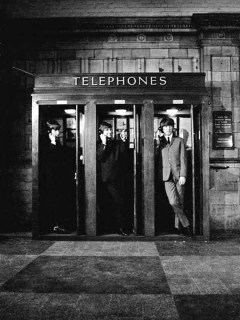
Flash forward to the rooftop, when they ended up playing just five complete songs. Do the math, and the Beatles end up on the same timeline originally proposed here.

(Turns out they already know those five songs by Jan. 7 — the just-written “Get Back,” “Don’t Let Me Down,” “I’ve Got a Feeling,” “One After 909” and “Dig a Pony.”)

A conversation between Georges Harrison and Martin about a Jackie Lomax session is held as Paul and Lindsay-Hogg’s continuing discussion on the urgency of the schedule.

As far as the director is concerned, the session’s first day  – the abbreviated gathering on Jan. 2 – was the best musical day yet. So at least to him, the entirety of the sessions so far as been a study in deterioration.

“If people aren’t interested, I lose interest,” Paul says.” We can’t blame our tours … and so on and so on.”

“The past couple of months, its been this. The [White] album was like this. The album was worse.”

“What, agony?” Lindsay-Hogg asks.

“Just the whole idea of, “Do you want to do it?’” Paul says.

“And that’s the whole joke of it. After it all came about we all phoned [Neil Aspinall] individually, saying things like, ‘Could you get them together.'” — Paul McCartney, Jan. 7, 1969

Paul relates a story of every Beatle phoning Neil Aspinall individually, with each asking the Apple Records manager and band confidant to reassemble the group.

“Instead of asking each other, we went to Neil asking what are the lads doing. You know, we should just have it out.”

It’s a damning indictment of where the band’s interpersonal communication — a reflection of their desire — stood post-White Album in late 1968, before the sessions at Twickenham would even begin.

George steps back into the conversation with a key admission and seemingly parameters for an endgame for the Beatles.

George: Like you said, ‘Well I’d like to do this, this and that. And I’d like to do this … and I’d like to do that, and I’d like to do that. And we end up doing something, again, that nobody really wants to do.

Paul: If this turns into that, it should definitely be the last for all of us. Because there just isn’t any point.

MLH: That would be sad, as an audience.

Paul: It’s stupid. But it’s even more stupid the other way. To go through it.

George: ‘Cause this time you could using for what you want to be doing: creating, instead of doldrums, which it always is.

The word struck a nerve with Lindsay-Hogg, who was keeping a diary of his recent experiences.  “‘Doldrums’ is the word I used. The doldrums have been coming like to a ship on a calm sea.”

“The Beatles have been in doldrums for at least a year,” George says.

Thus, at least to George – and no one disagrees – The Doldrums include the launch of Apple, the trip to India and the entirety of the White Album sessions, and could well stretch back into late ’67. How about Aug. 27, 1967, when Mr. Epstein died, as the genesis?

Today, Lindsay-Hogg – only seven months John’s senior — opts to step into that vacuum as manager/father figure.

“We all need you,” Lindsay-Hogg says as George cheekily accompanies him with an off-the-cuff rendition “What the World Needs Now is Love” in the background. “And it is communication. If you all can’t get it together, that’s really very sad. Maybe what we should do now is let you play a little and you all have lunch together.

“So should we leave you for a while?”

(The lengthy discussion leading up to this point, as covered in the last few posts, was distilled down to a few minutes in the 2021 Get Back docuseries in the January 7 segment).

With Lindsay-Hogg gone, the group fiddles around, seemingly ready to begin the day’s work, musically. Then George steps in and steps up for himself.

“What I was saying about the songs is … I’ve got about 20 songs from 1948, because I knew very well at the moment I’d bring them into the studio that [splat sound] there its gone. And slowly I can bring a couple out because I can get it more like how it should have been then.”

“It doesn’t matter what’s going wrong as long as the four of us notice it,” Paul says as George, now incredulous, sure thinks it does matter what is going wrong as he’s so often wronged.

“And instead of just noticing it, to turn it to put it right,” Paul finishes.

But George is done.

“We should have a divorce.”

Paul admits he’s almost done.

“Well, I said that at the last meeting. But it’s getting near it.”

A deadpan John — mostly silent in the exchange so far — injects a laugh line, asking in the context of the divorce, “Who’d have the children?”

“Dick James,” answers Paul, referring to Northern Songs’ co-owner. (The music publisher would, coincidentally, make an in-person appearance at Twickenham about 72 hours later, immediately before George left the group).

Paul gets in one final point, and directs it squarely at John. He would have liked more input beyond the well-timed zinger.

Just because it’s so silly of us at this point in our lives to crack up. It’s just so silly, because there’s no point. We’re not going to get anywhere we want to get by doing that. The only possible direction is the other way from that. But the thing is, we’re all just theoretically agreeing with it, but we’re not doing it.

You’re doing it with your thing with you and Yoko. But it’s silly to come in and [be] talking down to us, when actually your way out is not to talk — rather than talk down to us, which you’d have to do. And you wouldn’t. And remember, I think I’m talking down to you, too. … We’re sort of talking down to each other.

George wants a divorce. Paul is desperate for John to show up. Nobody wants to be there and they’re running out of time to salvage what time they’ve already spent working on their product at Twickenham.

This moment, right here on Jan. 7, would be the moment that would make the most sense for the Beatles to break up, go on hiatus, something, anything. Everyone’s tugging at the band-aid. But no one is willing to provide the last rip.

All the arguing, backbiting, rash decisions they would be so well known for in their eventual breakup wasn’t second-nature yet. So they do the only thing that really is: play music together.

“OK,” Paul continues, and picking the song most obvious to begin with. “‘I’ve Got a Feeling.’ One-two-three-four…”

And John immediately goes into “She Came in Through the Bathroom Window,” as the take quickly breaks down in laughter.

“How does it go?” John asks.

And then, astoundingly, the day’s sessions begin in full, starting with about 20 minutes (on tape) of “I’ve Got a Feeling.”

What on earth to make of all of this?

Having “compared it to a marriage a million times” (John, from 1976, as quoted in the “Anthology” book), it stands that the band’s ultimate split would be a “divorce.” George asked for it Jan. 7, 1969, and eight-plus months later John would ask for the same thing.

“I want a divorce, like my divorce from Cynthia,” John is famously quoted as saying late September 1969 in Phillip Norman’s “Shout!”  “It’s given me a great feeling of freedom.”

The Beatles were Paul’s band, by the time they were at Twickenham, after first being John’s. The Beatles weren’t George’s — as critical and brilliant he was — and thus it wasn’t his place to ask for a divorce. He could just leave — which he would a few days later — and in that way he absolutely held sway over the band’s future, engineering Billy Preston’s arrival and the shift into cozy 3 Savile Row. Conceding to George things nobody else was wed to but having him in the Beatles beat not having George in the Beatles. But there was no getting around his junior membership, in a sense.

Even in suggesting a divorce, George was immediately met with Paul basically saying, “Me too.” But since Paul wasn’t ready and John was silent on the issue, the divorce wasn’t going to happen.

It’s clear the group’s momentum and motivation as things stand on Jan. 7  is founded on nothing. It sounds as if getting anything done post-Sgt. Pepper was a miracle.  Epstein is missed, and it’s become plainly obvious. Based on their brutal descriptions of the White Album sessions, it’s amazing, in retrospect, they finished the LP, much less recorded as many songs as they did for as many months as they did.

Paul’s right — these guys are indeed “on their own at the holiday camp.” They’re four men pushing 30 who don’t know life beyond the extremes of childhood and being a Beatle.  A day earlier, in the wake of the “I’ll play if you want me to play” argument, it sounded like it was an option for the group to remain as one in name, at least. Now, even that seemed out of reach.

The Beatles reached a pivot point on Jan. 7 to commit or bust, and, against all reason based on their arguments, they chose to commit.  To what, nobody seemed to know.

28 Comments

Filed under Day by day