Tag Archives: Paul McCartney

TMBP Extra: Let it be first

Like so many of the outtakes on the “sessions” discs unearthed and unleashed on the most deluxe version of the Beatles eponymous double-album, this newest version of “Let It Be” — the oldest recording of the song — is acutely alive and profoundly captivating.

As performed on September 5, 1968 — the day after recording their iconic performance of “Hey Jude” for Frost on Sunday — here’s the world’s greatest tea-room orchestra:

Fifty years in the books, and Beatles history still has room for an edit.

In some ways, this one-minute, 18-second cosmic jam capturing the band in medias resbetween takes of “While My Guitar Gently Weeps” — is just what should be expected, even if its very existence is still something of a minor surprise. A White Album-era version of “Let It Be” felt apocryphal, despite established knowledge rooting it in fact. And so it is that the disjointed, driving performance sounds like it’s out of time — it was.

Let’s dig in on some finer points:

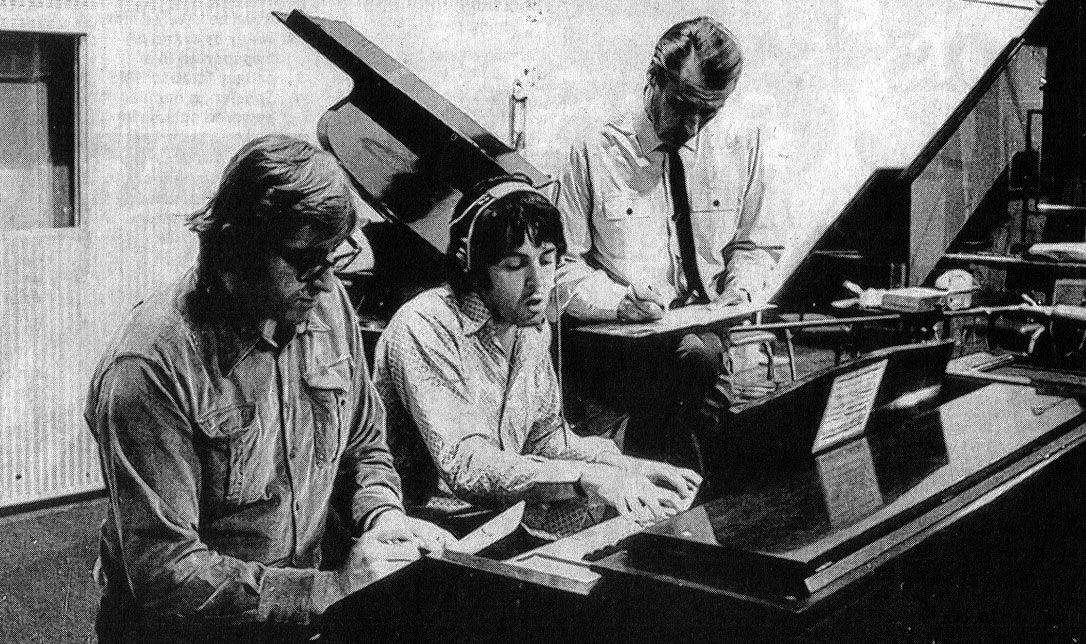
Brother Malcolm, Paul and George Martin during the White Album sessions in 1968

Brother Malcolm, Mother Mary and the lyrics of “Let It Be”
Notably, the lyrics of the song hardly advanced in the three months between September 5, 1968 and January 3, 1969, the first recorded performance of “Let It Be” at the sessions that would ultimately bear its name.

Here’s Paul grooving alone at the piano for the song’s debut on the Nagra tapes:

The lone addition, lyrically: “In my darkest hour, she is standing right in front of me.”

“She,” of course, is Mother Mary, who presumably was in the very original lyric sourced from Paul’s dream about his mother but was absent in the 1968 early attempt. That featured “Brother Malcolm,” a nod to do-it-all assistant Mal Evans. The reference to Mal was inconsistent over January 1969 but endured to the very end of the sessions. Here are the Beatles on the final day of the sessions, January 31, 1969:

It wasn’t until a few days into the sessions at Savile Row, on January 25, 1969, that most of the verses had been added. But Paul started teaching “Let It Be” to others in the band on January 8, when we hear Paul naming chords to the others to learn. That’s also when Paul disclosed that, even at this early stage, he planned to have Aretha Franklin cover the song.

Interludes
Students of the Beatles’ January 1969 sessions have heard this sort of thing several times before, someone in the group veering into an original, a cover, an improvisation between songs, during a transition during a rehearsal or purely as an aside.

Some of these drop-in songs were even the same for the White Album and Get Back/Let It Be sessions:

And just as future songs were sampled and explored during jams in 1968, they were in ‘69 too. And probably long before that as well. A few examples:

Divine intervention
This initial iteration of “Let It Be” may not have had “Mother Mary” but it did feature the hand of “God.”

The September 5 session of “While My Guitar Gently Weeps” was the one that featured Eric Clapton as the Beatles’ guest on lead guitar. That places Eric at the origin of “Let It Be,” and he can be heard adding a few guitar licks to the improvisation. (Listen to the very end and you can hear George close the track imploring his friend to don his headphones: “Cans on, Eric.”)

A full 31 years later Eric would get to play the song again, joining Paul on stage at the 1999 Rock & Roll Hall of Fame inductions. Paul was inducted for his solo career, but the show closed with, naturally, “Let It Be.”

Clapton didn’t take the solo — that’s Robbie Robertson of the Band, the group whose sound the Beatles sought to emulate during the Get Back/Let It Be sessions.

This same induction ceremony honored producer George Martin, who happened to miss the September 5, 1968, session whilst on vacation.

Times of trouble?
Even Paul called the White Album “the tension album.” John said worse in the early ’70s. Ringo literally left the band for a few weeks in the summer of ’68.  Four Beatles, each recording in a separate studio — we all know the stories.

But while history is static, perceptions are variable.

The 2018 reissue’s promotional campaign works to dispense with some of the darker sides of the session, from Giles Martin’s interviews to the numerous dismissals of dysfunction in the lovely hardbound book packaged with the deluxe edition. Indeed, there’s plenty of laughter and carefree spirit throughout the White Album outtakes. The outtake set even begins with laughter among John, Paul and Yoko, as if to hammer the point home.

The Get Back/Let It Be sessions inherit the same sour reputation, yet it would be very easy to compile 50 tracks from January 1969 filled with laughter, chatter and the indication that nothing could ever tear these guys apart. And I bet if and when we do see a formal reissue campaign of Let It Be (which I suspect will be attached to a larger Abbey Road/”Beatles in ‘69” re-release), we’ll see that very recalibration of Beatles history. More “Suzy Parker,” and not quite so many calls for a divorce.

And that’s OK. I’ve long posited that things weren’t necessarily so bad — or at least that much worse — for the Get Back/Let It Be sessions than in the period immediately before and after. Naturally, the reality lies somewhere in between. Neither the White Album nor Let It Be are outliers — that’s just how the group was post-1967.

On January 7, 1969, the day before the rest of the Beatles learned the chords to “Let It Be,” George Harrison made it clear: “Ever since Mr. Epstein passed away, it hasn’t been the same…  [the Beatles had] “been in doldrums for at least a year.” That takes the group to before their trip to India in February 1968.

Together at the beginning of that trip, the individual Beatles returned to England separately. For the final stage of their career, they produced enduring music, though they may be parted.

4 Comments

Filed under Extra

Jan. 9: Love from Paul

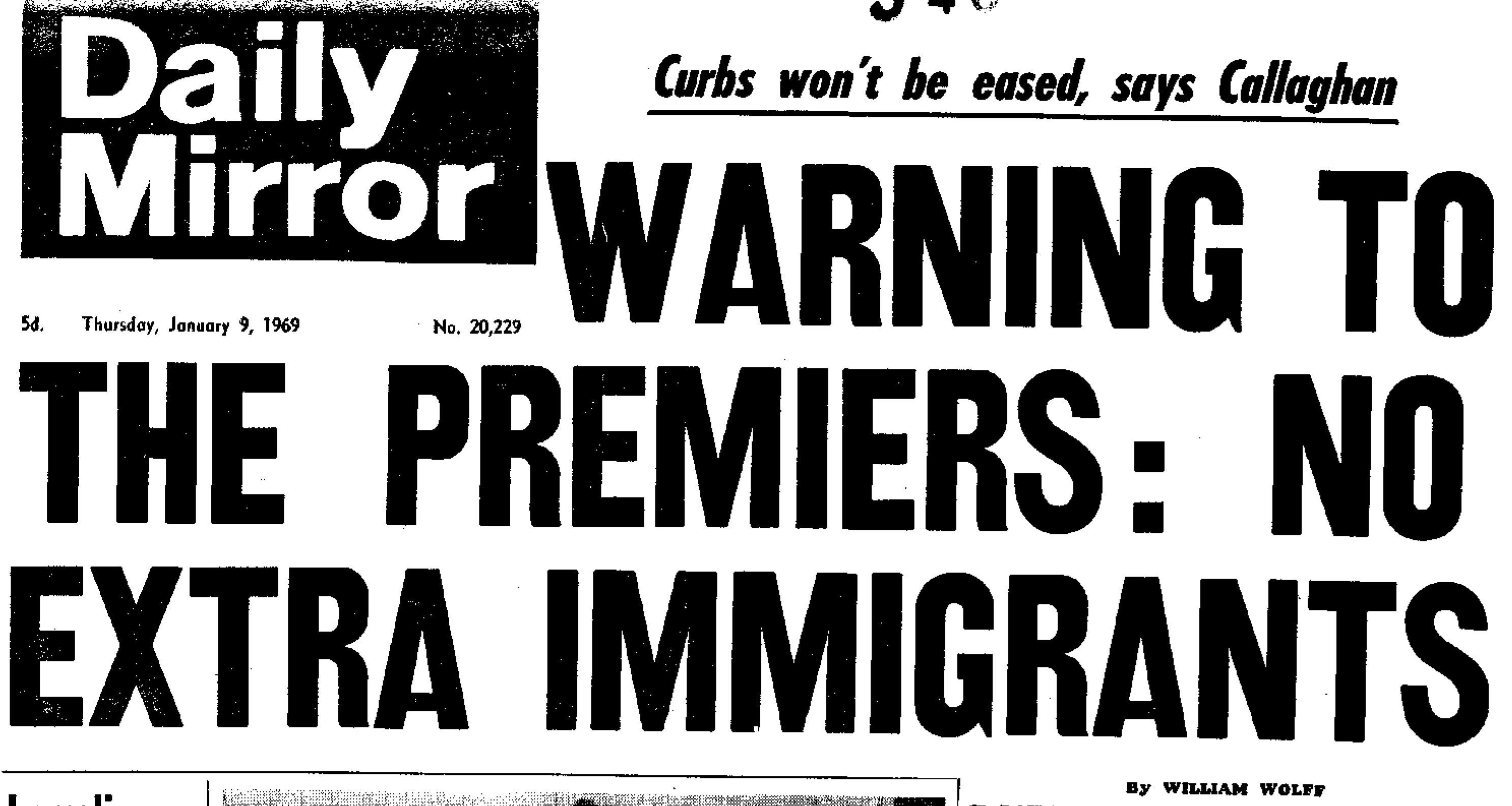
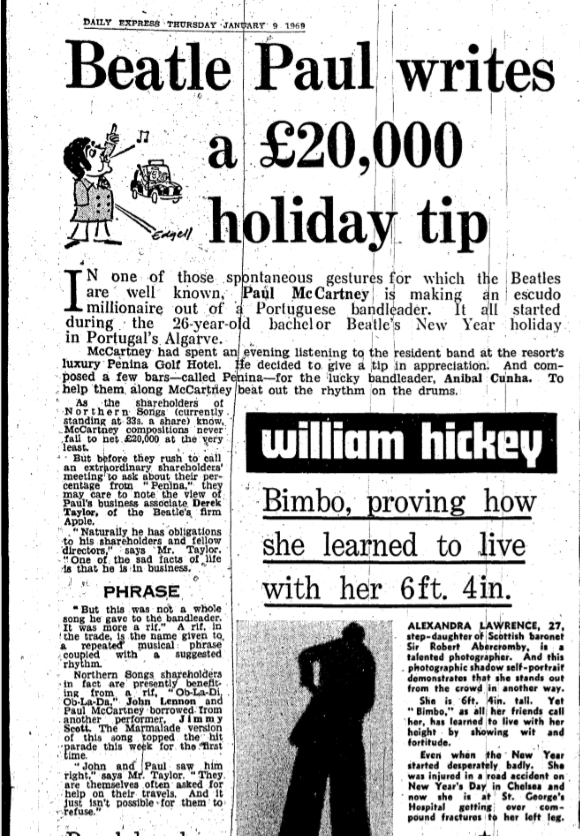
Almost fifty years have passed, and we’re still unsure of how the Beatles’ ditty “Suzy Parker” came about. But the origin story for “Penina” — discussed and introduced by Paul McCartney a few hours after the somewhat mysterious performance of “Suzy Parker” — quite literally appeared in print on the very day we’re discussing, January 9, 1969, in the Daily Express.

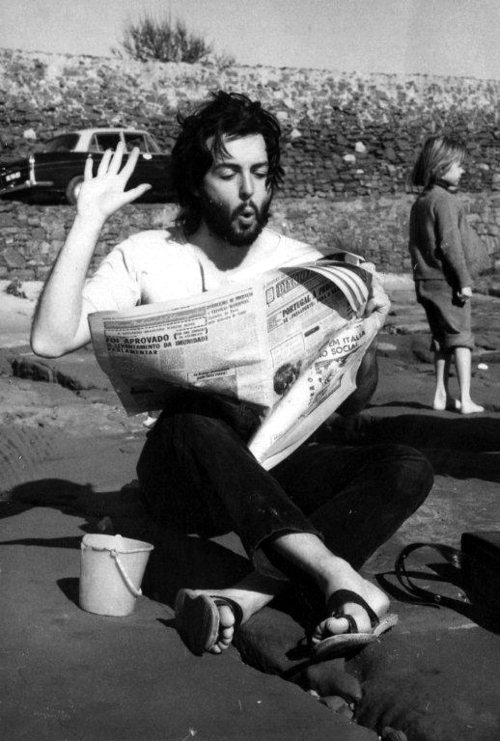
A newsworthy trip: Paul in Portugal, December 1968

“Penina” is usually lumped into the pile of Lennon/McCartney songs given away to other artists. Why, you may have seen it on the 1979 EMI compilation “The Songs Lennon And McCartney Gave Away,” alongside far more notable tracks like Peter & Gordon’s “World Without Love” and Billy J. Kramer’s “Bad to Me.” Those were No. 1 hits. “Penina” wasn’t even released in the U.K. or U.S.

So how does “Penina” fit in and how did it come that Paul is the sole author?

Paul, who vacationed in Portugal in mid-December 1968 with Linda Eastman, her daughter Heather, and Beatles biographer Hunter Davies — a trip highlighted by Paul proposing to Linda and her discovery she was pregnant with Mary —  recounted a story of showing up drunk at La Penina, a hotel resort, one night around midnight.“See the bit in the paper where it said about me giving a song to some group, in William Hickey this morning?” Paul asked the rest of the group a little bit after lunch.

As printed in that day’s Daily Express, under the headline “Beatle Paul writes a £20,000 holiday tip”:

McCartney had spent an evening listening to the resident band at the resort’s luxury Penina Golf Hotel. He decided to give a tip in appreciation. And composed a few bars — called Penina — for the lucky bandleader, Anibal Cunha. To help them along McCartney beat out the rhythm on the drums.

Paul elaborated: “And I sat in on drums, and they said, ‘Give us a song.’ So I said, OK.”

Good lord, is that all it takes? Someone get me in the same room as Paul McCartney, I have absolutely no good material.

“’I’ve been to Albufera, had a great time there,’” Paul sang before continuing to describe the scene. “It was called La Penina, the hotel. And they were all digging it and singing along, and it was good. And William Hickey [in the paper] said he’s giving away this 20,000-pound song.”

Per the paper’s report:

As the shareholders of Northern’ Songs (currently standing at 33s. a share) know, McCartney compositions never fail to net £20,000 at the very least.

Northern Songs shareholders in fact are presently benefiting from a rif, “Ob-La-Di, Ob-La-Da,” John Lennon and Paul McCartney borrowed-from another performer, Jimmy Scott. The Marmalade version of this song topped the hit parade this week for the first time.

Paul didn’t mask his disgust with the report:

“Cunts. That’s what you write something, for a riff. You don’t say ‘hello,’ and you haven’t got a riff when you say ‘hello.’ That’s the riff I got off of Jimmy Scott, those two words (“Ob-la-di, Ob-La-Da”). You’d think I’d taken his life. It’s not as though he wrote the song.”

This wasn’t the only time on these tapes Paul would show his frustration with Jimmy Scott regarding ownership of “Ob-La-Di, Ob-La-Da.” Over the years, however, Paul’s softened his view on Scott. This is from just weeks ago, during his promotional tour for Egypt Station:

Meanwhile, back in 1969, the newspaper report continued, quoting Apple press officer Derek Taylor:

“John and Paul saw him right,” says Mr. Taylor. “They, are themselves often asked for help on their travels. And it just isn’t possible for them to refuse.”

Having only heard of “Penina” from the newspaper and Paul’s own recollection, the rest of the group finally had their chance to hear — and participate — in what would be the lone known Beatles performance of the song.” Paul has a vague memory of the lyrics, and the rest of the group clearly has no idea how the song goes (this is in deep contrast to “Suzy Parker,” by the way, lending more support to the argument that song wasn’t a pure improvisation). Here’s how they sounded:

It’s not quite “Eleanor Rigby” — it’s hardly “Wild Honey Pie” (or “Fuh You” for that matter, to evoke Egypt Station again). But it’s a Paul McCartney original and from the same moment in time he was writing songs like “Let It Be” and “The Long and Winding Road” so it deserves to be at least more than a footnote.

Been to Albufeira, I had a few drinks there
And now I’m on my way home
I really don’t care
La Penina, La Penina, La Penina hotel
Well it’s been a long road …

OK, maybe that could be a footnote. (Albufeira, by the way, was where Paul wrote the lyrics to “Yesterday” in 1965. How’s that for a footnote?)

When the song was finally released a few months later — by Anibal Cunha’s band, Jotta Herre — the sleeve proudly trumpeted the Beatle’s songwriting credit. And it’s a lone McCartney credit, not Lennon/McCartney. The eventual lyrics have just three verses, with the final one ending with a first-person reference. It’s a languid offering, plaintive at best sporting simplistic lyrics that recap the evening sung over a bland melody.

(Chorus)
Penina, Penina, Penina one night

I’ve been to Albufiera
And I had a good time there
And then I came to Penina
And found good friends

Drinking liquid, making music
Love has come to my heart
Beat the drums take me home
Helping friends free my soul

Time has come, time has gone
Time to bet for keeping friends
Take my arm girl, lets go home
Thank you all, love from Paul

In challenging the report that it was a £20,000 song, Paul was clearly giving the song little merit in January 1969. After all, it was just a riff!

In short time, however, Paul was interested in taking a little bit of ownership in “Penina,” starting soon thereafter with his blessing the band to use his name as a promotional tool.

In an interview with a Portuguese magazine published in July 1969 and beautifully titled “Jotta Herre — the godchildren of Paul McCartney,” Cunha disclosed further communication with the bearded Beatle.

Translated, roughly, from Portuguese to English via Google Translate:

I have only one thing to regret, and we must involve the name of Paul McCartney and the friendship he gave us. But, in truth, he also forced us to do so. And in a letter he sent us he tells us categorically. “Use my name without hesitation, let it be used for your publication.” And, finally, the commercial entities linked to the release of the album knew this and took advantage of the idea. Well Paul’s name has a made market and it is assumed that it will be commercially valid.

The song was not really that commercially valid, to use that term. Neither the original version nor a subsequent cover that year by two-time Portuguese Eurovision contestant Carlos Mendes — whose cut appeared on the aforementioned EMI compilation — appears to have made much of a dent in sales, despite the McCartney name behind the song. Perhaps it was the quality of the song that played a role.

A quarter century later, in a 1994 interview in his Club Sandwich fan club magazine, Paul sounded like there was more to the story than perhaps there was:

I went to Portugal on holiday and returned to the hotel one night slightly the worse for a few drinks. There was a band playing and I ended up on the drums. The hotel was called Penina, I made up a song with that name, someone made enquiries about it and I gave it to them. And, no, I shouldn’t think I’d ever record it myself!

The Summer 1995 issue of the same magazine likewise listed “Penina” among the songs Paul gave away, chronologically listed between bona-fide hits “Goodbye” (Mary Hopkin) and “Come and Get It” (Badfinger), showing a breathtaking contrast of song quality with his Portuguese throwaway.

To this day, Paul still hasn’t recorded “Penina,” but the song lives on. Mendes re-recorded it for his latest LP, which came out in April 2018.

And while “Suzy Parker” lives on only through bootlegs and YouTube clips, having become the actual footnote in Beatles lore, you can see the 71-year-old Mendes perform “Penina” live in concert in Portugal this December, nearly 50 years to the day Paul wrote the song a few hours away at the Penina Hotel and Golf Resort.

7 Comments

Filed under Day by day

Jan. 9: Jokes in between

Let’s run through the ones we know and then learn the [new] one.

This is our format.

Paul McCartney was right. There was a format. At least there was a framework developing as the Beatles rehearsed in their second week at Twickenham.

As covered in the last post, George Harrison would have to wait a few hours for attention to return to his new “For You Blue.” Instead, with the full band ready to go nearly 90 minutes into the January 9, 1969, Nagra tapes, the Beatles tackled “Two of Us” for the fifth time in six days, initiating a sequence in which the group returned to some of the finished, core songs they’d have for their live show. Why, it was their format!

This stretch also clearly exposed the side of the Beatles that everyone (else) usually cites when describing the Get Back sessions. While I’m quick to argue January 1969 at Twickenham was not of itself the downfall of the band as it was filled with harmonious, joyous and highly fruitful moments to match the uglier, fractious component of the sessions, these guys could get pretty petulant and didn’t hide it with the tapes rolling.

A quick, carefree one-off into the song the day before, this day’s “Two of Us” rehearsal stretched about a half-hour, and quite unlike the Rocky and the Rubbers’ version, Paul insisted on serious refinement.

As loose as their run-through was early on the 8th was exactly how tense things emerged on the 9th, with consistent, stuttered efforts to get through a full song.

From the top, the group can’t find the proper pacing of “Two of Us,” with Paul pushing the others to pick it up. “Keep them all quiet, keep your instruments down so we can sort of hear what’s going on.”

They had another go at the song, and “it’s still pathetic,” in Paul’s words. He suggested the issues went beyond just the song’s speed.

As Paul nitpicked what arrangement the song needed entering the bridge, John argued, “We never got into this [part] yet,” defending himself and the others as Paul criticized the group for not knowing what’s in his head.

A fiery example of the strain came during a “Two of Us” take in which Paul barked at John, who wasn’t in perfect rehearsal position, to “get on the mic.”  John, certainly responding to the tone more than the instruction itself snapped back.

“You don’t have to bitch about it, we’ll never get through it.”

The band immediately went into another take, and you can hear John loud and clear — but he came in early. You can hear Paul’s displeasure when he comes in himself at the right time. Still, they championed on.

(This sequence was in the Let It Be film, and led immediately to the “I’ll play, you know, whatever you want me to play” sequence from three days earlier.

A dark moment, for sure, but as usual for these guys, they were able to compartmentalize and still harmonize figuratively and literally. Picking apart “Two of Us” to improve the various “bits” and now focusing on the middle eight, Paul started thinking out loud.

“The two things I think of are both corny, but something better are oohs  … or [a staccato “dit-dit-dit”]”

Never mind that the “oohs” are actually “aahs” when Paul, John and George instantly launch into a demonstration of the vocals, which are proposed to appear supporting the “you and I have memories” lead. This is the Beatles magic, immediate and spontaneous and completely normal, even when it comes a few minutes after one member complains about the other one’s bitchiness. The subsequent stab at the staccato vocalization came off a bit sloppier but still likable.

Concerned the backup line would sound “too thin,” George proposed, “Maybe we get a few Raelettes,” marking yet another time the group evoked Ray Charles’ backup singers. “Get three girls” with some phasing on the mics.

John’s cheeky reply was to bring in three boys instead, and George named the Dallas Boys, Britian’s first boy band (by ’69 they were into their 30s).

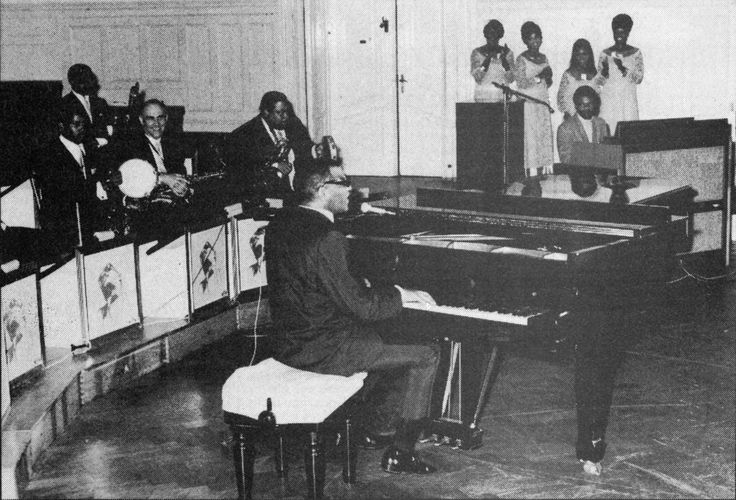
While they never landed the Raelettes, the Beatles would soon enlist the man seated before them, Billy Preston. (Photo from late 1968).

Ultimately, Paul asked the others to “just think of something, then” for the middle eight, and off they went into another take, this one featuring the lovely “aahs.”  The song may not have dramatically improved, but the mood had over the last 25 or so minutes on the tapes.

But Paul still had something to complain about, turning his attention to a frequent (and legitimate) punching bag for the band, the equipment setup at Twickenham. If we think the tapes sound diluted, just imagine how substandard the quality must have been for the musicians on the sound stage. With the proposed show nearing — and despite some pretty ambitious ideas, uh, floated less than 24 hours earlier — improved sound needed to be addressed along with other facets of a finalized live performance.

“Just so that we can all hear, so it sounds really great here,” Paul said. “So that our voices are just as loud as they need to be. ‘Cause then we’ll be able to hear what’s wrong.”

What’s more …

“Everything we’re going to actually do like that, we could get into now. Just where the amps are going to be, and where we stand. It is a bit silly to be rehearsing sitting, facing this way, when we’re actually to be playing standing, facing that way.”

And here’s where we return to a disagreement among the principals, but with a far different result than earlier.

John: I thought we’d get into that when we do a few more.

George: We still have dance steps to learn.

Paul: And the jokes in between.

The esprit de corps resumed as the group advanced to a singular take of “Don’t Let Me Down.” There was no nibbling, no exhausting search for a missing “bit,” and even when there was a screw-up on the lyric, they powered on and completed the song in a tidy 3:10.

Far less concise, and clocking in at nearly 25 minutes of torturous micromanagement, was a brutal run of “I’ve Got a Feeling.” After a perfectly adequate (for this point in the sessions) initial run-through, Paul immediately identified just one specific spot for improvement — the same part of the song that had bedeviled the group on multiple occasions, and the same point that the struggled with in several songs —  “The only bit is the break. Still not sort of dramatic enough.”

This tense sequence was up there among the least listenable parts of the entire month’s worth of tapes. Paul offered several variants on how he wants the guitar part to sound, right after his line, “All that I’ve been looking for is somebody who looks like you!”

Issues:

  • “All the notes are clipped.”
  • “There shouldn’t be any recognizable jumps.”
  • “The notes shouldn’t ring on.”
  • “At the moment, it’s like a riff.”

Solutions:

  • “[The notes should be] just like falling, falling.”
  • “Try to sort of sing it.”
  • “It’s got to be like pain.”
  • “Certainly do anything like it’s crying.”

It’s got to be like pain. What an instruction!

Paul desperately and relentlessly attempted to communicate how he wanted the part to sound — gesticulating, vocalizing, playing it on the bass — but George simply couldn’t or wouldn’t accurately nail the brief solo.

In another editing trick that showed up in the Let it Be film, it was nailed. That’s because the film shows the January 8 “Rocky and the Rubbers” take of the song (where Paul shouts a celebratory “good morning!” after the part is played), and spliced it on both ends of a brief portion of this sequence from January 9.

Ultimately, the part was hit satisfactorily enough for the Paul to continue the group through their core set. The mood rose again for another jubilant effort of “One After 909,” although we don’t get a complete grasp of the rehearsal due to the tape cutting in and out. We can pretty safely assume, though, that like “Don’t Let Me Down,” the band tore through a single take.

As John moved over to the piano, the Beatles practiced their stage patter, in hilariously fake sincere voices.

Paul: “Certainly, it’s a great occasion for us.”

John: “First chance we’ve had to play for you dummies for a long time.”

The playful attitude continued as Paul dabbled in a bit of “Norwegian Wood” on bass, soon to be joined briefly by Ringo on drums and George on guitar and vocals before they immediately launched into, as George called it, “the one about the window.”

It was a straightforward, strong take of “She Came In Through the Bathroom Window,” although we don’t hear the whole thing on the tapes.  Far less straightforward, but wholly enjoyable was a string of takes broken up by tape cuts, including one with John taking the lead vocal with a heavy Cockney accent.

By this point, the mood was entirely loose. The song was given a slow ballad treatment, featuring a lyric referencing the famed celebrity female impersonator Danny La Rue.  Paul completed one take by answering the phone: “Hello, this is Tuesday speaking. Is that Paul? I’d like to have a word with you.”

Now, five minutes past 1 p.m., the group broke for lunch. Paul offered a brief impression of Elvis — who someone mentioned turned 34 the day earlier.

Only a few hours into a temperamental roller-coaster of a day, John replied to the rest of the 20-somethings in the group, “We all seem to be catching up to him.”

11 Comments

Filed under Day by day

Jan. 9: Road work

He launched the January 9 Get Back sessions with “Another Day,” an ode to the working woman. Paul McCartney followed it by making the most of his own makeshift satellite office in Twickenham.

Paul’s morning piano sessions weren’t simply exhibitions, nor was it just for conditioning as he alluded to director Michael Lindsay-Hogg at the outset of the day’s Beatles business. The Get Back sessions’ most prolific writer, Paul treated the recording studio as a design studio, too, frequently shaping his songs and writing his lyrics while on the clock. This day offered a terrifically vivid window into that process.

After “Another Day,” a revisiting of “The Palace of the King of Birds” and a quick spin of “Let It Be,” Paul dug into “The Long and Winding Road” for a third consecutive day. The first verse is locked in and would be unchanged through its eventual release. “The second verse, leave a space, for the same thing,” Paul sang as filler. As he continued, Paul play-tested the rhyme of “the many times I’ve cried” and “the many ways I’ve tried” — tested to ultimate success, obviously.

Less successful was Paul’s plan to work in the word “pleasure” into the lyric.

I’ve had lots of pleasure, but said better. …
I’ve had many pleasure. …
I’ve had much pleasure. …
I’ve had lots of pleasure from the many ways I’ve tried.

After less than four minutes on “The Long and Winding Road,” Paul moved on. “There’s no more to that yet,” he dictated to Mal Evans, the do-it-all roadie (the group no longer touring, his roads were now long and winding ones). “But if you leave it around, I’ll still know where I’m going to fill in.”

Following a momentary return to “Mother Mary,” i.e. “Let It Be,” Paul unwrapped another new number, this one a song that would eventually find a home at Abbey Road’s terminus.

Paul didn’t know it at the time, but “Her Majesty” was complete. His presentation of music and lyrics was the same as would appear as Abbey Road’s coda, although here Paul would scat a second verse that would never be written. This version’s introduction, especially, evoked the current, bouncy state of “Maxwell’s Silver Hammer,” and would be the lone instance “Her Majesty” could be heard on piano. Paul played the song one more time these sessions, weeks later, on guitar.

“Paul continued his trip across what would become Abbey Road. Evoking Frank Sinatra’s 1956 LP that reinvented pop standards in a more contemporary style, Paul pointed out to laughter that “Golden Slumbers” — unveiled two days earlier — “should be ready for a Songs for Swinging Singles album.”

Paul offered a gentle delivery of “Golden Slumbers,” and pointed out the direction he’d like to take the song. “It really should be like a fairy tale. ‘Once upon a time, there lived a king. Sleep pretty darling, do not cry.’”

Leading into the next line, Paul introduces the original melody that he intended to change: “The bit you might remember: And I will sing a lullaby.”

Paul repeated his experiment merging “Golden Slumbers” and “Carry That Weight.” And as he did three days earlier, likewise in Ringo Starr’s presence, Paul signaled his intention to expand the song beyond its single line we all know. Paul doesn’t have the verses yet, but he knows what he wants them to say.

“Like a story,” he said. “A bit like ‘Act Naturally,’ where the tagline keeps coming up.”

In referencing one of Ringo’s showcase songs, it’s another piece of evidence pointing to the reason Paul opted to give the drummer a prominent voice on “Carry That Weight,” thinking of him for this song months before it was recorded for Abbey Road.

At this point, Paul wanted “Carry That Weight” to evolve into a comedy song featuring verses describing “just the sort of normal kind of troubles that everyone has” before leading into the “carry that weight” chorus. “There might be a verse about, like, ‘I got in trouble with the wife, I got drunk, something, something, something, something. … Woke up the next morning with a weight upon my head, and I found out it was my head. … Boy! You’re gonna carry that weight …’

“It could be one of those things, you know, in those songs where you’ve got everything, and everything is so great. And this morning, one of my eggs broke, (giggling). Just something trivial. The right shoe’s a bit tight. … ‘Boy, you’re gonna to carry that weight!’” Ringo sang along with every chorus.

Paul indeed delivered a wait, and we can close the circle on our story of “Carry that Weight.” The Nagra tapes don’t capture the song again. If he ever pursued the novelty song idea, there’s no record of it. By the time we get to the song’s actual recording for Abbey Road in July, it was exactly as the song was to this point: simply the line: “Boy, you’re gonna carry that weight, carry that weight a long time!”

Still at the piano, and unaccompanied by any other Beatles, Paul took a detour off (the future) Abbey Road and returned to the long and winding one for the second time in less than 15 minutes on the tapes. And again, Paul was very clinical, deliberate and open with his songwriting.

“I was thinking of having a weather obstacle,” he said before taking a stab at a new verse: “The storm clouds and the rain/The clouds disappear.”

The song’s imagery evoked a famed film thoroughfare.

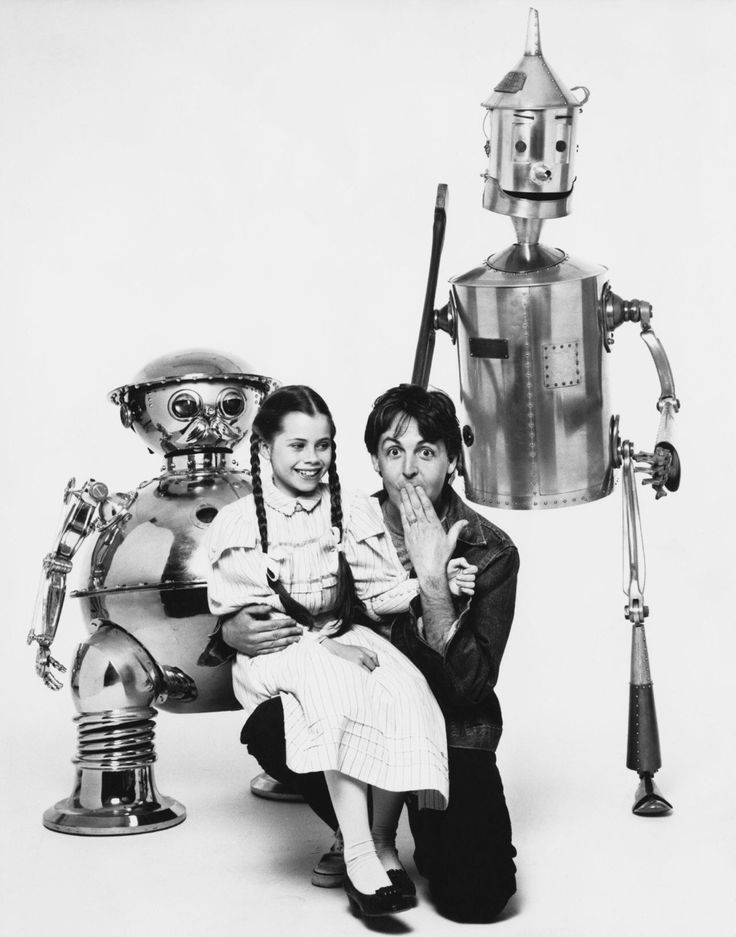
There’s a Beatles-related photo for everything! Here’s Paul with the cast of Return to Oz, for some reason, in 1985.

“It’s sort of like the Wizard of Oz,” Mal said. “Did you ever see the Wizard of Oz?”

“Yeah,” Paul quickly answered, clearly not paying attention at first, before continuing,“No, no, no, I didn’t.”

“The yellow brick road,” Mal said before Michael broke in, “A heartbreaker. Yeah, it’s great.”

Paul returned to the road he was constructing, singing a placeholder verse.

“The thing that’s up ahead/at the end of the road.”

For a lyric, Mal suggested recounting the obstacles on the road, but Paul dismissed that idea, reflecting the pervasive and prevailing uncertainty surrounding the live show. “We have enough obstacles without putting them in the song.”

Much like George asked Paul a week earlier, regarding Maxwell’s, Michael questioned the song’s endgame: “Is it going to end happily or not sure yet?”

Interestingly Paul didn’t address the emotion behind the song’s ending, just that he had an ending. And it was very close to the one that would appear on the record more than a year later:

“And still they lead me back to the long an winding road
You left me waiting here a long, long time ago
Don’t leave me standing here, lead me to your door”

4 Comments

Filed under Day by day

Jan. 9: Just another day

It had been a week.

Linda & Paul, 1969

With the benefit of nearly a half century of hindsight and purely from the vantage point of surviving audio tapes, it was an absolutely remarkable one for the Beatles, starting January 2 and entering the sessions on January 9. Amid sniping that peaked with a threatened walkout in unpleasant, wholly uninspiring surroundings, the Beatles put together — between mostly recently written shells and completely new originals — a compact set of fresh songs they could reasonably stage for a TV show. Just the night before, after days of deliberation, it sounded like they had come to consensus on what and where the show would be.

January 9 began, as many of the days at Twickenham Film Studios had, with Paul McCartney the first Beatle in the room. Today, he took a guest with him to the office.

“Do you know Michael Lindsay-Hogg?” Paul asked his bride-to-be, Linda Eastman.

From the conversation, it’s clear that Paul didn’t take his work home with him. She knew very little about the group’s plans regarding the live show.

Linda: So if you do it, it would be in here?

Paul: Dunno. There’s many a story …

MLH: If we do it here, we’ll do it in here.

Paul: But if we don’t, it’s on a boat to Tripoli.

Linda, like George Harrison the day before, instantly questioned the practicality of a boat trip. “What do you do with the equipment?”

Well, that’s Apple’s problem, Michael and Paul agreed.

The conversation abruptly shifted to a book Michael was reading — the title is never mentioned, but he clearly described My Father and Myself by J. R. Ackerley — before an evidently disinterested Paul bailed out minutes later: “I better go and put in some piano practice.”

Paul’s demonstration piece was an unfinished original, perhaps inspired by Linda’s time as a receptionist in New York before they met and after her first marriage. Or it may have just been another McCartney original observing life through a woman’s eyes, one Wings drummer Denny Seiwell would later call “Eleanor Rigby in New York.”

In two years’ time, “Another Day” was Paul McCartney’s first single as a solo artist (the 1970 McCartney LP yielded no singles), reaching No. 2 in the U.K. and No. 5 in the U.S. It also received a Linda McCartney co-writing credit, a fact that eventually spawned yet another Beatles-related lawsuit.

The song was name-checked that same 1971 in John Lennon’s furiously anti-Paul diatribe “How Do You Sleep”: “The only thing you done was yesterday / And since you’re gone you’re just another day.” The “Another Day” reference was actually written by Allen Klein, not Lennon.

But on January 9, 1969, Klein was a few weeks away from smashing into the Beatles orbit, and John was Paul’s partner, still a few moments from joining the day’s sessions. “Another Day,” however, was recognizable in this early state, the song’s first two verses largely identical to what Paul would record in New York in October 1970.

The sleeve of the Portuguese release of the “Another Day” single featuring Twickenham Paul.

Paul sang delicately and tentatively on the tapes, in contrast to his bolder performance on piano in his practice session. He’s searching, unsuccessfully, for a bridge to the song, and there’s no chorus. After about three minutes and two-plus repetitions of the two verses, Paul simply moved on to improvisations and several other previously debuted numbers (to be explored in subsequent posts).

The song could be heard just once more on the Nagra tapes, for less than a minute, in a fleeting rendition by Paul on acoustic guitar during an equipment change on January 25. “Another Day” was never a serious consideration for a Beatles record.

The next several songs Paul would play were.

9 Comments

Filed under Day by day