With the benefit of nearly a half century of hindsight and purely from the vantage point of surviving audio tapes, it was an absolutely remarkable one for the Beatles, starting January 2 and entering the sessions on January 9. Amid sniping that peaked with a threatened walkout in unpleasant, wholly uninspiring surroundings, the Beatles put together — between mostly recently written shells and completelyneworiginals — a compact set of fresh songs they could reasonably stage for a TV show. Just the night before, after days of deliberation, it sounded like they had come to consensus on what and where the show would be.
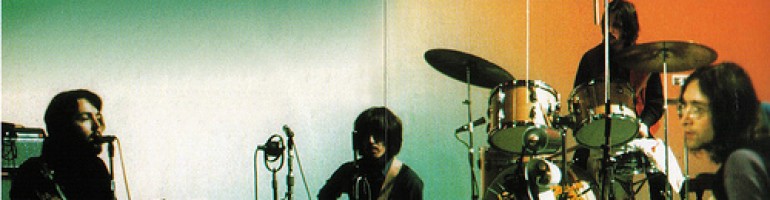
January 9 began, as many of the days at Twickenham Film Studios had, with Paul McCartney the first Beatle in the room. Today, he took a guest with him to the office.
“Do you know Michael Lindsay-Hogg?” Paul asked his bride-to-be, Linda Eastman.
From the conversation, it’s clear that Paul didn’t take his work home with him. She knew very little about the group’s plans regarding the live show.
Linda: So if you do it, it would be in here?
Paul: Dunno. There’s many a story …
MLH: If we do it here, we’ll do it in here.
Paul: But if we don’t, it’s on a boat to Tripoli.
Linda, like George Harrison the day before, instantly questioned the practicality of a boat trip. “What do you do with the equipment?”
Well, that’s Apple’s problem, Michael and Paul agreed.
The conversation abruptly shifted to a book Michael was reading — the title is never mentioned, but he clearly described My Father and Myself by J. R. Ackerley — before an evidently disinterested Paul bailed out minutes later: “I better go and put in some piano practice.”
Paul’s demonstration piece was an unfinished original, perhaps inspired by Linda’s time as a receptionist in New York before they met and after her first marriage. Or it may have just been another McCartney original observing life through a woman’s eyes, one Wings drummer Denny Seiwell would later call “Eleanor Rigby in New York.”
In two years’ time, “Another Day” was Paul McCartney’s first single as a solo artist (the 1970 McCartney LP yielded no singles), reaching No. 2 in the U.K. and No. 5 in the U.S. It also received a Linda McCartney co-writing credit, a fact that eventually spawned yet another Beatles-related lawsuit.
The song was name-checked that same 1971 in John Lennon’s furiously anti-Paul diatribe “How Do You Sleep”: “The only thing you done was yesterday / And since you’re gone you’re just another day.” The “Another Day” reference was actually written by Allen Klein, not Lennon.
But on January 9, 1969, Klein was a few weeks away from smashing into the Beatles orbit, and John was Paul’s partner, still a few moments from joining the day’s sessions. “Another Day,” however, was recognizable in this early state, the song’s first two verses largely identical to what Paul would record in New York in October 1970.
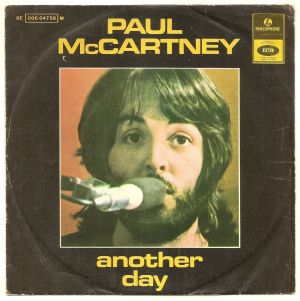
The sleeve of the Portuguese release of the “Another Day” single featuring Twickenham Paul.
Paul sang delicately and tentatively on the tapes, in contrast to his bolder performance on piano in his practice session. He’s searching, unsuccessfully, for a bridge to the song, and there’s no chorus. After about three minutes and two-plus repetitions of the two verses, Paul simply moved on to improvisations and several other previously debuted numbers (to be explored in subsequent posts).
The song could be heard just once more on the Nagra tapes, for less than a minute, in a fleeting rendition by Paul on acoustic guitar during an equipment change on January 25. “Another Day” was never a serious consideration for a Beatles record.
The TV show’s title and tagline could have written itself:
“The Beatles are … ADRIFT.”
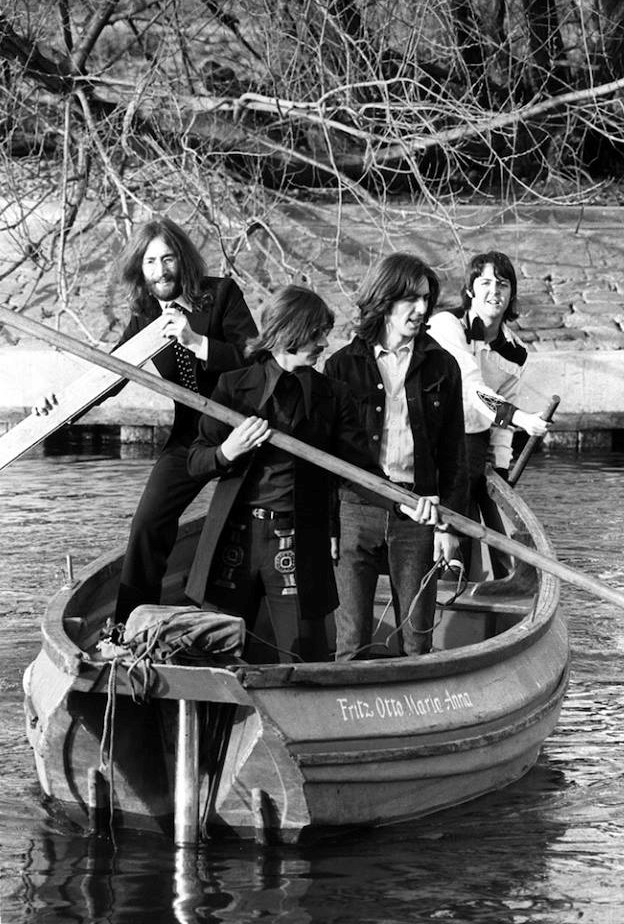
Picture yourself in a boat: The Beatles aboard the Fritz Otto Maria Anna, in the River Thames, on April 9, 1969.
It’s a simplistically obvious metaphor, and a literal description of what the group was seriously considering in the waning moments of their January, 8, 1969, session at Twickenham. If the TV show in production was to be episodic, this sequence would have provided a true cliffhanger.
Ringo Starr, codename “Russia,” wasn’t unwilling to drop his automatic veto, and it was John Lennon spearheading the effort withing the group, resurfacing as the group’s leader after so many years, who worked the sell on the drummer, along with Paul McCartney.
“Just give me one reason to stay here,” John asked.
“For the people,” Ringo answered with complete sincerity.
“All right, we’ll take ‘em with us,” John replied.
Paul McCartney clarified the pitch for a Winter 1969 rock cruise.
Look, we were going to give tickets away at this door here and say the first thousand people who come from Britian — British, white people (said to laughter as Paul was clearly joking; don’t write his reps). No, it’s going to be the first thousand that got here. We give them out, those tickets, but they include a boat ride, as well.
“We take them with us, and that’s the show,” Michael Lindsay-Hogg said.
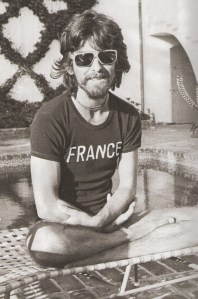
France — aka George Harrison — took a more skeptical view of the potential naval movements than Russia and voiced several specific concerns with the plan:
Traveling with fans: “We’re stuck with a bloody big boatload of people for two weeks. At least you can go home from here, you can get away from it all. … It’d have be a bloody big boat, it’ll have to be bigger than the Royal Iris.”
Technical logistics: ” It’s just impracticable to lug all those people there and get all that equipment. … Of course it’s our problem.”
Cost: “I think the idea of a boat is completely insane. It’s very expensive and insane.”
While at apparent odds, all the Beatles were deeply engaged in the discussion, and Michael took a straw poll for this proposal. “If we can get the audience and the boat, who votes to go?”
One hand — undoubtedly John’s — shot up immediately. George, despite his vocal objections, would still grudgingly go along with a trip if everyone else was joining. “I just want to get it over with, you know?”
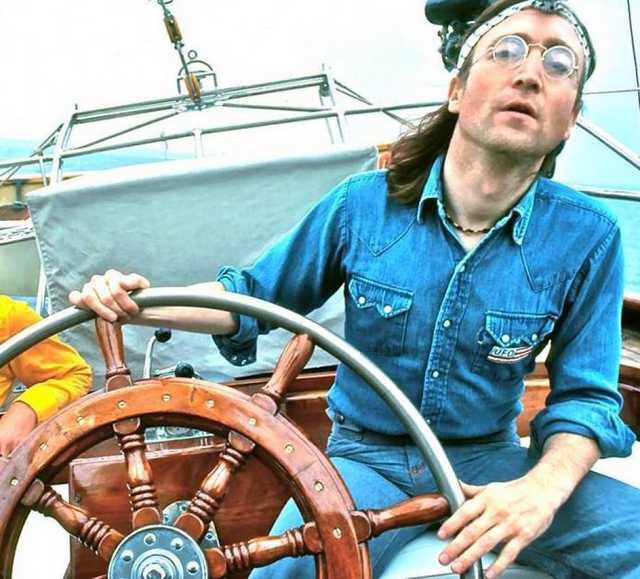
John piloting the ship (in 1975)
It was all coming together for Michael. The boat trip compromise to include a British audience was a bonus for him, an easy way to compile captivating footage for his documentary, another unusual setting — the Beatles not just mingling with fans, but doing it as they sail along the coasts of Western Europe and Northern Africa. It all would culminate with his deep wish to bring the group to the Sabratha amphitheater: the world’s greatest band making its stage comeback at a spectacular, unique venue.
“See, it’s like having the most fantastic set on earth, but we haven’t made a set, you know? It’s still simplicity itself,” John said.
Ringo still wasn’t sure.
Ringo: But how many’s going to be looking at the set besides us and [Michael]? … [Viewers] want to see what’s on, not what’s around.
John: We’re bound to get something from it.
Ringo: A nice time, get a bit of sun.
Michael: After you’ve had your nine or ten closeups each, we’ve got to have something else to shoot about.
John: It’ll be like being on the roof in India, only we’ll be fully equipped.
The roofs in India were where, not coincidentally, John was at his most prolific in this latter phase of Beatles history.
Even though, as Michael said, “the vibes are very good at the moment,” there was enough obvious dissent in the room to lead John to say that the group will mull it over that night. “We all could say yes now, and somebody could decide no tomorrow.”
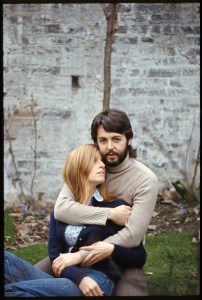
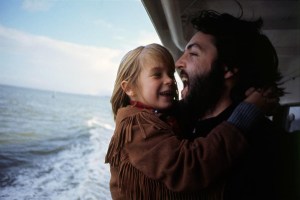
Paul and Heather at sea, 1969. (Photo by Linda McCartney)
As they wrapped up, a final, spirited discussion — as animated as the room has been with no fewer than six people all talking at once (the four Beatles, plus Michael and Apple Films head Denis O’Dell) — emerged over the cost of the boat trip, Ringo and George most concerned.
“We should be able to get the boat for nothing,” John said. “We should be able to get the boat for the publicity they get from it.” Denis replied to Ringo’s skepticism that he could get a ship “in three hours on the phone.”
John confirmed Denis’ skills, relaying how the producer was able to secure a vessel for How I Won the War. “It was the American Navy making an antiwar film.”
Really, it was all falling into place.
January 8, 1969, was the band’s sixth day back to work at Twickenham, and while most of theirnewsongs were still a work-in-progress, the was actual progress. One day earlier, George was on the brink of leaving the group. Now, while he was bothered to do so, he was still seemingly willing to get on a boat with the group — and 1,000 fans he wanted little to do with — to go to Africa for a concert he didn’t really want to play. Ringo was dead-set against going, and now he was willing to bend. Paul was always ready “for an adventure” and as the group’s de facto musical director, he was shaping the material to have ready for the production. As for John, he wasn’t just finally involved — during the final conversation, you heard him speak on the tapes, not Yoko Ono — but he was the group’s leader again.
Days of discussion of where and how to stage the concert had been a distraction from the music-making process, which needed to continue. They were almost ready for a decision.
“Sleep on it then,” said Paul. “I am.”
One question remained as the working day ended: Would the great democracy that was the Beatles agree to this plan for a live show and have a goal they could rehearse toward, or would January 9, 1969, be just another day?
In a time of global crisis — isn’t it always, though? — it was the world’s greatest legislative body. OK, maybe the Beatles were the world’s greatest band that also tried to behave like a legislative body, and late in the day on January 8, 1969, it was nearing time for a decisive vote on a lingering issue: Where would the Beatles play their next — and presumably last — concert?
You know his name (look up the nation)
From the band’s outset to its imminent end, the Beatles prided themselves on what they called democracy, but it was really complete consensus. “We had a democratic thing going between us, particularly by 1962,” George Harrison told the high court in 1997 amid a lawsuit to stop the release of a Beatles recording from one of their residencies in Hamburg. “Everybody in the band had to agree with everything that was done.”
Unanimity isn’t necessary to the democratic model, but this model United Nations was extraordinary by nature of its four voting members: John Lennon, Paul McCartney, George Harrison and Ringo Starr. The two serious veto threats earned code names from director Michael Lindsay-Hogg — Russia (Ringo) and France (George, so named “because he smoked some garlic once,” per Paul).
Continuing his earlier conversation with Ringo, and desperate to sell a show overseas, Michael laid out the situation as he saw it in hopes of chipping through the Iron Curtain.
The way it stacks up is, John is happy to go. … Paul is, I gather, in the middle, tending toward either side … and George is swinging more your way. So there’s quite a tough battle. The problem was we couldn’t talk about it because of Russia. And it’s the four powers. And if Russia says no, then the conversation is obviously in the bag and we can’t do anything with it. And I think if we now can talk about it, we may still discard it … or we may come up with something better.
In retrospect, the drama of the group’s incapability of finding agreement on a concert location, despite the suggestion of several intriguing venues, would have made for a captivating documentary for Michael. It would have given a narrative the Let It Be film lacked. But after less than a week of sessions, the director saw things differently.
“My documentary is running out of gas,” Michael admitted to John. “If we were to vote tomorrow, it’s not running out of gas.”
Fine-tuning the group’s intentions would do more than make for better television. “It might make it better again, whatever the wound is,” Michael told John moments earlier.
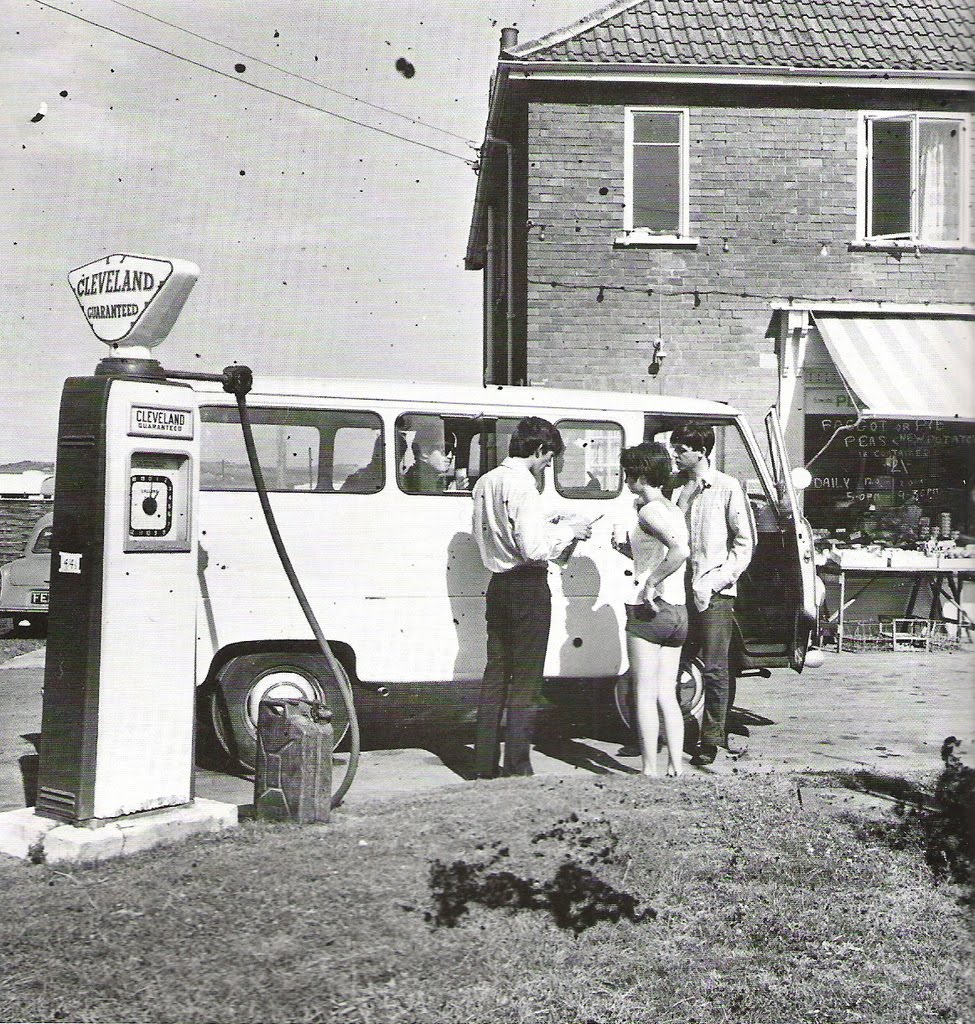
What octane do documentaries use? (Photo of the Beatles at Weston-super-Mare by Dezo Hoffman, 1963)
“Yeah, that’s what I was thinking,” John replied.
And here you thought John didn’t care about the band anymore. The Beatles were a wounded group before the Get Back sessions started, and salt would soon be added when George quit in two days’ time. But the Beatles were still worth saving in January 1969, even if John himself would call it quits well before the calendar year was out.
The day’s musical session was complete, Paul having walked the group through “The Long and Winding Road” and “Let It Be.” For these final 15 or so minutes on the tapes, all four Beatles are engaged, animated and opinionated concurrently to a degree yet unheard to this point on the Nagra reels.
All the principals immersed, Denis O’Dell makes the sell on Michael’s repeated preferred overseas adventure.
“I really think we could go and shoot a day sequence, a night sequence, a torch-light sequence, out there the sea, desert, in four days. Make it comfortable for everybody.”
Paul’s skepticism remained. But he was willing to keep options open and the live concert plans … uh, afloat.
My major objections to that: Traveling, one. Setting up and everything — I’m sure we can do that. Then, there’s that thing, which may not seem much, but we’re doing a live show, and we’re doing it in Arabia (laughter), and everyone’s waiting to see the lads rocking again. So, like, I’ll tell you what then, I’ll come in with it as long as you can get a couple of boats, the QE2. And then give away the tickets here, as you would have done, but the ticket includes a boat journey as well.
The composition of the audience was a sticking point, especially for Ringo, and there’s something virtuous to be said for the lads’ loyalty and desire to be rocking again before an audience that was with them from the start.
“We’ve got to get the right audience for Russia,” Michael said. “If we can get the right audience over there, which we can get over there.”
George wasn’t easily swayed. “What is the point of doing it abroad… apart from getting a great holiday? I’d much rather do it and then go away.”
Reminding the band of Twickenham’s relatively pedestrian features, Denis replied, presumably waving his hand at the scene around him, “To get away from that, that’s really the answer.”
“It’s ‘Around the Beatles ‘69′,” John acknowledged after a brief exchange about potential set possibilities on the Twickenham stage.
Paul, having had enough at the end of a long day, aggressively presented a compromise.
“I’ll tell you what I’ll offer you. If we’re going away, and we hire a boat to take the audience with you, we’ll do a bloody show on the boat, and then we’ll do a show when we get there, in the moonlight. … Final dress rehearsals on the boat.”
History never stopped chasing the Beatles, and sometimes it caught up to them. They didn’t want to repeat a past accomplishment, whether it was “Around The Beatles” or a stadium show. But Paul’s suggestion would have done just that: Bringing along a select audience to a performance at sea would combine a pair of episodes from the other side of their career.
Feb. 20, 1962, just a month after Brian Epstein formally signed on to manage them, the Beatles — that’s still John, Paul, George and Pete, at this point — performed an important show at Floral Hall in Southport. From Mark Lewisohn’s epic Tune-In:
[Epstein’s] principal involvement in the Floral Hall night was two-fold: to help sell the 1200 tickets and to book the talent that would provide continuous dancing for four hours — five groups headed by POLYDOR RECORDING STARS, THE BEATLES. He circulated typed leaflets among Beatles fans and on the record counters at all three Nems shops, announcing affordable coach trips: fans could pay 8s, 6d for return transportation, admission to the hall and, afterwards, the chance to mingle with the musicians and get their autographs. These special all-in tickets were sold only in the Whitechapel shop, outside which the chartered buses would leave. The Beatles were taking a Liverpool audience with them for a night out up the coast.
Emphasis mine.
Instead of towing British passengers across the Atlantic and Mediterranean, the Beatles brought their fans from their Cavern Club base in Liverpool about 20 miles up the A565.
That was by bus. Six months before the Floral Hall show, the Beatles made the first of four appearances on the Riverboat Shuffle, a concert series on the MV Royal Iris, a ferry cruising in the River Mersey.
For Paul — who would record parts of Wings’ London Town on a boat in the Virgin Islands in May 1977 — the Royal Iris performances made enough of a lasting impact that he referenced them decades later on his 2007 LP Memory Almost Full:
“I don’t think anything is going to beat a perfect acoustic place, by the water, out of doors, a perfect theater, with perfect acoustics,” he said.
John was on board. “Just singing a number, sunset and the dawn and all that. Gentle, and the moon, and all that for the songs, you know.”
“I think we’re going to do rock and roll at dawn or at night, and we can have the change of day over something like this,” Michael replied. “Because I’m sure we can do the rock and roll there if we get the right audience.”
All-important consensus was building between the two most powerful members of the band, and it was more than wanderlust and closer to finding a way to heal that wound — do something different, but still be together as The Beatles.
“Last year, when we were doing the album, like you said, we suddenly said we don’t need to do it here, in EMI in London,” Paul said. You can listen along to this particular sequence on the “Fly on the Wall” bonus CD packed with Let It Be … Naked.
John excitedly picked up the argument.
“Every time we’ve done an album, we’ve said, ‘Why are we stuck in EMI, we could be doing it in L.A.! We could be in France! And every time we do it, and here we are again, building another bloody castle around us, and this time we [should] do it there. And not only would we be doing it, physically making the album there, but it takes [off] all that weight of, ‘Where’s the gimmick, what is it?’ God’s the gimmick. And the only problem we’ve got now is an audience, you know.”
For a moment, at least, Paul’s skepticism vanished.
From Forthin Road’s front room to their final fracture, the Beatles were openly ripping off Chuck Berry, imitating and flattering the late, great rock and roll patriarch with complete sincerity.
Here’s Paul McCartney, getting the message through in Beat Instrumental, via Barry Miles’ Many Years From Now:
I played exactly the same notes as he did and it fitted our number perfectly. Even now, when I tell people about it, I find few of them believe me.
This you can believe: The massive influence of Charles Edward Anderson Berry — who left the material world on Saturday at 90 — on the Beatles is quite impossible to minimize. The Beatles’ growth pattern wouldn’t have been the same if there was no Buddy Holly or Little Richard, Elvis Presley or Carl Perkins, Lonnie Donegan or Slim Whitman, Jim McCartney or Julia Lennon. But the mark Chuck Berry left was unique.
You’ve heard this quote for sure, if not before this weekend, then certainly since:
If you tried to give rock and roll another name, you might call it “Chuck Berry.”
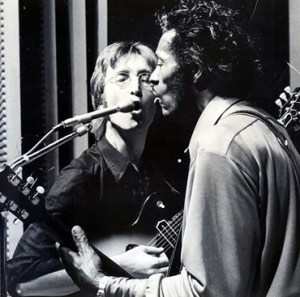
That was John Lennon in 1972, spoken in Berry’s presence on the Mike Douglas show. John’s adoration took many forms in the more than decade prior to that. Here’s Paul, as quoted in the Anthology book:
We’d go up to John’s bedroom with his little record player and listen to Chuck Berry records, trying to learn them.
And there was plenty of reason to learn them. The sheer velocity of the music was one. John explained the other in a 1972 interview, relayed in Anthology:
In the Fifties, when people were virtually singing about nothing, Chuck Berry was writing social-comment songs, with incredible metre to the lyrics. When I hear rock, good rock, of the calibre of Chuck Berry, I just fall apart and I have no other interest in life. The world could be ending if rock ‘n’ roll is playing.
As the Quarrymen moved things up a trifle further in becoming Beatles, their love of Berry’s music was written all over their performances, with more than a dozen of his songs covered live over their touring career (you can find many of those songs as performed by the Beatles on their two Live at the BBCcompilations, plus the Bootleg Recordings 1963 release).
“Memphis, Tennessee” made the cut as one of the songs for their failed audition for Decca in 1962.
“Rock and Roll Music,” “Roll Over Beethoven” — the Beatles blessed record buyers with those tracks on wax and also live from the stage. The former was performed right up until their last live show in 1966, when it was the concert opener, while the latter made it as late as into their 1965 tours.
Two and a half years after that last concert — in the timeline we’re concerning ourselves with here on this blog, January 1969 — the Beatles turned to Berry’s music over and over again, if not for inspiration then at the least out of habit and comfort. For John, Paul and George, it meant filling moments amid the tension and tedium by jamming into a impromptu but completely sincere rehashes of “School Days” or “Sweet Little Sixteen” or “Thirty Days” or “I’m Talking About You” or .. or … or …
Even when they were fooling around with their own “Back in the U.S.S.R.” at Twickenham, it was just another reminder of Berry’s influence by way of “Back in the U.S.A.”
That the Beatles would play a song by Berry wasn’t in and of itself that telling, but their universal knowledge and comfort in playing his songs, said a lot.
Months later, in the Beatles’ waning days as a unit, Berry’s inspiration struck Lennon very directly in “Come Together.” John dismissed the claim that “You Can’t Catch Me” — a song he said he hadn’t heard in a decade, yet one that John belted out a few lines from in a jam the final week of January 1969 — sparked the Abbey Road opener.
Paul, who had no shame admitting he integrated Berry’s work into his own, felt pretty certain John did the same. As quoted in Anthology:
John came in with an up-tempo song that sounded exactly like Chuck Berry’s ‘You Can’t Catch Me,’ even down to the ‘flat-top’ lyric. I said, ‘Lets slow it down with a swampy bass-sand-drums vibe.’ I came up with a bass line and it flowed from there. Great record.”
Turns out, they could catch John, and as part of an eventual settlement, John had a chance to re-make “You Can’t Catch Me” (as well as a few other songs owned by the prosecution) for his 1975 Rock ‘N’ Roll LP (another great record).
John’s love of that original era of rock and roll, which made him want to do it himself, gave his life and career meaning and shone on that record, and really whenever he had the opportunity to play it. The genuine glee felt by John, when he got to share the stage with Berry on the Mike Douglas Show in 1972 is palpable. If you haven’t watched it before, you should, both the performances as well as the interview segment.
John recalled that day during an interview/DJ session with Dennis Elsas on WNEW, September 24, 1974:
Because although I was there with Chuck Berry, and I’d been sitting backstage with him, I met him a few times over the years, I still have that feeling, that when I was sixteen, those were the records I listened to [in] what we called “milk bars” in England, with a jukebox. And I could never quite see him as a human ’cause there was one of my idols, actually talking to me. … It’s sort of an effort to see, “Oh, yeah, it’s a human, but it is Chuck Berry, isn’t it?”
Like John Lennon, Chuck Berry was indeed human and thus mortal, and the master was able to enjoy 50 more years on this earth than his apprentice. The Beatles were as innovative as any act as popular music has seen, but with Berry’s genius baked into the individual members’ DNA from youth, the group didn’t have to start from scratch. It wasn’t enough that the Beatles had a backbeat they couldn’t lose, the lyrics mattered too.
“Ever since I was in my teens I was acquainted with the works of Chuck Berry, whom I consider one of the original rock and roll poets,” John Lennon said after the Beatles’ breakup.
Said in a deposition.
Said in a deposition in which he was being sued for ripping off Berry.
But this spoke more of the litigious universe that enveloped The Beatles in the early ‘70s than anything else — Berry didn’t sue John over lyrics in “Come Together,” it was the people who owned the rights to “You Can’t Catch Me.” And the solution was simple: Just play some Chuck Berry music on another record.
Paul was never litigated for ripping off Berry, but he still went ahead and covered him decades later in 1999, cutting “Brown-Eyed Handsome Man” for the most excellent Run Devil Run.
On Berry’s death, Paul (and/or his people) tweeted his condolences, and it was his turn to rip off John.
Or maybe he didn’t rip off John at all. Berry was a poet, and Paul just didn’t have any better word to describe him.
Berry’s music will live on through his own recordings and as a direct line through the Beatles, too. And as long as we’ve got a dime, the music will never stop.
Mid-afternoon on January 8, 1969, at Twickenham Film Studios, Paul McCartney sat at a piano and microphone and ran though “Let It Be.” Nine months later, and 3,500 miles to the west of London, the Queen of Soul was doing the very same thing.
By that point — October 1969 — Abbey Road was in stores while “Let It Be,” along with the rest of the songs slated for the Get Back LP that would ultimately evolve into the Let It Be LP, remained on the shelf. Aretha Franklin had a copy of the unreleased track, though, and we know she had been promised that song for a long time, going back at least as far as the start of the new year. But she wasn’t getting an exclusive.
Let’s go back to Twickenham, January 8, 1969:
George: You going to give it to Aretha Franklin? Paul: I’m going to do it, and give it to her.
Specifically, Paul planned to have the Beatles cut a “rough demo from the first rehearsal” once the song was complete and would “try to get her to do it as a single.” But “Let It Be” was not quite complete yet on this, the fifth day of the sessions. The melody is locked down, but Paul only presented the first verse and chorus to this point.
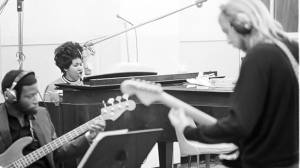
Weight and see: Aretha Franklin does her thing, while Duane Allman (right) does his on a cover of The Band’s “The Weight” on January 9, 1969.
Still, he knew what he had, and its potential as a cover. “It would be great for Aretha Franklin, that number,” Paul said before singing a line in an absolutely terrible imitation of her. (For the record, that same January 8, 1969, Aretha was recording her version of “The Weight” by The Band, whose influence weighed heavily on the Beatles these sessions.)
Ringo provided upbeat drum accompaniment — exactly as laid out by Paul, with a faster tempo than would ultimately surface on the record, and with several awkwardly inserted fills.
Tongue firmly in cheek, John soon offered a lyrical tweak and a poke at Paul’s pseudo-religious lyric, suggesting “Brother Malcolm” as a nod to the group’s do-it-all assistant. (Paul will deliver that line in a few future takes.)
The group would return to the day’s on-again, off-again writing-cum-rehearsal session for “I Me Mine” followed by “The Long and Winding Road,” which like “Let It Be” was similarly unfinished lyrically and being given its first introduction on the tapes to the full band this afternoon.
These repeated truncated takes of “The Long and Winding Road” — which lasted nearly a half hour, split into two separate stagings late in the day — mainly served, as far as the Nagra reels were concerned, as background music for an increasingly captivating conversation about the eventual live show. More about that in the next post.
“The Long and Winding Road” caught George’s fancy, and he called the song “lovely.” Before the end of the day, Paul taught George the song’s chords. Likewise, Paul sketched out how to play “Let It Be,” which was played for about 10 minutes at the very end of the day’s musical portion, and George and Ringo were full participants. The song was never to be played live in front of an audience by the Beatles, but at this point it was clearly in line for the upcoming concert, and Paul sought out additional accompaniment come showtime.
“It’s sort of gonna do like a hymn. That’s why I was thinking we could get audience participation on that,” he told George.
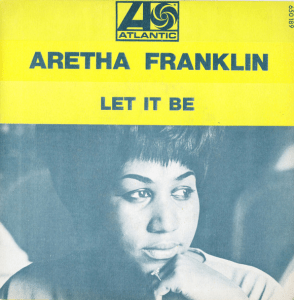
The sleeve for the French release of Aretha’s version of “Let It Be.”
The January 8 session was really the formal coming-out party for “Let It Be,” marking first time Paul played it to the rest of the band these sessions (on tape, at least, but it seems clear if it had been played prior, it wasn’t as extensive).
Like “Yesterday,” the song was famously sourced from a dream, but this time around it was the lyrics that were nocturnally inspired.
In the dream she said, “It’ll be all right.” I’m not sure if she used the words “Let it be” but that was the gist of her advice, it was “Don’t worry too much, it will turn out okay.” It was such a sweet dream I woke up thinking, Oh, it was really great to visit with her again. I felt very blessed to have that dream. So that got me writing the song “Let It Be.” I literally started off “Mother Mary,” which was her name, “When I find myself in times of trouble,” which I certainly found myself in.
But to be clear, the trouble wasn’t dated to January 1969. Rather, like “The Long and Winding Road,” “Let It Be” materialized in 1968 amid the lengthy and tumultuous White Album sessions. The two gospel-flavored songs had another link, and that was they were written with other people in mind from the start, too: “The Long and Winding Road” was influenced by Ray Charles.
As for Ray’s future Blues Brother co-star, Aretha never did end up releasing “Let It Be” as a single in the U.S. or U.K., but it was among the standout tracks (her covers of “Elanor Rigby” and “The Weight” were among others) on her This Girl is in Love With You LP, which was released January 15, 1970 — two months before the Beatles’own version came out as a single, and 11 days after the last Beatles recording session.
 They May Be Parted