By the time the subsequent Oscars rolled around, on April 15, 1971, the Beatles were, well, really broken up. George and Paul each had No. 1 hits in either the US the UK or both (All Things Must Pass LP and “My Sweet Lord” single for the former, McCartney LP for the latter), John would have his first later in the year (Imagine LP and single) and Ringo had just released his biggest hit to date, “It Don’t Come Easy.”
Also, everyone was suing each other.
But ancient history was relevant to the Academy, who gave The Beatles — whatever that was anymore — the award for Best Music, Original Song Score over the soundtracks to The Baby Maker, A Boy Named Charlie Brown (one of this author’s chidhood favorites), Darling Lili and Scrooge.
Of course, the Beatles wouldn’t be at the ceremony to pick up what would be their lone Academy Award (A Hard Day’s Night had two nominations in 1964, lost both). That honor would go to Quincy Jones, who had already produced a track on Ringo’s Sentimental Journey and would more than 10 years later work with Paul. (Decades later still, the two would be in the news together again).
Paul’s absence, apparently, wasn’t for lack of trying by Jones, who said he visited Macca — while he was recording RAM in New York — and tried to convince him to come out for the ceremony.
Paul would later get two nominations as a solo artist for best song (“Live and Let Die” in 1973 and “Vanilla Sky” in 2002), but he went 0-for-2.
And with that, John, Paul, George and Ringo’s trophy cases only had the lone Oscar for Let It Be — provided Quincy Jones gave it to them.
Quite literally, the freshest sound in music right now is by Ringo Starr, whose 17th solo release — Ringo 2012 — hit shelves and servers today (Jan. 31, 2012). Most of the songs are at least co-written by him, meaning perhaps Richard Starkey is is finally hitting his stride as a songwriter as he has little more than 100 songs to his credit over the course of 50-plus years since the Beatles began recording. And many of those — while I don’t doubt his contributions — are things like “Dig It” and “Flying,” songs that received the four-Beatle credit and other songs in which he presumably didn’t have much heavy lifting.
Of course, that list doesn’t count songs written and not registered. It certainly doesn’t have songs he partially crafted. And that’s just what we have out of Ringo as early on the second day as rehearsals continue at Twickenham.
Source: thebeatles.com
George was discussing The Band with Paul and Ringo (John wasn’t there yet) and how their favorite track (presumably off the White Album — he didn’t specify) was “Don’t Pass Me By” because of its country western vibe. “That’s their scene, completely,” George said of the very first composition credited solely to Starkey.
Paul chimes in to ask Ringo, “Are you going to write another?”
“Yes I am,” he replied, almost incredulously before some cross-talk obscures what was said next, although Paul already knew what was in the works. In fact, he already was able to name one — “Picasso” (also bootlegged as “I Bought A Picasso”) — before Ringo started pounding out the chords (a struggle).
“Let’s hear it,” Paul asked, remarking it was “a fast one” — something they were looking to add to the set list of the live show. “Too fast for me,” Ringo replied. Paul, as well as George, had absolutely heard it before based on their reactions and subsequent suggestions.
Sounding very similar — and, really, quite like a sped-up “Don’t Pass Me By” — Ringo then launched into “Taking a Trip to Carolina” — a song he’d first touched upon for 45 seconds or so a few minutes prior to “Picasso.” As he says midway through, “the words are not very good.”
Note that this clip, from the bonus disc that came with “Let it Be … Naked,” begins with the exchange that preceded “Picasso” edited in as the lead-in to “Taking a Trip to Carolina.” But in reality, that’s not the exact order of how it really happened.
“Carolina” was also featured in the 2021 Get Back docuseries.
Ringo wouldn’t showcase a song again until later in the month, with “Octopus’s Garden,” which of course would later appear on Abbey Road (I’ll cover the song’s introduction to the sessions when I reach that date). We wouldn’t hear either “Picasso” or “Taking a Trip to Carolina” for the remainder of the tapes.
He would not have a vocal on Let it Be — either of the iterations (Glyn Johns mix of the Get Back LP or the final Phil Spector production) — marking the first time that happened since the A Hard Day’s Night LP in 1964 (*He didn’t have a lead on ’67’s Magical Mystery Tour, either, but it was technically an EP with old singles padding the US full-album release).
I need to make one more interruption before returning to the day-by-day tapes breakdown to recognize the 43nd anniversary of the rooftop concert atop 3 Savile Row that just about concluded the Get Back sessions and wrapped the Beatles’ career as a live act. More on this iconic event as I eventually reach it in the Nagra tapes timeline down the road.
Something I never completely got my head around is why the Get Back sessions had to happen when they did, in the beginning of the new year, 1969. And in such a disorganized state, to boot.
The timeline is stunning, really, when you look back on it, even in the context of the music industry not being what it is today, when you can go years and years between records.
Consider: On Jan. 2, 1969, the Twickenham sessions got under way. “Hey Jude” was recorded five months earlier (July 31, 1968), released four months earlier (Aug. 26, 1968) and had just finished runs at No. 1 around the world. The White Album was released SIX WEEKS earlier. Six weeks!
The members of the band couldn’t have been bored — John and Yoko were doing the concept art thing, George and Bob Dylan were writing together only weeks earlier in late November (he’d show off “Let it Down” on this day). Paul and Linda were a little less than two months from marrying. Ringo had just appeared in “Candy” and was soon to be in “Magic Christian.” They had stuff going on!
And again, I know, the industry is different today than it was then. But even considering that, there really wasn’t that much reason for the Beatles to rush into the studio in January 1969. It’s just what they did.
Famously, the goal here was to rehearse fresh material for a film or TV special, culminating in a concert before a live audience. New material. Six weeks after they put out a double album.
But there they were, at the Twickenham sound stage on Jan. 2. Six weeks after they released the White Album (did I mention that?). And despite the rush to be there, sessions beginning in the morning like it was an office job, they still didn’t really have the the session’s raison d’être lined up. There was no agreement on a venue to actually perform the concert.
A little more than halfway through the day’s recordings, Glyn Johns and Michael Lindsay-Hogg discuss with Paul — in addition to the state of his beard — the potential venues for the culmilation concert. Legend has local clubs, African amphitheaters and the like in the mix, but from discussions on the first day of the sessions, it’s clear that it’s most likely going to be a soundstage. Twickenham itself is an option, and seemingly Paul’s preferred one (“Just as well stay here”). Another option pitched is Intertel Studio in Wembley, where the Stones’ Rock and Roll Circus was recorded a mere three weeks earlier. The venue received raves — “It sounds like a good live studio.”
Amazingly, at that moment elsewhere at Twickenham– and sure, who knows if he was in the room at the time, out having a smoke, grabbing a bite or in the bathroom — was John Lennon. But he was never consulted (on tape, at least) about what he thought of Intertel. And he only performed “Yer Blues” there a mere three weeks earlier.
But even though it was a potential concert venue following the rehearsals there, everyone hated Twickenham. PAs hadn’t even been set up (they were arriving later that day). John was suggesting they move into a corner of the room — Ringo was too far away. “This place sounds terrible,” Paul said.
Said Lindsay-Hogg to laughter, “I think the thing to do is just be very flexible about every aspect of the enterprise.”
As a director, Lindsay-Hogg was naturally eyeing a dramatic scene. A Tunisian open-air amphitheater was famously pitched, the Beatles to play at dawn. “Snake charmers, holy men … torchlit, 2,000 Arabs and friends around,” Lindsay-Hogg visualized.
It was never going to happen, no matter what. Paul put it straight right there on Day 1. “I think you’ll find we’re not going abroad, because Ringo just said he doesn’t want to go abroad. And he put his foot down.”
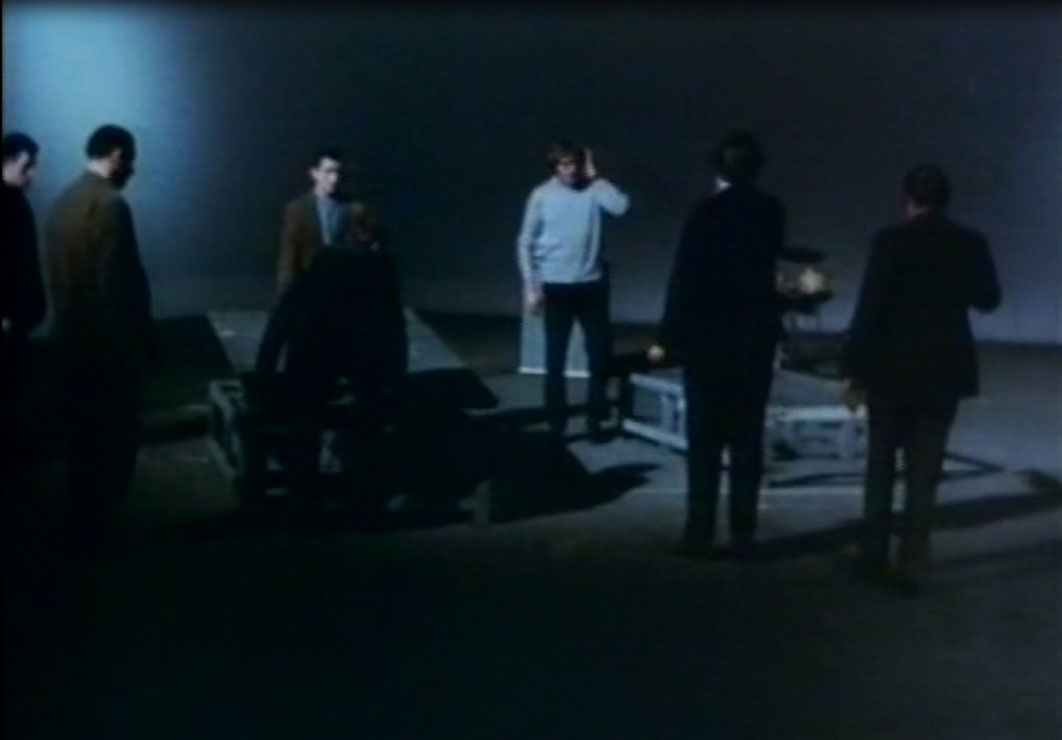
The stage is set at Twickenham as the opening credits roll in “Let it Be.”
Lindsay-Hogg hoped to change minds. “Let’s see what we all feel in a day or two… instead of making anything hard and fast.”
There would be no budging. “Ringo definitely doesn’t want to go abroad,” Paul said, “so that means we don’t go abroad. Maybe we go abroad next time… [but] it would be nice to find some way to do it out of doors.”
Like John wasn’t even considered when discussing a venue he played just weeks earlier, Ringo didn’t state his case in person, only via proxy. It did really sound like it was the first time the topic of concert venue was seriously discussed immediately between the director and the film’s principals, and it was after they had already began the sessions.
Thus, there they were on Jan. 2, starting 20 days of rehearsals culminating in a concert that had absolutely no parameters decided outside of the band scheduled to perform.
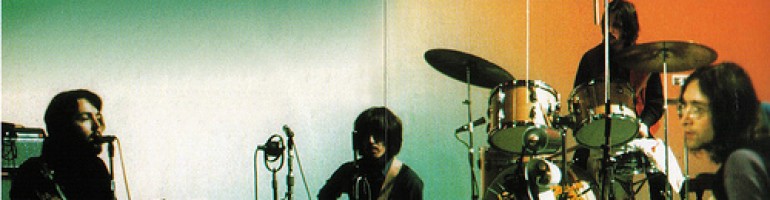
 Not initially intended as a feature film, Let It Be was indeed eventually released in theaters in May 1970, more than a year and three months since the end of the Get Back sessions. Paul became the final member to quit the band a month earlier, and famously, none of the Beatles attended the premiere.
 They May Be Parted