Tag Archives: Twickenham

TMBP Extra: Sound Man

Glyn Johns’ resume is so impressive, his work with The Beatles could be considered a footnote.

Just take the next 24 hours, and check out a fraction of songs he worked on as producer, engineer and/or was tasked with mixing on this playlist I put together. I tried to attach as many full albums as I could find on YouTube. Otherwise, I drew just a few tracks to sample. To any classic rock radio program directors reading, feel free to use this playlist to do your job for you.

Alternately, take less than a full day, but more than a few minutes and enjoy the discography posted on his website. It’s staggering, and truly touches on “the biggest names in rock” (spoken in radio promo voice).

But as impressive as his work with the likes of Zeppelin, the Stones, Kinks, Who, Dylan, Eagles and so many others (The Clash! Jools Holland!! Paul on Red Rose Speedway!!!) as well as innovating a technique for recording drums, what matters most here at They May Be Parted International HQ is Glyn’s involvement with The Beatles in January 1969. As engineer for the sessions and later producer for the aborted Get Back album that ultimately became Phil Spector’s Let It Be, Glyn is part of the fabric of the story we’re telling here, even if his actual work isn’t present on the Nagra Tapes itself that we’re listening through.  He was a brief part of Abbey Road’s story, too, having worked on “I Want You (She’s So Heavy)” and “Something.”  But that’s another post.
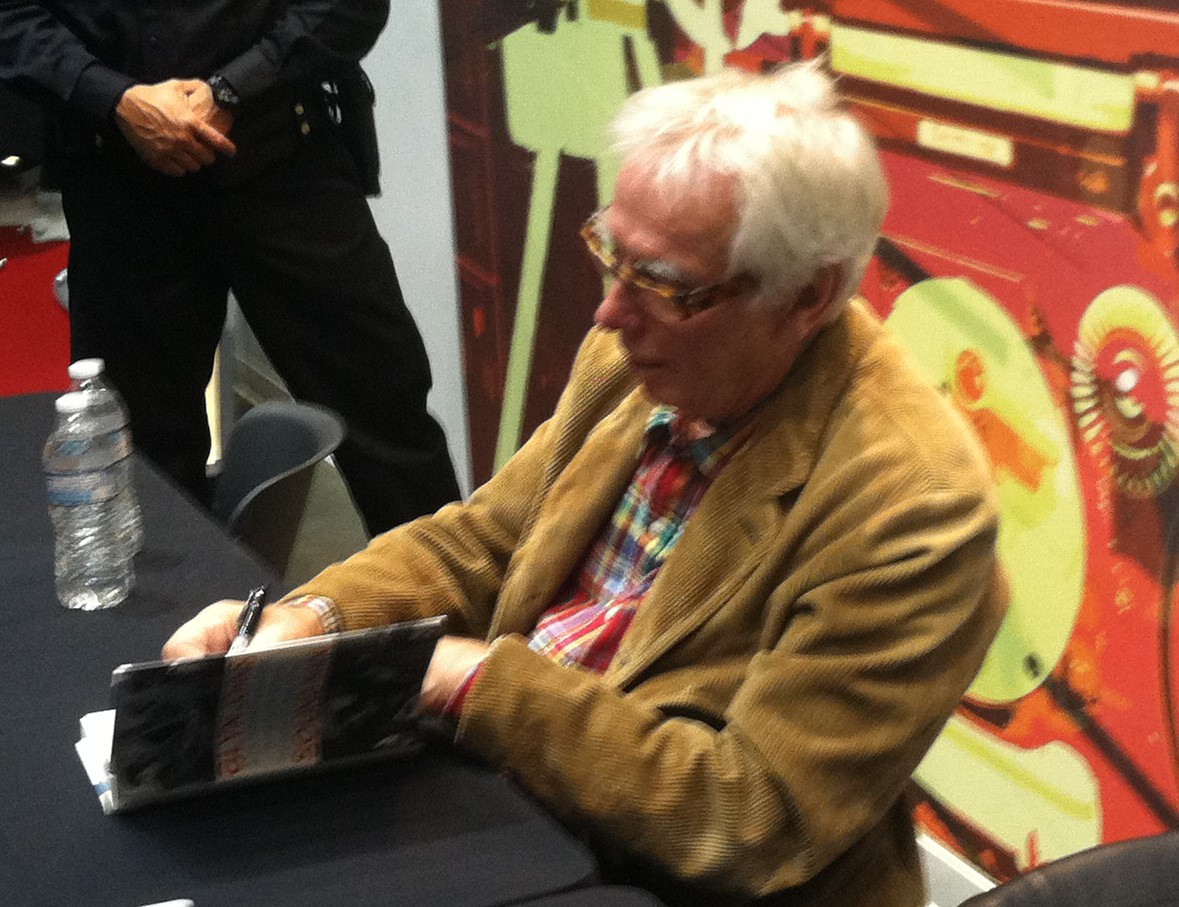
Glyn Johns autographs a book at Saturdays Rock Hall event.

Glyn Johns autographs a book at Saturday’s Rock Hall event.

Glyn, inducted into the Rock and Roll Hall of Fame two years ago, was among the few to be present for the duration of the Get Back sessions, and thanks to whatever combination of good living, good genetics and good luck, he’s among the even fewer still with us in 2014. He just released a memoir, “Sound Man,” and I was lucky enough to see him at a promotional Q&A hosted by the Rock and Roll Hall of Fame and Museum’s Library and Archives in Cleveland on Saturday.

The briskly paced event covered specifics of his start in the recording industry at IBC, his pioneering role as a freelance engineer and his views on production today (he hates it, with the move to digital the culprit) with some short anecdotes peppered throughout.  There was a bit of discussion on the Stones (he helped them from the start and worked with them throughout the ’60s and ’70s, plus he lived with keyboardist Ian Stewart), and a he made a few one-off, matter-of-fact mentions that brought into context just how monumental his career has been (“When I was producing Jimi Hendrix” … “Oh, that was on ‘Won’t Get Fooled Again'” … “I worked on ‘Exile” later on,” etc.). But his biggest raves were for Led Zeppelin, whose debut he engineered in October 1968 before its release three months later during the period of George Harrison’s walkout at Twickenham.  Glyn is still clearly moved by the music Zeppelin made in the studio as he was recording them for the first time.

George, however, was unimpressed (and he wasn’t alone).

Glyn — who in perfect deadpan answered that Zep drummer John Bonham’s most remarkable achievement in the studio was to “turn up” — told the same tale about George’s dismissal of Zeppelin in the book.

Glyn offered his first-hand observations of the Get Back sessions in pretty straightforward fashion in the memoir, although he does take credit for having the idea to play on the roof, the origin of which has been in dispute for 45 years. But per his style, Glyn doesn’t air any dirty laundry. For instance, when it comes to George’s walkout, he writes:

It is not my place to discuss any detail of what happened, but it is common knowledge that George left the band and was persuaded to return a couple of days later. Once that was over and done with we carried on and it seemed that all was quickly forgotten.

Glyn does contest the notion he was picked by The Beatles to produce the session over George Martin because he had a union card to work on a movie. But per the official written Beatles story — Anthology — Georges Martin and Harrison are both quoted saying that Glyn was selected just for a change of pace.

As an elite engineer, Glyn’s descriptions of Magic Alex’s famed “work” at the Apple Studio are a fun read.

The console looked like something out of a 1930s Buck Rogers science fiction movie. Above it on the wall were eight loudspeakers that were about the size and thickness of a large ham and cheese sandwich.

Glyn’s overall involvement in the Get Back sessions is illustrative of how unusual January 1969 was for the Beatles compared to how they did everything else throughout their career, before and for the brief time after that they were together. The Beatles weren’t just altering how they wrote and rehearsed songs, working in a foreign studio with cameras in their faces, they went an extra step to hire a man they’ve never worked with them to capture that sound. It all ultimately came to an disappointing end for Glyn, who after the sessions made several attempts at creating the Get Back album for naught as the project was bumped back and later supplanted by Abbey Road. As he told the Rock Hall audience in 2012, “I go off thinking I’m pretty hot stuff, [but] I’m not at all. I’m sweeping up, really.”
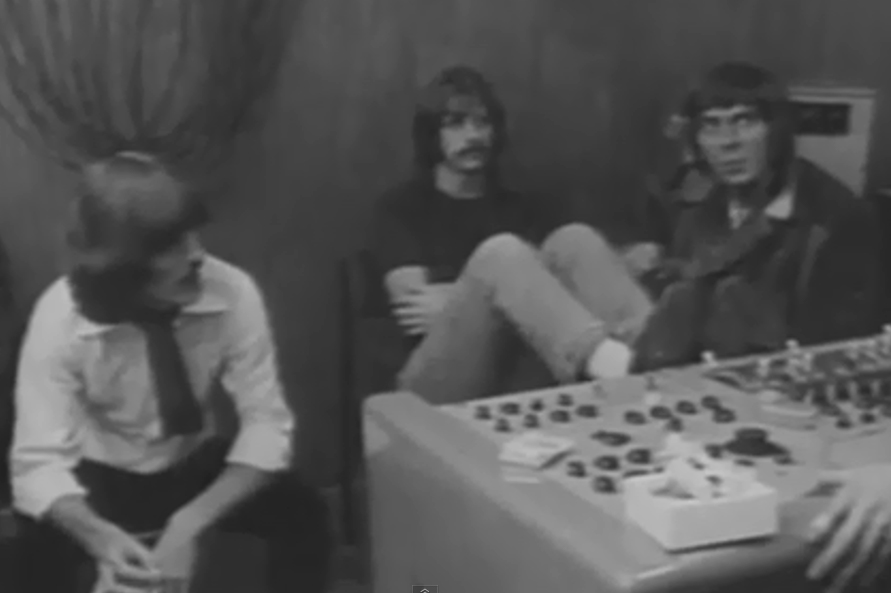
George, Ringo and Glyn at Savile Row, late January 1969

George, Ringo and Glyn at Savile Row, late January 1969

His thoughts on the Let It Be LP, on which he has a mere “thanks to” mention on the back cover? Glyn doesn’t mince words on his opinion of the Spector version of the record, writing in Sound Man that “Phil Spector … puked all over them, turning the album into the most syrupy load of bullshit I ever heard.”  His opinion hasn’t softened over time — two years ago he told the Rock Hall audience that “shame he wasn’t locked up earlier, really, wouldn’t have played with my record.”

All told, Glyn — who wrote that “I felt like I’d won the lottery” when he got the job to work the Get Back sessions —  spent about 25 pages of his book’s 286 pages on working with The Beatles (including a couple on his first experience working with the group, as second engineer on the 1964 TV special “Around the Beatles”).  That’s nearly 10 percent of an autobiography written about a product he never saw officially released. So perhaps the Beatles weren’t quite a footnote after all for Johns.

———-

This, however, IS a footnote: After the Q&A, I purchased Sound Man and got it autographed by the author. I let Glyn know about this blog and he gave me the wordless impression that I must be a madman to immerse myself in these tapes for pleasure (and perhaps I am). Still, he said he’d check out the blog, so if you find your way here, Glyn, welcome! And to everyone, I’m working on the next post, a continuation of Jan. 7 “Maxwell’s” session with “Across the Universe” coming up on its heels. I intend on having both out before the end of the month. As always, stay tuned for updates at twitter.com/theymaybeparted.
 

7 Comments

Filed under Extra

Jan. 7: Joke whistlings

From the Let It Be film

Mal at work. From the Let It Be film

If there’s a tape of Paul and John asking Mal Evans to manage the alarm clock in “A Day in the Life,” it hasn’t surfaced. Likewise, we never hear John telling George Martin he wanted to “smell the sawdust” in adding the fairground feel to “Being For the Benefit of Mr. Kite!”

But among the days’ worth of Nagra reels covering the Get Back sessions on Jan. 7, 1969, as the band lurched toward what became at least a temporary split later that week  — this is Tuesday, and George walks out on Friday —  we do get to hear  play out in real time the origin story of unique and memorable instrumentation to appear later on Abbey Road.

Unremarkable in the moment, Paul’s suggestion, made for the second time in three days, Mal “should have a hammer. … an anvil” comes about 20 minutes into the day’s work on “Maxwell’s Silver Hammer.”

Like, on steel. You know, a [bang, bang]. So it sounds silver, steel.

Sprouting from a short rehearsal of “I’ve Got a Feeling” with a quick touch of “Oh! Darling,” the “Maxwell” session on Jan. 7 runs for more than an hour on the tapes, straddling both ends of a lunch break. It’s far and away the longest time spent on any single song this day.

The key to appreciating the “Maxwell’s Silver Hammer” rehearsals is to view them completely in a vacuum. In a sense, it’s incredibly frustrating to think of the time spent on this when George has “All Things Must Pass,” for instance, withering to group disinterest. Or that John has a skeleton of what would become “Gimme Some Truth” two years later, unfinished — a song tinkered with briefly this very day. Paul himself could have spent the extra time on “Oh! Darling,” which purportedly had interest from other bandmates at this very specific moment in time. So on its face, just listening to this portion of the tapes is infuriating, because WHY IS PAUL MAKING US LISTEN TO “MAXWELL’S SILVER HAMMER” FOR HOURS??? STOP KILLING JOAN!!!

But in a vacuum — and with the understanding that all of The Beatles’ musical children are beautiful and deserving of love — this is a very instructive and iconic moment in the history of the song, and we see significant progress in the song’s overall development. This, even though Paul himself admits he hasn’t finished writing it.

The band hit the ground running with the song, having already spent time on it Jan. 3 (when Paul also made reference to getting a hammer for the song, but didn’t follow through as he would today), but it’s a bit of a bumpy start as Paul is still reminding the rest of the group of the chords — the alignment is Paul on piano, George on bass and John on a jaunty guitar.  When Paul remarks he “doesn’t like the waltz” drum pattern that coming out of the chorus into the verse, Ringo laughingly bemoaned, “it’s the only bit I remembered in the whole piece!” It’s just an early reminder and reflection that the song was Paul’s priority and his alone, something that would continue into the song’s recording for Abbey Road six months later.

Paul doesn’t always play it straight, hamming it up lounge-singer style, delivering cringe-worthy tongue clicks and scats along where he still needs to write lyrics. Sure, he’s completely contradicting his own instructions moments earlier as they worked on “I’ve Got a Feeling” — “We should start off by doing everything we’re going to do on the thing. Like if you’re going to do the ‘oh yeahs’ innit, you’ve got to do ‘em how you’re going to do it.”  It wasn’t the first (or last) time he wouldn’t take his own advice, either.   But here it probably shows the more advanced, but unpolished state “I’ve Got a Feeling” was in, the song in true rehearsal stage, while “Maxwell’s” was clearly an unfinished product.

Like on so many of these tapes, and especially on Paul’s songs — which more often seem to be delivered to the band incomplete  — we get an incredible windows into Paul’ s songwriting technique. As he plays along on piano, he’ll hum a suggested bassline.  Without notice, he’ll change it. Once he gets a certain part down — whether it’s a drum pattern or a whistle — he’ll interrupt and make clear it’s what he’s looking for. Until he decides to change it again. That’s in contrast to George’s songs, which more often are closer to complete and accompanying parts are set in George’s mind. While John wasn’t nearly as productive as Paul or George during the sessions, we’ve seen how he’s more willing to get open input from the rest of the band.

What Paul’s looking for here is a far more whimsical production than what surfaced on Abbey Road months later. It’s not just the tongue clicks. Paul’s looking to go all out, proposing ukulele solos and looking to Ringo for some “razzmatazz there on the cymbals.”

Then there’s the whistling. There was plenty of whistling in these early takes of “Maxwell’s.” But lapsing into caricature, Paul — interrupting an unrelated question from George — explains just what he’s looking for from his band.

If we do a solo, whistling, we should try and do like a real whistling solo, ’cause it is a bit much if it’s those joke whistlings.

The man was nothing if not a perfectionist. Of all the things that would put the song over the top, Paul was sure here it would be insincere whistling. Just to make sure everyone knew he was serious, during a subsequent stab at a part whistled in unison between verses, Paul barks out “straight” just to make sure any joke whistlings didn’t sneak its way in.

In all, the song was definitely coming together nicely. Incomplete, it still had shape and vibrancy, and the rest of the group beyond Paul gave every indication they were enjoying performing it, despite continued confusion at times over cues.

It was in this context Paul suggested a figurative bell to add to his literal whistles.

We should have a hammer. … Mal, on an anvil. Like, on steel. You know, a [bang, bang]. So it sounds silver, steel.

Wearing bow ties for this one.

Paul doesn’t just see the anvil as part of the instrumentation. It gives Paul the excuse to think more broadly about the song in the context of the live show. “We’ll all be wearing bow ties for this one, blazers.”  The Beatles were on the verge of breaking up earlier this day, and now Paul’s suggesting costume changes during a performance of “Maxwell’s Silver Hammer.” Moods swing rapidly at Twickenham.

The group is in a jocular mood — probably as much as we’ve heard to this point on the tapes — as the band laughs, whoops and hams it up during the final takes of this portion of the “Maxwell’s” rehearsals and as they head out for lunch.

They’d return with full stomachs and pieces of steel.

10 Comments

Filed under Day by day

Jan. 7: Pulled their socks up

Everybody had a hard year? If we’re talking about the Beatles, that’s a fair appraisal just a week into 1969.

As rehearsals were set to get fully under way January, 7, 1969, the group openly discussed breaking up. Instead, moments later, they were trying to hammer out the details of “I’ve Got a Feeling” for more than 20 minutes before launching into an extended session dedicated to Paul’s pet “Maxwell’s Silver Hammer.”paul

The out was right there for them; the group was in agreement that a divorce was not unreasonable. But while we don’t know for certain, (unless this particular discussion was filmed and we can see for ourselves if the footage is ever released), it doesn’t even sound like anyone moved out of their chairs, much less high-tailed for the exits. Paul left the band during the recording of “She Said, She Said” in 1966 and Ringo split during “Back in the USSR” in ’68. But this cry for divorce, so much more severe than a walkout of a single member, didn’t immediately lead to much of anything. Nobody budged January 7, 1969, after the early takes of “Get Back,” and status quo reigned.

As tension melts and the group trades chatter for chords, it quickly becomes clear little that had led to the group to the brink had actually changed.  Paul may not enjoy his role as band leader — “I’m scared of that, ‘You be the boss’” — but he’s not letting that job go, either, despite any prior protests from George or anyone else in the group.

Arranger/producer Paul made plain his preferences for “I’ve Got a Feeling,” and anything else they were to tackle going forward in preparation for the live show.

We should start off by doing everything we’re going to do on the thing. Like if you’re going to do the ‘oh yeahs’ innit, you’ve got to do ’em how you’re going to do it. No use singing ’em quiet now if you’re planning on doing them loud on the night.

Paul certainly sweats the details and is quick to dictate the construction of the song, asking John to keep the chord sequence before the chorus “kind of tight,” barking “riff” to George at the appropriate times and working on the balance of “oh yeahs” with “oh noes.” Even Ringo wasn’t spared; he received explicit directions, too: “Don’t go into the swing at the end,” Paul said as he vocalized the closing drum pattern.

Overall, special focus was paid to the transition to “Everybody’s had a hard year” and the subsequent section. Paul pushes George to add “something recognizable” just prior to the bridge (“All these years I’ve been wandering around”).

The vibe, meanwhile, is generally agreeable throughout, and there’s certainly no indication that moments earlier the band was basically trying to figure out the right way to break up.  While no songs were particularly tight by this stage of the sessions, there’s a definite, steady progression here with “I’ve Got a Feeling, ” a song that had seen time each day thus far at Twickenham. The group works their way through at least one complete take (tape cuts, as usual, keep any claim here from being definite).

Content with the state of the song, and with a lengthy pivot to “Maxwell’s Silver Hammer” imminent, the band detours briefly into a pair of apparent improvisations that wouldn’t be heard from again (the bluesy “Woman Where You Been So Long” and the especially catchy, Little Richard-inspired “Oh! Julie, Julia”).

John cuts off the jam to ask Paul to launch into “Oh! Darling,” an admitted favorite of John’s up to his death 11 years later. Paul was again in instruction mode here — there was no solicitation for advice on working out kinks, rather the song was set and merely needed to be taught.

Paul had already played the song twice at Twickenham — both times solo at the piano for Lindsay-Hogg (“Sounds great, Fats Domino!” the film director said on the 6th), but it was without any further accompaniment and probably without the full band even in the building.  This is the first full-band take of the song, which, despite the need for Paul to shout out chords and generally sounding in a rough state, seems to have had at least some off-tape rehearsal at some point. With John’s enthusiasm for the song only helping the cause, it’s not unlikely to think “Oh! Darling” could have been a viable option for an extended live show, were it to have actually been staged. Alas, with the rooftop featuring Paul only on bass, and the setlist short, it wasn’t meant to be, but the song certainly found a happy home on Abbey Road.

With just single take achieved, George (largely off-mic) thinks beyond “Oh! Darling.”

“‘Maxwell’s’ would be even better to go on.”

Even Paul’s skeptical as the band readies to lay down the silver hammer.

You never know.”

6 Comments

Filed under Day by day

TMBP Extra: Jan. 7, 1969 recap

Blogoversary week continues with a look back at my posts about today in Nagra tapes history: Jan. 7, 1969, a dramatic, dynamic day rich in music that has proven eternal and one that brought the Beatles to the brink as they questioned why they were even together.

  • Still they lead him back: Jan. 7 begins with a proper debut for “The Long and Winding Road,” poignant and revealing given the mood at the sessions and the prior day’s tension.
  • Sing a lullaby: “Golden Slumbers” debuts, and the day-old “Carry That Weight” isn’t all a hurting Paul fits it with that morning.
  • Signature song: It’s the origin story for “Get Back,” the song perhaps most identified with these sessions, featuring Paul, George and an absent Jackie Lomax.
  • Power Hour: Putting Paul’s Jan. 7, 1969, morning session in context, 44 years later.
  • On their own at the holiday camp: As Mr. Epstein’s ghost lingers, what motivates The Beatles in January 1969? The group openly questions that very thing.
  • Taking the easy way out, now: The Beatles, comfortable as a studio-only band and admittedly shy to perform live but also fed up playing together, get a pep talk as they try to find the desire to stage a concert.
  • Ain’t got no ‘pow’: Still searching for the elusive hook to their live show, the Beatles recall a misguided fan-club show, consider their lack of charity and foretell one of rock’s iconic moments.
  • Entertainment is almost enough: In which the Beatles are asked to embrace showbiz, because “you may never do another television show.” Perhaps a captive audience is the answer.
  • Have a divorce: The Beatles’ frustration with each other and the state of the group — an issue they admit dates back more than a year — reaches a tipping point as a conversation that began with the continued search for a live venue concludes with the band’s future in question.
  • Pulled their socks up: “Divorce” was all talk, no action for the Beatles, who casually moved to “I’ve Got a Feeling” and “Oh! Darling” (briefly) after agreeing they should split up — without actually doing so — moments earlier.
  • Joke whistlings: Amid the “Maxwell’s Silver Hammer” origin story, Paul wants a little more “razzmatazz” but please keep the whistle solos “straight,” OK?
  • Bangers and mashups: After making accidental musical history, The Beatles whistle while they work extensively on “Maxwell’s Silver Hammer.”
  • Tumble blindly: The anachronistic, symbolic “Across the Universe” returns to The Beatles orbit, while the group also has a brief re-exploration of another John tune, “Gimme Some Truth,” as a Beatles number.
  • Et cetera: Picking up the pieces from remaining storylines of the day, including a few covers and a link between “Don’t Let Me Down” and “Devil in Her Heart.”

3 Comments

Filed under Extra, General, Recap

TMBP Extra: Everybody had (another) good year — 2nd Blogoversary

opening

Work begins anew for the Beatles. From the opening scene in Let It Be.

John Lennon, Paul McCartney, George Harrison and Ringo Starr were working stiffs like the rest of us* 45 years ago today, when those four, joined by a film crew, headed back to work after New Year’s.

The hours they put in over the subsequent month has stood the test of time, as documented on the Let It Be album and film, and with the results of their labor also eventually surfacing on Abbey Road and various solo albums.

But you all knew this.

I did too before I started this blog, two years ago today. But I just didn’t know how deep the story ran and how much more there was to these sessions. Especially with so much of our knowledge of this era couched in the record’s tumultuous production and release a year later and the breakup that preceded it.

A few days ago, I rewatched the Let It Be film (I’ve been watching it every few weeks in spurts as I write, but this was purely for “leisure,” having a few beers with my wife, who wanted to see it again). Knowing what I know now, both in my own immersion in the tapes and researching what is available about the sessions (far less than you think), I’m struck by what really got me interested in the tapes in the first place: You see all of the results, but absolutely none of the motivation.

Why did they move from Twickenham to Apple all of the sudden? Who’s this guy showing up to play keyboards? Why are there so many covers, and so many songs we’d see later on Abbey Road? What’s the deal with playing on the roof? Was that the first choice for the concert they allude to really late?

The movie creates more questions than it answers. And of course, that’s a part of what makes listening to the tapes so captivating.

Finding answers is also what makes for some really deep blog posts. In 2013, I wrote 13 posts on the timeline (of 19 total posts last year) covering a little less than 3 1/2 hours on the tapes.

Wait, what?

Yes, a mere 3 1/2 hours of conversations and rehearsals were able to form the basis of 13 posts — and more than 17,000 words therein. But talk about memorable moments in just those 200-plus minutes:

It makes you wonder what kind of film Michael Lindsay-Hogg could have made if he had his way. This drama is writing itself. And with a great soundtrack!

Cheers to you all!

Cheers to you all!

And to think, we’re only at the middle of Jan. 7.  There’s a heck of a way to go, and I can’t wait to dig in.

I can’t say enough for the support I’ve gotten from readers, be it in comments, over Twitter, Facebook and from other blogs. It’s been amazing to share this experience — and communicate with — Beatles fans as passionate and curious as I am. I want to especially thank and point back to Hey Dullblog, Kenwood, A Mythical Monkey, Ultimate Classic Rock  and the York Beatles Appreciation Society for linking to me over these years. It really makes this all the more fun to know people are reading and enjoying it.

And the most special thanks to my wife, Dianne, for being my editor and putting up with my “child-like wonder” at Paul’s playing the songs he introduced Jan. 7, 1969, live daily in 2013.

Here’s a recap of the first few days:

What’s next? More of the same in 2014. Happy New Year!

*- Full disclosure: While I may be a working stiff, I actually have the day off. But back to work Saturday!

2 Comments

Filed under Extra, General, Recap