Tag Archives: Twickenham

Jan. 6: Icing Cream

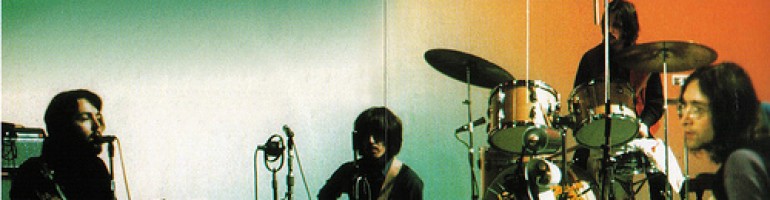
When the Beatles reconvened at Twickenham Film Studios the morning of Jan. 6, 1969, it was the prior evening’s television that dominated early conversation between the band and director Michael Lindsay-Hogg.

And, hey, why not? Twickenham is their office, and the piano is the water cooler, so what else would the grunts talk about as another work day begins?

Just seconds into the day’s tapes  the discussion goes right into the Cream farewell concert that aired on BBC the evening before. And with it, it’s one of the Beatles’ reference points for their eventual film. Or, at least, a great example of what they didn’t want to do.

The documentary is, in fact, really lousy — I watched the whole damn thing in prepping this post. Cream, as a band, is great. But what a terrible program, from the seizure-inducing cuts to the wildly melodramatic narration and ridiculous band interviews. The camera’s always on the wrong thing, the songs aren’t complete, there’s continuity errors and it’s just an effort to get through.  Try it yourself here!

“Ginger Baker’s was the only interesting interview,” Lindsay-Hogg said to Paul, explaining that he himself is “really uncoordinated” and learned a bit of drum technique from Baker.

“I just thought they were interviewed badly,” Paul said.

Paul likened the interviewer to “a 3-year-old kid” in suggesting Eric Clapton play his parts again on guitar.

The talk shifts to a tangent when Lindsay-Hogg compares the Cream production to the grandiose “Eloise” by Barry Ryan (the song itself, not the promo clip below), a chart-topper from a few weeks earlier.

“All form and no substance,” the director said of the song after using the same term to describe the Cream doc.

“It’s great, I thought,” Paul replied. “I loved it.”

“All form, no substance, I hated it,” Lindsay-Hogg said before again repeating “All form and no substance.”

“That’s too big a put-down,” Paul said. “All form, and not much substance.”

“It was my least favorite record from the last five years,” Lindsay-Hogg insisted before adding under his breath,”I really hate it.”

Paul then sings a bit of “Eloise,” and Lindsay-Hogg is incredulous, although he would admit he liked the musical break.

The conversation wandered a bit, and included a quick take of “Oh Darling!” by Paul solo on the piano. But after Ringo, and then John and Yoko arrived, discussion of the Cream documentary resumed.

“We ought to think this week sometime about the show,” Lindsay-Hogg said to the group. “We could do it at the Albert Hall with those quick cuts.” Paul again expresses his disappointment, especially focusing on those edits.

Paul asked Ringo if he saw the show.

“Bits,” said the drummer.

“That’s all there were! Just bits, terrible quick-cutting,” replied Lindsay-Hogg.

Hard to tell what John or Yoko said as they were well off-mic.

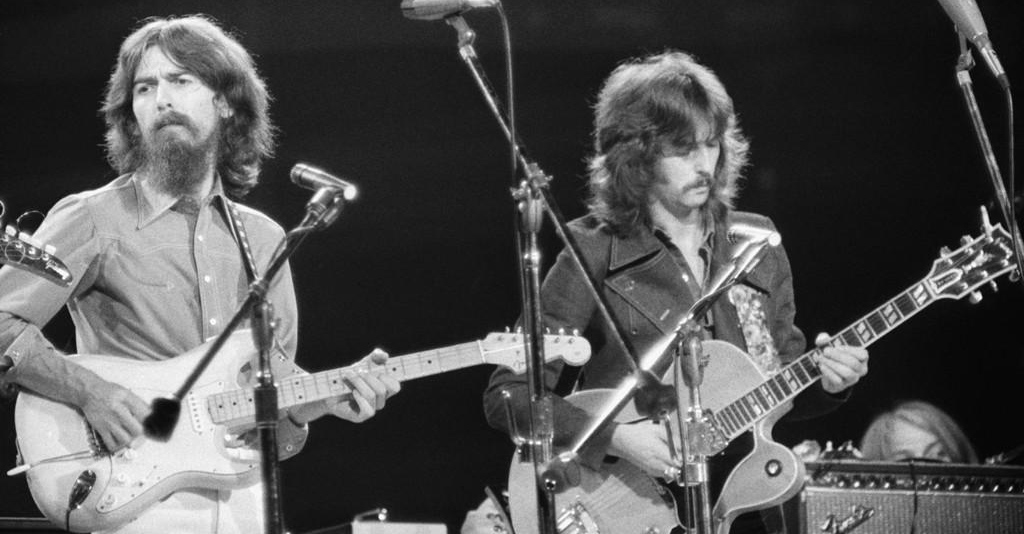
George is the last to arrive. He was already good friends with Clapton — who contributed his part on “While My Guitar Gently Weeps” four months earlier and had played in Lennon’s Plastic Dirty Mac just weeks earlier on the Rock & Roll Circus. Despite the friendship, George doesn’t shy from criticizing his friend’s production.

“There were some nice bits, but … what was … with the photography? You don’t see anything,” George said.

George calls Baker “great,” and Paul asks Ringo if he’s met him “as star drummers.”
George & Eric

Conversation shifted again, George talks about a new song he wrote (“Hear Me Lord”) and then his equipment arrives at the studio (“like an ambulance for ailing documentaries” according to Lindsay-Hogg).

But they can’t shake talking about Cream’s own doc, again mocking the interviewer.

Then, finally after 40 minutes of the tapes, the band’s finally ready to start the business of making music, and a documentary of their own.

I found it interesting, in retrospect, is they’re discussing a farewell concert, which is what Let it Be ended up being — not planned that way, of course (of course?) —  and that’s what they would spend so much of the sessions attempting to organize. Not that Lindsay-Hogg would end up producing anything that looked like the Cream special — nothing he’d done I’ve seen had given that indication — but Let it Be was certainly not anything like the Cream farewell.

But having that reference point so early in the sessions could only have helped light even the smallest of sparks in encouraging the band to do what they always have done, and that’s do something better than every other band.

21 Comments

Filed under Day by day

TMBP Extra: Twickenham saved?

And a break for news.

Back in February we learned Twickenham Film Studios, many times a character in Beatle films and promos and one of the famed villains in “Let it Be,” was slated to close in its 99th year.

Today we learn a “mystery buyer” has put down a 10 percent deposit to keep the studios alive, just a few weeks after a pair of different buyers withdrew their offers —  the first one after local residents opposed the developer’s plans to build a housing complex on the site.

Via Sky News:

Gerald Krasner, from joint administrators Begbies Traynor, told Sky News a mystery buyer exchanged contracts with them on Friday and they have received a 10% deposit.

He said the building would continue as studio facilities with all staff jobs secured.

Colin Firth, Sir Paul McCartney and Steven Spielberg all backed the campaign to save the studios

A statement released by Begbies Traynor added: “It is envisaged that completion will take place later this year.

“At this stage, the purchaser wishes to remain anonymous and further details will be released after completion.”

Staff at studios say they are “delighted” at the news but Maria Walker, who started the petition to save the studios, is wary.

She told Sky News: “I am cautiously optimistic because we don’t know who the buyer is. If it is genuine then it is great news but we do have our concerns.”

2 Comments

Filed under Extra

Jan. 3: Et cetera

With Maxwell’s Silver Hammer, the band wrapped the second day of the sessions at Twickenham. This blog is ready to move onto Jan. 6, the next day the band assembled after the weekend, but first, I wanted to tie up a few loose ends and address a few items that didn’t quite merit their own separate posts.

•  After being introduced the day before, the band continued to work on “Two of Us” in a matter that totally didn’t distinguish itself. The song had the familiar architecture and same lyrics as would be eventually released, while the tune was a little bit quicker than we’d hear. Just ordinary runthroughs churned with nothing groundbreaking and no remarkable dialogue or discussion.

•  With the exception of his introduction of a pair of never-to-be-released originals, Ringo was the real quiet Beatle on Jan. 3. Totally invisible except for his drumming, which was characteristically steady.

•  As they famously did throughout the sessions, the band covered “oldies” (by this point, we’re talking some songs that in 1969 were less than a decade old, of course).  George, Paul and John each led the way at different points. And while they seemed happy — or at least not bored — they weren’t necessarily very good.

To me, this is a hallmark of what these sessions were about prior to beginning to listening to the complete tapes, when I all would see/hear were compilation bootlegs of the sessions. “The Beatles cover all these songs!” OK, great, but they’re not particularly listenable. Or at least re-listenable.


Interesting to note just how many of these songs would eventually see release by these guys on solo records (John and Paul, at least).

This environment of the oldies, however, did at least bring to the forefront their oldies, like “One After 909.”

•  Plus they touched upon a number of contemporary  songs, but “touching” is even too strong a term. Often it was just for a few seconds, and often it was mere mockery. And even then, it’s completely disingenuous to call it covering. In some cases, like “I’m a Tiger” by Lulu, Paul sings the chorus while George tunes up  (That song, incidentally, appeared on No One’s Gonna Change Our World, the record that first debuted “Across the Universe.”).

Dylan got his due with “All Along the Watchtower,” “Blowin’ in the Wind” and “Please Mrs. Henry.”


Paul shows his love for Canned Heat at one point in a hilarious exchange with George and Michael Lindsay-Hogg.

“That Canned Heat number, I love that new one. It’s cornier than the last one, not quite as good. ‘Up the Country‘ is it?”

Paul proceeds to sing the first verse before continuing.

“It’s just got flutes playing. It’s a bit of a fruity thing they do. … Almost no soul.”

“Almost no what?” George asks.

“Soul,” says Paul. “They don’t bend the flutes or anything. But it’s great because they don’t. It’s sort of a … “

Paul offers the flute part in falsetto “doo-doo-doos” and continues..

“The end is great. They do, like, a false end.”

More “doo-doo-doos.”

“They keep going with the flute!”

After some laughs, George does a few-second quote of Canned Heat’s other hit, “On the Road Again,” before the band completely changes course and reintroduces “One After 909”.

As the band departed the session, the last point of discussion caught on tape was George and Mal picking up the discussion they had about equipment earlier in the day, during the “All Things Must Pass” rehearsals. Then with the goodbyes, the day’s tapes are done.

9 Comments

Filed under Day by day

Jan. 3: Fifteen minutes of fame

The second day of sessions at Twickenham on A/B Road clock in at close to 5 1/2 hours, more than two hours of which was spent solely on “All Things Must Pass” and “Maxwell’s Silver Hammer” (a song to a post coming soon).

For sure, much of the time that falls under a certain song’s track was actually dialogue. But ultimately, there wasn’t a lot of new material introduced.

When we did get new stuff, it was a taste of some classic songs.

Indeed, the entire day’s session begins with Paul tickling at the ivories with an incredible one-two punch that lasted just over a minute and a half. “The Long and Winding Road,” right into “Oh! Darling.”  Another future Abbey Road Side 1 track — “Maxwell’s  Silver Hammer,” which wasn’t actually new, but new to the sessions — gets the solo piano treatment next. Enjoy that sequence here:

Paul continues to play, and caps an incredible 15-plus-minute stretch with one more new song, and one that eventually defined the sessions overall: Let It Be.

John, as he was throughout the entirety of the sessions, only brought in the one new track — “Gimme Some Truth” — that day. And again, it wasn’t actually new to the band.

Outside of a pair of Ringo songs we’ve covered previously and seminal songs like “One After 909,” “Because I Know You Love Me So” or “Thinking of Linking,” the balance of originals on Jan. 3 were brief tastes, and in some cases presumably improvised jams.


8 Comments

Filed under Day by day

Jan. 3: Let you down, leave you flat

Central to the legend of the Get Back/Let it Be sessions is the looseness of the group as they sloppily play covers and fool around with their own old songs. So many weird things, tucked in between a million takes of “Get Back” and “I’ve Got a Feeling,” right?

It’s what appealed to me in listening to the Get Back sessions in the first place, so long ago,  when it was available on only curated compilations on vinyl.  And really bad sounding ones, too.  But go to record shows or Beatlefests and scan the back cover, and things seemed like they’d be cool! All these crazy cover songs, all these oldies of theirs, all these outtakes of songs we know and songs we don’t.

But the reality usually didn’t match the fantasy. [This overall theme will absolutely be covered again in this blog, likely ad nauseum].

And on Jan. 3, they did indeed have some fun with some oldies and originals. It’s not great. And really, I think things like this add to the generic resentment toward these sessions by Beatles fans. The band doesn’t care, so why should we?

Really, not a bad point. But it is interesting so long as you accept it for what it is. It’s no different than those of us who have office jobs spending a few minutes doodling on a notepad between taking care of real work, right? Their office happens to be the studio, and their doodles, songs. And if we’re eager enough to listen to their doodles as big enough fans, well… this is what we get.

So while the band didn’t spend all that much time the first few days genuinely going over their old songs,  in addition to a poke at Every Little Thing and the reintroduction of “One After 909,” the band on Jan. 3 went into the back catalog for “You Can’t Do That” — after a take of  Marvin Gaye’s “Hitch Hike,” a song that seems to have inspired the song off A Hard Day’s Night.

It was pretty much 3 a.m. bar-band quality. The song breaks down about a minute in, during the “everybody’s green” part. John keeps singing, Paul keeps in there, too, and eventually the song sort of comes back to life.  They make it through the instrumental portion of the song before things completely break down for good.

More fun and somewhat historic, I suppose, was when Paul took the mic for a more significant take of “I’m So Tired.” Obviously, this was not meant to be anything beyond a bit of fun. Again, more 3 a.m. bar band. But perhaps even moreso. At least, here we got through the song. And even with an attempt at the end-of-song babble!

There’s no context, by the way, for why they went into this take. The tapes I’m listening to (A/B Road) just go from an unidentifiable jam cut straight into “I’m So Tired.”

The 2021 Get Back docuseries uses this sequence to great effect as something of a gag reel, showing various moments of the group yawning, rubbing their eyes, etc., for the final moment of the day’s coverage. I posit it’s also a sneakily effective response to the famous scene of Paul yawning during “Across the Universe” in the Let It Be film, show how everyone was yawning, it wasn’t a reflection of boredom to a particular song.

They stick with the White Album (flip from side 2 to 1 if you’re so inclined) for the next song they roll right into.  As on the record, Paul takes the lead on “Ob-la-di Ob-la-da” — kicking things off with the bass line — but it doesn’t take very long for John to take over.

And with Marmalade’s version of the song presently sitting atop the British singles charts (while the White Album was the best-selling LP), why wouldn’t the McCartney/Lennon songwriting team enjoy themselves all the way through the song?

4 Comments

Filed under Day by day