Twickenham Film Studios, which have been used for films as diverse as Roman Polanski’s Repulsion, Ridley Scott’s Blade Runner and current Oscars hopeful My Week with Marilyn, are to be closed just one year ahead of the facility’s centennial anniversary.
Administrator Gerald Krasner said the business was losing money and would be wound down between now and June, with half of its 17 employees having already left. It was unlikely to be maintained as a film studio by new owners, he said. “We are selling it on,” Mr Krasner told the BBC News website. “Everyone will then be paid in full.”
Twickenham opened in 1913 as St Margaret’s Studios and was given its current moniker in 1929 by one of its most famous owners, British film magnate Julius Hagen. Built on the site of a former ice rink, it was the largest studio in the country during the era and is still considered one of the UK’s pre-eminent film-making facilities alongside Pinewood and Shepperton studios.
The Beatles’ “Revolution” promo, filmed Sept. 1968
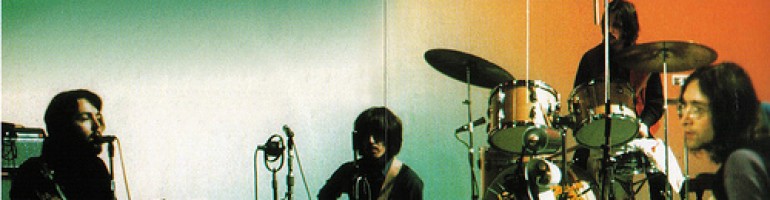
It’s also, of course, where the Beatles filmed parts of A Hard Day’s Night, Help!, the “Hey Jude” and “Revolution” promos and the first half of Let it Be.
It’s back to the timeline next time around, when we pick up where we left off on Jan. 3, 1969.
Just as the band was trying to find an agreeable venue for the concert that would cap the sessions, they likewise were searching for a setlist.
The new songs they were rehearsing were a given — at this early point, it was obvious “I’ve Got a Feeling” and “Don’t Let Me Down” were being worked on to reach that payable point and passed the generally accepted bar of “fast” ones good for a live show.
In a curious admission, George expresses his worry about putting on a TV show of all new songs. Of course, by that point, the critical failure Magical Mystery Tour (the film) was a little over a year old, and it wouldn’t be seen in the United States until 1974, supposedly because of the negative criticism surrounding it.
But they’re still the Beatles! The White Album was in the middle of a nine-week run atop the charts in the U.S., en route to becoming their best-selling record (each sale counted as two). “Hey Jude” was the No. 1 song in the U.S. as recently as six weeks earlier after spending nine atop the Billboard charts, and it was still sitting at No. 15.
Also, they’re the Beatles.
Yet George was still concerned about how new songs would be received.
So of all the songs, George suggests an album track from 1964’s Beatles For Sale.
“We’re not going to do any oldies but goldies for the show?” George asks.
“Dunno, could be” says Paul.
“Cuz I’d like to do it,” George continues, agreeing with someone who says “it would be nice.”
“And also from the selling point of view, in America … maybe it’s all new, or maybe… If they had the album and then saw it, [the concert] a week after. But just to hit… the first initial thing of us singing all completely new … they need something to identify with apart from us. It would be nice to start the show or end the show with a couple of… (then he either cuts himself off of the sound cuts out.)
I’ll tell you which is a good one..
Then George starts playing the beginning to “Every Little Thing.” Paul, the song’s author, joins in with little gusto. We get to see some of this sequence in the 2021 Get Back docuseries.
So of all songs George suggests would be a good kick-start — or capper — to the big concert, it’s not “Hey Jude,” not “Back in the USSR” — which George had been riffing on leading into this suggestion — not his own recent classic “While My Guitar Gently Weeps” or slightly older “Taxman.” He could have suggested “All My Loving,” which opened up the first Ed Sullivan appearance and won over the United States instantly. Or for the idea of going full circle, the first song off their first album in “I Saw Her Standing There.”
But instead it was “Every Little Thing.” A great song! But probably just a tick more familiar as the other new songs they’d debut.
I don’t question the choice from a standpoint of quality. It’s just surprising. And I wonder if it would have done anything to “ease” American audiences.
As it happened, the Beatles would, in fact, find an oldie of theirs to play at the concert that ended the sessions, and they dusted it off earlier in the day on Jan. 3. But while it was an old Beatles song, it wasn’t something that would be at all familiar to fans…
Quite literally, the freshest sound in music right now is by Ringo Starr, whose 17th solo release — Ringo 2012 — hit shelves and servers today (Jan. 31, 2012). Most of the songs are at least co-written by him, meaning perhaps Richard Starkey is is finally hitting his stride as a songwriter as he has little more than 100 songs to his credit over the course of 50-plus years since the Beatles began recording. And many of those — while I don’t doubt his contributions — are things like “Dig It” and “Flying,” songs that received the four-Beatle credit and other songs in which he presumably didn’t have much heavy lifting.
Of course, that list doesn’t count songs written and not registered. It certainly doesn’t have songs he partially crafted. And that’s just what we have out of Ringo as early on the second day as rehearsals continue at Twickenham.
Source: thebeatles.com
George was discussing The Band with Paul and Ringo (John wasn’t there yet) and how their favorite track (presumably off the White Album — he didn’t specify) was “Don’t Pass Me By” because of its country western vibe. “That’s their scene, completely,” George said of the very first composition credited solely to Starkey.
Paul chimes in to ask Ringo, “Are you going to write another?”
“Yes I am,” he replied, almost incredulously before some cross-talk obscures what was said next, although Paul already knew what was in the works. In fact, he already was able to name one — “Picasso” (also bootlegged as “I Bought A Picasso”) — before Ringo started pounding out the chords (a struggle).
“Let’s hear it,” Paul asked, remarking it was “a fast one” — something they were looking to add to the set list of the live show. “Too fast for me,” Ringo replied. Paul, as well as George, had absolutely heard it before based on their reactions and subsequent suggestions.
Sounding very similar — and, really, quite like a sped-up “Don’t Pass Me By” — Ringo then launched into “Taking a Trip to Carolina” — a song he’d first touched upon for 45 seconds or so a few minutes prior to “Picasso.” As he says midway through, “the words are not very good.”
Note that this clip, from the bonus disc that came with “Let it Be … Naked,” begins with the exchange that preceded “Picasso” edited in as the lead-in to “Taking a Trip to Carolina.” But in reality, that’s not the exact order of how it really happened.
“Carolina” was also featured in the 2021 Get Back docuseries.
Ringo wouldn’t showcase a song again until later in the month, with “Octopus’s Garden,” which of course would later appear on Abbey Road (I’ll cover the song’s introduction to the sessions when I reach that date). We wouldn’t hear either “Picasso” or “Taking a Trip to Carolina” for the remainder of the tapes.
He would not have a vocal on Let it Be — either of the iterations (Glyn Johns mix of the Get Back LP or the final Phil Spector production) — marking the first time that happened since the A Hard Day’s Night LP in 1964 (*He didn’t have a lead on ’67’s Magical Mystery Tour, either, but it was technically an EP with old singles padding the US full-album release).
The second day of the sessions at Twickenham, Jan. 3, begins with Paul alone at the piano, and in the span of the first five minutes we hear the first fleeting tastes of “Long and Winding Road” and “Oh! Darling,” plus an extended preview of “Maxwell’s Silver Hammer,” which would see an extensive full band rehearsal later in the day.
While it’s among the dozens of covers sampled that day alone, a few minutes of Paul riffing Samuel Barber’s “Adagio for Strings” jumped out at me as someone who’s seen the film “Let it Be” countless times.
And as the Twickenham stage is set on Jan. 2, the actual first day of the sessions, “Adiago” plays as the opening credits roll, cutting to Paul (with Ringo) at the piano. This truncated version of the song gives way to “Don’t Let Me Down,” and the rest of the film.
The Adagio was broadcast over the radio at the announcement of Franklin D. Roosevelt’s death. It was also played at the funeral of Albert Einstein and at the funeral of Princess Grace of Monaco. It was performed in 2001 at Last Night of the Proms in the Royal Albert Hall to commemorate the victims of the September 11 attacks, replacing the traditional upbeat patriotic songs.
…
In 2004, listeners of the BBC’s Today program voted Adagio for Strings the “saddest classical” work ever..
Thus, of all songs to use to begin the film that ostensibly chronicles the band’s breakup, we get this over the credits.
Something I never completely got my head around is why the Get Back sessions had to happen when they did, in the beginning of the new year, 1969. And in such a disorganized state, to boot.
The timeline is stunning, really, when you look back on it, even in the context of the music industry not being what it is today, when you can go years and years between records.
Consider: On Jan. 2, 1969, the Twickenham sessions got under way. “Hey Jude” was recorded five months earlier (July 31, 1968), released four months earlier (Aug. 26, 1968) and had just finished runs at No. 1 around the world. The White Album was released SIX WEEKS earlier. Six weeks!
The members of the band couldn’t have been bored — John and Yoko were doing the concept art thing, George and Bob Dylan were writing together only weeks earlier in late November (he’d show off “Let it Down” on this day). Paul and Linda were a little less than two months from marrying. Ringo had just appeared in “Candy” and was soon to be in “Magic Christian.” They had stuff going on!
And again, I know, the industry is different today than it was then. But even considering that, there really wasn’t that much reason for the Beatles to rush into the studio in January 1969. It’s just what they did.
Famously, the goal here was to rehearse fresh material for a film or TV special, culminating in a concert before a live audience. New material. Six weeks after they put out a double album.
But there they were, at the Twickenham sound stage on Jan. 2. Six weeks after they released the White Album (did I mention that?). And despite the rush to be there, sessions beginning in the morning like it was an office job, they still didn’t really have the the session’s raison d’être lined up. There was no agreement on a venue to actually perform the concert.
A little more than halfway through the day’s recordings, Glyn Johns and Michael Lindsay-Hogg discuss with Paul — in addition to the state of his beard — the potential venues for the culmilation concert. Legend has local clubs, African amphitheaters and the like in the mix, but from discussions on the first day of the sessions, it’s clear that it’s most likely going to be a soundstage. Twickenham itself is an option, and seemingly Paul’s preferred one (“Just as well stay here”). Another option pitched is Intertel Studio in Wembley, where the Stones’ Rock and Roll Circus was recorded a mere three weeks earlier. The venue received raves — “It sounds like a good live studio.”
Amazingly, at that moment elsewhere at Twickenham– and sure, who knows if he was in the room at the time, out having a smoke, grabbing a bite or in the bathroom — was John Lennon. But he was never consulted (on tape, at least) about what he thought of Intertel. And he only performed “Yer Blues” there a mere three weeks earlier.
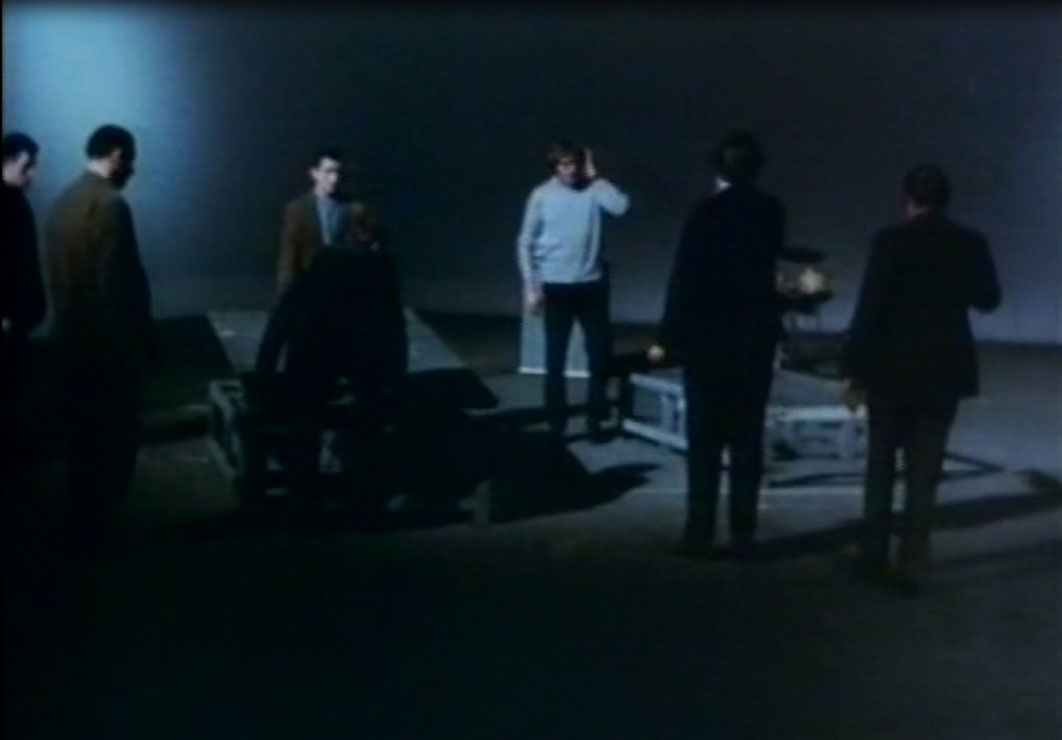
But even though it was a potential concert venue following the rehearsals there, everyone hated Twickenham. PAs hadn’t even been set up (they were arriving later that day). John was suggesting they move into a corner of the room — Ringo was too far away. “This place sounds terrible,” Paul said.
Said Lindsay-Hogg to laughter, “I think the thing to do is just be very flexible about every aspect of the enterprise.”
As a director, Lindsay-Hogg was naturally eyeing a dramatic scene. A Tunisian open-air amphitheater was famously pitched, the Beatles to play at dawn. “Snake charmers, holy men … torchlit, 2,000 Arabs and friends around,” Lindsay-Hogg visualized.
It was never going to happen, no matter what. Paul put it straight right there on Day 1. “I think you’ll find we’re not going abroad, because Ringo just said he doesn’t want to go abroad. And he put his foot down.”
The stage is set at Twickenham as the opening credits roll in “Let it Be.”
Lindsay-Hogg hoped to change minds. “Let’s see what we all feel in a day or two… instead of making anything hard and fast.”
There would be no budging. “Ringo definitely doesn’t want to go abroad,” Paul said, “so that means we don’t go abroad. Maybe we go abroad next time… [but] it would be nice to find some way to do it out of doors.”
Like John wasn’t even considered when discussing a venue he played just weeks earlier, Ringo didn’t state his case in person, only via proxy. It did really sound like it was the first time the topic of concert venue was seriously discussed immediately between the director and the film’s principals, and it was after they had already began the sessions.
Thus, there they were on Jan. 2, starting 20 days of rehearsals culminating in a concert that had absolutely no parameters decided outside of the band scheduled to perform.


 They May Be Parted