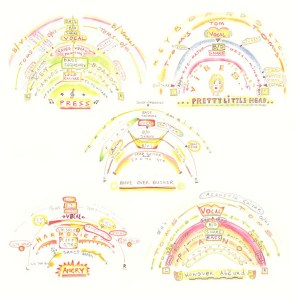
The Beatles, as depicted by John Lennon in November 1968, as published in the December 7, 1968, issue of New Music Express.
In my faith, we count down the 25 days to the start of the Get Back/Let It Be sessions. This is completely normal.
To operate this particular digital advent calendar, simply click the day below and read up on what our boys and their extended circle were doing in these days leading up to their Most Holy Assemblage at Twickenham Film Studios on January 2, 1969.
To write about the Beatles’ lunchroom discussion on January 13, 1969, is to write about a conversation that has no particular aim and a sudden ending. As I wrote last time — I cut-and-pasted this part — it’s sincerely impossible to give a linear rundown of this 30-minute discussion, as it isn’t a linear discussion. My disclaimer remains: You may have already read some of the below in previous posts. Now three parts in, this isn’t a straight recap — instead I’m trying to follow themes as they moved across different points in the conversation.
If you haven’t already, please read Part 1 first and then Part 2. It’ll get you right where you need to be to start off here.
***
There’s no snark, no playing for the cameras, no sarcasm. Otherwise absent, John Lennon revealed his instinctual charm in his vulnerability.
“I played a weaker game now than ever,” John was recorded saying at one point during the Beatles’ lunchroom discussion on January 13, 1969, as captured by the Nagra Tapes.
He did know, however, that whomever he was speaking to, Paul McCartney, Ringo Starr, Yoko Ono and Linda Eastman could listen in and follow up. This wasn’t complete privacy.
This conversation, like so much on the lunchroom Nagra tape and so much of the serious discussion around the band these days, is framed around the group’s approach to George Harrison’s role in the group. John and Paul certainly admitted to treating him “like a mongrel.” But much of the conversation is really centered on John and Paul themselves, the conjoined Nerk Twins and compositional heart and soul of the Beatles, the two biggest heads of the mighty four-headed monster that embodied the Beatles.
Much drama lay in store for the John and Paul relationship in years to come, but a lot had developed already. The threat of a further fracture — of the greater four, of these specific two — hung over Twickenham on January 13, 1969. The four were really three at this point anyway, with George gone.
And then there were those two. It was clear the relationship between John and Paul was, at best, impaired. The Lennon-McCartney partnership was discussedat some length before John and Yoko arrived for the day. In the presence of Ringo, Linda and others, Paul admitted his relationship with John — certainly when it came to songwriting, their job — wasn’t the same.
As the tapes secretly rolled in the Twickenham canteen, John came off as sincere in airing his grievances, which he must have held close prior, given how fresh his admissions sound.
“It’s like George said,” John conceded 12 minutes in, a line captured in the 2021 Get Back docuseries. “It just doesn’t give me the same sort of satisfaction anymore, because of the compromise we’d have to make to be together.”
The end result of the records now aren’t enough. … When something came out, like Revolver or [Sgt.] Pepper or whatever, there was still that element of surprise that we didn’t know where it came from. But now we know exactly where it comes from, and how it arrived at that particular noise, and how it could have been much better. Or it needn’t have been at all. The only way to do it satisfactorily, for yourself, is to do it on your own. And then that’s fucking hard.
So what’s the way out? It should have been these very sessions — the Beatles were in the midst of conducting exactly what it seems like John sought. The Get Back sessions weren’t delicately curated, and even if the actual noises weren’t necessarily unique, the process of creating new songs for a show demanded spontaneity unseen in their history.
John didn’t say the above to Paul, who was engaged in conversation with Yoko. Instead, John was speaking to Linda, who challenged her partner’s partner.
Linda: But you were saying yesterday … you write good songs and it can’t be any better way. You don’t want just studio musicians. I mean, that’s how I look at it. You make good music together, whether you like it or not.
John:I like it.
Linda: And making good music is also … it’s really hard working at a relationship.
Issues clearly emerged in 1968, and whether it sprouted from the death of Brian Epstein or the trip to India or during the White Album sessions itself isn’t necessarily relevant to this discussion. While the 1967 noises still surprised, the White Album left John “dissatisfied” (Ringo disagreed), even though “the end result was as good as it could’ve been.”
At once, John yearned for time on his own, while also lamenting that the Beatles had turned more in that very direction – more actively working separately — during the recording of their last album. To this end, The Beatles LP should have been called “John, Paul, George and Ringo.”
“I dig it, individually, far more than Sgt. Pepper,” John said. “But as a whole — as a Beatles thing, I think it didn’t work as a Beatles thing.”
There’s another contradiction. To get The Beatles Thing, they had to be themselves. But that behavior alienated George.
I wrote about some of what’s written below when I recounted Paul’s concept of a “breakup show” earlier on the 13th, but it’s worth not only repeating but going into further detail in the context of the rest of the lunchroom tape. We’re now in the post-Get Back docuseries world, which requires more commentary than before to amplify or clarify what a broader audience has now seen.
“You try and make George play competently, because you’re afraid that how he’ll play won’t be like you want him to play,” John told Paul. “And that’s what we did.
“And that’s what you did to me.”
The accusation came as no surprise to Paul, who simply mustered a “yeah,” like he did so many times during this conversation in response to John.
We can’t pretend this is a surprising point of contention. Paul Was Bossy largely defined the iconic Winter of Discontent. It was why the Let It Be Sessions, as we often called it once upon a time, was a “failure,” and why we believed the Beatles entered the summer of 1969 to produce Abbey Road as a way to go out on a high. This is 50 years of how Beatles history was recounted, whether you like it or not, to quote Linda.
We know better today, but even if it wasn’t the ultimate casus belli, of course Paul was bossy, even if that’s just in the lowercase. The other Beatles struggled with it: George quit at least in part because of it, and at the canteen, John protested. Paul may have placed himself as merely “secondary boss” earlier in the conversation when discussing an expanded lineup, but now, with around seven minutes left on the lunchroom recording, John conceded he felt powerless working with Paul, and had for some time.
“I’d got to a bit where I thought it’s no good, me telling you how to do it, you know? All I tried to do on [the White A]lbum was just sing it to you like I was drunk, you know? Just did me best to say, ‘Now look, this, this stands up on its own.’
“And I’m not doing this quite well this time, ‘cause I — like, even with ‘Don’t Let Me Down’, the first time I sang it. Because I hadn’t allowed meself to say it was a whole song. I couldn’t — it was only after we’d done it that I’d realized it was done. You know, and on The Beatles album, I just sort of said, ‘Here it is, ignore here, this is me singing it drunk, but I’m pretending as if I’m not. What would you do with it? George, you play whatever you like.’”
Paul arranges “Don’t Let Me Down,” from the January 6 sequence of Get Back.
Paul laughed at John’s second mention of singing drunk, but it goes to John feeling he had to be stripped of inhibitions to present and arrange a song to Paul as finished in his ears and in his eyes. John entered these sessions feeling unsure again, though. As he said regarding “Don’t Let Me Down,” it took Paul and George to help arrange it earlier in the sessions after John himself said he wasn’t sure in which order the song’s three sections should be presented.
You know, and that’s what it was. It wasn’t -– it wasn’t the arrogance of, “Listen, this is it, baby.” It was that I can’ttell you what to do because you won’t play, here, like what I think you should play. And I’m not going to tell you what to play.
Paul and John continued to speak to and over each other. It wasn’t angrily, they just were doing everything to make their respective points.
Paul: OK, and that’s great, you know. And then – it’s just being able to say that, on the occasion, just being – say, “Look, I’m not going to say anything about the song, because it’ll be difficult … to sing it to you.”
John: Yeah, I know, but you wouldn’t say – listen to me – you probably arranged it you know?
Paul: I know, I know.
…
John: Well, I’m saying that “Dear Prudence” is arranged. Can’t you hear [John vocalizes part of the song]. That is the arrangement, you know? But I’m too frightened to say “This is it.” I just sit there and say, “Look, if you don’t come along and play your bit, I won’t do the song,” you know? I can’t do any better than that. Don’t ask me for what movie* you’re gonna play on it.
Because apart from not knowing, I can’t tell you better than you have, what grooves you can play on it. You know, I just can’t work. I can’t do it like that. I never could, you know. But when you think of the other half of it, just think, how much more have I done towards helping you write? I’ve never told you what to sing or what to play. You know, I’ve always done the numbers like that. Now, the only regret, just the past numbers, is when because I’ve been so frightened, that I’ve allowed you to take it somewhere where I didn’t want.
[* Author’s note: I swear “movie” is what John said there, even if it doesn’t sound like it makes sense in context.]
What made the last bit a dialogue instead of a monologue was only the occasional “yeah” delivered by Paul.
John was pouring it out. He admitted fear, regret and submission.
“And then, my only chance was to let George … take over, or interest George in it, because I knew he’d …”
“’She Said, She Said,’” Paul interrupted, and John confirmed.
Interestingly, you can hear Linda replying, “yes, yes,” which means this was a big enough deal to Paul that he shared the story of that song’s recording with her (the couple didn’t meet for nearly a year after that session, so she wasn’t around at the time). It’s easy to reason why he did, and why he likely brought it up within the last 100 hours. With George having just quit, Paul probably told Linda about the time he himself walked out on the band – during the recording of the final song cut for Revolver, on June 21-22, 1966.
I’m not sure but I think it was one of the only Beatle records I never played on. I think we all had a blarney or something and I said, “Oh, fuck you!” and they said, “Well, we’ll do it.” I think George played bass.
Paul’s account had been the single source of this incident. It’s now part of the Beatles’ official history with this passage appearing in the book that accompanied the 2022 Revolver deluxe reissue (along with Paul’s quote):
The disagreement that happened in the dead of night seems to have been about how to resolve differing ideas for the arrangement. A recording sheet in the Abbey Road archive indicates a piano was added to the song at one stage, but no trace of the instrument remains on the tapes.
Back in the Twickenham canteen, John was clear about what mattered to him that night in 1966: “He’d take it as it is,” John said of George before continuing.
“So on [the White Album] … it’s probably George, you know, if there’s anything wrong with it. Because I don’t want your arrangement on it … I only want your … If you give me your suggestions, let me reject them, or if there’s one I like, it’s when we’re writing songs. The same goes for the arrangement.”
Exasperated and resigned, John continued, “I don’t want it to … I don’t know.”
Both Paul and Yoko said they knew what he meant, even if John couldn’t pin it down.
Opposite sides of the same coin. Not captured in Get Back: Yoko chiming in.
In the tape’s final moments, John returned the focus to his in-studio working relationship to Paul and continued to show what, at best, can be called inconsistencies.
And that’s all I did on the last album was say, “OK, Paul, you’re out to decide [how] my songs [are] concerned, arrangement-wise.” … I’d sooner just sing them, than have them turn into, into ‘[Being For the Benefit of] Mr. Kite,’ or anything else, where I’ve accepted the problem from you that it needs arrangement. … I don’t see any further than the guitar, and the drums, and, and George Martin doing the … I don’t hear any of the flutes playing, you know? I suppose I could hear ‘em if I [spoken as if straining] sat down and worked very hard! You know, I could turn out a mathematical drawing, if you like …
Indeed, John was more likely to tell George Martin he wanted “to smell the sawdust” in “Mr. Kite’s” circus atmosphere, or that he wanted to sound like the Dalai Lama chanting from a mountaintop in “Tomorrow Never Knows.” It’s all consistent with John’s outspoken, retrospective dissatisfaction with arrangements on his own songs, like “Across the Universe” and “Strawberry Fields Forever.”
And I really am relying on your touch: Paul’s hand-drawn instrument charts from the gatefold of 1986’s Press to Play LP.
Isn’t John lucky to have run into a guy like Paul McCartney (and a producer like George Martin) to help him take the song beyond guitar and drums and happily chart out those mathematical drawings?
It’s the archetypal refrain when bands splinter: There were musical differences. The Beatles didn’t really have musical differences. Just listen to the music they kept making and their general output as solo artists. These guys just had differences in how to make music. Despite the protestations, John and Paul weren’t incompatible but perfectly complementary, they knew it and we all know it.
How to fit in George (Harrison) was an entirely different issue. This was all part of the “compromise we’d have to make to be together,” as John said earlier at the canteen.
Paul: I’m onto the same thing, you know. … It is only, like, if you can just remember that we’re, you know, the four of us are trying to do that. ‘Cause I mean, all of those things you say, you know, in some way, apply to me. Not always —
John: Yes, yes, because everything applies a little bit to each other.
Paul: It is just you saying it. They’re all, you know, in some way, to some degree, will apply to me.
John: But there was a period where none of us could actually say anything, about your criticisms.
Paul: Yeah. Yeah.
John: ‘Cause you would reject it all.
Paul: Yeah, sure.
John: And so George and I would just go, you know, “I’ll give you a line here,” “OK,” you know, “We’ll do four in a bar, and I’ll do…” [resigned, sincere] And a lot of the times you were right.
Paul: Yeah.
John: But a lot of the times you were the same as they always are. But I can’t see the answer to that.
Paul’s ego at this moment was justifiably boundless, and it extended to his thoughts on the band itself. The Beatles’ reputation earned them wiggle room. It ties indirectly to an imaginary scenario he laid out earlier in the conversation: drunkenly playing the piano just because he felt like it and “everyone in that room will dig it, because it’s me really doing it.”
Here Paul insists the Beatles don’t have to play perfectly to sound that way to listeners and critics.
The thing is, like, within each other, within ourselves, we’ve reached something that’s nearly perfect. And everyone else who’s listening to it — “That’s it! We’ve done it!” … OK, so we know we nearly made it, but we’ve really made it for everyone else. ‘Cause, OK, we’re into the fine, finest, finest technicalities, you know, I mean, that’s where it’s at, you know? If one day, we can even keep all the people who are listening to this, nearly,nearly made it, they think we’ve made it. They think that’s it.
The next bit is familiar from the opening moments of the lunchroom scene of the Get Back series, although on the tapes it actually was said very close to the end.
“Like last week,” Paul said, “I say I was doing all right for me, I was really trying to just say to George, ‘Take it there,’ you know? Whereas I wouldn’t have gone, previously — I would have said, “Take it there – with [vocalizing] ‘diddle-derddl-diddle-der.’ But I was trying last week, to say, ‘Now, take it there, and it needs to be like…”
“You see, the point now is we both did that to George this time,” John replied.
The policy that kept us together. The compromise we’d have to make to be together. John had asserted in the canteen several times there was a system, and in not so many words, he believed that system had collapsed and they broke George. This was, like so many issues these four had, a communication problem.
John put it succinctly: “It’s like if I say, ‘All right, take it,” he’ll say, “Well, look, I can’t take it.”
Before the tape ran out in the lunchroom, as John and Paul continued to discuss their inability to get through to George, musically, we get to hear part of an exchange that was introduced in an edited fashion very early in the Get Back version of the sequence.
Paul: So he knows that when we say, “Take it,” we expect [Paul vocalizing]. If I said that, then he’d … [vocalizing George playing a simplified version of that same part]
John: But it’s just that bit. The bit where we’ve — “I’ve Got a Feeling.” There’s no way we could have translated it to him to say …
Paul: He’d have said, “I’ll do it at home.”
…
John: He’s gonna go home. But so have I, you know. I’m gonna go home in a studio, rather than go through this with anybody.
Paul: I’ve never said to George, “Look, George, I think, when I want a guitar bit, I want it exactly like I want it.” And he’s never said to me, “Well, you can’t have it.” … But that’s it, while he’d never said that to me, and I’ll never say that to him, and we’ll go on. But, really, I mean it is gonna be much better if we can actually say, “Look George, ‘I Got A Feeling,’ I want … exactly [like this].” And he’ll say, “Yeah, but I’m not you and I can’t do it exactly how you do it.”
And that ended the near-30-minute reel. It’s unclear how much longer they spoke, and what direction the conversation took.
So where are we left after extensively eavesdropping on the Beatles?
Ultimately we only know what a 1960s-era miniature spy microphone shoved into a flowerpot in an active lunchroom was able to pick up over a single half-hour period. At several points, the conversation is completely indistinguishable. At others we have a conversation being picked up in the foreground when one in the background is completely obscured. Even with Get Back’s AI, we’ve learned it’s not all perfectly heard.
Thanks to the lunchroom tape we know the Beatles better than before if only because there are more data points to draw upon, but that doesn’t mean we understand things proportionally better. These Beatles were never ones to keep a story consistently straight when it was for public consumption, and it doesn’t seem much different in private.
All at once during this same conversation, John wanted to:
Assign song arrangements to Paul because he didn’t want to bother with the job himself
Ask for suggestions on arrangements with the right of refusal
Not have any additional arrangements to his songs
As relaxedly outspoken he was on the lunchroom tape as well as earlier in talking to the others prior to John’s arrival, Paul was likewise levelheaded, perhaps thinking all along, “John, you’re all over the place, as usual” while never coming close to saying as much.
The tape and these sessions overall allow us to witness a maturation in Paul’s temperament and what sounds anecdotally like a softening in his micromanagement style in the 30 months since his 1966 walkout. He could still be very stubborn, but if we assume the “She Said, She Said” situation was comparable to other tense moments in January ’69, he handled these recent situations with greater poise. Paul recognized it himself saying just above, “Like last week, I say I was doing all right for me.” There are several similar snapshots throughout the sessions at Twickenham where Paul can be heard stopping himself.
Get Back was misleading in its presentation of the “I’ll go home to do it” quote. It’s not that George wanted to quit the band — or for that matter that John wanted to also. Home was the space George was more comfortable working on certain things. Witness the “last-night” songs George composed alone at home. When John says George will go home, he didn’t mean he was quitting the band, as Get Back implies. The context is clear it was to be in a different space to work out his parts.
The Get Back edit of the lunchroom tape is a very frustrating viewing once you know the contents of the entire original half-hour audio tape. Deceptive at its worst and unreliable at other points, the TV edit simply blurs an already schizophrenic conversation. Even if the two central participants were John and Paul, the active presence of Ringo, Yoko and Linda needed to be acknowledged, period.
An alternate televised account of the lunchroom — perhaps openly presented as a supercut or trailer of sorts of the full conversation — would have come off cleaner. A movie trailer never presents the action in the final order, but that’s OK and assumed by a viewer. Openly presenting the lunchroom sequence as a sampler of the conversation — one that jumps in, out and all around — would have been a more fair portrayal to satisfy the critics (like me) while keeping with the show’s clear time limitations.
Paul was most outspoken when discussing the group’s future, both before and during the lunchroom tape. But to be clear, the Beatles always discussed their future, even publicly, going back to the dawn of Beatlemania. You’ve heard John’s quote from November 1963 before:
You can be big-headed and say, ‘”Yeah, we’re gonna last 10 years.” But as soon as you’ve said that you think, ‘We’re lucky if we last three months,’ you know.
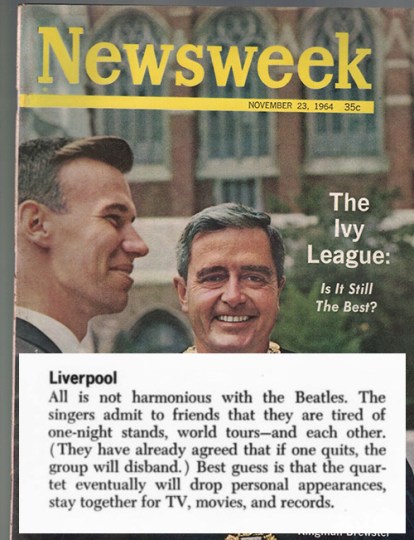
That they were conscious of their future more than six years after that interview should be no surprise. Breakup rumors appeared in the mainstream press as early as 1964 and reignited periodically. They were always expected to break up until they unexpectedly broke up.
The issue date of this Beatles breakup rumor — November 23, 1964 — was the same day “I Feel Fine” was released in the U.S.
How often did the Beatles privately have conversations like this one at the Twickenham canteen? How often over their career during a bumpy period? How often in January 1969? This 30-minute sequence was a one of a kind capture, but it doesn’t make it a one-of-a-kind conversation.
The individual Beatles of January 13, 1969, were closer to 30 years old than 20. Closer to the release of the McCartney LP than Sgt. Pepper. Their egos were developed, and John said he needed to smother his in Paul’s shadow. George’s could hardly develop in the space of John and Paul.
Did John even want George back? That’s not my question, that’s John’s question.
At this point, there are conflicting goals: self-preservation and singing how you really sing it vs. the Beatles Thing. With the luxury of retrospection, we know it shook out OK. Abbey Road was terrific, Let It Be was great and the intermittent singles were fab. It was more in question on January 13, 1969.
Like “Her Majesty” — the conclusion to Abbey Road that had its origins in the Get Back sessions — the lunchroom tape cuts off unresolved. We only know what comes next some short time later: John, Paul and Ringo head back to Twickenham’s sound stage. George isn’t there. They don’t replace him either. They simply go back to the studio.
But George’s on their mind.
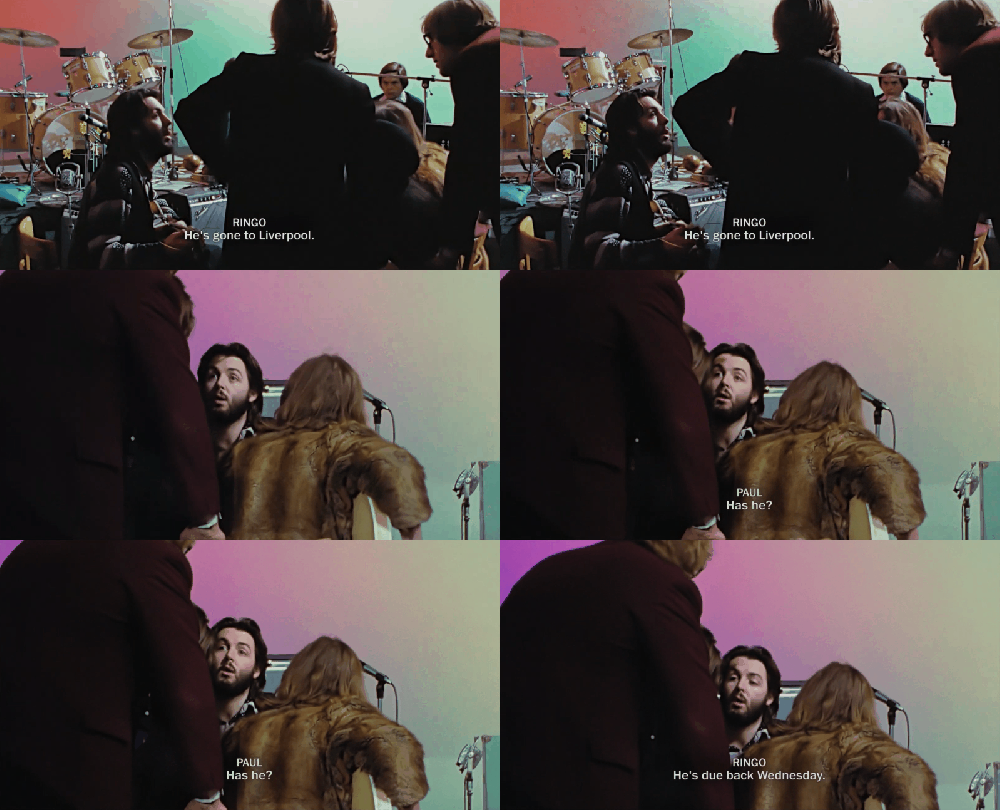
“Let’s go and see George,” Paul said about 10 minutes into the post-lunch Nagras, which were initially filled with idle talk — a little bit about camera work, some about television. There was one problem with that excellent plan, and Ringo delivered the news: George, in fact, had — quite literally — gone back home.
“He’s gone to Liverpool” and would be back Wednesday.
“Oh, then Wednesday’s the day we see him, right?” Yoko replied, cheerfully.
“Yeah, and I think til then … ” Paul said before being cut off by Ringo.
Here’s that disclaimer again. For this series of posts recounting the Beatles’ private January 12, 1969, board meeting, I’m going to jump between various parts of the January 13 Nagra tapes that directly (and indirectly) address January 12, for the sake of the overall narrative. Specific quotes and certain discussion topics conspicuously absent here will soon be tied back into the story. I swear!
****
The Beatles were facing a rupture; at best they were simply in another crisis. George Harrison first walked out on the group January 10, 1969, and then from an Apple Corpsboard meeting at Ringo Starr’s house two days later.
Through — and despite — the tumult, Paul McCartney continued to consider the big show that would serve as the finale of Michael Lindsay-Hogg’s documentary TV show, the grand closing statement. Paul conceived the grandest statement of all, and he shared it with Apple head Neil Aspinall the evening of the 12th. It’s not clear if he told him at Ringo’s or after at a different location, but it was Neil himself who “really finished the idea off, which made it sensational,” per Paul on the Nagra tapes recorded the morning of January 13.
While we were rehearsing the show ourselves, we should have alongside us someone sort of near, so that we’re getting the same kind of buzz but completely independent. We should get, say, the editor of the Daily Mirror. You’d have to get someone as good as him, a real hard news nut, rehearsing a team of really hard, incredible newsmen. With films, writing … so that on the night of the show, in between all our songs is news. But the fastest and hottest, from every corner of the earth.
Paul continued, attempting to sound like a serious news anchor in a breaking news environment, gravity in his voice and mimicking contemporary newsroom sounds, like a reporter tearing copy off a teletype machine.
‘We just heard there’s been an earthquake and so-and-so [makes exploding noise]’. You know, just like incredible news in between each thing, so it’s like a red-hot news program.
And at the end, the final bulletin is:
The Beatles have broken up.
So much for centering a show around 2,000 torch-lit Arabs or a boat ride. Michael is impressed by Paul’s pitch, presumably for its dramatic effect, calling it “nice” after a moment of reflection.
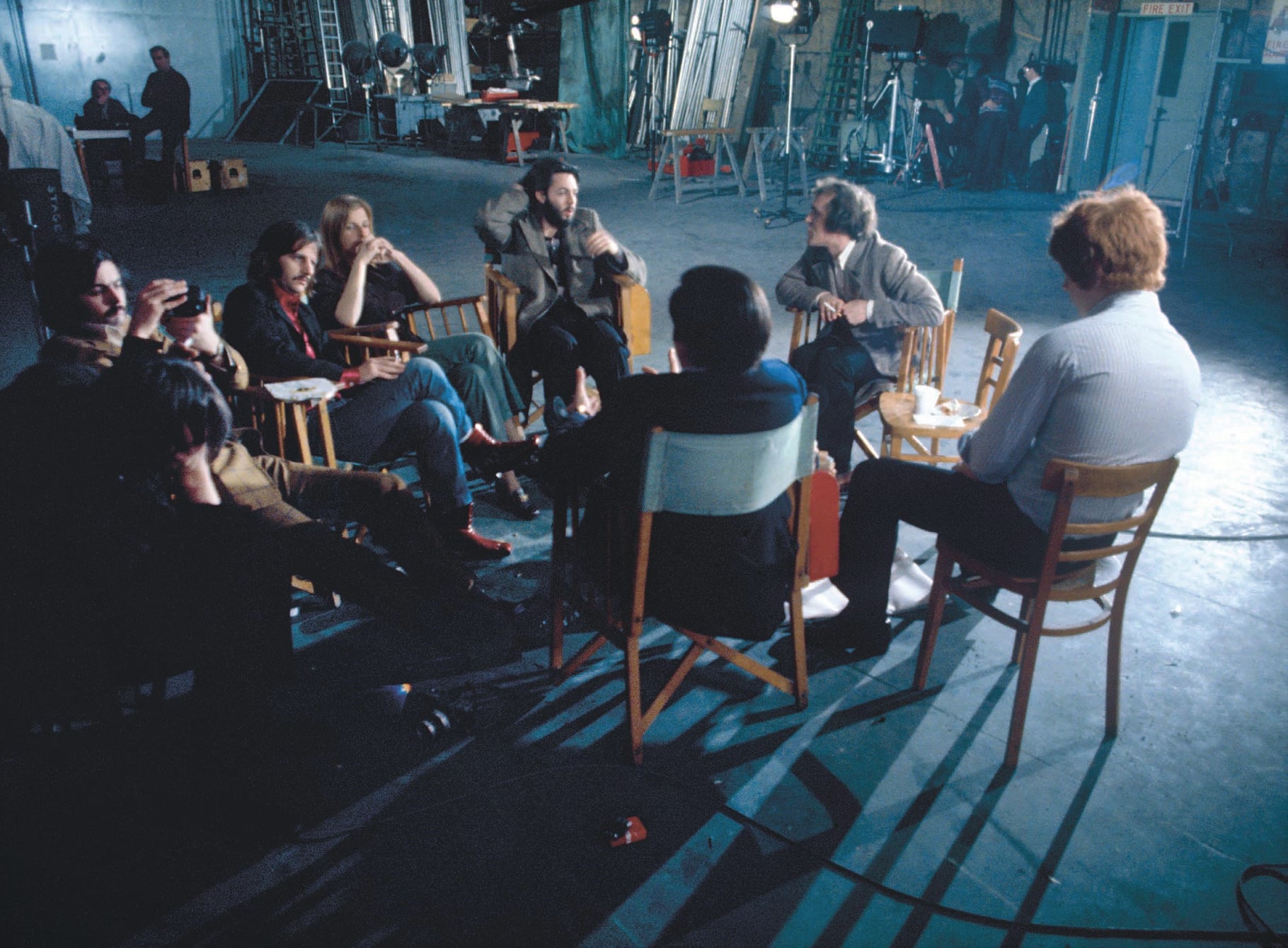
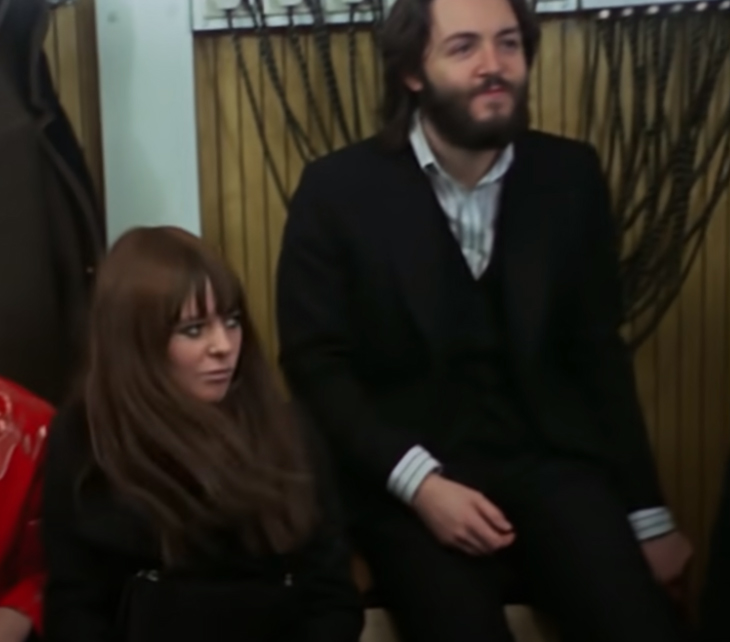
“Nice, but who wants to hear that?” asked Paul’s girlfriend Linda Eastman, who was present both at the meeting the day before and the recap at Twickenham.
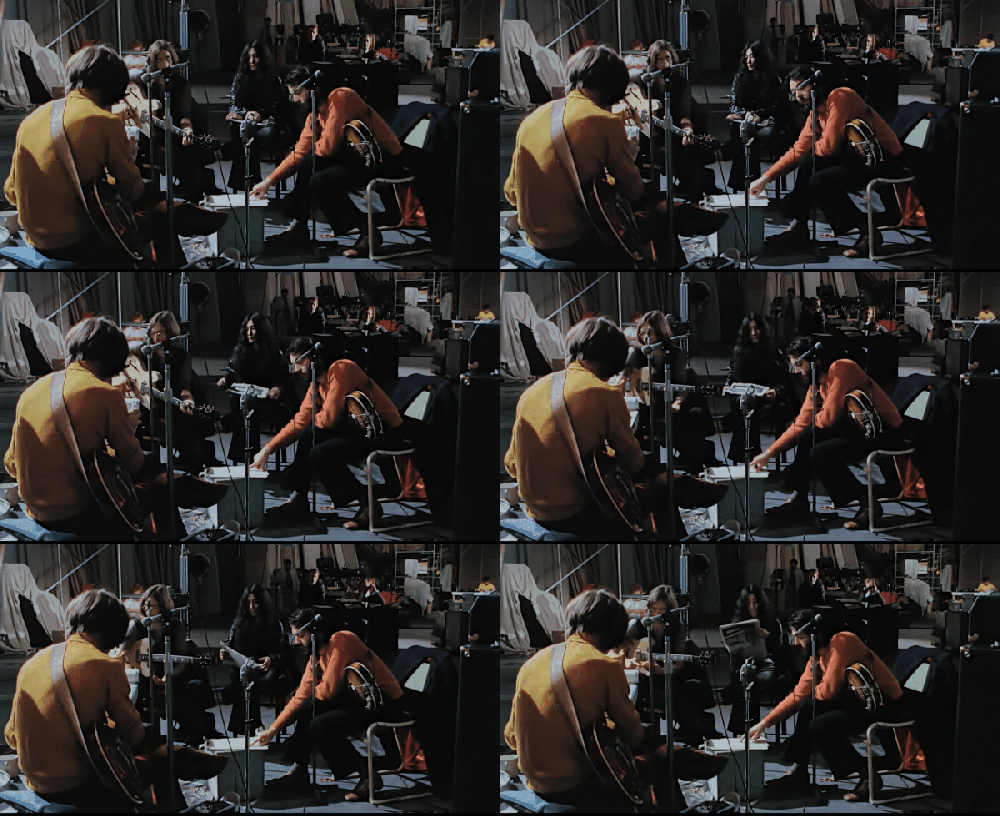
This photo captures around the time Paul was discussing the breakup show concept, on January 13, 1969. (Photo by Ethan Russell from the new Get Back book)
“But, I mean, it would be an incredible show,” Paul said.
Cover all the earthquakes and explosions you want. It was the final implosion that would inflict the most harm to this audience. Immediately before Paul’s pitch, Michael called it “dispiriting” if the Beatles couldn’t find a way to save themselves from a breakup.
“God, it’s an event when a Beatles album comes out,” an exasperated Linda replied to Michael. “Or even a single. People listen more to that than when [President Lyndon] Johnson gives a speech.”
It was the better halves who cared more to see the the group whole.
“It’s like Maureen [Starkey] was saying [presumably at Saturday’s meeting]: We’re fans. The Beatles are it. Musically, I still think that way.”
It continued to be the problem, for at least half the group. During lunch, in a discussion secretly recorded shortly after this conversation on January 13, John decried the Beatles’ “myth” in an echo of George, who said something along those lines a few days earlier.
A mythological concept to John, the sincere fans did believe in Beatles.
Paul’s suggestion of the surprise farewell in the wake of the meeting at Ringo’s came off more for shock than true consumption — it wasn’t discussed on the tapes again, and may never have reached the ears of John or George. But Paul did show a sincere willingness for the group to stand solo in the sun, saying that he himself wasn’t completely satisfied as just a Beatle only. He wasn’t busting any myths, only suggesting there were even more opportunities for them, and not by simply growing the number of Beatles, as John had previously suggested.
Ringo was already contemplating what would eventually become his Sentimental Journey LP a year later, and Paul pressed him to move forward with the idea of this “Stardust” album, despite the drummer’s fear of singing on a record by himself.
From the lunchroom tape on the 13th, in a remarkable exchange:
Paul: It isn’t as daft as you were sort of frightened it might sound. … The great thing is that you singing how you really sing will be it.
Ringo: Yes, but the only way to do it is on your own.
Paul: Until then, yeah, sure. Until then, until you reach how you really sing, you’ll sing your half-soul.
And it’s probably when we’re all very old that we’ll all sing together.
And we’ll all really sing, and we’ll all show each other how good we are, and in fact we’ll die then, I don’t know. Probably something sappy or soft like that. I don’t know.
But really, I mean, it’s really down to all those sort of simple, silly things to me.
Yoko Ono: But those are the important things, you know?
This part of the lunchroom conversation covered much of the same ground as the “divorce” discussion on January 7, but with a softer, more optimistic and accepting posture. A few extra days and George’s actual absence — not merely a threat of one — created a clear difference in the vibe.
Through this John sounded sincerely unsure of himself and the path he’d like to take. It can only be assumed that the lack of cameras or visible recorders allowed him to speak more fearlessly.
While Paul worked to reassure John — “You’ve noticed the two ways open to us. You know the way we all want to go, and you know the way you want to go. Which is positive!” — John’s insecurity overwhelmed his outsized abilities.
“Like Ringo said about his album … I won’t do it cause I’m gonna let us down or look like a fool.”
Days after pushing back on George’s concern that his songs “come out like a compromise,” Paul adjusted his stance. Maybe it’s re-positioning with George gone or maybe it’s a result of the departure and any responsibility he had in it, but Paul showed a retreat on the group micromanaging their respective songs, including his own role in doing so, at least now while they were still together.
What I’d like to do is for the four of us — and you know, we’ve all have done that things to different degrees — I think is if you [Ringo] go one way, you [John] go one way, George one way and me another. But I know it will apply to all of us, if one day you can all be singing like you’re singing, [Ringo] can be drumming like you’re drumming. George can be really playing, I mean like he plays, not like as if I’m trying to make him play. But I keep trying to make him play like that.
This dynamic reached beyond just George and Paul.
“You try and make George play competently because you’re afraid that how he’ll play won’t be like you want him to play,” John replied. “And that’s what we did, and that’s what you did to me. …
“I got to a bit where I thought it’s no good me telling you how to do it, you know? All I tried to do on [the White Album] was just sing it to you like I was drunk, you know? Just did me best to say , ‘Look, this stands up on its own.’ … It wasn’t the arrogance of [saying,] ‘Listen, this is it, baby.’ It isn’t that I can’t tell you what to do because you won’t play here like I think you should play. And I’m not going to tell you what to play.”
The differing approaches John and Paul took to arranging their songs are pretty evident on the Nagra tapes and to readers here. At this point in the lunchroom conversation, John admited he’s just too scared to stop Paul from micromanaging parts to the detail and degree he does.
John continued:
Apart from not knowing, I can’t tell you better than you have, what grooves you’d play on it. … But when you think of the other half of this, just think how much more have I done towards helping you write. I’ve never told you what to sing or what to play.
You know, I’ve always done the numbers like that. Now the only regret, just for the past numbers, is that when because I’ve been so frightened, I’ve allowed you to take it somewhere where I didn’t want. And then my only chance was to let George … take over, or interest George in it.
Of all their songs to name, it’s a notable discussion point and not accidental. The final song recorded for Revolver (and one they played in passing earlier in the week at Twickenham), Paul walked out during its sessions in June 1966, a link from that moment to this one, with a Beatle missing.
I’m not sure but I think it was one of the only Beatles records I never played on. I think we had a barney or something and I said, “Oh, fuck you!” and they said, “Well, we’ll do it.” I think George played bass.
Without Paul’s interference, John could let the others just play their parts as originally, and simply, arranged. “[George would] take it as is, you know?” John recalled before backhandedly crediting Paul’s management style. “It’s George, you know, if there’s anything wrong with it, because I don’t want your arrangement on it. … If you give me your suggestions, let me reject them or in the case there’s one I like, it’s when we’re writing songs.”
The situation wasn’t reciprocal, as John reminded Paul — who agreed — “there was a period where none of us could actually say anything about your criticisms, ’cause you’d reject it all.” (Still, John conceded Paul’s musical decisions would often be the correct ones.)
If this line of conversation sounds familiar, it’s because exactly a week before this lunchroom chat, Paul and George debated this very issue in the quintessential tension-filled moment of the Let It Be film. Ultimately, George wasn’t too excited to take things “as is” and Paul wasn’t necessarily insistent he do so. So the situation is characteristically blurry.
“I’ll play, you know, whatever you want me to play. Or I won’t play at all, if you don’t want me to play. Whatever it is that will please you, I’ll do it.”
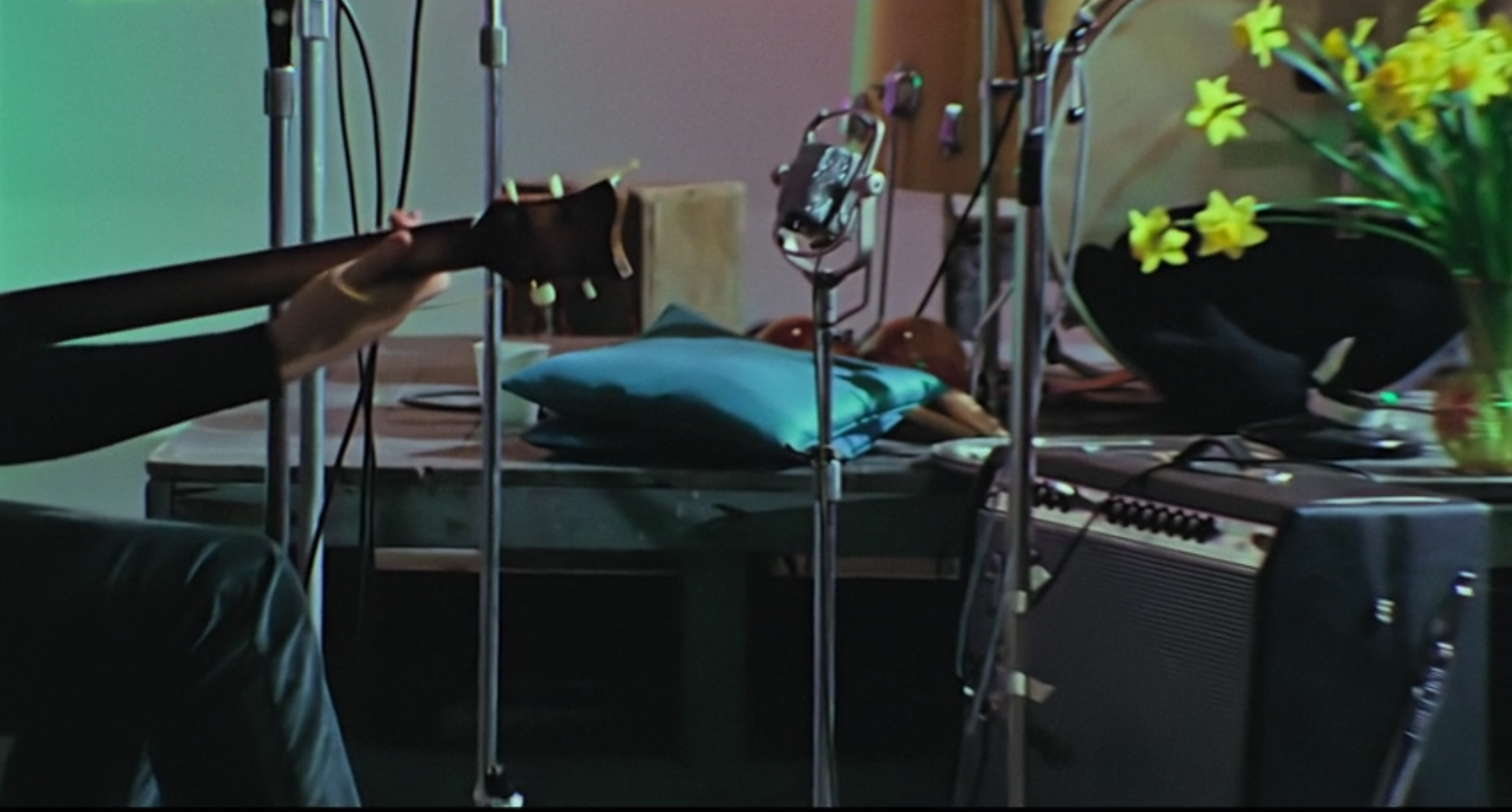
Assuming nobody noticed the hidden microphone in the flower pot at the canteen — a phrase as ridiculous for me to type as it is for you to read — we can be certain none of the parties on the lunchroom tape were playing for the cameras and a larger degree of posterity. (Whether they were being sincere with each other in this private moment is a completely separate question.)
Without the this recording, however, we wouldn’t know just how far Paul was encouraging the others to experience outlets outside the band’s restraints, and just how warmly he spoke of what would be an eventual reunion “when we’re all very old.” It would be a return in which they all can show off how much they’ve grown as artists outside of the limitations and restrictions they posed upon each other, and this reunion would serve as their very final act. It’s sweet and in retrospect very sad, even if Paul backs off a little calling it “silly.” Two Beatles never advanced past middle age, must less having a chance to be “very old.” Thankfully Yoko appreciated Paul’s line of thinking.
Around the context of their conversations and at the precise moment these sessions — and collective future — were in question, Paul’s support for and active, repeated urging of the group to go their separate ways very much complemented his grand statement to end their proposed TV show.
Their ultimate reunion would have made a most spectacular sequel.
Daylight is good at arriving at the right time, but January 11, 1969, was always going to be that gray.
London was rainy that Saturday morning, a desperately needed day off for the Beatles, who finished spending fiveconsecutivepackedand chargeddays at Twickenham Film Studios, the final one witnessing George Harrison quitting the band after lunch.
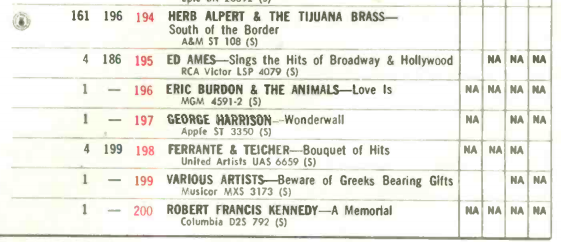
At least George woke up to a little good news: The soundtrack to the film Wonderwall, his excellent first solo effort, cracked the Billboard 200 LP charts in the United States, where the January 11 issue of the magazine placed the LP at a very modest No. 197. (It would eventually peak at No. 49, on March 1, 1969). His presently erstwhile band’s eponymous double album remained the best-selling LP in the country, while Sgt. Pepper’s Lonely Hearts Club Band (No. 56) and Magical Mystery Tour (75) remained on the top half of the charts. Bearing a sound retrospectively of so long ago, these two 1967 releases remained relevant to record-buyers.
(Still, George had one up on Paul McCartney, whose own 1967 release — the soundtrack to The Family Way, ostensibly the first “solo” release by a Beatle, albeit with little participation from Paul himself — did not chart at all.)
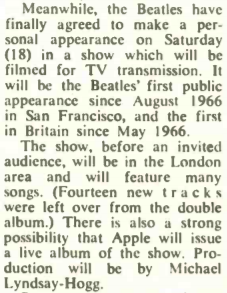
Meanwhile, the Beatles have finally agreed to make a personal appearance on Saturday (18) in a show which will be filmed for TV transmission. It will be the Beatles’ first public appearance since August 1966 in San Francisco, and the first in Britain since May 1966. The show, before an invited audience, will be in the London area and will feature many songs. (Fourteen new tracks were left over from the double album.) There is also a strong possibility that Apple will issue a live album of the show. Production will be by Michael Lyndsay-Hogg. [sic]
As we’ve heard on the Nagra tapes throughout the sessions so far, the show’s date and location had remained completely fluid and in constant state of negotiation to that point, beyond the fact the Beatles were now short a guitarist. We could charitably say 14 White Album leftovers wasn’t far off, although that was probably guesswork on Billboard’s part.
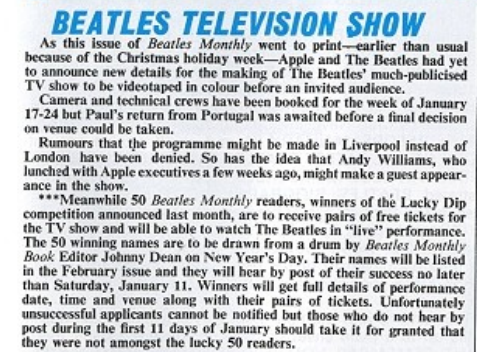
Left unspoken on the tapes was the Beatles Book’s competition (as described in the January 1969 issue), in which 50 winners would earn invitations to the group’s live show on January 18. The magazine said winners would receive details “no later than Saturday, January 11.” But it was the 11th, and no one had been alerted.
George was ready for his own victory, a weekend away from the band with the chance to rest and reset his private and professional problems. Then an unplanned and very personal appearance ended any search for serenity.
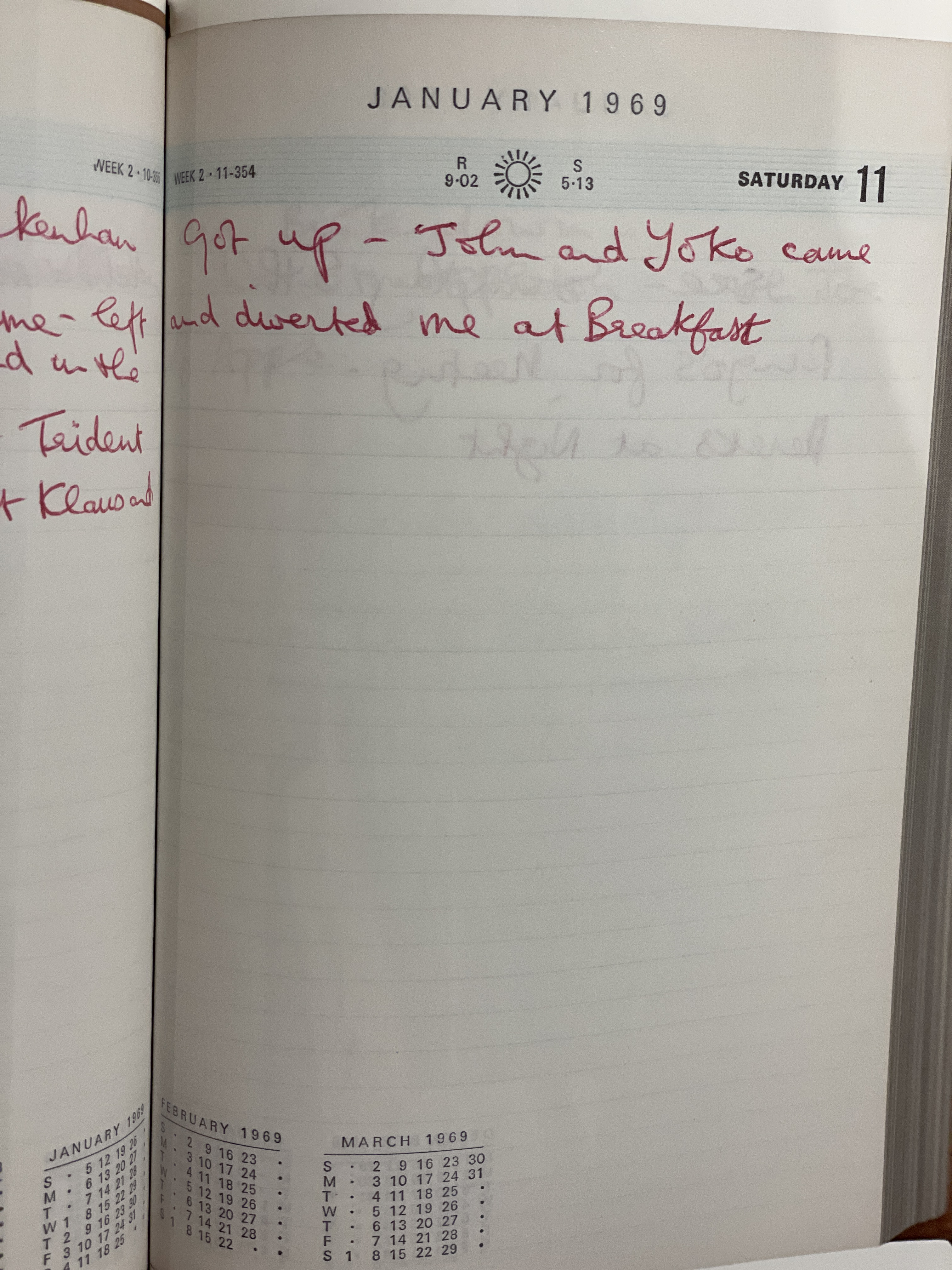
From George’s diary: “Got up – John and Yoko came and diverted me at Breakfast”
George’s diary entry for January 11, 1969. From the Living in the Material World book.
To paraphrase George himself from the Beatles’ chart-topping album, we don’t know how he was diverted. We can only guess what John Lennon and Yoko Ono spoke about with George.
It’s notable, however, that the couple made the effort to intercept George as one of their very first activities that day — George probably wasn’t up at dawn, but it was still what he considered breakfast time. John didn’t offer George any cooling-off period in what could have been an attempt to make amends as much as it may have been a power play on John’s part, a multifaceted attempt to rein in George.
“I’m phoning Eric [Clapton], and he’ll be in Monday to replace you,” one could imagine John saying, with Yoko looking on. “And the others are happy to go along with the change! You should have heard them jamming with Yoko yesterday.”
That’s only a guess at what John could have told George. He could have simply said, “I’m really sorry, please come back,” but we don’t know that either.
We do know the result of the visit: Any apology on John’s part for their presumed midday argument wasn’t good enough, or George, no matter what, was never going to be receptive the day after the walkout. Instead, he would continue his holdout.
Separately, any attempt by Paul McCartney or Ringo Starr to contact George is conspicuous by its absence, a contrast notable in its own right.
The single line about John and Yoko’s visit is the lone January 11 entry in George’s diary.
It’s possible this is the day George threw out Charlotte Martin and reconciled with wife Pattie Boyd. It may have been the day he wrote “Wah-Wah.” But we don’t have any evidence either way, we just know those events happened in this narrow period while George was away from the band.
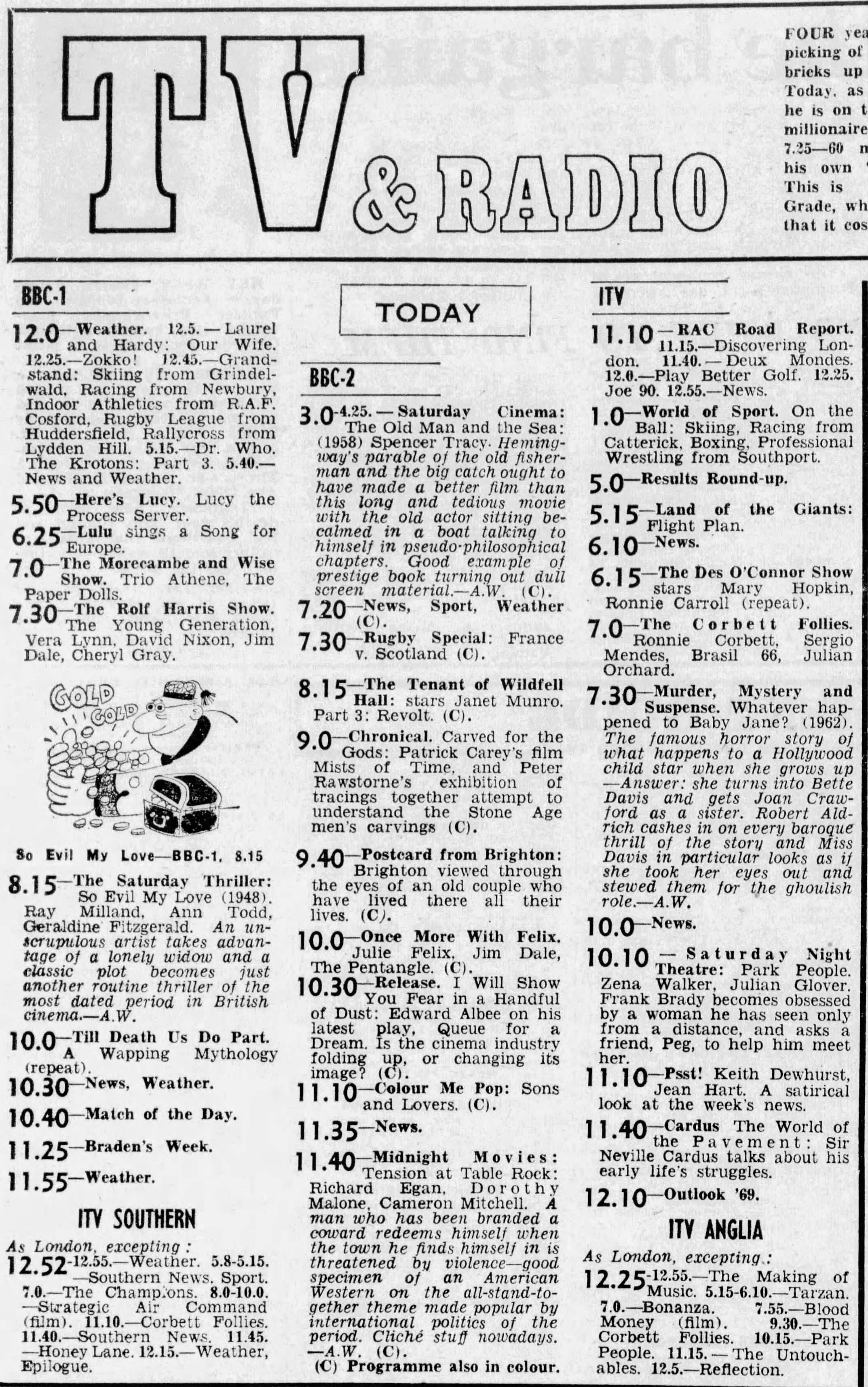
It’s unclear what Paul was doing Saturday. It’s possible that if he stayed in, he watched the Rolf Harris show at 7:30 p.m., when Vera Lynn performed “Good Night” on BBC-1, as promoted by Dick James the day before.
Ringo didn’t bother listening to a cover of the track he sang to close the White Album. Instead, he was tuned to the ITV murder mystery, which was on at the same time.
Saturday night’s TV listings
“Did you see ‘[Whatever Happened To] Baby Jane?’ on Saturday?” Ringo asked Michael Lindsay-Hogg on Monday, January 13, as captured by that day’s Nagra tapes. “Great film.”
The 1962 film starring Bette Davis and Joan Crawford is a dark thriller revolving around a tortured celebrity sibling rivalry. The mixed-up state of the Lennon-McCartney-Harrison dynamic and its internal rivalries had devolved into its own tortured state by this point.
When the calendar turned to January 12, three of them — John, Paul and George — were Sunday driving, separately arriving, on their way to Ringo’s home.
Previewed on Friday before George’s departure, this meeting didn’t occur Saturday, as it was initially discussed. And when they gathered Sunday, it wasn’t exclusively an Apple business meeting as originally scheduled, but it also turned into a rescue mission to get George back to the Get Back sessions and make the Beatles whole again.
“It seems highly unlikely we’d be on,” the guitarist told the director.
With a member of the band unexpectedly AWOL, he was justifiably skeptical the Beatles could stage the big concert to end the film.
“I mean, the law of averages are against it,” he continued. “I think if you could get the juggler on with a couple more clubs, that’d fill in a bit of time.”
That guitarist speaking was George Harrison, and the production was A Hard Day’s Night, the Beatles’ first feature, filmed Spring 1964. On the afternoon of Friday, January 10, 1969, it wasn’t a self-deprecating Ringo Starr who was missing, it was a self-reliant George himself, having sprung Twickenham during his “Winter of Discontent.” This left the remaining Beatles and director Michael Lindsay-Hogg juggling ideas for how to close what would become “Let It Be,” their final film, and who else would be on stage playing lead guitar.
Michael and Ringo, January 1969. From Peter Jackson’s Get Back.
More than a week into the Get Back sessions, Michael continued making similar iterations of the same pitch for the show.
“One of my ideas is if we go to, like, anywhere, that we mightn’t just announce any times for the concert at all,” he said to Paul McCartney later in the day on the 10th. “We’ll set them (the Beatles) up in whatever desert we do it in, and they start to play. And one by one, and ten by ten, people will come in.”
“Inane, I’d call that,” Paul replied with a comedic aggression. “Straight off the top of my head. … Imbecilic. Salacious.”
(Like in his songwriting, at times, Paul sometimes spoke words that simply sounded good, even if they didn’t make sense in context.)
Michael deflected the response, saying “‘imbecilic’ sounded like a bad bug you get the flu from.”
Regaining focus, he invoked the show’s target date, 10 days hence: “I though that could make a very kind of groovy, trendy opening. Seriously, like: January 20, 1969.”
Moments later, the director and the others in the room — which extended beyond just the band — discussed the issue of visas and difficulties several of the Beatles’ peers (Donovan, Mick Jagger and Keith Richards) faced getting into the United States. They were open to several options, including Mexico, the Virgin Islands and other Caribbean destinations.
“And Catalina, which George said wasn’t very nice,” Michael said.
Not that it mattered what George thought then, he’d quit the group almost an hour earlier.
“So what’s our next move?” Michael asked the others.
“We split George’s instruments,” John Lennon said to laughter.
It was clear in the immediate they were not considering splitting the band, though. If the Beatles were going to be on the move, it would just be in a different iteration. Abandoning the project wasn’t a consideration at present.
The conversation would shortly return to locations, with the Roman amphitheater at Sabratha in Tunisia remaining at the forefront, all other contenders just conversation pieces to keep the group engaged. Michael’s long-preferred destination, he enlisted a “reconnaissance team” that included Beatles assistant Mal Evans and producer Denis O’Dell slated to scout the venue the upcoming Monday.
“There has to be someone to say, ‘The weather’s fine, come on in,’” Michael said.
Paul repeated familiar, feasible suggestions (The Cavern Club, Tower Ballroom) along with new nearby options (the Underground) and more distant, outlandish and outrageous ones (“the mouth of a volcano near Ecuador”).
“I think we should do it for more than 500 people,” Michael added.
It was a tough time to think big. This was an afternoon and evening of distractions and interruptions.
In the wake of George’s departure, there were several coincidental arrivals at Twickenham: A package arrived for Paul (marked “‘handle tenderly”); several “EMI heavies” wandered around the soundstage; a CBC interviewer prepped John and Yoko for an infamous interview that would come a few days later.
Rather than return to a full rehearsal, the group joined Michael in telling several imbecilic (and salacious) knock-knock jokes. Of more interest was Michael discussing his career and relationship with Orson Welles, whom decades later he would discover was his father. One lengthy anecdote (which was also detailed in his 2011 autobiography, “Luck and Circumstance”) described Michael acting in Welles’ 1960 stage production of “Chimes of Midnight” when Welles briefly stormed out of the production in anger.
An afternoon replete with nostalgia would soon continue after Paul returned to the piano (you can hear “The Long and Winding Road” and “Adagio for Strings” clearly on the tapes in the background). After quizzing the band on whether they had endured any scuffles with their fans (Ringo recalled being kicked in the head), Michael asked if they looked back fondly on their frenzied touring period.
John replied with an affected accent, the voice of a ragged bluesman looking back on a lifetime, not merely a few years earlier:
Why, I think of it every day. I think what fun we had when we was [sic] the Beatles, playing and rocking with the group around the world. I said, ‘Richard, you remember that?’ He says, ‘No, I hadn’t joined you then.’
Reminded by Ringo he had missed part of the 1964 Australian tour (although he was there for the egging in Brisbane), John evoked the name of the rare Beatle stand-in.
Now with the band facing a new vacancy, would they soon get to Beatle No. 30?
As if on cue, moments later, Michael barked an instruction for additional equipment:
“Glyn, Yoko wants a mic.”
She was back, but the music was hardly intense, with Paul having moved onto his White Album ode “Martha My Dear.” Now, her vocals were largely calm and controlled, more comedic than anything.
While Yoko once again wailed, John — in conversation with Michael — laid out his plans to replace George. He didn’t suggest Yoko.
A few hours earlier, George told the other Beatles, “You need Eric Clapton.” The time had come for John to heed the advice, sharing it with Michael.
“I think if George doesn’t come back by Monday or Tuesday, we ask Eric Clapton to play, ” John said. “Eric would be pleased. He left Cream because they’re all soloists. … The point is, if George leaves, do we want to carry on as Beatles?”
Harsh feedback shortly overwhelmed the room, obscuring some of the conversation on the tapes. But the discussion continued, as Yoko again passionately called out John’s name.
MLH: Maybe for the show, you would just say George is sick.
John: (Sincerely): No, I mean, if he leaves, he leaves.
MLH: But what’s the consensus, do you want to go on with the show and the work?
John: Yeah. If he doesn’t come back by Tuesday, we get Clapton.
Yoko: John!
John: Whaaaaat? (laughter)
John and Yoko continued to repeat each other’s names, but this was the couple playing for laughs. Meanwhile, John and Michael’s discussion continued through the call-and-response, bringing together the issue of show location with locking down a replacement guitarist.
MLH: And what about the venues? … If George comes back we go away, and if Clapton comes in we stay here.
John: We should just go on, as if nothing’s happening.
MLH: I think we should go away.
So eager to get the show on the road, Michael had the potential logistics lined up in his head, proposing the group spend the following week at Twickenham and the week after abroad, all conforming to the group’s timetable, which was in part defined by Ringo’s filming schedule for The Magic Christian.
“What I’ve always thought is we leave here next weekend (January 18-19) and do the show the following weekend (January 25-26) there, if we decide to go there,” Michael said. “And then come back on Monday (January 27), which is just inside Ringo’s seven days.” (The January 20, 1969, date floated previously must have only applied to a domestic show or an alternative, abbreviated schedule.)
Michael’s plans to this point were more extensive than expected, implying there really was no option, at least that he was eager to prepare, other than Sabratha.
“We’ve arranged everything food-wise to come in from Germany,” Michael said, adding for the skeptics, “I do not joke. It’s the same food from the American [military] base.”
Eric Clapton and John Lennon, from the Rock & Roll Circus, December 1968.
And if it wasn’t enough John was trying to enlist Eric Clapton to join the Beatles, Michael casually suggested a near reunion of Cream, if it meant just getting Paul and John to Libya for rehearsals, and Ringo — who was least receptive to travelling — to be minimally overseas.
“We can get out a session man for a couple days,” Michael said. “Or Ginger Baker can come for a few days. Just to kind of routine it.”
The discussion between John and Michael petered out as John joined Paul and Yoko on another jam. Unlike earlier, when the Beatles played hard blues rock out of rage, this improvisation was more subdued, a more gentle and at times an arguably pleasant performance, containing elements of “Castle of the King of Birds.” Paul was on piano, John on guitar and Ringo on tambourine with Yoko providing another disruptive vocal — although not quite as consistently intense than earlier in the day.
Soon, Paul shifted to the drums — and it’s a noticeable drop in quality from Ringo to Paul, as strong as the latter is as a multi-instrumentalist. More importantly, it freed up Ringo, who returned to conversing with Michael. But first, he played up for the cameras (and tapes).
Yeah, rock it to me baby, that’s what I like. You may think this is a full orchestra, but if you look closely you can see there’s only two people playing and one person singing. I know it sounds like Benny Goodman, but don’t worry. It’s the big sound of 1969! You bet your life. Oh, sock it to me, sock it to me. (Laughter)
Interested in the filmmaking, Ringo asked Michael precisely what he was doing — “I thought what we should do is the first sessions when you came back, make it very hand-held looking,” Michael said, pulling the curtain behind the sausage-making. More importantly, Michael shared his first-hand view on what he saw after George walked out.
“And the interesting thing is, Paul went to his amp. … I don’t know if you knew what you did, psychologically, after lunch. You (addressing Paul, who joined them) went at your amp like you shut the door into a closet. … And you (Ringo) were playing very hard. … And John was doing whatever he was doing.”
Ringo, Paul and Michael continued their conversation, as John provided background music — “Sun King” and “Dear Prudence.”
MLH: Have you ever had coverage when you were doing a whole album?
Ringo: No.
MLH: Have you ever wanted it?
Ringo: No.
Like it or not, the Beatles — what presently remained of them — were getting blanket coverage, and the real drama was happening in the studio, not on location.
“Are we meeting again Monday?” Michael asked hopefully in the waning moments of the day’s session.
“Yeah, I’ll have Eric, Jimi (Hendrix, although it could feasibly be Jimmy Page) and Tommy (Evans of the Iveys, perhaps?) lined up,” John replied, with varying and low degrees of sincerity.
Paul’s set his bar much lower.
“A7, D7, G7,” he instructed Maureen Starkey, who was visiting Twickenham that afternoon. “Get ’em off over the weekend and you’re in.”
(Ironically, armed with those chords, Maureen would have been able to fill in for George on his For You Blue.)
Paul with guitar protégée Maureen Starkey. From the Get Back trailer.
Before splitting for the day, Michael made sure to capture the scene. “We have this well-documented. And a lot of shots of the empty cushion.” We’ll see what Peter Jackson shows us in Get Back ’21, but this footage was left on the cutting-room floor of the final cut of Let It Be.
“And I guess that’s it,” wrapped up Michael, who wished the others luck in their planned weekend business meeting, which would include George. “And I hope everything really goes swell. I’d like to say, I’ve enjoyed our week together, hope one day we have another one like it.”
As you certainly know, Clapton never joined the Beatles, and John didn’t bring him in the following Tuesday, even though George wasn’t back. There clearly wasn’t an actual offer anyway.
After George went we had a meeting out at John’s house, and I think John’s first comment was, ‘Let’s get Eric in.’ I said, “No!” I think John was half-joking. We thought, “No, wait a minute. George has left and we can’t have this — it isn’t good enough.’
For his part, Clapton repeatedly downplayed the idea he was an actual fallback option for the Beatles. In modern parlance, Clapton thought John used him as clickbait, and the friendship he had with George would have been a blocker anyway.
There may have been [a suggestion the Beatles would ask him to join]. The problem with that was, I had bonded or was developing a relationship with George — which was exclusive of them. I think it fitted a need of his and mine, that he could elevate himself by having this guy, that I could be like a gun-slinger to them. Lennon would use my name every now and then for clout, as if I was the fastest gun. So I don’t think I could have been brought into the whole thing, because I was too much a mate of George’s.
Several years later, after George’s death, Clapton literally laughed at the idea of joining the Beatles when he was interviewed for Martin Scorsese’s 2011 documentary “Living in the Material World”.
As he said in the clip, the Beatles could be the most close-knit quartet, but at the same time, “the cruelty and the viciousness was unparalleled.”
The latter led the Beatles to this moment. After their first full day at Twickenham, on January 3, George described with envy The Band‘s ability to blur their domestic and working lives, something he witnessed first-hand when he visited the group and Bob Dylan six weeks prior. “They’ve got all that gear there, but … they’re just living, and they happen to be a band as well.”
While he’d join John Lennon as a member of the Dirty Mac before and the Plastic Ono Band later, Eric Clapton was neither asked, nor was he seemingly willing to accept an assignment with the Beatles.
The Beatles didn’t need Eric Clapton, a gunslinger for hire. They needed George Harrison.
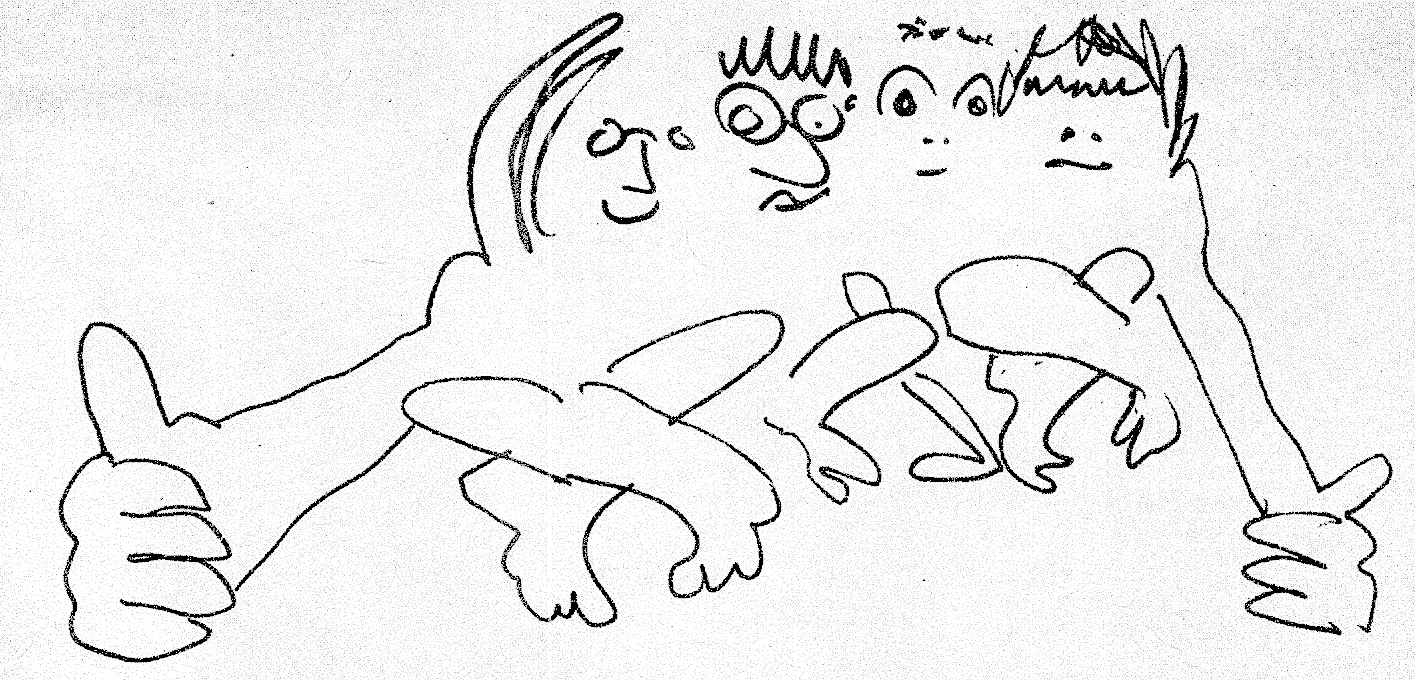 The Beatles, as depicted by John Lennon in November 1968, as published in the December 7, 1968, issue of New Music Express.


























 They May Be Parted