On Nov. 22, 1968, The Beatles graced us with The Beatles, ie., the White Album. It’s as brilliant on a listen today as I’m sure it was then. Yet, less than six weeks after it hit stores, John, Paul, George and Ringo were at Twickenham writing and rehearsing songs that would eventually populate Let It Be, Abbey Road, All Things Must Pass, McCartney and sporadically on other releases.
The Get Back sessions story – what we’re telling here via the Nagra reels — can’t be told completely without the context and seen through, in part, the lens of the rocky White Album sessions. Ringo left the band three months into recording The Beatles. It took only eight days for George to flee the group at Twickenham. Just listen to the group’s own words on Jan. 7, 1969.
Paul: The past couple of months, it’s been this. The [White] album was like this. The album was worse.
George: The Beatles have been in doldrums for at least a year.
Perhaps to snap out of those doldrums, the group flirted with the idea of a live show to promote the White Album into the new year – ie., 1969 – but that idea soon fizzled. That flirtation and subsequent search for a live show scenario, however, was a prevalent theme all January 1969 long with the rooftop show the ultimate answer.
Of course, another important connection linking the White Album and the Get Back sessions are the songs. And not just wacky takes like this:
Or this:
The Get Back sessions continued the White Album’s larger focus on playing together as a band (further distancing themselves from Sgt. Pepper) and ostensibly served as a writing lab and demo venue for Abbey Road, the clear bridge between the two records. “Maxwell’s Silver Hammer” and “Something” both dated to 1968, while “Mean Mr. Mustard” and “Polythene Pam” were rehearsed in the White Album demo session at Kinfauns. “I’ve Got a Feeling” (and “Everybody Had a Hard Year”) and “Don’t Let Me Down” similarly dated to 1968.
So while proximity (1968 vs. 1970 releases) and the ultimate productions do a lot to blur some of the relations between the White Album and Let It Be (via the Get Back sessions), the anniversary of The Beatles’ release offers as good an opportunity as any to briefly mark those ties.
To celebrate, here’s “Revolution,” filmed at Twickenham nearly four months to the day before the band returned to the same soundstage to begin the Get Back sessions.
A wanderingdiscussionostensiblyabout the staging of a Beatles live concert prior to the full-band session on Jan. 7, 1969, was light-hearted no longer as the conversation eclipsed the half-hour mark.
The pressure of the clock and calendar is very real if this thing was going to pull together the way it’s being planned — insomuch as it’s being planned at all — and Paul makes clear to everyone else just how dire the situation is.
Start caring. Now.
Paul: If we’re going to do the show here, we’re going to have to decide today. …If we’re going to do these songs, we’re going to have to learn the chords. … We’ve got to learn the words, certain basic things we’ve just got to do if we’re going to do it.
There’s only two ways. And that’s what I was shouting at the last meeting we had. We’re going to do it, or we’re not going to do it. And I want a decision, because I’m not interested enough to spend my fucking days farting around here while everyone makes up their minds whether they want to do it or not.
I’ll do it. If everyone wants to, then all right. It’s just a bit soft. It’s like a school, you’ve got to be here. And I haven’t. We’ve all left school, and we don’t have to come. But it to a scene where you do have to come.
Michael Lindsay-Hogg: The first thing to get together is yourselves totally. And then we all follow with our kit bags and our cameras.
It’s not the first time this conversation Paul compared the experience to school. And as made clear in the Beatles’ biography, we know how much these four men cared for their responsibility to the classroom.
Things are right back where the discussion started out the “Get Back” introduction earlier that hour. Paul loves this band and doesn’t think anyone else has nearly the level of commitment anymore. And he’s right.
Keeping the Beatles as a performing unit, much less determining how their live show would come off, is not a small issue here, but a minor mystery — the band’s initial, planned timetable for a live show – does become clear in this exchange as Paul continues.
“Five days before [the show] is a week from now,” Paul says, “and that means by the time a week from now comes, all these songs we’ve got we’ve got to know perfectly. And then five days, we really, really get us to know them.”
Beautiful! The early timeline is clarified and confirmed: Five days from this is Jan. 12, a week before Jan. 19. Falling within the estimate drawn from their discussion the prior day — Jan. 18-22 — this pinpoints the original plan for concert day.
Flash forward to the rooftop, when they ended up playing just five complete songs. Do the math, and the Beatles end up on the same timeline originally proposed here.
(Turns out they already know those five songs by Jan. 7 — the just-written “Get Back,” “Don’t Let Me Down,” “I’ve Got a Feeling,” “One After 909” and “Dig a Pony.”)
A conversation between Georges Harrison and Martin about a Jackie Lomax session is held as Paul and Lindsay-Hogg’s continuing discussion on the urgency of the schedule.
As far as the director is concerned, the session’s first day – the abbreviated gathering on Jan. 2 – was the best musical day yet. So at least to him, the entirety of the sessions so far as been a study in deterioration.
“If people aren’t interested, I lose interest,” Paul says.” We can’t blame our tours … and so on and so on.”
“The past couple of months, its been this. The [White] album was like this. The album was worse.”
“What, agony?” Lindsay-Hogg asks.
“Just the whole idea of, “Do you want to do it?’” Paul says.
“And that’s the whole joke of it. After it all came about we all phoned [Neil Aspinall] individually, saying things like, ‘Could you get them together.'” — Paul McCartney, Jan. 7, 1969
Paul relates a story of every Beatle phoning Neil Aspinall individually, with each asking the Apple Records manager and band confidant to reassemble the group.
“Instead of asking each other, we went to Neil asking what are the lads doing. You know, we should just have it out.”
It’s a damning indictment of where the band’s interpersonal communication — a reflection of their desire — stood post-White Album in late 1968, before the sessions at Twickenham would even begin.
George steps back into the conversation with a key admission and seemingly parameters for an endgame for the Beatles.
George: Like you said, ‘Well I’d like to do this, this and that. And I’d like to do this … and I’d like to do that, and I’d like to do that. And we end up doing something, again, that nobody really wants to do.
Paul: If this turns into that, it should definitely be the last for all of us. Because there just isn’t any point.
MLH: That would be sad, as an audience.
Paul: It’s stupid. But it’s even more stupid the other way. To go through it.
George: ‘Cause this time you could using for what you want to be doing: creating, instead of doldrums, which it always is.
The word struck a nerve with Lindsay-Hogg, who was keeping a diary of his recent experiences. “‘Doldrums’ is the word I used. The doldrums have been coming like to a ship on a calm sea.”
“The Beatles have been in doldrums for at least a year,” George says.
Thus, at least to George – and no one disagrees – The Doldrums include the launch of Apple, the trip to India and the entirety of the White Album sessions, and could well stretch back into late ’67. How about Aug. 27, 1967, when Mr. Epstein died, as the genesis?
Today, Lindsay-Hogg – only seven months John’s senior — opts to step into that vacuum as manager/father figure.
“We all need you,” Lindsay-Hogg says as George cheekily accompanies him with an off-the-cuff rendition “What the World Needs Now is Love” in the background. “And it is communication. If you all can’t get it together, that’s really very sad. Maybe what we should do now is let you play a little and you all have lunch together.
“So should we leave you for a while?”
(The lengthy discussion leading up to this point, as covered in the last few posts, was distilled down to a few minutes in the 2021 Get Back docuseries in the January 7 segment).
With Lindsay-Hogg gone, the group fiddles around, seemingly ready to begin the day’s work, musically. Then George steps in and steps up for himself.
“What I was saying about the songs is … I’ve got about 20 songs from 1948, because I knew very well at the moment I’d bring them into the studio that [splat sound] there its gone. And slowly I can bring a couple out because I can get it more like how it should have been then.”
“It doesn’t matter what’s going wrong as long as the four of us notice it,” Paul says as George, now incredulous, sure thinks it does matter what is going wrong as he’s so often wronged.
“And instead of just noticing it, to turn it to put it right,” Paul finishes.
But George is done.
“We should have a divorce.”
Paul admits he’s almost done.
“Well, I said that at the last meeting. But it’s getting near it.”
A deadpan John — mostly silent in the exchange so far — injects a laugh line, asking in the context of the divorce, “Who’d have the children?”
“Dick James,” answers Paul, referring to Northern Songs’ co-owner. (The music publisher would, coincidentally, make an in-person appearance at Twickenham about 72 hours later, immediately before George left the group).
Paul gets in one final point, and directs it squarely at John. He would have liked more input beyond the well-timed zinger.
Just because it’s so silly of us at this point in our lives to crack up. It’s just so silly, because there’s no point. We’re not going to get anywhere we want to get by doing that. The only possible direction is the other way from that. But the thing is, we’re all just theoretically agreeing with it, but we’re not doing it.
You’re doing it with your thing with you and Yoko. But it’s silly to come in and [be] talking down to us, when actually your way out is not to talk — rather than talk down to us, which you’d have to do. And you wouldn’t. And remember, I think I’m talking down to you, too. … We’re sort of talking down to each other.
George wants a divorce. Paul is desperate for John to show up. Nobody wants to be there and they’re running out of time to salvage what time they’ve already spent working on their product at Twickenham.
This moment, right here on Jan. 7, would be the moment that would make the most sense for the Beatles to break up, go on hiatus, something, anything. Everyone’s tugging at the band-aid. But no one is willing to provide the last rip.
All the arguing, backbiting, rash decisions they would be so well known for in their eventual breakup wasn’t second-nature yet. So they do the only thing that really is: play music together.
“OK,” Paul continues, and picking the song most obvious to begin with. “‘I’ve Got a Feeling.’ One-two-three-four…”
And John immediately goes into “She Came in Through the Bathroom Window,” as the take quickly breaks down in laughter.
“How does it go?” John asks.
And then, astoundingly, the day’s sessions begin in full, starting with about 20 minutes (on tape) of “I’ve Got a Feeling.”
What on earth to make of all of this?
Having “compared it to a marriage a million times” (John, from 1976, as quoted in the “Anthology” book), it stands that the band’s ultimate split would be a “divorce.” George asked for it Jan. 7, 1969, and eight-plus months later John would ask for the same thing.
“I want a divorce, like my divorce from Cynthia,” John is famously quoted as saying late September 1969 in Phillip Norman’s “Shout!” “It’s given me a great feeling of freedom.”
The Beatles were Paul’s band, by the time they were at Twickenham, after first being John’s. The Beatles weren’t George’s — as critical and brilliant he was — and thus it wasn’t his place to ask for a divorce. He could just leave — which he would a few days later — and in that way he absolutely held sway over the band’s future, engineering Billy Preston’s arrival and the shift into cozy 3 Savile Row. Conceding to George things nobody else was wed to but having him in the Beatles beat not having George in the Beatles. But there was no getting around his junior membership, in a sense.
Even in suggesting a divorce, George was immediately met with Paul basically saying, “Me too.” But since Paul wasn’t ready and John was silent on the issue, the divorce wasn’t going to happen.
It’s clear the group’s momentum and motivation as things stand on Jan. 7 is founded on nothing. It sounds as if getting anything done post-Sgt. Pepper was a miracle. Epstein is missed, and it’s become plainly obvious. Based on their brutal descriptions of the White Album sessions, it’s amazing, in retrospect, they finished the LP, much less recorded as many songs as they did for as many months as they did.
Paul’s right — these guys are indeed “on their own at the holiday camp.” They’re four men pushing 30 who don’t know life beyond the extremes of childhood and being a Beatle. A day earlier, in the wake of the “I’ll play if you want me to play” argument, it sounded like it was an option for the group to remain as one in name, at least. Now, even that seemed out of reach.
The Beatles reached a pivot point on Jan. 7 to commit or bust, and, against all reason based on their arguments, they chose to commit. To what, nobody seemed to know.
Quick quiz: When the Beatles convened Jan. 2, 1969, at Twickenham for the Get Back/Let it Be sessions, what was their most recent record release?
It wasn’t the “Hey Jude” single, which was still on the charts , but came out the end of August 1968. It’s not the White Album either — that came out at the end of November. The soundtrack to the Yellow Submarine film was released nearly two weeks into the January 1969 sessions, with songs that had long been recorded.
Check the solo discographies, even, and you come close — but not close enough. Two Virgins — cut in May — came out a week after the White Album. John also participated in the Rock & Roll Circus on Dec. 11, 1968, but that recording wasn’t released until 1996. George’s Wonderwall Music was close, too, released Nov.1, 1968 in the U.K. and Dec. 1 in the U.S.
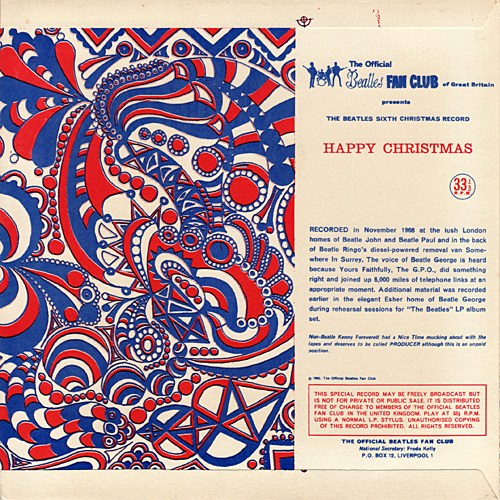
The answer, a giveaway by now thanks to the post title and above image, is the Beatles’ Sixth Christmas Record, recorded post-White Album sessions in November 1968 and released Dec. 20, 1968, less than two weeks before the band assembled at Twickenham in Jan. 1969, and while the band was in active discussions planning out the film and potential shows.
Does it portend anything musically for the band? Well, no, not at all.
It’s odd and experimental in (most) places. But perhaps more relevant, this is the first of the fan-club-only Christmas releases, which date back to 1963, in which the group wasn’t actually a group, with each of the four members submitted their own message for inclusion. How separate were they? It was an international affair with George literally phoning it in from L.A., while the rest of the band put their respective pieces together from their homes.
Alas, they were forced back together again days later at Twickenham, but by the time their following (and last) Christmas albumcame out in Dec. 1969, they’d be done recording as The Beatles, separately or together, altogether (one exception aside).
I originally put this post together in 2012, to mark Paul McCartney’s 70th birthday. Since then, I’ve added similar, more extensive birthday posts for John Lennon, George Harrison and Ringo Starr.
Like the many millions of Beatles-focused blogs, of course I need to recognize Paul McCartney’s milestone birthday.
I’ve wrestled with just how. This blog is a niche, focused on January 1969’s Get Back/Let It Be sessions and its reasonable relations (the Let It Be album and movie). June 18 is half a year away from January, so there’s no direct tie to the timeline.
The easy way out is to post a relevant video of Paul from the sessions, pluck out some classic tune, and I just leave it there.
But I got to thinking about June 1969, a few months after the sessions, and just what the band was doing. And the answer was… nothing.
“Get Back” — the single — was already a hit. The Get Back album was alive and being worked on by Glyn Johns. A couple of songs for Abbey Road were worked on, but not extensively. “The Ballad of John and Yoko” was quickly written and recorded in April and released the end of May.
But June? No studio time.
Come July 1, the full recording sessions for Abbey Road would formally begin. Before September was out, it was in stores. Think about that. It took less than three months for the vast majority of Abbey Road to be recorded. It took me about three months to bang out 10 posts for this blog.
So with nothing going on June 18, 1969, I backed up a year to the same date in 1968. There was no recording session that day, either, but the band was about three weeks into the White Album sessions, with “Revolution” “Don’t Pass Me By” and “Blackbird” having been worked on to that point.
And yet again, like I always am by the Beatles and keep finding myself as I work on this blog, I’m left marveling at things I already knew but didn’t think much about. Between Paul’s birthday in 1968 and 1969, the band recorded the vast majority of the White Album, the entirety of what would become Let It Be and had gotten Abbey Road under way (with most of the songs already written) — not to mention recording and releasing things like “Hey Jude,” too. Tack on three more months, and over 15 months we had all three albums in the can. Remarkable. (And that’s just what they did on vinyl — they also built Apple, had personal lives, side projects, etc.).
So where does that leave this post? Well, back to the start I think: Pluck something from the sessions and leave it at that.
So for Paul’s 70th, here’s one of the greatest of them all, and the song from which this blog’s name came from, “Let It Be.”
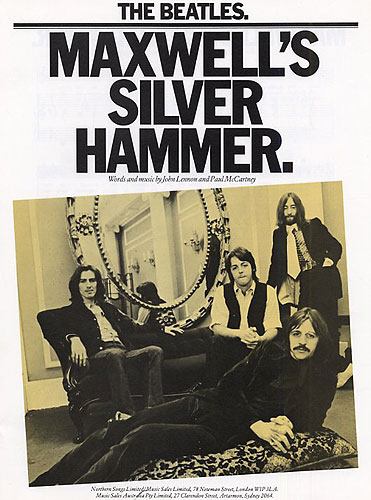
Well before it was derided by John as more “granny music,” George as “so fruity” and Ringo as “worst session ever” (in reference to the Abbey Road recording), “Maxwell’s Silver Hammer” on Jan. 3, 1969, was simply “the corny one,” a song The Beatles had yet to rehearse so many times that it literally caused bandmembers to refuse to participate or go ahead and quit the band.
Written in October 1968, just too late for inclusion on the White Album (per Lewisohn) — but apparently never rehearsed then — we hear it for the first time as Paul doodles on the piano to start the Jan. 3 sessions.
With Paul in novelty-song mode for much of the White Album (a planned topic of a post for the distant future, when I’m done with the Nagra timeline), this tune would have fit like a glove on that record. And, perhaps it’s in retrospect, but it didn’t fit at all with Get Back/Let it Be, at least what we’ve heard in these first few days.
Hours after the piano sketch, we get to hear the full band tackle the song for the first time in rehearsals that clock in at less than 35 minutes.
It’s an interesting contrast with the “All Things Must Pass” rehearsals that had just occurred earlier in the day. George played and sang his heart out, clearly exasperated and desperate for the band to appreciate the song. Paul, meanwhile, is slogging through “Maxwell’s.” He knows he band will learn it, even if they hate it (and they will in time!).
While George is desperate to bring “All Things Must Pass” to the band, he’s seems aware there’s little urgency.
Paul, meanwhile, laughs, scats the lyrics, has an extremely relaxed demeanor, especially impressive given the long day that’s near to ending.
The Let it Be film captures some of this pretty well, with Paul barking out chords. If you’re able to follow along at home, the first 45 seconds or so are indeed from these Jan. 3 sessions, with the edit coming right as the anvil hits.
With Paul in instructional mode, George is proactive in offering suggestions to the harmonies as well as guitar licks. Again, quite the opposite experience from “All Things Must Pass,” where the other members of the band did little to add to the song George brought to them.
The origin of the song’s most notable feature — the anvil — is discussed by Paul during one of the takes.
“Originally, I was trying to get a hammer, which we might get Mal [Evans] to do. A hammer, like on an anvil. A big hammer on an anvil.
You can’t make it with anything else. Bang, bang!”
As they had done earlier in the sessions on “Don’t Let Me Down” and “All Things Must Pass,” the band shakes up the lineup as the “Maxwell’s” rehearsals progress, with Paul shifting to piano and George taking over on bass, preferring the six-string. At one point, Paul asks George for his bass to sound like it was “from those movies” — a shivering sound during the “Joan was dead” bit.
It’s a fun, bouncy song at this point, none of the weight of the Moog on the Abbey Road version, and a circus-like groove from the rhythm section. There is the old-timey movie feel to it, and it works for whatever the song at present is.
In something of a telling, but confusing exchange, George asks about the seemingly incomplete state of the lyrics. At this point, all we’ve heard in both the early solo piano sketch and the afternoon full-band rehearsals are just the two verses and the chorus.
To my ears, this is what they say:
Paul: There’s only two verses. … But I don’t really know where it goes after that.
John: Finish three of them. You need another one, yeah?
George: Do the words, like, resolve the story?
Paul: Well, they will do.
George: I mean, there’s no more to write?
Paul: No, no not more to write.
Here it seems Paul is content to have the song’s lyrics stay as they are in truncated form — no P.C. 31, testimonial pictures, Rose, Valerie or the judge — and perhaps the musical arrangement alone is what he plans to finish.
Again, the contrast with “All Things Must Pass” is fascinating. “Maxwell’s” isn’t brand-new — it’s a few months old — but it’s still incomplete. If anything, “ATMP” is newer, and it’s a finished product when it was brought to the band.
Really, I think what we’re learning here George is a saint — he not only brings polished work to the group only to have it passively embraced, he’s busy working to improve everyone else’s songs. Sure, we know he actually quits the band in a few days, but you’d have to think this is a pattern that appeared on prior records, but we only have tape of these sessions to hear it.
Further, and it’s a point I’ve obsessed on before, but why bring an incomplete song to a session that seemingly had a purpose and endgame, a live show soon to be recorded? Shouldn’t everyone be bringing their best material to the table? Was “Maxwell’s” — and we know, ultimately, on Abbey Road it didn’t change that much musically and would only get the extra verse — really something worth spending valuable time on when we know what great stuff Paul had in the bank already (“Two of Us,” “Long And Winding Road,” “Let it Be,” “She Came in Through the Bathroom Window,” etc.)? They’re rehearsing an incomplete song, they’d have to get back to it regardless. Paul makes a brief mention of where an orchestra would come in — clearly he was thinking beyond just the live rock show.
At least this early version of “Maxwell’s” gives us the memorable lines: “Back in class again/Maxwell is an ass again” and “She tells Max to stay/when his ass has gone away.” Alas, never to make the final cut.
With the end of the “Maxwell’s” sessions, the band wraps it up for the day, a Friday. The day’s tapes end with the band saying their goodbyes and, the working stiffs they were, agreeing to reassemble Monday at 10 a.m.
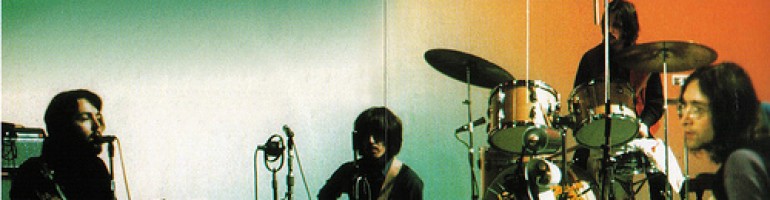
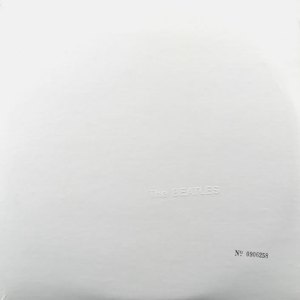 The Get Back sessions story – what we’re telling here via the Nagra reels — can’t be told completely without the context and seen through, in part, the lens of the rocky White Album sessions. Ringo left the band three months into recording The Beatles. It took only eight days for George to flee the group at Twickenham. Just listen to the group’s own words on Jan. 7, 1969.
 Beautiful! The early timeline is clarified and confirmed: Five days from this is Jan. 12, a week before Jan. 19. Falling within the estimate drawn from their discussion the prior day —
 They May Be Parted