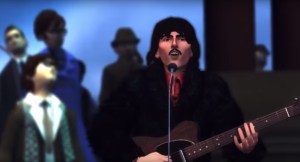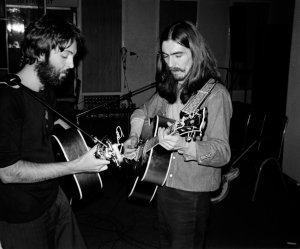
On the afternoon of January 10, 1969, seven days into the Get Back sessions and nearly 10 years into his tenure with the band — a term that began when he was 15 years old — George Harrison quit the Beatles.
George: I’m leaving the band now.
John Lennon: When?
George: Now.
After a cut in the Nagra tapes, which captured the exchange, George casually continued: “Get a replacement. [Place an ad] in NME and get a few people.”
While the tapes don’t capture him saying “see you ’round the clubs,” it’s too good a line to be purely apocryphal (and it’s, in fact, alluded to by others on the tapes later in the day). George then briefly shared a few words with Mal Evans and was off, his boots echoing as he departed.
Likewise, for the sake of the complete record, there is simply no indication on the tapes of what happened between the final take of “Two of Us,” and George’s departure, the immediate spark of George’s decision (if there was any). Like the Beatles themselves, the tapes were out to lunch.
Film director Michael Lindsay-Hogg, so proud of his spy microphone hours earlier, had the right instincts and was prepared for this moment, but he probably should have upgraded to a better model.
“My bug had only picked up the sounds of cutlery banging on china plates, obscuring what the muffled voices had said,” Michael wrote in his 2011 autobiography Luck and Circumstance. In his “role as documentarian,” he had asked his sound engineer to mic the flowerpot on the dining room table as George encountered the band at lunchtime. Per Michael, George concluded by saying, “See you ’round the clubs.”

George grabs his coat on his way out of the utter sty that was the studio at Twickenham, as pictured on an earlier day. (Screen capture from Beatles Anthology)
What exactly happened over lunch is a source of legitimate dispute in Beatles history. Dig in — here are varied accounts that span 50 years.
The most contemporary retelling of the events of January 10, 1969, comes from George himself, later that day, in his personal diary.
Got up went to Twickenham rehearsed until lunch time – left the Beatles – went home and in the evening did King of Fuh at Trident Studio — had chips later at Klaus and Christines went home.
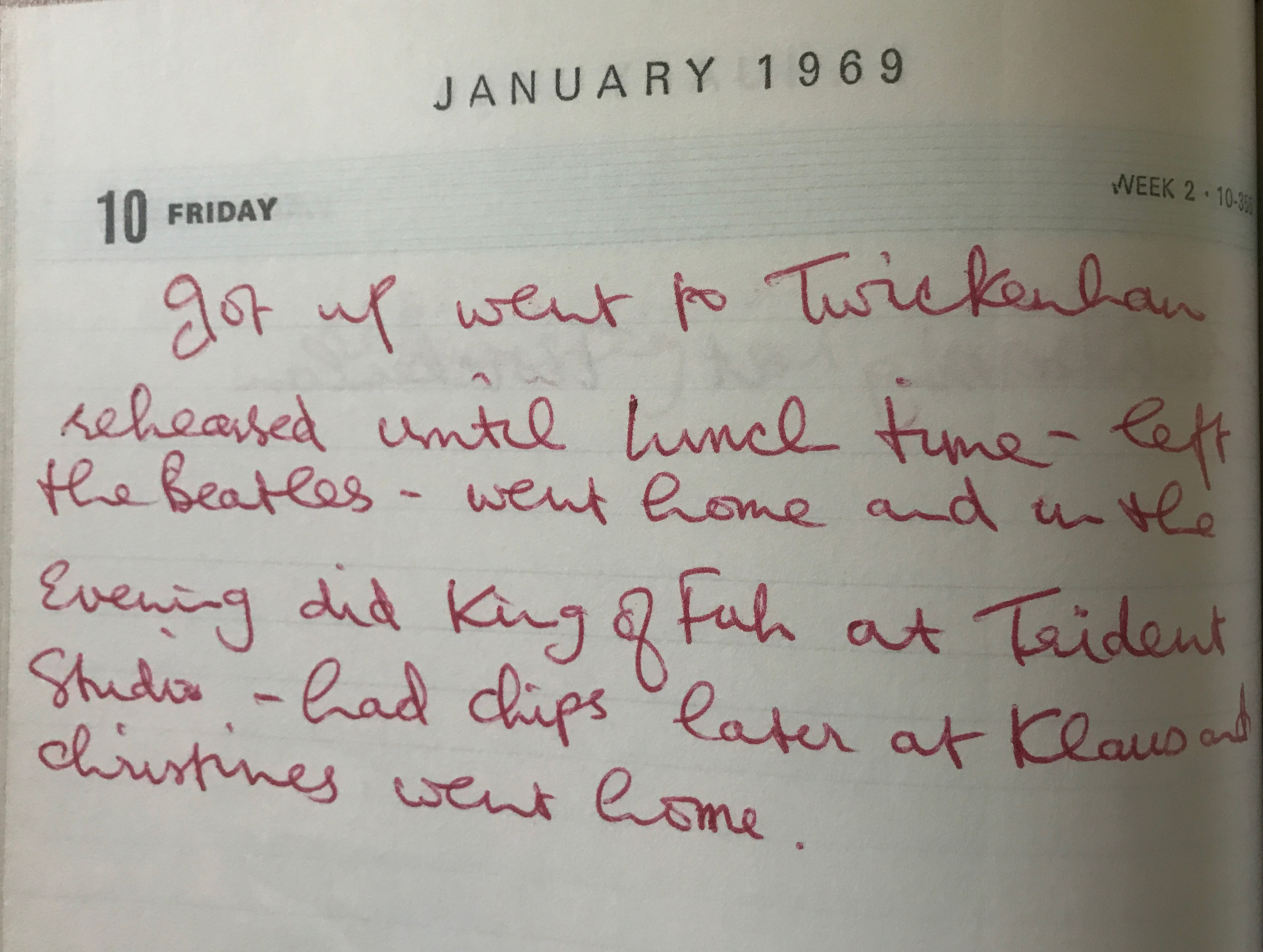
George’s diary entry for January 10, 1969, as later published in the Living in the Material World book in 2011.
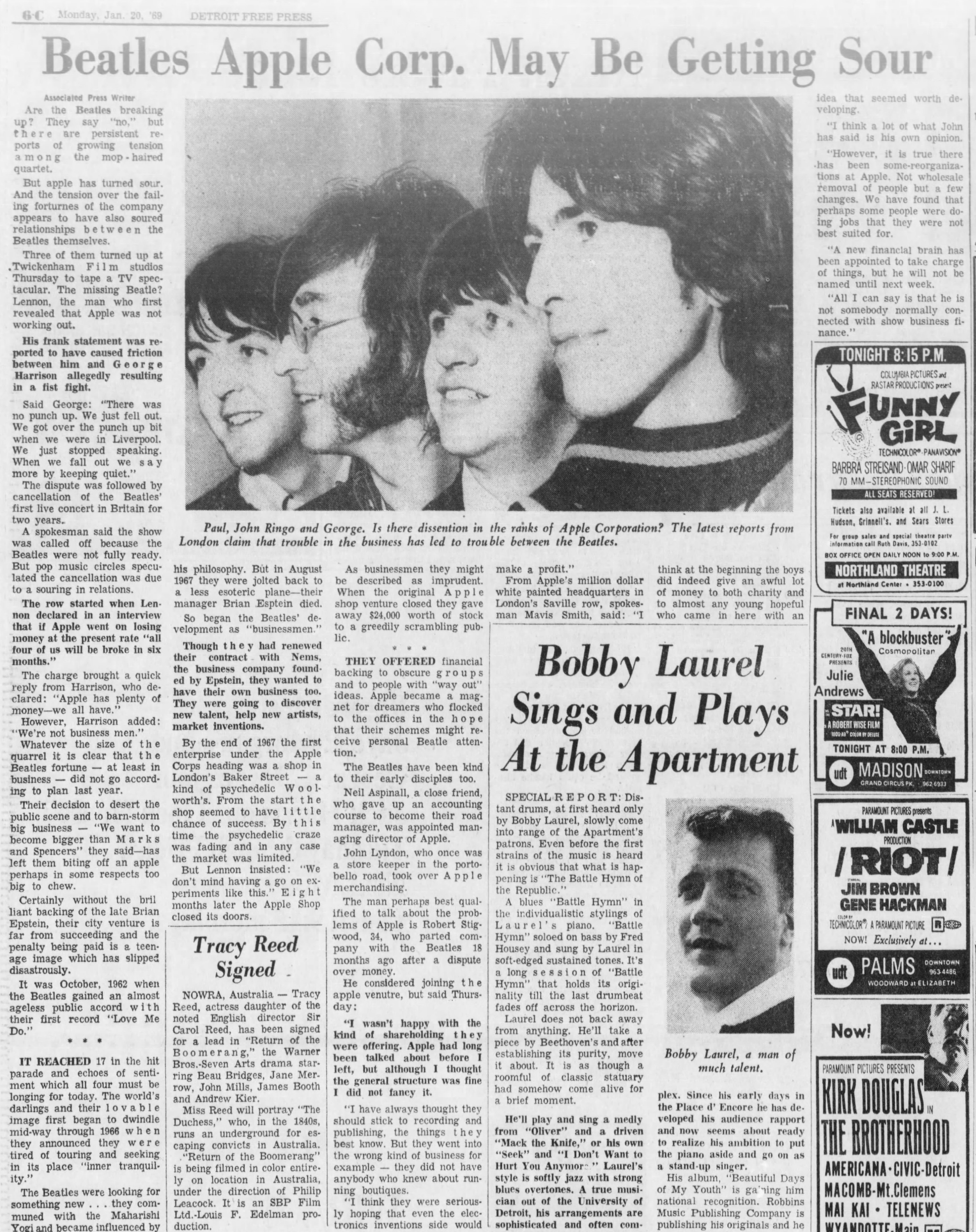
There wasn’t any Twitter in 1969 (although John and Yoko probably would have dominated the platform had it existed), so when George left the Beatles, it didn’t instantaneously go viral. But within days, George’s resignation was widely reported around the world — jumping off an original report by the Daily Sketch (more on their reporting to come in a subsequent post) — though he was already back with the band by the time those reports came out.
It wasn’t just that George left the Beatles. Word was out that that things got violent.
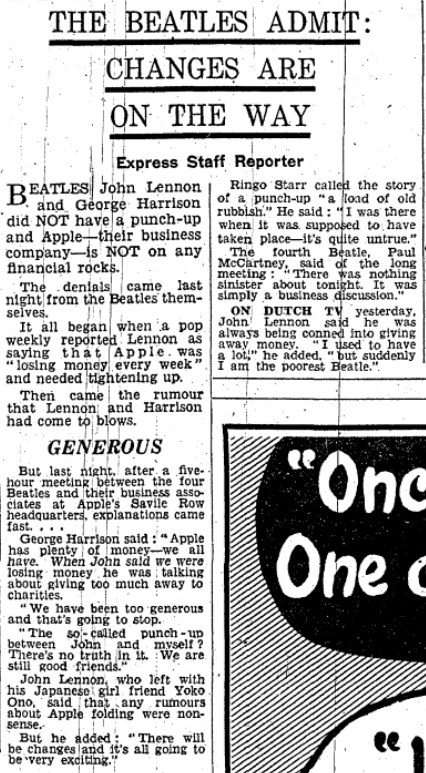
From the Daily Express, January 16, 1969:
Beatles John Lennon and George Harrison did NOT have a punch-up and Apple — their business company — is NOT on any financial rocks.
The denials came last night from the Beatles themselves.
It all began when a pop weekly reported Lennon as saying that Apple was “losing money every week” and needed tightening up.
Then came the rumour that Lennon and Harrison came to blows.
But last night, after a five-hour meeting between the four Beatles and their business associates at Apple’s Savile Row headquarters, explanations came fast.
…
“The so-called punch-up between John and myself? There’s no truth in it. We are still good friends.”
…
Ringo Starr called the story of a punch-up “a load of old rubbish.” He said: “I was there when it was supposed to have taken place — it’s quite untrue.”
A few days later, on January 21, Ringo told BBC’s David Wigg that “there’s that famous old saying, you’ll always hurt the one you love,” when he was asked if the group was still close. But he spoke without any specifics regarding George’s departure, just generic reconciliatory language.
“[W]e all love each other and we all know that,” Ringo said. “But we still sort of hurt each other, occasionally. You know… where we just misunderstand each other and we go off, and it builds up to something bigger than it ever was. Then we have to come down to it and get it over with, you know. Sort it out. And so we’re still really very close people.”
One of the Beatles’ official mouthpieces, the Beatles Book Monthly fan club magazine predictably poured cold water on the idea of a physical altercation in its March 1969 issue. In his diary feature, Mal Evans went as far to write there wasn’t any argument at all when George “stalked” out.
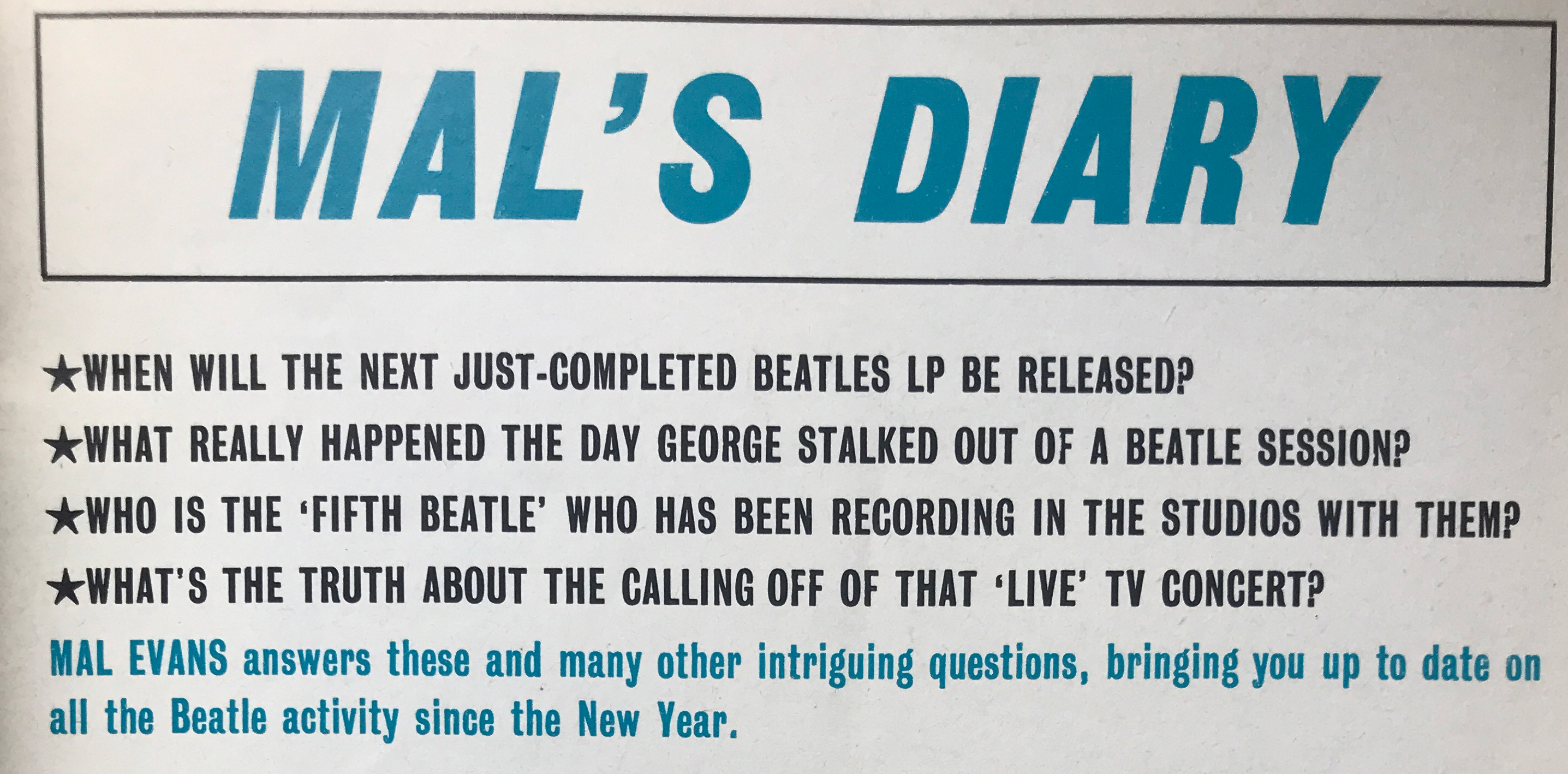
Matching the account on the tapes, Mal said George simply came over during lunch to “quietly” say he was going home. “There WASN’T a fight, physical or verbal,” Mal wrote. “There WEREN’T any tempers or shouting. I just couldn’t believe it when I saw the press afterwards.”
George Harrison maintained in subsequent interviews that no punches were thrown. But another George had another memory.
“They actually came to blows,” George Martin told Phillip Norman in his 2008 biography John Lennon: The Life. “You’d think it would have been with Paul, but it was John. It was all hushed up afterwards.”
Here’s where the retelling of the day’s events descends more deeply into farce.
According to a separate account from EMI engineer Dave Harries, a frazzled Martin only arrived at Twickenham that day as Harrison departed from the studio.
As related in Ken Womack’s Martin biography Sound Pictures:
I remember that George Martin had just backed across the car park in his Triumph Herald and knocked a dent in the door of George Harrison’s Mercedes and he didn’t have time to tell him he’d dented his car before George walked out in a huff and drove off.
Just hours after engaging in passionate car talk, this wasn’t George’s finest hour.
While George Martin was around to some arguable degree that morning (and at the sessions overall), there was no doubt fellow producer Glyn Johns was there on January 10. He was an active participant on the day’s tapes.
Johns, too, wrote of his recollections of that day in his 2014 autobiography Sound Man:
I have a very clear memory of sitting outside in the bleak surroundings of the soundstage at Twickenham on that cold gray afternoon with Denis [O’Dell], the line producer for the film, both of us praying that the elation of being employed for a project with the most successful artist in the world was not about to come to a grinding halt after two days.
It is not my place to discuss any detail of what happened, but it is common knowledge that George left the band and was persuaded to return a couple of days later.
While an implication is there, Glyn wouldn’t spill the beans. Although in Graeme Thompson’s 2015 George Harrison biography Behind the Locked Door, Glyn conceded there may not be too many beans to spill:
When it became apparent that there was going to be a bit of an argument those of us who weren’t in the band left the room. It was clear that it would be intrusive for us to remain. So what actually was said and and what went on I don’t know, but I do know that George left the band that day. The whole thing was very uncomfortable, and it was very embarrassing for me and others who were not in the band to be close by while this was going on — to have to watch this begin and be there in the immediate aftermath. It was very unpleasant and I felt really awkward.
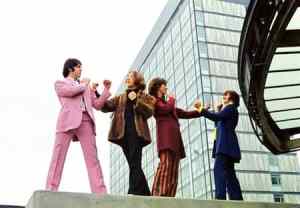
The Beatles pre-enact their January 10, 1969, fistfight more than five months before it probably didn’t happen. (From the Mad Day Out photo session in 1968).
More than 50 years after the fact, what we know with absolute certainty is that George Harrison quit the Beatles the afternoon of January 10, 1969. Everything else — most prominently whether there was a physical altercation — is ultimately speculative.
It’s not just what happened that’s in question, but the why. We’ll never unearth that last straw, the specific reason George quit when and how he ultimately did on January 10. There’s just too much open to interpretation, and as long as the tapes of the day are considered complete, there is simply no smoking gun, no spark that broke George. The conversation with Dick James, the rehearsals of “Get Back” and “Two of Us” — these moments lacked an obvious trigger beyond what were usual pockets of growing frustration.
It’s worth mentioning the other three Beatles openly discussed their feelings and opinions in the wake of George’s departure on the Nagra tapes, directly addressing his growing sense of frustration as a junior member of the group. They were aware of this, and their conclusions were consistent with much of what is discussed below. I’ll examine those specific conversations, which also touch on off-site meetings, however, in future posts when we reach those days on the blog’s timeline.
Still, by rewinding many of the same sources we examined above in this post to construct what happened, we can put together a loose reasoning as to why George left the Beatles. Notably absent from each of these recollections is the one mentioned specifically in the original flurry of news reports — George’s fury with John over the latter’s comments about Apple’s difficult financial situation. George and John even had light-hearted discussions about business earlier in the day. It seems clear the Apple finances excuse for George’s departure was a leap of faith by the media. Musical and personal differences were responsible.
Back to Mal’s Diary in the March ’69 Beatles Book Monthly:
Singing and playing together would always be fine with [George] and the last thing he was suggesting was any break-up of the Beatles. So that day, January 10, George didn’t want to stay at Twickenham rehearsing for a show he couldn’t believe in.
And what — or who — could make George an such an unbeliever? In published interviews over the subsequent decades, George was at least consistent on why he left: His famed filmed argument with Paul (“I’ll play, you know, whatever you want me to play“) gave him a moment of clarity.
From George’s 1980 memoir I Me Mine:
I remember Paul and I were trying to have an argument and the crew carried on filming and recording us. Anyway, after one of those first mornings I couldn’t stand it. I decided this is it! — it’s not fun any more — it’s very unhappy being in this band — it’s a lot of crap — thank you I’m leaving.
His Anthology interviews, conducted in the early 1990s and first broadcast in 1995, yielded similar memories:
They were filming us having a row. It never came to blows, but I thought, “What’s the point of this? I’m quite capable of being relatively happy on my own and I’m not able to be happy in this situation. I’m getting out of here.’
Everybody had gone through that. Ringo had left at one point. I knew John wanted out. It was a very, very difficult, stressful time, and being filmed having a row as well was terrible. I got up and I thought, ‘I’m not doing this anymore. I’m out of here.’
…
Paul wanted nobody playing on his songs until he decided how it should go. For me it was like: ‘What am I doing here? This is painful!”
In other words, George’s recollections were colored by the Let It Be movie. He’s just like the rest of us!
George elevated the “I’ll play” argument in a way that other recent encounters, which were also filmed but not included in the final release, did not.
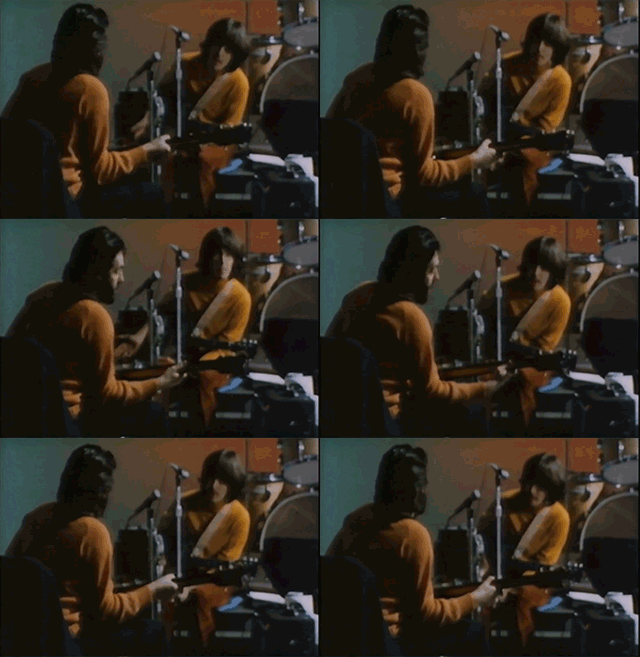
“I’ll play, you know, whatever you want me to play. Or I won’t play at all, if you don’t want me to play. Whatever it is that will please you, I’ll do it.”
Even Paul had the self-awareness to admit his role in George’s departure, saying in the Anthology book with a hilarious parenthetical: “These things had been going down in Let It Be. George leaving because he felt he was being told what to do (I think that’s why he left).”
Ringo was more certain of the reason, going way back. He corroborated George’s accounts in 1971, telling Melody Maker:
George had to leave because he thought Paul was dominating him. [H]e was, because Michael Lindsay-Hogg liked Paul I would think more than the rest of us.
Indeed, George called for a divorce one day after the “I’ll play” argument, but a move to actually leave was delayed. This, as George continued to match Paul in productivity (or come close) during the sessions, certainly lapping a creatively spent John. But it was George’s own songs that were afterthoughts and that treatment deeply affected him.
Paul, though, was not the lone accused party.
Yoko Ono has unjustifiably been blamed for a lot of terrible things over the last half-century. Among the dramatis personae of the Get Back sessions, she was largely out of the spotlight to this point on the tapes, often speaking for John but not fighting for overall attention, certainly not as the group actually made music. And, perhaps by the filmmaker’s design, Yoko was usually off-mic. But since the White Album sessions, she was a disruptive figure to the other three Beatles. While Paul earned his share of the blame, Yoko drove George out of Twickenham, too.
“[S]uperimposed on top of that was Yoko, and there were negative vibes at that time,” George later said in interviews for Anthology. “John and Yoko were out on a limb. I don’t think he wanted much to be hanging out with us, and I think Yoko was pushing him out of the band, inasmuch as she didn’t want him hanging out with us.”
The accusation of bad vibes wasn’t something John quickly forgot. From his famously raw Lennon Remembers interview for Rolling Stone, conducted in December 1970:
George, shit, insulted her right to her face in the Apple office at the beginning, just being ‘straight-forward,’ you know that game of ‘I’m going to be up front,’ because this is what we’ve heard and Dylan and a few people said she’d got a lousy name in New York, and you give off bad vibes. That’s what George said to her! And we both sat through it. I didn’t hit him, I don’t know why.
(Emphasis added.)
George had a stubborn memory, too, to the point of remembering things that didn’t quite happen. From a 1977 interview in Crawdaddy:
There’s a scene [in Let It Be] where Paul and I are having an argument, and we’re trying to cover it up. Then the next scene I’m not there and Yoko’s just screaming, doing her screeching number. Well, that’s where I’d left.
A few years later in I Me Mine, George references “the time in the film where John and Yoko were freaking out screaming.”
There’s only one problem with George’s accounts: There is no scene in Let It Be where Yoko is performing and “freaking out screaming.” She’s hardly in the movie at all, really. But the event in question — Yoko sitting in with the other three Beatles and “doing her screeching number” is an event that did happen. The original, longer rough cut of the Let It Be film did feature Yoko jamming with the other Beatles, per Peter Jackson, and it appeared in the unreleased pre-Anthology documentary “The Long and Winding Road” (which George was not only aware of, but shared a copy with Eric Idle with as source material for The Rutles).
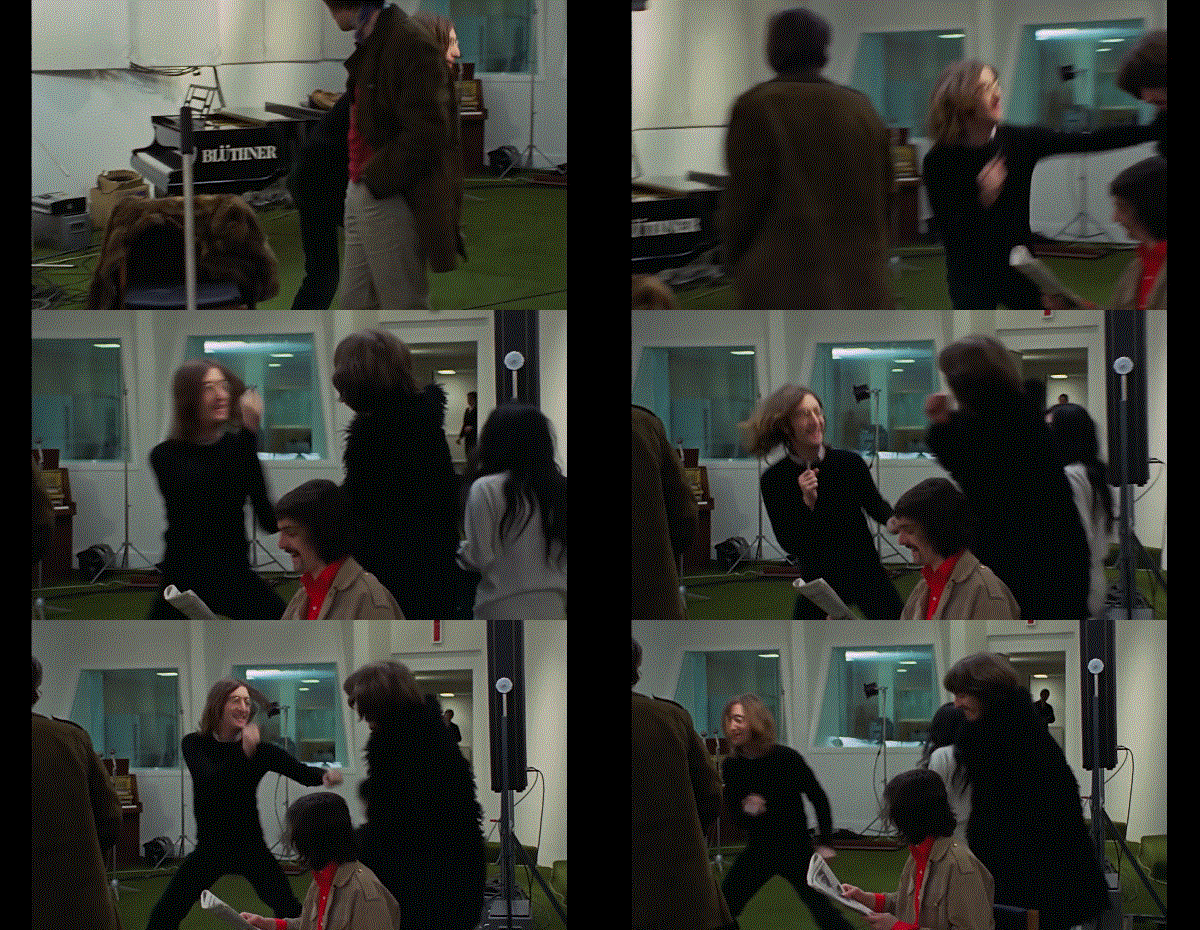
Playful punch-up: John and George at Savile Row after discussing — and denying — any fight between the two. Footage from Peter Jackson’s Get Back.
To the surprise of absolutely nobody who has closely followed the group’s history, the combination of the four Beatles, their associates and the passage of a half century makes for a most compelling but absolutely terrible narrator. Barring the emergence of additional footage or audio, we’ll never know the trigger for George’s departure. Maybe Yoko did do something specific to put him over the edge (the digestive biscuit episode allegedly happened later, so that wouldn’t be it). Or it could have been something John said — or didn’t say, leaving his opinions to Yoko. Maybe the “I’ll play, you know, whatever you want me to play” argument between George and Paul really did change everything.
Or maybe John had it all figured out for an interview he gave for Earth News in 1976 — a quote later used to great effect in Anthology:
[L]ike people do when they’re together, they start picking on each other. It was like, ‘It’s because of you — you got the tambourine wrong — that my whole life is a misery. It became petty, but the manifestations were on each other because we were the only ones we had.
George’s domestic situation at this precise moment is essential to the story yet is generally ignored. For the duration of the Twickenham sessions, he was estranged from his wife, Pattie, and involved with 20-year-old Charlotte Martin — Eric Clapton’s ex-girlfriend — who was living at Kinfauns with him for the duration of their brief affair.
After George left the Beatles on January 10, 1969, he drove back to his Esher home, ended the affair and began his reconciliation with Pattie. Oddly, those decisions didn’t reach the threshold of snacking with the Voormanns’ to make his diary. It wasn’t a choice of the Beatles or Pattie, but like John suggested, perhaps George’s musical issues were amplified by his marital issues.
George wasn’t working for the Beatles anymore that afternoon, but he remained on the clock. In his first act as a temporarily liberated solo artist, George played, you know, whatever he wanted to play, and he wrote “Wah-Wah,” which later appeared on the All Things Must Pass LP and was the opener of his first solo performance, at The Concert For Bangladesh. George couldn’t have found a more symbolic beginning to his stage debut as a solo headliner, opening with a song born from his first independent moment.
“‘Wah-Wah’ was a ‘headache’ as well as a footpedal,” George later wrote in I Me Mine.
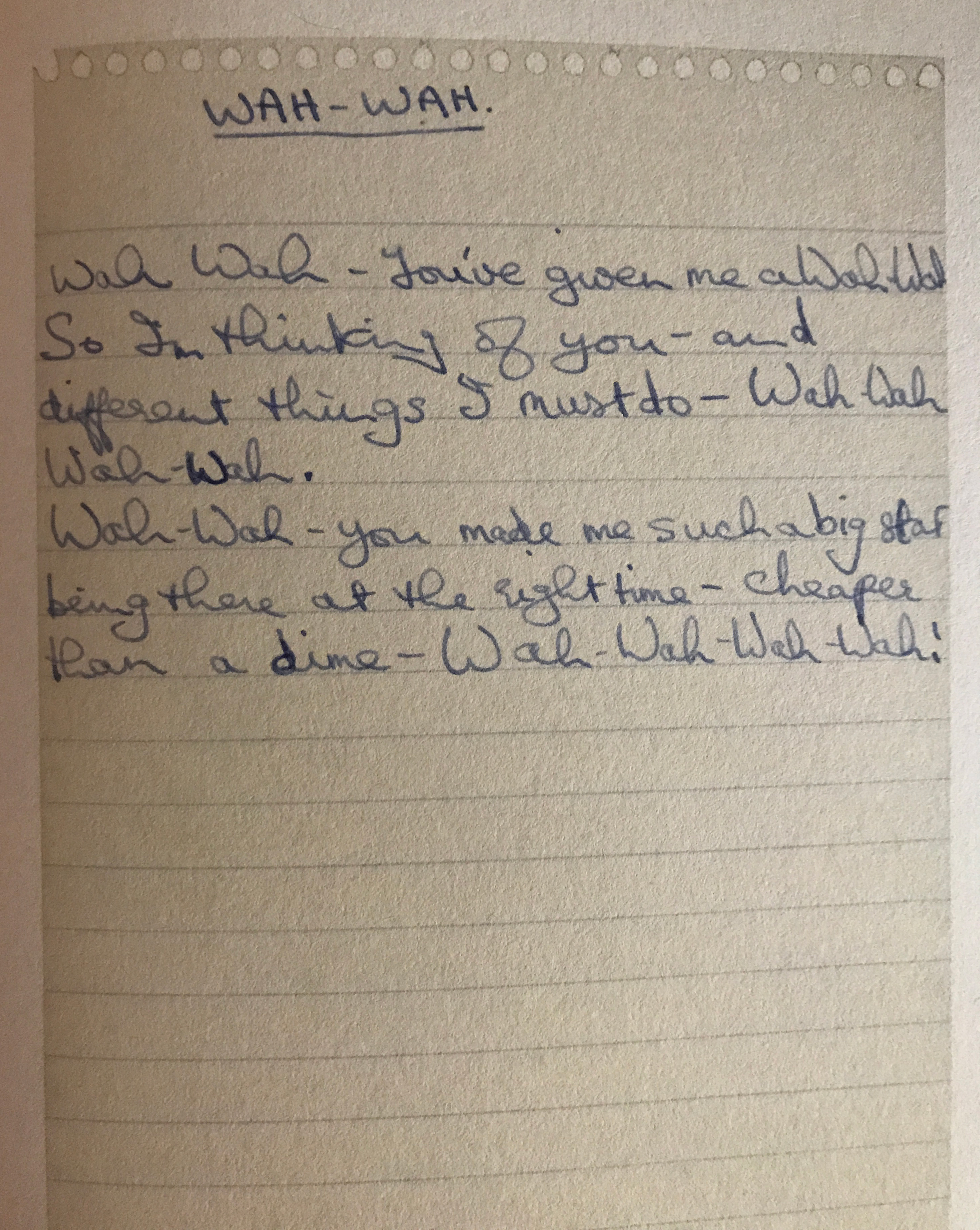
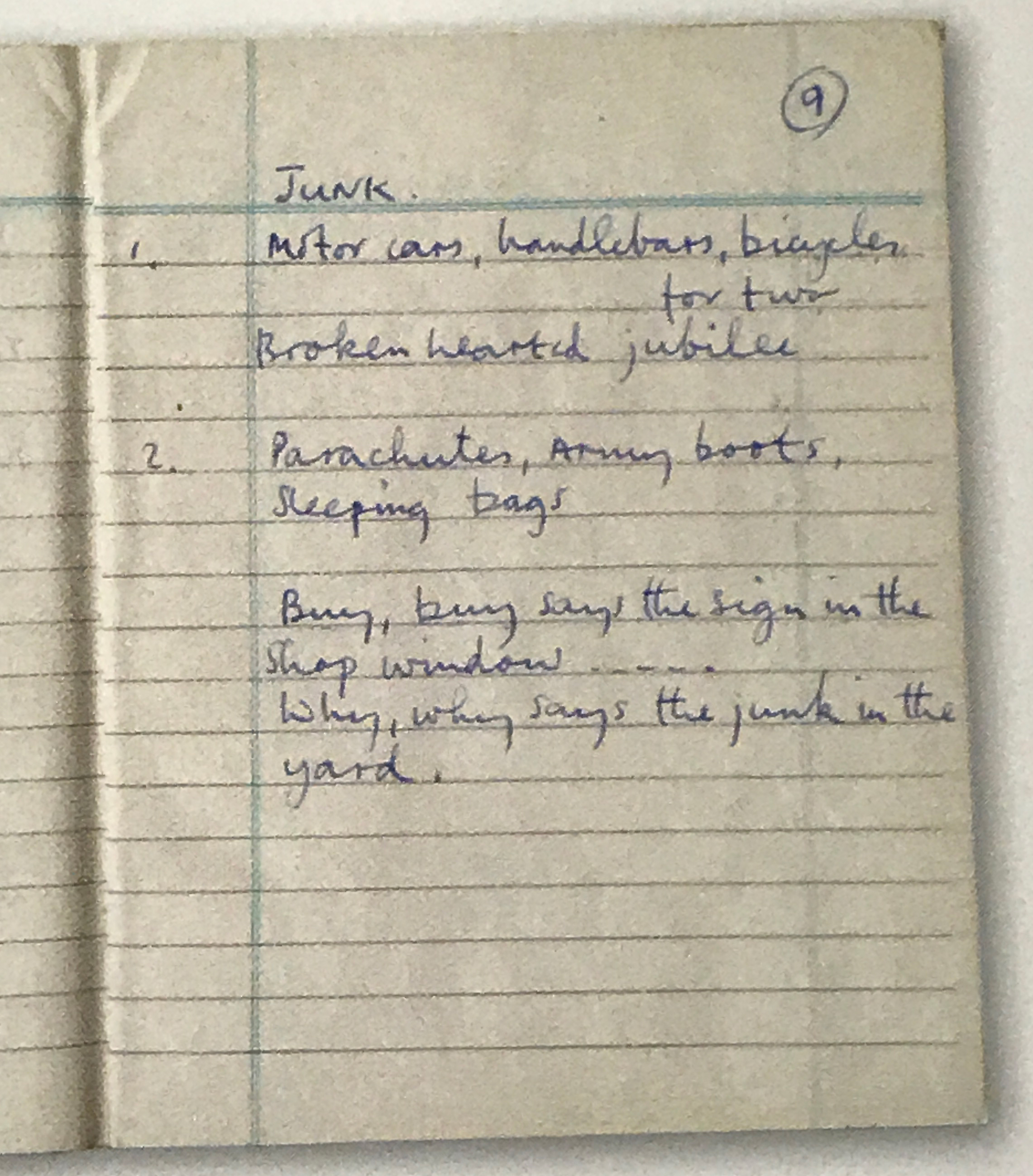
George’s hand-written lyrics to “Wah-Wah.” (Published in I Me Mine)
“It had given me a wah-wah, like I had such a headache with that whole argument,” George told Crawdaddy in 1977.
“It was such a headache.”
Professional clashes with Paul, personnel issues with Yoko (and John), personal crises with Charlotte and Pattie — these were all reasons George left the Beatles. If Paul wasn’t so pushy, maybe it would have made dealing with Yoko and the problems at home easier. If Yoko wasn’t so ubiquitous and John withdrawn, maybe George could work more easily with Paul with one less work distraction. If George’s marriage was fine, maybe he could have slogged through the work day, more easily accepted his continued junior role and at least had an opportunity to unwind and unload in a relaxed home.
But each of those factors played off the other. He’s just like the rest of us.