Category Archives: Day by day

Jan. 3: Et cetera

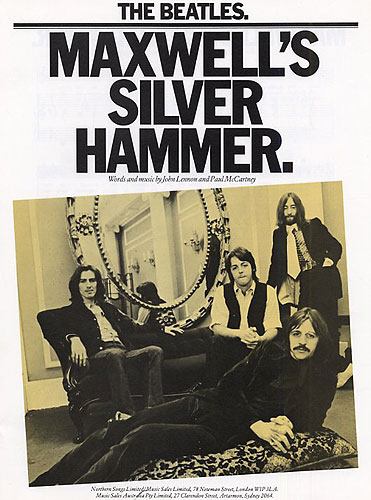
With Maxwell’s Silver Hammer, the band wrapped the second day of the sessions at Twickenham. This blog is ready to move onto Jan. 6, the next day the band assembled after the weekend, but first, I wanted to tie up a few loose ends and address a few items that didn’t quite merit their own separate posts.

•  After being introduced the day before, the band continued to work on “Two of Us” in a matter that totally didn’t distinguish itself. The song had the familiar architecture and same lyrics as would be eventually released, while the tune was a little bit quicker than we’d hear. Just ordinary runthroughs churned with nothing groundbreaking and no remarkable dialogue or discussion.

•  With the exception of his introduction of a pair of never-to-be-released originals, Ringo was the real quiet Beatle on Jan. 3. Totally invisible except for his drumming, which was characteristically steady.

•  As they famously did throughout the sessions, the band covered “oldies” (by this point, we’re talking some songs that in 1969 were less than a decade old, of course).  George, Paul and John each led the way at different points. And while they seemed happy — or at least not bored — they weren’t necessarily very good.

To me, this is a hallmark of what these sessions were about prior to beginning to listening to the complete tapes, when I all would see/hear were compilation bootlegs of the sessions. “The Beatles cover all these songs!” OK, great, but they’re not particularly listenable. Or at least re-listenable.


Interesting to note just how many of these songs would eventually see release by these guys on solo records (John and Paul, at least).

This environment of the oldies, however, did at least bring to the forefront their oldies, like “One After 909.”

•  Plus they touched upon a number of contemporary  songs, but “touching” is even too strong a term. Often it was just for a few seconds, and often it was mere mockery. And even then, it’s completely disingenuous to call it covering. In some cases, like “I’m a Tiger” by Lulu, Paul sings the chorus while George tunes up  (That song, incidentally, appeared on No One’s Gonna Change Our World, the record that first debuted “Across the Universe.”).

Dylan got his due with “All Along the Watchtower,” “Blowin’ in the Wind” and “Please Mrs. Henry.”


Paul shows his love for Canned Heat at one point in a hilarious exchange with George and Michael Lindsay-Hogg.

“That Canned Heat number, I love that new one. It’s cornier than the last one, not quite as good. ‘Up the Country‘ is it?”

Paul proceeds to sing the first verse before continuing.

“It’s just got flutes playing. It’s a bit of a fruity thing they do. … Almost no soul.”

“Almost no what?” George asks.

“Soul,” says Paul. “They don’t bend the flutes or anything. But it’s great because they don’t. It’s sort of a … “

Paul offers the flute part in falsetto “doo-doo-doos” and continues..

“The end is great. They do, like, a false end.”

More “doo-doo-doos.”

“They keep going with the flute!”

After some laughs, George does a few-second quote of Canned Heat’s other hit, “On the Road Again,” before the band completely changes course and reintroduces “One After 909”.

As the band departed the session, the last point of discussion caught on tape was George and Mal picking up the discussion they had about equipment earlier in the day, during the “All Things Must Pass” rehearsals. Then with the goodbyes, the day’s tapes are done.
9 Comments

Filed under Day by day

Jan. 3: Quizzical

Well before it was derided by John as more “granny music,” George as “so fruity” and Ringo as “worst session ever” (in reference to the Abbey Road recording),  “Maxwell’s Silver Hammer” on Jan. 3, 1969, was simply “the corny one,” a song The Beatles had yet to rehearse so many times that it literally caused bandmembers to refuse to participate or go ahead and quit the band.

Written in October 1968, just too late for inclusion on the White Album (per Lewisohn) — but apparently never rehearsed then — we hear it for the first time as Paul doodles on the piano to start the Jan. 3 sessions.

With Paul in novelty-song mode for much of the White Album (a planned topic of a post for the distant future, when I’m done with the Nagra timeline), this tune would have fit like a glove on that record.  And, perhaps it’s in retrospect, but it didn’t fit at all with Get Back/Let it Be, at least what we’ve heard in these first few days.

Hours after the piano sketch, we get to hear the full band tackle the song for the first time in rehearsals that clock in at less than 35 minutes.

It’s an interesting contrast with the “All Things Must Pass” rehearsals that had just occurred earlier in the day. George played and sang his heart out, clearly exasperated and desperate for the band to appreciate the song. Paul, meanwhile, is slogging through “Maxwell’s.” He knows he band will learn it, even if they hate it (and they will in time!).

While George is desperate to bring “All Things Must Pass” to the band, he’s seems  aware there’s little urgency.

Paul, meanwhile, laughs, scats the lyrics, has an extremely relaxed demeanor, especially impressive given the long day that’s near to ending.

The Let it Be film captures some of this pretty well, with Paul barking out chords. If you’re able to follow along at home, the first 45 seconds or so are indeed from these Jan. 3 sessions, with the edit coming right as the anvil hits.

With Paul in instructional mode, George is proactive in offering suggestions to the harmonies as well as guitar licks. Again, quite the opposite experience from “All Things Must Pass,” where the other members of the band did little to add to the song George brought to them.

The origin of the song’s most notable feature — the anvil — is discussed  by Paul during one of the takes.

“Originally, I was trying to get a hammer, which we might get Mal [Evans] to do. A hammer, like on an anvil. A big hammer on an anvil.

You can’t make it with anything else. Bang, bang!”

As they had done earlier in the sessions on “Don’t Let Me Down” and “All Things Must Pass,” the band shakes  up the lineup as the “Maxwell’s” rehearsals progress, with Paul shifting to piano and George taking over on bass, preferring the six-string. At one point, Paul asks George for his bass to sound like it was “from those movies” — a shivering sound during the “Joan was dead” bit.

It’s a fun, bouncy song at this point, none of the weight of the Moog on the Abbey Road version, and a circus-like groove from the rhythm section. There is the old-timey movie feel to it, and it works for whatever the song at present is.

In something of a telling, but confusing exchange, George asks about the seemingly incomplete state of the lyrics. At this point, all we’ve heard in both the early solo piano sketch and the afternoon full-band rehearsals are just the two verses and the chorus.

To my ears, this is what they say:

Paul: There’s only two verses. … But I don’t really know where it goes after that.

John: Finish three of them. You need another one, yeah?

George: Do the words, like, resolve the story?

Paul: Well, they will do.

George: I mean, there’s no more to write?

Paul: No, no not more to write.

Here it seems Paul is content to have the song’s lyrics stay as they are in truncated form — no P.C. 31, testimonial pictures, Rose, Valerie or the judge — and perhaps the musical arrangement alone is what he plans to finish.

Again, the contrast with “All Things Must Pass” is fascinating. “Maxwell’s” isn’t brand-new — it’s a few months old — but it’s still incomplete. If anything, “ATMP” is newer, and it’s a finished product when it was brought to the band.

Really, I  think what we’re learning here George is a saint — he not only brings polished work to the group only to have it passively embraced, he’s busy working to improve everyone else’s songs. Sure, we know he actually quits the band in a few days, but you’d have to think this is a pattern that appeared on prior records, but we only have tape of these sessions to hear it.

Further, and it’s a point I’ve obsessed on before, but why bring an incomplete song to a session that seemingly had a purpose and endgame, a live show soon to be recorded? Shouldn’t everyone be bringing their best material to the table? Was “Maxwell’s” — and we know, ultimately, on Abbey Road it didn’t change that much musically and would only get the extra verse — really something worth spending valuable time on when we know what great stuff Paul had in the bank already (“Two of Us,” “Long And Winding Road,” “Let it Be,” “She Came in Through the Bathroom Window,” etc.)? They’re rehearsing an incomplete song, they’d have to get back to it regardless. Paul makes a brief mention of where an orchestra would come in — clearly he was thinking beyond just the live rock show.

At least this early version of “Maxwell’s” gives us the memorable lines: “Back in class again/Maxwell is an ass again” and “She tells Max to stay/when his ass has gone away.”  Alas, never to make the final cut.

With the end of the “Maxwell’s” sessions, the band wraps it up for the day, a Friday.  The day’s tapes end with the band saying their goodbyes and, the working stiffs they were,  agreeing to reassemble Monday at 10 a.m.

16 Comments

Filed under Day by day

Jan. 3: Fifteen minutes of fame

The second day of sessions at Twickenham on A/B Road clock in at close to 5 1/2 hours, more than two hours of which was spent solely on “All Things Must Pass” and “Maxwell’s Silver Hammer” (a song to a post coming soon).

For sure, much of the time that falls under a certain song’s track was actually dialogue. But ultimately, there wasn’t a lot of new material introduced.

When we did get new stuff, it was a taste of some classic songs.

Indeed, the entire day’s session begins with Paul tickling at the ivories with an incredible one-two punch that lasted just over a minute and a half. “The Long and Winding Road,” right into “Oh! Darling.”  Another future Abbey Road Side 1 track — “Maxwell’s  Silver Hammer,” which wasn’t actually new, but new to the sessions — gets the solo piano treatment next. Enjoy that sequence here:

Paul continues to play, and caps an incredible 15-plus-minute stretch with one more new song, and one that eventually defined the sessions overall: Let It Be.

John, as he was throughout the entirety of the sessions, only brought in the one new track — “Gimme Some Truth” — that day. And again, it wasn’t actually new to the band.

Outside of a pair of Ringo songs we’ve covered previously and seminal songs like “One After 909,” “Because I Know You Love Me So” or “Thinking of Linking,” the balance of originals on Jan. 3 were brief tastes, and in some cases presumably improvised jams.


8 Comments

Filed under Day by day

Jan. 3: Let you down, leave you flat

Central to the legend of the Get Back/Let it Be sessions is the looseness of the group as they sloppily play covers and fool around with their own old songs. So many weird things, tucked in between a million takes of “Get Back” and “I’ve Got a Feeling,” right?

It’s what appealed to me in listening to the Get Back sessions in the first place, so long ago,  when it was available on only curated compilations on vinyl.  And really bad sounding ones, too.  But go to record shows or Beatlefests and scan the back cover, and things seemed like they’d be cool! All these crazy cover songs, all these oldies of theirs, all these outtakes of songs we know and songs we don’t.

But the reality usually didn’t match the fantasy. [This overall theme will absolutely be covered again in this blog, likely ad nauseum].

And on Jan. 3, they did indeed have some fun with some oldies and originals. It’s not great. And really, I think things like this add to the generic resentment toward these sessions by Beatles fans. The band doesn’t care, so why should we?

Really, not a bad point. But it is interesting so long as you accept it for what it is. It’s no different than those of us who have office jobs spending a few minutes doodling on a notepad between taking care of real work, right? Their office happens to be the studio, and their doodles, songs. And if we’re eager enough to listen to their doodles as big enough fans, well… this is what we get.

So while the band didn’t spend all that much time the first few days genuinely going over their old songs,  in addition to a poke at Every Little Thing and the reintroduction of “One After 909,” the band on Jan. 3 went into the back catalog for “You Can’t Do That” — after a take of  Marvin Gaye’s “Hitch Hike,” a song that seems to have inspired the song off A Hard Day’s Night.

It was pretty much 3 a.m. bar-band quality. The song breaks down about a minute in, during the “everybody’s green” part. John keeps singing, Paul keeps in there, too, and eventually the song sort of comes back to life.  They make it through the instrumental portion of the song before things completely break down for good.

More fun and somewhat historic, I suppose, was when Paul took the mic for a more significant take of “I’m So Tired.” Obviously, this was not meant to be anything beyond a bit of fun. Again, more 3 a.m. bar band. But perhaps even moreso. At least, here we got through the song. And even with an attempt at the end-of-song babble!

There’s no context, by the way, for why they went into this take. The tapes I’m listening to (A/B Road) just go from an unidentifiable jam cut straight into “I’m So Tired.”

The 2021 Get Back docuseries uses this sequence to great effect as something of a gag reel, showing various moments of the group yawning, rubbing their eyes, etc., for the final moment of the day’s coverage. I posit it’s also a sneakily effective response to the famous scene of Paul yawning during “Across the Universe” in the Let It Be film, show how everyone was yawning, it wasn’t a reflection of boredom to a particular song.

They stick with the White Album (flip from side 2 to 1 if you’re so inclined) for the next song they roll right into.  As on the record, Paul takes the lead on “Ob-la-di Ob-la-da” — kicking things off with the bass line — but it doesn’t take very long for John to take over.

And with Marmalade’s version of the song presently sitting atop the British singles charts (while the White Album was the best-selling LP), why wouldn’t the McCartney/Lennon songwriting team enjoy themselves all the way through the song?

4 Comments

Filed under Day by day

Jan. 3, 1969: Hearing things

There wasn’t a heck of a lot of John on the second day of rehearsals at Twickenham.

Nagra has about 13 minutes of Don’t Let Me Down, 30 minutes of I’ve Got a Feeling (which is half-John, at least),  and he led some covers.

But about halfway through the day otherwise dominated by Paul (Two of Us, Maxwell’s Silver Hammer) and George (All Things Must Pass), John pops in to give us a very special minute or so.


“Gimme Some Truth.” A future classic.  Now, still pretty rough. But, certainly recognizable as a tease to what we’d see two years later on Imagine.

The band jumps right in, little preparation for the rehearsal. Indeed, the song dates back to ’68 in India, so there’s at least some familiarity.

Lyrically, it’s certainly not to its final form. Or even if it is, we don’t hear it here. Paul repeatedly makes reference to “son of Gary Cooper” — Richard Nixon, at this point the president-elect — wasn’t yet part of the lyric.

Prior to the brief foray into the song — the lone attempt at it on Jan. 3 — there’s a bit of back and forth as to what to play next. During part of the discussion, Paul (presumably) is playing the bass line to “Money (That’s What I Want).” There’s shuffling of papers as they ask which song to play next.

Paul: If you will all now turn to page 33.

George: “She Came in through the Bathroom Window?”

Paul: “All Things Must Pass?”

George: “Bang Bang, Maxwell’s Hammer?”

John: Is this a Harrisong? … I’ve got one, “Gimme Some Truth,” or something.”

It was, in fact, “Gimme Some Truth.” Not “Something.”

As we hear on vocals, curiously enough, it’s Paul. John sings along harmony and then takes over the lead when singing what would ultimately be the song’s first verse as the rehearsal concludes (the clip above pretty much is all we’d get). Why does Paul lead? Could just be Paul being Paul, taking over and singing while John gets himself acclimated or is otherwise occupied. Interesting, regardless.

However it happened, it’s the last we’d hear of the song for the day (we’d hear it again in a few days).

As quickly as it was introduced, they returned to “All Things Must Pass.”  It was John’s last notable contribution the rest of the day.

8 Comments

Filed under Day by day