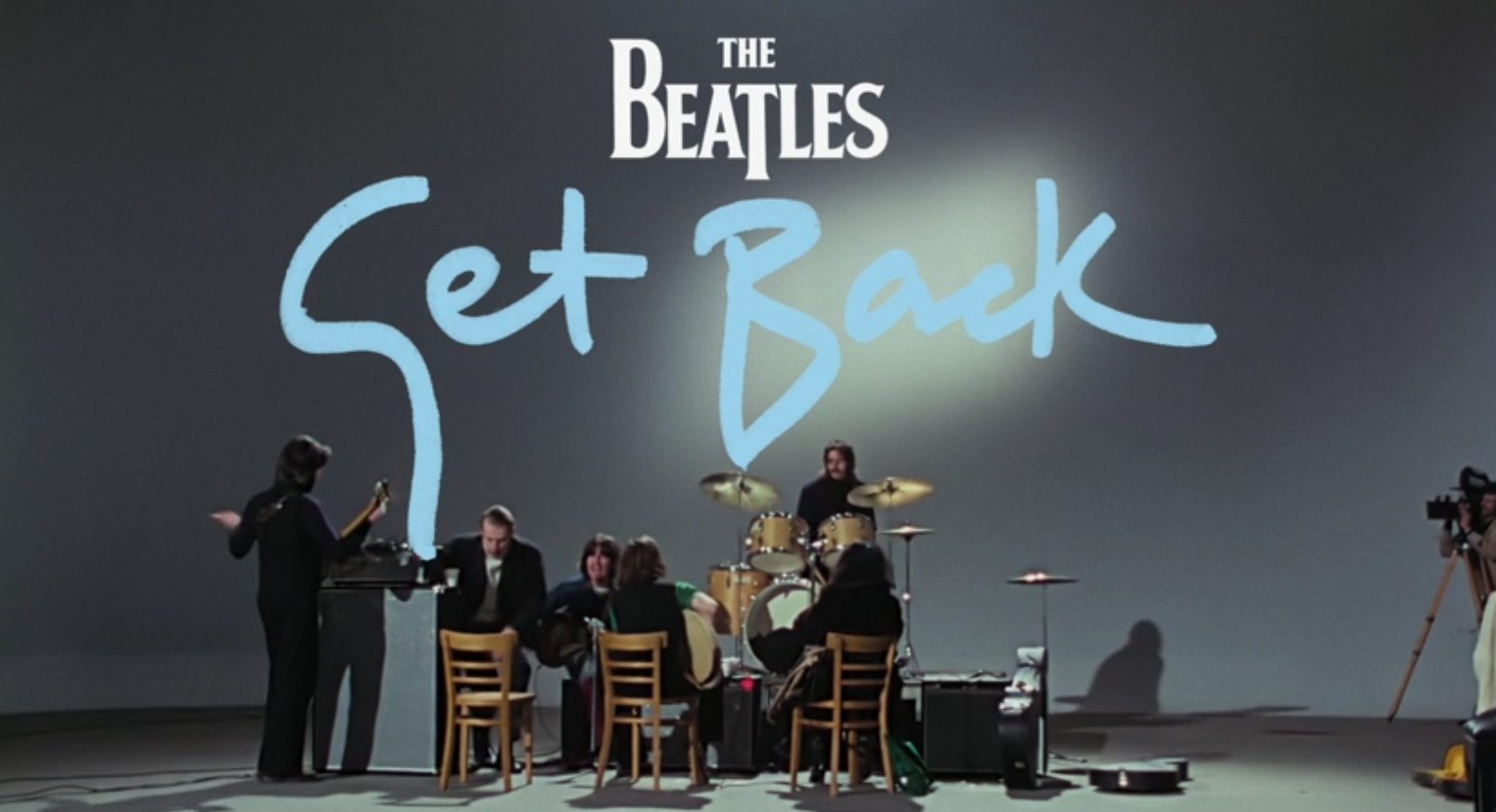
In the days leading up to the premiere of Get Back on Disney+, I had the tremendous opportunity to spend more than three hours speaking with director Peter Jackson as part of Robert Rodriguez’s Something About the Beatles podcast. We go deep into the weeds — or is it the California grass? — on the film, on the group and the period.
Please enjoy this unexpected party presented, appropriately, in three parts, wherever you listen to podcasts. Links in the tweets below! (I’ll update this post with all three parts as they’re released).
It's with extreme joy I can share Pt. 1 of a conversation — a *three-hour* conversation– with Get Back director Peter Jackson. We talked about bootlegs. We talked about day-by-day minutiae. He's one of us.
Part II of our conversation with Peter Jackson on @SATBshow is here! I just listened, and it's even better than I remember, I kid you not. Tune in! 🎧 https://t.co/41hiJI9dd7
It's the epic conclusion to our Peter Jackson interview trilogy on @SATBshow!
We get into the original '69 Let it Be cut, discuss coordination with this year's book and box set, talk John & George fisticuffs, get into audio AI and hopes for an extended cut. PLUS MORE!! 🎧🎧🎧 https://t.co/soacnzF89v
A quick word: As someone who’s dug increasingly deeper into the Beatles’ January 1969 Get Back sessions for the past decade, it’s with obvious jubilation I welcome Peter Jackson’s new Get Back docuseries on Disney+. The story I’ve been telling here is now matched on the big(ger) screen. It’s very exciting in every way.
I plan to give any posts that need any tweaks for content and significant audio-visual upgrades a scrubbing when I can. At some more distant point I was planning on rewriting my earliest posts anyway.
I’ve spoken to a few outlets about Get Back/Let It Be in recent days and have a few more appearances on tap, and I’m looking forward to sharing them here.
Please follow me on Twitter @theymaybeparted for constant chatter and on Facebook for a little bit less chatter.
🧠@TVpsychologist on band dynamics ❤️@ElisJames on loving The Beatles 🎥@GailPorter on living on-camera 💻@TheyMayBeParted on a decade of 'blogging about January 1969 🔊 Tania Harrison on the logistics of staging the rooftop gig today
As a film, Let It Be has more backstory than story.
In Beatle-time, the 15-plus-month turnaround from the end of their January 1969 sessions until the film’s release in May 1970 was simply a glacial pace. Then from the moment it reached theaters, Let It Be has been treated as a snuff film.
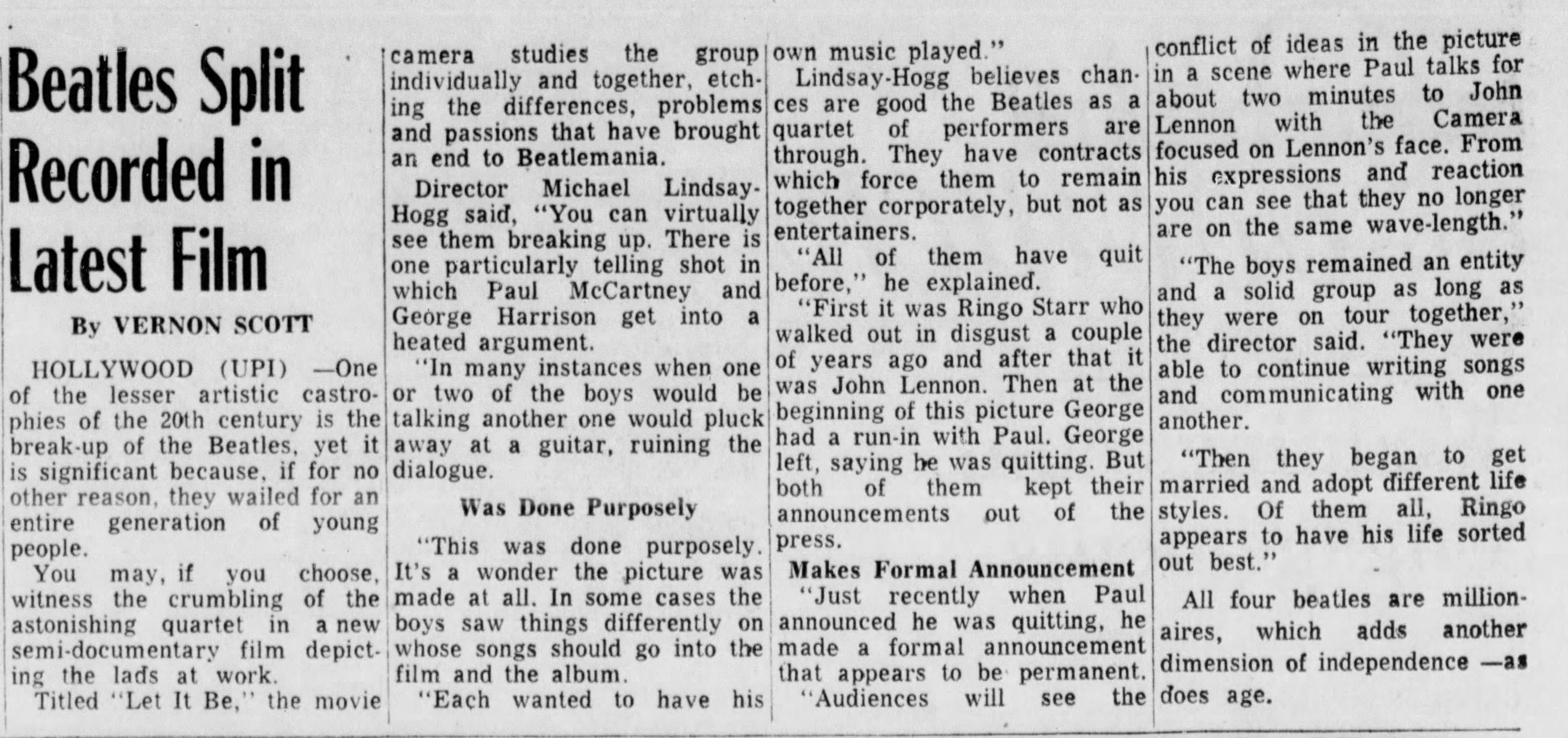
You can virtually see them breaking up … it’s a wonder the picture was made at all.
That’s director Michael Lindsay-Hogg, quoted in a syndicated wire story the week of the film’s release, ostensibly to promote the film. We’ll never know if he’d have said the same thing if the film come out in sometime in 1969 as originally planned, when it was provisionally titled Get Back.
To put 51 years into context, it’s 11 more years than John Lennon spent in the material world. It’s about as far away from today as the release of Let It Be was from the Treaty of Versailles. It’s a relative eternity.
Let’s pick up this story after January 1969. The Beatles completed busy and fruitful winter sessions split between Twickenham Film Studios and their own basement recording studios at 3 Savile Row with dozens of hours of audio and video that would emerge as a TV show and springtime LP, their follow-up to the White Album.
The February 1969 issue of the Beatles Book, their fan club magazine, said that while there was “still no fresh progress” on the Beatles’ next film, it was a “priority job” for the new year. They hadn’t yet realized the film was already in the can.
For the next several months, a clear pattern emerged: The release of the album was delayed because the movie was hung up.
April 29, 1969: Melody Maker reported 68 hours of footage was about to be edited down, “from which two films will be produced.”
May 3, 1969: “This film … somebody’s editing that at the moment. It’s sixty-eight hours, and they’re trying to get it down to five for several TV specials. Or then, it might be a movie. I don’t know” — John, to Melody Maker
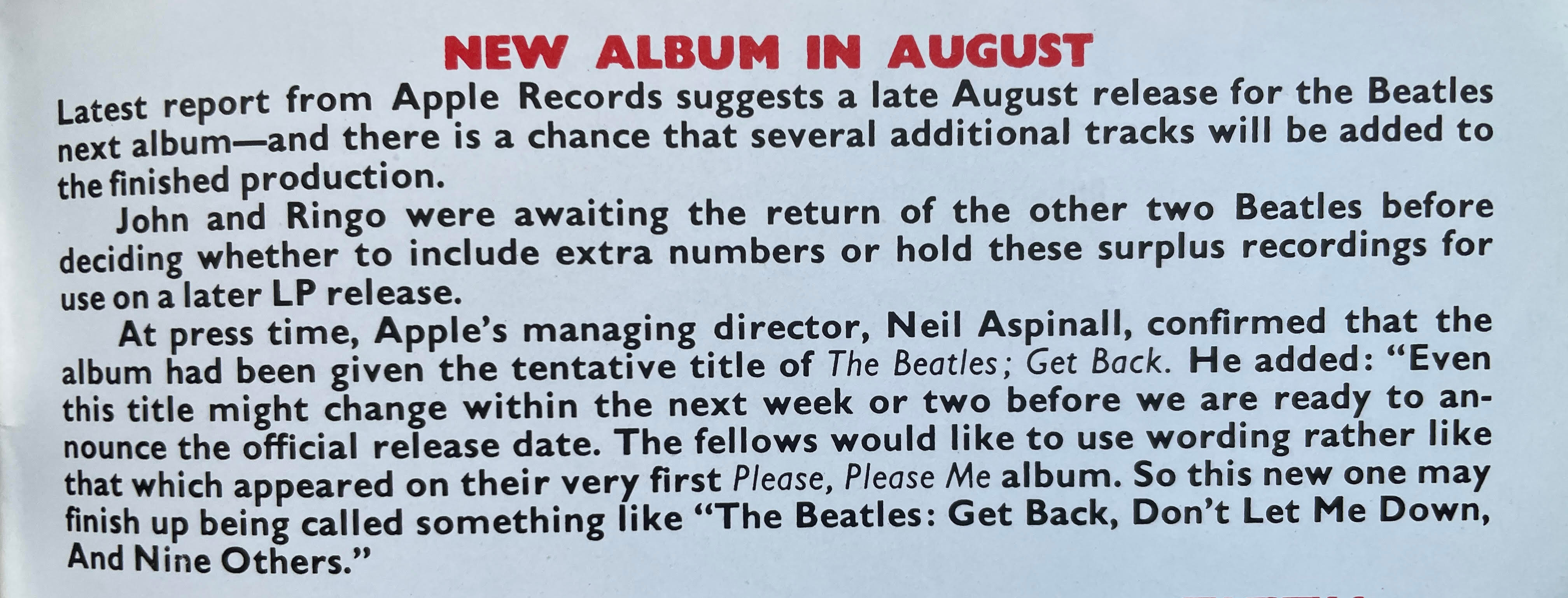
Early July 1969: The Beatles Book reported the release of the album and a companion book would be delayed because “the fellows would like the film to go on television in August so that everything comes together at the same time.”
July 12, 1969: “[The LP] is tentatively set for September release … to coincide with the screening of the group’s TV special. … If the TV show is delayed until later in the autumn, it is possible that an alternative album … will be released first. From all the many reels of film shot during their recording sessions, the Beatles are hoping to produce a three-hour cinema film, from which the two-hour TV special would then be extracted.” — NME
The Beatles and family, at the July 20, 1969, rough cut screening.
July 20, 1969: The same day mankind made a giant leap on the moon, the stars of the film sat in place for a while to view Michael’s working cut of the film, which at the time clocked in at about 2 1/2 hours. This was about three months after editing was reported to be getting under way.
July 21, 1969: The day after the screening, Beatles assistant Peter Brown phoned Michael, asking on behalf of the group just one required edit: Whack a half-hour of John and Yoko footage. In his 2011 memoir Luck and Circumstance, Michael wrote he was told, “Let me put it this way. I’ve had three calls this morning to say it should come out.”
July 29, 1969: Variety reported plans to screen a TV special to coincide with the release of the Get Back LP. “The TV show and a three-hour cinema version are still at the editing stage,” the magazine said.
Early August 1969: The Beatles Book said the Get Back LP will be pushed back again to coincide with the film, “probably towards the end of November.”
August 30, 1969: “There is still no news of release of the … ‘Get Back’ album. … It is understood that this will still be issued as a soundtrack album for the film, however, and that Christmas is a possibility.” — NME
September 1969: After screening a new cut at some point this month, the group signed off on the film to business manager Allen Klein, according to Michael. In what could simply be a coincidence, the same month also saw John announce to the others that he was quitting the Beatles. They released Abbey Road in September, too.
September 20, 1969: Six days before that very release, NME reported the 85-minute “Get Back” film would premiere early in 1970. The paper said the documentary had been edited from “five hours of film taken at the time,” quite the error of scale. The paper does say, however, that the movie is expected to be picked up by United Artists in order to fulfill their three-film commitment. The Beatles’ priority for the year, as mentioned in February, was now complete. This is definitely a scoop, with Variety reporting the same UA deal the following April.
October 1969: Counter to the NME story, the Beatles Book maintained the LP and film would come out in December. Elsewhere in this issue, in Steve Turner’s article on the Beatles’ effect on modern culture, the rumor that the Beatles may film a version of Lord of the Rings was revived.
November 1969: The Beatles Book was back to reporting a 1970 release with UA distributing.
On the very eve of the Let It Be’s ultimate release in May, we can catch a glimpse of contemporary opinions of the film.
Based on interviews conducted prior to the release of the McCartney LP, the traditional marker for the breakup of the Beatles, BBC Radio 1 broadcast a promotional special on May 23, 1970, in conjunction with the film’s wide release in the UK.
George, however, said he “can’t stand” seeing the “pure documentary of us slogging.
“But for other people who don’t know what we’re really about, who like to go in and see our warts, it’s very good. … It’s the complete opposite to the clinical approach that we’ve normally had.”
Of the album, he says “you can actually get to know us. It’s more human.”
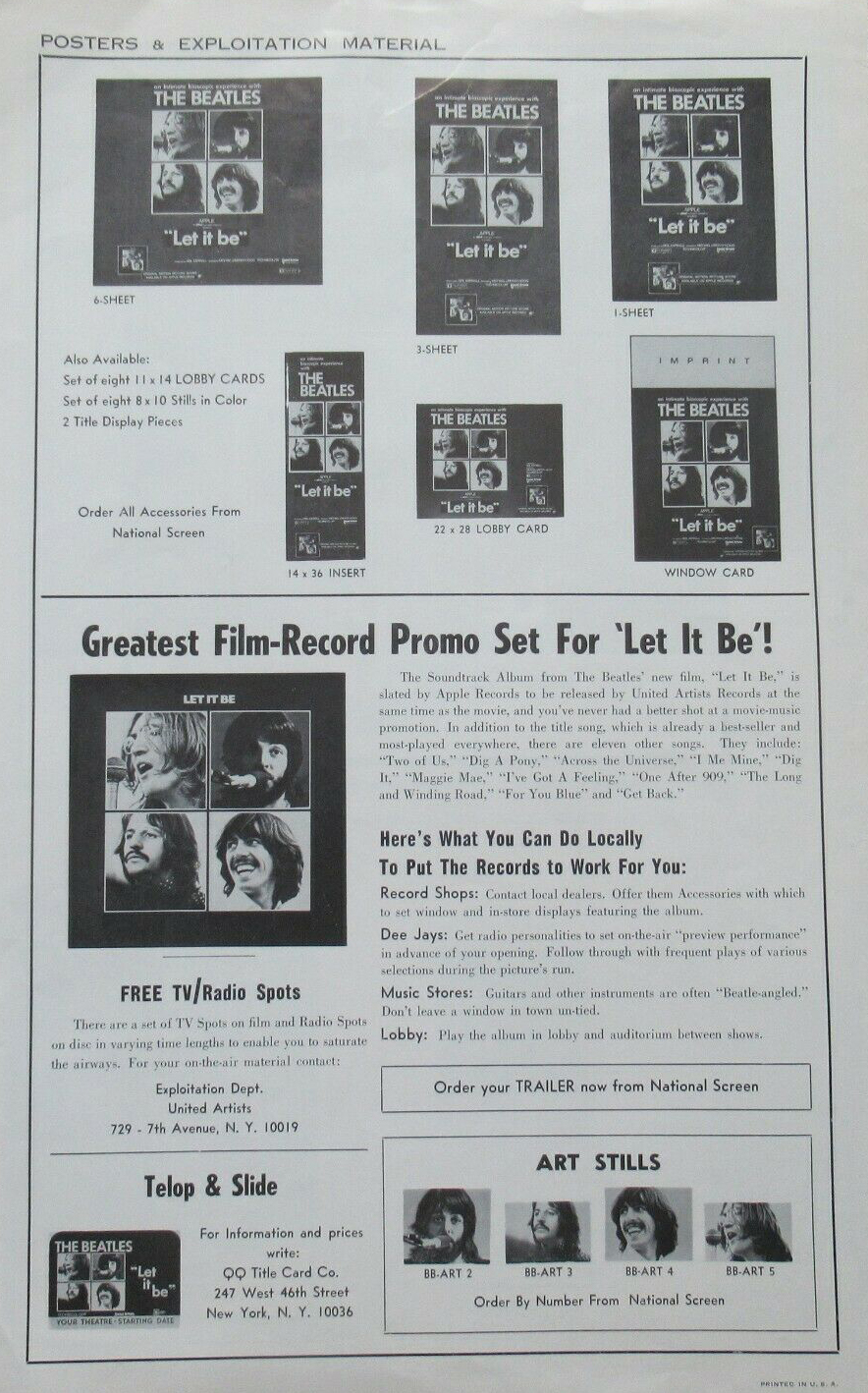
“Exploitation materials and posters” intended for theaters to use for promotion of Let It Be.
Speaking to Rolling Stone for a cover story on the eve of the release of his solo debut — the magazine is dated April 30, but the interview was clearly conducted prior to April 10 — Paul continued to point to the film, which he still referred to as Get Back, in positive terms.
“The Get Back film is a good film. And it is a real film. The troubles are in it as well as the happy moments.”
Paul went on to complain about the delays of the record’s release in interestingly prescient terms while blaming Klein for the holdup.
“The LP is looking to be a joke, for it is a bit of a cliff hanger. I would have liked to have seen it out there three months ago and now I don’t even remember making it.”
It’s tough to keep pace in Beatle-time. Paul’s point is clear, though, even with the tremendous exaggeration.
While the Beatles may have been in a difficult spot in early April 1970, it wasn’t the same spot — difficult or not — they were in January 1969.
When Let It Be was first shown to the public, on May 13, 1970, there was no glitz or red carpet. Instead the film was screened in ordinary theaters dotting the United States, not at a promoted premiere in New York as Apple had initially promoted.
A week later, May 20, the film received a more proper launch, premiering in London and Liverpool with the pomp missing stateside. In London, Beatle exes Jane Asher and Cynthia Lennon were among the guests, which also included Mary Hopkin, Lulu, Spike Milligan and other notables as thousands of fans showed up at the scene. Kevin Harrington, equipment manager at the time, wrote in his memoir that he took an Apple Scruff to the premiere. No Beatles were present, however.
At this moment, two key figures were across the globe, in Los Angeles. John Lennon was in Bel Air undergoing Primal Scream therapy while Michael Lindsay-Hogg was at work about a half-hour away in Hollywood (traffic pending).
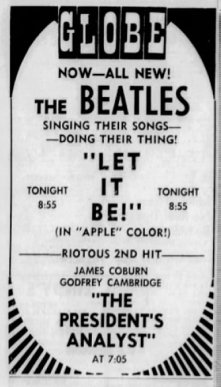
The most accurate review yet: “Singing their songs, doing their thing!” (From the May 13, 1970, Californian)
John and Yoko joined Rolling Stone chief Jann Wenner and his wife, Jane, for a showing Let It Be at a sparsely attended theater in San Francisco in the early part of June 1970.
“After the show — moved at whatever level, either as participants or deep fans — we somehow cried,” recalled Wenner.
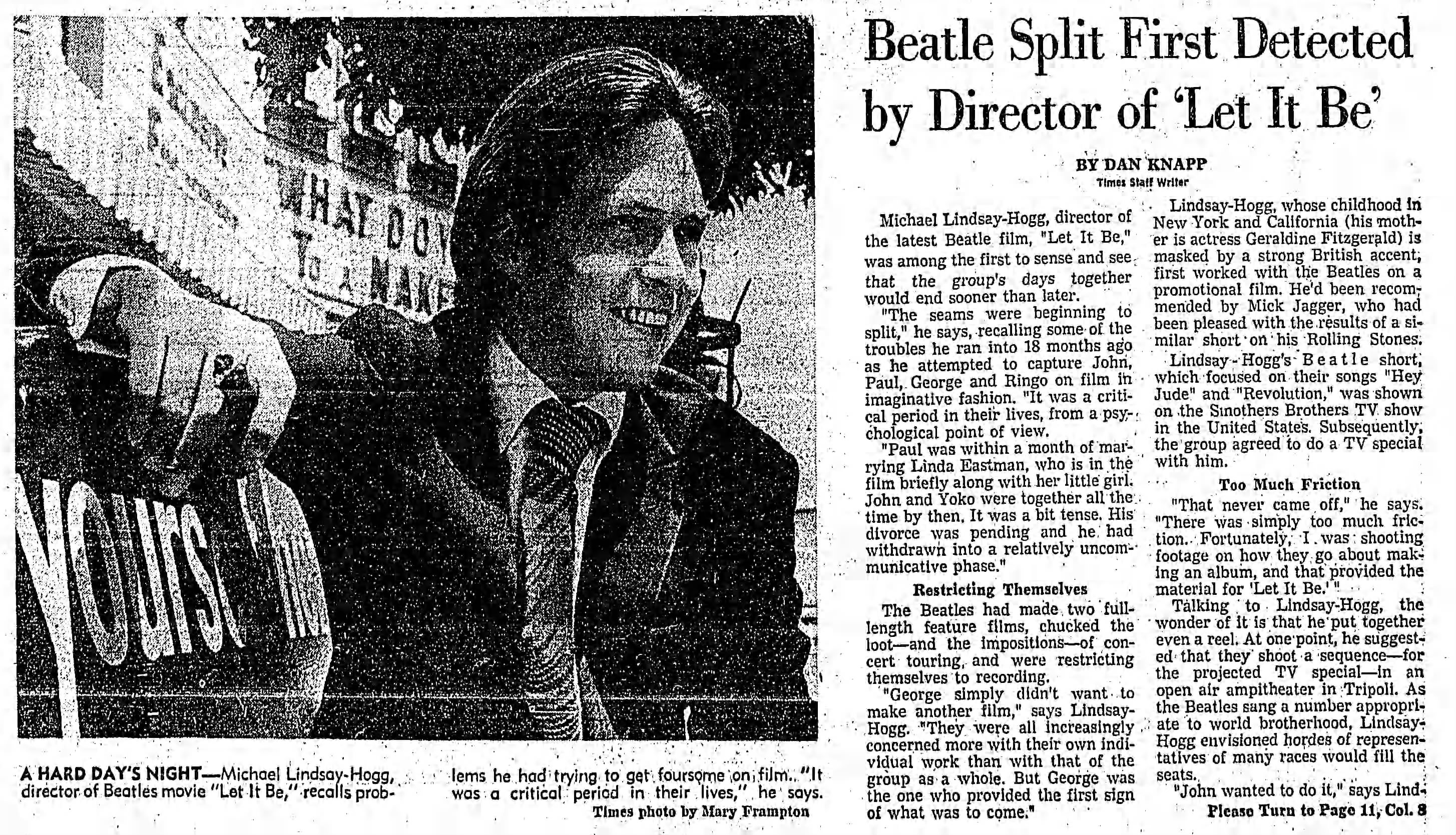
In a Los Angeles Times interview published just a few days after Lennon saw the movie, Michael again reflected on the difficulty of filming the sessions in terms dramatic enough the reporter remarked “the wonder of it is that he put together even a reel.”
In the June 10, 1970, article, Michael complained the group would disrupt “a lot of good, funny and antagonistic conversation” by playing music and moving microphones away. “I don’t think I got them when they were their most charming,” he said, essentially acknowledging they were never charming given the amount of footage he actually did get.
The article was memorable enough for Michael that he remembered his reaction to it decades later in his book.
… [I] was surprised, or concerned, that what had seemed clear to me when I’d said it had been reported without insight, with no recognition of irony or jokes. The Beatles were portrayed only as argumentative people, without extenuation, without subtlety.
The article prompted a further response, a phone call from fellow director — and father, as he later learned — Orson Welles, who asked Michael if he was happy with Let It Be.
“Some of it,” Michael replied. “It’s hard when your stars are your producers. And there were four of them. … A lot I liked got cut out. … But the footage was good.”
Let It Be arrived at theaters at various points in May 1970, but it was absolutely impossible to separate it and its impact from the April release of McCartney. Ringo’s late-March release of his solo debut, Sentimental Journey, wasn’t necessarily seen to have been as critical to the story as McCartney, but it simply piled on the narrative. Let It Be was the breakup film paired with a breakup soundtrack LP. Reviews of one usually paired with reviews of the other.
Variety’s review, published in their May 20 issue, called the movie “relatively innocuous, unimaginative piece of film. But the musicians are the Beatles, and coming hard on the group’s breakup, … [it’s] charged with it own timely mystique.
The fascination of “Let It Be” is that it is, in a sense, probably the last public appearance of Paul McCartney, John Lennon, George Harrison and Ringo Starr as a group, with all the gossip and speculation attending the split, reading between the spoken lines of the film becomes a game in itself.
Variety did wisely predict “McCartney … will probably emerge strongest as a major individual talent of the Seventies as a composer and singer.”
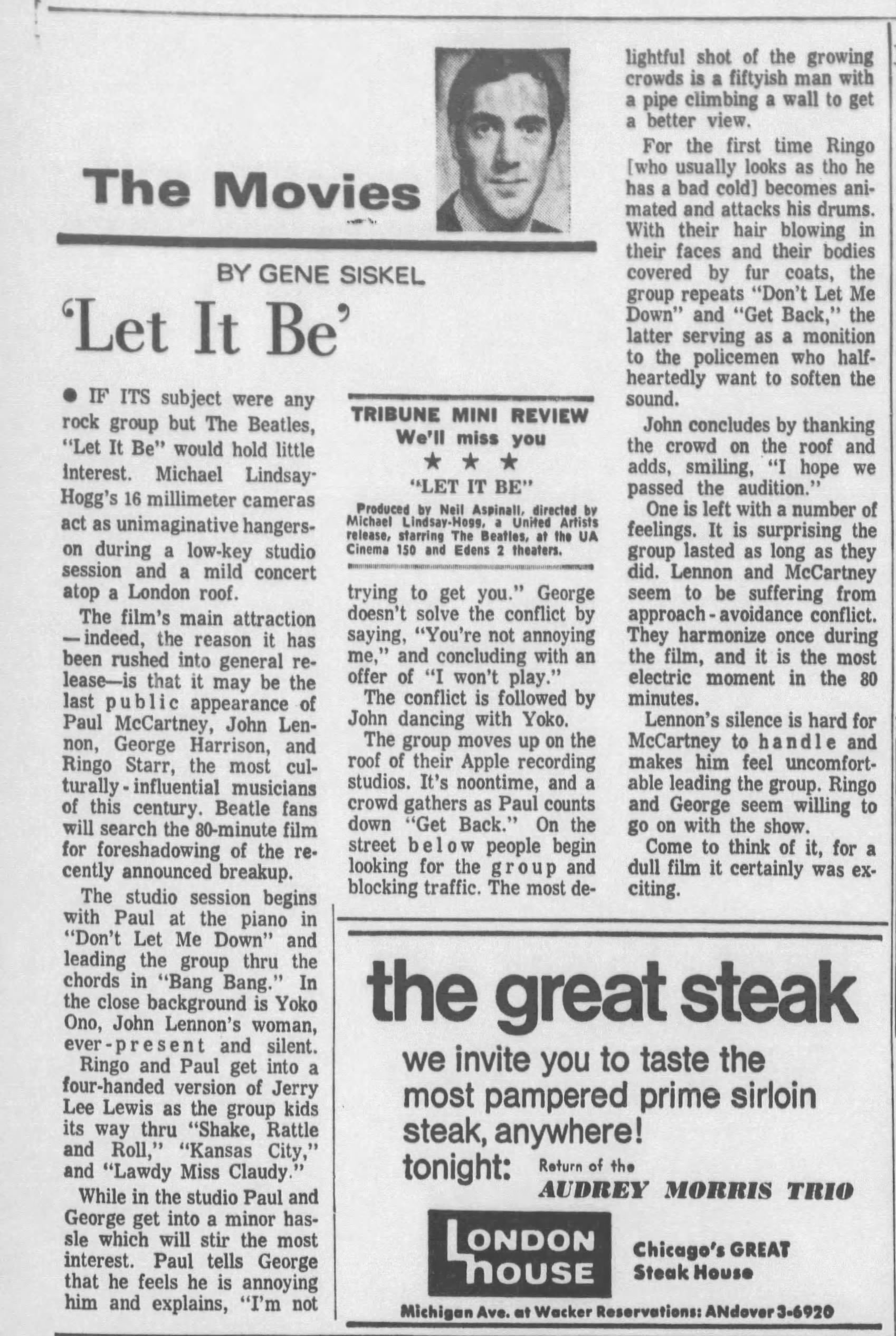
Chicago Tribune legend Gene Siskel gave Let It Be three stars, writing “Beatle fans will search the 80-miunte film for foreshadowing of the recently announced breakup.”
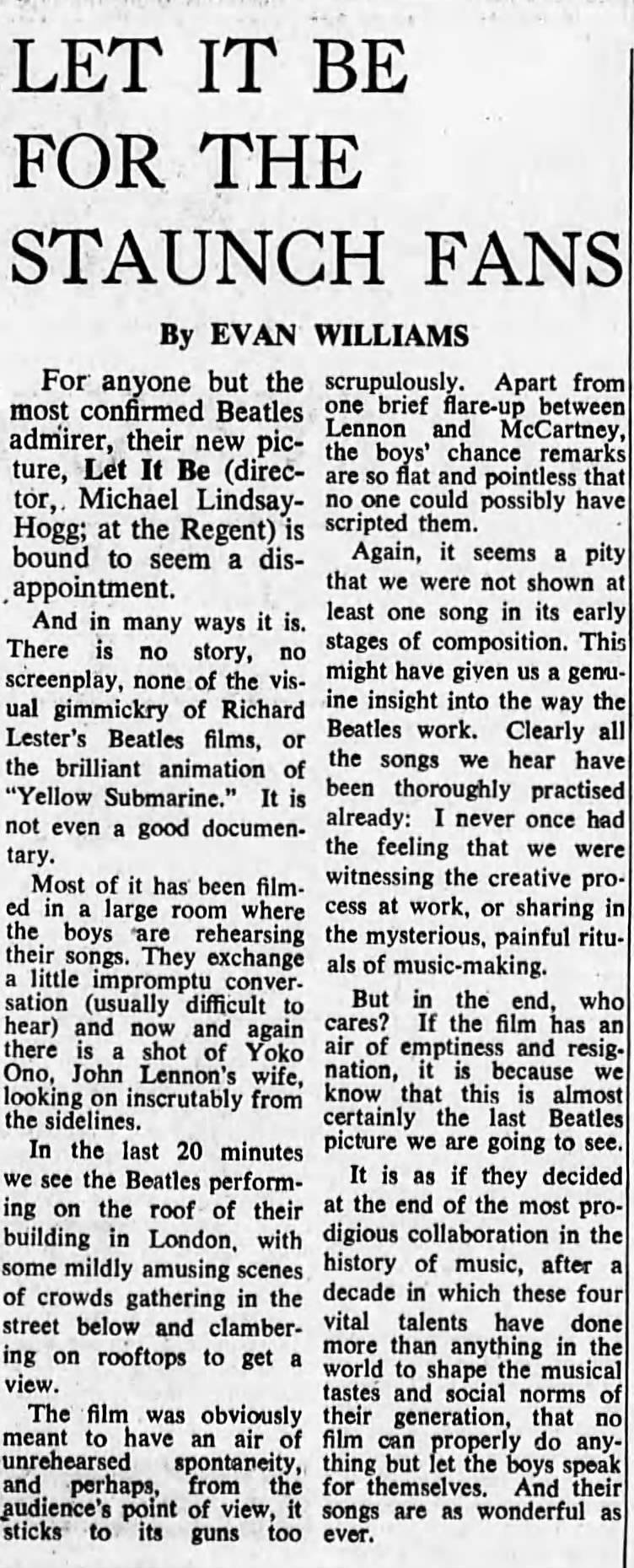
In the the Sydney Morning Herald’s review headlined “Let It Be For the Staunch Fans,” writer Evan Williams smartly noted:
It seems a pity that we are not shown at least one song in its early stages of composition. This might have given us a genuine insight into the way the Beatles work. … I never once had the feeling that we were witnessing the creative process at work, or sharing in the mysterious, painful rituals of music-making.
(This key point is something the 2021 Get Back film is set to get right).
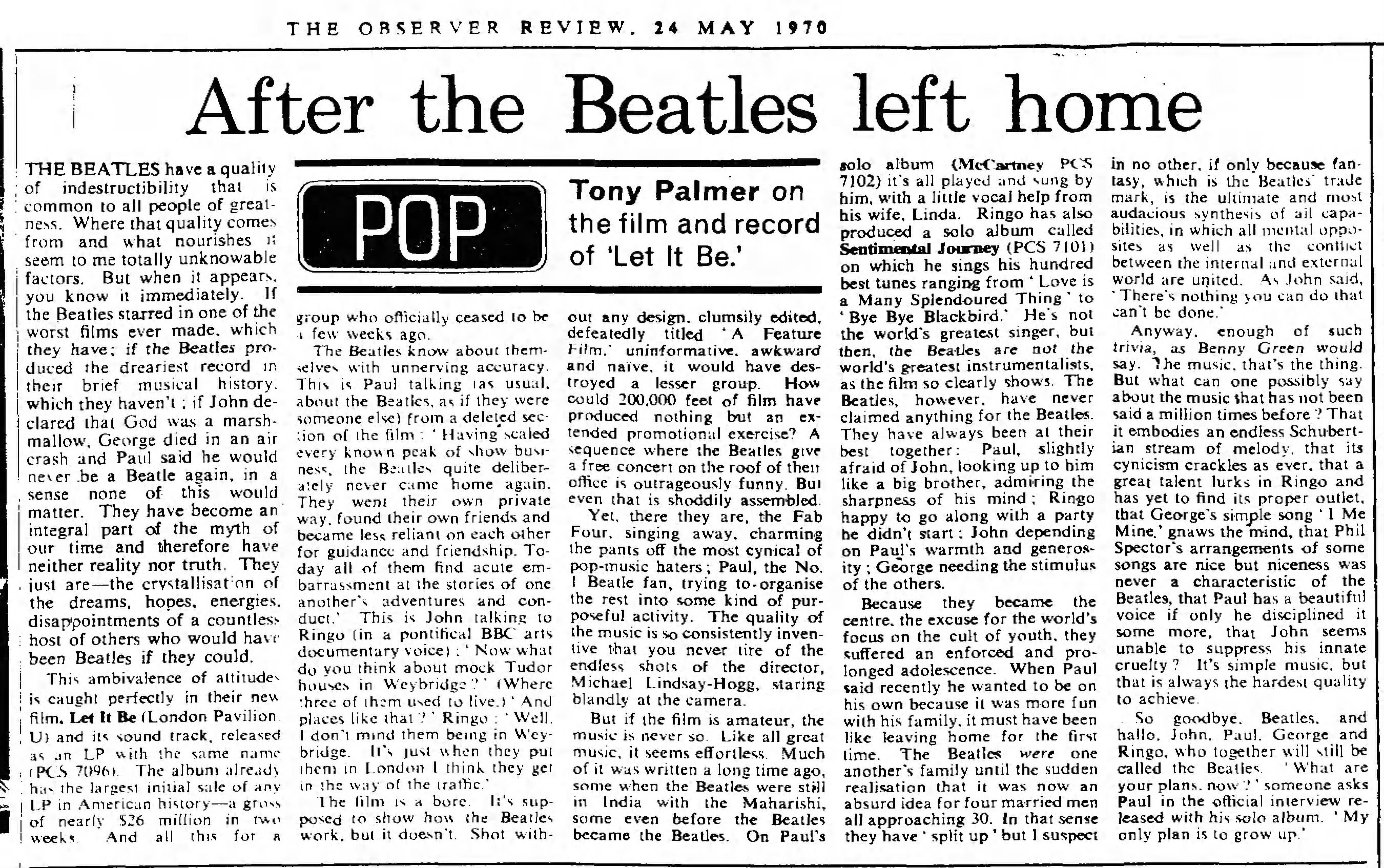
Tony Palmer gave a brutal takedown of the film in the Observer’s May 23, 1970, issue.
The film is a bore. … Shot without any design, clumsily edited, defeatedly titled ‘A Feature Film,’ uninformative, awkward and naive. It would have destroyed a lesser group. How could 200,000 feet of film have produced nothing but an extended promotional exercise?
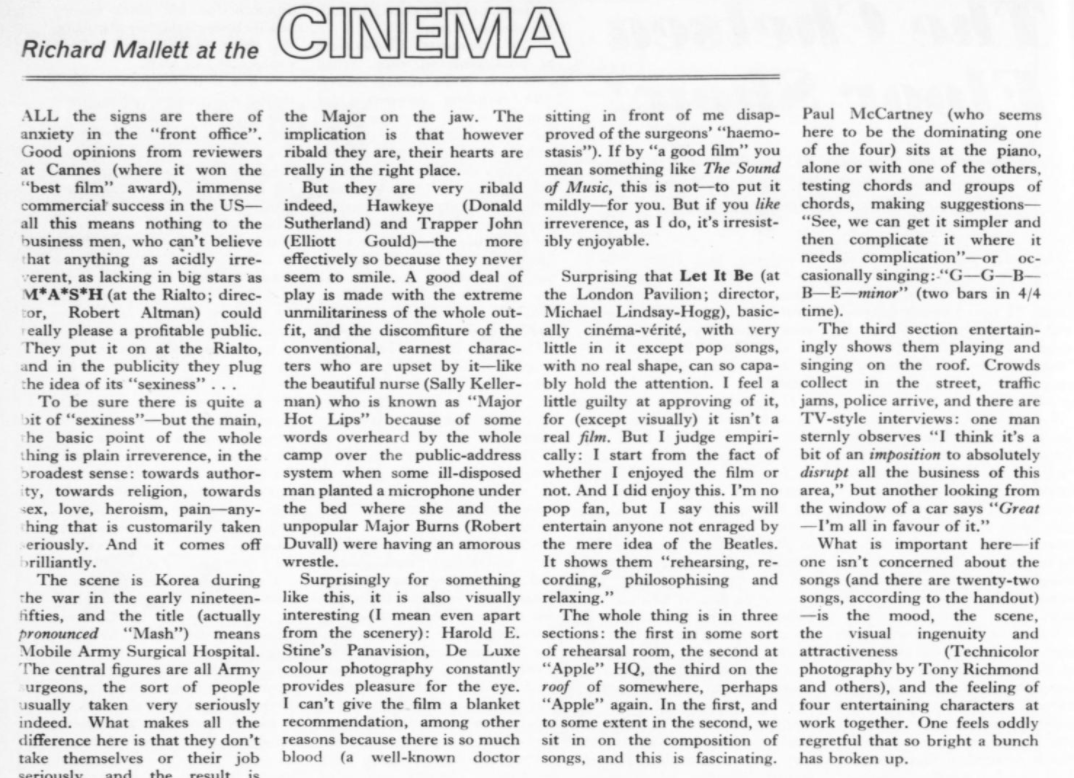
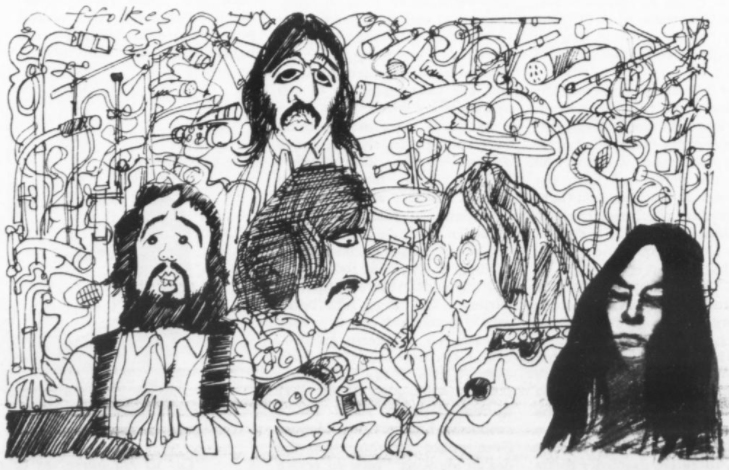
Writing for Punch magazine, Richard Mallett, who described himself “as no pop fan” called the film shapeless but wrote it “will entertain anyone not enraged by the mere idea of the Beatles.” He enjoyed the film’s mood, visuals and interplay of the four Beatles, concluding, “One feels oddly regretful that so bright a bunch has broken up.”
“The Beatles and Friend” – from Punch magazine
These are just a small sampling of reviews. I could have posted hundreds, but you get the idea.
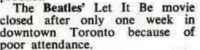
The film performed OK at the box office, seeming to peak in Variety’s weekly rankings at No. 5 in its third week. Per those same rankings, it dropped from No. 8 to 41 on June 17 and then slowly vanished from theaters overall. The film ultimately won an Oscar for its score, but no there weren’t any Beatles around to pick up the trophy.
From Billboard, June 11, 1970
It’s an understatement to say the Beatles, especially John and George, piled on subsequent years, advancing and ensuring the film’s terrible standing.
Even Capitol Records eventually called out the film’s dim reputation. Remember Reel Music? (Don’t answer that). The 1982 compilation of Beatles movie songs promoted Let It Be like this:
Let It Be poignantly documents the group’s disintegration while capturing their inimitable songwriting technique.
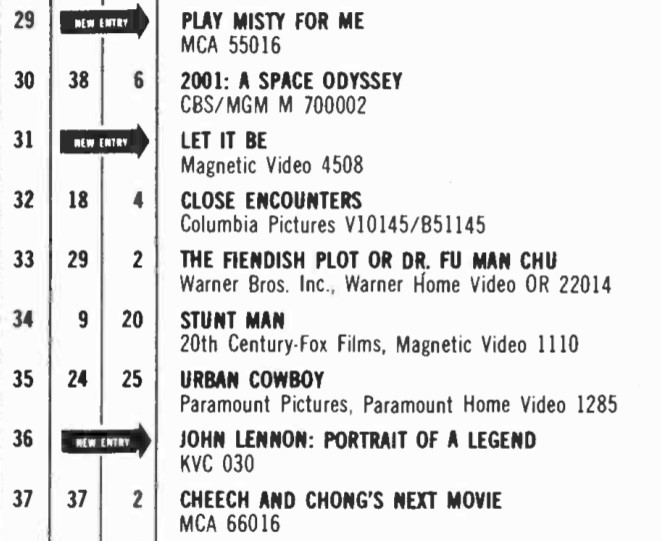
In July 1981, a decade after it was in theaters, Let It Be saw its first home release on VHS (it was later issued on Laserdisc). Again using Variety’s rankings, the tape debuted at No. 31 and kind of bubbled around the 20s, peaking at No. 19 before eventually falling out of the Top 40.
VHS charts, August 1, 1981, Variety.
That makes it 40 years since the movie was last issued for a home audience. In January 2022, “A Hard Day’s Night” is slated for a 4K Criterion Collection reissue. You could have bought that fab film on VHS, Laserdisc, DVD, Blu-Ray and streamed it online in that same period of time. It’s a big game of telephone, but Michael says that Paul told him George blocked the DVD release in the 1990s, while a planned DVD to be released in tandem with Let It Be … Naked in 2003 never materialized.
Footage from Let It Be trickled out officially on occasion, like in Anthology in 1995, when a whole new audience was exposed to George playing if Paul wanted him to play during the “winter of discontent.” On the flip side, part of the rooftop show ran during the credits of the 2014 documentary “Eight Days a Week,” a lovely — if strictly anachronistic — conclusion to a movie about the Beatles’ touring years.
But for all intents and purposes, the original Let It Be film had its reputation established by its release, with the breakup taking on a disproportionate stake. Decades of unavailability for mainstream viewers cemented the movie as a straw man for late-era Beatles. The only two views of it were “watch the Beatles break up” or “watch for the symptoms of the Beatles breaking up.” There was little middle ground. Maybe Michael Lindsay-Hogg offered up too much subtlety.
Or maybe we also lost some context along the way.
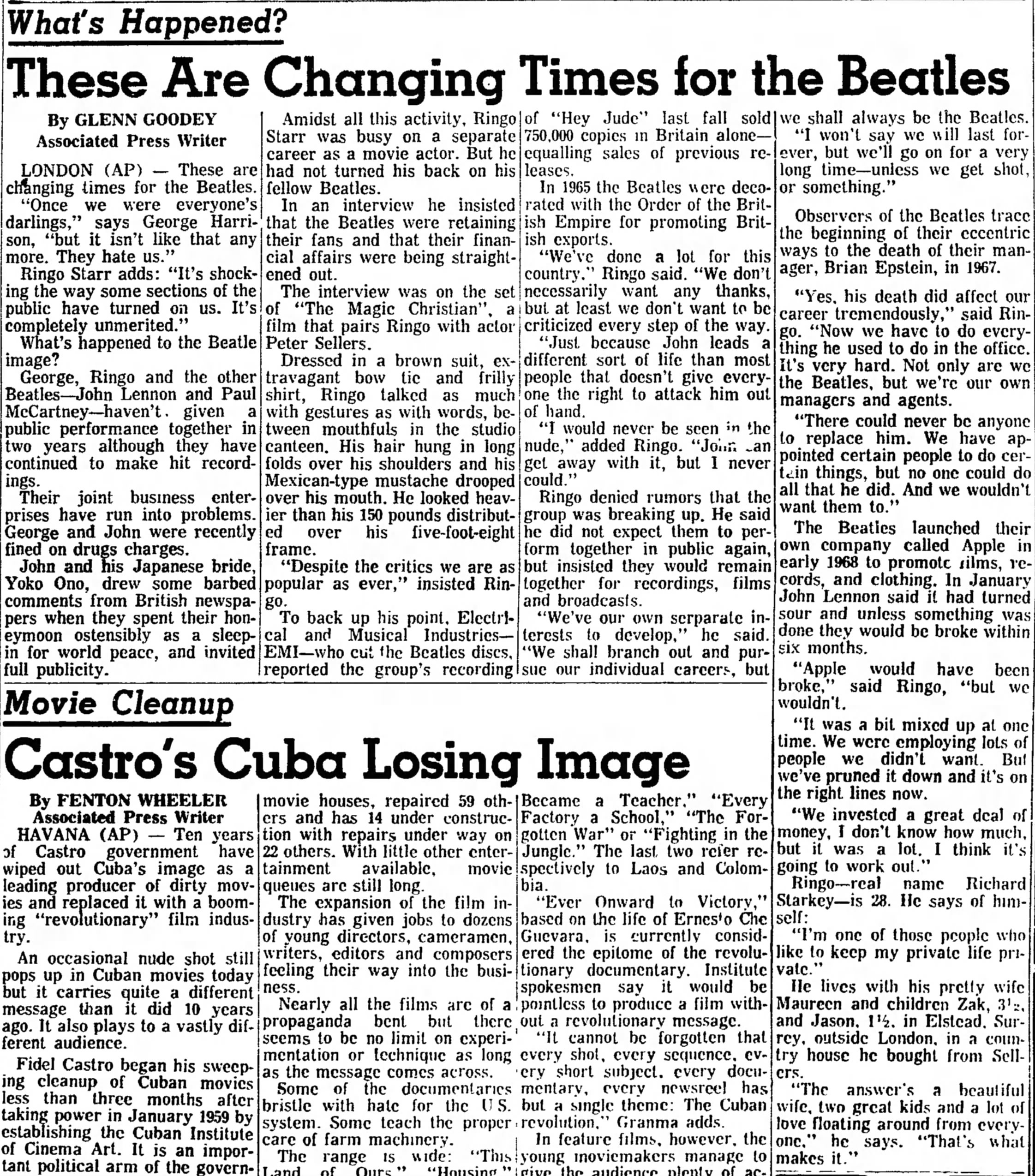
“Once we were everyone’s darlings,” George said in an interview published by AP. “But it isn’t like that anymore. They hate us.”
Ringo agreed in the same article. “It’s shocking the way some sections of the public have turned on us. It’s completely unmerited.”
It only took 51 years, but Let It Be is Get Back again. It’s out in conjunction with the release of the LP and a book (and within months of competing solo Beatles products). Yet with all this history behind it, it instead arrives with excitement from the band and fans alike, and it’ll draw upon its own blank slate.
Had the phrase been in vogue in May 1970, a record review would have called Let It Be a “hot mess.” I absolutely love the record, but I get how it’s a little off-kilter, off-putting and, frankly, a little bewildering.
Apple Corps announced the 51st anniversary reissue of the Beatles’ final LP on Thursday, and befitting the record’s legacy, it’s complicated and conflicted.
I say this as a sincere apologist of the original Let It Be. It’s a bizarre compilation album that’s nothing like anything they had done previously: Part-live, part-studio. Re-recorded and remixed older tracks, and songs written on the spot during the sessions. Novelty songs sequenced adjacent to their deepest statements. A rich overproduction of a loose session that wasn’t initially meant to be an album at all. Packaged along with a rich book of photos and dialogue and in conjunction with the film, Let It Be was a true, albeit helter-skelter multimedia experience.
Before getting to 2021, let’s first take a quick spin at the long and winding road (ugh, sorry) that got us here, just for the sake of background. It’ll be fun!
After spending January 1969 split between Twickenham Film Studios and Apple Studio at 3 Savile Row (see this fabulous blog for more on that history), the Beatles themselves were never unanimously satisfied with the record pulled together over the subsequent months. Glyn Johns, ostensibly the producer/arranger at the sessions, mixed and sequenced multiple versions of a Get Back LP throughout 1969, and told the story of his first compilation in his 2014 memoir Sound Man, outlining what became the “concept” of the album.
Having no real end in sight for the album, one evening after our session at Savile Row, I took it upon myself to take the multitrack recordings I had made during our rehearsals to Olympic Studios to mix and edit what I thought could be an idea for the album. This was to show in an audio documentary what I had witnessed in the previous days, as a “fly on the wall” insight to the four of them interacting, having fun, jamming, taking the mickey, stopping and starting and creating some wonderful music, warts and all. I had five acetates cut the following morning and gave one each to the band, keeping one for myself, saying it was just an idea and and asking them to take a listen. The next day I got a resounding NO from each of them, which I completely understood and had fully expected.
By May 1969, the Beatles reconsidered, delivering Johns a pile of multitrack tapes from the sessions, asking him to create a mix from their recordings at Savile Row on his own, without the group’s input. He wrote that he “soon realized that the real reason had to be that they had lost interest in the project.”
After multiple postponements and revisions to the mix — delays in part because of film delays — the Get Back LP (d)evolved into the Let it Be album as John and George Harrison tasked Phil Spector to produce the final version of the record in late March 1970.
We all have opinions on Phil Spector’s Let It Be, and I’m not here to judge.
John said Spector “worked like a pig” on the production, which used Glyn Johns’ mix as a starting point. “When I heard it, I didn’t puke,” John said. Ringo Starr likewise kept in his lunch, going as far as saying in the Anthology book, “I like what Phil did, actually.”
Paul McCartney, meanwhile, literally sued the other Beatles over Spector’s production of “The Long and Winding Road” (among other things, of course) on the last day of 1970. Macca has since made a cottage industry of rerecording and reissuingnon-Spectorversionsof the song at every opportunity.
Bootlegged since before Let It Be was even released, the first raw recordings from the sessions were officially released in 1996 on Anthology 3, with a somewhat randomly selected 12 tracks culled for the collection.
Glyn Johns (as pictured in the Peter Jackson’s Get Back trailer)
By the time Let It Be … Naked was released in 2003, half the band was dead (although George had previously given his approval to the project). Its existence is primarily owed to Paul’s wishes to avenge Spector’s production (although the addition of “Don’t Let Me Down” to the rest of Let It Be is welcome and it sounds great, even if the collection completely lacks the occasional humor of the original, stripping it of the between-song banter). It’s other saving grace is the addition of the “Fly On the Wall” disc, a little starter set for the Nagra-curious, compiling all manner of song and conversation snippets from the sessions.
And that pretty much brings us to this very glorious day, when we formally learned what would be on the “Special Edition” of Let It Be.
This is a great time to be a fan of this era, with the Get Back book of photos and dialogue coming out October 12, the album coming out just three days later and the new six-hour Get Back documentary series by Peter Jackson streaming November 25-27. That’s a lot of product for a period that the Beatles couldn’t stop bashing for several decades, and that we see from the start was something they weren’t really enthusiastic to release in the very first place.
The transformation of the Beatles’ Winter of Discontent in the upcoming Fall of Rehabilitation seems built around the documentary, the apparent centerpiece of the revival.
Thanks to @SATBshow for having me back on to ruminate and speculate on the upcoming Get Back production along with the always eloquent @drduncd. Find your headphones and please enjoy!! 🎧 https://t.co/MDuolxdSOY
We can guess what will be in the film (and I tried to guess — check out the above!) but now we know for sure what a Let It Be deluxe entails. Beyond the Giles Martin/Sam Okell remixed version of the original album — “guided” by Phil Spector’s version — the box will contain:
Glyn Johns’ mix of the Get Back LP (looks like his third compilation)
An EP featuring two unreleased 1970 Johns mixes (“Across the Universe” and “I Me Mine”) and two 2021 remixes (“Let It Be” and “Don’t Let Me Down” singles)
27 “previously unreleased outtakes, studio jams, rehearsals”
It’s easy to welcome the release of the Glyn Johns mix, a historic document and true “lost album.” It’s a natural and expected addition to the set, even if all four Beatles nixed it more than half a century ago. The two lost 1970 Johns mixes make sense as add-ons. As for the 2021 remixes … sure, why not.
That leaves the outtakes. Oh, the outtakes. While a microscopic fraction of what was captured at Twickenham and Savile Row, it could well be representative in a remarkably scaled down fashion. But until we hear more selections, read more reviews or get dates, even, of some of the tracks, they’ll be a bit of a mystery until we put the record on. What’s in mono (sourced from the Nagras) and what’s in stereo (recorded on multitrack) gives a hint where certain tracks were recorded, but that’s one of the very few clues for you all.
The track list
For instance, what is “I Me Mine (rehearsal)”? The Nagra reels have more than an hour of the song being rehearsed, over more than 40 tracks.
Every track that ultimately appeared on the original Let It Be is represented by at least one outtake/rehearsal version. That’s not a bad thing. Some songs that dominated the sessions did not surface — like “Maxwell’s Silver Hammer,” a significant Twickenham work-in-progress. “All Things Must Pass” seems to be represented by one of these early takes, but only this one. That’s not a good thing.
It’s nice to have the origin story of “Something” and “Octopus’s Garden” (as seen in the Let It Be film) as links to Abbey Road and an early working rehearsal of “Gimme Some Truth” as a tie to their future solo career. This is a great introduction to a wider audience to the concept that the January 1969 sessions were creatively sprawling and carried a legacy beyond Let It Be alone.
All of this needs to be in there. But every track draws attention to missed opportunities of every scale. The tapes record Paul debuting “Golden Slumbers” and “Carry That Weight” on separate occasions and then later linking them together alone at the piano, but these are left to the bootlegs alone. George and Paul introduce numerous future solo tracks during these sessions, but we don’t get “Here Me Lord” or “Another Day,” to name just two examples.
The set features two Savile Row versions of “Get Back,” but the signature song of the sessions and its 2021 reboot was written while the cameras were rolling over the course of early January 1969. We hear the song spring from a jam and later become a foray into politics (“No Pakistanis”) before Paul and John work together to finalize the lyrics we know today. To those who know the takes, those earlier, nascent versions are conspicuous by its absence.
To me the development of these songs represent the essence of the January 1969 sessions. It’s what makes this collection have the potential to stand out from the others (Sgt. Pepper, White Album, Abbey Road), in which the songs arrived in the studio mostly formed. The songwriting build should be central to the bonus content, but it doesn’t appear to be.
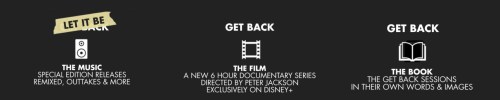
Over the course of the Peter Jackson documentary, I would guess we’ll get such moments. And maybe this is where Let It Be and Get Back separate after 50 years of sharing the same exact space. You almost get a sense that’s what the group is doing, when you look at the Beatles’ homepage, and the image promoting the set: “LET IT BE” is “taped” over “GET BACK,” making clear this thing is different.
To its credit, this box feels too narrow to be seen as revisionist. There’s just not enough material to redefine any narrative (barring whatever’s in the accompanying book). That job will likely be left to the documentary.
I know I’m spoiled. I’ve heard 80-something Beatles hours from January 1969. I want it all, with better sound, in a fancy box I can put on my shelf and not let my kids touch until they wash their hands twice. That beats having of a partition on my hard drive filled with MP3s.
(I’m also spoiled as a Prince fan and have been using the incredible Sign O’ The Times deluxe reissue as a point of reference, too. That had 45 unreleased studio tracks in addition to singles, remixes and different concerts on two CDs and one DVD. It’s a sexy beast of a box set.)
The thing is, how do you compile a widely satisfactory version of the Get Back/Let It Be sessions?
Obviously, it’s impossible to market and widely release dozens of takes of “Maxwell’s Silver Hammer” or nine hours of “Get Back” (the song) sessions. I may like to hear George kvetch about having to be on a boat with Beatles fans or Paul tell John to sing louder or Ringo discuss his dog, but it’s hardly a selling point to a mainstream audience and it’s most certainly not re-listenable (unless you’re literally me or a few other dozen people doing this kind of thing). I’m not convinced what we’re getting is sufficient either, though.
So what would have been the right way to do this?
• At one point I posited that a “Beatles ’69” super-duper deluxe would have been a possible out-of-the-box box-set approach, combining Let It Be with Abbey Road, something that makes quite a bit of sense when you see how many songs from the latter were essentially demoed at the former’s sessions.
But one gigantic box was never going to happen, the Abbey Road and Let It Be “brands” would never be — and probably shouldn’t be — diminished. I get that. But we’re left with something a little halfway right now. Disc 3 of this set has five eventual Abbey Road numbers. Yet there are another seven that could have been included, but weren’t, and I’m not sure what the rationale was to select which made the cut.
• Further, if the original Let It Be film is to be dead and buried, this box should have been its final resting place. Mark it up another $20, that’s fine, lots of us will pay it.
And that would be another way to delineate Let It Be from the forthcoming Get Back, identical twins who finally grew up to lead separate lives. At some point, on one of my appearances on Something About the Beatles, I suggested perhaps the Get Back series should get an actual soundtrack. That would be another — albeit confusing way, to less dedicated fans — to get us to buy another box set with more of what’s missing here.
• Likewise, there’s more than enough material to have stuffed a CD or two of oldies (beyond the medley on the Glyn Johns mix). These sessions are known for those oldies performances, and that’s something Mal Evans even broached in 1969, writing as much in Beatles Book 72, published that June.
• Given the consistent on-site song building, they could have easily taken the same approach used on the Sgt. Pepper deluxe with several songs, tracing the progression of “Get Back,” “I Me Mine,” “Don’t Let Me Down” and beyond. It’s very easy to sequence tracks to show these songs’ evolutions. This was so unique for this period, where we can literally hear in the studio, a song’s origin as a piano vamp or a guitar jam, and follow it to the end.
• If they insisted on having an EP, one of George playing Dylan songs throughout the sessions would have been lovely.
• It pains me there’s no recorded document of the “fast” version of “Two of Us.” But that is one of the drawbacks of many of the outtakes from throughout January 1969: Not everything recorded is a complete take of a song. In fact, quite the opposite.
• We need more Billy Preston, but we always need more Billy Preston. The Beatles certainly were better for it.
The addition of Billy Preston just improved this post.
• I don’t know if we need more Yoko Ono, but I was hoping — though not necessarily expecting — her jams with the group on January 10, 1969, after George walked out. It’s a piece of history, too, regardless of what you think of Yoko’s voice.
• A dozen songs already appeared on Anthology 3. Like the other recent box sets there are a few redundancies. I credit the new set for having something different the January 1970 Threetles session, but it would have been something to have more than just the single track.
• One of the great oddities of the Beatles catalogue, “You Know My Name, Look Up the Number” needed to have a home on this set. It’s timeline was split between Sgt. Pepper and Abbey Road, but as the B-side to “Let It Be,” this is where it belongs (especially as it’s not packaged with either of those deluxes).
• The definitive musical moment of the sessions — the rooftop performance — is featured raw on only one track in the new set. This would have been the obvious spot to offer the whole collection for the completist and as a companion to the Get Back documentary, which includes the whole thing.
***
So to ask again, how do you compile a widely satisfactory version of the Get Back/Let It Be sessions? I don’t think you can. There’s really no suitable middle ground. I — and many others like me — crave everything, a horrible idea for a mainstream audience. I feel the new box goes partway in the right direction with the addition of the Glyn Johns mix and some of the outtake tracks, but it doesn’t go as far as it should as a historic resource.
That puts some pressure on the documentary, but six hours of unreleased Beatles is a long time. And like the original record, it’s only fair to treat the entire package — records, documentary, books — as a singular, albeit helter-skelter, multimedia unit.
And in true Beatles tradition, we don’t have to agree on it anyway.
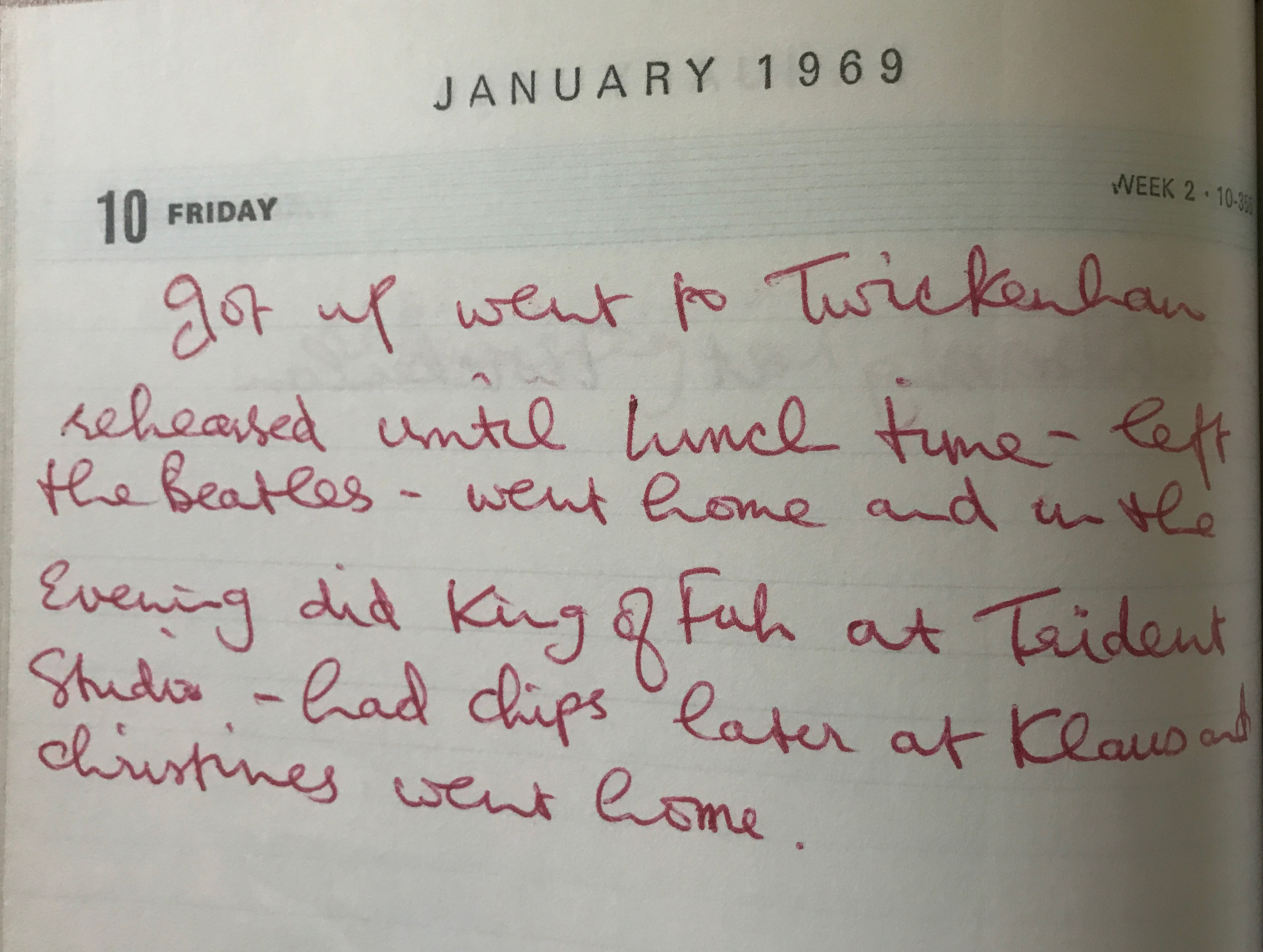
More than a half century removed, it’s pretty easy to say George Harrison was on a clear trajectory to cut his losses and walk away from the Beatles a week into the Get Back sessions and cut bait on January 10, 1969.
But even on that Friday morning at Twickenham Film Studios, was George a man with a plan to leave the group? Here’s how the day played out:
Only the Northern Songs, Pt. 1: Unpacking the day George quit the Beatles, a day that began with a visit from Dick James, and featured a deep dive into their extended publishing catalog, family greetings and Zsa Zsa Gabor stories.
Only the Northern Songs, Pt. 2: “Fascist bum” or friend to the Beatles? Maybe Dick James was both. Here’s the second part of our deep dive into the publisher’s visit to the band, hours before George left. Featuring Magic Alex stories, car talk, hidden mics and secret meetings.
Knew it wouldn’t last: In the hour before George quits, his performance and motivation are in question during rehearsals for the increasingly dynamic “Get Back”
On his way home: Deemed “faceless” by Paul McCartney “Two of Us” goes through a final set of rehearsals before the entire trajectory of the Beatles’ Get Back sessions changes completely. Plus, peeling back a myth about the song and Grapefruit.
See you ’round the clubs: On January 10, 1969, George Harrison quit the Beatles. This is the story of what happened that afternoon, what didn’t happen and the reasons why. It’s peak They May Be Parted, — my longest post to date.
A quick one, while he’s away: With George gone, the Beatles carried on as a trio with a vocal plus-one. Here’s what happened when Yoko Ono took a seat on George’s blue cushion.
Go on, as if nothing’s happening: No plans, no guitarist, no problem for the Beatles, who completed their first full week at Twickenham with no clarity on who, where or what the future would bring. “If (George) doesn’t come back by Tuesday,” John Lennon said, “we get Clapton.”
Et cetera: A box for George and a bag for John. Song notation and interview negotiation. There’s a story in these stray conversations that didn’t quite fit in other posts.




 They May Be Parted