The first day of the Get Back sessions
The phones began to ring at 8:30 a.m. This was going to be a new routine at a new venue, so a friendly wake-up call couldn’t hurt.
“[B]etween bites of breakfast, I’d telephoned round all four fellows to remind them it was getting up time and they were due at Twickenham by eleven,” roadie Mal Evans wrote in the March 1969 Beatles Book magazine, citing his January 2, 1969, diaries.
The Get Back sessions were underway.
Despite Mal’s best effort, Paul McCartney didn’t arrive until 12:30 p.m., “having come by underground, then local train, then taxi from Hampton Court station,” Mal wrote. “He’d meant to do the entire journey by public transport but, knowing he was late, he chickened out and caught a cab rather than wait at the bus stop!”
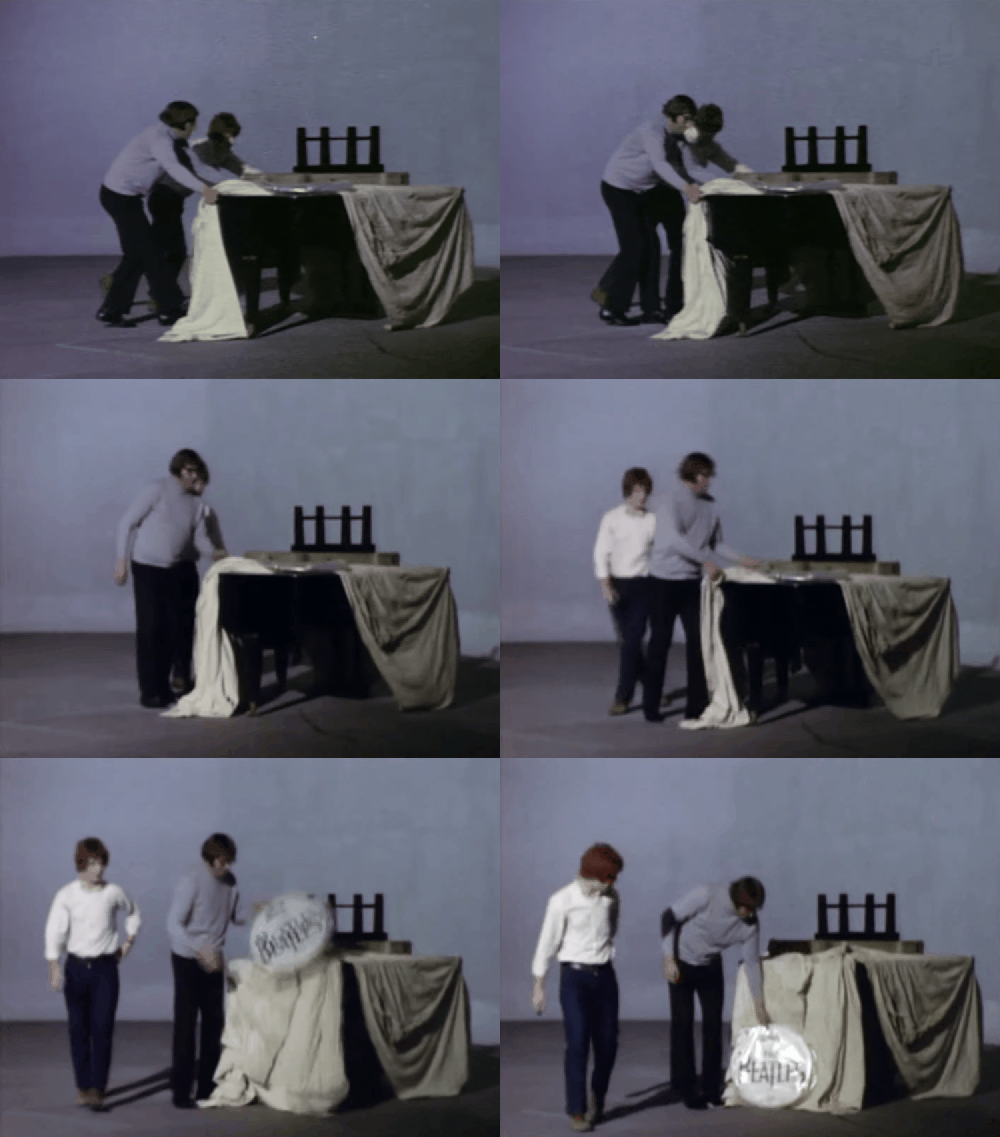
We can see Mal and Kevin Harrington set up the stage, in the opening shots of both Let It Be and Get Back.
Here’s Kevin, from his 2015 memoir “Who’s the Redhead on the Roof …. ?” in a story I’m grateful to have heard first-hand from the man when I visited England in June 2024 :
Michael Lindsay-Hogg, the director, asked us to push a piano in a certain direction so they could film us pushing a piano in a certain direction. We duly obliged and, with Mal carrying a drum skin in one hand and me carrying a cymbal, we pushed the piano in this certain direction. Mad. Me, I would have done that in two trips. Mal would have put the drum skin on the piano first then pushed the piano in a certain direction. Then we would have stopped, turned and walked away in a certain direction. Mad.
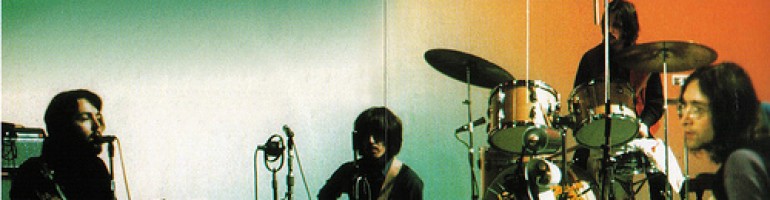
By the time Paul arrived, the other three Beatles were already gathered on the soundstage, John Lennon (“Don’t Let Me Down,” “Dig a Pony”) and George Harrison (“All Things Must Pass,” “Let it Down”) offering samples of their respective newest offerings, potential songs for the upcoming concert they were going to stage.
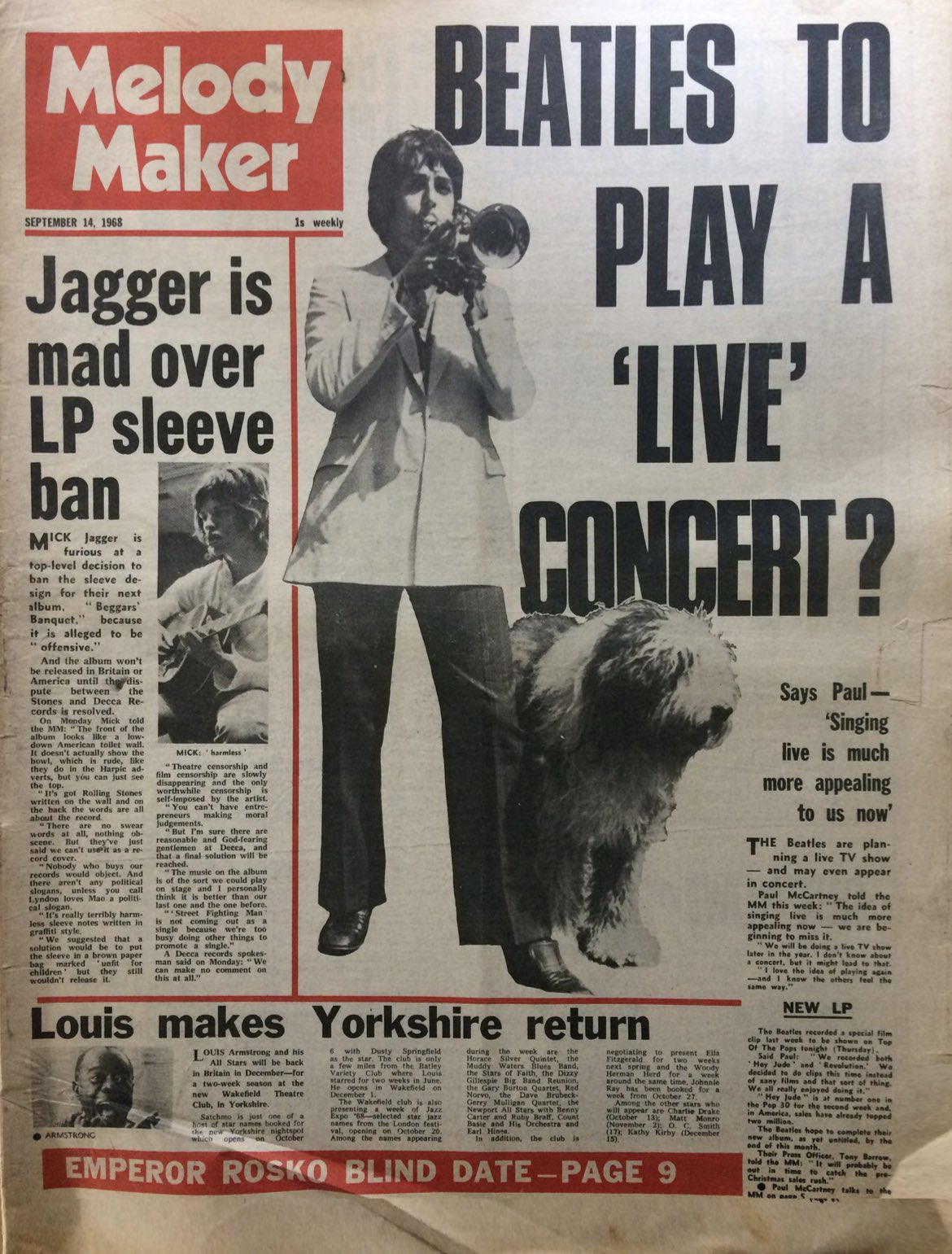
In the past few weeks, a live TV concert that was first publicly teased in mid-September — in the midst of the White Album recording sessions – evolved into a whole new concept: recording a documentary of the group writing and then rehearsing new songs for the live show.
Mal and Kevin did their best to give the group all the best conveniences. Per Mal:
Toast, cornflakes and tea were ready for each arrival on the open space of Stage One every morning. Beatles prefer to get where ever they’re going for the day and THEN start the day’s eating!
Kevin [Harrington] and I brought over all the food from the Studios canteen. For lunch they started off by using some new flats which have been built for film actors and actresses so that they can make themselves at home between ‘takes’ without leaving the studio area. That didn’t work because the food was cold by the time we served it so we block-booked a couple of big tables in the canteen and added a bottle or two of good wine to whatever was on the day’s menu!
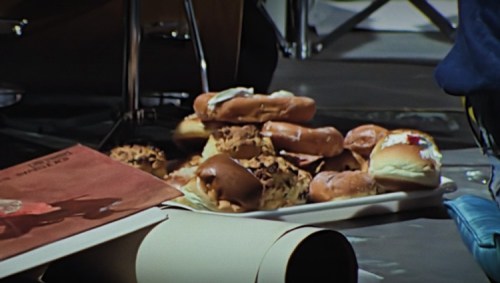
“It’s like a rock cake, but needs butter or something” – John Lennon on Twickenham’s dry buns, January 2, 1969 (From Get Back)
Much of the tone of the rest of the month plays out in this short session: negotiations over how and where to stage a show, collaboration on new songs and improvised jamming on familiar oldies, reminiscence of the past with an eye to their future and general productivity among the self-created chaos. It all plays out in the two hours and forty minutes on the Nagra tapes documenting the day’s audio. Anytime we hear a little bit of an edge in a remark, it’s at once a signal everyone is coming into the sessions from a different place and with a different agenda as well as an indication we’re laying our own biases into the story, knowing how it all played out. (I’ve written a little bit about this first day, when the blog first launched; it’ll get to a rewrite sooner than later.)
“This is fine for the documentary for a day or two,” Michael said of Twickenham at one point in a conversation with Paul and Apple Films producer Denis O’Dell on January 2.
Paul: We’ll move out of here [when we’re ready], or maybe we won’t.
Denis: Do a couple of days, see what happens, get a little of film.
We saw what happened, even if the parties involved couldn’t process it in real time as we can in retrospect. What played out over the subsequent 30 days altered the band’s history – its interpersonal relationships, its musical and visual output –and has been written and rewritten, edited and re-edited, understood and misunderstood.
Only a few months removed from the sessions, Mal recognized a little space was needed, speculating in the same March ’69 Beatles Book magazine cited earlier that a “sort of ‘Beatles at Work’ documentary production on the side … could be saved and shown later perhaps even 10 years later, to let people see … the Beatles start off to build up a new set of songs.”
Context always matters. And here’s what this advent calendar project taught me.
Common knowledge holds true: After the “Hey Jude” live performance for David Frost’s show, the Beatles became enamored with performing before a live audience again. They bandied about a few venue ideas before deciding to write songs on the fly and perform somewhere, stuff they’d sort out at Twickenham, for better or worse.
While that story is still accurate, knowing how John, Paul, George, Ringo and the other important adjacent figures spent their December 1968 day-to-day completely informs the January 1969 story so much more.
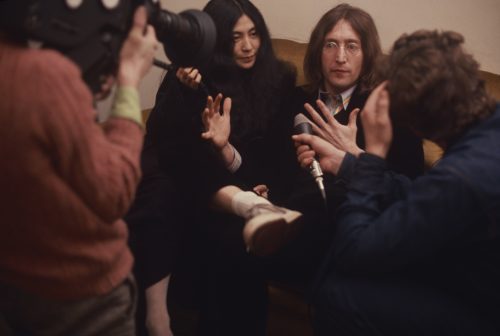
John and Yoko hold court in the waiting room of his dentist on December 14, 1968. Photo by Susan Wood.
No one hustled like John, in tandem with Yoko Ono. They’d host multiple media outlets while undergoing dental work, in order not to waste any time (see December 14 entry). They’d bring the press to his house (December 16), or sneak in a radio appearance in the middle of a concert performance (December 12). They’d perform at a charity show (December 18) and make an appearance in support of teachers they didn’t even know (December 30). They played Mr. and Mrs. Claus under threats of violence at the Apple Christmas party (December 23). All of this was on the heels of Yoko suffering a miscarriage (November), their continued problems selling Two Virgins (ongoing since November) and a drug bust (October). John justifiably entered 1969 on fumes.
Then there’s Paul, who went on a beach vacation mostly in anonymity. He visited his family Merseyside. This was on the heels of a trip to New York to spend time in Linda’s hometown, and then a lengthy stay at Paul’s farm in Scotland.
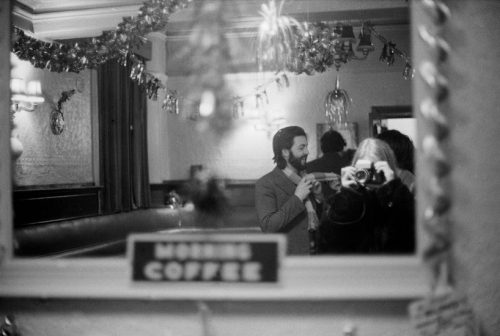
From Linda’s Instagram: “Self-portrait with Paul. Christmas, Liverpool, 1968.”
Look at pictures of Paul from this period – when he went to Portugal with Linda Eastman and her daughter, Heather (see December 10-17), and from his visit to Liverpool for Christmas (December 25, of course) – he smiles a true, broad smile. These are private photos, usually taken by Linda. Paul is animated yet relaxed. He wasn’t hustling at all – there would be time for that. Instead, Paul was falling deeper in love with Linda and experiencing what it would be like to be a father. Clearly, he loved it. And when he arrived at Twickenham, he wasn’t burnt out, but instead recharged and alive.
A further juxtaposition is stark: John had just lost a child in a miscarriage; a month later, Paul found out his girlfriend was pregnant.
George, meanwhile, enjoyed a wife and a girlfriend (see December 31). The former was on the verge of moving out of the house on account of the latter. George enjoyed fruitful time away from the Beatles, spending an extended period in the United States, producing Jackie Lomax and spending time with Bob Dylan and the Band. He had plenty of good musical material, but my personal take is that no matter what, his life at home was coloring every other aspect of his life, Beatles-life included. (Beyond that, George had his tonsils removed in early February, so it stands to reason he just didn’t feel good in January).
Not relied upon as a songwriter, Ringo had it easier than the others (although he did continue to write in this period). Still, it’s hard to think he wasn’t distracted by the upcoming production of The Magic Christian, and all the lines he needed to learn.
Michael and Glyn both entered the sessions on an upward trajectory. Michael didn’t yet know his production of the Rolling Stone’s Rock and Roll Circus (December 11–12) would be shelved until 1996. For now, it was an imminent project, one that would springboard him right into an even bigger venture with the biggest band in the land.
Glyn climbed the same ladder. Not only was he a part of the Rock and Roll Circus, but he also was waiting on Led Zeppelin’s debut (which he produced) to be released in the coming weeks (see December 31). But that band were relative nobodies at this point. Glyn was tabbed to be the first man other than George Martin to produce the Beatles.
It’s with this collected knowledge we’ll enter Twickenham on January 2, 1969. The mighty Beatles, had reassembled to push to greater heights even while standing at what could be seen as their peak. This was a really good time to be a Beatles fan.
The band had nothing to prove, yet their audition was underway.
 They May Be Parted