I’ve been sharing my insights on the Beatles’ Get Back sessions on this blog for the last seven years, and it’s been with great joy that recently I’ve been able to share my voice as well at some other fine locations online.
Deep thanks to Robert Rodriguez for engaging me in a terrific, lengthy discussion on the Something About the Beatles podcast on the occasion of the 50th anniversary of the January 1969 sessions. Log onto your favorite podcast app (here it is on iTunes) or just click below. Perhaps do both!
Additionally, a huge thank you to the FabFourArchivist for having me on for a couple of cameos on his YouTube series about the road to the rooftop.
Greetings to all the new readers and followers who have found this site thanks to the above! We’re now more than 50 years removed from the Get Back sessions — and with this one, 100 posts on this blog — and we can’t stop talking about it. And why would we?
The Beatles wanted to make a Lord of the Rings movie, going back more than 50 years. A half century later, they’ve got director Peter Jackson aboard, but for an entirely different film. Will this end up a fantasy, too?
Having maintained a monthlong silence on the 50th anniversary of the Get Back/Let It Be sessions, the Beatles raised the Dead Men of Dunharrow (that’s the Army of the Dead if you only saw the film) on the anniversary of the rooftop concert.
Quick takeaways here:
• The selection of Jackson was no accident. He obviously has a masterful storytelling ability while working within the constraints of very detailed and very iconic source material, as well as film restoration. While I don’t anticipate him to introduce Tauriel to, say, sit in on saxophone, I’m expecting something we’re not expecting.
Jackson’s a superfan, too, which can only be a good thing.
• I don’t believe having an “upbeat” Let It Be film is necessarily revisionist history — or fantasy, for that matter. I’ve long maintained there was plenty of sugar to along with the medicine when considering January 1969. It would be disingenuous not to include the tension, the arguing, the passive-aggressive relationships between the band members, and I think Jackson’s quote saying there was “none of the discord this project has long been associated with” is an overstatement. To whitewash that aspect of the sessions would be problematic (though not surprising, given the promotional work recasting of the White Album sessions 50 years later). But it would be likewise false to resissue the film as merely their “winter of discontent,” not that we should expect that.
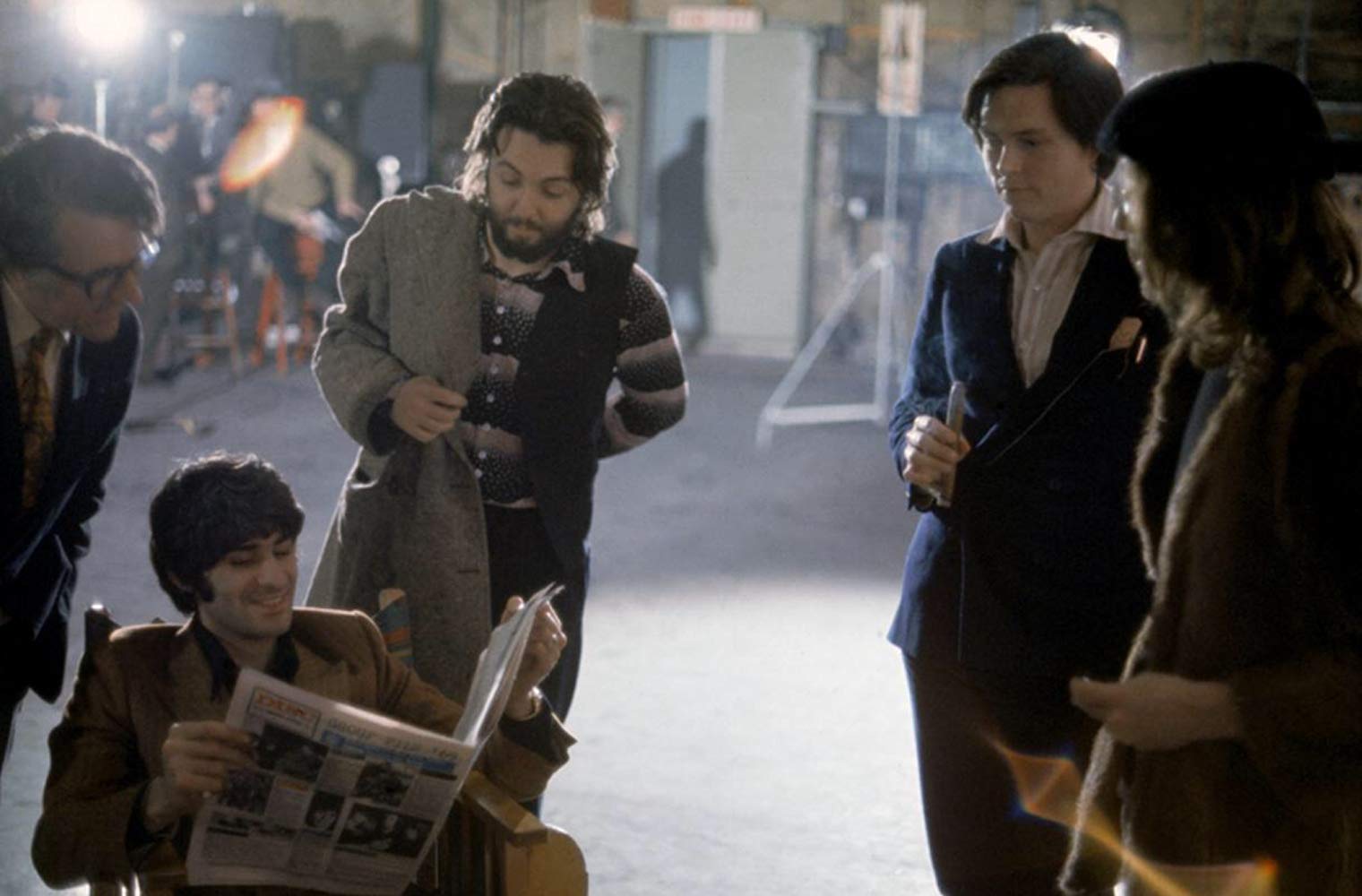
Paul McCartney and Michael Lindsay-Hogg (right) “on the set” of Let It Be. (Via IMDB)
• Make no mistake: Let It Be is Michael Lindsay-Hogg‘s film. He wasn’t just behind the scenes, he was an active participant in the sessions. Listen to the tapes (or leave it to me and read this fine blog instead), and you can hear MLH’s voice more than anyone else who’s not in the band. I’m very curious to see how Jackson works with MLH’s ubiquity — he’s central to every discussion about the live show, and perhaps he’ll retroactively get his first acting credit, that’s how much screen time he could get, in theory.
• And about that live show. I’ve written it before, but clearly the film’s arc should be (and have been) the sort of near-comedy of the greatest group in the world wondering what to do next and how — and that includes debating their own future — throwing out every idea they can think of, only to have someone argue against it. Finally, after ups and downs (George quitting), the villian (Twickenham Film Studios) is vanquished, a bit player from their past (Billy Preston) emerges out of nowhere to help return order, and everyone realizes the simplest solution (rooftop show) is what they were looking for all along. The farther one travels, the less one knows, so find the answer at home.
• I won’t call this a buried lede, but not even mentioned in the social media blitz — only the Beatles’ press release — is this news:
Following the release of this new film, a restored version of the original Let It Be movie directed by Michael Lindsay-Hogg will also be made available.
Quite the “oh, by the way …”
This is, of course, good news. Let It Be is a critical document, too, despite it’s obvious flaws, and we haven’t seen an official release since it the days of LaserDisc and VHS.
• The 140 hours of audio cited by Jackson is quite a bit more — in excess of 50 hours or so — than we’ve already have heard leaked and bootlegged over the years. It could be 24 more hours of discussions about a live show (I’m hoping) or 24 more hours of Maxwell’s Silver Hammer outtakes (I’m expecting). Reality, as usual, will likely be somewhere in between. I can’t see anything that changes the direction of history, but maybe we do get a few more specifics on locations. And I’m sure we get some improvisations or clipped covers we never heard.
“It’s funny, uplifting and surprisingly intimate.” – Peter Jackson
• I’ll admit I was wrong about something — but I’ll bury it at the bottom of this post. I never thought the Beatles would release Let It Be while Paul, Ringo and Yoko were still with us. And I thought, once Paul announced several months ago that some new version of the film was to be released, we’d probably just get Let It Be content lumped in as part of an Abbey Road deluxe set — “Beatles ’69.” But I was wrong there, too. Mea culpa.
• That said, we didn’t hear a thing about getting some of the audio outtakes — Nagra or otherwise — finally released. I’m still not expecting any sort of sweeping set — do you really think they’re going to put out tapes of Paul calling a newspaper “cunts” or, more relevantly, acknowledging how negative they are and doubting their future? — but maybe we will get a disc or two of some January 1969 upbeat highlights — “Suzy Parker,” “Oh Julie, Julia,” “Commonwealth,” etc. And there’s certainly enough terrific material to fill several Abbey Road “demo” discs, too.
The most disappointing part of the announcement is the timeline: It hasn’t been announced yet. But simply to get news of a new (and old) Let It Be is reason enough to celebrate with an unexpected party.
“I canceled the papers last week,” George Harrison told the rest of the Beatles early on January 9, 1969. “And they won’t stop them coming.”
Whether George reluctantly toted the Daily Express and Daily Mirror from his Kinfauns home or if they were delivered otherwise to Twickenham Film Studio, the newspapers were put to good use by the Beatles that Thursday.
“It’s about going away, and then the chorus is ‘Get Back.’ Actually, it’s not about anything.” – Paul McCartney
When looking for inspiration, we all know of John Lennon’s willingness to read the news (oh, boy), but it was Paul who ripped from the headlines to fill out some lyrics in his signature song on the sixth day of the Get Back sessions.
“Get Back” emerged from a jam two days earlier with a small set of lyrics — most of which would ultimately survive — including “she thought she was a woman, but she was another man,” “say she got it coming, but she gets it while she can” and “knew it couldn’t last.” The chorus would never change: “Get back to where you once belonged.”
The newspapers informed additional verses to give meaning to the chorus.
But first, let’s get back to George’s opening quote. After complaining about the papers’ non-cancellation, he continued: “George Gale is such an ignorant bastard.”
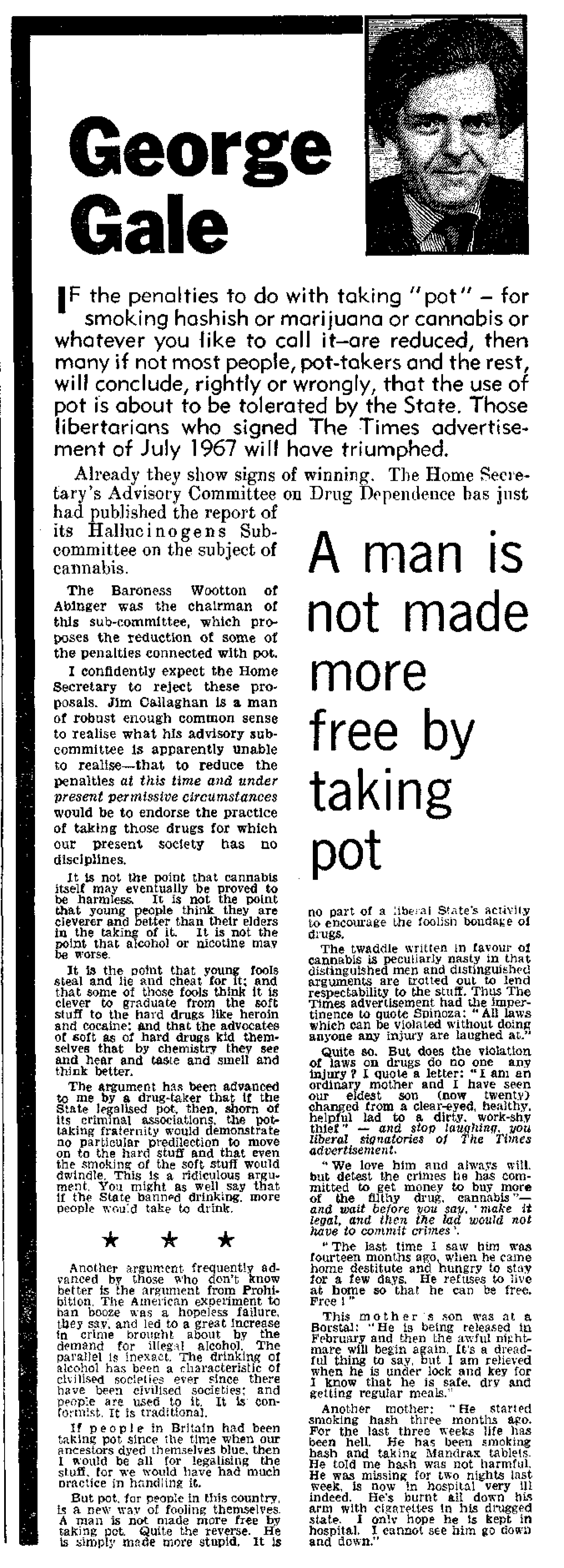
Gale, who at the time wrote for the Mirror, probably caught George’s venom because of that day’s column ridiculing marijuana users in the context of the release of the Wootton Report on the potential decriminalization of the drug.
But pot, for people in this country, is a new way of fooling themselves. A man is not made more free by taking pot. Quite the reverse. He is simply made more stupid.
But Gale’s politics would have been antithetical to George and the rest of the band since their teenage years. It was in 1956 — the year the Quarrymen were formed — that Gale famously wrote under the headline: “Would YOU let your daughter marry a black man?”
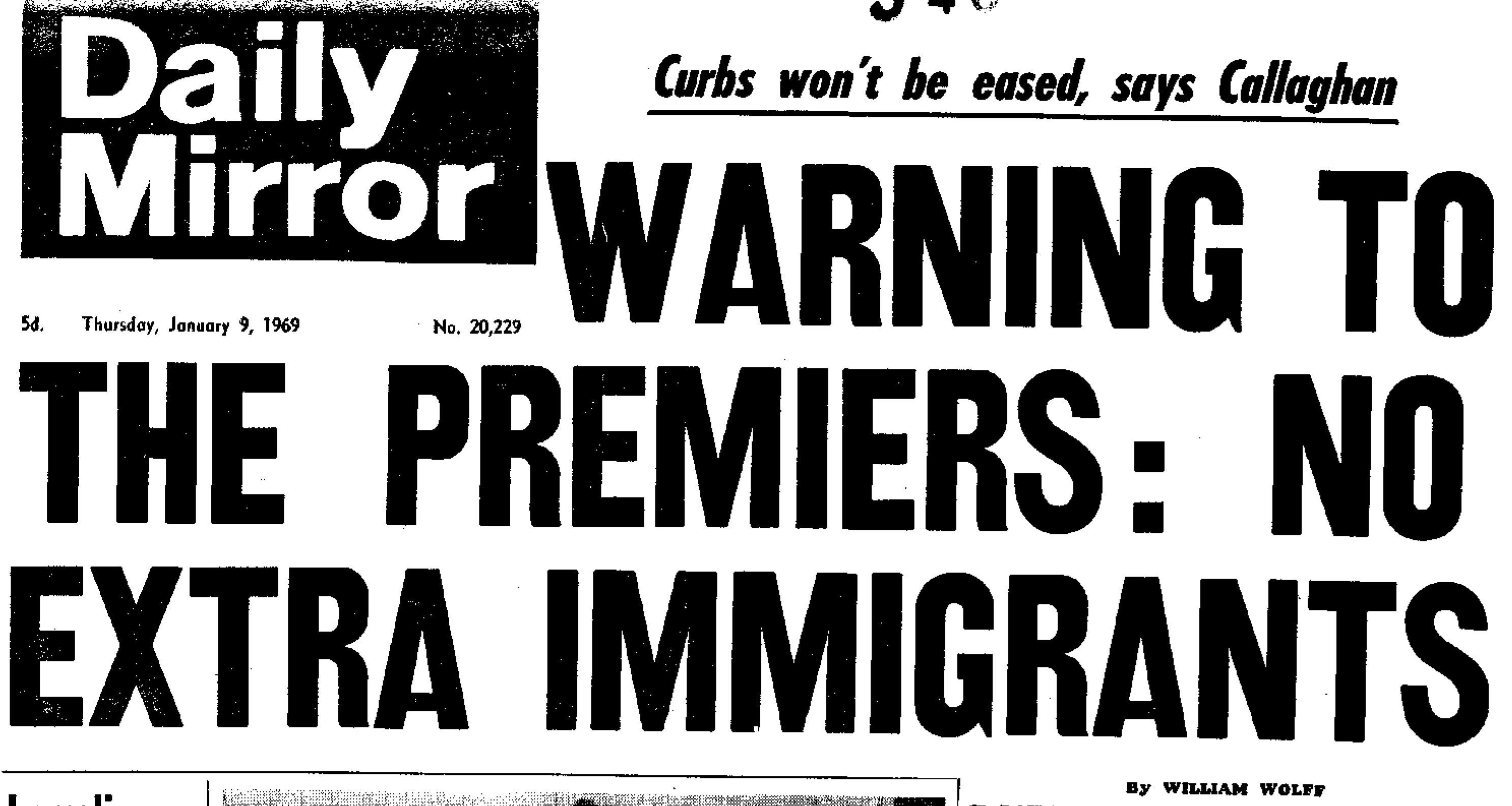
Enoch Powell’s Rivers of Blood speech was given in April 1968, less than year earlier, and its impact continued to resonate (Powell will soon enter this day’s story, too). Race issues remained a terrible plight and severely divisive issue across Britain into 1969 — and, obviously, before, beyond and basically everywhere throughout human history. In the specific context of immigration to Britain, it was in front-page news on January 9 as the Daily Mirror shouted on Page 1: “WARNING TO THE PREMIERS: NO EXTRA IMMIGRANTS”
BRITAIN has no intention of easing her immigration restrictions to take in extra Asians forced out of East Africa. … Mr. Callaghan insists that if Britain is forced to take more Asians from Kenya and Uganda, there will be a cutdown on other Commonwealth immigrants. The Home Secretary is giving the Premiers the strongest warning yet of serious trouble in Britain if extra migrants have to be accepted.
And that takes us back to “Get Back,” the first song the Beatles worked on after lunch. Musically it surges, spunky and alive with the four Beatles perhaps recognizing this is the upbeat rock song they were searching for a week into the sessions. It was likely the first time John played on the song, having arrived after the others when it was first played two days earlier.
From a purely musical standpoint, the song was hot and was rivaled by “One After 909” at this point in pure energy — as far as their originals were concerned. By this early moment in the song’s life, it already had the guitar riff and Ringo’s identifiable cymbal crash during the chorus.
“Think of some words, if we can. I don’t know what it’s about,” Paul admitted. “It’s about going away, and then the chorus is ‘Get Back.’ Actually, it’s not about anything” (said to laughter).
That was fine with George. “We’ll just have those words, just words like [the Band’s] ‘Caledonia Mission.’ They’re just nothing about anything, it’s just rubbish.”
So don’t count George as finding any deeper meaning into that Big Pink cut, in its hexagrams or Arkansas towns. The movement Paul needed was on his shoulder: Just write words that track to the tune, regardless of any actual meaning, and it’ll all eventually shake out.
Despite Paul’s admission to the contrary, to this point, the song did start to find a vague lyrical angle. Joe and Theresa entered the picture this afternoon — JoJo and Loretta would join eventually in their place. There remained the pursuit of California grass. Tucson — the Arizona city in which Linda Eastman went to college and close to where the McCartneys would later own a ranch (and Linda would pass away) — was specifically named for the first time.
Additional lyrics — often turns of phrases rather than coherent statements — emerged during the more than 20 minutes of high quality and high energy vamping and jamming. One pass through the verse is in the first-person, with the singer the protagonist who was a loner leaving his home for California and who was getting back to where he once belonged.
But for the majority of the rest of the time, Paul draws from the immigration news in his search for a relevant lyric, alternating verses about a Puerto Rican and a Pakistani, with the East Asian community’s flight from Kenya still such a big part of the news in Britain. (As a footnote, Paul visited Kenya in 1966, going on a safari with Mal Evans)
There were several points where Paul simply garbled over a name, phrase or section of lyric just for filler. Elsewhere, we get the beginning of a narrative, with an intolerant public imploring the different nationalities “get back to where they once belonged.”
A sampling of lyrics:
A man came from Puerto Rico, oh, he joined the middle class/Where I came from, I don’t need no Puerto Ricans
Take the English job, only Pakistanis riding on the buses, man
All the people said we don’t need Pakistanis, so you better travel home
Don’t dig no Pakistanis taking all the people’s jobs
Don’t need no Puerto Ricans living in the U.S.A.
Don’t want no black man
When tapes from these sessions first leaked into the bootleg market in the mid-1970s, we would simply get single songs stitched together with no context, little dialogue and guessed song titles — like ones called “No Pakistanis.” It’s obvious the Beatles were simply making a social commentary, satirizing the segment of the public who harbored the feelings they were singing. But by the mid-80s, a wide exposure of these takes by The Sun — lacking the needed conversational context or tracing of the evolution of the song — posited the Beatles must have been xenophobes themselves. Gotta sell papers, after all. There probably aren’t too many times Paul ever commented on bootlegged tapes, but Rolling Stone got him on record in 1986, responding to the racism claims:
Sensational journalism – The Sun is not a highly reputable newspaper. What this thing is, I think, is that when we were doing Let It Be, there were a couple of verses to “Get Back” which were actually not racist at all – they were antiracist. There were a lot of stories in the newspapers then about Pakistanis crowding out flats – you know, living sixteen to a room or whatever. So in one of the verses of “Get Back,” which we were making up on the set of Let It Be, one of the outtakes has something about “too many Pakistanis living in a council flat” – that’s the line. Which to me was actually talking out against overcrowding for Pakistanis. The Sun wishes to see it as a racist remark. But I’ll tell you, if there was any group that was not racist, it was the Beatles. I mean, all our favorite people were always black. We were kind of the first people to open international eyes, in a way, to Motown. Whenever we came to the States they’d say, “Who’s your favorite artists?” And we’d say, “Well, they’re mainly black, and American – Motown, man. It’s all there, you’ve got it all.” I don’t think the Beatles ever had much of a hang-up with that.
The reference he makes to the line about “too many Pakistanis living in a council flat” actually came on January 10, when the Beatles continued to work on the song. But the point remains. The song has been misunderstood by some unwilling or unable to see the nuance (search around the Internet for “Beatles” and “racist” at your own risk, even moreso if you read any comments).
We have on tape evidence the “get back” element of the chorus came before anything else on January 7, and was likely a riff on Jackie Lomax’s “Sour Milk Sea,” and we can reasonably dispense of the myth the song’s true origin was political. It’s also pretty clear Paul simply liked the flow of “Pakistani” and “Puerto Rican” — words with four syllables that were easy to rhyme — and was searching for something that sounded appealing, while not shying away from something political. At one point he clumsily rhymes “Puerto Rican” and “Mohican” (a Native American tribe), a perfect example of how little thought out the lyrics were at this point. He was just searching.
John Lennon later said “Get Back” was directed at Yoko Ono, anyhow. But more on that another post.
The 20-plus-minute post-lunch writing and rehearsal session marked the end of the group’s work on “Get Back” for January 9, although they’d return to it nearly every day they were in the studio until the end of the month. It wasn’t the last time the group included the racial element in the song, and it wasn’t the last time they’d address the issue in song on January 9, either.
Like so many of the outtakes on the “sessions” discs unearthed and unleashed on the most deluxe version of the Beatles eponymous double-album, this newest version of “Let It Be” — the oldest recording of the song — is acutely alive and profoundly captivating.
As performed on September 5, 1968 — the day after recording their iconic performance of “Hey Jude” for Frost on Sunday — here’s the world’s greatest tea-room orchestra:
Fifty years in the books, and Beatles history still has room for an edit.
In some ways, this one-minute, 18-second cosmic jam capturing the band in medias res — between takes of “While My Guitar Gently Weeps” — is just what should be expected, even if its very existence is still something of a minor surprise. A White Album-era version of “Let It Be” felt apocryphal, despite established knowledge rooting it in fact. And so it is that the disjointed, driving performance sounds like it’s out of time — it was.
Let’s dig in on some finer points:
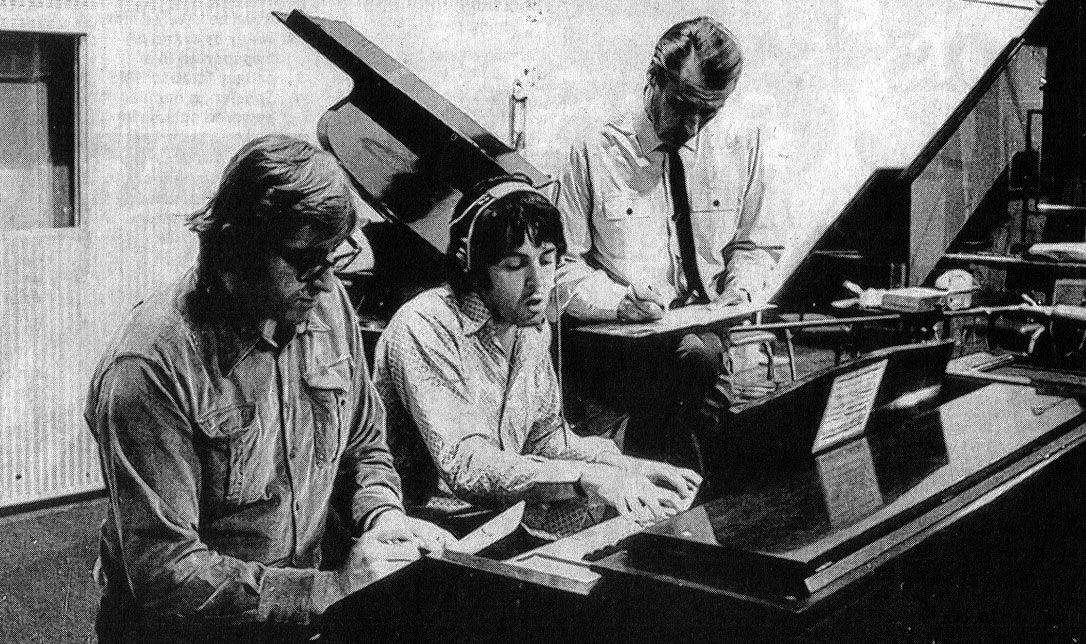
Brother Malcolm, Paul and George Martin during the White Album sessions in 1968
Brother Malcolm, Mother Mary and the lyrics of “Let It Be”
Notably, the lyrics of the song hardly advanced in the three months between September 5, 1968 and January 3, 1969, the first recorded performance of “Let It Be” at the sessions that would ultimately bear its name.
Here’s Paul grooving alone at the piano for the song’s debut on the Nagra tapes:
The lone addition, lyrically: “In my darkest hour, she is standing right in front of me.”
“She,” of course, is Mother Mary, who presumably was in the very original lyric sourced from Paul’s dream about his mother but was absent in the 1968 early attempt. That featured “Brother Malcolm,” a nod to do-it-all assistant Mal Evans. The reference to Mal was inconsistent over January 1969 but endured to the very end of the sessions. Here are the Beatles on the final day of the sessions, January 31, 1969:
It wasn’t until a few days into the sessions at Savile Row, on January 25, 1969, that most of the verses had been added. But Paul started teaching “Let It Be” to others in the band on January 8, when we hear Paul naming chords to the others to learn. That’s also when Paul disclosed that, even at this early stage, he planned to have Aretha Franklin cover the song.
Interludes
Students of the Beatles’ January 1969 sessions have heard this sort of thing several times before, someone in the group veering into an original, a cover, an improvisation between songs, during a transition during a rehearsal or purely as an aside.
Some of these drop-in songs were even the same for the White Album and Get Back/Let It Be sessions:
And just as future songs were sampled and explored during jams in 1968, they were in ‘69 too. And probably long before that as well. A few examples:
Divine intervention
This initial iteration of “Let It Be” may not have had “Mother Mary” but it did feature the hand of “God.”
The September 5 session of “While My Guitar Gently Weeps” was the one that featured Eric Clapton as the Beatles’ guest on lead guitar. That places Eric at the origin of “Let It Be,” and he can be heard adding a few guitar licks to the improvisation. (Listen to the very end and you can hear George close the track imploring his friend to don his headphones: “Cans on, Eric.”)
A full 31 years later Eric would get to play the song again, joining Paul on stage at the 1999 Rock & Roll Hall of Fame inductions. Paul was inducted for his solo career, but the show closed with, naturally, “Let It Be.”
This same induction ceremony honored producer George Martin, who happened to miss the September 5, 1968, session whilst on vacation.
Times of trouble?
Even Paul called the White Album “the tension album.” John said worse in the early ’70s. Ringo literally left the band for a few weeks in the summer of ’68. Four Beatles, each recording in a separate studio — we all know the stories.
But while history is static, perceptions are variable.
The 2018 reissue’s promotional campaign works to dispense with some of the darker sides of the session, from Giles Martin’s interviews to the numerous dismissals of dysfunction in the lovely hardbound book packaged with the deluxe edition. Indeed, there’s plenty of laughter and carefree spirit throughout the White Album outtakes. The outtake set even begins with laughter among John, Paul and Yoko, as if to hammer the point home.
The Get Back/Let It Be sessions inherit the same sour reputation, yet it would be very easy to compile 50 tracks from January 1969 filled with laughter, chatter and the indication that nothing could ever tear these guys apart. And I bet if and when we do see a formal reissue campaign of Let It Be (which I suspect will be attached to a larger Abbey Road/”Beatles in ‘69” re-release), we’ll see that very recalibration of Beatles history. More “Suzy Parker,” and not quite so many calls for a divorce.
And that’s OK. I’ve long posited that things weren’t necessarily so bad — or at least that much worse — for the Get Back/Let It Be sessions than in the period immediately before and after. Naturally, the reality lies somewhere in between. Neither the White Album nor Let It Be are outliers — that’s just how the group was post-1967.
Together at the beginning of that trip, the individual Beatles returned to England separately. For the final stage of their career, they produced enduring music, though they may be parted.
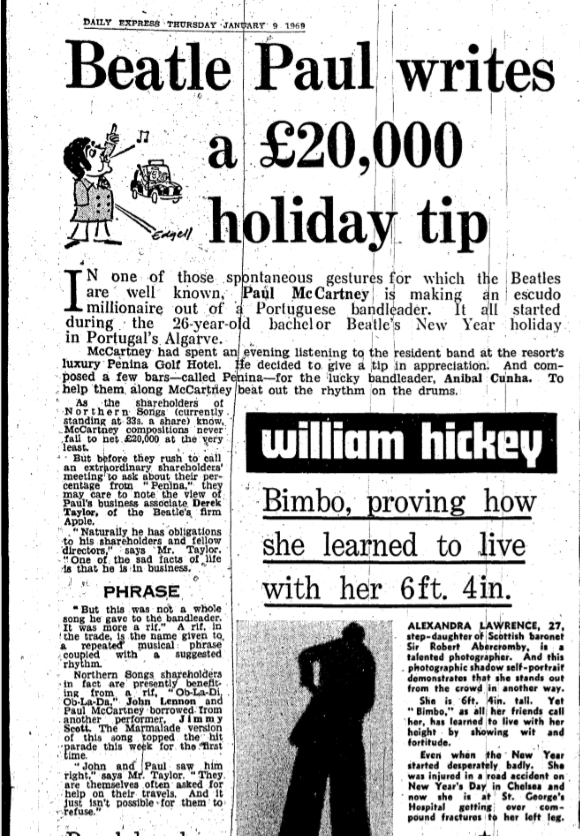
Almost fifty years have passed, and we’re still unsure of how the Beatles’ ditty “Suzy Parker” came about. But the origin story for “Penina” — discussed and introduced by Paul McCartney a few hours after the somewhat mysterious performance of “Suzy Parker” — quite literally appeared in print on the very day we’re discussing, January 9, 1969, in the Daily Express.
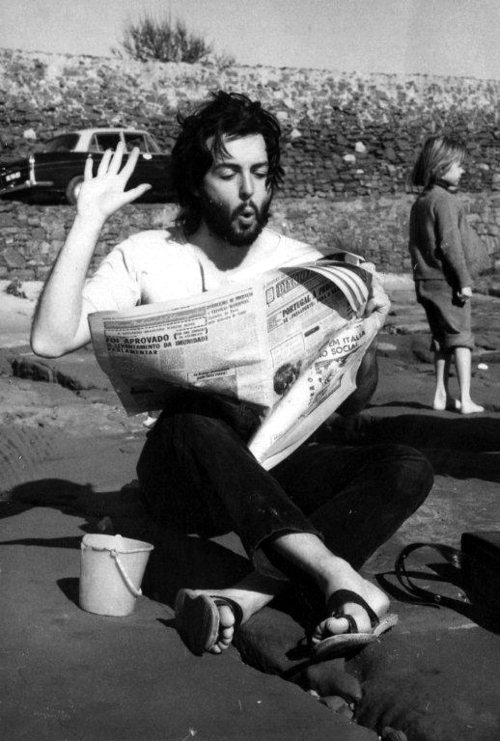
A newsworthy trip: Paul in Portugal, December 1968
McCartney had spent an evening listening to the resident band at the resort’s luxury Penina Golf Hotel. He decided to give a tip in appreciation. And composed a few bars — called Penina — for the lucky bandleader, Anibal Cunha. To help them along McCartney beat out the rhythm on the drums.
Paul elaborated: “And I sat in on drums, and they said, ‘Give us a song.’ So I said, OK.”
Good lord, is that all it takes? Someone get me in the same room as Paul McCartney, I have absolutely no good material.
“’I’ve been to Albufera, had a great time there,’” Paul sang before continuing to describe the scene. “It was called La Penina, the hotel. And they were all digging it and singing along, and it was good. And William Hickey [in the paper] said he’s giving away this 20,000-pound song.”
Per the paper’s report:
As the shareholders of Northern’ Songs (currently standing at 33s. a share) know, McCartney compositions never fail to net £20,000 at the very least.
…
Northern Songs shareholders in fact are presently benefiting from a rif, “Ob-La-Di, Ob-La-Da,” John Lennon and Paul McCartney borrowed-from another performer, Jimmy Scott. The Marmalade version of this song topped the hit parade this week for the first time.
Paul didn’t mask his disgust with the report:
“Cunts. That’s what you write something, for a riff. You don’t say ‘hello,’ and you haven’t got a riff when you say ‘hello.’ That’s the riff I got off of Jimmy Scott, those two words (“Ob-la-di, Ob-La-Da”). You’d think I’d taken his life. It’s not as though he wrote the song.”
This wasn’t the only time on these tapes Paul would show his frustration with Jimmy Scott regarding ownership of “Ob-La-Di, Ob-La-Da.” Over the years, however, Paul’s softened his view on Scott. This is from just weeks ago, during his promotional tour for Egypt Station:
Meanwhile, back in 1969, the newspaper report continued, quoting Apple press officer Derek Taylor:
“John and Paul saw him right,” says Mr. Taylor. “They, are themselves often asked for help on their travels. And it just isn’t possible for them to refuse.”
Having only heard of “Penina” from the newspaper and Paul’s own recollection, the rest of the group finally had their chance to hear — and participate — in what would be the lone known Beatles performance of the song.” Paul has a vague memory of the lyrics, and the rest of the group clearly has no idea how the song goes (this is in deep contrast to “Suzy Parker,” by the way, lending more support to the argument that song wasn’t a pure improvisation). Here’s how they sounded:
It’s not quite “Eleanor Rigby” — it’s hardly “Wild Honey Pie” (or “Fuh You” for that matter, to evoke Egypt Station again). But it’s a Paul McCartney original and from the same moment in time he was writing songs like “Let It Be” and “The Long and Winding Road” so it deserves to be at least more than a footnote.
Been to Albufeira, I had a few drinks there
And now I’m on my way home
I really don’t care
La Penina, La Penina, La Penina hotel
Well it’s been a long road …
When the song was finally released a few months later — by Anibal Cunha’s band, Jotta Herre — the sleeve proudly trumpeted the Beatle’s songwriting credit. And it’s a lone McCartney credit, not Lennon/McCartney. The eventual lyrics have just three verses, with the final one ending with a first-person reference. It’s a languid offering, plaintive at best sporting simplistic lyrics that recap the evening sung over a bland melody.
(Chorus)
Penina, Penina, Penina one night
Penina, Penina, Penina one night
I’ve been to Albufiera
And I had a good time there
And then I came to Penina
And found good friends
Drinking liquid, making music
Love has come to my heart
Beat the drums take me home
Helping friends free my soul
Time has come, time has gone
Time to bet for keeping friends
Take my arm girl, lets go home
Thank you all, love from Paul
In challenging the report that it was a £20,000 song, Paul was clearly giving the song little merit in January 1969. After all, it was just a riff!
In short time, however, Paul was interested in taking a little bit of ownership in “Penina,” starting soon thereafter with his blessing the band to use his name as a promotional tool.
In an interview with a Portuguese magazine published in July 1969 and beautifully titled “Jotta Herre — the godchildren of Paul McCartney,” Cunha disclosed further communication with the bearded Beatle.
Translated, roughly, from Portuguese to English via Google Translate:
I have only one thing to regret, and we must involve the name of Paul McCartney and the friendship he gave us. But, in truth, he also forced us to do so. And in a letter he sent us he tells us categorically. “Use my name without hesitation, let it be used for your publication.” And, finally, the commercial entities linked to the release of the album knew this and took advantage of the idea. Well Paul’s name has a made market and it is assumed that it will be commercially valid.
The song was not really that commercially valid, to use that term. Neither the original version nor a subsequent cover that year by two-time Portuguese Eurovision contestantCarlos Mendes — whose cut appeared on the aforementioned EMI compilation — appears to have made much of a dent in sales, despite the McCartney name behind the song. Perhaps it was the quality of the song that played a role.
I went to Portugal on holiday and returned to the hotel one night slightly the worse for a few drinks. There was a band playing and I ended up on the drums. The hotel was called Penina, I made up a song with that name, someone made enquiries about it and I gave it to them. And, no, I shouldn’t think I’d ever record it myself!
The Summer 1995 issue of the same magazine likewise listed “Penina” among the songs Paul gave away, chronologically listed between bona-fide hits “Goodbye” (Mary Hopkin) and “Come and Get It” (Badfinger), showing a breathtaking contrast of song quality with his Portuguese throwaway.
To this day, Paul still hasn’t recorded “Penina,” but the song lives on. Mendes re-recorded it for his latest LP, which came out in April 2018.
And while “Suzy Parker” lives on only through bootlegs and YouTube clips, having become the actual footnote in Beatles lore, you can see the 71-year-old Mendes perform “Penina” live in concert in Portugal this December, nearly 50 years to the day Paul wrote the song a few hours away at the Penina Hotel and Golf Resort.

 They May Be Parted