Jan. 8: Nothing is real

Far from chaotic, the Get Back sessions, if anything, could be defined by its routines. Paul arrived early to play piano, and then pretty much ran the rehearsals. George’s songs — whether written overnight or brought back for another day — were a slog for everyone else. John didn’t have much new to offer, while Ringo did Ringo things like participate in conversations and keep the beat. Turn the page to the next day on the calendar, and do it all again.

Beyond music, the daily pattern underlying the scene centered around discussion of the live concert the Beatles were trying to put together. At once a footnote to the songs, the show was simultaneously the purpose of these January sessions and thus ostensibly what mattered most. The push and pull between director Michael Lindsay-Hogg’s wanderlust and the group’s default stance — to stay put — was a constant. And the more they couldn’t settle on a British venue, the closer they collectively moved toward simply staying in the very room where they were rehearsing and ruminating.

January 8, 1969, then, was no different than so many other days the Beatles spent at Twickenham the first half of the month. Discussion about the concert surfaced late in the work day, concurrent with Paul introducing the unfinished “The Long and Winding Road” and “Let It Be” to the rest of the band for the first time, and with their initial attempts at a full-band arrangement.

Yet now, to stage the “honest” sound they sought to achieve these sessions, the Beatles began to consider an ersatz solution. Rock and roll begets rocks, or something imitating it, at least.
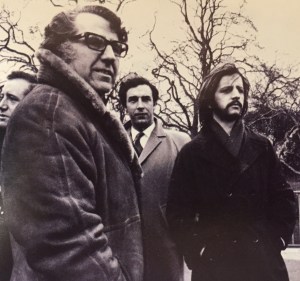
Denis O’Dell (left) with Ringo at The Magic Christian shoot. Photo from O’Dell’s book, At The Apple’s Core.

“If we try to cover all this (Twickenham’s sound stage) and build caverns and caves, it’s nice, you see,” said Denis O’Dell, the head of Apple Films.

Why perform at the Cavern in Liverpool for the nearly 300th time, when you can simply craft your own cavern indoors? (Please don’t answer that.)

Denis had been in the film industry since before the Beatles were born, and his association with the group began in 1964, when he was associate producer on the A Hard Days Night film. It was the start of a mutually beneficial partnership to this point, which included How I Won the War (associate producer and John starred), Magical Mystery Tour (producer) and led to his appointment as an Apple executive.

Of course, you already know his name (but have to look up his number) from his time at Slaggers, and do note he is NOT related to Miss Chris O’Dell.

Denis had appeared sporadically on the tapes to this point, and here it dovetailed with one of the first times John seemed even marginally interested in what was going on with the live show.

“Then we could do what we’d like with a backing,” Denis told John. “Go black, or stark or something. Then we could control all our lights from a panel, and we could have all colors you’d like.”

“Yes. And they’ll be able to see us through everything.”

John invoked sets used by Stanley Kubrick, Denis’ boss on Dr. Strangelove (that film was the source of the footage used during the “Flying” sequence in Magical Mystery Tour), and the man floated to direct a version of Lord of the Rings starring the Beatles. An extensive recap of that aborted episode in Beatles history is discussed at length in Denis’ 2003 fine autobiography of his Beatles years, At The Apple’s Core.

The conversation would continue, with Denis asking someone to fetch George Djurkovic, art director of The Magic Christian, from the film’s set elsewhere at Twickenham to provide added insight. But while Paul continues to play “The Long and Winding Road” in the background the conversation on the tapes meandered to a new duo: Ringo — one of the stars of The Magic Christian — and Michael. While Denis and John spoke as if the live show was to be held at the studio, Michael continued negotiations on taking the show on the road with Ringo. They were the leaders of the rival factions: Stay-put Starr vs. the whole Hogg.

“If I do go, I think it’s better just to go for four or five days,” Ringo said, showing newfound flexibility. “We don’t need to go to rehearse.”

Ringo was willing to bend and travel, but there’s a catch: “I’d like to do it to a British audience.”

It’s a catch, but one Michael is willing to receive. “Can we all talk about it? Will you take the veto off if you can be convinced we can get an audience?” Michael asked.

A Roman amphitheater wasn’t artificial, but to Ringo, the whole reason to perform overseas was contrived. The only reason to travel was the “helicopter shot, you’ll see the sea, the theater. And that is, for one, two minutes, say, that shot isn’t worth me going down there when I really prefer to do it here.”
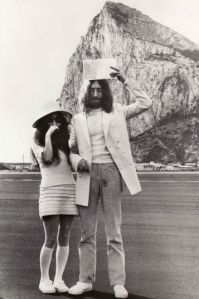
Two and a half months after Ringo suggested the Beatles perform before there for a “British audience,” John and Yoko would be married in Gibraltar (near Spain).

“I see us doing a good show here [at Twickenham], because it’s you [the Beatles],” Michael said, again conceding this could be the last TV program the band will ever do.

Speaking quickly, Michael continued:  “Everything you do has got to be good. All your albums are good. …. It’s not only you as the band, it’s not only them as songwriters, it’s the four of you.

“It’s got to be the best.”

Of course they’re the best. Like Ringo doesn’t know that?

“Every time we do anything it’s going to be the best,” Ringo replied. “Can’t we just do something straight?”

And back to Twickenham, and staying precisely put.

“At the moment, that scaffolding set and the tubular thing, it is kind of like four years ago,” Michael said. “And there’s nothing wrong with four years ago. … We’re all 28 now, or whatever we are. The audience isn’t the same, life isn’t the same.”

For the record, John, Ringo and Michael were all 28, Paul was 26 and George a wee 25. But his point remained legitimate. This wasn’t 1965 anymore.

“This place, it could be rock and roll, ” Michael began.

“It could be rock and roll in Tahiti or wherever you want to put us. What’s it called? (laughing)”

Michael’s not even sure himself. “It’s either Tunisia or Tripoli.”

Ringo asks about a British possession likewise on the Mediterranean — “What about Gibraltar?” — before turning his attention back to the room he was in and the music, ignored during the conversation.

How’s this for an idea of stripping a show down?

“See, Ringo said, “I’d watch an hour of just [Paul] playing the piano.”
7 Comments

Filed under Day by day

TMBP Extra: RIP Chuck Berry

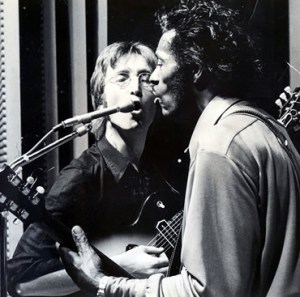
From Forthin Road’s front room to their final fracture, the Beatles were openly ripping off Chuck Berry, imitating and flattering the late, great rock and roll patriarch with complete sincerity.

The bass line to “I Saw Her Standing There,” for instance, is the bass line to Berry’s “I’m Talking About You.”

Here’s Paul McCartney, getting the message through in Beat Instrumental, via Barry Miles’ Many Years From Now:

I played exactly the same notes as he did and it fitted our number perfectly. Even now, when I tell people about it, I find few of them believe me.

This you can believe: The massive influence of Charles Edward Anderson Berry — who left the material world on Saturday at 90 — on the Beatles is quite impossible to minimize. The Beatles’ growth pattern wouldn’t have been the same if there was no Buddy Holly or Little Richard, Elvis Presley or Carl Perkins, Lonnie Donegan or Slim Whitman, Jim McCartney or Julia Lennon. But the mark Chuck Berry left was unique.

You’ve heard this quote for sure, if not before this weekend, then certainly since:

If you tried to give rock and roll another name, you might call it “Chuck Berry.”

That was John Lennon in 1972, spoken in Berry’s presence on the Mike Douglas show. John’s adoration took many forms in the more than decade prior to that.  Here’s Paul, as quoted in the Anthology book:

We’d go up to John’s bedroom with his little record player and listen to Chuck Berry records, trying to learn them.

And there was plenty of reason to learn them. The sheer velocity of the music was one. John explained the other in a 1972 interview, relayed in Anthology:

In the Fifties, when people were virtually singing about nothing, Chuck Berry was writing social-comment songs, with incredible metre to the lyrics. When I hear rock, good rock, of the calibre of Chuck Berry, I just fall apart and I have no other interest in life. The world could be ending if rock ‘n’ roll is playing.

As the Quarrymen moved things up a trifle further in becoming Beatles, their love of Berry’s music was written all over their performances, with more than a dozen of his songs covered live over their touring career (you can find many of those songs as performed by the Beatles on their two Live at the BBC compilations, plus the Bootleg Recordings 1963 release).

“Memphis, Tennessee” made the cut as one of the songs for their failed audition for Decca in 1962.

“Rock and Roll Music,” “Roll Over Beethoven” — the Beatles blessed record buyers with those tracks on wax and also live from the stage.  The former was performed right up until their last live show in 1966, when it was the concert opener, while the latter made it as late as into their 1965 tours.

Two and a half years after that last concert — in the timeline we’re concerning ourselves with here on this blog, January 1969 — the Beatles turned to Berry’s music over and over again, if not for inspiration then at the least out of habit and comfort. For John, Paul and George, it meant filling moments amid the tension and tedium by jamming into a impromptu but completely sincere rehashes of “School Days” or “Sweet Little Sixteen” or “Thirty Days” or “I’m Talking About You” or .. or … or …

Even when they were fooling around with their own “Back in the U.S.S.R.” at Twickenham, it was just another reminder of Berry’s influence by way of “Back in the U.S.A.”

That the Beatles would play a song by Berry wasn’t in and of itself that telling, but their universal knowledge and comfort in playing his songs, said a lot.

Months later, in the Beatles’ waning days as a unit, Berry’s inspiration struck Lennon very directly in “Come Together.”  John dismissed the claim that “You Can’t Catch Me” — a song he said he hadn’t heard in a decade, yet one that John belted out a few lines from in a jam the final week of January 1969 — sparked the Abbey Road opener.

Paul, who had no shame admitting he integrated Berry’s work into his own, felt pretty certain John did the same. As quoted in Anthology:

John came in with an up-tempo song that sounded exactly like Chuck Berry’s ‘You Can’t Catch Me,’ even down to the ‘flat-top’ lyric. I said, ‘Lets slow it down with a swampy bass-sand-drums vibe.’ I came up with a bass line and it flowed from there. Great record.”

He’s right, it is a great record.

Turns out, they could catch John, and as part of an eventual settlement, John had a chance to re-make “You Can’t Catch Me” (as well as a few other songs owned by the prosecution) for his 1975 Rock ‘N’ Roll LP (another great record).

John’s love of that original era of rock and roll, which made him want to do it himself, gave his life and career meaning and shone on that record, and really whenever he had the opportunity to play it. The genuine glee felt by John, when he got to share the stage with Berry on the Mike Douglas Show in 1972 is palpable. If you haven’t watched it before, you should, both the performances as well as the interview segment.

John recalled that day during an interview/DJ session with Dennis Elsas on WNEW, September 24, 1974:

Because although I was there with Chuck Berry, and I’d been sitting backstage with him, I met him a few times over the years, I still have that feeling, that when I was sixteen, those were the records I listened to [in] what we called “milk bars” in England, with a jukebox. And I could never quite see him as a human ’cause there was one of my idols, actually talking to me. … It’s sort of an effort to see, “Oh, yeah, it’s a human, but it is Chuck Berry, isn’t it?”

Like John Lennon, Chuck Berry was indeed human and thus mortal, and the master was able to enjoy 50 more years on this earth than his apprentice.   The Beatles were as innovative as any act as popular music has seen, but with Berry’s genius baked into the individual members’ DNA from youth, the group didn’t have to start from scratch. It wasn’t enough that the Beatles had a backbeat they couldn’t lose,  the lyrics mattered too.

“Ever since I was in my teens I was acquainted with the works of Chuck Berry, whom I consider one of the original rock and roll poets,” John Lennon said after the Beatles’ breakup.

Said in a deposition.

Said in a deposition in which he was being sued for ripping off Berry.

But this spoke more of the litigious universe that enveloped The Beatles in the early ‘70s than anything else — Berry didn’t sue John over lyrics in “Come Together,” it was the people who owned the rights to “You Can’t Catch Me.” And the solution was simple: Just play some Chuck Berry music on another record.

Paul was never litigated for ripping off Berry, but he still went ahead and covered him decades later in 1999, cutting “Brown-Eyed Handsome Man” for the most excellent Run Devil Run.

On Berry’s death, Paul (and/or his people) tweeted his condolences, and it was his turn to rip off John.

Or maybe he didn’t rip off John at all. Berry was a poet, and Paul just didn’t have any better word to describe him.

Berry’s music will live on through his own recordings and as a direct line through the Beatles, too. And as long as we’ve got a dime, the music will never stop.

1 Comment

Filed under Extra

Jan. 8: Let it be hers

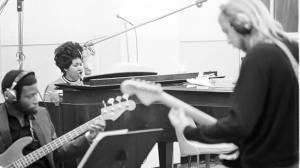
Mid-afternoon on January 8, 1969, at Twickenham Film Studios, Paul McCartney sat at a piano and microphone and ran though “Let It Be.” Nine months later, and 3,500 miles to the west of London, the Queen of Soul was doing the very same thing.

By that point — October 1969 — Abbey Road was in stores while “Let It Be,” along with the rest of the songs slated for the Get Back LP that would ultimately evolve into the Let It Be LP, remained on the shelf. Aretha Franklin had a copy of the unreleased track, though, and we know she had been promised that song for a long time, going back at least as far as the start of the new year. But she wasn’t getting an exclusive.

Let’s go back to Twickenham, January 8, 1969:

George:  You going to give it to Aretha Franklin?
Paul:  I’m going to do it, and give it to her.

Specifically, Paul planned to have the Beatles cut a “rough demo from the first rehearsal” once the song was complete and would “try to get her to do it as a single.” But “Let It Be” was not quite complete yet on this, the fifth day of the sessions. The melody is locked down, but Paul only presented the first verse and chorus to this point.

Weight and see: Aretha Franklin does her thing, while Duane Allman (right) does his on a cover of The Band’s “The Weight” on January 9, 1969.

Still, he knew what he had, and its potential as a cover. “It would be great for Aretha Franklin, that number,” Paul said before singing a line in an absolutely terrible imitation of her. (For the record, that same January 8, 1969, Aretha was recording her version of “The Weight” by The Band, whose influence weighed heavily on the Beatles these sessions.)

Ringo provided upbeat drum accompaniment —  exactly as laid out by Paul, with a faster tempo than would ultimately surface on the record, and with several awkwardly inserted fills.

Tongue firmly in cheek, John soon offered a lyrical tweak and a poke at Paul’s pseudo-religious lyric, suggesting “Brother Malcolm” as a nod to the group’s do-it-all assistant. (Paul will deliver that line in a few future takes.)

The group would return to the day’s on-again, off-again writing-cum-rehearsal session for “I Me Mine” followed by “The Long and Winding Road,” which like “Let It Be” was similarly unfinished lyrically and being given its first introduction on the tapes to the full band this afternoon.

These repeated truncated takes of “The Long and Winding Road” — which lasted nearly a half hour, split into two separate stagings late in the day — mainly served, as far as the Nagra reels were concerned, as background music for an increasingly captivating conversation about the eventual live show. More about that in the next post.

“The Long and Winding Road” caught George’s fancy, and he called the song “lovely.” Before the end of the day, Paul taught George the song’s chords. Likewise, Paul sketched out how to play “Let It Be,” which was played for about 10 minutes at the very end of the day’s musical portion, and George and Ringo were full participants.  The song was never to be played live in front of an audience by the Beatles, but at this point it was clearly in line for the upcoming concert, and Paul sought out additional accompaniment come showtime.

“It’s sort of gonna do like a hymn. That’s why I was thinking we could get audience participation on that,” he told George.

af-lib

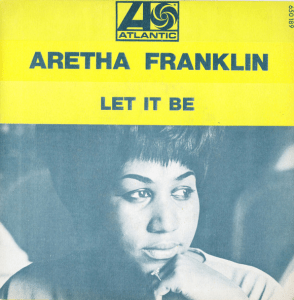
The sleeve for the French release of Aretha’s version of “Let It Be.”

The January 8 session was really the formal coming-out party for “Let It Be,” marking first time Paul played it to the rest of the band these sessions (on tape, at least, but it seems clear if it had been played prior, it wasn’t as extensive).

Like “Yesterday,” the song was famously sourced from a dream, but this time around it was the lyrics that were nocturnally inspired.

Here’s Paul, as quoted in Barry Miles’ Many Years From Now:

In the dream she said, “It’ll be all right.” I’m not sure if she used the words “Let it be” but that was the gist of her advice, it was “Don’t worry too much, it will turn out okay.”  It was such a sweet dream I woke up thinking, Oh, it was really great to visit with her again. I felt very blessed to have that dream. So that got me writing the song “Let It Be.” I literally started off “Mother Mary,” which was her name, “When I find myself in times of trouble,” which I certainly found myself in.

But to be clear, the trouble wasn’t dated to January 1969. Rather, like “The Long and Winding Road,” “Let It Be” materialized in 1968 amid the lengthy and tumultuous White Album sessions. The two gospel-flavored songs had another link, and that was they were written with other people in mind from the start, too: “The Long and Winding Road” was influenced by Ray Charles.

As for Ray’s future Blues Brother co-star, Aretha never did end up releasing “Let It Be” as a single in the U.S. or U.K., but it was among the standout tracks (her covers of “Elanor Rigby” and “The Weight” were among others) on her This Girl is in Love With You LP, which was released January 15, 1970 — two months before the Beatles’own version came out as a single, and 11 days after the last Beatles recording session.

6 Comments

Filed under Day by day

TMBP Extra: Songs for everyone

It was only 100 hours before the Beatles would return to the studio together, and the charts on both sides of the Atlantic on December 29, 1968, were a perfect illustration of why there really wasn’t any rush for them to do so.

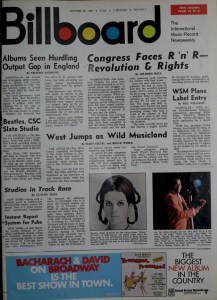
billboard_122868

Billboard, December 28, 1968

That day, The Beatles (White Album) retained the top spot in the British charts for the fifth straight week in the midst of a run that would see the double LP at No. 1 for seven consecutive weeks and eight of nine. After a few weeks’ climb, it hit No. 1 in the United States a day earlier, on December 28, taking a much slower slog to the top. That climb vaulted the Beatles past Glen Campbell’s Wichita Lineman LP, the previous week’s No. 1 that was sunk to the runner-up position, and one of four records the country music star had in the top 30.

The Beatles owned multiple shares in the Billboard album charts, too, with Sgt. Pepper’s Lonely Hearts Club Band (No. 63) and Magical Mystery Tour (85). The latter would provide the title track for Sergio Mendez’s Fool on the Hill LP that sat at No. 11 this week 48 years ago.

Even with the White Album entrenched atop the British charts, there was plenty of Beatle-related materials moving off the shelves, with the Best of Cilla Black (No. 21) featuring four Lennon/McCartney credits and Jose Feliciano’s Feliciano! containing three Beatles covers and sitting one notch behind the Liverpudlian chanteuse (and higher at No. 7 in the U.S.).

The first post-Christmas LP chart in the U.K. was predictably littered with greatest hits and other compilations, with about a dozen such records in the top 50. Four Simon & Garfunkel records were simultaneously on that chart, with a few soundtracks and two separate live LPs recorded at London’s Talk of the Town (Tom Jones and The Seekers).

On the U.S. singles chart, Motown dominated with the label holding the top three spots: Marvin Gaye’s “I Heard it Through the Grapevine,” Stevie Wonder’s “For Once in My Life” and Diana Ross & The Supremes’ “Love Child.” While Beatles smash “Hey Jude” may have been fading, dropping to No. 15, “Hey Jude” the soulful Wilson Pickett cover was rising, hitting No. 43 on its way to eventually peaking at 23. That’s Duane Allman with the epic lead guitar part.

Even though the Beatles didn’t release singles from their albums (a tradition scrapped in time for their final LPs, Abbey Road and Let It Be), their presence was made on the U.K. top 50 without charting a single song of their own (”Hey Jude” dropped out a week earlier). Marmalade’s sugary cover of “Ob-La-Di, Ob-La-Da” stood at No. 7 en route to the top spot the following week, while the Bedrock’s more authentically Caribbean-sounding version of the same song was at No. 30. That cover, produced by former Beatles engineer Norman Smith, would peak 10 notches higher a week later. On its way down the charts was Joe Cocker’s cover of “With a Little Help From My Friends,” dropping to No. 39 on its last week on the charts it had topped about six weeks earlier.

Apple Records artist Mary Hopkin fell to No. 24 in the U.K. with former No. 1 hit “Those Were the Days,” as produced by Paul McCartney (it was at No. 25 in the U.S., down from it’s peak at No. 2).

What held the top spot in the British charts? It was a song written by McCartney, but not that one.  Mike McCartney, Paul’s brother under his stage name Mike McGear, wrote “Lily the Pink” with fellow Scaffold members Roger McGough and John Gorman. The song remained at No. 1 for a second consecutive week, part of a run that saw the comedy folk song reign atop the charts for four of five weeks. “Lily the Pink” had no shortage of future and contemporary star power: Elton John, Graham Nash and Tim Rice provided backup vocals, while Cream’s Jack Bruce laid down the bass line.

The Beatles wouldn’t be absent from the British charts for too long. Exactly five months after December 29, 1968, “Get Back” — which Paul developed out of a jam on January 7, 1969, and was written in the studio throughout the month during the sessions that would bear its name — would debut at No. 1 in the U.K.

3 Comments

Filed under Extra

Jan. 8: Look Around

It was 12 days until their scheduled concert, and on January 8, 1969, the Beatles were loose, relatively upbeat and open-minded, uncommon characterizations associated with Get Back/Let It Be sessions. Still, there wasn’t even consensus on what continent to stage the concert, much less what venue or what kind of audience would have tickets to the show.

What they lacked in plans and new material — Paul would insist the group would produce a few “rockers” soon — the Beatles at least had no shortage of live productions against which they could reflect and project.

Two classes of potential inspirations highlighted discussions to this point: recent live broadcasts by their peers (eg., Cream’s Farewell Concert, the Rolling Stones’ Rock and Roll Circus) and the Beatles’ own history on stage and on the small screen. The audience was as much a consideration as the venue.

In the final hours of the day’s sessions, as the group continued to work on George’s new song “I Me Mine,” John and Yoko waltzed the room right into a continued deliberation of the staging of the imminent show.

“I think the thing to do is just put you all in a framework, which will be just, like, the audience and a stage,” pitched Michael Lindsay-Hogg, who was tentatively willing to settle for a simple approach if his preferred idea — an overseas trip — was denied. “And by the time we get to the stage, we’d have a routine of numbers. We can find each number how they fit theatrically, like your dance for that one, like the song that you cry in and the song you do that brings tears to everybody’s eyes.”  Off mic, it was joked there’ll be the one song that’s done in the wrong key.

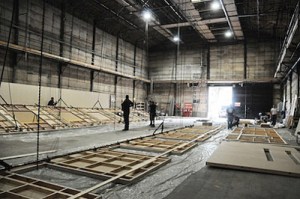
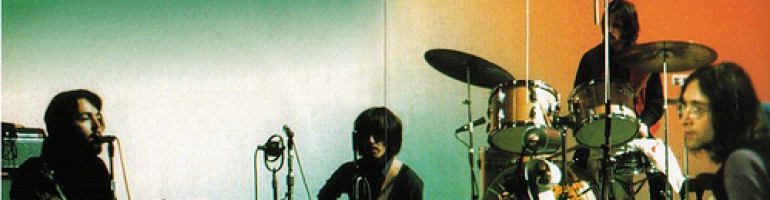
Twickenham's Stage 1. What a pretty palette!

Twickenham’s Stage 1. Simply gorgeous!

“Seriously,” the director continued. “Almost, we should end with ‘Good Night’ or whatever song is going to be like ‘Good Night’ this time. … The end of the show should be a tearjerker like ‘Hey Jude’ or like ‘Good Night’ or like something else.”

Two large signs promoting the show’s working title — “January 20, 1969” — would hang as a backdrop. “And it’s the 19th of February, 1982,” John injected for a laugh and commentary on the decision process’ plodding pace.

When Paul asked about the composition of the audience, Michael answered forcibly, “Human beings, and the first thousand who queue up.” John was more specific, positing “pastry cooks from Walton-on-Thames” would be in attendance.  (John’s joke was told nine weeks before the London suburb actually became a footnote in Beatles history: George and Pattie were fined for drug possession in Walton-on-Thames on March 12, 1969 — the same day Paul and Linda married.)

To snickers, Michael proposed voice overs for each song. E.g.: “Now Paul sings a song of true love.” 

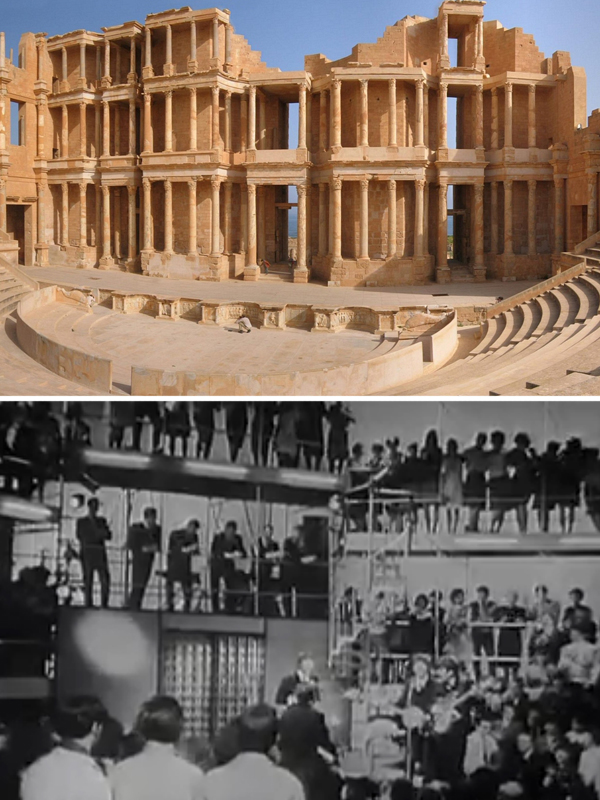
The audience seated at Twickenham’s Stage 1 would sit in the round, either at three-quarters or fully encircling the group. “You could build this place great like that, all of it like a coliseum,” Paul said. “Four sides, then on the top of it all, your cameras, or a camera.”

“I still don’t think that’s our best idea, for the record and on tape,” Michael replied, resigned. “But I think if that’s what we’re going to do, it’ll be fine. Because I’ll make it fine, and you’ll make it fine.”

Coliseums real (Sabratha, top) and fabricated (Rediffusion's Wembley Park studio)

Coliseums real (Sabratha, top) and fabricated (“Around the Beatles” at Rediffusion’s Wembley Park studio)

The bar for the Beatles’ triumphant return to the stage re-established at “fine,” Michael conceded “torch-lit is for next time.”

While the coliseum-style arrangement recalled to Michael the currently shelved Sabratha, Paul was reminded of a moment in the group’s history from four and a half years earlier, when Beatlemania was at its peak.

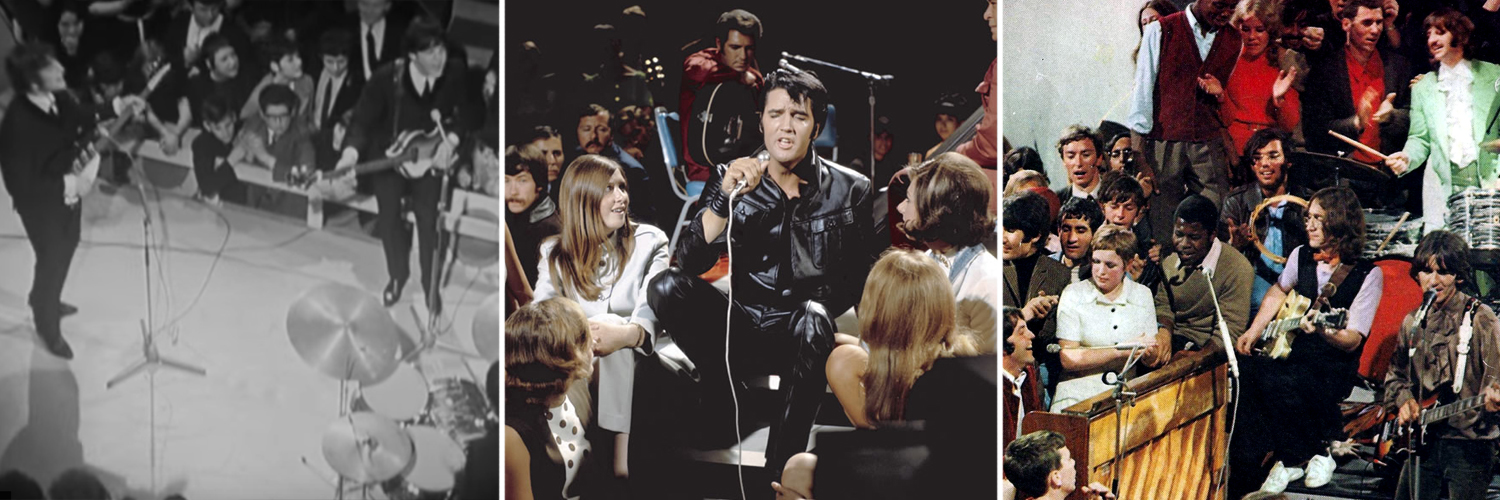
“It’s a bit like ‘Around the Beatles.'”

“Ah, I was thinking about that,” Michael said. “That was a very good show. That’s why I think it should be kind of theatrical. … Also the Presley show they’ve just done, apparently, which has more of an ‘Around the Beatles’ audience.”

In reality, the live sequences in the ’68 Comeback Special — broadcast on NBC as “Singer presents … Elvis” — had more of a “Hey Jude” vibe than an “Around The Beatles” one; there was always a distance between fans and the band in “Around the Beatles,” while “Hey Jude” and the Comeback Special put the musicians within reach of the crowd, and the King several times interacted directly with the commoners. What “Around the Beatles” and the Comeback Special did share in their audiences was its enthusiasm-cum-mania.

The Comeback Special was being cited in discussions of the Beatles ’69 show, but it had no influence on the “Hey Jude” taping, or vice versa. Elvis filmed the concert portion in late June 1968 but those tapes weren’t broadcast until December. “Hey Jude” was filmed in early September 1968 and broadcast days later. The two paths never crossed.

compare

Way beyond compare: Around the Beatles (left), Elvis’ Comeback Special (center) and the “Hey Jude” promo film.

Elvis triumphantly rehabilitated his rock and roll credentials with his special; the Beatles didn’t need to do that. Yet …

“One of the things we’re up against,” Michael continued, “is all the past things you’ve done.”

Here we are with a reference to the past again. The Beatles did a lot. But surprisingly, although they were commonly featured across all facets of the media, they had very few their own television programs.

“There’s only about three of them,” Paul said, and John rattled off the list: “‘Magical Mystery Tour,’ ‘Around the Beatles’ and ‘Shea'” — the latter the landmark 1965 concert at the former New York Mets ballpark that was broadcast a year later on BBC and in 1967 in the U.S. on ABC. (It recently had a run in theaters in 2016, remastered and looking downright fab as the capper to the enjoyable “Eight Days a Week” documentary).

But “Magical Mystery Tour” was a scripted musical, and “Shea” was a concert film. So that means …

“‘Around the Beatles’ is our only ever TV show, isn’t it?” said Paul.

“And it was good,” Michael said, as Glyn Johns — who had long, but falsely  claimed second-engineer duties on the show (see the postscript of this post for more on that)  — called the program “fantastic.”

After John broke into a few seconds of “Shout” — the finale of that show  — Paul complained to Michael about a theater-in-the-round setup, arguing it’s a step backward, replicating the set of “Around the Beatles.”

“I think with every idea we will have is bound to be …  any of us can pick out a negative side to it,” Michael countered.

“Yeah,” Paul replied. “But it should’t be too heavy negative a side.”

Michael asked the others for input, but John replied by playing Chuck Berry‘s “Sweet Little Sixteen” — a song Michael said, without explanation, “always frightens me” — and swapping in a variety of British locales for the original American cities. (John delivered a more serious reworking of the song six years later on his Rock ‘N’ Roll album).

Returning to “I Me Mine,” Michael remarked John and Yoko’s waltz is “kind of theatrical. And it’s also romantic, and it also fits the song.” Michael was also concerned about the complete bill and “what’s going to be our mind-blasting topper at the end, which I think ought to be a weep-weep, myself. A bang or a cry.”

Paul leaned toward the bang, saying, “we intend to write a couple of rockers.” That worked for Michael — at the beginning, at least. “I think you should open exciting and end with the audience in tears.”

John launches into another Chuck Berry number, this time “Almost Grown,” and is soon joined by Paul. Pleased, Michael said, “That’s what January 20, 1969″ is all about.”

The documentary portion of the production returns to Michael’s forefront when he asks his crew if this performance is being filmed — don’t forget, while the Nagra tapes recorded sound throughout the sessions, the group wasn’t consistently filmed.

Despite the illusion, it was time to get back to work, and Paul returned to setting the agenda.

“Are we all right on George’s number (‘I Me Mine’)? I’m not. Are you? Should we keep doing it a bit more?”

And so, for the time being, the Beatles ended negotiations regarding the live show. The metaphors don’t come much easier: The Beatles’ recounting and considering a return to a theater in the round left them talking in circles.

10 Comments

Filed under Day by day