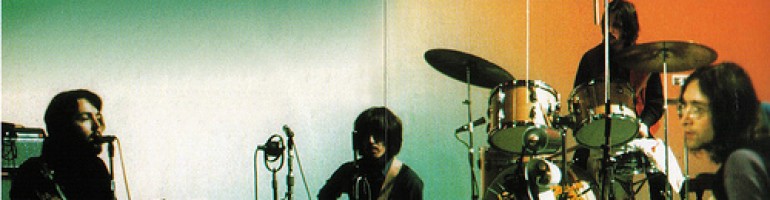
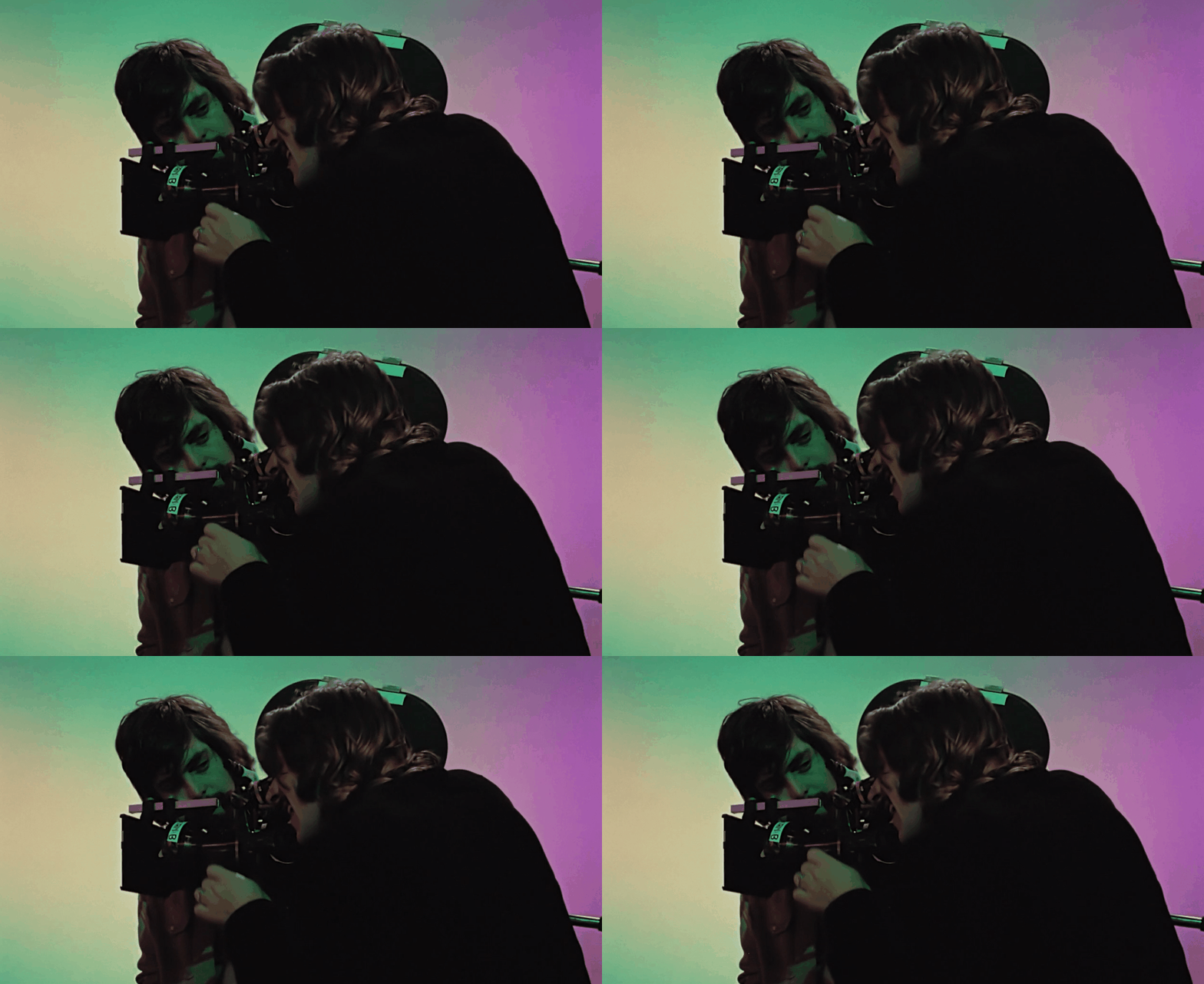
Ringo Starr works the camera on January 14, 1969, as pictured in Get Back.
While they ultimately became a legend of the silver screen, the Beatles didn’t make as many films as they actually did.
As recently as January of this very 2026, octogenarian Paul McCartney recalled in an online Q&A what could have been the Beatles’ feature film debut, preceding A Hard Day’s Night by about a year.
Originally there was something called The Yellow Teddy Bears. We said to Brian [Epstein], ‘Yeah, OK, great!’ And then he came back to us after talking to the producers, and told us they wanted to write the songs themselves. So, we passed on that.
There may have been more to it. As quoted in Roy Carr’s Beatles at the Movies, published in 1996, Paul said: “It might have been that part of the deal meant that we also had to give away the copyright to any new songs which were featured in the film.”
You’d have to think the film’s limited potential audience – it received an X rating on release – was a further drawback, keeping anyone under 16 years old out of the theater.
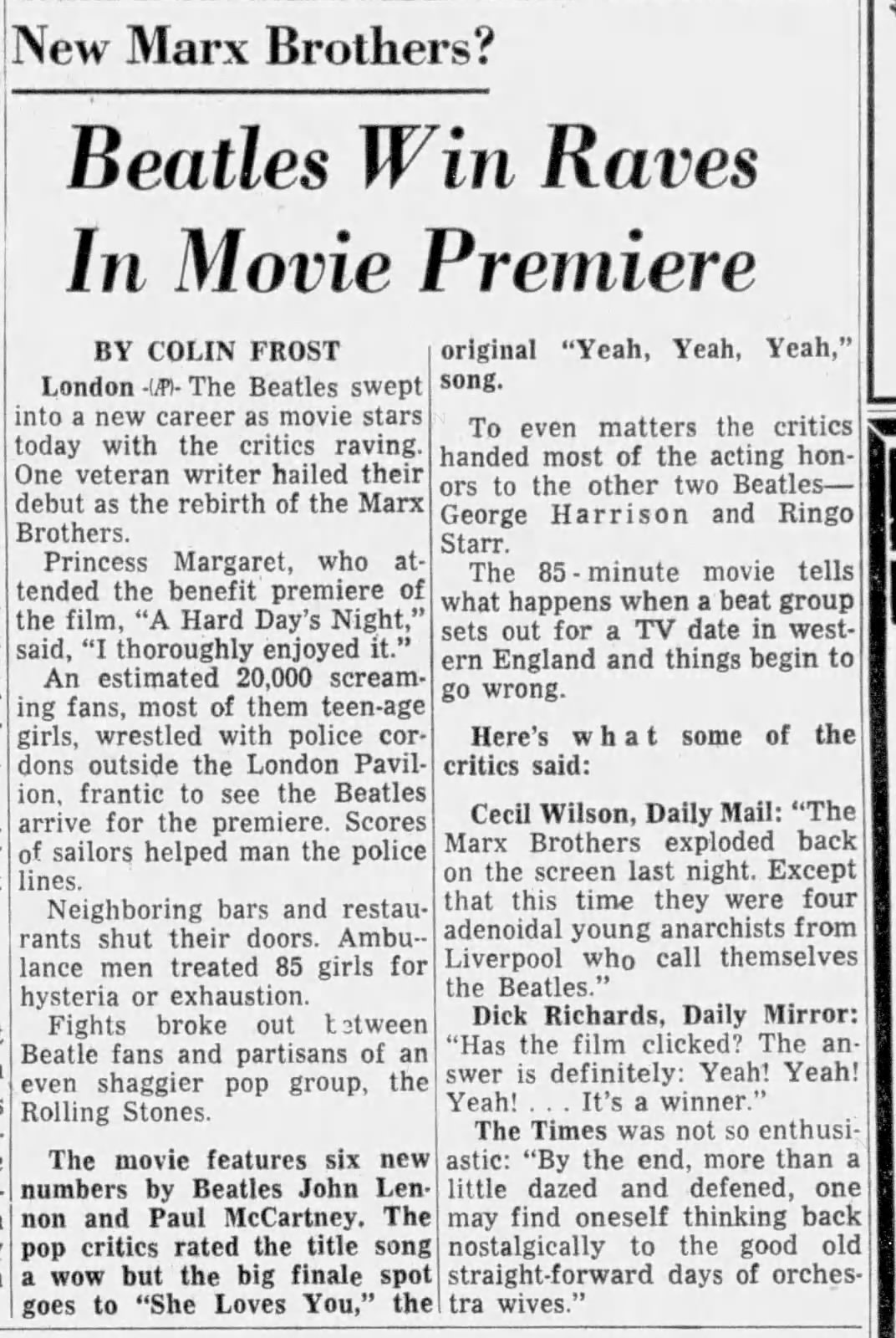
Regardless of the actual reasons, they “immediately” turned the offer down, per 1990s Paul, via Carr’s book. And instead of portraying another band for their film debut, the Beatles instead appeared as John, Paul, George and Ringo in their cinematic introduction in 1964: A Hard Day’s Night.
While the Beatles’ participation in The Yellow Teddy Bears never went beyond the discussion phase, A Talent For Loving was explicitly announced as the Beatles third film, right before they started filming their second, Help!
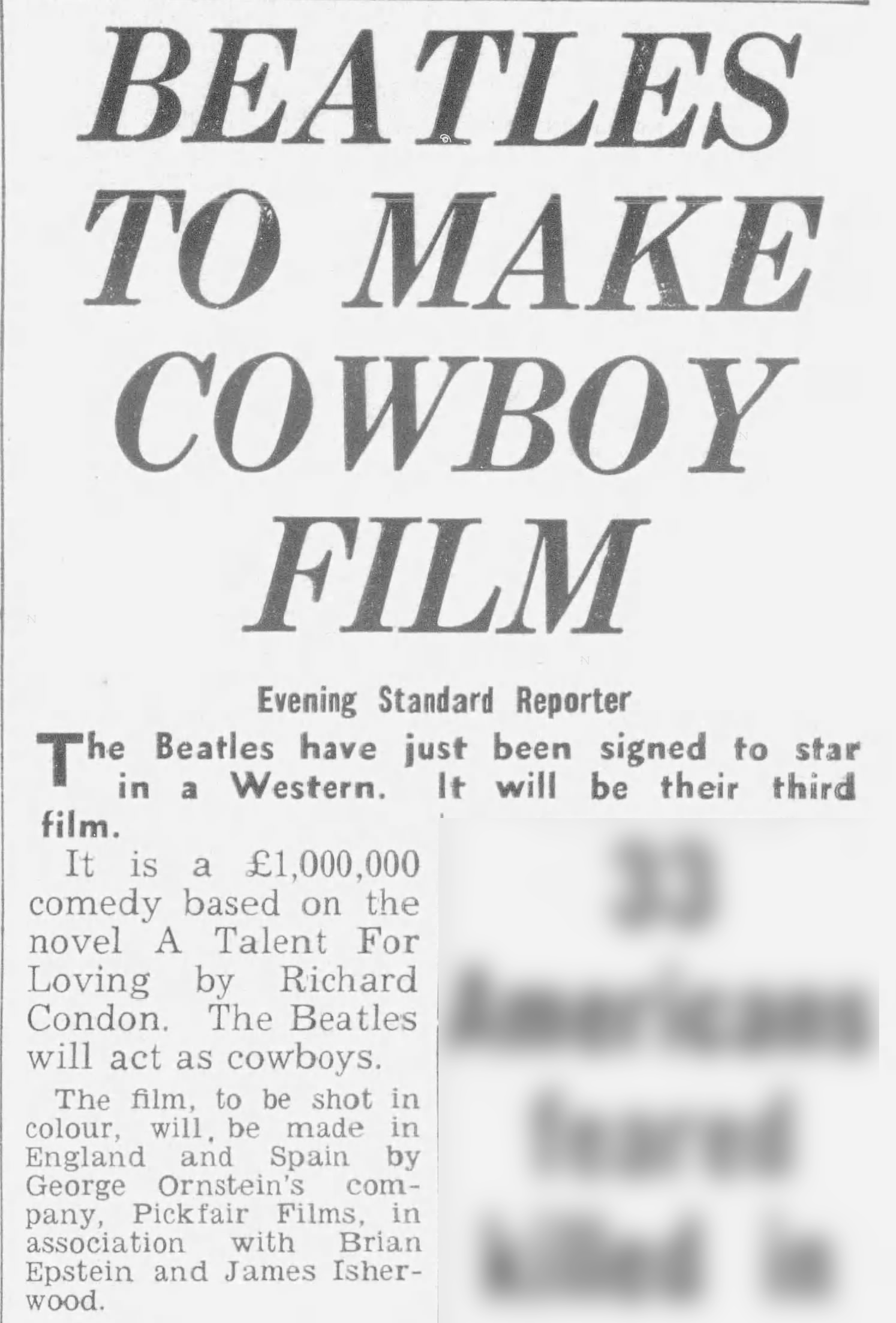
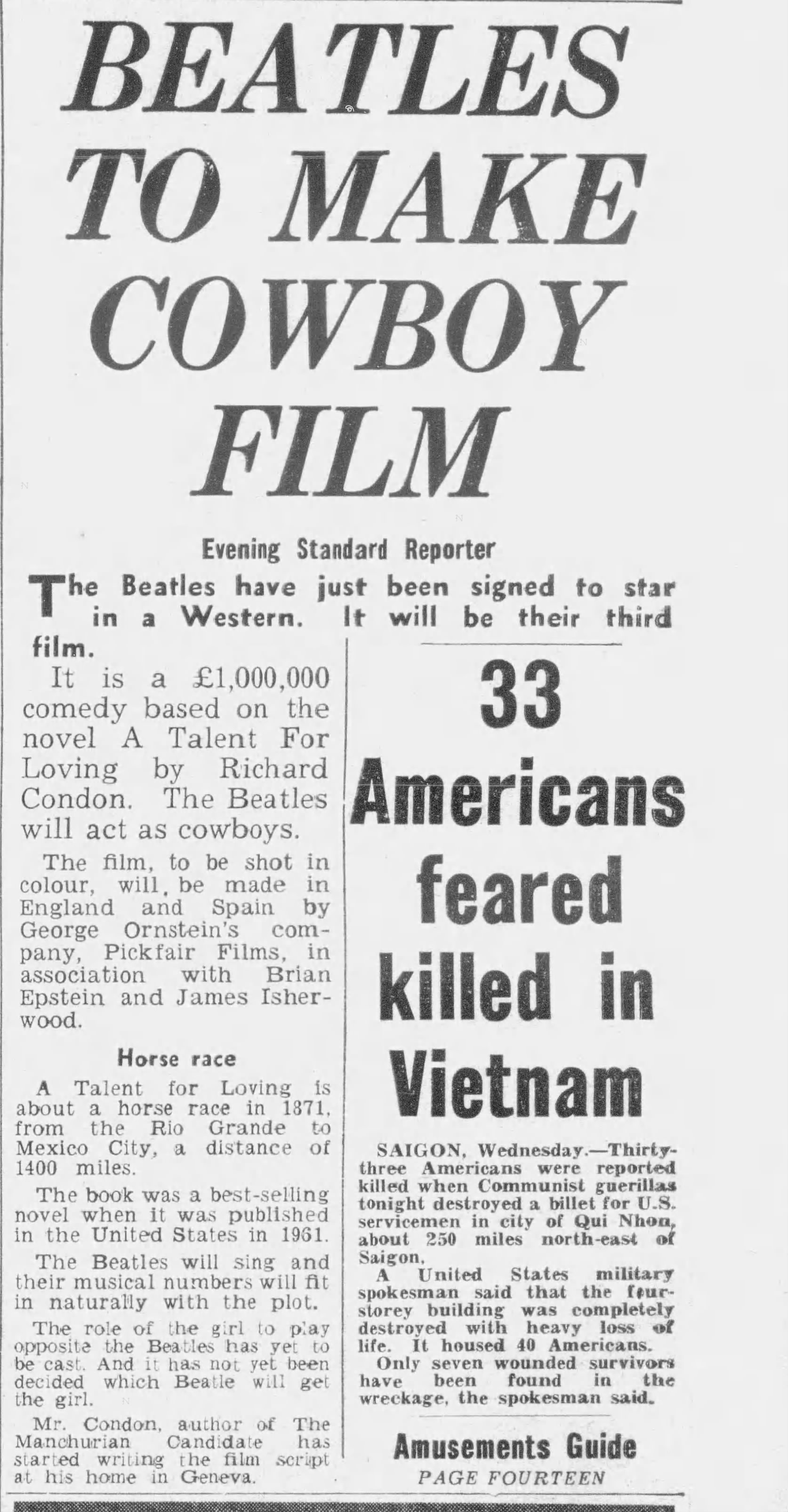
From the February 10, 1965, Evening Standard
“The Beatles have just been signed to star in a Western. It will be their third film,” reported the February 10, 1965, issue of the Evening Standard under the headline “BEATLES TO MAKE COWBOY FILM”.
It is a £1,000,000 comedy based on the novel A Talent For Loving by Richard Condon. The Beatles will act as cowboys.
…
The Beatles will sing and their musical numbers will fit in naturally with the plot.
The role of the girl to play opposite the Beatles has yet to be cast. And it has not yet been decided which Beatle will get the girl.
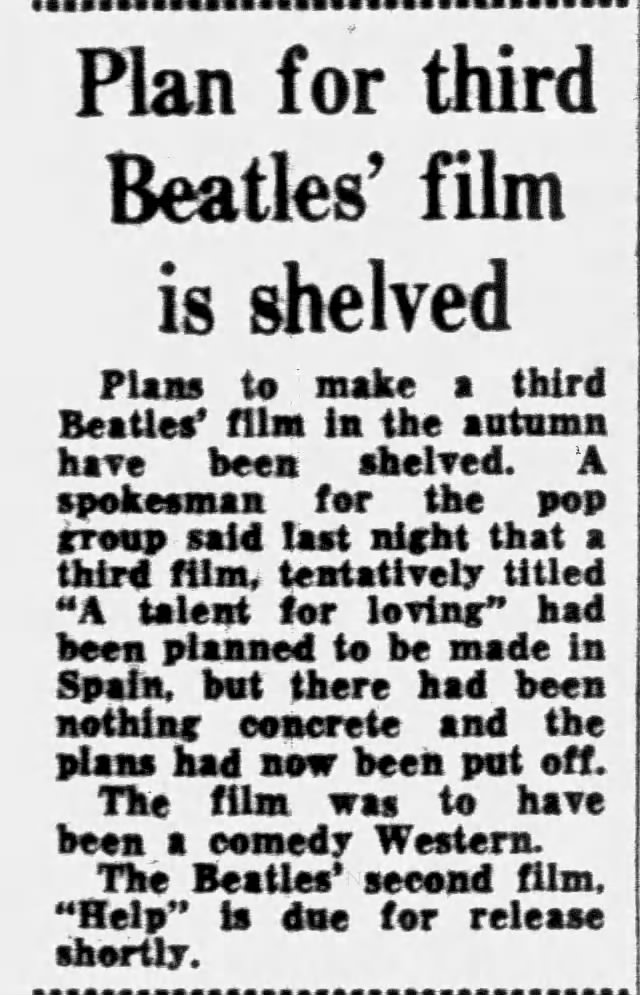
Only four months after news emerged, while Help! was still being filmed, plans its follow-up were shelved.
“The script is not us,” Paul said. “We turn out like four Roy Rogers singing in the saddle.”
Paul and George elaborated in the February 1966 issue of The Beatles Book Monthly:
Paul: That doesn’t mean we decided to rule out the idea of doing a Western. It would be a comic-type Western, of course. And if we don’t do a Western this time I think it’s something we should keep in mind for the future. There are all kinds of great comedy situations you can work into a cowboy story.
George: Anyway, unless some kind of miracle happens – a script-type miracle, that is – we’ve ruled out “A Talent for Loving” and Walter Shenson has been searching for new script suggestions.
Paul: As George said, the problem is that most writers go by our image as a group. It’s difficult to get across to them the thought of having a Beatles film with a non-Beatles story.
Shades of a Personality was supposed to solve this concern, casting one Beatle (eventually reported to be John) with split personalities (himself and the other three) in something a little less fab than their previous efforts. News dribbled out of the script by prolific playwright Owen Holder in summer 1966, with an expectation filming would begin in January 1967. Ultimately Shades of a Personality never really landed squarely with the group, who took the premise elsewhere.
Looped into the Beatles world in January 1967, subversive British playwright Joe Orton — whose play Loot was financially backed by Paul — took the idea and worked off an unreleased novel as a frame for a very different Beatles film, Up Against It.
From a February 1967 entry in Orton’s diary, as published as the introduction to the screenplay for Up Against It:
I hadn’t the heart to tell [producer Shenson] that the boys, in my script, have been caught in flagrante, become involved in dubious political activity, dressed as women, committed murder, been put in prison and committed adultery. And the script isn’t finished yet. I thought it best to say nothing of my plans for the Beatles until he had a chance of reading the script. We parted at five o’clock amicably. With the contract, according to him, as good as signed. And on my part, the film almost written.
Orton wrote the script so rapidly, he asked his agent to wait three weeks before submitting it to the Beatles in early March 1967. A month later, the Beatles had moved on. Again, from the published version of Up Against It:
By March 29, Orton had still heard nothing from the Beatles. He fixed on Brian Epstein as the culprit: ‘An amateur and a fool. He isn’t equipped to judge the quality of a script. Probably he will never say “yes” equally hasn’t got the courage to say “no”. A thoroughly weak, flaccid type.’ And then on April 4, Up Against It was returned. ‘No explanation why. No criticism of the script. And apparently, Brian Epstein has no comment to make either. Fuck them.’
Decades later, in Beatles at the Movies, Paul offered a direct explanation why the script was rejected.
“The reason why we didn’t do Up Against It wasn’t because it was too far out or anything like that. We didn’t do it because it was gay. We weren’t gay and really that was all there was to it. … Now it wasn’t that that we were anti-gay – just that we, The Beatles, weren’t gay.”
(Thirty years later, Blur’s Damon Albarn performed in a BBC Radio production of Up Against It, another link from the Fabs to ’90s Britpop).
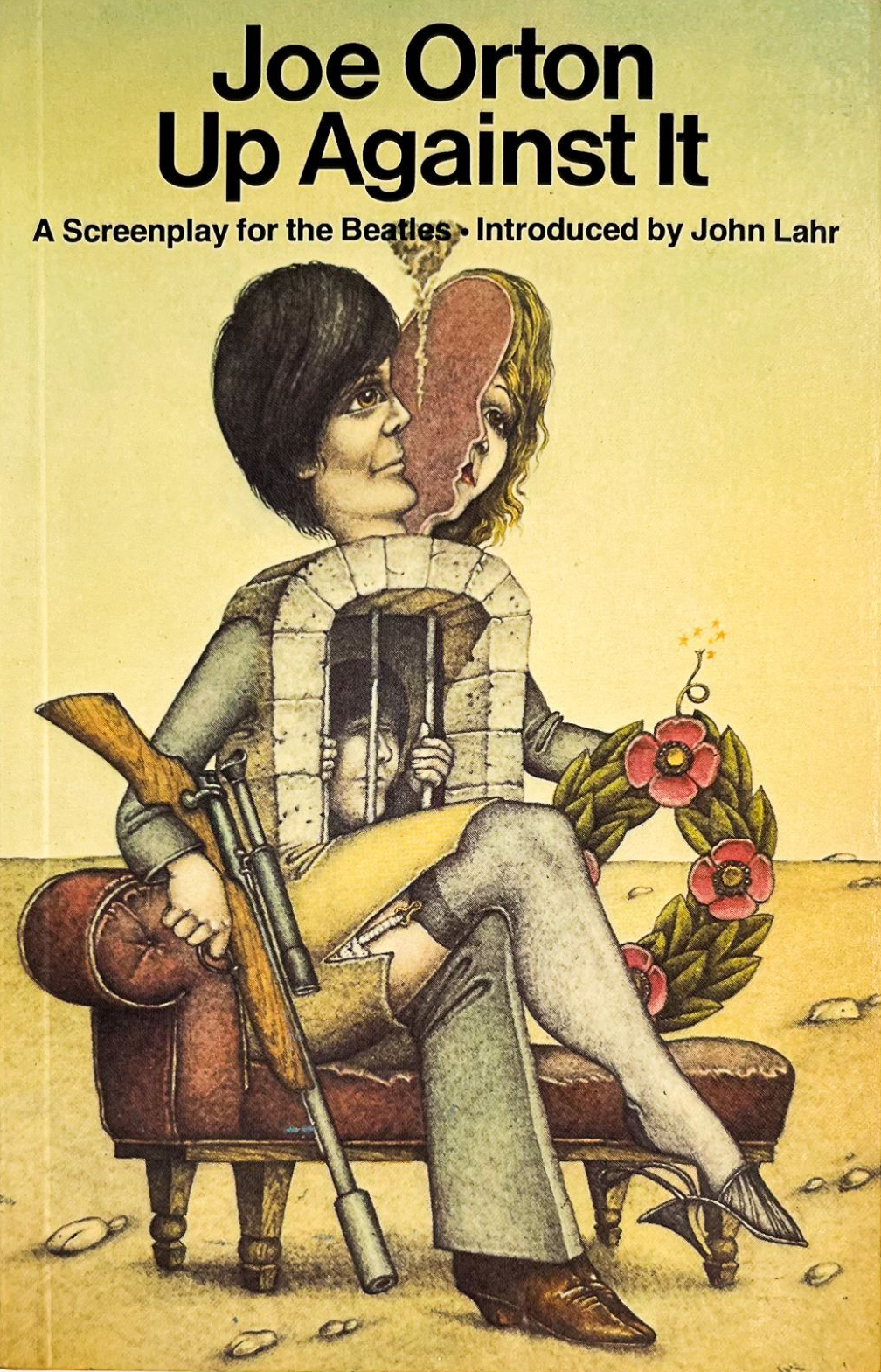
The cover to the 1979 UK edition of Joe Orton’s posthumously published and modified script for Up Against It. Cover art is by Nick Price, who you may recognize as the illustrator of Kate Bush’s Never for Ever album cover.
Aborted efforts of film adaptations of The Three Musketeers and Lord of the Rings starring the Beatles never got far, either, despite the rumors in the late ’60s.
Even after the Get Back sessions, with the Beatles straining to simply stay together as a band, much less as an acting troupe, George enthused over a script for a potential late-stage Beatles film. From the April 5, 1969 DISC and Music Echo:
BEATLES have decided on a script for their next film and shooting should start before the end of the year.
George Harrison told Disc on Monday: “It will be at least as big as 2001 visually with full stereo sound and Cinerama.
“The story is fantastic. It’s based on an idea we had a year ago, but which fell through because of a lot of technicalities at the time. The tables have turned now and we have access to the script again.”
All four Beatles have agreed to do the movie – their third group film – provided they could make it their way.
“And we’ve agreed to let each other do exactly what he wants to do with it. We’ve got to a point where we can see each other quite clearly. And by allowing each other to be each other we can become the Beatles again.”
My emphasis on those last few lines, which is an interesting window on what George believed – or very much wanted the public to believe in what well could have been a giant leg-pull – was happening in Beatledom in springtime 1969.
On January 14, 1969, however, it was the very lack of one George Harrison that prompted further film ideas, as they killed time and entertained each other in this period the Beatles were a temporary trio. Creativity flowed at Twickenham, even if it wasn’t always in song. If the Beatles really wanted to make a new movie, and even if it was completely as a joke, they could define it exactly as they wanted.
“We could make a film, you know,” Paul said, sidelining the film the Beatles were actually making – what would later become Let It Be (1970) and ultimately Get Back (2021) – which remained stalled as the second Tuesday of the year went on.
“Let’s get a script and all that, and really not waste all this camera time and do a little sort-of film today. … We all get parts, and get an old Fabian script or something.”
George wasn’t landing a role — he was still AWOL from the band after walking out four days earlier. John Lennon wouldn’t pass the audition, either, but at least he had an excuse: He was presently joining Yoko Ono in an interview with a Canadian TV network elsewhere on set at Twickenham Film Studios. More on that next time.
Paul was there, and so was Ringo Starr, and the ideas flowed freely from the rhythm section and an increasingly desperate Michael Lindsay-Hogg, with Mal Evans and Glyn Johns chipping in.
We get this sequence in part, chopped up and out of sequence in Get Back. The docuseries gives an accurate if incomplete vibe of what they talked about, but while it was a couple minutes in Get Back, it was more than 20 minutes of real time on the Nagra Tapes, long enough to justifiably dig into it here.
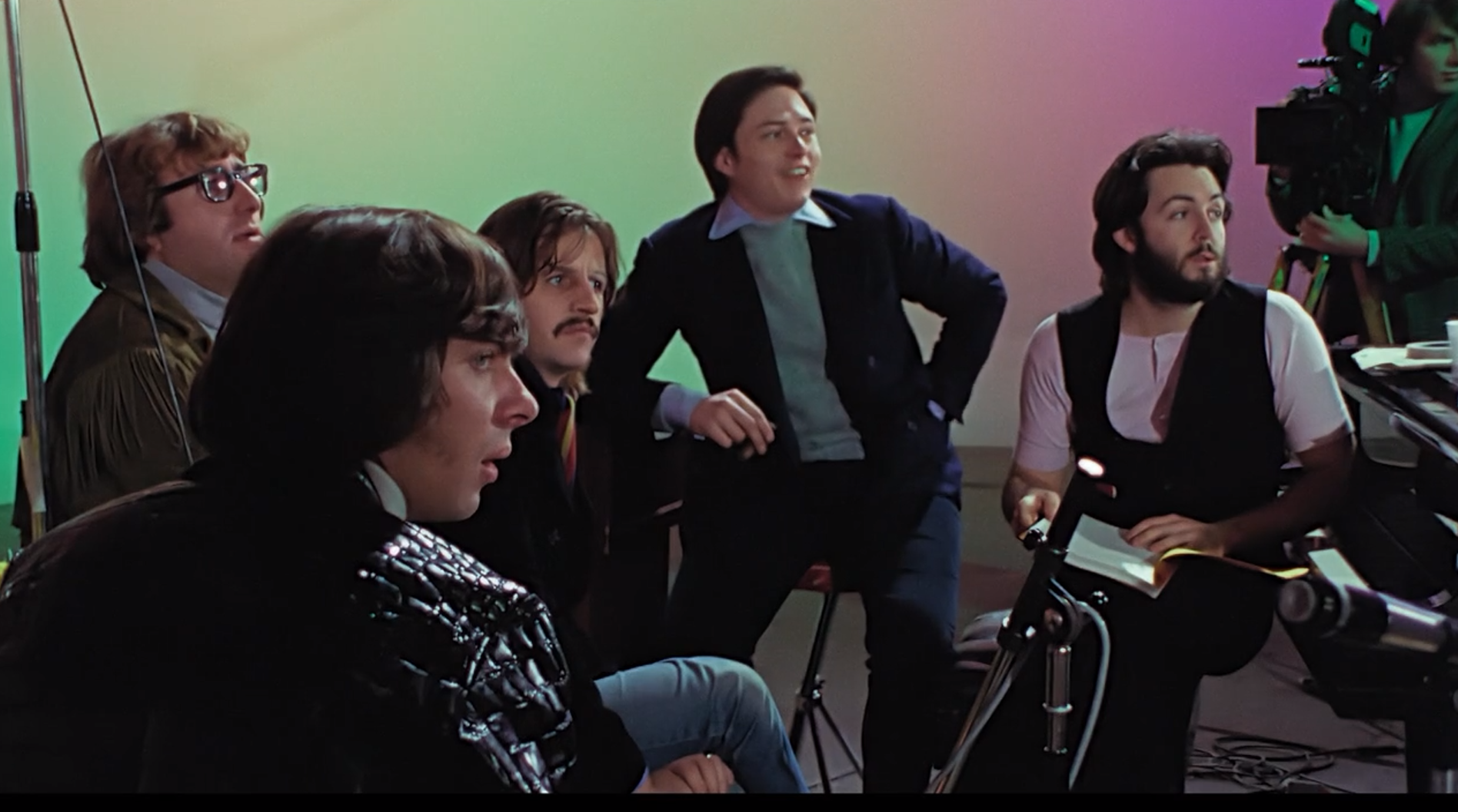
Mal, Glyn, Ringo, Michael and Paul on January 14, 1969, as seen in Get Back.
Let’s start with the cast of characters, led by the public safety staff. Sgt. Badger and Private Cluff (“happily known as ‘Ginge’”) had yet to be cast, but by Ringo’s suggestion Mal would play the “policeman gone wrong.”
The “church-hall lout who commits the robbery” was given to Glyn, who gave the impression he didn’t want to be a villain, at least by Paul’s interpretation.
“Do you want to be a goodie then, Glyn?” Paul said to laughter. “Come on now, you’re sulking, aren’t you? [Glyn] wants to be a goodie.”
It was unclear who would play “the roughneck that changes, the hard-drug-peddling yob turned to religion” but Ringo accepted the role of the schoolteacher on vacation who was just taking children on a tour to see the famous masks of Damascus before finding himself yanked into a crime thriller.
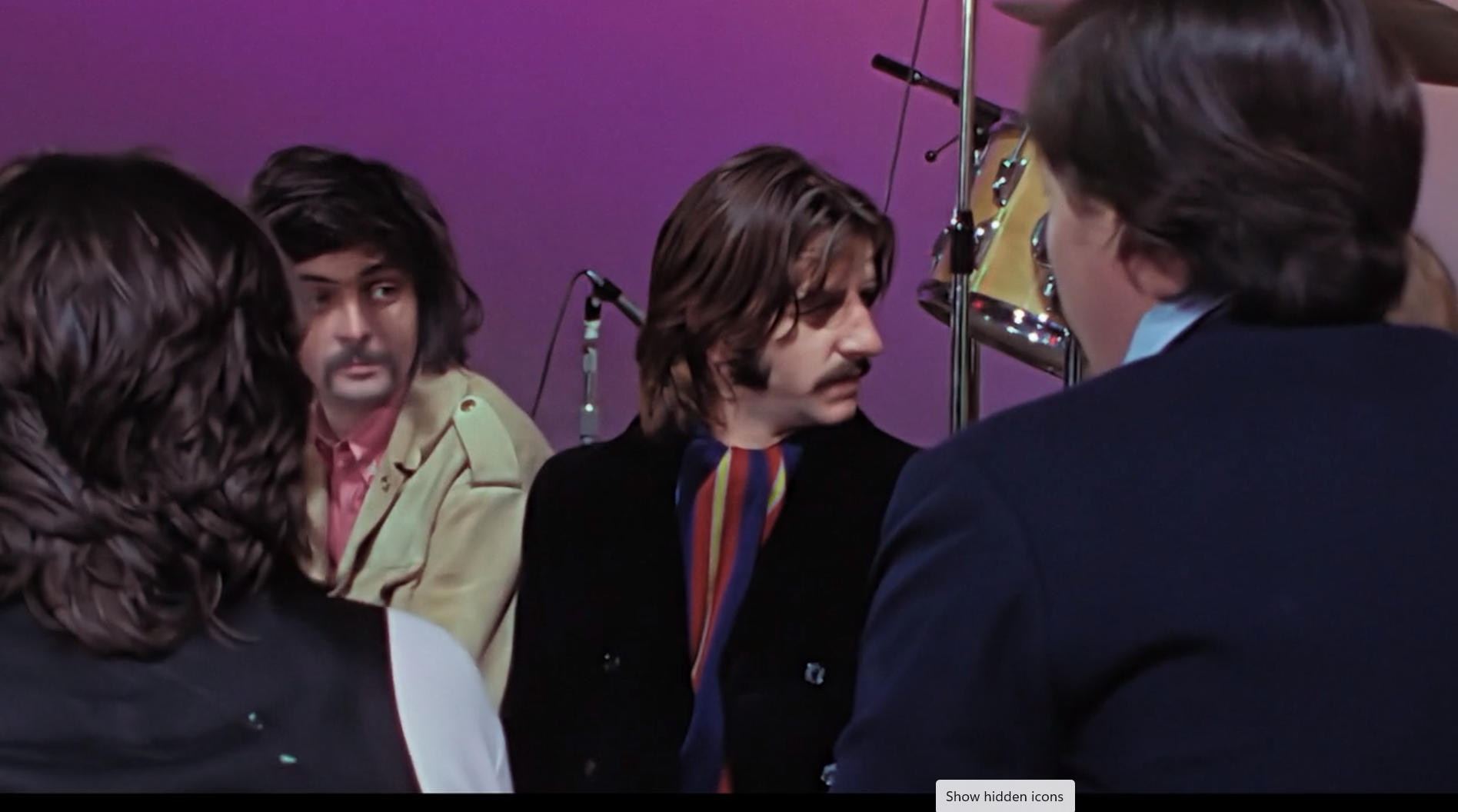
Tony Richmond (pictured left of Ringo) is the fence.
Michael offered to direct, and suggested Tony Richmond do his usual work behind the camera.
“No, Tony’s in it,” Paul countered. “He’s the fence, where Glyn gets rid of the drugs, through him.”
“You’re the traffic sign,” Ringo deadpanned to Michael.
Eventually they worked on diversifying the cast, eyeing a few women present at Twickenham for a Magic Christian casting call, seeking a “couple of groovy-looking blondes,” per Michael, for the spy girl (Lavinia or Titania) and the sex interest – the last of which Paul called for a “closed set for the nude bathing scene.”
While the farcical script took shape, so to speak, an authentic prop appeared on the soundstage, a locomotive slated to be used in the imminent filming of The Magic Christian, as starring Ringo.
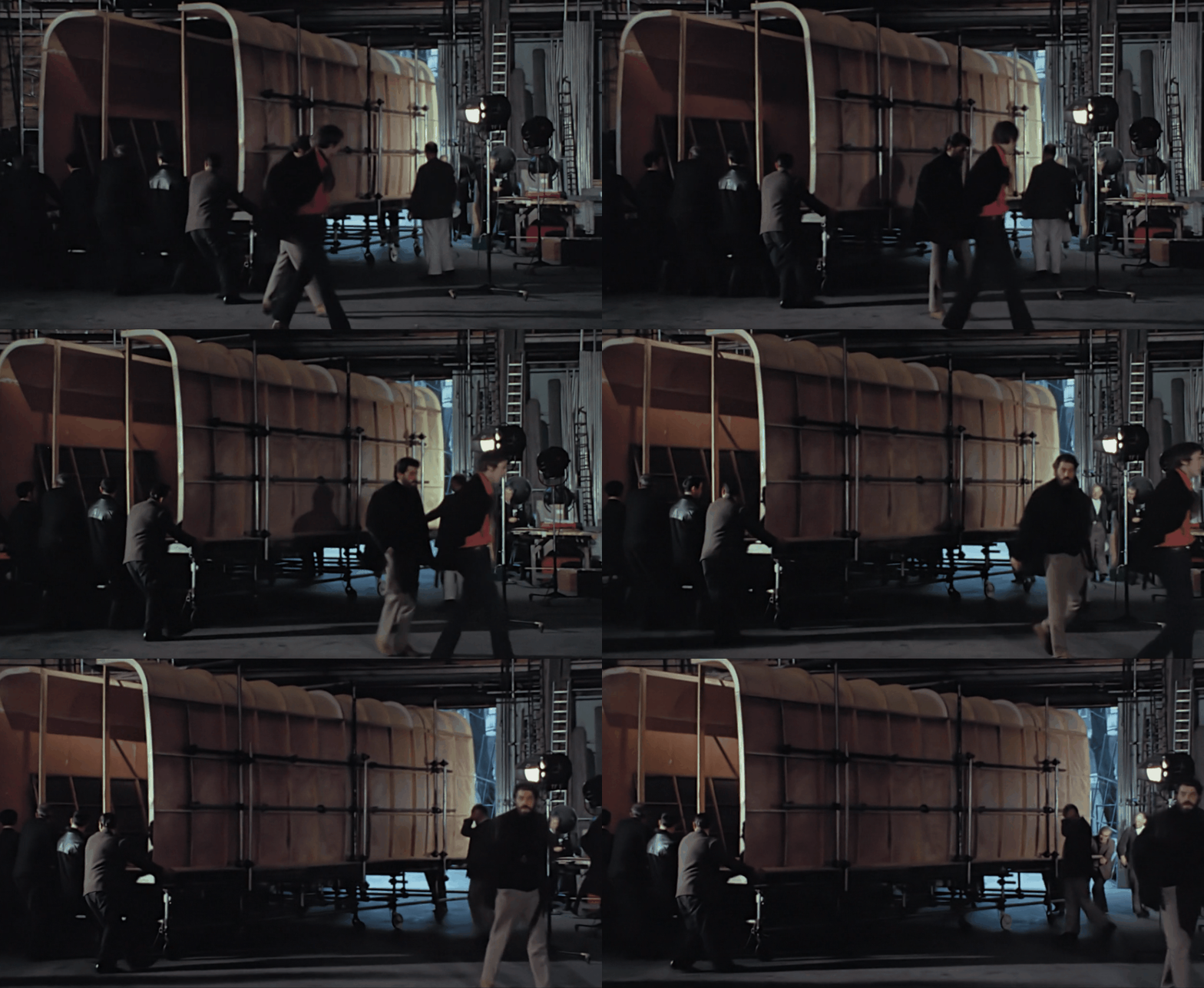
The train sets for The Magic Christian are loaded into Twickenham, as shows in Get Back.
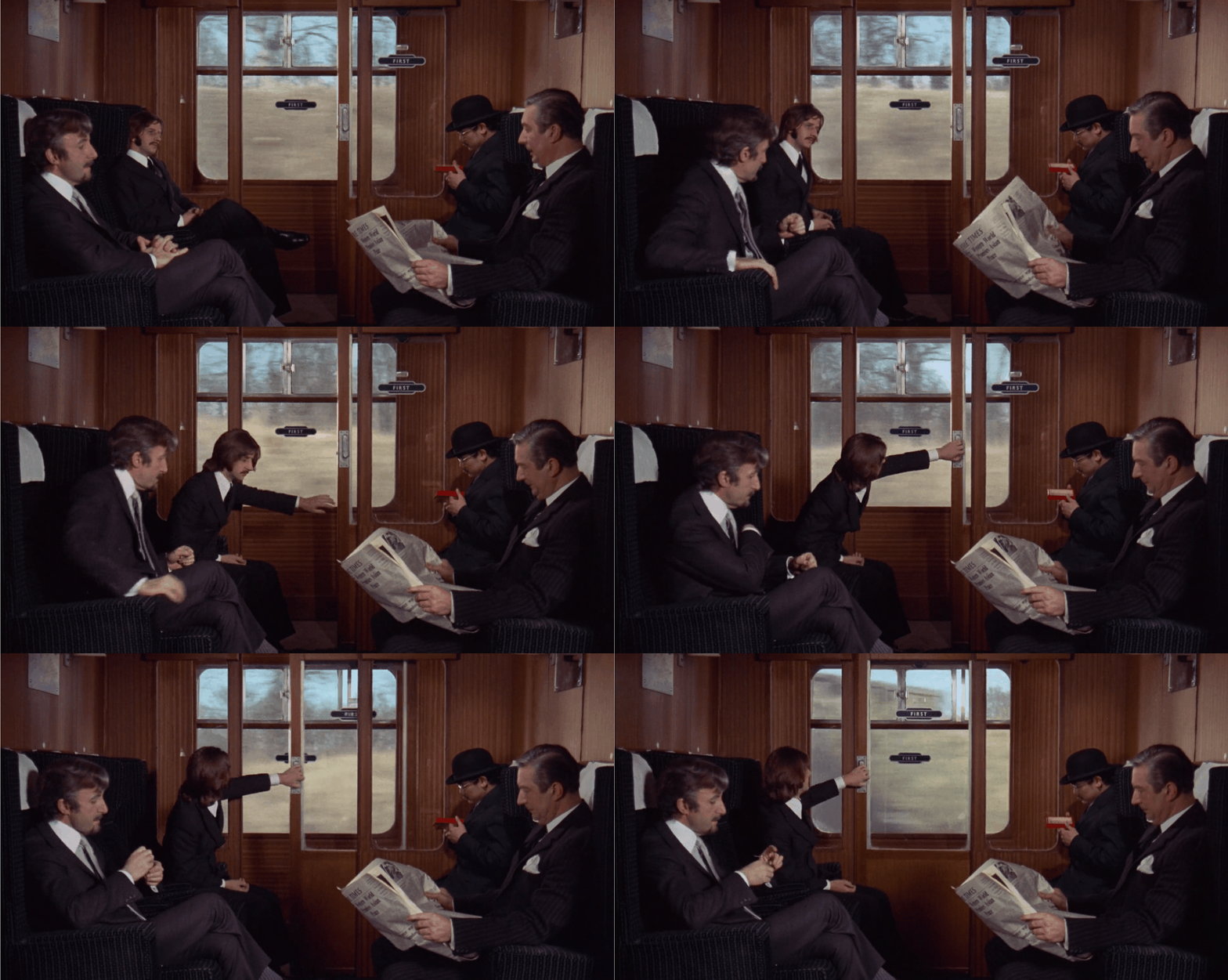
The Twickenham train, as seen with Peter Sellers, Ringo Starr, et al., in The Magic Christian.
“Hey, we’re getting a train in!” Michael said excitedly. We weren’t left any timetables, but we can be clever and even call that train the one after 9:09 if we wanted to get in the spirit of things and tie things together.
It was a full-circle moment: Less than five years earlier the Beatles filmed the opening performance of A Hard Day’s Night – the sequence for “I Should Have Known Better” as performed on a train – on this same Twickenham soundstage, a point that couldn’t have been lost on Paul and Ringo.
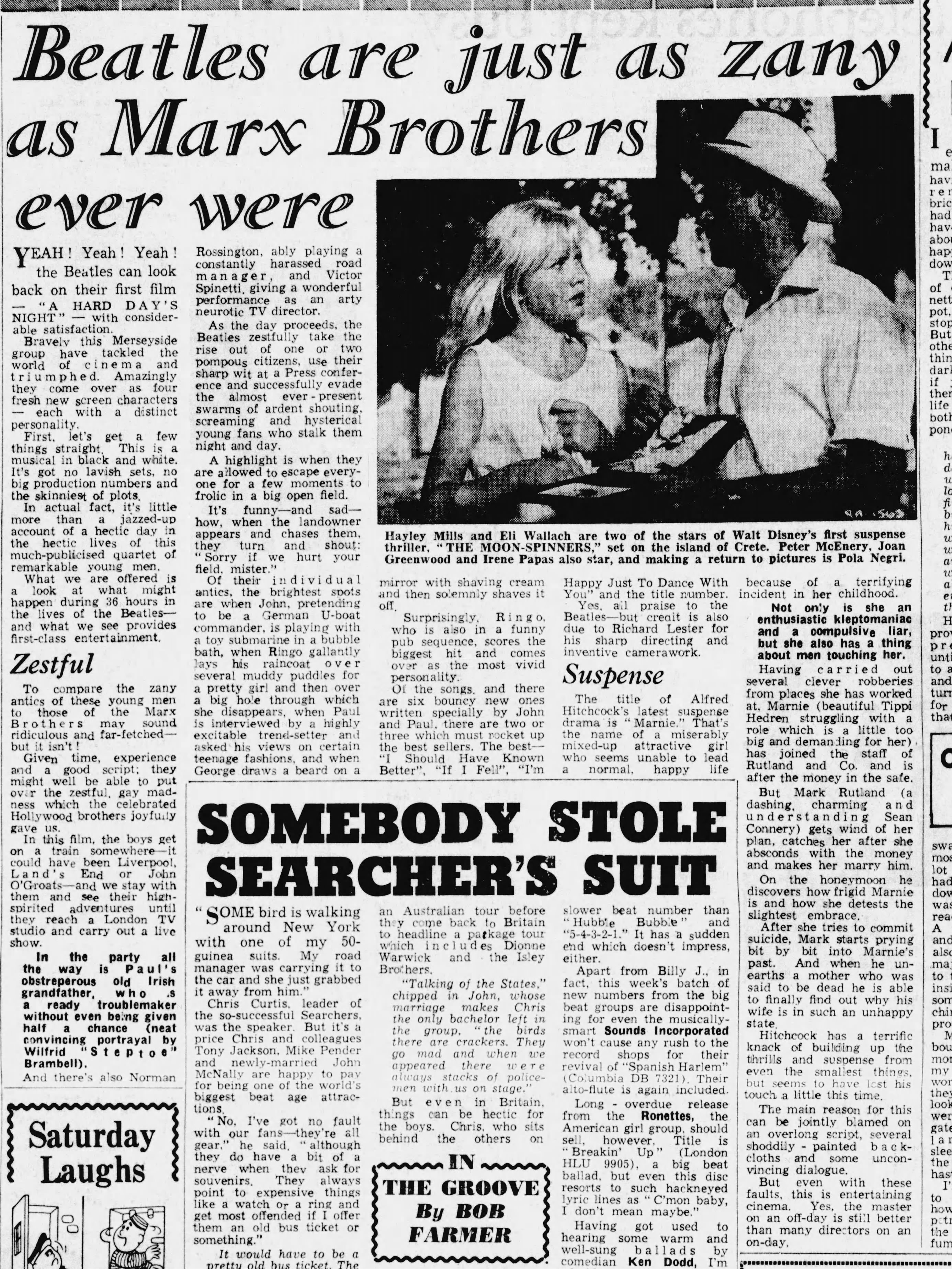
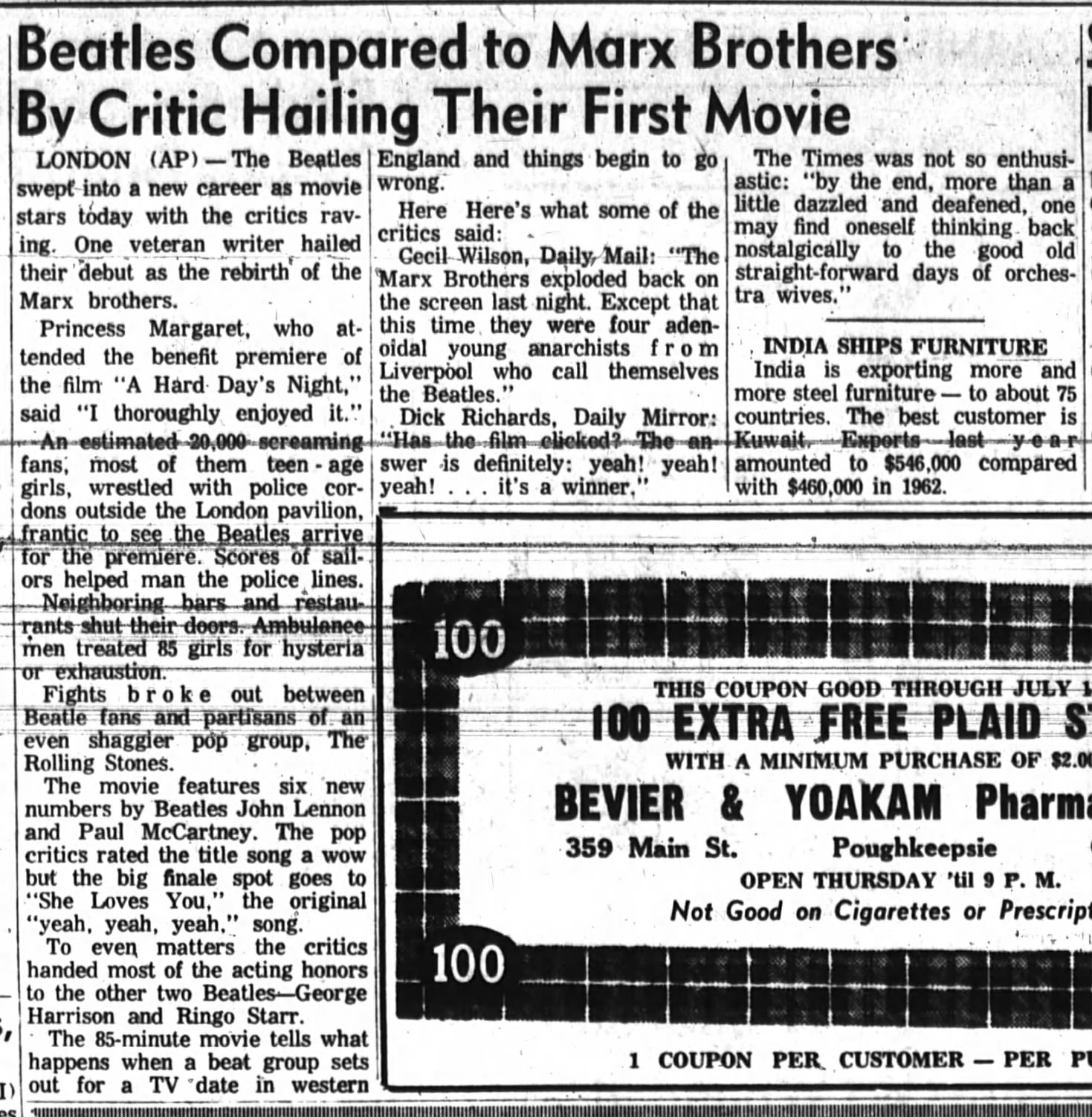
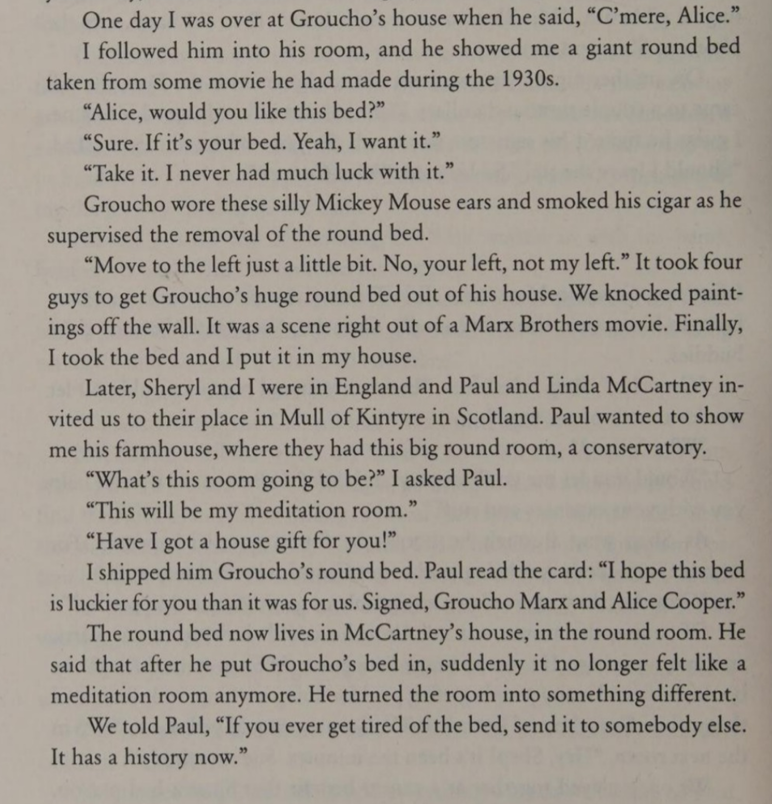
More full-circleness: A Hard Day’s Night led the Beatles to draw no shortage of comparisons to the Marx Brothers. And it just so happened Paul – who to this day owns Groucho’s old bed, by the way (check this excerpt from Alice Cooper’s autobiography) — had a Marx Brothers script in his hands. You can see it in Get Back: He’s reading from a couple of thick, comb-bound, soft-covered books.
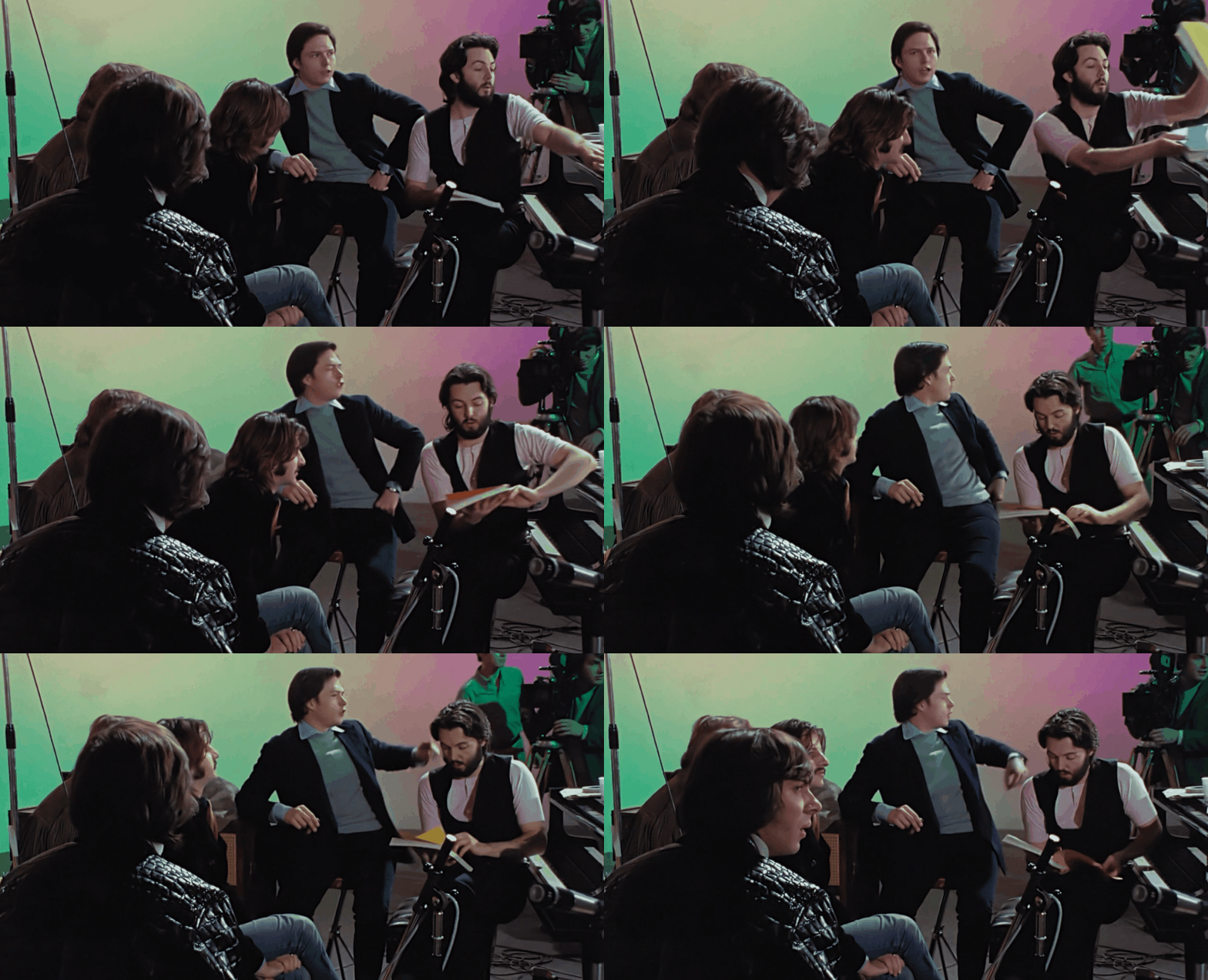
“[We can do a] remake,” Paul suggested as he read from the “A Night at the Opera” script. (Ringo conflated this film with “At The Circus,” referring to “A Night at the Circus.”)
As read by Paul:
Groucho: I’m glad you told me.
Maids: (in high voice) We’ve come to make up your room sir.
Chico: Are those my hard-boiled eggs?
Groucho: I can’t tell till …they get them out of me
Fun fact: A Night at the Opera, filmed in 1935, employed backwards masking a generation before the Beatles popularized it on record. Just another little Marx Brothers-Beatles link to share with your friends.
Ringo, still considering “At The Circus,” broke into harmony with someone who sounded like Mal on that film’s “Two Blind Loves.”
“We’re going to make a train movie,” Michael said. “Why don’t we do ‘A Night on a Train’?
“We’ve got a spare few thousand feet [of film], we don’t tell [Let it Be and The Magic Christian producer Denis O’Dell] we’re doing it.”
Remembering one of their missing members, Paul suggested the film crew capture John and Yoko being interviewed by the CBC.
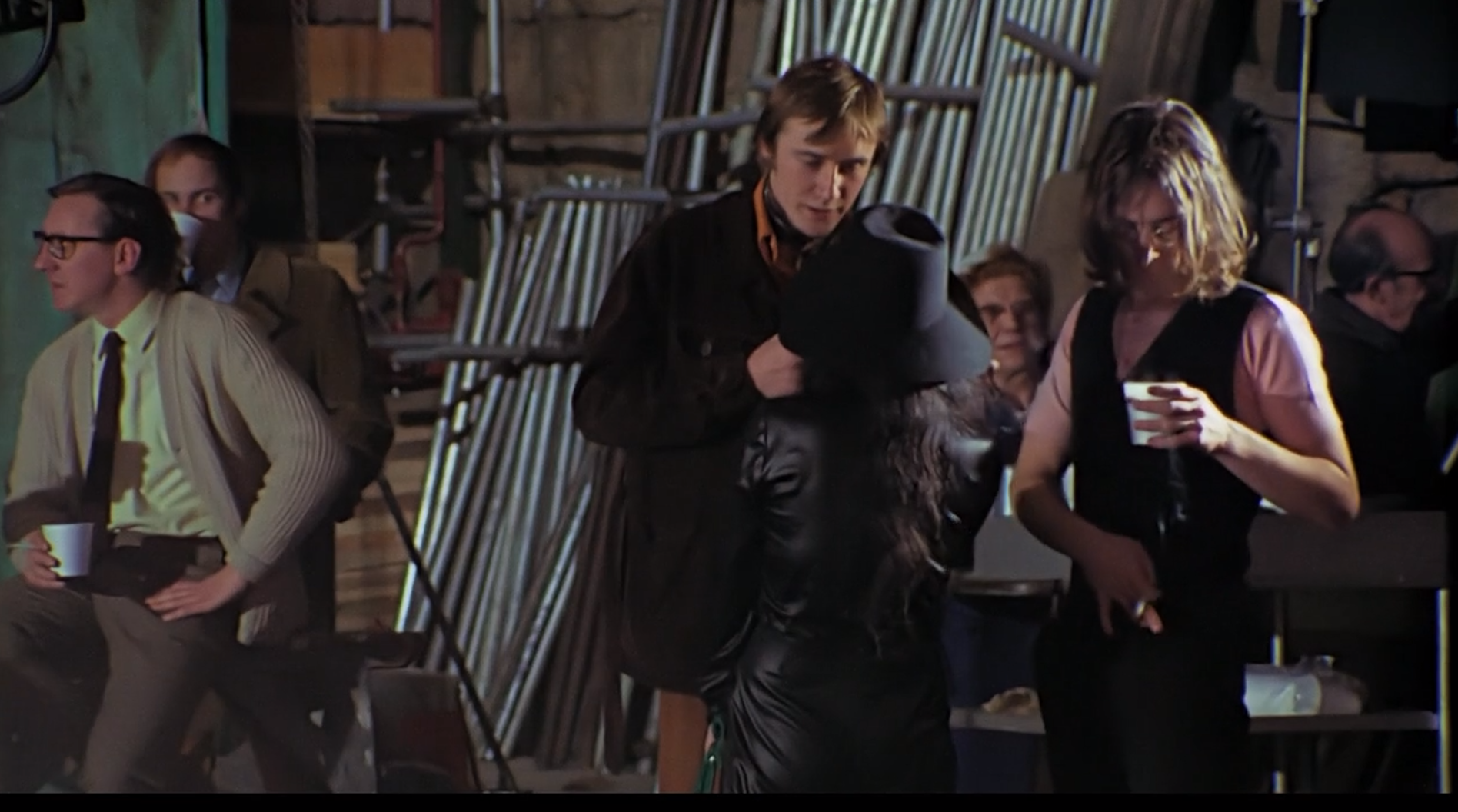
John, Yoko and CBC’s Hugh Curry on set on January 14, 1969.
“But John and Yoko should be shooting Ringo and I,” Paul said. “And we should be taking Instamatic shots of the crew [laughing].” Drifting back into fiction, Paul adds: “And the crew is reading Playboy.”
Earlier Paul pitched a remake, then Ringo suggested a throwback. “Let’s make a silent movie. Slow ‘til its speeded up when we play it back, ’cause they’re always funny to watch.”
For pretty much the first time in this sequence, someone came up with a reasonable idea, and it’s the director of the only film that actually was on the other end of the camera.
“What we could do to save a little money is,” Michael pitched, “figure [we] take one of these songs we’re recording, make it a single and do the promo film for the single here.”
Paul only chuckled a “yeah, right” in reply – while the idea was justifiable, George wasn’t there, and there weren’t many songs in decent enough shape to fully record.
But if they were going to make a “train movie” then maybe Michael was thinking of their completed train song: “One After 909.” He had worse ideas (and I say that as an MLH advocate).
Whether it was for a song promo or fake film, Michael set his sights on the star backdrop in a moment we catch in Get Back.
“Hey, should we shoot the train coming in? Chug, chug.”
Tony shut him down to widespread disapproval, repeatedly rejecting any filming of the set intended for The Magic Christian. “It’s copyright,” he said.
“It’s a documentary. … It’s a good shot for the part of the atmosphere,” Michael said, incredulous. “Oh, c’mon Tony. Oh, fuck.”
Ringo and Paul likewise objected, the latter mocking Tony as Parisian New Wave filmmaker Jean-Luc Godard.
Godard was a bit of a dirty word in Beatle parts, especially around John, so pardon the Frenchman and this huge tangent that revolves around another Beatle movie that wasn’t made.
One obituary for Godard, who died in 2022, called the filmmaker “cinema’s north star” asserting “no one did more to make movies the art of youth.” He was deeply important, and this time and place was his as a filmmaker.
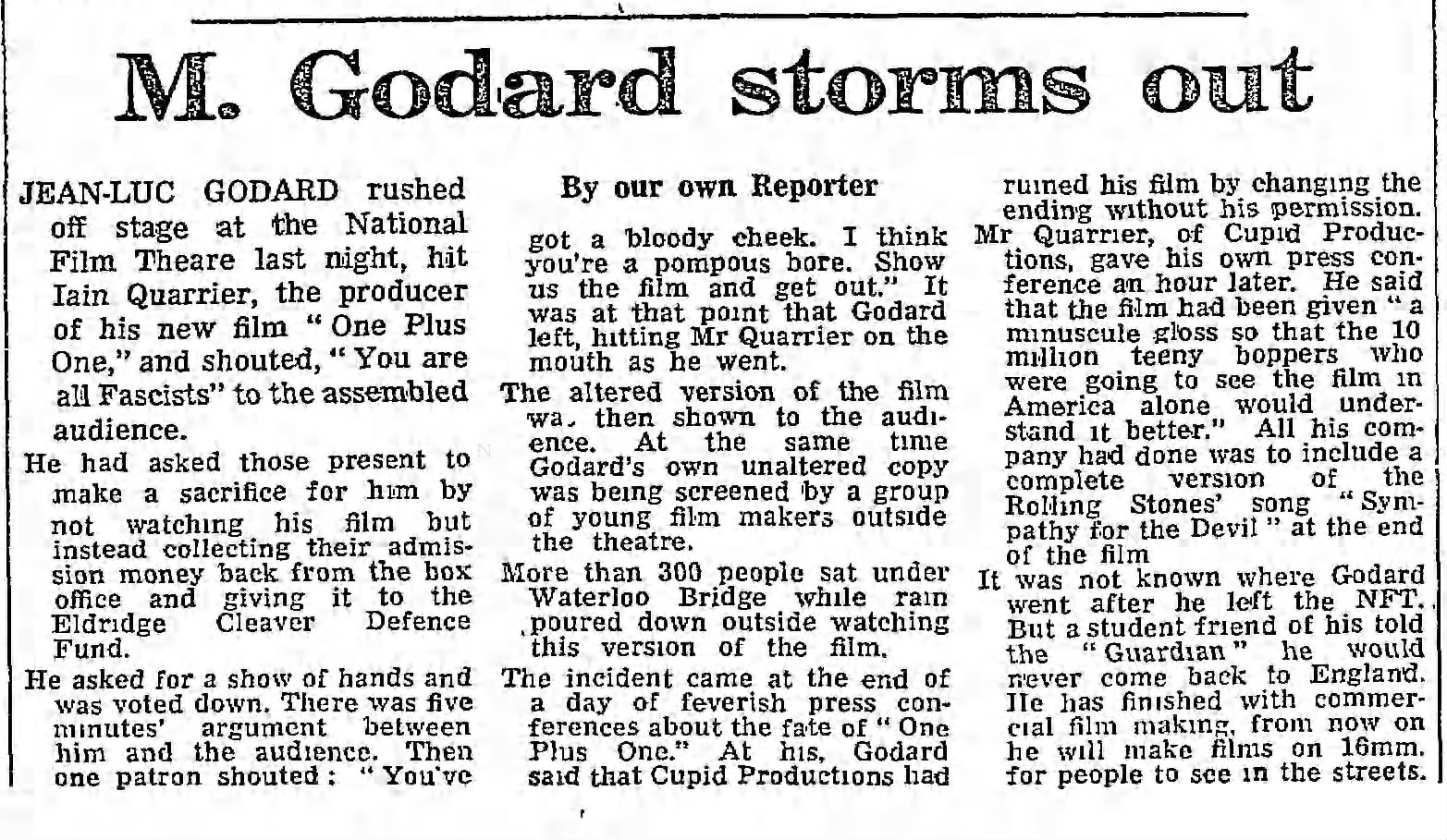
A memorable night at the end of November 1968 – certainly fresh in the mind of the gang at Twickenham, it was only weeks earlier — included Godard imploring the audience to not watch his new film (One Plus One, his production with the Rolling Stones), calling the viewers fascists when they did. Then he punched his producer.
But before he worked with the Stones, he set his sights even higher, on our Fabs. Anne Wiazemsky, Godard’s wife from 1967-1979 laid it all out in her 2015 memoir, Un an Après.
Via Google Translate, from the original French to English:
At the instigation of an English producer determined to make a film featuring Godard and the Beatles, I had accompanied him to London. He had even scribbled a rough outline of a plot in which a young woman unable to get an abortion (me) tried to commit suicide by throwing herself in front of a car. Alas, she kept running into a Beatle behind the wheel of a Rolls-Royce, and her attempt would fail. What would happen next? Jean-Luc didn’t know, but he was counting on the Beatles to provide further inspiration.
…
A meeting was arranged with John Lennon and Paul McCartney at their Abbey Road offices. The former was immediately hostile, unreceptive to any of the enterprising producer’s suggestions; he seemed miles away and intent on ending the meeting as quickly as possible. The latter, by contrast, was all charm and kindness, eager to make a film with Godard—whose cinema, he said, he “revered… all of it.” As the discussion dragged on, John Lennon stood up and left the room without a word or a backward glance. “Come back tomorrow,” the conciliatory Paul McCartney told us. “John isn’t having a good day. But I’ll speak to him, and I hope he’ll be more cooperative.”
Godard returned with an idea based on a script “The Assassination of Trotsky,” with Lennon playing Lenin’s co-revolutionary.
“John Lennon will play Trotsky! Undeniable, right?” … Jean-Luc, in high spirits, had immediately launched into a pitch to John Lennon about the Trotsky story. They would make a real revolutionary film together—the first of its kind. He was speaking at breakneck speed … [b]ut John Lennon soon interrupted them; his face twisted with rage and his voice pitched high, he launched into a torrent of words of his own.
…
John Lennon and Jean-Luc were soon shouting at each other. “I think it’s a bust,” Paul said, and seeing my disappointed look, added, “I’m sorry—it sounded really good, your husband’s project… Will you tell him?”
A September 1968 interview with Godard in the International Times blamed the Beatles for being “corrupted by money,” an accusation John refuted in the November 23, 1968, issue of Rolling Stone.
Now that’s sour grapes from a man who couldn’t get us to be in his film. … Dear Mr. Godard, just because we didn’t want to be in the film with you, it doesn’t mean to say that we aren’t doing any more than you.
Returning to Twickenham ’69, Michael eventually got his shot (even if we never saw it in Let It Be or Get Back). With his voice fading in the distance on the Nagras, we hear MLH saying he’ll be somewhere “just for a minute.”
“Shall we get some seats in the train and pretend we’re on a Tube or something?” Michael soon pitched another stab at a fake film.
In due time, Paul occasionally played some piano, but he continued to be a part of the conversation.
“Can we have it in a club? You know, the atmosphere is a club. … That’s it! We’re in a band [and] peddle drugs.”
They weren’t quite done talking movies, but another stage feature – utility chains – seized their attention. They may be at a soundstage, but to mother nature’s son, it was probably like climbing a rope or tree for Paul, a erstwhile Boy Scout.
(The Scouts weren’t a complete footnote in Paul’s childhood, even though it’s a parenthetical reference here. Paul missed his first gig as a member of the Quarrymen in August 1957 because he was away at Boy Scout camp.)
Ringo was the first to dare a climb even though he admitted he “was never very good on the ropes.”
Paul: That’s the trouble you get the panic about halfway up.
Ringo: You realize you can’t stand heights.
Paul: Seen The Good, the Bad and the Ugly?
Paul’s question drew a chorus of noes – the film hit theaters in London the previous August and was presently playing in Piccadilly Circus, a mere six-minute walk from 3 Savile Row. They could have gotten some steps in and killed their time seeing real movies instead of making them up.
Good thing no one else had seen it, though — it would have been an intimidating moment, revisiting the scene he was probably recalling.
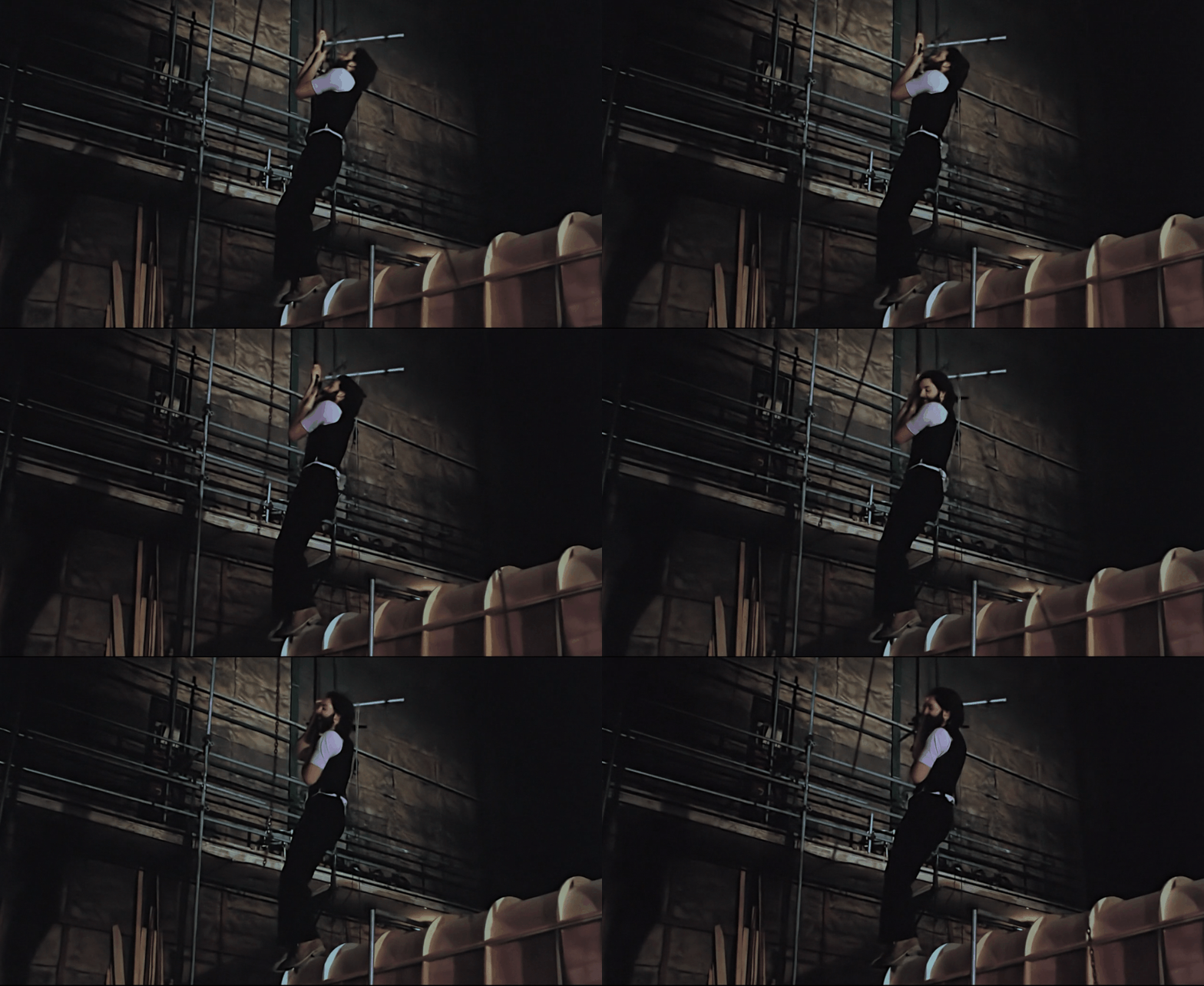
In a segment we get to see in Get Back, Ringo playfully calls an end to the day’s filming with Paul stuck high on the chains.
“It’s a wrap!” Ringo said to the camera. “There’s no business like show business!”
Ringo, Paul and Mal all gave it a go, they just can’t get away from these chains. And by the time they were done, the group inched closer to reforming.
“OK, John, rise up the chains to the top,” Paul said to his songwriting partner a few minutes later, after John was reunited with the others after his lengthy TV interview.
“I know you could do this, lad. My money’s on him.”
The tapes reveal nervous laughter from Yoko before a commotion and thud from what we could assume was a minor tumble that gave way to huge laughs from the others on set.
“It’s all right,” John said in an exaggerated pained voice. “Don’t worry about a thing, Yoko.”
Still, she sounded genuinely concerned at John’s physical activity.
“He’s not that young anymore,” she said.
“No, I’m not 18 anymore,” said John, who was, in fact, 28. “I couldn’t do it at bloody 12.”
So what’s John to do instead?
“I thought we might make a film this afternoon,” Paul told him.
John was caught a little off-guard, replying, “Well, what? OK. What should we do?”
Paul: A comedy.
MLH: You rejected the guys in the Tube train and the guy whose pimp is the conductor.
Paul: We rejected it.
A lot of rejections. A lot of ideas. A lot of roles. But amateur hour was over, with multiple BAFTA and Oscar nominee and Beatle friend and muse Peter Sellers — the star of The Magic Christian, soon to be filming on this stage — arriving at Twickenham for an impromptu meet and greet.
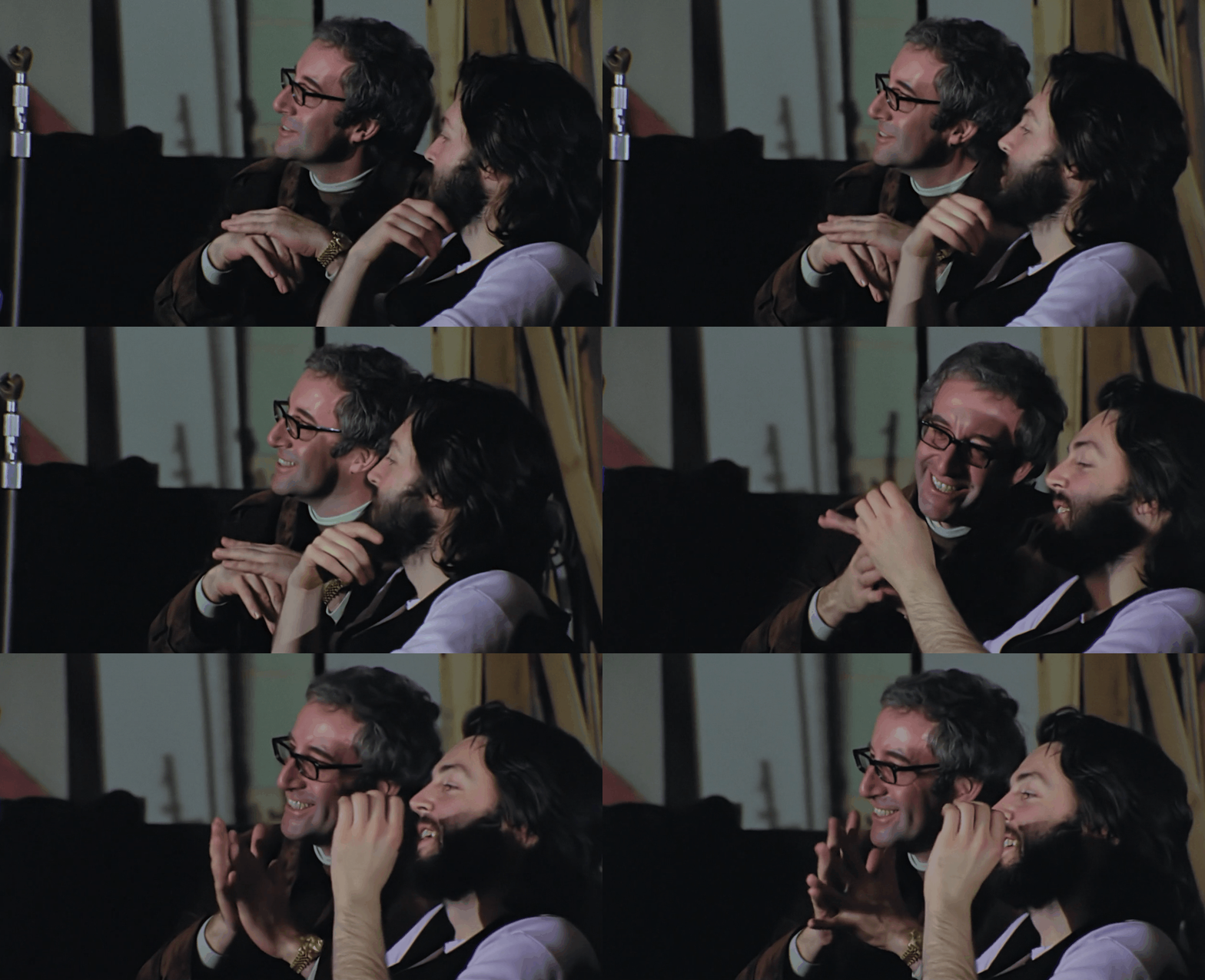
Paul makes his pitch to Peter
With the Beatles’ film at a standstill, Paul figured he may as well have some fun with one of his many movie ideas and aim high to land a star lead.
“We’re casting this afternoon,” Paul told Peter.