Tag Archives: movies

Jan. 14: A day at the circus

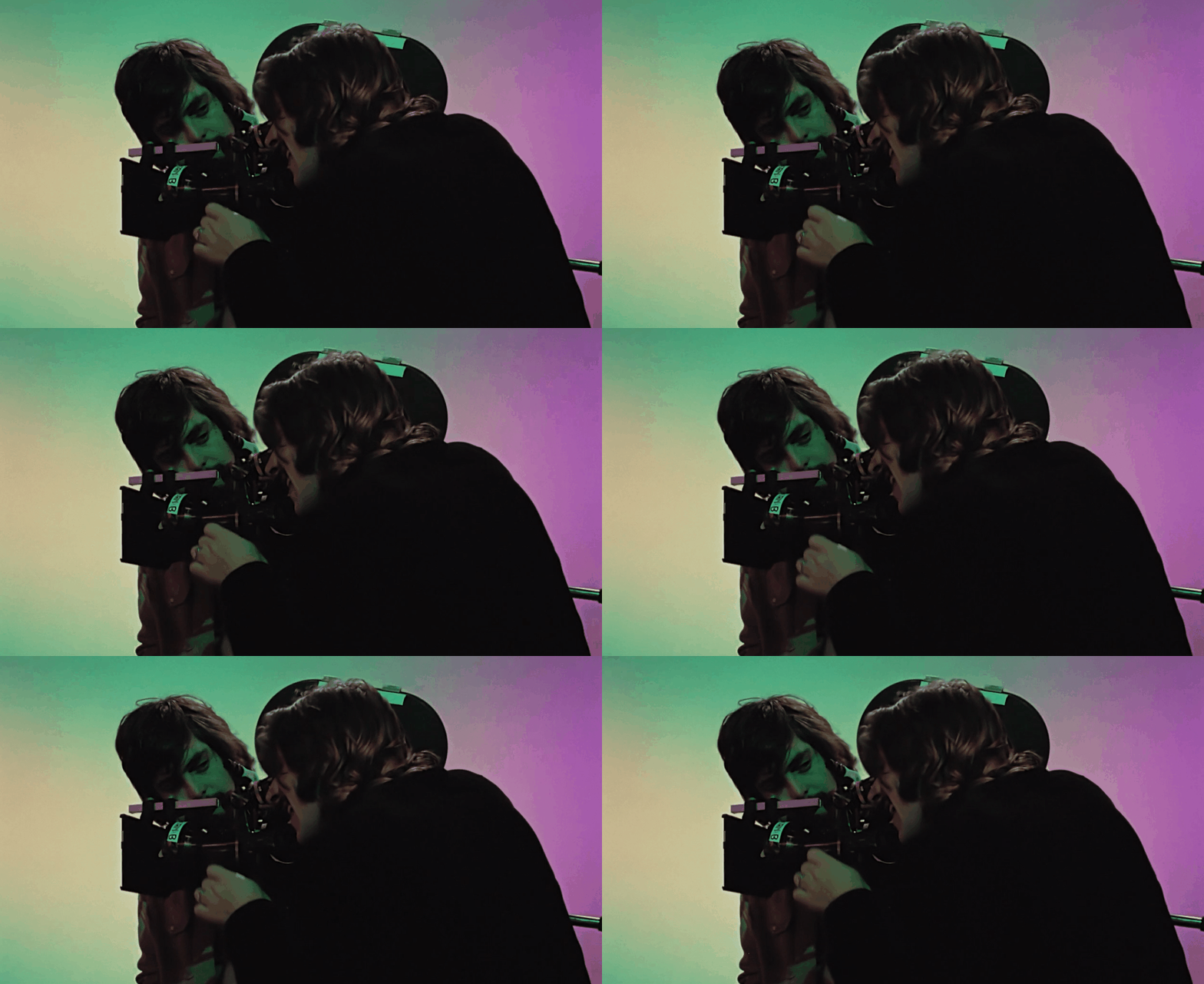
Ringo Starr works the camera on January 14, 1969, as pictured in Get Back.

While they ultimately became a legend of the silver screen, the Beatles didn’t make as many films as they actually did.

As recently as January of this very 2026, octogenarian Paul McCartney recalled in an online Q&A what could have been the Beatles’ feature film debut, preceding A Hard Day’s Night by about a year.

Originally there was something called The Yellow Teddy Bears. We said to Brian [Epstein], ‘Yeah, OK, great!’ And then he came back to us after talking to the producers, and told us they wanted to write the songs themselves. So, we passed on that.

There may have been more to it. As quoted in Roy Carr’s Beatles at the Movies, published in 1996, Paul said: “It might have been that part of the deal meant that we also had to give away the copyright to any new songs which were featured in the film.”

You’d have to think the film’s limited potential audience – it received an X rating on release – was a further drawback, keeping anyone under 16 years old out of the theater.

Regardless of the actual reasons, they “immediately” turned the offer down, per 1990s Paul, via Carr’s book. And instead of portraying another band for their film debut, the Beatles instead appeared as John, Paul, George and Ringo in their cinematic introduction in 1964: A Hard Day’s Night.

While the Beatles’ participation in The Yellow Teddy Bears never went beyond the discussion phase, A Talent For Loving was explicitly announced as the Beatles third film, right before they started filming their second, Help!
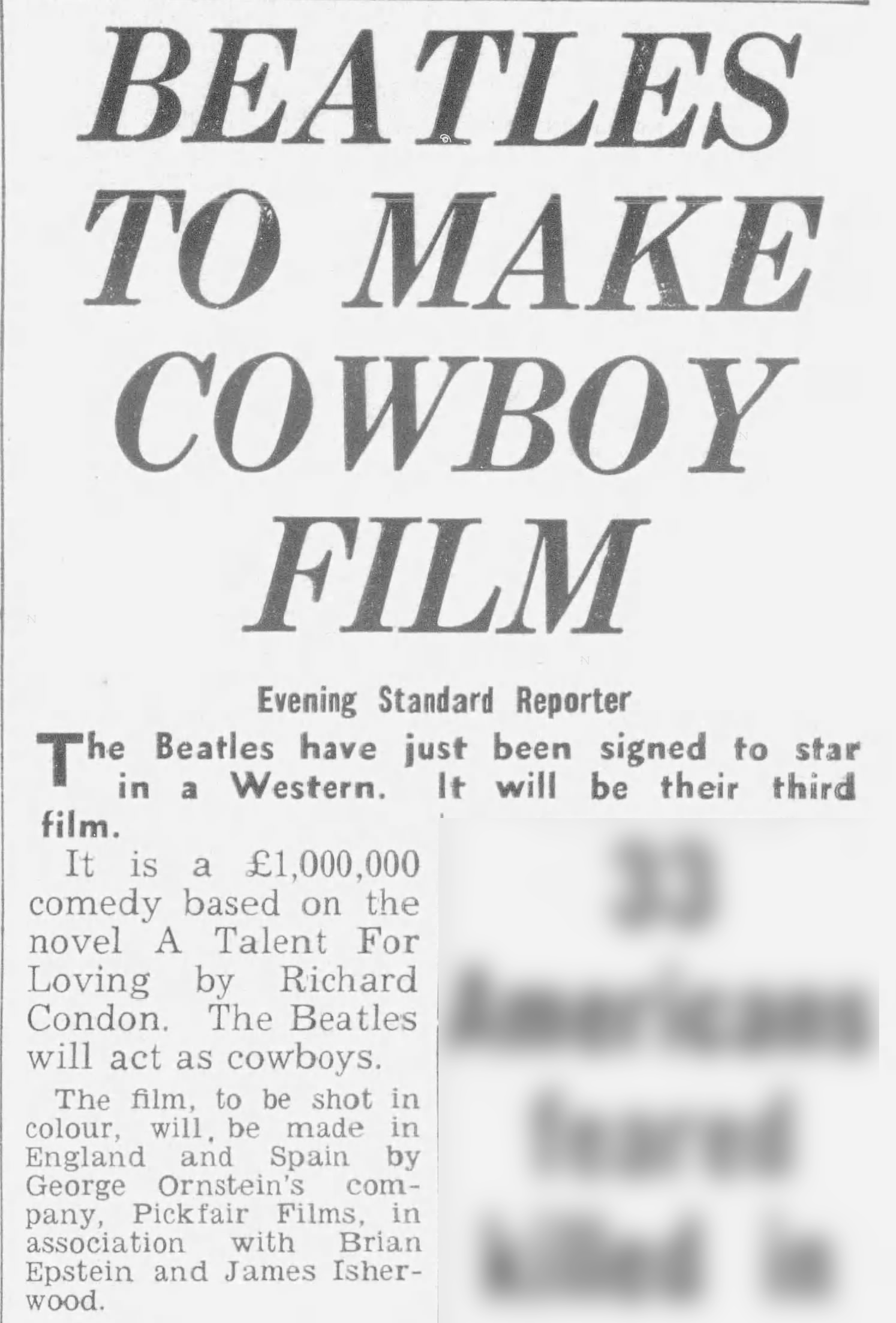
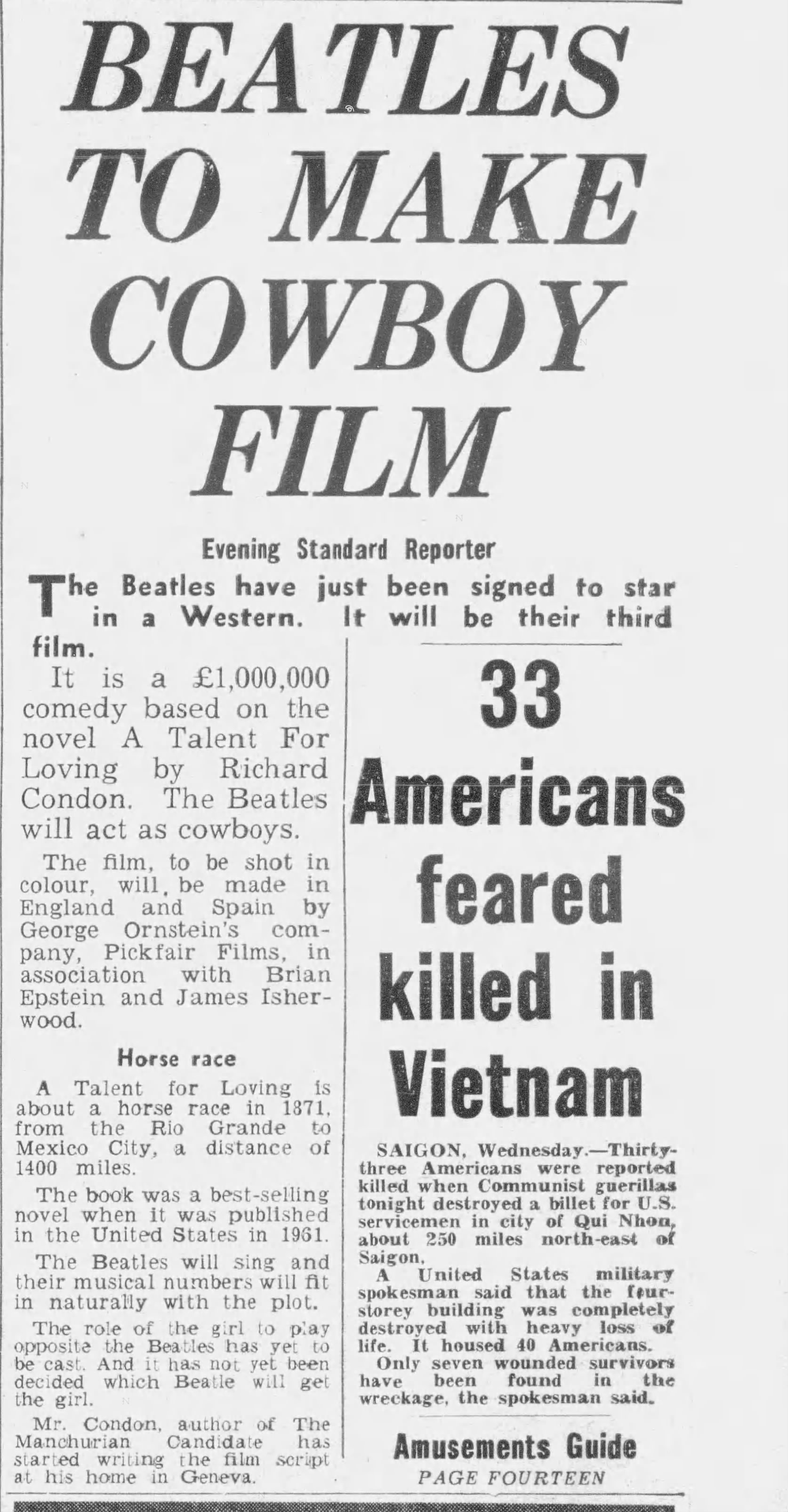
From the February 10, 1965, Evening Standard

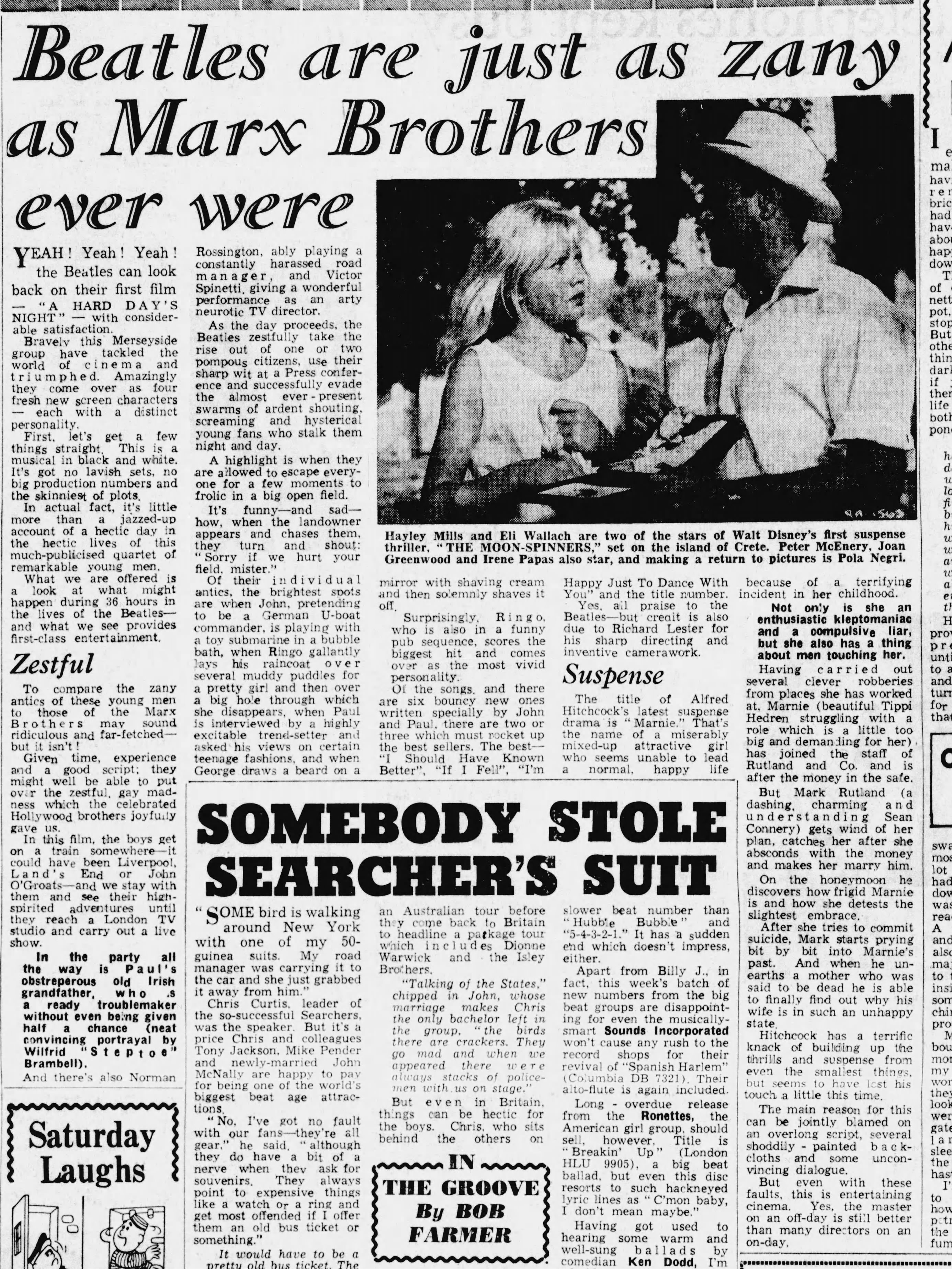
“The Beatles have just been signed to star in a Western. It will be their third film,” reported the February 10, 1965, issue of the Evening Standard under the headline “BEATLES TO MAKE COWBOY FILM”.

It is a £1,000,000 comedy based on the novel A Talent For Loving by Richard Condon. The Beatles will act as cowboys.

The Beatles will sing and their musical numbers will fit in naturally with the plot.

The role of the girl to play opposite the Beatles has yet to be cast. And it has not yet been decided which Beatle will get the girl.

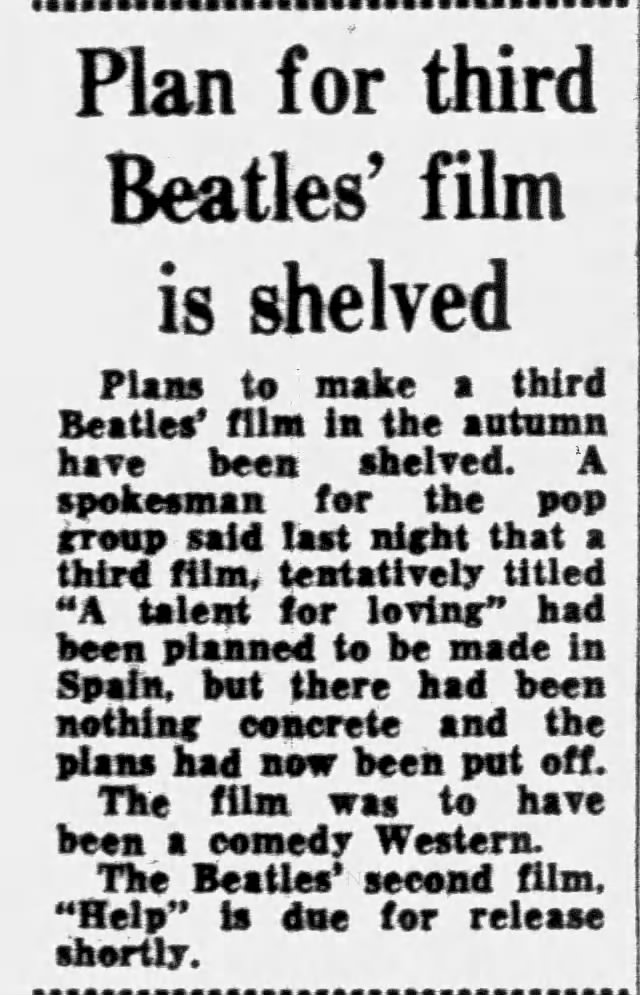
Only four months after news emerged, while Help! was still being filmed, plans its follow-up were shelved.

“The script is not us,” Paul said. “We turn out like four Roy Rogers singing in the saddle.”

Paul and George elaborated in the February 1966 issue of The Beatles Book Monthly:

Paul: That doesn’t mean we decided to rule out the idea of doing a Western. It would be a comic-type Western, of course. And if we don’t do a Western this time I think it’s something we should keep in mind for the future. There are all kinds of great comedy situations you can work into a cowboy story.

George: Anyway, unless some kind of miracle happens – a script-type miracle, that is – we’ve ruled out “A Talent for Loving” and Walter Shenson has been searching for new script suggestions.

Paul: As George said, the problem is that most writers go by our image as a group. It’s difficult to get across to them the thought of having a Beatles film with a non-Beatles story.

Shades of a Personality was supposed to solve this concern, casting one Beatle (eventually reported to be John) with split personalities (himself and the other three) in something a little less fab than their previous efforts. News dribbled out of the script by prolific playwright Owen Holder in summer 1966, with an expectation filming would begin in January 1967. Ultimately Shades of a Personality never really landed squarely with the group, who took the premise elsewhere.

Looped into the Beatles world in January 1967, subversive British playwright Joe Orton — whose play Loot was financially backed by Paul — took the idea and worked off an unreleased novel as a frame for a very different Beatles film, Up Against It.

From a February 1967 entry in Orton’s diary, as published as the introduction to the screenplay for Up Against It:

I hadn’t the heart to tell [producer Shenson] that the boys, in my script, have been caught in flagrante, become involved in dubious political activity, dressed as women, committed murder, been put in prison and committed adultery. And the script isn’t finished yet. I thought it best to say nothing of my plans for the Beatles until he had a chance of reading the script. We parted at five o’clock amicably. With the contract, according to him, as good as signed. And on my part, the film almost written.

Orton wrote the script so rapidly, he asked his agent to wait three weeks before submitting it to the Beatles in early March 1967. A month later, the Beatles had moved on. Again, from the published version of Up Against It:

By March 29, Orton had still heard nothing from the Beatles. He fixed on Brian Epstein as the culprit: ‘An amateur and a fool. He isn’t equipped to judge the quality of a script. Probably he will never say “yes” equally hasn’t got the courage to say “no”. A thoroughly weak, flaccid type.’ And then on April 4, Up Against It was returned. ‘No explanation why. No criticism of the script. And apparently, Brian Epstein has no comment to make either. Fuck them.’

Decades later, in Beatles at the Movies, Paul offered a direct explanation why the script was rejected.

“The reason why we didn’t do Up Against It wasn’t because it was too far out or anything like that. We didn’t do it because it was gay. We weren’t gay and really that was all there was to it. … Now it wasn’t that that we were anti-gay – just that we, The Beatles, weren’t gay.”

(Thirty years later, Blur’s Damon Albarn performed in a BBC Radio production of Up Against It, another link from the Fabs to ’90s Britpop).
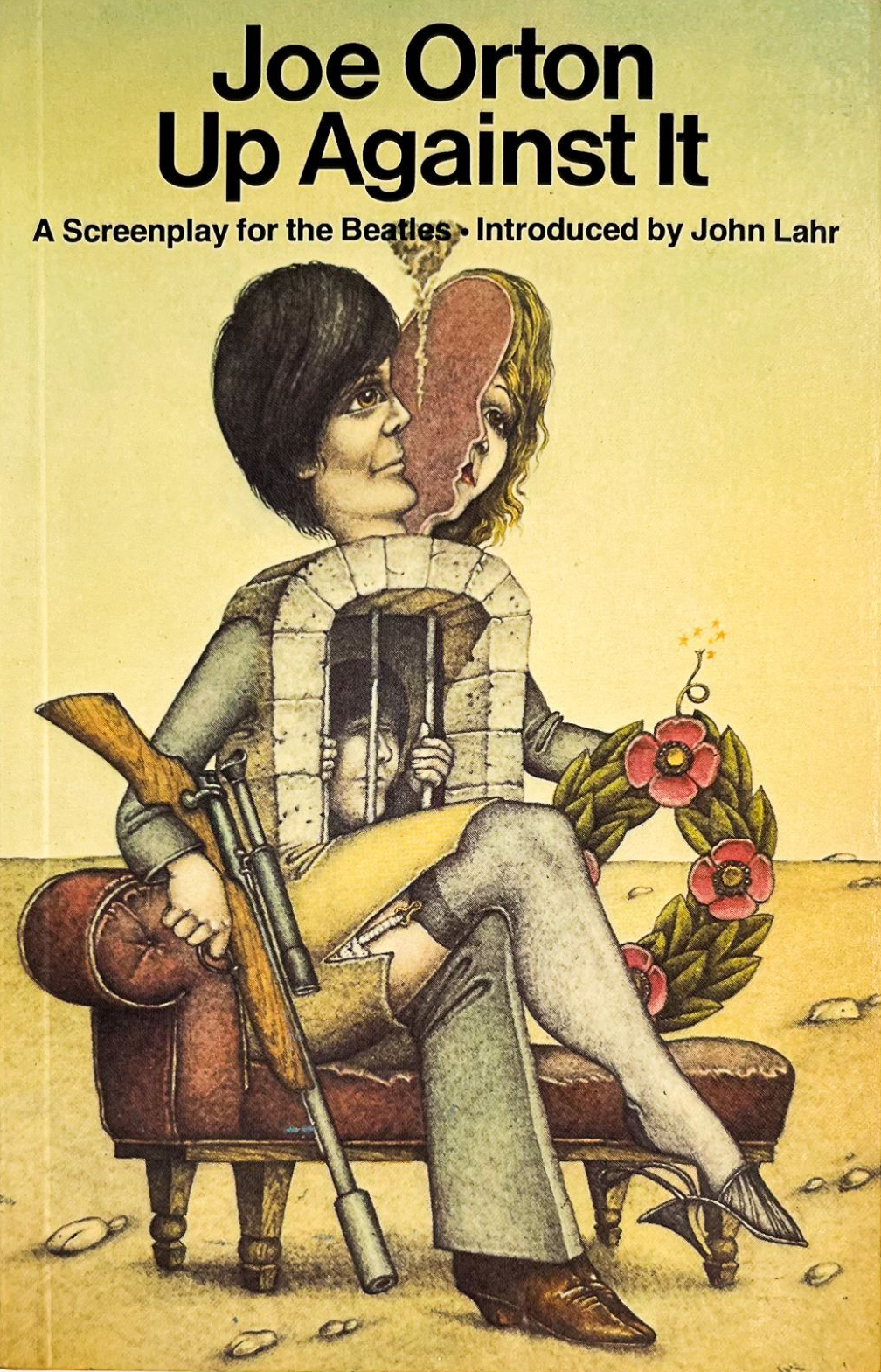
The cover to the 1979 UK edition of Joe Orton’s posthumously published and modified script for Up Against It. Cover art is by Nick Price, who you may recognize as the illustrator of Kate Bush’s Never for Ever album cover.

Aborted efforts of film adaptations of The Three Musketeers and Lord of the Rings starring the Beatles never got far, either, despite the rumors in the late ’60s.

Even after the Get Back sessions, with the Beatles straining to simply stay together as a band, much less as an acting troupe, George enthused over a script for a potential late-stage Beatles film. From the April 5, 1969 DISC and Music Echo:

BEATLES have decided on a script for their next film and shooting should start before the end of the year.

George Harrison told Disc on Monday: “It will be at least as big as 2001 visually with full stereo sound and Cinerama.

“The story is fantastic. It’s based on an idea we had a year ago, but which fell through because of a lot of technicalities at the time. The tables have turned now and we have access to the script again.”

All four Beatles have agreed to do the movie – their third group film – provided they could make it their way.

“And we’ve agreed to let each other do exactly what he wants to do with it. We’ve got to a point where we can see each other quite clearly. And by allowing each other to be each other we can become the Beatles again.

My emphasis on those last few lines, which is an interesting window on what George believed – or very much wanted the public to believe in what well could have been a giant leg-pull – was happening in Beatledom in springtime 1969.

On January 14, 1969, however, it was the very lack of one George Harrison that prompted further film ideas, as they killed time and entertained each other in this period the Beatles were a temporary trio. Creativity flowed at Twickenham, even if it wasn’t always in song. If the Beatles really wanted to make a new movie, and even if it was completely as a joke, they could define it exactly as they wanted.

“We could make a film, you know,” Paul said, sidelining the film the Beatles were actually making – what would later become Let It Be (1970) and ultimately Get Back (2021) – which remained stalled as the second Tuesday of the year went on.

“Let’s get a script and all that, and really not waste all this camera time and do a little sort-of film today. … We all get parts, and get an old Fabian script or something.”

George wasn’t landing a role — he was still AWOL from the band after walking out four days earlier. John Lennon wouldn’t pass the audition, either, but at least he had an excuse: He was presently joining Yoko Ono in an interview with a Canadian TV network elsewhere on set at Twickenham Film Studios. More on that next time.

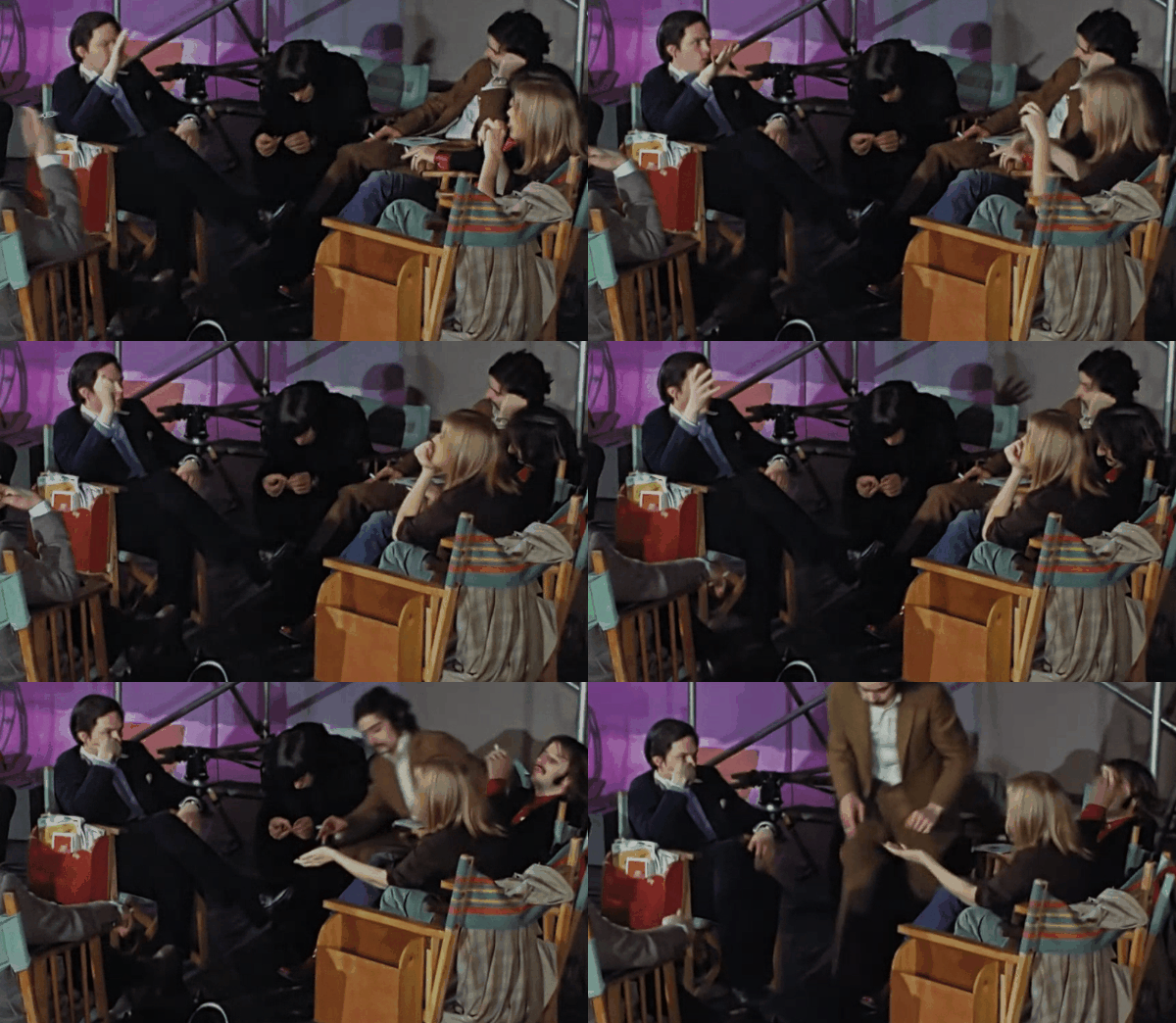
Paul was there, and so was Ringo Starr, and the ideas flowed freely from the rhythm section and an increasingly desperate Michael Lindsay-Hogg, with Mal Evans and Glyn Johns chipping in.

We get this sequence in part, chopped up and out of sequence in Get Back.  The docuseries gives an accurate if incomplete vibe of what they talked about, but while it was a couple minutes in Get Back, it was more than 20 minutes of real time on the Nagra Tapes, long enough to justifiably dig into it here.
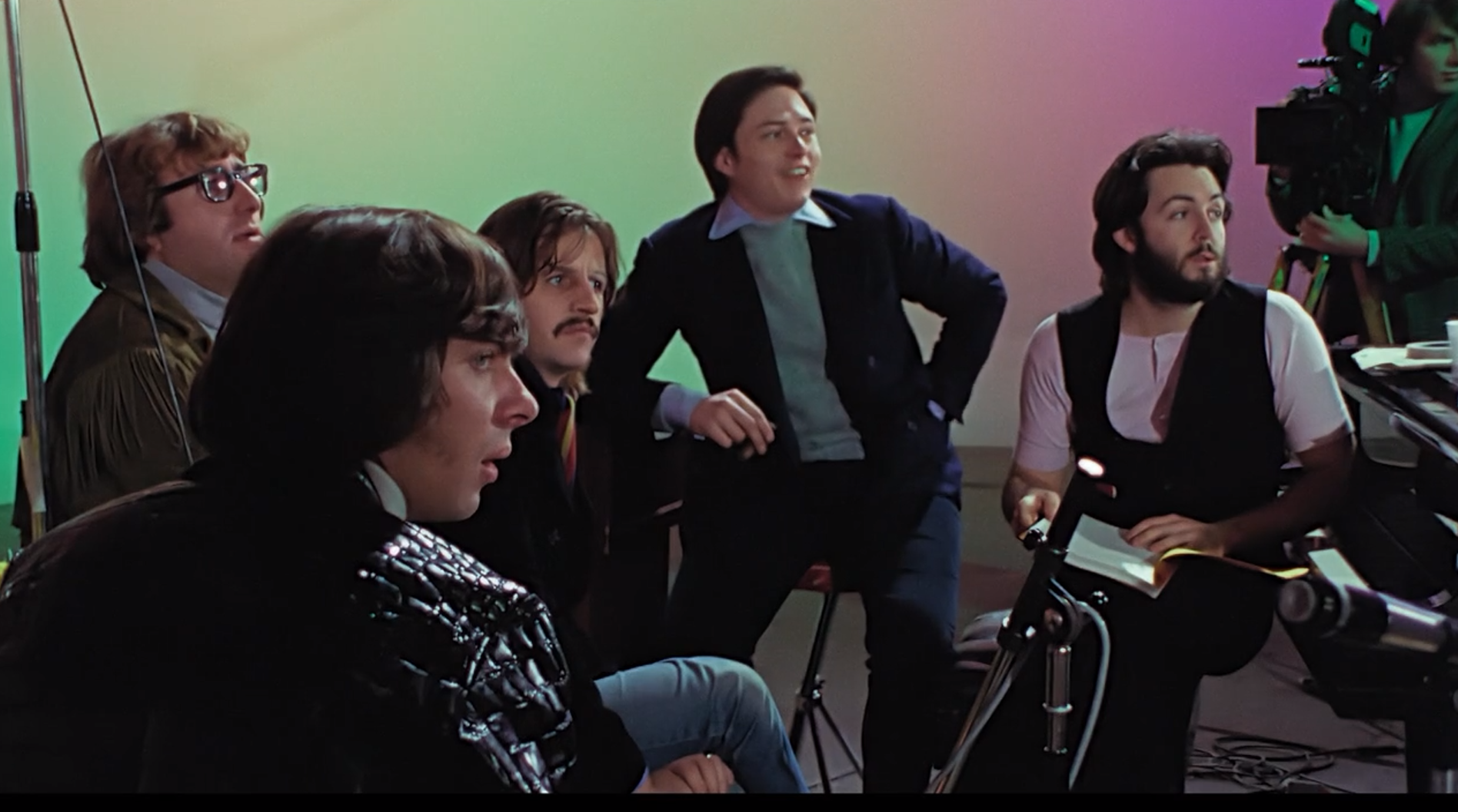
Mal, Glyn, Ringo, Michael and Paul on January 14, 1969, as seen in Get Back.

Let’s start with the cast of characters, led by the public safety staff. Sgt. Badger and Private Cluff (“happily known as ‘Ginge’”) had yet to be cast, but by Ringo’s suggestion Mal would play the “policeman gone wrong.”

The “church-hall lout who commits the robbery” was given to Glyn, who gave the impression he didn’t want to be a villain, at least by Paul’s interpretation.

“Do you want to be a goodie then, Glyn?” Paul said to laughter. “Come on now, you’re sulking, aren’t you? [Glyn] wants to be a goodie.”

It was unclear who would play “the roughneck that changes, the hard-drug-peddling yob turned to religion” but Ringo accepted the role of the schoolteacher on vacation who was just taking children on a tour to see the famous masks of Damascus before finding himself yanked into a crime thriller.
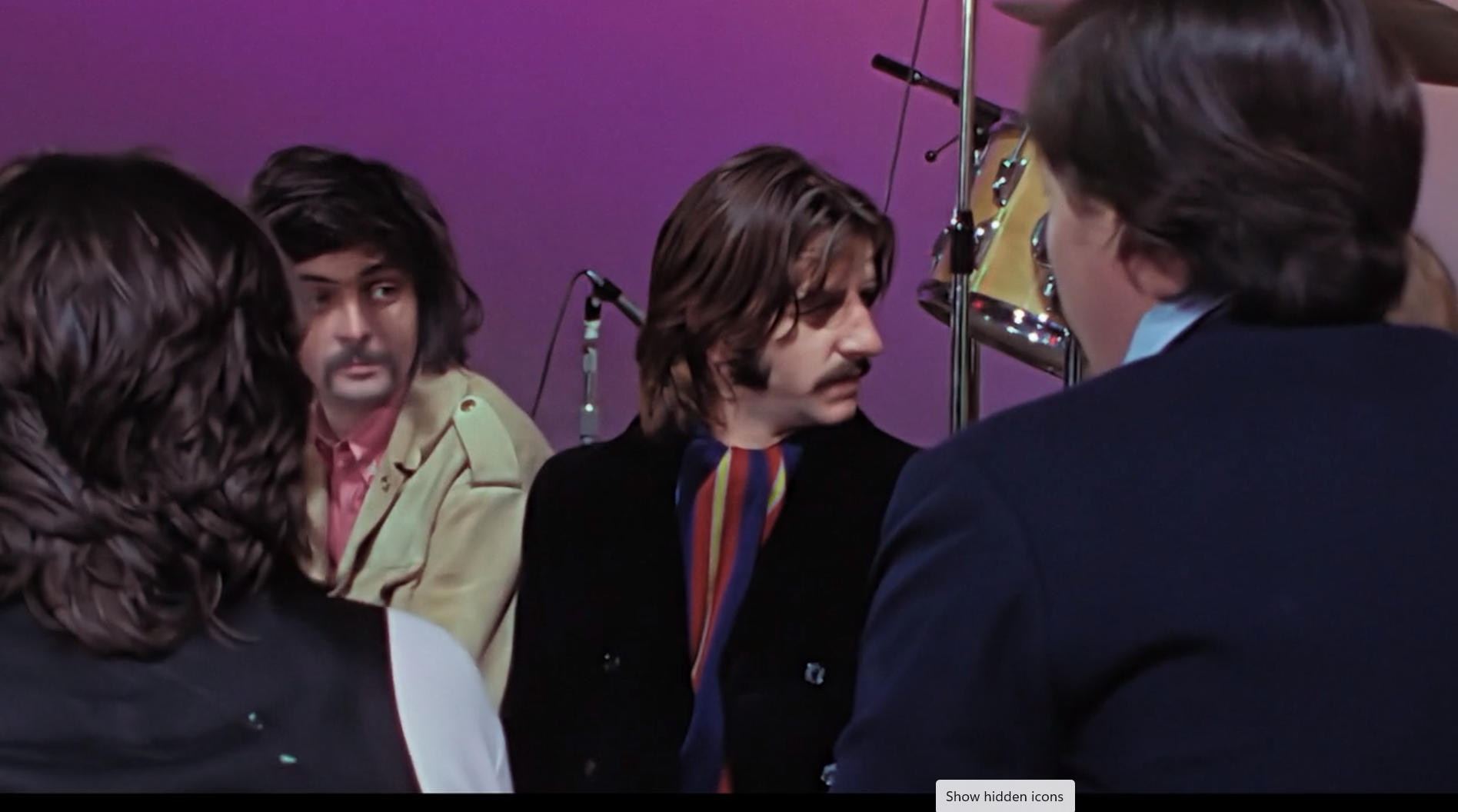
Tony Richmond (pictured left of Ringo) is the fence.

Michael offered to direct, and suggested Tony Richmond do his usual work behind the camera.

“No, Tony’s in it,” Paul countered. “He’s the fence, where Glyn gets rid of the drugs, through him.”

“You’re the traffic sign,” Ringo deadpanned to Michael.

Eventually they worked on diversifying the cast, eyeing a few women present at Twickenham for a Magic Christian casting call, seeking a “couple of groovy-looking blondes,” per Michael, for the spy girl (Lavinia or Titania) and the sex interest – the last of which Paul called for a “closed set for the nude bathing scene.”

While the farcical script took shape, so to speak, an authentic prop appeared on the soundstage, a locomotive slated to be used in the imminent filming of The Magic Christian, as starring Ringo.
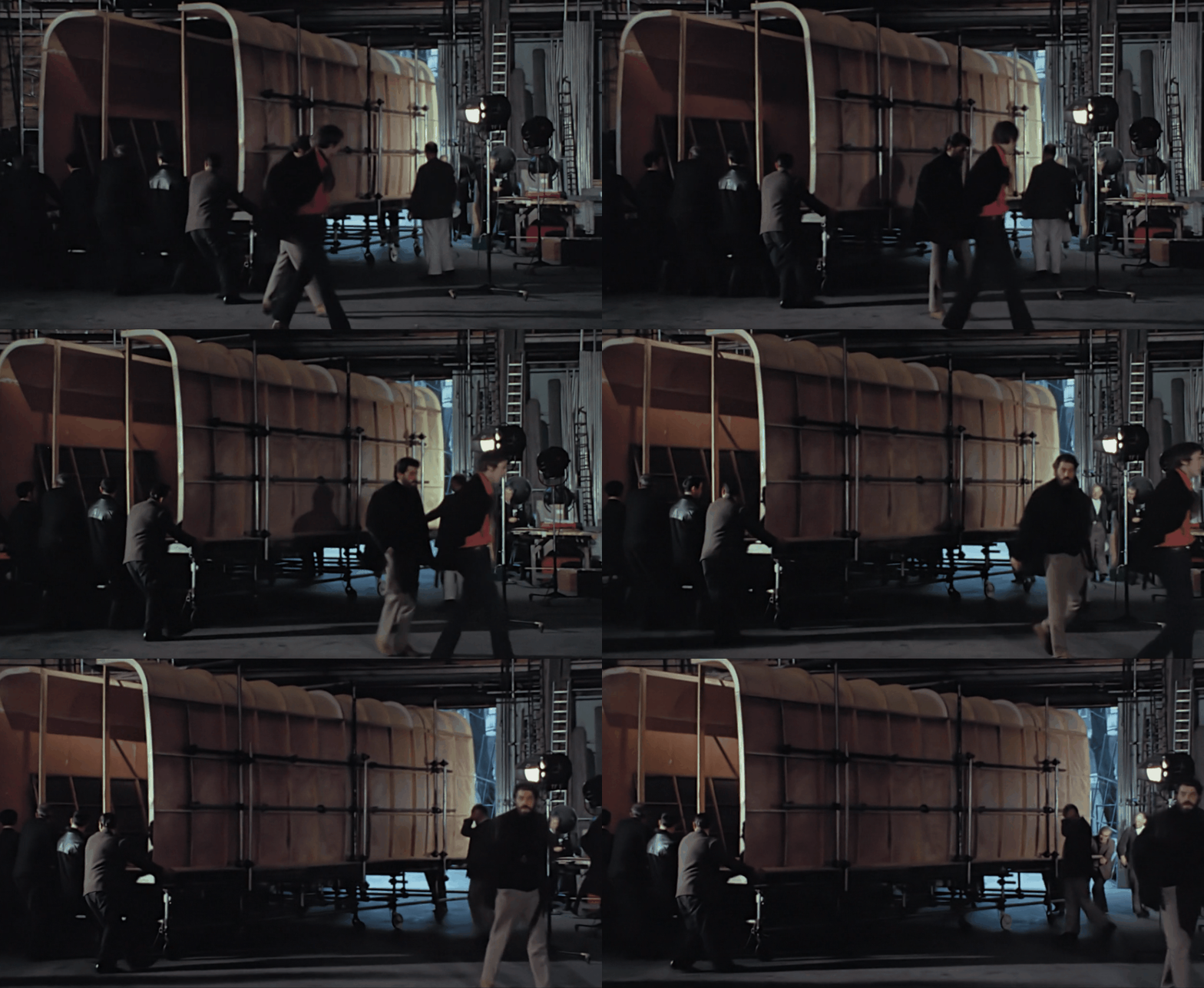
The train sets for The Magic Christian are loaded into Twickenham, as shows in Get Back.
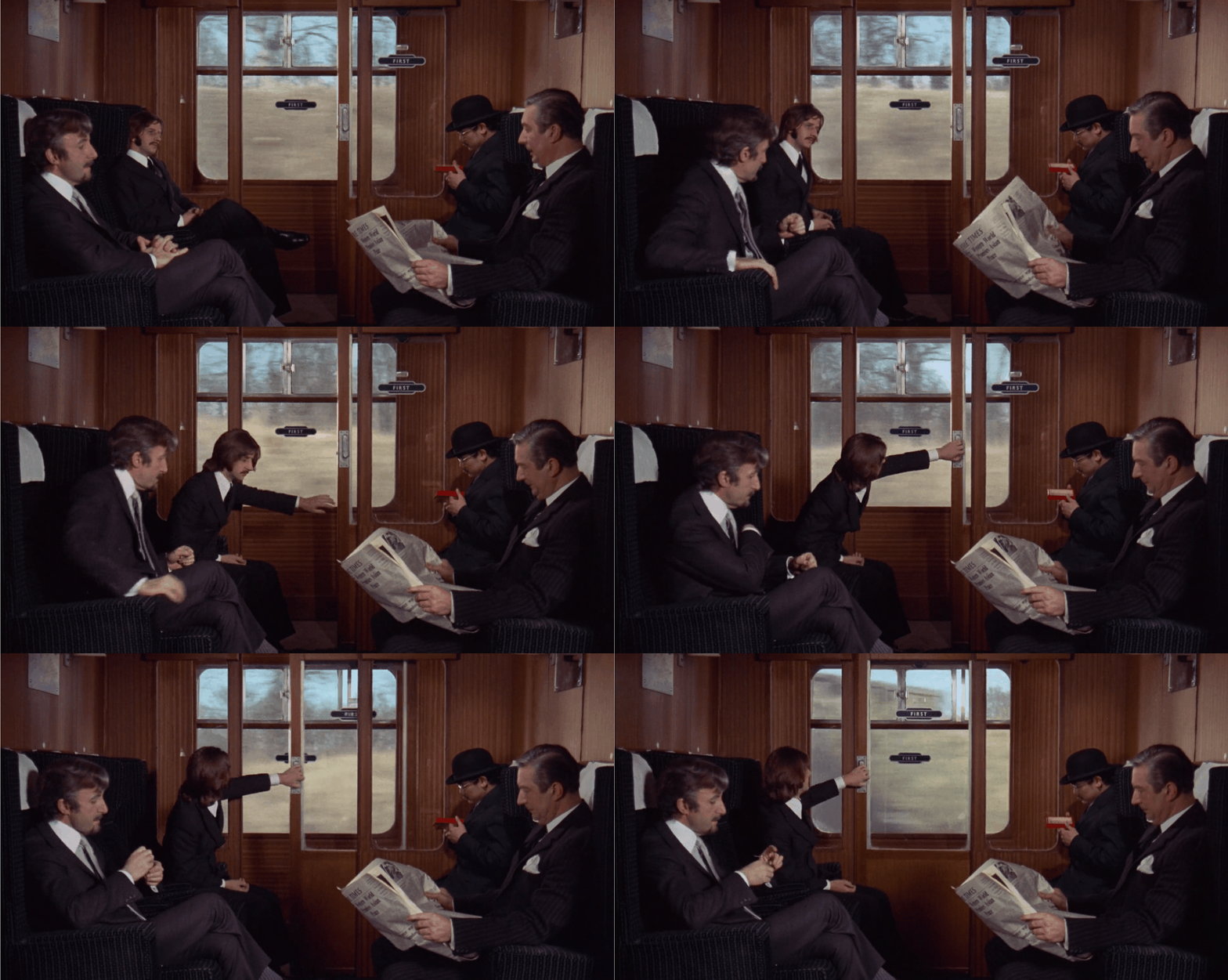
The Twickenham train, as seen with Peter Sellers, Ringo Starr, et al., in The Magic Christian.

“Hey, we’re getting a train in!” Michael said excitedly. We weren’t left any timetables, but we can be clever and even call that train the one after 9:09 if we wanted to get in the spirit of things and tie things together.

It was a full-circle moment: Less than five years earlier the Beatles filmed the opening performance of A Hard Day’s Night – the sequence for “I Should Have Known Better” as performed on a train – on this same Twickenham soundstage, a point that couldn’t have been lost on Paul and Ringo.

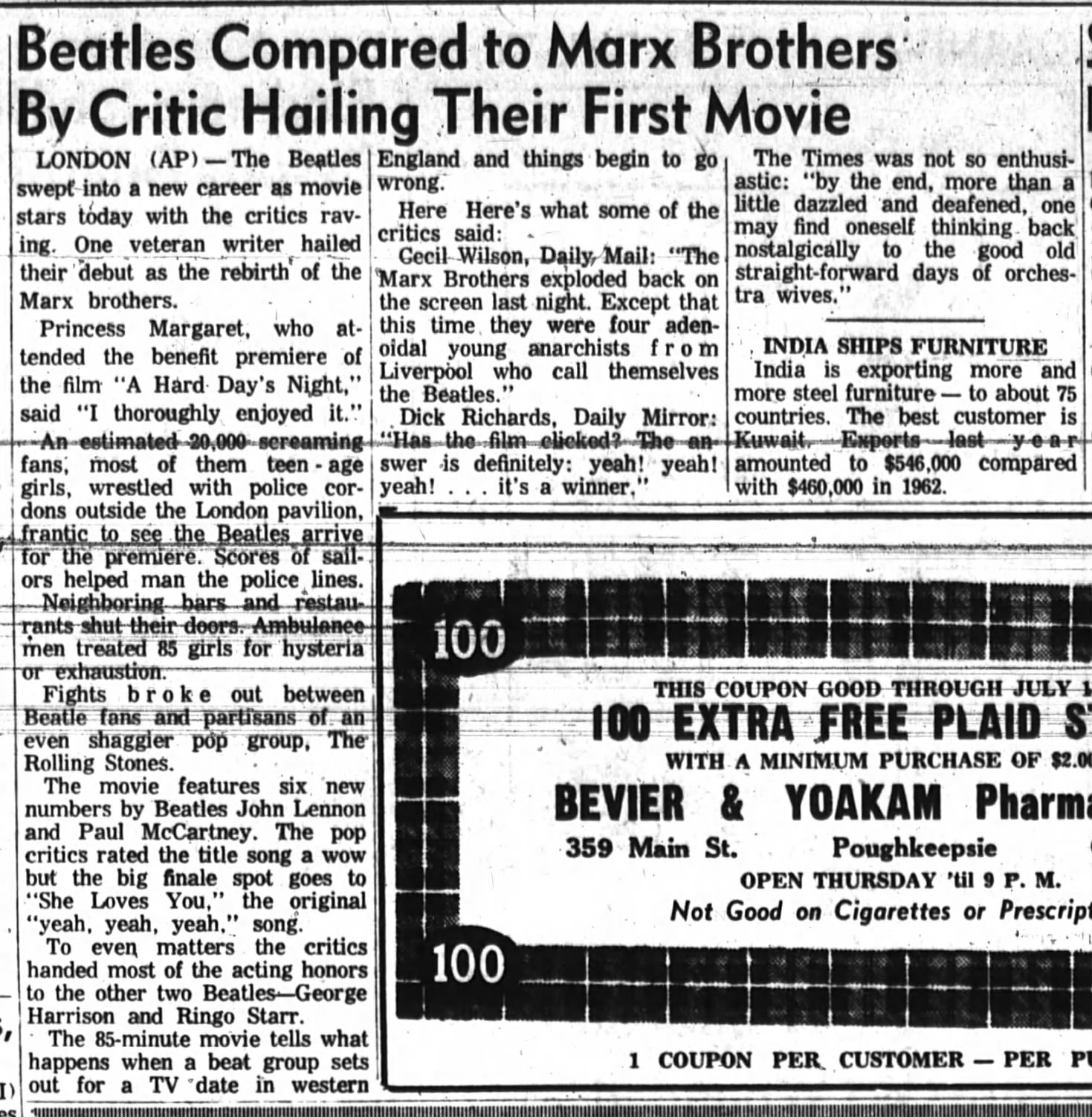
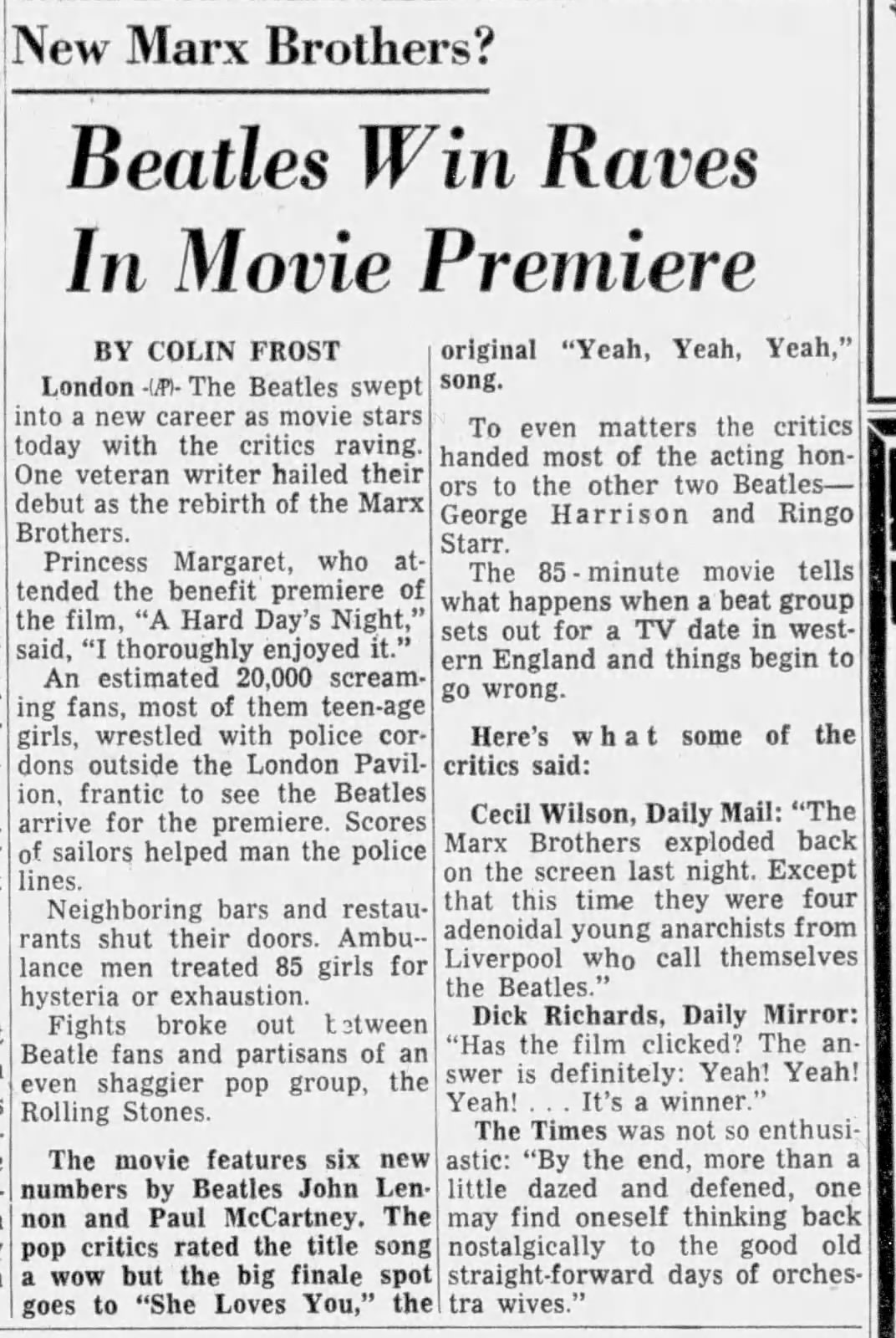
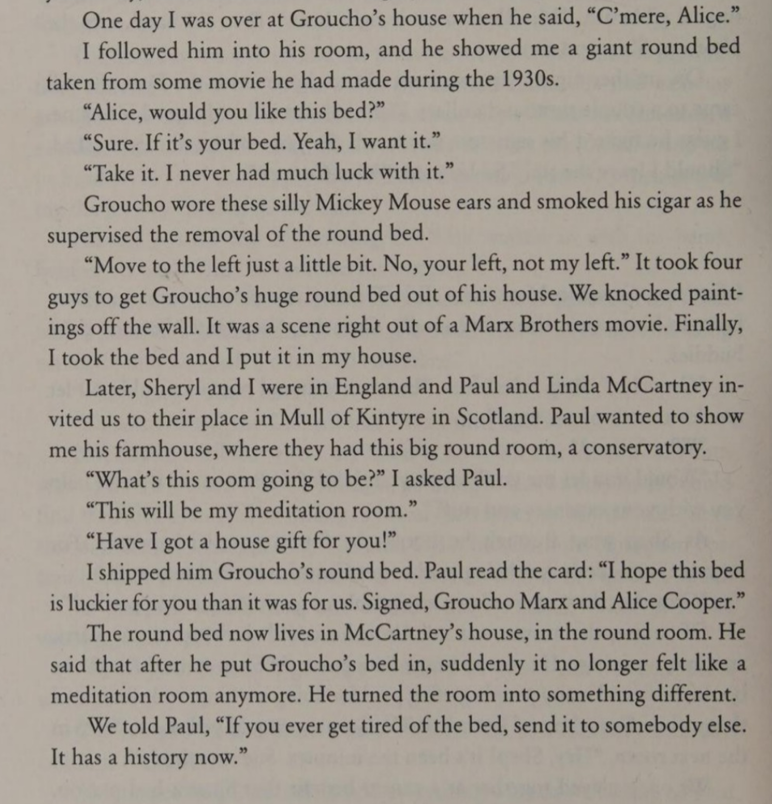
More full-circleness: A Hard Day’s Night led the Beatles to draw no shortage of comparisons to the Marx Brothers. And it just so happened Paul – who to this day owns Groucho’s old bed, by the way (check this excerpt from Alice Cooper’s autobiography) — had a Marx Brothers script in his hands. You can see it in Get Back: He’s reading from a couple of thick, comb-bound, soft-covered books.
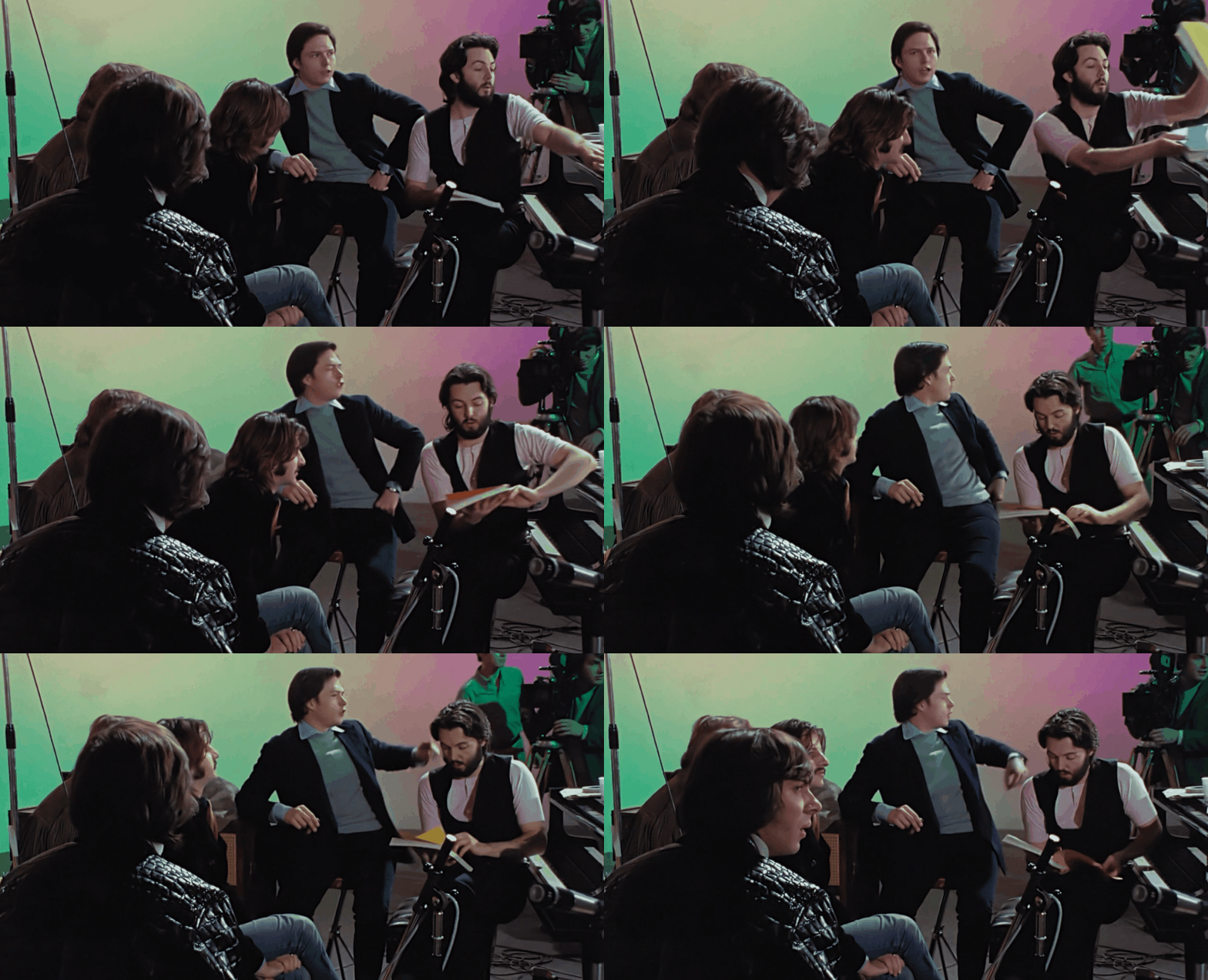
“[We can do a] remake,” Paul suggested as he read from the “A Night at the Opera” script. (Ringo conflated this film with “At The Circus,” referring to “A Night at the Circus.”)

As read by Paul:

Groucho: I’m glad you told me.

Maids: (in high voice) We’ve come to make up your room sir.

Chico: Are those my hard-boiled eggs?

Groucho: I can’t tell till …they get them out of me

Fun fact: A Night at the Opera, filmed in 1935, employed backwards masking a generation before the Beatles popularized it on record. Just another little Marx Brothers-Beatles link to share with your friends.

Ringo, still considering “At The Circus,” broke into harmony with someone who sounded like Mal on that film’s “Two Blind Loves.”

“We’re going to make a train movie,” Michael said. “Why don’t we do ‘A Night on a Train’?

“We’ve got a spare few thousand feet [of film], we don’t tell [Let it Be and The Magic Christian producer Denis O’Dell] we’re doing it.”

Remembering one of their missing members, Paul suggested the film crew capture John and Yoko being interviewed by the CBC.
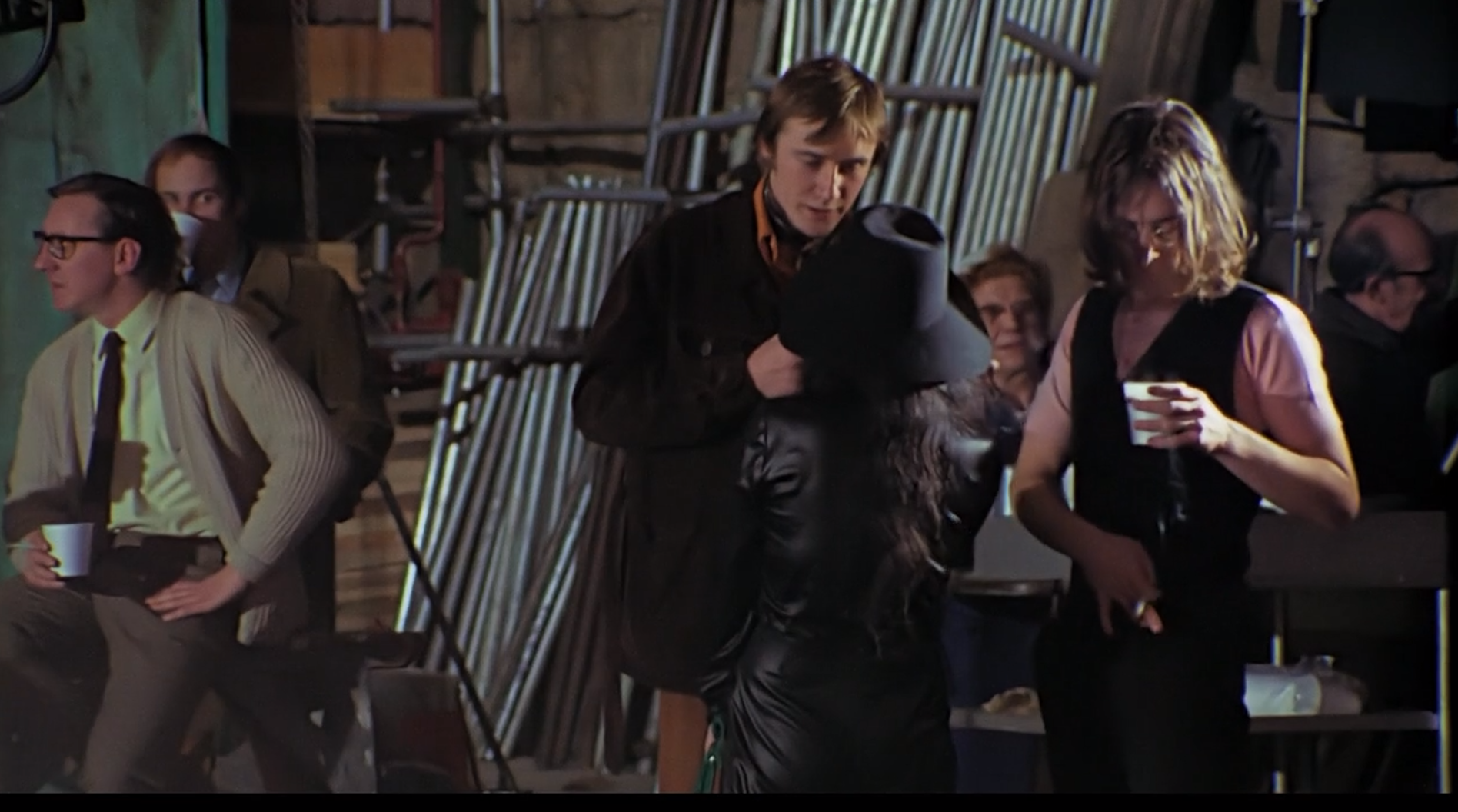
John, Yoko and CBC’s Hugh Curry on set on January 14, 1969.

“But John and Yoko should be shooting Ringo and I,” Paul said. “And we should be taking Instamatic shots of the crew [laughing].” Drifting back into fiction, Paul adds: “And the crew is reading Playboy.”

Earlier Paul pitched a remake, then Ringo suggested a throwback. “Let’s make a silent movie. Slow ‘til its speeded up when we play it back, ’cause they’re always funny to watch.”

For pretty much the first time in this sequence, someone came up with a reasonable idea, and it’s the director of the only film that actually was on the other end of the camera.

“What we could do to save a little money is,” Michael pitched, “figure [we] take one of these songs we’re recording, make it a single and do the promo film for the single here.”

Paul only chuckled a “yeah, right” in reply – while the idea was justifiable, George wasn’t there, and there weren’t many songs in decent enough shape to fully record.

But if they were going to make a “train movie” then maybe Michael was thinking of their completed train song: “One After 909.” He had worse ideas (and I say that as an MLH advocate).

Whether it was for a song promo or fake film, Michael set his sights on the star backdrop in a moment we catch in Get Back.

“Hey, should we shoot the train coming in? Chug, chug.”

Tony shut him down to widespread disapproval, repeatedly rejecting any filming of the set intended for The Magic Christian. “It’s copyright,” he said.

“It’s a documentary. … It’s a good shot for the part of the atmosphere,” Michael said, incredulous. “Oh, c’mon Tony. Oh, fuck.”

Ringo and Paul likewise objected, the latter mocking Tony as Parisian New Wave filmmaker Jean-Luc Godard.

Godard was a bit of a dirty word in Beatle parts, especially around John, so pardon the Frenchman and this huge tangent that revolves around another Beatle movie that wasn’t made.

One obituary for Godard, who died in 2022, called the filmmaker “cinema’s north star” asserting “no one did more to make movies the art of youth.” He was deeply important, and this time and place was his as a filmmaker.

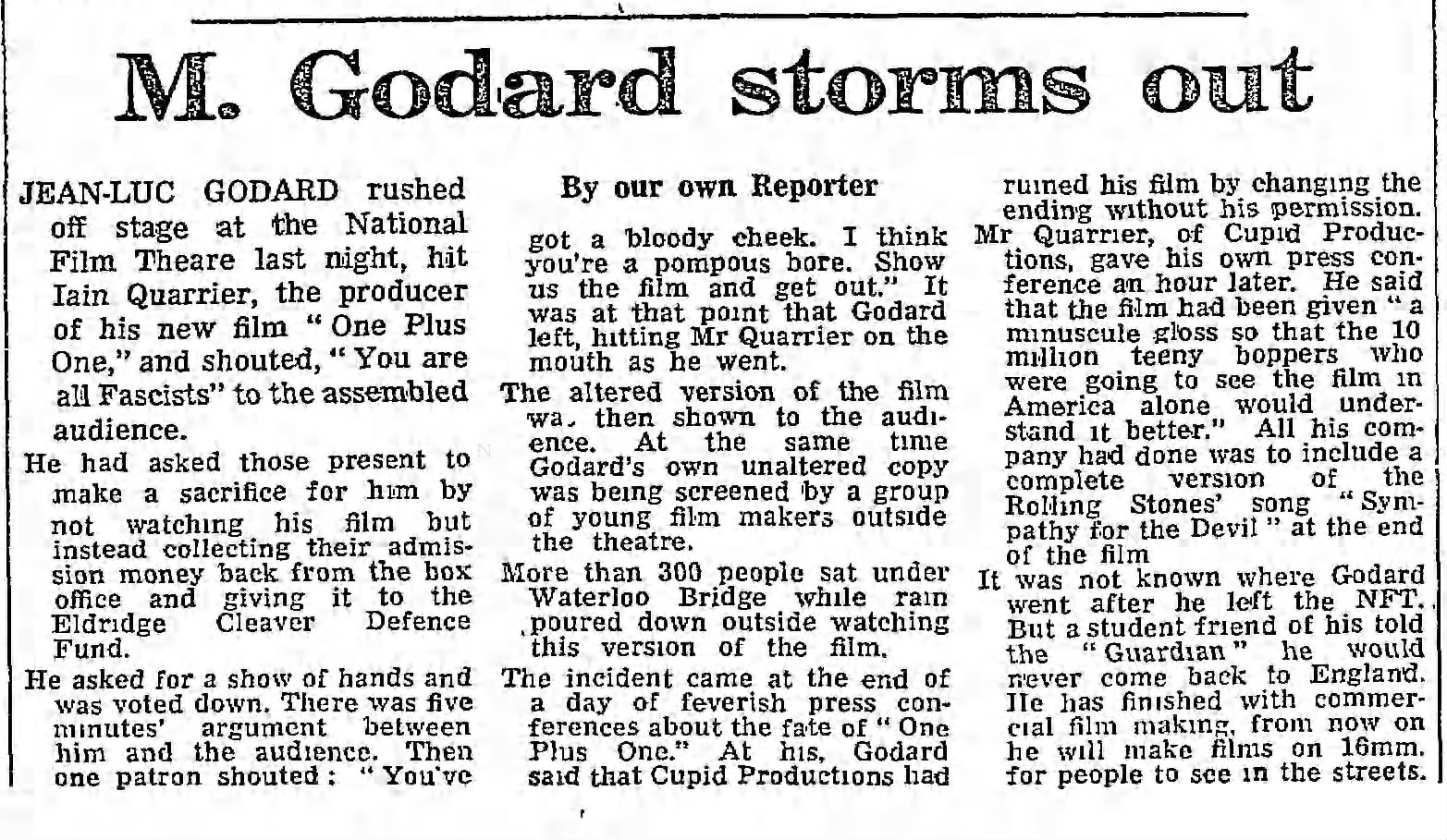
A memorable night at the end of November 1968 – certainly fresh in the mind of the gang at Twickenham, it was only weeks earlier — included Godard imploring the audience to not watch his new film (One Plus One, his production with the Rolling Stones), calling the viewers fascists when they did. Then he punched his producer.

But before he worked with the Stones, he set his sights even higher, on our Fabs. Anne Wiazemsky, Godard’s wife from 1967-1979 laid it all out in her 2015 memoir, Un an Après.

Via Google Translate, from the original French to English:

At the instigation of an English producer determined to make a film featuring Godard and the Beatles, I had accompanied him to London. He had even scribbled a rough outline of a plot in which a young woman unable to get an abortion (me) tried to commit suicide by throwing herself in front of a car. Alas, she kept running into a Beatle behind the wheel of a Rolls-Royce, and her attempt would fail. What would happen next? Jean-Luc didn’t know, but he was counting on the Beatles to provide further inspiration.

A meeting was arranged with John Lennon and Paul McCartney at their Abbey Road offices. The former was immediately hostile, unreceptive to any of the enterprising producer’s suggestions; he seemed miles away and intent on ending the meeting as quickly as possible. The latter, by contrast, was all charm and kindness, eager to make a film with Godard—whose cinema, he said, he “revered… all of it.” As the discussion dragged on, John Lennon stood up and left the room without a word or a backward glance. “Come back tomorrow,” the conciliatory Paul McCartney told us. “John isn’t having a good day. But I’ll speak to him, and I hope he’ll be more cooperative.”

Godard returned with an idea based on a script “The Assassination of Trotsky,” with Lennon playing Lenin’s co-revolutionary.

“John Lennon will play Trotsky! Undeniable, right?” … Jean-Luc, in high spirits, had immediately launched into a pitch to John Lennon about the Trotsky story. They would make a real revolutionary film together—the first of its kind. He was speaking at breakneck speed … [b]ut John Lennon soon interrupted them; his face twisted with rage and his voice pitched high, he launched into a torrent of words of his own.

John Lennon and Jean-Luc were soon shouting at each other. “I think it’s a bust,” Paul said, and seeing my disappointed look, added, “I’m sorry—it sounded really good, your husband’s project… Will you tell him?”

A September 1968 interview with Godard in the International Times blamed the Beatles for being “corrupted by money,” an accusation John refuted in the November 23, 1968, issue of Rolling Stone.

Now that’s sour grapes from a man who couldn’t get us to be in his film. … Dear Mr. Godard, just because we didn’t want to be in the film with you, it doesn’t mean to say that we aren’t doing any more than you.

Returning to Twickenham ’69, Michael eventually got his shot (even if we never saw it in Let It Be or Get Back). With his voice fading in the distance on the Nagras, we hear MLH saying he’ll be somewhere “just for a minute.”

“Shall we get some seats in the train and pretend we’re on a Tube or something?” Michael soon pitched another stab at a fake film.

In due time, Paul occasionally played some piano, but he continued to be a part of the conversation.

“Can we have it in a club? You know, the atmosphere is a club. … That’s it! We’re in a band [and] peddle drugs.”

They weren’t quite done talking movies, but another stage feature – utility chains – seized their attention. They may be at a soundstage, but to mother nature’s son, it was probably like climbing a rope or tree for Paul, a erstwhile Boy Scout.

(The Scouts weren’t a complete footnote in Paul’s childhood, even though it’s a parenthetical reference here. Paul missed his first gig as a member of the Quarrymen in August 1957 because he was away at Boy Scout camp.)

Ringo was the first to dare a climb even though he admitted he “was never very good on the ropes.”

Paul: That’s the trouble you get the panic about halfway up.

Ringo: You realize you can’t stand heights.

Paul: Seen The Good, the Bad and the Ugly?

Paul’s question drew a chorus of noes – the film hit theaters in London the previous August and was presently playing in Piccadilly Circus, a mere six-minute walk from 3 Savile Row. They could have gotten some steps in and killed their time seeing real movies instead of making them up.

Good thing no one else had seen it, though — it would have been an intimidating moment, revisiting the scene he was probably recalling.
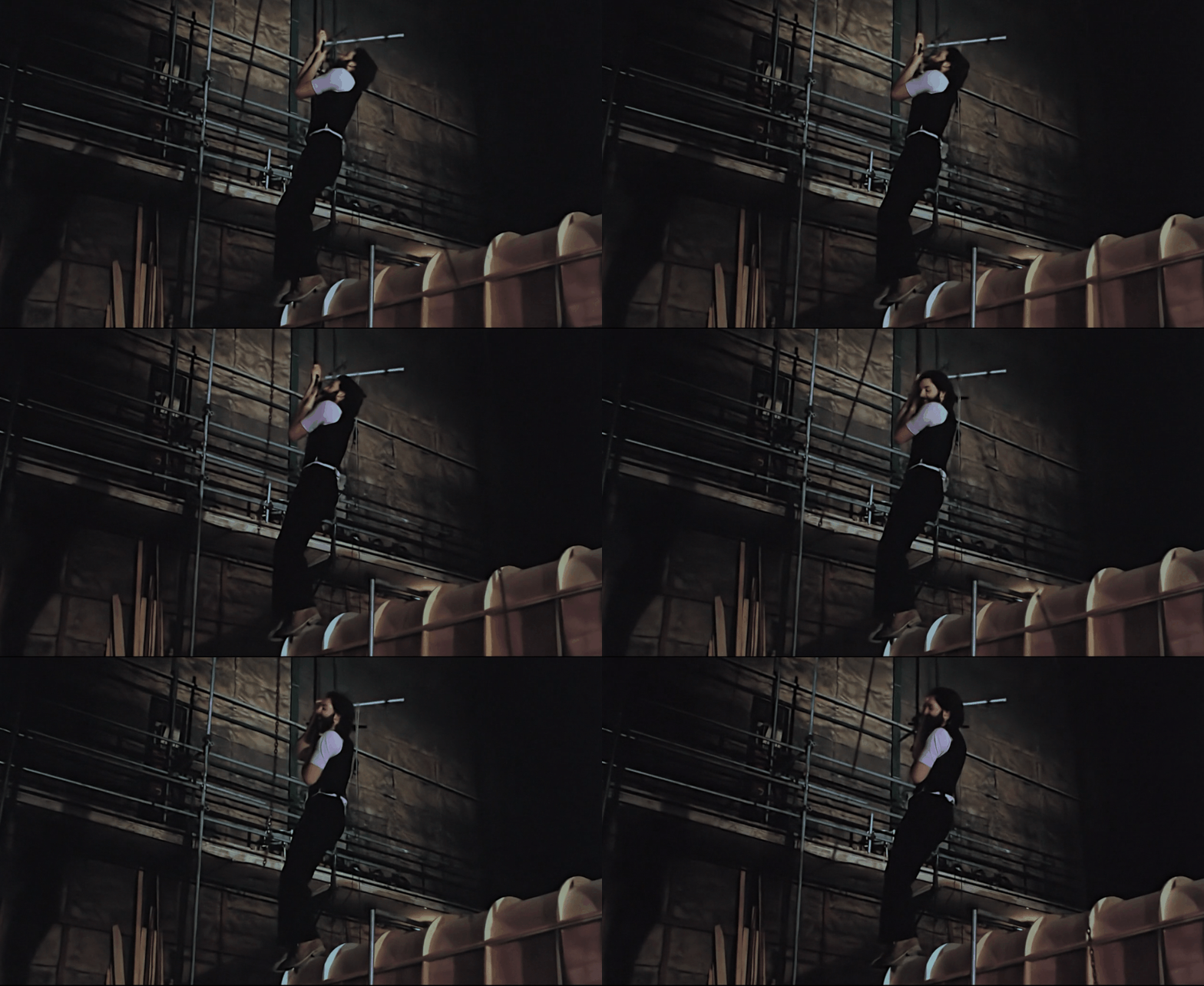
In a segment we get to see in Get Back, Ringo playfully calls an end to the day’s filming with Paul stuck high on the chains.

“It’s a wrap!” Ringo said to the camera. “There’s no business like show business!”

Ringo, Paul and Mal all gave it a go, they just can’t get away from these chains. And by the time they were done, the group inched closer to reforming.

“OK, John, rise up the chains to the top,” Paul said to his songwriting partner a few minutes later, after John was reunited with the others after his lengthy TV interview.

“I know you could do this, lad. My money’s on him.”

The tapes reveal nervous laughter from Yoko before a commotion and thud from what we could assume was a minor tumble that gave way to huge laughs from the others on set.

“It’s all right,” John said in an exaggerated pained voice. “Don’t worry about a thing, Yoko.”

Still, she sounded genuinely concerned at John’s physical activity.

“He’s not that young anymore,” she said.

“No, I’m not 18 anymore,” said John, who was, in fact, 28. “I couldn’t do it at bloody 12.”

So what’s John to do instead?

“I thought we might make a film this afternoon,” Paul told him.

John was caught a little off-guard, replying, “Well, what? OK. What should we do?”

Paul: A comedy.

MLH: You rejected the guys in the Tube train and the guy whose pimp is the conductor.

Paul: We rejected it.

A lot of rejections. A lot of ideas. A lot of roles. But amateur hour was over, with multiple BAFTA and Oscar nominee and Beatle friend and muse Peter Sellers — the star of The Magic Christian, soon to be filming on this stage — arriving at Twickenham for an impromptu meet and greet.
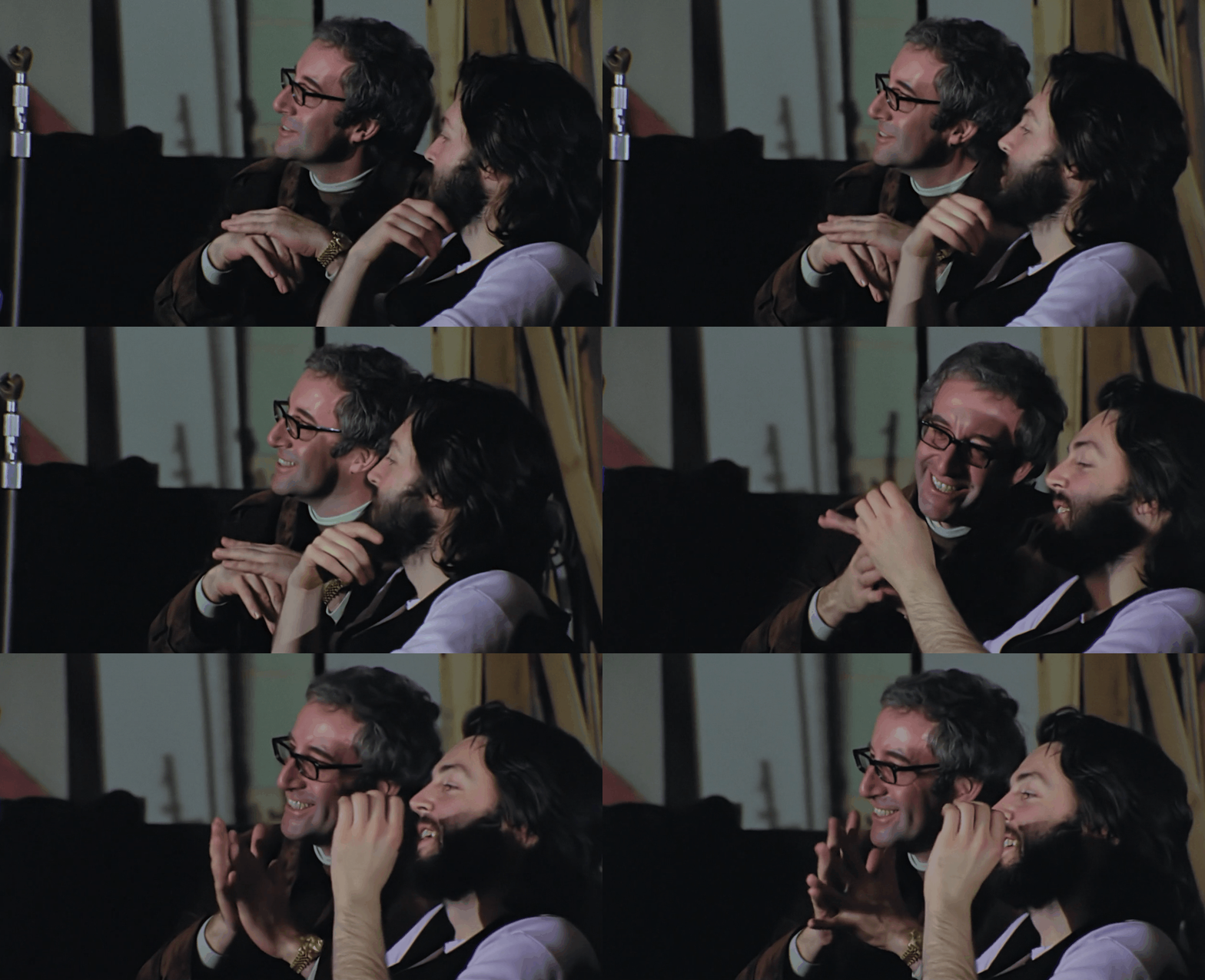
Paul makes his pitch to Peter

With the Beatles’ film at a standstill, Paul figured he may as well have some fun with one of his many movie ideas and aim high to land a star lead.

“We’re casting this afternoon,” Paul told Peter.
Leave a comment

Filed under Day by day

TMBP Extra: A conversation with Steve Matteo

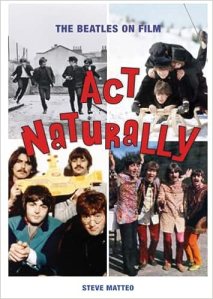
I recently had the pleasure of chatting with author Steve Matteo, who not only is a fellow New Yorker, but even better, also shares the unique experience of writing at length about the Let It Be/Get Back sessions. You may have already read his 33 1/3 on “Let It Be,” and now his latest book — Act Naturally: The Beatles on Film — takes on the entirety of the group’s core movies in heightened detail with expansive context enveloping the period.  If 33 1/3 was an LP, this book is a deluxe box set. 

We spoke for almost 90 minutes, which was a great experience in real time — I suggest talking about the Beatles with people for hours, it’s always a wonderfully rewarding experience — but delivering a full transcript would cause severe eye strain. And I’m not going to start podcasting, despite my standout overnight freeform college radio stint almost 30 years ago. 

So I did a little bit of both, transcribing the best bits of the conversation and then dropping extended soundbites when you want to hear a little more. 

A caveat as you dig in with the hope you dig it: I’m neither a broadcaster nor professional podcaster (although I’ve appeared on several as a guest!).  I recorded the audio by putting poor Steve on speakerphone and then taping the interview from a mic on a computer. I cough some. Dogs mournfully bark for treats in the distance. The conversation wasn’t originally meant to be heard, but I ultimately believed smaller soundbites would be an effective way to present further parts of the interview, even if it wasn’t properly produced.  

One other minor note: We talked a little about the potential of a future “Let It Be” reissue. This conversation was held a few weeks before we starting hearing rumors of a late 2023/early 2024 re-release of the film. 

The Beatles, literally, at the movies

They May Be Parted: Why did films appeal to the Beatles? Was it just general desire for fame and exposure? There was nothing their earlier biographies to suggest otherwise. They were performers but not necessarily people who dreamt of acting. Was it just a product of the time and their own love of films that drew them in?

Steve Matteo: One, let’s make some money. They’re still young kids who grew up in Liverpool and had nothing. I think it was part of just the way it was done. When you became popular and you became big in the pop music world, like Elvis and Cliff Richard, you made a movie.

And I also think that they just loved movies, especially American movies. I think that movies had always been an escape for people who are middle class or lower-middle class, where you can go, there was a time you can literally spend your 10 cents and go into these big, beautiful movie palaces and escape into this other world. And if you’re young kids in Liverpool that lived in this place that in this country was literally bombed during World War II and you’re lucky to be alive and you have no money and you have really nothing, to go into these beautiful movie theaters and see these incredible American, mostly American films of cowboys and Indians.

And, you know, Ringo loved Westerns. So it’s like a fantasy. Like you’re this kid watching these movies. You never thought you would become a movie star. You never thought you would be in a movie. That’s why the title of the book comes from that particular song (“Act Naturally”). It works so perfectly.

So there’s all of these reasons. I think once they did “A Hard Day’s Night” though, I think they kind of felt like once the train of “Help!” had started up, they were sort of like, “Oh, now we’re going to do this again.”

You know how they were, they didn’t want to repeat themselves. I think after “Help!” they were sort of like, “Well, we’re not going to make movies like that anymore.”

Listen for more 

“Paul saw the potential for creativity and it was like, ‘Well, let’s try this. We’re the Beatles. We can do anything.’”

TMBP: Your book spends a great deal of space on films that predated and were contemporaries of the Beatles’ movies. How intimate were you with these films previously? Did you think, “I know the context around the Beatles films, so I want to include that?” Or, “I’m writing about the Beatles films so I need to learn this context?”

SM: I think I knew a lot about the Beatles films, but there’s always more to discover. I’ve always really loved the British films of the ’60s. I’m a big fan of spy movies, and it’s a very rich period. There was a lot that I knew, but then obviously once you start doing research, there’s so much more that you learn about. So I just felt like I didn’t want to write a book that was, “OK, the Beatles made ‘A Hard Day’s Night.’ Oh, OK, and then they did ‘Help!'” And I wanted there to be context. I wanted there to be connective tissue.

It’s like the Beatles sort of influenced everything in that period, but they were also influenced by what was going on. So it is a film book. And when you write a book on the Beatles, you want to figure out a way to have it be somewhat different because there’s so many of them. So I felt like all of this context would kind of be a way to do that. And I think it became more than I thought it was going to be.

And there’s obviously, there’s musical context too. I give a lot of what’s going on, the British Invasion, the British music that came later, the psychedelic music. And I included the San Francisco sound and the psychedelic culture and all that was going on with mod fashions and photography. And it’s like a sort of cultural history of the ’60s where the sort of jumping-off point is the Beatles films. But then I give you all this other stuff.


“I hope that really hardcore Beatle people will appreciate the book … but I didn’t want to just write a book for the fans, or a book that was just for people who are only into the hardcore.”

TMBP: With hindsight we get it, but what did United Artists see in these guys to sign them for three films in 1963? You wrote it was for a quickie B-movie kind of thing, but the group had just a couple hit songs in the UK and no American footprint at all at the time. And UA took this incredible leap of faith.

SM: I think what they really were signing on for first was the soundtrack album. Capitol had this horrible contract where they did not have the rights to a soundtrack. And so United Artists, who had a really strong soundtrack component to their media company knew Capitol doesn’t have the U.S. rights to a soundtrack. “We got to sign these guys up. They’re selling records, and we’ll make money just on the soundtrack. And if we break even on the movie, it’s fine. It’s a cheap, old movie. It’s not going to cost us a lot of money.”


“They were one of the first United States artistic media companies that were formed by the creative people. … United Artists is really important to this story”

TMBP: There’s no question to the Beatles’ brilliance, but — whether it’s the serious Beatles fan, a Beatles scholar, music writers – do we almost give the band too much credit for inventing things out of whole cloth, instead of crediting them for synthesizing and improving upon their influences and contemporaries?

SM: That’s why I wrote it the way I did, because I wanted people to realize, for example, how important Richard Lester is. How important the other people who worked on the films — the cinematographers, the camera people, the writers, all of these folks.


“You do it because you love the Beatles, and there’s a lot of love that’s going on here. I try to be a journalist, though, too, and I want to be objective.”

TMBP: Researching the Beatles is a minefield, going through 10 years worth of the band’s history that’s more than 60 years removed.

SM: And that’s why I like to use books as a source of more than newspaper articles, because newspaper articles, it’s where they say journalism is the first draft of history. The newspaper articles often get it wrong because they’re rushing to hit a deadline. And it’s written by people who don’t know pop music. And it’s, “Oh, this is going to happen.” When you read about “Let It Be,” and you read about what was being said in Beatles Monthly or those things, they’re just talking about what it’s going to be. And as you know, this is your area, it constantly changed what it was going to be and what it eventually became.

That section in particular, I felt like whatever was sort of contemporary material is it’s just filled with conjecture on what the Beatles thought it was going to be. And you know, Derek Taylor’s saying whatever. And it’s not anybody lying. It’s just, well, on January 4th, it’s going to be X. By January 10th, it’s going to be something different. So books, I like to use more as a source because they’re after the fact. Here it is. This is what happened. It’s written down here, you know.

And I try to like, you know, and I go, as you know, I go deep into explaining my sourcing. I felt it was important to do. It is a minefield. And I really worry. And then the thing that drives you the most crazy is you read sources that are supposed to be the definitive, authorized, correct sources. And those people get it wrong. Humans make mistakes, and facts that are not facts get picked up over and over again where they become gospel.

There was one fact alone, when John and Yoko met with Klein, I could not get, we’re literally talking about not even 24 hours. I could not nail that down. I contacted Chip Madinger. He was great. He’s like, “Here you go, Steve.”

People are going to just read that one sentence in a 350-page book. I must’ve spent three days on that. Just that one sentence, literally. But it has to be right. I mean, if we’re writing history, we’re writing history, we’re not writing an opinion piece. And I’m a journalist. I’m not a music critic. I’m not writing Revolution In the Head.


TMBP
:
The Get Back sessions are always justifiably referred to as having no set plan. They’re making up everything as they go along. In reading your book, it seemed like there was a lot of making things up as they go along in “Magical Mystery Tour,” in “Yellow Submarine.” They were written on the fly, too. It almost seems like this is just the way they like to work.

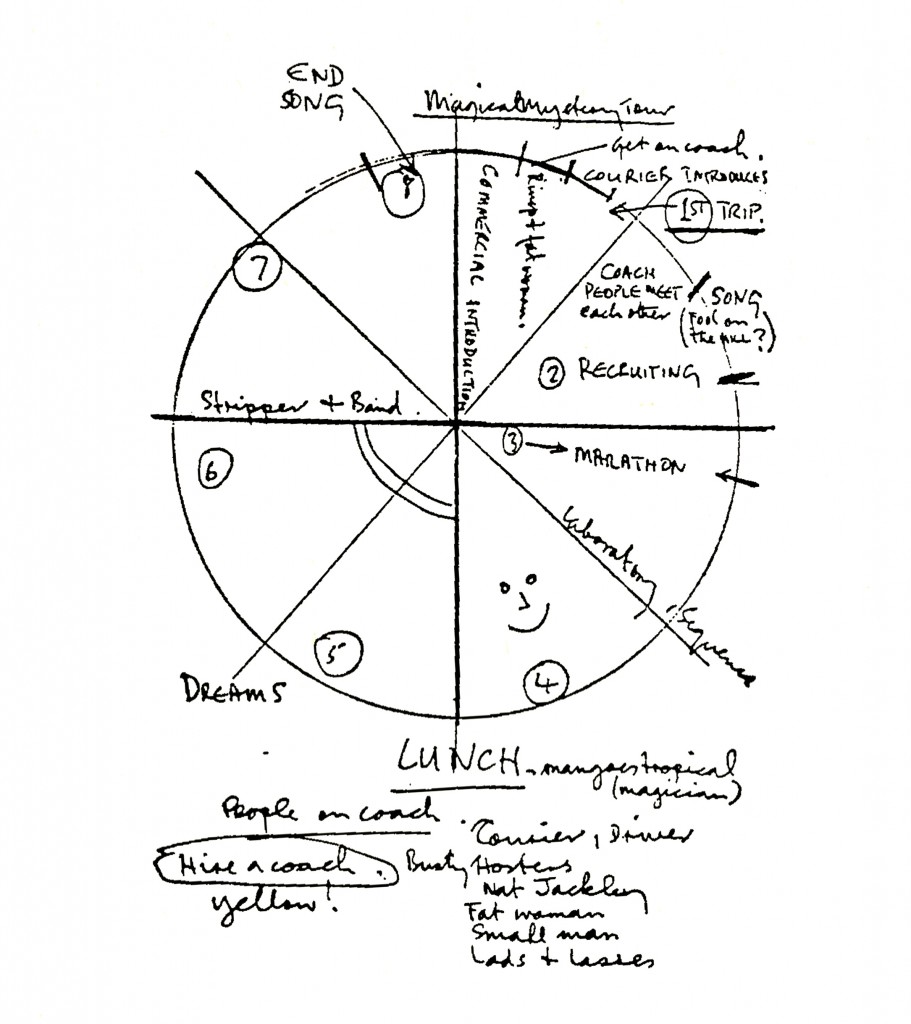
Honey pie (chart): Paul’s “Magical Mystery Tour” breakdown

SM: With “Magical Mystery Tour” they had a blueprint. They had like an outline, as you know, the pie chart that Paul came up with. And then with “Let It Be,” it’s reality TV. It’s just like, “So we’re going to set up here, you guys turn the cameras on.” I mean, that’s really what it was. So that’s a documentary.

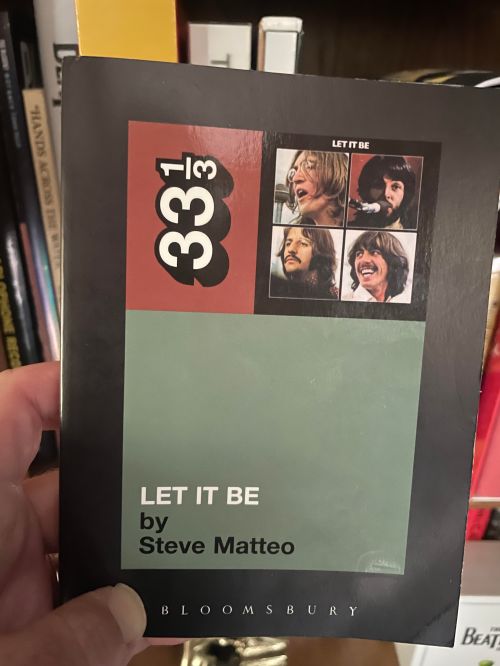
I don’t know if you’ve read my “Let It Be” book.


TMBP
:
I literally have it in my hand because I have a follow-up question about it.

SM: What I did was when I wrote that, I said, “OK, ‘Let It Be,’ it was a documentary.” So I think that’s my approach. I like the journalistic approach because first of all, I don’t think anybody cares about my opinion. And I would rather present the facts and let people come to their own conclusions. There are some people that they don’t like that. They find it a little dry. They feel like it’s just that you’re stringing a lot of facts together. I try to create a certain amount of, I have my opinions here and there, and I make observations. And obviously there’s, particularly with this [new] book, there’s a ton of context. So I just think that that’s what it is. It’s a documentary. I mean, you’re not going to script a documentary. You know what I mean?

So, of course, they would rather work sort of extemporaneously. I mean, that’s what they did when they wrote songs. That’s what they did in the studio. They would say, “Let’s try this. Let’s try that. Oh, let’s go down that road.”

One of the reasons why the music is so great is because they didn’t sit around thinking too much like, “But they’re not going to play that on the radio.” And, “Well, we’re only going to sell a million copies if we do it that way instead of 5 million.”

They were these geniuses. You had these great songwriters and that’s kind of where it starts. You’ve got these songs and you’ve got this great supporting cast in the studio. You’ve got George Martin and these great engineers. And yeah, there was limitations with Abbey Road Studios. We all know that, but there was also the amazing studio with the real echo chambers, real, not digital delay. And it just kind of all comes together, if you’ll excuse the joke.


TMBP
:
They were also — and this includes George Martin — great editors, and they knew they knew what should stay and what should go. And whether during the songwriting process or whether in the actual recording of the song, knowing just what was too muchwhat they didn’t need. And it seems, again, in reading your book, that they were good at that with their films — whether it was in “A Hard Day’s Night” and “Help!” or “Magical Mystery Tour” — knowing what to cut, knowing what they need to rework, knowing what they need to shorten. And it wasn’t always just, “We’ll give you everything.”

SM: Right. I think that “A Hard Day’s Night” and “Help!”, that was a lot in terms of Richard Lester and whoever was editing which particular film. You know, “Magical Mystery Tour,” they had a lot of help with that too, in terms of editing it down and creating something that was close to being cohesive. “Let It Be” is this thing of just hours and hours and hours because of the nature of it, because it was a documentary.

I mean, keep in mind, they obviously have all of this control over their music as time went on. But with the films, it is very much collaborative and various decisions in the way things end up is very much the filmmakers’ and not the Beatles. “Magical Mystery Tour,” they had almost total control over.


TMBP
:
So I was saying, I have your 33 1/3 on “Let It Be” in my hand. On the last page (this is a spoiler alert for anyone who has not read it yet)  you write — and this is right after they found the stolen tapes – “Whether the recovery of the stolen Nagra tapes will impact the fate of the new DVD remains to be seen.” When you wrote that 20 years ago, what did you expect would happen?

I meant it when I said I had Steve Matteo’s 33 1/3 on Let It Be in my hand. Please visit the Contact Me page if you’re looking for an inexperienced hand model.

SM: When I interviewed Michael Lindsay-Hogg, he told me that he was interviewed for extras for a DVD release. And there were other people that I talked to who said the same thing. Now, of course, it never came out. The whys, we don’t know. There’s always been this speculation that the Beatles didn’t like “Let It Be,” particularly George. And that was a lot of the reason why it kind of sat on the shelf.

This is after George passed away [in November 2001]. I’m working on the book mostly in 2003. So that must have been the impetus, in some ways, to say, “Now’s the time to get this thing off the ground. George was never really a fan.”

I don’t mean this in a negative way. They weren’t being like, “OK, George is gone. Let’s put this out.” I don’t mean that. That’s not where I’m going with this. I think that I think it’s just the opposite. I think they respected, they all had an equal share, and he really wasn’t a fan of putting it out. 

So now that George had left us, I think that was one of the projects they felt like, “We don’t like it, [but] people want to see it. So let’s get it out there.” But it never happened. And whatever the reason, I don’t think anybody really knows that.  If somebody knows it now, tell them to e-mail me and let me know. Was there something? Because they put all this work into it. And if you remember, also, when they announced “Get Back,” they announced “Let It Be” would be re-released.


TMBP
:
It was the last line in the press release announcing “Get Back.”

SM: Right. And so here we are, once again. It’s, as Yogi Berra said, déjà vu all over again. Every time they do this, people start calling me and they want to interview me. And I say this, the story of “Let It Be,” “Get Back” — whatever you want to call it — it is not over, it will not die, it will not go away.

And that was one of the reasons why I did the 33 1/3 book. Because I felt like of all their albums, that was the one that the life of it was not finished. It wasn’t something that was done. I mean, look at it. As much as they hated it, we’ve had Let It Be … Naked, we’ve had “Get Back,” and we’ve had the Let It Be box. And whatever’s on the Anthology albums, the CDs, and it’s still not over.

You have to remember, too, that Peter Jackson said that he’s going to work on another project with Paul and Ringo. And whether that is the “Now and Then” thing or whether it’s hopefully more like the Star Club-type stuff. I think it’s more than just using that technology to get better recordings out of some of this to put out. But I don’t know, I have no inside information.


TMBP
:
What were your experiences listening to the Nagra tapes? Because there aren’t that many of us who have put in the effort to hear it all. For me was very eye-opening to get this full breadth of who they were. You got little bits of it in all the bootlegs that came out from 1969 on, but then to finally get the full extent of it — what was that like for you?

SM: I was never a big bootleg guy. I know there was almost an industry of Let It Be/Get Back bootlegs, but it always intrigued me and it was interesting. And then when I started working on the 33 1/3 book, obviously I started really digging deep into this stuff, and it is fascinating. You do kind of get into it and the history of it, the photography, the pictures. I love the way that — and I talk about this in the new book — these bootleggers would come up with these crazy names for these things, like “Jamming with Heather.” I named the last section of the book after “Posters, Incense and Strobe Candles,” the BCN bootleg. I love that stuff.

I mean, I know some people think this stuff should all remain dead and buried. Some people want to hear every note. Steely Dan, they’ve never wanted to release all of the outtakes and all of that stuff. They have this aversion to it. I think they’ve released one unreleased song in their entire history. They just don’t want this, they are such perfectionists. They don’t want people to see Picasso’s sketches.


TMBP
:
At some point in the 1970s or early ‘80s, didn’t George Martin say there’s nothing in the vaults anyone would want to hear? But that wasn’t true. And then you have someone like Bob Dylan, who in his lifetime makes the decision to put everything out there. And I think that’s what the fan wants to hear.

SM: Neil Young is doing that too.


TMBP
:
And I want to hear everything. But I guess that’s me. And again, I don’t know how many people would sit through 80 or 85 hours of Nagra tapes or whatever the band’s leftovers are.

SM: They could make it available digitally or something. I think that Capitol, Universal, Apple — I think they’ve gotten better at it. I think that the Anthologies were the kind of first step towards doing this stuff right. Whatever problems they’re all with it, and everybody’s got their opinion. And then I think the next kind of leap was once they started with the Sgt. Pepper 50th anniversary, I think they’re getting this stuff right. And I think the reason why is because I think they’re trying to be more open to listen to what the people who really know have to say, not just relying on whoever the person is at the particular label at the particular time who’s in charge of catalog development.


“It all ended in 1970. I think they’re going to reach a point where they’re going to run out of stuff. But I think there’s still stuff left to be put out.”

TMBP: What was your reaction to the “Get Back” series, to hear the tapes cleaned up and see those visuals? There are moments in “Get Back” not quite portrayed the way it really happened, some scenes not edited sincerely – there are some gray areas. How did you view how “Get Back” was presented overall?

SM: What you’re saying in terms of your knowledge of it, where you know, they played with that, they enhanced it, or it’s a little out of sequence, which is troubling. But I think that’s just what filmmakers do.


TMBP
:
It’s a good story. Peter Jackson made a great story.

SM: Right. And I don’t think they’re necessarily trying to mislead anybody. I just think there’s a sense of it doesn’t make sense, even though it’s correct.

Because you know, “No, that’s wrong. That’s enhanced. They overdubbed something there.” But maybe they didn’t, maybe it’s just this new technology. They were able to fix it. Maybe it wasn’t right before because you couldn’t hear it right. And now it is right because you can hear it now because of the new technology. I mean, that’s a discussion to have.


TMBP
:
For sure. I’ve thought everything that Peter Jackson did was certainly from a good place. Maybe I’m speaking like this is the world of sports, but “Get Back” invigorated the fan base, so to speak, and then brought in so many new, younger fans. I’m on social media and shocked in the best way at how many teenagers, 20-somethings are knowledgeable and fully invested in the Beatles. I think these were the right choices at the right time, the right phase of the Beatles to blow this out.

SM: Yeah. I think that it was — these guys are so cool and not just the four of them, but all the people that surround them. Glyn Johns wins the “Get Back” Fashion Award. I don’t think there’s any question about it. I think that they, the world, the media world is so used to these long-form streaming shows, these bingeable kind of things. Rather than just watch some dopey show on network television or go to a movie, this is almost like a new format, for lack of a better word. And it was so smart to put it on the first time over Thanksgiving weekend, when everybody’s home for this long weekend, and everybody’s exhausted from eating too much turkey and drinking too much wine. We’re kind of in the middle of COVID. So it’s sort of like, “Well, what do you want to do tonight? Yeah, let’s watch ‘Get Back.’”

And the critics seem to really love it. It’s Peter Jackson, too. He’s like the biggest at that time. No one could touch him as a filmmaker. He’s like this old hippie, too. So I think he comes from, like you said, the right place. It wasn’t just, “This brilliant director guy, we’ll just have him do it.” Don’t forget the Beatles wanted to do Lord of the Rings. Well, here’s the guy that did Lord of the Rings. So how perfect is this? I mean, it really, once you heard that this was going to happen, it was like, ah, perfect.


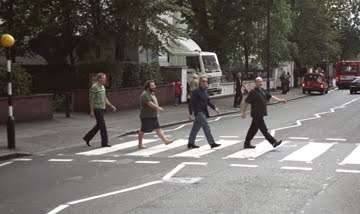
Peter Jackson and Co. cross the Road during the mixing of the Lord of the Rings soundtrack in the early 2000s.


TMBP
:
Exactly.  There was, there were a lot of ways they could have gone. And it couldn’t have gone better.

SM: I could have written a book just on that. I’m in the 11th hour on my [new] book, and at that point that I was able to say — and we were cutting a bit from that section — I could have went on and on and on. I could go back and really do the “Let It Be” book again as “Let It Be/Get Back.” That would make a great book. Someone’s going to do that. I know it. I wish it would be me, but I’m not going to go retread that area again. It doesn’t make any sense. It will not go away.

I think part of it is it’s the end of the Beatles. So no one wants it to end. It’s the one part of their period that no one wants to see. It’s metaphorically, on so many levels, you know what I mean? Culturally, musically, generationally. It’s just like, “Oh no, wait, the Beatles broke up. What do you mean?”


TMBP
: “
Get Back” came at a time with so many generations of people watching, so many more than had seen “Let It Be” first-hand. So you have people who experienced the breakup in real time and read Lennon Remembers when it came out. And it’s like, you know what? Maybe John didn’t really mean all those things. Look how happy he was in the moment. And then you have people who never dwelled on the breakup, didn’t live through it, watching these guys creating songs out of nothing. It kind of hit something for every kind of fan.

SM: It’s like a soap opera, too. It’s like “Downton Abbey” or something. It’s “Downton Abbey Road.” It’s like “Bridgerton.” I’m stretching here, obviously, but it’s all those hours. There was a time where people would be like, “What, how many hours is it? Forget it. It’s more than a half an hour. I’m not watching it.”

But we’re all so used to this now, with Netflix and Apple TV+ and Hulu. People don’t read anymore. They don’t read long novels, but they’ll watch the eight-hour limited series on Netflix. They’re hungry for that. They want to be told an enveloping story, but they don’t want to sit down and read Thomas Wolfe.


“You get to watch them, and they’re silly, and they’re hysterical, and they have no computers, and they have no cell phones.”

TMBP: They had no cell phones and they were busy reading newspapers. “Get Back” is a beautiful time capsule, and while in that sense it’s dated, watching the footage, it seems timeless.

SM: Right, exactly. That’s what it is. You get to people. So there’s no time machine. Well, yeah, there is, and it’s called records and books and movies. And either it means you go back in time or you read something that somebody wrote yesterday about something that either happened in 1965, or they made it up about 1965. So that’s the time machine. People are stressed. I mean, between COVID and Trump and climate change, and I could go on and on, people are kind of fed up. So you go back to the ’60s and everybody’s groovy and having a good time.

Yeah, there were other things going on like the Vietnam War, and the world wasn’t perfect, let’s face it. But if you look at it through rose-colored glasses or kaleidoscope eyes, there’s this phrase for golden-age thinking — everybody thinks because something happened in the past, it’s better because you see it differently. It seems simpler, but it really was better. I’m sorry.


TMBP
:
In watching “Get Back,” I was struck by Michael Lindsay-Hogg’s work. I guess we know why he edited “Let It Be” as he did — he had four Beatles to please in real time — but he edited his own film in such a different way than Peter Jackson did with “Get Back.” Michael took such spectacular shots and we had to wait 50 years to see them.

SM: He is a great filmmaker. And one of the other things that I liked about “Get Back” is, Michael and Peter — it’s a mutual admiration society. They both really, truly like each other and respect each other. Michael went on, as you know, to have a great career. Before the Beatles, he was one of the main people in the evolution of Ready, Steady, Go!, probably the greatest music television show ever. And then after the Beatles he did “Brideshead Revisited.” That was huge. That was a phenomenon when it came out. In terms of critical acclaim and in terms of the amount of people that watched it, that was the “Downton Abbey” of its day. And of course he did other things, and he’s a painter. And I tell you what, he’s the nicest guy in the world. I’d like to hang out with him. He’s so talented. He’s a renaissance man. He’s a throwback. He really is, truly. And he’s royalty, too — he’s a baronet.

I’m glad that he is getting his just desserts, in a good way. That’s another reason why I would like to see “Let It Be” come out. Because I think that it will be reevaluated. And I think that Michael deserves his moment in the sun.


“Whether they’re collectively or as solo artists or the various labels, there’s so much material to re-put out again.”

TMBP: Twickenham Film Studios is part of their entire career. They’re going in and out of Twickenham, whether it’s for movies or promotional films, all these different things. Was that the only real feasible location in the UK or in London for such a large-scale operation?

SM: No, there are other places to make movies. I just think Twickenham just happened to be the place. I think it was just kind of happening at the time. I think maybe United Artists also had some sort of connection with them. It was probably the most fulsome setup. It was maybe a little bit more centrally located than some of these other studios that were a little farther outside of London than Twickenham was. They could just become like, ‘Oh, we just happen to work here first.’ And then they’re like, ‘Oh, yeah, that worked out fine.’ So we’ll just go back there again. There’s not a lot of thought put into it.


TMBP
:
It’s like always going to EMI when you could go anywhere. I’ve always wondered if there ever any suggestion — and presumably wouldn’t be from them, but who knows – of shooting something in Hollywood. You would think that would be fun, at least for them.

SM: “Magical Mystery Tour” is mostly shot on location. And I think they even tried to film some scenes at Twickenham, but it was all booked up. And that’s why they used that big Air Force hangar, because they couldn’t get into one of the film studios at the last minute.


TMBP
:
And thank God they did that, because the “I Am The Walrus” sequence one of the great scenes in their history.

SM: And then “Help!,” obviously, is shot on location in the Bahamas and Austria. And “A Hard Day’s Night” is mostly shot on location. So yeah, they did a lot of promos at Twickenham. They shot almost half of “Let It Be” there. So I don’t think there was necessarily that much thought that went into these things. I think maybe it was just a question of a certain comfort level, you know?


TMBP
:
Sticking with “Magical Mystery Tour,” should that have been a cinematically released film instead of a TV show? We see how influential “Yellow Submarine” became, acknowledging how they weren’t involved with it. But would “Magical Mystery Tour” have had that same sort of acclaim had it been in theaters instead of on TV in 1967, and changed its historic trajectory?

SM: I think it was a film, but I think it was a short film. Let me just qualify that. And then, why it was shown on television? I think it was because they really couldn’t get film distribution because it was so freaking weird. And also it wasn’t the length of a feature film. So again, they’re in this weird place. I think they wanted to show it on television because I think they wanted to get it out quicker. And I think they perceived it as almost like partially, believe it or not, as a promotional tool. So if they released it as a film in the shape that it was in, and what I mean is by length.

And it was just shown at universities and at the UFO Club or Middle Earth or whatever, I think that it would have gotten the avant-garde media, underground media, which was ‘67 is just really coming into place. Rolling Stone magazine launches in October. I believe FM radio was actually around in  ‘66 in New York with WOR. So you’re just getting the beginning of sort of the underground. I guess you have Oz magazine …  and it’s very underground. So if it’s shown as a film in the kind of places where those kinds of people go, and it’s only covered by that media, then maybe it starts out in a different sort of spot. It was wrong for it to be shown the way it was shown, particularly on the date, but we all know that.

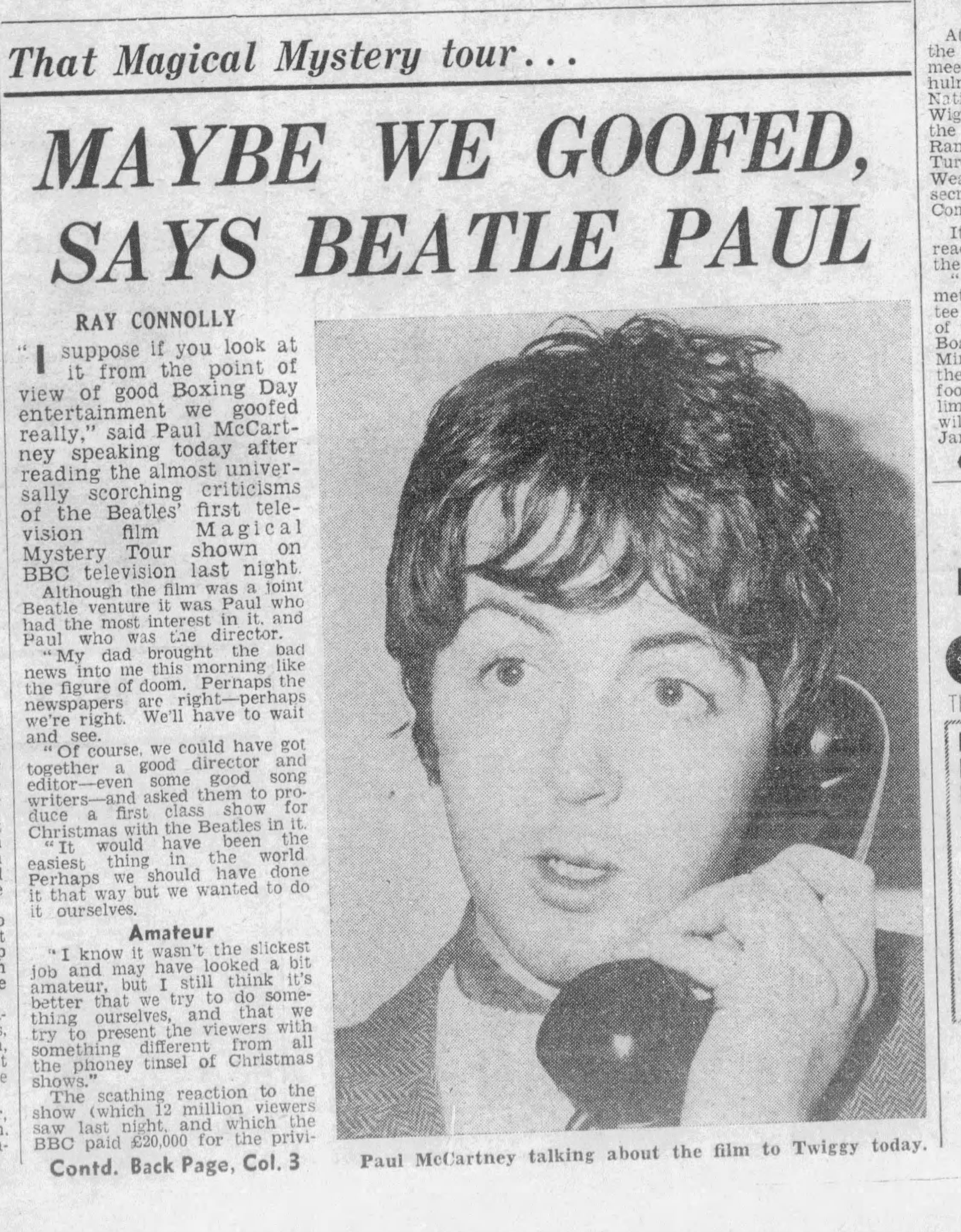
The day after. From Page One of the December 27, 1967 Evening Standard.

The day after. From Page One of the December 27, 1967 Evening Standard.


TMBP
:
Why was it kept off American TV for so long?

SM: NBC turned it down. They just thought, “This is just too weird. We’re not going to show this stuff.” You have to remember this is 1967. If you’re in New York or San Francisco or London or maybe some places in Colorado or Boston, yeah, you’re plugged into this counterculture underground, this thing is happening. This is the next phase.

It comes out after the Summer of Love. So we’ve been through all of that. It’s not quite the tail end of psychedelia, because psychedelia starts and ends. It’s a wide period of time, but the peak is a short period of time where it sort of peaks.


TMBP
:
What’s your favorite Beatles film?

SM: I think “A Hard Day’s Night.” Without getting into a long-winded explanation, I think “A Hard Day’s Night” still the best, it is still such a great movie. It stands on its own as a film. You can watch it and kind of separate the Beatles from it, but you can view it just a film. And it’s just great, it’s an important film. It’s part of this evolution of ’60s cinema, where you can’t really say that about the other films. Maybe “Yellow Submarine” in terms of it being the first sort of major important animated feature-length animated film for adults. But I think it’s “A Hard Day’s Night.” Give a lot of credit to Richard Lester.

Is that your favorite? Or is it “Let It Be?”


TMBP: It’s “Let It Be” and it’s sort of in a sick way, but I recognize “A Hard Day’s Night” as their greatest film –- I acknowledge the separation between favorite and best. What about something that someone else has done about The Beatles? Is there something that stands out?

SM: “Anthology,” I really would like to see it again. And I would like to see them fix it. I don’t know if you’re into Pink Floyd, but they took one of these films, it was from the ’80s. And what they did is they went back and they completely redid it — they made it in widescreen, they took away some of the clunky sound of it. They did a restoration to it. I would really like to see that done with “Anthology.” And then I think I would have a certain feeling about it.

I really loved “Across the Universe.” I thought that was really beautifully done. You know, it’s hard to kind of make a movie like that. I really like “The Beatles and India” film a lot. I thought that was really, really wonderfully done. I remember seeing “I Wanna Hold Your Hand” when it came out in the movies. It was kind of cute, the idea of it. I think it was done with a lot of heart.

Backbeat,” that’s probably my favorite, I love that movie. Everything about that movie just works. “The Concert for Bangladesh” is a great show. It’s a time capsule. I can remember, I had just gotten an FM radio of my own, a whole stereo setup. And I remember them playing that on the radio, premiering it and playing chunks of it in a row on the radio and just being blown away by it.


TMBP
: “
The Compleat Beatles” was really formative for me.

SM: Yes, me too. I have that on VHS. That’s never come out on DVD or Blu-ray. I think they’ve lost all the rights on that.


TMBP
:
The Beatles have all these little pockets of things that we’ll never see ever again. Or, who knows when we’ll see it, whether it’s “Let it Be,” or “Anthology.” I mean, unless you own the physical media.

SM: I think they will put those out. I think you’ll see these things — when, I don’t know. I hope they don’t just do like what they did with the rooftop concert audio, where they just put it out on streaming only. To me, I don’t think they know who their audience is when they’re doing that. You know, their core audience is still is physical media people. Especially vinyl. Now maybe their plan is at some point to do that, but I thought that was awful that they did that.


TMBP
:
Paul did something similar with the Flowers in the Dirt box set, where more than a dozen songs -– demos, B-sides, remixes – were bundled for purchase and download-only.

SM: If you see the way that they’re discounting some of this stuff, I think that from their point of view, whatever numbers they had in mind, I think there’s a certain degree of disappointment. I think it’s selling a lot, but I think that sometimes I think they have an overinflated sense. I also think that they, what they want to do is if they print a 100,000 copies, they’ve got to sell every last one. Like they want to wring out every last penny from it.

And I know that Disney did not handle the “Get Back” reissues on Blu-ray. That was not handled right. They did a terrible job on that. It was almost like they didn’t even want to do it. I have this conversation with my wife all the time — there was a time that a record, an album, a CD, a DVD, a Blu-ray, people love this stuff as a gift, because there’s a certain personal connection there. And it’s an inexpensive gift. Twelve-inch albums aren’t small, but it’s relatively small. It’s value for money too. Some of these are things people don’t want to spend the money themselves. They think it’s extravagant, but if you give somebody a $25 Blu-ray or if you give them a nice double vinyl album, they’re like, “Whoa, thank you.” And these record companies and film companies that want to phase this stuff out.


“Once you buy a record or a CD or, or an album or a book, you own it. It’s yours. You can do whatever you want with it. You can have it forever. They don’t like that.”

TMBP: : Your book stuck to the core films. Did you consider writing about “Anthology” or “Eight Days a Week” or anything like that?

SM: The only one that I thought possibly could have been included was the Shea Stadium concert. But again, I felt like it really was just a television show and it just would have made things so much more complicated. I think that those five films is the way that it is. That’s the canon, so to speak. I don’t think Shea Stadium is really part of it. I touch on Shea Stadium, but again, then the book becomes, it becomes unwieldy. It really ended, I have to let it be. That’s it. It’s over, you know? I mean, I give you a little sense of how these ’60s films would go on to influence. And then I give you a laundry list of film directors — Marty Scorsese and Francis Ford Coppola and Robert Altman and the usual suspects, how important ’70s American film is, how that kind of takes over. That’s like the golden age. Again, there’s that phrase, you know?

I thought about maybe at the end, I could put a couple of pages of a capsule review of some of the films that came after, but then where does it end? I’m having trouble with the length of my manuscript to begin with. So to even think about that, maybe that’s a Part Two, but I don’t know if I would ever actually do it.


I should probably have one of these disclaimers: Steve sent me a review copy of the book. But in all honesty, I would have bought it anyway.

2 Comments

Filed under Extra

Jan. 13: Picasso’s last words

At the conclusion of the 1956 French documentary “Le Mystère Picasso,” the grand old painter splashed his iconic signature on a print and announced (translated to English), “That’s the end.” He wasn’t bargaining with director Henri-Georges Clouzot, himself considered a master in his field. It was a declaration: This film was over.

Pablo Picasso’s paintings and his exhaustive creative process were the focus of the film, his hand usually invisible as it brushed across a transparent screen, at times in black and white, and at others in vibrant color. In the film, Picasso produced several completed paintings, and we catch occasional glimpses of him at work, creating art out of nothing in an spartan studio while holding an occasional dialogue with the film’s director. This should sound familiar.

Paul McCartney had a few occasions to come across the film. It was screened in Liverpool in June 1958, when Paul turned 16 and was nearly a year into his creative partnership with John Lennon. But odds are Paul saw it sometime between late January and March 1967, when the film was shown at the Academy Two in the West End, about 2 1/2 miles from where the Beatles were recording Sgt. Pepper’s Lonely Hearts Club Band and a very short walk from other frequent haunts like the Saville Theater and the Bag O’Nails. (The documentary was broadcast on BBC-2 in May 1968, as well, but Paul was in New York at the time).

One of several films considered a reference point in the early afternoon of January 13, 1969, “Le Mystère Picasso” was mentioned by Paul as an inspiration to Michael Lindsay-Hogg, who was in the midst of directing what became known as the Beatles’ Get Back project.

“They don’t sort of fast-cut the paintings,” Paul said to Michael. “And these songs are going to be our paintings at the end of it.”

The endgame for the Beatles’ documentary of the creative process was unclear even as the documentary was underway. And unlike Picasso, here the creative powers continuously bargained with the director.

That Paul, with a comparatively quiet Ringo Starr, would even waste time debating with Michael speaks to the confidence the band had to to see out this project.

Yes, yes, and then there were two. So what, the show must go on. And that’s why the Beatles were at Twickenham Film Studios to start 1969, after all: to stage a show. The rhythm section was in tow relatively early that Monday. Of the missing half, one member had already decisively quit while another was frustratingly unreachable.

Having recapped the previous day’s difficult meeting that saw George Harrison ultimately walk out in large part due to the disruptive dynamic between John and girlfriend Yoko Ono, the present conversation only looked ahead.

This initial sequence first appeared on film in the 2021 Get Back docuseries.

“If we were going to take a ship’s pool on what our communal life is going to be in the next two weeks, what are we all betting?” Michael, in his imitable way, asked Paul and Ringo.

Paul shared his hopes the current state of limbo would only be temporary. “I think we see the end of this week out,” he said. “And something will have happened, definitely. … Then we’ll say that we don’t come in next week and we sort of chuck it. Or, we come in next week, and .. make it next week.”

“Then we send the guys off to Africa,” Michael chimed in, to laugher.

Paul continued, laying out the actual logistics.

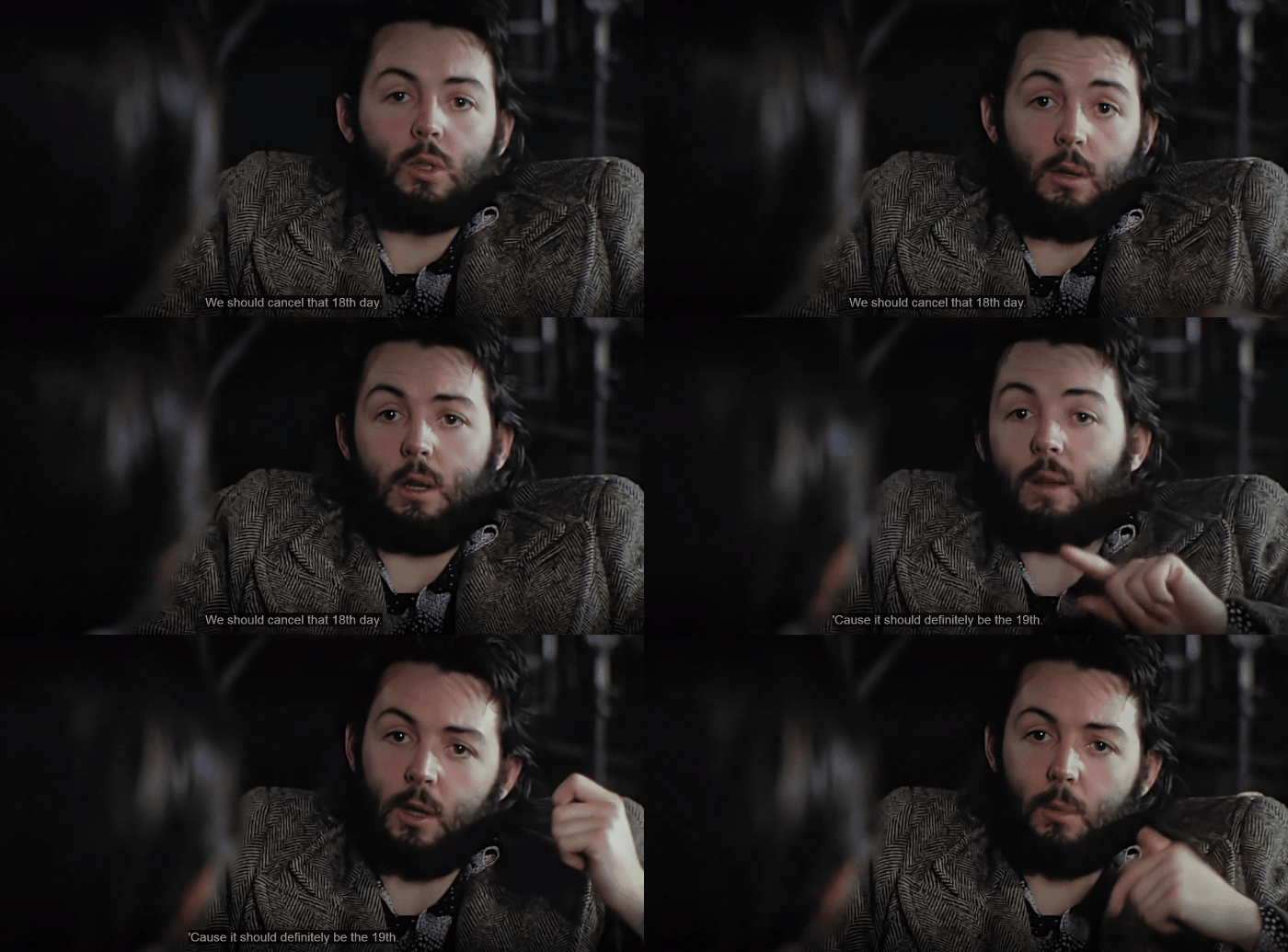
“We’ve got to stop the clock while this is all going on. Like, this isn’t counted. We should cancel that [January] 18th date, ‘cause it should definitely be the 19th already, ‘cause we’re going to lose today.”

Timing mattered, and so did location.

“We should do it here,” said Ringo, again. His desire to stay in England was a true constant in January 1969, and he only briefly toyed with the idea of traveling a few days earlier. But that was then, and now, there seemed to be true consensus on staying put at Twickenham or nearby — and that included the better halves.

Paul: I don’t really see any point anymore [in going overseas].

Ringo: There were eight of us who didn’t see any point.

Paul: And luckily we’re the Beatles, who don’t see any point.

As had been the case for nearly two weeks, while they may not have known what they wanted out of the show, they knew what they didn’t want. At least Paul knew, speaking on behalf of Beatles present and otherwise unavailable.

At once a touchstone and a millstone, the Rolling Stones’ Rock and Roll Circus was filmed a month earlier in London under Michael’s direction and with John as one of the performers. Paul, who had seen an early cut of the film — it wasn’t released commercially until 1996 — made clear the fast-moving Circus wasn’t a format he wanted to follow, continuing to deflate Michael.

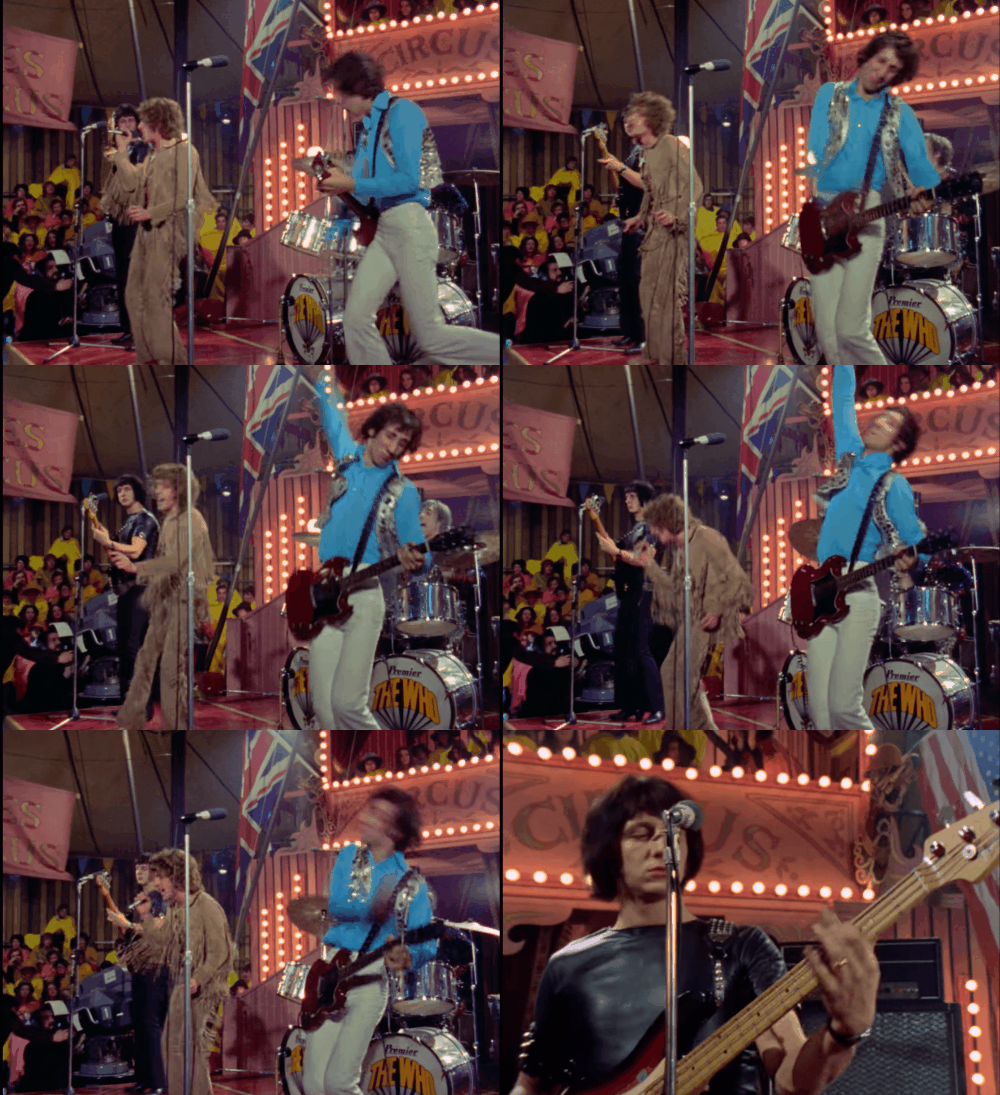
“It didn’t look right,” Paul said. “I know it was a bad print. But like, I didn’t ever get into any one of the Who. Ever. It was the event all the time. And no one digs that. That’s over, that sort of event, I think. It really is now, if you’re trying to show him, I just really say just stick [the camera] on him.”

A “study.”

That’s what Linda Eastman suggested, and Paul repeated.

Here’s where the conversation turned to “Le Mystère Picasso” — it showed up as “The Picasso Mystery” in British movie listings. Anecdotally, Paul called it “Picasso Paints.”

Michael contended the documentary the Beatles were filming — not the grand finale concert, wherever it may be, but this ongoing build-up — was the study, but Paul suggested the examination should extend into that live performance. He saw “Le Mystère Picasso” as analogous to this Beatles concert.

“They didn’t sort of fast-cut the paintings or anything,” Paul said to Michael, who was also familiar with the film. “He just sort of painted them. They showed how he built up, and they stayed on it.”

There’s a bit of a straw-man argument going on, since Michael never contended he should litter the film with quick cuts. To the contrary, he complained about that very technique in the recently broadcast Cream Farewell Concert.

Paul brought it back to the Circus, and justifiably, as it was Michael’s most recent production and featured fellow A-listers.  It wasn’t just contemporary, but it was competition. (And perhaps moreso personally so for Paul, with John having been a Circus performer). January 1969 had seen a lot of wandering discussions on where a Beatles concert should be. Here Paul — speaking over Michael — explained how he thought it should look, regardless of location.

“Very, very bright lights, so you see every detail about [Ringo], instead of moody things. Really totally bright-lit, it hardly needs scenery or anything. Really should be about him and his drum kit. … Says it all.

“And then John: his amp, his guitar. Actually sitting there, doing it at that minute. I think if you start going in that direction, then, I think you might think of a great idea. ‘Oh, incidentally, we think it all should be done in a black bag or something.’”

Michael pushed back, saying the Circus had a very deliberate design.

“You can’t compare the two,” Michael said. “The Circus was designed as an event. It was a different concept. The Rolling Stones needed a family show, and Mick [Jagger] wanted a family show. Mick said he wanted Ed Sullivan without Ed Sullivan.”

I’ll leave the analysis of Mick’s motivation to the Rolling Stones writers and researchers (free blog name suggestion: “Traps for Troubadours”). Those intentions, though, eventually impacted the Beatles’ decision-makers.

“You don’t go off Ringo,” Paul clarified. “Don’t go off into the scenic backgrounds. Or the audience. Or the moon. It’s not necessary.”

Swept up in the vision, Linda said, “God, you have it. Ooh.” Overwhelmed by the very thought of the Beatles, she quickly giggled before regaining her composure. Linda wore her love of the Beatles on her sleeve. It went beyond her personal affection for Paul.

Paul’s right: Michael did cut away from Pete Townshend as soon as he finished the windmill. (From Rock and Roll Circus)

“I missed a lot of that Who thing the other day,” Paul continued, with Linda occasionally interjecting and overlapping her agreement. “Pete Townshend, I never saw him. I’d really like to look at him for a long time cause he fascinates me. … I’d like to really just see what he looks like after he’s done that thing (presumably his windmill guitar move). …

“You know, [I’d like to see] Keith Moon just sort of jabbering away on the drums, just for a whole number almost. OK, so you’re going to have to cut between the four of them. But it’s just that thing, really sticking with it. And I think that’s the point of this show, for us.”

Paul evoked the news again.

“The really good coverage is the shot of the fellow with the gun to a head, and the fellow who got that [camera] shot, that was the man who covered the event,” Paul said a few moments earlier. “The fellow who got the guy on the ground afterwards with the blood coming out of his head missed it. And with all that fast-cutting, [you missed it].”

Less gruesome comparisons continued. It emerged as the best way for the director and the talent to triangulate an acceptable idea for their own production:

Top of the Pops: Michael said “they never help the act. … If you just take a wide shot of [the Who] doing their act, with no particular response from the audience, they do look like they’re lunatics, but the wrong kind of lunatics.”

Ringo brought up a recent appearance from Crazy World of Arthur Brown, whose single “Fire” hit No. 1 in Summer 1968, to prove this point. “The camera needs to do something. And Arthur Brown, every time he came on … he’s so wild, and the camera’s going wild so you didn’t see anything.”

The “Hey Jude” promo film: “The comment about ‘Jude’ was that when I was doing those high bits, you didn’t see me doing them,” Paul complained to its director.

Michael, for his part, expressed regret at how the sequence turned out.

“I physically couldn’t get a camera onto you because they couldn’t hear the talk-back,” he said, referring to communication with his crew. “I should have been ready for that, but it was a mistake.”

An excerpt from “an old film” on TV the night before (probably something shown during Film Night on BBC-2): “They came down on the rooftops of Paris,” Paul said, with Glyn and Michael saying they saw the same sequence, too, at 11:15 p.m.

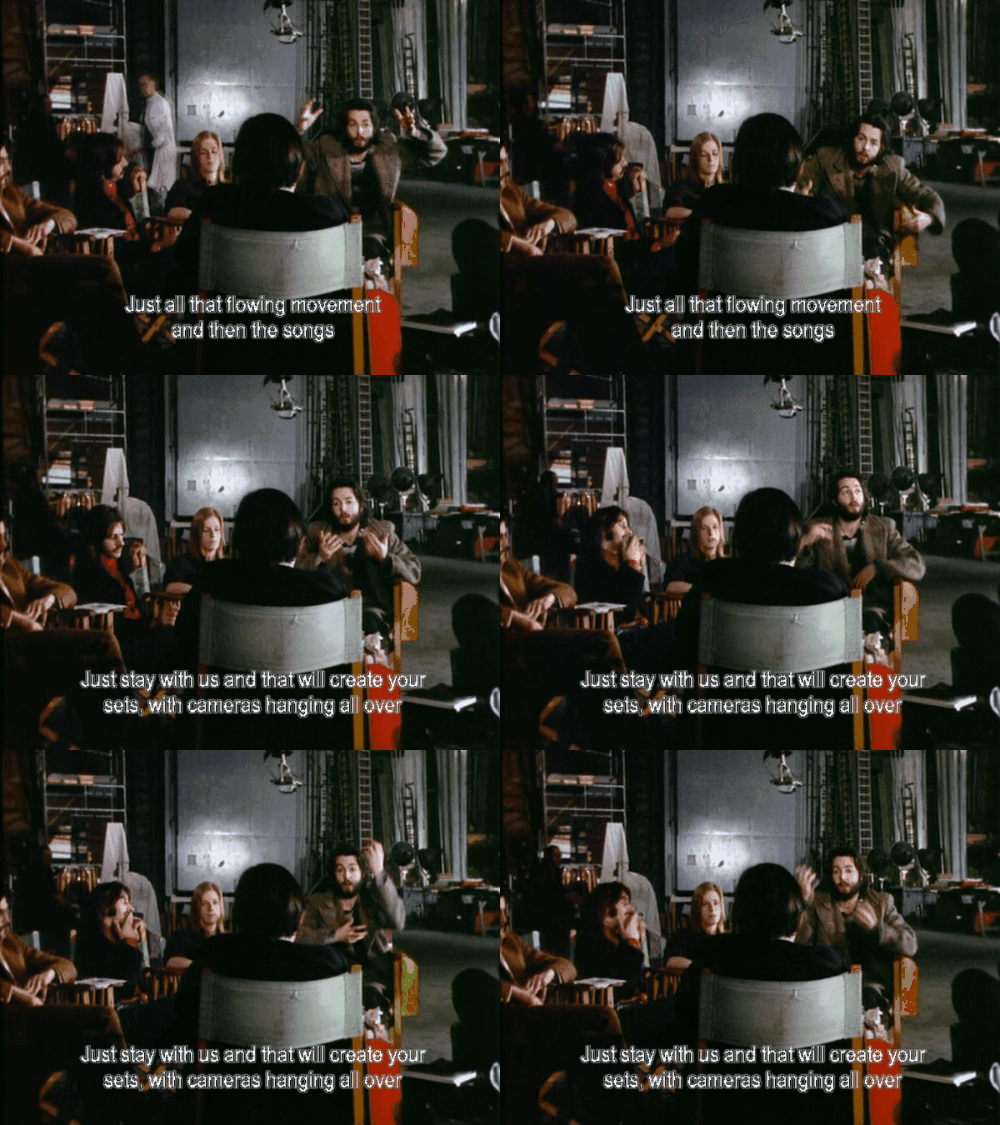
“And that’s really where this should all be at Twickenham. This should totally be built like those film sets. So that you can glide all over the place like on tracks and everything with your cameras, go to places that TV cameras don’t go. So you can come down out of that roof, on one long shot, right from the back there, and just come down on a thing. Slowly, like a chair lift, right down, right into Ringo’s face on the one shot, from right back from there. It’s like the old films, and have all sorts of cranes and lifts and stuff for your cameras to float around us. And just all that flowing movement. And then the songs, you know? And just really stay with us. And then that’ll create your sets then, you’ll have cameras hanging all over the place.

From Anthology

If that sequence sounds familiar, it should: It was included in the 1995 Beatles Anthology documentary. It was not included in Get Back more than a quarter-century later.

Linda continued to be unable to resist the Beatles on film, even as she sat with them in person. “Mmm, but just them,” she said.

Andy Warhol’s Empire: This was a cautionary tale. It’s one thing to linger on Ringo’s drum kit for a three minutes. It’s another to have a single, black-and-white shot of the stationary Empire State Building for eight hours.

“That idea of slowly getting into the thing and being careful not to miss anything … I really do think you’ll find the pace is there without you having to put it there,” Paul tried to explain. “It’s like with Warhol’s things is that he does go right in to the other extreme. He reckons his pace in that Empire State [sic]. But I wouldn’t agree with him, I’d think he’d be boring, but I see his point.”

Glyn does too, but he falls in with Michael, arguing that a slow study could work for a few songs, but not for a 52-minute show.

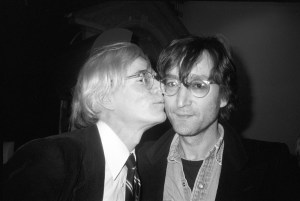
Andy and John, 1978. (Photo by Christopher Makos)

“If we’re doing that, then I really think we should do galloping horses and really go the whole hog and really have an epic,” Paul replied. “But if we are going a bit towards the Beatles, I really think get the close-up lenses and get right into one of John’s eyes. Can you do that? Look in that direction rather than trying to get a picture of John and the moon or a big amphitheater.”

It was at this moment — not Paul’s “and then there were two” line but around 15 minutes later — Paul exits the stage to speak to John on the phone.

Deep as the Nagra tapes go, and despite Michael’s prep to bug the phones, we don’t know what was said on the call. We do know the conversation continued without Paul. The top storyline coming out of the meeting at Ringo’s the day before was the frustration of Yoko speaking for John. Here, in Paul’s absence, Linda doesn’t just speak in line with Paul, but she advocates for herself, too. This sequence appears in part in Get Back.

“I have never seen a study of any musical event,” Linda said. “You want to be there, that’s the thing. (Speaking forcefully) And if I were there, I’d be staring at them. I’d never look around me once. I’d be staring at them if I were sitting in the audience. It’s like you see in the theater. Why can’t the camera be you sitting there?”

Linda’s tone is outspoken and sincere, and something that was needed to move the conversation forward, her viewpoint as an artist and a fan. It clearly put Michael at unease and somewhat on the defensive in what emerged as something of a tense, sarcastic exchange that didn’t go unnoticed 52 years later in Get Back.

MLH: I saw their last concert at Hammersmith … and I was totally aware of not only them, and they were 40 miles away [sic], but the audience, the screams, the lights.

Linda: We looked at Help! the other night again and Hard Day’s Night. And that was them playing.

MLH: Right, but it was them over an hour and a half and 30,000 [feet high]. If it is an Andy Warhol picture …

Linda (fed up and combative): Oh, don’t take the other extreme! Andy Warhol, that’s not you! .. I’m speaking like a fan! I really am.

MLH: I am too. I’m a bigger fan than you are (said laughing, and with complete sincerity)

Linda (gruffly): Oh, OK should we fight about it?

MLH: I can do it any way. But being the fan I am, I gotta keep saying I think you’re all wrong.

Linda: You want to be too sophisticated.

MLH: We ran the Circus the other night, and it’s so simple. I’m the least pretentious director you’re going to meet.

While Michael said that last line straight, it was met with laughter around the room.

Let’s just watch on a loop Linda’s body language while she talks to Michael. (From the Get Back docuseries)

This is a real argument between two artists, a photographer and a film director, with legitimate differing visions. And no one held a higher status. Linda was just 27 (older than Paul and Ringo). Michael was 28. Each had about the same amount of professional experience at their respective trades, only a couple of years.

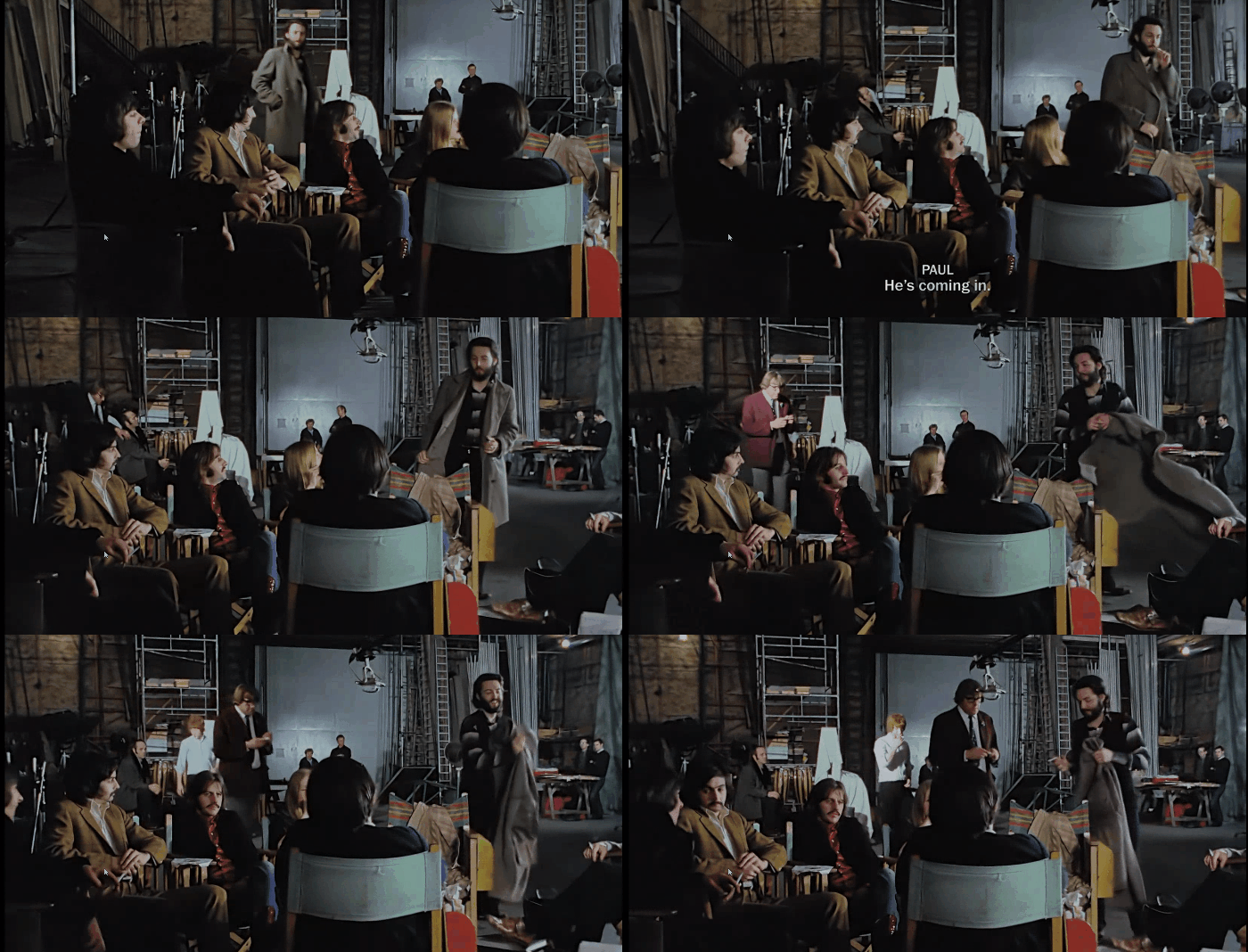
Paul returned after a phone call that couldn’t have lasted more than two minutes. Seeing his return, as shown in Get Back, is one of the great revealing moments in the documentary and something you never could have heard in a lifetime studying the Nagra tapes.

To this point, Paul spent the morning still in his overcoat. At any point, everyone could have called it a day and cut their losses. George wasn’t coming back. But when Paul dramatically — and joyously — removed his coat, revealing his magnificent black shirt, it was clear John wasn’t a issue.

“He’s coming in,” Paul said simply.

It’s a big deal, and the visual — of which we are now aware — really brings it to the forefront (if you’re looking for it). The Nagra tapes tell a lot, but audio alone can’t tell everything.

Through Paul’s return, Michael remained bold.

“You see, Paul, I was telling Linda when you were out, I could do it any way. Except I got to keep saying you’re wrong when I think you’re wrong.”

“Yeah, sure, great,” Paul replied, beaming and about to light a celebratory cigarette. “I’ll just keep saying I’m right when I think I’m right.

The daily circular discussion returned — again — to a pitch for Africa by Michael, one that was more quickly dismissed by Paul and Ringo than it had been, with the unspoken allegation of a trip being used as a crutch and gimmick.

Paul shared another idea he said he conceived the day before. That may have been a Sunday, but Paul’s brain had no days off.

“There’s another idea for a set: Instruments. You need a grand piano for one number, then for ‘Maxwell’s Silver Hammer’ … we should get a bit of a honky-tonk [piano]. So then you start to get the whole place just littered with instruments we could move around from. And it’s like a big game of musical chairs. Moving around on that amp, on that guitar, and it’s really planned. A whole computed setup … and then Ringo gets off and goes onto his congas for that one. That kind of sort of thing, then you get scenery, almost.

“You’re thinking of linking numbers,” Michael replied.

There were more shows used as points of reference — these guys absorbed so much TV:

The Potter’s Wheel: “They made a pot before your very eyes,” Paul explained. “Just one shot held, and it took about five minutes or something. And it was great, because you never felt bored. [I] always [watched it].”

Allow yourself the luxury of imagining a tween Paul McCartney soaking up these brief BBC interludes to the point of reminiscing about them at a moment he’s crafting on his own creative work at the height of his powers.

If the process should be the focal point, as Paul argued, it’s not enough for the instruments to create the scenery. Presaging the production of Get Back in 2021, he suggested the crew act as the supporting cast.

“Like [Glyn] switching everything over, you know, to taking all the top out of that on this track, ‘cause we want want a very biting guitar sound on this track.”

“I think that’s the documentary,” Michael argued, “because I think to go away to Glyn as opposed to a camel is distracting from you, because I think we’re getting into you. I think the documentary, we got all this in the documentary.”

Paul “totally” disagreed. “I think he’s a lot more to do with this show than a camel.”

After Neil jumped in to say Glyn was really a performer, too, Paul continued.

“That’s it! You’re going to miss him live. There he is. The camel won’t be doing anything live. Chances are it won’t even be looking at us or anyone. It won’t be looking at your camera, it will just sort of shit in front of you. Be lucky if it does, would be a bit of action.”

Camels with Wings. “Chances are it won’t even be looking at us or anyone.” (Photo from Paul’s Twitter).

Michael was truly exasperated, interrupting Paul who had continued his pitch, off the camel but back onto the fluidity of camera movements.

“See what I wanted to do in the desert,” Michael said, “was really make to the most dramatic thing of all time.”

Michael deserves credit for a lot of things having to do with his work in January 1969, including his real desire to create something exceptional and his willingness to exchange ideas. Here, he turned his attention back to the Beatles’ past, asking what was the band’s most successful and enjoyable TV appearance. Paul said “Around the Beatles,” an answer met with consensus from the others but unfortunately there was never any follow-up questioning to ask exactly why.

Still, it was yet another inspiration. Just like …

Some country music TV show Paul and Ringo “saw at the ranch”: Sparked off a comment from do-everything assistant Mal Evans, Paul and Ringo recalled a country music show. The “ranch” is certainly Reed Pigman’s in Alton, Mo., where the Beatles stayed Sept. 19, 1964. That would likely make Slim Wilson’s local country music show the memory. It was on at 6 p.m., right before “Flipper” — which the rancher’s son explicitly remembered watching with Ringo.

“There’s just one camera, and they all walked into it.” Paul recalled, describing Wilson’s show.

Ringo continued: “If it was the guitarist’s bit, he’d just step in and do it there. They’d all take the center, and if it was violin, he’d just walk in and do his bit, and he’d get back wherever he was. They acted all the movement.”

One memory sparked another, as often happens.

Unrealized Apple promotional film: “We were thinking of doing this once for an Apple thing, getting James Taylor, Mary Hopkin,” Paul remembered.

“We were going to get our home video things and set them up. And then have an area of the room which was lit, and that was it.. And then you came in, you did your thing and then if you wanted to say anything in close-up, you’ve walked up to the camera and you said it in close-up. Then you ducked out and someone else came in, in close-up and then walked into long shot and then did his dance.”

“So we can do a switch on this,” Paul said. “Get us to do the movement. Get us to go to the camera,”

Michael sought to punch holes in the idea, saying that if you were playing piano, movement was limited.

When Paul accused Michael of just being negative, Glyn said that was a “slight” contradiction.

“We’re all contradicting ourselves,” Michael said. “It’s the only way we ever get an idea.”

It was at this point Paul estimated John would arrive in about an hour, and with that news, the stage emptied out as everyone headed to lunch.

***

As an artist, Picasso announced when his film was complete — there was no haggling in a search for a conclusion. Sure, Picasso and Clouzot probably planned things out a little better before filming.  It’s arguable the fluid state of the Beatles’ finale concert was expected to be an unspoken initial plot point of the Let It Be film, but if so, it was never pursued in the original film, only exploited later in Get Back. Maybe there’s something important to the relative age and experience of Picasso and Clouzot compared to the Beatles and Michael, too, in how it all played out.

The revealing debate between Linda and Michael justifiably reached the small screen in Get Back, but so much of the rest of this lengthy sequence remains left to the beautiful losers who labor to listen to the Nagra tapes in full. None of the revealing TV and movie comparisons above were featured in Get Back the docuseries or the book published in 2021.

Before the Let It Be film even came out, though, that sequence owned prime real estate. The very first page of dialogue in the original Get Back bookthe one originally packaged with the Let It Be LP — spans this discussion. While the transcription is sloppy and incomplete, it’s there to set the tone for the text portion of the book, despite being from Day 8.

It’s absolutely no surprise the Beatles found inspiration in literally anything they encountered in film or television, whether it was something incredibly proximate, like the Rock and Roll Circus, or a pottery interlude they watched as kids or a rural country music show they caught just once. That’s how they synthesized their musical influences too. How George — absent for the discussion on the 13th — developed “I Me Mine” from watching a waltz on TV is a perfect example of all of this.

“Get right into one of John’s eyes,” almost.

Michael Lindsay-Hogg filmed a lot a footage in 1969, and most of us didn’t really know what that meant from 1970 through late 2021. Let It Be, from 1970, was nothing like Get Back in 2021, the latter deliberately not following the former’s model. But did conversations like those on January 13, 1969, inform some of Michael’s decisions of how to build his documentary?

“Get right into one of John’s eyes,” Paul suggested. And sure, we get a few seconds here and there of extreme close-ups in Michael’s Let It Be, but these are hardly studies. That’s where the luxury of an eight-hour palette benefitted films like Warhol’s 1965 Empire — and Get Back in 2021.

Michael was clear that a “wide shot … with no particular response from the audience” was the wrong route. The success of the “Hey Jude” promo — with the band surrounded by the audience — was rooted in this strategy. It may have been the unspoken reason behind the affinity for Around the Beatles, too. And perhaps it’s why the rooftop performance in Let It Be was punctuated and interrupted consistently by street-level interviews. Otherwise, the Beatles were just playing on a very tall stage (which would have worked for me, but I’m not a filmmaker).

Still, the rooftop on January 13, 1969, was simply the top level of 3 Savile Row, not The Rooftop. Inspirations, open minds and contradictions were how they got to an idea.

8 Comments

Filed under Day by day