Tag Archives: George Harrison

Jan. 9: Last-night song

“I was just so hungry today.”

Why, it’s a metaphor for George Harrison’s flowering ambition within the Beatles in their final year! OK sure, but it’s actually just the guitarist describing how famished he was before arriving at Twickenham Film Studios mid-morning on January 9, 1969.

“I had to be late, just to eat me breakfast. If you want an excuse.”
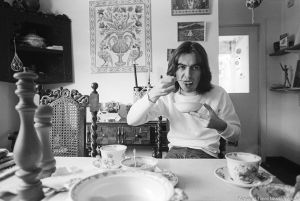
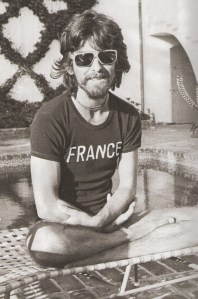
You know that what you eat you are: George enjoys breakfast at home on April 9, 1969, three months to the day after this post’s session.

Paul McCartney already had spent at least 45 minutes at the piano this Thursday, and he ceded the virtual spotlight to the new arrival, who reintroduced “For You Blue” to the sessions.

“This is his last-night song,” Paul would later describe it to John Lennon, who would show up shortly (Ringo Starr was already around when Paul was playing). Paul’s characterization of George’s song wasn’t entirely accurate. As far as the tapes are concerned, this was the third day “For You Blue” was demonstrated — but it was the first time it was properly and deliberately performed for and with the other Beatles.

A slower, bluesier version acted as background music on January 6 during a conversation about equipment. Likewise, the next day, the song wasn’t performed so much as it kept George busy amid the overwhelmingly tense debate over the band’s future.

Finally on January 9, George properly lifted the veil on “For You Blue,” offering it on an acoustic guitar as a sharper, more highly paced toe-tapper as compared to those previous, abbreviated versions. The skiffle influence was obvious, and on this morning, admitted.  The song was clearly a “last-night” project, enjoying a clear evolution heading into the 9th.

The guts of the version that would be recorded a few weeks in the future and released more than a year later existed this morning for the first time: its distinguishable introduction, the first few verses, guitar solo and its ending. The cat didn’t bop yet, and Johnny didn’t go, but the number George described as “our little blues-folk song” was indeed the same ol’ twelve-bar blues.

Paul chipped in an imperfect but not insincere stab at a piano part and a vocal harmony. Neither would stand the test of time, but the attempt wasn’t out of place.

Peaking as a songwriter, George admitted writing the lyrics was a simple process.

“You got most of the words?” Paul asked.

“They’re so easy, I just wrote about two [verses] down,” George replied. “You just make ‘em up.”

John arrived moments later, and with the fab count complete at four, proper rehearsals were finally able to commence. John initially suggested kicking things off with “For You Blue.”

“Should we learn your song then, ‘I love you sweet and honey baby.’”

Paul slammed the brakes, though, setting the terms of the rehearsals.

“Let’s run through the ones we know and then learn the [new] one.

“This is our format.”

For better or worse, it was. And following was a sequence in which the group tackled some of their more familiar numbers — “Two of Us,” “I’ve Got a Feeling,” “One After 909,” “She Came In Through the Bathroom Window,” new favorite “Get Back” and the rehabilitated “Across the Universe” — before they got a little original and political. But that’s for another post.

Fresh out of a cover of “Honey Hush” (by Big Joe Turner, via Johnny Burnette, with John taking lead vocals), we finally got the day’s first few attempts at full-band takes of “For You Blue” on the tapes. It sweats with swagger, with George leading the way on electric guitar and Paul adding a mature though imprecise bass part.

The group picked up their parts pretty quickly and easily, because, after all, it’s a pretty basic song. George’s eventual description of the “For You Blue” in his 1980 autobiography “I Me Mine” says as much:

“For You Blue” is a simple twelve-bar song following all the normal twelve-bar principles, except that it’s happy-go-lucky!

At least one person, though, wasn’t too happy with the song after the first full go.

“Pretty short, innit?” John asked after the two-or-so-minute take.

George didn’t address his critic, instead criticizing the ad-hoc arrangement — making it at least two people unhappy with the song — saying he’d like to perform the song “on acoustic on the show. I don’t want to do it like that.”

“I’d like to do it with just an acoustic guitar. If we can get an acoustic bass, it’d be nice.”

John interrupted, almost shocked. “Acoustic bass?”

He shouldn’t have been too surprised — George suggested the same instrument just the day before, for “I Me Mine.”

George retrieved an acoustic guitar and proceeded to perform the song alone, accompanied only by hand-claps, probably from Paul.

Clearly noting the lack of enthusiasm for his own songs and probably reflecting his own increasing boredom as he endured the sessions , George — for the third time in a week — tried to deflect effort from the Beatles’ own rush to produce new material.

“Should we do some other people’s tunes as well?” George asked.

To laughter, but clearly laced with sincerity, John shot down the idea. “I can only just bear doing your lot’s songs, never mind doing strangers’.”

George: “Yeah, but those songs are so much better than ours.”

“That’s why I don’t learn them,” Paul replied.

George performed “For You Blue” one more time, and he eventually quit singing after Paul melodically read or improvised a wholly unrelated speech while George played guitar.

On January 3, the sessions’ first full day, George asked if the group would dip into their back catalog.  On January 7, he asked if other groups would join them on the bill. And now, he was feeling out the potential of mixing in covers, something they were doing relatively effortlessly throughout the sessions thus far. His most significant contributions to this point — “All Things Must Pass,” “I Me Mine” and “For You Blue” — arguably matched Paul’s newest songs and certainly outpaced John’s meager output.

And still, George’s songs were downgraded or degraded by the others, nothing that was really new. Per the tapes, George’s last-night song was the only song of his rehearsed on this January 9. His hunger for an expanded role — or a significant change in the band’s operation — was growing insatiable.  On January 10, it was breakfast at home again for George, but the change he starved for came at lunch.
11 Comments

Filed under Day by day

Jan. 8: Syndicate any boat

The TV show’s title and tagline could have written itself:

“The Beatles are … ADRIFT.”

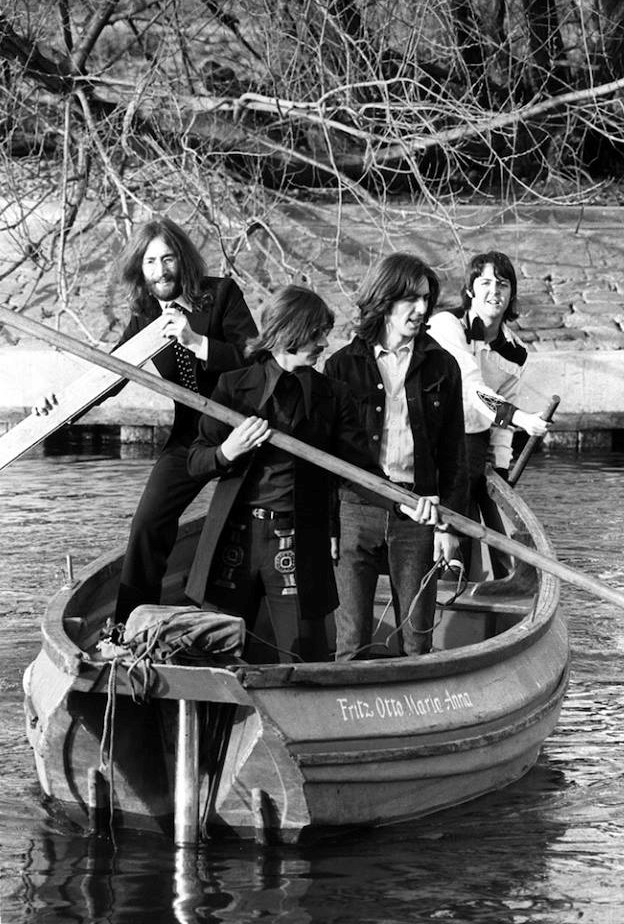
Picture yourself in a boat: The Beatles aboard the Fritz Otto Maria Anna, in the River Thames, on April 9, 1969.

It’s a simplistically obvious metaphor, and a literal description of what the group was seriously considering in the waning moments of their January, 8, 1969, session at Twickenham. If the TV show in production was to be episodic, this sequence would have provided a true cliffhanger.

Ringo Starr, codename “Russia,” wasn’t unwilling to drop his automatic veto, and it was John Lennon spearheading the effort withing the group, resurfacing as the group’s leader after so many years, who worked the sell on the drummer, along with Paul McCartney.

“Just give me one reason to stay here,” John asked.

“For the people,” Ringo answered with complete sincerity.

“All right, we’ll take ‘em with us,” John replied.

Paul McCartney clarified the pitch for a Winter 1969 rock cruise.

Look, we were going to give tickets away at this door here and say the first thousand people who come from Britian — British, white people (said to laughter as Paul was clearly joking; don’t write his reps). No, it’s going to be the first thousand that got here. We give them out, those tickets, but they include a boat ride, as well.

“We take them with us, and that’s the show,” Michael Lindsay-Hogg said.

France — aka George Harrison — took a more skeptical view of the potential naval movements than Russia and voiced several specific concerns with the plan:

  • Traveling with fans: “We’re stuck with a bloody big boatload of people for two weeks. At least you can go home from here, you can get away from it all. … It’d have be a bloody big boat, it’ll have to be bigger than the Royal Iris.”
  • Technical logistics: ” It’s just impracticable to lug all those people there and get all that equipment. … Of course it’s our problem.”
  • Cost:  “I think the idea of a boat is completely insane. It’s very expensive and insane.”

While at apparent odds, all the Beatles were deeply engaged in the discussion, and Michael took a straw poll for this proposal. “If we can get the audience and the boat, who votes to go?”

One hand — undoubtedly John’s — shot up immediately. George, despite his vocal objections, would still grudgingly go along with a trip if everyone else was joining. “I just want to get it over with, you know?”

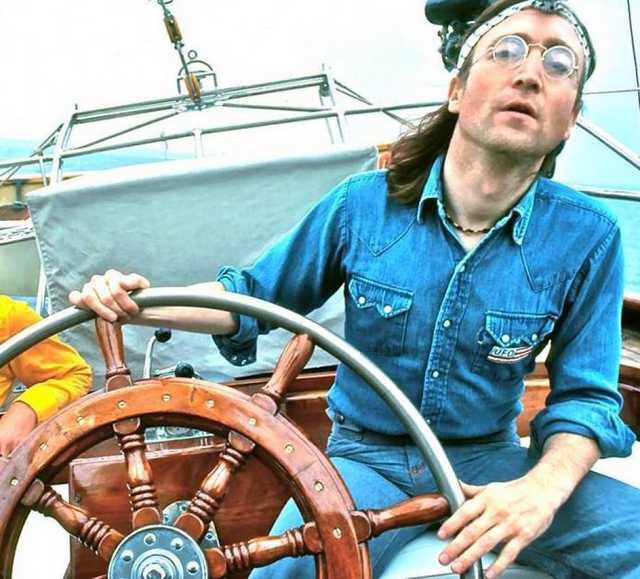
John piloting the ship (in 1975)

It was all coming together for Michael. The boat trip compromise to include a British audience was a bonus for him, an easy way to compile captivating footage for his documentary, another unusual setting — the Beatles not just mingling with fans, but doing it as they sail along the coasts of Western Europe and Northern Africa.  It all would culminate with his deep wish to bring the group to the Sabratha amphitheater: the world’s greatest band making its stage comeback at a spectacular, unique venue.

“See, it’s like having the most fantastic set on earth, but we haven’t made a set, you know? It’s still simplicity itself,” John said.

Ringo still wasn’t sure.

Ringo: But how many’s going to be looking at the set besides us and [Michael]? … [Viewers] want to see what’s on, not what’s around.

John: We’re bound to get something from it.

Ringo: A nice time, get a bit of sun.

Michael: After you’ve had your nine or ten closeups each, we’ve got to have something else to shoot about.

John: It’ll be like being on the roof in India, only we’ll be fully equipped.

The roofs in India were where, not coincidentally, John was at his most prolific in this latter phase of Beatles history.

Even though, as Michael said, “the vibes are very good at the moment,” there was enough obvious dissent in the room to lead John to say that the group will mull it over that night. “We all could say yes now, and somebody could decide no tomorrow.”

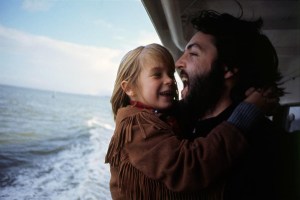
Paul and Heather at sea, 1969. (Photo by Linda McCartney)

As they wrapped up, a final, spirited discussion — as animated as the room has been with no fewer than six people all talking at once (the four Beatles, plus Michael and Apple Films head Denis O’Dell) — emerged over the cost of the boat trip, Ringo and George most concerned.

“We should be able to get the boat for nothing,” John said. “We should be able to get the boat for the publicity they get from it.”  Denis replied to Ringo’s skepticism that he could get a ship “in three hours on the phone.”

John confirmed Denis’ skills, relaying how the producer was able to secure a vessel for How I Won the War. “It was the American Navy making an antiwar film.”

Really, it was all falling into place.

January 8, 1969, was the band’s sixth day back to work at Twickenham, and while most of their new songs were still a work-in-progress, the was actual progress.  One day earlier, George was on the brink of leaving the group. Now, while he was bothered to do so, he was still seemingly willing to get on a boat with the group — and 1,000 fans he wanted little to do with — to go to Africa for a concert he didn’t really want to play.  Ringo was dead-set against going, and now he was willing to bend. Paul was always ready “for an adventure” and as the group’s de facto musical director, he was shaping the material to have ready for the production. As for John, he wasn’t just finally involved — during the final conversation, you heard him speak on the tapes, not Yoko Ono — but he was the group’s leader again.

Days of discussion of where and how to stage the concert had been a distraction from the music-making process, which needed to continue. They were almost ready for a decision.

“Sleep on it then,” said Paul. “I am.”

One question remained as the working day ended: Would the great democracy that was the Beatles agree to this plan for a live show and have a goal they could rehearse toward, or would January 9, 1969, be just another day?

11 Comments

Filed under Day by day

Jan. 8: The Four Powers

In a time of global crisis — isn’t it always, though? — it was the world’s greatest legislative body. OK, maybe the Beatles were the world’s greatest band that also tried to behave like a legislative body, and late in the day on January 8, 1969, it was nearing time for a decisive vote on a lingering issue: Where would the Beatles play their next — and presumably last — concert?

You know his name (look up the nation)

From the band’s outset to its imminent end, the Beatles prided themselves on what they called democracy, but it was really complete consensus. “We had a democratic thing going between us, particularly by 1962,” George Harrison told the high court in 1997 amid a lawsuit to stop the release of a Beatles recording from one of their residencies in Hamburg. “Everybody in the band had to agree with everything that was done.”

Unanimity isn’t necessary to the democratic model, but this model United Nations was extraordinary by nature of its four voting members: John Lennon, Paul McCartney, George Harrison and Ringo Starr. The two serious veto threats earned code names from director Michael Lindsay-Hogg — Russia (Ringo) and France (George, so named “because he smoked some garlic once,” per Paul).

Continuing his earlier conversation with Ringo, and desperate to sell a show overseas, Michael laid out the situation as he saw it in hopes of chipping through the Iron Curtain.

The way it stacks up is, John is happy to go. … Paul is, I gather, in the middle, tending toward either side … and George is swinging more your way. So there’s quite a tough battle. The problem was we couldn’t talk about it because of Russia. And it’s the four powers. And if Russia says no, then the conversation is obviously in the bag and we can’t do anything with it. And I think if we now can talk about it, we may still discard it … or we may come up with something better.

In retrospect, the drama of the group’s incapability of finding agreement on a concert location, despite the suggestion of several intriguing venues, would have made for a captivating documentary for Michael. It would have given a narrative the Let It Be film lacked. But after less than a week of sessions, the director saw things differently.

“My documentary is running out of gas,” Michael admitted to John. “If we were to vote tomorrow, it’s not running out of gas.”

Fine-tuning the group’s intentions would do more than make for better television. “It might make it better again, whatever the wound is,” Michael told John moments earlier.

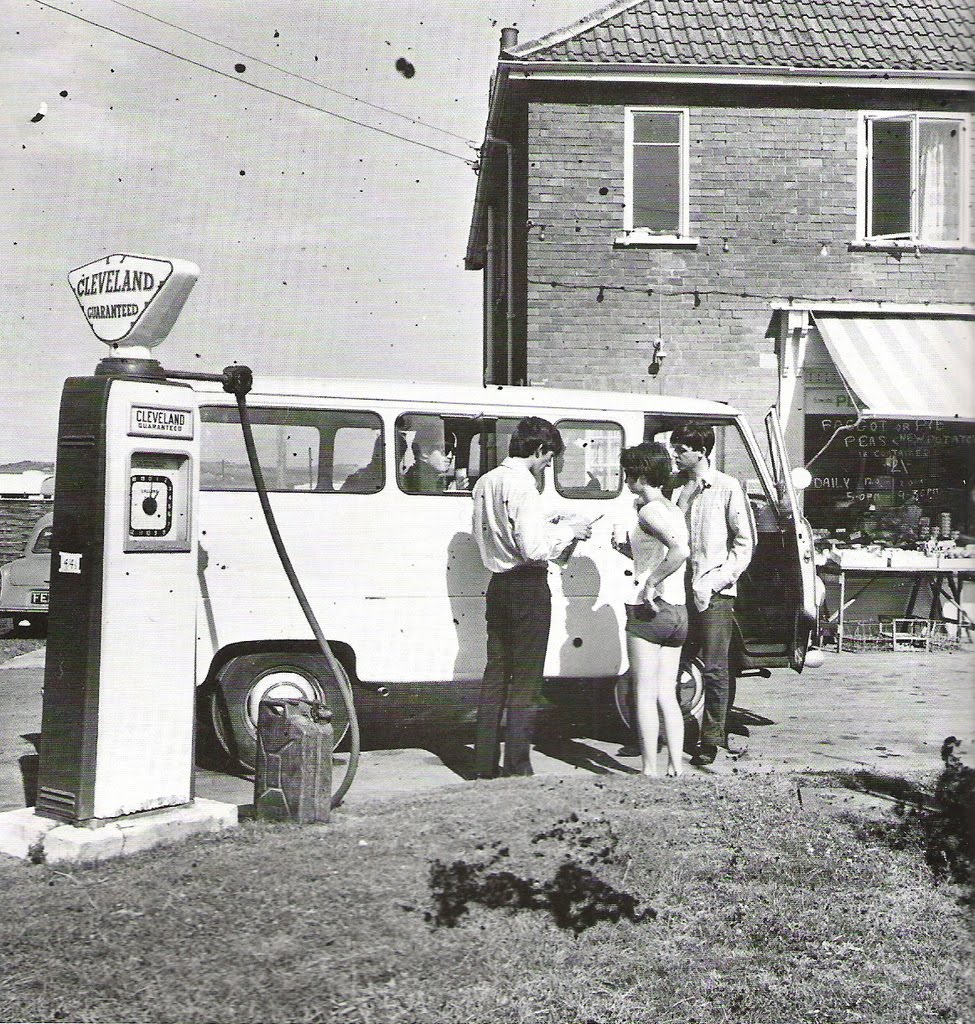
What octane do documentaries use? (Photo of the Beatles at Weston-super-Mare by Dezo Hoffman, 1963)

“Yeah, that’s what I was thinking,” John replied.

And here you thought John didn’t care about the band anymore. The Beatles were a wounded group before the Get Back sessions started, and salt would soon be added when George quit in two days’ time. But the Beatles were still worth saving in January 1969, even if John himself would call it quits well before the calendar year was out.

The day’s musical session was complete, Paul having walked the group through “The Long and Winding Road” and “Let It Be.” For these final 15 or so minutes on the tapes, all four Beatles are engaged, animated and opinionated concurrently to a degree yet unheard to this point on the Nagra reels.

All the principals immersed, Denis O’Dell makes the sell on Michael’s repeated preferred overseas adventure.

“I really think we could go and shoot a day sequence, a night sequence, a torch-light sequence, out there the sea, desert, in four days. Make it comfortable for everybody.”

Paul’s skepticism remained. But he was willing to keep options open and the live concert plans … uh, afloat.

My major objections to that: Traveling, one. Setting up and everything — I’m sure we can do that. Then, there’s that thing, which may not seem much, but we’re doing a live show, and we’re doing it in Arabia (laughter), and everyone’s waiting to see the lads rocking again. So, like, I’ll tell you what then, I’ll come in with it as long as you can get a couple of boats, the QE2. And then give away the tickets here, as you would have done, but the ticket includes a boat journey as well.

The composition of the audience was a sticking point, especially for Ringo, and there’s something virtuous to be said for the lads’ loyalty and desire to be rocking again before an audience that was with them from the start.

“We’ve got to get the right audience for Russia,” Michael said. “If we can get the right audience over there, which we can get over there.”

George wasn’t easily swayed. “What is the point of doing it abroad… apart from getting a great holiday? I’d much rather do it and then go away.”

Reminding the band of Twickenham’s relatively pedestrian features, Denis replied, presumably waving his hand at the scene around him, “To get away from that, that’s really the answer.”

“It’s ‘Around the Beatles ‘69′,” John acknowledged after a brief exchange about potential set possibilities on the Twickenham stage.

Paul, having had enough at the end of a long day, aggressively presented a compromise.

“I’ll tell you what I’ll offer you. If we’re going away, and we hire a boat to take the audience with you, we’ll do a bloody show on the boat, and then we’ll do a show when we get there, in the moonlight. … Final dress rehearsals on the boat.”

History never stopped chasing the Beatles, and sometimes it caught up to them. They didn’t want to repeat a past accomplishment, whether it was “Around The Beatles” or a stadium show. But Paul’s suggestion would have done just that: Bringing along a select audience to a performance at sea would combine a pair of episodes from the other side of their career.

Feb. 20, 1962, just a month after Brian Epstein formally signed on to manage them, the Beatles — that’s still John, Paul, George and Pete, at this point — performed an important show at Floral Hall in Southport. From Mark Lewisohn’s epic Tune-In:

[Epstein’s] principal involvement in the Floral Hall night was two-fold: to help sell the 1200 tickets and to book the talent that would provide continuous dancing for four hours — five groups headed by POLYDOR RECORDING STARS, THE BEATLES. He circulated typed leaflets among Beatles fans and on the record counters at all three Nems shops, announcing affordable coach trips: fans could pay 8s, 6d for return transportation, admission to the hall and, afterwards, the chance to mingle with the musicians and get their autographs. These special all-in tickets were sold only in the Whitechapel shop, outside which the chartered buses would leave. The Beatles were taking a Liverpool audience with them for a night out up the coast.

Emphasis mine.

Instead of towing British passengers across the Atlantic and Mediterranean, the Beatles brought their fans from their Cavern Club base in Liverpool about 20 miles up the A565.

That was by bus. Six months before the Floral Hall show, the Beatles made the first of four appearances on the Riverboat Shuffle, a concert series on the MV Royal Iris, a ferry cruising in the River Mersey.

For Paul — who would record parts of Wings’ London Town on a boat in the Virgin Islands in May 1977 — the Royal Iris performances made enough of a lasting impact that he referenced them decades later on his 2007 LP Memory Almost Full:

The journey wasn’t as important to Michael as the destination: the Roman amphitheater in Sabratha, Libya.

“I don’t think anything is going to beat a perfect acoustic place, by the water, out of doors, a perfect theater, with perfect acoustics,” he said.

John was on board. “Just singing a number, sunset and the dawn and all that. Gentle, and the moon, and all that for the songs, you know.”

“I think we’re going to do rock and roll at dawn or at night, and we can have the change of day over something like this,” Michael replied. “Because I’m sure we can do the rock and roll there if we get the right audience.”

All-important consensus was building between the two most powerful members of the band, and it was more than wanderlust and closer to finding a way to heal that wound — do something different, but still be together as The Beatles.

“Last year, when we were doing the album, like you said, we suddenly said we don’t need to do it here, in EMI in London,” Paul said. You can listen along to this particular sequence on the “Fly on the Wall” bonus CD packed with Let It Be … Naked.

John excitedly picked up the argument.

“Every time we’ve done an album, we’ve said, ‘Why are we stuck in EMI, we could be doing it in L.A.! We could be in France! And every time we do it, and here we are again, building another bloody castle around us, and this time we [should] do it there. And not only would we be doing it, physically making the album there, but it takes [off] all that weight of, ‘Where’s the gimmick, what is it?’ God’s the gimmick. And the only problem we’ve got now is an audience, you know.”

For a moment, at least, Paul’s skepticism vanished.

“It makes it kind of an adventure, doesn’t it?”

8 Comments

Filed under Day by day

Jan. 8: An hors d’oeuvre

“All Things Must Pass” should have been a Beatles song, another gripping, iconic anthem dating to the group’s long goodbye.

gh-rs

By the time the Beatles were rehearsing and recording in January 1969, George Harrison’s emergence into a songwriter that rivaled John Lennon and Paul McCartney was essentially complete, with “All Things Must Pass” part of that transformation. Taste matters, but a fair argument could be made that the song could have been the band’s greatest.

“All Things Must Pass” — which had the potential to emerge during the Get Back sessions, be performed live and later land on the Let It Be LP — thus could have gone a long way to giving George his ‘moment’ prior to the group’s send-off of Abbey Road. It never happened. But on January 8, John and Paul gave George the option of taking his song, creating that moment and enjoying his own spotlight at the live show to come. They never said it, but based on the prior week’s tapes, the two senior members of the band were probably just disinterested in playing the song.

“Do you fancy just doing it on your own on an acoustic?” Paul asked. “That would work. But it’s a bit of a thing for you.” The “thing” in question was effort.

Paul would know about playing alone on stage with an acoustic guitar while the rest of the Beatles waited in the wings.

Would opportunity knock, but for George this time?

John was on board, too, condescendingly positing George could serve “an hors d’oeuvre” to the presumptive hungry crowd.

George didn’t directly knock the idea, but didn’t follow up on the suggestions, instead trying work Paul and John on the chorus’ harmonies. After scuttling Paul’s suggestion to begin the song with George’s instrumental opening straight into the chorus, instead of the first verse — hey, it worked for “Don’t Let Me Down” a few days earlier — the pair haggled over the bassist’s harmony line, with Paul complaining it moved too much.

The group spent about a half hour on the tapes working on and around “All Things Must Pass” on January 8 — returning to the song after skipping it the day before — and while there was no significant or specific alterations to the song from the previous days’ rehearsals, they capped the day’s work on the song with a legitimate, listenable and, dare I say, enjoyable take of “All Things Must Pass.” It’s a version that should have shown up, at least, on Anthology 3, in addition to George’s one-man demo from a month later.

While the day’s final take is not too dissimilar in overall form than the one ended up on the final recording on George’s solo debut the following year (excepting the orchestration and dozens of additional flourishes, of course), John’s piano part here — he had moved over from organ in the final phases of the day’s takes — added little, usually amounting to pounding out chords. Still, it’s not wholly detrimental, and Paul’s bass line is on point.  Ringo, as usual, hits the spot.

The Beatles’ greatness has been amplified by the what ifs and what could have beens, and the possibility of a “Beatles’ 1969 classic ‘All Things Must Pass’” is a genuine opportunity lost.

It sounds as good as it could at this point in what amounts to a few hours of overall rehearsal and arrangement with half to three-quarters of the band giving a fraction of effort. It’s the Beatles playing a coherent, complete version of “All Things Must Pass,” and that counts for something in a world where such a release never existed, yet we all paid money (several times, in fact, thanks to new formats, remastering, etc.) to buy “Wild Honey Pie” and “Dig It.”

There is a “rest of the story.” But the vast majority of history of “All Things Must Pass” by the Beatles is now mostly told. This pre-lunch performance marked the final time they played the song at Twickenham. They returned to it very briefly near the end of the month at Savile Row with the support of Billy Preston, who released the song a few months before George would in 1970. By January 8, 1969, the rehearsal stage was essentially over, however, and this was really the final fumes of “All Things Must Pass” as a Beatles song.

Notably, the song never appeared in the Let It Be film. “I Me Mine,” revealed earlier on January 8, did, joining “For You Blue” (which was properly introduced to the band a day later) as George’s contribution to the Get Back sessions. Despite all the hours of rehearsals, the song he carried over into January 1969 as a product of his days with Dylan and The Band, would be passed over by his own band. And it was good enough to serve as the title track of what could be argued to be the greatest Beatles solo album.

6 Comments

Filed under Day by day

TMBP Extra: Since he fell out of the womb

Over the years, we’ve celebrated the birthdays of Paul McCartneyJohn Lennon and Ringo Starr, looking back at the periods straddling the big days in 1968-1969. Today it’s George Harrison’s turn. It may be the anniversary of George Harrison’s birth today, or it may be the day after the anniversary of his birth. With Liverpool under bombardment during World War II, keeping the records became confused that day in 1943. But February 25 is the day George celebrated, so it’ll be the day we mark, too.

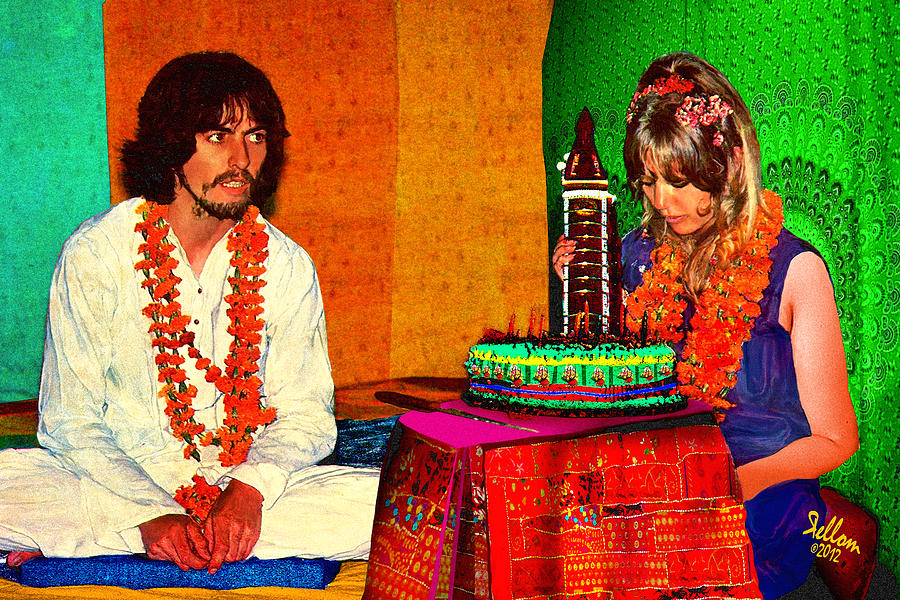
1968, in India. That's actually a cake for Pattie Boyd, whose birthday was a three weeks after George's.

India, 1968. That’s actually a cake for Pattie Boyd, whose birthday was three weeks after George’s.

George’s 26th birthday came just a few weeks after the Beatles wrapped up the Get Back sessions at Twickenham and Savile Row. It capped a remarkable year in his life and career, one that could fill a book, much less a blog post.

George’s 25th birthday was celebrated in India less than 10 days after the Beatles arrived to study Transcendental Meditation under Maharishi Mahesh Yogi. Their retreat lasted nearly two months (for George, who outlasted the rest of the Beatles), transforming the four men, their music and Western culture along the way.

Starting in May and lasting throughout the summer, the Beatles recorded The Beatles. The double White Album, featuring a career-high four compositions, would be released before the winter. In between, George produced Jackie Lomax and saw the release of his solo LP Wonderwall, which was recorded late 1967 and early 1968. (It’s really great, and worth infinite listens).

With Winter 1968 came another transformative overseas trip, this time on the other side of the earth from India, a journey that included a stop in upstate New York, where George spent an intimate holiday with Bob Dylan and the Band, playing and writing songs. They were not laying the groundwork for the formation of the Traveling Wilburys about 20 years later, but it’s worth the dream.

That brings us to January 1969, and you can read all about it here and in posts to come. It’s worth noting, George brought Billy Preston into the Beatles’ circle, and then later would produce him for Apple.

What happened next? George had his tonsils out a week after the rooftop concert, and was laid up for about another week.

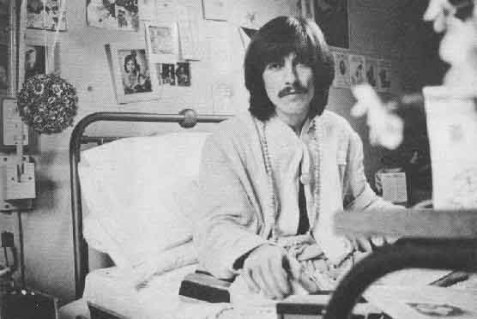
George breaks up with his tonsils, February 1969. Photo appears in his autobiography, I Me Mine.

George breaks up with his tonsils, February 1969. Photo appears in his autobiography, I Me Mine.

He joined the rest of the Beatles on February 22, 1969, to record the first 35 takes of “I Want You,” essentially beginning the Abbey Road sessions, and that about brings things up to his 26th birthday, on February 25, 1969.

Of course, that’s not it. What about the music? Check out this list of Harrisongs composed or at least worked on seriously between his 25th and 26th birthdays (listed alphabetically, with one obvious omission I’ll explain below): “All Things Must Pass,” “Badge” (with Eric Clapton), “Circles” (eventually released in 1982), “Dehradun,” “For You Blue,” “Hear Me Lord,” “I Me Mine,” “I’d Have You Anytime,” “Isn’t it a Pity,” “Long, Long, Long,” “Not Guilty” (left off the White Album, it was released in 1979), “Nowhere to Go” (All Things Must Pass LP outtake written with Dylan), “Old Brown Shoe,” “Piggies,” “Savoy Truffle,” “Sour Milk Sea” (written for Jackie Lomax), “Wah-Wah,” “While My Guitar Gently Weeps,” “Window, Window” (another All Things Must pass outtake). And there’s probably others we don’t know the origins of that would fall in this timeframe too.

Enjoy it all on this YouTube playlist (it’s not just “Badge” as the image implies — click around!):

Not too shabby. As a bonus, he finally had his first song to appear on a Beatles single — the mighty “The Inner Light” was on the flip side of the “Lady Madonna” single, released while they were in India.

Oh, he bought a Moog, too. More about that later in 1969.

George had a really good year, artistically. It was an important one spiritually, too, and he was expanding his professional horizons and stockpiling compositions. In many ways, he shaped the Get Back sessions by walking out and resetting the parameters under which the group would perform live, plus he brought Billy into the fold. His relationship with Dylan, developed when he was in New York, was a critical moment in his career and his own window into how other artists could interact, and reflecting everything that was wrong with the Beatles. While he was still not quite yet afforded the same global respect given to Paul and John, the Beatles’ junior member’s time would come in 1969, thanks in large part to something.

Sorry, I missed the punctuation and capitalization. That’s thanks in part to “Something.” 

There are lots of dumb ways to spend a birthday in your 20s, but recording a few demos at EMI Studios on Abbey Road isn’t one of them.  February 25, 1969, saw George cut solo acoustic versions of “Old Brown Shoe” (first debuted during the Get Back sessions) and “All Things Must Pass” (from 1968, and rehearsed extensively in January 1969). The final song he worked on that day was “Something”, the seeds of which were planted in 1968, but he hadn’t completed as late as the final days leading to the rooftop concert on January 30, 1969.

You can find takes of all three songs on Anthology 3, with a fleshier version also on the 2019 Abbey Road anniversary deluxe edition.

The commercial and critical success of the Abbey Road release of “Something” (finally, his first A-side) — earning high praise from Lennon and McCartney — plus the LP’s “Here Comes the Sun,” changed how George Harrison, Songwriter, was viewed. The time and efforts he spent between his birthdays in 1968 and 1969 propelled him to that point.

6 Comments

Filed under Extra