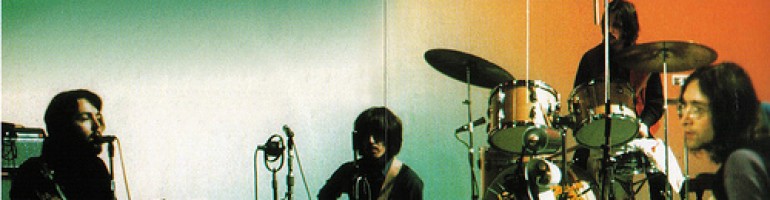
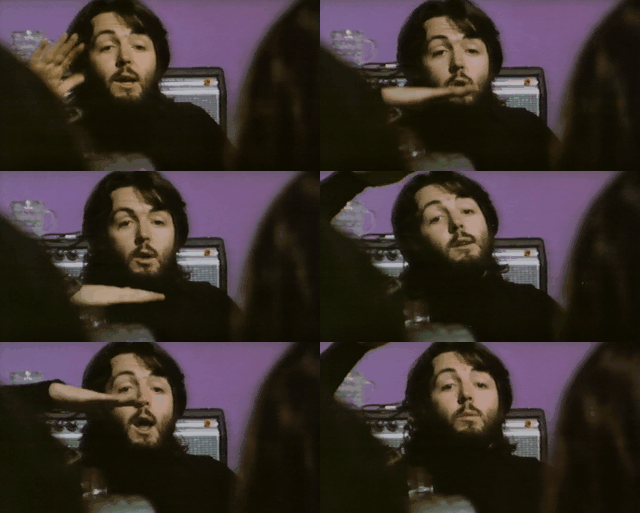
Paul McCartney began January 9, 1969, at the piano sketching out “Another Day,” but it was anything but for the sixth day of the Beatles’ sessions at Twickenham, where things started to get a little testy, while musically it remained deeply compelling.
Just another day: The Beatles begin their second week at Twickenham with Paul at the piano and his muse by his side as he debuts an important future solo classic.
Road work: Twickenham is Paul’s songwriting lab as the morning’s tapes reveal his effort to put lyrics to several works-in-progress, like “Carry That Weight” and “The Long and Winding Road,” among others.
Last-night song: George Harrison lifts the veil on a proper version of “For You Blue,” but are the other Beatles eager to bite on another George original?
Jokes in between: Harmony and discord, joy and petulance. It’s a roller-coaster of moods for the members of the Beatles as they continued work on their core set at Twickenham.
Another kind of gig: Get yourself well done with the backstory of the Beatles’ lively and perpetually mysterious “Suzy Parker.”
Love from Paul: Take an exceedingly deep dive into Paul McCartney’s “Penina,” one of the most obscure originals from the Beatles era and a “£20,000 holiday tip.”
No Pakistanis: Inspired by current events, Paul McCartney works on a set of satirical, racially charged — and later misunderstood — lyrics to “Get Back.” Putting this Beatles’ session into appropriate context 50 years later.
Power politics: “This racial business over in England” inspires a suite of upbeat, satirical improvisations. This is the story of The Beatles’ “Commonwealth” and “Get Off.”
Subconscious sabotage: To his death, John Lennon hated the recording of “Across the Universe.” But with a chance to make it anew during The Beatles’ Get Back sessions, instead of changing his world, the song would slip away.
It’s dead easy: An inspired Paul McCartney & Co. raid the toolbox to effortlessly shape “Let It Be” into a more coherent, familiar song. Here’s the origin story of the riffs, harmonies and arrangement with far more detail than you likely asked for.
Homeward bounder: After flirting the night before with the idea of a sea cruise to Libya, The Beatles’ enthusiasm for show-boating waned as Ringo Starr preached mundanity over spectacle for a planned live performance.
Crossroads he’s standing at: How a pair of covers of yet-to-be-released Bob Dylan songs sheds light on George Harrison’s disposition the afternoon before he’d walk out on The Beatles.
Et cetera: Putting a bow on The Beatles’ busy January 9, 1969. Featuring “Junk” and “Teddy Boy” from Paul, some proto-punk from John, bugs that aren’t Beatles and more.
January 9, 1969, marked the last full day all four Beatles worked together at Twickenham during the Get Back sessions. Here are a few loose ends worth tying up before the pivot point of January 10.
“Junk” (Paul’s hand-written lyrics, from the White Album deluxe companion book)
Conceived in India in 1968 and born at Paul McCartney’s home in 1970, “Junk” and “Teddy Boy” were under a period of gestation in the studio in January 1969. These brothers in song, destined to be releasedtogether on Paul’s eponymous solo record, were likewise introduced to the Get Back sessions in tandem on January 9, 1969.
“Remember that one?” Paul asked the room after a spinning off a quick, shuffling verse of “Teddy Boy.” That song’s story will continue later, after the action shifts to Savile Row.
“And ‘Junk’?” Paul continued.
That song, while lyrically incomplete, was formed enough to be among the May 1968 Esher demos, but except for this momentary appearance, it wouldn’t surface again during the Get Back sessions and it never seemed to be a contender for Abbey Road, either.
It’s a stretch to even call this a performance.
After mentioning the song’s title, Paul rattled off a few words (“epsilon,” “elephant,” “parachute” were the most recognizable) in an exaggerated French accent — John Lennon chipped in, too — to the tune of the song before they quickly return to “Across the Universe.”
A key takeaway from this sequence is the nostalgia with which Paul asks “remember that one” to John, as if these were songs from their childhood, not merely less than a year old. Paul, especially, will refer to the trip to India as if it was another era. More on that as we get to those portions of the tapes.
*****
We’re living in the wrong timeline.
John: “I’d like to do a number just on electric”
In another universe, John’s “Quit Your Messing Around” is hailed as essential proto-punk, a harsh, noisy sound brought into the mainstream. In ours, however, the song is a sub-30 second blast of chords followed by John’s four-word request, obscured by so many other electric (and acoustic) numbers throughout the day’s songs on the tapes.
*****
Surrounded by a film crew for a week already, the Beatles were still learning the extent of personal coverage a week into the sessions.
“This is the bugging device,” Michael Lindsay-Hogg said. “So we can surreptitiously bug your showbiz conversations.”
In this sequence, both Ringo Starr and George Harrison on separate occasions asked if “that” was the tape.
This bugging device will be a part of the story the next day of the sessions.
*****
Ringo was consistent, at least. He resisted traveling abroad for a concert, and he lobbied against needless travel for his role in The Magic Christian, too.
Film producer Denis O’Dell was working on selling Ringo on filming a scene in New York, mostly to get a single distinctive shot.
“We thought of doing one day in Wall Street,” Denis said, though conceding he was “two-minded about it.”
“If we’re just going to America for one scene … I mean, I’ll do it. I don’t think it’s worth it.. .. And who knows Wall Street? I don’t know Wall Street. Unless you put up a sign that says “Wall Street,” I’d have no idea what it looks like.”
The scene was never filmed. But four months later, Ringo joined the rest of the cast and crew on the QE2 as it sailed for New York to celebrate the end of filming.
*****
As the day’s session came to a close, John and Yoko Ono apologized to Paul — and notably not the film’s director or producer — for consistently rolling into the studio well after the others. Paul’s reply was a study in passive-aggressive behavior.
Yoko: Are we getting later and later? Paul: … It’s getting to be a habit. John: OK, we’ll come in … Yoko: … around 10, Paul: I’m getting used to it! Don’t throw me now.
During a brief transition immediately preceding the extensive “Let It Be” session late on January 9, 1969, George Harrison opened himself up to significant, retrospective armchair psychoanalysis in just five minutes of music.
He also became a human bootleg.
Everybody’s got somebody to lean on: Lucky and Nelson, November 1968.
Bob Dylan’s Basement Tapes with the Band (a huge influence on the Beatles’ Get Back sessions) had been privately circulating since 1968, and the first true rock bootleg — Great White Wonder, which featured two LPs of his music that stretched back to as early as 1961 — surfaced in record shops starting in July 1969.
But this January 9, George — just a few weeks removed from his first collaboration with Dylan — seized a few moments of spotlight and shared a few of his friend’s songs, and ones that the others in the room hadn’t likely heard.
“I Threw It All Away” was so fresh a cut, Dylan wouldn’t record it for his forthcoming “Nashville Skyline” until Feb. 13, precisely two weeks after the Beatles’ rooftop performance and while George was in a London hospital recovering from a tonsillectomy.
Dylan first shared the song with George and wife Pattie Boyd around Thanksgiving 1968 at his home in upstate New York. George retained quite a bit of the song in performing at Twickenham, injecting intensity in his solo acoustic take.
George didn’t perfectly nail the lyrics, but he captured guts of the chorus and parts of the verses — “No matter what you think about it, you just can’t do without it. Take a tip from one who’s tried … And I threw it all away.”
The performance seamlessly went into “Mama, You Been On My Mind,” written in 1964, but to that point another unreleased Dylan track.
Perhaps it’s the color of the sun cut flat
An’ cov’rin’ the crossroads I’m standing at
Or maybe it’s the weather or something like that
But mama, you been on my mind
When you wake up in the mornin’, baby, look inside your mirror
You know I won’t be next to you
There could be no reason at all George plucked these songs out of thin air this Thursday afternoon, as meaningless as the group’s brief forays into “Tennessee” or “Slippin’ and Slidin‘” within the same hour. He’d been playing Dylan throughout the sessions, after all.
Or …
Maybe the songs reflected George’s mood as he was less than 24 hours from quitting the group. Paul transparently sang the blues about the Beatles in “The Long and Winding Road,” “Let It Be” and “Golden Slumbers,” so why wouldn’t George do likewise? It’s not a significant stretch to consider George was speculating about what he was throwing all away, at these crossroads he was standing at.
Without question, those two Dylan songs did hit home with George.
But …
Maybe it wasn’t necessarily only for the reasons we’ve always supposed.
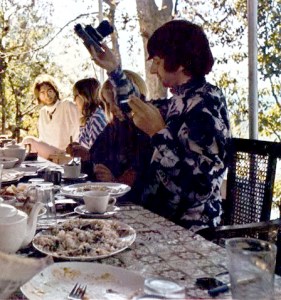
The January 9 tapes begin with the Paul’s muse, Linda Eastman, visiting the studio. John’s girlfriend, Yoko Ono, had been a Beatles session fixture for months, and this day was no different.
George’s wife, Pattie, was very much not hanging around Twickenham. And when she looked inside her mirror, George wasn’t next to her, because she had walked out on him. But that didn’t mean he was alone at his Kinfauns home.
From Pattie’s autobiography Wonderful Tonight:
I was friendly with a French girl who was going out with Eric Clapton. She was always flirtatious with George, but so were a lot of girls and he, of course, loved it. Then she and Eric broke up — Eric told her to leave — and she came to stay with us at Kinfauns.
It was January 1, 1969, and George and I had seen in the new year at Cilla Black’s house. … We arrived home in good spirits but then everything went swiftly downhill. The French girl didn’t seem remotely upset about Eric and was uncomfortably close to George. Something was going on between them, and I questioned George. He told me my imagination was running away with me, I was paranoid.
Soon I couldn’t stand it so I went to London to stay with Belinda and Jean-Claude. Six days later George phoned me to say that the girl had gone and I went home.
The French girl was 20-year-old Charlotte Martin, and she had been dating Eric for more two years. Eric has since said he left Charlotte because of his growing feelings for Pattie. Why, you can almost say George tried to give her consolation when her old man let her down.
George’s fling was in its final day on January 9 — and after leaving the Beatles the next day, he asked Charlotte to leave Kinfauns, ending the affair. He would reconcile with Pattie, and separately, with the rest of the Beatles shortly thereafter.
The two Dylan songs George touched on wouldn’t drift far from his consciousness. Sixteen months after this date, George joined Bob in New York City, where they recorded both “I Threw It All Away” and “Mama, You Been On My Mind,” and the sessions have since surfaced on bootlegs.
George continued to show love for “Mama, You Been on My Mind,” laying down a solo studio version in the 1980s; this was still before Dylan’s first authorized release of the song in 1991. George’s recording would get a proper release in 2012 on Early Takes, Vol. 1.
He recorded it at home in Friar Park at some point during the ‘80s, and it originally had programmed drums and loads of keyboards on it, and George had overdubbed himself for a three-part vocal harmony.
I asked [George’s widow] Olivia if it would be OK to break it down a bit, I thought it sounded a lot better stripped to its bones. You can still hear a bit of the drum sound in the background, because there was bleed on the tape — probably coming through from George’s headphones.
George did his own three-part harmonies in the ’80s, but his first vocal partners, John and Paul, were silent on the tapes during George’s brief Dylan set on January 9, 1969. Walking out on the group, George silenced himself the next day, not only because of his increasingly tense relationship with John and Paul, but with trouble surrounding his marriage, as well.
***
Charlotte Martin remained in rock-and-roll’s inner circle. In a coincidence of the calendar, exactly one year after her last day involved with George, on January 9, 1970, she met Jimmy Page after a Led Zeppelin concert. The couple would maintain a relationship into the 1980s. Their daughter, Scarlet Page, is a rock photographer of note; she’s shot Paul McCartney and contributed to the Visions of Dylan photo exhibition in 2007.
It was becoming clear by the end of January 9, 1969, that the Beatles would end up opting for ad-hoc over adventure.
A lengthy discussion the night before found all four Beatles showing varying levels of willingness to travel by boat to Africa for a one-off show, and some sort of decision seemed imminent. With the planning needed and a schedule to keep before the band lost Ringo Starr to an imminent acting assignment, it had to be.
But after the group slept on it, pinning down a consensus was just a dream. Any momentum to raise anchor dissipated among the members of the band, despite the continued best efforts of director Michael Lindsay-Hogg to ship the group to a Roman-era amphitheater in Libya.
There was no grand discussion about the show on this Thursday, just a series of short conversations sprinkled about the day among the various principles. The Beatles were making musical progress at Twickenham Film Studio, and as the Nagra tapes proved, the overall mood was fine, certainly better than it had been a couple of days earlier. But there was no great enthusiasm for travel, and it often seemed like settling on a venue was a binary choice: Twickenham or outside Tripoli, by boat — the devil (they know) or the deep blue sea.
“If we do it here, then we’ll do it in here,” director Michael Lindsay-Hogg told Paul McCartney’s girlfriend Linda Eastman on her January 9 morning visit to the soundstage. “But if we don’t, it’s on a boat to Tripoli,” said Paul.
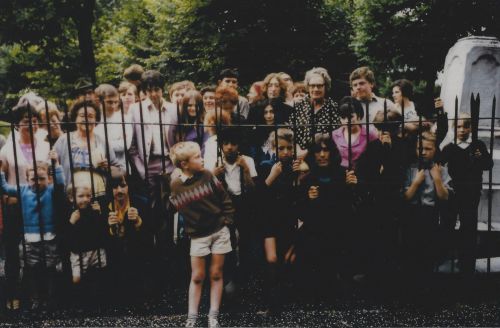
“Ordinary people like themselves.” On the Mad Day Out on July 28, 1968, the Beatles mingled with the British crowd at St Pancras Old Church and Gardens. Less than six weeks later, they filmed the “Hey Jude” promo film. (From Meet The Beatles For Real)
“So if you do it, it would be in here?” Linda asked.
“There’s many a story,” Paul replied.
“What will you do with all the equipment?” Linda asked. “Get it on the boat,” replied director Michael Lindsay-Hogg. “That’s what Apple’s for, really, isn’t it?”
Discussions over the show circulated around these unresolved issues: Where would it be staged, what would be its format and who would be the audience. Thus the seventh day of the session was not much different than the first, and it wasn’t even a matter of agreeing to some aspects and then pursuing another. Every aspect of the show was in flux, and every suggestion was repeated.
Airports, apartment houses, cathedrals, the Houses of Parliament — these venues were considered before and mentioned yet again on the 9th, along with a transformed Twickenham. Transformed how? That wasn’t elaborated.
The boat, which was brainstormed at length the night before, was in play. But Ringo, while never issuing his veto, was clear in his distaste for a trip to Northern Africa, much as that was Michael’s preferred and planned choice. A continued sticking point was the his loyalty to a British — or American — audience. Ringo cited long-running talent show Opportunity Knocks as an example to follow in ultimately challenging that mundanity transcends spectacle, obscurity over celebrity — at least when it came to the spectators.
“Just because he had granny on the show, someone’s mother, and they only win because audiences like to watch ordinary people like themselves. That’s one of the things to do it here. Because English people — and Americans — and the two main people, at least they can associate with them and say, ‘I could have gone there.'”
MLH: The only thing is, I really do think it’s going to be for the world. Ringo: The biggest part of our world is America and [here]. MLH: But funnily enough, I think the way they think of you is not only for themselves but they do think of you as for everybody in the world. That was one of the things things that was good about Jude, the guy in the turban. ….
Unfortunately, the tape cuts off during this dialogue, but we can assume it’s much of the same conversation that we’ve heard before with similarly little resolution.
(For the record, Opportunity Knocks provided Apple Records with one of its greatest success stories: Mary Hopkin’s winning performance in May 1968 directly led to her signing with the Beatles’ label).
Still, Michael was planning as if he could sway Ringo eventually.
“I think we spend till the middle of next week here or til the end of the week, go out on the and the following weekend. That’s eight days,” Michael said.
Ringo: Too long. MLH: Go out on Sunday and finish it on Sunday. Ringo: How about Sunday and finish it on Wednesday? Who wants to stay in Tripoli? MLH: Denis (O’Dell, film producer), isn’t Tripoli a great country? Denis: It’s the asshole of the world there. (Laughter) MLH: You didn’t take my feed! Denis: Look, I have to work with him the next six months and therein after! (More laughter)
Denis next related a story of how Ringo “saved his life” in India, thanks to the drummer’s cache of Western food he left behind when he returned to England. “[I] went back to Ringo’s room and I was rummaging around … found some powdered milk and baked beans, and it was a feast. … The stuff that you and Maureen left, and that’s what I lived on secretly.”
Uncommitted as they were to a destination for a live show, the Beatles comfortably and casually addressed the composition of the gig itself.
Many times I’ve bean alone: Ringo’s diet in India. (From Beatle Photo Blog)
The band discussed staging issues (“It is a bit silly to be rehearsing sitting, facing this way, when we’re actually to be playing standing, facing that way”) and between-song banter (“First chance we’ve had to play for you dummies for a long time”) — see Jan. 9: Jokes in between for more on that.
“Is Michael around?” George asked at one point. “If we are in a groovy location place, and if there’s just people there and we’re just playing anyway, [can] we make the show about different bits and pieces of what we’ve done or [do] we have to do it in one consecutive piece?”
John: We do both, you see. We set one way when we say, ‘This is the show,” But we do, like, a dress rehearsal and another rehearsal. George: (Laughing incredulously) Dress rehearsal? John: Well, you know, we do it as is, we try and do it one through. We should do it about three times, and probably the middle one will have the most. And see if there’s anybody around that played piano or anything we just get him up, and let’s have a gig.
John told the future well, unaware at the time Billy Preston would be that piano player. John also didn’t realize that the man he was speaking to would walk away from the group the next day.
It took only a few minutes on January 9, 1969, for Paul McCartney to invoke jazz guitar, classical compositions and swing percussion for a hymnal ballad being written for an R&B singer that would become a classic rock and easy listening staple.
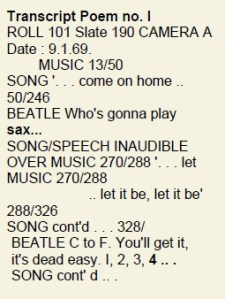
Transcript Poem No. 1, from the Get Back Book
“Let It Be,” lovingly and deliberately crafted during much of this day, spoke clearly to Paul’s boundless musical vocabulary, and on the day’s Nagra tapes we clearly hear the well-defined, rich genetic code buried within the song. No wonder it’s so special.
Dubbed “Mother Mary” by Paul at this point, “Let it Be” received solo piano treatment early in the day’s session per Paul’s daily ritual and a brief engagement, mainly with George Harrison, midday. The full ensemble’s rehearsal treatment later in the working day crafted the song into something both concrete and familiar. But importantly and quite visibly, Paul didn’t arrange it all by himself.
To recap the chronology of “Let It Be” to this point:
• September 6, 1968: The earliest-known recording of the song — released in 2018 on the White Album Deluxe — consisted of a snippet of the first verse and chorus. Paul is on piano (the group was in the midst of recording “While My Guitar Gently Weeps”). If there was anything to “Let It Be” beyond this, it’s either buried inside the vaults at Abbey Road, secured in Paul’s private archives or lost amid the echoes of Cavendish Avenue. But there’s no reason to believe there was really much more, because …
• January 3, 1969: While the song gained an introduction as the Beatles rehearsed in their first full day at Twickenham, Paul hadn’t advanced “Let It Be” beyond the first verse and chorus, exactly what he had in 1968.
• January 8, 1969: After the weekend and a couple extra days, the song appeared on the tapes again, as Paul disclosed he wrote the song for Aretha Franklin — but he wanted the Beatles to record it, too. Paul instructed a faster pace on the drum pattern and shared the chord structure with George. The musical tag was borrowed from the introduction and applied to the song’s conclusion, as the day’s session wrapped.
On January 9, the song was a significant focal point, with rehearsals of “Let It Be” alone taking up a good 20 percent of the day’s recorded sessions on the tapes. An initial midday discussion of the tag — “just at the end of ‘Mother Mary,’ there’s, like, a riff,” as described by Paul — was nestled between rehearsals of “Get Back” and “Across The Universe,” just prior to the “Penina” origin story.
At once, Paul had an unfinished song — musically, it was sharp, but the lyrics were quite incomplete — and he solicited advice and allowed the song to evolve, while at the same time explicitly mapping out musical parts for the others.
(Ignore the subtitles in the below clip, for everyone’s sake. But enjoy the audio from this part of the session)
The first phase of the hour-plus sequence that concludes the day’s tapes has Paul walking the others through the song in a deliberate fashion.
To Ringo Starr: Play the drums “like swing.”
To John Lennon, who was on bass: “C … G … A … F,” Paul instructed, vocalizing the bass part with piano accompaniment and working his way through the verse and chorus. “You’ll get it, it’s dead easy.”
Paul continued to work the group through the song, repeating the verse-chorus sequence, methodically taking stock of every element. After the primer, the song’s iconic harmonies were casually introduced to the chorus. “It’s like ‘aahs,'” instructed Paul, who suggested harmonies that were to be delivered “very simply.”
There’s a lot of things with these chords. See that harmony there – it’s like church harmony. There’s all that bit of sustained. … it’s like Bach, just holding the notes. Can you hear it?
With the harmony in strong development, Paul shifted to broader aspects of the song, like “how should we start it?” (Days earlier, John asked the same thing of “Don’t Let Me Down,” unsure how to arrange the various elements of the song).
There was a go at opening “Let It Be” with the chorus, but that idea was scrapped quickly, with the song’s soon-to-be established format taking hold early on.
“OK, the first two choruses, just the piano,” Paul said. “Then the second thing to come in is your two voices on the ‘let it be.’ And then [it] builds. So maybe bass isn’t in till, like, halfway.”
While the harmonies were framed around a centuries-old inspiration, Paul invoked a contemporary to George for his guitar part.
“If you could just somehow hold the one note on guitar without making it sort of corny,” Paul said. “Like Wes Montgomery, the octaves.”
Too bad we don’t get to hear a complete picture of what happens next, because … cats.
Michael-Lindsay Hogg: “I don’t like dogs, I like cats.”
Ringo: “We’ve got a poodle, as well.”
With the tapes’ camera and microphone shifting to a conversation between the film’s director and drummer, we’re deprived of a clear listen to the continued development of the song for a few moments. But the instructional continued in the background, as John added a grating, deep baritone harmony that was thankfully abandoned ultimately, but was retained throughout most of the day.
As Ringo continued his conversations away from the rest of the band, including a chat with Denis O’Dell about the Magic Christian, Paul and John alone casually delivered a rendition of Buddy Holly’s “That’ll Be The Day” — which was the first song recorded by the Quarrymen (to an acetate) more than 10 years earlier.
Following John’s cheeky order — “Come on you gits, get on your fucking instruments!” — the rest of the group indeed followed their leader, enthusiastically launching into an full-band Little Richard medley, “Slippin’ and Slidin'” (as later covered by John) into “Jenny Jenny,” before Paul applied the breaks in a return to “Let It Be.”
As a nod to his muse, Paul swapped in “Oh, Aretha Franklin” where he would normally sing “speaking words of wisdom” at one point.
Resuming the song-crafting process, Paul sought to integrate the musical tag he mentioned earlier to George.
Paul: I was thinking John: You’ve been thinking again. Paul: After we’ve done the “let it be, let it be,” done the whole thing through, we might make something of [played the riff]. … Like, without rhythm, but with you [John] and me doing it.
Upon Ringo questioning when the various instruments come in throughout the song, Paul begins make suggestions before stopping himself.
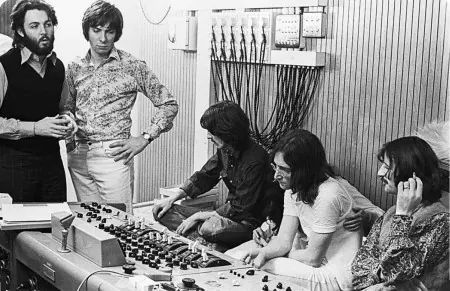
Enter Glyn Johns. Well, not really “enter” — he’d been with the group the entirety of the sessions in a somewhat nebulous production role.
“He seems to be arranging this, come on,” Paul said to laughter. “That’s good, come on.”
After they had finally run through the first song a couple of times, Paul turned to me and asked what I thought they should do for an intro. I nearly fell over in shock. I thought I had been employed to just engineer and here I am in the first hour of rehearsals being asked for my input into the arrangement. I responded as quickly and confidently as I could and suggested a way of playing the intro, which they liked, and we were off. I was amazed at how quickly and easily I was accepted, each guy individually making an attempt to put me at ease and make me feel part of the team. …
On the second day, things came to a head among the band. …
I have a very clear memory of sitting outside in the bleak surroundings of the soundstage at Twickenham at on that cold gray afternoon with Denis, the line producer for the film, both of us praying that the elation of being employed for a project with the most successful artist in the world was not about to come to a grinding halt after two days.
It is not my place to discuss any detail of what happened, but it is common knowledge that George left the band and was persuaded to return a couple days later.
Glyn’s timeline isn’t precise; he wrote that the arrangement request was on the session’s first day (which was January 2) and George would quit the band the next day, but Paul was a late arrival on the first day at Twickenham and George’s departure happened on January 10, the day after the events of this post. Still, the recollection is valuable to get an idea of Glyn’s mindset early in the sessions regarding his role.
Glyn with the Beatles, from Glyn’s autobiography, Sound Man.
With Paul handing him the reins, Glyn was confident and direct in dictating his plan — based on Paul’s original idea — to a very receptive band.
“Absolutely nothing except the piano and voice the first time around,” said Glyn. “And then the voices, right? … Then you [George] come in where you come in. And you [John] come in the next time round.
“So it goes: Piano and voice. Backing added [to the chorus], then it goes back to the top [the sound of high-hat is played]. George is in then. John comes in when John comes in. Then the the next chorus, you’re [Ringo] back in on your thing, and back on your [swinging drum pattern]”
Paul gave very simple approval — “that’s it” — before leading the group into a demonstration and subsequent instructions, like building up the percussion without any snares — “It’s like jazz,” George remarked — and adding “big drums” on Ringo’s fill before the second round of the chorus.
The writer and arranger disagreed on when John and George should come in — Paul proposed they should join together, while Glyn thinks otherwise. “It’s all happening a little bit too quickly with the bass coming in at the same time, that’s all,” Glyn said. Paul deferred, and instructed George to come in for a solo after the “big” chorus, and to base it after the verse’s chords.
“Do it to your own discretions and sort of come in so it builds up, just so you’re not all in at the one time,” Paul said. “Let those two [Ringo and John] get in before you [George] come in.”
The group returned to a run-through as it was drawn up with George entering into the riff, after the second chorus. But it didn’t click and the placement of the riff becomes the next segment receiving attention.
Glyn suggested back-to-back plays of the riff after the second chorus, an idea Paul jumped on.
Paul: See, then that can lead into the solo, ’cause I think it’ll be time by then.
John: Just use that riff into the solo and the end [of it] for the end.
Paul: It’s going to be a short one, anyway.
Paul ordered up “two lengths of solo,” while he and John added harmonies over the second one. The conclusion of “Let It Be” was then sketched: the guitar solo, another chorus and two plays of the riff, with the second one coming in slow.
A first full run of the complete song structure clocked in at barely more than two minutes, with no additional verses after the solo. That is, what we know now as the “And when the night is cloudy…” verse — that section didn’t exist yet.
“Want to do it again? George asked. “It’s quite short, isn’t it?”
“Yes, it is a little bit,” Paul conceded. “It does need something else. It may be sort of ‘oohs’ though the second verse or something else when the cymbals come in. It sounds a bit sort of bare with just piano there.”
“Organ. I could play organ for that and drop it for the bass,” John suggested, forecasting Billy Preston’s eventual arrival without calling for additional personnel, for now, anyway.
Now in the final phases of the day’s rehearsals, the group put further attention on getting into and out of the riff. And in its final moments, George purposely hacked his way through the solo, building the framework of what would later appear on record. Paul gave further bass instruction to John, while George went over the drum pattern with Ringo.
Having logged more than an hour on the song at the end of the day’s session, exhaustion finally set in after a few more competent attempts of the song. A suggested short break became a request from George to quit for the day entirely, which they all did following a final take.
As they gathered to leave, a debriefing showed the band still found room for improvement in “Let It Be”:
Paul: It should have more bits, should be more complicated.
George: I just feel [the ending] needs something really sustaining.
John: Or even some words … a big all-together.
Any further collaborative work on the “Let It Be” was going to have to wait. Paul touched on the song in a brief solo version the next morning, but later that day, George left the group.
Still, the Beatles — led by Paul but with significant help from others in the room — got through much of the musical dirty work in “Let It Be” in relatively effortless fashion on January 9.
 Paul McCartney began January 9, 1969, at the piano sketching out “Another Day,” but it was anything but for the sixth day of the Beatles’ sessions at Twickenham, where things started to get a little testy, while musically it remained deeply compelling.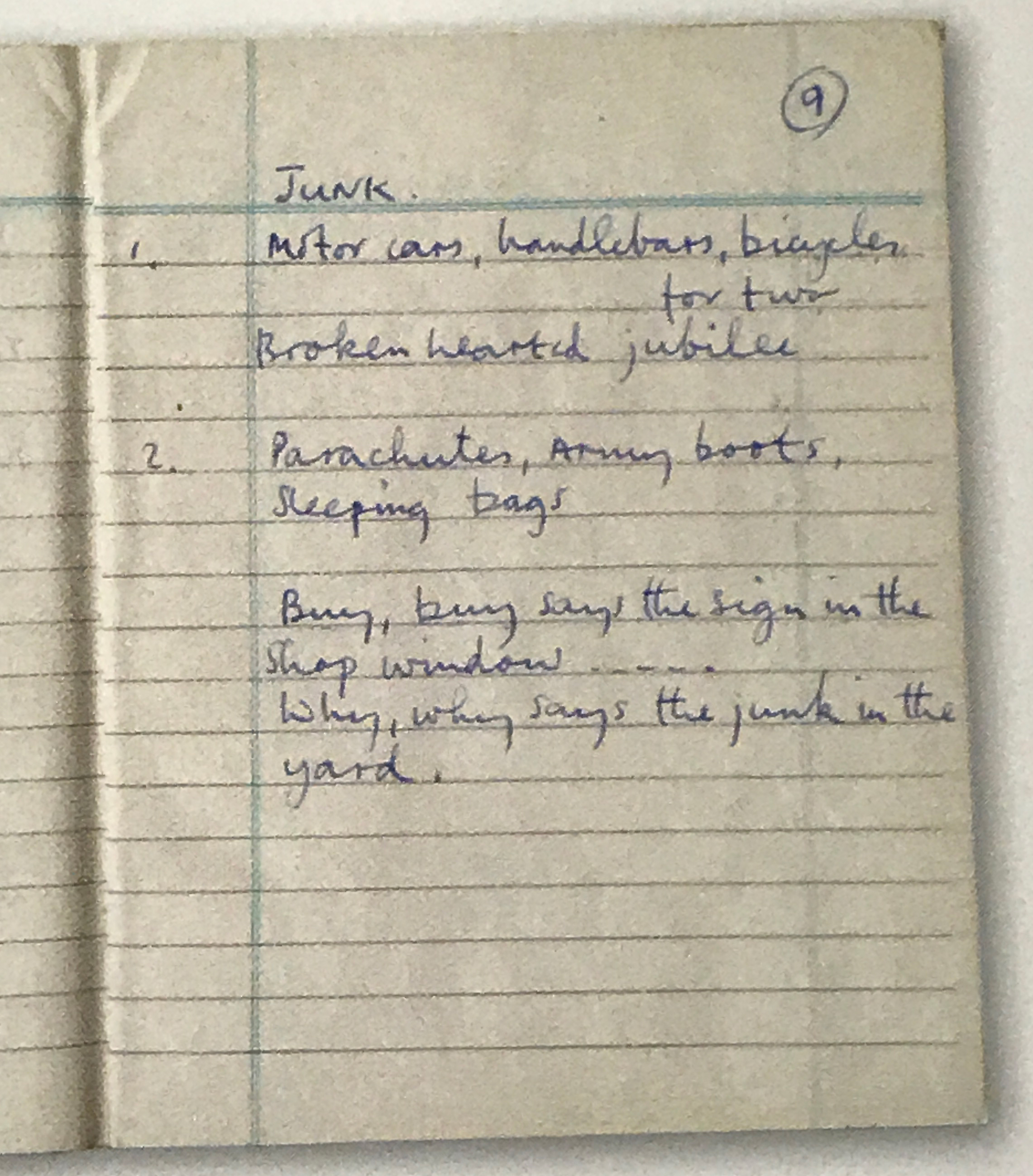

 They May Be Parted