Tag Archives: Mal Evans

Jan. 7: Joke whistlings

From the Let It Be film

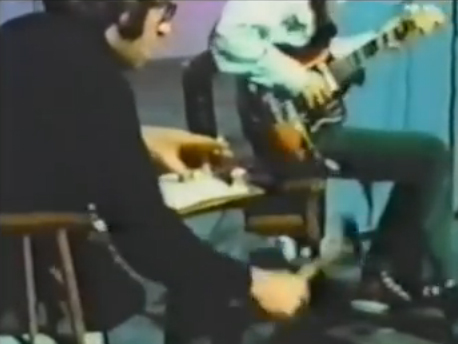
Mal at work. From the Let It Be film

If there’s a tape of Paul and John asking Mal Evans to manage the alarm clock in “A Day in the Life,” it hasn’t surfaced. Likewise, we never hear John telling George Martin he wanted to “smell the sawdust” in adding the fairground feel to “Being For the Benefit of Mr. Kite!”

But among the days’ worth of Nagra reels covering the Get Back sessions on Jan. 7, 1969, as the band lurched toward what became at least a temporary split later that week  — this is Tuesday, and George walks out on Friday —  we do get to hear  play out in real time the origin story of unique and memorable instrumentation to appear later on Abbey Road.

Unremarkable in the moment, Paul’s suggestion, made for the second time in three days, Mal “should have a hammer. … an anvil” comes about 20 minutes into the day’s work on “Maxwell’s Silver Hammer.”

Like, on steel. You know, a [bang, bang]. So it sounds silver, steel.

Sprouting from a short rehearsal of “I’ve Got a Feeling” with a quick touch of “Oh! Darling,” the “Maxwell” session on Jan. 7 runs for more than an hour on the tapes, straddling both ends of a lunch break. It’s far and away the longest time spent on any single song this day.

The key to appreciating the “Maxwell’s Silver Hammer” rehearsals is to view them completely in a vacuum. In a sense, it’s incredibly frustrating to think of the time spent on this when George has “All Things Must Pass,” for instance, withering to group disinterest. Or that John has a skeleton of what would become “Gimme Some Truth” two years later, unfinished — a song tinkered with briefly this very day. Paul himself could have spent the extra time on “Oh! Darling,” which purportedly had interest from other bandmates at this very specific moment in time. So on its face, just listening to this portion of the tapes is infuriating, because WHY IS PAUL MAKING US LISTEN TO “MAXWELL’S SILVER HAMMER” FOR HOURS??? STOP KILLING JOAN!!!

But in a vacuum — and with the understanding that all of The Beatles’ musical children are beautiful and deserving of love — this is a very instructive and iconic moment in the history of the song, and we see significant progress in the song’s overall development. This, even though Paul himself admits he hasn’t finished writing it.

The band hit the ground running with the song, having already spent time on it Jan. 3 (when Paul also made reference to getting a hammer for the song, but didn’t follow through as he would today), but it’s a bit of a bumpy start as Paul is still reminding the rest of the group of the chords — the alignment is Paul on piano, George on bass and John on a jaunty guitar.  When Paul remarks he “doesn’t like the waltz” drum pattern that coming out of the chorus into the verse, Ringo laughingly bemoaned, “it’s the only bit I remembered in the whole piece!” It’s just an early reminder and reflection that the song was Paul’s priority and his alone, something that would continue into the song’s recording for Abbey Road six months later.

Paul doesn’t always play it straight, hamming it up lounge-singer style, delivering cringe-worthy tongue clicks and scats along where he still needs to write lyrics. Sure, he’s completely contradicting his own instructions moments earlier as they worked on “I’ve Got a Feeling” — “We should start off by doing everything we’re going to do on the thing. Like if you’re going to do the ‘oh yeahs’ innit, you’ve got to do ‘em how you’re going to do it.”  It wasn’t the first (or last) time he wouldn’t take his own advice, either.   But here it probably shows the more advanced, but unpolished state “I’ve Got a Feeling” was in, the song in true rehearsal stage, while “Maxwell’s” was clearly an unfinished product.

Like on so many of these tapes, and especially on Paul’s songs — which more often seem to be delivered to the band incomplete  — we get an incredible windows into Paul’ s songwriting technique. As he plays along on piano, he’ll hum a suggested bassline.  Without notice, he’ll change it. Once he gets a certain part down — whether it’s a drum pattern or a whistle — he’ll interrupt and make clear it’s what he’s looking for. Until he decides to change it again. That’s in contrast to George’s songs, which more often are closer to complete and accompanying parts are set in George’s mind. While John wasn’t nearly as productive as Paul or George during the sessions, we’ve seen how he’s more willing to get open input from the rest of the band.

What Paul’s looking for here is a far more whimsical production than what surfaced on Abbey Road months later. It’s not just the tongue clicks. Paul’s looking to go all out, proposing ukulele solos and looking to Ringo for some “razzmatazz there on the cymbals.”

Then there’s the whistling. There was plenty of whistling in these early takes of “Maxwell’s.” But lapsing into caricature, Paul — interrupting an unrelated question from George — explains just what he’s looking for from his band.

If we do a solo, whistling, we should try and do like a real whistling solo, ’cause it is a bit much if it’s those joke whistlings.

The man was nothing if not a perfectionist. Of all the things that would put the song over the top, Paul was sure here it would be insincere whistling. Just to make sure everyone knew he was serious, during a subsequent stab at a part whistled in unison between verses, Paul barks out “straight” just to make sure any joke whistlings didn’t sneak its way in.

In all, the song was definitely coming together nicely. Incomplete, it still had shape and vibrancy, and the rest of the group beyond Paul gave every indication they were enjoying performing it, despite continued confusion at times over cues.

It was in this context Paul suggested a figurative bell to add to his literal whistles.

We should have a hammer. … Mal, on an anvil. Like, on steel. You know, a [bang, bang]. So it sounds silver, steel.

Wearing bow ties for this one.

Paul doesn’t just see the anvil as part of the instrumentation. It gives Paul the excuse to think more broadly about the song in the context of the live show. “We’ll all be wearing bow ties for this one, blazers.”  The Beatles were on the verge of breaking up earlier this day, and now Paul’s suggesting costume changes during a performance of “Maxwell’s Silver Hammer.” Moods swing rapidly at Twickenham.

The group is in a jocular mood — probably as much as we’ve heard to this point on the tapes — as the band laughs, whoops and hams it up during the final takes of this portion of the “Maxwell’s” rehearsals and as they head out for lunch.

They’d return with full stomachs and pieces of steel.
10 Comments

Filed under Day by day

Jan. 7: Entertainment is almost enough

The conversation took a very silly twist before taking a sober turn.

A half-hour or so into Tuesday’s wandering discussion attempting to define the framework for a live show, it was suggested that if the Beatles didn’t play for sick children, they should play at an orphanage. Or maybe it’s a show of all dedications.

“What’s the most charitable thing anyone can do?” director Michael Lindsay-Hogg asks before suggesting the band perform mass murder. “There are certain judicious murders in the history of the world which are very charitable.”

Paul then expands on his equally farcical — presumably farcical, at least  —  idea of playing at the Biafran airport amid the Nigeria-Biafra War. That is,  after they “rescue all the people.”

“Say we were doing it in an airport, you couldn’t stop all the people coming and going — they’ve all got planes to catch. So like you’d get a lot of people all the time, going for planes. … It’d be a scene.”

And so would a children’s hospital before an incapacitated captive audience. “They can’t get up and walk,” Paul says. “Except for the finale, when John walks up to the little girl. … aaah — she gets up and walks!”

Work your magic, John.

Alas, if only John can cure this process and heal the band. Lindsay-Hogg says he wants this to be better than any rock-and-roll show ever staged. And it’s not only because he wants to be proud of his product.

“You may never do another television show.”

It’s a bitter pill, but clearly Lindsay-Hogg knows the band is hanging by a thread here, just days into the Twickenham sessions. Feel free to read more into what George is playing low in the background during this part of the conversation: “I Shall Be Released” and “To Kingdom Come,” both by The Band.

“They just sound like that album in their house, in their living room,” George tells Mal as Paul and MLH go over (again) the possibility of filming the concert at Twickenham.

George then brings up a point not yet broached — will the Beatles be the only band on the bill? The last time they put on a TV special — Magical Mystery Tour, just over a year prior — The Bonzo Dog Doo-Dah Band performed during the strip-club scene, and Traffic was filmed but left out of the final edit.

So padding out the bill wouldn’t have been that unusual a thought, especially in the light of the Rolling Stones’ recently filmed Rock & Roll Circus and its own dazzling lineup. Then again …

“Are we going to have other people or just us —  John, Paul, Jeff and Richie?” George asks. “But then, you’re getting the bit where The Who steal the show.  But …   let the best man win.”

Lindsay-Hogg believes in his boys, saying, “If anyone can hold an hour, it’s you.”

George admits he isn’t so sure, but Paul has no doubt. What he’s struggling with is getting any semblance of a fire lit under the band.

“I don’t see why any of you — talking to whoever it is not interested —  get yourself into this then,” Paul says after Ringo says something difficult to hear, but likely being “not interested” in traveling. “What’s it for? Can’t be for the money. Why are you here? I’m here ’cause I want to do a show. But I really don’t feel an awful lot of support. Is anyone here because they want to do a show?”

Lindsay-Hogg wants to do a show. Meanwhile, haven’t we already heard this conversation several times already at Twickenham these first few days?

“Mal is right,” Lindsay-Hogg says, referring to comments from the roadie moments earlier. “Entertainment is almost enough. It’s where to put the entertainment.” Lindsay-Hogg also pushes the potential multimedia package the sessions could yield: an album, a documentary and the live concert, and George acknowledges it could be a bounty.

But he adds a caveat.

“If we can get the enthusiasm and really strength to do it.”

“All the ideas like hospital, orphanage, charity is part of it,” Lindsay-Hogg says. “It should be great, great showbiz, because that’s what’s going to make people happy. …  A smile on the lips of a small boy in France or a tear in the eye of a big girl in America is what we want.”

Part of the problem here is that Lindsay-Hogg is either wildly misreading the gravity of the situation at hand  or overreaching in setting up a diversion. Certainly it’s the latter, he’s no dummy. The Beatles are in dire straits. It’s out in the open. He’s lucky to have them in the studio together in any capacity. I’m not sure there was a stage anywhere on earth — plenty were mentioned, for sure —  that would have created any greater spark than they already had within them.

History made it clear. The group traveled a few dozen stairs at 3 Savile Row to the roof, where they did create magic. But that magic wouldn’t have been any more enchanting had they staged the same show at Sabratha, Biafra, George’s house or the Twickenham soundstage. Their hearts, collectively, were in it to a specific point, and that’s what bore out on the roof.

But more on that later.

The conversation keeps going, and even gets more depressing and deflating next post.

15 Comments

Filed under Day by day

Jan. 6: Such a lovely audience? (If there’s a rock show, Pt. 2)

Having established earlier in the conversation that there will be two live shows to cap the documentary of which filming is already in progress, the band — primarily Paul — plus Yoko Ono, George Martin, Michael Lindsay Hogg and a few other insiders (probably the likes of Mal Evans, Neil Aspinall and Derek Taylor? I don’t know them as well by voice) — continue their lengthy discussion about the show, potential venues and the composition of an audience.

For a show plan first hatched more than a month earlier, things remain in total flux.

Paul latches onto Yoko’s idea of playing to an empty house, at least for one of the two proposed shows, with the second night’s performance before a conventional audience.

Hey, maybe there will be some traction here! Paul’s on board with Yoko’s ideas up front and early on (and John doesn’t seem to care, not chiming in at all during this chat), so a huge part of the battle here is over, George’s independent streak — which is about to erupt — notwithstanding. And it’s not much of a surprise, really, given Paul’s avant garde leanings.

Alas, Lindsay-Hogg punctures that idea, saying there’s no need to eschew a crowd “partly [because] the documentary is playing in silence. I know it’s not for an audience, but it’s the same thing.”

Paul replies to say that the band has ignored the camera from the moment they started filming at Twickenham a few days earlier, repeating the  “performance might be — should be — two cameras or two audiences …  two something.”

But Yoko pressed on — with Paul again agreeing —  saying the audience isn’t the draw for people watching the film at home, unless it’s something different, like “kings or queens coming to see it.”

The director keeps pressing back.

MLH: What I think is if you got in front of an empty house and played, it makes you look too … rich, in the bad sense. In other words, whats the point? This is the negative aspect of that. What’s the point in you getting up and playing for an empty house when you could be giving people happiness with whatever kind of full house we decided?

Yoko: Nobody’s going to think that. They’re going to think it’s a very poetic situation. And they know the Beatles are rich …

Voice of reason George Martin, as he did earlier in the conversation, again sides with Lindsay-Hogg on just what a waste a live performance to an empty room would be, putting it succinctly:

There’s no point in doing a live performance, it’s like going into a recording studio and doing one take.

He then repeats the point that an audience would give an extra something to the band they wouldn’t get otherwise.

Someone chimes to suggest one of the more exotic venues that had been in the mix, presumably since December,as the band hatched the live-show idea.

You’re going right back to Sabratha, [then].

Sabrathra was alluded to on the first day of filming by the director, promising a scene replete with “snake charmers, holy men … torchlit, 2,000 Arabs and friends around.”

And a beautiful, unique venue the former Roman amphitheater outside Tripoli, Libya, would have been and with such an unusual audience. It’s certainly something that would one-up recent rock films like Cream at the Albert Hall and the recently completed Rolling Stones Rock & Roll Circus.

Paul agrees with a remark that a bit of a focus on the audience (wherever it may be)  isn’t a bad thing — seeing the reaction of people who have seen the band before in the Beatlemania era and how they’d react to the band now, post-1966 and the end of their live era.

Yoko: Then it should be a real scene. You have to announce in the newspaper say that it’s going to be a real alive show. It’ll be a crazy scene, like everybody queuing for it and everything.

Neil? Mal? Derek? Then it should be an Albert Hall scene.

Lindsay-Hogg,  who joked earlier in the day about a Beatles show at “the Albert Hall with those quick cuts,” said a few hours later that he’s not opposed to a show at the nearly 100-year-old stage. But…

MLH: I just think it slightly smells of a few years ago. The Shea Stadiums, wherever it has been.

Yoko: Say anything, and it will slightly smell of a few years ago or slightly less than a few years ago because they topped it.

MLH: I’m not particularly supporting this idea, but it is an idea we can then say no to and go away from if we can top it. But [Sabratha] is a location which is marvelous in itself, by the sea.

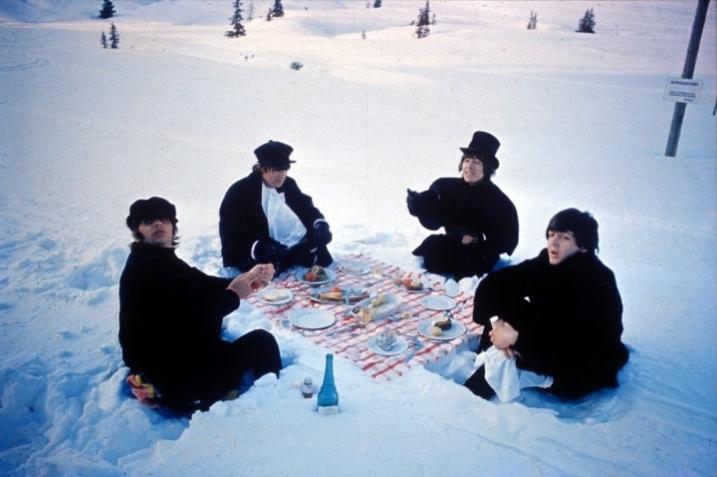
The Beatles faced winter elements before

Perhaps this is just calling Ringo’s bluff.  As Paul said on Jan. 2, “I think you’ll find we’re not going abroad, because Ringo just said he doesn’t want to go abroad. And he put his foot down.”

And calling the drummer’s bluff is something the Get Back book and Let it Be Naked’s “Fly on a Wall” disc proves was done repeatedly. But for the second time this day, Paul shoots down an overseas trip, saying, “Look, it has to be in England. An outdoor scene has to be in England, because we’ve decided we’re not going  abroad.”

To someone responding that a performance under the skies couldn’t be done in wintertime England, which is “too bloody cold,” Paul doubles down, after agreeing to the sentiment.

We have decided, it’s a definite decision, that we’re not going abroad, so we should sort of rule that out. It’s not even to the two-way, should we go abroad, we like, we definitely said no to that.

So as usual these days, they’re back to Square One, crossing the seas and back in just a few minutes, only to end up again home in England — and potential venues therein as the discussion continues.

An odd postscript to the Sabratha flirtation: More than 40 after the Beatles toyed with the idea of playing at Sabratha just eight months before Khadafi led a coup to take over Libya, former Apple exec and Beatles assistant Peter Brown had his PR firm hired to improve the dictator’s image.

Tune in next post, where we resume this Jan. 6, 1969, conversation about the forthcoming show.

24 Comments

Filed under Day by day