Tag Archives: Michael Lindsay-Hogg

Jan. 7: Ain’t got no ‘pow’

When we left the gang at Twickenham in the last post on the timeline, Michael Lindsay-Hogg was wrapping up his “pep talk,” imploring The Beatles to challenge themselves make a show worth staging. After saying he didn’t know what would make the production unique, Paul asks for a “bad example.”

“The bad example is going away,” Lindsay-Hogg replies.

An overseas adventure has been nixed several times already, and was about to be again. But less than a week into the sessions at Twickenham, the director wasn’t ready to let his dream concert die.

How could the band resist playing in the fresh, open air?

MLH. Pow, there you are. And pow, what are you going to do with it? And pow, it’s going to be fantastic. That was pow, you see. And we ain’t got no pow at the moment.

Paul: The only thing about that is [pause], we don’t want to go away. A group decision.

For George, the refusal to go overseas goes beyond Ringo’s veto. The logistics would be overwhelming.

It’s going to be the same thing as here, but it’s a bit nicer place to be in, George says. “It’s going to be even more complicated, trying to plug in all mics and tapes and all that crap, video. …”

Complications are all the more reason to go that route, Lindsay-Hogg says. Go big, and don’t put together a show like Cream’s. And if Lindsay-Hogg is going to stage a Beatles extravaganza, he’s made clear he wants precisely 2,000 Arabs in the audience. Apparently, no more, no less.

MLH: Visually, the thing that worries about here, it’s going to make it look like Cream, with a couple shots held a bit longer. .. If we went away, we’ve got the enormous plus of the visuals. Think of a helicopter shot over the amphitheater, with the water, with the lights. Torchlit, 2,000 Arabs. Visually, it is fantastic. Therefore, that was a challenge. And you see, I just myself am trying to think of any other framework to put us in to make it work. But it does really need a framework. And it doesn’t need to be done in just the back of an auditorium.

George, those kinds of obstacles are kind of good. I don’t mean this in any sense of discipline. I know you’ve done it all, but maybe you haven’t been there. Its  a very difficult thing once you are, you to create false obstacles, because what you’ve been trying to do for five years is eliminate obstacles.

You don’t want to play the show in straitjackets, that’s the wrong kind of obstacle. … At the moment, it is too soft.
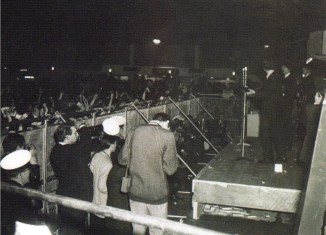
Caged Beatles perform at the Palais Wimbledon, Dec. 14, 1963

While they never played in a straitjacket, The Beatles did play from inside a “cage.”

Paul’s memory of a night in Wimbledon steered the conversation to a Beatles gig in late 1963, when they played a fan-club show that included a meet-and-greet with the 3,000 fans.

In his 2006 memoir John, Paul, George, Ringo and Me: The Real Beatles Story, Beatles PR man Tony Barrow  recalls the event.

After these close encounters with the Fab Four, the fans were treated to a special stage show in the main ballroom area where an over-protective Palais management had constructed a high-walled metal cage inside which the group were to perform on an extended makeshift stage beneath a huge banner that screamed: WIMBLEDON PALAIS WELCOMES THE BEATLES. Welcomes? The cage didn’t make it look like that!

The Beatles threatened at first to walk out unless the whole intimidatiing barricade was demolished and there were mutterings about “prison conditions” and “more like a zoo than a dance hall”. Eventually, for the sake of their fan club members, they went on and gave an enthusiastic mini-concert. During this, as the crowd surged forward pinning those with a place in the front row against the cage, John remarked in a loud stage whisper: “If they press any harder they’ll come through as chips.”

At Twickenham, George remembers the night as “hell.” And no wonder Lindsay-Hogg is having a problem getting traction for a “different” kind of Beatles show, when their past is  dotted with experiences like this.

Despite calling that night “terrible,”  Paul offers an opening.

“But that kind of thing gave that particular show a different thing, because it was like playing to a hospital,” Paul says. “Playing to a thing. Like a fan club, like a hospital.”

Lindsay-Hogg brings it back to the “Hey Jude” promo.

“‘Jude’ to me is a tear-jerker the way we did it, with black and white and the postman and old mothers, and the children and the bellboy and the guy who adjusted his spectacles at one point.  I think part of your music is tear-jerky.”

Paul latches on. After all, he just ripped off a pair of brand-new tear-jerkers earlier that morning in “The Long and Winding Road” and “Golden Slumbers.”

“Really would be great for us to get something, a serious intent,” Paul says. “Say we were all very charitable.  Which we’re not, particularly. But say we were really sort of charity nuts…” And then the tape cuts off, before picking up after a roll announcement.

The group had in fact done a few shows for charity — the Royal Variety Performance most famously for its jewelry-rattling. It wasn’t until their solo careers when charity work and concerts became part of their fabric, led by George and his pioneering Concert for Bangladesh.  Now, desperately searching for a catch, they stumble into the idea of playing for a greater cause merely because it would be a unique hook.

A remark by Lindsay-Hogg about pop-culture heroes sparks an animated monologue from Paul about a recent telecast of “Late Night Line-Up,” a live, late-night talk show with a focus on the arts that wrapped BBC2’s programming day. The particular episode — Paul described at once as “incredible” and “wasn’t very good, but it was pretty good” — saw students given the keys to the show, with one segment featuring the camera zooming in and out on a man watching himself on a monitor drinking tea  as “Revolution” plays in the background.

Praising the anarchic quality of the show, Paul finds inspiration.  “It’s that kind of opportunity we’ve got for an hour.”

The potential of doing a political broadcast — like “All You Need is Love” — appeals to George for the moment, but he realizes “whatever we have to say to do with anything is always incidental, hiding behind the chords of the tune.”  Unspoken, it’s perhaps an acknowledgement the current crop of potential songs for performance lack the clear-cut message of “All You Need is Love.”

A joke from Paul about the potential of staging the show at the Houses of Parliament  — “we tried for the [Rock and Roll] Circus; they didn’t go for it” was Lindsay-Hogg’s reply — led to another thought that was quickly passed over.  But it foretold one of the greatest moments in popular music history, one which was only three-and-a half weeks away.
savile-row

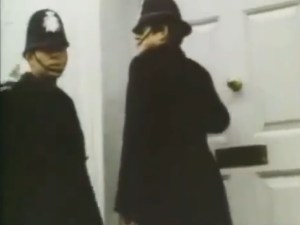
London police visit 3 Savile Row at the conclusion of Let It Be

“We should do the show in a  place we’re not allowed to do it,” Paul suggested. “We should trespass. Go in, set up and then get moved, and that should be the show. Get forcibly ejected still trying to play numbers. And the police lifting you.

“You have to take a bit of violence.”

Lindsay-Hogg simply brushed it off.

“It’s too dangerous.”

The lengthy early Jan. 7 discussion resumes in the next post, here on They May Be Parted.
11 Comments

Filed under Day by day

TMBP Extra: Tea-room orchestra

beatles-frost-hey-judeLast Monday brought the news of the death of longtime TV interviewer David Frost.

There are far better places to read about his life and career, including the several times he hosted and interviewed The Beatles together and individually. But a specific moment in Beatles history with a tie to Frost, one touched on plenty on this blog, is worthy of its own post.

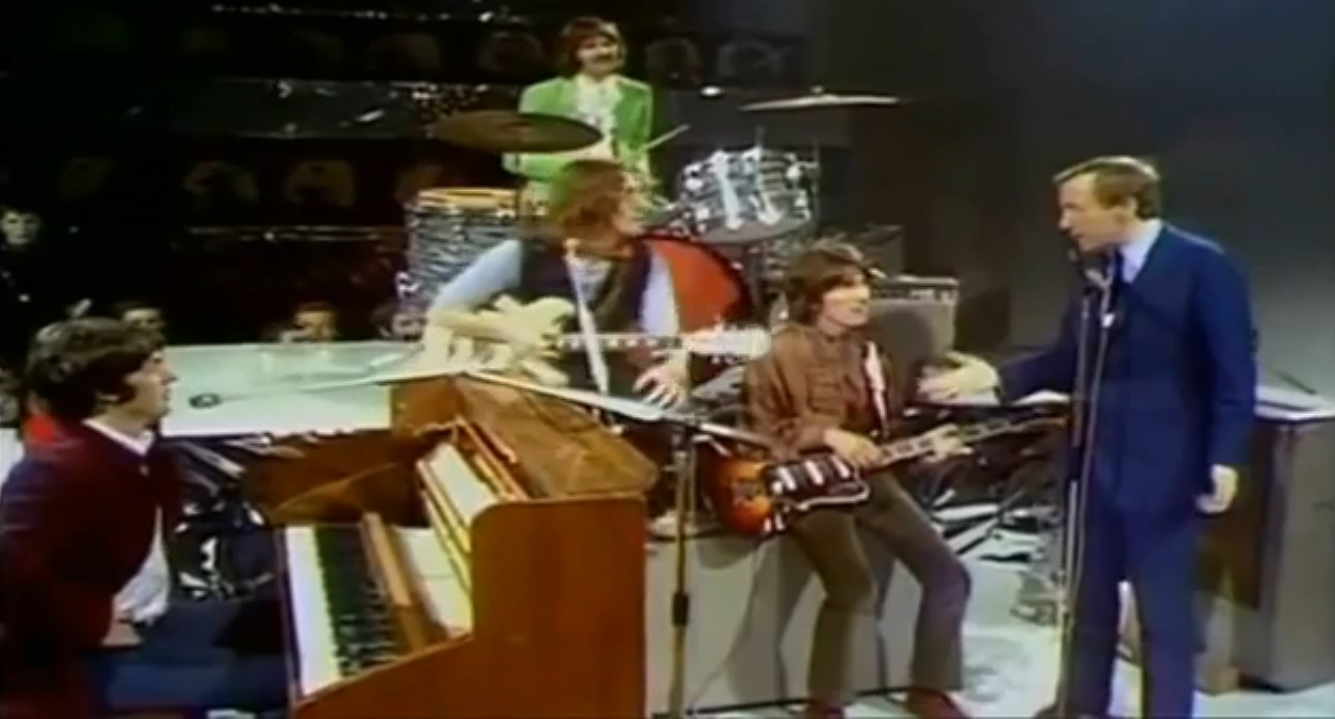
It was 45 years ago today — Sept. 8, 1968 — ITV’s “Frost on Sunday” variety show debuted the “Hey Jude” promotional video, which was filmed four days prior.  The performances — they filmed three complete takes of a dozen attempts total — along with the rooftop show nearly four months later, marked the only times The Beatles would play together to a live audience after they stopped touring in 1966.

Michael Lindsay-Hogg, who had last worked with the group that same year  directing “Rain” and “Paperback Writer,” was hired again for the shoot at Twickenham. And with the formal introduction is Frost, who is serenaded, primarily by John, with the show’s theme song (which, as it were, was written by George Martin).

If you’ve seen it once, you’ve seen it a thousand times. But because it’s so good, make it 1,001:


The “greatest tea-room orchestra in the world” really does stage an inspirational, iconic performance. OK, so they weren’t really live, playing with an actual orchestra in the house over a recorded track with Paul double-tracking himself in parts and adding freshly scatted vocals during the extended outro. Musician union rules had forbid a strictly lip-synched act.

It’s a new generation of Beatlemania on display here in this new phase of the Beatles’ career. Gone are the screaming fans drowning out the group, instead replaced with the 300 guests encircling then and joining the coda’s chorus. Lindsay-Hogg captures the fresh, optimistic tone of the song, and the band’s jubilant mood, with a clip to match. Things almost get out of control, but never do. It’s perfect.

(For a fun bit of frivolity and another bit of Get Back session foreshadowing, listen in during the coda in the above clip for Paul quoting “The Weight” by The Band at around the 6:20 mark — they were already serving as a bit of inspiration).

A great first-hand account of the day from audience member Marc Sniden — the “geek with the horn-rimmed glasses and school blazer behind Ringo” — was published in a 2009 article in the Liverpool Daily Post.

They just walked in holding their guitars, then walked round and shook our hands saying, ‘Hello, I’m John’” he says, still incredulous at the memory. “It was the days of screaming, but nobody screamed. We were suddenly in the presence of God. That’s the only way I can describe it. These people had changed history. We grew up with them.

To alleviate the boredom, John started to play a song on his acoustic guitar. “Everyone went, ‘wow’,” says Marc. “Filming started before we could ask what it was. When it was later released, we realised it was Back in the USSR. That was strange.”

Marc says they were almost telepathic as a band. But, as the afternoon wore on, even they became fractious.

“Paul had been banging away on the piano and John was swearing a lot, asking ‘Haven’t you got it yet?’ to Lindsay Hogg,” says Marc. “After take 12, Paul said, ‘I think that’s enough’.”

Marc Sniden (right)

While the song gave The Beatles a monumental hit song to launch Apple Records, the experience of the performance also had its own significant repercussion: The band was open to playing before an audience again.

“They hammed it up, putting in some naughty lyrics about George Martin,” Sniden said. “It was all jokey, they were very relaxed.”

The director took notice.

“They were jamming and having a good time and having a better time than they thought they were going to have,” Lindsay-Hogg said in Steve Matteo’s 33 1/3 book on Let it Be. “So they sort of thought maybe there is some way they can do something again in some sort of performance way.”

And thus, the seed of the idea for the Get Back/Let it Be sessions was planted, before they’d even completed recording the White Album. The Beatles would be back at Twickenham with Lindsay-Hogg and producer Dennis O’Dell in less than four months time. The clip would be a cited repeatedly on the Nagra Tapes as a benchmark for what they were trying to achieve, be it the composition of the audience, the focal point of the camera or the location of the show.

Just a footnote in Frost’s long career, the “Hey Jude” promo filming proved to be a pivotal moment in The Beatles career.

11 Comments

Filed under Extra

Jan. 7: Taking the easy way out, now

We pick up the scene where we left off from the last post, Jan. 7: On our own at the holiday camp, as The Beatles and film director Michael Lindsay-Hogg wrestle with the question of the band’s motivation in the post-Brian Epstein era and struggle to find a live-show venue amenable to all parties.

Michael Lindsay-Hogg continues the discussion by posing a question to John, Paul, George and Ringo that seems like it has an obvious answer. After all, since Candlestick Park in Aug. 1966, The Beatles quite famously haven’t staged a concert, instead embracing all the luxuries being a full-time studio band offers.

“But do you still want to perform to an audience?” he asks. “Or  do you just see yourselves as a recording group.”

That’s a simple enough question that really does cut into their motivation, not only for these sessions but for their own reason for existing at this point in their history.  Paul responds, speaking over the director, saying that an audience indeed should be involved with whatever it is they’re trying to accomplish with this project.

“I think we’ve got a bit shy,” Paul says before the cameras. “I think I’ve got a bit shy of certain things, and it is like that.”

Lindsay-Hogg, who so badly wants to stage a grand return before an audience for the group, again suggests departing from their past experiences. Get back to where you once belonged? Not now.

MLH:  Maybe the difficulty is also getting up in front of an audience with all you’ve done in front of audiences, and trying to get something as good, but maybe not the same thing. And that’s a very hard thing to get back. In other words, you mustn’t think of getting back what you had.

The audience has indeed grown up along with the Beatles — who are all in their late 20s by now. Paul says they’re all searching for a  “desire” to perform and achieve.

And just then, Paul comes out and reminds everyone how little they enjoy working together.  After all, just three months earlier they were together at EMI Studios to finish up the White Album sessions, so the memory’s fresh.

“With all these songs, there’s some really great songs, and I just hope we don’t blow any of them,” Paul says. “Because, you know often, like on albums, we sometimes blow one of your songs cause we come in in the wrong mood, and you say, ‘This is how it goes, I’ll be back,’ and we’re all just ‘chugga-chugga, chugga-chugga’ [sounds of guitars].”

So there’s just a little more proof that the Get Back sessions weren’t the specific spark that led to The Beatles’ breakup. They had already been known to mail it in on occasion for a few years now, and Paul wasn’t shy to admit it.

But Paul’s remarks didn’t drop like a bomb — they were simply acknowledged silently as the conversation resumed, with Lindsay-Hogg’s continued insistence to use a specific live-show idea as a rallying point.

1968, White Album sessions: " ‘You can do anything that you want, Paul, anything you desire.’ " (Photo by Linda McCartney)

1968, White Album sessions: “You can do anything that you want, Paul, anything you desire.” (Photo by Linda McCartney)

George Harrison wouldn’t bite. His response is damning, striking at the essence of the debate of what The Beatles are, post-White Album. Are they a cooperative? Each others’ backing band? Something in between?  And what should they be, in their eyes?

What they definitely aren’t, according to Harrison, is an effective live group.

“Really, I don’t want to any of my songs on the show, because they just turn out shitty, ” he says. “They come out like a compromise. Whereas in a studio, then you can work on them till you get them how you want them.”

So for a live show, George just wants to be the band’s lead guitarist, nothing more.

Paul, audibly disgusted at that remark, is having none of it, still believing in The Beatles.

Last year, you were telling me that ‘You can do anything that you want, Paul, anything you desire.’ … But you’re saying before the show is finished, and before we’ve done it … letting forth this word of, ‘They’re going to come out a compromise.’ …

I really think we’re very good, and … if we think that we want to do these songs great, we can just do it great. Thinking it’s not going to come out great, you know, that is like meditation. Where you just get into a bummer, and you come out of it, you don’t go through it.

Paul hits George where it hurts, referencing his beloved meditation.

Paul continues, hitting home the point that even he’s fed up, too, but it shouldn’t mean avoiding whatever challenge they’re setting up for themselves.

Paul: [Presumably to Ringo]: So you’re sick of playing the drums, we all got to say, ‘We’re sick too, pat pat.’ It’s all the same and go through it. There’s no use just saying, ‘Well, fuck it.’

MLH: … What’s wrong about doing the show here [Twickenham] is it’s too easy. Like, when we were in the car looking at locations at the glorified boutiques … then Denis [O’Dell, film producer] said, ‘Why not do it at Twickenham,’ and Neil [Aspinall, Apple manager]  said, ‘Why not do it at Twickenham, because it’s so easy.’ … I think that’s wrong.

I don’t mean we should put obstacles in our way,  but also in a funny way, like you were talking about Brian [Epstein]. … We should have some force to resist.   But just doing it  in the backyard …  it’s too easy.  And we’re not fighting it. There’s no balls to the show at all, I’m included. There’s no balls to any of us at the moment. And that’s why I think we’re all being soft about it.

Credit the director for recognizing the dire straits at hand. He’s right: Without a show at this point, the sessions would effectively have no real purpose and would cease. Obviously, no one wants to be there merely to start recording a new album, with the possible exception of Paul.

“If you all decided to do a show, it should be the best show,” Lindsay-Hogg says. “You are The Beatles, you aren’t four jerks.  And that’s really my job. Because when you’re playing your guitar, they’re not going to be thinking about those millions of unwashed.

“I think we’re all being soft. It’s all too easy.”

Laughing, Paul asks what kind of obstacles would the director suggest the group face.

Well, I don’t know,” Lindsay-Hogg replies, “But that was the pep talk for the morning.”

With hindsight, we can call out Lindsay-Hogg’s instincts. The Beatles had the knack to make the “easy” way work and deliver something iconic. After all, a little more than three weeks after this conversation, the band merely climbed from the basement studio at 3 Savile Row to the roof of the five-story building for the much-debated live show. George, as he suggested on this day, was just the guitarist, and none of his songs were played.

Later the same year, The Beatles took the easy way out again, naming their subsequent album after the street they recorded on — Abbey Road — and shooting their cover  just outside the studio’s door.

For The Beatles, sometimes easy worked.

11 Comments

Filed under Day by day

Jan. 7: On their own at the holiday camp

Some time passed on the morning of Jan. 7 between when “Get Back” made its debut and when Paul McCartney, George Harrison and Ringo Starr — plus director Michael Lindsay-Hogg and John Lennon, who had just arrived for the day’s sessions — returned to the much-needed discussion of what exactly they were doing at Twickenham Film Studios.

The arguments of the day before that culminated in George’s “just want to please you” line may be the moment etched in cultural history of these sessions, but the next 45 or so minutes did far more to define the vibe at Twickenham.

The tapes pick up the discussion already in progress, but the message and motive is clear: There’s a serious movement to abandon the documentary and live show, and, by extension, these sessions, which are only just beginning its fourth day.

From the Get Back book.

From the Get Back Book.

“If we cancel the show now, we’d still be throwing it away,” Paul said. “That’s the way we tend to do (it)… that’s where all the money goes.”

Lindsay-Hogg tries to rally the troops, suggesting the worst-case scenario is the group is left with a documentary, which is something the group could still sell, since money is being made something of an issue here by George.  John agrees, saying a documentary of the group making an LP isn’t the worst if they can’t find a gimmick for a show.

With big dreams of an African adventure still flickering, Lindsay-Hogg continues to insist there should be a show anyway. He’s not crazy about the term “gimmick,” either.

Very quietly, George shares something every Beatles fan knows in retrospect when we look back and put the pieces together.

George: Ever since Mr. Epstein passed away, it hasn’t been the same.

Paul: We’ve been very negative since Mr. Epstein passed away. That’s why all of us,  in turn, have been sick of the group, you know? There’s nothing positive in it.  It is a bit of a drag. But the only way for it to not be really a drag, is for the four of us to say, “Should we make it positive? Or should we fuck it?”  There’s only two alternatives, innit?

It’s a fascinating exchange for several reasons, starting with how they refer to their former manager. Both Paul and George still call him Mr. Epstein, not Brian, nearly a year and a half after his death. The formality of the business relationship never broke.

More of note is not only the ease at which they’re willing to discuss their current state and lack of motivation, but how severely Paul views the band’s state. There’s “nothing” positive in it. And so we’re at the group’s climacteric moment.  These four men seem ready to walk away from at least their present phase as a four-piece. Now’s the time to find a new way of continuing as a band, return to the old way they would record and perform together or just walk away. It’s a distillation of the same conversation they had the day before, but spoken with more urgency.

It bears repeating — this strife and breakup talk isn’t at the end of a grueling, unhappy month, or after a several weeks of early mornings on the cold Twickenham soundstage, as the fable of the Get Back sessions relates. This is after the group has been back together in January for a period that can be measured in hours.

John — lacking sleep, sobriety or both — simply suggests the group just needs a little incentive.

“All the things that we do, the whole point of it is communication. And to be on TV is communication. We have a chance … to smile at people, like (in the broadcast for) “All You Need is Love.”  So that’s my incentive for doing it.”

With John referencing another Beatles television production, the director’s wheels begin to turn.

MLH: Both “All You Need is Love” and  (his own production) “Hey Jude” did communicate.

Paul: Of course, they did, course they did.

John: We need to think of an incentive, the inventive is to communicate.

Paul: You know, there really is no one there now to say: Do it.

And thus we return to Mr. Epstein’s ghost. No one is there to make them get up at 8 a.m. now, Paul says. They have to get themselves up at 8.  And this is part of growing up.

These men range in age from 25 to 28 at the time of these sessions and have been professional musicians since their teens.

“Your daddy goes away at  certain point of your life, and you stand on your own feet,” Paul continues. “And that’s all we’ve been faced with. Daddy’s gone away now, and we’re on our own at the holiday camp. And I think we’d rather go home.

“Or,  we do it.”

So it’s crystal clear to Paul here, he’s fighting uphill. The fresh lyrics of “The Long and Winding Road” are playing out moments after he introduces the song. This here is one of the many times he’s been alone.  And he’s still waiting by his bandmates’ door.

Paul continues.

It’s discipline we like. We all agree — for everything you do, if you want to do it well, you got to have discipline, we all think that. But for this, we’ve never had discipline. A slight, symbolic discipline by Mr. Epstein. And he sort of said, ‘Get suits on,’ and we did … And so we were sort of always fighting that discipline a bit.

But now it’s silly to fight the discipline because its our own self-imposed, these days. So we put in as little as possible. But I think we need  bit more if we are going to get on with it.

Lindsay-Hogg acknowledges the decision to work at all is the group’s, not his own, but that they have indeed started work and should maximize it.  Paul, meanwhile, equates what Lindsay-Hogg is dealing with to his own work on the Jackie Lomax LP.

“Any other director in the world would say, ‘Fuck off. Get off my set, you cunt.’ I mean, wouldn’t you?” Paul asks. “I couldn’t operate. … if Jackie in the middle of the album said he won’t do it, (we) wouldn’t have the album.”

Paul suggests to George that the group used to “do it,” be “fully switched on.”  And he hearkens back to their feature film career.

“Those films, look at it, that was us doing it.”

“Well, if that’s what doing it is, that’s why I don’t want to do it,” George retorts. “I never liked that.”

Like the day before, George’s matter-of-fact, deflating response draws a pause followed by nervous laughter and a stammered response.

Paul (talking over George):  See nowadays, you’ve grown up and you don’t have to do that anymore. You don’t have to put the pancake on and go out in front and sweat and shake our heads because we’re not that anymore. We’ve grown up a bit.

George: And we’ve done that anyway.

Paul:What I mean is, we did it, the but it doesn’t mean to do it again means to do all that. For him (John) to do it, he has to do a thing in a black bag with Yoko. And you’re doing it.

Several voices correct Paul.

“White bag,” he says.

“You know you’re doing it then, on this level.”

Paul’s argument, that doing something is tantamount to doing “it” isn’t flying. Lindsay-Hogg changes course and questions just what the Beatles are, circa January 1969 and what is it, since we’re talking about “doing it,” that  they really want to do?

“But do you still want to perform to an audience?” he asks. “Or  do you just see yourselves as a recording group.”

That’s a simple enough question that really does cut into their motivation, not only for these sessions but for their own reason for existing at this late stage in their career.

And its a question we hope to answer next time here at They May Be Parted!

15 Comments

Filed under Day by day

TMBP Extra: Lindsay-Hogg catalog

Lindsay-Hogg and Lennon

With the first significant discussion of the potential live show complete, I thought it was as good a time as any to briefly go off timeline to present what the project’s director, Michael Lindsay-Hogg, had already worked on in his career to this point. More than 30 posts in, it’s clear he’s a central character to the Let it Be/Get Back story, even if he doesn’t pick up a guitar or sing a note during the sessions.

After some stage work, the 25-year-old entered the world of music in 1965 as a director on “Ready Steady Go!

And it was his exposure working on the show that caught the eye of Brian Epstein, who drafted Lindsay-Hogg to direct promo films for “Paperback Writer” and “Rain” in 1966.

Certainly foreshadowing the relationship we’ve heard thus far on these Jan. 1969 tapes, the director describes his first meeting with the band to sketch out ideas for the two films in his 2011 autobiography, “Luck and Circumstance“:

But with The Beatles that evening, I found an idea was something to be mauled, like a piece of meat thrown into an animal cage. They’d paw at it, chuck parts of it from one to the other, chew on it a bit, spit it out, and then toss the remnant to me, on the other side of the bars.

Ultimately, the director “was told Mr. Epstein did not want anything ‘unusual, just a video of the boys performing,'” he wrote in his autobiography.

The creative relationship with The Beatles seems much different than the one he developed with the Rolling Stones, a band for which he ultimately directed dozens of videos for into the 1980s, beginning with both sides of the “Jumping Jack Flash” single in 1968.

Not much after the Stones shoots, Lindsay-Hogg was back with The Beatles, this time filming both halves of the uber-single “Hey Jude/Revolution” in September.

Here’s Lindsay-Hogg with a few words on the “Revolution” clip, in an interview published as part of the promotion of the 1+ set.

Iconic Beatles visuals, I dare say, and it showed the potential of a shoot at Twickenham. And it’s partly from the “Hey Jude” experience, in which the band is said to have enjoyed playing live before an audience — not just the songs before the camera, but impromptu performances between takes — that led Paul to hatch the Get Back idea, which began filming nearly four months to the day later.

But first, Lindsay-Hogg got the call from Mick Jagger to direct what was to become the Rock and Roll Circus, with one John Lennon contributing “Yer Blues” to the production, filmed about three weeks before The Beatles commenced rehearsals at Twickenham.

The show was famously shelved until 1996, in part because The Who blew the Stones off the stage. The same Who, incidentally, that Lindsay-Hogg shot the “Happy Jack” promo film for two years earlier after also shooting them for “Ready Steady Go!”

This is the oeuvre the then-29-year-old son of Orson Welles (something he only recently found out was true) brings into his latest gig for The Beatles in January 1969.

4 Comments

Filed under Extra