The second day of sessions at Twickenham on A/B Road clock in at close to 5 1/2 hours, more than two hours of which was spent solely on “All Things Must Pass” and “Maxwell’s Silver Hammer” (a song to a post coming soon).
For sure, much of the time that falls under a certain song’s track was actually dialogue. But ultimately, there wasn’t a lot of new material introduced.
When we did get new stuff, it was a taste of some classic songs.
Indeed, the entire day’s session begins with Paul tickling at the ivories with an incredible one-two punch that lasted just over a minute and a half. “The Long and Winding Road,” right into “Oh! Darling.” Another future Abbey Road Side 1 track — “Maxwell’s Silver Hammer,” which wasn’t actually new, but new to the sessions — gets the solo piano treatment next. Enjoy that sequence here:
Paul continues to play, and caps an incredible 15-plus-minute stretch with one more new song, and one that eventually defined the sessions overall: Let It Be.
John, as he was throughout the entirety of the sessions, only brought in the one new track — “Gimme Some Truth” — that day. And again, it wasn’t actually new to the band.
Outside of a pair of Ringo songs we’ve covered previously and seminal songs like “One After 909,” “Because I Know You Love Me So” or “Thinking of Linking,” the balance of originals on Jan. 3 were brief tastes, and in some cases presumably improvised jams.
Central to the legend of the Get Back/Let it Be sessions is the looseness of the group as they sloppily play covers and fool around with their own old songs. So many weird things, tucked in between a million takes of “Get Back” and “I’ve Got a Feeling,” right?
It’s what appealed to me in listening to the Get Back sessions in the first place, so long ago, when it was available on only curated compilations on vinyl. And really bad sounding ones, too. But go to record shows or Beatlefests and scan the back cover, and things seemed like they’d be cool! All these crazy cover songs, all these oldies of theirs, all these outtakes of songs we know and songs we don’t.
But the reality usually didn’t match the fantasy. [This overall theme will absolutely be covered again in this blog, likely ad nauseum].
And on Jan. 3, they did indeed have some fun with some oldies and originals. It’s not great. And really, I think things like this add to the generic resentment toward these sessions by Beatles fans. The band doesn’t care, so why should we?
Really, not a bad point. But it is interesting so long as you accept it for what it is. It’s no different than those of us who have office jobs spending a few minutes doodling on a notepad between taking care of real work, right? Their office happens to be the studio, and their doodles, songs. And if we’re eager enough to listen to their doodles as big enough fans, well… this is what we get.
So while the band didn’t spend all that much time the first few days genuinely going over their old songs, in addition to a poke at Every Little Thing and the reintroduction of “One After 909,” the band on Jan. 3 went into the back catalog for “You Can’t Do That” — after a take of Marvin Gaye’s “Hitch Hike,” a song that seems to have inspired the song off A Hard Day’s Night.
It was pretty much 3 a.m. bar-band quality. The song breaks down about a minute in, during the “everybody’s green” part. John keeps singing, Paul keeps in there, too, and eventually the song sort of comes back to life. They make it through the instrumental portion of the song before things completely break down for good.
More fun and somewhat historic, I suppose, was when Paul took the mic for a more significant take of “I’m So Tired.” Obviously, this was not meant to be anything beyond a bit of fun. Again, more 3 a.m. bar band. But perhaps even moreso. At least, here we got through the song. And even with an attempt at the end-of-song babble!
There’s no context, by the way, for why they went into this take. The tapes I’m listening to (A/B Road) just go from an unidentifiable jam cut straight into “I’m So Tired.”
The 2021 Get Back docuseries uses this sequence to great effect as something of a gag reel, showing various moments of the group yawning, rubbing their eyes, etc., for the final moment of the day’s coverage. I posit it’s also a sneakily effective response to the famous scene of Paul yawning during “Across the Universe” in the Let It Be film, show how everyone was yawning, it wasn’t a reflection of boredom to a particular song.
They stick with the White Album (flip from side 2 to 1 if you’re so inclined) for the next song they roll right into. As on the record, Paul takes the lead on “Ob-la-di Ob-la-da” — kicking things off with the bass line — but it doesn’t take very long for John to take over.
Unlike a few weeks later, when none of the Beatles would show up to accept their Oscar for best film score, at the 13th Grammy Awards — held March 16, 1971 — there was indeed a member of the Fab Four in the house. Way in the back of the house.
Presenting the award for Best Original Score Written for a Motion Picture or a Television Special was none other than a not necessarily sober John Wayne (who was pretty funny with Andy Williams in the intro to the award). Safe to say there was no Beatles connection.
In fact, the award wasn’t given to the Beatles at all, but to the individual composers.
Paul kept his thanks as brief as they could be with a “thank you, good night.”
The awards show itself seemed like a fun watch.
Here’s a rundown, via Film Threat by way of the Internet Archive (update January 2018: It doesn’t look like this link works anymore, but it did back in 2012 when I first saw this).
Speaking of acceptance speeches, no one said anything beyond a mere thanks. Even the most dramatic audience response of the night, which accompanied the surprise appearance of Paul McCartney (with his wife Linda) to accept the Best Original Score Written for a Motion Picture or Television Special Award, was capped by McCartney saying a mere “Thank you!” before disappearing from the show. (Herb Alpert, a guest presenter, deviated from the script to offer a sincere word of praise for McCartney’s attendance at the broadcast.)
But for the rest of the show, “The 13th Annual Grammy Awards” was fascinating for its sheer strangeness. Some of the presenters were having a seriously off-night: Lynn Anderson was sporting a large chin brace (she never explained why, only joking that she was trying “to keep my chin up), Nancy Sinatra boasted of having the flu, John Wayne (who announced the award McCartney accepted) appeared to have indulged in a few too many drinks and was visibly bobbing and weaving, Brook Benton and Glen Campbell could not see the distant TelePrompter during their respective podium turns and needed Williams to help read the nominations out loud, and Zsa Zsa Gabor (introduced by Williams as being “beautiful and talented”) flustered co-presenter Bob Newhart (for the comedy recording award) by the ad-libbed suggestion he was fathering children out of wedlock.
The following is an excerpt from the “Variety” book entitled “The Grammy’s” by Thomas O’Neil….
“Bridge [may have] swept the top honours”, wrote the L.A. Times, “but it was ex-Beatle Paul McCartney, in a rare public appearance, who created the most excitement” at the ceremony. “Though the event was strictly black tie, McCartney strolled in wearing a blue suit, red flower shirt and open at the neck, and white tennis shoes.”
Like Simon & Garfunkel, the Beatles broke up in 1970 but still had a bounty of nominations (six) for their farewell LP, Let It Be. They won only one award — for Best Original Score written for a Motion Picture or TV Special – after losing Record and Song of the Year nods (in a close contest, according to the Washington Post) to “Bridge.” But “there were shrieks of surprise” from the audience when the winner of the best film score was announced, the Times reported. “With Linda at his side, McCartney raced up to the podium to accept the award from actor John Wayne, saying only, ‘Thank you.'”
Variety columnist Army Archerd added, “Paul McCartney kept his word, returned to the press tent after the awards — and, as expected, had to plough his way thru a mob to reach his car with (expectant) wife Linda. McCartney, informally attired (would you believe sneakers?), admitted, ‘I didn’t know whether they’d let me in.'”
Interesting side note: During the presentation, Wayne said the nominees were John, Paul and George — and he in fact handed Paul three awards. But as history tells, Ringo should have also received some hardware.
When we last left you on the Nagra Tapes timeline, George wondered aloud whether it was practical for the Beatles to perform a concert consisting only of new songs, without throwing the audiences — especially the American one — a bone with an “oldie but goldie.”
They had, in fact, rehearsed such a song a few hours earlier. Well, it may not have been a goldie, but it was an original Beatles oldie dating all the way back to the days of the Quarrymen.
And while they did in fact record “One After 909” in 1963 — in fact, it was 49 years ago today, on March 5, 1963 (the same day they cut “From Me To You”) — that original recording didn’t see an official release until Anthology in 1995.
The band attacked their first take of the song (in presumably five-plus years) with much of the same gusto they gave covers of the same era during the sessions. How do we know they enjoyed playing it? They actually finished the song.
Following that first run-through, which was replete with stumbles but seemed to have John and Paul remembering all the words, the band — especially Paul — collectively marveled at the simplicity of the lyrics.
“I always meant to just change the words a bit,” John said. Paul chimed in that “it’s great,” before giving a spoken-word run-through of first verse, to George’s laughter. Then George, ever eager still to actually have a focus here, asks if the band should rehearse the song more.
“Or maybe we should do it without practicing. You know, practicing will fuck it up,” George said.
The band in fact, did return to the song — after first running through a take of the presumed John oldie “Wake Up in the Morning/Because You Love Me So.” And like the prior run-through, this take of “One After 909” was closer in spirit and pacing to the Quarrymen version than the 1963 recording.
Also like the prior take, the band continues to poke fun at the lyrics once the song is over. John bemoans, “We always thought it wasn’t finished.” And George goes further, suggesting “Most people don’t give a shit what the words are
about, as long as it’s popping along.”
It’s rock and roll, and it’s a song, written in 1957, that is indeed seminal rock. It was a Beatles song, not a John song/Paul song/George song as the bandmates had been bringing to the sessions otherwise — and you can hear the harmony (literally and figuratively) while they play. Really, it’s the perfect song for what they were trying to achieve during these sessions: developing a loose, off-the-cuff presentation of their songs.
By the time the subsequent Oscars rolled around, on April 15, 1971, the Beatles were, well, really broken up. George and Paul each had No. 1 hits in either the US the UK or both (All Things Must Pass LP and “My Sweet Lord” single for the former, McCartney LP for the latter), John would have his first later in the year (Imagine LP and single) and Ringo had just released his biggest hit to date, “It Don’t Come Easy.”
Also, everyone was suing each other.
But ancient history was relevant to the Academy, who gave The Beatles — whatever that was anymore — the award for Best Music, Original Song Score over the soundtracks to The Baby Maker, A Boy Named Charlie Brown (one of this author’s chidhood favorites), Darling Lili and Scrooge.
Of course, the Beatles wouldn’t be at the ceremony to pick up what would be their lone Academy Award (A Hard Day’s Night had two nominations in 1964, lost both). That honor would go to Quincy Jones, who had already produced a track on Ringo’s Sentimental Journey and would more than 10 years later work with Paul. (Decades later still, the two would be in the news together again).
Paul’s absence, apparently, wasn’t for lack of trying by Jones, who said he visited Macca — while he was recording RAM in New York — and tried to convince him to come out for the ceremony.
Paul would later get two nominations as a solo artist for best song (“Live and Let Die” in 1973 and “Vanilla Sky” in 2002), but he went 0-for-2.
And with that, John, Paul, George and Ringo’s trophy cases only had the lone Oscar for Let It Be — provided Quincy Jones gave it to them.
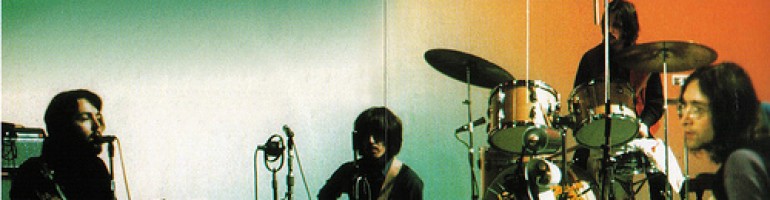
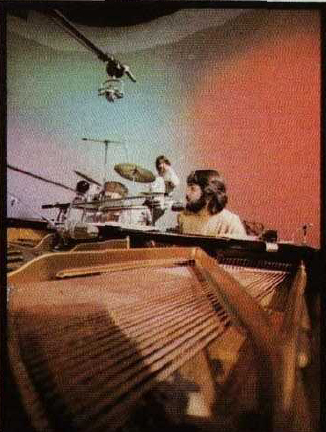 The second day of sessions at Twickenham on A/B Road clock in at close to 5 1/2 hours, more than two hours of which was spent solely on “All Things Must Pass” and “Maxwell’s Silver Hammer” (a song to a post coming soon).

 They May Be Parted