Tag Archives: Paul McCartney

Jan. 12: A family outing (Pt. 2)

FYI at the outset: I’m applying the same disclaimer from last time, when I started recounting the Beatles’ January 12, 1969, meeting at Ringo Starr’s house.  For this series of posts, I’m going to jump between various parts of the January 13 Nagra tapes that directly address January 12, for the sake of the overall narrative.  Specific quotes and certain discussion topics conspicuously absent here will soon be tied back into the story. I promise!

****

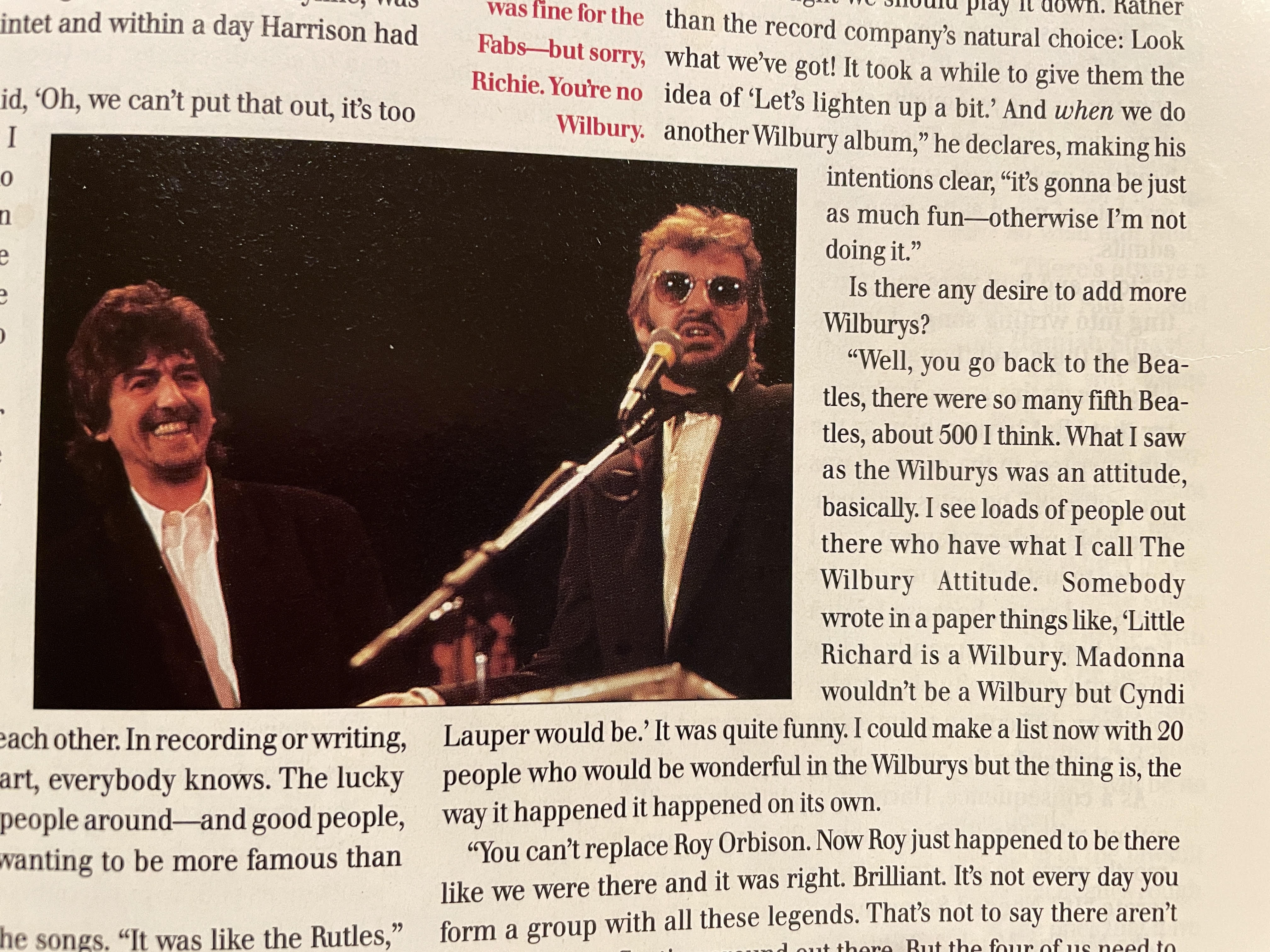
Twenty years after the breakup of the Beatles and in the midst of leading his own supergroup, George Harrison characterized the “Wilbury Attitude.”

From the March 1990 issue of Musician:

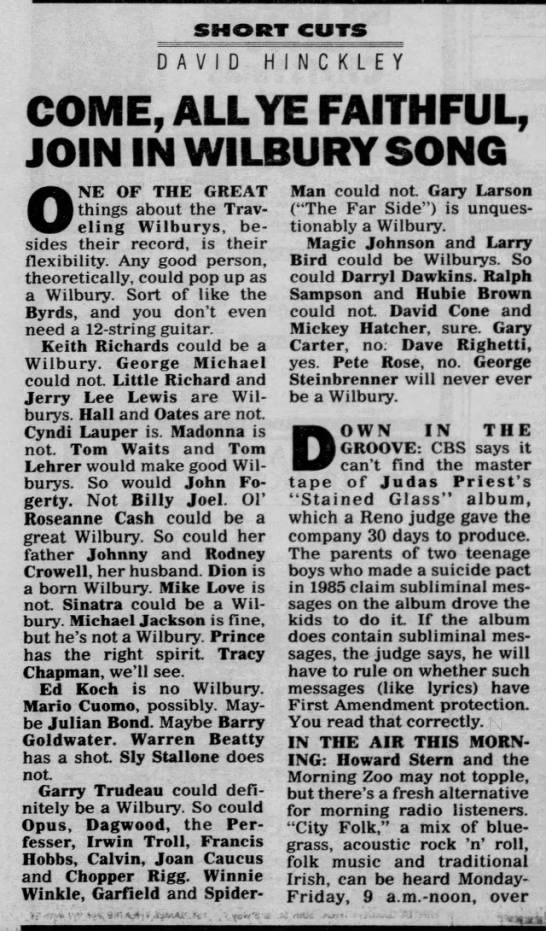
Somebody wrote in a paper things like, ‘Little Richard is a Wilbury. Madonna wouldn’t be a Wilbury but Cyndi Lauper would be.’ It was quite funny.

While there may have been “about 500” fifth Beatles, as George estimated in that same Musician profile, the four proper members of the Beatles were set in stone (Pete Best and Stu Sutcliffe screw up this accounting, so let’s just stick with the figure of four), and the lineup had been stable for more than six and a half years by the time we reached January 1969.

John Lennon proposed expanding the group more than once over the course of that month. The Beatles’ board meeting on January 12 was one such occasion.

Most of what we know about that meeting we learned from recordings of John, Ringo and Paul McCartney — among several other key figures — captured a day later. And while some of those January 13 conversations were filmed openly at Twickenham Studios on the set, so to speak, of Let It Be, a clandestinely recorded lunchroom discussion fleshed out the story.  Remember Michael Lindsay-Hogg’s spy microphone? Documenting this lunch became the device’s greatest legacy.

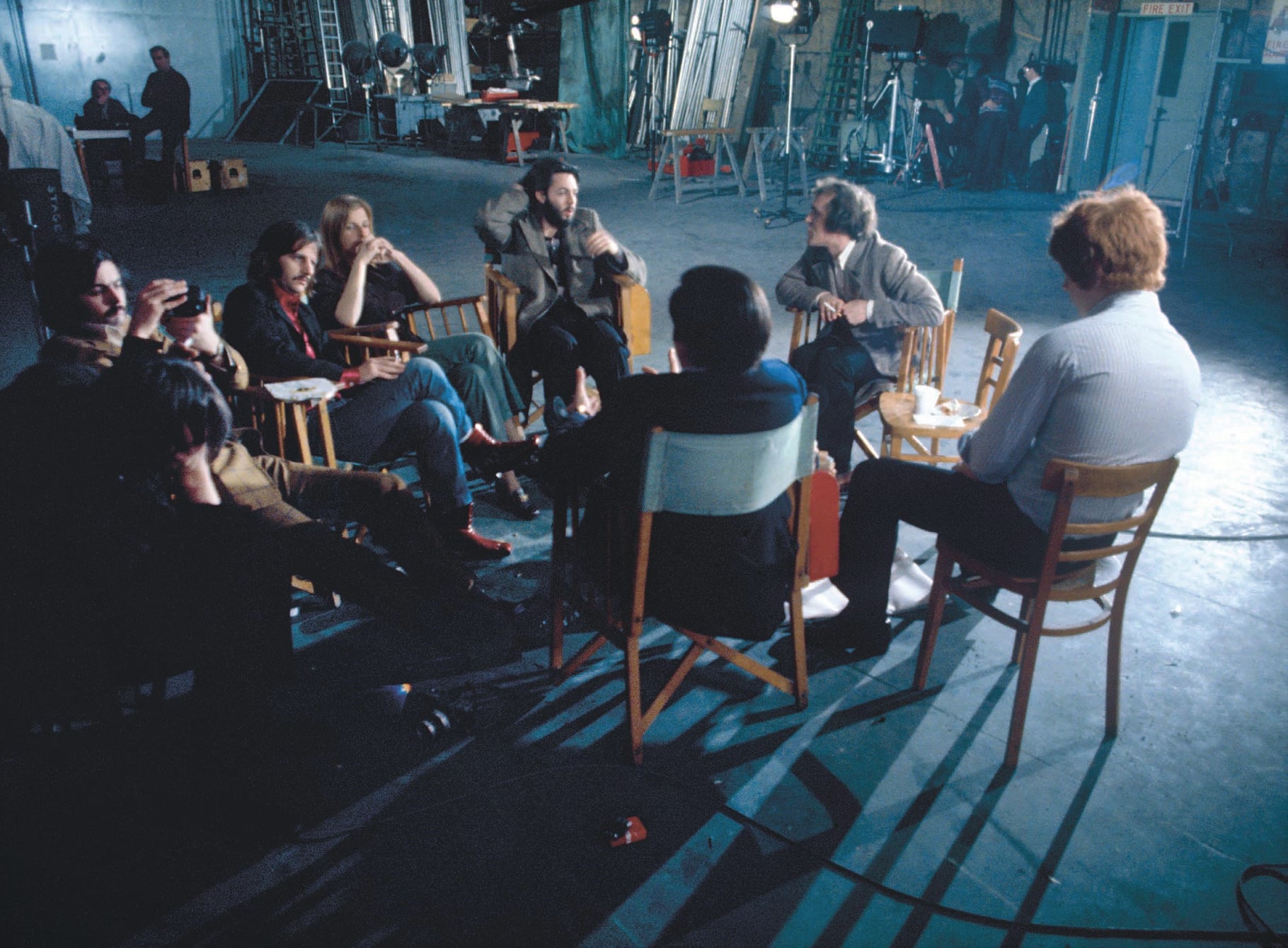
It must be repeated to make it clear: This meeting was not merely between Paul and John, as suggested by the 2021 Get Back docuseries. There were at least half a dozen people present.

“The Beatles, to me, isn’t just limited to the four of us,” John said on the 13th, candidly recounting what became a contentious point discussed during the previous day’s meeting and in response to Ringo relaying that George wanted a meeting limited to the four Beatles. It’s worth noting there were multiple occasions during lunch that Ringo and Paul explicitly referred to the “four” Beatles.

“I think that I alone could be a Beatle. I think [Paul] could. I’m not sure whether [Ringo] could. … I’m just telling you what I think. I don’t think the Beatles revolve around the four people.”

Maybe it’s hindsight speaking, but of course the Beatles revolved around four people, and it had since Stu stepped out in 1961, even if their nominal leader suggested otherwise by calling a critical upgrade at drums merely a reorientation.

“It’s like [Ringo] joining instead of Pete,” John continued. “To me, it is like that.”

We don’t hear Yoko Ono’s name explicitly mentioned in the context of being a part of an expanded Beatles, a proto-Plastic Ono Band, but it’s the clear suggestion amid her omnipresence and in the wake of her taste of the fab experience 48 hours earlier.

For her part, Yoko didn’t see George’s departure as anything but temporary. His return was, in her eyes, completely in the hands of the others.

“You could get back George so easily, you know that,” Yoko said during the lunch.

****

Reputation’s changeable, situation intolerable: George stuck on the third rung

“The third boss.”

That’s how Paul plainly described George’s place in the Beatles hierarchy on the lunchroom tape. (Paul conceded John was at the front and himself secondary.)

It was only a few days prior when George openly bemoaned his status within the group and the dead-end destiny of so many of his contributions: “I’ve got about 20 songs from 1948, because I knew very well at the moment I’d bring them into the studio that [splat sound], there its gone.”

This complaint on January 7 came immediately before he called for “a divorce,” which he pursued when he walked out January 10. At the January 12 board meeting, it only got worse, according to John.

“It’s a festering wound … yesterday we allowed to go even deeper,” John said early in the recording of the lunchroom discussion. “But we didn’t give him any bandages.”

Not only a reluctant medic, John wasn’t sure he wanted George to even be a Beatle anymore. Maybe the Beatles could be a four-piece after all, just with Yoko and without George.

“Do I want him back, Paul?” John said. “I’m just asking, do I want it back, whatever it is — the myth?”

That remark echoed George himself from the divorce conversation, in his response to Paul, saying the band used to be “switched on,” George had replied, “If that’s what doing it is, that’s why I don’t want to do it.”

Like George, John was searching for motivation to maintain the group’s status quo, even when the Beatles’ status quo was really a constant state of invention and reinvention, at least to the point of view of us on the outside.

During lunch on January 13, Paul and John agreed the duo would “connive,” when it came to their marginalization of George within the band and their maintenance of creative control. This, while George “could afford to be more insensitive” himself, as “some other part,” an other acting separately from the other members of the band, perhaps musically, perhaps socially.

“I do think that as grim as it all is,” Paul said, “that [George] is right. And I do think that our sole approach is exactly what he’s been saying.”

John simply said that he knows he’s treated people this way since primary school and offered the customary breakup excuse, “It’s not him, it’s just me.”

Yet while the duo acknowledged the problem of their treatment of George as a tertiary Beatle — later Paul would admit they treated him “a bit like a mongrel” — they didn’t set forth a path to solve it directly. The board meeting on the 12th, which was supposed to be a general business meeting, went so far beyond just an attempt to reconcile George’s walkout. The band’s very existence was in question. Again.

“It’s like George said. It doesn’t give me much satisfaction anymore,” John said on the 13th. “Because of the compromise we’d have to make to be together. The end result of the records now aren’t enough. …  When something came out like Revolver or Pepper or whatever, there was still that element of surprise that we didn’t know where it came from. But now we know exactly where it comes from, and how we arrived at that particular noise and how it could have been much better.

“The only way to get it satisfactorily for yourself is to do it on your own. And then that’s fucking hard.”

Here John again mirrors another of George’s points from January 7, when the latter said he wanted no part of performing any of his own songs at the presumptive forthcoming concert “because they just turn out shitty. They come out like a compromise.”

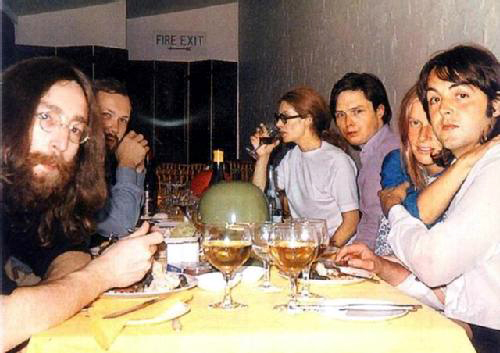
A fab feast, July 1969

Linda Eastman, who like Yoko was at the lunch on the 13th, responded by throwing some of John’s words back in his face. “But you were saying yesterday … you write good songs and it can’t be any better way. You don’t want just studio musicians. I mean, that’s how I look at it. You make good music together, whether you like it or not.

John admitted that he liked it. Still, he was dissatisfied with the White Album. Not his own contributions, which he remained happy with, but the sum of the parts. While Ringo said he dug it “far more than Sgt. Pepper,” John struggled to reconcile how good the White Album was and what he felt it should have been.

As difficult as the situation was, Paul was the optimist. He didn’t even see George’s absence as a problem — yet.

“See, I’m just assuming he’s coming back, you know? I’ll tell you, I’m just assuming he’s coming back.

“What if he isn’t?” John asked.

“If he isn’t, then it’s a new problem.”

****

A “new” problem implies previously existing problems, and on January 12, 1969, the Beatles definitely had other problems.

With the benefit of hindsight,  we know Yoko was right and Paul’s optimism was justified. It was easy to get George to return to the group. It took a couple painless concessions from the others, and he was back with the Beatles just a few days later — this wasn’t any protracted estrangement, just one with good retrospective drama and publicity. For context, Ringo’s resignation during the White Album sessions lasted almost twice as long.

While acknowledging the issue, why didn’t John and Paul go a step further and apply the bandages to salve George’s festering wounds? It’s unclear, as they had recognized, at least in the wake of the meeting — if not during it — their “conniving” problem.

“Our brains sort of … con him,” Paul said at lunch, calling those moments “so innocent” and “so simple.”

That kind of treatment came completely natural to John. “It might have been my game. It might have been masochistic,” he said describing his approach. “But the goal was still the same: self-preservation.”

Yet, John said he “had to fight it the last three years,” saying he overcompensated by feeling he was actually giving in to George for several years, going out of his way to work with and relinquish a territory on their records, while George was creatively on “a good ride.”

He didn’t use the word “connived,” but in later interviews George did consider the others’ actions selfish. None of this should surprise anyone who has followed the Beatles for the last half-century.

From George’s terrific 1977 interview with Crawdaddy:

There were too many limitations based upon our being together for so long. Everybody was sort of pigeonholed. It was frustrating. The problem was that John and Paul had written songs for so long it was difficult. First of all because they had such a lot of tunes and they automatically thought that theirs should be the priority, so for me I’d always have to wait through ten of their songs before they’d even listen to one of mine. … I had a little encouragement from time to time, but it was a very little. It was like they were doing me a favor. …

Paul would always help along when you’d done his ten songs, then when he got ‘round to doing one of my songs, he would help. It was silly. It was very selfish, actually.

Then there’s Yoko, who George didn’t want around the studio as a non-participant, much less as an artistic partner. He may have been insensitive to her when she entered John’s life (invoking her “bad vibes”), but he clearly felt that behavior was justified. This emerged as the red line for John. We know how the story ended, and Yoko didn’t leave John’s side while the Beatles were together. John won that part of the battle, even if she wasn’t elevated to a member of the group.  (Through tragedy she ultimately became a member of the Apple board.)

There was no punch-up on January 10, 1969, that pushed George to take a break from the Beatles, it was just, largely, the simple, sweeping con he endured for years. You could almost say George had been fobbed off and he’d been fooled, he’d been robbed and ridiculed. John and Paul recognized and acknowledged as much on the lunchroom tape.

Like it or not, in the words of Linda, the Beatles made good music together. After the meeting on January 12, 1969, it was an open question if the four of them had any mutual desire and consensus to resume doing so.

15 Comments

Filed under Day by day

TMBP Extra: Leave me waiting here

Had the phrase been in vogue in May 1970, a record review would have called Let It Be a “hot mess.”  I absolutely love the record, but I get how it’s a little off-kilter, off-putting and, frankly, a little bewildering. 

Apple Corps announced the 51st anniversary reissue of the Beatles’ final LP on Thursday, and befitting the record’s legacy, it’s complicated and conflicted. 

I say this as a sincere apologist of the original Let It Be. It’s a bizarre compilation album that’s nothing like anything they had done previously: Part-live, part-studio. Re-recorded and remixed older tracks, and songs written on the spot during the sessions. Novelty songs sequenced adjacent to their deepest statements. A rich overproduction of a loose session that wasn’t initially meant to be an album at all.  Packaged along with a rich book of photos and dialogue and in conjunction with the film, Let It Be was a true, albeit helter-skelter multimedia experience.

Before getting to 2021, let’s first take a quick spin at the long and winding road (ugh, sorry) that got us here, just for the sake of background. It’ll be fun!

After spending January 1969 split between Twickenham Film Studios and Apple Studio at 3 Savile Row (see this fabulous blog for more on that history), the Beatles themselves were never unanimously satisfied with the record pulled together over the subsequent months. Glyn Johns, ostensibly the producer/arranger at the sessions, mixed and sequenced multiple versions of a Get Back LP throughout 1969, and told the story of his first compilation in his 2014 memoir Sound Man, outlining what became the “concept” of the album.

Having no real end in sight for the album, one evening after our session at Savile Row, I took it upon myself to take the multitrack recordings I had made during our rehearsals to Olympic Studios to mix and edit what I thought could be an idea for the album. This was to show in an audio documentary what I had witnessed in the previous days, as a “fly on the wall” insight to the four of them interacting, having fun, jamming, taking the mickey, stopping and starting and creating some wonderful music, warts and all. I had five acetates cut the following morning and gave one each to the band, keeping one for myself, saying it was just an idea and and asking them to take a listen. The next day I got a resounding NO from each of them, which I completely understood and had fully expected.

By May 1969, the Beatles reconsidered, delivering Johns a pile of multitrack tapes from the sessions, asking him to create a mix from their recordings at Savile Row on his own, without the group’s input. He wrote that he “soon realized that the real reason had to be that they had lost interest in the project.”  

“We let Glyn Johns mix it,” John Lennon said in 1970. “We didn’t want to know.”

From the June 1969 Beatle Book

After multiple postponements and revisions to the mix — delays in part because of film delays — the Get Back LP (d)evolved into the Let it Be album as John and George Harrison tasked Phil Spector to produce the final version of the record in late March 1970. 

We all have opinions on Phil Spector’s Let It Be, and I’m not here to judge.

John said Spector “worked like a pig” on the production, which used Glyn Johns’ mix as a starting point. “When I heard it, I didn’t puke,” John said.  Ringo Starr likewise kept in his lunch, going as far as saying in the Anthology book, “I like what Phil did, actually.”

Paul McCartney, meanwhile, literally sued the other Beatles over Spector’s production of “The Long and Winding Road” (among other things, of course) on the last day of 1970.  Macca has since made a cottage industry of rerecording and reissuing non-Spector versions of the song at every opportunity. 

Bootlegged since before Let It Be was even released, the first raw recordings from the sessions were officially released in 1996 on Anthology 3, with a somewhat randomly selected 12 tracks culled for the collection.

Glyn Johns (as pictured in the Peter Jackson’s Get Back trailer)

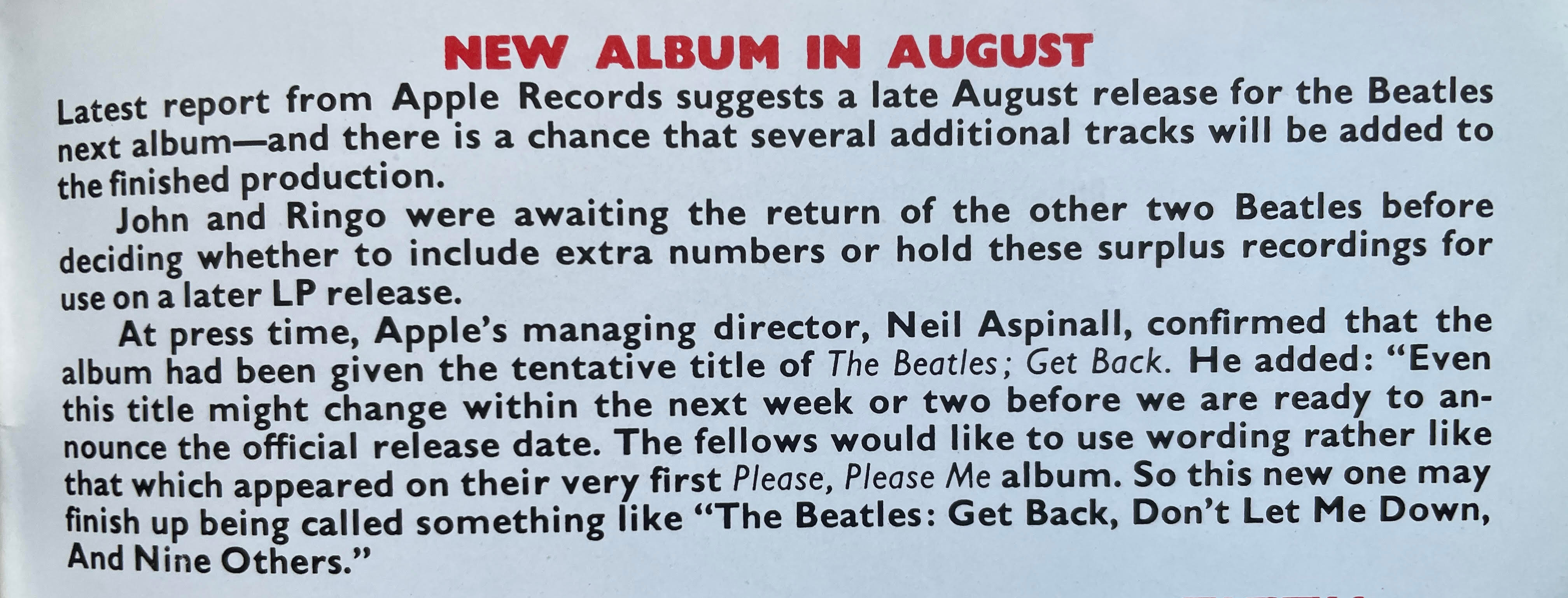
By the time Let It Be … Naked was released in 2003, half the band was dead (although George had previously given his approval to the project). Its existence is primarily owed to Paul’s wishes to avenge Spector’s production (although the addition of “Don’t Let Me Down” to the rest of Let It Be is welcome and it sounds great, even if the collection completely lacks the occasional humor of the original, stripping it of the between-song banter). It’s other saving grace is the addition of the “Fly On the Wall” disc, a little starter set for the Nagra-curious, compiling all manner of song and conversation snippets from the sessions.

And that pretty much brings us to this very glorious day, when we formally learned what would be on the “Special Edition” of Let It Be. 

This is a great time to be a fan of this era, with the Get Back book of photos and dialogue coming out October 12, the album coming out just three days later and the new six-hour Get Back documentary series by Peter Jackson streaming  November 25-27. That’s a lot of product for a period that the Beatles couldn’t stop bashing for several decades, and that we see from the start was something they weren’t really enthusiastic to release in the very first place.

The transformation of the Beatles’ Winter of Discontent in the upcoming Fall of Rehabilitation seems built around the documentary, the apparent centerpiece of the revival. 

We can guess what will be in the film (and I tried to guess — check out the above!) but now we know for sure what a Let It Be deluxe entails. Beyond the Giles Martin/Sam Okell remixed version of the original album — “guided” by Phil Spector’s version — the box will contain:

  • Glyn Johns’ mix of the Get Back LP (looks like his third compilation) 
  • An EP featuring two unreleased 1970 Johns mixes (“Across the Universe” and “I Me Mine”) and two 2021 remixes (“Let It Be” and “Don’t Let Me Down” singles) 
  • 27 “previously unreleased outtakes, studio jams, rehearsals” 

It’s easy to welcome the release of the Glyn Johns mix, a historic document and true “lost album.” It’s a natural and expected addition to the set, even if all four Beatles nixed it more than half a century ago.  The two lost 1970 Johns mixes make sense as add-ons. As for the 2021 remixes … sure, why not. 

That leaves the outtakes.  Oh, the outtakes. While a microscopic fraction of what was captured at Twickenham and Savile Row, it could well be representative in a remarkably scaled down fashion. But until we hear more selections, read more reviews or get dates, even, of some of the tracks, they’ll be a bit of a mystery until we put the record on. What’s in mono (sourced from the Nagras) and what’s in stereo (recorded on multitrack) gives a hint where certain tracks were recorded, but that’s one of the very few clues for you all. 

The track list

For instance, what is “I Me Mine (rehearsal)”? The Nagra reels have more than an hour of the song being rehearsed, over more than 40 tracks.  

Every track that ultimately appeared on the original Let It Be is represented by at least one outtake/rehearsal version.  That’s not a bad thing. Some songs that dominated the sessions did not surface — like “Maxwell’s Silver Hammer,” a significant Twickenham work-in-progress. “All Things Must Pass” seems to be represented by one of these early takes, but only this one.  That’s not a good thing.

It’s nice to have the origin story of “Something” and “Octopus’s Garden” (as seen in the Let It Be film) as links to Abbey Road and an early working rehearsal of “Gimme Some Truth” as a tie to their future solo career. This is a great introduction to a wider audience to the concept that the January 1969 sessions were creatively sprawling and carried a legacy beyond Let It Be alone.

All of this needs to be in there. But every track draws attention to missed opportunities of every scale. The tapes record Paul debuting “Golden Slumbers” and “Carry That Weight” on separate occasions and then later linking them together alone at the piano, but these are left to the bootlegs alone. George and Paul introduce numerous future solo tracks during these sessions, but we don’t get “Here Me Lord” or “Another Day,” to name just two examples.

The set features two Savile Row versions of “Get Back,” but the signature song of the sessions and its 2021 reboot was written while the cameras were rolling over the course of early January 1969. We hear the song spring from a jam and later become a foray into politics (“No Pakistanis”)  before Paul and John work together to finalize the lyrics we know today. To those who know the takes, those earlier, nascent versions are conspicuous by its absence.

To me the development of these songs represent the essence of the January 1969 sessions. It’s what makes this collection have the potential to stand out from the others (Sgt. Pepper, White Album, Abbey Road), in which the songs arrived in the studio mostly formed. The songwriting build should be central to the bonus content, but it doesn’t appear to be. 

Over the course of the Peter Jackson documentary, I would guess we’ll get such moments. And maybe this is where Let It Be and Get Back separate after 50 years of sharing the same exact space.  You almost get a sense that’s what the group is doing, when you look at the Beatles’ homepage, and the image promoting the set: “LET IT BE” is “taped” over “GET BACK,” making clear this thing is different.


To its credit, this box feels too narrow to be seen as revisionist. There’s just not enough material to redefine any narrative (barring whatever’s in the accompanying book). That job will likely be left to the documentary.

I know I’m spoiled. I’ve heard 80-something Beatles hours from January 1969. I want it all, with better sound, in a fancy box I can put on my shelf and not let my kids touch until they wash their hands twice. That beats having of a partition on my hard drive filled with MP3s.

(I’m also spoiled as a Prince fan and have been using the incredible Sign O’ The Times deluxe reissue as a point of reference, too. That had 45 unreleased studio tracks in addition to singles, remixes and different concerts on two CDs and one DVD. It’s a sexy beast of a box set.)

The thing is, how do you compile a widely satisfactory version of the Get Back/Let It Be sessions?

Obviously, it’s impossible to market and widely release dozens of takes of “Maxwell’s Silver Hammer” or nine hours of “Get Back” (the song) sessions. I may like to hear George kvetch about having to be on a boat with Beatles fans or Paul tell John to sing louder or Ringo discuss his dog, but it’s hardly a selling point to a mainstream audience and it’s most certainly not re-listenable (unless you’re literally me or a few other dozen people doing this kind of thing).  I’m not convinced what we’re getting is sufficient either, though.

So what would have been the right way to do this? 

At one point I posited that a “Beatles ’69” super-duper deluxe would have been a possible out-of-the-box box-set approach, combining Let It Be with Abbey Road, something that makes quite a bit of sense when you see how many songs from the latter were essentially demoed at the former’s sessions.

But one gigantic box was never going to happen, the Abbey Road and Let It Be “brands” would never be — and probably shouldn’t be — diminished. I get that. But we’re left with something a little halfway right now. Disc 3 of this set has five eventual Abbey Road numbers. Yet there are another seven that could have been included, but weren’t, and I’m not sure what the rationale was to select which made the cut. 

• Further, if the original Let It Be film is to be dead and buried, this box should have been its final resting place. Mark it up another $20, that’s fine, lots of us will pay it. 

And that would be another way to delineate Let It Be from the forthcoming Get Back, identical twins who finally grew up to lead separate lives. At some point, on one of my appearances on Something About the Beatles, I suggested perhaps the Get Back series should get an actual soundtrack. That would be another — albeit confusing way, to less dedicated fans — to get us to buy another box set with more of what’s missing here.

• We really could have used the originals and curios that they never did anywhere else: “Suzy Parker,” “Oh Julie, Julia,” “Because You Know I Love You So,” “Penina,” “Taking a Trip to Carolina,” “Watching Rainbows,” “There You Go, Eddie,” “Maureen” — that’s half a disc there, and I’m stopping myself from listing more.

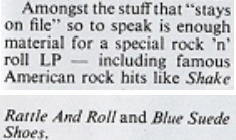
• Likewise, there’s more than enough material to have stuffed a CD or two of oldies (beyond the medley on the Glyn Johns mix). These sessions are known for those oldies performances, and that’s something Mal Evans even broached in 1969, writing as much in Beatles Book 72, published that June.

• Given the consistent on-site song building, they could have easily taken the same approach used on the Sgt. Pepper deluxe with several songs, tracing the progression of “Get Back,” “I Me Mine,” “Don’t Let Me Down” and beyond. It’s very easy to sequence tracks to show these songs’ evolutions. This was so unique for this period, where we can literally hear in the studio, a song’s origin as a piano vamp or a guitar jam, and follow it to the end.  

• If they insisted on having an EP, one of George playing Dylan songs throughout the sessions would have been lovely.

• It pains me there’s no recorded document of the “fast” version of “Two of Us.” But that is one of the drawbacks of many of the outtakes from throughout January 1969: Not everything recorded is a complete take of a song. In fact, quite the opposite.

• We need more Billy Preston, but we always need more Billy Preston. The Beatles certainly were better for it.

The addition of Billy Preston just improved this post.

• I don’t know if we need more Yoko Ono, but I was hoping — though not necessarily expecting — her jams with the group on January 10, 1969, after George walked out. It’s a piece of history, too, regardless of what you think of Yoko’s voice.

• A dozen songs already appeared on Anthology 3. Like the other recent box sets there are a few redundancies. I credit the new set for having something different the January 1970 Threetles session, but it would have been something to have more than just the single track.

• One of the great oddities of the Beatles catalogue, “You Know My Name, Look Up the Number” needed to have a home on this set. It’s timeline was split between Sgt. Pepper and Abbey Road, but as the B-side to “Let It Be,” this is where it belongs (especially as it’s not packaged with either of those deluxes).

• The definitive musical moment of the sessions — the rooftop performance — is featured raw on only one track in the new set. This would have been the obvious spot to offer the whole collection for the completist and as a companion to the Get Back documentary, which includes the whole thing.

***

So to ask again, how do you compile a widely satisfactory version of the Get Back/Let It Be sessions? I don’t think you can. There’s really no suitable middle ground. I — and many others like me — crave everything, a horrible idea for a mainstream audience. I feel the new box goes partway in the right direction with the addition of the Glyn Johns mix and some of the outtake tracks, but it doesn’t go as far as it should as a historic resource. 

That puts some pressure on the documentary, but six hours of unreleased Beatles is a long time. And like the original record, it’s only fair to treat the entire package — records, documentary, books — as a singular, albeit helter-skelter, multimedia unit.  

And in true Beatles tradition, we don’t have to agree on it anyway.

2 Comments

Filed under Extra

Jan. 12: A family outing (Pt. 1)

For all the company’s subsidiaries, history could have used Apple Stenography.

The Nagra tapes so ubiquitous around the Beatles during January 1969 weren’t rolling at Ringo Starr’s Brookfield House estate in Elstead on Sunday the 12th. George Harrison ditched the band midway through the January 10 sessions, and after a brief encounter with John Lennon and Yoko Ono on the 11th, he was back in the company of the entire band as they met to discuss their immediate and long-term future.

Even without minutes of the meeting, we have an excellent idea how it transpired thanks to those very recordings and the candor of others recapping and analyzing the meeting’s fallout the next day back at Twickenham.

For this and the next several posts, I’m going to be jumping between various parts of those January 13 Nagra tapes for the sake of the overall narrative. Specific quotes and certain discussion topics absent here will soon be tied back into the story. There will be redundancies and I may not get to specific points until later. But please trust the process!

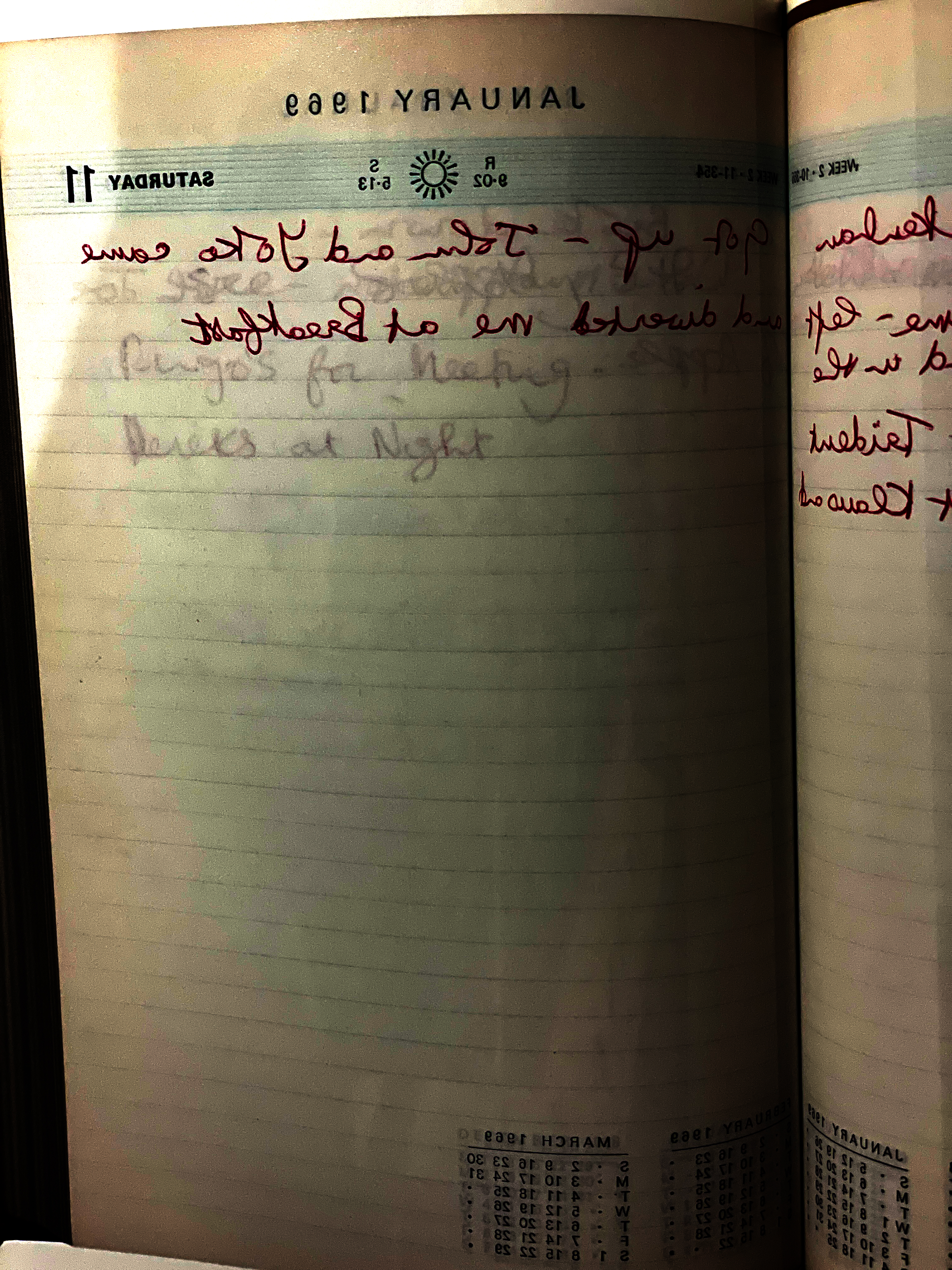
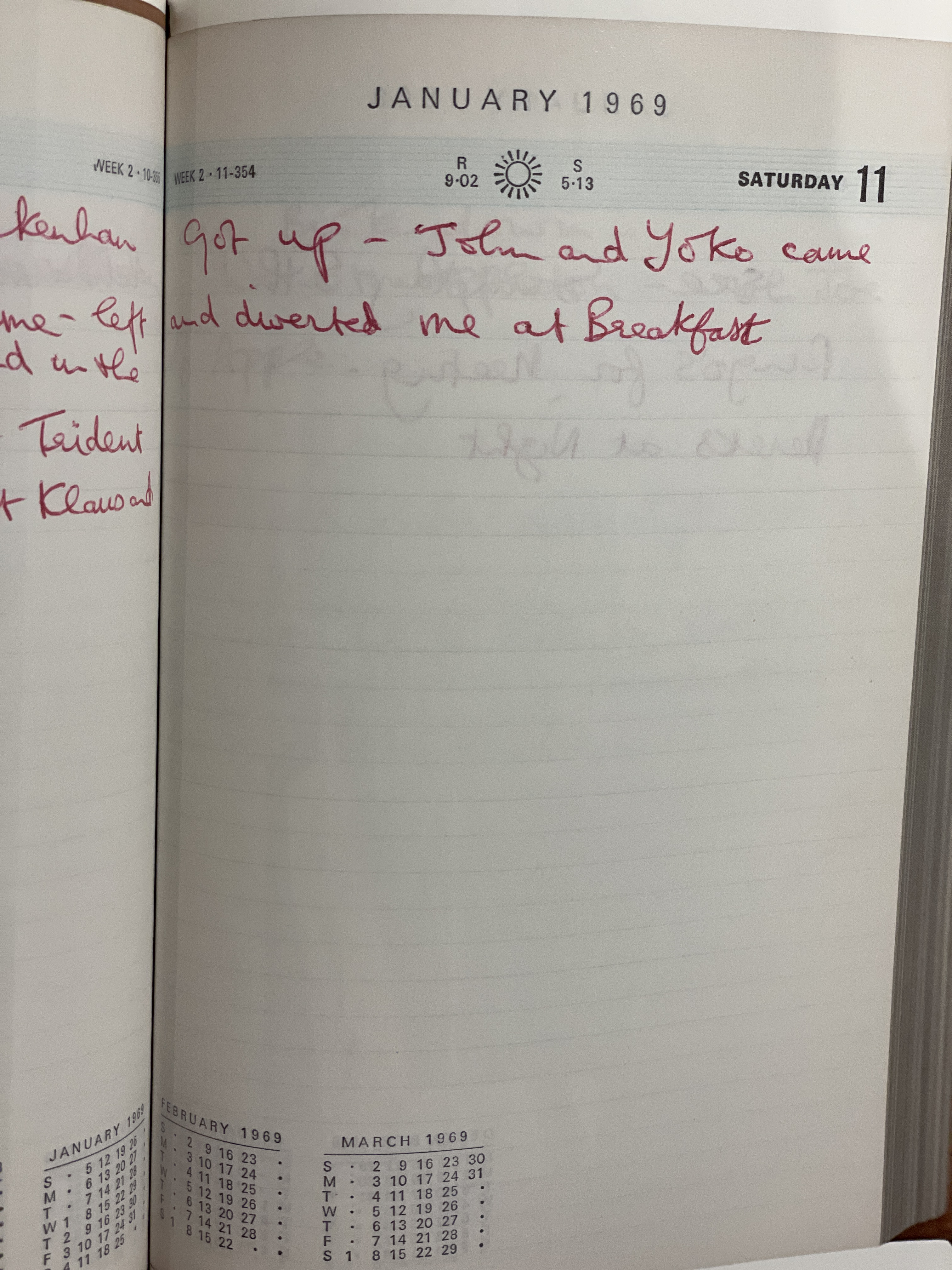
We know nothing about the meeting from George’s perspective except an acknowledgment of its very existence. And we only know that much thanks to 21st century Photoshop trickery, taking his diary entry for the day before (as published in the Living In the Material World book), flipping the image and manipulating the colors to reveal what was on the opposite page.

Clearly and without further detail, George wrote: “Ringo’s for Meeting.”

Do-it-all assistant Mal Evans provided another rare written reference to the meeting, merely saying January 12 was the day “the fellows finally gave up all idea of doing the TV show.”

This tidbit was for public consumption, published in the March 1969 Beatle Books fan club magazine, months after the event, with the storm of George’s departure long passed and the group seemingly — at least in public — a unit again, the earliest Abbey Road sessions under way and more to come.

While we have reason to question if this January 12 meeting is exactly when the premise of a Beatles TV documentary was called off, at the very least because cameras were back at Twickenham the next day, remember Mal did keep a diary, so it stands to reason he checked the date.

(From the March 1969 Beatles Book)

Early January 13, the day the Get Back sessions resumed, Ringo summarized the proceedings in a dry voice: “The meeting was fine, a lot of good things. But then, you know, they all sort of fell apart at the end.”

While the meeting was held in the wake of George’s departure, it quickly became clear the missing guitarist wasn’t the group’s greatest concern.

“I love you laconic Liverpudlians,” film director Michael Lindsay-Hogg said on the 13th. “Because I said to [Apple chief] Neil [Aspinall], ‘And then the businessmen left and then there was just the five of you there, right?’ He said, ‘No, that’s the trouble. Six,’ he said with his flat voice.”

***

Sunday’s gathering featured two distinct components:

  • A business meeting, which included John Eastman, Paul McCartney’s soon-to-be brother-in-law, and other accountants
  • A personnel meeting, so to speak, to discuss the Beatles’ near-term future as a viable unit and to hash out issues better left to a modern HR department

There was only passing mention of the business element, with Ringo referring to “John from America” and the “new accountants we just moved with.” (On January 10, George explicitly mentioned John Eastman in the context of an imminent business meeting, a meeting that had Neil very excited and promised to have news that was “so good.”)

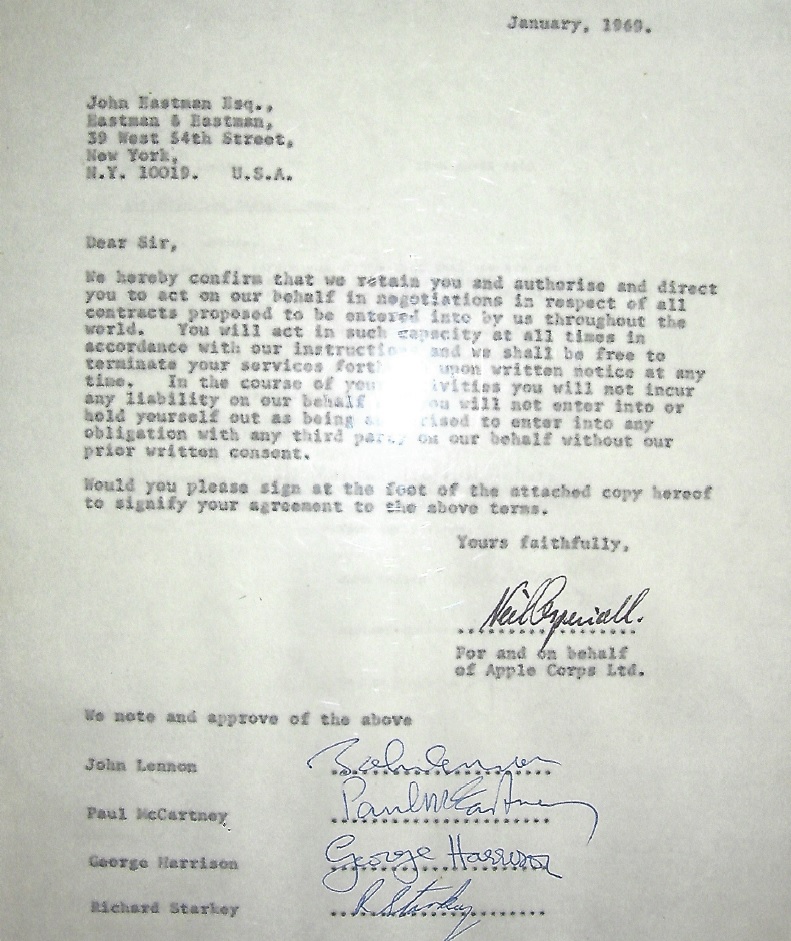
It’s feasible the Sunday meeting is when this document — which is only dated “January 1969” — was signed, giving the Eastman & Eastman law firm rights to negotiate contracts on the Beatles’ behalf.  The timing works out — John Eastman was working on a deal for the successor company to NEMS less than a week later.

The Eastman & Eastman management contract, January 1969.

If only to justify what Ringo described as “a lot of good things” coming of the meeting, the business aspect must have pointed to a positive development.

Most of the subsequent recollections of the Sunday meeting were about the greatest strain on group.

“[John] looked great yesterday” Linda Eastman said in the open discussion early on the 13th between Paul, Ringo, Neil, Michael and Mal.

“Who was he wearing, the usual?” Michael asked, to laughter, including Paul, who repeated the joke.

To be clear, Yoko wasn’t the only non-Beatle or Beatle employee at Ringo’s on Sunday. Linda was there, and even if she regretted her own presence, Paul’s girlfriend (and the lawyer’s sister) was critical that she — and others — were even welcome to attend.

Linda: It’s harder being at a meeting and everybody putting their two cents in, and none of you all saying anything.
Paul: But that’s the other thing, having the meeting. You came with me, and [Linda’s daughter] Heather came.
Linda: Yeah, I was going to say I shouldn’t go.
Paul: It’s such a temptation going out to Ringo’s for the afternoon. It feels like a family outing. (said to laughter)

Paul: It should have been the four of us.
Ringo: Well you (Linda) were out of the way. It nearly was.
Paul: It’s still that thing.
Linda: When there’s something serious, a few other people talking about it, and you get off the tracks.

Paul would also describe the scene as being like “board meetings of ICI (Imperial Chemical Industries) and all the governors and all the wives, and mates and kids and animals.”

Neil explicitly said that Yoko’s participation undermined any chance for a serious discussion. “Everybody else is like, ‘Fuck it. You know it’s not going to be a board meeting, so let’s make it a party.'”

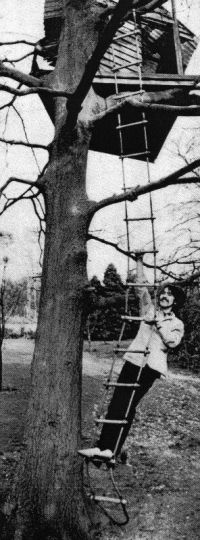
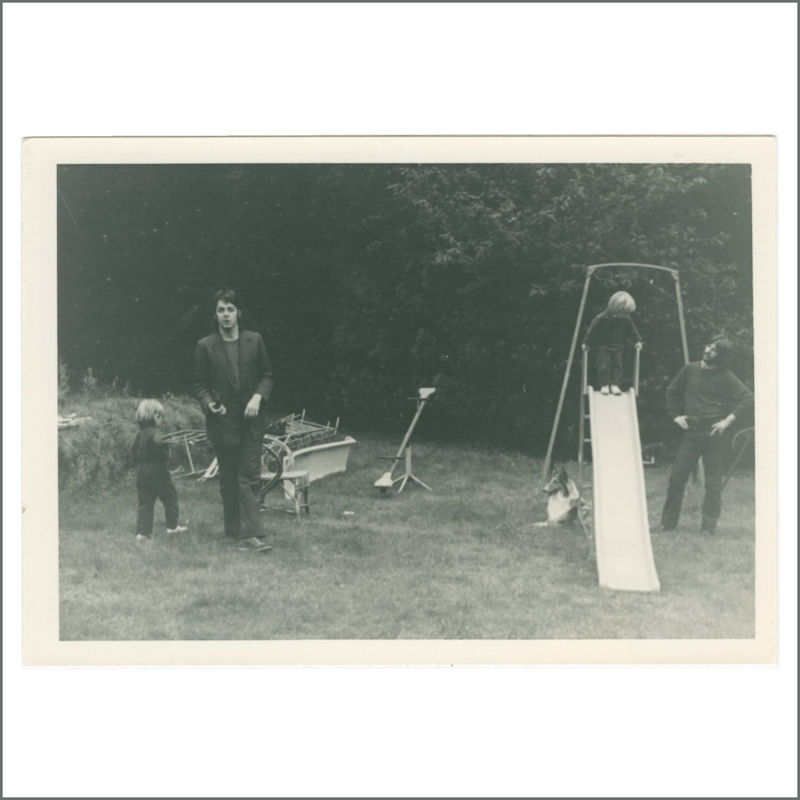
When I get to the bottom I go back to the top of the slide, etc. Beatles and family at Ringo’s in Summer 1969.

Yoko did “so much talking,” Linda bemoaned.

A “key moment,” according to Paul, came when John said he didn’t understand George’s desire for a meeting consisting exclusively of the four Beatles, explicitly excluding Yoko. Twice George told John, ” I don’t believe you,” in reaction to John’s stated confusion.

“I think John knew what he was talking about, too,” Neil said. “It’s like the bullshitting bit where that can go on. It’s silly.”

Paul agreed, but absolved John to a degree.

“John does bullshit. I bullshit. Ringo bullshits. George bullshits. You know, we bullshit.

“With John, you think you can influence it, you think he’s past it. So you start giving him more credit than he’s due for. With Yoko, they mean it.”

Paul consistently placed legitimacy on John’s dedication to Yoko (we’ll see more of this in the coming posts). John alone could be a slippery figure, but here Paul was insisting John really needed Yoko at his side, completely and sincerely.

Paul’s last remark was met with derision from Linda and Neil, especially. Paul’s tone implied maybe he didn’t really believe what he was saying out loud, either.

***

This meeting was scheduled to be about Apple. It would have helped to have been about George. But it became a meeting that revolved around Yoko.

John accused the others of pushing out anyone who threatened the sanctity of the four members of the group, a balance he and Yoko disrupted months earlier. Paul freely admitted as much the next day, describing the Beatles’ conscious decision to maintain a well-defined inner circle.

“The trouble with us, like John said [during Sunday’s meeting], is anything that comes in … with the egos, we try and push out,” Paul said Monday. “It’s always been that. Anybody who’s come in, Like with Michael Braun, with that book, [he] came in for a while, within the circle for a while, and then he gets pushed out cause we don’t want him in the inner circle. And he’s got to stay on the edges.”

Braun’s book — Love Me Do! The Beatles’ Progress —  was published in 1964, and chronicles the group over the course of several months that year and the year prior. John later told Rolling Stone it “was a true book. He wrote how we were, which was bastards. ” Really, the book reads like a draft manuscript of the “A Hard Day’s Night” film, the group enveloped by Beatlemania with supplementary anecdotes of those dismissing the movement. It’s candid, and in the context of its original publication, it had to be a revelation by comparison to other portrayals of the group.

But to Paul’s point in January 1969, the proximity given to Braun, an American journalist who had his own colorful biography, was too much for the group in time. Yoko came in for a while, had been within the circle for a while, but she wasn’t getting pushed out. She was inner circle, with no reason to think she would be forced to the edges.

This wasn’t the only issue. John’s silence, in tandem with Yoko’s new role as his spokesperson, made for the untenable situation. After all, Linda was there too, but she didn’t attempt to speak for Paul.

Still why wouldn’t John talk? One of the greatest wits of his generation, the outspoken and leader of the Beatles — self-proclaimed by this point — silenced himself. John had already forced Yoko into the inner circle. He didn’t need to hand her his voice too. Unless, he didn’t think he needed his voice in the first place.

John openly discussed the Beatles’ ability to communicate non-verbally in Hunter Davies’ 1968 authorized biography.

I think communication all the time like mad, but putting it into words is a waste of time. We talk in code to each other as Beatles. … We understand each other. It doesn’t matter about the rest.

(Listen to the terrific One Sweet Dream podcast for the deepest of dives into this corner – and many others — of the Lennon-McCartney relationship).

If John was silent because he thought he didn’t have to speak at all, Paul cried foul the next day, ultimately mocking John’s telepathic approach.

“Who was he wearing?” (From the Get Back book)

“With our heightened awareness, the answer is not to say anything,” Paul said. “But it isn’t! Cause, I mean, we screw each other up totally when we don’t do that. Cause we’re not ready for heightened vows of silence.”

Paul started to laugh before conceding, “We don’t know what the fuck each other’s talking about.”

Paul then shattered the telepathy myth, explaining why he thought Yoko spoke for John.

“There was something the other day, I said, ‘What do you think?’ And he just didn’t say anything. And I know exactly why. … If one of us is talking about it, it’s a drag if the other three aren’t.”

John’s silence only made Yoko’s outspokenness more conspicuous by contrast.

“Yoko was saying yesterday, ‘This is my opinion. This is my opinion how the Beatles should be.’”

There was no indication of what John’s opinion was.

“John didn’t talk,” Paul later said. “Yoko talked for John.”

John, too, was a laconic Liverpudlian.

***

Despite having spent several years working with the band, Michael Lindsay-Hogg was, by simple logic of not being an insider, a Beatles outsider.

He also had a film to make — a film the Beatles hired him to make — and it wasn’t for quite some time into the January 13 session he finally asked about one of his missing stars, who had hardly been mentioned at all that morning.

“Did George stay?”

“Well, in the middle of all that, actually,” Paul answered, “George went. He said, ‘I’ll see you.’”

15 Comments

Filed under Day by day

Jan. 10: Et cetera

January 10, 1969, saw the Beatles at the precipicesomething we’ve heard before, and will again. Listening to the day’s tapes to the end, it’s clear this wasn’t a band prepared to call any kind of hiatus, even when they had every reasonable excuse to do so. 

Before we move into the weekend away from the studio and their return the following Monday, here are a few loose ends, some other conversations and events from this Friday.

***

While Paul McCartney, John Lennon and Ringo Starr gleefully jammed away in George Harrison’s absence, Michael Lindsay-Hogg was the face of pessimism. 

“Once you leave, it’s really hard to come back,” he conceded. But the director was alone in his premise.

“Not really,” replied Apple chief Neil Aspinall, who’d seen this kind of thing before. “We’re all having a meeting on Sunday. So he could be back then.”

“The box that George is in,” Neil continued, “it’s him versus John and Paul when it comes to what he’s got to do and what he has to play.”

Nevertheless, make the most of it.

George Martin clarified the deeper issue.

“And there’s the songwriting. Because they’re a songwriting team, and he’s his own team.”

Michael — who had been immersed in the Lennon-McCartney experience for more than a week — doubted the extent of their partnership at this point in their career. 

“Nevertheless,” George countered, “they’re still a team.”  

***

In a storyline hard to contain, George’s box wasn’t nearly as notorious as John and Yoko’s bag.

Paul continued to poke fun at the couple for their nascent bagism movement, quizzing his musical partner on logistics and therein shattering any attempt by future scholars to find deeper meaning in the shade of their sack.

“Can you see each other in the bag?” Paul asked the couple — seemingly apropos of nothing, at least on the tapes — during one of the day’s early takes of “I’ve Got a Feeling.”

“Yes,” John said, laughing. “We’re together in the bag.”

“I know, but can you see each other inside, when you’re in the bag.”

“It’s just like being under the sheets. … She generally used to use black bags where you could see out, but we couldn’t see a thing.”

Later in the day, after the couple briefly left the set, Paul speculated, to laughter, that they were “probably in a bag in his dressing room … they brought their own bag with them today.”

“Hence the expression,” Michael replied, “Papa’s got a brand-new bag.”

***

When Dick James referred to sheet music as part of an “expanding market,” Michael questioned just who was part of that market, opening up an illuminating conversation on the state of that industry in 1969. The NME stopped publishing sheet music charts in 1965, and in retrospect, it’s laughable to consider the market’s state as Dick describes. Even in January 1969, it was an open question just who was that market.

“Who buys sheet music?,” Michael asked. “Do I buy at home ‘I Want to Hold Your Hand’ to play on my piano on Saturday night with my family?”

It wasn’t just piano players in the market for sheet music, Dick claimed, but “guitar people, little groups.”

When Michael countered that it would be cheaper for enterprising bands to just buy the records, Paul said not everyone had the ear for that. “They try to find the chords on the piano, and they’re blind.”

George Martin, proofreader

The real issue arose when the the sheet music’s chords were wrong, something Glyn Johns said happened with “extraordinary” frequency.

On the defensive, and speaking on behalf of the publishing industry, Dick laid out the process of how the song went from record to printed paper.

“Where the boys are concerned, they don’t write the song (down), they create the song. I get an acetate or a tape when the record’s finished, and I give it to my music scribe, and he has to take it down. He’s a very good man, he’s very experienced. He can make mistakes, but in an effort to eliminate this now, we check the lyrics — John and Paul, they OK the lyric to be correct.

“That we print, and that is proofed as well. When my scribe is finished transcribing what the boys have done into a song copy, we then send it down to George Martin, and George vetoes it (i.e., he approves). Now if there’s still is a mistake after that, it truly is one of these genuine oversights.”

***

While the Beatles were in the midst of creating their own raw documentary, George promoted the computerized film “Permutations” by pioneering animator John Whitney, who hosted the film at Apple’s HQ the the night before. Featuring an Indian music soundtrack, George was first introduced to the film by Ravi Shankar.

“You’ve seen the three-screen thing before,” George told Michael, describing the film’s unique presentation. “It wasn’t like the psychedelic ones that just freak out and all that. It was just really great and nice to look at.

“So if you hear somebody say, ‘There’s a John Whitney looking for Mr. Harrison,’ let him in.”

***

Hugh Curry, January 1969

No one was looking for Hugh Curry, a Canadian DJ who found himself at Twickenham in the waning moments of the day’s session and would later interview John and Yoko on the same soundstage a few days later.

At the outset, Curry sought a solo interview with Yoko, but if John could somehow maybe make an appearance, well …

“If there’s a moment while she’s doing it, I’ll wander into it,” John generously replied to the suggestion. “You just set a time to do her, and if I’m not doing anything I’ll come in on it.”

“Goddamn sinister”

Pivoting to the subject of the box-office success of the Yellow Submarine film, Curry invoked the missing Beatle, clearly unaware of his recent departure. 

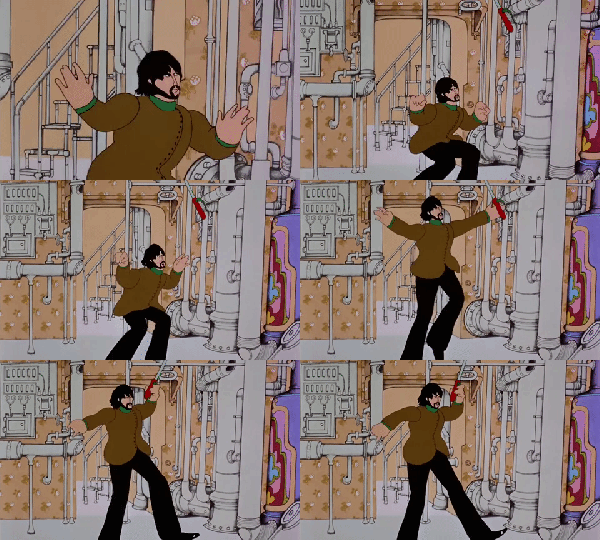
“They make George look so goddamn sinister.”

After a nervous giggle from Yoko, John changed the subject, pinning down the interview for the following Tuesday, anytime after 10 a.m. 

Even with a plan in place, Curry stayed put, pre-interviewing the couple. 

“I heard some stuff over the phone, it sounds good,” Curry said of Yoko’s earlier vocal disruption. “Oh wow, she’s laying some new sounds on it!” 

John and Yoko’s delight was short-lived.

Curry: I heard the Two Virgins thing.

Yoko: Oh, you like it?

Curry: No, I don’t.

The interviewer’s matter-of-fact response brought John to mock tears.

“I dig Cage, Stockhausen, people like that,” he said. “I thought it was too much on one level. It didn’t have enough peaks and valleys.” 

Incredulous, Yoko could only repeat “are you kidding?” before John interjected, “It’s got millions of ’em.”

Curry backed off, suggesting that maybe his “head wasn’t in the right place” on that first listen.

A brief discussion of Cage’s “Indeterminacy” — John hadn’t heard it, but Yoko had, and she was sick of it — led into a discussion of Two Virgins and the difficulty of its distribution in Canada. 

And speaking of record labels … 

“How’s Apple doing,” Curry asked. 

“Going around in circles,” John replied. “Like everything else.” 

1 Comment

Filed under Day by day

Jan. 10: Go on, as if nothing’s happening

“It seems highly unlikely we’d be on,” the guitarist told the director.

With a member of the band unexpectedly AWOL, he was justifiably skeptical the Beatles could stage the big concert to end the film.

“I mean, the law of averages are against it,” he continued. “I think if you could get the juggler on with a couple more clubs, that’d fill in a bit of time.”

That guitarist speaking was George Harrison, and the production was A Hard Day’s Night, the Beatles’ first feature, filmed Spring 1964. On the afternoon of Friday, January 10, 1969, it wasn’t a self-deprecating Ringo Starr who was missing, it was a self-reliant George himself, having sprung Twickenham during his “Winter of Discontent.” This left the remaining Beatles and director Michael Lindsay-Hogg juggling ideas for how to close what would become “Let It Be,” their final film, and who else would be on stage playing lead guitar.  

Michael and Ringo, January 1969. From Peter Jackson’s Get Back.

More than a week into the Get Back sessions, Michael continued making similar iterations of the same pitch for the show.

“One of my ideas is if we go to, like, anywhere, that we mightn’t just announce any times for the concert at all,” he said to Paul McCartney later in the day on the 10th. “We’ll set them (the Beatles) up in whatever desert we do it in, and they start to play. And one by one, and ten by ten, people will come in.”

Inane, I’d call that,” Paul replied with a comedic aggression. “Straight off the top of my head. … Imbecilic. Salacious.”

(Like in his songwriting, at times, Paul sometimes spoke words that simply sounded good, even if they didn’t make sense in context.)

Michael deflected the response, saying “‘imbecilic’ sounded like a bad bug you get the flu from.”

Regaining focus, he invoked the show’s target date, 10 days hence: “I though that could make a very kind of groovy, trendy opening. Seriously, like: January 20, 1969.”

Moments later, the director and the others in the room — which extended beyond just the band — discussed the issue of visas and difficulties several of the Beatles’ peers (Donovan, Mick Jagger and Keith Richards) faced getting into the United States. They were open to several options, including Mexico, the Virgin Islands and other Caribbean destinations.

“And Catalina, which George said wasn’t very nice,” Michael said.

Not that it mattered what George thought then, he’d quit the group almost an hour earlier.

“So what’s our next move?” Michael asked the others. 

“We split George’s instruments,” John Lennon said to laughter.

It was clear in the immediate they were not considering splitting the band, though. If the Beatles were going to be on the move, it would just be in a different iteration. Abandoning the project wasn’t a consideration at present.

The conversation would shortly return to locations, with the Roman amphitheater at Sabratha in Tunisia remaining at the forefront, all other contenders just conversation pieces to keep the group engaged. Michael’s long-preferred destination, he enlisted a “reconnaissance team” that included Beatles assistant Mal Evans and producer Denis O’Dell slated to scout the venue the upcoming Monday.

“There has to be someone to say, ‘The weather’s fine, come on in,’” Michael said.

Paul repeated familiar, feasible suggestions (The Cavern Club, Tower Ballroom) along with new nearby options (the Underground) and  more distant, outlandish and outrageous ones (“the mouth of a volcano near Ecuador”). 

“I think we should do it for more than 500 people,” Michael added.

It was a tough time to think big. This was an afternoon and evening of distractions and interruptions.

In the wake of George’s departure, there were several coincidental arrivals at Twickenham: A package arrived for Paul (marked “‘handle tenderly”); several “EMI heavies” wandered around the soundstage; a CBC interviewer prepped John and Yoko for an infamous interview that would come a few days later.

Rather than return to a full rehearsal, the group joined Michael in telling several imbecilic (and salacious) knock-knock jokes. Of more interest was Michael discussing his career and relationship with Orson Welles, whom decades later he would discover was his father. One lengthy anecdote (which was also detailed in his 2011 autobiography, “Luck and Circumstance”) described Michael acting in Welles’ 1960 stage production of “Chimes of Midnight” when Welles briefly stormed out of the production in anger. 

“See you ’round the clubs!” Glyn Johns reacted, laughing — and confirming George’s earlier valedictory statement, which wasn’t caught on tape. 

An afternoon replete with nostalgia would soon continue after Paul returned to the piano (you can hear “The Long and Winding Road” and “Adagio for Strings” clearly on the tapes in the background). After quizzing the band on whether they had endured any scuffles with their fans (Ringo recalled being kicked in the head), Michael asked if they looked back fondly on their frenzied touring period.

John replied with an affected accent, the voice of a ragged bluesman looking back on a lifetime, not merely a few years earlier:

Why, I think of it every day. I think what fun we had when we was [sic] the Beatles, playing and rocking with the group around the world. I said, ‘Richard, you remember that?’ He says, ‘No, I hadn’t joined you then.’

One of the not-so-fond memories: “Having eggs thrown at us in Australia was one of my big moments,” John said.

Reminded by Ringo he had missed part of the 1964 Australian tour (although he was there for the egging in Brisbane), John evoked the name of the rare Beatle stand-in. 

Jimmie Nicol: Now making a living as the 29th Beatle in New Mexico,” John said of the fill-in drummer, who was actually in old Mexico at the time.  

Now with the band facing a new vacancy, would they soon get to Beatle No. 30?

As if on cue, moments later, Michael barked an instruction for additional equipment: 

“Glyn, Yoko wants a mic.” 

She was back, but the music was hardly intense, with Paul having moved onto his White Album ode “Martha My Dear.”  Now, her vocals were largely calm and controlled, more comedic than anything.

While Yoko once again wailed, John — in conversation with Michael — laid out his plans to replace George. He didn’t suggest Yoko. 

A few hours earlier, George told the other Beatles, “You need Eric Clapton.” The time had come for John to heed the advice, sharing it with Michael. 

“I think if George doesn’t come back by Monday or Tuesday, we ask Eric Clapton to play, ” John said. “Eric would be pleased. He left Cream because they’re all soloists. … The point is, if George leaves, do we want to carry on as Beatles?”

Harsh feedback shortly overwhelmed the room, obscuring some of the conversation on the tapes. But the discussion continued, as Yoko again passionately called out John’s name.

MLH: Maybe for the show, you would just say George is sick.

John:  (Sincerely): No, I mean, if he leaves, he leaves.

MLH: But what’s the consensus, do you want to go on with the show and the work?

John: Yeah. If he doesn’t come back by Tuesday, we get Clapton.

Yoko: John!

John: Whaaaaat? (laughter) 

John and Yoko continued to repeat each other’s names, but this was the couple playing for laughs.  Meanwhile, John and Michael’s discussion continued through the call-and-response, bringing together the issue of show location with locking down a replacement guitarist.

MLH: And what about the venues? … If George comes back we go away, and if Clapton comes in we stay here.

John: We should just go on, as if nothing’s happening.

MLH: I think we should go away.

So eager to get the show on the road, Michael had the potential logistics lined up in his head, proposing the group spend the following week at Twickenham and the week after abroad, all conforming to the group’s timetable, which was in part defined by Ringo’s filming schedule for The Magic Christian. 

“What I’ve always thought is we leave here next weekend (January 18-19) and do the show the following weekend (January 25-26) there, if we decide to go there,” Michael said. “And then come back on Monday (January 27), which is just inside Ringo’s seven days.”  (The January 20, 1969, date floated previously must have only applied to a domestic show or an alternative, abbreviated schedule.)

Michael’s plans to this point were more extensive than expected, implying there really was no option, at least that he was eager to prepare, other than Sabratha. 

“We’ve arranged everything food-wise to come in from Germany,” Michael said, adding for the skeptics, “I do not joke. It’s the same food from the American [military] base.”

Eric Clapton and John Lennon, from the Rock & Roll Circus, December 1968.

And if it wasn’t enough John was trying to enlist Eric Clapton to join the Beatles, Michael casually suggested a near reunion of Cream, if it meant just getting Paul and John to Libya for rehearsals, and Ringo — who was least receptive to travelling — to be minimally overseas.

“We can get out a session man for a couple days,” Michael said. “Or Ginger Baker can come for a few days. Just to kind of routine it.”

The discussion between John and Michael petered out as John joined Paul and Yoko on another jam. Unlike earlier, when the Beatles played hard blues rock out of rage, this improvisation was more subdued, a more gentle and at times an arguably pleasant performance, containing elements of “Castle of the King of Birds.” Paul was on piano, John on guitar and Ringo on tambourine with Yoko providing another disruptive vocal — although not quite as consistently intense than earlier in the day.

Soon, Paul shifted to the drums — and it’s a noticeable drop in quality from Ringo to Paul, as strong as the latter is as a multi-instrumentalist. More importantly, it freed up Ringo, who returned to conversing with Michael. But first, he played up for the cameras (and tapes).

Yeah, rock it to me baby, that’s what I like. You may think this is a full orchestra, but if you look closely you can see there’s only two people playing and one person singing. I know it sounds like Benny Goodman, but don’t worry. It’s the big sound of 1969! You bet your life. Oh, sock it to me, sock it to me. (Laughter)

Interested in the filmmaking, Ringo asked Michael precisely what he was doing — “I thought what we should do is the first sessions when you came back, make it very hand-held looking,” Michael said, pulling the curtain behind the sausage-making. More importantly, Michael shared his first-hand view on what he saw after George walked out. 

“And the interesting thing is, Paul went to his amp. … I don’t know if you knew what you did, psychologically, after lunch. You (addressing Paul, who joined them) went at your amp like you shut the door into a closet. … And you (Ringo) were playing very hard. … And John was doing whatever he was doing.”

Ringo, Paul and Michael continued their conversation, as John provided background music — “Sun King” and “Dear Prudence.”

MLH: Have you ever had coverage when you were doing a whole album?

Ringo: No. 

MLH: Have you ever wanted it?

Ringo: No.

Like it or not, the Beatles — what presently remained of them — were getting blanket coverage, and the real drama was happening in the studio, not on location.

“Are we meeting again Monday?” Michael asked hopefully in the waning moments of the day’s session.

“Yeah, I’ll have Eric, Jimi (Hendrix, although it could feasibly be Jimmy Page) and Tommy (Evans of the Iveys, perhaps?) lined up,” John replied, with varying and low degrees of sincerity.

Paul’s set his bar much lower. 

“A7, D7, G7,” he instructed Maureen Starkey, who was visiting Twickenham that afternoon. “Get ’em off over the weekend and you’re in.”

(Ironically, armed with those chords, Maureen would have been able to fill in for George on his For You Blue.)

Paul with guitar protégée Maureen Starkey. From the Get Back trailer.

Before splitting for the day, Michael made sure to capture the scene. “We have this well-documented. And a lot of shots of the empty cushion.” We’ll see what Peter Jackson shows us in Get Back ’21, but this footage was left on the cutting-room floor of the final cut of Let It Be.

“And I guess that’s it,” wrapped up Michael, who wished the others luck in their planned weekend business meeting, which would include George. “And I hope everything really goes swell. I’d like to say, I’ve enjoyed our week together, hope one day we have another one like it.”

“Surely,” Paul replied. “Why not?”

And thus ended the first full work week of the Get Back sessions.  While George was kicking Eric Clapton’s ex-girlfriend out of his own house, John pushed the concept of welcoming Eric into the Beatles’ office. 

As you certainly know, Clapton never joined the Beatles, and John didn’t bring him in the following Tuesday, even though George wasn’t back. There clearly wasn’t an actual offer anyway.

Here’s Paul, from the Anthology book:

After George went we had a meeting out at John’s house, and I think John’s first comment was, ‘Let’s get Eric in.’ I said, “No!” I think John was half-joking. We thought, “No, wait a minute. George has left and we can’t have this — it isn’t good enough.’

For his part, Clapton repeatedly downplayed the idea he was an actual fallback option for the Beatles. In modern parlance, Clapton thought John used him as clickbait, and the friendship he had with George would have been a blocker anyway. 

Eric, from the April 1998 issue of Mojo

There may have been [a suggestion the Beatles would ask him to join]. The problem with that was, I had bonded or was developing a relationship with George — which was exclusive of them. I think it fitted a need of his and mine, that he could elevate himself by having this guy, that I could be like a gun-slinger to them. Lennon would use my name every now and then for clout, as if I was the fastest gun. So I don’t think I could have been brought into the whole thing, because I was too much a mate of George’s.

Several years later, after George’s death, Clapton literally laughed at the idea of joining the Beatles when he was interviewed for Martin Scorsese’s 2011 documentary “Living in the Material World”.

As he said in the clip, the Beatles could be the most close-knit quartet, but at the same time, “the cruelty and the viciousness was unparalleled.” 

The latter led the Beatles to this moment. After their first full day at Twickenham, on January 3, George described with envy The Band‘s ability to blur their domestic and working lives, something he witnessed first-hand when he visited the group and Bob Dylan six weeks prior.  “They’ve got all that gear there, but … they’re just living, and they happen to be a band as well.”

His relationships with his wife and his band in distress, George had neither element 10 days into January 1969 — he wasn’t living properly, and he didn’t feel like a useful member of the Beatles.  

While he’d join John Lennon as a member of the Dirty Mac before and the Plastic Ono Band later, Eric Clapton was neither asked, nor was he seemingly willing to accept an assignment with the Beatles.

The Beatles didn’t need Eric Clapton, a gunslinger for hire. They needed George Harrison. 


5 Comments

Filed under Day by day