Tag Archives: Ringo Starr

Jan. 8: Nothing is real

Far from chaotic, the Get Back sessions, if anything, could be defined by its routines. Paul arrived early to play piano, and then pretty much ran the rehearsals. George’s songs — whether written overnight or brought back for another day — were a slog for everyone else. John didn’t have much new to offer, while Ringo did Ringo things like participate in conversations and keep the beat. Turn the page to the next day on the calendar, and do it all again.

Beyond music, the daily pattern underlying the scene centered around discussion of the live concert the Beatles were trying to put together. At once a footnote to the songs, the show was simultaneously the purpose of these January sessions and thus ostensibly what mattered most. The push and pull between director Michael Lindsay-Hogg’s wanderlust and the group’s default stance — to stay put — was a constant. And the more they couldn’t settle on a British venue, the closer they collectively moved toward simply staying in the very room where they were rehearsing and ruminating.

January 8, 1969, then, was no different than so many other days the Beatles spent at Twickenham the first half of the month. Discussion about the concert surfaced late in the work day, concurrent with Paul introducing the unfinished “The Long and Winding Road” and “Let It Be” to the rest of the band for the first time, and with their initial attempts at a full-band arrangement.

Yet now, to stage the “honest” sound they sought to achieve these sessions, the Beatles began to consider an ersatz solution. Rock and roll begets rocks, or something imitating it, at least.
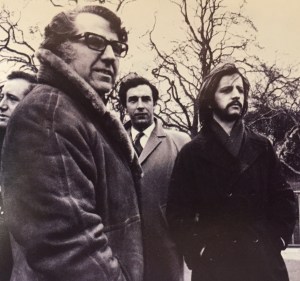
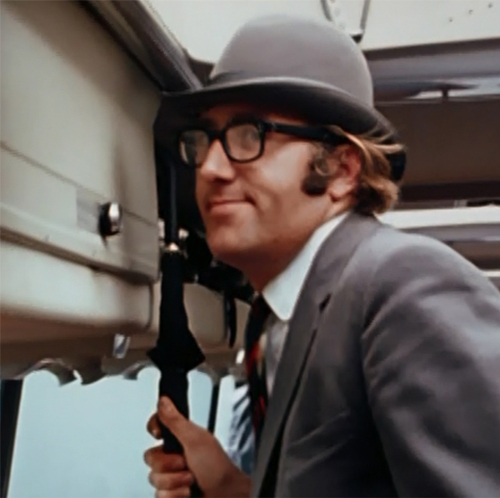
Denis O’Dell (left) with Ringo at The Magic Christian shoot. Photo from O’Dell’s book, At The Apple’s Core.

“If we try to cover all this (Twickenham’s sound stage) and build caverns and caves, it’s nice, you see,” said Denis O’Dell, the head of Apple Films.

Why perform at the Cavern in Liverpool for the nearly 300th time, when you can simply craft your own cavern indoors? (Please don’t answer that.)

Denis had been in the film industry since before the Beatles were born, and his association with the group began in 1964, when he was associate producer on the A Hard Days Night film. It was the start of a mutually beneficial partnership to this point, which included How I Won the War (associate producer and John starred), Magical Mystery Tour (producer) and led to his appointment as an Apple executive.

Of course, you already know his name (but have to look up his number) from his time at Slaggers, and do note he is NOT related to Miss Chris O’Dell.

Denis had appeared sporadically on the tapes to this point, and here it dovetailed with one of the first times John seemed even marginally interested in what was going on with the live show.

“Then we could do what we’d like with a backing,” Denis told John. “Go black, or stark or something. Then we could control all our lights from a panel, and we could have all colors you’d like.”

“Yes. And they’ll be able to see us through everything.”

John invoked sets used by Stanley Kubrick, Denis’ boss on Dr. Strangelove (that film was the source of the footage used during the “Flying” sequence in Magical Mystery Tour), and the man floated to direct a version of Lord of the Rings starring the Beatles. An extensive recap of that aborted episode in Beatles history is discussed at length in Denis’ 2003 fine autobiography of his Beatles years, At The Apple’s Core.

The conversation would continue, with Denis asking someone to fetch George Djurkovic, art director of The Magic Christian, from the film’s set elsewhere at Twickenham to provide added insight. But while Paul continues to play “The Long and Winding Road” in the background the conversation on the tapes meandered to a new duo: Ringo — one of the stars of The Magic Christian — and Michael. While Denis and John spoke as if the live show was to be held at the studio, Michael continued negotiations on taking the show on the road with Ringo. They were the leaders of the rival factions: Stay-put Starr vs. the whole Hogg.

“If I do go, I think it’s better just to go for four or five days,” Ringo said, showing newfound flexibility. “We don’t need to go to rehearse.”

Ringo was willing to bend and travel, but there’s a catch: “I’d like to do it to a British audience.”

It’s a catch, but one Michael is willing to receive. “Can we all talk about it? Will you take the veto off if you can be convinced we can get an audience?” Michael asked.

A Roman amphitheater wasn’t artificial, but to Ringo, the whole reason to perform overseas was contrived. The only reason to travel was the “helicopter shot, you’ll see the sea, the theater. And that is, for one, two minutes, say, that shot isn’t worth me going down there when I really prefer to do it here.”
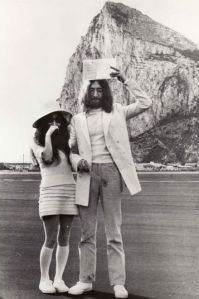
Two and a half months after Ringo suggested the Beatles perform before there for a “British audience,” John and Yoko would be married in Gibraltar (near Spain).

“I see us doing a good show here [at Twickenham], because it’s you [the Beatles],” Michael said, again conceding this could be the last TV program the band will ever do.

Speaking quickly, Michael continued:  “Everything you do has got to be good. All your albums are good. …. It’s not only you as the band, it’s not only them as songwriters, it’s the four of you.

“It’s got to be the best.”

Of course they’re the best. Like Ringo doesn’t know that?

“Every time we do anything it’s going to be the best,” Ringo replied. “Can’t we just do something straight?”

And back to Twickenham, and staying precisely put.

“At the moment, that scaffolding set and the tubular thing, it is kind of like four years ago,” Michael said. “And there’s nothing wrong with four years ago. … We’re all 28 now, or whatever we are. The audience isn’t the same, life isn’t the same.”

For the record, John, Ringo and Michael were all 28, Paul was 26 and George a wee 25. But his point remained legitimate. This wasn’t 1965 anymore.

“This place, it could be rock and roll, ” Michael began.

“It could be rock and roll in Tahiti or wherever you want to put us. What’s it called? (laughing)”

Michael’s not even sure himself. “It’s either Tunisia or Tripoli.”

Ringo asks about a British possession likewise on the Mediterranean — “What about Gibraltar?” — before turning his attention back to the room he was in and the music, ignored during the conversation.

How’s this for an idea of stripping a show down?

“See, Ringo said, “I’d watch an hour of just [Paul] playing the piano.”

7 Comments

Filed under Day by day

TMBP Extra: Time to leave the capsule

Today, Jan. 8, marks David Bowie’s birthday. We’ve noted Bowie’s birthday here before, purely as an afterthought in conjunction with the fact it’s also Elvis Presley’s birthday. But we focused on Elvis last time, and today’s it’s Bowie’s turn.

Life on Mars and Venus

Life on Mars and Venus

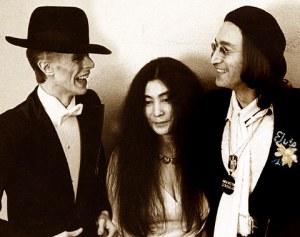
Bowie wrote and recorded with, covered and befriended John, performed with Paul, covered George and at least hung out with Ringo (were we all so blessed).

From last year’s Bowie: The Biography (which I only skimmed, but my wife thought was pretty trashy):

According to Tony Visconti, David’s friendship with John developed to such a degree that the three of them often spent a night on the town together. “We stayed up with John Lennon until 10:30 a.m. We did mountains of cocaine, it looked like the Matterhorn, obscenely big, and four open bottles of cognac,” Tony recalled. … John and David bonded over drugs, music, and a shared quirky British sense of humor.

In addition to having crossed paths to varying degrees with each of the members of the band, Bowie was deeply influenced and inspired by the Beatles, and when you try hard enough, you can hear it throughout his extensive catalog. Additionally, Ken Scott was a shared link in the studio, engineering Magical Mystery Tour and the White Album while engineering and/or producing Bowie from 1969-1973. (Visconti worked with Paul, too, after he first worked with Bowie).

Los Angeles, 1975: Bowie, Ono, Lennon

New York, 1975: Bowie, Ono, Lennon

But one thing Bowie did not do was have anything to do with the Beatles as a unit. His star only rose as the Beatles’ was burning out.  The Beatles closed the 1960s after defining its sound just as Bowie prepared to do the same for the ’70s. As Bowie eventually put it, when referring to his friendship with Lennon: “Although there were only a few years between us, in rock and roll that’s a generation, you know? Oh boy, is it ever.”

After a lifetime of enjoying rock music, it somehow took until my 40th year to fully immerse myself into Bowie’s music. This is not to say I wasn’t a fan, or didn’t enjoy various releases over the years. But in 2014 I really became a superfan, getting completely absorbed into his music. Part of that immersion was to visit the truly incredible David Bowie Is exhibition that recently closed at Chicago’s Museum of Contemporary Art. Comprehensive and engrossing, I was blissfully overwhelmed.

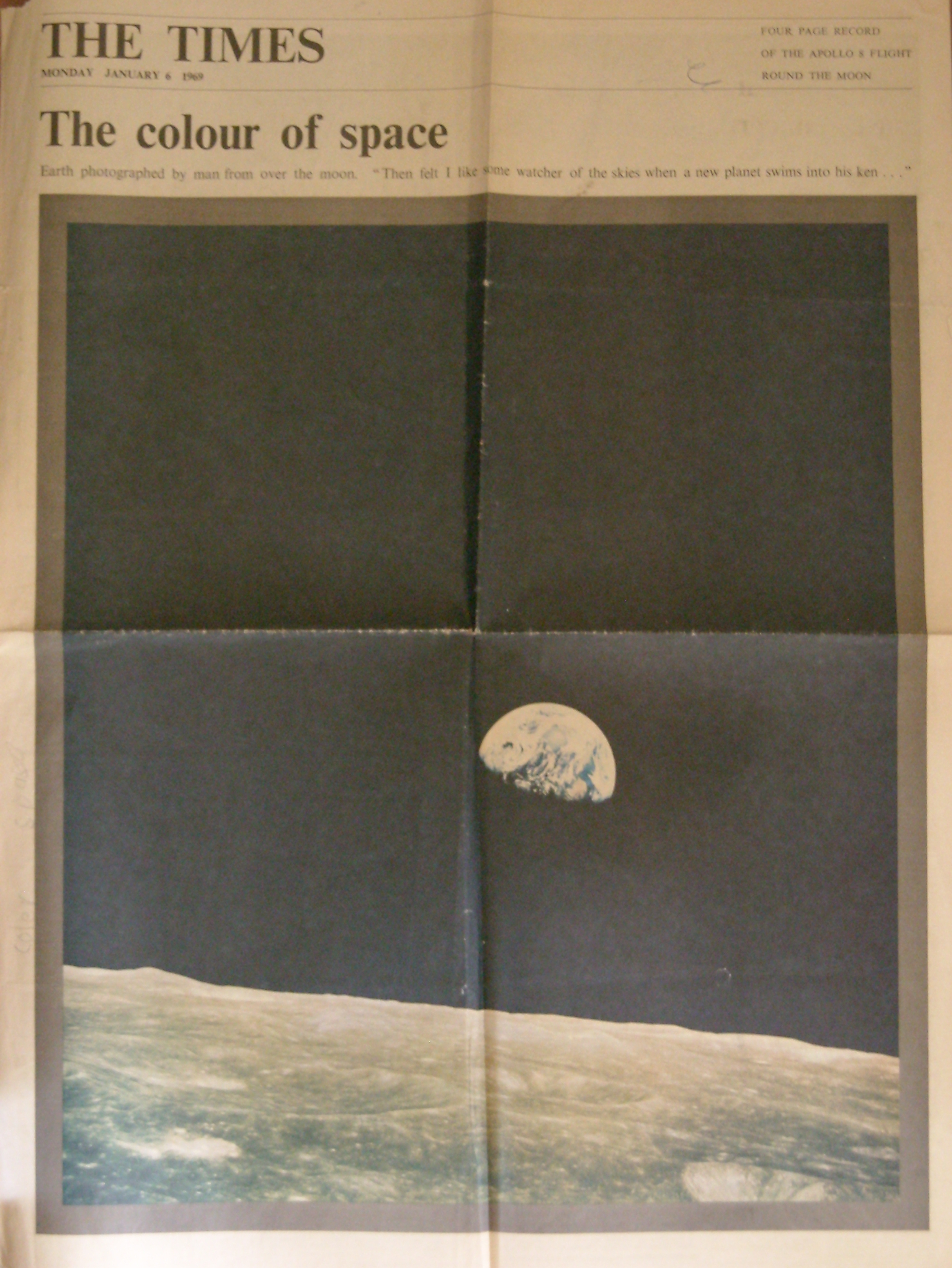
The Times, Jan. 6, 1969 (click for larger image)

The Times, Jan. 6, 1969 (click for larger image)

Among the artifacts near the beginning of the exhibit was a newspaper: the Times of London showing the Earthrise, the iconic image from Apollo 8 that shows, well, the earth rising as viewed from the moon. The photo was taken Dec. 24, 1968, but was published in a special insert in the Times on Jan. 6, 1969. According to the exhibit, after seeing the paper, Bowie had “Space Oddity” written within a week.

Especially when you place yourself into that era, it’s a moving image, the blue earth rising above the moon, but that’s not what jumped out at me. And if you happened to be at the MCA that morning in mid-November and heard someone muttering, “I’ll play, you know, whatever you want me to play,” and wondered who it was, that would be me.

Because on Jan. 6, 1969, David Bowie was inspired to begin writing “Space Oddity” at the precise moment the Beatles were bickering over how to rehearse “Two of Us” just miles away at Twickenham.

The Nagra tapes didn’t roll 24/7 in the lives of John, Paul, George and Ringo from Jan. 2-31, so we certainly can’t say the Apollo mission — or any other particular news event — did or didn’t inspire or influence the band. The group touched on politics, immigration in particular, in outtakes like the “No Pakistanis” version of “Get Back” and “Commonwealth” at various points during the Get Back sessions, and it’s not as if the Beatles didn’t have a history of being social commentators.

But I found it illustrative with regards to where these different acts were at this very specific moment in time — Jan. 6, 1969 — that David Bowie was able to find a muse that would launch him into stardom for the first time just as the Beatles found themselves trapped –Planet Earth is blue, and there’s nothing the Beatles could do. Between the time Bowie started writing “Space Oddity” on Jan. 6 and finished it on the 13th, George would suggest the band “have a divorce” after an open discussion recounting how bad things have been for a year (Jan. 7), and then he’d end up quitting (Jan. 10). The Twickenham sessions ended after Jan. 14.

George on David Bowie, 1974

I certainly won’t argue the Beatles were out of ideas in January 1969; this entire blog is predicated on the idea the group remained vibrant and vital during the Get Back sessions. But it’s obvious any success they had was despite themselves. The songs they wrote or worked on this month were works of art, to varying degrees, but it was often tantamount to climbing up the hill backwards, as Bowie would put it, to get anything done. We’d have lost Abbey Road and Let It Be (although you’d assume many of the songs would later resurface on solo records) but an argument can be made John and George, at least, may have been happier people had the Beatles ceased to exist in their present form sometime in 1968. Is the difference tangible between a band being pulled apart and an artist ready to burst? Oh boy, is it ever.

Used in conjunction with the BBC’s Apollo 11 moon landing coverage in July 1969, “Space Oddity” made a name of Bowie just as the Beatles were in the thick of recording Abbey Road. (About 12 hours after man first walked on the moon, the Beatles began recording “Come Together”). By the time Bowie’s eponymous LP featuring “Space Oddity” was released that November, the Beatles were effectively finished. Five years (what a surprise) later, after meeting John at a party, the Starman ultimately entered the orbit of the Beatles.

5 Comments

Filed under Extra

Jan. 7: Bangers and mashups

OK, stick with me here.

Nearly 46 years ago, somewhere between lunch and the resumption of the day’s writing session-cum-rehearsals for “Maxwell’s Silver Hammer,” it sure sounds like Paul McCartney may just have invented the mashup, or at least a rough approximation.

Really!

This is not a medley, sampling, sound collage or musique concrete a la “Revolution No. 9” and others before it. This is turn-of-the-21st century-style mashup: Think The Grey Album, Girl Talk or the Beatles’ own Love with elements of two or more songs layered on top of each other.  The kind of stuff Paul got roped into a few years back before an audience, he and George performed live to tape decades earlier in a little bit of completely obscure history.

That would be 1967’s “When I’m 64” (written a decade earlier as one of Paul’s first songs and described here by Paul as the “beautiful geriatric Beatles song”) sung atop “Speak to Me,” which would ultimately lead off Jackie Lomax’s debut album, as produced by George and released two months later.  We already heard George briefly play a more proper version of “Speak to Me” to John a few days earlier.

As Paul’s “When I’m 64” vocals eventually drop out – and his mouth clicks chime in – we go from a forgotten moment of debatable history to one that would have a lasting impact on wax: the debut of Maxwell’s actual Silver Hammer, the anvil, as ordered before lunch.

The band comfortably eases out of “Speak to Me” with a fun and increasingly polished run through of “Oh! Darling” – polished for this point in the sessions, for sure –  the second time they played the song in a few hours, and with John having rejoined the group back on guitar. The song is essentially complete and by all accounts should have been by now part of the core considered for the live show at this early stage. It doesn’t get any further attention this afternoon as Paul immediately returns to “Maxwell’s” for the better part of another hour. This initial launch into the song is captured in the Let it Be film, spliced in from the point where Mal strikes the anvil.  It’s a truncated slice of the song, and in the film we end up getting thrust into the Shoctric Shocks incident, which actually occurred four days earlier.

Paul doesn’t introduce any new wrinkles yet in this first go-round after lunch. He’s pleased, though. “It’s catchy enough, then,” he says after the first full take. He soon boasts of the dramatis personæ and vibe of the song, “It’s so cartoon … such caricatures.”

Paul remains a delightful caricature of himself, remaining fixated on the whistles that color the song throughout. “We want a mic for John and George on this ’cause the whistle on this,” is Paul’s first and primary direction to the crew. George’s initial concern in the early going of the post-lunch session is getting the song’s timing and cues down, especially for the sake of Mal, who wielded the hammer. Not that George didn’t try to give his drummer an additional bit of work.

“I’m sorry, George, the hammer’s too heavy for me,” Ringo says to laughter.  As it turned out, Ringo would end up carrying that weight after all, striking the anvil in July, when the group properly recorded “Maxwell’s” for Abbey Road.

By Paul’s thinking, the roadie was the man for the job.

Mal’s more like Maxwell, anyway. … He should be very scholarly. Very straight, in a striped tie and a blazer, sort of. Big chrome hammer. That’s how I see him anyway. [He’s] Maxwell Edison, majoring in medicine, in fact.

Resplendent in a smart gray blazer and striped tie, Mal Evans is already dressed for the role of Maxwell Edison as he rides the Magical Mystery Tour bus.

Resplendent in a smart gray blazer and striped tie, Mal Evans is already dressed for the role of Maxwell Edison, medical student, as he rides the Magical Mystery Tour bus.

Sparked by a question from George about the repeated of “bang, bang” in the chorus, Paul runs through the song structure again with the usual caveat: “I haven’t written the last bit.”

That’s fine with George, who thinks he knows how the song goes. “I just know it in my head, rather than the words, because the words are not in the right order anyway.”

Loose as he can be, Paul repeats the song structure: “It’s like two verses (scatting and singing) Bang, bang. … Clang, clang. … Whistle. … That’s nice fellas.”

As work continues, George shows a bit of concern with his own instrumentation.

George: To the man that’s producing me, whenever I play bass, because I don’t know anything about it, I don’t know what the sound is. I just plug it in and play it. So if somebody knows how to get the sound or record it. I mean Glyn’ll have to do that if he’s around. So you can mention that to him.

That’s some pretty self-deprecating talk from George, but he really has few bass credits under his belt to this point.

Straight out of the Small Faces’ playbook, John ad libs a narrative introduction to the song, laying out Maxwell Edison’s origin story, with Paul picking up in the middle.

John: Let me tell you the story about Maxwell’s Silver Hammer. He got it from F.D. Cohen, the pawnbroker from Bayswater.

Paul: Maxwell was a young boy just like any other boy, and he might’ve lived a life like any other young boy’s life had it not been for some certain unforeseen circumstances.

And … whistle!

Given that the band spent more than an hour on the song of about five hours of recorded tapes this day, it’s no surprise it was a very early contender for the live act. So much so, George began offering up suggestions on how to stage it, beyond costuming for the band and Mal. There’s a practical side to his suggestions, too.

George: I think we can do it with lots of people singing the chorus, ‘Bang, bang, Maxwell’s Silver Hammer,’ but it’s very difficult for me to whistle and sing and keep in sync. … It should be like the end of [Hey] Jude.

John:  ‘You all know it, join in, gang, because we don’t know it.’

George: We could just project it up, have the chorus projected up there.

We’re not sure what Paul thinks of that idea, since there’s whistling to be done, and no joke whistling, please.  “Really, do it like it’s straight,” he says, telling George how the notes of the chorus solo goes. That’s a whistle solo, not a guitar solo, mind you.  Paul does work on improving the song, spending a few minutes crafting a harmony based on a short, partial climb up a scale “with jumps on the hammer,” in his words. It’s pretty and adds to the carnival-like atmosphere the song has to this point.

For the final takes of the day of the song, the rest of the group still doesn’t have the song’s structure completely down, and Paul resorts to vocal cues to alert when the whistling solos come. John asks Paul to shout out “blow it, boys” at the appropriate time. Paul can’t help but repeat his helpful reminder: “It should be very straight, the whistling.”  He really does keep saying this, to a near obsessive state, and at no point is he kidding about it.

The “Maxwell’s” rehearsals for the day end with a final, full run through. The song’s basic elements are there: new harmonies, whistle solos, the anvil and a full strong structure. What it lacks is a complete set of lyrics, but Paul isn’t sweating it, concluding with a simple, “OK, that’s Maxwell’s.”

While the song did progress with the work on Jan. 7, there was a noticeable missed opportunity shortly after lunch as a lead-in to the mashup sequence. For a few brief moments as the group warms up, a sloppy yet sincere take of “Maxwell’s” features Ringo on vocals, and it sounded like the perfect fit. Paul’s song eventually drove the other three Beatles to fury; giving Ringo an extended vocal role could have changed a little corner of Beatles history.

As the sessions continue, John takes the reins for the next song, one that not only has its lyrics set, but the instrumentation as well.

“Should we do ‘Across the Universe?’ We almost know that, don’t we?”

9 Comments

Filed under Day by day

Jan. 7: Pulled their socks up

Everybody had a hard year? If we’re talking about the Beatles, that’s a fair appraisal just a week into 1969.

As rehearsals were set to get fully under way January, 7, 1969, the group openly discussed breaking up. Instead, moments later, they were trying to hammer out the details of “I’ve Got a Feeling” for more than 20 minutes before launching into an extended session dedicated to Paul’s pet “Maxwell’s Silver Hammer.”paul

The out was right there for them; the group was in agreement that a divorce was not unreasonable. But while we don’t know for certain, (unless this particular discussion was filmed and we can see for ourselves if the footage is ever released), it doesn’t even sound like anyone moved out of their chairs, much less high-tailed for the exits. Paul left the band during the recording of “She Said, She Said” in 1966 and Ringo split during “Back in the USSR” in ’68. But this cry for divorce, so much more severe than a walkout of a single member, didn’t immediately lead to much of anything. Nobody budged January 7, 1969, after the early takes of “Get Back,” and status quo reigned.

As tension melts and the group trades chatter for chords, it quickly becomes clear little that had led to the group to the brink had actually changed.  Paul may not enjoy his role as band leader — “I’m scared of that, ‘You be the boss’” — but he’s not letting that job go, either, despite any prior protests from George or anyone else in the group.

Arranger/producer Paul made plain his preferences for “I’ve Got a Feeling,” and anything else they were to tackle going forward in preparation for the live show.

We should start off by doing everything we’re going to do on the thing. Like if you’re going to do the ‘oh yeahs’ innit, you’ve got to do ’em how you’re going to do it. No use singing ’em quiet now if you’re planning on doing them loud on the night.

Paul certainly sweats the details and is quick to dictate the construction of the song, asking John to keep the chord sequence before the chorus “kind of tight,” barking “riff” to George at the appropriate times and working on the balance of “oh yeahs” with “oh noes.” Even Ringo wasn’t spared; he received explicit directions, too: “Don’t go into the swing at the end,” Paul said as he vocalized the closing drum pattern.

Overall, special focus was paid to the transition to “Everybody’s had a hard year” and the subsequent section. Paul pushes George to add “something recognizable” just prior to the bridge (“All these years I’ve been wandering around”).

The vibe, meanwhile, is generally agreeable throughout, and there’s certainly no indication that moments earlier the band was basically trying to figure out the right way to break up.  While no songs were particularly tight by this stage of the sessions, there’s a definite, steady progression here with “I’ve Got a Feeling, ” a song that had seen time each day thus far at Twickenham. The group works their way through at least one complete take (tape cuts, as usual, keep any claim here from being definite).

Content with the state of the song, and with a lengthy pivot to “Maxwell’s Silver Hammer” imminent, the band detours briefly into a pair of apparent improvisations that wouldn’t be heard from again (the bluesy “Woman Where You Been So Long” and the especially catchy, Little Richard-inspired “Oh! Julie, Julia”).

John cuts off the jam to ask Paul to launch into “Oh! Darling,” an admitted favorite of John’s up to his death 11 years later. Paul was again in instruction mode here — there was no solicitation for advice on working out kinks, rather the song was set and merely needed to be taught.

Paul had already played the song twice at Twickenham — both times solo at the piano for Lindsay-Hogg (“Sounds great, Fats Domino!” the film director said on the 6th), but it was without any further accompaniment and probably without the full band even in the building.  This is the first full-band take of the song, which, despite the need for Paul to shout out chords and generally sounding in a rough state, seems to have had at least some off-tape rehearsal at some point. With John’s enthusiasm for the song only helping the cause, it’s not unlikely to think “Oh! Darling” could have been a viable option for an extended live show, were it to have actually been staged. Alas, with the rooftop featuring Paul only on bass, and the setlist short, it wasn’t meant to be, but the song certainly found a happy home on Abbey Road.

With just single take achieved, George (largely off-mic) thinks beyond “Oh! Darling.”

“‘Maxwell’s’ would be even better to go on.”

Even Paul’s skeptical as the band readies to lay down the silver hammer.

You never know.”

6 Comments

Filed under Day by day

TMBP Extra: All that lies ahead

As I write this, it’s Friday, Jan. 31. About three-and-a-half weeks ago was Jan. 7. Check your own personal calendars, news headlines and the like. It’s not that long ago. That matters to me, and this blog, because this is where the Beatles come in.

Flip (or click) back several calendar pages – 45 in fact – and we’re at January 1969, dominated by the Get Back sessions. Jan. 31 marked its final day, a short day dedicated to nailing for film and for tape usable takes of Paul’s non-rooftop-suitable “Two of Us,” “Let It Be” and “The Long and Winding Road.” (The clips appeared in the movie prior to the rooftop show, but were in fact filmed the next day).

What of Jan. 7? That’s where we left off last in the session timeline, at a genuine pivot point.  George suggested the group “have a divorce,” Paul said he’d thought about that, too. The Doldrums. It hung over the band.

So what happened between Jan. 7 and Jan. 31, 1969, to recast the sessions? Well, I’m not going to give it all away at once. What else would I blog about, the recording of Sentimental Journey? (That actually seems like an interesting, star-studded, intercontinental story, but I digress.) Three and a half weeks is such a short period of time, in relative terms, and we know that the group was on the brink Jan. 7. By Jan. 31 so much memorable musical output was in the bank and in the works. Factor in that there’s 10 ½ days without George after his walkout and more than a week without any rehearsals at all, and I’m left grasping at superlatives.

To wit: From Jan. 7-13 and Jan. 21-31, 1969 (18 days, and that includes weekends not spent in the studio):

  • Paul wrote the majority of “The Long and Winding Road,” “Let It Be” and “Get Back” and debuted future solo tracks “Another Day,” “Teddy Boy” and “Back Seat of My Car”
  • George wrote: “I Me Mine,” “Old Brown Shoe” and “Something,” as well as “Wah-Wah” at home during his break from the band.
  • Everything you hear on “Let It Be,” plus “Don’t Let Me Down” was recorded.
  • We saw the birth – and if not the birth, than at least the studio debut – of Abbey Road’s “I Want You,”  “Oh! Darling” and “Octopus’s Garden.”
  • We have the rooftop show, too.
  • The Beatles even found time to meet with Allen Klein for the first time.

And I feel like I’m understating what happened.

So, there’s just a little bit of food for thought before I return to the timeline (soon!). Context is everything, and with January here and now gone, it provided the perfect chance to put into focus how much these guys got done throughout the madness they, for the most part, created themselves.

5 Comments

Filed under Extra