Tag Archives: The Long and Winding Road

TMBP Extra: All that lies ahead

As I write this, it’s Friday, Jan. 31. About three-and-a-half weeks ago was Jan. 7. Check your own personal calendars, news headlines and the like. It’s not that long ago. That matters to me, and this blog, because this is where the Beatles come in.

Flip (or click) back several calendar pages – 45 in fact – and we’re at January 1969, dominated by the Get Back sessions. Jan. 31 marked its final day, a short day dedicated to nailing for film and for tape usable takes of Paul’s non-rooftop-suitable “Two of Us,” “Let It Be” and “The Long and Winding Road.” (The clips appeared in the movie prior to the rooftop show, but were in fact filmed the next day).

What of Jan. 7? That’s where we left off last in the session timeline, at a genuine pivot point.  George suggested the group “have a divorce,” Paul said he’d thought about that, too. The Doldrums. It hung over the band.

So what happened between Jan. 7 and Jan. 31, 1969, to recast the sessions? Well, I’m not going to give it all away at once. What else would I blog about, the recording of Sentimental Journey? (That actually seems like an interesting, star-studded, intercontinental story, but I digress.) Three and a half weeks is such a short period of time, in relative terms, and we know that the group was on the brink Jan. 7. By Jan. 31 so much memorable musical output was in the bank and in the works. Factor in that there’s 10 ½ days without George after his walkout and more than a week without any rehearsals at all, and I’m left grasping at superlatives.

To wit: From Jan. 7-13 and Jan. 21-31, 1969 (18 days, and that includes weekends not spent in the studio):

  • Paul wrote the majority of “The Long and Winding Road,” “Let It Be” and “Get Back” and debuted future solo tracks “Another Day,” “Teddy Boy” and “Back Seat of My Car”
  • George wrote: “I Me Mine,” “Old Brown Shoe” and “Something,” as well as “Wah-Wah” at home during his break from the band.
  • Everything you hear on “Let It Be,” plus “Don’t Let Me Down” was recorded.
  • We saw the birth – and if not the birth, than at least the studio debut – of Abbey Road’s “I Want You,”  “Oh! Darling” and “Octopus’s Garden.”
  • We have the rooftop show, too.
  • The Beatles even found time to meet with Allen Klein for the first time.

And I feel like I’m understating what happened.

So, there’s just a little bit of food for thought before I return to the timeline (soon!). Context is everything, and with January here and now gone, it provided the perfect chance to put into focus how much these guys got done throughout the madness they, for the most part, created themselves.

5 Comments

Filed under Extra

TMBP Extra: Jan. 7 Power Hour

Sirvana, July 20, 2013

Before I move on with the Twickenham happenings on January 7, 1969, I wanted to offer up this bit of context as Paul McCartney circles the globe on his latest world tour.

It’s more than 44 years since Jan. 7, 1969, and Paul McCartney is still playing the four songs he began that day with live: “The Long and Winding Road,” “Golden Slumbers/Carry That Weight” and “Get Back.”

As in, 60-something hours before I posted this, the same James Paul McCartney that sat before a piano at Twickenham introducing these songs to a room of just a few people, played the very same numbers to 47,000 at Safeco Field in Seattle (playing “Golden Slumbers/Carry That Weight/The End” and “Get Back” with the surviving members of Nirvana). That’s after performing them hundreds and hundreds of times over the decades.

Four songs he introduced over the course of about an hour one morning in 1969 at age 26. He turned 71 in June.

According to setlist.fm, Paul played 39 songs in Seattle — seven that were introduced in January 1969 and a whopping 14 (!) originating from 1968-1969. That’s 36 percent of his show in 2013 spanning less than 24 months, the remainder covering another 50 or so years of his career.

5 Comments

Filed under Extra

Jan. 7: Sing a lullaby

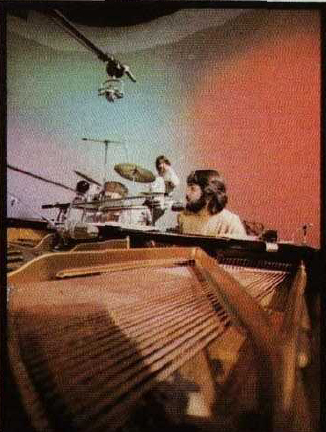
With Paul McCartney seated at the piano at Twickenham on the morning of Jan. 7, 1969, the seeds of the Abbey Road medley are planted. Or, at least, unveiled on tape.

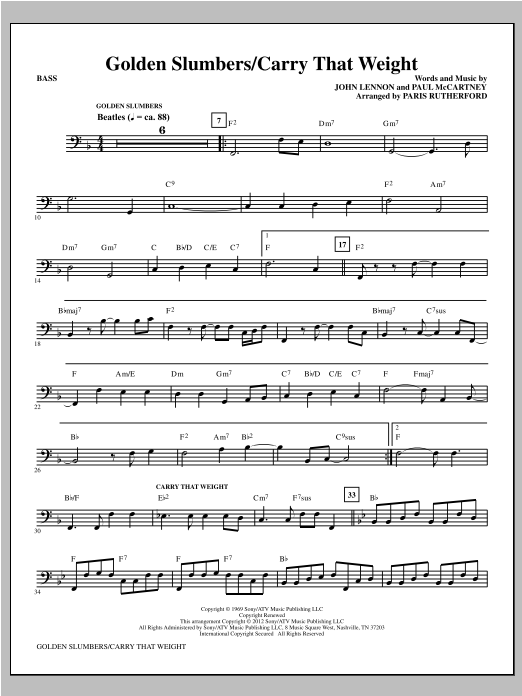
Famously pinched, in part, from a poem that was more than 350 years old, “Golden Slumbers” debuted minutes into the Jan. 7 tapes, another of Paul’s performances solo at the piano.

Lyrically and musically, the song is just about what would end up on Abbey Road.

Once there was a way to travel homeward
Once there was a way to get back home
Sleep pretty darling, don’t you cry
And I will sing a lullaby

Golden slumbers fill your eyes
Smiles awake you when you rise
Sleep pretty darling, don’t you cry
And I will sing a lullaby

While the song has its origin in a Thomas Dekker poem from 1603, the recollection of a “way back home” is Paul. Here’s the inspiration, the original verse by Dekker:

Golden slumbers kiss your eyes,
Smiles awake you when you rise.
Sleep, pretty wantons, do not cry,
And I will sing a lullaby,
Rock them, rock them, lullaby.

Care is heavy therefore sleep you.

You are care and care must keep you.
Sleep, pretty wantons, do not cry,
And I will sing a lullaby,
Rock them, rock them, lullaby.

After repeats of the song, Paul transitions right into “Carry that Weight.” Of course, it sounds like the songs are made for each other, but that could be more than 40 years of built-in bias.

It’s unclear if the link was simply improvised that morning, conjured over breakfast or what. But “Carry That Weight” sure did seem to be a standalone piece when brought to the band the day before.

As the piano part winds down, implying “You Never Give Me Your Money” (which is yet to be written), instead he goes right back into “The Long and Winding Road,” the same song Paul began to play prior to “Golden Slumbers.”

Any other day, it wouldn’t strike a chord, no pun intended (really!). But on this morning, “Golden Slumbers” and “The Long and Winding Road,” separated by five months in the studio and eight on vinyl, are pieces of a puzzle that  I didn’t realize existed.

Of course, book-ending “Golden Slumbers/Carry that Weight”with “The Long and Winding Road” could just as well be coincidence, too. But this context, deliberate or not, sheds light on what sounds like shared DNA.

Paul’s incomplete lyric to “The Long and Winding Road” — truly debuted as the tapes began to roll on Jan. 7, 1969, just moments earlier — spoke of  this sad, Sisyphean journey.

The Long and Winding road that leads to your door, will never disappear, I’ve seen that road before. It always leads me here, lead me to your door.

Having completed that performance, Paul unveils the song’s echo in “Golden Slumbers.”

HL_DDS_9079800pW60Dl5XJ“Golden Slumbers” shares the yearning as “The Long and Winding Road” but, side-by-side, it sounds further removed with a stronger sense of contemplative acceptance to the singer’s situation.

The time has passed: There “once” was a way to get back homeward. So while  “The Long and Winding Road” (as written to this point, at least)  has  a sense of distant, desperate hope, “Golden Slumbers” delivers acceptance but a promise of a better tomorrow via Dekker’s original lyric (“Smiles awake you when you rise”).

It’s Paul’s “All Things Must Pass.”

Bundle “The Long and Winding Road” and “Golden Slumbers” with “Carry That Weight” — not to mention “Let it Be,” which is absent from this sequence but was first played four days prior —  and in Paul you have a man who seems to readily acknowledge and be at peace with the fate of his band more than a year before they would actually split.

14 Comments

Filed under Day by day

Jan. 7: Still they lead him back

paul-at-pianoA difficult January 6, 1969, did not result in a collapse of the sessions at Twickenham — which were entering just its fourth day — nor a break in the band. Not yet, at least.

So with the promise of optimism any new day delivers — daylight is good at arriving at the right time, after all — Paul was again the first back at the studio Tuesday, Jan. 7. And as was the norm that developed, he kicked off the day’s tapes solo at the piano.

“The Long and Winding Road” had the most brief of debuts at the first full session, Jan. 3, lasting about 10 seconds prior to Paul launching into “Oh! Darling” during his first morning piano jam.

It’s a poignant beginning to this session, on the heels of the rough day prior. Paul has very much alluded that “The Long and Winding Road” is about the splintering of the group — although the song itself wasn’t really new. Instead it was a few months old, a product to the White Album sessions, and one he said he wrote channeling Ray Charles.

He says as much on the brand-new official Let it Be … Naked site (Note from 2018 — it’s since vanished from the web) — in an interview that was probably from the record’s original release in 2003, not from 2013, I’d guess, repeating the point about “writing as” Ray Charles, but stopping short of saying “The Long and Winding Road” is about his relationship with the group.

On the heels of saying that people read a lot into “Two of Us” being about him and John when it was actually written for Linda, Paul does leave the door open about what exactly “The Long and Winding Road” was about:

It’s to do with your personal situation at the time. You don’t always realize it.

While the song had been demoed months earlier, the song this day is in nascent form.

He plays for about five minutes, with the skeleton of the piano part in place, but just few lyrics.

The Long and Winding road that leads to your door, will never disappear, I’ve seen that road before. It always leads me here, lead me to your door.

Many times I’ve been alone, and many times I’ve cried. …

And that’s all we hear, beyond a few scatted lyrics to what was the eventually vocal melody.

We hear the song one more time later in the day — it’s a 30-second instrumental, straight out of a short rehearsal of “Oh! Darling” right after Paul moves to the piano in advance of a lengthier session on “Maxwell’s Silver Hammer.” It’s just a time-filler as everyone else tunes up.

Even without the later, tacit acknowledgement, it’s very easy to read his struggles with the rest of the group in what few lyrics he did have written for “The Long and Winding Road.”  And it’s illuminating to know he felt this same sense of desperation already during the White Album sessions. It’s just another reinforcement to the thought that the Get Back/Let it Be sessions were part of the road to the breakup, not necessarily the vehicle for it.

George is confrontational and about 72 hours away from quitting the group. John is drugged, distant and tethered to Yoko. Ringo keeps a great beat but is otherwise not much of an active participant. But still, what they mean to Paul brings him back to Twickenham’s door.

The song ultimately would become a lightning rod, the most flagrant example of Phil Spector’s fingerprints on the final release and in a bit of a legal sense, the song that technically broke up The Beatles.

Listen to “The Long and Winding Road” on its own, and it’s a somber, beautiful song about not much in particular. Apply your own dysfunctional relationship here to what could be another typically McCartneyesque vague lyric.

Listen to it on this the morning after the fractious Jan. 6 sessions,  and at this moment, the fact it’s about the band — and Paul’s feeling of helplessness, which runs counter to the bossy image he’s developed — is inescapable.

16 Comments

Filed under Day by day

Jan. 3: Fifteen minutes of fame

The second day of sessions at Twickenham on A/B Road clock in at close to 5 1/2 hours, more than two hours of which was spent solely on “All Things Must Pass” and “Maxwell’s Silver Hammer” (a song to a post coming soon).

For sure, much of the time that falls under a certain song’s track was actually dialogue. But ultimately, there wasn’t a lot of new material introduced.

When we did get new stuff, it was a taste of some classic songs.

Indeed, the entire day’s session begins with Paul tickling at the ivories with an incredible one-two punch that lasted just over a minute and a half. “The Long and Winding Road,” right into “Oh! Darling.”  Another future Abbey Road Side 1 track — “Maxwell’s  Silver Hammer,” which wasn’t actually new, but new to the sessions — gets the solo piano treatment next. Enjoy that sequence here:

Paul continues to play, and caps an incredible 15-plus-minute stretch with one more new song, and one that eventually defined the sessions overall: Let It Be.

John, as he was throughout the entirety of the sessions, only brought in the one new track — “Gimme Some Truth” — that day. And again, it wasn’t actually new to the band.

Outside of a pair of Ringo songs we’ve covered previously and seminal songs like “One After 909,” “Because I Know You Love Me So” or “Thinking of Linking,” the balance of originals on Jan. 3 were brief tastes, and in some cases presumably improvised jams.

8 Comments

Filed under Day by day