January 10, 1969, saw the Beatles at the precipice — something we’ve heard before, and will again. Listening to the day’s tapes to the end, it’s clear this wasn’t a band prepared to call any kind of hiatus, even when they had every reasonable excuse to do so.
Before we move into the weekend away from the studio and their return the following Monday, here are a few loose ends, some other conversations and events from this Friday.
***
While Paul McCartney, John Lennon and Ringo Starr gleefully jammed away in George Harrison’s absence, Michael Lindsay-Hogg was the face of pessimism.
“Once you leave, it’s really hard to come back,” he conceded. But the director was alone in his premise.
“Not really,” replied Apple chief Neil Aspinall, who’d seen this kind of thing before. “We’re all having a meeting on Sunday. So he could be back then.”
“The box that George is in,” Neil continued, “it’s him versus John and Paul when it comes to what he’s got to do and what he has to play.”
Nevertheless, make the most of it.
George Martin clarified the deeper issue.
“And there’s the songwriting. Because they’re a songwriting team, and he’s his own team.”
Michael — who had been immersed in the Lennon-McCartney experience for more than a week — doubted the extent of their partnership at this point in their career.
“Nevertheless,” George countered, “they’re still a team.”
***
In a storyline hard to contain, George’s box wasn’t nearly as notorious as John and Yoko’s bag.
Paul continued to poke fun at the couple for their nascent bagism movement, quizzing his musical partner on logistics and therein shattering any attempt by future scholars to find deeper meaning in the shade of their sack.
“Can you see each other in the bag?” Paul asked the couple — seemingly apropos of nothing, at least on the tapes — during one of the day’s early takes of “I’ve Got a Feeling.”
“Yes,” John said, laughing. “We’re together in the bag.”
“I know, but can you see each other inside, when you’re in the bag.”
“It’s just like being under the sheets. … She generally used to use black bags where you could see out, but we couldn’t see a thing.”
Later in the day, after the couple briefly left the set, Paul speculated, to laughter, that they were “probably in a bag in his dressing room … they brought their own bag with them today.”
When Dick James referred to sheet music as part of an “expanding market,” Michael questioned just who was part of that market, opening up an illuminating conversation on the state of that industry in 1969. The NME stopped publishing sheet music charts in 1965, and in retrospect, it’s laughable to consider the market’s state as Dick describes. Even in January 1969, it was an open question just who was that market.
“Who buys sheet music?,” Michael asked. “Do I buy at home ‘I Want to Hold Your Hand’ to play on my piano on Saturday night with my family?”
It wasn’t just piano players in the market for sheet music, Dick claimed, but “guitar people, little groups.”
When Michael countered that it would be cheaper for enterprising bands to just buy the records, Paul said not everyone had the ear for that. “They try to find the chords on the piano, and they’re blind.”
George Martin, proofreader
The real issue arose when the the sheet music’s chords were wrong, something Glyn Johns said happened with “extraordinary” frequency.
On the defensive, and speaking on behalf of the publishing industry, Dick laid out the process of how the song went from record to printed paper.
“Where the boys are concerned, they don’t write the song (down), they create the song. I get an acetate or a tape when the record’s finished, and I give it to my music scribe, and he has to take it down. He’s a very good man, he’s very experienced. He can make mistakes, but in an effort to eliminate this now, we check the lyrics — John and Paul, they OK the lyric to be correct.
“That we print, and that is proofed as well. When my scribe is finished transcribing what the boys have done into a song copy, we then send it down to George Martin, and George vetoes it (i.e., he approves). Now if there’s still is a mistake after that, it truly is one of these genuine oversights.”
***
While the Beatles were in the midst of creating their own raw documentary, George promoted the computerized film “Permutations” by pioneering animator John Whitney, who hosted the film at Apple’s HQ the the night before. Featuring an Indian music soundtrack, George was first introduced to the film by Ravi Shankar.
“You’ve seen the three-screen thing before,” George told Michael, describing the film’s unique presentation. “It wasn’t like the psychedelic ones that just freak out and all that. It was just really great and nice to look at.
“So if you hear somebody say, ‘There’s a John Whitney looking for Mr. Harrison,’ let him in.”
***
Hugh Curry, January 1969
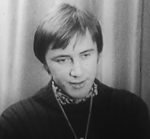
No one was looking for Hugh Curry, a Canadian DJ who found himself at Twickenham in the waning moments of the day’s session and would later interview John and Yoko on the same soundstage a few days later.
At the outset, Curry sought a solo interview with Yoko, but if John could somehow maybe make an appearance, well …
“If there’s a moment while she’s doing it, I’ll wander into it,” John generously replied to the suggestion. “You just set a time to do her, and if I’m not doing anything I’ll come in on it.”
“Goddamn sinister”
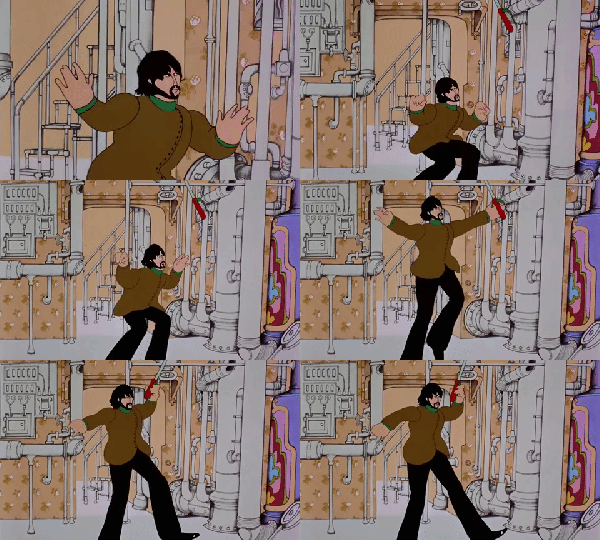
Pivoting to the subject of the box-office success of the Yellow Submarine film, Curry invoked the missing Beatle, clearly unaware of his recent departure.
“They make George look so goddamn sinister.”
After a nervous giggle from Yoko, John changed the subject, pinning down the interview for the following Tuesday, anytime after 10 a.m.
Even with a plan in place, Curry stayed put, pre-interviewing the couple.
“I heard some stuff over the phone, it sounds good,” Curry said of Yoko’s earlier vocal disruption. “Oh wow, she’s laying some new sounds on it!”
John and Yoko’s delight was short-lived.
Curry: I heard the Two Virgins thing.
Yoko: Oh, you like it?
Curry: No, I don’t.
The interviewer’s matter-of-fact response brought John to mock tears.
“I dig Cage, Stockhausen, people like that,” he said. “I thought it was too much on one level. It didn’t have enough peaks and valleys.”
Incredulous, Yoko could only repeat “are you kidding?” before John interjected, “It’s got millions of ’em.”
Curry backed off, suggesting that maybe his “head wasn’t in the right place” on that first listen.
A brief discussion of Cage’s “Indeterminacy” — John hadn’t heard it, but Yoko had, and she was sick of it — led into a discussion of Two Virgins and the difficulty of its distribution in Canada.
And speaking of record labels …
“How’s Apple doing,” Curry asked.
“Going around in circles,” John replied. “Like everything else.”
“It seems highly unlikely we’d be on,” the guitarist told the director.
With a member of the band unexpectedly AWOL, he was justifiably skeptical the Beatles could stage the big concert to end the film.
“I mean, the law of averages are against it,” he continued. “I think if you could get the juggler on with a couple more clubs, that’d fill in a bit of time.”
That guitarist speaking was George Harrison, and the production was A Hard Day’s Night, the Beatles’ first feature, filmed Spring 1964. On the afternoon of Friday, January 10, 1969, it wasn’t a self-deprecating Ringo Starr who was missing, it was a self-reliant George himself, having sprung Twickenham during his “Winter of Discontent.” This left the remaining Beatles and director Michael Lindsay-Hogg juggling ideas for how to close what would become “Let It Be,” their final film, and who else would be on stage playing lead guitar.
Michael and Ringo, January 1969. From Peter Jackson’s Get Back.
More than a week into the Get Back sessions, Michael continued making similar iterations of the same pitch for the show.
“One of my ideas is if we go to, like, anywhere, that we mightn’t just announce any times for the concert at all,” he said to Paul McCartney later in the day on the 10th. “We’ll set them (the Beatles) up in whatever desert we do it in, and they start to play. And one by one, and ten by ten, people will come in.”
“Inane, I’d call that,” Paul replied with a comedic aggression. “Straight off the top of my head. … Imbecilic. Salacious.”
(Like in his songwriting, at times, Paul sometimes spoke words that simply sounded good, even if they didn’t make sense in context.)
Michael deflected the response, saying “‘imbecilic’ sounded like a bad bug you get the flu from.”
Regaining focus, he invoked the show’s target date, 10 days hence: “I though that could make a very kind of groovy, trendy opening. Seriously, like: January 20, 1969.”
Moments later, the director and the others in the room — which extended beyond just the band — discussed the issue of visas and difficulties several of the Beatles’ peers (Donovan, Mick Jagger and Keith Richards) faced getting into the United States. They were open to several options, including Mexico, the Virgin Islands and other Caribbean destinations.
“And Catalina, which George said wasn’t very nice,” Michael said.
Not that it mattered what George thought then, he’d quit the group almost an hour earlier.
“So what’s our next move?” Michael asked the others.
“We split George’s instruments,” John Lennon said to laughter.
It was clear in the immediate they were not considering splitting the band, though. If the Beatles were going to be on the move, it would just be in a different iteration. Abandoning the project wasn’t a consideration at present.
The conversation would shortly return to locations, with the Roman amphitheater at Sabratha in Tunisia remaining at the forefront, all other contenders just conversation pieces to keep the group engaged. Michael’s long-preferred destination, he enlisted a “reconnaissance team” that included Beatles assistant Mal Evans and producer Denis O’Dell slated to scout the venue the upcoming Monday.
“There has to be someone to say, ‘The weather’s fine, come on in,’” Michael said.
Paul repeated familiar, feasible suggestions (The Cavern Club, Tower Ballroom) along with new nearby options (the Underground) and more distant, outlandish and outrageous ones (“the mouth of a volcano near Ecuador”).
“I think we should do it for more than 500 people,” Michael added.
It was a tough time to think big. This was an afternoon and evening of distractions and interruptions.
In the wake of George’s departure, there were several coincidental arrivals at Twickenham: A package arrived for Paul (marked “‘handle tenderly”); several “EMI heavies” wandered around the soundstage; a CBC interviewer prepped John and Yoko for an infamous interview that would come a few days later.
Rather than return to a full rehearsal, the group joined Michael in telling several imbecilic (and salacious) knock-knock jokes. Of more interest was Michael discussing his career and relationship with Orson Welles, whom decades later he would discover was his father. One lengthy anecdote (which was also detailed in his 2011 autobiography, “Luck and Circumstance”) described Michael acting in Welles’ 1960 stage production of “Chimes of Midnight” when Welles briefly stormed out of the production in anger.
An afternoon replete with nostalgia would soon continue after Paul returned to the piano (you can hear “The Long and Winding Road” and “Adagio for Strings” clearly on the tapes in the background). After quizzing the band on whether they had endured any scuffles with their fans (Ringo recalled being kicked in the head), Michael asked if they looked back fondly on their frenzied touring period.
John replied with an affected accent, the voice of a ragged bluesman looking back on a lifetime, not merely a few years earlier:
Why, I think of it every day. I think what fun we had when we was [sic] the Beatles, playing and rocking with the group around the world. I said, ‘Richard, you remember that?’ He says, ‘No, I hadn’t joined you then.’
Reminded by Ringo he had missed part of the 1964 Australian tour (although he was there for the egging in Brisbane), John evoked the name of the rare Beatle stand-in.
Now with the band facing a new vacancy, would they soon get to Beatle No. 30?
As if on cue, moments later, Michael barked an instruction for additional equipment:
“Glyn, Yoko wants a mic.”
She was back, but the music was hardly intense, with Paul having moved onto his White Album ode “Martha My Dear.” Now, her vocals were largely calm and controlled, more comedic than anything.
While Yoko once again wailed, John — in conversation with Michael — laid out his plans to replace George. He didn’t suggest Yoko.
A few hours earlier, George told the other Beatles, “You need Eric Clapton.” The time had come for John to heed the advice, sharing it with Michael.
“I think if George doesn’t come back by Monday or Tuesday, we ask Eric Clapton to play, ” John said. “Eric would be pleased. He left Cream because they’re all soloists. … The point is, if George leaves, do we want to carry on as Beatles?”
Harsh feedback shortly overwhelmed the room, obscuring some of the conversation on the tapes. But the discussion continued, as Yoko again passionately called out John’s name.
MLH: Maybe for the show, you would just say George is sick.
John: (Sincerely): No, I mean, if he leaves, he leaves.
MLH: But what’s the consensus, do you want to go on with the show and the work?
John: Yeah. If he doesn’t come back by Tuesday, we get Clapton.
Yoko: John!
John: Whaaaaat? (laughter)
John and Yoko continued to repeat each other’s names, but this was the couple playing for laughs. Meanwhile, John and Michael’s discussion continued through the call-and-response, bringing together the issue of show location with locking down a replacement guitarist.
MLH: And what about the venues? … If George comes back we go away, and if Clapton comes in we stay here.
John: We should just go on, as if nothing’s happening.
MLH: I think we should go away.
So eager to get the show on the road, Michael had the potential logistics lined up in his head, proposing the group spend the following week at Twickenham and the week after abroad, all conforming to the group’s timetable, which was in part defined by Ringo’s filming schedule for The Magic Christian.
“What I’ve always thought is we leave here next weekend (January 18-19) and do the show the following weekend (January 25-26) there, if we decide to go there,” Michael said. “And then come back on Monday (January 27), which is just inside Ringo’s seven days.” (The January 20, 1969, date floated previously must have only applied to a domestic show or an alternative, abbreviated schedule.)
Michael’s plans to this point were more extensive than expected, implying there really was no option, at least that he was eager to prepare, other than Sabratha.
“We’ve arranged everything food-wise to come in from Germany,” Michael said, adding for the skeptics, “I do not joke. It’s the same food from the American [military] base.”
Eric Clapton and John Lennon, from the Rock & Roll Circus, December 1968.
And if it wasn’t enough John was trying to enlist Eric Clapton to join the Beatles, Michael casually suggested a near reunion of Cream, if it meant just getting Paul and John to Libya for rehearsals, and Ringo — who was least receptive to travelling — to be minimally overseas.
“We can get out a session man for a couple days,” Michael said. “Or Ginger Baker can come for a few days. Just to kind of routine it.”
The discussion between John and Michael petered out as John joined Paul and Yoko on another jam. Unlike earlier, when the Beatles played hard blues rock out of rage, this improvisation was more subdued, a more gentle and at times an arguably pleasant performance, containing elements of “Castle of the King of Birds.” Paul was on piano, John on guitar and Ringo on tambourine with Yoko providing another disruptive vocal — although not quite as consistently intense than earlier in the day.
Soon, Paul shifted to the drums — and it’s a noticeable drop in quality from Ringo to Paul, as strong as the latter is as a multi-instrumentalist. More importantly, it freed up Ringo, who returned to conversing with Michael. But first, he played up for the cameras (and tapes).
Yeah, rock it to me baby, that’s what I like. You may think this is a full orchestra, but if you look closely you can see there’s only two people playing and one person singing. I know it sounds like Benny Goodman, but don’t worry. It’s the big sound of 1969! You bet your life. Oh, sock it to me, sock it to me. (Laughter)
Interested in the filmmaking, Ringo asked Michael precisely what he was doing — “I thought what we should do is the first sessions when you came back, make it very hand-held looking,” Michael said, pulling the curtain behind the sausage-making. More importantly, Michael shared his first-hand view on what he saw after George walked out.
“And the interesting thing is, Paul went to his amp. … I don’t know if you knew what you did, psychologically, after lunch. You (addressing Paul, who joined them) went at your amp like you shut the door into a closet. … And you (Ringo) were playing very hard. … And John was doing whatever he was doing.”
Ringo, Paul and Michael continued their conversation, as John provided background music — “Sun King” and “Dear Prudence.”
MLH: Have you ever had coverage when you were doing a whole album?
Ringo: No.
MLH: Have you ever wanted it?
Ringo: No.
Like it or not, the Beatles — what presently remained of them — were getting blanket coverage, and the real drama was happening in the studio, not on location.
“Are we meeting again Monday?” Michael asked hopefully in the waning moments of the day’s session.
“Yeah, I’ll have Eric, Jimi (Hendrix, although it could feasibly be Jimmy Page) and Tommy (Evans of the Iveys, perhaps?) lined up,” John replied, with varying and low degrees of sincerity.
Paul’s set his bar much lower.
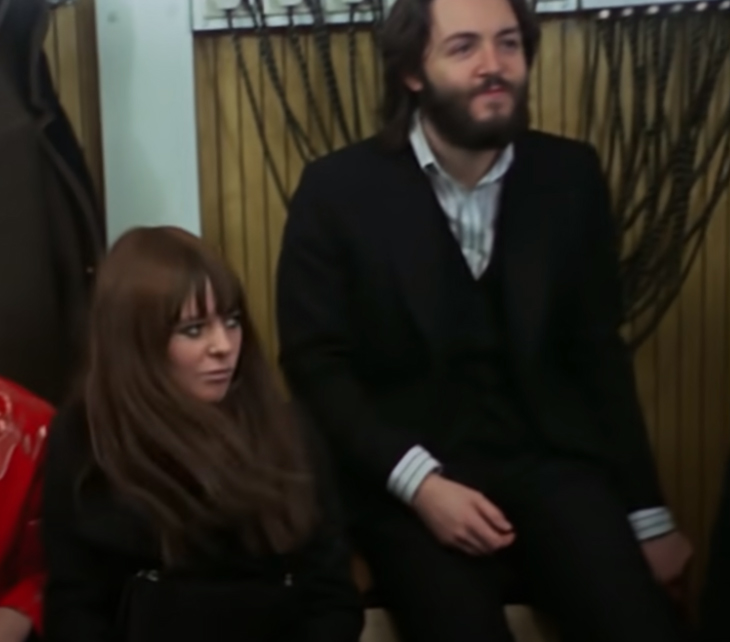
“A7, D7, G7,” he instructed Maureen Starkey, who was visiting Twickenham that afternoon. “Get ’em off over the weekend and you’re in.”
(Ironically, armed with those chords, Maureen would have been able to fill in for George on his For You Blue.)
Paul with guitar protégée Maureen Starkey. From the Get Back trailer.
Before splitting for the day, Michael made sure to capture the scene. “We have this well-documented. And a lot of shots of the empty cushion.” We’ll see what Peter Jackson shows us in Get Back ’21, but this footage was left on the cutting-room floor of the final cut of Let It Be.
“And I guess that’s it,” wrapped up Michael, who wished the others luck in their planned weekend business meeting, which would include George. “And I hope everything really goes swell. I’d like to say, I’ve enjoyed our week together, hope one day we have another one like it.”
As you certainly know, Clapton never joined the Beatles, and John didn’t bring him in the following Tuesday, even though George wasn’t back. There clearly wasn’t an actual offer anyway.
After George went we had a meeting out at John’s house, and I think John’s first comment was, ‘Let’s get Eric in.’ I said, “No!” I think John was half-joking. We thought, “No, wait a minute. George has left and we can’t have this — it isn’t good enough.’
For his part, Clapton repeatedly downplayed the idea he was an actual fallback option for the Beatles. In modern parlance, Clapton thought John used him as clickbait, and the friendship he had with George would have been a blocker anyway.
There may have been [a suggestion the Beatles would ask him to join]. The problem with that was, I had bonded or was developing a relationship with George — which was exclusive of them. I think it fitted a need of his and mine, that he could elevate himself by having this guy, that I could be like a gun-slinger to them. Lennon would use my name every now and then for clout, as if I was the fastest gun. So I don’t think I could have been brought into the whole thing, because I was too much a mate of George’s.
Several years later, after George’s death, Clapton literally laughed at the idea of joining the Beatles when he was interviewed for Martin Scorsese’s 2011 documentary “Living in the Material World”.
As he said in the clip, the Beatles could be the most close-knit quartet, but at the same time, “the cruelty and the viciousness was unparalleled.”
The latter led the Beatles to this moment. After their first full day at Twickenham, on January 3, George described with envy The Band‘s ability to blur their domestic and working lives, something he witnessed first-hand when he visited the group and Bob Dylan six weeks prior. “They’ve got all that gear there, but … they’re just living, and they happen to be a band as well.”
While he’d join John Lennon as a member of the Dirty Mac before and the Plastic Ono Band later, Eric Clapton was neither asked, nor was he seemingly willing to accept an assignment with the Beatles.
The Beatles didn’t need Eric Clapton, a gunslinger for hire. They needed George Harrison.
Their man had been gone, for nigh on a few minutes.
John Lennon played a familiar riff on his guitar, the country-western lick from the middle of The Who’s 1966 mini-rock opera “A Quick One, While He’s Away.”
“Soon be home!” sang John. Paul McCartney added an aggressive harmony as John wailed the refrain.
After a brief fade in the tapes, John returned with a spontaneous scream that devolved into a wheeze, then a cough. On regaining his composure, he barked an instruction:
OK, George, take it!
Then John giggled.
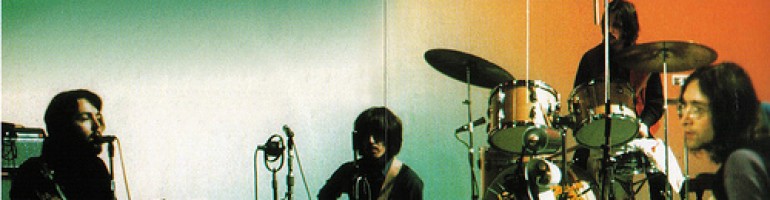
George Harrison quit the Beatles after lunch on Friday, January 10, 1969, and at the end of the second week of the Get Back sessions, the Fab Four were a sub-fab three-piece — John, Paul and Ringo Starr. John’s girlfriend, Yoko Ono, was there too, a given since the previous year.
“So pissed,” John said in response to nobody, certainly meaning drunk in the British vernacular, but it registered as the Americanism, too: anger at George’s brazen and sudden departure.
Just like they did when Ringo quit during the White Album sessions less then five months earlier, and just like they did a year later when John was far gone from the group, the remaining Beatles immediately continued as a three-piece.
The music restarted behind an angry riff from John, and Paul and Ringo quickly fell into the jam. The riff was another iteration of Bobby Parker’s “Watch Your Step,” which earlier in the week was manifest in Paul’s improvised “My Imagination,” and previously formed the foundation of “I Feel Fine” and “Day Tripper.”
John taunted George again.
“Soon be home!”
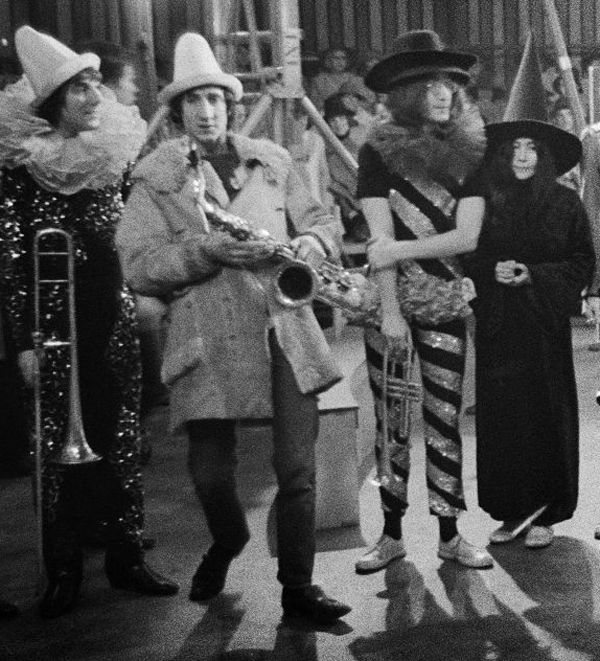
The band begins at ten to six: Pete Townshend, John Lennon, Yoko Ono and others at the filming of the Rock & Roll Circus.
This quick one came grooving up slowly, with the improv running in spurts for about 20 minutes, John’s full-throated scream ending one portion of the jam. The Beatles briefly “covering” the Who, itself a terrific curio, isn’t nearly the most important takeaway.
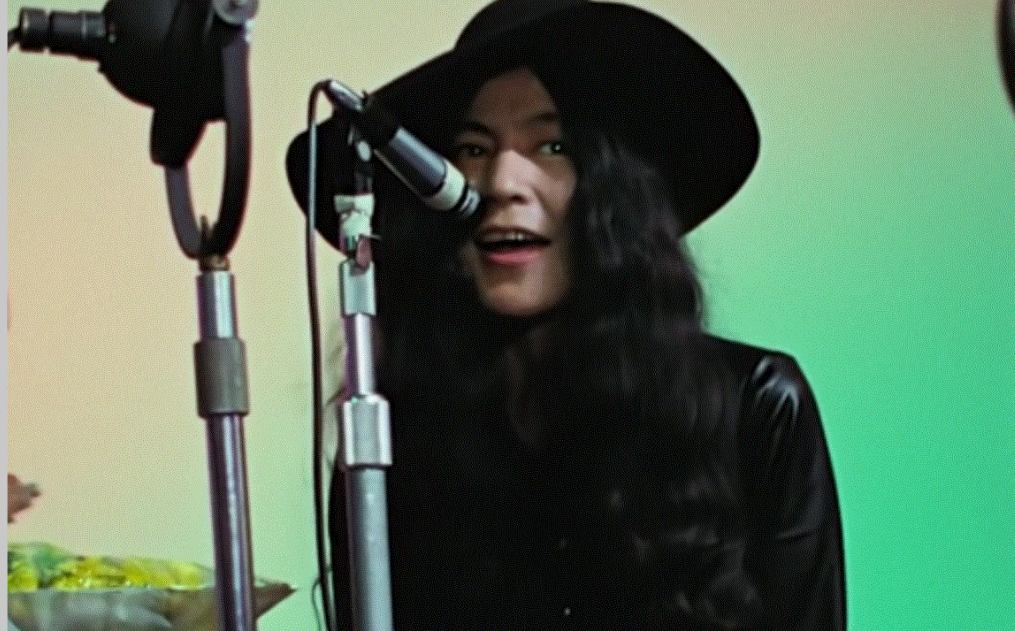
Yoko Ono at Twickenham, January 10, 1969.
The most shocking moment filmed for a Beatles movie ended up on the cutting-room floor — perhaps it makes the final edit of the forthcoming Get Back ’21 — and came several minutes into the jam.
That’s when Yoko seized the spotlight and filled a vacuum, her voice dramatically piercing the Twickenham soundstage during what Michael later described in his autobiography as a “half an hour of anger and frustration expressed with guitars and drums.” But the most memorable instrument was Yoko’s voice.
Ringo recounted the afternoon in the 1990s for the Anthology book:
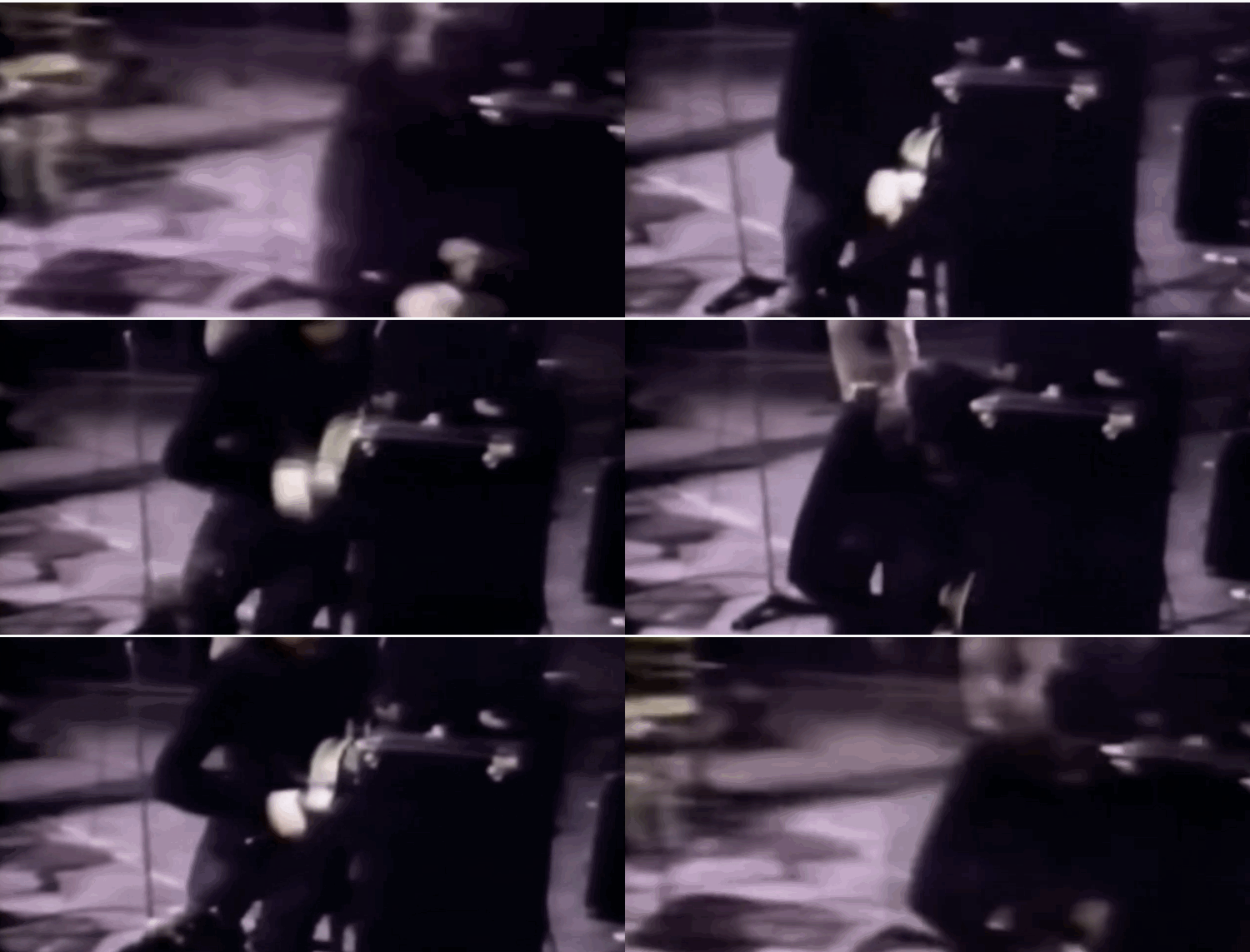
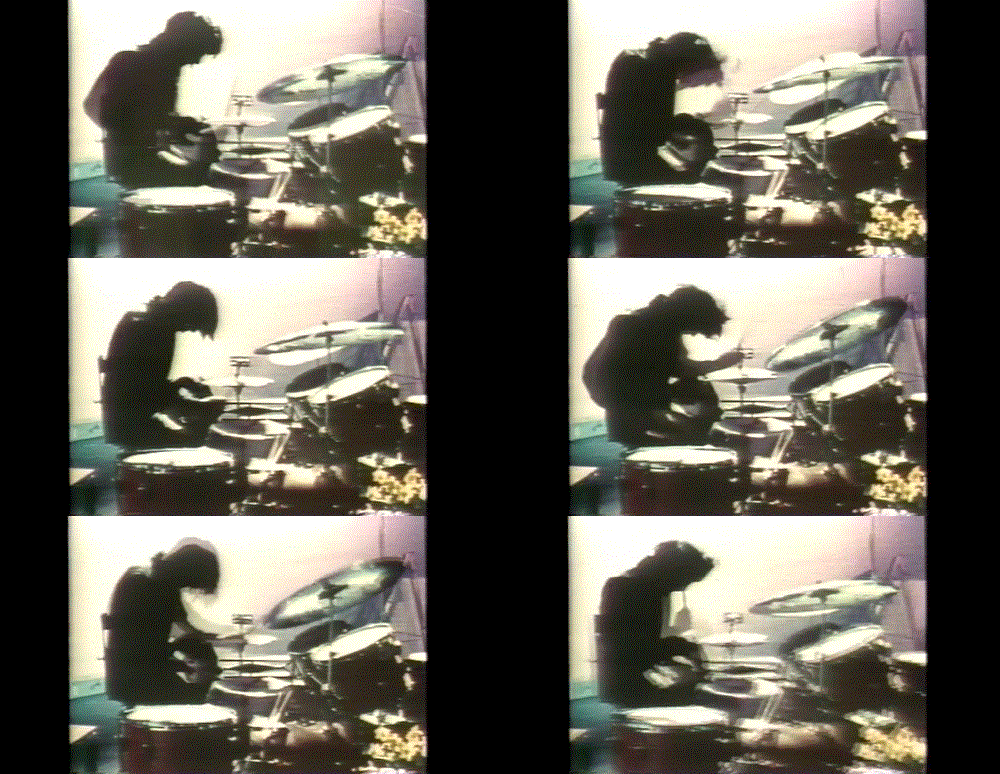
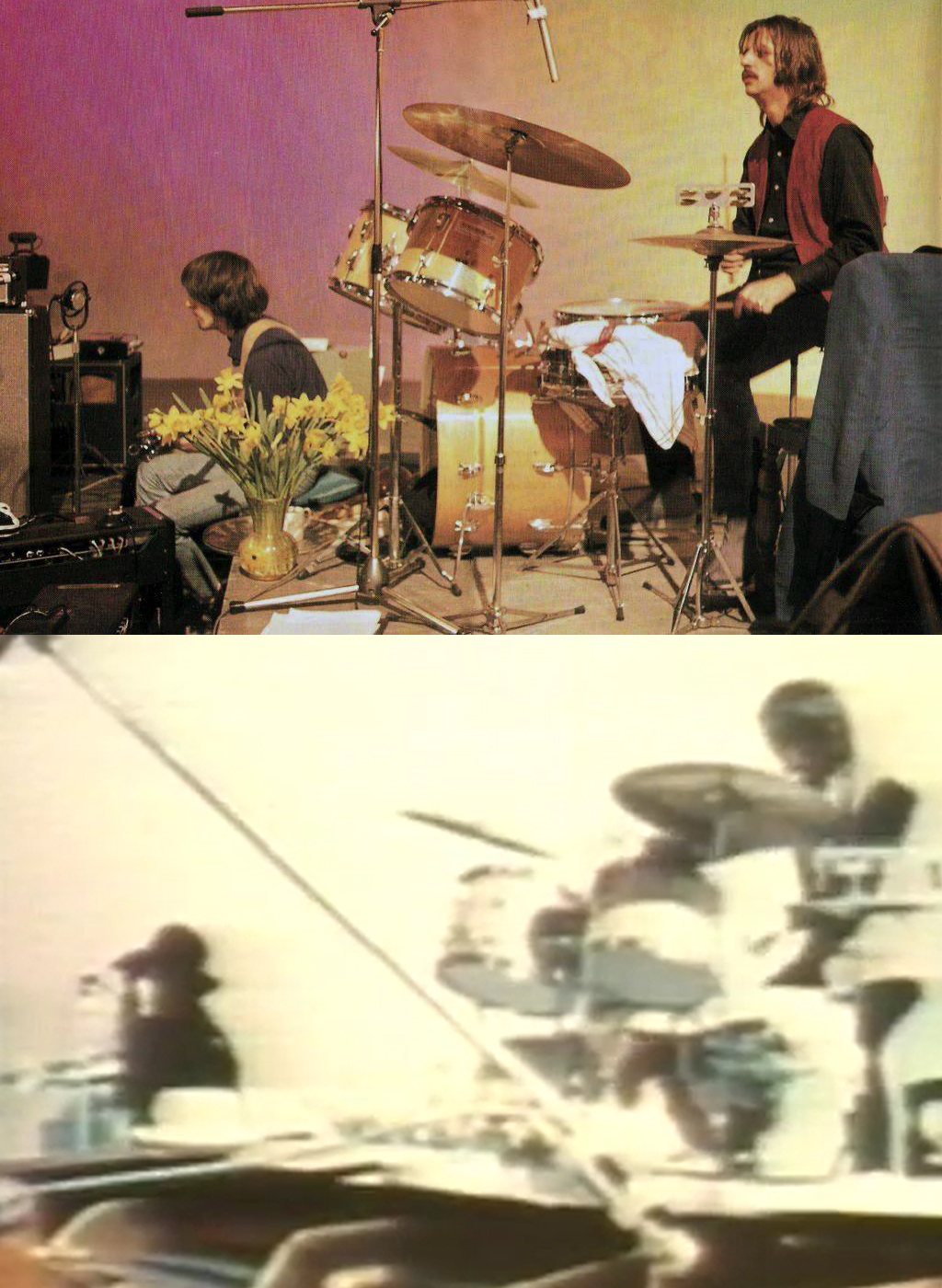
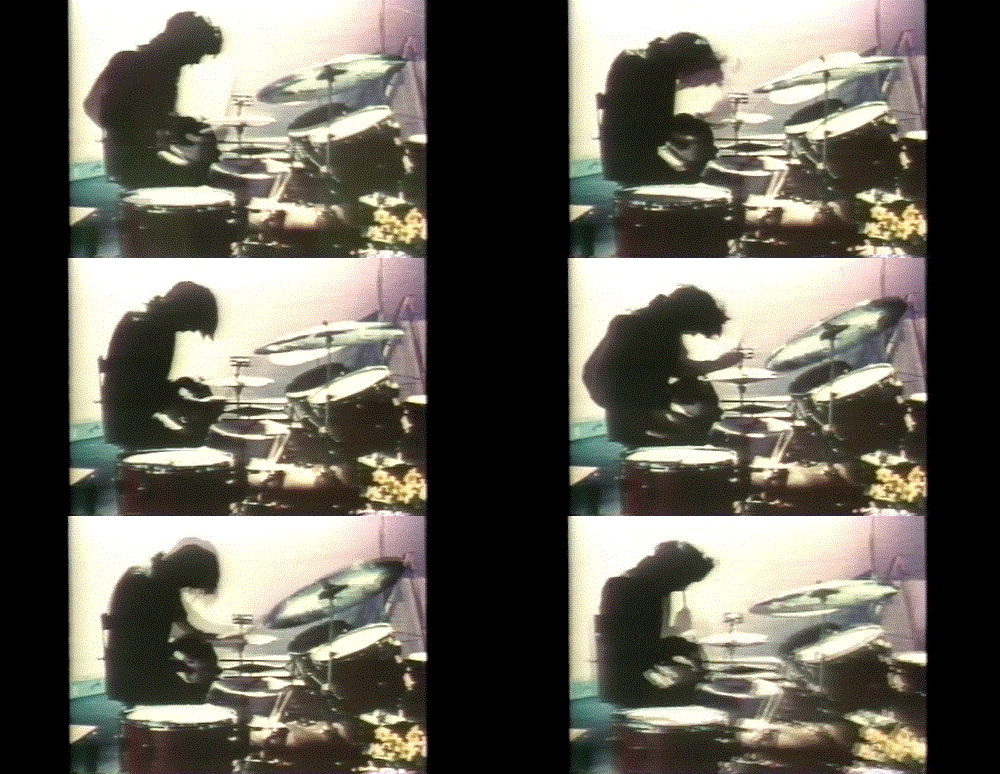
None of us realised until we went to lunch that George had gone home. When we came back he still wasn’t there, so we started jamming violently. Paul was playing his bass into the amp and John was off, and I was playing some weird drumming that I hadn’t done before. I don’t play like that as a rule. Our reaction was really, really interesting at the time. And Yoko jumped in, of course; she was there.
Emphasis mine.
Before and after
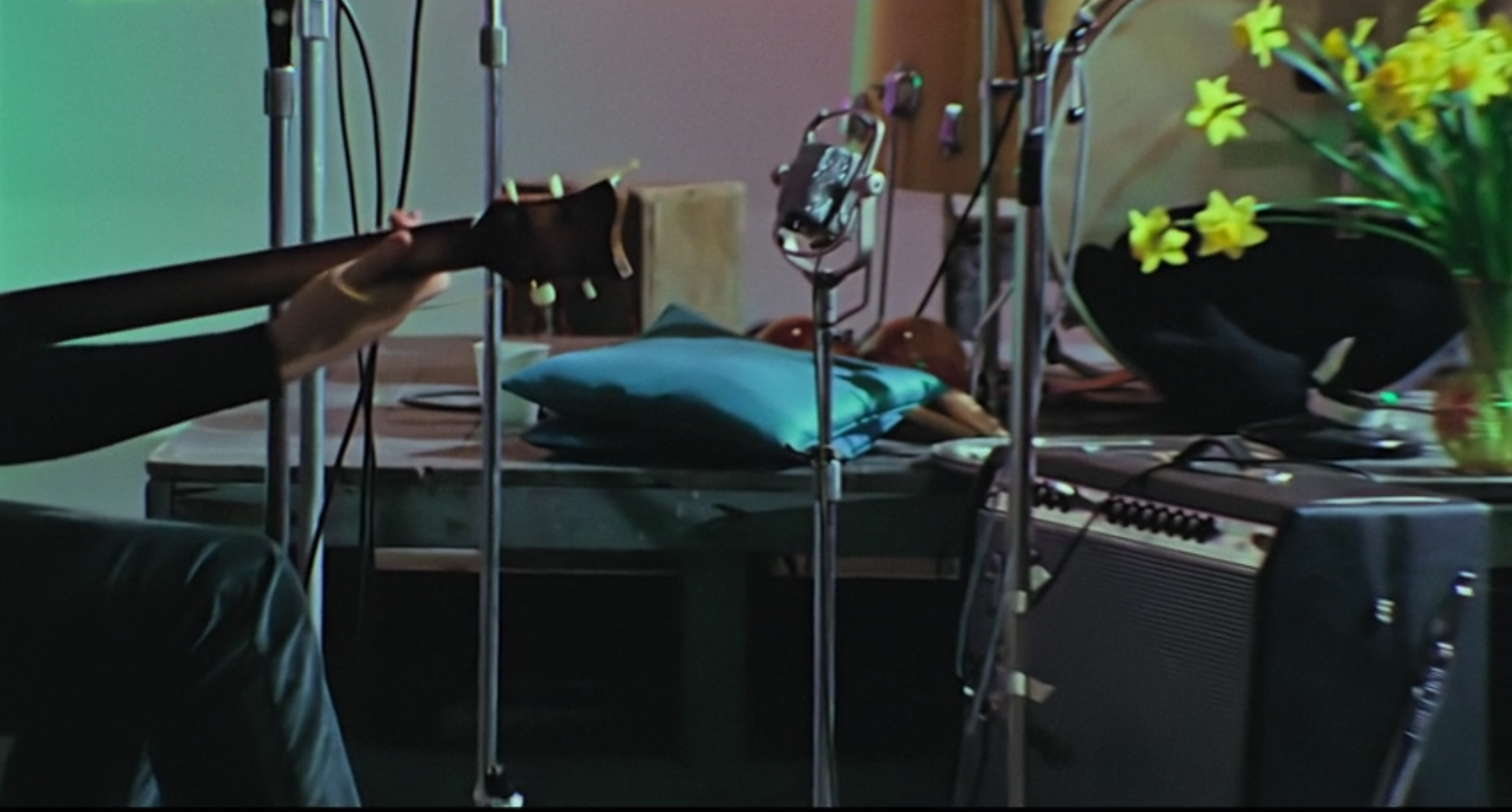
She wasn’t simply there. She was there on George’s blue cushion, and she was there on George’s microphone. George eventually found out, too. As described in the previous post, George referred to Yoko “just screaming, doing her screeching number” in a 1977 interview, a moment he didn’t witness but later saw on film.
Yoko wailed to the band’s furious, repetitive backing in a sequence of organized chaos. It’s “Whole Lotta Yoko” blended with “Helter Skelter,” “Don’t Worry Kyoko” tied into “John John (Let’s Hope For Peace)“. Previewing her vocals from the last song in the above list, she repeatedly, violently called out John’s name. It’s a harsh listen.
Ringo Starr “playing some weird drumming that I hadn’t done before.” From the unreleased The Long and Winding Road documentary.
Musically, the improvisation veered into slightly different corners of blues rock and it maintained the same general, rollicking intensity throughout.
Either you like Yoko or you don’t, and I’m not going to be able to persuade you either way (and I wouldn’t try to change your mind anyway). It’s reasonable, though, to describe her performance as completely in character.
Ringo indeed played a little out of his mind, and at one point, Paul abandoned the bass line to evoke feedback — John did the same with his guitar. At a couple separate moments, John returned to the “soon be home” riff from “A Quick One,” but he didn’t sing along. Throughout the entire performance, there’s no attempt by the others to join Yoko on vocals, but the remaining Beatles were a pretty good hard-rock combo when they chose to be. Even Yoko took notice of Ringo’s aggressive performance, changing her lyric to call out Ringo’s name, an unintentionally funny moment after a hypnotic repetition of John’s name. There was no full roll call, though. Yoko never shouted “Paul.”
Somebody calls out his name …
While there was frustration and anger in the wake of George’s temporary flight from the Beatles, one can sense momentary release. Paul’s project was at a standstill, but his most difficult relation had fled. John had one fewer person — and the most vocal one — balking at Yoko’s presence. Still, the Beatles lost their lead guitarist and junior songwriter. He left them, and that clearly was a big problem.
The bigger the cushion, the sweeter the pushin’ – Yoko Ono, January 10, 1969 (or was it Nigel Tufnel, 1984?)
For Yoko, though, there was no frustration, only relief. At this instant, the blue cushion was hers. She went from sitting beside John to inheriting her own equal space. If George was 25 percent of the world’s greatest democracy, then she, in this moment, owned that share — the solo vocalist alongside the guitarist, bassist and drummer. In the currently available film of this sequence, from the aborted The Long and Winding Road documentary and in various Internet destinations, we see a broad smile on Yoko’s face as she sings John’s name.
Yoko’s experience from every other day with the Beatles informs how she must have approached midday January 10, 1969. From an Anthology-era interview with Newsweek:
I was just trying to sit there very quietly without disturbing them. You know, John always wanted me there and if I was not there, John might not have gone to those sessions.
This session marked her opportunity to be an artist and create a needed disturbance. The jam couldn’t have completely satisfied her creative need, but at worst, it allowed her to collaborate with John in his primary space, and scratch a specific itch.
After about 20 minutes, starting with the initial “A Quick One” sequence, the jam abruptly concluded as John searched for technical help with a microphone.
“OK, ‘I’ve Got a Feeling,'” barked John, as this incarnation of the Threetles (or the first Plastic Ono Band, for that matter) rehearsed their newest material in a fashion they’d never present onstage. The performance was jagged and angry, and just a few days after dismissing their farewell concert, the Beatles became their own version of Cream, the disintegrating power trio. Yoko did not participate in this part of the session.
Then it turned. “Everybody had a hard year,” was sung by John with such extreme gruff, it turned over into laughter. The stab at the song devolved into Paul playing the closing theme to the Beatles cartoon (for the second time that day) to close it out.
Remember when John said he was “pissed”? The British slang was definitely the vibe. The Beatles had no care in the world and were, in this moment of relative bedlam, enjoying themselves. The full-throated “Don’t Let Me Down” was the closest they came to a sincere attempt at a song, and it wasn’t particularly sincere. The next 15 minutes on the tapes featured John and Paul trading small bites of a variety of oldies (“Til There Was You,” “C’mon Everybody” “Mack The Knife,” “Don’t Be Cruel,” “On a Sunny Island”). The hilarious performance devolved into moos, baas, barks, meows and whistles.
A highlight — so to speak — from this sequence was John’s droll destruction of “Maxwell’s Silver Hammer,” as Paul played willing accomplice.
George’s departure from the group completely stalled any momentum toward planning the Beatles’ live show as well as reasonably developing new songs in progress. Yet, John, Paul and Ringo stayed in the studio and played purely for their own amusement. This is the Beatles at Friday afternoon happy hour. Meanwhile, Michael continued to discuss how to power the show — and group — forward.
Though we’d still hear her perform with the Beatles again before the end of the day, the band’s long-term future wasn’t ever going to include Yoko Ono — the Beatles weren’t the proto-Plastic Ono Band, and it’s difficult to imagine a scenario in which Paul and Ringo would have allowed it even if John insisted. The question now, was in what form the band would progress.
***
When I first started listening to the Purple Chick A/B Road bootleg about nine years ago, diving into a hulking torrent file of the Nagra Tapes, the first track I listened to was on the January 10, 1969, set of files, one marked “A Quick One While He’s Away.” I had Beatles bootlegs on vinyl and cassette for a long time, and knew full well the general scope of the Get Back sessions, but I hadn’t listened to every possible cover song or outtake from the era. (That would be crazy!) I didn’t know they attempted “A Quick One.”
After playing the track, I realized they never did attempt it at all. But listening to the context around the track — George’s departure from the group, which I also knew much about, but never heard on tape — convinced me to make a better effort and listen to the entirety of the tapes from the very beginning, and really study what happened. That curiosity directly led to creating this blog, weeks later.
On the afternoon of January 10, 1969, seven days into the Get Back sessions and nearly 10 years into his tenure with the band — a term that began when he was 15 years old — George Harrison quit the Beatles.
George: I’m leaving the band now.
John Lennon: When?
George: Now.
After a cut in the Nagra tapes, which captured the exchange, George casually continued: “Get a replacement. [Place an ad] in NME and get a few people.”
While the tapes don’t capture him saying “see you ’round the clubs,” it’s too good a line to be purely apocryphal (and it’s, in fact, alluded to by others on the tapes later in the day). George then briefly shared a few words with Mal Evans and was off, his boots echoing as he departed.
Likewise, for the sake of the complete record, there is simply no indication on the tapes of what happened between the final take of “Two of Us,” and George’s departure, the immediate spark of George’s decision (if there was any). Like the Beatles themselves, the tapes were out to lunch.
Film director Michael Lindsay-Hogg, so proud of his spy microphone hours earlier, had the right instincts and was prepared for this moment, but he probably should have upgraded to a better model.
“My bug had only picked up the sounds of cutlery banging on china plates, obscuring what the muffled voices had said,” Michael wrote in his 2011 autobiography Luck and Circumstance. In his “role as documentarian,” he had asked his sound engineer to mic the flowerpot on the dining room table as George encountered the band at lunchtime. Per Michael, George concluded by saying, “See you ’round the clubs.”
George grabs his coat on his way out of the utter sty that was the studio at Twickenham, as pictured on an earlier day. (Screen capture from Beatles Anthology)
What exactly happened over lunch is a source of legitimate dispute in Beatles history. Dig in — here are varied accounts that span 50 years.
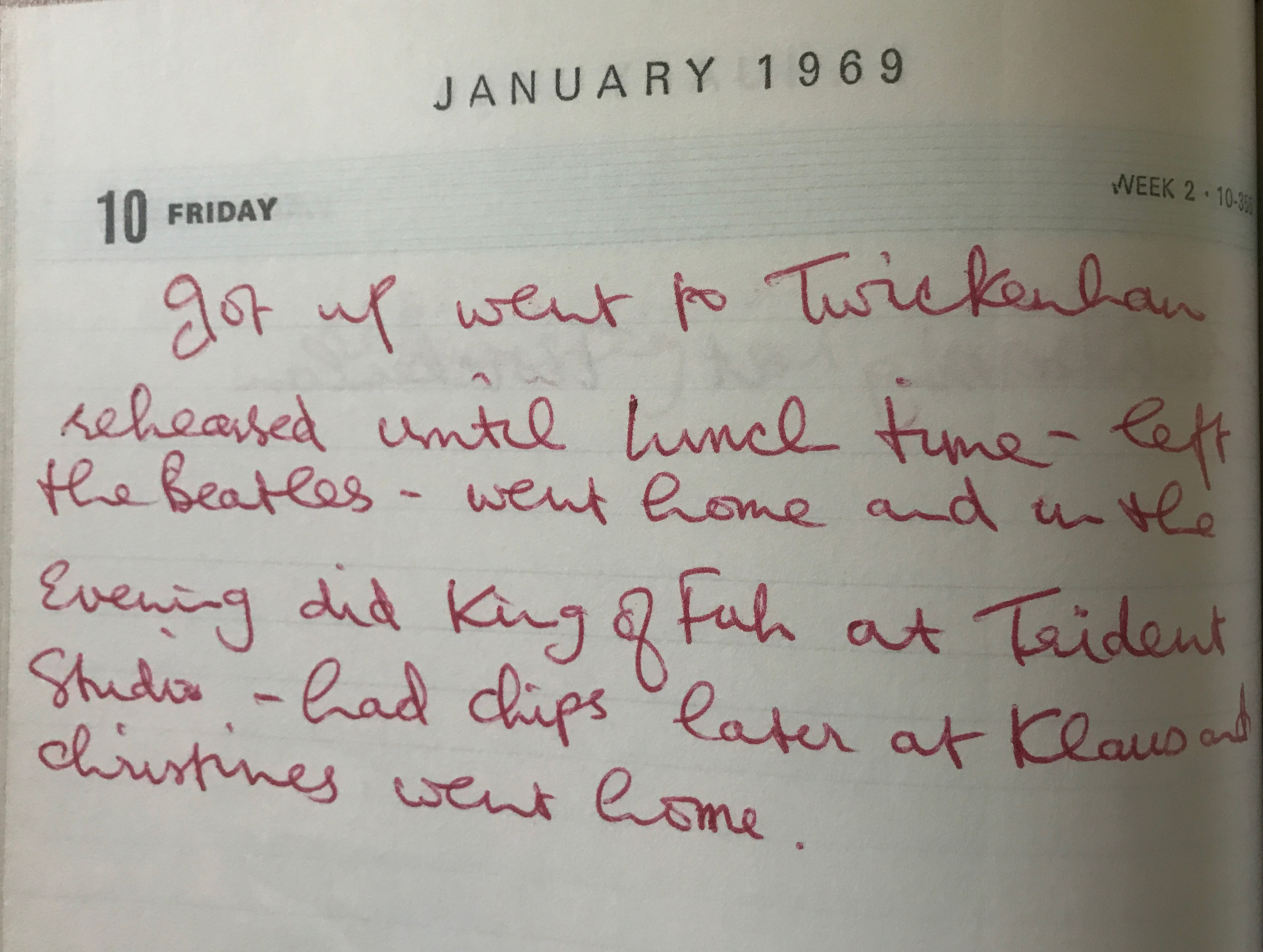
The most contemporary retelling of the events of January 10, 1969, comes from George himself, later that day, in his personal diary.
Got up went to Twickenham rehearsed until lunch time – left the Beatles – went home and in the evening did King of Fuh at Trident Studio — had chips later at Klaus and Christines went home.
George’s diary entry for January 10, 1969, as later published in the Living in the Material World book in 2011.
There wasn’t any Twitter in 1969 (although John and Yoko probably would have dominated the platform had it existed), so when George left the Beatles, it didn’t instantaneously go viral. But within days, George’s resignation was widely reported around the world — jumping off an original report by the Daily Sketch (more on their reporting to come in a subsequent post) — though he was already back with the band by the time those reports came out.
It wasn’t just that George left the Beatles. Word was out that that things got violent.
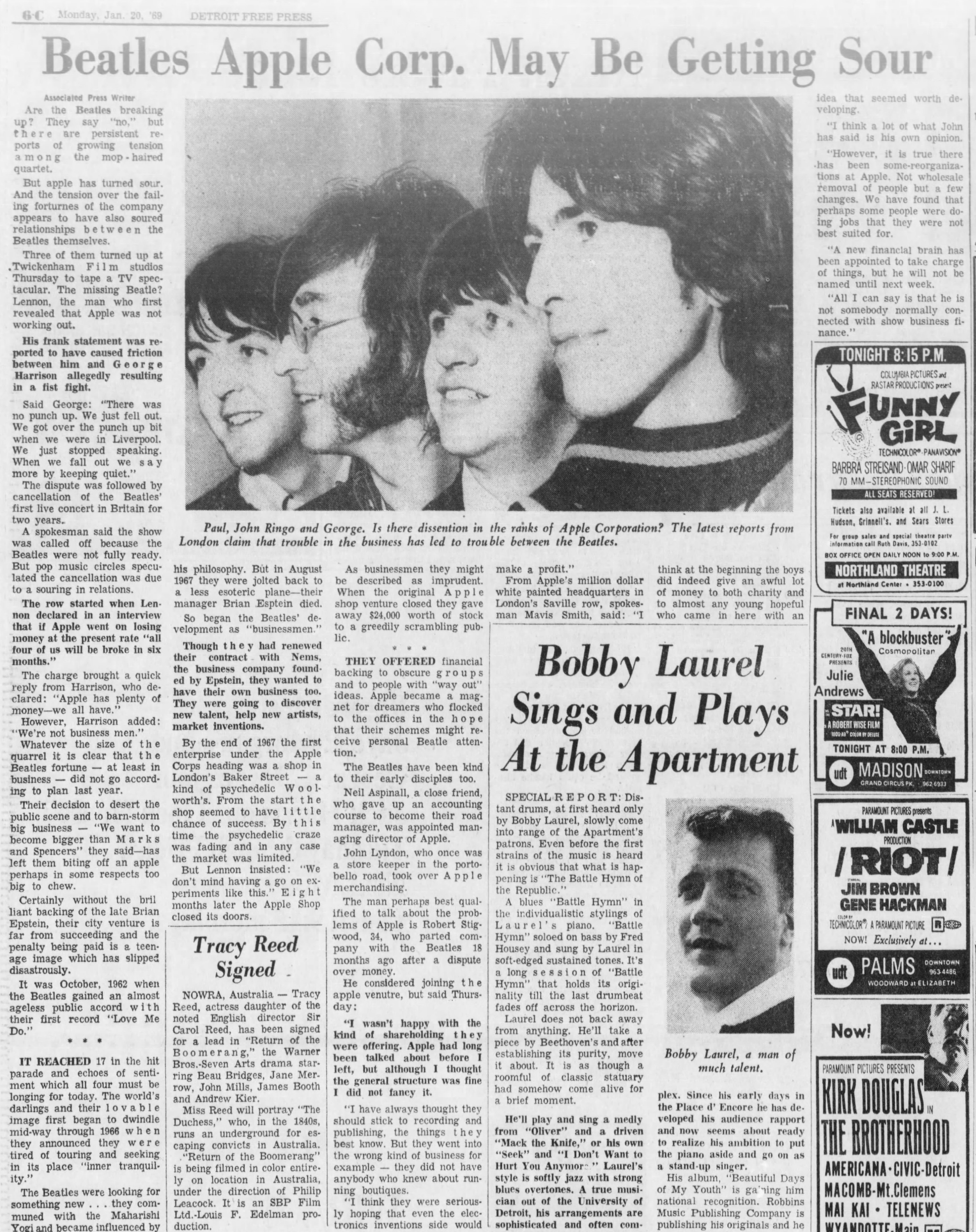
Beatles John Lennon and George Harrison did NOT have a punch-up and Apple — their business company — is NOT on any financial rocks.
The denials came last night from the Beatles themselves.
It all began when a pop weekly reported Lennon as saying that Apple was “losing money every week” and needed tightening up.
Then came the rumour that Lennon and Harrison came to blows.
But last night, after a five-hour meeting between the four Beatles and their business associates at Apple’s Savile Row headquarters, explanations came fast.
…
“The so-called punch-up between John and myself? There’s no truth in it. We are still good friends.”
…
Ringo Starr called the story of a punch-up “a load of old rubbish.” He said: “I was there when it was supposed to have taken place — it’s quite untrue.”
A few days later, on January 21, Ringo told BBC’s David Wigg that “there’s that famous old saying, you’ll always hurt the one you love,” when he was asked if the group was still close. But he spoke without any specifics regarding George’s departure, just generic reconciliatory language.
“[W]e all love each other and we all know that,” Ringo said. “But we still sort of hurt each other, occasionally. You know… where we just misunderstand each other and we go off, and it builds up to something bigger than it ever was. Then we have to come down to it and get it over with, you know. Sort it out. And so we’re still really very close people.”
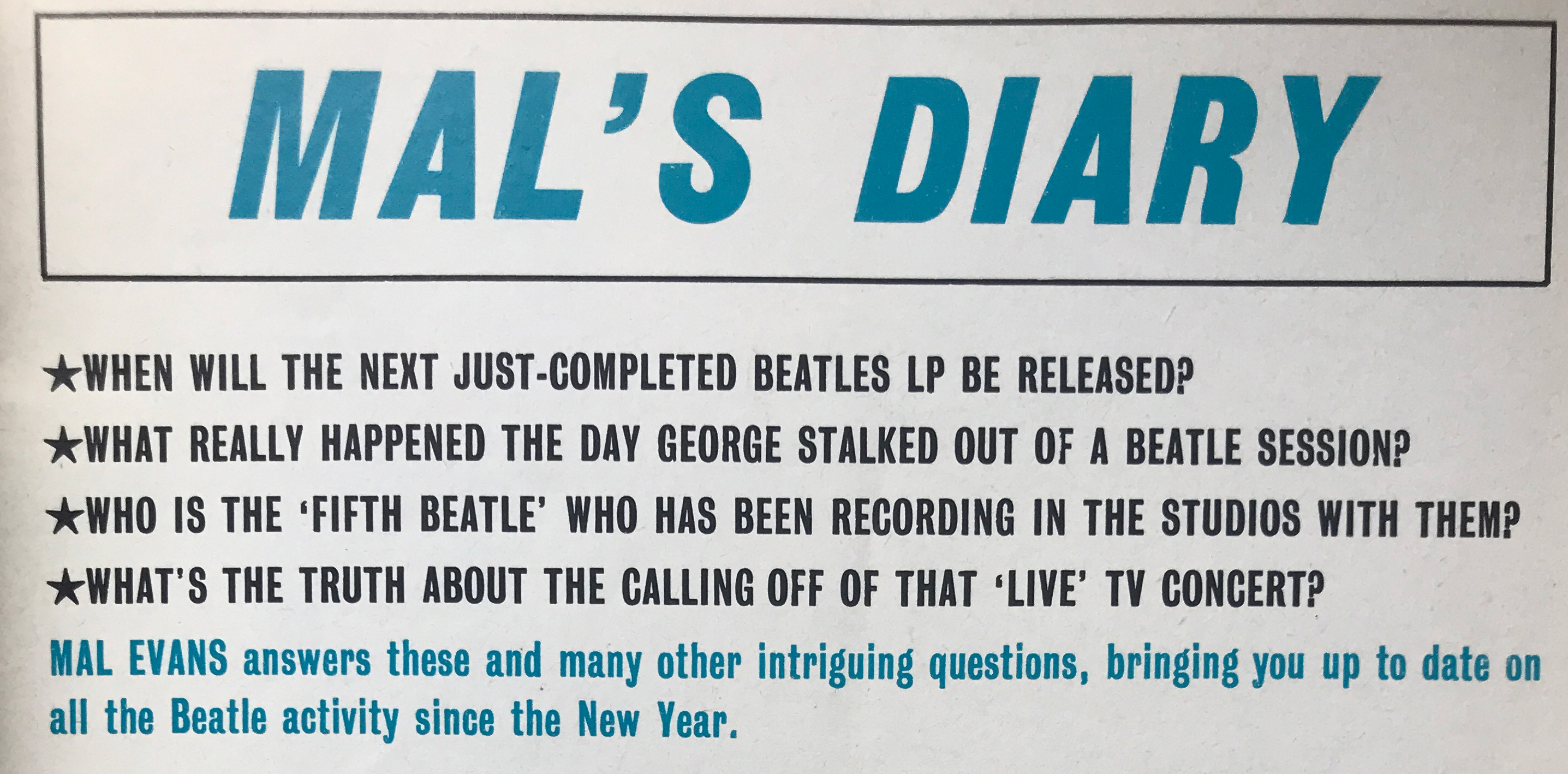
One of the Beatles’ official mouthpieces, the Beatles Book Monthly fan club magazine predictably poured cold water on the idea of a physical altercation in its March 1969 issue. In his diary feature, Mal Evans went as far to write there wasn’t any argument at all when George “stalked” out.
Matching the account on the tapes, Mal said George simply came over during lunch to “quietly” say he was going home. “There WASN’T a fight, physical or verbal,” Mal wrote. “There WEREN’T any tempers or shouting. I just couldn’t believe it when I saw the press afterwards.”
George Harrison maintained in subsequent interviews that no punches were thrown. But another George had another memory.
“They actually came to blows,” George Martin told Phillip Norman in his 2008 biography John Lennon: The Life. “You’d think it would have been with Paul, but it was John. It was all hushed up afterwards.”
Here’s where the retelling of the day’s events descends more deeply into farce.
According to a separate account from EMI engineer Dave Harries, a frazzled Martin only arrived at Twickenham that day as Harrison departed from the studio.
As related in Ken Womack’s Martin biography Sound Pictures:
I remember that George Martin had just backed across the car park in his Triumph Herald and knocked a dent in the door of George Harrison’s Mercedes and he didn’t have time to tell him he’d dented his car before George walked out in a huff and drove off.
Just hours after engaging in passionate car talk, this wasn’t George’s finest hour.
While George Martin was around to some arguable degree that morning (and at the sessions overall), there was no doubt fellow producer Glyn Johns was there on January 10. He was an activeparticipant on the day’s tapes.
Johns, too, wrote of his recollections of that day in his 2014 autobiography Sound Man:
I have a very clear memory of sitting outside in the bleak surroundings of the soundstage at Twickenham on that cold gray afternoon with Denis [O’Dell], the line producer for the film, both of us praying that the elation of being employed for a project with the most successful artist in the world was not about to come to a grinding halt after two days.
It is not my place to discuss any detail of what happened, but it is common knowledge that George left the band and was persuaded to return a couple of days later.
While an implication is there, Glyn wouldn’t spill the beans. Although in Graeme Thompson’s 2015 George Harrison biography Behind the Locked Door, Glyn conceded there may not be too many beans to spill:
When it became apparent that there was going to be a bit of an argument those of us who weren’t in the band left the room. It was clear that it would be intrusive for us to remain. So what actually was said and and what went on I don’t know, but I do know that George left the band that day. The whole thing was very uncomfortable, and it was very embarrassing for me and others who were not in the band to be close by while this was going on — to have to watch this begin and be there in the immediate aftermath. It was very unpleasant and I felt really awkward.
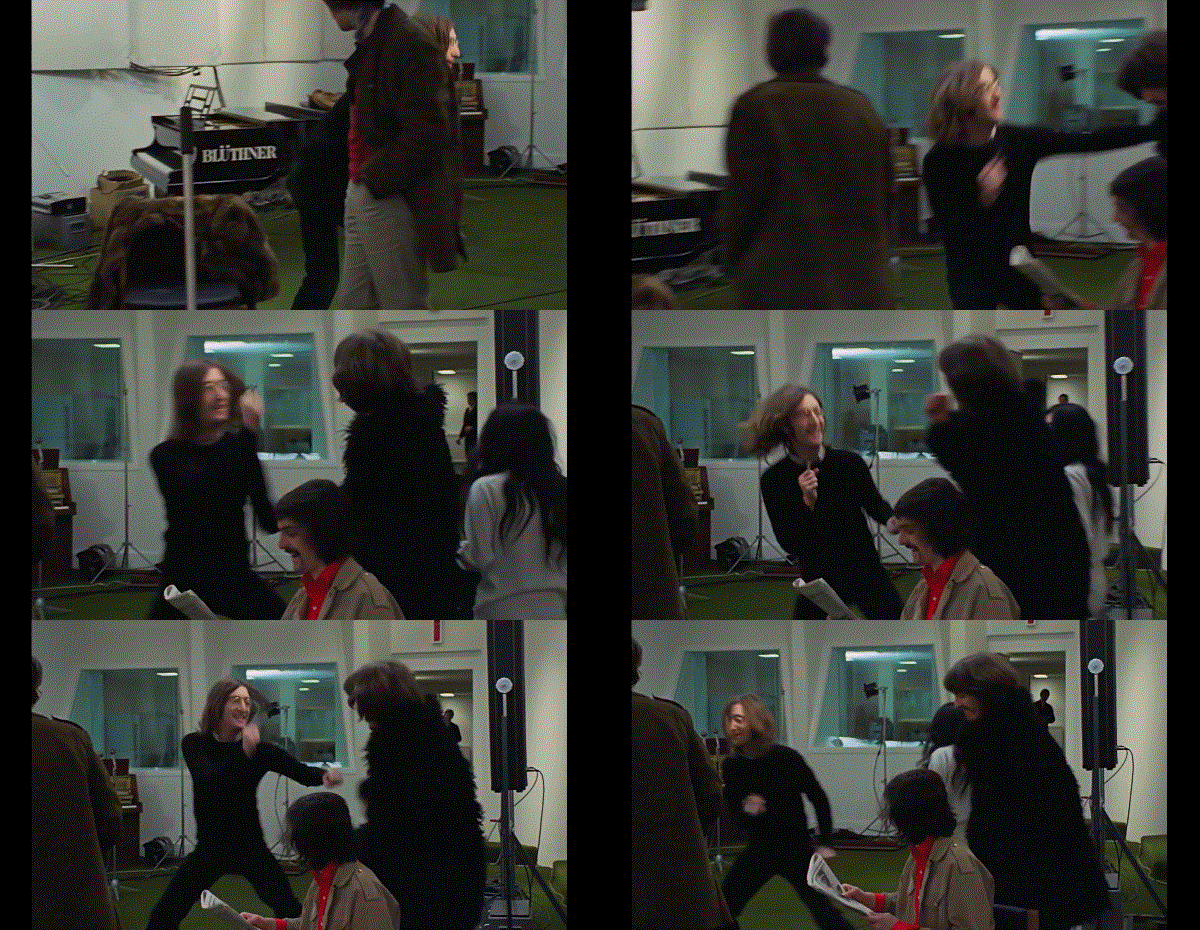
The Beatles pre-enact their January 10, 1969, fistfight more than five months before it probably didn’t happen. (From the Mad Day Out photo session in 1968).
More than 50 years after the fact, what we know with absolute certainty is that George Harrison quit the Beatles the afternoon of January 10, 1969. Everything else — most prominently whether there was a physical altercation — is ultimately speculative.
It’s not just what happened that’s in question, but the why. We’ll never unearth that last straw, the specific reason George quit when and how he ultimately did on January 10. There’s just too much open to interpretation, and as long as the tapes of the day are considered complete, there is simply no smoking gun, no spark that broke George. The conversation with DickJames, the rehearsals of “Get Back” and “Two of Us” — these moments lacked an obvious trigger beyond what were usual pockets of growing frustration.
It’s worth mentioning the other three Beatles openly discussed their feelings and opinions in the wake of George’s departure on the Nagra tapes, directly addressing his growing sense of frustration as a junior member of the group. They were aware of this, and their conclusions were consistent with much of what is discussed below. I’ll examine those specific conversations, which also touch on off-site meetings, however, in future posts when we reach those days on the blog’s timeline.
Still, by rewinding many of the same sources we examined above in this post to construct what happened, we can put together a loose reasoning as to why George left the Beatles. Notably absent from each of these recollections is the one mentioned specifically in the original flurry of news reports — George’s fury with John over the latter’s comments about Apple’s difficult financial situation. George and John even had light-hearted discussions about business earlier in the day. It seems clear the Apple finances excuse for George’s departure was a leap of faith by the media. Musical and personal differences were responsible.
Back to Mal’s Diary in the March ’69 Beatles Book Monthly:
Singing and playing together would always be fine with [George] and the last thing he was suggesting was any break-up of the Beatles. So that day, January 10, George didn’t want to stay at Twickenham rehearsing for a show he couldn’t believe in.
And what — or who — could make George an such an unbeliever? In published interviews over the subsequent decades, George was at least consistent on why he left: His famed filmed argument with Paul (“I’ll play, you know, whatever you want me to play“) gave him a moment of clarity.
From George’s 1980 memoir I Me Mine:
I remember Paul and I were trying to have an argument and the crew carried on filming and recording us. Anyway, after one of those first mornings I couldn’t stand it. I decided this is it! — it’s not fun any more — it’s very unhappy being in this band — it’s a lot of crap — thank you I’m leaving.
His Anthology interviews, conducted in the early 1990s and first broadcast in 1995, yielded similar memories:
They were filming us having a row. It never came to blows, but I thought, “What’s the point of this? I’m quite capable of being relatively happy on my own and I’m not able to be happy in this situation. I’m getting out of here.’
Everybody had gone through that. Ringo had left at one point. I knew John wanted out. It was a very, very difficult, stressful time, and being filmed having a row as well was terrible. I got up and I thought, ‘I’m not doing this anymore. I’m out of here.’
…
Paul wanted nobody playing on his songs until he decided how it should go. For me it was like: ‘What am I doing here? This is painful!”
In other words, George’s recollections were colored by the Let It Be movie. He’s just like the rest of us!
George elevated the “I’ll play” argument in a way that otherrecentencounters, which were also filmed but not included in the final release, did not.
“I’ll play, you know, whatever you want me to play. Or I won’t play at all, if you don’t want me to play. Whatever it is that will please you, I’ll do it.”
Even Paul had the self-awareness to admit his role in George’s departure, saying in the Anthology book with a hilarious parenthetical: “These things had been going down in Let It Be. George leaving because he felt he was being told what to do (I think that’s why he left).”
Ringo was more certain of the reason, going way back. He corroborated George’s accounts in 1971, telling Melody Maker:
George had to leave because he thought Paul was dominating him. [H]e was, because Michael Lindsay-Hogg liked Paul I would think more than the rest of us.
Indeed, George called for a divorce one day after the “I’ll play” argument, but a move to actually leave was delayed. This, as George continuedto match Paulinproductivity (or come close) during the sessions, certainly lapping a creatively spent John. But it was George’s own songs that were afterthoughts and that treatment deeply affected him.
Paul, though, was not the lone accused party.
Yoko Ono has unjustifiably been blamed for a lot of terrible things over the last half-century. Among the dramatis personae of the Get Back sessions, she was largely out of the spotlight to this point on the tapes, often speaking for John but not fighting for overall attention, certainly not as the group actually made music. And, perhaps by the filmmaker’s design, Yoko was usually off-mic. But since the White Album sessions, she was a disruptive figure to the other three Beatles. While Paul earned his share of the blame, Yoko drove George out of Twickenham, too.
“[S]uperimposed on top of that was Yoko, and there were negative vibes at that time,” George later said in interviews for Anthology. “John and Yoko were out on a limb. I don’t think he wanted much to be hanging out with us, and I think Yoko was pushing him out of the band, inasmuch as she didn’t want him hanging out with us.”
The accusation of bad vibes wasn’t something John quickly forgot. From his famously raw Lennon Remembers interview for Rolling Stone, conducted in December 1970:
George, shit, insulted her right to her face in the Apple office at the beginning, just being ‘straight-forward,’ you know that game of ‘I’m going to be up front,’ because this is what we’ve heard and Dylan and a few people said she’d got a lousy name in New York, and you give off bad vibes. That’s what George said to her! And we both sat through it. I didn’t hit him, I don’t know why.
(Emphasis added.)
George had a stubborn memory, too, to the point of remembering things that didn’t quite happen. From a 1977 interview in Crawdaddy:
There’s a scene [in Let It Be] where Paul and I are having an argument, and we’re trying to cover it up. Then the next scene I’m not there and Yoko’s just screaming, doing her screeching number. Well, that’s where I’d left.
Playful punch-up: John and George at Savile Row after discussing — and denying — any fight between the two. Footage from Peter Jackson’s Get Back.
To the surprise of absolutely nobody who has closely followed the group’s history, the combination of the four Beatles, their associates and the passage of a half century makes for a most compelling but absolutely terrible narrator. Barring the emergence of additional footage or audio, we’ll never know the trigger for George’s departure. Maybe Yoko did do something specific to put him over the edge (the digestive biscuit episode allegedly happened later, so that wouldn’t be it). Or it could have been something John said — or didn’t say, leaving his opinions to Yoko. Maybe the “I’ll play, you know, whatever you want me to play” argument between George and Paul really did change everything.
Or maybe John had it all figured out for an interview he gave for Earth News in 1976 — a quote later used to great effect in Anthology:
[L]ike people do when they’re together, they start picking on each other. It was like, ‘It’s because of you — you got the tambourine wrong — that my whole life is a misery. It became petty, but the manifestations were on each other because we were the only ones we had.
After George left the Beatles on January 10, 1969, he drove back to his Esher home, ended the affair and began his reconciliation with Pattie. Oddly, those decisions didn’t reach the threshold of snacking with the Voormanns’ to make his diary. It wasn’t a choice of the Beatles or Pattie, but like John suggested, perhaps George’s musical issues were amplified by his marital issues.
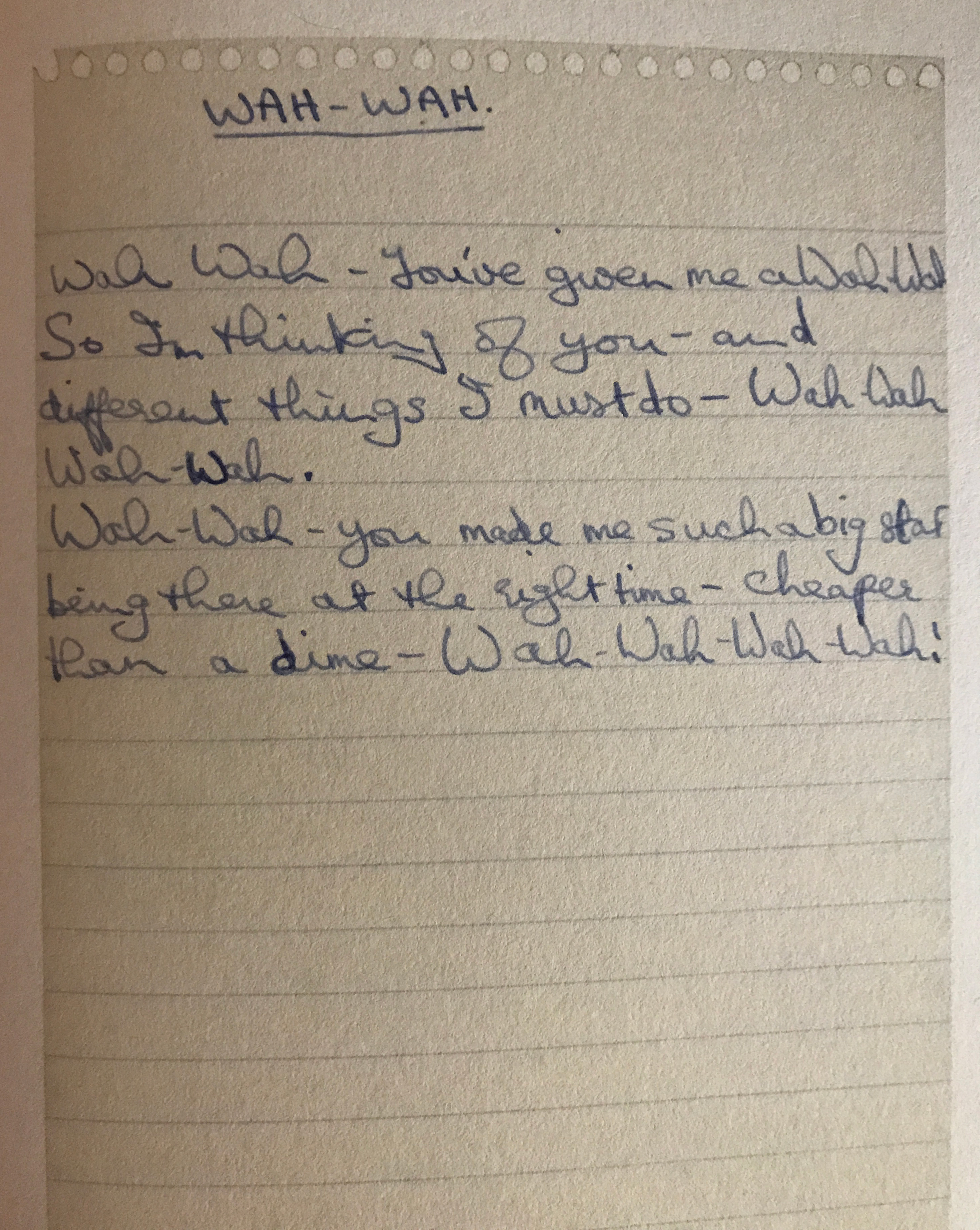
George wasn’t working for the Beatles anymore that afternoon, but he remained on the clock. In his first act as a temporarily liberated solo artist, George played, you know, whatever he wanted to play, and he wrote “Wah-Wah,” which later appeared on the All Things Must Pass LP and was the opener of his first solo performance, at The Concert For Bangladesh. George couldn’t have found a more symbolic beginning to his stage debut as a solo headliner, opening with a song born from his first independent moment.
“‘Wah-Wah’ was a ‘headache’ as well as a footpedal,” George later wrote in I Me Mine.
George’s hand-written lyrics to “Wah-Wah.” (Published in I Me Mine)
“It had given me a wah-wah, like I had such a headache with that whole argument,” George told Crawdaddy in 1977.
“It was such a headache.”
Professional clashes with Paul, personnel issues with Yoko (and John), personal crises with Charlotte and Pattie — these were all reasons George left the Beatles. If Paul wasn’t so pushy, maybe it would have made dealing with Yoko and the problems at home easier. If Yoko wasn’t so ubiquitous and John withdrawn, maybe George could work more easily with Paul with one less work distraction. If George’s marriage was fine, maybe he could have slogged through the work day, more easily accepted his continued junior role and at least had an opportunity to unwind and unload in a relaxed home.
But each of those factors played off the other. He’s just like the rest of us.
Following a lengthy but productive workshop of “Get Back” early on January 10, 1969, Paul McCartney conceded the Beatles were “going to hate these [new songs by the time] we do them [live].” And they were already starting to feel it.
“My favorite” was John Lennon’s glib reply after Paul introduced “Two of Us” as the next song to be rehearsed.
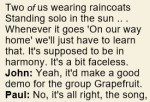
The song’s author himself was salty, too, with Paul criticizing the song at the start of this 30-minute sequence as “faceless” after the day’s first run-through.
(This throwaway joke is worthy of a brief sidebar. It’s treated as fact that the band Grapefruit, who were signed to Apple Publishing and named by John after Yoko Ono’s book of the same name, were offered — but refused — to record “Two of Us.” That fact appears sourced entirely from the above quote by John, which also appeared in the book packaged with the Let It Be LP. Not discernible in print, John said this with a laugh, seemingly underwhelmed by Grapefruit at this point in their career and jokingly ready to hand off this faceless effort to a juice-less Grapefruit.)
A slightly defensive Paul backed off his critique. “No, it’s all right, the song. It’s just not very interesting to me yet.”
With the same treatment we can still see today in the Let It Be film, electric and energetic, John proposed a solution that would come once the group convened at Savile Row: Unplug.
“The question’s always the same, and the answer’s always the same. Maybe in the studio, it’s acoustic.”
When he wasn’t micromanaging (see below), Paul had no problem opening the floor to an organic solution, and he sounded especially — and uncharacteristically — happy to see the working week nearly over. “OK, just run through it. … See, George, you can just [plays galloping guitar part], and then try to tart it up. I know that’s what I said not to do last time, but it’s Friday. Let’s try it.”
After another attempt petered out, Paul refocused on the song’s bridge, sounding an air of desperation. “We’ve just got to do something about this middle eight before it’s too late. … It’s time for riffs. That’s the only thing that’s going to help all of this.” Still, his own detailed suggestions crossed into the comical.
“Do something slow, four in the bar, with a little bit of kick to it,” Paul said before laughing at the absurdity of his requested word salad. Still, the group added minor flourishes here and there, with Ringo working a bossa-nova tempo in the bridge at one point, while later trying a “Peggy Sue”-inspired pattern.
Frustrated, Paul conceded that he’d “never been stuck with the middle eight, but it’s all right.” John countered that it was a typical middle eight, while George — who was largely quiet during the “Two of Us” session — suggested the group mix in a Mellotron part.
And while Paul said the middle eight remained lacking — John proposed, to laughs, some choreography –“Two of Us” rehearsals wrapped up on the tapes, with the final takes featuring a variety of experimental parts, including a guitar part from George that had a echo of the Byrds’ “The Bells of Rhymney” (or maybe it’s just by way of his own “If I Needed Someone”).
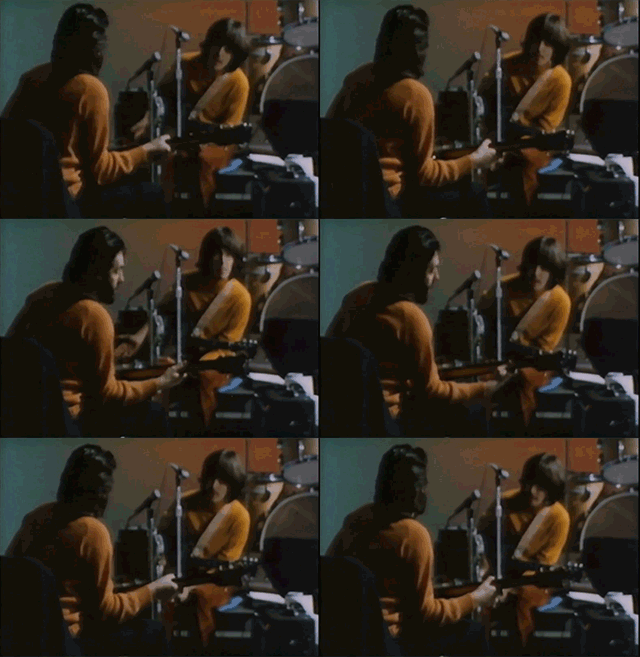
In those same final moments — and ultimately the song didn’t advance much further from where they began that day — Paul sang “four of us” at one point. That was quite poignant, because just minutes later on the tapes, the Beatles would, in fact, consist of just three of them.



 They May Be Parted