Tag Archives: Two of Us

Jan. 6: Please, please you (Pt. 2)

Rehearsals on January 6 — just the third day of the Get Back/Let it Be sessions — deteriorated to the point where The Beatles were arguing about the very nature of rehearsals and the extent to which a song need be complete in order to have a member bring it to the full band to actually bother with run-throughs.
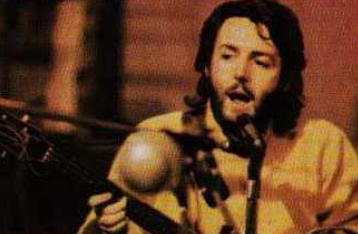
paul-gb-bookWith takes of “Two of Us” under way, Paul’s already defensive, George is already passive-aggressive. And John? Seems like he just wants to run out the clock and get the hell out of there. But at least he’s not showing any desire to have confrontation at this very specific moment in time.

When we last left things, the song — while sounding great to these ears more than 40 years later — was hung up in the intro, outro and bridge (I guess that doesn’t leave a lot, does it?). Paul had just accused George of being annoyed by him and he bemoaned the presence of the cameras. After some silence and noodling by the group, and another remark by John about the opening riff that continues to torture him, Paul repeats his preferred rehearsal style.

Paul: Doesn’t everyone agree that it’s confused at the moment? So all I’m trying to say is, let’s get the confusion, unconfuse it, then confuse it.

It’s what we’ve been doing all afternoon — this is why we’re not getting anything done. We’ve just got [to get] rolling on with it. We’ve only got 12 more days, so we’ve really got to do this methodically, this one. Unconfused, then a bit more confused, then a bit more. “Now try this drumming here, try this drumming there. Now, OK, let’s stop and look into this bit.”

Well, there’s another nice, little revelation. As of Jan. 6, it seems it’s locked in that the sessions will end Jan. 18 — or, if we’re adding in weekends, make it the 21st or 22nd (depending on whether the 6th counts against that 12 days). Presumably this is how long they’ve booked Twickenham. Talk about ambitious. As history would eventually prove, The Beatles would be out of Twickenham much earlier than that, on Jan. 14 – but that would be a direct result of George leaving the band before rejoining on a condition they abandoned the soundstage for Savile Row.

After Paul’s repeated plea to simplify first, John jumps in, almost as comic relief, continuing his complete fixation on getting out of playing the opening galloping part on guitar.

“I’ve got an idea,” John graciously offers. “I should vamp, because I’ve got to sing, and it’s hard going. But it’s annoying” (and he plays the opening riff).

George fools around on guitar over a bit, making dialogue hard to pick up, until things get clearer in this next exchange.

Paul: I’m trying to stop us all playing until we know what we are playing.

George: But you got to play in order to find out which fits and what doesn’t.

Paul: I’m thinking … we’re improvising the solos, but we play strict chords and strict rhythms around the vocals… I don’t want to say, ‘cause I really just hear myself the only one saying it. All this time…I don’t, don’t get any support or anything…you know its right, and you know its right. (He’s presumably talking to George and John).

John: OK, so I just don’t know what to do about it.

George: I’ll wait until you get your bits and then work my part out if you like. It’s like a matter of working it out with you while you’re working your bit out. You know if you got your bass bit, you know… it will take even longer.

Paul: I’m not trying to say to you, you’re doing it again as though I’m trying to say, and what we said the other day, I’m not trying to get you. What I really am trying to just say is, “Look lads” — the band, you know — “should we try it like this,” you know?

George: It’s funny now how I don’t even care.

It’s amazing honesty from George. He, for one, doesn’t seem to care at all about the cameras capturing the proceedings.  But alas, the tone he spoke in was somewhat mild (and who knows what the visual was) so I can see how this didn’t end up becoming the killer line chosen for the film, like “whatever it is that will please you” became.

Meanwhile, Paul’s showing no hesitation in calling out George and John, both, in saying he’s alone in keeping things afloat. Really, for all of Paul’s flaws, he’s kind of right here about the situation. There does seem to be a bit of cart-before-the-horse when it comes to running through the songs.

And as Paul continues, not skipping a beat after George’s dismissive comment, he goes back at George, reminding him of a recent exchange the two had over a song.

Paul: This one, it’s like, “Should we play guitar through ‘Hey Jude’? No, I don’t think we should.”
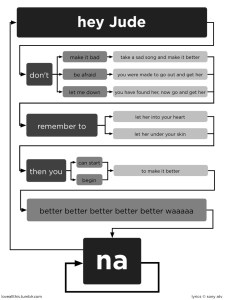
(loveallthis.tumblr.com)

(loveallthis.tumblr.com)

More than 40 years later as I write this, it almost seems like “Hey Jude” was from a different generation of Beatles than the ones arguing their way through the Get Back/Let it Be sessions. But on Jan. 6, 1969, where we are today in this blog’s current timeline, it was a song recorded less than six months prior, released a little over four months earlier and had just dropped out of the UK Top 40 three weeks prior.

It’s a funny thing how prevalent the ghost of “Hey Jude” was at the time of the Twickenham sessions. The song’s sessions were easy, with rehearsals beginning July 29, ending Aug, 1. The experience of the song’s video shoot – done at the same Twickenham — helped encourage the band that the time was right to perform in front of live audiences. And like these sessions, “Hey Jude” was ultimately recorded away from the safe and familiar confines of EMI Studios at Abbey Road (where they recorded what turned out to be more rehearsals than real takes), and instead at Trident.  And if outtakes are any indication, it was a pretty upbeat affair.

Thus, the experience recording the song — which happened smack in the middle of the White Album sessions — was fresh at the time of the Get Back/Let it Be sessions. Paul and George had just been discussing how much they liked Wilson Pickett’s cover version just three days prior.

So what was Paul’s beef with George on “Hey Jude”? Here’s what he has to say sometime in the 1990s, as captured to print in the Anthology book:

On “Hey Jude”, when we first sat down and I sang ‘Hey Jude…’, George went ‘nanu nanu’ on his guitar. I continued, ‘Don’t make it bad…’ and he replied ‘nanu nanu’. He was answering every line – and I said, ‘Whoa! Wait a minute now. I don’t think we want that. Maybe you’d come in with answering lines later. For now I think I should start it simply first.” He was going, ‘Oh yeah, OK, fine, fine.’ But it was getting a bit like that. He wasn’t into what I was saying.

In a group it’s democratic and he didn’t have to listen to me, so I think he got pissed off with me coming on with ideas all the time. I think to his mind it was probably me trying to dominate. It wasn’t what I was trying to do – but that was how it seemed.

This, for me, was eventually what was going to break The Beatles up. I started to feel it wasn’t a good idea to have ideas, whereas in the past I’d always done that in total innocence, even though I was maybe riding roughshod.

I did want to insist that there shouldn’t be an answering guitar phrase in ‘Hey Jude’ – and that was important to me – but of course if you tell a guitarist that, and he’s not as keen on the idea as you are, it looks as if you’re knocking him out of the picture. I think that it was like, ‘Since when are you going to tell me what to play? I’m in The Beatles too.’ So I can see his point of view.

But it burned me, and I then couldn’t come up with ideas freely, so I started to have to think twice about anything I’d say – ‘Wait a minute, is this going to be seen to be pushy?’ – whereas in the past it had just been a case of, ‘Well, the hell, this would be a good idea. Let’s do this song called “Yesterday”. It’ll be all right.’

What we see here is pretty obvious: The Get Back/Let it Be sessions have been tarnished — demonized even — in part, because we actually can hear everything that happens thanks to voluminous bootlegs. Good luck finding a recording George and Paul arguing over the “Hey Jude” extra guitar part.

So in the Anthology excerpt (among other places, like in Barry Miles’ “Many Years From Now”), Paul does a pretty good job here giving what seems like an honest presentation of what was happening in 1968-69. And nearly 30 years after the fact , he was still able to run through the specifics.

And it was Paul’s reflection — This one, it’s like, ‘Should we play guitar through ‘Hey Jude’? No, I don’t think we should.'” — is what directly prompted George to spew “I’ll play, you know, whatever you want me to play.”

More from the “Two of Us” rehearsals, including George finally uttering that line I keep on going on about, coming up in the next post!

22 Comments

Filed under Day by day

Jan. 6: Please, please you (Pt. 1)

It’s a passive-aggressive greatest hit.

And it’s the highlight of the series of posts — which gets under way here — I was most eager to write before I heard a minute of the complete tapes.

George to Paul: I’ll play, you know, whatever you want me to play, or I won’t play at all if you don’t want to me to play. Whatever it is that will please you… I’ll do it.

Having just heard the band make their way through a somewhat torturous rehearsal of “Don’t Let Me Down,” the context is finally here of just why George was ready to snap at Paul. But it’s a long and, well, somewhat direct road to get to “whatever it is that will please you,” and the tension isn’t one-sided as the group pivots to Paul’s “Two of Us,” an ode to his bride-to-be, Linda.

please youIn listening to the entirety of the “Two of Us” tapes, Paul’s ready to jump at anyone, feeling quite on the defensive. John, for one, doesn’t take the bait. And in fact, as the session for the song goes on, John actually attempts a bit of a peacemaker role once things begin to boil between Paul and George. But that comes later. George, on the other hand, is quite ready to share his feelings with Paul.

Musically, the song isn’t too much different than it had been before they broke for the weekend, on Jan. 3. It’s upbeat, and completely electric at this point. But like the final version, it’s a Paul-John duet. The first take of the day, straight from the top after they had moved on from “Don’t Let Me Down,” breaks down seconds in when John asks if he’s supposed to be singing.

Paul: Melody. You’re supposed to remember the words, too.

John: Yes, I’ve got them here.

Paul: But learn ’em.

John: I almost know ’em.

And we’re off and running! Just another 50 or so minutes of remaining rehearsals of “Two of Us” — and arguments — to go. Fasten your seat belts.

The tension never lets up — getting to “whatever it is that will please you” was inevitable.

Paul references past Beatles songs a number of times during the rehearsal, beginning with an early run-through, when he dictates to George that the guitar part during the verses should sound “like that bit in ‘Getting Better All the Time'” (meaning the staccato guitar part opening the song and that plays throughout).

After subsequent noodling around with the song, Paul tries to restore order and get down to actual business, in the orderly, McCartneyesque manner we’ve come to know and love/hate.

“OK, come on, come on,” Paul says to the group with a headmaster’s tone. “Let’s get it so we know it simply, and then we can add. We don’t know any one [song] yet straight. We keep trying to get to the bits.”

This is indeed true through the first few days of the sessions. “Don’t Let Me Down” is dragged down by the bridge. “I’ve Got a Feeling” isn’t quite right yet. “All Things Must Pass” is very much a work in progress. “Maxwell’s Silver Hammer” isn’t finished yet. You get the picture. Only “One After 909” – written more than a decade earlier, despite the slower arrangement, and born in these sessions out of an oldies jam – was in game shape.

Another pass at “Two of Us” and things break down as they enter the first bridge (“You and I have memories…”). So it’s time for a band meeting (Ringo, the passive drumming robot, says nothing throughout).

Paul: We’re going to have to sort of bring it together, because we’re all at odds. We’re doing that thing we did on The Beatles — we’re all playing, you know? Like in this verse, it’s two harmonies singing, trying to say some words, right? So it’s just… (he vocally apes a guitar vamp ). And in the bits when we need bits….

John: I’m just trying to sing it and do this thing (he plays the guitar part played during the “We’re on our way home” line).

Paul: We’ve got to get the riffs when the riffs bits come in.

George: The riffs… There’s no riffs. It’s nice just to get what you’re playing. (George then starts to sing “You and I are memories…”)

Paul: But it’s not together, so that it’s not sounding together.

George: So we keep playing until we…

Paul: Or, we can stop and say it’s not together.

George: Yes, then you’ve got to carry on until you get it together. It’s all right to keep playing until it sounds like it’s blending with the rest.

Paul: I never know what to say to that, you know? ‘Cause what I want to say is, “Now, come on,” and play, but I can’t, I know. You know, and we get into that one. OK.

They’re not talking about what sounds good, what words work or don’t or the like. This is a debate about the philosophy of how to rehearse. We’re in uncharted territory. These four men are writing a record on the spot, under strict time constraints to get these songs in working order for a show that’s going to happen at some unknown locale, and very soon.

You’d think this kind of thing would have been hashed out, but then again, why would it? When they last toured, in 1966, they played about a dozen songs — nothing brand new, and some songs they’d been playing for many years. They knew the songs inside and out, plus they weren’t writing anything special for the tour or struggled under the pressure of the clock. And when they last brought new songs to the table — a few months earlier for the White Album sessions — they didn’t have the pressure of the live show.

There’s a bit of nervous laughter from Paul before he continues to offer a logic he repeats numerous times over the “Two of Us” sessions this day.

Paul: … It’s complicated now. See, if we can get it simpler, and then complicate it where it needs complications, but it’s complicated in the bit.

George: It’s not complicated.

Paul: But, I mean, you know.

George: I’ll play just the chords if you like, and then…

While George is low-key throughout, speaking in completely passive-aggressive tones, Paul grows audibly exasperated.

Paul: No, no, come on. You always get annoyed when I say that. I’m trying to help, you know? But I always hear myself annoying you…

George: No, you’re not annoying. It’s not annoying anymore (or is it “anyone”? Hard to tell).

Paul: … And I get so where I can’t say it. But you know what I mean. Just do this then, and, I don’t know. I can’t do it on film either. I don’t know if we can do it on camera.

Funny, Paul had just said earlier in the day that he didn’t mind being filmed, that the band has ignored the camera from the moment they started filming at Twickenham a few days earlier.

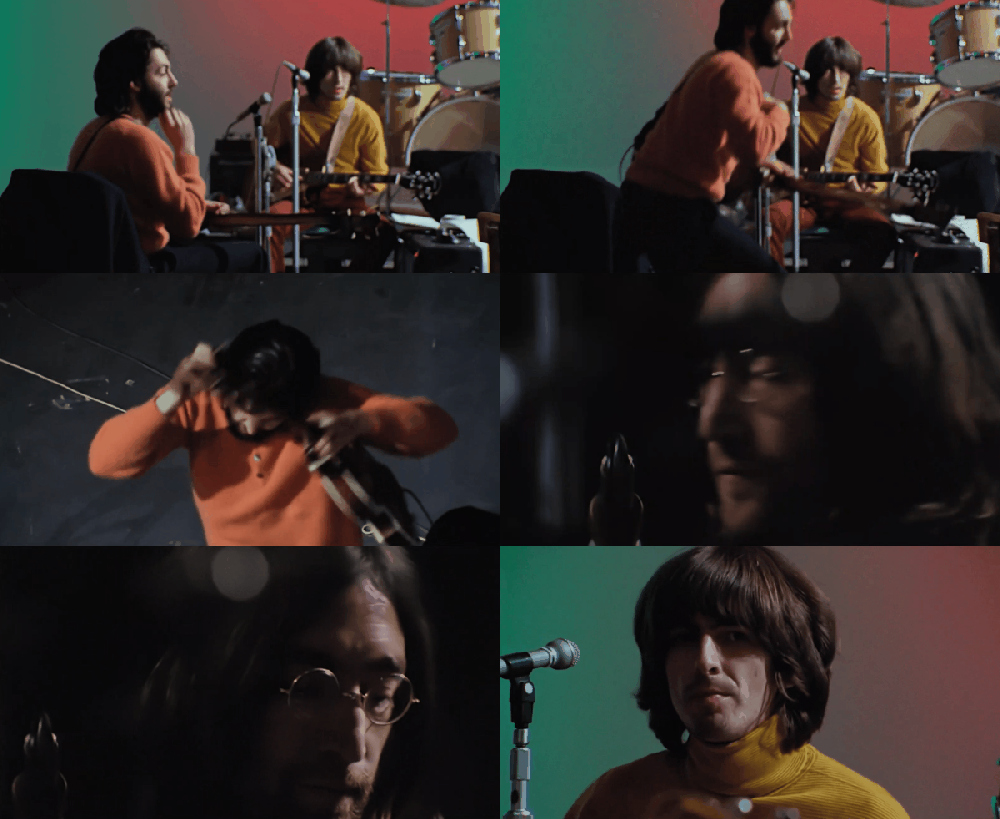
As we see in the 2021 Get Back docuseries, at this point, Paul stands up, and paces around, showing emotion the Nagra tape audio alone doesn’t capture. It’s a clear dovetail between audio only and the audiovisual moment that was very new on first viewing in 2021.

As it would turn out, Paul returned to his seat and would end up having to continue this discussion on camera after all, and it would become one of the iconic moments of the Get Back/Let it Be sessions and the film — behind only the rooftop concert — and truly in the group’s history overall.

The in-depth look at the “Two of Us” sessions on Jan. 6, 1969, will resume in the next post. Coming very soon!

20 Comments

Filed under Day by day

Jan. 3: Et cetera

With Maxwell’s Silver Hammer, the band wrapped the second day of the sessions at Twickenham. This blog is ready to move onto Jan. 6, the next day the band assembled after the weekend, but first, I wanted to tie up a few loose ends and address a few items that didn’t quite merit their own separate posts.

•  After being introduced the day before, the band continued to work on “Two of Us” in a matter that totally didn’t distinguish itself. The song had the familiar architecture and same lyrics as would be eventually released, while the tune was a little bit quicker than we’d hear. Just ordinary runthroughs churned with nothing groundbreaking and no remarkable dialogue or discussion.

•  With the exception of his introduction of a pair of never-to-be-released originals, Ringo was the real quiet Beatle on Jan. 3. Totally invisible except for his drumming, which was characteristically steady.

•  As they famously did throughout the sessions, the band covered “oldies” (by this point, we’re talking some songs that in 1969 were less than a decade old, of course).  George, Paul and John each led the way at different points. And while they seemed happy — or at least not bored — they weren’t necessarily very good.

To me, this is a hallmark of what these sessions were about prior to beginning to listening to the complete tapes, when I all would see/hear were compilation bootlegs of the sessions. “The Beatles cover all these songs!” OK, great, but they’re not particularly listenable. Or at least re-listenable.

Interesting to note just how many of these songs would eventually see release by these guys on solo records (John and Paul, at least).

This environment of the oldies, however, did at least bring to the forefront their oldies, like “One After 909.”

•  Plus they touched upon a number of contemporary  songs, but “touching” is even too strong a term. Often it was just for a few seconds, and often it was mere mockery. And even then, it’s completely disingenuous to call it covering. In some cases, like “I’m a Tiger” by Lulu, Paul sings the chorus while George tunes up  (That song, incidentally, appeared on No One’s Gonna Change Our World, the record that first debuted “Across the Universe.”).

Dylan got his due with “All Along the Watchtower,” “Blowin’ in the Wind” and “Please Mrs. Henry.”

Paul shows his love for Canned Heat at one point in a hilarious exchange with George and Michael Lindsay-Hogg.

“That Canned Heat number, I love that new one. It’s cornier than the last one, not quite as good. ‘Up the Country‘ is it?”

Paul proceeds to sing the first verse before continuing.

“It’s just got flutes playing. It’s a bit of a fruity thing they do. … Almost no soul.”

“Almost no what?” George asks.

“Soul,” says Paul. “They don’t bend the flutes or anything. But it’s great because they don’t. It’s sort of a … “

Paul offers the flute part in falsetto “doo-doo-doos” and continues..

“The end is great. They do, like, a false end.”

More “doo-doo-doos.”

“They keep going with the flute!”

After some laughs, George does a few-second quote of Canned Heat’s other hit, “On the Road Again,” before the band completely changes course and reintroduces “One After 909”.

As the band departed the session, the last point of discussion caught on tape was George and Mal picking up the discussion they had about equipment earlier in the day, during the “All Things Must Pass” rehearsals. Then with the goodbyes, the day’s tapes are done.

9 Comments

Filed under Day by day