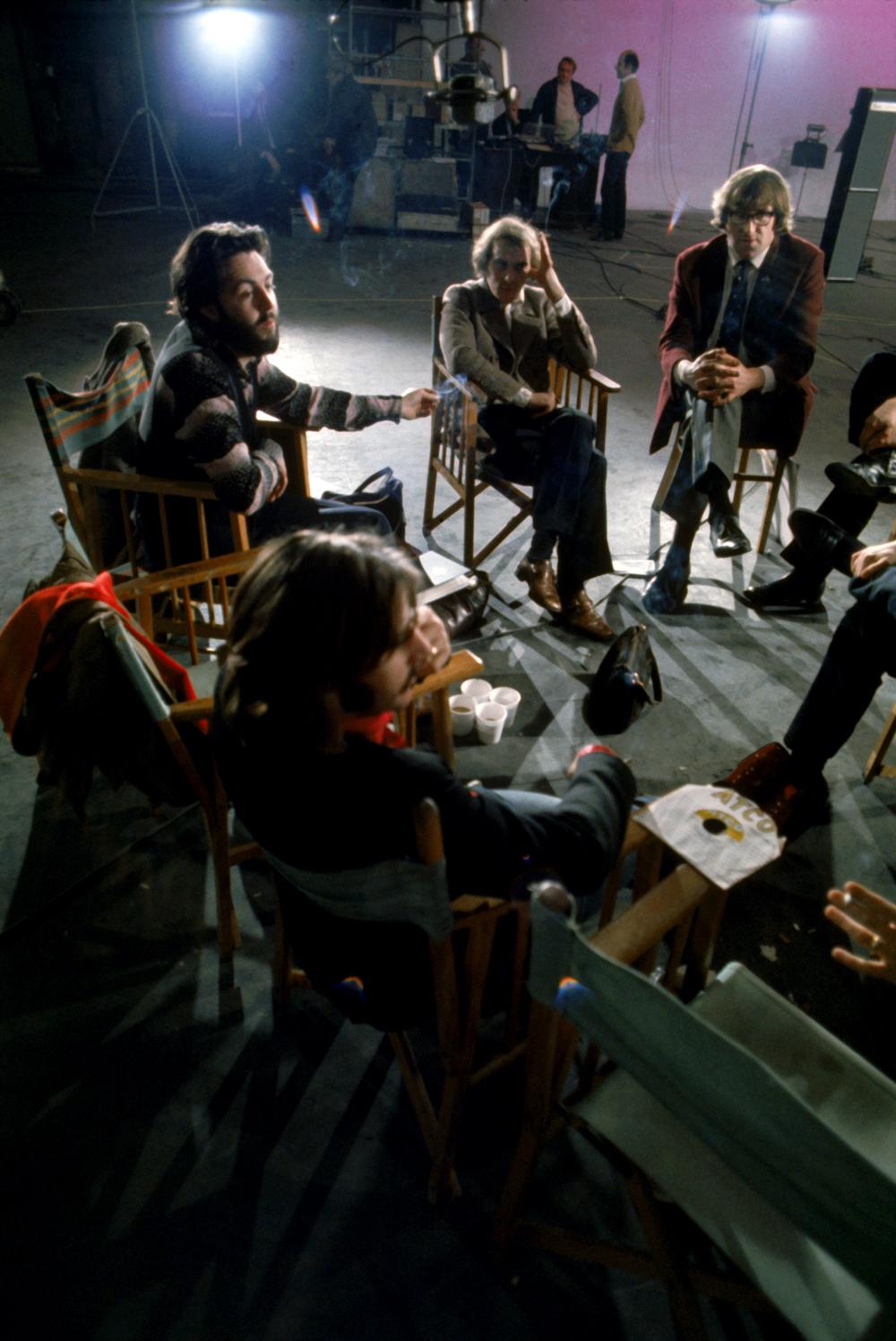
It’s spring 2024 A.D., and when we last saw the Beatles, they were vanishing before our eyes in the “Now and Then” video, ascending to Pepperland, probably. In the moment, it was a powerful and tidy conclusion to the clip and the greater arc of their career.
But to paraphrase Paul McCartney, there is no end to what they can do together. Having reclaimed the top spot on the charts in what they trumpeted as their “last song,” the Beatles have chosen to re-audition after all.
The Beatles don’t really do tidy endings. They keep the accidental outtake “Her Majesty” after the majestic “The End.” They break up the band in the most clumsy fashion. And now, after the triumphant back-to-back successes of the Get Back docuseries in 2021 and “Now and Then” last November, the Beatles exhume a movie George Harrison called a “fiasco” and “painful,” John Lennon said made him “sick” and Ringo Starr said had “no joy.” Ringo’s quote is from two weeks ago. Ringo still has issues with Let It Be. Doesn’t he know he’s supposed to promote this thing?
Leave it to me, Ringo. I’m excited, because the return of Let It Be to Beatles canon is critically important, even as it comes off now as the Beatles trying to be completists.
Once I started listening to the full run of Nagra Tapes on my own in 2012, it completely changed my point of view on how the sessions played out. I’ve been writing that story here for 12 years. And for most of that time – until Get Back premiered — I could only cross-reference the Nagras’ account with what amounts to a late 20th century antique (a video cassette of Let It Be) and nearly 50 years’ worth of public grievances. And that’s precisely why I didn’t think the film should have remained inaccessible for so long and truly feared it would stay buried. Because Let It Be didn’t tell the story of the Beatles breakup, the reaction to it did. This, above all else, is why Let It Be matters.
<Getting on soapbox again> I talk about the Let It Be film all the time not only because it was something the Beatles did, but because it shaped 50 years of their history. Maybe it's not the same now, but it mattered for a very, very long time. </end soapbox for now>
I first saw Let It Be on VHS in the mid-1980s – we rented it and subsequently pirated our own copy in a nod to the tradition of Let It Be/Get Back bootleging. Of course I bought into the idea that Let It Be showed their breakup – I was an impressionable fan, didn’t dig independently into it (where were the counter-narratives back then anyway?) and if the Beatles themselves said that’s the way to interpret the film, who am I to say otherwise? If it’s in Compleat Beatles, it was gospel. Also, remember we didn’t have the full Nagras leaked at the time, only a few hours of bootleg records, mainly of performances.
That VHS release, along with an edition on Laserdisc (a contemporary technology with the video cassette) and Betamax, represent the most modern formats on which Let It Be exists prior to its streaming debut. I’ve written this before, but it’s worth repeating: In the time since street-legal Let It Be appeared on store shelves, you could have picked up A Hard Day’s Night on VHS, Betamax, Laserdisc, DVD, Blu-Ray, 4K UHD and streamed it.
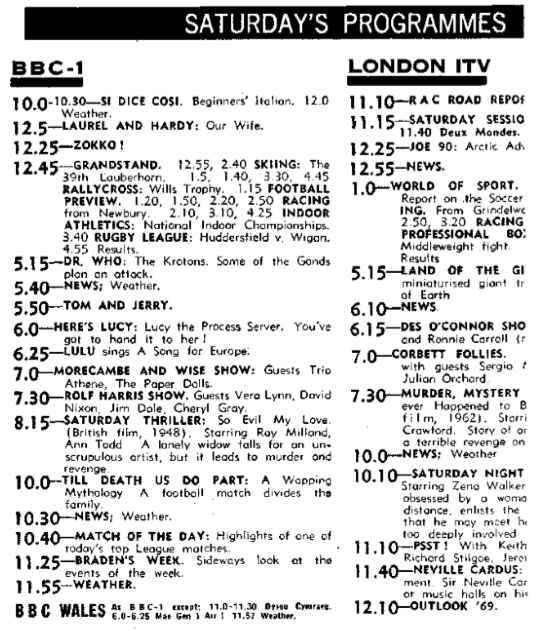
The last UK television broadcast of Let It Be came May 8, 1982, according to the Radio Times. The film was screened sporadically in American theaters into the mid-1980s, but then it simply disappeared. Other Beatles productions remained stocked, promoted and upgraded. Magical Mystery Tour (which had its own terrible reputation for a long time) was belatedly released on VHS in October 1988 – like the other Beatle movies, it had its subsequent reissues on modern formats.
From our retrospective standpoint, we can see what film is conspicuous by its absence https://t.co/UHajUtcuMc
Once in a while, Let It Be’s absence was made conspicuous to the general public.
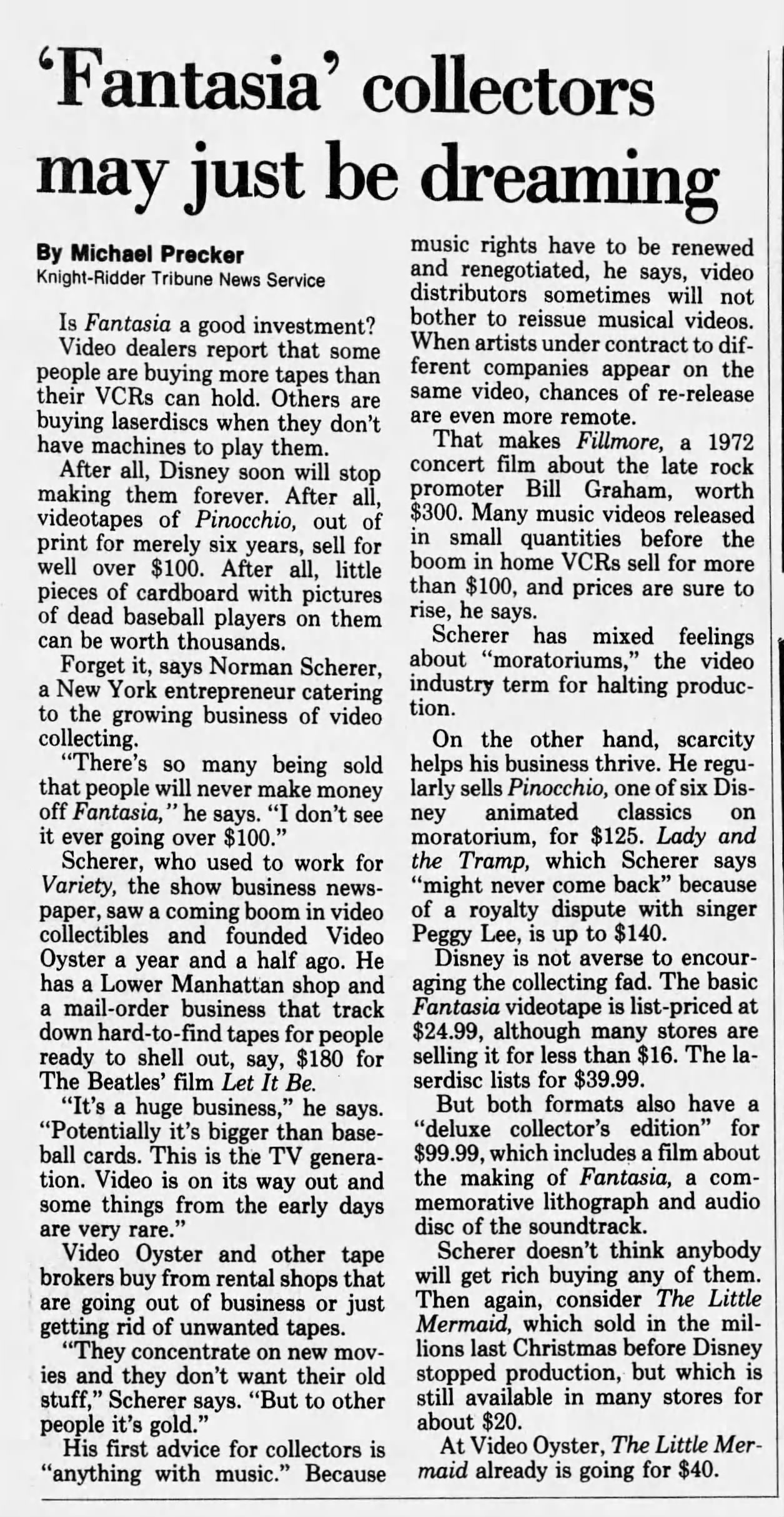
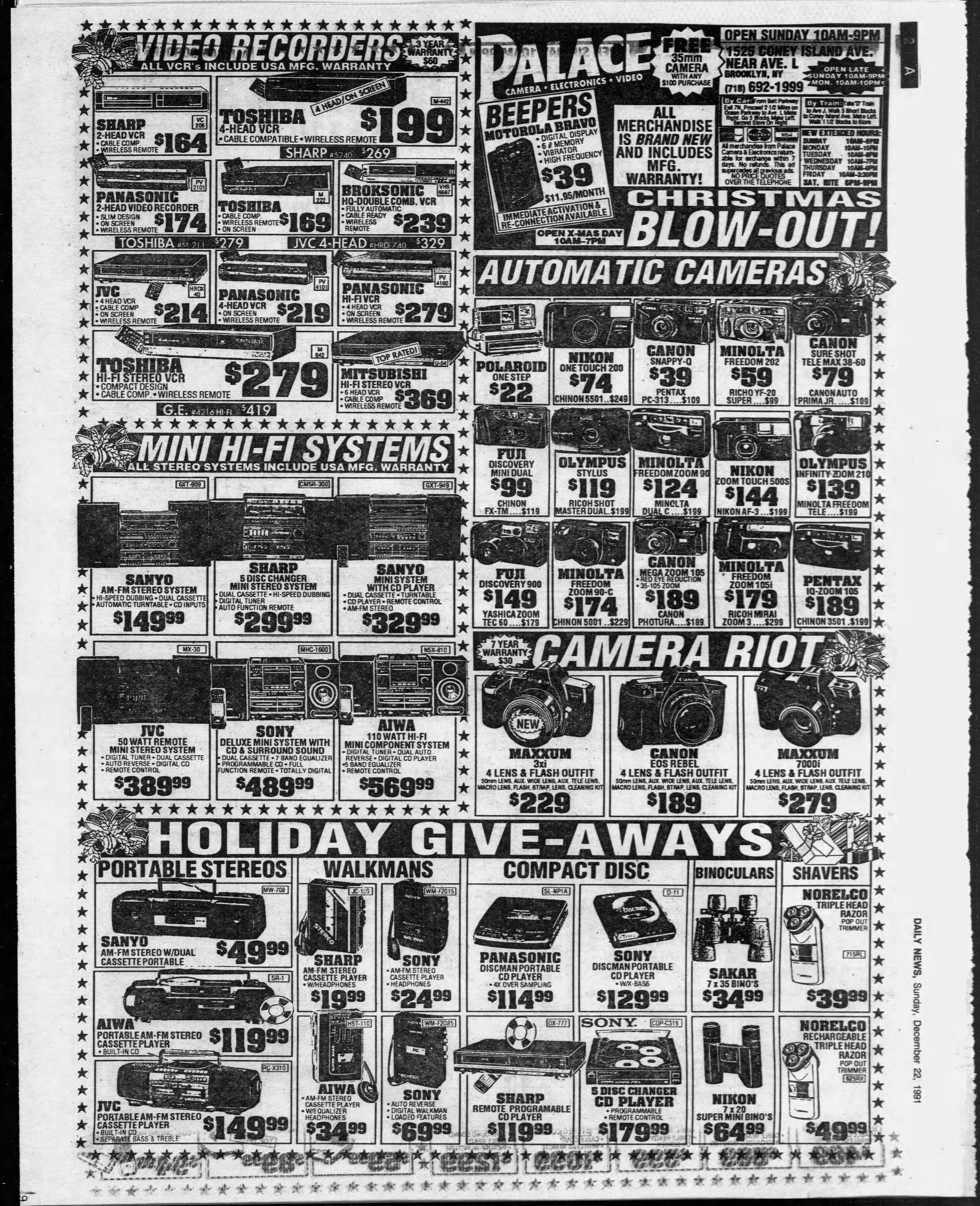
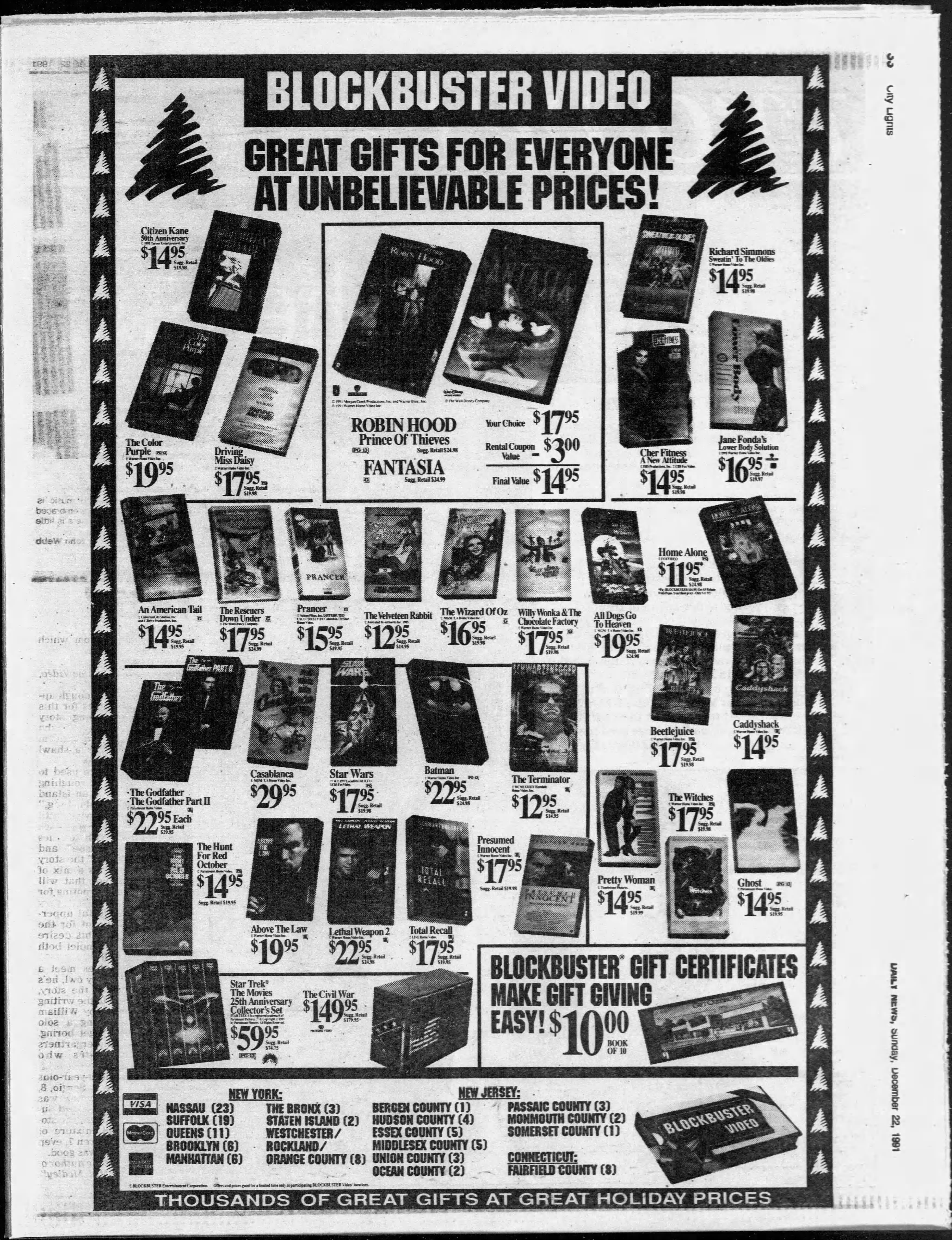
Buried in a 1991 news story about the future collectible value of Disney VHS tapes (which was really a thing, I remember it!), a mail-order video store reported it was tracking down copies of Let It Be videotapes for $180. For context, you could have bought a decent name-brand VCR for that price – or about 10 new copies of “Star Wars” or “Driving Miss Daisy” (or 13 copies of “Sweatin’ To The Oldies”).
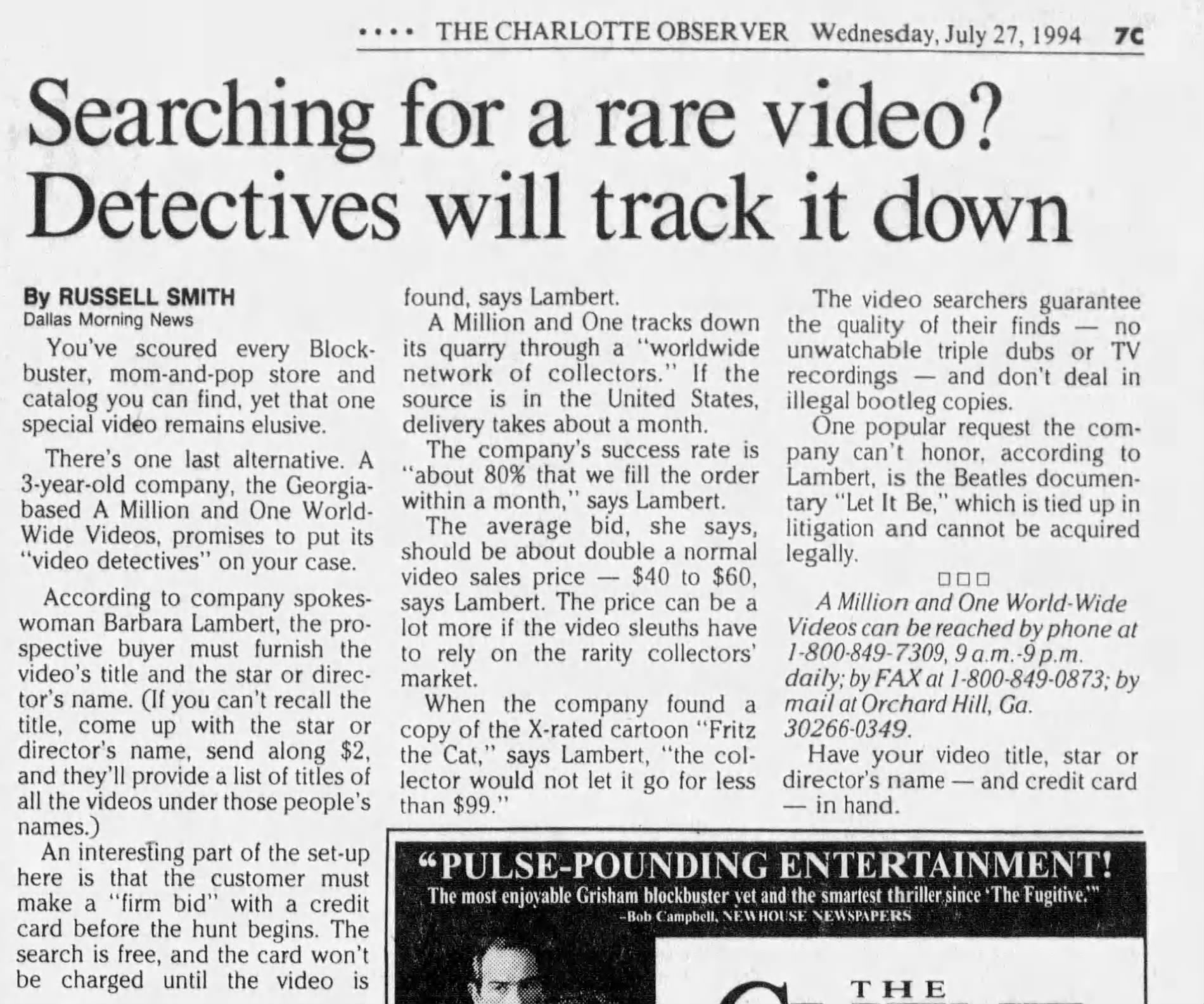
“[A]pparently the collectors who own it aren’t willing to part with the title,” said a representative from a different specialty video store in 1994.
That was 30 years ago.
Let it Be is haunted by more than a half century of degradation and denigration as a physical product and a featured work in Beatles history, a ruin by which it’s defined.
If you wanted to watch the movie prior to its Disney+ debut, you were forced to view it on technology that peaked in the 1980s in its native format or on a digital copy ripped from those same 40-year-old analog formats. It’s a bad experience. And even in 1970, the original theatrical release was trashed, including the decision to blow up and crop the original 16mm print to 35mm, and it was hit for poor sound quality too.
(David Bowie deliberately had the Blackstar LP, released days before his death in 2016, physically degrade before your eyes, employing a hard clear plastic sleeve destined to aid in wrecking your record beyond routine wear and tear on the turntable and viewable through a window in the front cover.)
Let It Be on Laserdisc
Before you even slipped your Let It Be Laserdisc (for instance) into your player, you were hit over the head with the breakup story on the back cover:
The Beatles were breaking up. The Beatles were boys becoming men. … One squirms as Paul snips at George and Ringo for not playing their parts correctly, as if the Beatles magic was of a kind that could be whipped into shape. But you can’t blame Paul, because he, like us, saw the Beatles coming to an end.
(Paul said exactly as much during 1990s interviews for Anthology, too: “When we got in there, we showed how the breakup of a group works. We didn’t realize that we were actually sort of breaking up as it was happening.”)
That the film originally reached theaters — a reported 225 in the U.S. alone — a month after the “PAUL IS QUITTING THE BEATLES” headline shattered the music world is critical, but not alone in its importance. Some people still expected the wacky, scripted Beatles to appear on the big screen.
Don’t think that matters? To give one example, Variety’s May 20, 1970,review of the film bemoaned “the Beatles’ past togetherness, the chummy camaraderie, the quickness to seize on a line and build a series of gags is no longer there.”
Los Angeles Times movie listings, June 20, 1970
We can nitpick even further and argue that if someone wanted to spend their $1.50 or 6/1 ½, maybe it was better spent on Woodstock, which was in theaters much at the same time (Woodstock was reaching more theaters as Let It Be completely ran out of steam). Running 100 minutes longer than Let It Be, the cinematic release of the concert documentary earned widespread critical and commercial acclaim.
Just a few pages away from the movie listings for Let It Be, reviews and stories touted the Beatles’ recent split, and record store ads promoted Paul’s new solo LP.
Or, as that same Variety review said, “If the film has an air of emptiness and resignation, it is because we know that this is almost certainly the last Beatles picture we are going to see.”
Let’s be clear about the Beatles’ audience, now and then. The younger Beatles fan base that exists today is utterly outstanding, bringing a completely different perspective on the group and, critically, lacking the baggage so many of us had to live with and work to shake free. I’m a second-generation fan, a born in the mid-1970s and too late to be around for Beatles’ first run, but I remember the possibility all four could one day reunite. And I remember hearing on the radio John was killed.
I grew up with The Compleat Beatles, Lennon Remembers, Shout! and later aged with Anthology and Drugs, Divorce and a Slipping Image – so the story was baked in: Let It Be was hell, period.
Even the Beatles’ own records promoted that this was a bad time. The back cover to Reel Music (1982) said “Let It Be poignantly documents the group’s disintegration while capturing their inimitable songwriting technique,” while the liner notes to Let It Be … Naked nearly 20 years later put it this way:
It is the Twickenham sessions that have characterised the whole Let It Be project as an unhappy one both in the minds of the Beatles themselves and anyone who saw the documentary footage in the movie.
In 1970, Get Back was merely the name of a song and an abandoned LP (and film title) while the Nagras sat securely in Apple Records’ vault. Multiple generations loved the Beatles, but they were all “first-generation” fans who witnessed the group’s evolution and dissolution in real time, not forced to read about it in a book or watching it from a documentary. When Let It Be was promoted in theaters, there wasn’t a new generation of fans to reach.
Let It Be movie posters as displayed at the Rock and Roll Hall of Fame in 2022.
Much as the audience mattered, the four most important figures requiring appropriate contextualization are the Beatles themselves. To them, Let It Be wasn’t just a monthlong session in 1969 and a movie premiering after a breakup in May 1970. The Let It Be experience spanned the 16 months in between too. That’s a long time.
It’s time that included rejected cuts of the film (“Let me put it this way. I’ve had three calls this morning to say [Yoko Ono footage] should come out” is how director Michael Lindsay-Hogg remembered the reaction to an initial screening).
Those 16 months included several rejected Glyn John edits of the soundtrack album, tapes eventually being dumped on Phil Spector and Paul hating much of what Spector did.
It included John saying he wanted a divorce from the Beatles, and later McCartney accepting it, properly beginning the Beatles solo era.
It had all of the Northern Songs drama and the disintegrating Apple. And Allen Klein brooding over everything.
All of that happened to the Beatles as part of their Let It Be-era experience, when a long and lonely “winter of discontent” really spans six calendar seasons. We can separate an 80-minute film from the period, but how could they?
The music wasn’t blackballed the same way the movie was. I always thought it was great, and I never bought John’s complaints about it (“[Phil Spector] was given the shittiest load of badly recorded shit – and with a lousy feeling to it – ever. And he made something out of it … When I heard it, I didn’t puke.”).
I may not have been in under the lights and in front of the cameras, but I do listen to the music and haven’t puked either. It makes me feel quite good! Let It Be made its CD debut in tandem with Abbey Road to great fanfare in 1987, capping the band’s reissue campaign on the new-ish format. A dozen songs from the sessions appeared on 1996’s Anthology 3. Seven years later in 2003, a reworked mix emerged as Let It Be … Naked. We can even throw in Reel Music and the Movie Medley for more examples that they fully incorporated Let It Be’s music into their catalog since its release.
I think the film just sat there as this giant symbolic target. It was harder to pan the companion soundtrack LP when it was such a smash – it had the biggest initial sale of any LP in American history at $26 million in 2 weeks. The movie, on the other hand, was a relative box office failure, pulling in $1.06 million gross. That sounds like a lot of money until you see A Hard Day’s Night made $11 million and Help! pulled in $12 million.
If the music from the same sessions have been tolerated by Beatles Inc. over the last 50 years, what was so damning about Let It Be’s visuals for so long? Was it the scant minutes featuring Yoko in the frame? The “confrontation”betweenPaul and George. The waltz? We know it wasn’t about Billy Preston, and the rooftop has long been justifiably lionized. The three completed songs performed in the basement (“Two of Us,” “Let It Be” and “The Long and Winding Road”) are perhaps staged a bit too formally, but those have resurfaced at various times in Beatle releases (eg., two of the three on the 2015 “1” DVD).
There is very little in the way of actual dialogue – as in full, extensive conversations — in Let It Be (and in its original print, which is very muddy compared to the MAL-enhanced sounds of the 2020s).
George has been quoted multiple times referring to Yoko’s “freakout” with John in Let It Be – but that never made the final cut. An early edit long colored George’s opinion of the film – it wasn’t a first-hand memory, since he wasn’t in the room when Yoko performed with the others. Did George even see the theatrical version of Let It Be?
It’s probably a matter of simple bias: When you listen to Let It Be you can’t see Paul and George bickering, John asking if they can “play a fast one,” Paul yawning, Ringo looking like he’s going through the motions or Yoko just sittingthere.
“I’ll play, you know, whatever you want me to play. Or I won’t play at all, if you don’t want me to play. Whatever it is that will please you, I’ll do it.”
The result is actually backed up by science – what we hear isn’t as sticky as what we see.
Paul and George did bicker. Yoko did just sit there. That’s real, even if that’s not all they did.
What is spread out over eight hours in Get Back simply didn’t translate as well over 80 minutes in Let It Be. Some of that was by choice — maybe it could have benefitted by one less oldies cover and one more evolution of an original song — but there was really little wiggle room in the format.
We’re lucky to have Get Back, for its clarity of picture and sound, and all that footage. Normally a recording session wouldn’t have a particular story to tell — group frustrations come to a boil, a member walks out, but they rally and stage a memorable performance, etc. — and in 1969/70, the Beatles never intended to tell anything more than “this is how an album is made, and here we are performing it as the payoff” as the original TV concept.
And to that end – with Get Back as its companion — Let It Be should be considered an honest depiction of the band. Still, it’s always been a struggle to describe what exactly Let It Be is.
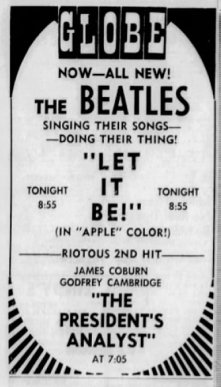
The original movie trailer (which was given an homage in the 2024 Disney+ trailer) asked viewers to view the band “rehearsing, recording, rapping, relaxing, philosophizing, creating.” One movie ad was more blunt: “The Beatles singing their songs, doing their thing.”
Let It Be appeared on HBO in the late 1970s, and the cable network’s guide described the film on different occasions as “A film to make you smile” and, simply, “McCartney sings Besame Mucho.”
I'm working on a post (of course I am) for next week in advance of the restored Let It Be & now's good excuse to share these from HBO Guide (remember those?), Aug 1978. They had no idea how to describe Let It Be, had to over and over again. Yet I'd call each description accurate! pic.twitter.com/jUvmyrrmj2
The original movie poster (“an intimate bioscopic experience”) and present-day blurb on Disney+ (“Available for the first time in over 50 years, the original 1970 film about the Beatles”) both tout the plain fact that Let It Be is a movie as it’s main descriptor.
It feels like the original VHS box got the story right, with a positive spin not common at the time:
An exhilarating documentary of the making of an album by The Beatles, the film concentrates on the many recording sessions that went into the production of the “Let it Be” album. It offers a unique glimpse into the creative process of this world-renowned group as well as the subtle relationships among the individual members. There is jamming of old songs and painstaking work on new ones. In search of a new direction, The Beatles play an inspired concert on the roof of their London offices.
In the announcement of the 2024 reissue of Let It Be, Peter Jackson said Get Back and Let It Be “enhance each other.”
‘Let It Be’ is the climax of ‘Get Back,’ while ‘Get Back’ provides a vital missing context for ‘Let It Be.’
That first part sounds reversed, but the director is absolutely right. Let It Be isn’t backward compatible because of how it directly influenced the subsequent 50 years of Beatles history. Let It Be owns it’s baggage, period.
Get Back told a specific story, but it was reactionary, too, not simply giving a nod to Let It Be, but deliberately clarifying — and in a sense undermining — some of the original film’s more negative moments.
My favorite example (of several): Paul tries to stifle a yawn in Let It Be, 50-year-old proof that the band is bored. But a drowsy Beatles performance of “I’m So Tired” results in a minute-long sequence in Get Back, with everyone yawning. George yawns his way through Paul’s magical “Get Back” origin story.
For all the drama in Get Back — agonizing over the band’s future, dealing with walkouts (George) and sit-ins (Yoko) — the only real resolution we get was to the problem of how to stage the show, by going onto the roof. Both films feature the same ending, with Get Back criminally dustheaping the full indoor performances, a robbery rectified with Let It Be’s restoration.
No matter how Michael Lindsay-Hogg edited Let It Be, he was stuck in his time. We all knew what came after the credits in 1970 — it wasn’t a gag reel or sneak preview, but a very public breakup, a breakup that was inevitable whether the January 1969 sessions were in front of cameras or not.
“We filmed the whole thing showing all the trauma we go through,” John said in the April 12, 1969, Melody Maker, which hit newsstands right around the time the “Get Back” b/w “Don’t Let Me Down” single was released and more than a year before Let It Be reached theaters.
Tellingly, there’s more to the quote: “Every time we make an album we go through a hellish trip.” (emphasis mine).
Let It Be was put together in the Beatles’ time, yet could only reflect the past tense. It’s no accident Michael put Paul’s piano rendition of “Adagio for Strings” — once voted the ““saddest classical” song — over the opening credits.
Fifty years later, with a different concept and such a different, wider audience, Get Back allowed — and still allows — us to dream on a future. It freed the Beatles from the events that came after it. That story, so focused on the friendship of the band, directly set up “Now and Then.” The same rooftop ending delivered an alternate ending.
The existence of Get Back offers the original Let It Be the same liberation. Today, in 2024 and beyond, it’s indeed the climax to Get Back, the scar that healed over, at once an apocryphal footnote and a window into the post-breakup era — if you know to look for it.
The Beatles website, as captured in the days leading up to the release of “Now and Then.”
The Last Beatles Song.
Let’s be a little more accurate and say with several qualifiers that it’s the last, new officially released Beatles song. The diehards already knew it from bootlegs, of course.
Not now, but back then, it was some other John Lennon vocal — not “Free as a Bird” or “Real Love” but the group’s 1964 recording of “Leave My Kitten Alone” — that qualified as the first last Beatles song.
“There is other unfinished recorded material of the Beatles which has never been released but ‘Kitten’ is the only complete track,” an EMI spokesman (presumably Brian Southall) told the Daily Mirror in September 1981. That same story said John’s death derailed initial plans to release the song as a Christmas 1980 single.
Daily Mirror, Sept. 19, 1981.
If you’re looking for a sign of the times and an indication of how much the coordination between the label and band have changed in 40 years for legal reasons and otherwise, here’s another quote from EMI:
We don’t need anybody’s permission to release the record because it was made for us before the Beatles set up Apple, their own recording company. But we would probably inform Paul McCartney who is still with us.
(George Harrison and Ringo Starr were still with them, too, by the way.)
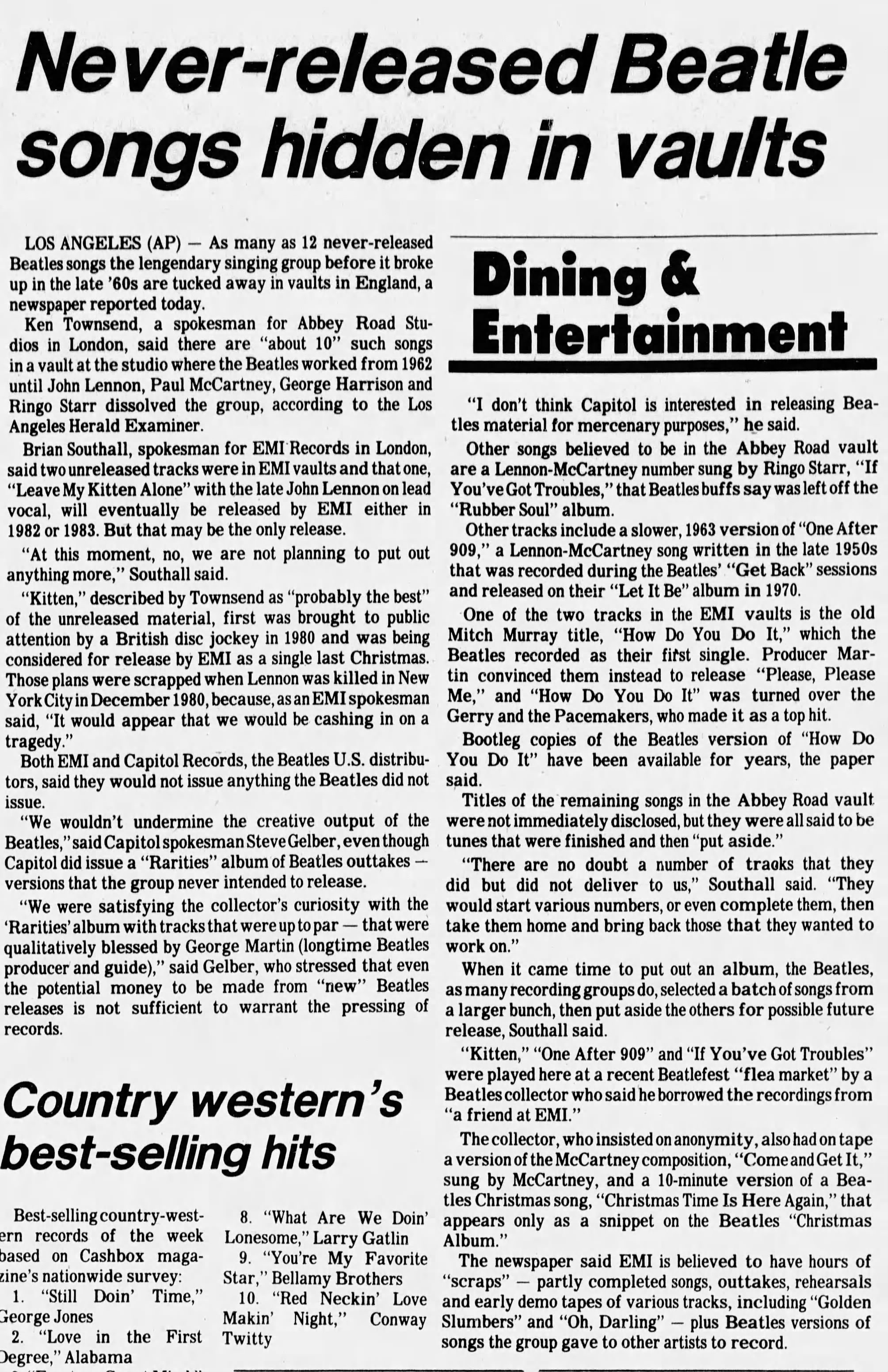
Further details emerged later in 1981, when an AP report (citing the now-defunct Los Angeles Herald Examiner) said a dozen unreleased Beatles songs were in the vault, but only “Leave My Kitten Alone” would see daylight, probably in 1982 or 1983. Hope we didn’t get too excited back then because …
“At this moment, no, we are not planning to put out anything more.”
Just how do EMI and the Beatles lose a song and recover it years later? Here’s a quick timeline:
December 4, 1964: Beatles for Sale is released, and of its whopping six covers, none are “Leave My Kitten Alone.” We don’t hear of the song again in the Beatles career, not even during the Get Back sessions, when they played all kinds of things.
August 15, 1970: Apple flack Peter Brown tells Melody Maker that there is no unreleased recorded Beatles material. Even then, everyone knew better as Get Back session outtakes, for instance, were already circulating.
1976: With the Beatles no longer under contract as an entity to EMI, the label began to take stock of what actually was in the Abbey Road archives, a lengthy process. An in-house EMI compilation of songs that included “Leave My Kitten Alone” eventually made its way into collectors’ hands, and ultimately bootlegs.
This brings us to the early 1980s, and EMI’s admission that the song would ultimately be released.
The emergence of “Leave My Kitten Alone” was tangible and exciting at the time. It wasn’t a fringe bootleg or a brief mention in newspapers anymore. You could hear it on mainstream radio.
Here’s one example: For a solid month in late summer 1984, the song was listed among the “Most Played Singles” on Boston’s WBCN (the same station which happened to be the source of the famed Kum Back bootleg 15 years earlier).
From the Aug. 28, 1984 issue of the Boston Phoenix.
The excitement for the song wasn’t isolated to one market, either. I know because I remember it myself.
That child is going to miss you: My ’80s dub off the radio here accompanied by elementary-school-era scrawl on the label. As you can tell, I save everything.
It must have been some time in that same period in 1984 that one of the local New York radio stations (WNEW? WAPP?) played the song. I was 10, but already a fully formed Fab Four fan. I remember the station’s promotion was breathless — it was the “new” Beatles song, and I’d never experienced such a thing.
I grabbed a cassette tape not unlike the one central to the 2023 “Now and Then” promotional campaign (mine was Type II though, only the best for the Beatles). I hit play-record a few seconds into the song, and while I thought I was doing myself a favor at the time cutting out commercials, 40 years later, I wish I hadn’t lost the extra context.
By this time, the song’s release dovetailed with that of the compilation, Sessions, which has its own entire backstory. The LP and its lead single, “Leave My Kitten Alone,” had catalog numbers and release dates for early 1985.
There’s some debate if this is genuine or a fake, but it’s definitely some kind of sleeve for a “Leave My Kitten Alone” single.
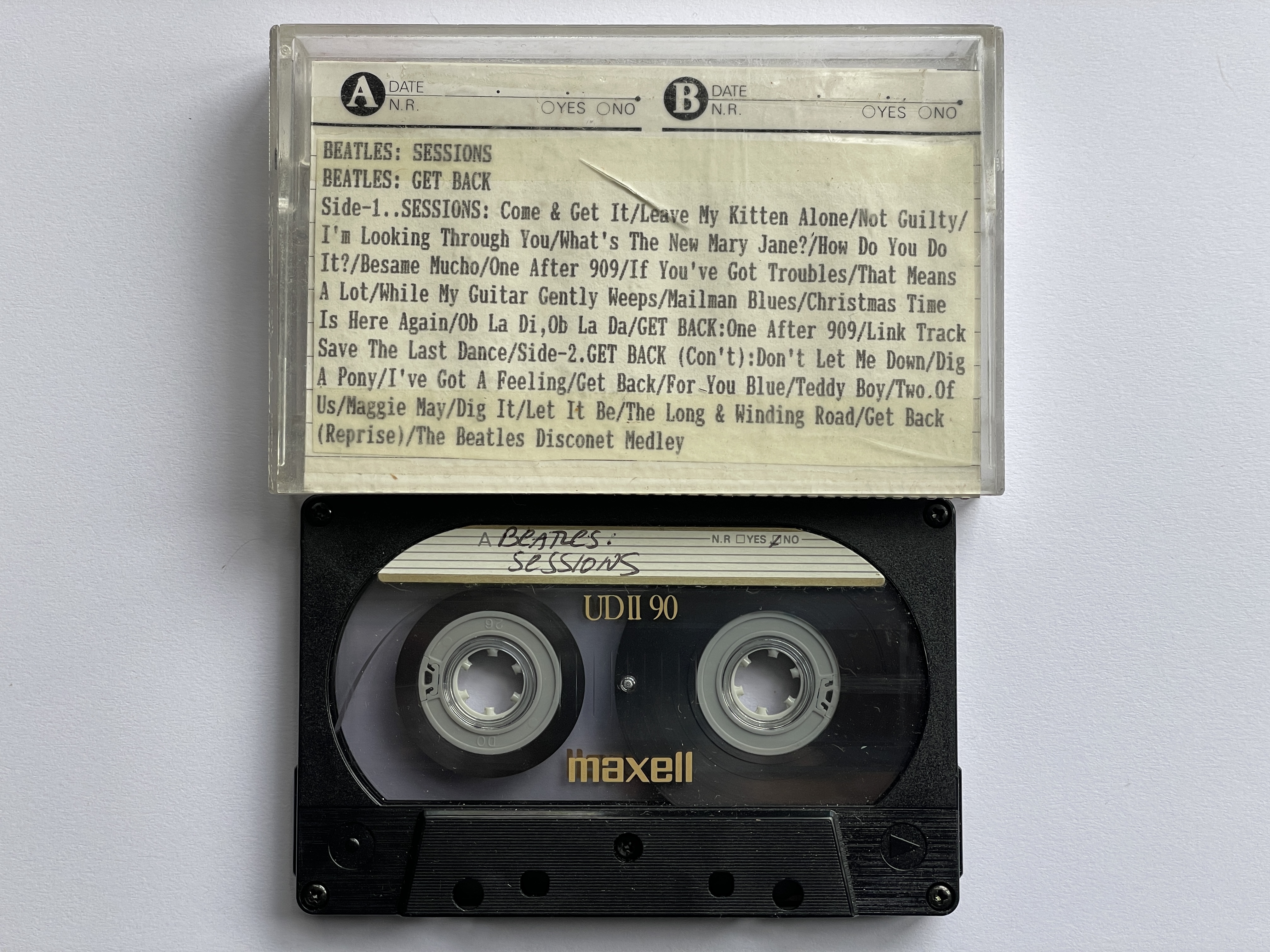
Suddenly, the entire project was dead, reportedly because of objections from the three living Beatles and the Lennon estate, as well as the fallout from a new lawsuit between Apple and EMI. Like so much else, the Sessions LP lived on in bootlegs, almost immediately. (I had mine on cassette, backed with Get Back.)
It took another decade, after all manner of legal issues were resolved, that Yoko Ono handed tapes of four demos by John — “Free as a Bird,” “Real Love,” “Grow Old With Me” and “Now and Then” to Paul in 1994 for the surviving Beatles to adorn for Anthology.
This “Kitten” had nine lives, finally hitching a ride with the nextlast Beatles song — “Free as a Bird” — onto Anthology 1, officially becoming canon 31 years after it was recorded.
And it left the door open for another to be the last Beatles song.
I recently had the pleasure of chatting with author Steve Matteo, who not only is a fellow New Yorker, but even better, also shares the unique experience of writing at length about the Let It Be/Get Back sessions. You may have already read his 33 1/3 on “Let It Be,” and now his latest book — Act Naturally: The Beatles on Film — takes on the entirety of the group’s core movies in heightened detail with expansive context enveloping the period. If 33 1/3 was an LP, this book is a deluxe box set.
We spoke for almost 90 minutes, which was a great experience in real time — I suggest talking about the Beatles with people for hours, it’s always a wonderfully rewarding experience — but delivering a full transcript would cause severe eye strain. And I’m not going to start podcasting, despite my standout overnight freeform college radio stint almost 30 years ago.
So I did a little bit of both, transcribing the best bits of the conversation and then dropping extended soundbites when you want to hear a little more.
A caveat as you dig in with the hope you dig it: I’m neither a broadcaster nor professional podcaster (although I’ve appeared on severalas a guest!). I recorded the audio by putting poor Steve on speakerphone and then taping the interview from a mic on a computer. I cough some. Dogs mournfully bark for treats in the distance. The conversation wasn’t originally meant to be heard, but I ultimately believed smaller soundbites would be an effective way to present further parts of the interview, even if it wasn’t properly produced.
One other minor note: We talked a little about the potential of a future “Let It Be” reissue. This conversation was held a few weeks before we starting hearing rumors of a late 2023/early 2024 re-release of the film.
The Beatles, literally, at the movies
They May Be Parted: Why did films appeal to the Beatles? Was it just general desire for fame and exposure? There was nothing their earlier biographies to suggest otherwise. They were performers but not necessarily people who dreamt of acting. Was it just a product of the time and their own love of films that drew them in?
Steve Matteo: One, let’s make some money. They’re still young kids who grew up in Liverpool and had nothing. I think it was part of just the way it was done. When you became popular and you became big in the pop music world, like Elvis and Cliff Richard, you made a movie.
And I also think that they just loved movies, especially American movies. I think that movies had always been an escape for people who are middle class or lower-middle class, where you can go, there was a time you can literally spend your 10 cents and go into these big, beautiful movie palaces and escape into this other world. And if you’re young kids in Liverpool that lived in this place that in this country was literally bombed during World War II and you’re lucky to be alive and you have no money and you have really nothing, to go into these beautiful movie theaters and see these incredible American, mostly American films of cowboys and Indians.
And, you know, Ringo loved Westerns. So it’s like a fantasy. Like you’re this kid watching these movies. You never thought you would become a movie star. You never thought you would be in a movie. That’s why the title of the book comes from that particular song (“Act Naturally”). It works so perfectly.
So there’s all of these reasons. I think once they did “A Hard Day’s Night” though, I think they kind of felt like once the train of “Help!” had started up, they were sort of like, “Oh, now we’re going to do this again.”
You know how they were, they didn’t want to repeat themselves. I think after “Help!” they were sort of like, “Well, we’re not going to make movies like that anymore.”
Listen for more
“Paul saw the potential for creativity and it was like, ‘Well, let’s try this. We’re the Beatles. We can do anything.’”
TMBP: Your book spends a great deal of space on films that predated and were contemporaries of the Beatles’ movies. How intimate were you with these films previously? Did you think, “I know the context around the Beatles films, so I want to include that?” Or, “I’m writing about the Beatles films so I need to learn this context?”
SM: I think I knew a lot about the Beatles films, but there’s always more to discover. I’ve always really loved the British films of the ’60s. I’m a big fan of spy movies, and it’s a very rich period. There was a lot that I knew, but then obviously once you start doing research, there’s so much more that you learn about. So I just felt like I didn’t want to write a book that was, “OK, the Beatles made ‘A Hard Day’s Night.’ Oh, OK, and then they did ‘Help!'” And I wanted there to be context. I wanted there to be connective tissue.
It’s like the Beatles sort of influenced everything in that period, but they were also influenced by what was going on. So it is a film book. And when you write a book on the Beatles, you want to figure out a way to have it be somewhat different because there’s so many of them. So I felt like all of this context would kind of be a way to do that. And I think it became more than I thought it was going to be.
And there’s obviously, there’s musical context too. I give a lot of what’s going on, the British Invasion, the British music that came later, the psychedelic music. And I included the San Francisco sound and the psychedelic culture and all that was going on with mod fashions and photography. And it’s like a sort of cultural history of the ’60s where the sort of jumping-off point is the Beatles films. But then I give you all this other stuff.
“I hope that really hardcore Beatle people will appreciate the book … but I didn’t want to just write a book for the fans, or a book that was just for people who are only into the hardcore.”
TMBP: With hindsight we get it, but what did United Artists see in these guys to sign them for three films in 1963? You wrote it was for a quickie B-movie kind of thing, but the group had just a couple hit songs in the UK and no American footprint at all at the time. And UA took this incredible leap of faith.
SM: I think what they really were signing on for first was the soundtrack album. Capitol had this horrible contract where they did not have the rights to a soundtrack. And so United Artists, who had a really strong soundtrack component to their media company knew Capitol doesn’t have the U.S. rights to a soundtrack. “We got to sign these guys up. They’re selling records, and we’ll make money just on the soundtrack. And if we break even on the movie, it’s fine. It’s a cheap, old movie. It’s not going to cost us a lot of money.”
“They were one of the first United States artistic media companies that were formed by the creative people. … United Artists is really important to this story”
TMBP: There’s no question to the Beatles’ brilliance, but — whether it’s the serious Beatles fan, a Beatles scholar, music writers – do we almost give the band too much credit for inventing things out of whole cloth, instead of crediting them for synthesizing and improving upon their influences and contemporaries?
SM: That’s why I wrote it the way I did, because I wanted people to realize, for example, how important Richard Lester is. How important the other people who worked on the films — the cinematographers, the camera people, the writers, all of these folks.
“You do it because you love the Beatles, and there’s a lot of love that’s going on here. I try to be a journalist, though, too, and I want to be objective.”
TMBP: Researching the Beatles is a minefield, going through 10 years worth of the band’s history that’s more than 60 years removed.
SM: And that’s why I like to use books as a source of more than newspaper articles, because newspaper articles, it’s where they say journalism is the first draft of history. The newspaper articles often get it wrong because they’re rushing to hit a deadline. And it’s written by people who don’t know pop music. And it’s, “Oh, this is going to happen.” When you read about “Let It Be,” and you read about what was being said in Beatles Monthly or those things, they’re just talking about what it’s going to be. And as you know, this is your area, it constantly changed what it was going to be and what it eventually became.
That section in particular, I felt like whatever was sort of contemporary material is it’s just filled with conjecture on what the Beatles thought it was going to be. And you know, Derek Taylor’s saying whatever. And it’s not anybody lying. It’s just, well, on January 4th, it’s going to be X. By January 10th, it’s going to be something different. So books, I like to use more as a source because they’re after the fact. Here it is. This is what happened. It’s written down here, you know.
And I try to like, you know, and I go, as you know, I go deep into explaining my sourcing. I felt it was important to do. It is a minefield. And I really worry. And then the thing that drives you the most crazy is you read sources that are supposed to be the definitive, authorized, correct sources. And those people get it wrong. Humans make mistakes, and facts that are not facts get picked up over and over again where they become gospel.
There was one fact alone, when John and Yoko met with Klein, I could not get, we’re literally talking about not even 24 hours. I could not nail that down. I contacted Chip Madinger. He was great. He’s like, “Here you go, Steve.”
People are going to just read that one sentence in a 350-page book. I must’ve spent three days on that. Just that one sentence, literally. But it has to be right. I mean, if we’re writing history, we’re writing history, we’re not writing an opinion piece. And I’m a journalist. I’m not a music critic. I’m not writing Revolution In the Head.
TMBP: The Get Back sessions are always justifiably referred to as having no set plan. They’re making up everything as they go along. In reading your book, it seemed like there was a lot of making things up as they go along in “Magical Mystery Tour,” in “Yellow Submarine.” They were written on the fly, too. It almost seems like this is just the way they like to work.
Honey pie (chart): Paul’s “Magical Mystery Tour” breakdown
SM: With “Magical Mystery Tour” they had a blueprint. They had like an outline, as you know, the pie chart that Paul came up with. And then with “Let It Be,” it’s reality TV. It’s just like, “So we’re going to set up here, you guys turn the cameras on.” I mean, that’s really what it was. So that’s a documentary.
I don’t know if you’ve read my “Let It Be” book.
TMBP: I literally have it in my hand because I have a follow-up question about it.
SM: What I did was when I wrote that, I said, “OK, ‘Let It Be,’ it was a documentary.” So I think that’s my approach. I like the journalistic approach because first of all, I don’t think anybody cares about my opinion. And I would rather present the facts and let people come to their own conclusions. There are some people that they don’t like that. They find it a little dry. They feel like it’s just that you’re stringing a lot of facts together. I try to create a certain amount of, I have my opinions here and there, and I make observations. And obviously there’s, particularly with this [new] book, there’s a ton of context. So I just think that that’s what it is. It’s a documentary. I mean, you’re not going to script a documentary. You know what I mean?
So, of course, they would rather work sort of extemporaneously. I mean, that’s what they did when they wrote songs. That’s what they did in the studio. They would say, “Let’s try this. Let’s try that. Oh, let’s go down that road.”
One of the reasons why the music is so great is because they didn’t sit around thinking too much like, “But they’re not going to play that on the radio.” And, “Well, we’re only going to sell a million copies if we do it that way instead of 5 million.”
They were these geniuses. You had these great songwriters and that’s kind of where it starts. You’ve got these songs and you’ve got this great supporting cast in the studio. You’ve got George Martin and these great engineers. And yeah, there was limitations with Abbey Road Studios. We all know that, but there was also the amazing studio with the real echo chambers, real, not digital delay. And it just kind of all comes together, if you’ll excuse the joke.
TMBP: They were also — and this includes George Martin — great editors, and they knew they knew what should stay and what should go. And whether during the songwriting process or whether in the actual recording of the song, knowing just what was too much, what they didn’t need. And it seems, again, in reading your book, that they were good at that with their films — whether it was in “A Hard Day’s Night” and “Help!” or “Magical Mystery Tour” — knowing what to cut, knowing what they need to rework, knowing what they need to shorten. And it wasn’t always just, “We’ll give you everything.”
SM: Right. I think that “A Hard Day’s Night” and “Help!”, that was a lot in terms of Richard Lester and whoever was editing which particular film. You know, “Magical Mystery Tour,” they had a lot of help with that too, in terms of editing it down and creating something that was close to being cohesive. “Let It Be” is this thing of just hours and hours and hours because of the nature of it, because it was a documentary.
I mean, keep in mind, they obviously have all of this control over their music as time went on. But with the films, it is very much collaborative and various decisions in the way things end up is very much the filmmakers’ and not the Beatles. “Magical Mystery Tour,” they had almost total control over.
TMBP: So I was saying, I have your 33 1/3 on “Let It Be” in my hand. On the last page (this is a spoiler alert for anyone who has not read it yet) you write — and this is right after they found the stolen tapes – “Whether the recovery of the stolen Nagra tapes will impact the fate of the new DVD remains to be seen.” When you wrote that 20 years ago, what did you expect would happen?
I meant it when I said I had Steve Matteo’s 33 1/3 on Let It Be in my hand. Please visit the Contact Me page if you’re looking for an inexperienced hand model.
SM: When I interviewed Michael Lindsay-Hogg, he told me that he was interviewed for extras for a DVD release. And there were other people that I talked to who said the same thing. Now, of course, it never came out. The whys, we don’t know. There’s always been this speculation that the Beatles didn’t like “Let It Be,” particularly George. And that was a lot of the reason why it kind of sat on the shelf.
This is after George passed away [in November 2001]. I’m working on the book mostly in 2003. So that must have been the impetus, in some ways, to say, “Now’s the time to get this thing off the ground. George was never really a fan.”
I don’t mean this in a negative way. They weren’t being like, “OK, George is gone. Let’s put this out.” I don’t mean that. That’s not where I’m going with this. I think that I think it’s just the opposite. I think they respected, they all had an equal share, and he really wasn’t a fan of putting it out.
So now that George had left us, I think that was one of the projects they felt like, “We don’t like it, [but] people want to see it. So let’s get it out there.” But it never happened. And whatever the reason, I don’t think anybody really knows that. If somebody knows it now, tell them to e-mail me and let me know. Was there something? Because they put all this work into it. And if you remember, also, when they announced “Get Back,” they announced “Let It Be” would be re-released.
SM: Right. And so here we are, once again. It’s, as Yogi Berra said, déjà vu all over again. Every time they do this, people start calling me and they want to interview me. And I say this, the story of “Let It Be,” “Get Back” — whatever you want to call it — it is not over, it will not die, it will not go away.
And that was one of the reasons why I did the 33 1/3 book. Because I felt like of all their albums, that was the one that the life of it was not finished. It wasn’t something that was done. I mean, look at it. As much as they hated it, we’ve had Let It Be … Naked, we’ve had “Get Back,” and we’ve had the Let It Be box. And whatever’s on the Anthology albums, the CDs, and it’s still not over.
You have to remember, too, that Peter Jackson said that he’s going to work on another project with Paul and Ringo. And whether that is the “Now and Then” thing or whether it’s hopefully more like the Star Club-type stuff. I think it’s more than just using that technology to get better recordings out of some of this to put out. But I don’t know, I have no inside information.
TMBP: What were your experiences listening to the Nagra tapes? Because there aren’t that many of us who have put in the effort to hear it all. For me was very eye-opening to get this full breadth of who they were. You got little bits of it in all the bootlegs that came out from 1969 on, but then to finally get the full extent of it — what was that like for you?
SM: I was never a big bootleg guy. I know there was almost an industry of Let It Be/Get Back bootlegs, but it always intrigued me and it was interesting. And then when I started working on the 33 1/3 book, obviously I started really digging deep into this stuff, and it is fascinating. You do kind of get into it and the history of it, the photography, the pictures. I love the way that — and I talk about this in the new book — these bootleggers would come up with these crazy names for these things, like “Jamming with Heather.” I named the last section of the book after “Posters, Incense and Strobe Candles,” the BCN bootleg. I love that stuff.
I mean, I know some people think this stuff should all remain dead and buried. Some people want to hear every note. Steely Dan, they’ve never wanted to release all of the outtakes and all of that stuff. They have this aversion to it. I think they’ve released one unreleased song in their entire history. They just don’t want this, they are such perfectionists. They don’t want people to see Picasso’s sketches.
TMBP: At some point in the 1970s or early ‘80s, didn’t George Martin say there’s nothing in the vaults anyone would want to hear? But that wasn’t true. And then you have someone like Bob Dylan, who in his lifetime makes the decision to put everything out there. And I think that’s what the fan wants to hear.
TMBP: And I want to hear everything. But I guess that’s me. And again, I don’t know how many people would sit through 80 or 85 hours of Nagra tapes or whatever the band’s leftovers are.
SM: They could make it available digitally or something. I think that Capitol, Universal, Apple — I think they’ve gotten better at it. I think that the Anthologies were the kind of first step towards doing this stuff right. Whatever problems they’re all with it, and everybody’s got their opinion. And then I think the next kind of leap was once they started with the Sgt. Pepper 50th anniversary, I think they’re getting this stuff right. And I think the reason why is because I think they’re trying to be more open to listen to what the people who really know have to say, not just relying on whoever the person is at the particular label at the particular time who’s in charge of catalog development.
“It all ended in 1970. I think they’re going to reach a point where they’re going to run out of stuff. But I think there’s still stuff left to be put out.”
TMBP: What was your reaction to the “Get Back” series, to hear the tapes cleaned up and see those visuals? There are moments in “Get Back” not quite portrayedthe wayit really happened, some scenes not edited sincerely – there are some gray areas. How did you view how “Get Back” was presented overall?
SM: What you’re saying in terms of your knowledge of it, where you know, they played with that, they enhanced it, or it’s a little out of sequence, which is troubling. But I think that’s just what filmmakers do.
TMBP: It’s a good story. Peter Jackson made a great story.
SM: Right. And I don’t think they’re necessarily trying to mislead anybody. I just think there’s a sense of it doesn’t make sense, even though it’s correct.
Because you know, “No, that’s wrong. That’s enhanced. They overdubbed something there.” But maybe they didn’t, maybe it’s just this new technology. They were able to fix it. Maybe it wasn’t right before because you couldn’t hear it right. And now it is right because you can hear it now because of the new technology. I mean, that’s a discussion to have.
TMBP: For sure. I’ve thought everything that Peter Jackson did was certainly from a good place. Maybe I’m speaking like this is the world of sports, but “Get Back” invigorated the fan base, so to speak, and then brought in so many new, younger fans. I’m on social media and shocked in the best way at how many teenagers, 20-somethings are knowledgeable and fully invested in the Beatles. I think these were the right choices at the right time, the right phase of the Beatles to blow this out.
SM: Yeah. I think that it was — these guys are so cool and not just the four of them, but all the people that surround them. Glyn Johns wins the “Get Back” Fashion Award. I don’t think there’s any question about it. I think that they, the world, the media world is so used to these long-form streaming shows, these bingeable kind of things. Rather than just watch some dopey show on network television or go to a movie, this is almost like a new format, for lack of a better word. And it was so smart to put it on the first time over Thanksgiving weekend, when everybody’s home for this long weekend, and everybody’s exhausted from eating too much turkey and drinking too much wine. We’re kind of in the middle of COVID. So it’s sort of like, “Well, what do you want to do tonight? Yeah, let’s watch ‘Get Back.’”
And the critics seem to really love it. It’s Peter Jackson, too. He’s like the biggest at that time. No one could touch him as a filmmaker. He’s like this old hippie, too. So I think he comes from, like you said, the right place. It wasn’t just, “This brilliant director guy, we’ll just have him do it.” Don’t forget the Beatles wanted to do Lord of the Rings. Well, here’s the guy that did Lord of the Rings. So how perfect is this? I mean, it really, once you heard that this was going to happen, it was like, ah, perfect.
Peter Jackson and Co. cross the Road during the mixing of the Lord of the Rings soundtrack in the early 2000s.
TMBP: Exactly. There was, there were a lot of ways they could have gone. And it couldn’t have gone better.
SM: I could have written a book just on that. I’m in the 11th hour on my [new] book, and at that point that I was able to say — and we were cutting a bit from that section — I could have went on and on and on. I could go back and really do the “Let It Be” book again as “Let It Be/Get Back.” That would make a great book. Someone’s going to do that. I know it. I wish it would be me, but I’m not going to go retread that area again. It doesn’t make any sense. It will not go away.
I think part of it is it’s the end of the Beatles. So no one wants it to end. It’s the one part of their period that no one wants to see. It’s metaphorically, on so many levels, you know what I mean? Culturally, musically, generationally. It’s just like, “Oh no, wait, the Beatles broke up. What do you mean?”
TMBP: “Get Back” came at a time with so many generations of people watching, so many more than had seen “Let It Be” first-hand. So you have people who experienced the breakup in real time and read Lennon Remembers when it came out. And it’s like, you know what? Maybe John didn’t really mean all those things. Look how happy he was in the moment. And then you have people who never dwelled on the breakup, didn’t live through it, watching these guys creating songs out of nothing. It kind of hit something for every kind of fan.
SM: It’s like a soap opera, too. It’s like “Downton Abbey” or something. It’s “Downton Abbey Road.” It’s like “Bridgerton.” I’m stretching here, obviously, but it’s all those hours. There was a time where people would be like, “What, how many hours is it? Forget it. It’s more than a half an hour. I’m not watching it.”
But we’re all so used to this now, with Netflix and Apple TV+ and Hulu. People don’t read anymore. They don’t read long novels, but they’ll watch the eight-hour limited series on Netflix. They’re hungry for that. They want to be told an enveloping story, but they don’t want to sit down and read Thomas Wolfe.
“You get to watch them, and they’re silly, and they’re hysterical, and they have no computers, and they have no cell phones.”
TMBP: They had no cell phones and they were busy reading newspapers. “Get Back” is a beautiful time capsule, and while in that sense it’s dated, watching the footage, it seems timeless.
SM: Right, exactly. That’s what it is. You get to people. So there’s no time machine. Well, yeah, there is, and it’s called records and books and movies. And either it means you go back in time or you read something that somebody wrote yesterday about something that either happened in 1965, or they made it up about 1965. So that’s the time machine. People are stressed. I mean, between COVID and Trump and climate change, and I could go on and on, people are kind of fed up. So you go back to the ’60s and everybody’s groovy and having a good time.
Yeah, there were other things going on like the Vietnam War, and the world wasn’t perfect, let’s face it. But if you look at it through rose-colored glasses or kaleidoscope eyes, there’s this phrase for golden-age thinking — everybody thinks because something happened in the past, it’s better because you see it differently. It seems simpler, but it really was better. I’m sorry.
TMBP: In watching “Get Back,” I was struck by Michael Lindsay-Hogg’s work. I guess we know why he edited “Let It Be” as he did — he had four Beatles to please in real time — but he edited his own film in such a different way than Peter Jackson did with “Get Back.” Michael took such spectacular shots and we had to wait 50 years to see them.
SM: He is a great filmmaker. And one of the other things that I liked about “Get Back” is, Michael and Peter — it’s a mutual admiration society. They both really, truly like each other and respect each other. Michael went on, as you know, to have a great career. Before the Beatles, he was one of the main people in the evolution of Ready, Steady, Go!, probably the greatest music television show ever. And then after the Beatles he did “Brideshead Revisited.” That was huge. That was a phenomenon when it came out. In terms of critical acclaim and in terms of the amount of people that watched it, that was the “Downton Abbey” of its day. And of course he did other things, and he’s a painter. And I tell you what, he’s the nicest guy in the world. I’d like to hang out with him. He’s so talented. He’s a renaissance man. He’s a throwback. He really is, truly. And he’s royalty, too — he’s a baronet.
I’m glad that he is getting his just desserts, in a good way. That’s another reason why I would like to see “Let It Be” come out. Because I think that it will be reevaluated. And I think that Michael deserves his moment in the sun.
“Whether they’re collectively or as solo artists or the various labels, there’s so much material to re-put out again.”
TMBP: Twickenham Film Studios is part of their entire career. They’re going in and out of Twickenham, whether it’s for movies or promotional films, all these different things. Was that the only real feasible location in the UK or in London for such a large-scale operation?
SM: No, there are other places to make movies. I just think Twickenham just happened to be the place. I think it was just kind of happening at the time. I think maybe United Artists also had some sort of connection with them. It was probably the most fulsome setup. It was maybe a little bit more centrally located than some of these other studios that were a little farther outside of London than Twickenham was. They could just become like, ‘Oh, we just happen to work here first.’ And then they’re like, ‘Oh, yeah, that worked out fine.’ So we’ll just go back there again. There’s not a lot of thought put into it.
TMBP: It’s like always going to EMI when you could go anywhere. I’ve always wondered if there ever any suggestion — and presumably wouldn’t be from them, but who knows – of shooting something in Hollywood. You would think that would be fun, at least for them.
SM: “Magical Mystery Tour” is mostly shot on location. And I think they even tried to film some scenes at Twickenham, but it was all booked up. And that’s why they used that big Air Force hangar, because they couldn’t get into one of the film studios at the last minute.
TMBP: And thank God they did that, because the “I Am The Walrus” sequence one of the great scenes in their history.
SM: And then “Help!,” obviously, is shot on location in the Bahamas and Austria. And “A Hard Day’s Night” is mostly shot on location. So yeah, they did a lot of promos at Twickenham. They shot almost half of “Let It Be” there. So I don’t think there was necessarily that much thought that went into these things. I think maybe it was just a question of a certain comfort level, you know?
TMBP: Sticking with “Magical Mystery Tour,” should that have been a cinematically released film instead of a TV show? We see how influential “Yellow Submarine” became, acknowledging how they weren’t involved with it. But would “Magical Mystery Tour” have had that same sort of acclaim had it been in theaters instead of on TV in 1967, and changed its historic trajectory?
SM: I think it was a film, but I think it was a short film. Let me just qualify that. And then, why it was shown on television? I think it was because they really couldn’t get film distribution because it was so freaking weird. And also it wasn’t the length of a feature film. So again, they’re in this weird place. I think they wanted to show it on television because I think they wanted to get it out quicker. And I think they perceived it as almost like partially, believe it or not, as a promotional tool. So if they released it as a film in the shape that it was in, and what I mean is by length.
And it was just shown at universities and at the UFO Club or Middle Earth or whatever, I think that it would have gotten the avant-garde media, underground media, which was ‘67 is just really coming into place. Rolling Stone magazine launches in October. I believe FM radio was actually around in ‘66 in New York with WOR. So you’re just getting the beginning of sort of the underground. I guess you have Oz magazine … and it’s very underground. So if it’s shown as a film in the kind of places where those kinds of people go, and it’s only covered by that media, then maybe it starts out in a different sort of spot. It was wrong for it to be shown the way it was shown, particularly on the date, but we all know that.
The day after. From Page One of the December 27, 1967 Evening Standard.
TMBP: Why was it kept off American TV for so long?
SM: NBC turned it down. They just thought, “This is just too weird. We’re not going to show this stuff.” You have to remember this is 1967. If you’re in New York or San Francisco or London or maybe some places in Colorado or Boston, yeah, you’re plugged into this counterculture underground, this thing is happening. This is the next phase.
It comes out after the Summer of Love. So we’ve been through all of that. It’s not quite the tail end of psychedelia, because psychedelia starts and ends. It’s a wide period of time, but the peak is a short period of time where it sort of peaks.
TMBP: What’s your favorite Beatles film?
SM: I think “A Hard Day’s Night.” Without getting into a long-winded explanation, I think “A Hard Day’s Night” still the best, it is still such a great movie. It stands on its own as a film. You can watch it and kind of separate the Beatles from it, but you can view it just a film. And it’s just great, it’s an important film. It’s part of this evolution of ’60s cinema, where you can’t really say that about the other films. Maybe “Yellow Submarine” in terms of it being the first sort of major important animated feature-length animated film for adults. But I think it’s “A Hard Day’s Night.” Give a lot of credit to Richard Lester.
Is that your favorite? Or is it “Let It Be?”
TMBP: It’s “Let It Be” and it’s sort of in a sick way, but I recognize “A Hard Day’s Night” as their greatest film –- I acknowledge the separation between favorite and best. What about something that someone else has done about The Beatles? Is there something that stands out?
SM: “Anthology,” I really would like to see it again. And I would like to see them fix it. I don’t know if you’re into Pink Floyd, but they took one of these films, it was from the ’80s. And what they did is they went back and they completely redid it — they made it in widescreen, they took away some of the clunky sound of it. They did a restoration to it. I would really like to see that done with “Anthology.” And then I think I would have a certain feeling about it.
I really loved “Across the Universe.” I thought that was really beautifully done. You know, it’s hard to kind of make a movie like that. I really like “The Beatles and India” film a lot. I thought that was really, really wonderfully done. I remember seeing “I Wanna Hold Your Hand” when it came out in the movies. It was kind of cute, the idea of it. I think it was done with a lot of heart.
“Backbeat,” that’s probably my favorite, I love that movie. Everything about that movie just works. “The Concert for Bangladesh” is a great show. It’s a time capsule. I can remember, I had just gotten an FM radio of my own, a whole stereo setup. And I remember them playing that on the radio, premiering it and playing chunks of it in a row on the radio and just being blown away by it.
SM: Yes, me too. I have that on VHS. That’s never come out on DVD or Blu-ray. I think they’ve lost all the rights on that.
TMBP: The Beatles have all these little pockets of things that we’ll never see ever again. Or, who knows when we’ll see it, whether it’s “Let it Be,” or “Anthology.” I mean, unless you own the physical media.
SM: I think they will put those out. I think you’ll see these things — when, I don’t know. I hope they don’t just do like what they did with the rooftop concert audio, where they just put it out on streaming only. To me, I don’t think they know who their audience is when they’re doing that. You know, their core audience is still is physical media people. Especially vinyl. Now maybe their plan is at some point to do that, but I thought that was awful that they did that.
TMBP: Paul did something similar with the Flowers in the Dirt box set, where more than a dozen songs -– demos, B-sides, remixes – were bundled for purchase and download-only.
SM: If you see the way that they’re discounting some of this stuff, I think that from their point of view, whatever numbers they had in mind, I think there’s a certain degree of disappointment. I think it’s selling a lot, but I think that sometimes I think they have an overinflated sense. I also think that they, what they want to do is if they print a 100,000 copies, they’ve got to sell every last one. Like they want to wring out every last penny from it.
And I know that Disney did not handle the “Get Back” reissues on Blu-ray. That was not handled right. They did a terrible job on that. It was almost like they didn’t even want to do it. I have this conversation with my wife all the time — there was a time that a record, an album, a CD, a DVD, a Blu-ray, people love this stuff as a gift, because there’s a certain personal connection there. And it’s an inexpensive gift. Twelve-inch albums aren’t small, but it’s relatively small. It’s value for money too. Some of these are things people don’t want to spend the money themselves. They think it’s extravagant, but if you give somebody a $25 Blu-ray or if you give them a nice double vinyl album, they’re like, “Whoa, thank you.” And these record companies and film companies that want to phase this stuff out.
“Once you buy a record or a CD or, or an album or a book, you own it. It’s yours. You can do whatever you want with it. You can have it forever. They don’t like that.”
TMBP: : Your book stuck to the core films. Did you consider writing about “Anthology” or “Eight Days a Week” or anything like that?
SM: The only one that I thought possibly could have been included was the Shea Stadium concert. But again, I felt like it really was just a television show and it just would have made things so much more complicated. I think that those five films is the way that it is. That’s the canon, so to speak. I don’t think Shea Stadium is really part of it. I touch on Shea Stadium, but again, then the book becomes, it becomes unwieldy. It really ended, I have to let it be. That’s it. It’s over, you know? I mean, I give you a little sense of how these ’60s films would go on to influence. And then I give you a laundry list of film directors — Marty Scorsese and Francis Ford Coppola and Robert Altman and the usual suspects, how important ’70s American film is, how that kind of takes over. That’s like the golden age. Again, there’s that phrase, you know?
I thought about maybe at the end, I could put a couple of pages of a capsule review of some of the films that came after, but then where does it end? I’m having trouble with the length of my manuscript to begin with. So to even think about that, maybe that’s a Part Two, but I don’t know if I would ever actually do it.
I should probably have one of these disclaimers: Steve sent me a review copy of the book. But in all honesty, I would have bought it anyway.
Had the phrase been in vogue in May 1970, a record review would have called Let It Be a “hot mess.” I absolutely love the record, but I get how it’s a little off-kilter, off-putting and, frankly, a little bewildering.
Apple Corps announced the 51st anniversary reissue of the Beatles’ final LP on Thursday, and befitting the record’s legacy, it’s complicated and conflicted.
I say this as a sincere apologist of the original Let It Be. It’s a bizarre compilation album that’s nothing like anything they had done previously: Part-live, part-studio. Re-recorded and remixed older tracks, and songs written on the spot during the sessions. Novelty songs sequenced adjacent to their deepest statements. A rich overproduction of a loose session that wasn’t initially meant to be an album at all. Packaged along with a rich book of photos and dialogue and in conjunction with the film, Let It Be was a true, albeit helter-skelter multimedia experience.
Before getting to 2021, let’s first take a quick spin at the long and winding road (ugh, sorry) that got us here, just for the sake of background. It’ll be fun!
After spending January 1969 split between Twickenham Film Studios and Apple Studio at 3 Savile Row (see this fabulous blog for more on that history), the Beatles themselves were never unanimously satisfied with the record pulled together over the subsequent months. Glyn Johns, ostensibly the producer/arranger at the sessions, mixed and sequenced multiple versions of a Get Back LP throughout 1969, and told the story of his first compilation in his 2014 memoir Sound Man, outlining what became the “concept” of the album.
Having no real end in sight for the album, one evening after our session at Savile Row, I took it upon myself to take the multitrack recordings I had made during our rehearsals to Olympic Studios to mix and edit what I thought could be an idea for the album. This was to show in an audio documentary what I had witnessed in the previous days, as a “fly on the wall” insight to the four of them interacting, having fun, jamming, taking the mickey, stopping and starting and creating some wonderful music, warts and all. I had five acetates cut the following morning and gave one each to the band, keeping one for myself, saying it was just an idea and and asking them to take a listen. The next day I got a resounding NO from each of them, which I completely understood and had fully expected.
By May 1969, the Beatles reconsidered, delivering Johns a pile of multitrack tapes from the sessions, asking him to create a mix from their recordings at Savile Row on his own, without the group’s input. He wrote that he “soon realized that the real reason had to be that they had lost interest in the project.”
After multiple postponements and revisions to the mix — delays in part because of film delays — the Get Back LP (d)evolved into the Let it Be album as John and George Harrison tasked Phil Spector to produce the final version of the record in late March 1970.
We all have opinions on Phil Spector’s Let It Be, and I’m not here to judge.
John said Spector “worked like a pig” on the production, which used Glyn Johns’ mix as a starting point. “When I heard it, I didn’t puke,” John said. Ringo Starr likewise kept in his lunch, going as far as saying in the Anthology book, “I like what Phil did, actually.”
Paul McCartney, meanwhile, literally sued the other Beatles over Spector’s production of “The Long and Winding Road” (among other things, of course) on the last day of 1970. Macca has since made a cottage industry of rerecording and reissuingnon-Spectorversionsof the song at every opportunity.
Bootlegged since before Let It Be was even released, the first raw recordings from the sessions were officially released in 1996 on Anthology 3, with a somewhat randomly selected 12 tracks culled for the collection.
Glyn Johns (as pictured in the Peter Jackson’s Get Back trailer)
By the time Let It Be … Naked was released in 2003, half the band was dead (although George had previously given his approval to the project). Its existence is primarily owed to Paul’s wishes to avenge Spector’s production (although the addition of “Don’t Let Me Down” to the rest of Let It Be is welcome and it sounds great, even if the collection completely lacks the occasional humor of the original, stripping it of the between-song banter). It’s other saving grace is the addition of the “Fly On the Wall” disc, a little starter set for the Nagra-curious, compiling all manner of song and conversation snippets from the sessions.
And that pretty much brings us to this very glorious day, when we formally learned what would be on the “Special Edition” of Let It Be.
This is a great time to be a fan of this era, with the Get Back book of photos and dialogue coming out October 12, the album coming out just three days later and the new six-hour Get Back documentary series by Peter Jackson streaming November 25-27. That’s a lot of product for a period that the Beatles couldn’t stop bashing for several decades, and that we see from the start was something they weren’t really enthusiastic to release in the very first place.
The transformation of the Beatles’ Winter of Discontent in the upcoming Fall of Rehabilitation seems built around the documentary, the apparent centerpiece of the revival.
Thanks to @SATBshow for having me back on to ruminate and speculate on the upcoming Get Back production along with the always eloquent @drduncd. Find your headphones and please enjoy!! 🎧 https://t.co/MDuolxdSOY
We can guess what will be in the film (and I tried to guess — check out the above!) but now we know for sure what a Let It Be deluxe entails. Beyond the Giles Martin/Sam Okell remixed version of the original album — “guided” by Phil Spector’s version — the box will contain:
Glyn Johns’ mix of the Get Back LP (looks like his third compilation)
An EP featuring two unreleased 1970 Johns mixes (“Across the Universe” and “I Me Mine”) and two 2021 remixes (“Let It Be” and “Don’t Let Me Down” singles)
27 “previously unreleased outtakes, studio jams, rehearsals”
It’s easy to welcome the release of the Glyn Johns mix, a historic document and true “lost album.” It’s a natural and expected addition to the set, even if all four Beatles nixed it more than half a century ago. The two lost 1970 Johns mixes make sense as add-ons. As for the 2021 remixes … sure, why not.
That leaves the outtakes. Oh, the outtakes. While a microscopic fraction of what was captured at Twickenham and Savile Row, it could well be representative in a remarkably scaled down fashion. But until we hear more selections, read more reviews or get dates, even, of some of the tracks, they’ll be a bit of a mystery until we put the record on. What’s in mono (sourced from the Nagras) and what’s in stereo (recorded on multitrack) gives a hint where certain tracks were recorded, but that’s one of the very few clues for you all.
The track list
For instance, what is “I Me Mine (rehearsal)”? The Nagra reels have more than an hour of the song being rehearsed, over more than 40 tracks.
Every track that ultimately appeared on the original Let It Be is represented by at least one outtake/rehearsal version. That’s not a bad thing. Some songs that dominated the sessions did not surface — like “Maxwell’s Silver Hammer,” a significant Twickenham work-in-progress. “All Things Must Pass” seems to be represented by one of these early takes, but only this one. That’s not a good thing.
It’s nice to have the origin story of “Something” and “Octopus’s Garden” (as seen in the Let It Be film) as links to Abbey Road and an early working rehearsal of “Gimme Some Truth” as a tie to their future solo career. This is a great introduction to a wider audience to the concept that the January 1969 sessions were creatively sprawling and carried a legacy beyond Let It Be alone.
All of this needs to be in there. But every track draws attention to missed opportunities of every scale. The tapes record Paul debuting “Golden Slumbers” and “Carry That Weight” on separate occasions and then later linking them together alone at the piano, but these are left to the bootlegs alone. George and Paul introduce numerous future solo tracks during these sessions, but we don’t get “Here Me Lord” or “Another Day,” to name just two examples.
The set features two Savile Row versions of “Get Back,” but the signature song of the sessions and its 2021 reboot was written while the cameras were rolling over the course of early January 1969. We hear the song spring from a jam and later become a foray into politics (“No Pakistanis”) before Paul and John work together to finalize the lyrics we know today. To those who know the takes, those earlier, nascent versions are conspicuous by its absence.
To me the development of these songs represent the essence of the January 1969 sessions. It’s what makes this collection have the potential to stand out from the others (Sgt. Pepper, White Album, Abbey Road), in which the songs arrived in the studio mostly formed. The songwriting build should be central to the bonus content, but it doesn’t appear to be.
Over the course of the Peter Jackson documentary, I would guess we’ll get such moments. And maybe this is where Let It Be and Get Back separate after 50 years of sharing the same exact space. You almost get a sense that’s what the group is doing, when you look at the Beatles’ homepage, and the image promoting the set: “LET IT BE” is “taped” over “GET BACK,” making clear this thing is different.
To its credit, this box feels too narrow to be seen as revisionist. There’s just not enough material to redefine any narrative (barring whatever’s in the accompanying book). That job will likely be left to the documentary.
I know I’m spoiled. I’ve heard 80-something Beatles hours from January 1969. I want it all, with better sound, in a fancy box I can put on my shelf and not let my kids touch until they wash their hands twice. That beats having of a partition on my hard drive filled with MP3s.
(I’m also spoiled as a Prince fan and have been using the incredible Sign O’ The Times deluxe reissue as a point of reference, too. That had 45 unreleased studio tracks in addition to singles, remixes and different concerts on two CDs and one DVD. It’s a sexy beast of a box set.)
The thing is, how do you compile a widely satisfactory version of the Get Back/Let It Be sessions?
Obviously, it’s impossible to market and widely release dozens of takes of “Maxwell’s Silver Hammer” or nine hours of “Get Back” (the song) sessions. I may like to hear George kvetch about having to be on a boat with Beatles fans or Paul tell John to sing louder or Ringo discuss his dog, but it’s hardly a selling point to a mainstream audience and it’s most certainly not re-listenable (unless you’re literally me or a few other dozen people doing this kind of thing). I’m not convinced what we’re getting is sufficient either, though.
So what would have been the right way to do this?
• At one point I posited that a “Beatles ’69” super-duper deluxe would have been a possible out-of-the-box box-set approach, combining Let It Be with Abbey Road, something that makes quite a bit of sense when you see how many songs from the latter were essentially demoed at the former’s sessions.
But one gigantic box was never going to happen, the Abbey Road and Let It Be “brands” would never be — and probably shouldn’t be — diminished. I get that. But we’re left with something a little halfway right now. Disc 3 of this set has five eventual Abbey Road numbers. Yet there are another seven that could have been included, but weren’t, and I’m not sure what the rationale was to select which made the cut.
• Further, if the original Let It Be film is to be dead and buried, this box should have been its final resting place. Mark it up another $20, that’s fine, lots of us will pay it.
And that would be another way to delineate Let It Be from the forthcoming Get Back, identical twins who finally grew up to lead separate lives. At some point, on one of my appearances on Something About the Beatles, I suggested perhaps the Get Back series should get an actual soundtrack. That would be another — albeit confusing way, to less dedicated fans — to get us to buy another box set with more of what’s missing here.
• Likewise, there’s more than enough material to have stuffed a CD or two of oldies (beyond the medley on the Glyn Johns mix). These sessions are known for those oldies performances, and that’s something Mal Evans even broached in 1969, writing as much in Beatles Book 72, published that June.
• Given the consistent on-site song building, they could have easily taken the same approach used on the Sgt. Pepper deluxe with several songs, tracing the progression of “Get Back,” “I Me Mine,” “Don’t Let Me Down” and beyond. It’s very easy to sequence tracks to show these songs’ evolutions. This was so unique for this period, where we can literally hear in the studio, a song’s origin as a piano vamp or a guitar jam, and follow it to the end.
• If they insisted on having an EP, one of George playing Dylan songs throughout the sessions would have been lovely.
• It pains me there’s no recorded document of the “fast” version of “Two of Us.” But that is one of the drawbacks of many of the outtakes from throughout January 1969: Not everything recorded is a complete take of a song. In fact, quite the opposite.
• We need more Billy Preston, but we always need more Billy Preston. The Beatles certainly were better for it.
The addition of Billy Preston just improved this post.
• I don’t know if we need more Yoko Ono, but I was hoping — though not necessarily expecting — her jams with the group on January 10, 1969, after George walked out. It’s a piece of history, too, regardless of what you think of Yoko’s voice.
• A dozen songs already appeared on Anthology 3. Like the other recent box sets there are a few redundancies. I credit the new set for having something different the January 1970 Threetles session, but it would have been something to have more than just the single track.
• One of the great oddities of the Beatles catalogue, “You Know My Name, Look Up the Number” needed to have a home on this set. It’s timeline was split between Sgt. Pepper and Abbey Road, but as the B-side to “Let It Be,” this is where it belongs (especially as it’s not packaged with either of those deluxes).
• The definitive musical moment of the sessions — the rooftop performance — is featured raw on only one track in the new set. This would have been the obvious spot to offer the whole collection for the completist and as a companion to the Get Back documentary, which includes the whole thing.
***
So to ask again, how do you compile a widely satisfactory version of the Get Back/Let It Be sessions? I don’t think you can. There’s really no suitable middle ground. I — and many others like me — crave everything, a horrible idea for a mainstream audience. I feel the new box goes partway in the right direction with the addition of the Glyn Johns mix and some of the outtake tracks, but it doesn’t go as far as it should as a historic resource.
That puts some pressure on the documentary, but six hours of unreleased Beatles is a long time. And like the original record, it’s only fair to treat the entire package — records, documentary, books — as a singular, albeit helter-skelter, multimedia unit.
And in true Beatles tradition, we don’t have to agree on it anyway.
A half-hour or so into the January 10 Nagra tapes, the visiting Dick James finally noticed something unusual at Twickenham.
“Are we interviewing?”
“This is my bug,” film director Michael Lindsay-Hogg answered. “I carry it with me, always.”
Paul McCartney chimed in: “We’re just constantly on film these days.”
“Oh, I see. Something’s happening,” Dick finally concluded.
He was half-right: Something was happening soon.
George Harrison was the third Beatle to arrive at Twickenham on the 10th, continuing a pattern over the first week of the group’s January 1969 sessions. He was the first to leave a few hours later, and he wouldn’t return to this studio again.
Liberal as the members of the band were to speak their minds — or at least not be transparently cagey — with knowledge of film and tapes rolling (including Michael’s not-so-undercover portable mic), the Beatles had a secret they wanted to discuss, but they never went so far as letting the cat out of the bag or into the bug.
Dick James and the group, January 10, 1969.
“Did Neil [Aspinall] ring you last night?” Paul asked earlier in the day, with Ringo answering in the negative. “Sad news on the wheeling and dealing scene. … I don’t think he wants to say much.”
Later, on John’s arrival, George goes into slightly further detail on the meeting of the Flocculent Four.
“Neil would like us to have a shave tomorrow” — a Saturday — “only because we’re busy every other day.”
George further discussed the upcoming meeting – spinning it as a positive, in contrast with Paul’s interpretation — without other details beyond the hopes of it happening at 8 or 9 in the morning “so we can have the rest of the day to ourselves. Neil was very excited.”
John: Good news? George: Yes, very. … It’s so good, he just told me briefly what it was. But I’d have to whisper it or write it on a paper and you’d have to swallow it.
Without further detail, George mentions John Eastman by name right as the microphone refocuses on Dick and Paul, clearly suggesting the meeting involved Paul’s future brother-in-law, whose legal counsel the Beatles received at some point in January 1969 regarding NEMS.
****
“Do you think if I paint this brown and put red on top it’ll look like like a cigar?” Michael asked of his spy microphone.
George: You wouldn’t see the red, just the ash. Ringo: Hide it in one of those film cigars. MLH: Yes, like Groucho Marx.
Perhaps the inventive director wanted to get his bug in the ear of Apple Electronics’ Magic Alex.
“To change the subject,” Glyn Johns asked as the morning continued, “That phasing device that Alexis [Mardas] has built, have you actually tried it out?” (Glyn — along with the Beatles — are counted among the pioneersof the technique.)
“He just comes across things as he’s designing,” said George of Alex. “He just designs it and then he says, ‘Oh, yeah, I’ve done this.’ But he hasn’t actually made it because he’s busy building recording studios.”
Everyone would soon learn “building” was a loose interpretation. More on that when the action shifts to 3 Savile Row.
At Michael’s request, George retold the origin story of Alex’s relationship with the Beatles.
“He met John Dunbar — or John Dunbar met him. Alex asked if he could stay and build a light machine for the Stones tour. So he stayed and did that. … And then he met John, and then he met us. And he’s been there ever since.”
“Is that device he’s going to put out on records going to work?” Michael asked. “Where you can’t tape it? Great idea.”
Home taping is(n’t) killing music. (Source: Ebay)
Ringo agreed with Alex’s primitive, unrealized copy-protection scheme, but said John was against it — why would the Beatles want to stop the kids from getting their hands on music? But John held the minority opinion.
“In America they have those cassette tapes,” George said. “That means its easy if somebody buys one and then rolls off their own 4 million and sell it. Everybody loses out on that because people bought it, and yet some cunts made all the money for doing fuck-all except thieving it.”
The idea of an intrusive “This is an Apple Record” messaging dropped into the record was embraced too. “It’s a good idea,” Michael said, “because if you’re rich enough to buy a tape recorder, you’re rich enough to buy a record, really.”
Conversation quickly shifted from Alex — “We should get all his tricks,” George said — and the record business at large to the immediate business at hand. And it gives a clear picture to George’s state of mind in the hours before he quit the Beatles.
“I’m getting tired … just coming here, I’m bored stiff.” Openly frustrated with the directionless situation and feeling trapped at Twickenham, George asked if the group was still planning on rehearsing the next day, which would be their sixth straight at work.
Michael doubted it — he wanted to get rid of a nagging cough, and anyway, “I think we’ve had quite a good week.” This was, remember, the last day of their first full week for these sessions, and just their seventh day in the studio overall.
At this point, John, who was pretty much always the last to arrive to Twickenham, did just that with Yoko. Again, Michael touts his discreet yet disclosed microphone.
“If anyone says anything interesting, will you remember it?”
“Dick James is a fascist bum,” John replied loudly, though clearly out of earshot of the publisher, who was in the midst of another business-related exchange with an inattentive Paul, touting things like “the consistency of earnings.” Referring to Dick as “pig” moments later, John’s feelings were certainly clear, but he also wasn’t confronting him, this morning anyway.
Whether it was playing for the cameras (and microphones) or just trying to keep the darker side of the business out of the studio, John was upbeat and friendly in chatting directly with Dick.
Step on the gas: The Daily Mirror from January 4, 1969.
Having hyped the “tremendous music book trade” and briefly addressing and then downplaying a published quote from the Daily Mirror from the previous weekend — “Will the Beatles record any of [the songs from the Lawrence Wright collection]? Said Mr. James: ” Now, that’s an interesting thought. … I doubt it, but it would be a gas if they did!” — the conversation turned as at often did, back to television.
John sounded sincerely charmed his song was getting the prime-time treatment. “Oh, she’s doing that? I thought she did ‘Fool on the Hill’.”
Alas for John, “[‘Good Night’ is the] B-side,” replied Dick. “We put them back to back. … it’s a nice medium waltz. It sounds like “True Love,” that kind of feel, makes it very commercial. (Because everything in Beatles history ties together, it’s worth nothing seven years after this conversation, George himself recorded “True Love” for his 33 1/3 LP, albeit without the original waltz arrangement.
Another cover, Arthur Conley’s version of “Ob-la-di, Ob-la-da” — as likely pictured in one of the photos from the Get Back Book that accompanied the Let It Be LP (look for the ATCO label) — drew George’s interest. “That’ll be the big American one? … It’s gone 50 now? Great!”
After fishing for a cigarette, Dick steered the conversation with George to a deep shared interest: cars.
“I would never have a Yankee car, not for this country,” Dick said. “They’re just a bit too big. Nineteen-feet long. ”
George: You look at it, and there’s all this plastic. Dick: A load of bull all over the place. George: Even the wood in it is like wallpaper.
They could hardly find a redeeming characteristic in American cars. “I can’t stand brakes on American cars,” Dick said, with George likewise bemoaning power brakes. “I nearly killed myself,” Dick said of owning a Buick Skylark.
George’s ride at the time was a Mercedes 600, as seen in the Let It Be film.
Not quite the driver and six months away from wrecking his British-made Austin Maxi, John broke to tell Paul, who had finished his piano stint and rejoined the others, the good news: “Vera Lynn’s done ‘Good Night’ and ‘Fool on the Hill.'”
After Dick recapped Lynn’s promotional schedule, Paul was ready to really get to work.
“OK, should we start?”
Dick left the scene having promised Paul to “send some discs down.”
And with that, the group returned to work on what had the potential to be their own next disc and the next batch of Northern Songs.
****
“If you’re listening late at night/You may think the band are not quite right But they are/They just play it like that”
The second verse of “Only A Northern Song” was written almost two years before the Beatles’ January 1969 sessions; coincidentally, it was released on the Yellow Submarine soundtrack LP 72 hours after the events of this post (in the U.S. — it came out in the U.K. a week later).
The Beatles most definitely were not quite right on January 10, 1969. George Harrison, John and Paul’s bandmate since 1958, before anyone was a Beatles, would soon the Beatles and there’s nothing right about that. But in a sense, they were quite right, they “just play (it) like that.”
There are multiple reasons George left the Beatles on January 10, but Dick James wasn’t one of them, despite the timing of his visit and the publisher and Northern Songs historically irritating George to the point it inspired a song. Dick wasn’t a true villain in the Beatles’ story contemporaneously, and he wasn’t a divisive figure to the group until he chose to leave their orbit by selling off Northern Songs to ATV a few months later. To this point relationship may have been deteriorating, but hadn’t in any way collapsed.
Tuesday’s on the phone to Dick James. 1968 at Savile Row.
Status as “a fascist bum” notwithstanding, Dick — a generally respected elder like George Martin or Brian Epstein — could still talk music-hall numbers with Paul and Ringo, and cars with George. This visit said more about the Beatles themselves than Dick, reinforcing the group’s innate ability to isolate business from pleasure, whether the pleasure was making music amongst themselves or happily discussing frivolities with a man George later called a con man and thief. And even when talking business — like ownership of “Boomps-A-Daisy” and how “Ob-la-di, Ob-la-da” covers fared on the charts — conversation could easily veer to power brakes or the kids at home.
It may have been in Hunter Davies’ words, but in his authorized biography of the Beatles that was published only a few months earlier, he conceded “they all loved Dick James.”
The same 1968 Apple promotional film touting Magic Alex’s electronics department (as posted above) also serves a glimpse of Paul and John confronting Dick over money, with Paul firmly directing Dick to “go away, and you come back with something which you know won’t start this argument again.” Months later at Twickenham, with Dick not even aware the Beatles were filming their sessions, there was no such encounter. The argument wasn’t started again, but there wasn’t any change in their arrangement, either.
The scheduled meeting for the next day that so excited the Beatles didn’t materialize. They ultimately met at Ringo’s houseon January 12 under completely different circumstances.
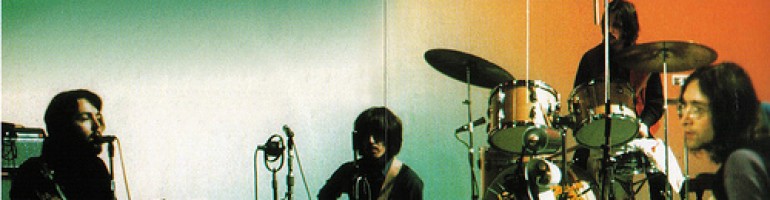
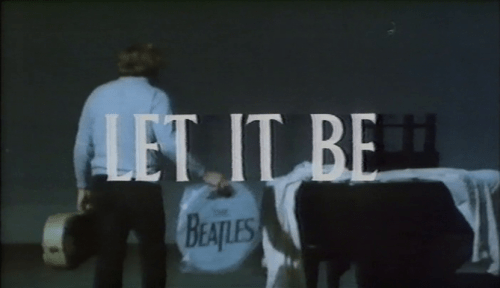
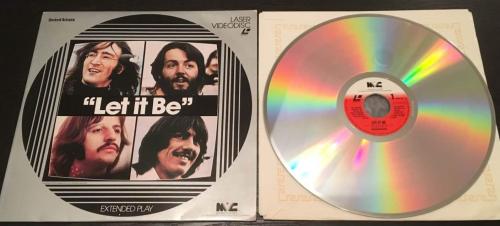
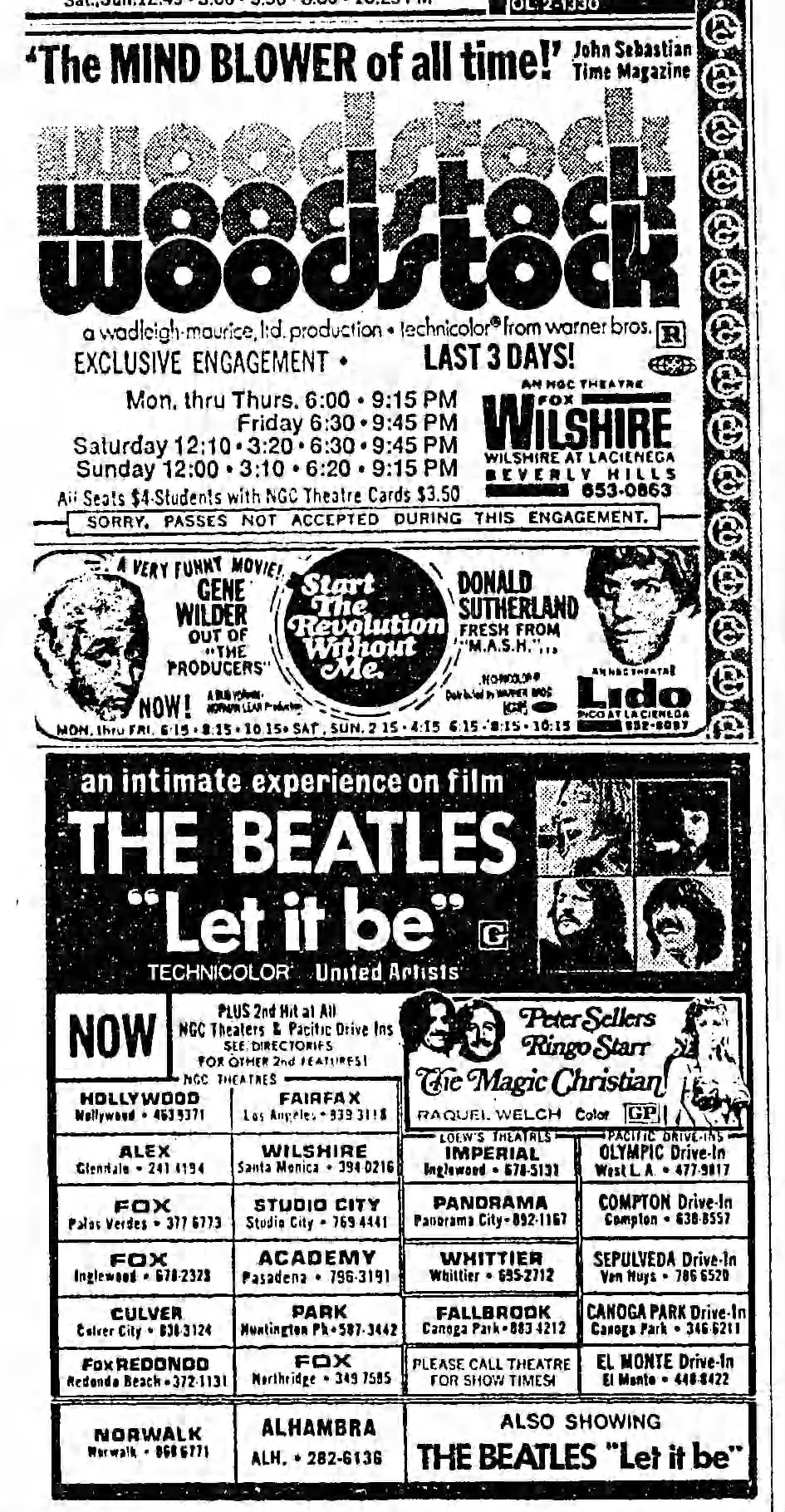
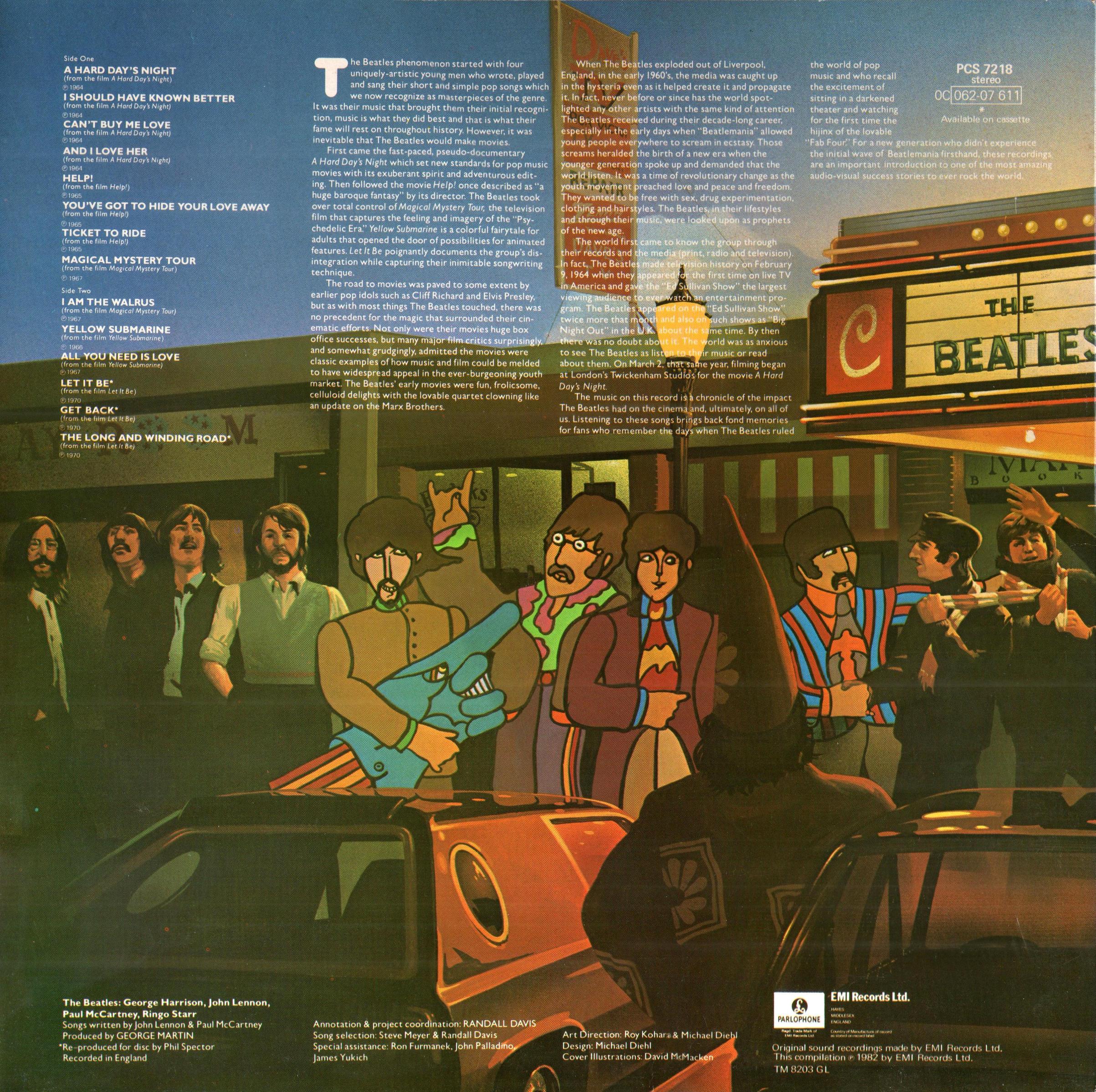
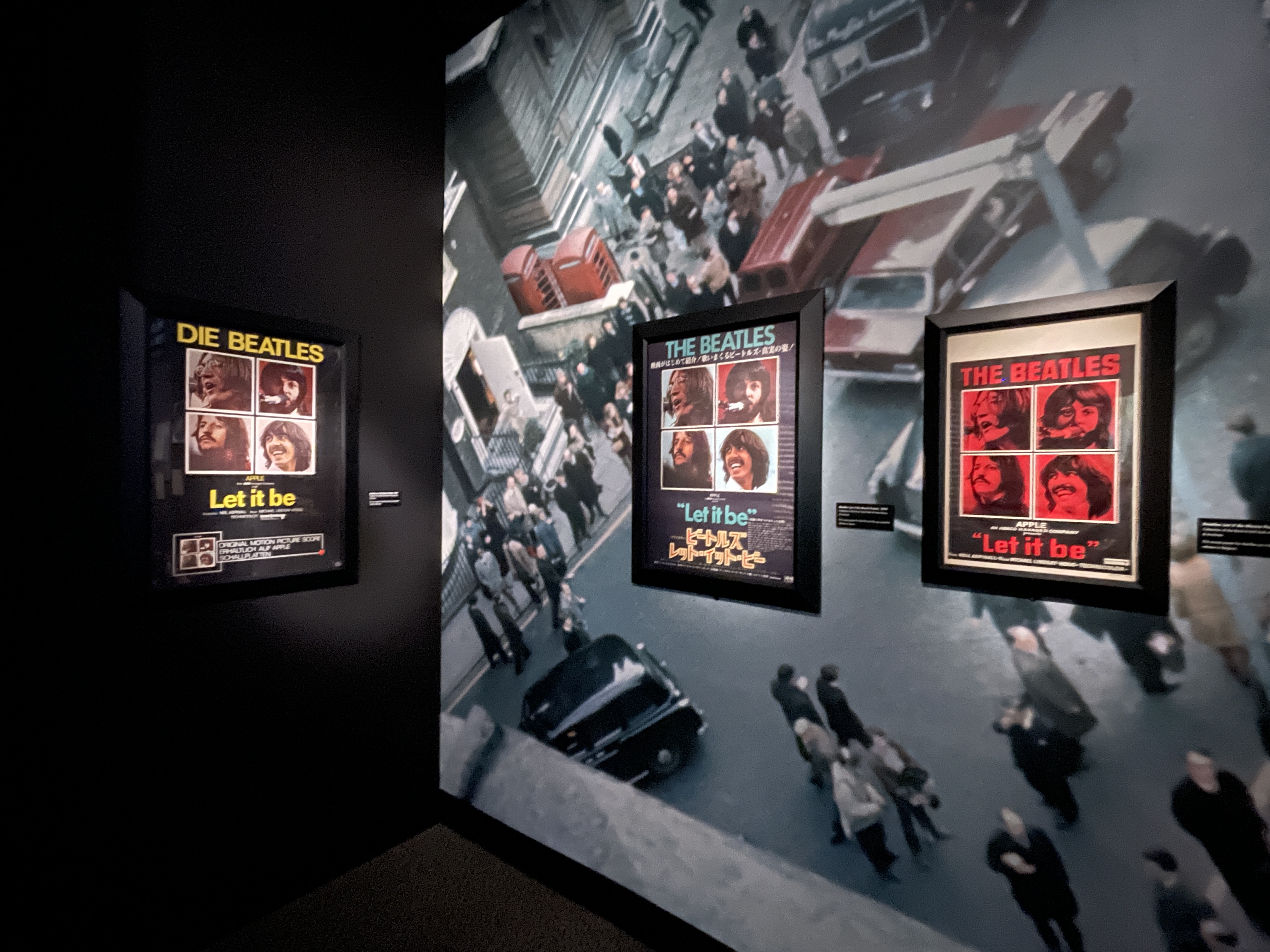
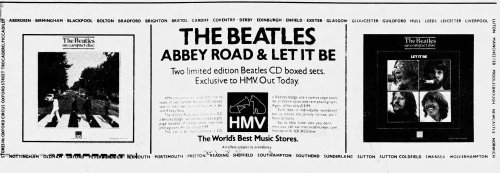

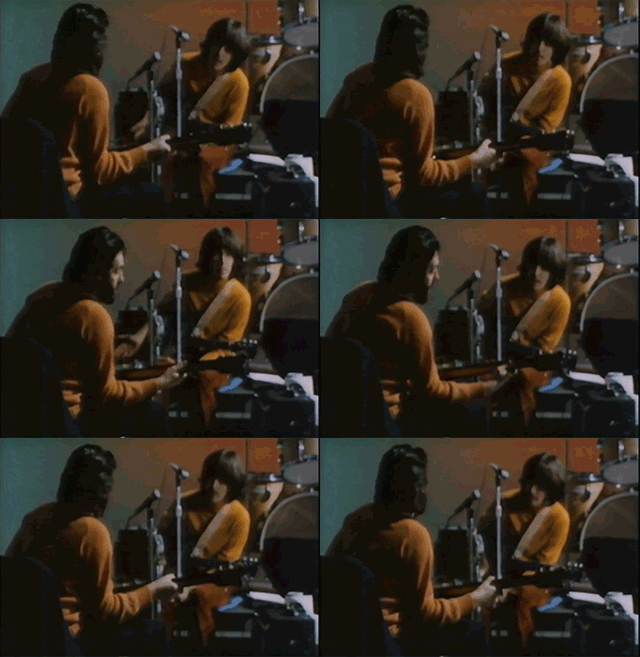
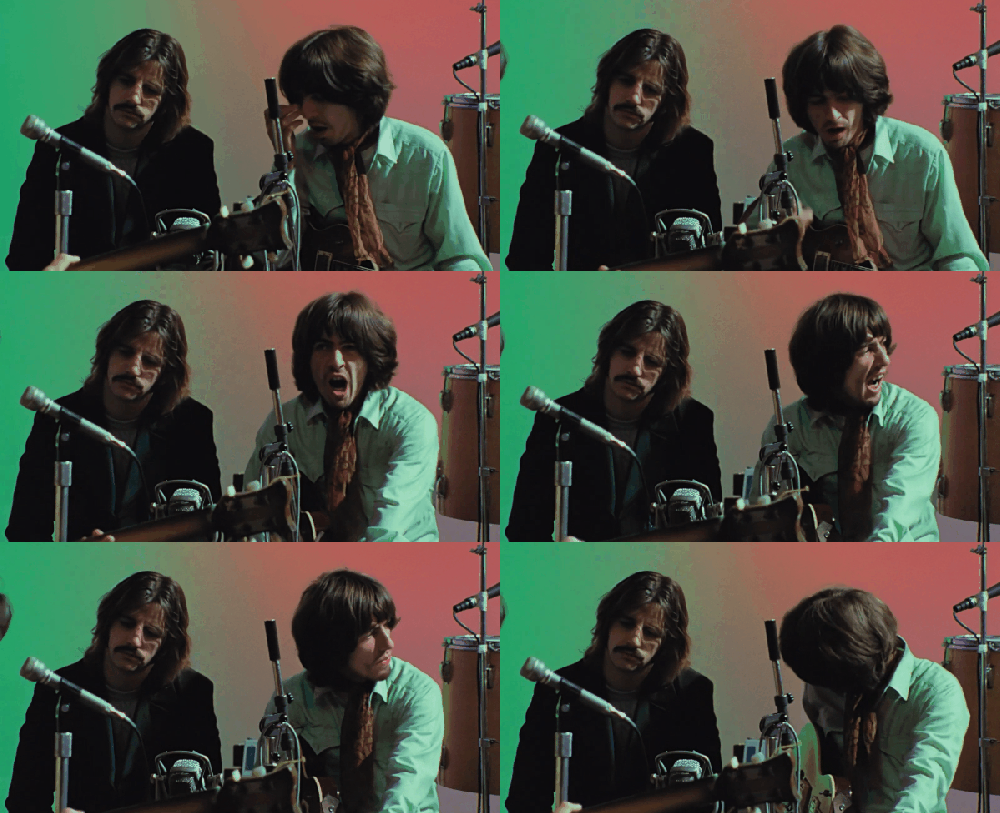
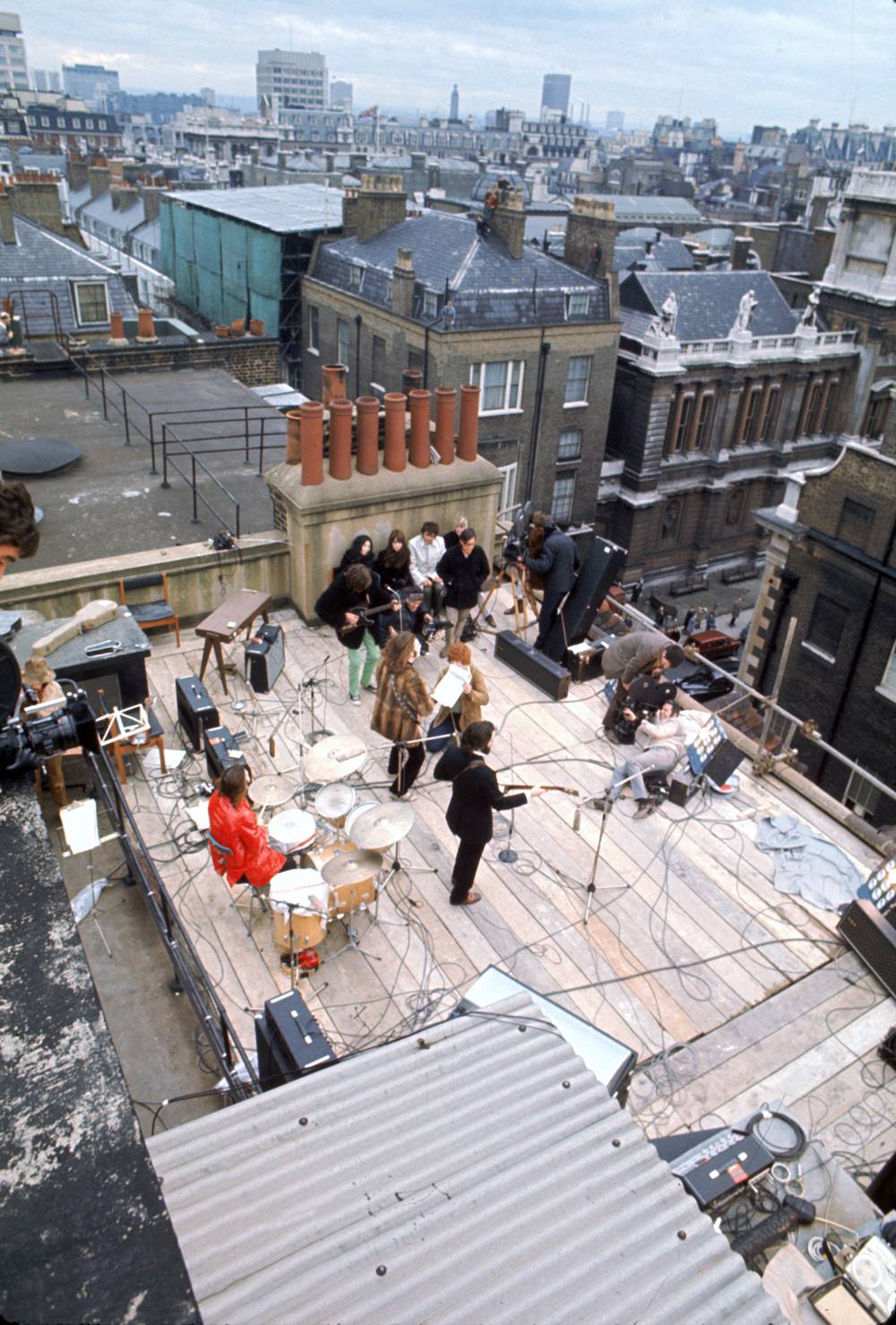
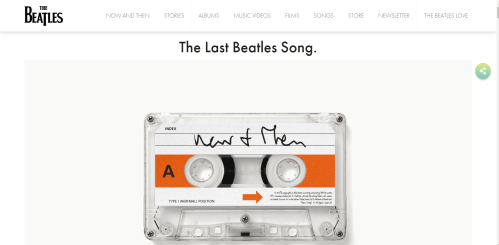
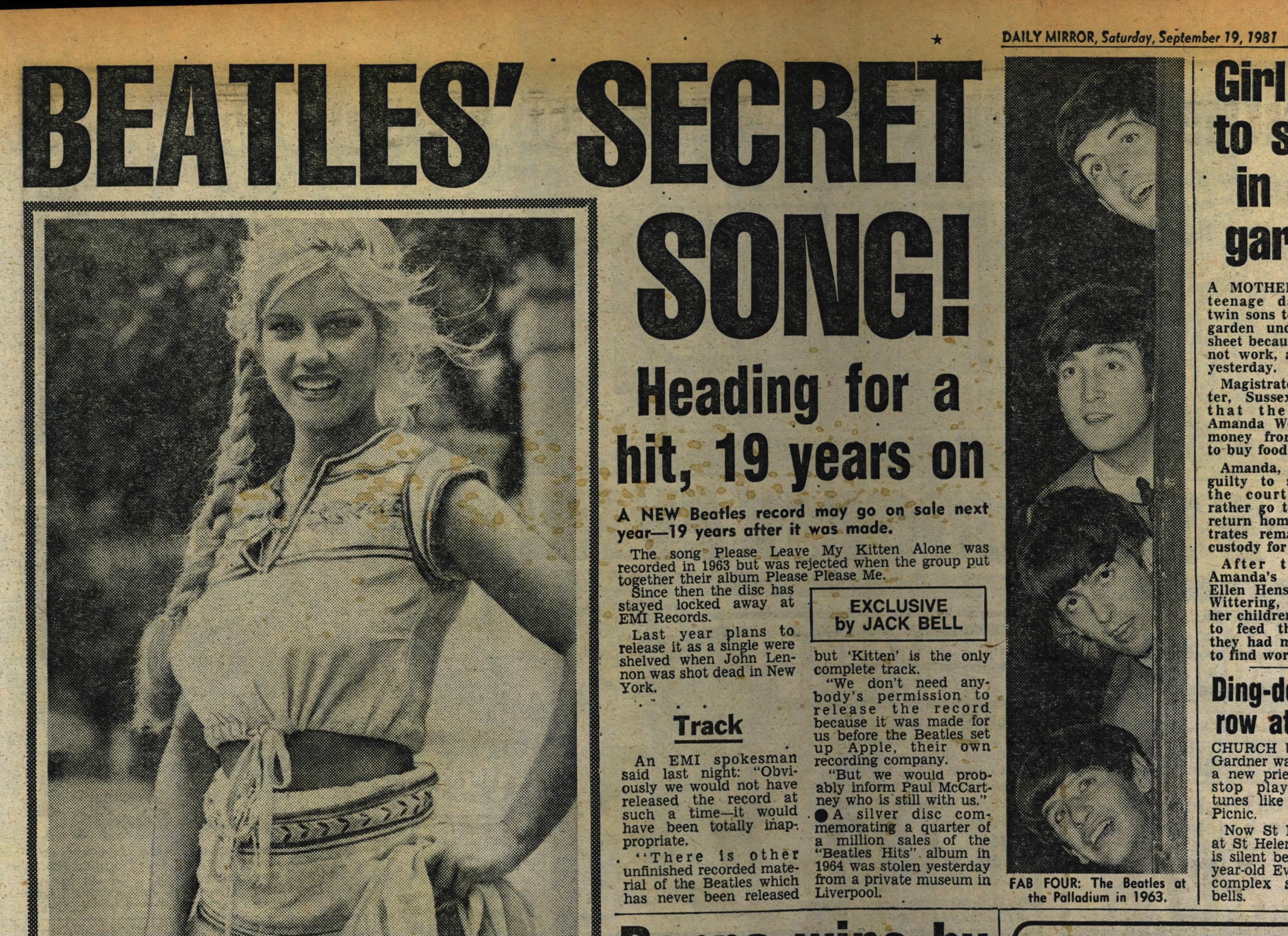
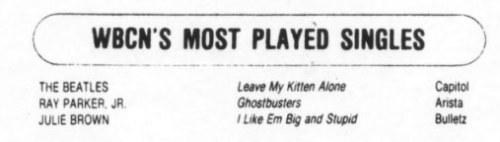
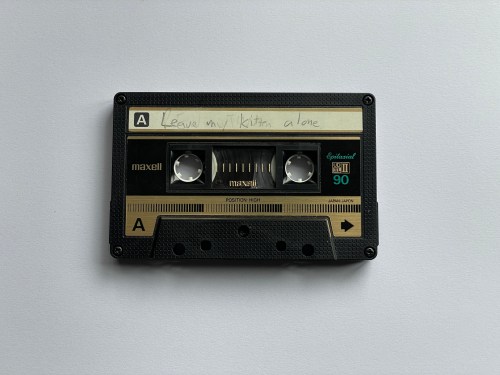
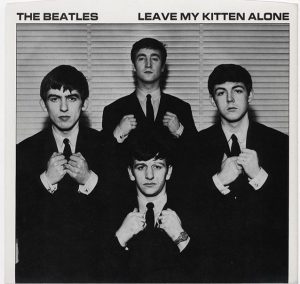
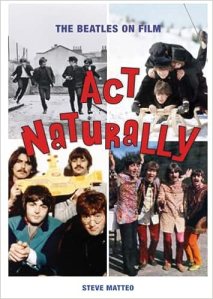
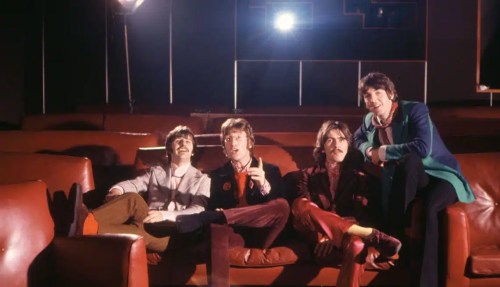
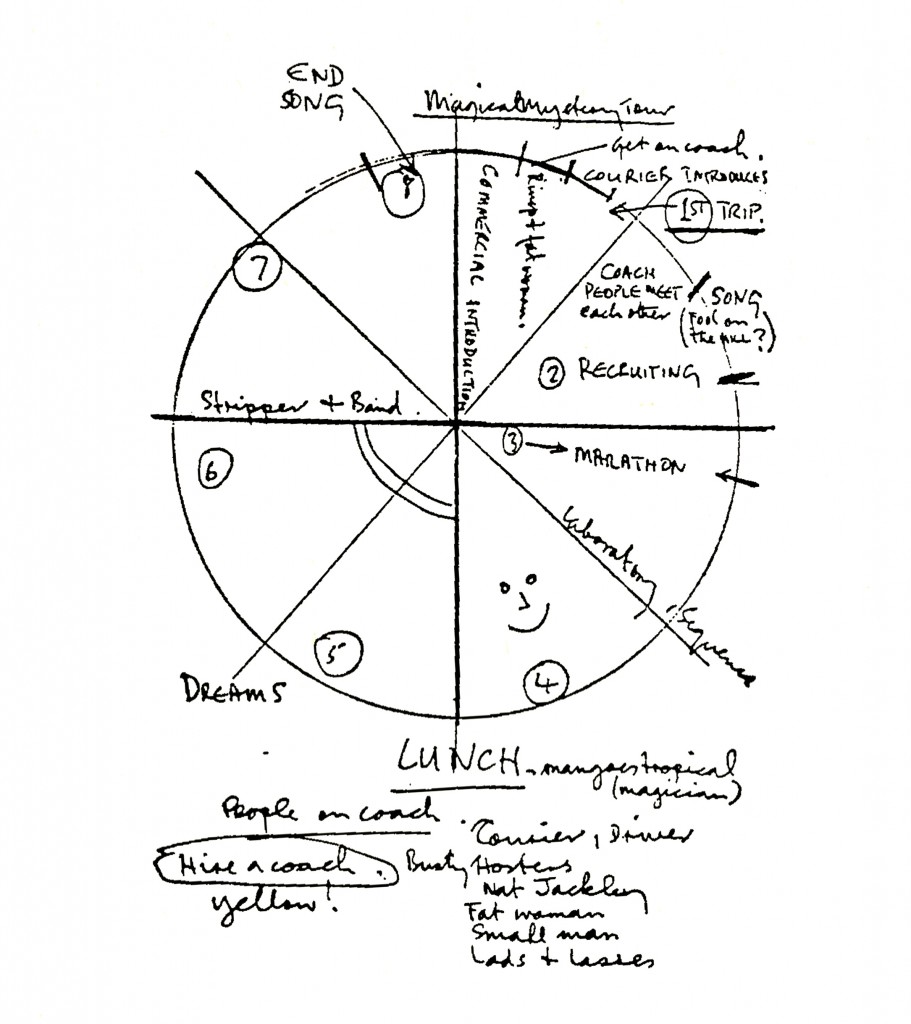
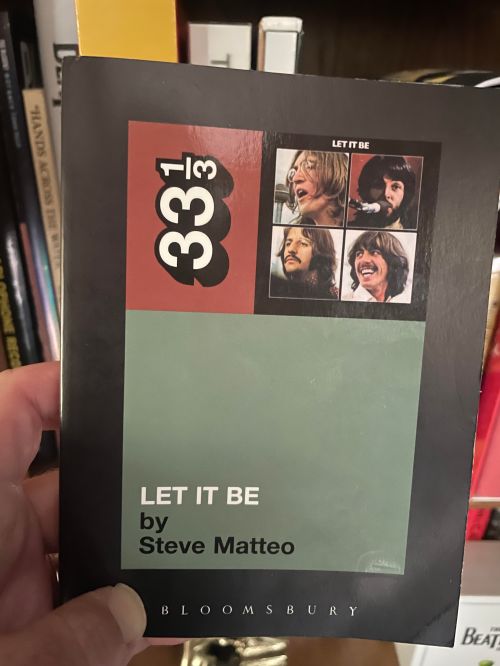
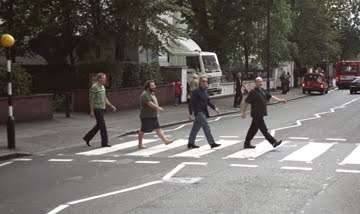
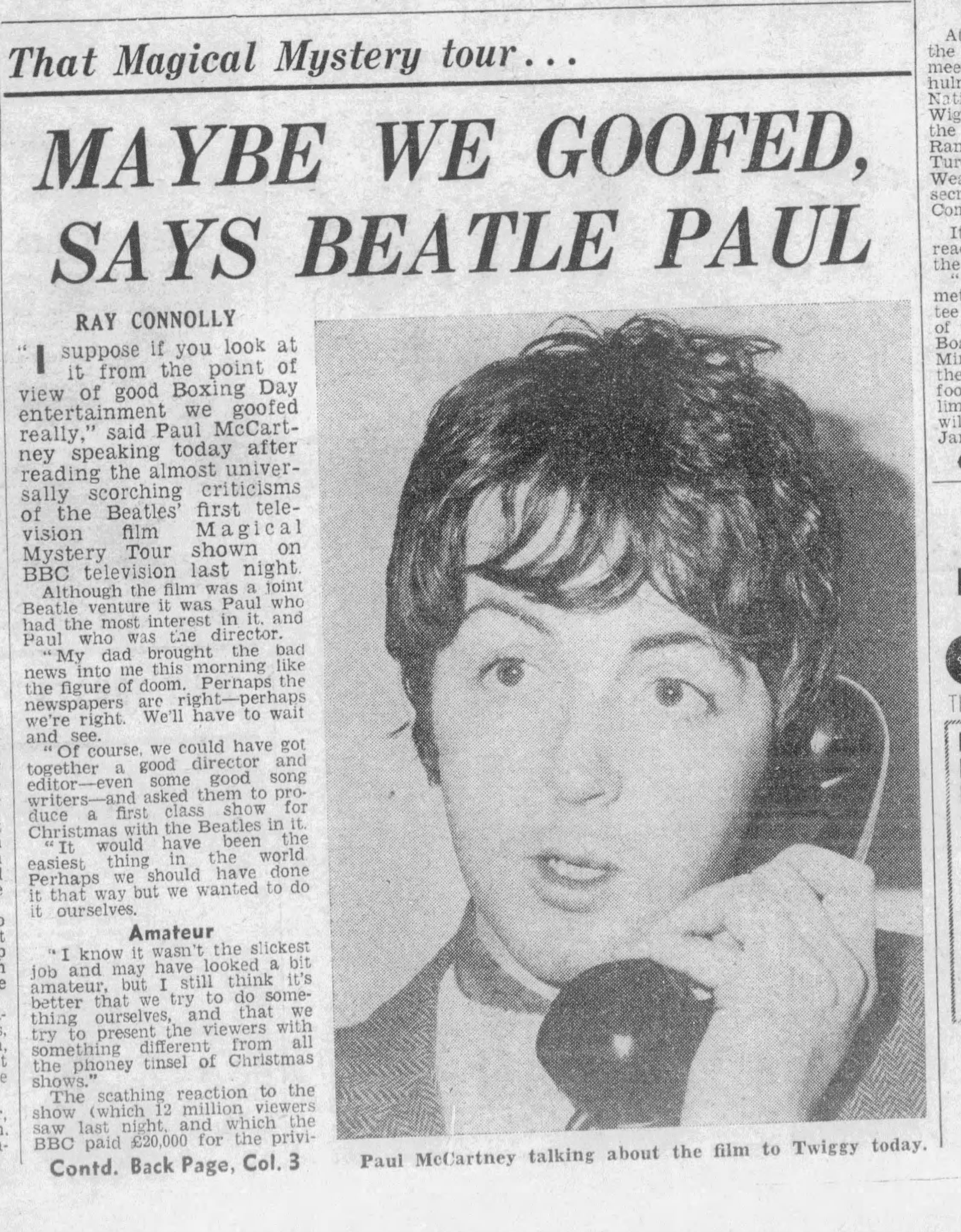


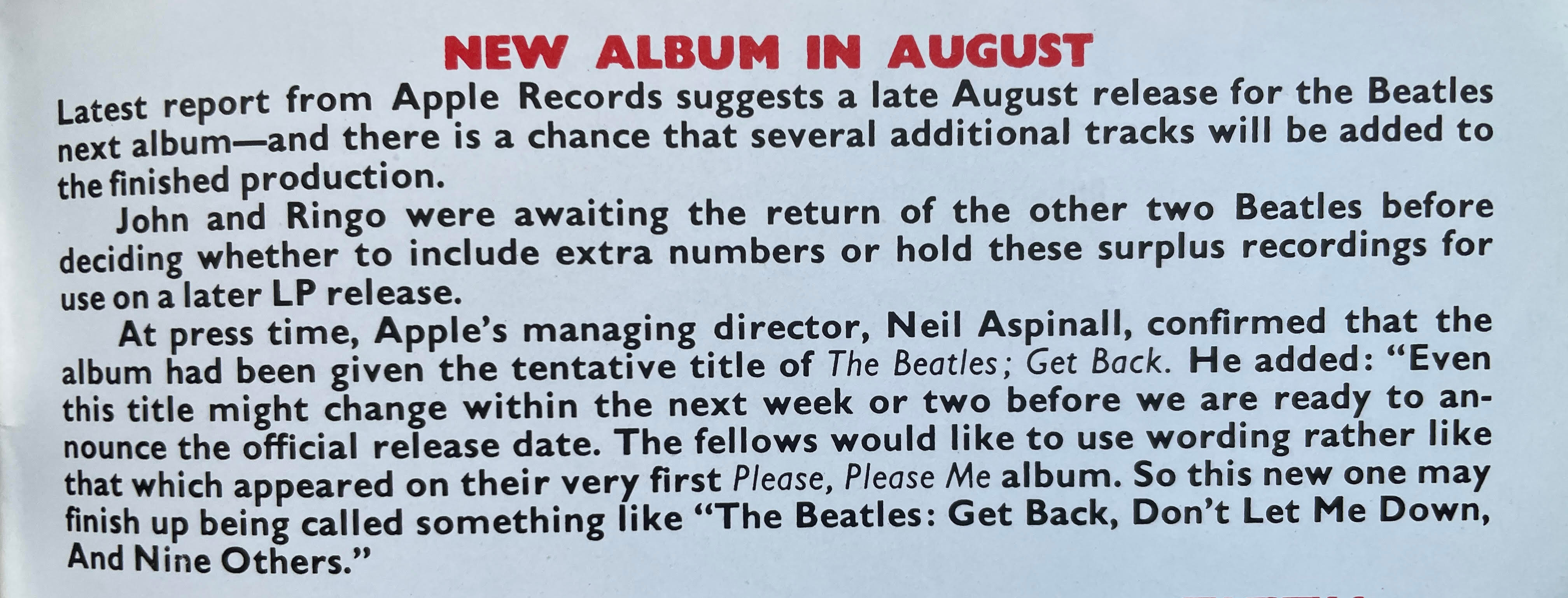


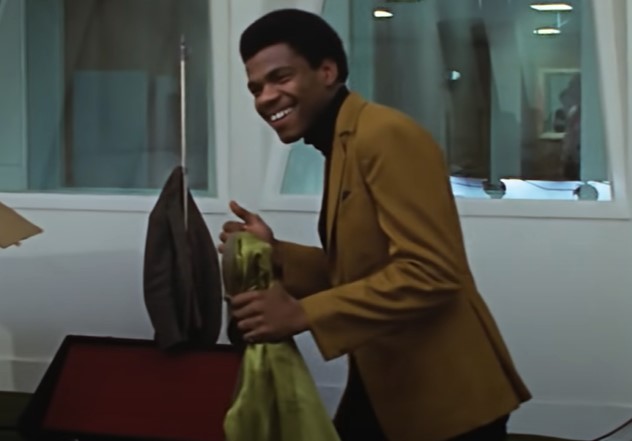
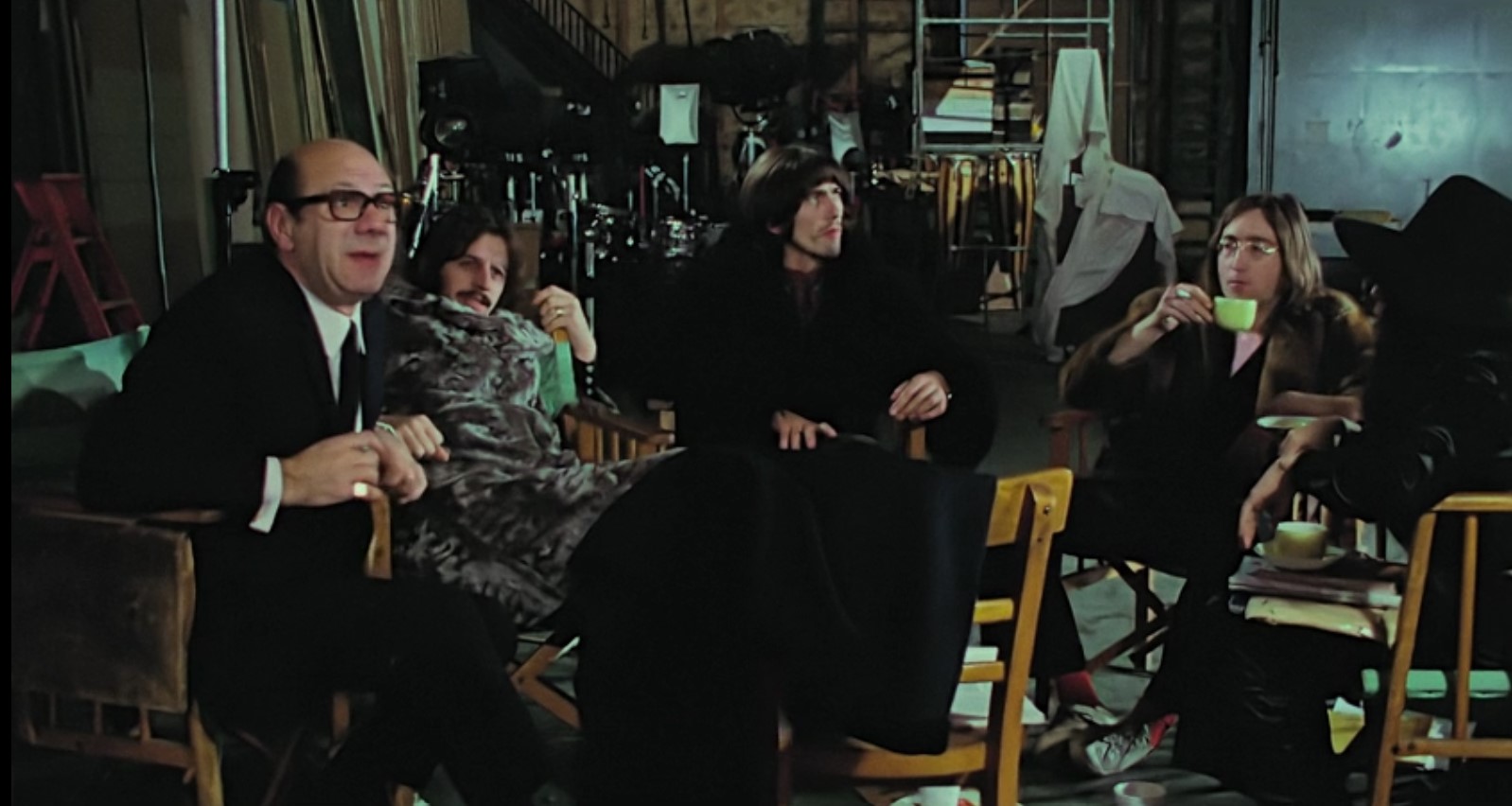
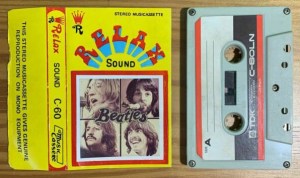
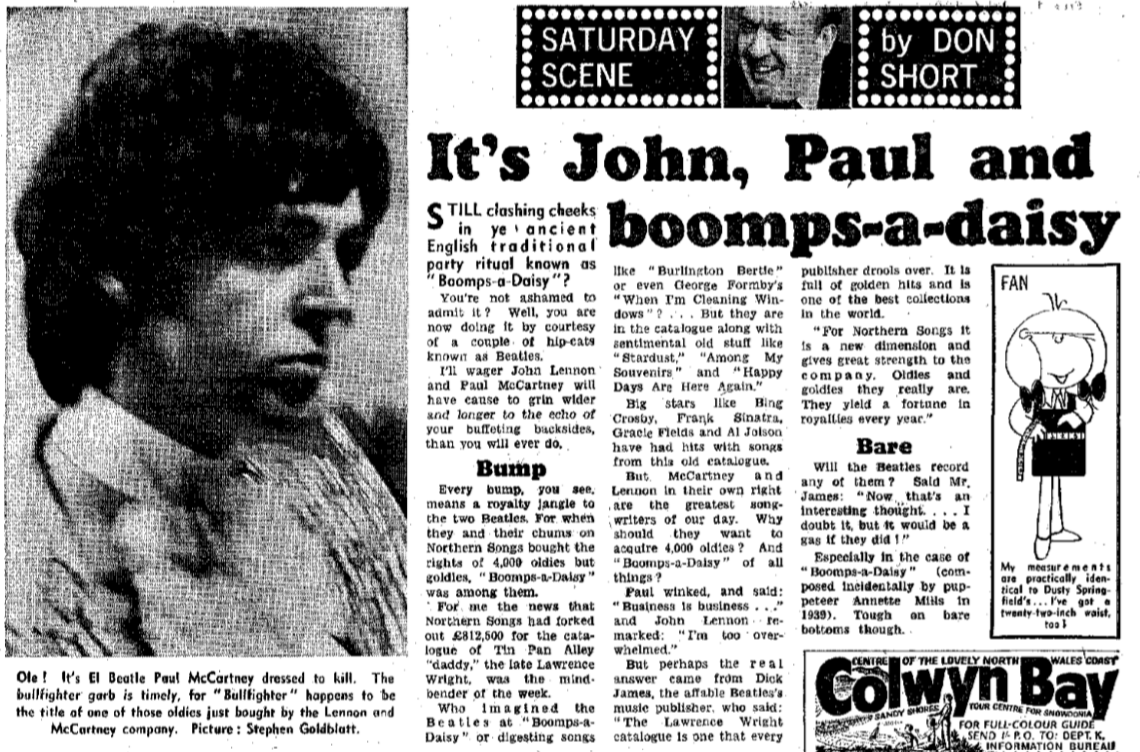
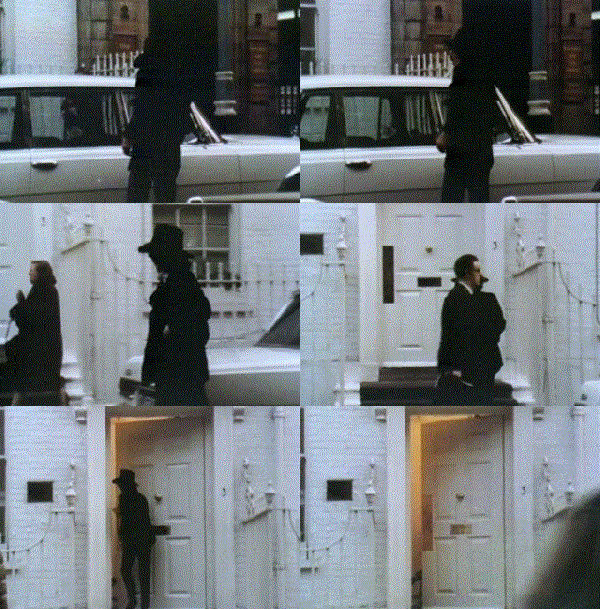
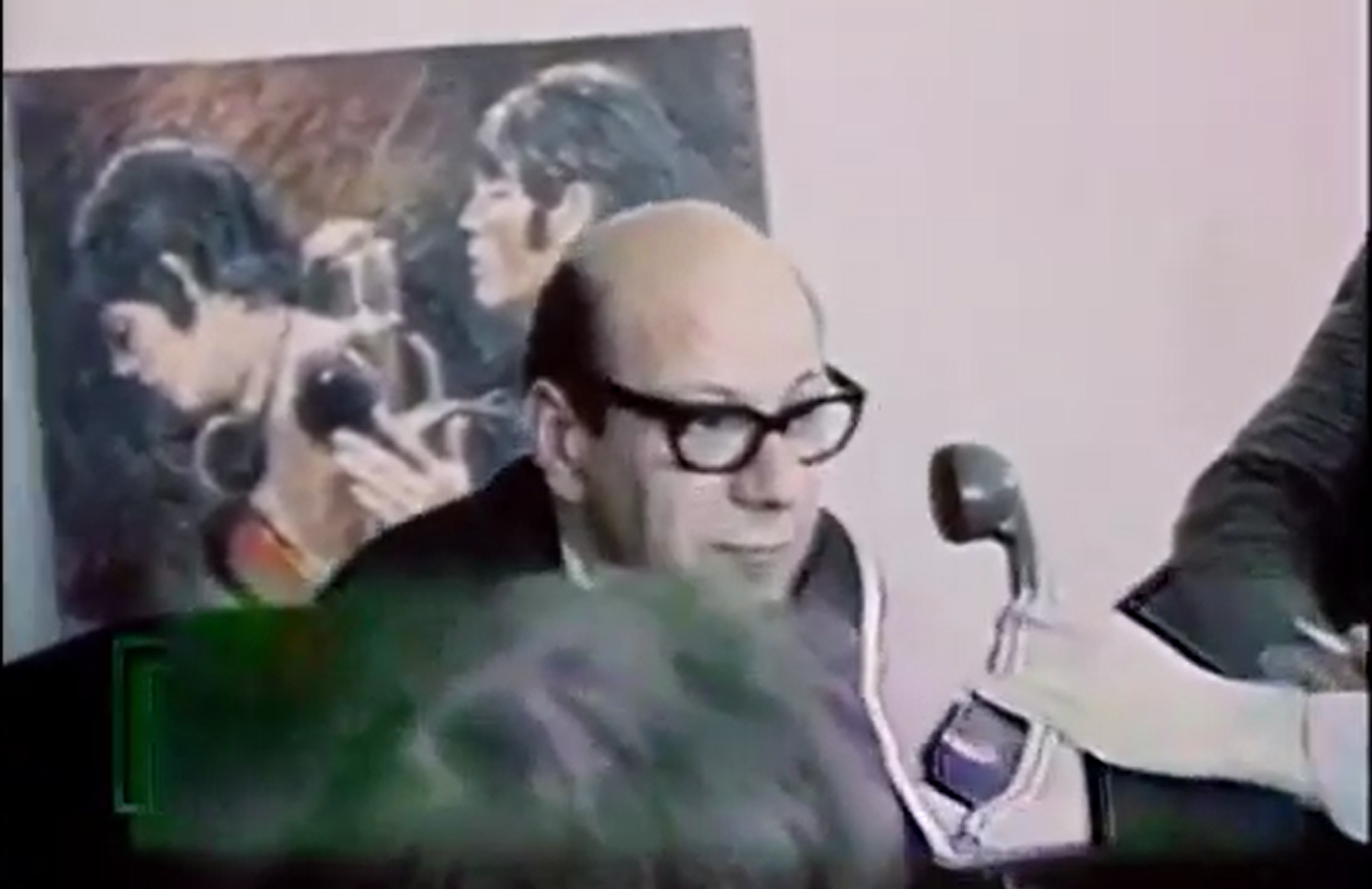
 They May Be Parted